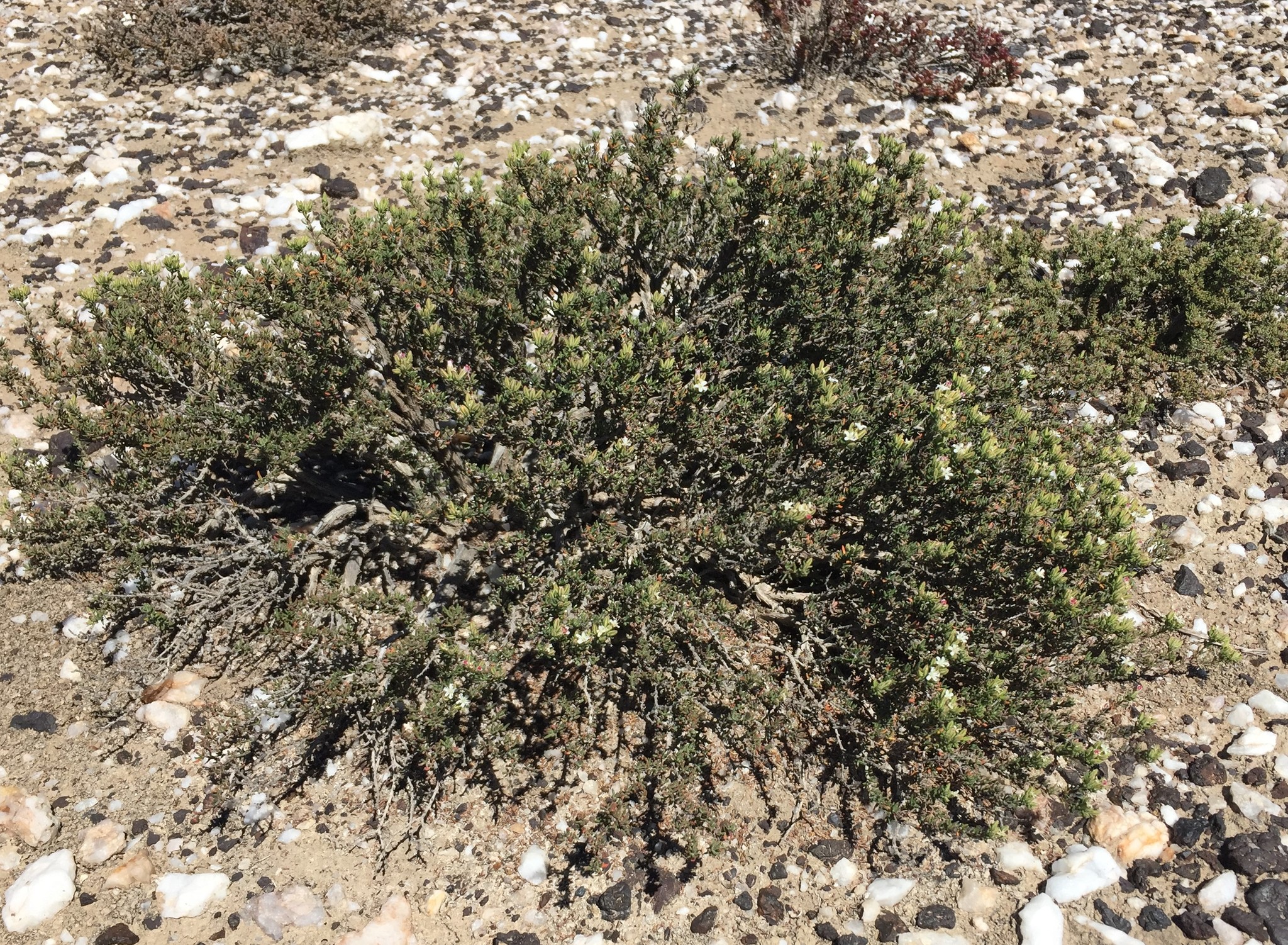
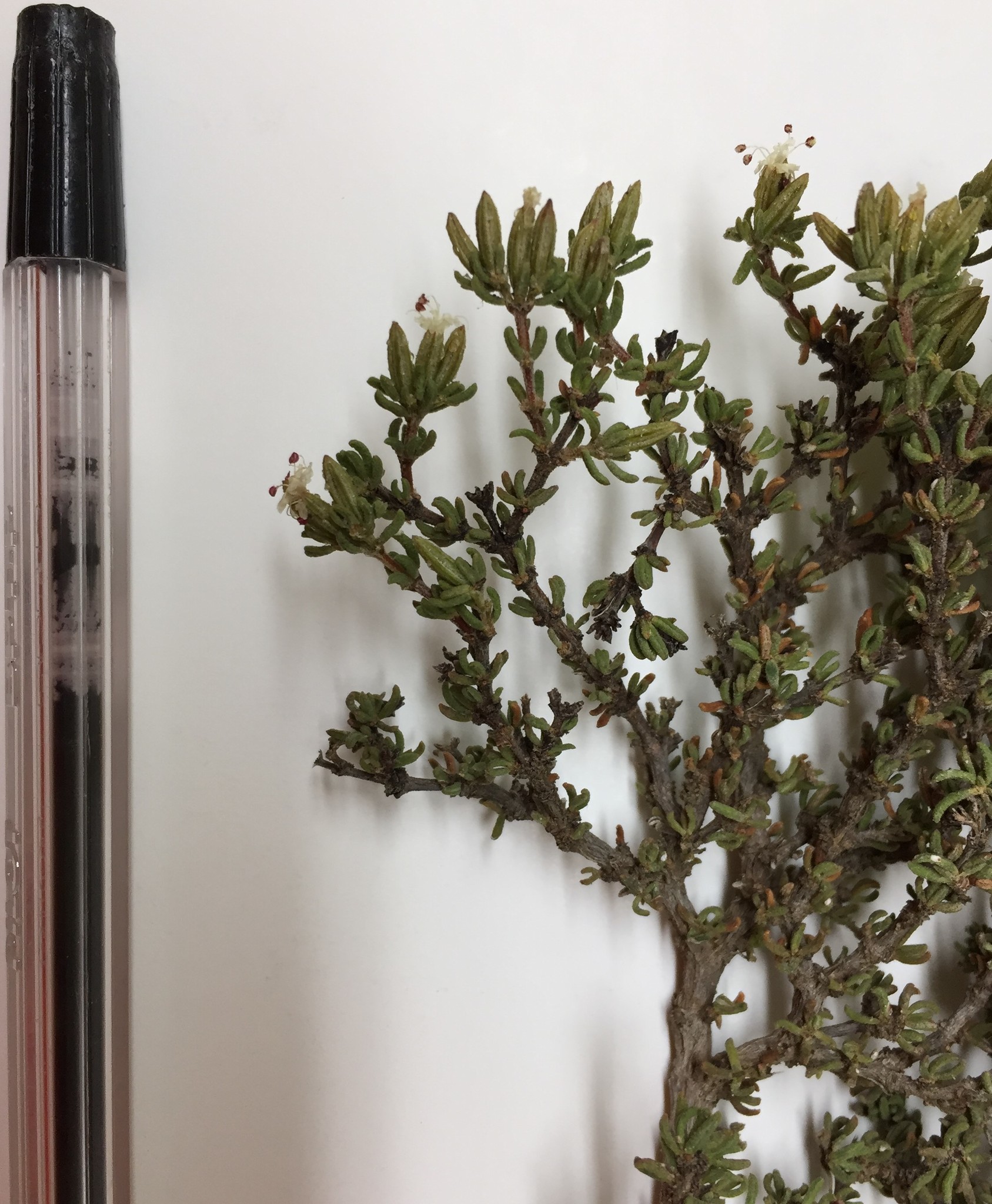
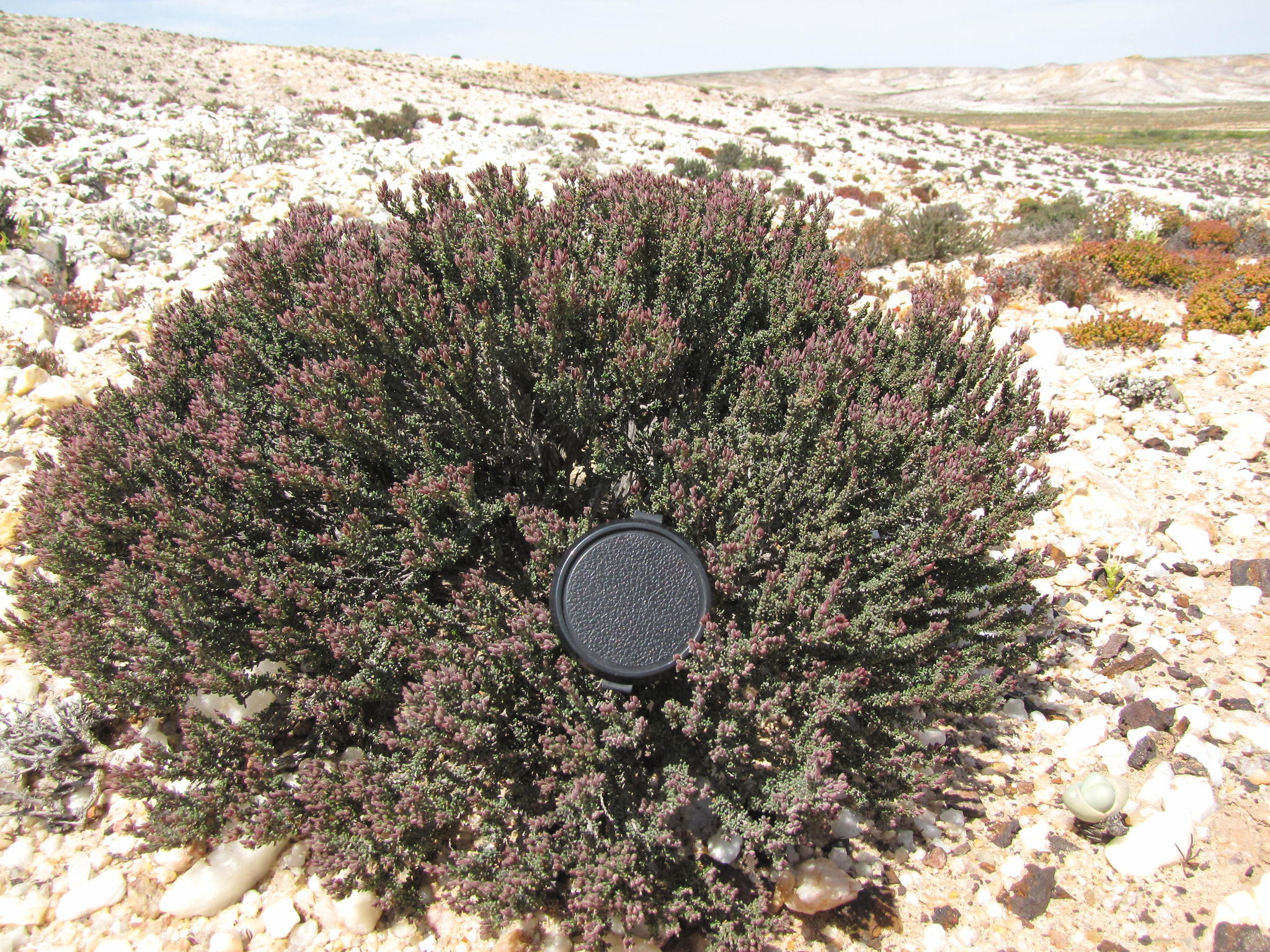
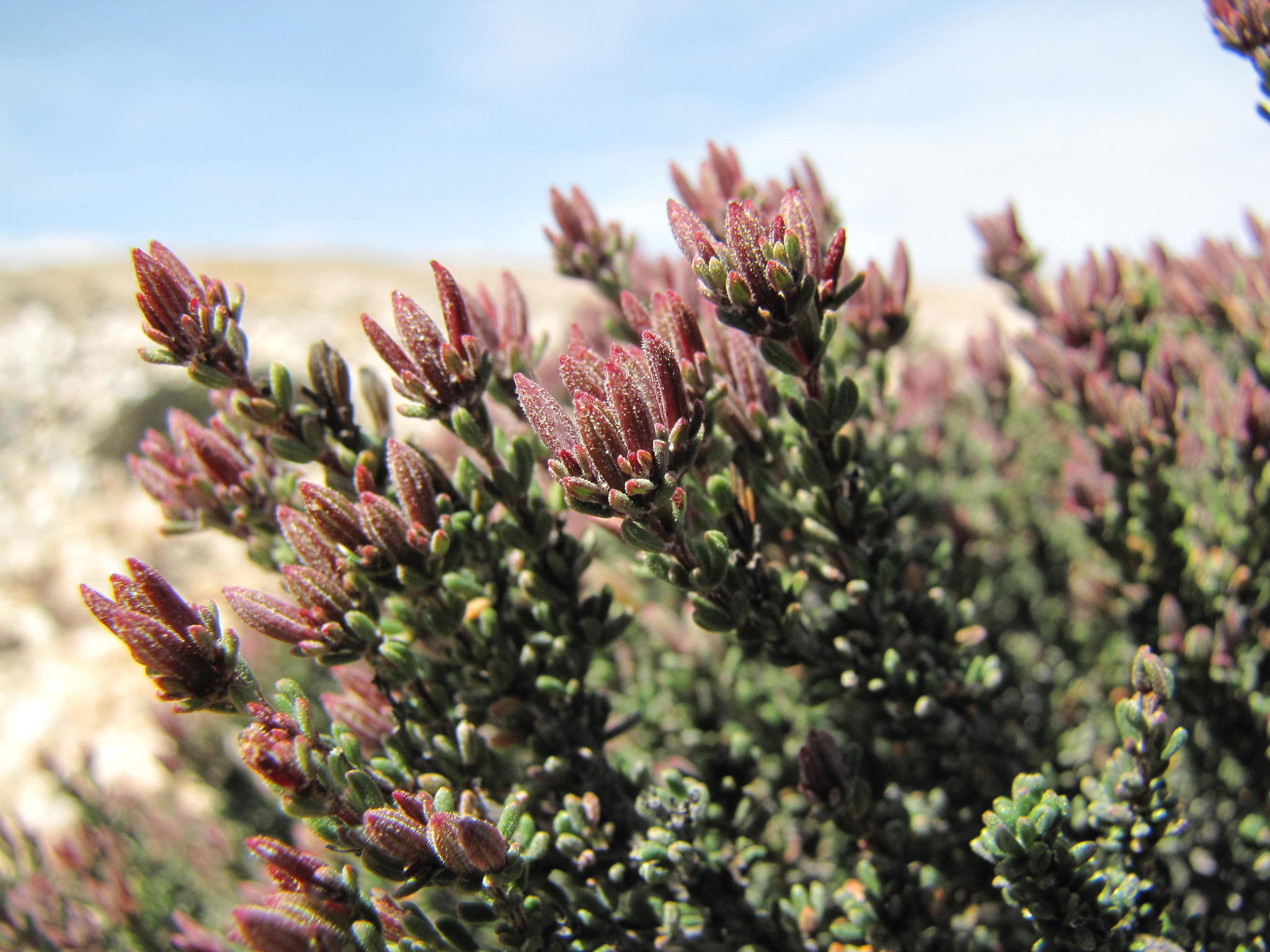
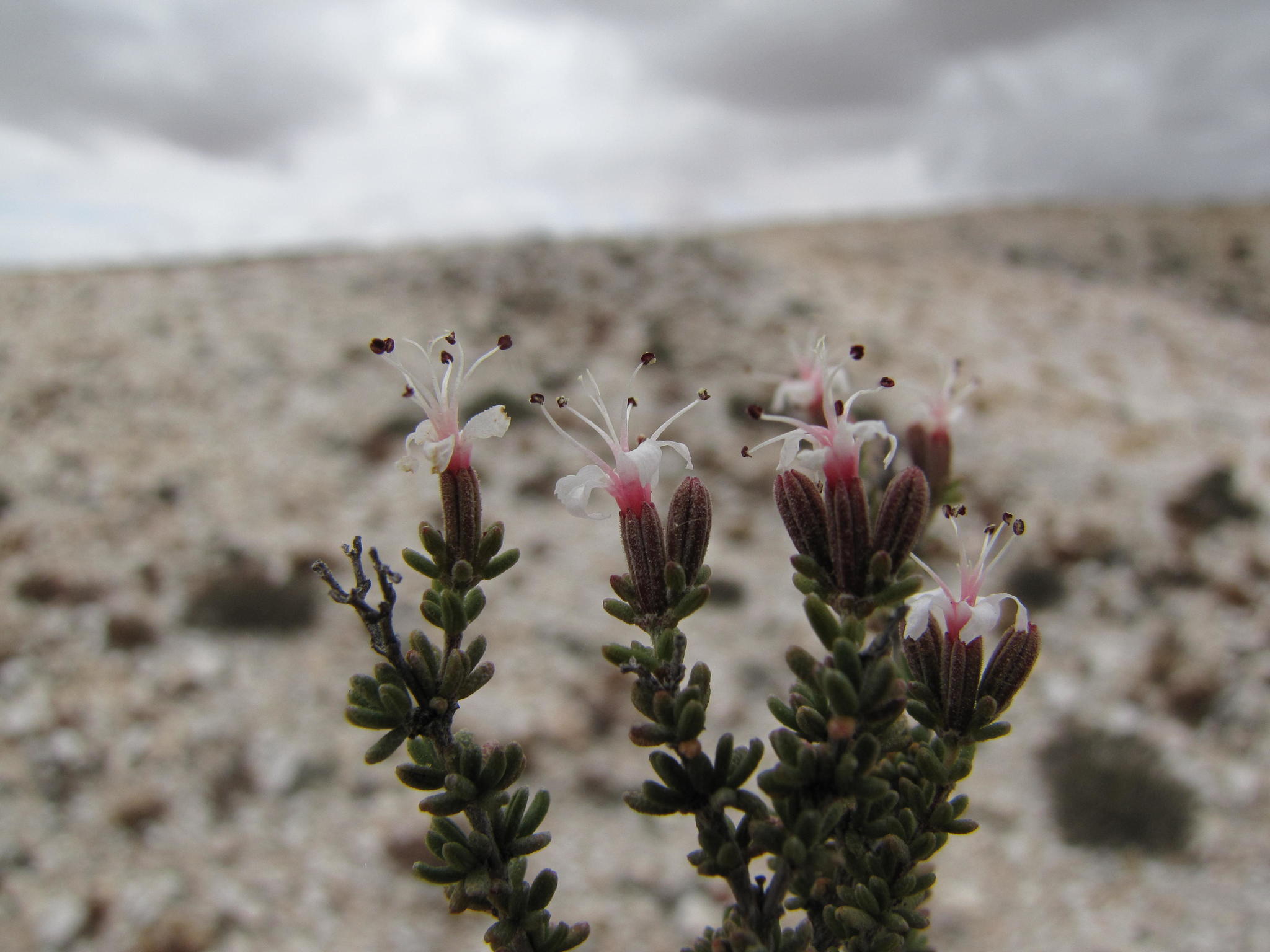
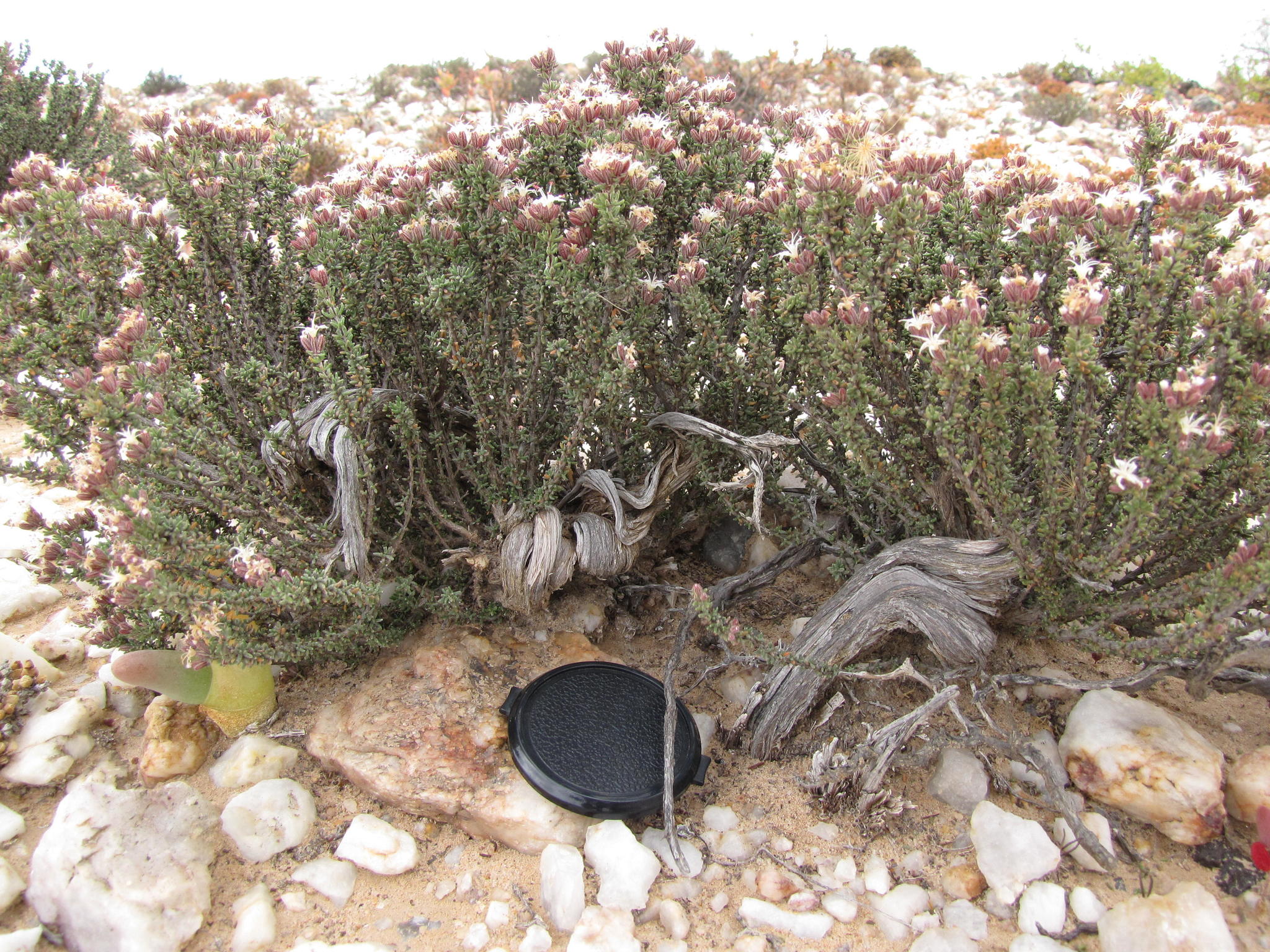
Rounded, multi-stemmed, densely leafy dwarf shrub to 350 mm high, with numerous short, upright branchlets from thick, gnarled or twisted, woody base up to 80 mm diam., ending in flowering dichasia, young branches reddish with dense white, curly pubescence, later glabrescent with grey bark; internodes as long as leaves, 1.5-3.0 mm long. Leaves opposite-decussate, ascending-incurved, subsessile, allantoid-ericoid, 1.5-2.5 x 0.5-1.0 mm, coarsely punctate, densely scabridulous, ventral surface with densely puberulent longitudinal groove, apex with a small warty apiculus, sheath a fringe of coarse hairs; bracts 2 or 4 in a verticel, similar to leaves; bracteoles 1.0-1.5 mm long, with broad, flattened petiole partially adnate to sheath. Flowers 1-few in dichasia congested at branch tips, bisexual, unscented. Calyx tubular, induplicate, 5-ribbed, 4-6 mm long, coarsely puberulous outside with white hairs on ribs and densely puberulous in grooves, glabrous inside. Petals 5, narrowly oblong, ± 8 mm long, white with pink claw, claw ± 4 mm long, ligulate, cohering laterally with margins tucked along ligule, ligule linear and longitudinally adnate to claw with truncate apex merging imperceptibly into blade, blade oblong, ± 4 x 1 mm, erose. Stamens 6, exserted up to 1 mm beyond mouth of calyx at anthesis, later torn loose at base by ripening fruit and then spreading and exserted ± 3 mm, filaments linear-oblanceolate, ± 7 mm long, slightly expanded and angled in lower half and cohering, filiform above, white flushed pink, anthers subglobose, bipartite, versatile, ± 1 mm long, wine-red, pollen yellow. Ovary ellipsoid, 5-angled or -ribbed by pressure from stamens and petals, ± 1.5 mm long, 6-ovulate with two ovules near base of each of three parietal placentas, funicles erect, shorter than ovules; style terete, up to 3 mm long at anthesis but later elongating to 5 mm, usually sharply kinked at base, 3-branched, branches ± 1 mm long, included at anthesis but later exserted 3-4 mm but never beyond stamens, pink to wine-red, stigmas clavate. Immature capsule ovoid, ± 2 mm long. Immature seeds ellipsoid-fusiform, angled by pressure, ± 1 mm long, smooth; developing rapidly even before flower has withered. Flowering time: November, possibly late October in dry years. From: Manning, JC; Helme, NA. 2014. Frankenia fruticosa (Frankeniaceae), a new dwarf shrub from the Knersvlakte, Western Cape. S. African J. Bot. 91: 84-87. [http://dx.doi.org/10.1016/j.sajb.2014.01.001] [Copyright held by the South African Association of Botanists (2014); http://www.sciencedirect.com/science/journal/02546299] [CC BY]
The species is locally common on the upper parts of south facing, quartz covered slopes, a habitat that receives significant extra moisture in the form of fog condensation (N. Helme, pers. obs.). From: Manning, JC; Helme, NA. 2014. Frankenia fruticosa (Frankeniaceae), a new dwarf shrub from the Knersvlakte, Western Cape. S. African J. Bot. 91: 84-87. [http://dx.doi.org/10.1016/j.sajb.2014.01.001] [Copyright held by the South African Association of Botanists (2014); http://www.sciencedirect.com/science/journal/02546299] [CC BY]
A local endemic of the Knersvlakte in southern Namaqualand, Western Cape. From: Manning, JC; Helme, NA. 2014. Frankenia fruticosa (Frankeniaceae), a new dwarf shrub from the Knersvlakte, Western Cape. S. African J. Bot. 91: 84-87. [http://dx.doi.org/10.1016/j.sajb.2014.01.001] [Copyright held by the South African Association of Botanists (2014); http://www.sciencedirect.com/science/journal/02546299] [CC BY]
November
This map contains point-based occurrences at different locations
Occurrence in the Flora of Southern Africa (FSA) countries and South African provinces. Residence status indicates if a taxon is indigenous, endemic, naturalised or invasive in a specific region. This data is based on specimen records and literature
FSA
SA
BOT
NAM
ESW
LES
WC
EC
NC
FS
GA
KZN
LP
MP
NW
Absent
Indigenous
Endemic
Naturalised
Invasive
Names and Sources
Published in: S. African J. Bot. 91: 85 (2014)
Type: South Africa, Western Cape, Vanrhynsdorp: NE of Lutzville, Moedverloren 208, 20 Nov. 2013, N.A. Helme 7796 (NBG, holo.; K, PRE, MO, iso.)
Classification
KINGDOM Plantae
SUBKINGDOM Phanerogamae
PHYLUM Anthophyta
ORDER Caryophyllales
FAMILY Frankeniaceae
GENUS Frankenia
SPECIES fruticosa
6 results for Frankenia fruticosa J.C.Manning & Helme
Barcode: NBG1457612-0 Collector(s) & number: Helme, NA, 7796 | 2013-11-20
South Africa, Western Cape, Vredendal. 11 km NE of Lutzville, Moedverloren 208, 3 km NW of old marble mine.
Data Resource: BODATSA View record
Barcode: NBG1457613-0 Collector(s) & number: Helme, NA, 7796 | 2013-11-20
South Africa, Western Cape, Vredendal. 11 km NE of Lutzville, Moedverloren 208, 3 km NW of old marble mine.
Data Resource: BODATSA View record
Barcode: NBG1468061-0 Collector(s) & number: Helme, NA, 8324 | 2013-10-11
South Africa, Western Cape, Knersvlakte; north central of Moedverloren 208.
Data Resource: BODATSA View record
This map contains point-based occurrences at different locations
2014
PERIODICAL/JOURNAL
Frankenia fruticosa (Frankeniaceae), a new dwarf shrub from the Knersvlakte, Western Cape Manning, JC; Helme, NASouth African Journal of Botany 91: 84-87
No results found for Frankenia fruticosa J.C.Manning & Helme
| Part(s) of plant used | Use(s) | Reference |
|---|
Coming soon...