
PLANTAE / PHANEROGAMAE / ANTHOPHYTA / ASTERALES / ASTERACEAE / ASTEROIDEAE / ASTEREAE / MAIRIA / PURPURATA

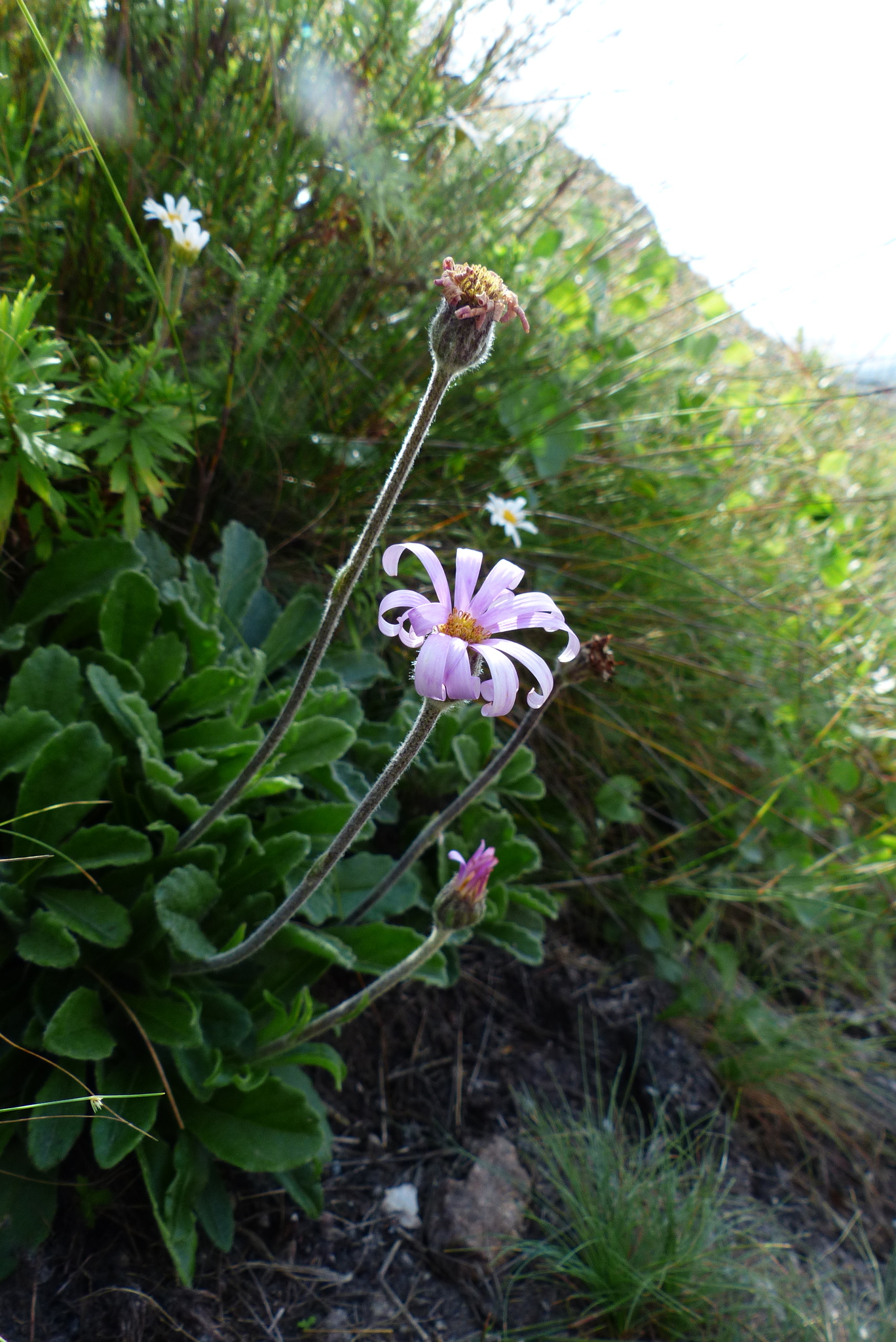
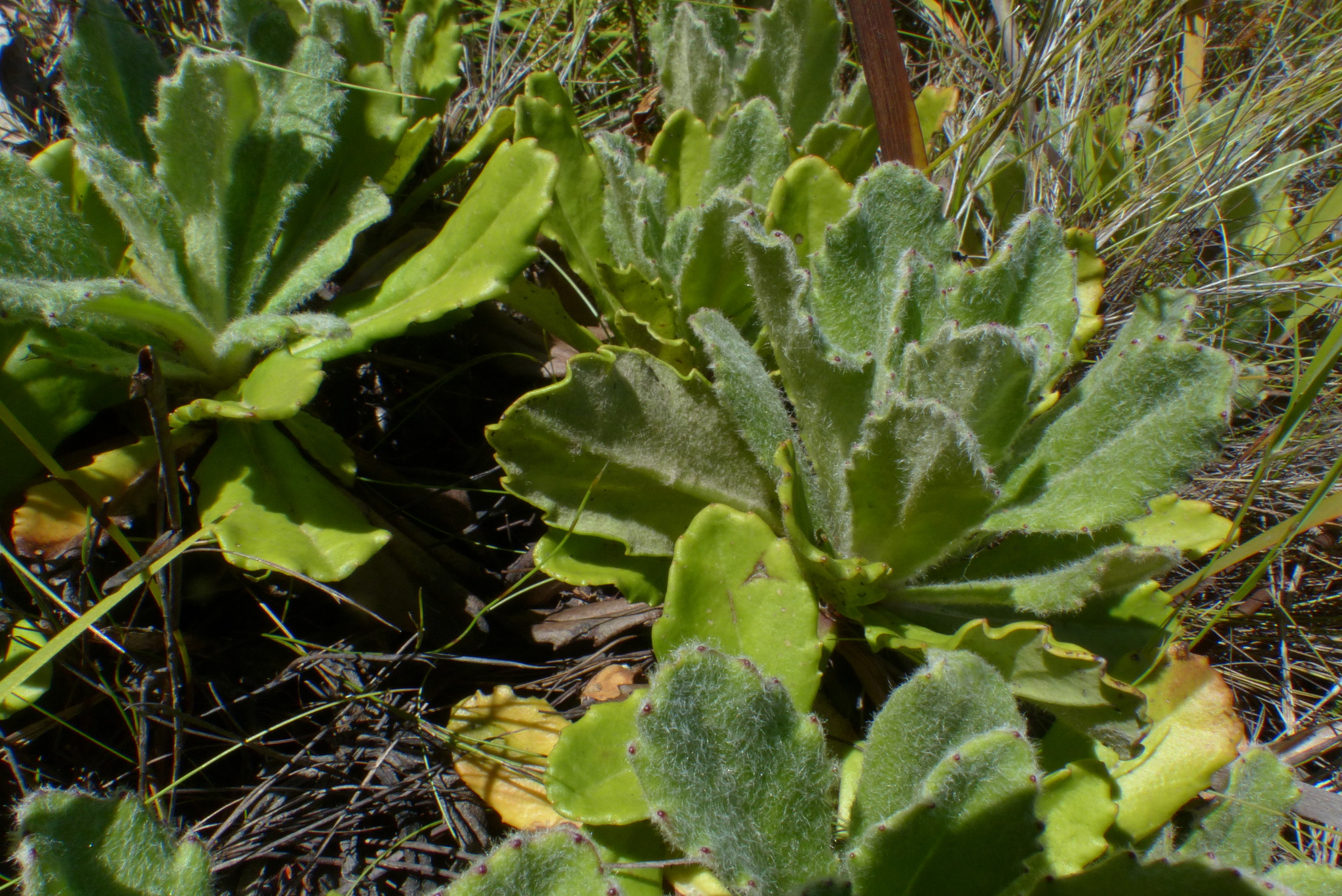
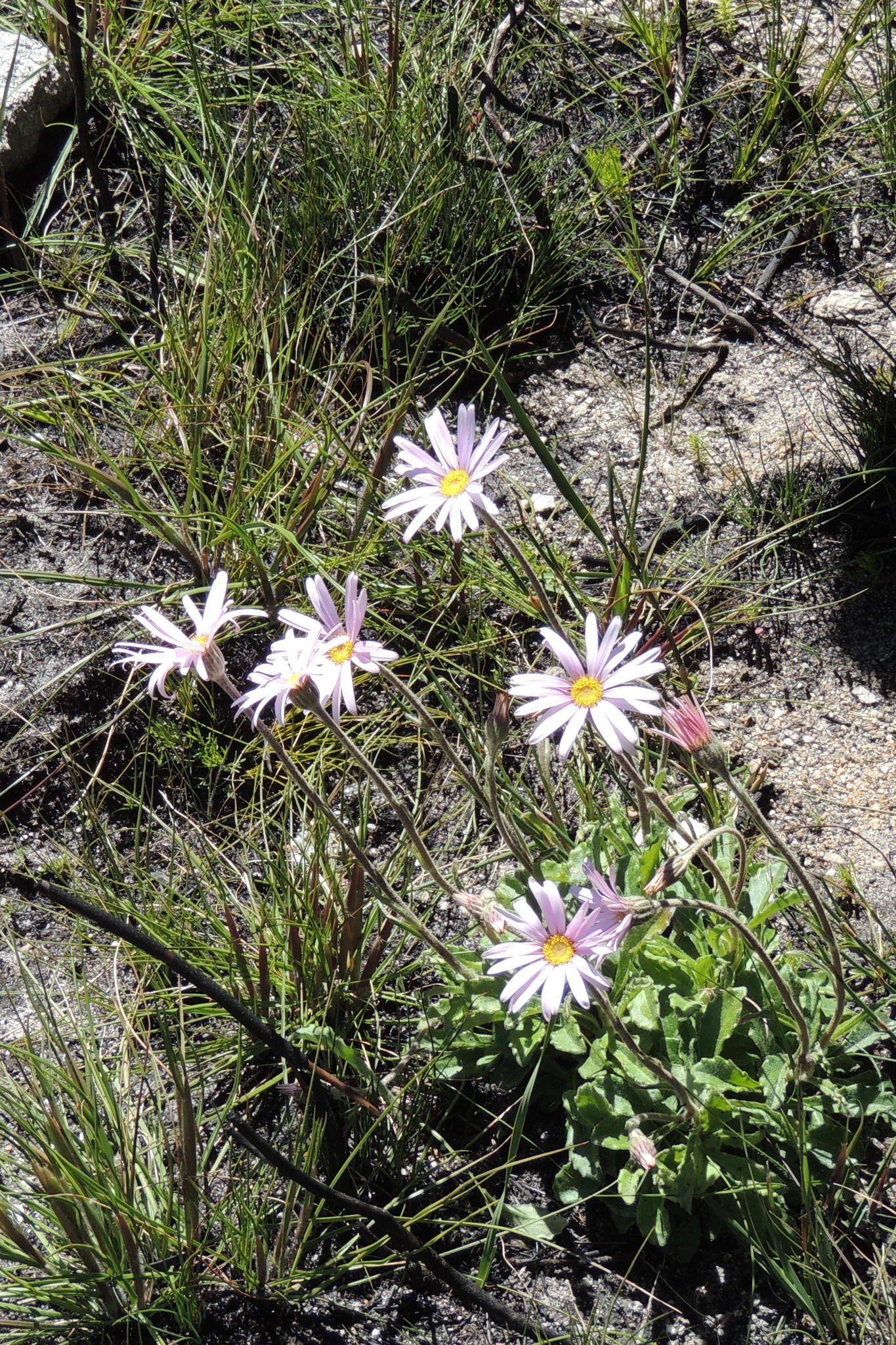
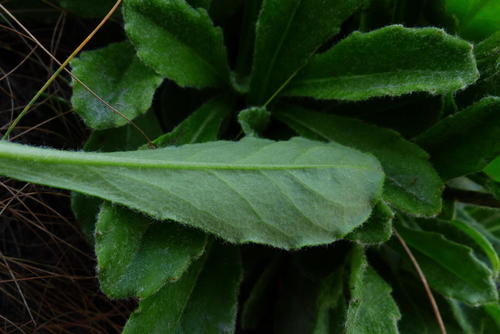
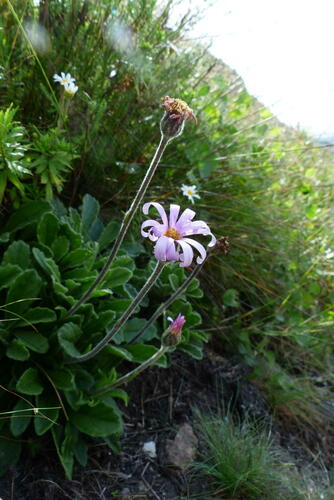
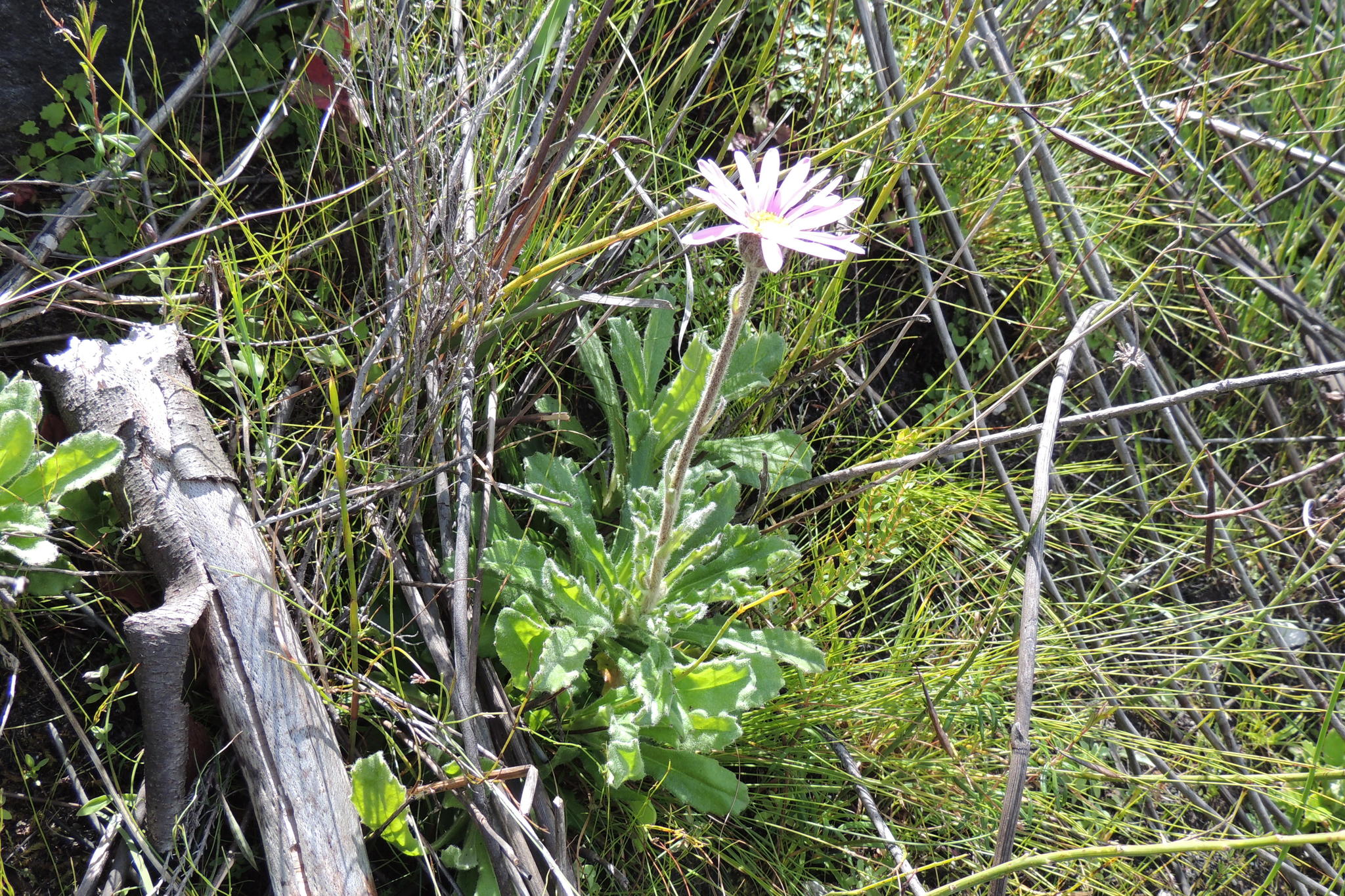
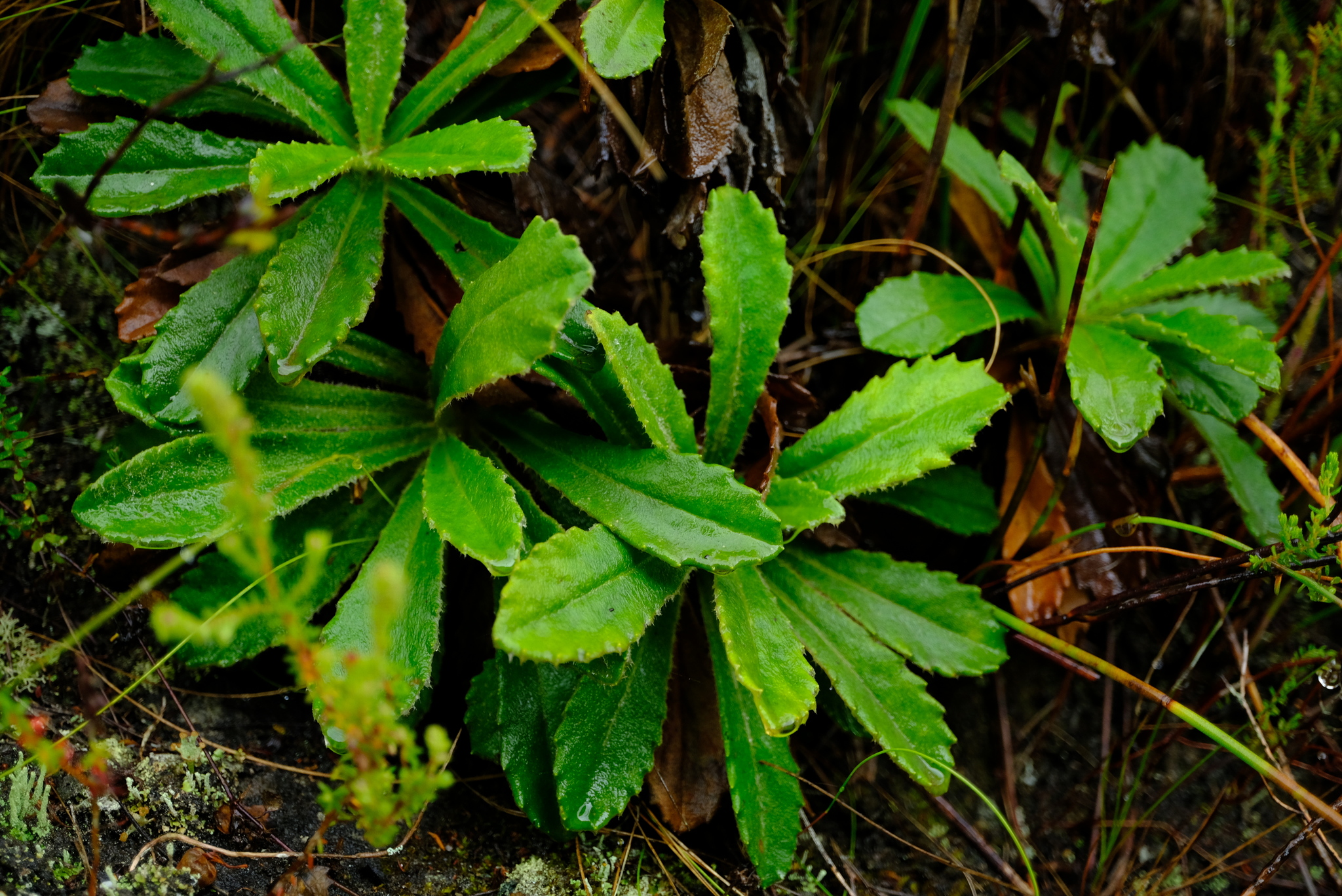
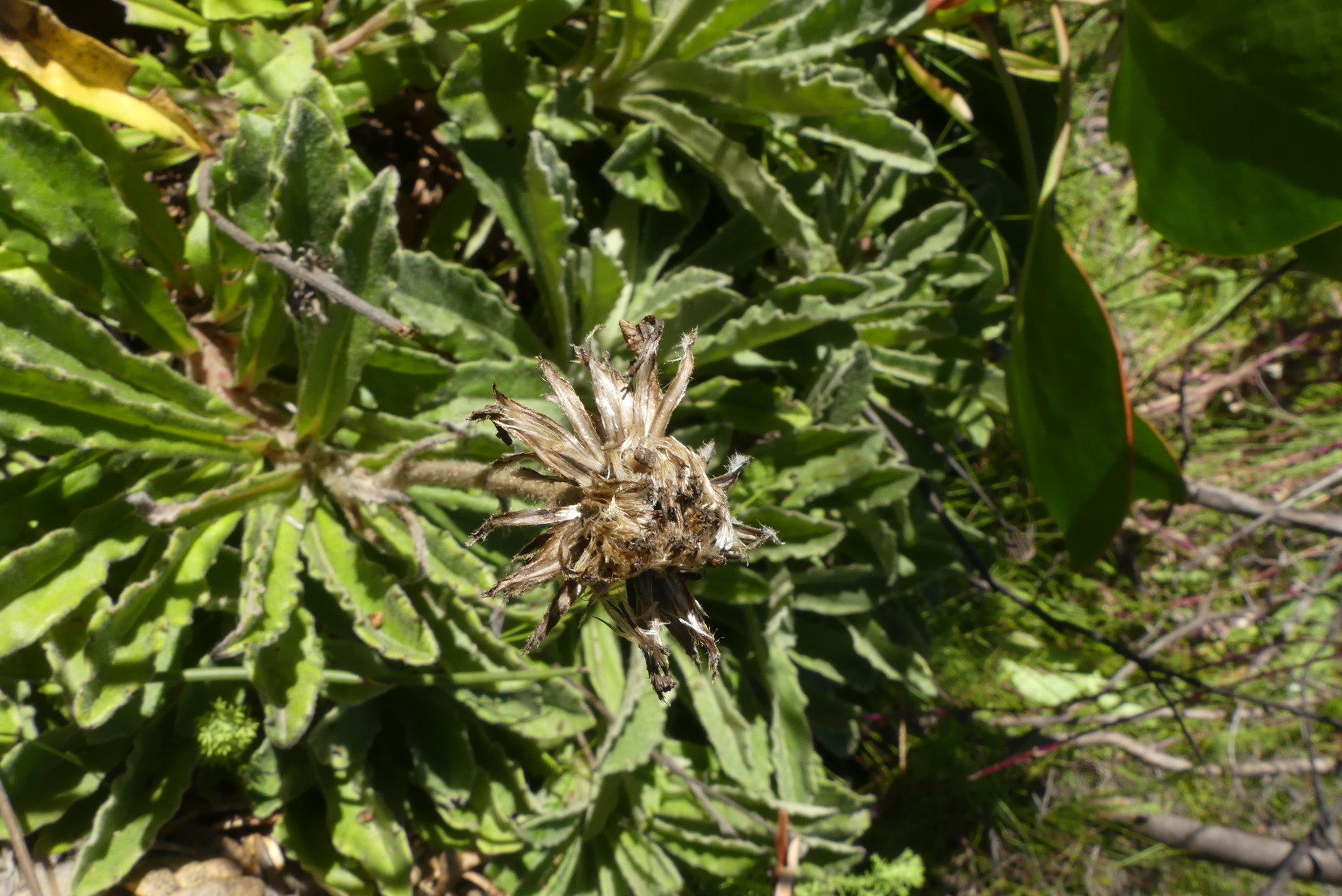
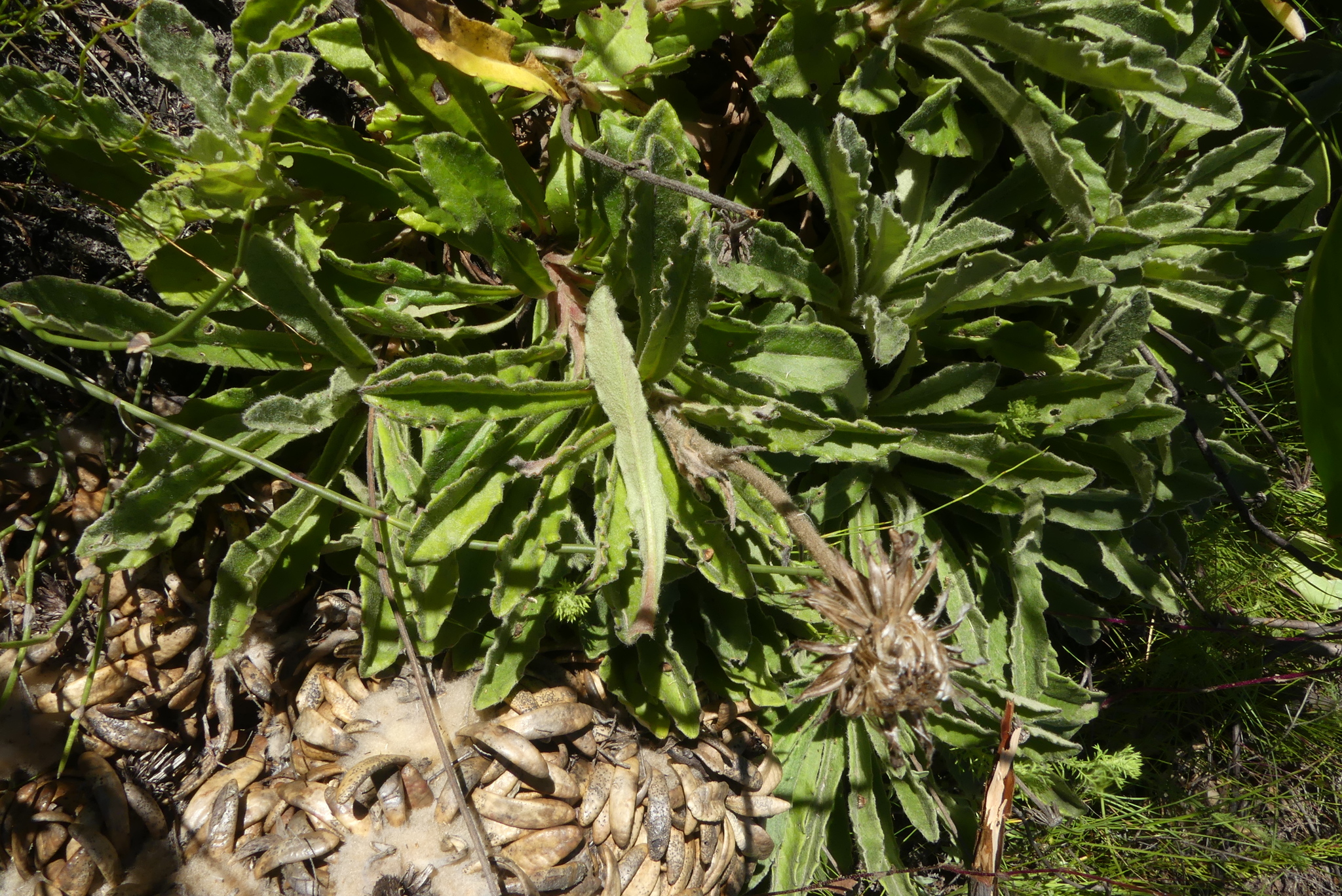
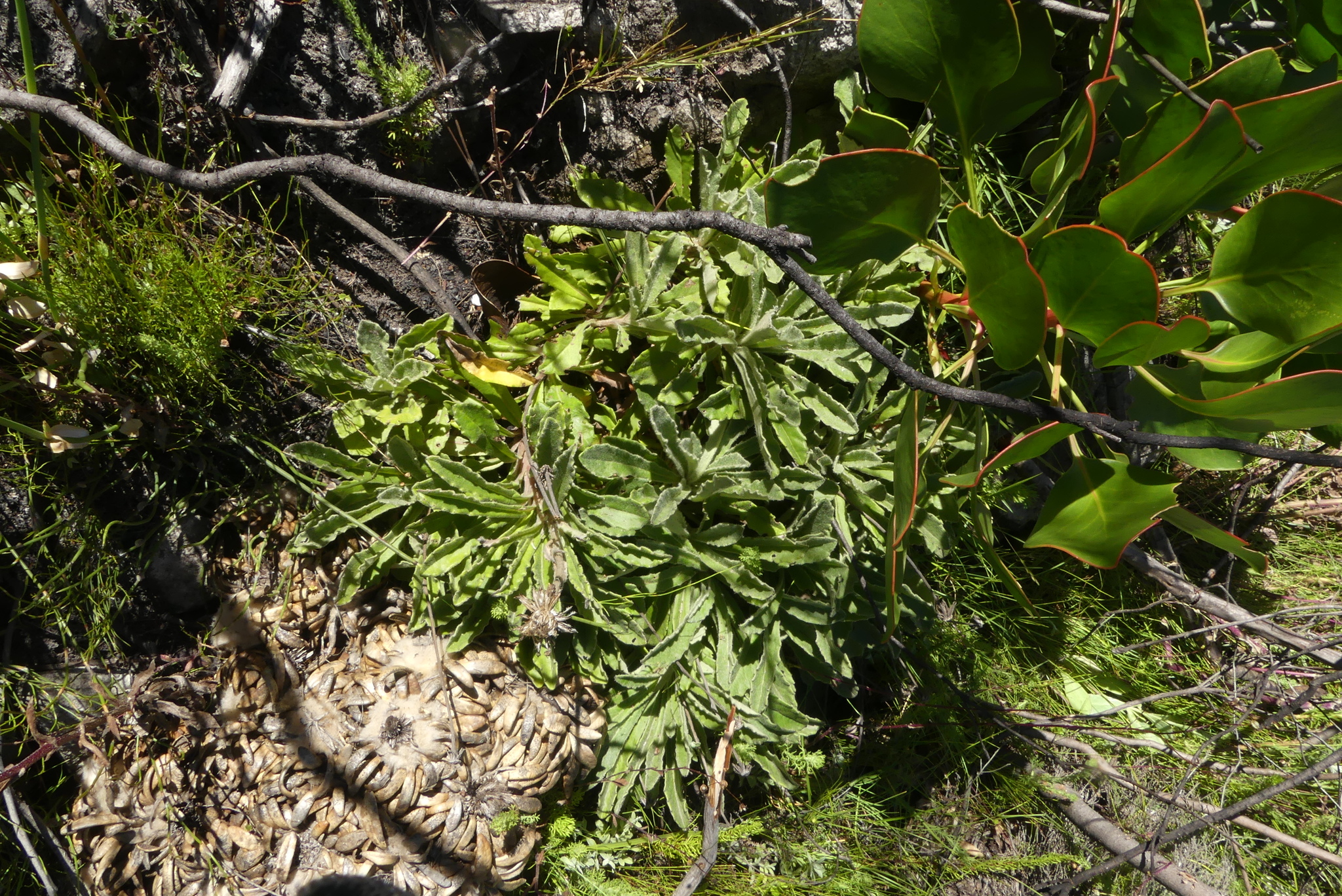
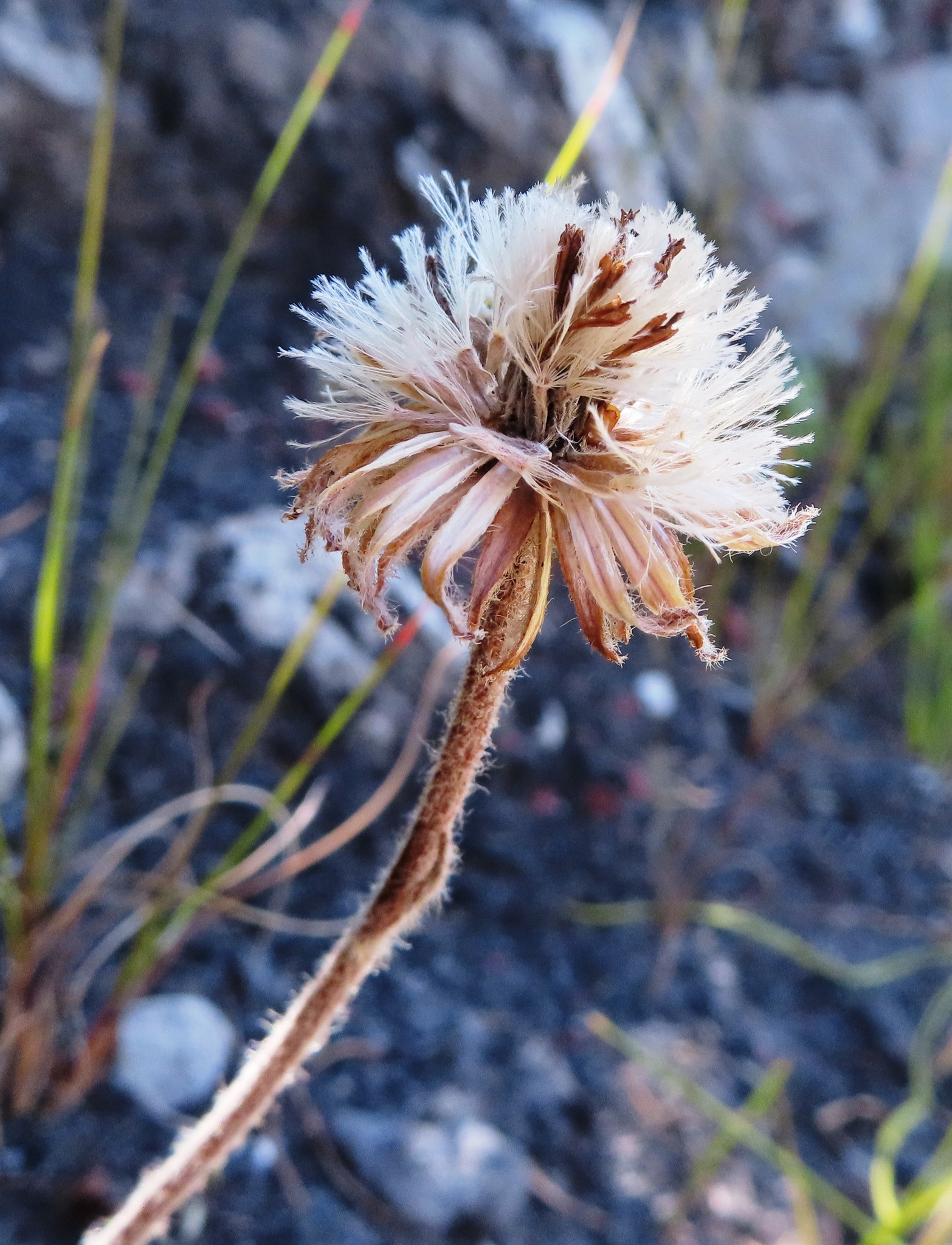
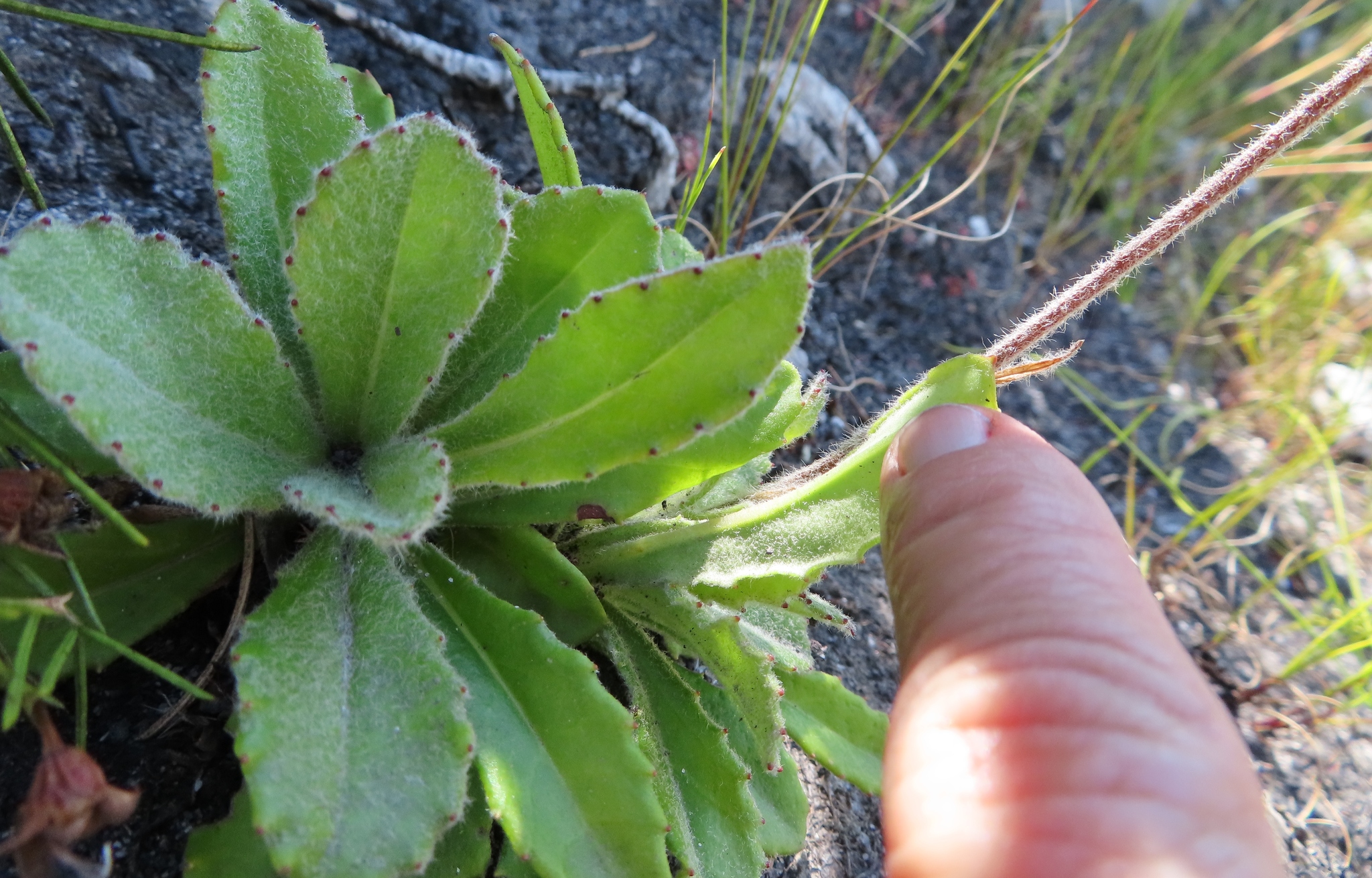
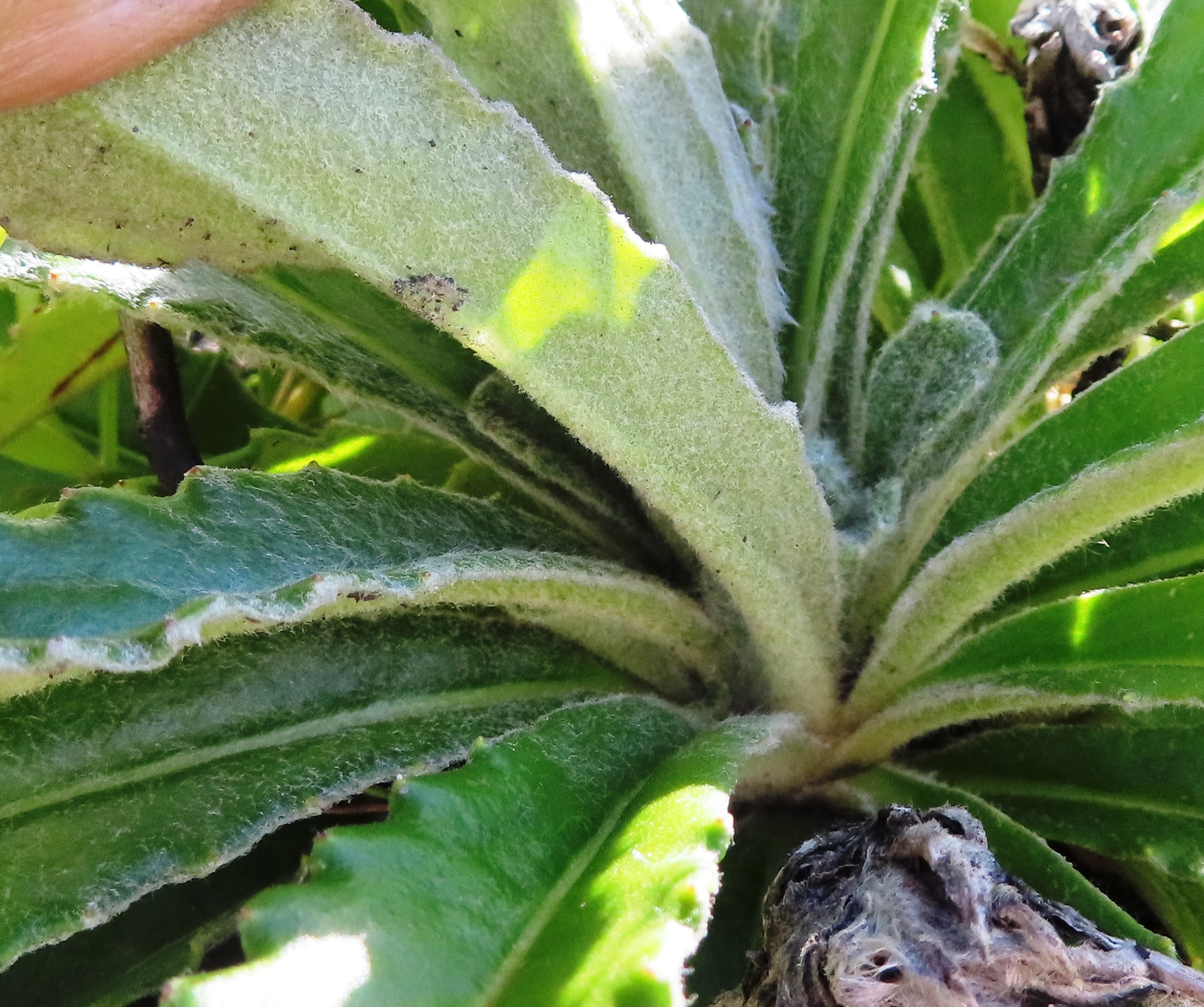
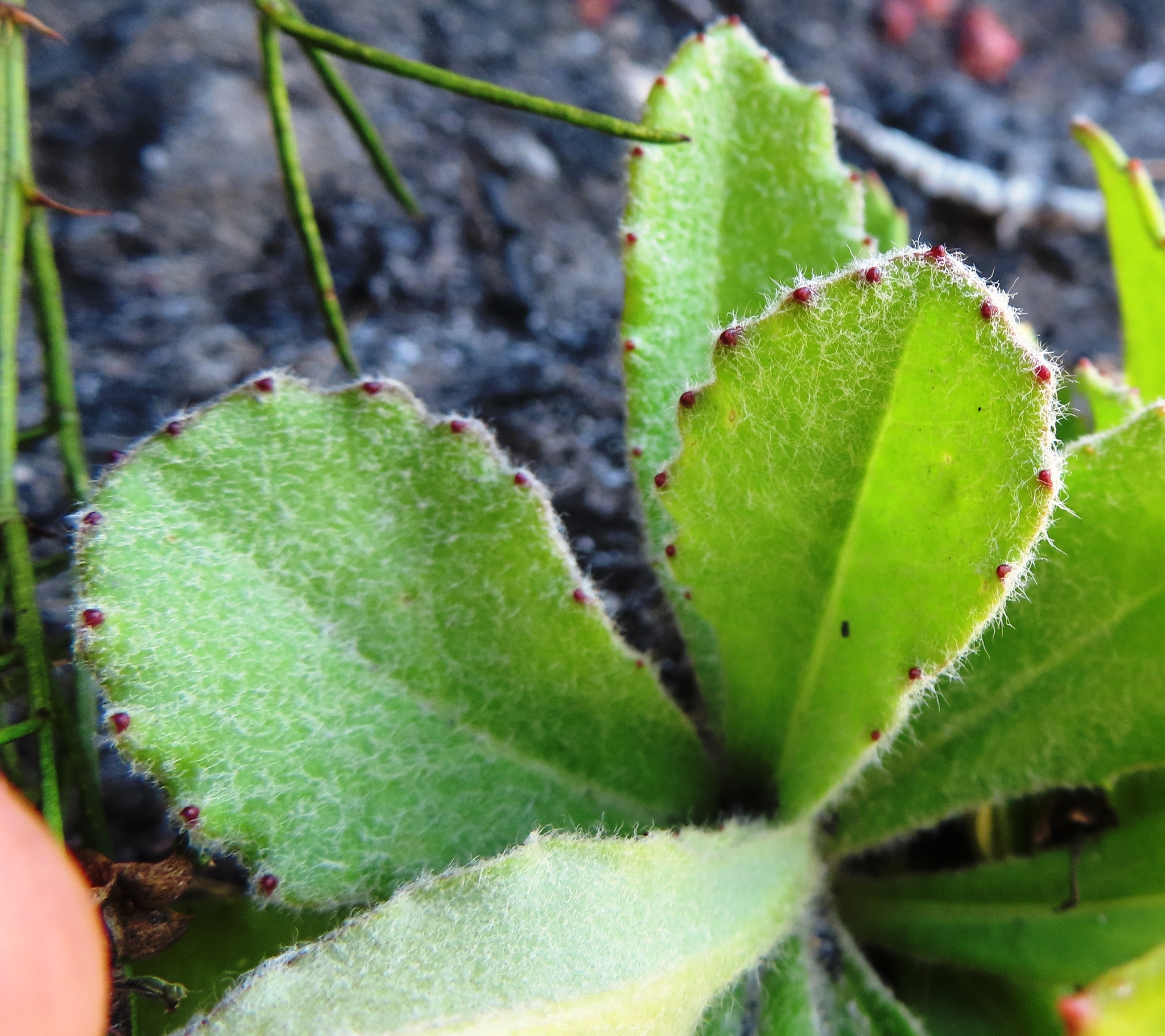
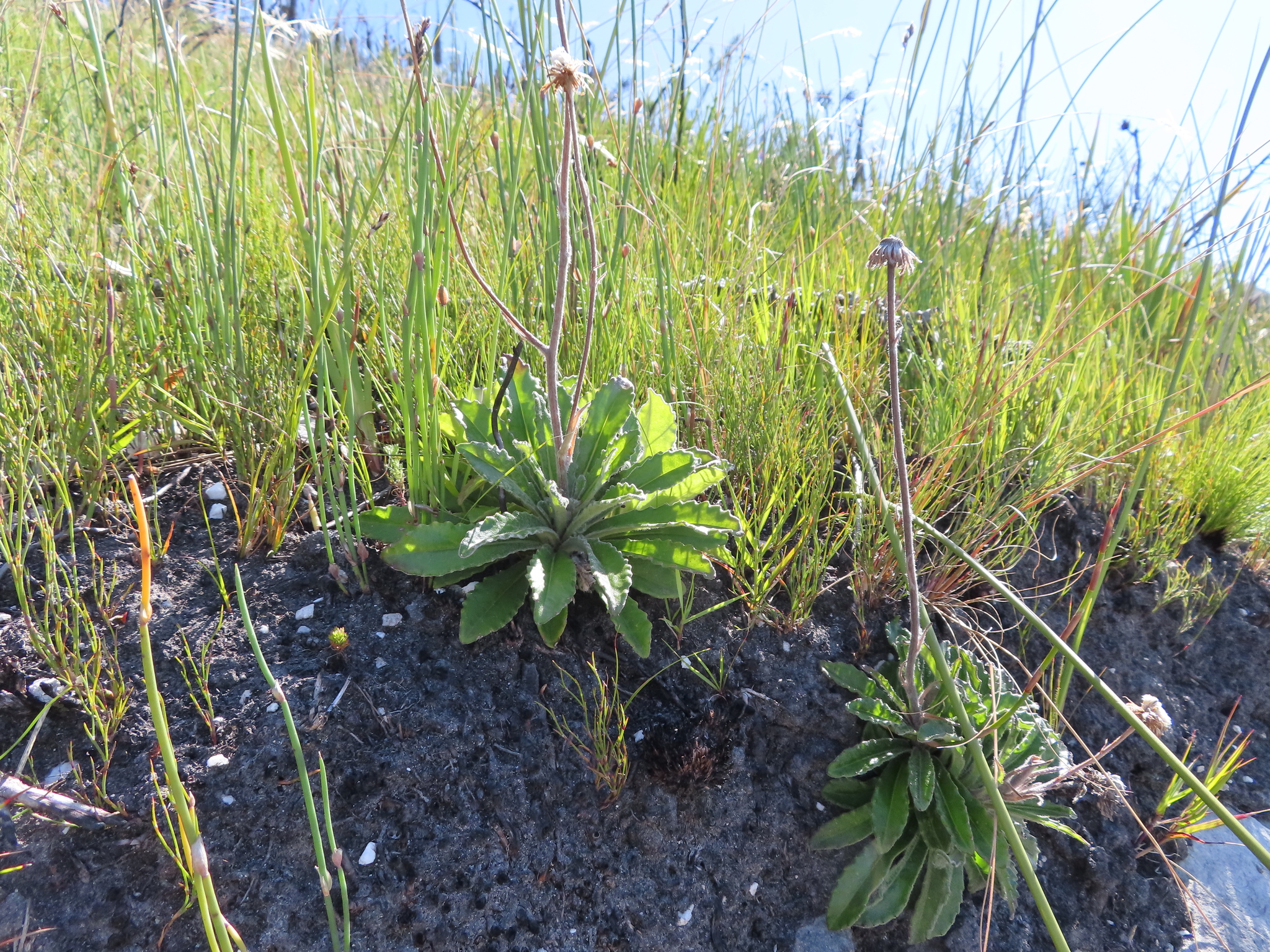
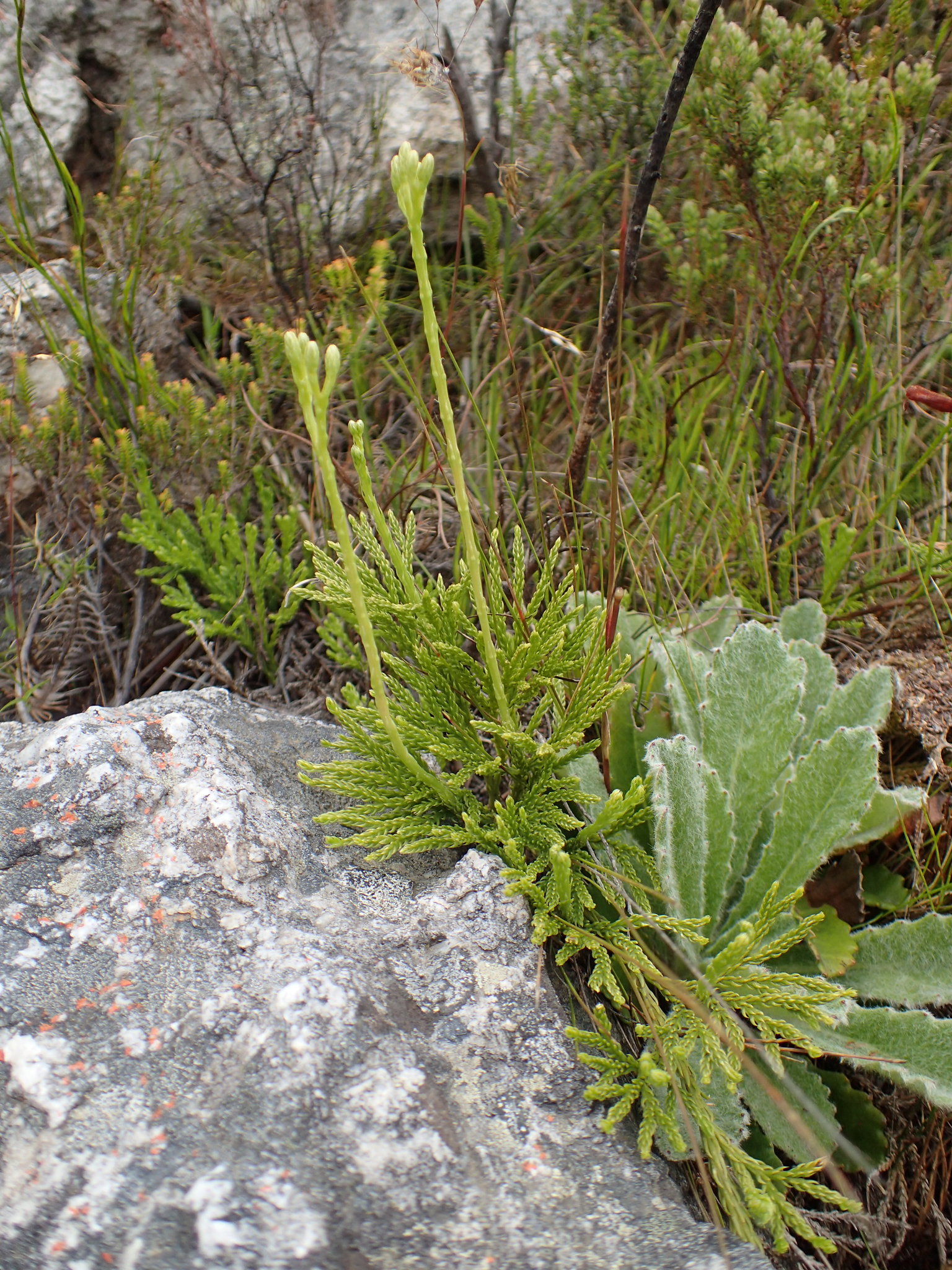
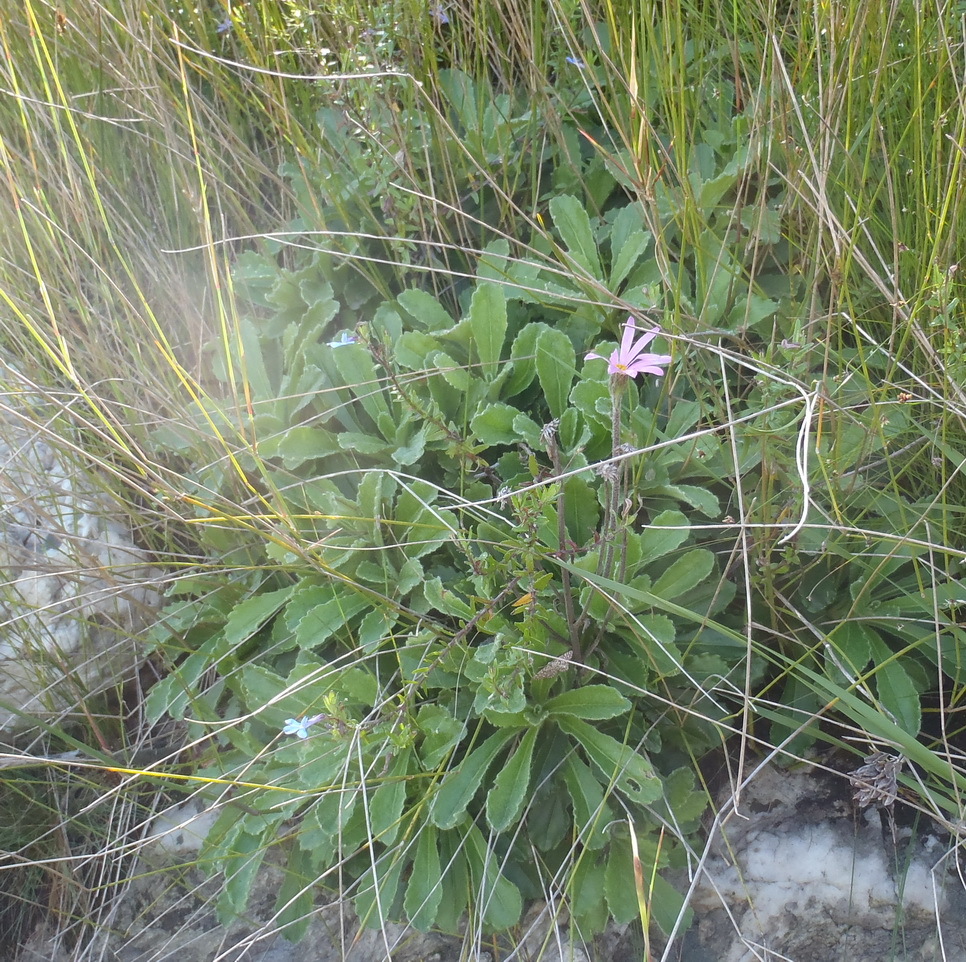
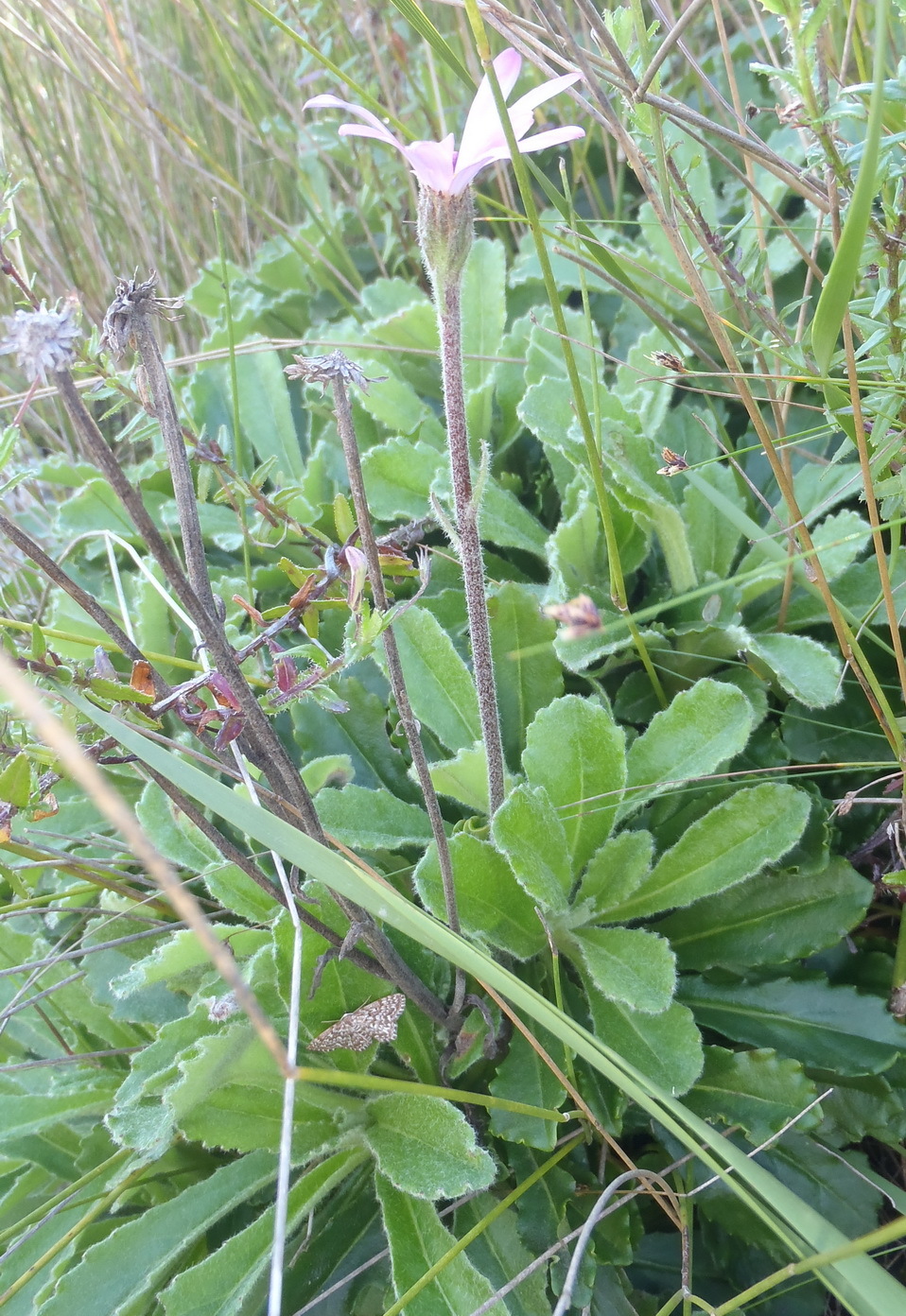
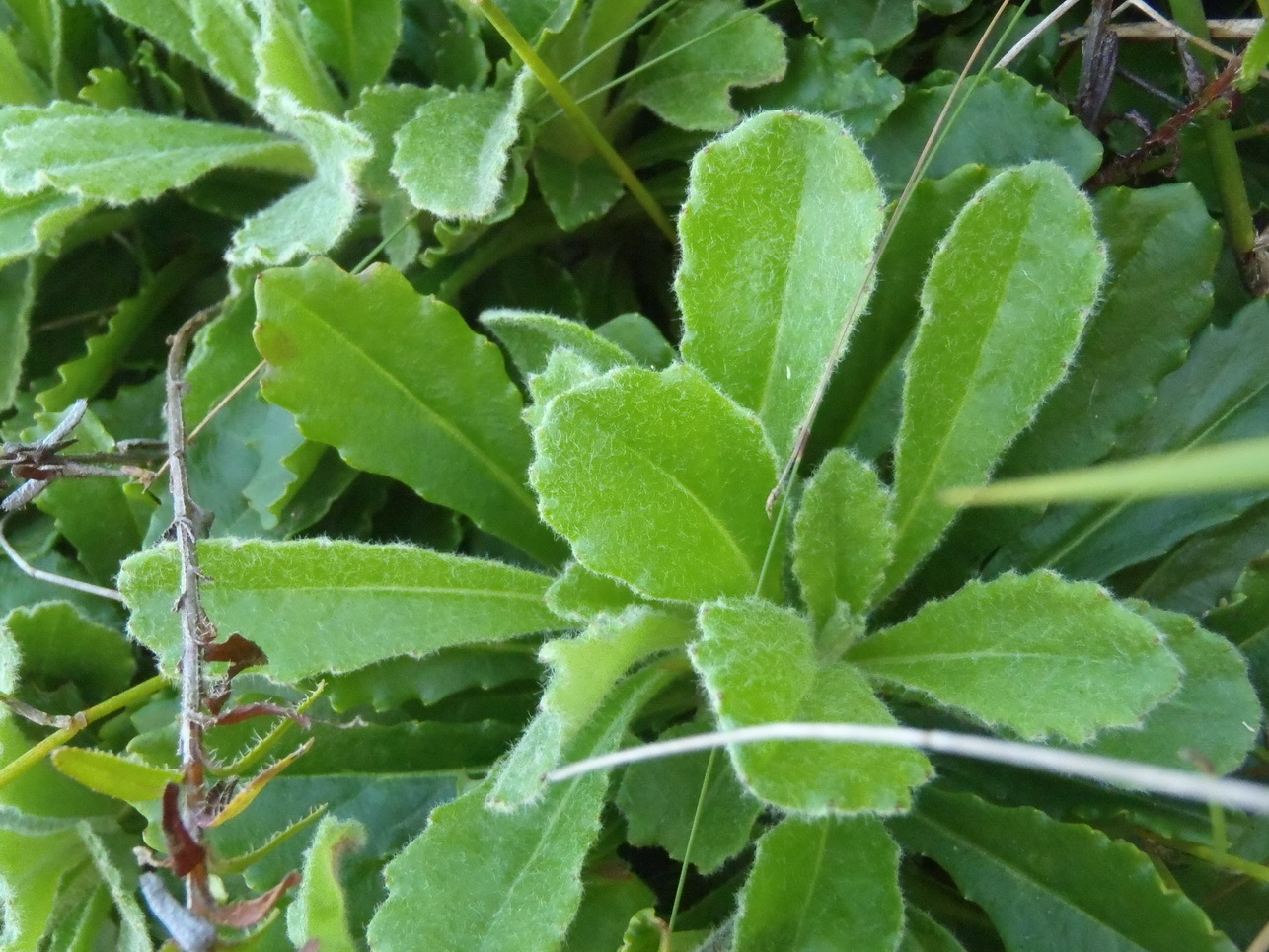
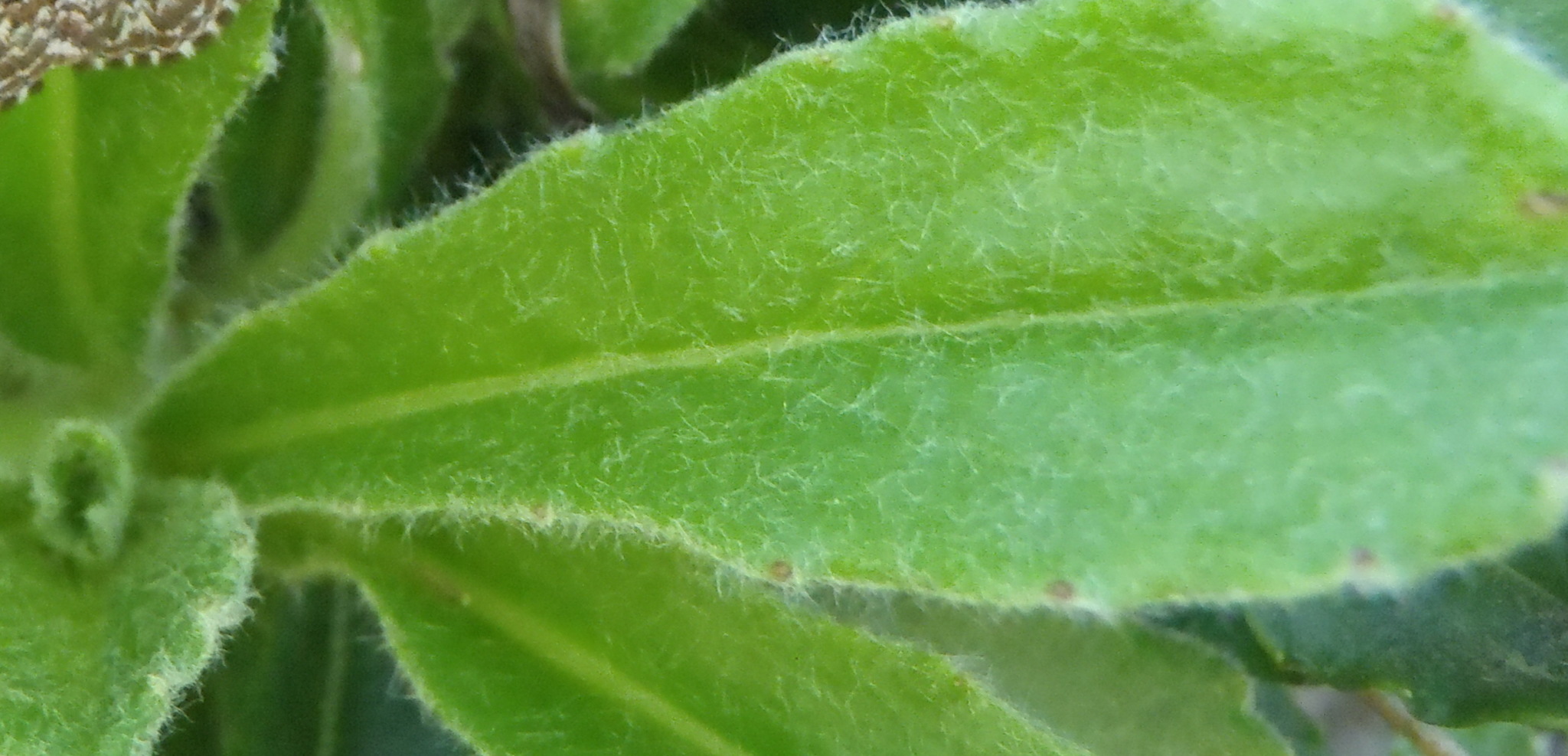
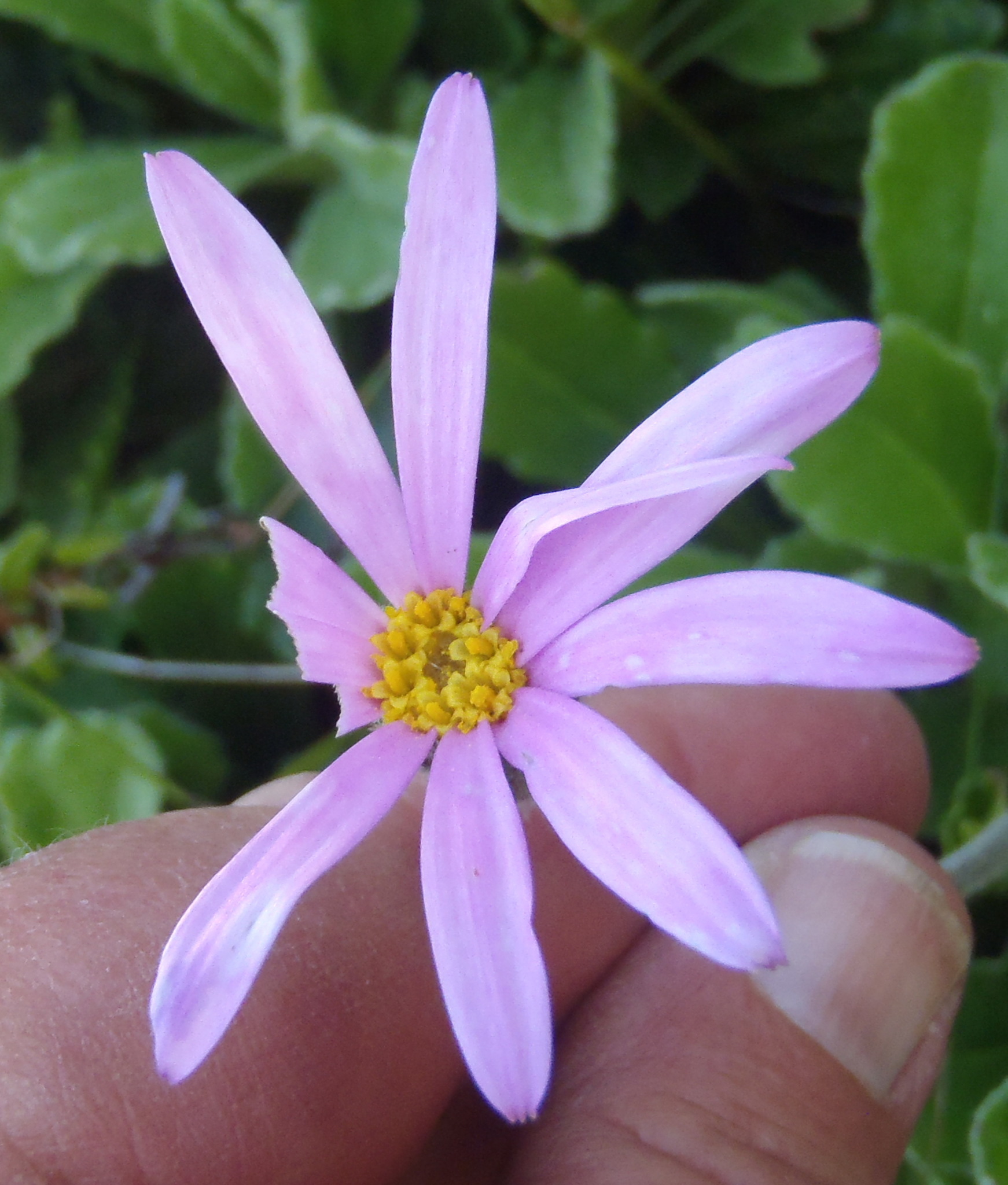
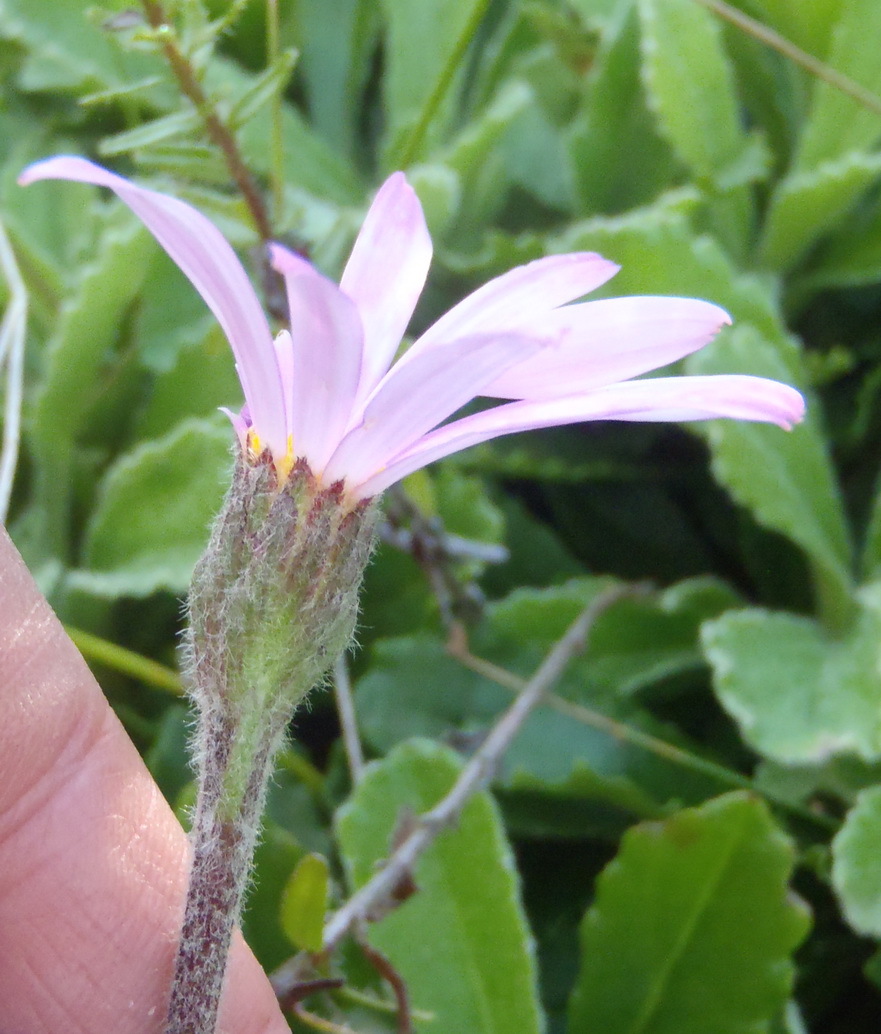
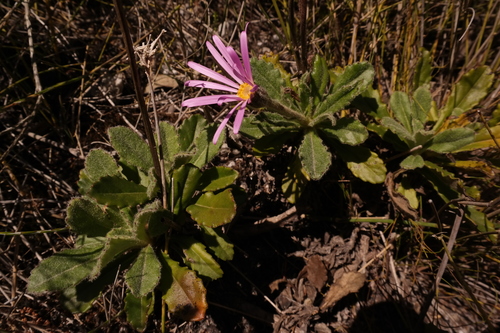
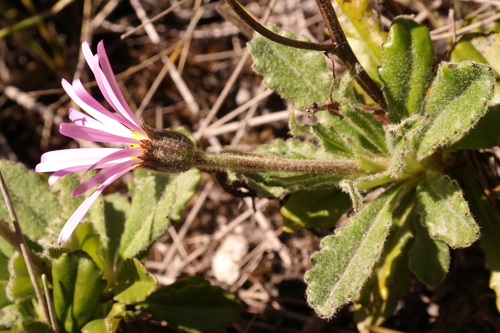
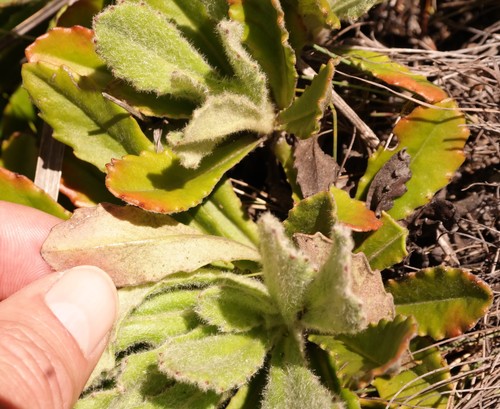
Rosulate robust, perennial herb, (14-)25-38(-40) cm high with 1 to 3 basal leaf rosettes. Roots thick and fleshy, dark brown, rhizome woody, robust, up to 70 mm long. Leaves in basal rosette, or alternate on lower part of scape, ±(7)9 to 18 per rosette; sessile or sometimes running into 3-25 mm long, petiole-like base or only slightly narrowing; leaf axils sometimes densely lanate; blade varying from narrowly elliptic to elliptic to narrowly or broadly obovate, (30-)43-100(-125) x (7-)15-35(-50) mm; apex obtuse or acute; margin crenate to dentate or sometimes almost entire, but then with some peg-like denticulations, revolute; obscurely net-veined but with distinct main vein; adaxial surface glabrous or sparsely to loosely lanate, abaxial surface densely to sparsely lanate, surface visible through indumentum, appears whitish scale-like, with shiny, honey-coloured glands; coriaceous and hard, often also succulent. Scapes 1 to 3 per rosette, robust, 80-380 mm long, with solitary capitula, rarely branched in upper two-thirds, brown or tinged dark red, mostly ribbed, densely lanate along whole length or from the middle or upper parts only, thickened directly below capitula; bracteate, bracts linear, up to 50 mm long, decreasing in size upwards, indumentum as in leaves, margins crenulate or mostly entire, erect or appressed to scapes. Involucre broadly campanulate, 19-35 mm in diameter, 12-17 mm high. Involucral bracts 32 to 46, in 4 series, imbricate; bracts of outer series linear or very narrowly ovate, 7.0-8.5 x 1.5-1.8 mm, purplish, densely lanate, apex acute, margin fimbriate; bracts of second series narrowly elliptic to very narrowly obovate, 9-11 x 1.5-2.0 mm, straw-coloured or tinged purple, sparsely to densely lanate, apex acute, rarely obtuse, margin fimbriate; bracts of third series linear, slightly narrowly obovate or very narrowly elliptic, 11.5-12.5 x 1.2-2.0 mm, base straw-coloured, apical part purple, sparsely to densely lanate in upper part, glabrescent in lower part, apex acute, margin narrowly membranous, fimbriate; bracts of inner series linear, 11-13 x 0.8-1.2 mm, base straw-coloured, glabrescent to glabrous, apical part purplish, lanate, apex acute, margin membranous, fimbriate. Ray florets ±30 to 32, corolla mauve, pink, white or coral-red, limb long linear, 20-29 x 3-5 mm, 3-lobed, 4-veined, tube 5-7 mm long, laxly glandular hairy. Style up to 5.5 mm long; style branches linear-elliptic, 1.2-1.5 mm long, apex obtuse, stigmatic areas marginal, confluent at apex, sometimes not confluent and with reduced apical appendages. Staminodes absent. Cypsela and pappus as in disc florets. Disc florets many, corolla 5-6 mm long, shorter than pappus, laxly glandular hairy; lobes ±1 mm long, erect or recurved, often with marginal resin ducts, sometimes with 0.4-0.8 mm long hairs and glossy glands with rounded heads. Anthers 1.5-2.0 mm long, with ±0.5 mm long triangular apical appendages. Style ±6 mm long; style branches linear-elliptic, ±1.0-1.5 mm long; style appendages deltoid, ±0.35 x 0.2 mm. Cypselae cylindrical to fusiform, occasionally obovate, ±3.5-4.4 x 0.9-2.0 mm, brown, distinctly 4- or 5-ribbed, ribs prominently raised, mostly dark brown; with many, yellow, shiny glands and dense sericeous twin hairs, 0.4-0.5 mm long, deeply cleft, apices almost equal in length; epicarp smooth. Pappus biseriate, outer series of free barbellate bristles, 0.5-3.5 mm long, white to straw-coloured, alternately arranged to inner series; inner series of plumose bristles 6.7-7.0 mm long, nude or barbellate and fused in a ring basally, white to straw-coloured, longer than disc florets. Flowering time: July to November, after fire or in disturbed places. From: Herman, PPJ; Zinnecker, U. 2016. A taxonomic revision of the genus Mairia (Asteraceae, Astereae) in South Africa. S. African J. Bot. 105: 45-60. [Copyright held by the South African Association of Botanists (2016); http://www.sciencedirect.com/science/journal/02546299] [CC BY] As: Mairia hirsuta DC.
Tufted subshrub to 30 cm, russet silky or woolly. Leaves in basal tufts, oblanceolate, margins crenate and revolute, russet silky or woolly beneath, glabrescent above but not discolorous. Flower heads radiate, solitary, subscapose, yellow with mauve-pink rays, ray florets without staminodes. From: Manning, JC; Goldblatt, P. 2012. Asteraceae: Mairia Nees. In: J Manning & P Goldblatt (eds), Plants of the Greater Cape Floristic Region 1: The Core Cape flora. Strelitzia 29: 393-394. South African National Biodiversity Institute, Pretoria. [CC BY] As: Mairia hirsuta DC.
M. hirsuta can be distinguished by the regularly crenate to dentate leaf margins, the long ray florets (limb 20-29 mm long) and the absence of staminodes in the ray florets. M. hirsuta can be confused with M. robusta, which has similar looking leaves, long ray florets and staminodes absent in ray florets. However, the indumentum on the abaxial leave surfaces of M. hirsuta differs from that of M. robusta: in M. hirsuta, the indumentum is densely to sparsely lanate with the surface visible through the indumentum, appearing whitish scale-like, with shiny, honey-coloured glands, whereas in M. robusta the indumentum of the abaxial leaf surfaces consists of 2 layers of hairs: densely and persistently softly white or pinkish canescent-cobwebby overlaid with longer lanate hairs, the leaf surface not visible through the indumentum, distinctly discolorous. The involucral bracts in M. hirsuta are imbricate with the outer bracts smaller than the inner bracts, but in M. robusta the involucral bracts are more or less equal in size. M. hirsuta can also be confused with M. crenata-see discussion under that species. From: Herman, PPJ; Zinnecker, U. 2016. A taxonomic revision of the genus Mairia (Asteraceae, Astereae) in South Africa. S. African J. Bot. 105: 45-60. [Copyright held by the South African Association of Botanists (2016); http://www.sciencedirect.com/science/journal/02546299] [CC BY] As: Mairia hirsuta DC.
Mountain slopes after fire. From: Manning, JC; Goldblatt, P. 2012. Asteraceae: Mairia Nees. In: J Manning & P Goldblatt (eds), Plants of the Greater Cape Floristic Region 1: The Core Cape flora. Strelitzia 29: 393-394. South African National Biodiversity Institute, Pretoria. [CC BY] As: Mairia hirsuta DC.
M. hirsuta is a local endemic of the Langeberge between Swellendam and Suurbraak and the adjacent Warmwaterberg. From: Herman, PPJ; Zinnecker, U. 2016. A taxonomic revision of the genus Mairia (Asteraceae, Astereae) in South Africa. S. African J. Bot. 105: 45-60. [Copyright held by the South African Association of Botanists (2016); http://www.sciencedirect.com/science/journal/02546299] [CC BY] As: Mairia hirsuta DC.
Langeberg. From: Manning, JC; Goldblatt, P. 2012. Asteraceae: Mairia Nees. In: J Manning & P Goldblatt (eds), Plants of the Greater Cape Floristic Region 1: The Core Cape flora. Strelitzia 29: 393-394. South African National Biodiversity Institute, Pretoria. [CC BY] As: Mairia hirsuta DC.
This map contains point-based occurrences at different locations
Occurrence in the Flora of Southern Africa (FSA) countries and South African provinces. Residence status indicates if a taxon is indigenous, endemic, naturalised or invasive in a specific region. This data is based on specimen records and literature
FSA
SA
BOT
NAM
ESW
LES
WC
EC
NC
FS
GA
KZN
LP
MP
NW
Absent
Indigenous
Endemic
Naturalised
Invasive

Names and Sources
Published in: Bothalia 46(1), a2404: 3 (2016)
Type: South Africa, ‘Cap. B. spei.’, Tulbagh 44, Herb. Linn. No. 1000.26 (LINN, lecto.) Lectotype designated by Cron et al., Kew Bulletin 61: 529 (2006).
Cineraria purpurata L.
Published in: Mant. Pl. Altera: 285 (1771)
Mairia hirsuta DC.
Published in: Prodr. [A. P. de Candolle] 5: 217 (1836)
Type: South Africa, Western Cape, ‘Zwellendam, am Berge bei Puspasvlei, Voormansbosch, Duivelsbosch und am Fuss Keureboomrivier, Oct., Ecklon & Zeyher 3071 (G-DC, holo.; K, M, P, NBG, PRE, S, SAM, iso.)
Zyrphelis hirsuta (DC.) Kuntze
Published in: Revis. Gen. Pl. 1: 374 (1891)
Classification
KINGDOM Plantae
SUBKINGDOM Phanerogamae
PHYLUM Anthophyta
ORDER Asterales
FAMILY Asteraceae
SUBFAMILY Asteroideae
TRIBE Astereae
GENUS Mairia
SPECIES purpurata
10 results for Mairia purpurata (L.) J.C.Manning
This map contains point-based occurrences at different locations
2022
SERIES
A taxonomic revision of the genus Zyrphelis (Asteraceae, Astereae) in South Africa. Herman, PPJ; Zinnecker-Wiegand, U.Strelitzia 45: 1-249
2016
PERIODICAL/JOURNAL
Nomenclatural adjustments in African plants 2 Goldblatt, P; Manning, JCBothalia - African Biodiversity & Conservation 46(1),a20241-5
2016
PERIODICAL/JOURNAL
A taxonomic revision of the genus Mairia (Asteraceae, Astereae) in South Africa Herman, PPJ; Zinnecker, USouth African Journal of Botany 105: 45-60
2012
SERIES CHAPTER
Asteraceae: Mairia Nees Manning, JC; Goldblatt, PIn: J Manning & P Goldblatt (eds), Plants of the Greater Cape Floristic Region 1: The Core Cape flora. Strelitzia 29: 393-394
South African National Biodiversity Institute, Pretoria
1994
No results found for Mairia purpurata (L.) J.C.Manning
| Part(s) of plant used | Use(s) | Reference |
|---|
Coming soon...


