
PLANTAE / PHANEROGAMAE / ANTHOPHYTA / CARYOPHYLLALES / AIZOACEAE / RUSCHIOIDEAE / RUSCHIEAE / CONOPHYTUM / JUCUNDUM / FRAGILE

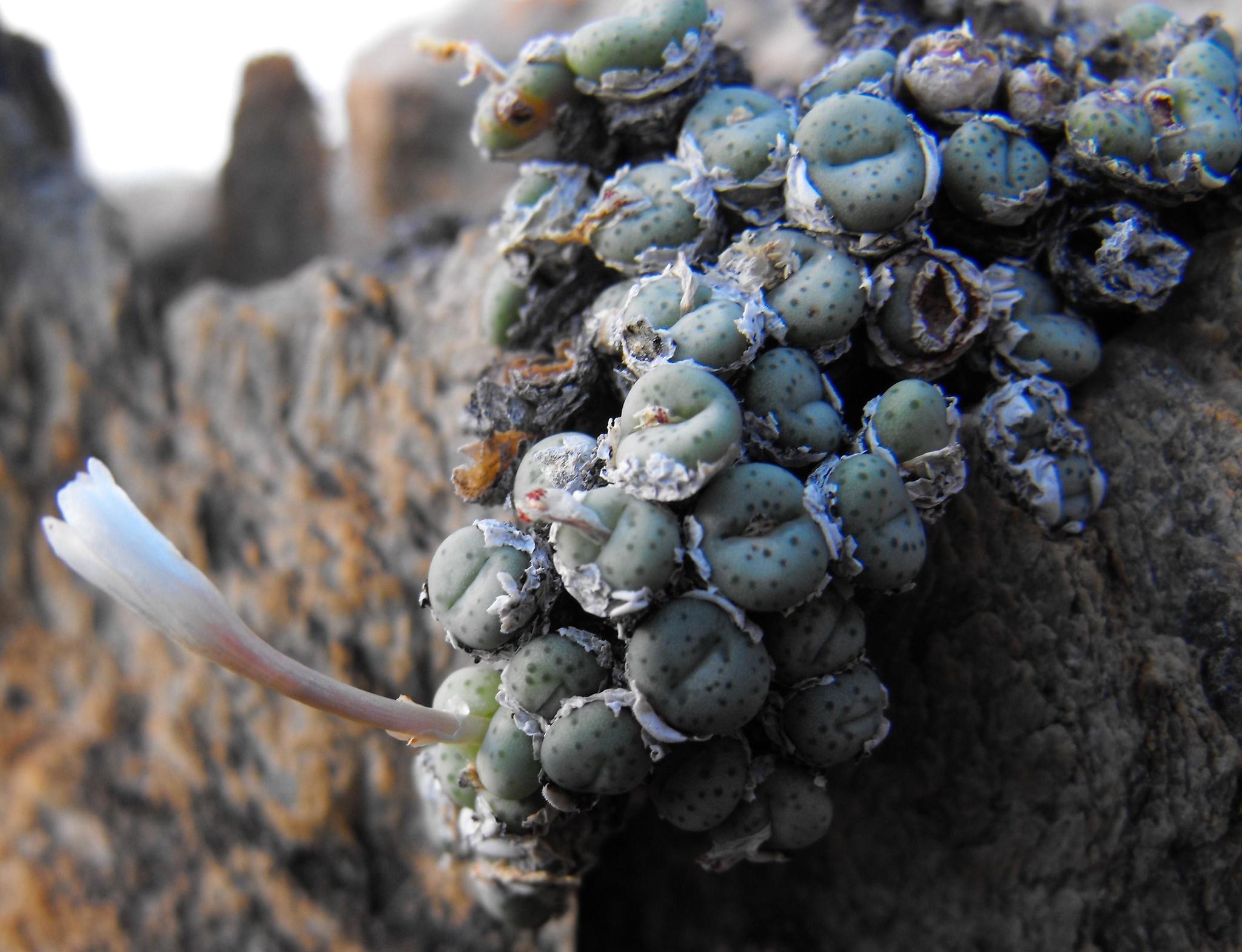
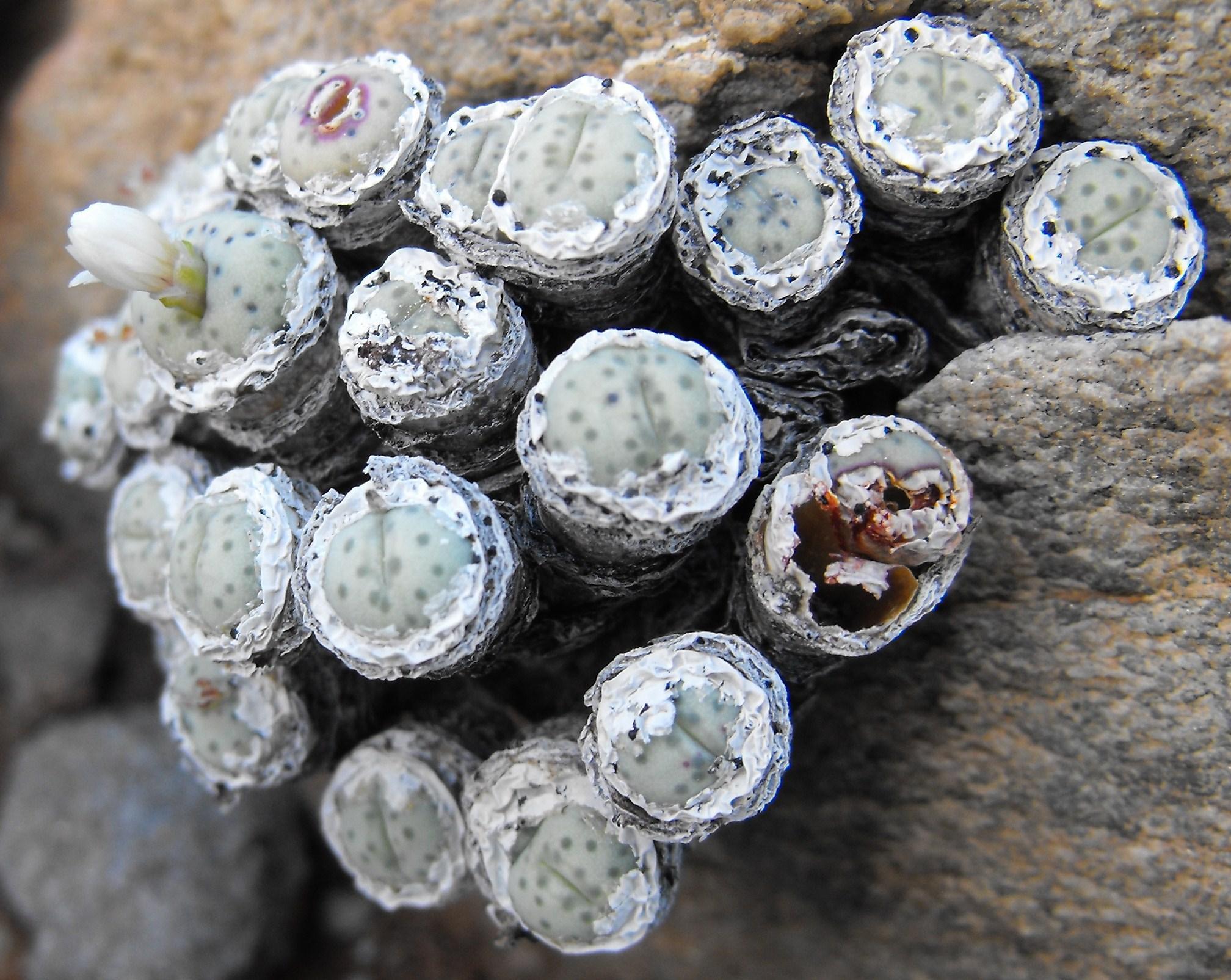
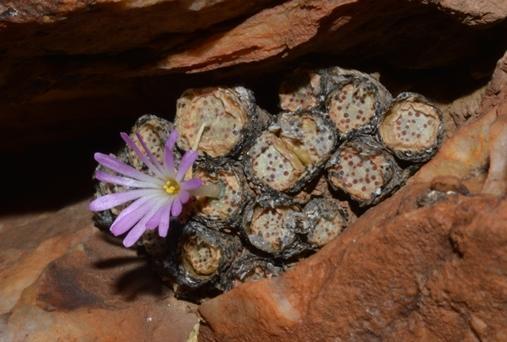
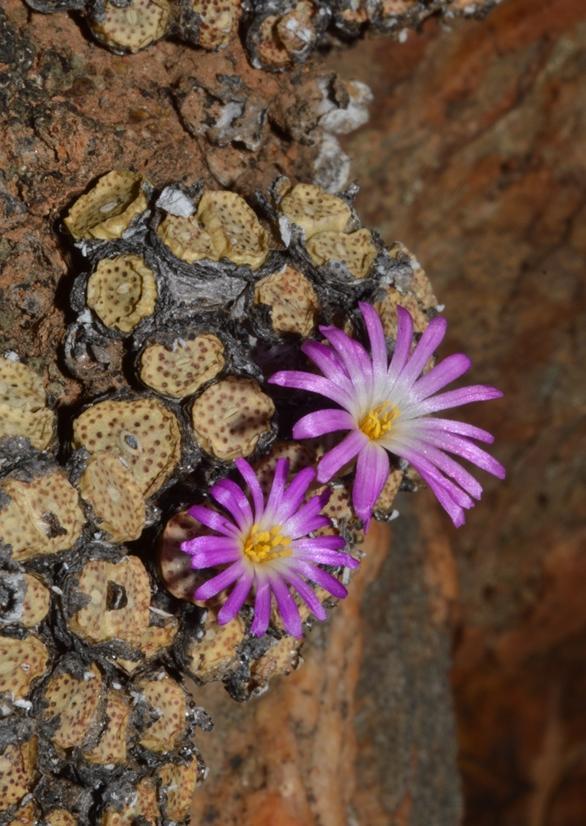
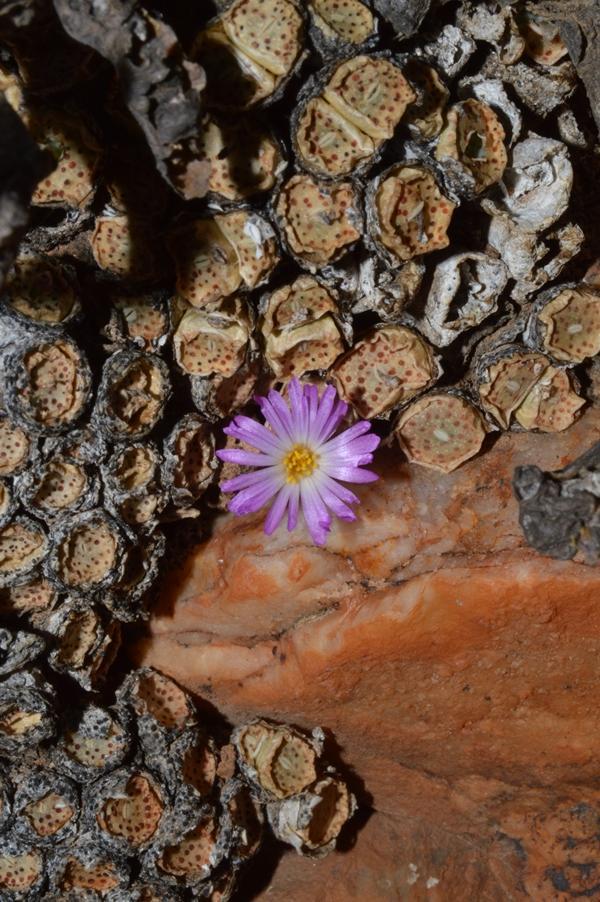
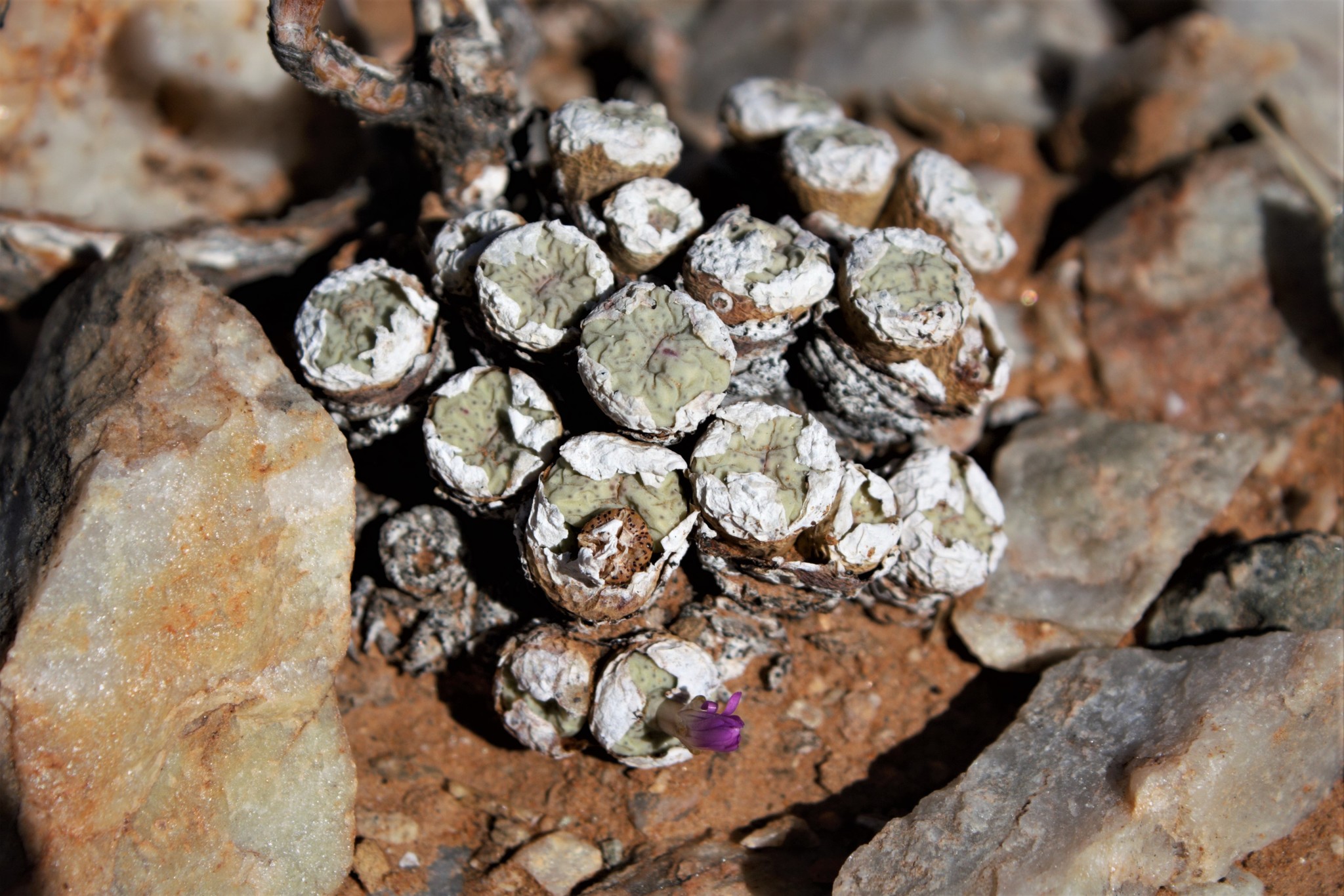
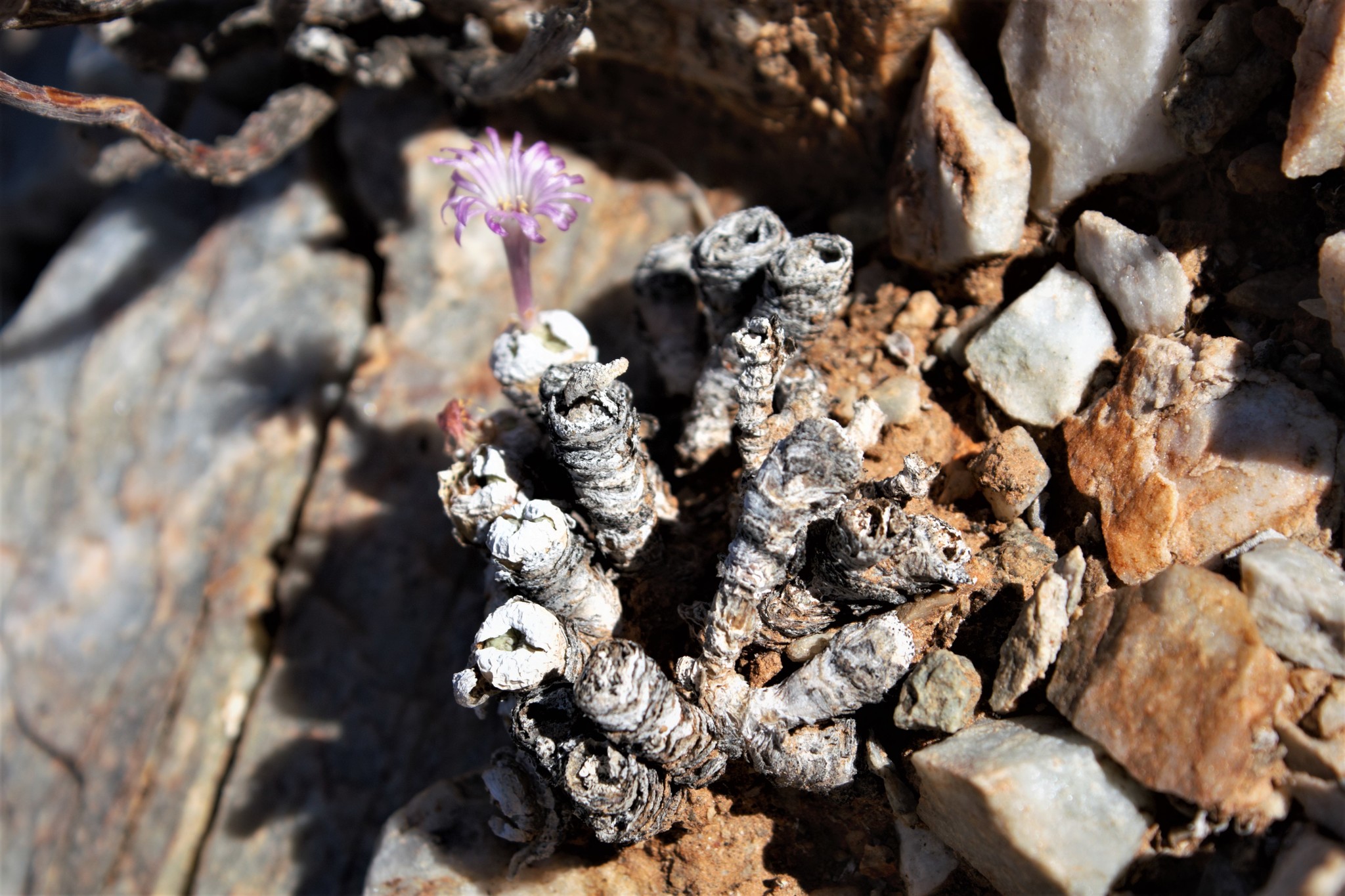
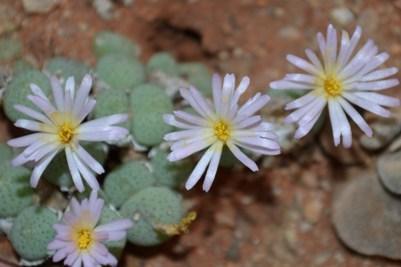
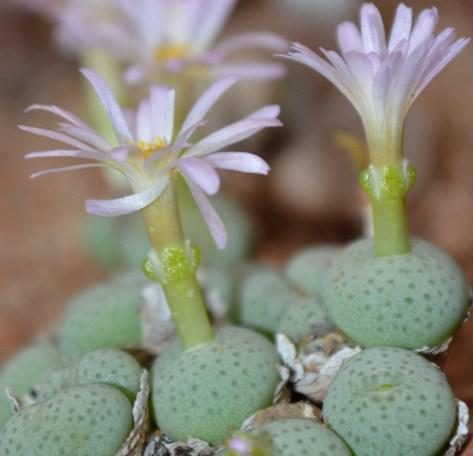
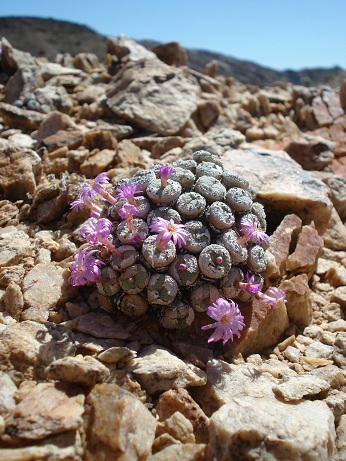
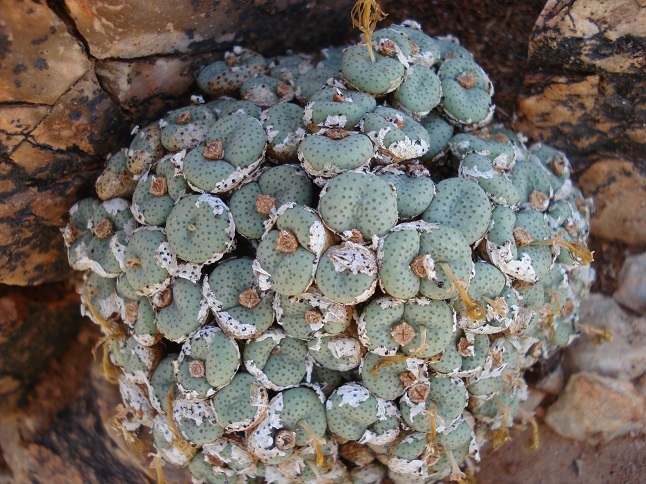
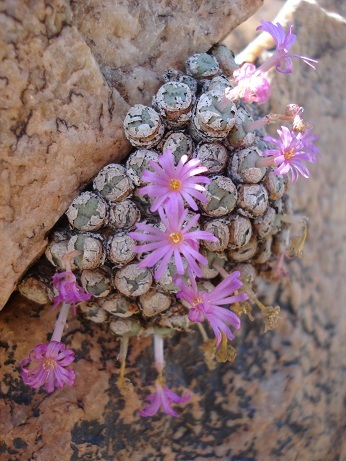
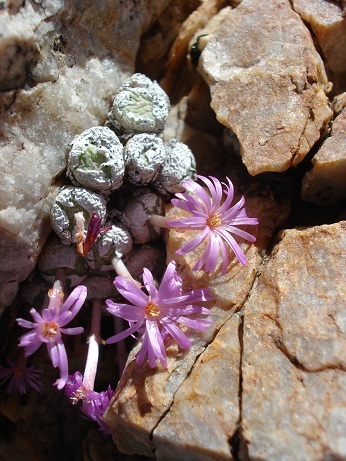
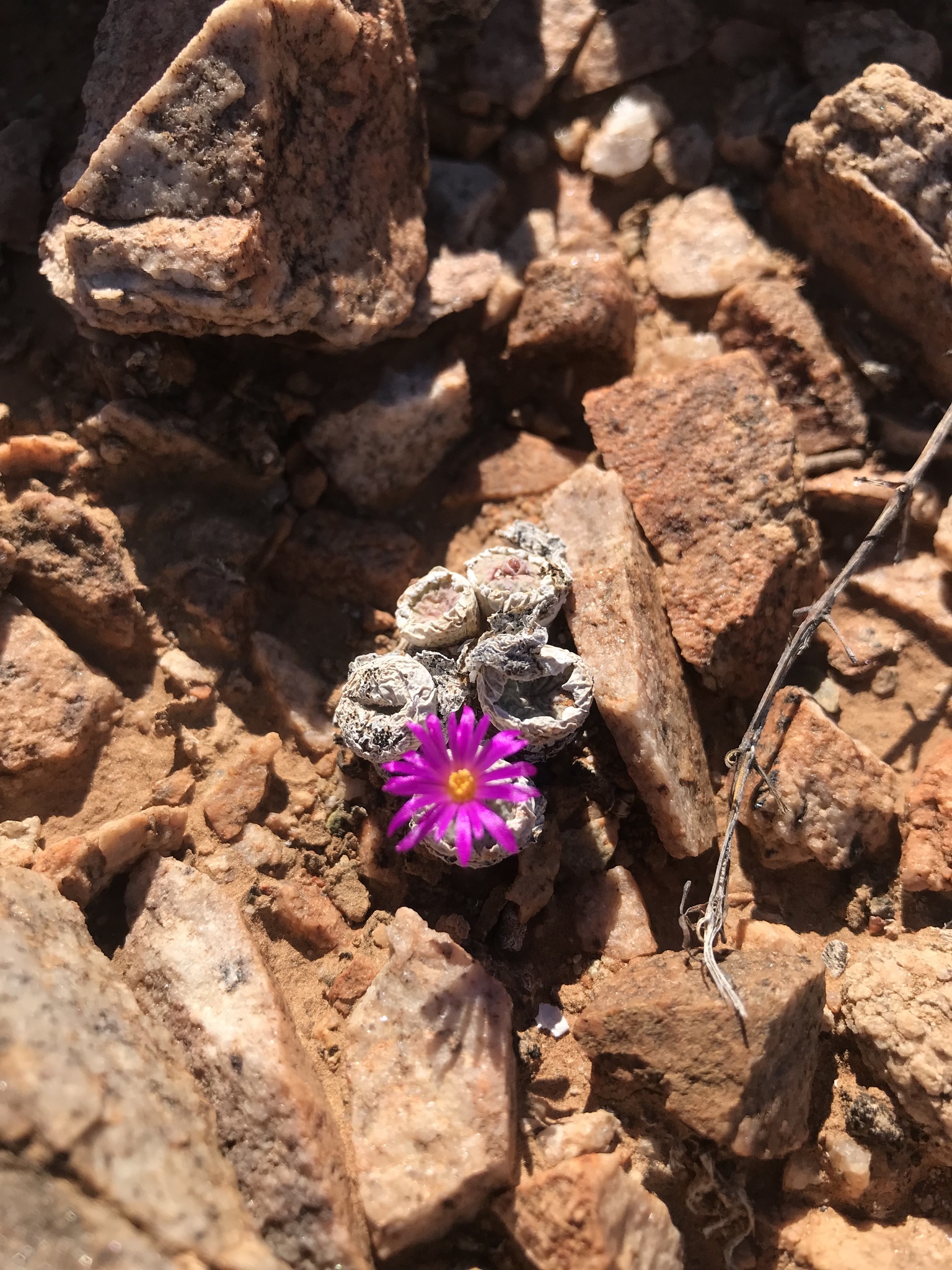
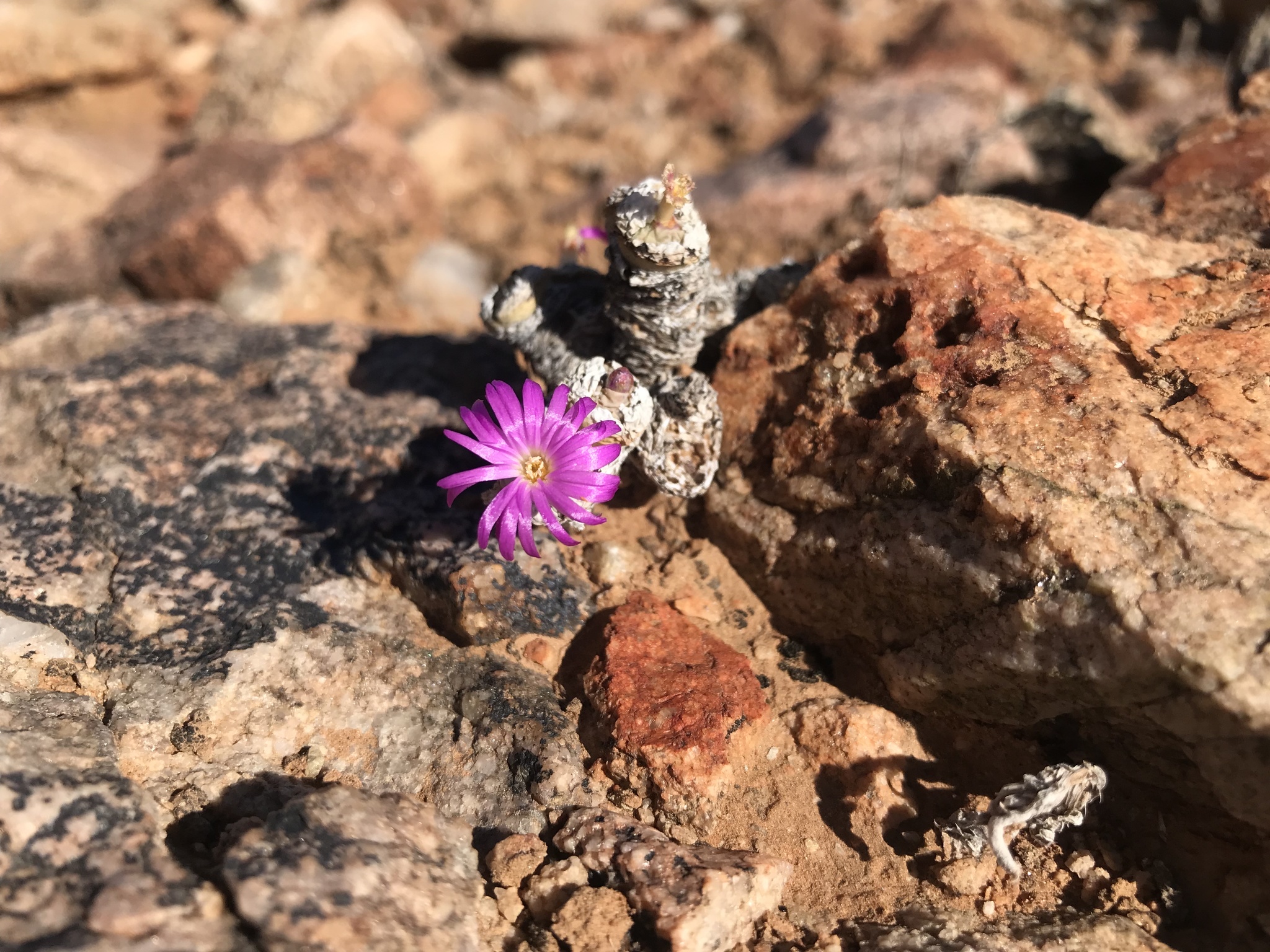
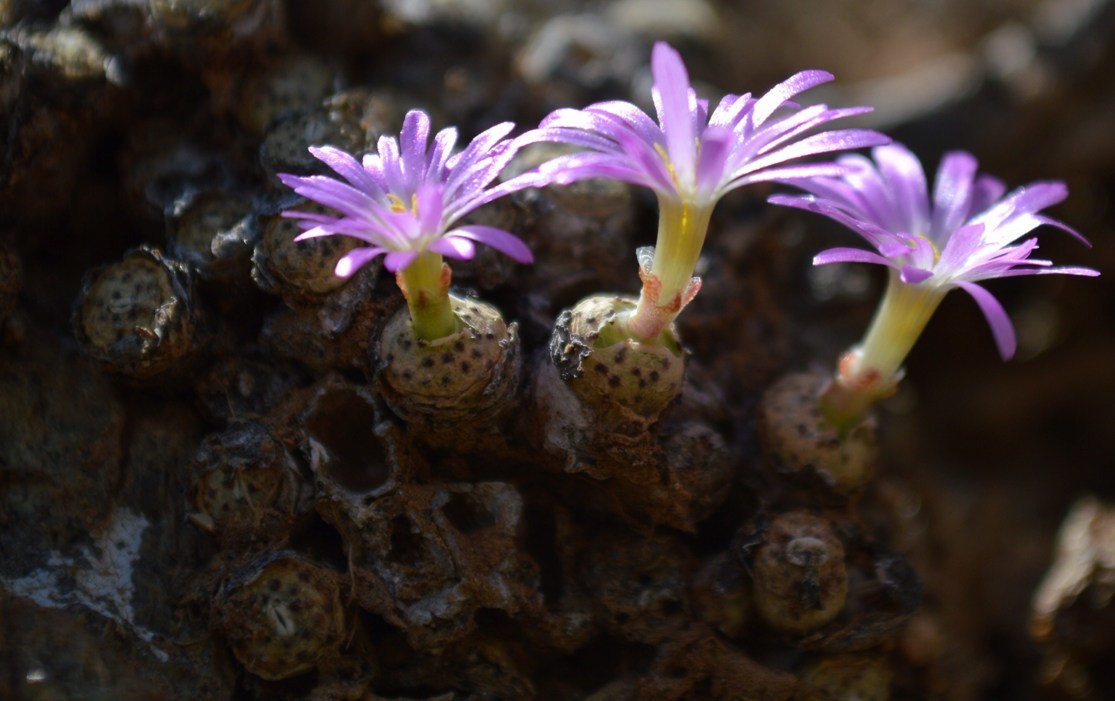
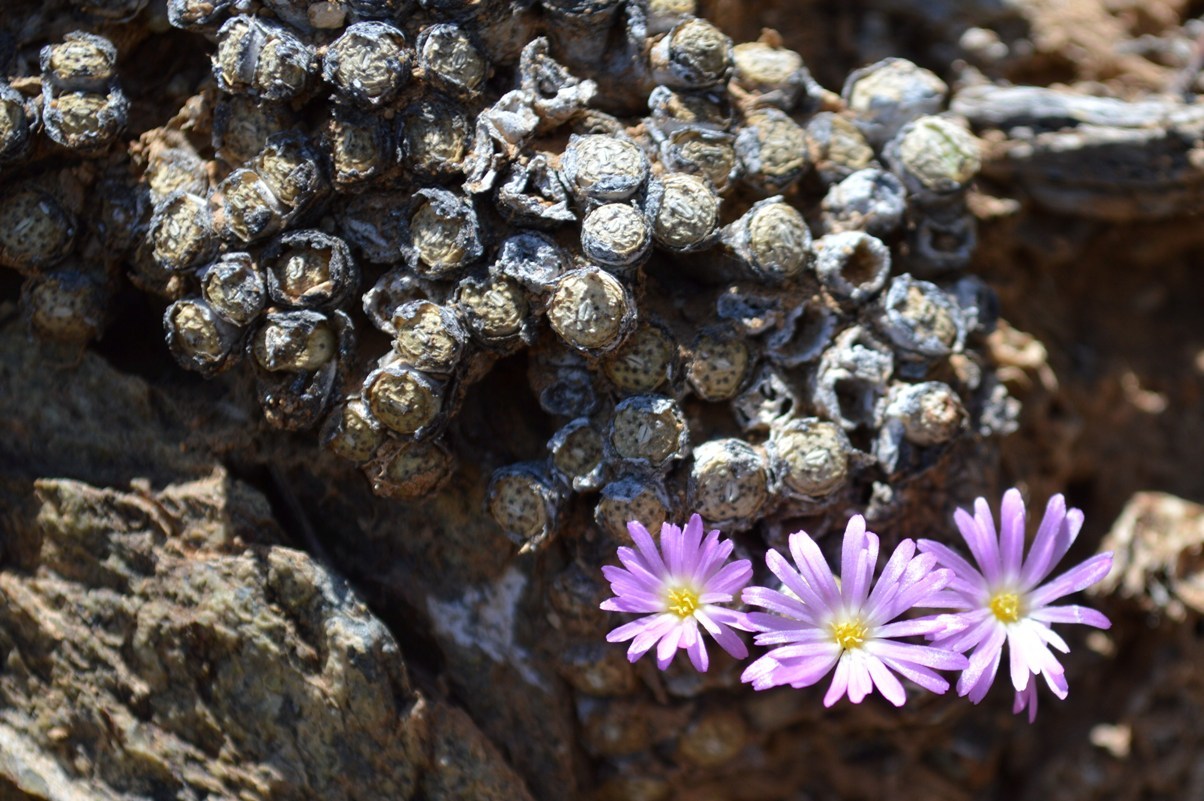
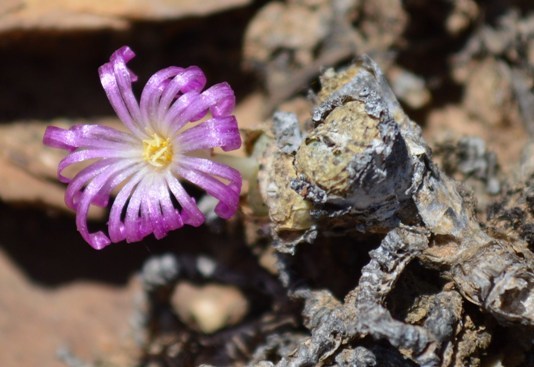
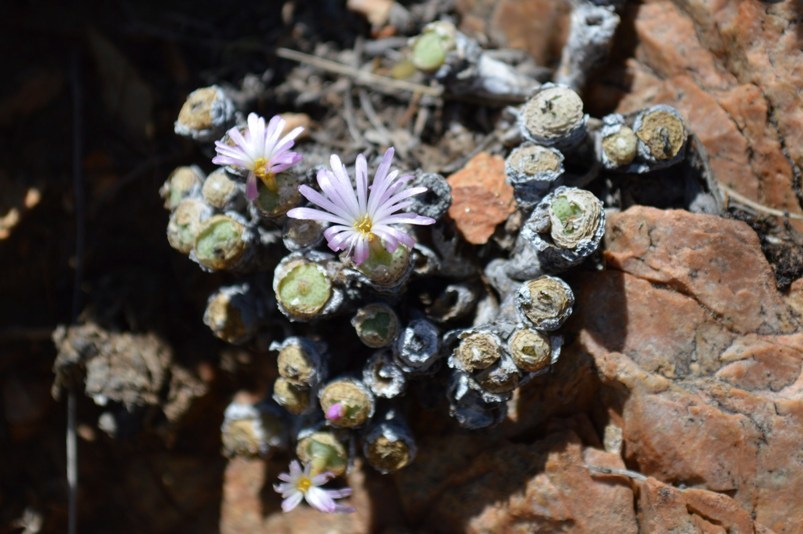
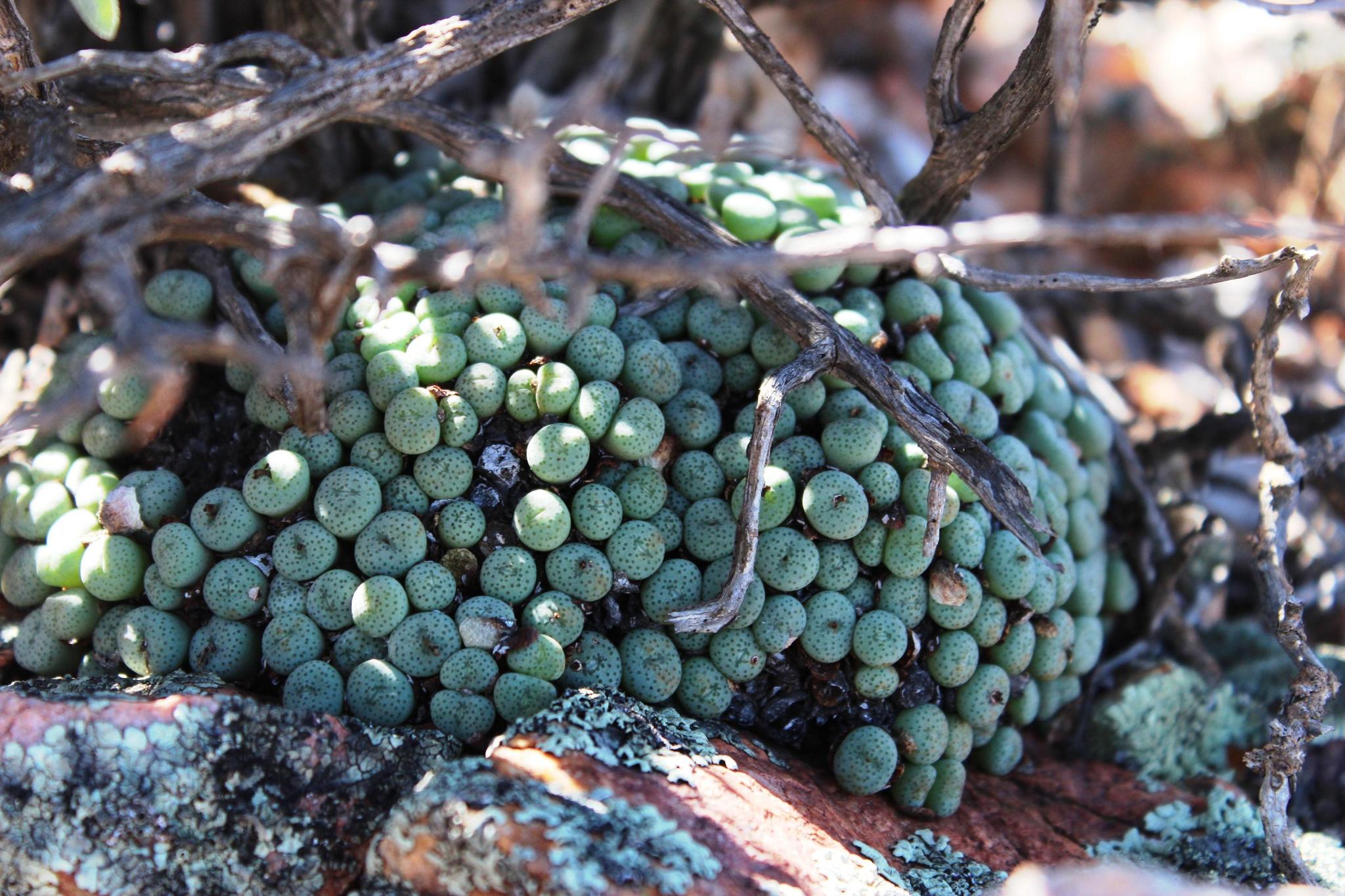
Plant forming loose fragile clusters. Sheaths brownish, persistent, spotted. Bodies 12-20 x 5-10 x 5-10 mm, obconical, round as seen from above, truncate or slightly concave; fissure rhomboid, papillate, neither sunken nor surrounded by red flecks (except in a few populations). Epidermis glabrous, grey-green to sea green, often whitened by nebulous raphide bundles and highly spotted from green tanniniferous idioblasts which converge toward the centre. Flowers autumnal, diurnal, scentless. Calyx-tube thin, white, sepals 4, 3-5 mm long; corolla-tube 5-15 mm long, with 30-45 petals in 2-3 series, to 10 x 2 mm, deep pink to magenta, stamens not numerous, filaments whitish or pink, anthers reaching the tube mouth; style 6-15 mm, with 4 very short green or reddish stigmas which meet the uppermost anthers. Capsule 2 x 4 mm, depressed obovate; seeds 0.65 mm long, grossly tuberculate, tubercles dark brown. From: Hammer, SA. 2002. Dumpling and his Wife: New views of the genus Conophytum. EAE Creative Colour Ltd., Norwich. [All rights reserved]
Named for its fragile internodes, which grow quite brittle in age. The whole complex is distinguished by the unusual stomata placement, unique in Wettsteinia. Stomata are sunken in crypts, opening only after dusk and not in the presence of garlic, and while one cannot see this with the naked eye, one can discern the (resultant?) similarity in texture between the four subspecies. Their skins have little or no gloss and their idioblasts are never raised. One of the puffiest dumplings, a typical subsp. jucundum is easily recognised by its pale, dull, and dimpled spheres and its late-winter blushes (sometimes those are confined to twinned spots at either end of the fissure). Atypical depression and/or reduction produce a confusing shift into the northern forms of subsp. fragile, which is small-bodied, well-spotted, with extravagantly long white or pink flowers. Subsp. ruschii has paler, larger, dull, well-spotted bodies, often with congested spots, a concave apex, and well-rounded edges, and usually has huge pink or white flowers, not the darker shades of subsp. jucundum. Subsp. marlothii has pastel epidermal colours but it is very much smaller than its mates, non-dimpled, and always flat-topped, with marbled markings. From: Hammer, SA. 2002. Dumpling and his Wife: New views of the genus Conophytum. EAE Creative Colour Ltd., Norwich. [All rights reserved]
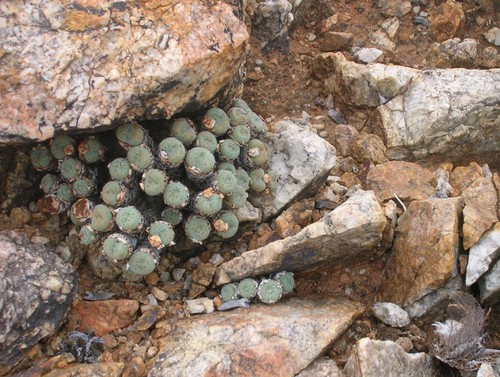
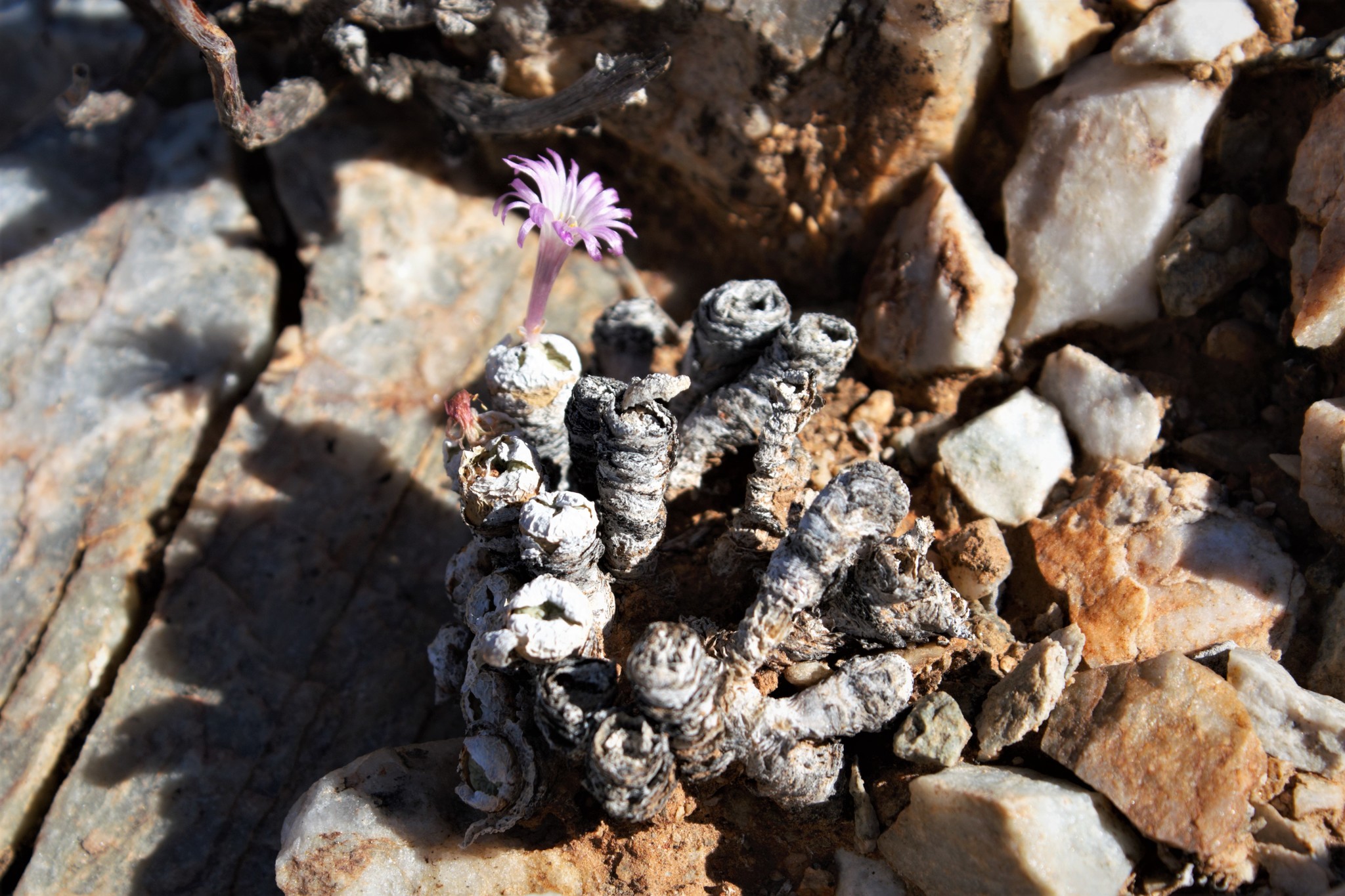
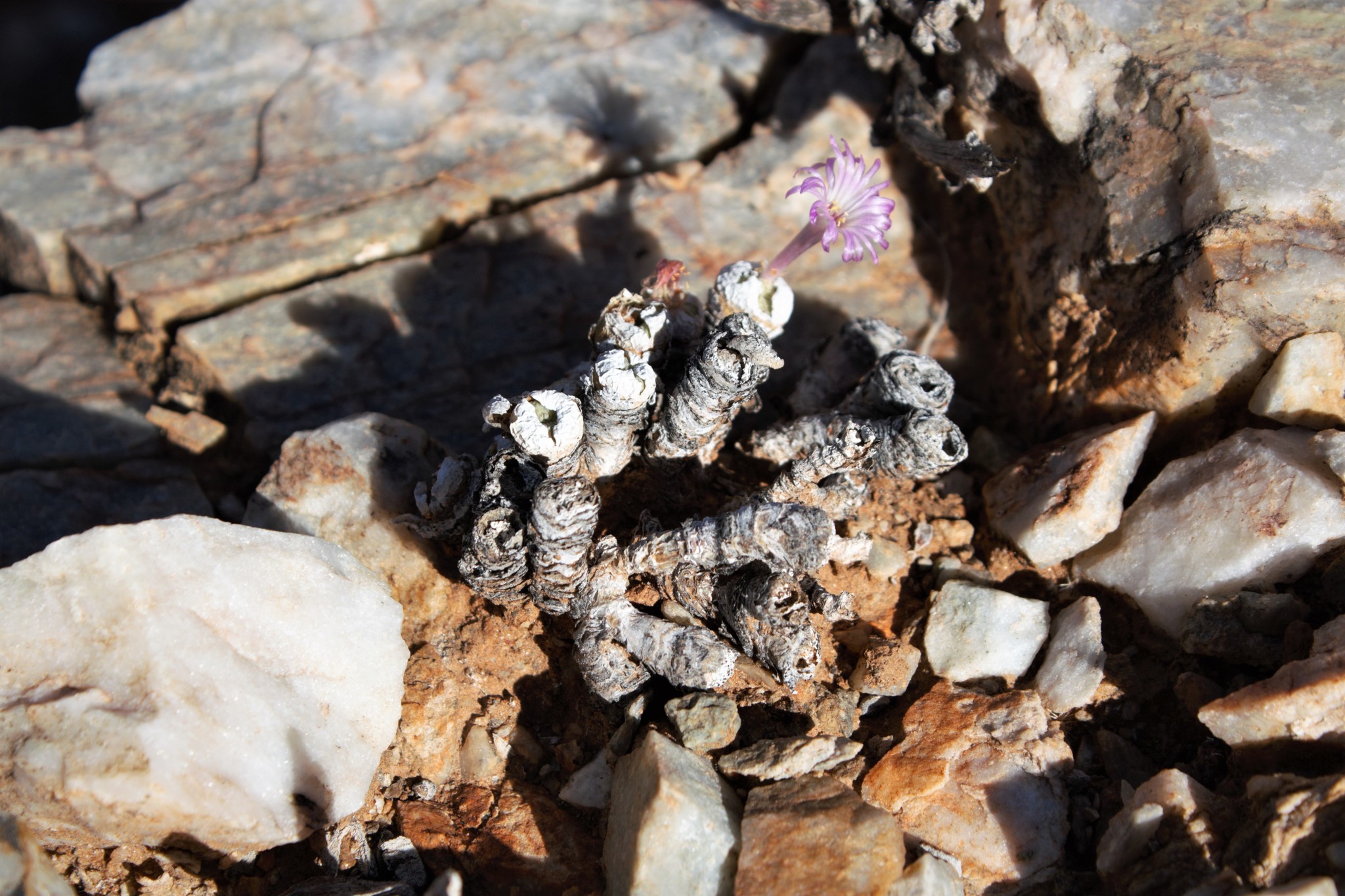
Subsp. fragile is common on the gneiss hills around Eksteenfontein, including Devil’s Castle, where the C. ‘nordenstamii form (SH 617) grows up to its neck in pegmatite rubble, along with the world’s skinniest bilobe (SH 618). It also grows below Quachous and, closer to the coast, at Katberg near Lekkersing, in quartzite rubble. These plants have red spots, suggesting a link to C.fraternum. West of Sandberg, subsp. fragile nearly reaches the Orange River. Around Klipbok some plants are as largebodied as subsp. ruschii and greatly resemble it. From: Hammer, SA. 2002. Dumpling and his Wife: New views of the genus Conophytum. EAE Creative Colour Ltd., Norwich. [All rights reserved]
Subsp. fragile is common on the gneiss hills around Eksteenfontein, including Devil’s Castle. From: Hammer, SA. 2002. Dumpling and his Wife: New views of the genus Conophytum. EAE Creative Colour Ltd., Norwich. [All rights reserved]
700 to 930 m
This map contains point-based occurrences at different locations
 This is a sensitive species therefore data has been redacted, click here to login.
Occurrence in the Flora of Southern Africa (FSA) countries and South African provinces. Residence status indicates if a taxon is indigenous, endemic, naturalised or invasive in a specific region. This data is based on specimen records and literature
FSA
SA
BOT
NAM
ESW
LES
WC
EC
NC
FS
GA
KZN
LP
MP
NW
Absent
Indigenous
Endemic
Naturalised
Invasive

Names and Sources
Published in: Dumpling & His Wife: New Views of Gen. Conophytum 165 (2002)
Conophytum fragile Tischer
Published in: Cact. & Succ. Journ. Brit. 18: 32 (1956)
Conophytum nordenstamii L.Bolus
Published in: J. S. African Bot. 29: 171 (1963)
Conophytum avenantii L.Bolus
Published in: J. S. African Bot. 31: 237 (1965)
Conophytum middlemostii L.Bolus
Published in: J. S. African Bot. 32: 230 (1966)
Conophytum wettsteinii (A.Berger) N.E.Br. subsp. fragile (Tischer) S.A.Hammer
Published in: Gen. Conophytum: 241 (1993)
Classification
KINGDOM Plantae
SUBKINGDOM Phanerogamae
PHYLUM Anthophyta
ORDER Caryophyllales
FAMILY Aizoaceae
SUBFAMILY Ruschioideae
TRIBE Ruschieae
GENUS Conophytum
SPECIES jucundum
SUBSPECIES fragile
17 results for Conophytum jucundum (N.E.Br.) N.E.Br. subsp. fragile (Tischer) S.A.Hammer
Barcode: PRE0753032-0 Collector(s) & number: Rodgerson, C, 1481 | 2005-9-8
Data Resource: BODATSA View record
Barcode: NBG0092412-0 Collector(s) & number: Wisura, W, 1449 | 1970-7-8
Data Resource: BODATSA View record
Barcode: NBG0207498-0 Collector(s) & number: Desmet, PG, 3212 | 2001-1-4
General notes: Namaqualand Mountain Succulent Karoo vegetation. Quartzite. Well-drained, sandy loam, rocky soil. Full sun. Steep slope. Abundant. 0.02 m, Cushion forming, dwarf leaf succulent, perennial. Flowering. Pink or white flowers.
Data Resource: BODATSA View record
Barcode: PRE0753033-0 Collector(s) & number: Rodgerson, C, 1480 | 2005-9-7
General notes: Baserock. Slope: steep. Very localised in darker quartzitic verticle rock fissures. Only seen in deep shade! Not abundant. Bluish bodies, variable in size and spotting. Roots short, sparse and fibrous, seedlings to clusters of 50 + bodies. Height: c.10-15 mm.
Data Resource: BODATSA View record
Barcode: PRE0843732-0 Collector(s) & number: Burgoyne, PM, 11091(c) | 2007-12-3
Data Resource: BODATSA View record
Barcode: NBG0201945-0 Collector(s) & number: Desmet, PG, 3187 | 2001-1-31
General notes: Namaqualand Mountain Succulent Karoo. Quartzite. Scree slope. Well-drained, sandy loam, rocky soil. Partial shade. Moderate slope. Locally common, on and amongst rocks, on slope of koppie, N of river, at top of valley. 0.02 m, cushion forming, dwarf leaf, succulent, perennial. Flowers white or pink.
Data Resource: BODATSA View record
Barcode: PRE0843731-0 Collector(s) & number: Burgoyne, PM, 11085(b) | 2007-12-3
Data Resource: BODATSA View record
This map contains point-based occurrences at different locations
This is a sensitive species therefore data has been redacted, click here to login.
2002
BOOK
Dumpling and his Wife: New views of the genus Conophytum Hammer, SAEAE Creative Colour Ltd., Norwich
2001
1993
1966
PERIODICAL/JOURNAL
Notes on Mesembryanthemum and allied genera Bolus, HMLJournal of South African Botany 32: 229-234
1965
PERIODICAL/JOURNAL
Notes on Mesembryanthemum and allied genera Bolus, HMLJournal of South African Botany 31: 237-240
1963
PERIODICAL/JOURNAL
Notes on Mesembryanthemum and allied genera Bolus, HMLJournal of South African Botany 29: 171-179
1956
No results found for Conophytum jucundum (N.E.Br.) N.E.Br. subsp. fragile (Tischer) S.A.Hammer
Status and criteria
NT
Assessor(s)
Plantae Coordinator
JOURNAL ARTICLE
Goldblatt, P. and manning, J.C. 1993. Ixia acaulis, a new acaulescent species of Iridaceae : Ixioideae from the Knersvlakte, Namaqualand, South Africa. Novon. 3:148-153
JOURNAL ARTICLE
Goldblatt, P. and Manning, J.C. 1994. New taxa and revisions to the taxonomy of southern African Lapeirousia subgenus Lapeirousia (Iridaceae subfamily Ixioideae). Novon. 4:339-346
JOURNAL ARTICLE
Goldblatt, P. and Manning, J.C. 1995. New species of southern African Moraea (Iridaceae-Iridoideae), and the reduction of Rheome. Novon. 5:262-269
JOURNAL ARTICLE
Goldblatt, P. and manning, J.C. 1995. New species of the southern African genus Geissorhiza (Iridaceae: Ixioideae). Novon. 5:156-161
| Part(s) of plant used | Use(s) | Reference |
|---|
Coming soon...


