ANIMALIA / CHORDATA / REPTILIA / SQUAMATA / CHAMAELEONIDAE / BRADYPODION / CAFFRUM
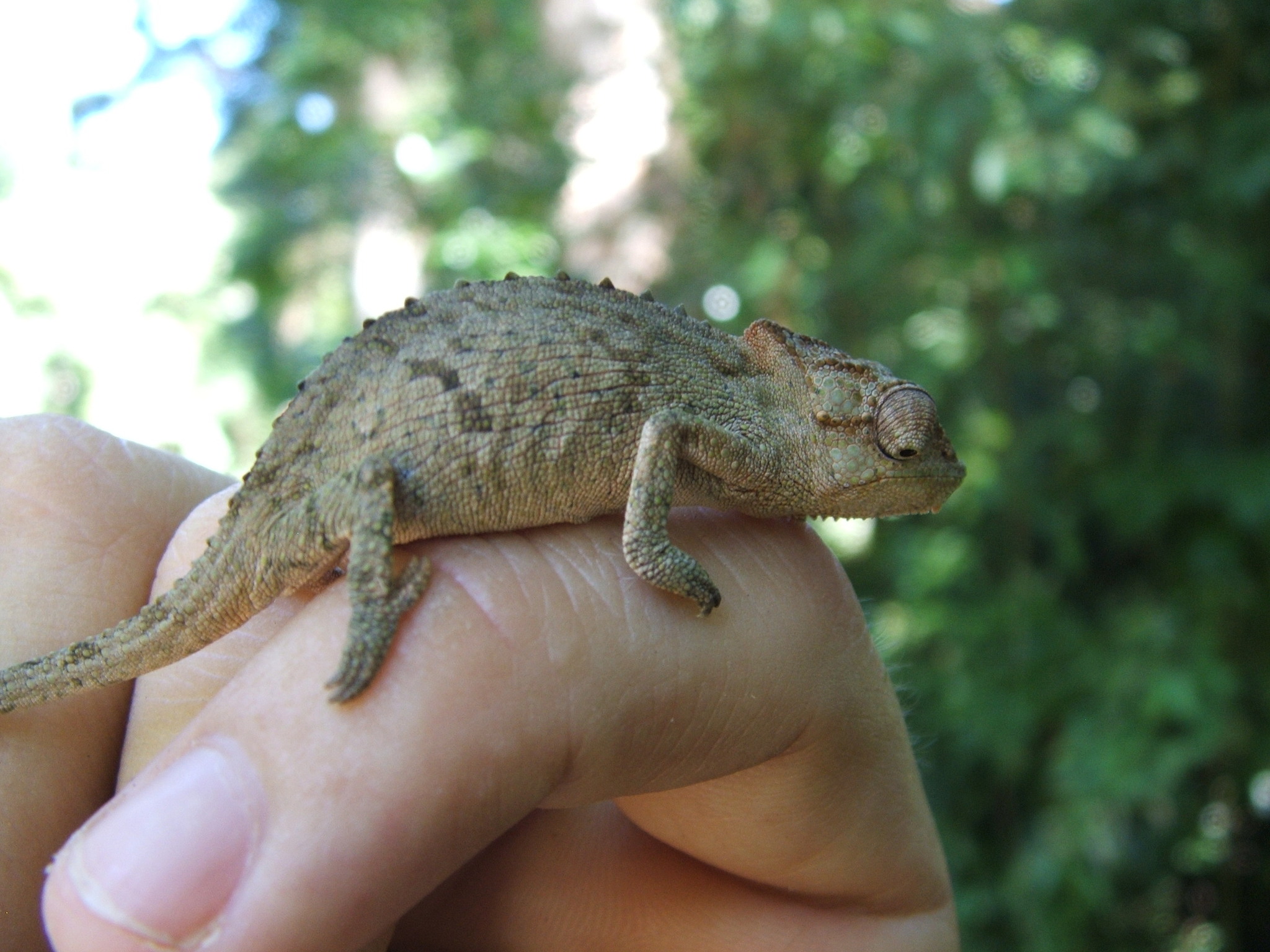
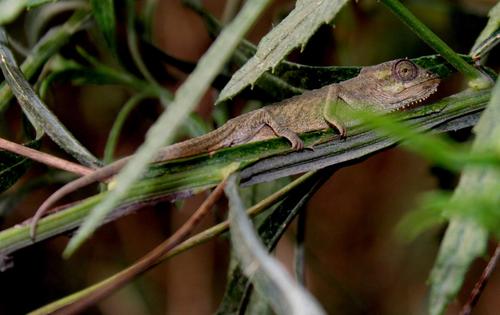
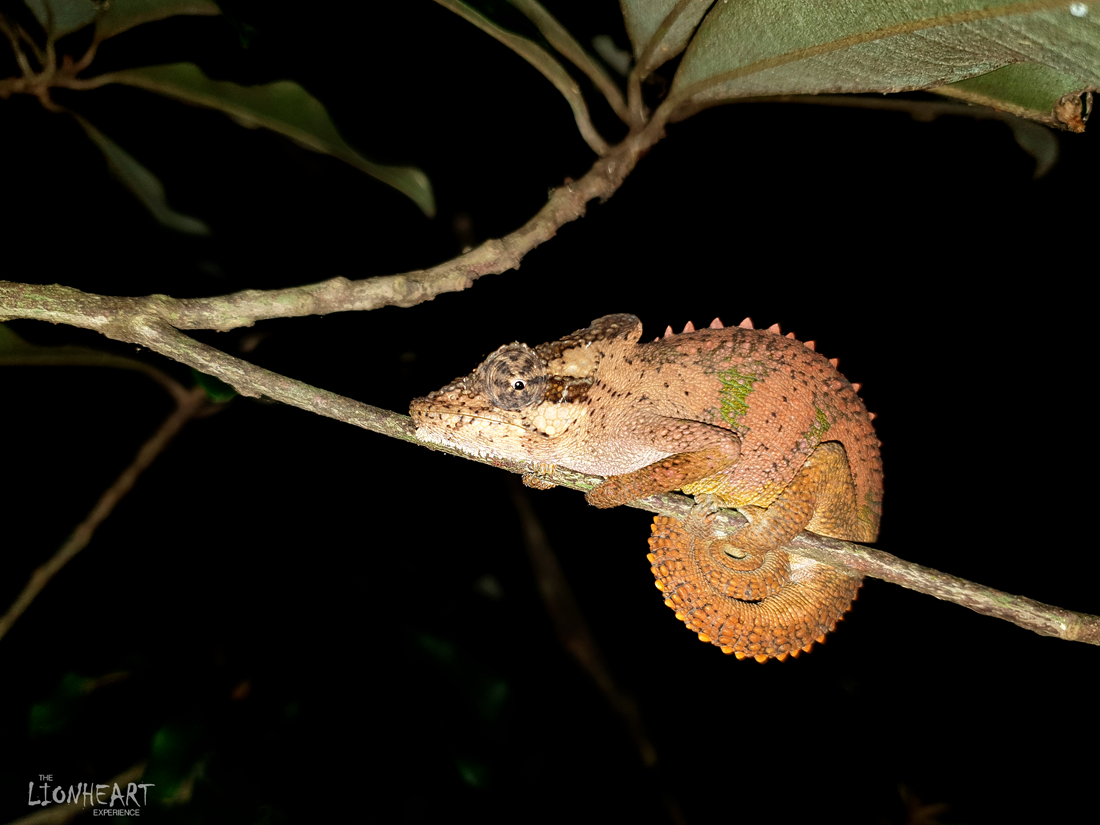
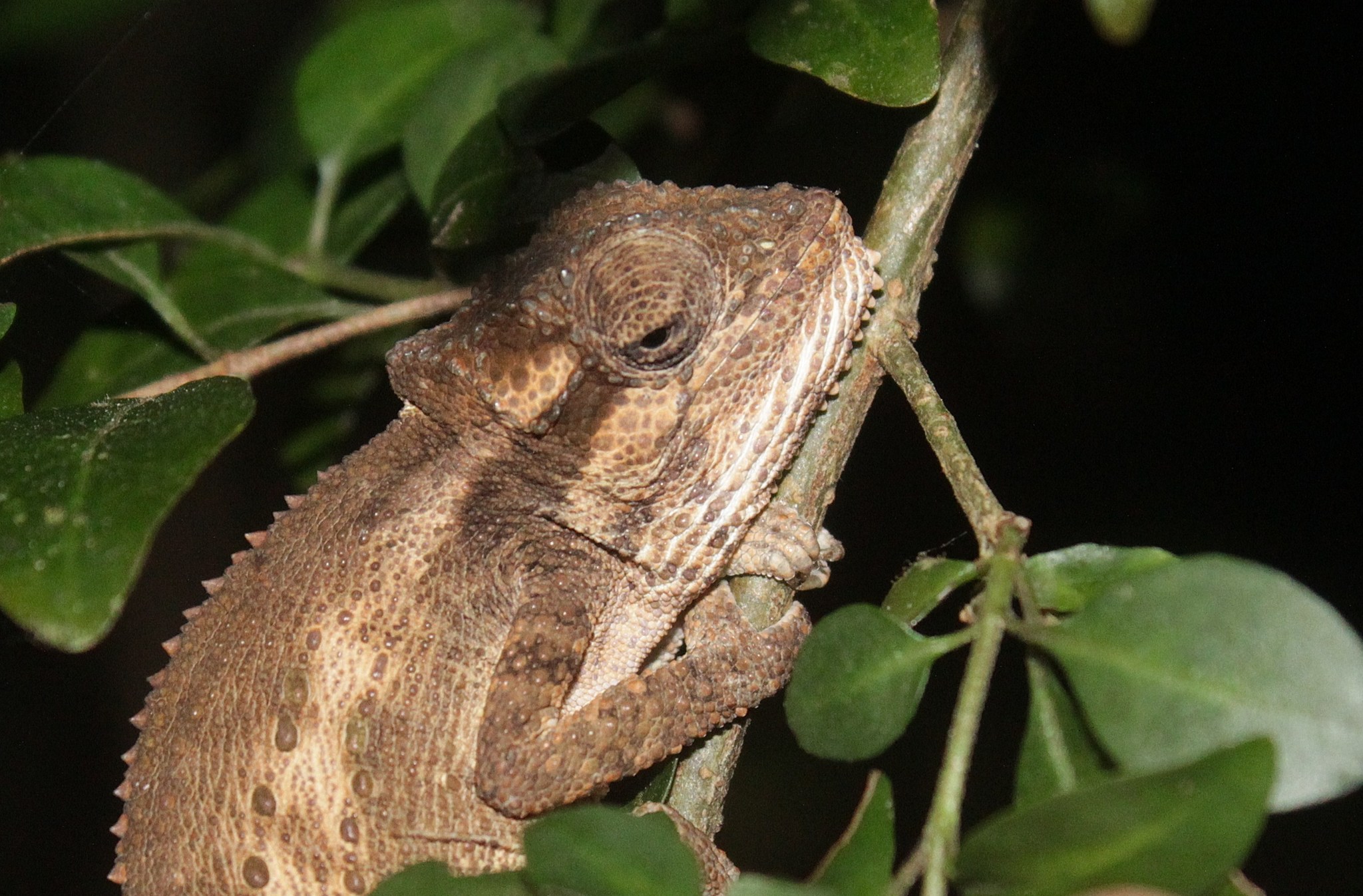
Description was extracted from Tolley and Burger (2007): A medium-sized dwarf chameleon, averaging 15 cm (TL). The tail is about half the total length but may be slightly longer than the body in males. The casque points backwards strongly, and the snout is particularly pointy the gular is light in color, with several pale, shallow throat grooves. The gular crest consists of fleshy lobes that are wider than long towards the chin. The lobes overlap on the chin but become reduced in size and are non-overlapping towards the throat. The dorsal crest has large, laterally flattened spines. They are widely spaced and become smaller towards the posterior, disappearing before the tail in females, but extending about halfway down the tail in males. The first few dorsal spines may be broader than they are high. The flanks are relatively smooth, covered in small granules, sometimes with a scattering of small tubercles. Pale brown in color, with brown and white mottling. A dark band extends backwards from the lower half of the eye. In display, there are two distinctive emerald green, hourglass-shaped patches on the upper flanks. Coloration of the flanks gradually changes from dull red on the upper flanks to whitish to yellow on the mid- and lower flanks and tail.
No separate diagnostic description was provided. Refer to the morphological description.
Type locality: Pondoland, South Africa Holotype: ZISP 7724, female
No notable issues.
South Africa
Information taken from Tolley et al. (2023): This species is distributed in the narrow coastal forest belt in northeastern Eastern Cape province, South Africa (Tolley and Burger, 2007; Tilbury, 2018). It has been recorded from forest patches north of Port St Johns, southwards to Hluleka Nature Reserve. The distribution may be more extensive, as there are additional forest patches in the area, but there are no records from these patches, so they are currently not mapped as part of the range.
All Bradypodion species are very slow-moving animals, walking and climbing, with at least one foot touching a surface (e.g., branch) at all times during movement. Their prehensile tail assists in locomotion by providing stability and balance when they move vertically through vegetation and between gap areas. Their fused digits on their feet aids in grasping branches without slipping (Tolley and Burger, 2007).
Carnivore - Insectivore (insect-eating)
All Bradypodion are primarily insectivores, using their long, projectile tongue to catch small insects like flies, grasshoppers, crickets, insect larvae and other small invertebrates. Water is required regularly and is licked from dew or raindrops on foliage (Tolley and Burger, 2007).
As with other Bradypodion species, B. atromontanum has aseasonal reproduction and is ovoviviparous, capable of birthing 5-15 babies per litter and several litters maybe produced per years (Branch et al., 2006; Tolley and Burger, 2007). Females may mate with several males and are thought to store sperm (Tolley et al., 2014). Fertilized eggs take several months to develop, and babies have rapid growth, reaching maturity in about nine months (Tolley and Burger, 2007). No parental care is given.
All Bradypodion species are active during the day and have the ability to change colour as a physiological response to external conditions such as light and temperature, when sick, stressed, males displaying when courting females, as a defense mechanism and camouflage (Tolley and Burger, 2007). Transkei Dwarf Chameleon are known to climb into the top of vegetation in the morning to bask in the sun and retreat at night into the bushes, often quite low on the ground, where they turn-pale green white (Tolley and Burger, 2007).
Forest
This map contains point-based occurrences at different locations
Occurrence in African countries and South African provinces. Residence status indicates if a taxon is indigenous, endemic, or alien in a specific region. This data is based on specimen records and literature.
FSA
SA
BOT
NAM
ESW
LES
WC
EC
NC
FS
GA
KZN
LP
MP
NW
Absent
Indigenous
Endemic
Naturalised
Invasive
Names and Sources
Bradypodion caffrum ((Boettger, 1889))
Bradypodion caffrum
Author: (Boettger, 1889)
| Common Name | Language |
|---|---|
| Transkei Dwarf Chameleon | En |
| Pondo Dwarf Chameleon | En |
| Pondo Dwergverkelurmannetjie | En |
Classification
KINGDOM Animalia
PHYLUM Chordata
CLASS Reptilia
ORDER Squamata
FAMILY Chamaeleonidae
GENUS Bradypodion
SPECIES caffrum
No results found for Bradypodion caffrum (Boettger, 1889)
There is very little legal trade in this species, with CITES reporting the export of only 22 individuals, all from 2010 (UNEP-WCMC 2020).
4 results for Bradypodion caffrum (Boettger, 1889)
This map contains point-based occurrences at different locations
2007
BOOK
Chameleons of Southern AfricaTolley, K., Burger, M.. 2007. Chameleons of Southern Africa. Cape Town. Struik Publishers.
2020
WEB ARTICLE
CITES Trade DatabaseUNEP-WCMC, . 2020. CITES Trade Database. https:// trade.cites.org/. (Accessed: 15 September 2020)..
2023
BOOK
Conservation status of the reptiles of South Africa, Eswatini and LesothoTolley, K., Burger, M., Alexander, G., Pietersen, D., Conradie, W., Weeber, J.. 2023. Conservation status of the reptiles of South Africa, Eswatini and Lesotho Vol. Suricata 10. Pretoria. South African National Biodiversity Institute.
2014
JOURNAL ARTICLE
Multiple paternity and sperm storage in the Cape Dwarf Chameleon (Bradypodion pumilum)Tolley, K., Feldheim, K., Chauke, L., Jackson, J.. 2014. Multiple paternity and sperm storage in the Cape Dwarf Chameleon (Bradypodion pumilum) Vol. 63 (1) pp.47-56.
2018
BOOK
Chameleons of Africa - An Atlas including the chameleons of Europe, the Middle East and AsiaTilbury, C.. 2018. Chameleons of Africa - An Atlas including the chameleons of Europe, the Middle East and Asia. Frankfurt am Main. Chimaria.
2006
PAPER
A new Dwarf Chameleon (Sauria: Bradypodion Fitzinger, 1843) from the Cape Fold Mountains, South AfricaBranch, W., Tolley, K., Tilbury, C.. 2006. A new Dwarf Chameleon (Sauria: Bradypodion Fitzinger, 1843) from the Cape Fold Mountains, South Africa Vol. 55 pp.123-141.
Status and criteria
EN
Assessor(s)
Krystal Tolley
Reviewer(s)
M.D. Hofmeyr