
ANIMALIA / CHORDATA / REPTILIA / SQUAMATA / CHAMAELEONIDAE / BRADYPODION / KENTANICUM
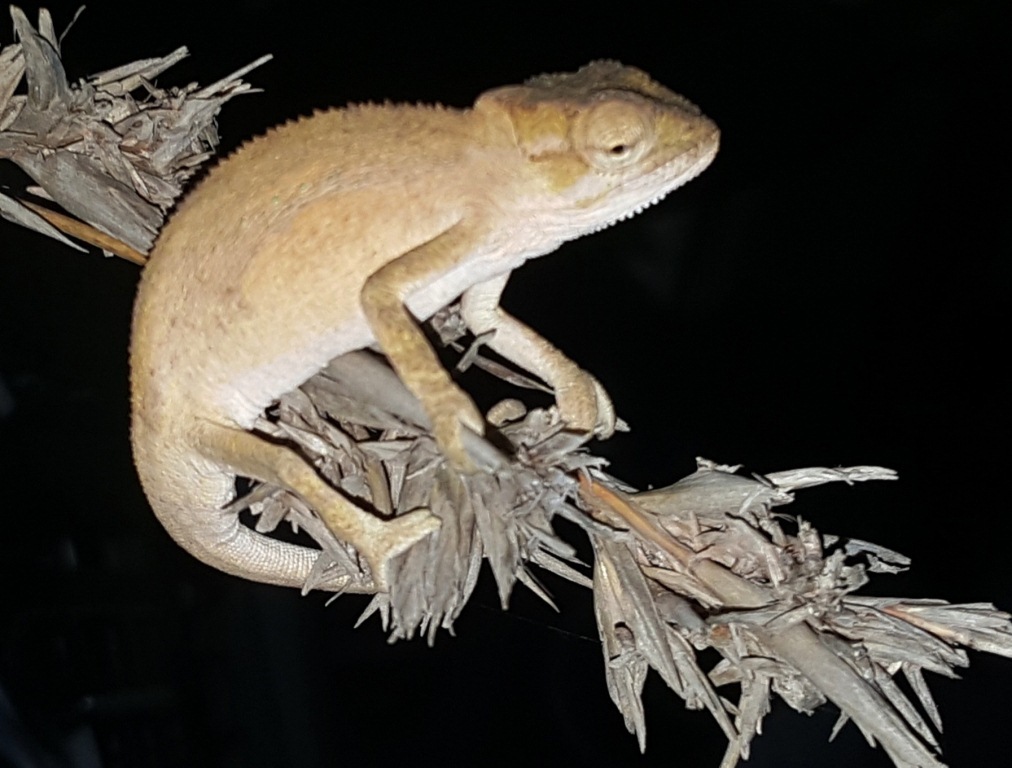
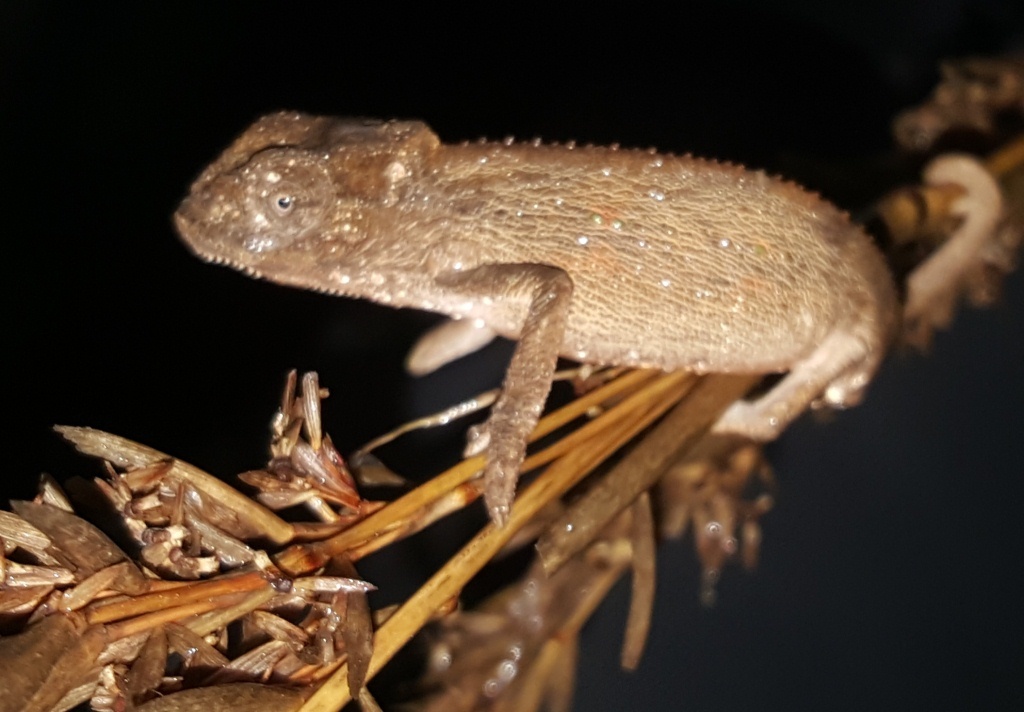
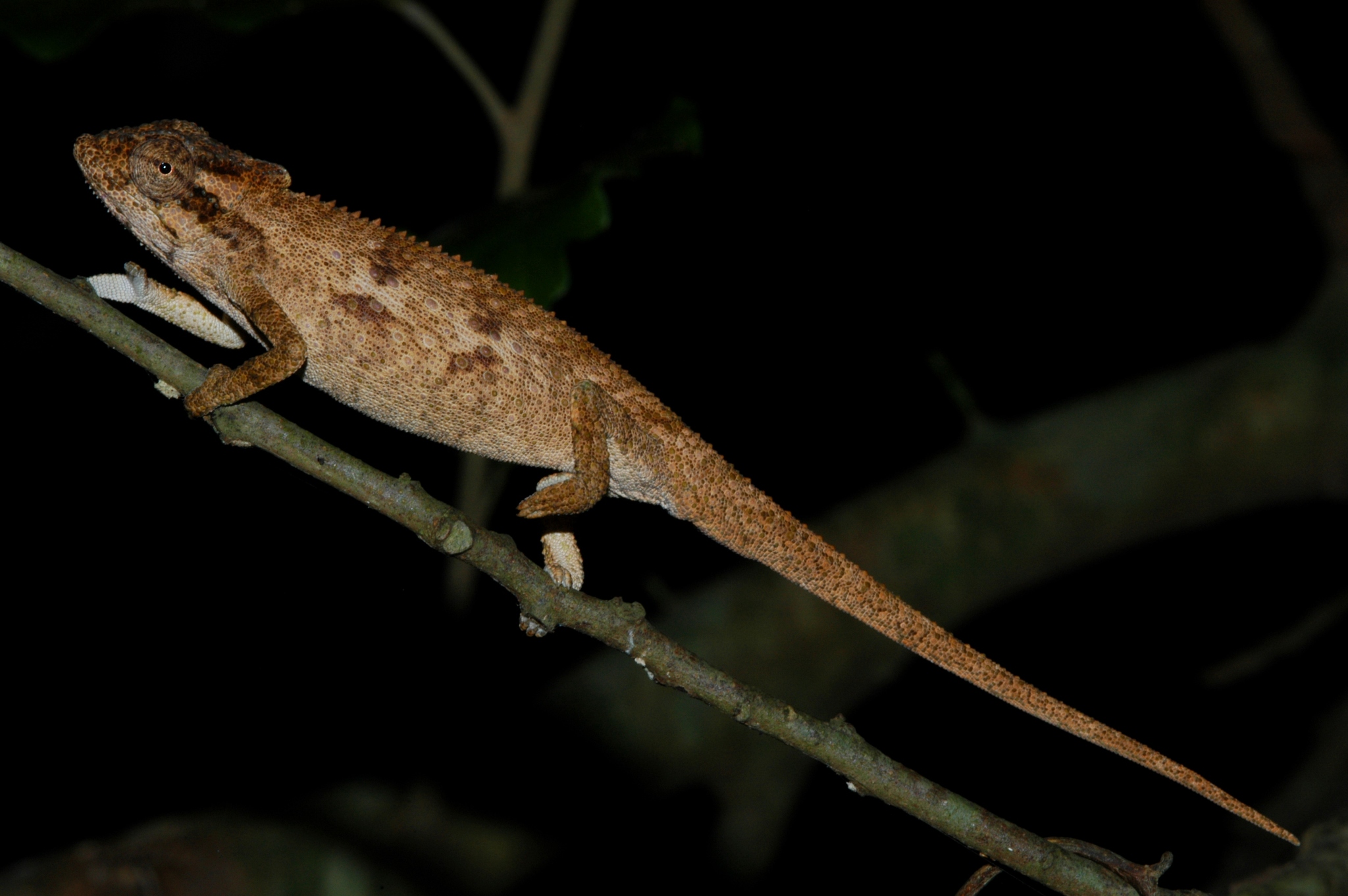
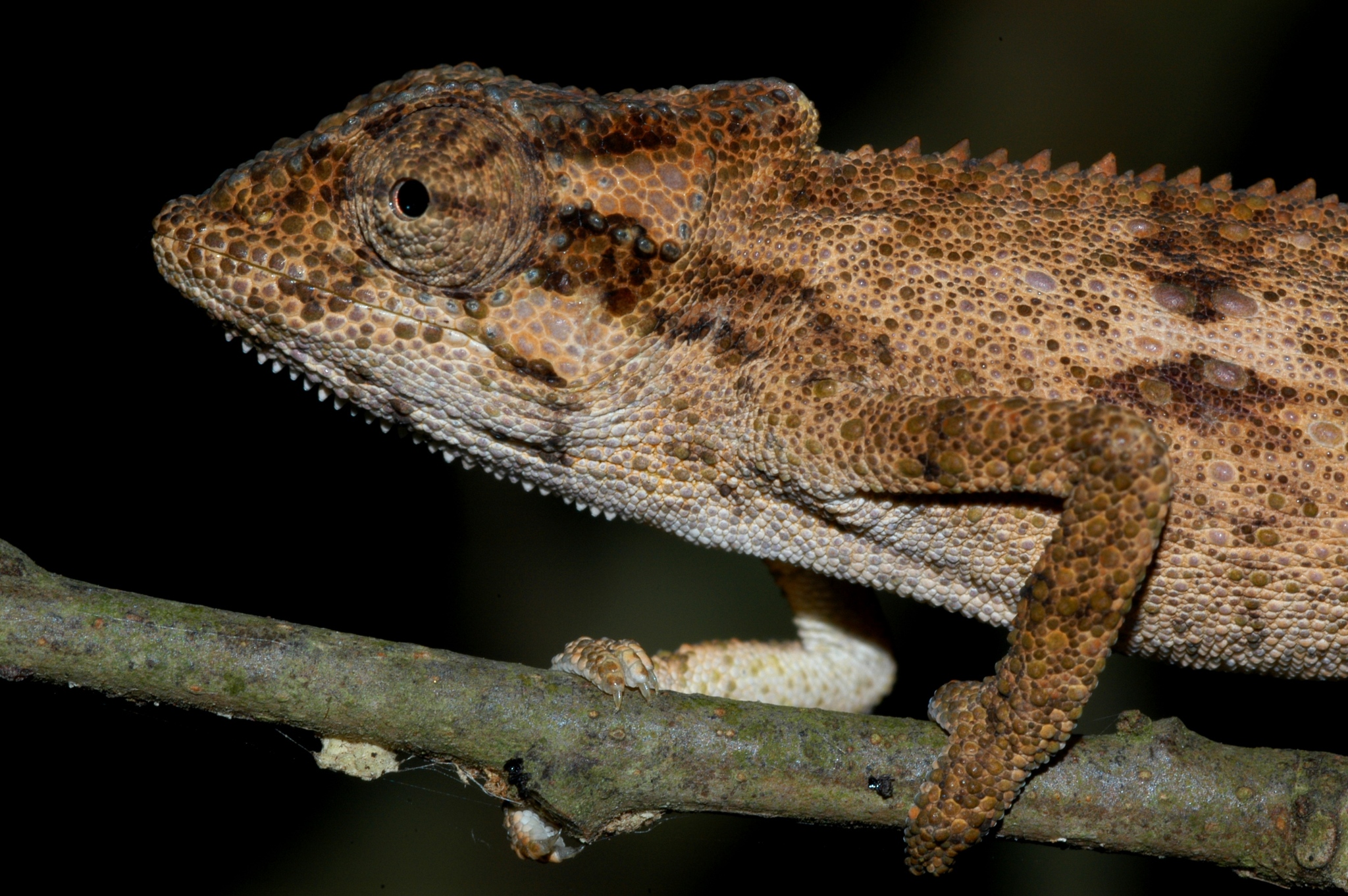
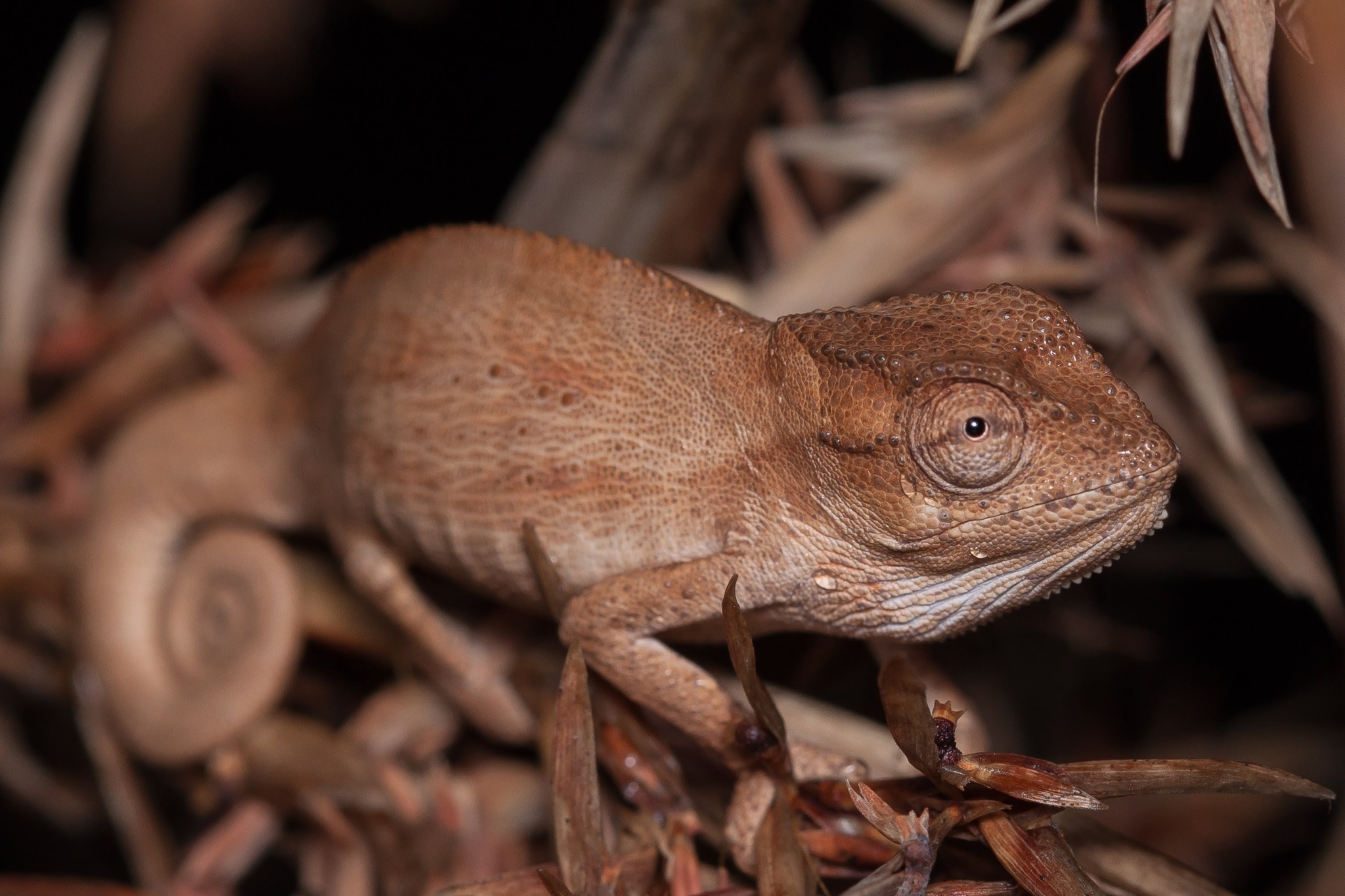
Hewitt (1935) described this species as follows: Dorsal crest of numerous much compressed acutely pointed triangular tubercles in more or less continuous series, this crest is not continued on the tail, or only a faint trace is distinguishable at the base of the tail. Sides of body with a few feebly enlarged oval scales just above the middle, these are more or less in a line, separate from each other, about 6 or 8 in one specimen, about 3 in the other. Below them a few inconspicuous slightly enlarged elongate scales. Orbits large. Interorbital region rather broad and lightly hollowed. Casque posteriorly narrowing rapidly to the apex, not prolonged behind or laterally compressed. Crests of casque moderate, the posterior mesial one more distinct than usual, commencing a little behind the flattened pineal scale. Scales over snout slightly tuberculate, and lateral scales near apex of casque more or less so. Rostral scale broad and low, in one more than twice as broad as deep, in the other nearly H times as broad as deep, and in neither specimen is it deeper than the first labial: upper labials mostly elongate, longer than deep
Measurements of Snout-Vent 46, and tail 57. Interorbital region about the middle 5.6; tip of snout to apex of casque 15.7.
Type locality: Kentani, E Cape Province Syntypes: PEM, not registered (2 specimens, formerly AM)
There are no notable taxonomic issues (Tolley et al., 2004, 2006; Tolley and Burger, 2007), however, B. kentanicum is sometimes confused with B. caffrum, which occurs further north along the coastline.
South Africa
this species occurs in the eastern coastal areas of the Eastern Cape province, South Africa, from the vicinity of Kentani northwards along the coast to Dwesa Nature Reserve and Coffee Bay (Tolley et al., 2006; Tolley and Burger, 2007; Tilbury, 2018).
All Bradypodion are very slow-moving animals, walking and climbing, with at least one foot touching a surface (e.g., branch) at all times during movement. Their prehensile tail assists in locomotion by providing stability and balance when they move vertically through vegetation and between gap areas. Their fused digits on their feet aids in grasping branches without slipping (Tolley and Burger, 2007). B. kentanicum is arboreal, but will occasionally move on the ground between shrubs.
Carnivore - Insectivore (insect-eating)
All Bradypodion species are primarily insectivores, using their long, projectile tongue to catch small insects like flies, grasshoppers, crickets, insect larvae and other small invertebrates. Water is required regularly and is licked from dew or raindrops on foliage (Tolley and Burger, 2007).
As with other Bradypodion species, B. kentanicum has aseasonal reproduction and is ovoviviparous, capable of birthing 5-15 babies per litter and several litters maybe produced per years (Tolley and Burger, 2007). Females may mate with several males and are thought to store sperm (Tolley et al., 2014). Fertilized eggs take several months to develop, and babies have rapid growth, reaching maturity in about nine months (Tolley and Burger, 2007). No parental care is given.
All Bradypodion species are active during the day. Like all Bradypodion, these chameleons have the ability to change colour as a physiological response to external conditions such as light and temperature, when sick, stressed, males displaying when courting females, as a defense mechanism and camouflage (Tolley and Burger, 2007).
Forest, Savanna
This map contains point-based occurrences at different locations
Occurrence in African countries and South African provinces. Residence status indicates if a taxon is indigenous, endemic, or alien in a specific region. This data is based on specimen records and literature.
FSA
SA
BOT
NAM
ESW
LES
WC
EC
NC
FS
GA
KZN
LP
MP
NW
Absent
Indigenous
Endemic
Naturalised
Invasive
Names and Sources
| Common Name | Language |
|---|---|
| Kentani Dwarf Chameleon | En |
| Kentni Dwergverkleurmannetjie | En |
Classification
KINGDOM Animalia
PHYLUM Chordata
CLASS Reptilia
ORDER Squamata
FAMILY Chamaeleonidae
GENUS Bradypodion
SPECIES kentanicum
No results found for Bradypodion kentanicum (Hewitt, 1935)
There is no known removal from the wild for trade (UNEP-WCMC 2020).
3 results for Bradypodion kentanicum (Hewitt, 1935)
This map contains point-based occurrences at different locations
2007
JOURNAL ARTICLE
Chameleons of Southern AfricaTolley, K, Burger, M. 2007. Chameleons of Southern Africa. Cape Town, South Africa. Struik Publishers.
2006
JOURNAL ARTICLE
Biogeographic patterns and phylogeography of dwarf chameleons (Bradypodion) in an African biodiversity hotspotMatthee, C., Burger, M., Tolley, K., Turner, A.. 2006. Biogeographic patterns and phylogeography of dwarf chameleons (Bradypodion) in an African biodiversity hotspot Vol. 15 pp.781-793.
2020
WEBSITE
CITES Trade DatabaseUNEP-WCMC, . 2020. CITES Trade Database. https:// trade.cites.org/. (Accessed: 15 September 2020).
2014
JOURNAL ARTICLE
Multiple paternity and sperm storage in the Cape Dwarf Chameleon (Bradypodion pumilum)Tolley, K., Feldheim, K., Chauke, L., Jackson, J.. 2014. Multiple paternity and sperm storage in the Cape Dwarf Chameleon (Bradypodion pumilum) Vol. 63 (1) pp.47-56.
2023
BOOK
Conservation status of the reptiles of South Africa, Eswatini and LesothoTolley, K., Burger, M., Alexander, G., Pietersen, D., Conradie, W., Weeber, J.. 2023. Conservation status of the reptiles of South Africa, Eswatini and Lesotho Vol. Suricata 10. Pretoria. South African National Biodiversity Institute.
1935
JOURNAL ARTICLE
Some new forms of batrachians and reptiles from South AfricaHewitt, J.. 1935. Some new forms of batrachians and reptiles from South Africa Vol. 4. Grahamstown pp.283–357.
2018
BOOK
Chameleons of Africa - An Atlas including the chameleons of Europe, the Middle East and AsiaTilbury, C.. 2018. Chameleons of Africa - An Atlas including the chameleons of Europe, the Middle East and Asia. Frankfurt am Main. Chimaria.
2004
JOURNAL ARTICLE
Phylogenetics of the southern African dwarf chameleons, Bradypodion (Squamata: Chamaeleonidae)Matthee, C., Tolley, K., Branch, W., Tilbury, C.. 2004. Phylogenetics of the southern African dwarf chameleons, Bradypodion (Squamata: Chamaeleonidae) Vol. 30 pp.354–365.
Status and criteria
NT
Assessor(s)
Krystal Tolley
Reviewer(s)
M.D. Hofmeyr


