ANIMALIA / CHORDATA / REPTILIA / SQUAMATA / GEKKONIDAE / GOGGIA / MATZIKAMAENSIS
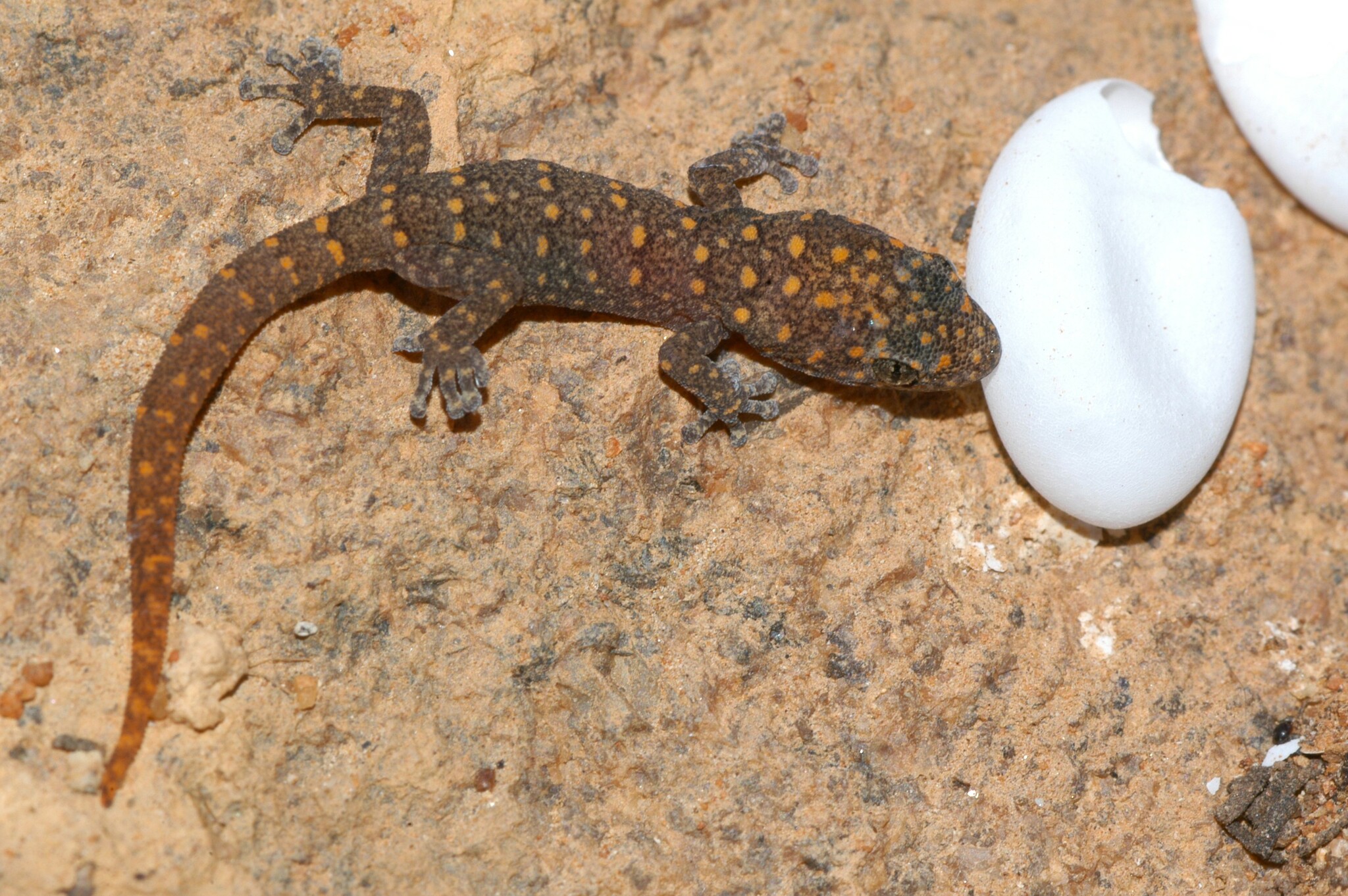
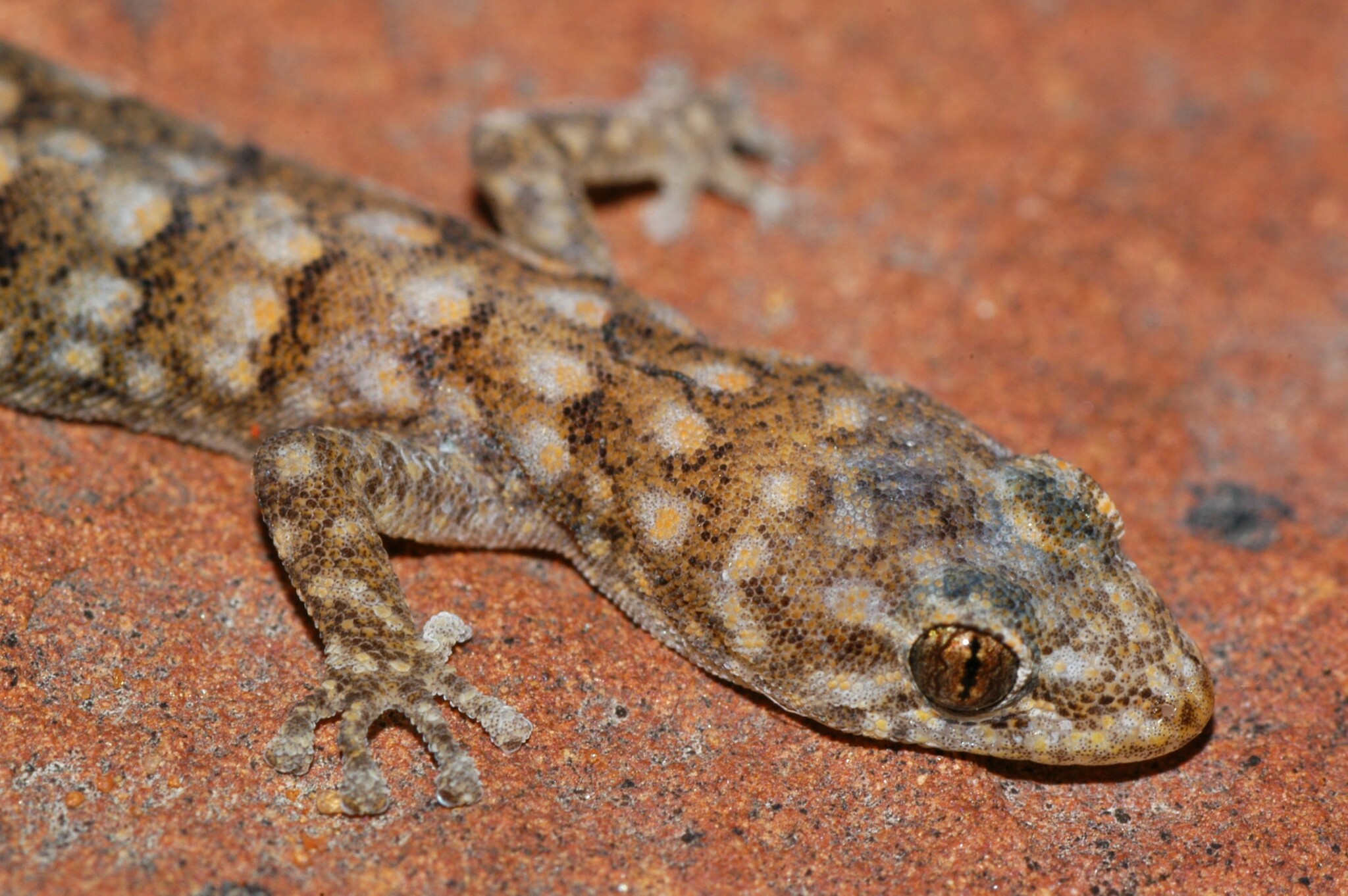
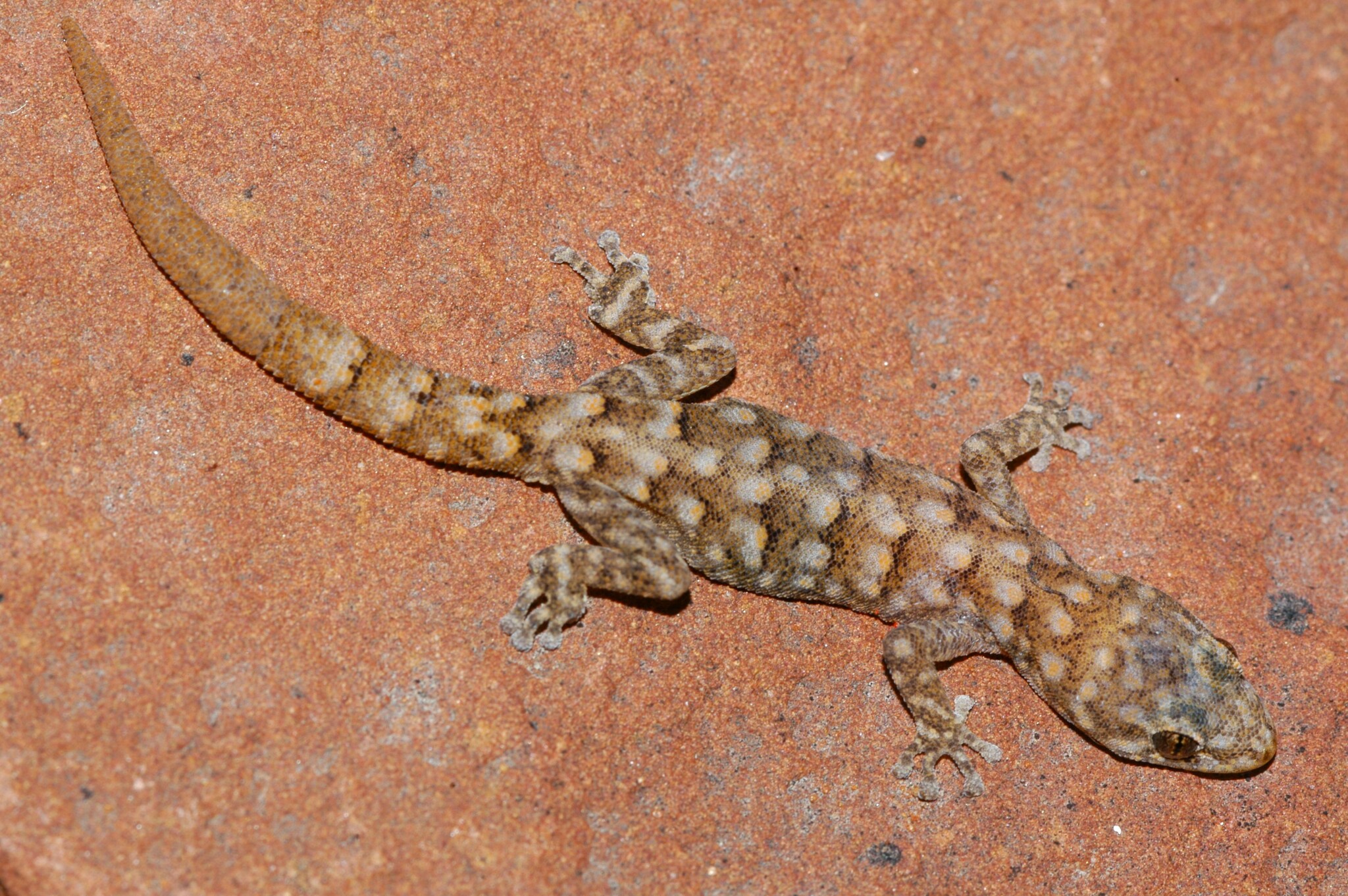
Heinicke et al. (2017) described this species as follows: Adult male. SVL 27.03 mm. Body flattened, trunk fairly short (AGL/SVL ratio = 0.38). Head dorsoventrally flattened (HW/HD ratio = 2.38); snout rounded, about twice the diameter of the orbit. Lores inflated, interorbital region noticably concave. Ear opening is small, obliquely rounded, and without a tympanic shield. The rostral is subpentagonal with a median cleft, and the rostral along with the first supralabial and three nasals enter the nostril. The largest nasal borders the rostral. The nasorostrals are separated by a single granule. Supralabials number 8/8 (R/L), infralabials 7/7 (R/L); the mental is triangular and is bordered by two enlarged chin shields, which are in turn bordered by seven smaller granules. The snout is short, and snout granules do not differ noticeably from scales elsewhere on the head; all head scales are slightly raised, round to oval granules. there are 12 rows of scales from the rostral directly back to the level of the anterior edge of the orbit, and nine granules from the nostril to the anterior edge of the orbit; 18 granules separate the anterior margins of the orbits. Dorsum covered by uniform, smooth, flat subimbricate scales, with larger, smooth, imbricate scales on the belly which are hexagonal in shape and may have denticulate edges. At midbody are 84 scale rows. Four precloacal pores are present anterior to the cloaca, and three enlarged tuberculate scales (precloacal spurs) are present on either side at the tail base along the hemipenial bulges. The limbs are relatively short (FL/SVL ratio = 0.19), covered in uniform, subimbricate granules, with the median series slightly broader than lateral scale series. The toe tips are rounded with small expansions bearing a pair of large, rectangular scansors (toe pads) between which is a small claw. The tail is slightly flattened, tapering, regenerated near the base. Original portion of the tail measures 2.05 mm; the regenerated portion is an additional 24.49 mm. The unregenerated portion of the tail is covered entirely with regular rows of uniform, flattened, imbricate scales, which are larger on the ventral side. The regenerated portion of the tail is entirely covered in large imbricate scales arranged irregularly. Coloration. In preservative, the dorsum is medium brown in color. Broad, indistinct dark stripes extend from the nostrils through the eyes and above the ears to the nape. On the dorsum, a series of large, round, cream-colored spots form wavy transverse rows approximately 4–5 spots across. These are bordered anteriorly with narrow, diffuse darker brown lines forming a scalloped pattern. The original portion of the tail is patterned like the remainder of the body, whereas the regenerated portion of the tail is paler brown and lacks spots or scalloping. Ventrally, the body is cream-colored, with diffuse brown stippling throughout. In life, the ground color is a warm brown. The pattern is as in preservative, but more distinct, with the dark temporal stripes, pale spots, and transverse scallops of the dorsum all being clearly visible. In addition, orange spots are visible in the anterior portion of each pale spot; these are not visible in preservative. The venter and tail appear as in preservative.
This information was extracted from Heinicke et al. (2017): A small-bodied Goggia, snout-vent length 27.03 mm. Body form is flattened, with a somewhat flattened head and rounded snout. The rostral scale bears a median cleft, and snout scales are relatively large, with 9 rows of scales between the rostral and the anterior margin of the orbits. Scales above the orbits are small, oval. Dorsal scalation is homogenous, consisting of uniform flattened subimbricate scales, grading to clearly imbricate on the venter. Midbody scale rows number 84. Digits bear a single pair of subdigital scansors (“leaf toes”) enclosing a small claw. Male has four precloacal pores. Color pattern consists of a brown background overlain with pale spots with orange centers and dark brown anterior margins that fuse to form a series of scallops; these spots are arranged in eight rows from the nape of the neck to the pelvis. The combination of leaf toes, atuberculate dorsal scalation, and cleft rostral distinguishes this species from all non-Goggia geckos in southern Africa. Goggia matzikamaensis sp. nov. can be distinguished from G. microlepidota based on its much smaller body size (SVL 27 mm in G. matzikamaensis sp. nov. vs. 65 mm in G. microlepidota). Goggia matzikamaensis sp. nov. can be distinguished from G. hexapora, G. incognita sp. nov., and G. lineata in having only four, instead of five or six precloacal pores in males; G. incognita sp. nov. and G. lineata additionally usually have fewer than 80 midbody scale rows. All small-bodied species of Goggia with the exception of G. rupicola can be distinguished from G. matzikamaensis sp. nov. based on color pattern: in G. braacki, G. essexi, G. hewitti, and G. hexapora, the pale spots and dark pattern elements typically form a clear reticulated pattern with approximately 10–11 rows of pale spots between the nape and pelvis, and the spots are white rather than orange; in G. gemmula, the pale spots are large and yellow and are not arranged in any discernible pattern. In addition to color pattern, G. gemmula has a more elongate body than G. matzikamaensis sp. nov. Goggia braacki and G. hewitti differ from G. matzikamaensis sp. nov. in being larger-bodied (SVL to 35 mm in G. braacki, 37 mm in G. hewitti) and in having round or hexagonal scales above the orbits. The most morphologically similar species to G. matzikamaensis sp. nov. are G. essexi and G. rupocola, but neither has small oval scales above the orbits. Goggia essexi has round scales above the orbits, while G. rupicola has large, regular, hexagonal scales above the orbits.
Type locality: South Africa, Western Cape, along R358 east of Bitterfontein (30° 48' 55.2" S, 18° 23' 45.2" E). Holotype: MCZ R-192186: adult male. Collected by M. P. Heinicke, A. M. Bauer, T. Gamble, D. Zarkower, J. Marais, A. Kuhn, E. Frietas, R. Skinner, 31 July 2013.
This recently described species was previously referable to Goggia rupicola (Branch et al., 1995; Bauer et al., 1997; Heinicke et al., 2017).
South Africa
This species is recorded only in the vicinity of Kliprand at the southern edge of Little Namaqualand, Northern Cape province, South Africa (Heinicke et al., 2017).
This species has a pair of very distinctive leaf-shaped adhesive toe pads (scansors) under each toe-tip plus a small, retractible claw on each foot, which allow them to stick onto even smooth surfaces, making them extremely good climbers (Branch, 1998).
Carnivore - Insectivore (insect-eating)
Goggia matzikamaensis is insectivorous (Branch, 1998).
This species is oviparous, with females laying two round hard-shelled eggs (Branch, 1998).
No data.
Fynbos, Nama-Karoo.
This map contains point-based occurrences at different locations
Occurrence in African countries and South African provinces. Residence status indicates if a taxon is indigenous, endemic, or alien in a specific region. This data is based on specimen records and literature.
FSA
SA
BOT
NAM
ESW
LES
WC
EC
NC
FS
GA
KZN
LP
MP
NW
Absent
Indigenous
Endemic
Naturalised
Invasive
Names and Sources
| Common Name | Language |
|---|---|
| Matzikama Pygmy Gecko | EN |
Classification
KINGDOM Animalia
PHYLUM Chordata
CLASS Reptilia
ORDER Squamata
FAMILY Gekkonidae
GENUS Goggia
SPECIES matzikamaensis
No results found for Goggia matzikamaensis Heinicke, Turk & Bauer, 2017
No data.
2 results for Goggia matzikamaensis Heinicke, Turk & Bauer, 2017
This map contains point-based occurrences at different locations
2017
JOURNAL ARTICLE
Molecular phylogeny reveals strong biogeographic signal and two new species in a Cape Biodiversity Hotspot endemic mini-radiation, the pygmy geckos (Gekkonidae: Goggia)Heinicke, M., Bauer, A., Turk, D.. 2017. Molecular phylogeny reveals strong biogeographic signal and two new species in a Cape Biodiversity Hotspot endemic mini-radiation, the pygmy geckos (Gekkonidae: Goggia) Vol. 4312 pp.449-470.
1998
BOOK
Field Guide to Snakes and Other Reptiles of Southern AfricaBranch, B.. 1998. Field Guide to Snakes and Other Reptiles of Southern Africa. Cape Town. Struik Publishers.
2023
BOOK
Conservation status of the reptiles of South Africa, Eswatini and LesothoTolley, K., Burger, M., Alexander, G., Pietersen, D., Conradie, W., Weeber, J.. 2023. Conservation status of the reptiles of South Africa, Eswatini and Lesotho Vol. Suricata 10. Pretoria. South African National Biodiversity Institute.
1997
JOURNAL ARTICLE
The taxonomy of the southern African leaf-toed geckos, with a review of Old World ‘Phyllodactylus’ (Squamata: Gekkonidae) and the description of five new generaBranch, W., Bauer, A., Good, D.. 1997. The taxonomy of the southern African leaf-toed geckos, with a review of Old World ‘Phyllodactylus’ (Squamata: Gekkonidae) and the description of five new genera Vol. 49(14) pp.447-497.
1995
JOURNAL ARTICLE
Species limits in the Phyllodactylus lineatus complex (Reptilia: Gekkonidae), with the elevation of two taxa to specific status and the description of two new speciesBranch, W., Bauer, A., Good, D.. 1995. Species limits in the Phyllodactylus lineatus complex (Reptilia: Gekkonidae), with the elevation of two taxa to specific status and the description of two new species Vol. 44(2) pp.33-54.
Status and criteria
LC
Assessor(s)
Michael Bates
Reviewer(s)
Krystal Tolley