
PLANTAE / PHANEROGAMAE / ANTHOPHYTA / ROSALES / ROSACEAE / ROSOIDEAE / SANGUISORBEAE / CLIFFORTIA / CLIFFORTIA / RUSCIFOLIA

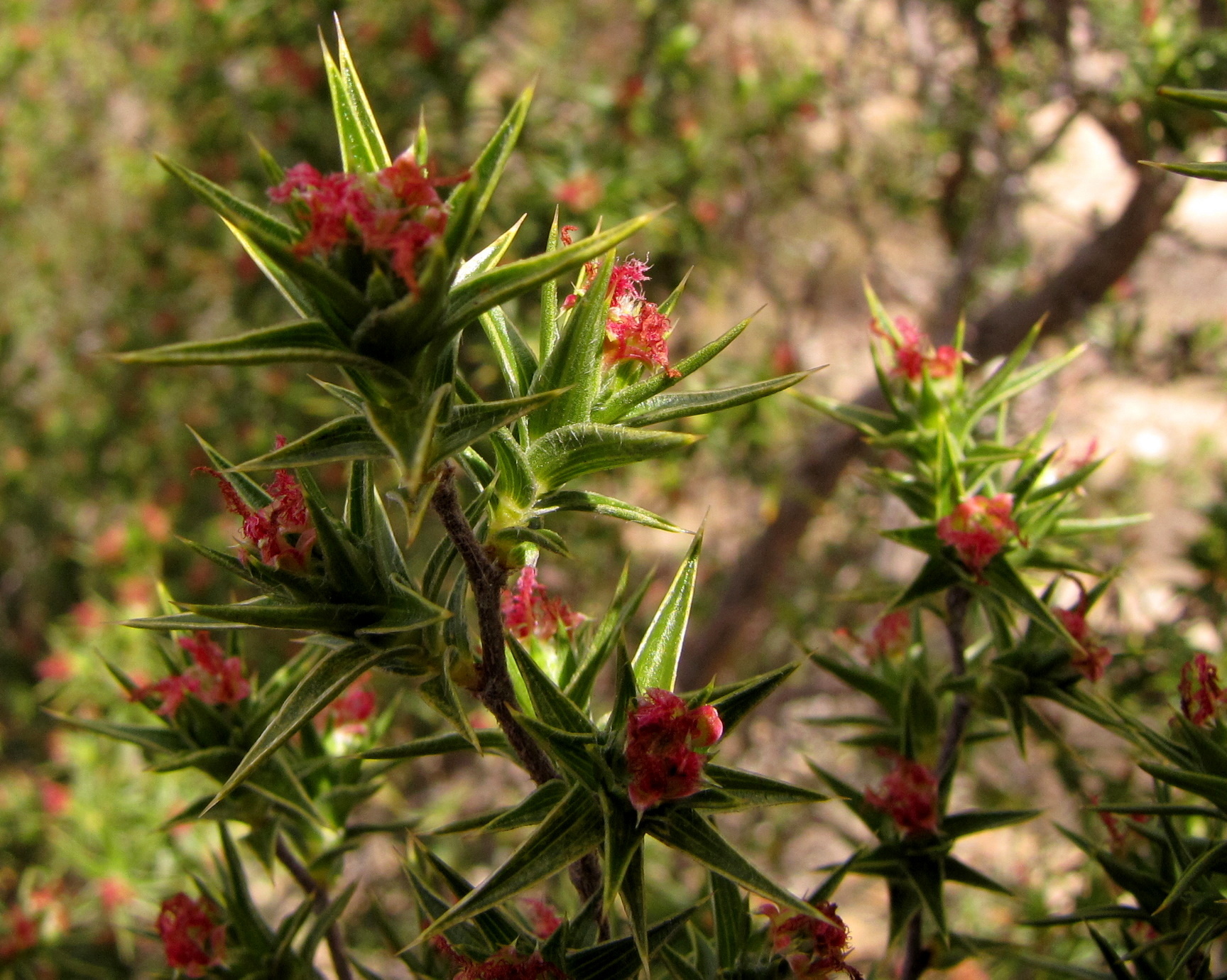
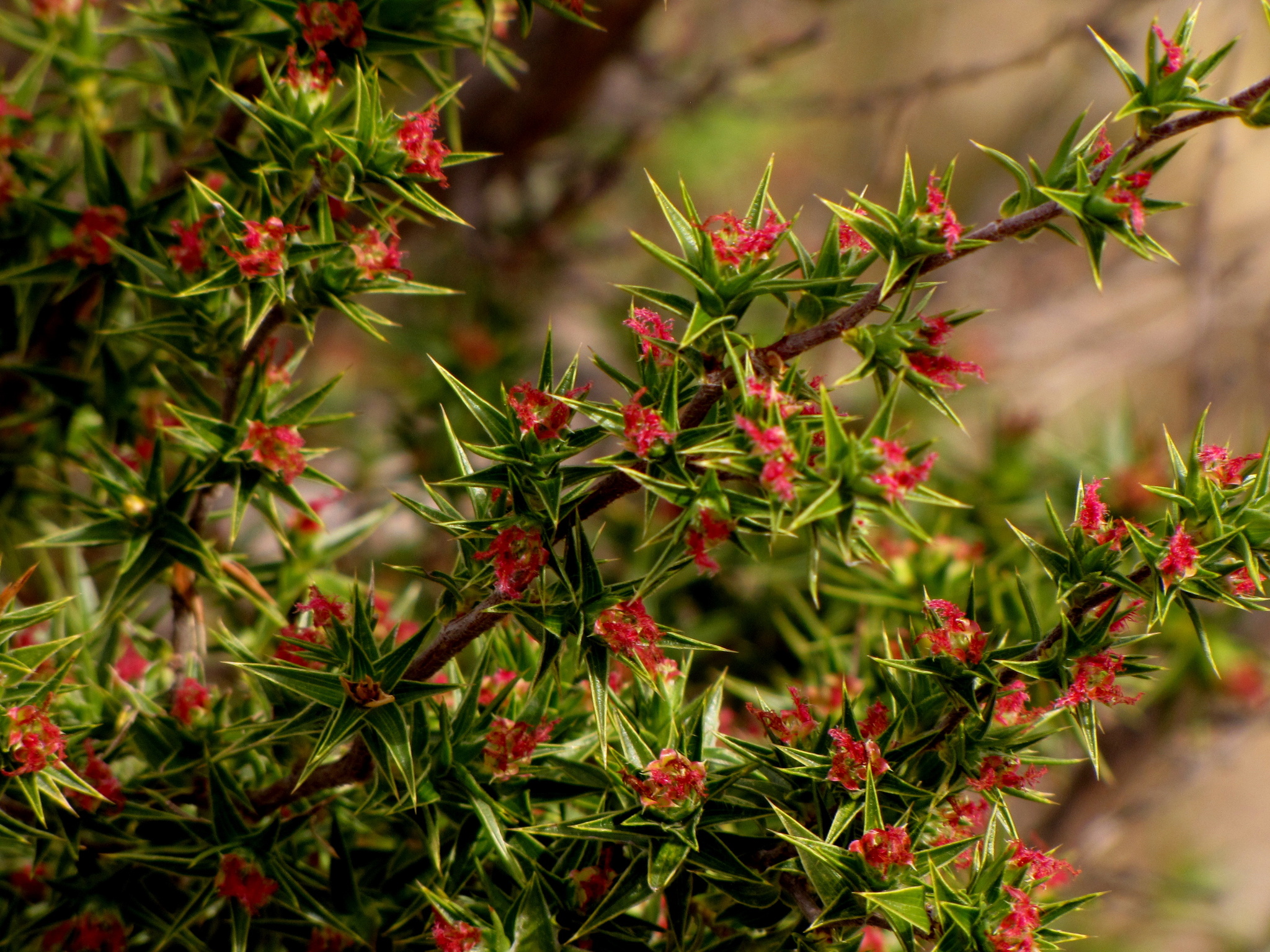
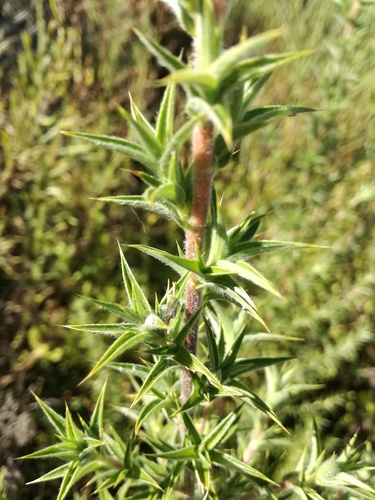
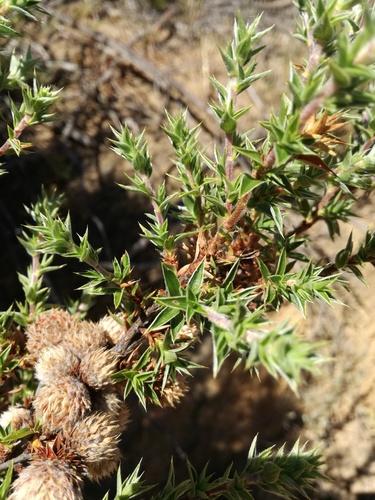
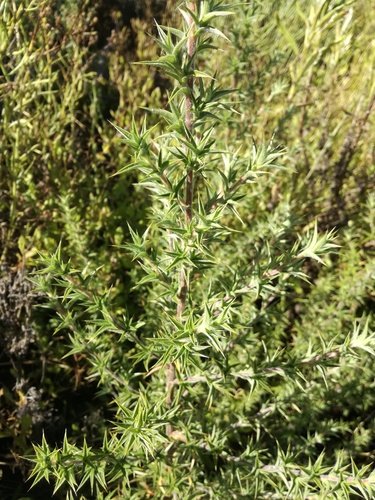
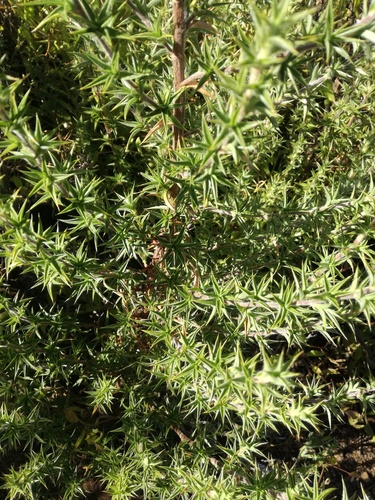
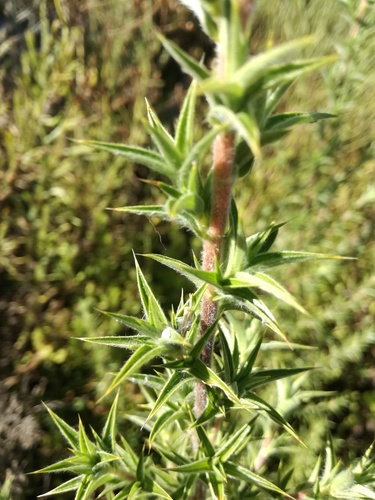
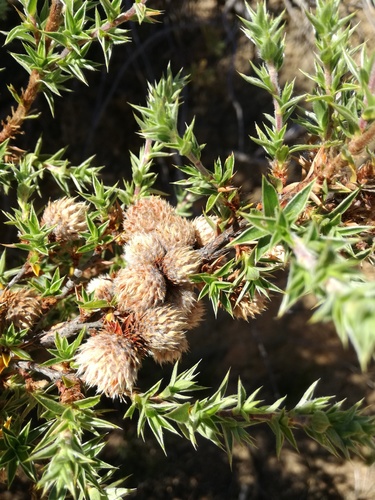
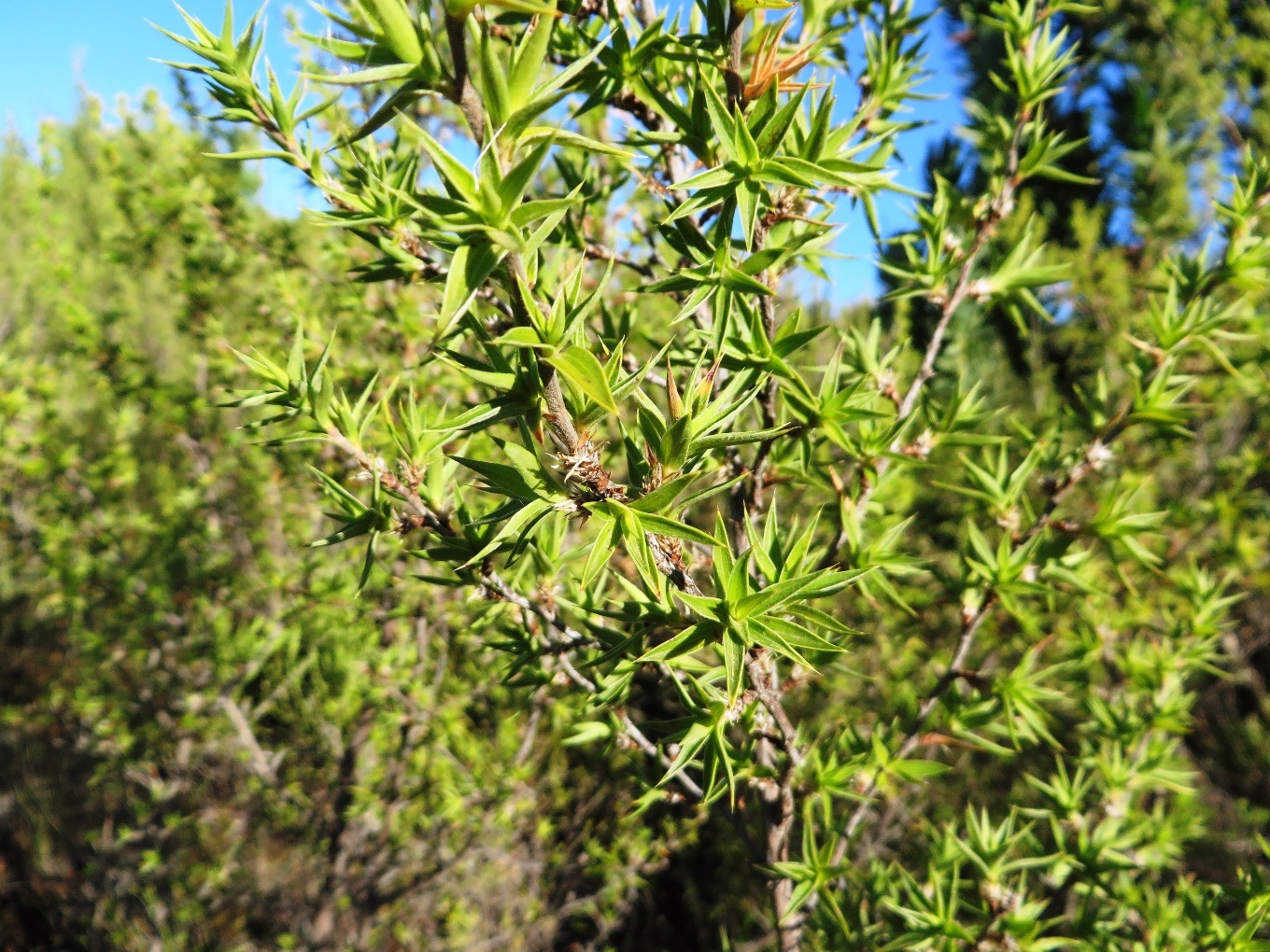
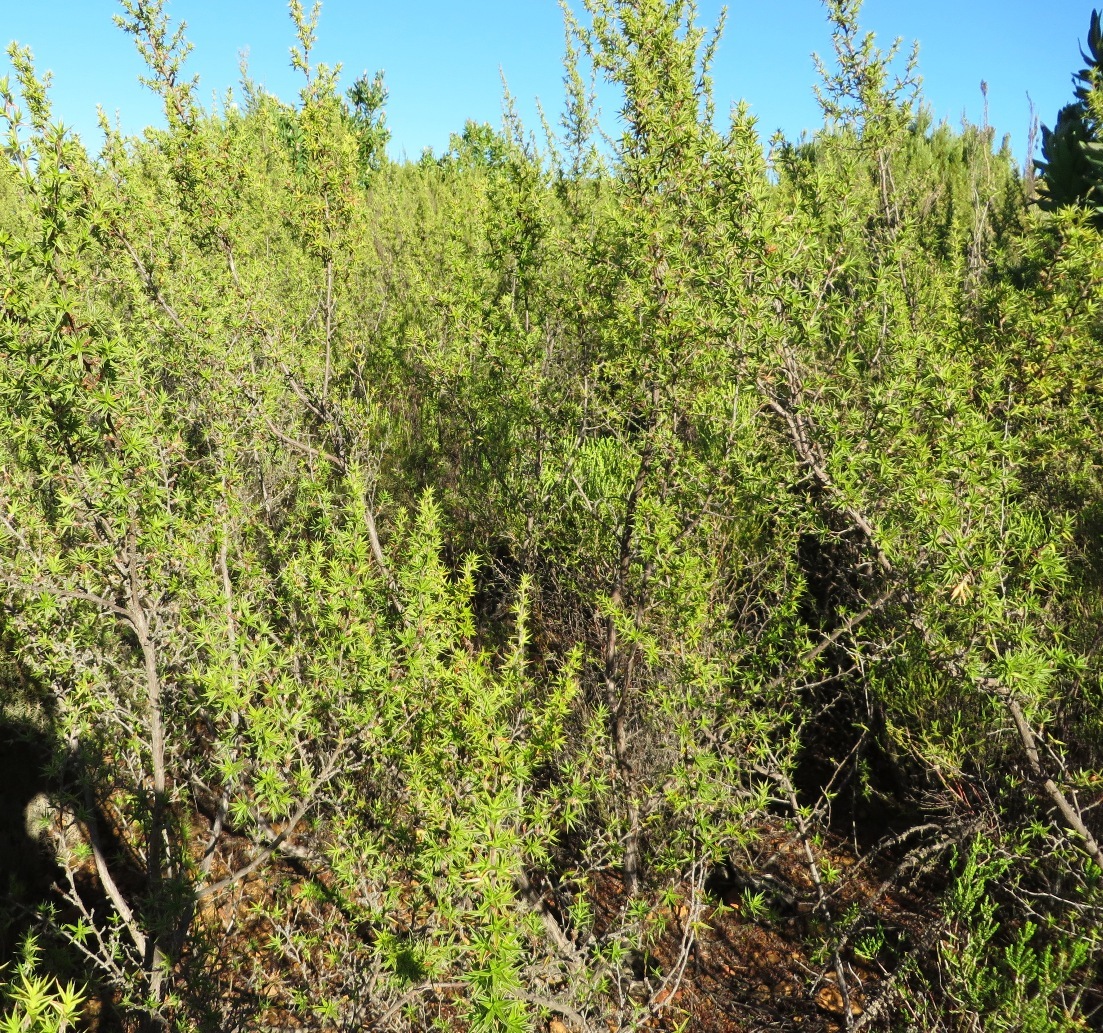
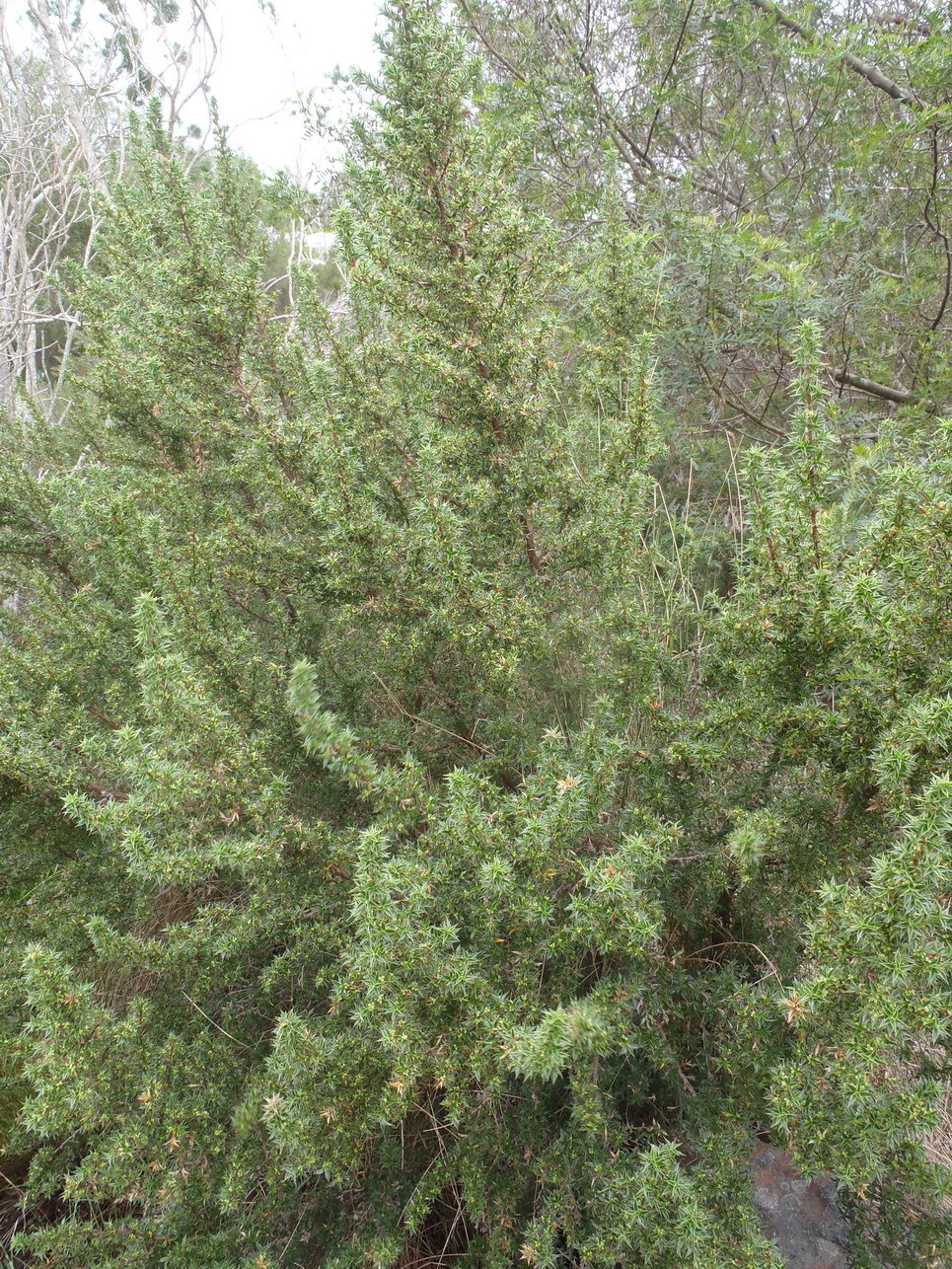
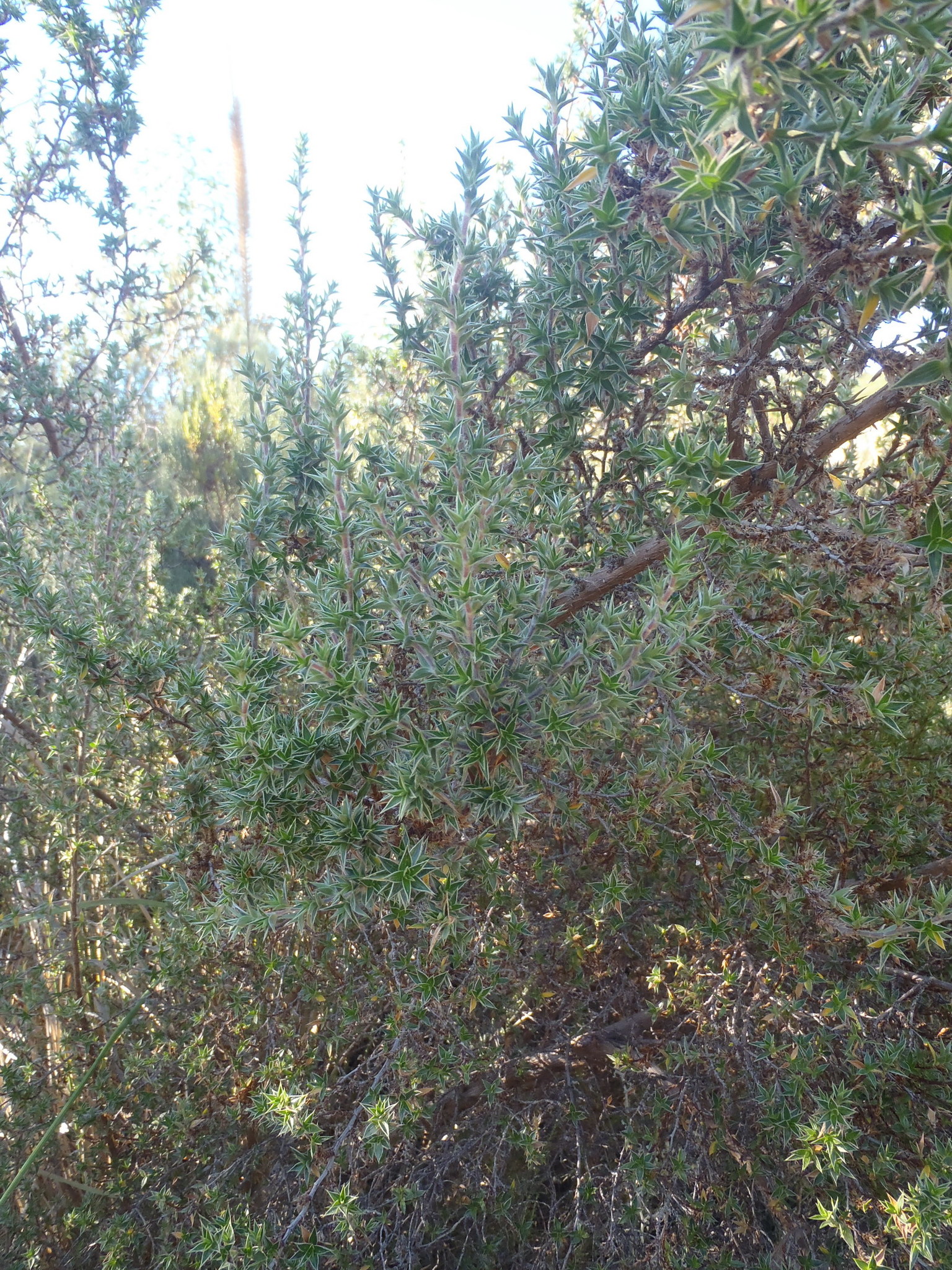
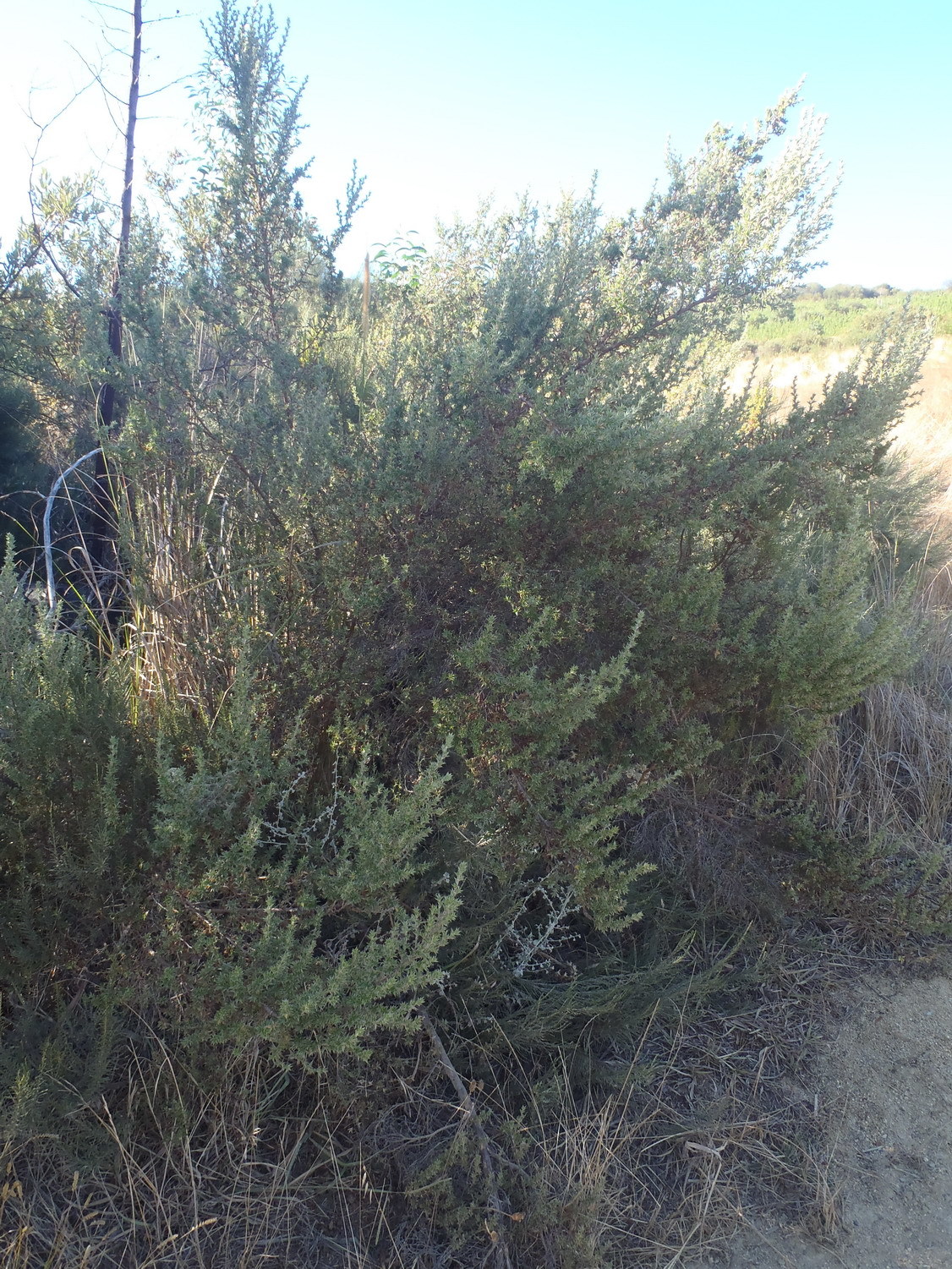
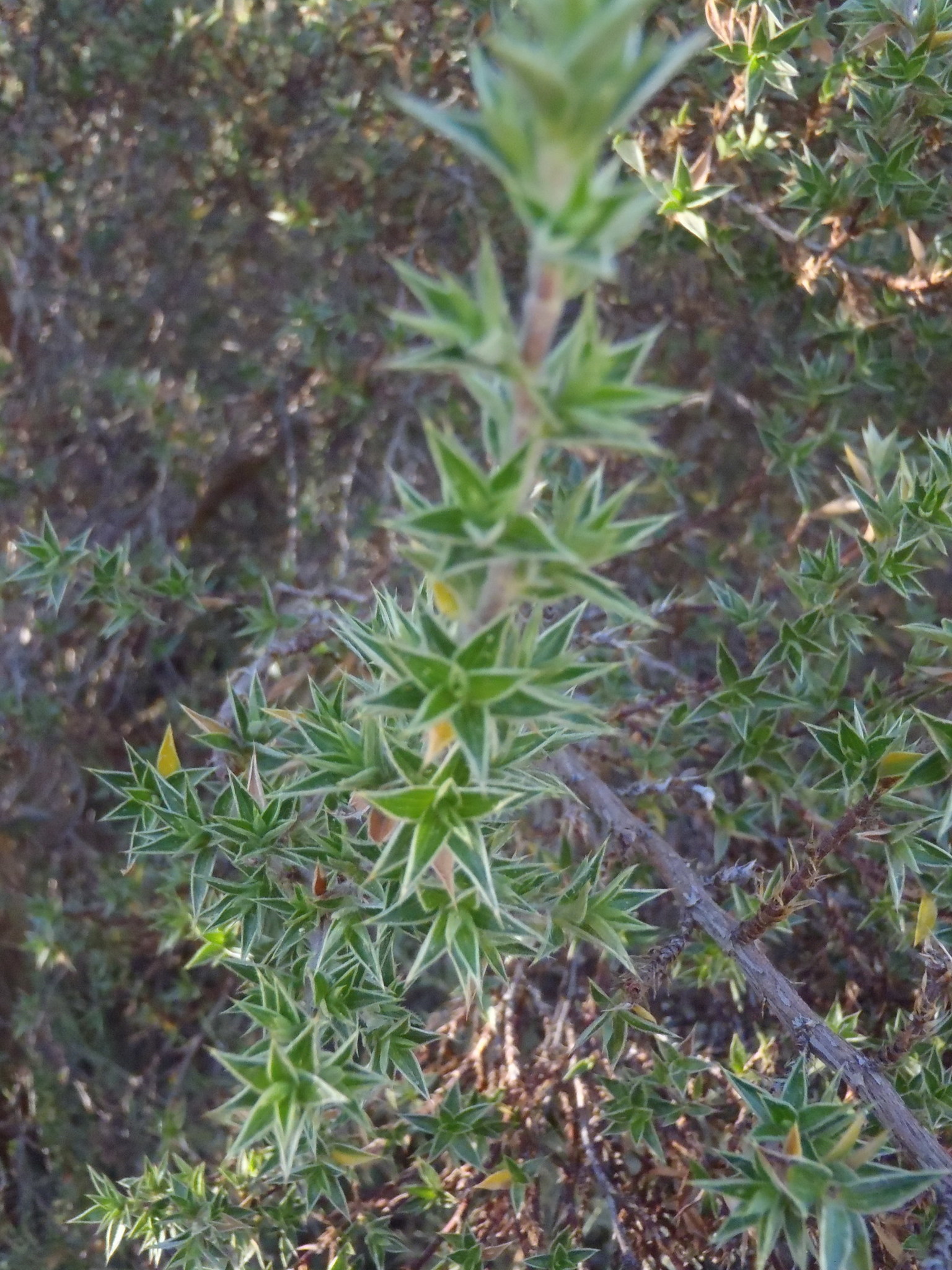
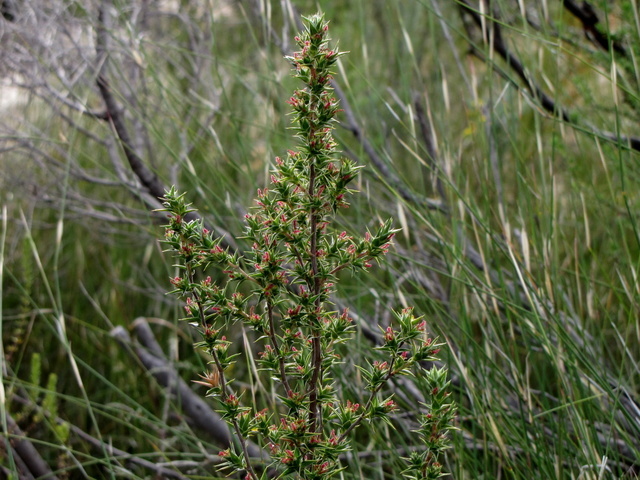
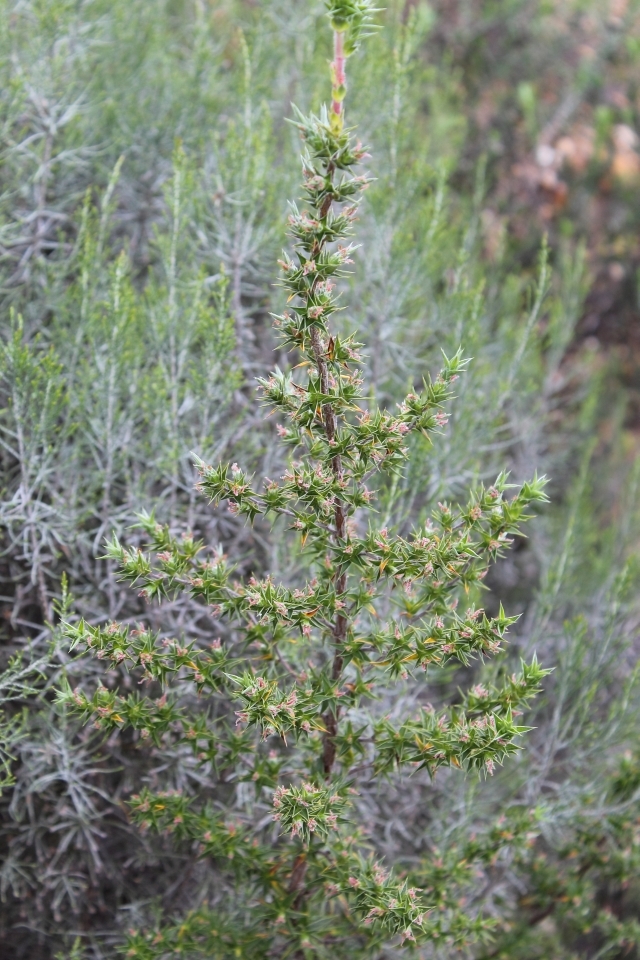
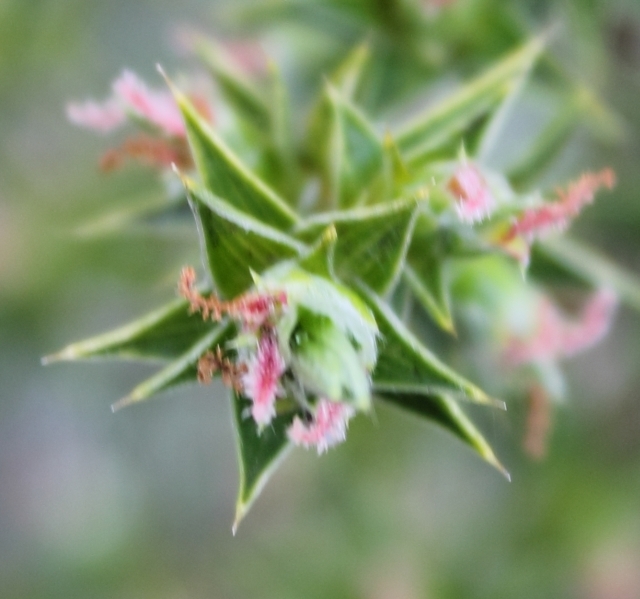
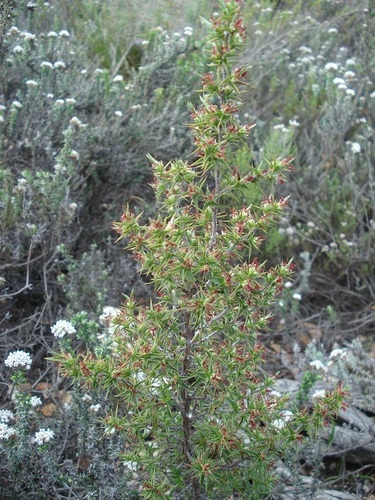
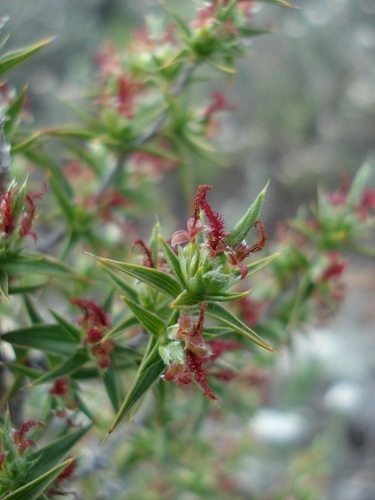
Medium erect shrub, up to 3 m high, killed by fire or resprouting after fire from a central crown; densely divaricately branched, forming brachyblasts. Young stems 0.8-1.8 mm wide, tinged reddish, hairy; stem hairs adpressed upwards to spreading, 0.2-1.1 mm long. Leaves unifoliolate, narrowly ovate to lanceolate, 9.4-15.0 x 2.0-5.2 mm; apex sharply acuminate to pungent, 0.3-1.8 mm long; margins markedly turned upwards to rounded, entire and smooth, rarely with an odd straight tooth, 0.8-1.6 mm long; lamina 3-13-veined from base, cartilaginous, 0.1-0.5 mm thick, midrib slightly prominent beneath against lamina, curved downwards and away from the stem, glabrous or with a few hairs above and then soon becoming glabrous, 0.25-1.05 mm long, hairy all over beneath, often densely so and whitish, although glabrescent, rarely completely glabrous, hairs 0.2-1.1 mm long; sheath 0.7-5.0 mm long, abaxially glabrous or hairy, adaxially markedly hairy to glabrous; stipules 0.2-3.1 mm long, free, margins smooth to ciliate; petiole absent. Flowers clustered together in brachyblasts with reduced leaves at base of each flower; bracteoles hairy to glabrous on the keel, margins clearly ciliate; sepals 3, hairy to glabrous on outside. Male flowers with bracteoles 3.9-6.3 mm long; pedicel 1.0-2.5 mm long, not articulated but slightly elongated, glabrous; sepals broadly ovate, 5.3-6.5 x 1.9-2.7 mm, acute to acuminate at the apex; stamens 7-11; filaments 5.0-7.4 mm long, red; anthers brownish red. Female flowers with bracteoles 2.8-6.0 mm long, longer than immature receptacle; sepals narrowly to broadly ovate, 2.4-5.0 x 0.9-2.2 mm, recurved; carpel 1; stigma 4.7-9.7 mm long, red to pinkish white, feathery, prominent above reduced leaves; immature receptacle 1.8-3.7 x 0.8-1.6 mm, glabrous, clearly ribbed. Achene narrowly ellipsoid, 3.4-4.8 x 1.2-1.8 mm, sometimes slightly curved, medium to greyish brown, glabrous, 10-16-ribbed; ribs rounded to acute, up to 0.2 mm wide, elaiosome swollen around base. From: Whitehouse, CM. 2021. A monograph on the genus Cliffortia. Strelitzia 43: 1-477. South African National Biodiversity Institute, Pretoria. [CC BY]
Monoecious or dioecious shrub, up to 1.5 m tall. Leaves simple, pungent, vegetative leaves oblong-lanceolate, channelled, sparsely hairy, 10-12 mm long, fertile leaves shorter, tridentate, densely hairy. Male flowers: pedicel 1-2 mm long, stamens ± 12; female flowers: receptacle 3-4 mm long, ovoid, brownish, sulcate. From: Snijman, DA. 2013. Rosaceae. In: DA Snijman (ed.), Plants of the Greater Cape Floristic Region 2: The Extra Cape flora. Strelitzia 30: 445-446. South African National Biodiversity Institute, Pretoria. [CC BY]
Monoecious or dioecious shrub to 1.5 m. Leaves simple, pungent, vegetative leaves oblong-lanceolate, channelled, sparsely hairy, 10-12 mm long, fertile leaves shorter, tridentate, densely hairy. Flowers: male: pedicel 1-2 mm long, stamens ± 12; female: receptacle 3-4 mm long, ovoid, brownish, sulcate. From: Fellingham, AC. 2012. Rosaceae: Cliffortia L. In: J Manning & P Goldblatt (eds), Plants of the Greater Cape Floristic Region 1: The Core Cape flora. Strelitzia 29: 692-700. South African National Biodiversity Institute, Pretoria. [CC BY]
Frutex 0.5-1.5 m altus. Rami et ramuli canescenti-villosi, internodiis 0.5-1.5 cm longis; ramuli abbreviati 2-10 mm longi. Folia simplicia; vagina brevissima amplectens, stipulis exiguis vel ad 1(-1.5) mm longis; lamina 1-2 cm longa 2-5 mm lata oblongo-lanceolata-lanceolata pungenti-mucronata integerrima vel utroque latere sub apice dente parvo instructa novella praecipue subtus canescenti-pilosa paulatim glabrescentia. Flores [male] pedicellis 1-2 mm longis praditi; bracteolae 6-8 mm longae lineares scariosae, nervo medio piloso; sepala 3 oblongo-lanceolata 6-7 mm longa acuta glabra; stamina plerumque 12, antheris rubiginosis 0.8-1.2 mm, filamentis ad 10 mm longis. Flores [female] brevissime pedicellati; bracteolae lineari-lanceolatae acutae, nervo mediano pilosulo; receptaculum 3-4 mm longum 1.5 mm crassum ovoideum-ovoideo-oblongum fuscum sulcatum glabrum; sepala 3, 2-3 mm longa triangulari-oblongo-lanceolata acuta glabra; stigma 5-6 mm e receptaculo prominens rubiginosum; achenium ad 3 mm longum oblongum. From: Weimarck, AH. 1934. Monograph of the genus Cliffortia. Hákan Ohlsson, Lund. [All rights reserved]
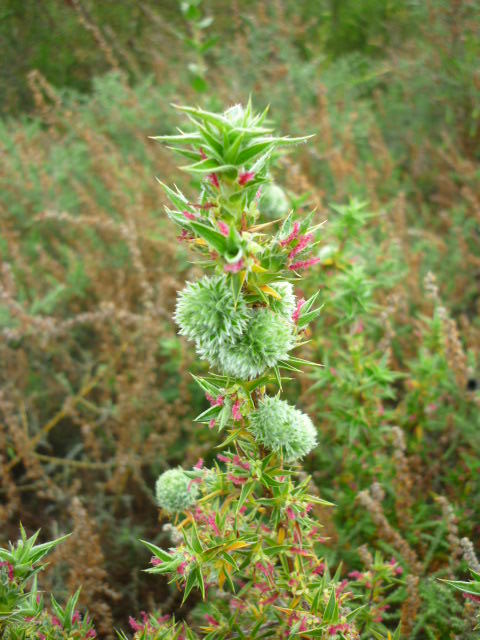
Probably the best known of all Cliffortia species, it is a variable species with many local variants. Furthermore, it is very promiscuous, hybridising and introgressing with several other species. Delimitation of boundaries between the different forms or hybrids is almost impossible without splitting the species up into many microspecies. The name is applied here to the form with congested flowerheads and short subtending bract leaves. It blooms almost exclusively in August and September. The head-like inflorescences are usually absent in hybrids, some of which also flower throughout the year. Some of the most distinctive local variants, here recognised as species, also lack head-like inflorescences; i.e. C. purpurea, C. verrucosa, C. tridentata and C. ferricola. The fire survival strategy of Cliffortia ruscifolia is varied, but most commonly plants are killed by fire and regenerate from seed. If the plants are rooted firmly amongst rocks then it may resprout from the protected rootstock. A few populations, however, resemble typical C. ruscifolia but demonstrate clonal resprouting. I suggest that these are not pure C. ruscifolia, but probably an introgressed hybrid. Fire survival strategy is impossible to determine from herbarium specimens and often difficult even from live plants except in the early years after fire. Until the distribution and frequency of these various types is known better, they are retained within a broad C. ruscifolia. The distribution of male flowers amongst populations of Cliffortia ruscifolia is worthy of further investigation. Most populations never appear to produce male flowers but the frequency of records is greatest in the north and west of its range, from Paarl to the Cederberg. Records of male flowering plants on the Cape Peninsula usually turn out to be errors for C. tridentata or C. theodori-friesii. Cliffortia ruscifolia is very susceptible to galls, in a similar way to C. strobilifera. These should not be mistaken for the congested flowerheads. From: Whitehouse, CM. 2021. A monograph on the genus Cliffortia. Strelitzia 43: 1-477. South African National Biodiversity Institute, Pretoria. [CC BY]
The following features are characteristic of C. ruscifolia. The young parts of stems and branches are shortly and densely pilous with greyish white hairs. The leaves are clustered closely together in, usually, very much abbreviated brachyblasts, not more than 10 mm long. The vagina of the leaves is very short and carries insignificant, sometimes hardly visible, stipules. The blade is on the upper side sparsely pilous, or quite glabrous, with usually inconspicuous nervature; on the other hand, the underside of the blade, at least when young, is more or less densely covered with canescent hairs; sometimes these hairs are very long, quite white and almost silky. The nerves are not very prominent, often inconspicuous with the midrib stronger and with weaker lateral nerves. From: Weimarck, AH. 1934. Monograph of the genus Cliffortia. Hákan Ohlsson, Lund. [All rights reserved]
Ranging from fynbos to margins of renosterveld and rock outcrops on high peaks, also common in disturbed habitats such as road verges and abandoned fields, on well-drained soils in full sun. From: Whitehouse, CM. 2021. A monograph on the genus Cliffortia. Strelitzia 43: 1-477. South African National Biodiversity Institute, Pretoria. [CC BY]
Rocky sandstone soils. From: Snijman, DA. 2013. Rosaceae. In: DA Snijman (ed.), Plants of the Greater Cape Floristic Region 2: The Extra Cape flora. Strelitzia 30: 445-446. South African National Biodiversity Institute, Pretoria. [CC BY]
Sandy and rocky sandstone slopes, often disturbed sites. From: Fellingham, AC. 2012. Rosaceae: Cliffortia L. In: J Manning & P Goldblatt (eds), Plants of the Greater Cape Floristic Region 1: The Core Cape flora. Strelitzia 29: 692-700. South African National Biodiversity Institute, Pretoria. [CC BY]
It is clear that the species is common at low levels, but how high up it grows is not known. It is, however, very likely that the species grows also on the highest summits in the Table Mtn... In the Piquetberg distr. the species is noted from 90 m (=c. 300 ft.,), in Clanwilliam from 75 m (=c. 250 ft.), while in the inner parts of the country considerably higher levels are given. Thus, the species is reported from Calvinia from 800 m (=c. 2600 ft.) and in Laingsburg even from 4000-5000 ft. From: Weimarck, AH. 1934. Monograph of the genus Cliffortia. Hákan Ohlsson, Lund. [All rights reserved]
Widespread throughout the CFR, but extending beyond it to the Kamiesberg of Namaqualand, common in the west and southwest but becoming rarer to the east except in the drier interior. From: Whitehouse, CM. 2021. A monograph on the genus Cliffortia. Strelitzia 43: 1-477. South African National Biodiversity Institute, Pretoria. [CC BY]
Ploegberg to Kamiesberg and Bokkeveld Mountains to Humansdorp. From: Snijman, DA. 2013. Rosaceae. In: DA Snijman (ed.), Plants of the Greater Cape Floristic Region 2: The Extra Cape flora. Strelitzia 30: 445-446. South African National Biodiversity Institute, Pretoria. [CC BY]
Richtersveld to Humansdorp. From: Fellingham, AC. 2012. Rosaceae: Cliffortia L. In: J Manning & P Goldblatt (eds), Plants of the Greater Cape Floristic Region 1: The Core Cape flora. Strelitzia 29: 692-700. South African National Biodiversity Institute, Pretoria. [CC BY]
C. ruscifolia has a very extensive distribution. It grows, as a matter of fact, within the whole area of the Cape Flora, from the Cape Peninsula to Namaqualand and Calvinia in the north and to Humansdorp in the east. The distribution of the [male]-and [female]-plants in different parts of the area is very peculiar. From the Cape Peninsula, where the species, so far as I know, has been collected not less than 29 times, not a single [male]-specimen has been found, while two collections out of three from the Paarl distr. consist of [male] [male]. In other districts the [female]-plants seem to be in the majority, but usually too little material is collected to justify any far-reaching conclusions. The occurrence of exclusively [female]-plants in the Cape Peninsula has been observed several times by different authors. From: Weimarck, AH. 1934. Monograph of the genus Cliffortia. Hákan Ohlsson, Lund. [All rights reserved]
July to November
0 to 1600 m
This map contains point-based occurrences at different locations
Occurrence in the Flora of Southern Africa (FSA) countries and South African provinces. Residence status indicates if a taxon is indigenous, endemic, naturalised or invasive in a specific region. This data is based on specimen records and literature
FSA
SA
BOT
NAM
ESW
LES
WC
EC
NC
FS
GA
KZN
LP
MP
NW
Absent
Indigenous
Endemic
Naturalised
Invasive
Names and Sources
Published in: Sp. Pl. 2: 1038 (1753)
Type: ‘Cliffortia foliis lanceolatis integerrimis: femina’ in L., t. 31 (1738), based on Herb. Clifford: 501, Cliffortia 3 (BM, lecto.). Lectotype designated by Stearn, An Introduction to the Species Plantarum and Cognate Botanical Works of Carl Linnaeus: (1957).
Borbonia trinervia L.
Published in: Sp. Pl. 2: 707 (1753)
Type: Herb. Clifford: 494, Borbonia 2 (BM, lecto.). Lectotype designated by Dahlgren, Botaniska Notiser 121: (1968).
Cliffortia arachnoidea Lodd.
Published in: Bot. Cab. 3(6): t. 260 (1819)
Type: Cultivated plant, origin unknown, 1799, in Lodd.: t. 260 (1819)
| Common name | Language | Reference/barcode | Published as |
|---|---|---|---|
| steekbos | Afrikaans | Fellingham, AC. 2012. Rosaceae: Cliffortia L.. In: J Manning & P Goldblatt (eds), Plants of the Greater Cape Floristic Region 1: The Core Cape flora. Strelitzia 29: 692-700. South African National Biodiversity Institute, Pretoria. | |
| steekbos | Afrikaans | Snijman, DA. 2013. Rosaceae. In: DA Snijman (ed.), Plants of the Greater Cape Floristic Region 2: The Extra Cape flora. Strelitzia 30: 445-446. South African National Biodiversity Institute, Pretoria. |
Classification
KINGDOM Plantae
SUBKINGDOM Phanerogamae
PHYLUM Anthophyta
ORDER Rosales
FAMILY Rosaceae
SUBFAMILY Rosoideae
TRIBE Sanguisorbeae
GENUS Cliffortia
SUBGENUS Cliffortia
SPECIES ruscifolia
24 results for Cliffortia ruscifolia L.
Barcode: NBG0253445-0 Collector(s) & number: Helme, NA, 6370 | 2009-7-27
South Africa, Western Cape, Toringberg, 25 km, W of Bitterfontein. Louisfontein 44, east of De Toren. 31°01'41.2" S; 17°59'41.2" E.
Data Resource: BODATSA View record
Barcode: PRE0567602-0 Collector(s) & number: Fellingham, AC, 1646 | 1994-10-11
South Africa, Western Cape, Betty's Bay area. Harold Porter NBG.
Data Resource: BODATSA View record
Barcode: NBG0195738-0 Collector(s) & number: Herdien, EL, 8 | 2004-1-14
South Africa, Western Cape, Cape Town. Table Mountain. Rooikat Ravine.Overlooking Cecilia Forest. SE facing. Lat: 33°59'32.4"S; Long: 18°25'17.0"E.
Data Resource: BODATSA View record
Barcode: NBG1570290-0 Collector(s) & number: Unknown, 11210 | 2021-11-12
South Africa, Western Cape, Cederberg. Cederberg Wilderness Area.
Data Resource: BODATSA View record
Barcode: NBG0213629-0 Collector(s) & number: Jardine, I, 84 | 2005-8-31
South Africa, Western Cape, Knolfontein. Swartruggens. 32°53.89'S: 19°38.32'E.
General notes: Fynbos biome. Vegetation type: Mountain fynbos. Gentle hill slope. Well-drained, stony and sandy soil. Sandstone. Full sun. N aspect. No biotic effect seen. Shrub. Flowers deep red. Plant height: 1.2 m.
Data Resource: BODATSA View record
Barcode: PRE0992635-0 Collector(s) & number: Trinder-Smith, TH, 233 | 2000-10-25
South Africa, Western Cape, Touws River District. Karrona Farm. On S. facing slope just below first rocky sandstone ridge.
Data Resource: BODATSA View record
Barcode: NBG1551627-0 Collector(s) & number: Unknown, MT17 | 1987-10-10
South Africa, Western Cape, Somerset West. Helderberg Nature Reserve. Lower Southern slopes.
Data Resource: BODATSA View record
Barcode: NBG1520214-0 Collector(s) & number: Raimondo, D, CR465 | 2004-11-6
South Africa, Western Cape, Overberg. Swellendam. Sandkraal Farm, above picnic site/abandoned house. Looking down towards Breede River/Doringsrivier confluence.
Data Resource: BODATSA View record
Barcode: PRE0866600-0 Collector(s) & number: Oliver, EGH, 10568 | 1994-10-13
South Africa, Western Cape, Citrusdal. Middelberg Pass. Summit slopes.
General notes: Growing with 10569.
Data Resource: BODATSA View record
Barcode: PRE0866601-0 Collector(s) & number: Oliver, EGH, 10569 | 1994-10-13
South Africa, Western Cape, Citrusdal District. Middelberg Pass. Summit slopes.
General notes: Growing with 10568.
Data Resource: BODATSA View record
Barcode: NBG0273757-0 Collector(s) & number: Nicholson, G, 244 | 2011-8-8
South Africa, Western Cape, Paardeberg, between Wellington & Malmesbury, Aasvoelkop. Vondeling, ±1.4 km NW of farm buildings. 33.58407' S; 18.83892' E.
Data Resource: BODATSA View record
Barcode: PRE0792318-0 Collector(s) & number: Chesselet, P, 86 | 1993-10-7
South Africa, Western Cape, SE side of Touwsberg; Farm Rietfontein; Top of ridge.
General notes: Dry Mountain Fynbos. Witteberg quartzite. Dry. On rock ledge. cf. C. ruscifolia L. FRD Touwsberg Expedition
Data Resource: BODATSA View record
Barcode: PRE0855475-0 Collector(s) & number: Nkonki, T, 50 | 2003-11-27
South Africa, Western Cape, Cederberg.
Data Resource: BODATSA View record
Barcode: NBG0248541-0 Collector(s) & number: Jardine, I, 1222 | 2009-10-22
South Africa, Western Cape, Knolfontein. Swartruggens 60 km NE of Ceres. 32°54'07.2"S, 19°38'13.9"E.
Data Resource: BODATSA View record
This map contains point-based occurrences at different locations
2021
SERIES
A monograph on the genus Cliffortia Whitehouse, CMStrelitzia 43: 1-477
South African National Biodiversity Institute, Pretoria
2013
SERIES CHAPTER
Rosaceae Snijman, DAIn: DA Snijman (ed.), Plants of the Greater Cape Floristic Region 2: The Extra Cape flora. Strelitzia 30: 445-446
South African National Biodiversity Institute, Pretoria
2012
SERIES CHAPTER
Rosaceae: Cliffortia L. Fellingham, ACIn: J Manning & P Goldblatt (eds), Plants of the Greater Cape Floristic Region 1: The Core Cape flora. Strelitzia 29: 692-700
South African National Biodiversity Institute, Pretoria
1934
No results found for Cliffortia ruscifolia L.
Status and criteria
LC
Assessor(s)
Plantae Coordinator
| Part(s) of plant used | Use(s) | Reference |
|---|
Coming soon...


