PLANTAE / PHANEROGAMAE / ANTHOPHYTA / CARYOPHYLLALES / AIZOACEAE / RUSCHIOIDEAE / RUSCHIEAE / FRITHIA / PULCHRA

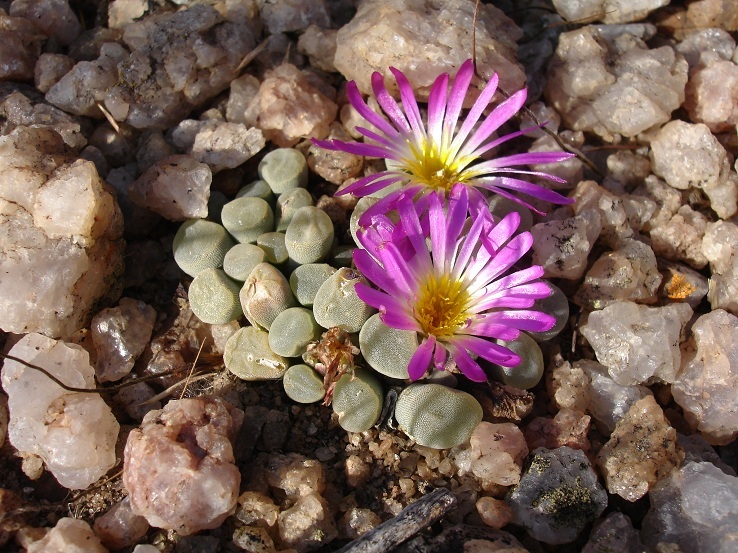
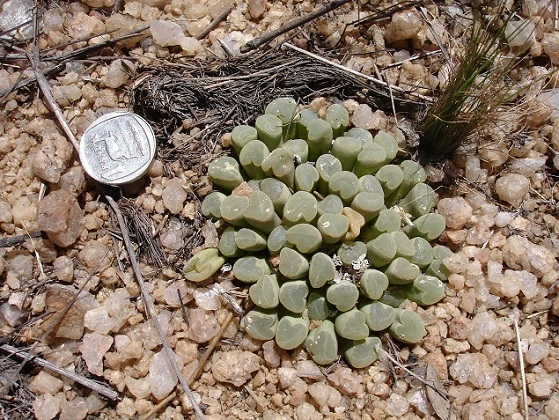
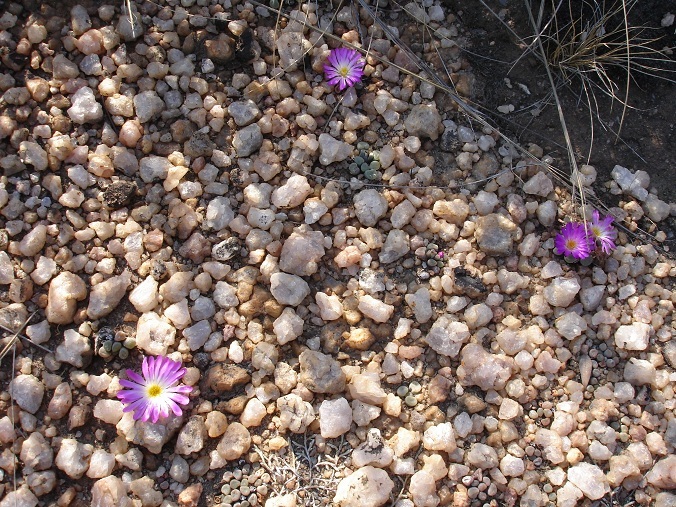
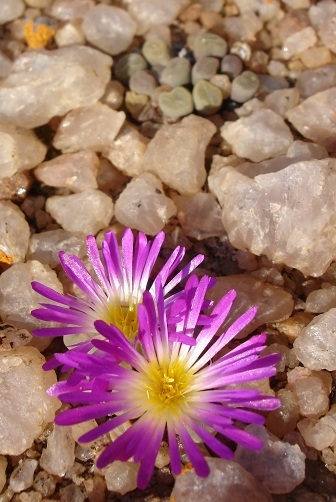
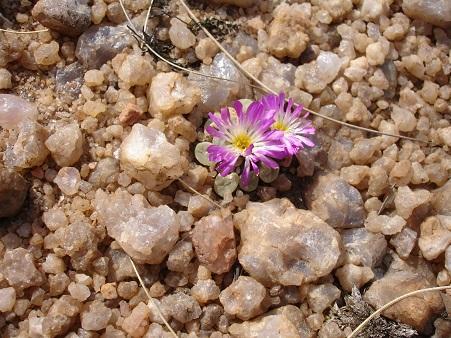
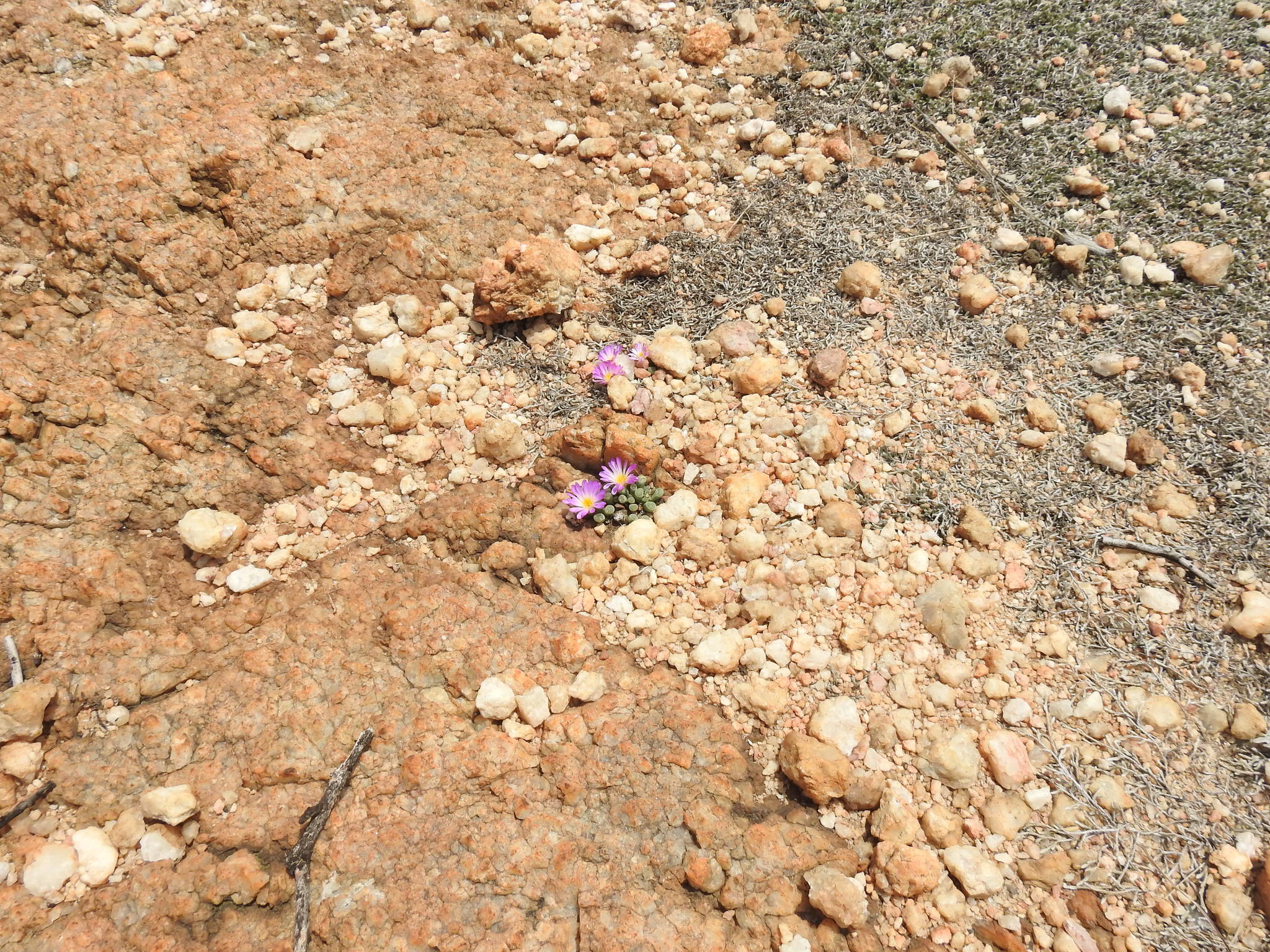
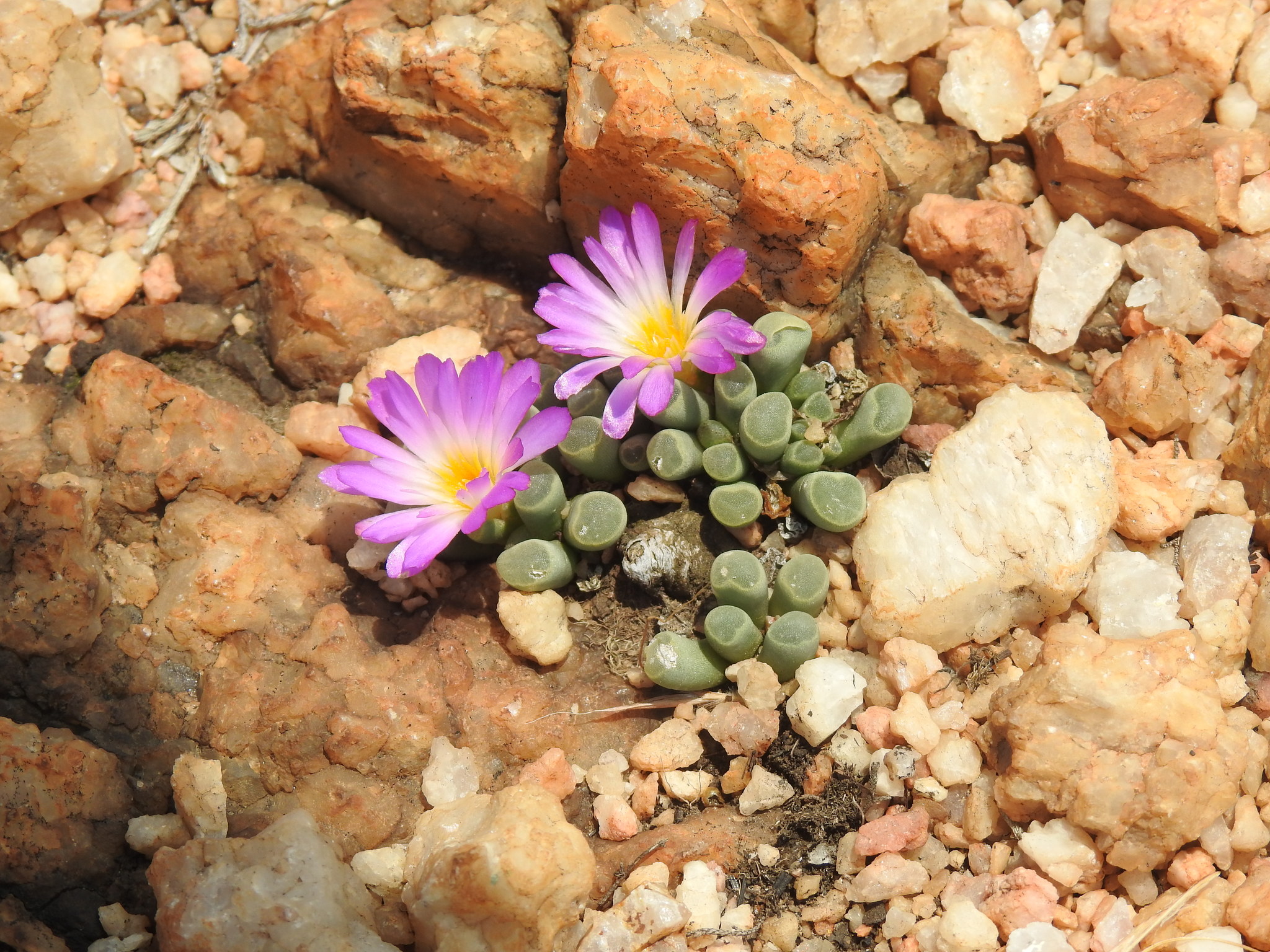
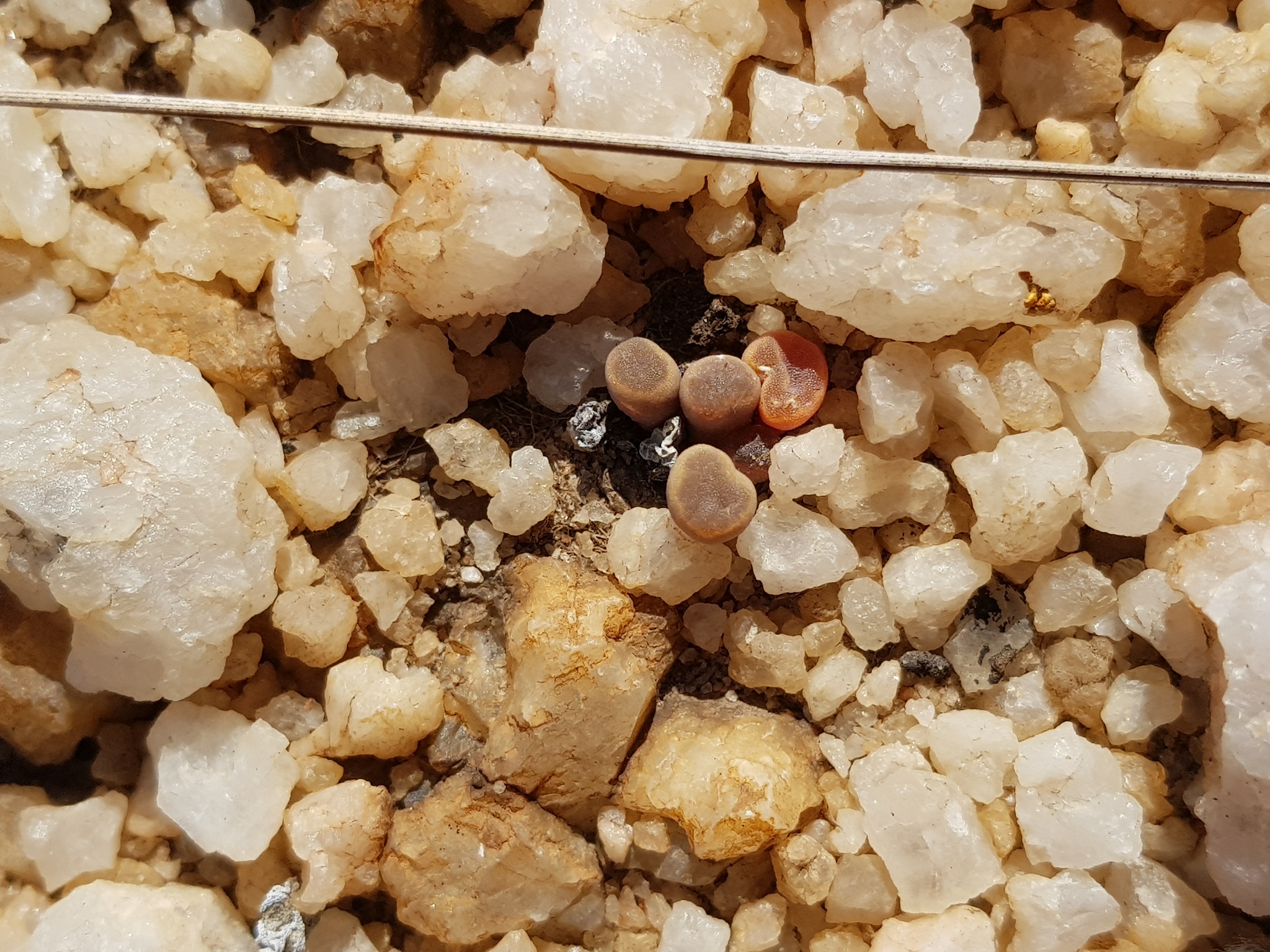
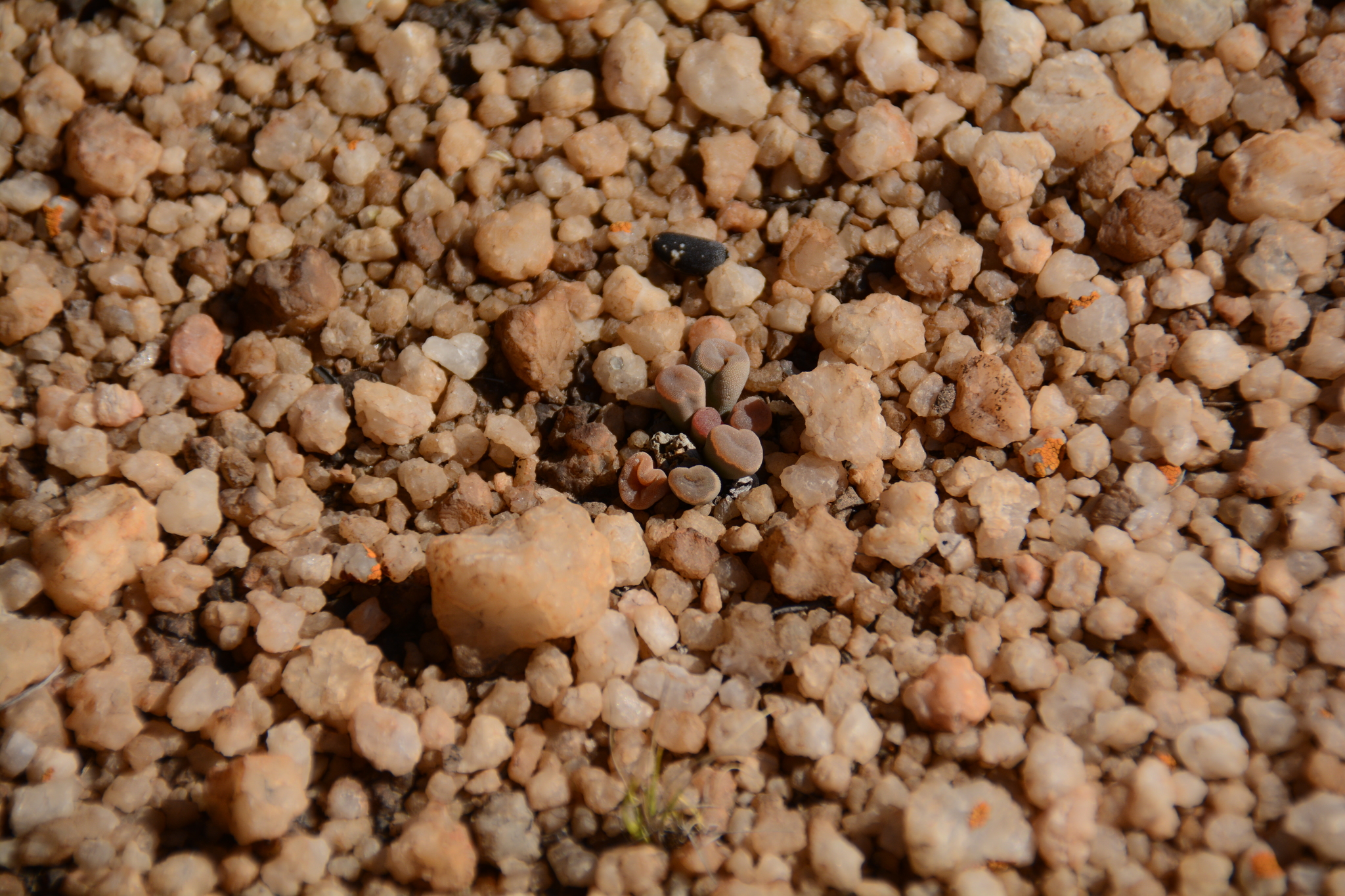
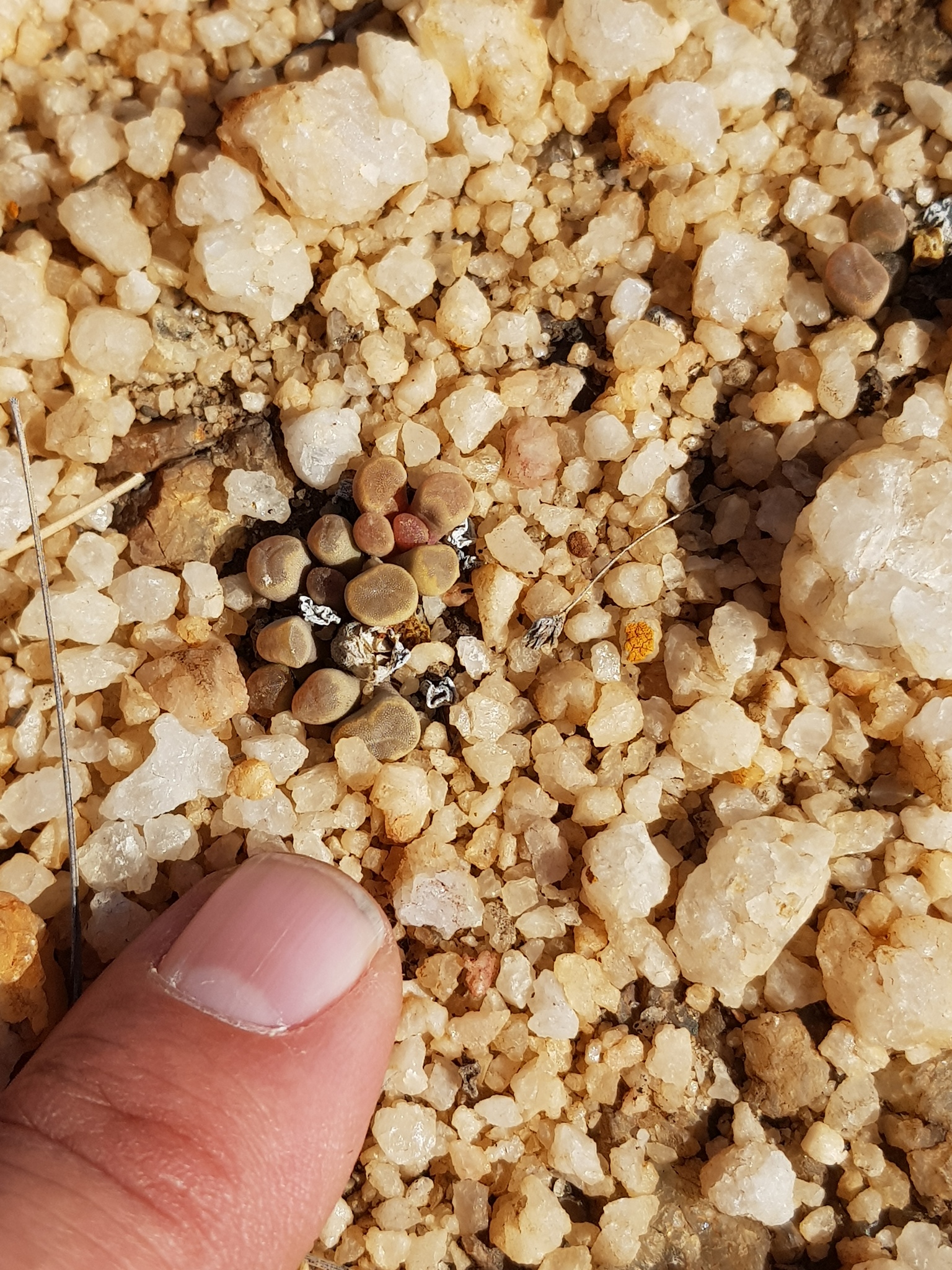
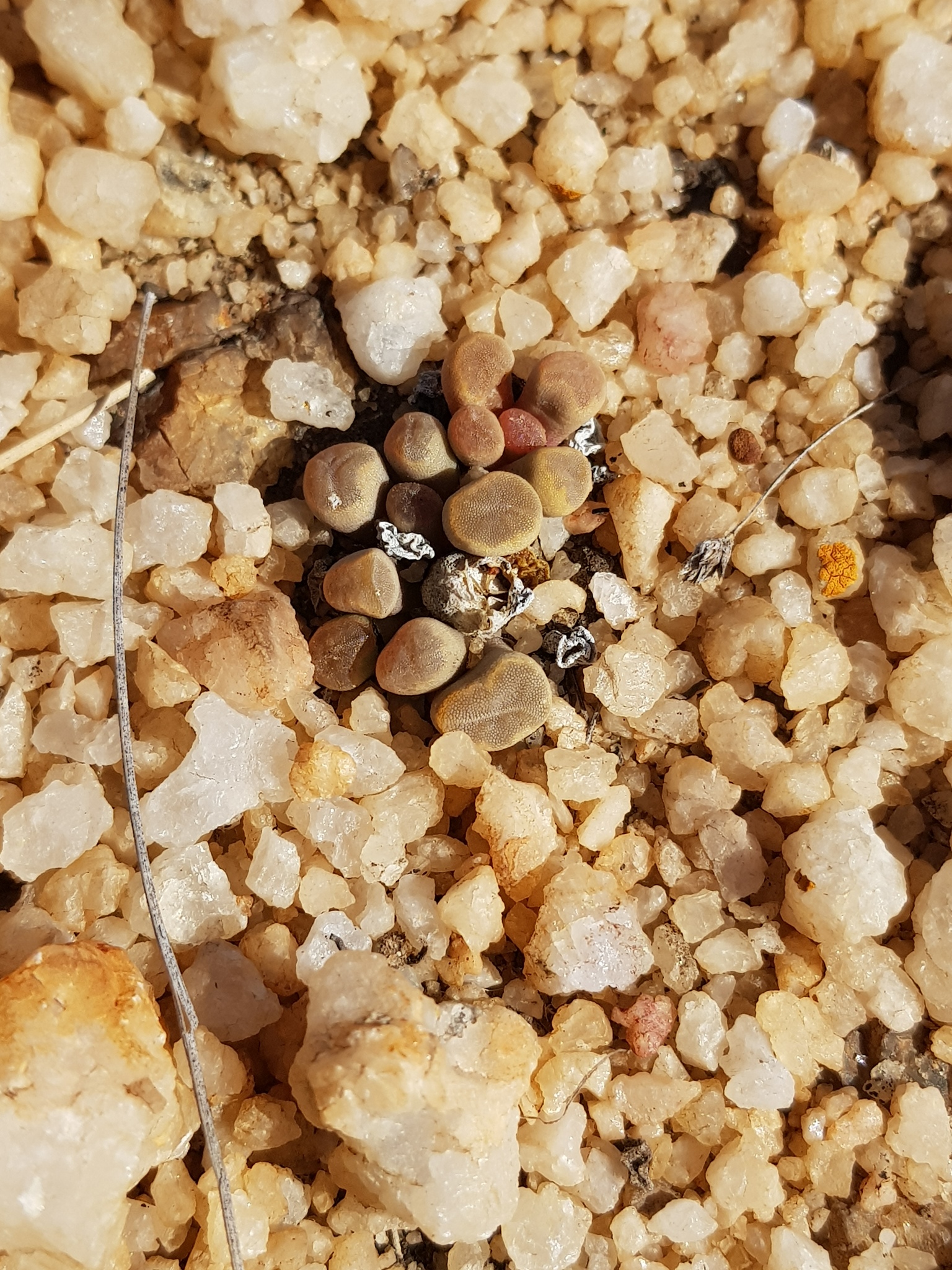
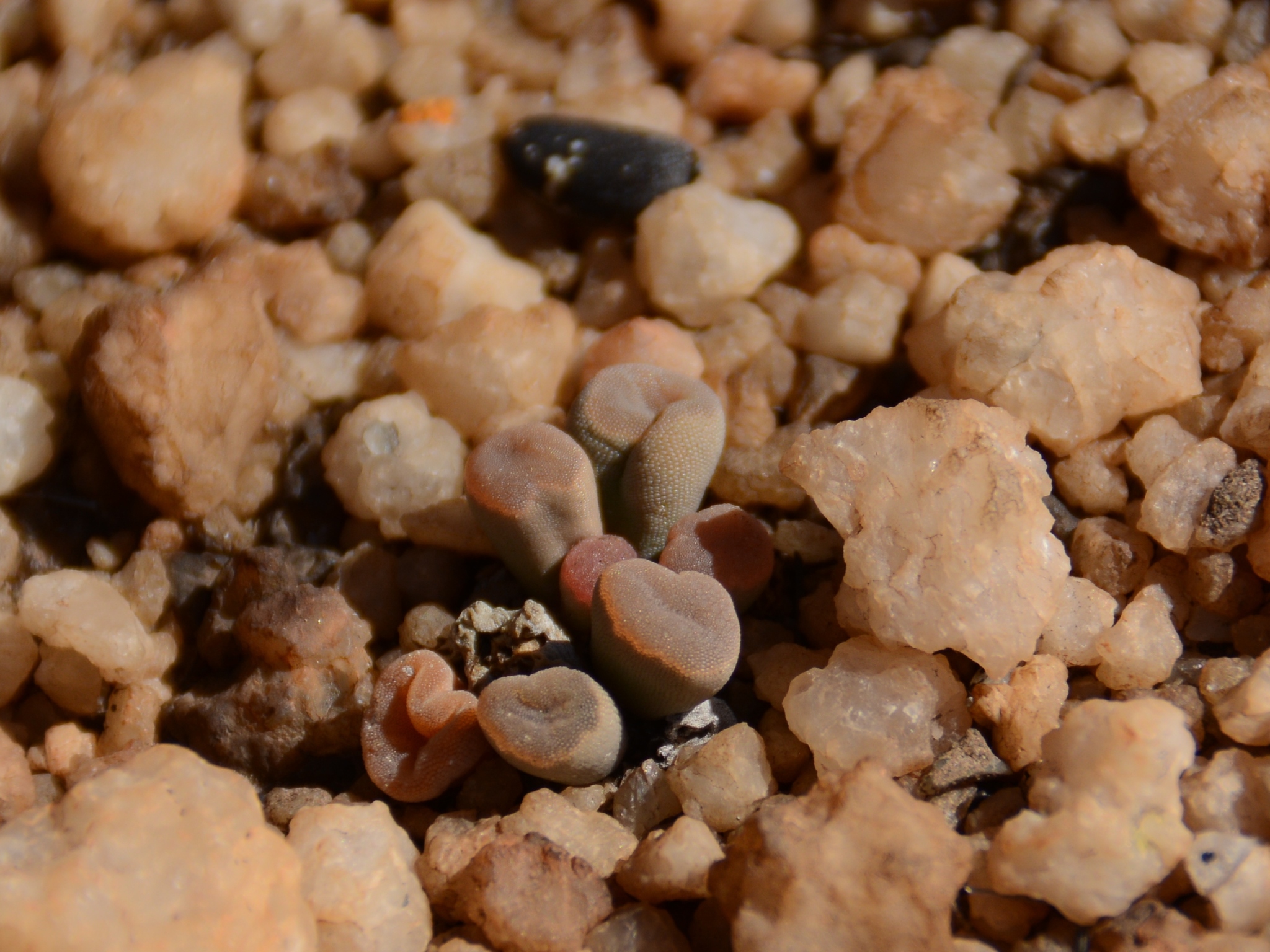
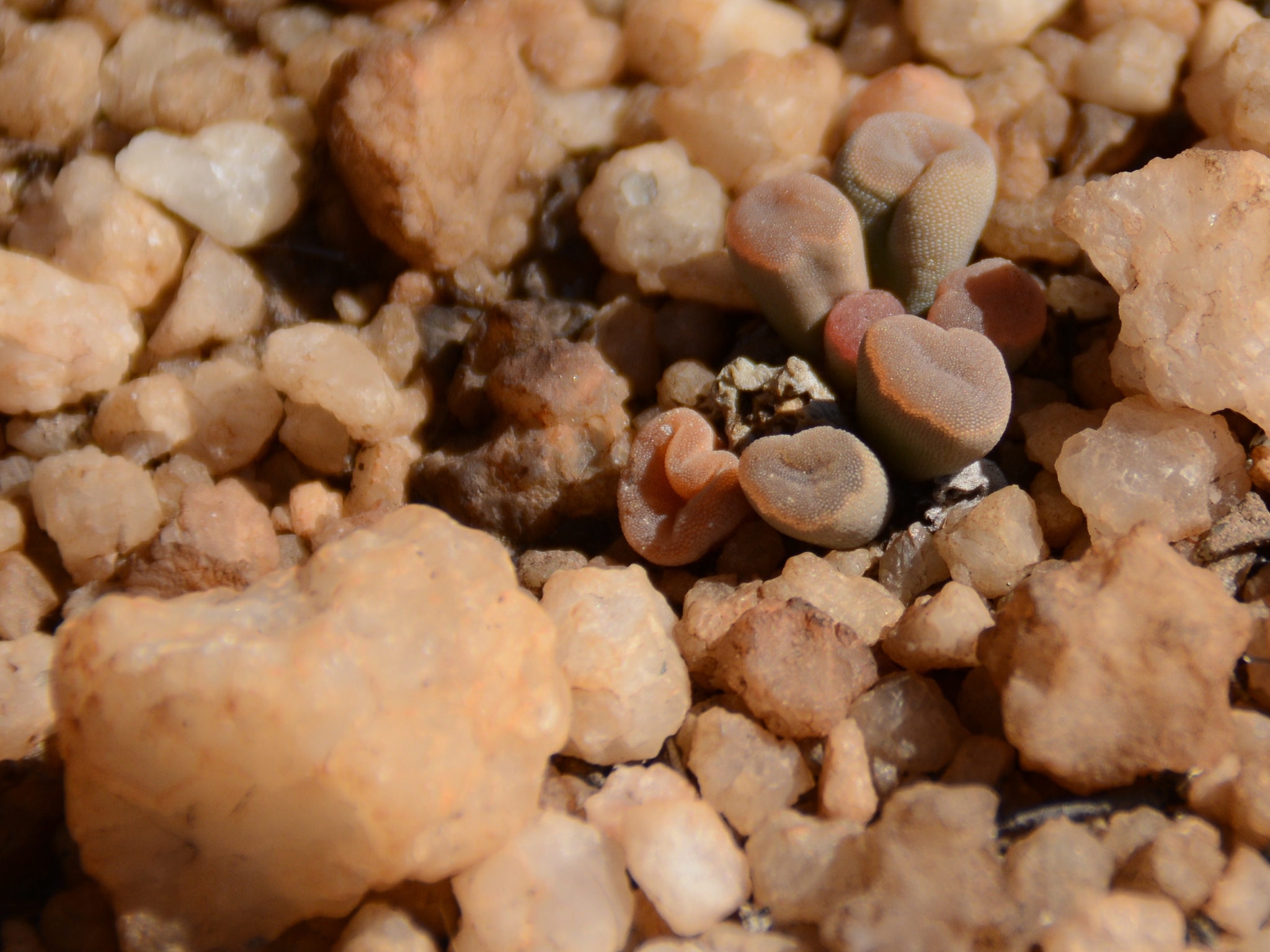
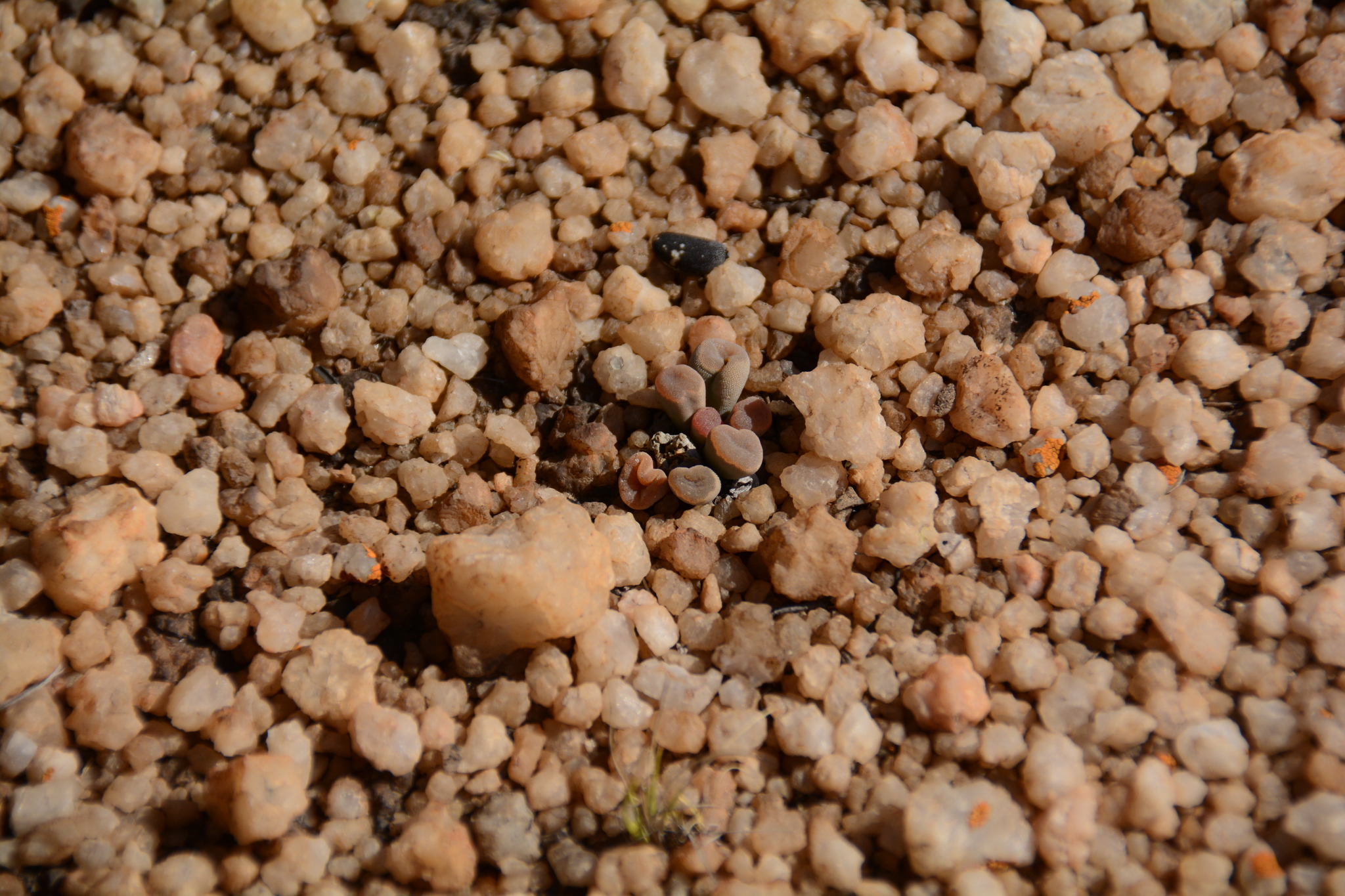
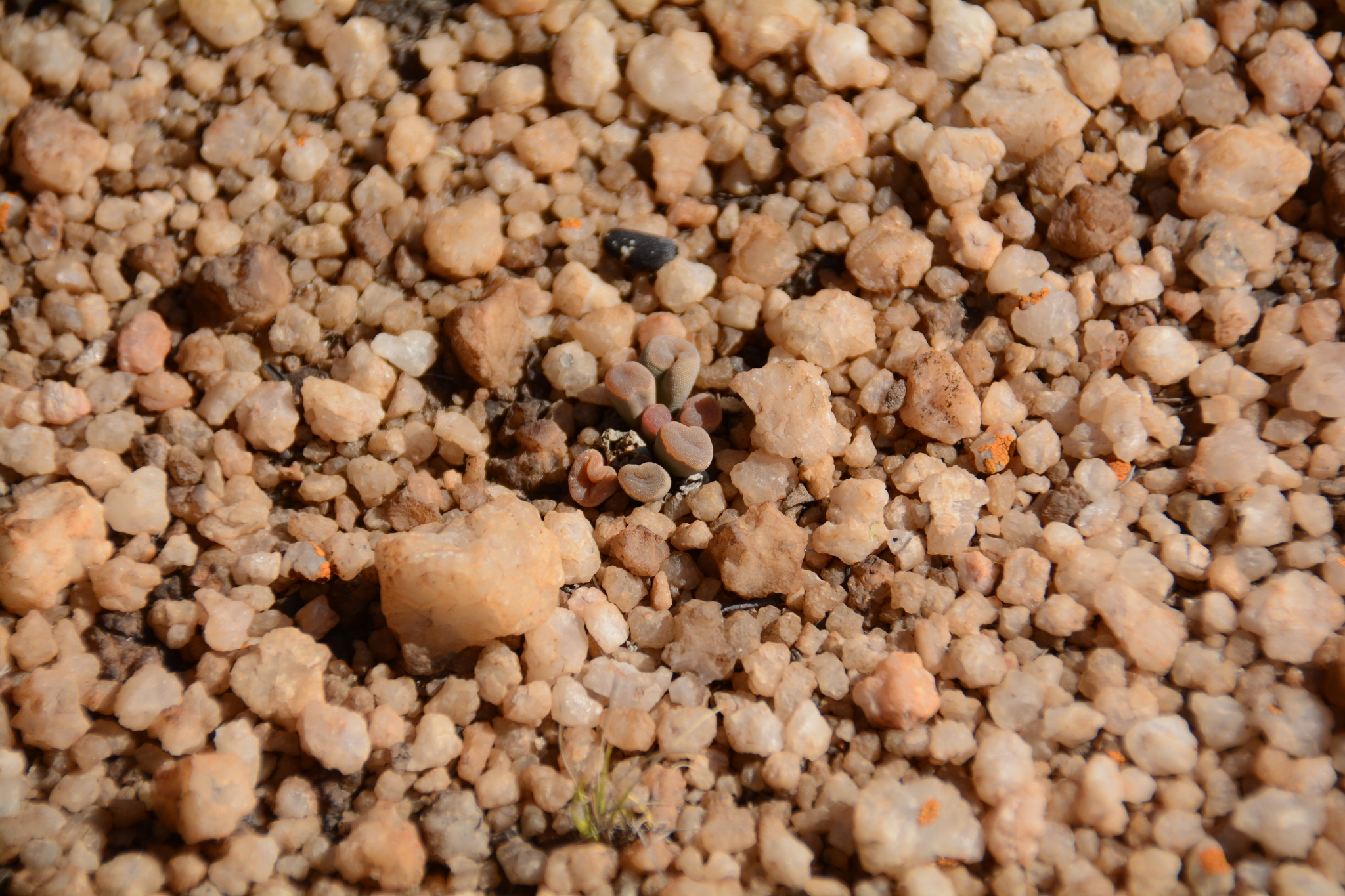
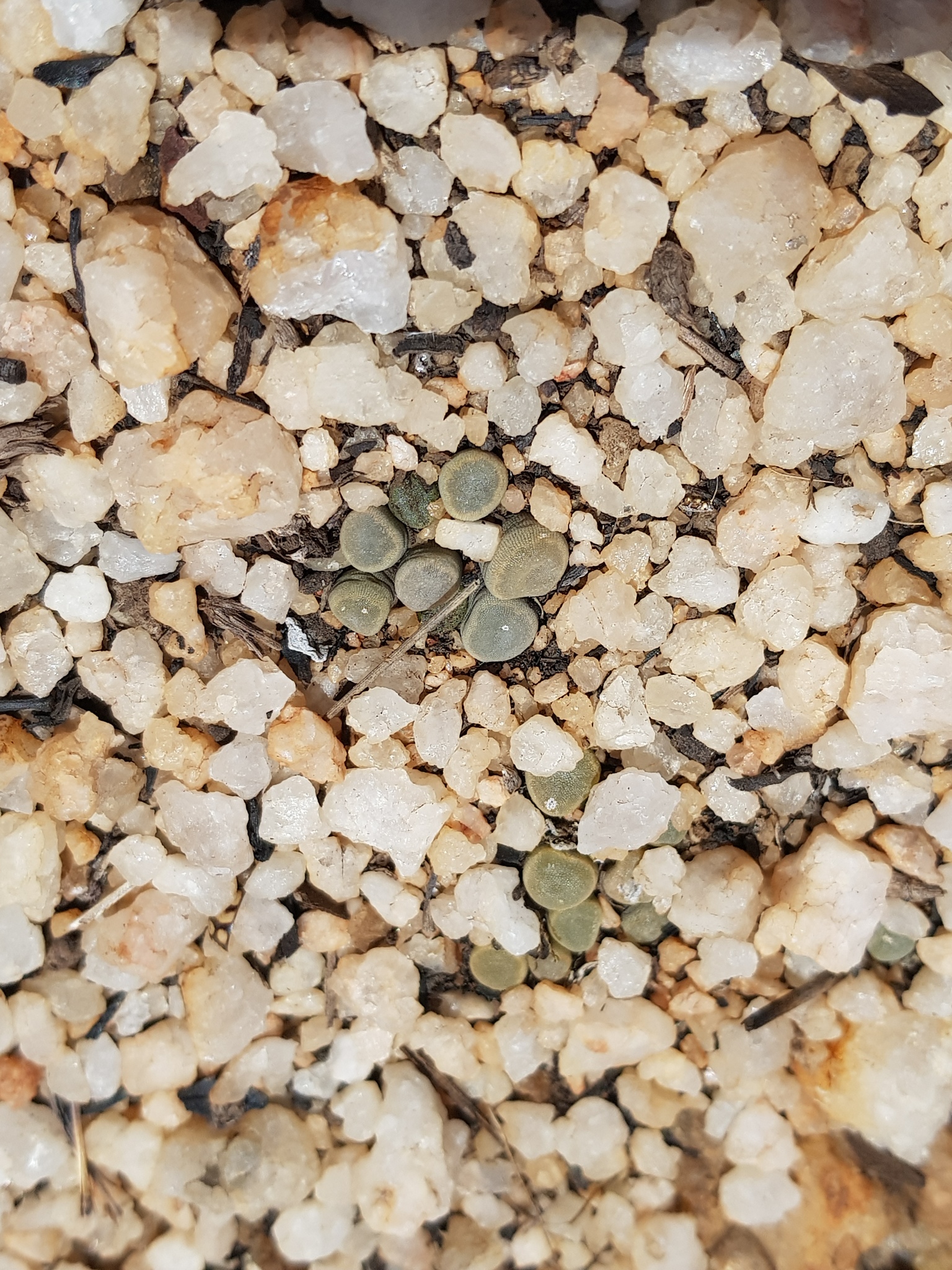
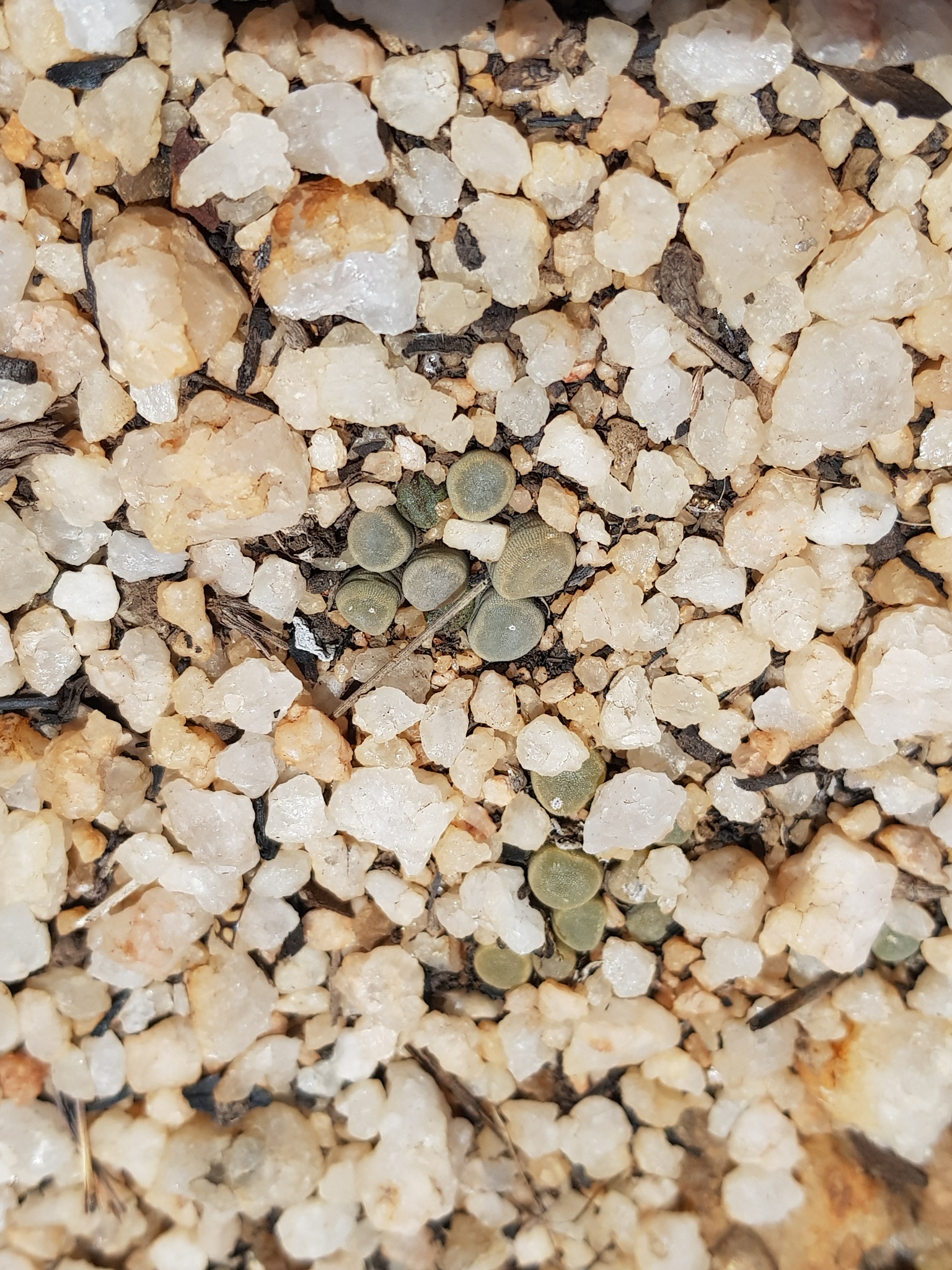
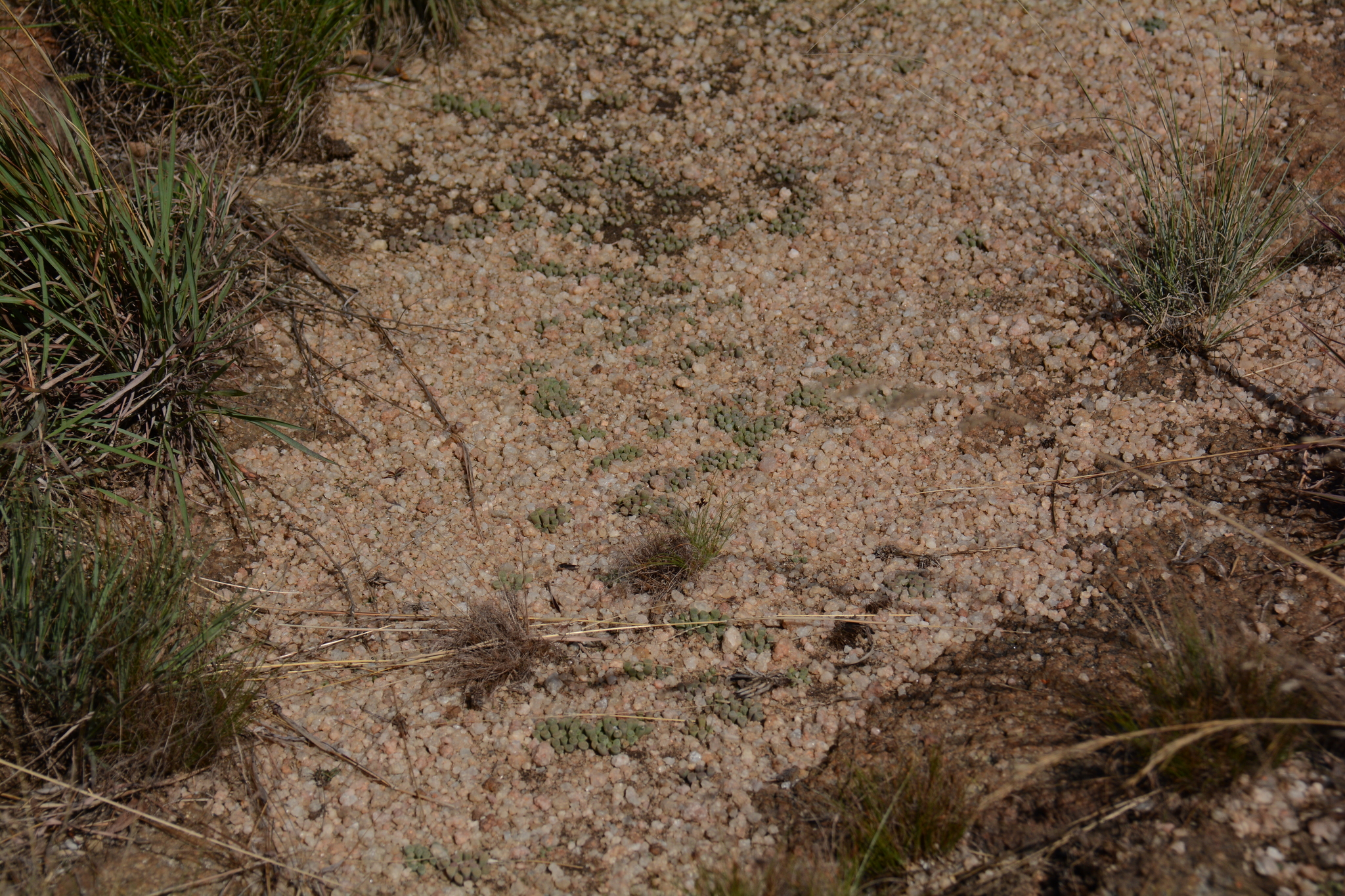
Habit: Dwarf perennials with thickened roots. The stems are much reduced and during periods of drought the plants retract into the sandy soil. This has been ascribed to contractile roots, but no such roots are present in either species. However, in Frithia the cells of the leaves are arranged in columnar, axial rows and when moisture is lost and the cells shrink, the tangential walls contract. Artificially induced dessication using silica gel, indicated that a leaf may contract to up to one third of its length. This causes the plants to retract into the soil, a mechanism which renders protection to the plants during times of drought. Retraction into the ground is thus achieved by means of 'contractile leaves, not contractile roots. Roots: Roots of Frithia pulchra differ from those of F. humilis in being more fibrous, possibly because of the drier conditions prevailing in its habitat and the strategy to insulate the plants against the heat of surrounding rocks in summer. Leaves: Borne spirally, the leaves of both species are cylindrical with windowed tips and are covered by an epidermal layer of waxy idioblasts arranged in distinct rows. Leaves 15-25 mm long, blue-green or grey-green. Window of leaf tips convex with no markings along margins.Flowers: Flowers in both species are borne singly and on very short stalks or are stalkless. They are subtended by five unequal sepals closely resembling the cylindrical leaves. The petals are bright magenta with gold, yellow or white centre, 25-35 mm diam.; number between 30 and 45 in F. pulchra and tend to have blunt, rounded tips, whereas those of F. humilis number between 20 and 30 and usually have acuminate tips. Pollen: Pollen in both species of Frithia is yellow. The grains are tricolpate and simplicolumellate in F. pulchra with a perforate surface and lumens of different sizes. Pollen in F. humilis has a perforate surface, and is pluricolumellate, with lumens of more or less equal size. Fruit: Fruits are hygrochastic capsules, the shape resembling a barrel. Thick tissue surrounds the capsules of F. pulchra, whereas that of F. humilis is more fragile. However, this character is not constant for the two species and seems to vary with environmental conditions. Capsules of both species tend to break up shortly after ripening. In both species, there are five or six locules, no valve wings and no closing bodies. Expanding keels are parallel with divergent tips, and are dark brown in F. pulchra and lighter brown in F. humilis. Covering membranes are reduced to a ledge in both cases.Seeds: In F. pulchra the end where the seed has been attached to the funicle (hilar end) has a sharp point, whereas in F. humilis it is more rounded. The surface of the epidermal cells differs markedly between the two species, that of F. pulchra being rough-textured whereas the cell surface of F. humilis is smoother. From: Burgoyne, PM; Du Plessis, F; Smith, GF. 2000. Notes on the genus Frithia (Mesembryanthemaceae) and the description of a new species, F. humilis, in South Africa. Bothalia 30(1): 1-7. [CC BY]
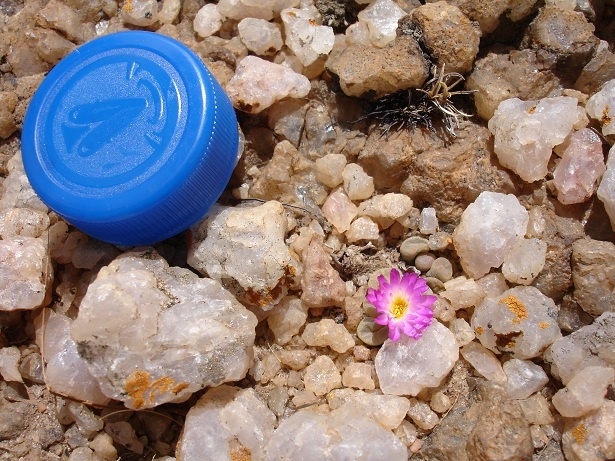
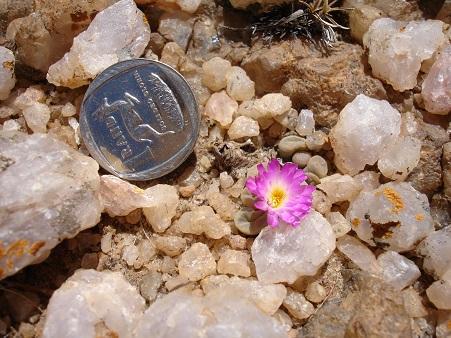
Leaves in adult plants of F. pulchra are longer (15-25 mm) than in F. humilis (shorter than 15 mm ). Leaf colour also varies slightly between the two species, those of F pulchra having a bluish tinge, whereas those of F. humilis are tinged brown or purple. The windowed tips of the leaves, however, differ conspicuously between the two species. Windows of F. pulchra are convex when turgid, slightly concave when flaccid and those of F. humilis are concave even when turgid, with crenulate markings along the margins. These leaf differences were also noted by Zimmermann (1996). Flowers of F. pulchra are bright magenta with a white or light yellow centre and are 25-35 mm in diam. Those of F. humilis are white with a yellow centre, sometimes tipped with pale pink, and are generally smaller (15-20 mm diam.). Occurs west of Pretoria in the Rustenburg area (F. humilis E of Pretoria). From: Burgoyne, PM; Du Plessis, F; Smith, GF. 2000. Notes on the genus Frithia (Mesembryanthemaceae) and the description of a new species, F. humilis, in South Africa. Bothalia 30(1): 1-7. [CC BY]
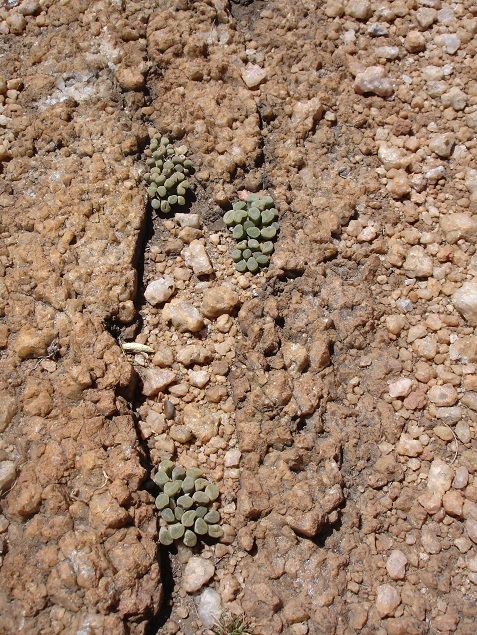
Very shallow soils derived from coarse sediments: quartzites of the Magaliesberg formation of the Pretoria Group of the Transvaal Supergroup. Winters are cold and dry and severe frost occurs in the areas where the plants grow. Other species often associated with both species of Frithia are the fern ally Selaginella dregei and the legume Indigofera melanadenia. Species sometimes found associated with either species of Frithia are the succulents Anacampseros subnuda subsp. subnuda, Crassula lanceolata subsp. transvaalensis, C. setulosa var. setulosa and Mossia intervallaris. Monocots like Microchloa kunthii, Anthericum calyptocarpum together with an extremely minute and monophyllous species of Drimia, are also found in these habitats. The habitat of Frithia pulchra tends to be drier than that of F. humilis, the soils where the latter grow, having a higher organic content, sometimes resembling peat, and thus retaining moisture better. From: Burgoyne, PM; Du Plessis, F; Smith, GF. 2000. Notes on the genus Frithia (Mesembryanthemaceae) and the description of a new species, F. humilis, in South Africa. Bothalia 30(1): 1-7. [CC BY]
Northwest province: West of Pretoria in the Rustenburg area. From: Burgoyne, PM; Du Plessis, F; Smith, GF. 2000. Notes on the genus Frithia (Mesembryanthemaceae) and the description of a new species, F. humilis, in South Africa. Bothalia 30(1): 1-7. [CC BY]
1500 to 1770 m
This map contains point-based occurrences at different locations
Occurrence in the Flora of Southern Africa (FSA) countries and South African provinces. Residence status indicates if a taxon is indigenous, endemic, naturalised or invasive in a specific region. This data is based on specimen records and literature
FSA
SA
BOT
NAM
ESW
LES
WC
EC
NC
FS
GA
KZN
LP
MP
NW
Absent
Indigenous
Endemic
Naturalised
Invasive

Names and Sources
Published in: Man. Pl. Transvaal [Burtt Davy] 1: 41, 162 (1926)
Classification
KINGDOM Plantae
SUBKINGDOM Phanerogamae
PHYLUM Anthophyta
ORDER Caryophyllales
FAMILY Aizoaceae
SUBFAMILY Ruschioideae
TRIBE Ruschieae
GENUS Frithia
SPECIES pulchra
23 results for Frithia pulchra N.E.Br.
Barcode: NBG0085795-0 Collector(s) & number: Hall, H, 1200 | 1967-2-9
South Africa, North West, Transvaal, Rustenburg District, Breedsnek Pass, Magaliesberg
Data Resource: BODATSA View record
Barcode: PRE0422777-0 Collector(s) & number: Rose-Innes, R, 167 | 1943-10-7
South Africa, North West, RUSTENBURG DIST.; MORGENZON; SUMMIT OF MT.
Data Resource: BODATSA View record
Barcode: PRE0573806-0 Collector(s) & number: Burgoyne, PM, 6699C | 1997-1-5
South Africa, North West, 25° 51' 293" S: 27° 26' 567" E. Rustenburg District: Breeds Nek. Maanhaarrand road ± 5-8 km along road on crest/slope.
General notes: Rocky grassland with some short shrubs. Stony soil. Well-drained. Gravel. Sandstone. Full sun. Mountain slope. Gentle slope. N-aspect. Biotic effect: none seen. Succulent ± 2-5cm tall with columnar upright leaves (alternate). Flowers bright mauve/pink with white centres. Colony 5-8 cm in diam. Seems that centres become white with age. Associated veg. Selaginella dregei, Anacampseros subruda sp. subruda. Euphorbia shinziee, Microcloa knuthii, Indigofera melanadenia.
Data Resource: BODATSA View record
Barcode: PRE0526691-0 Collector(s) & number: Venter, S, 2997 | 1978-2-1
South Africa, Mpumalanga, BRONKHORSTSPRUIT DIS; 20 KM. FROM VERENA ON KOPJE NEXT TO RD. FROM BRONKHORSTSPRUIT TO GROBLERSDAL
Data Resource: BODATSA View record
Barcode: NBG0091502-0 Collector(s) & number: Wisura, W, 1220 | 1970-1-26
South Africa, Gauteng, Transvaal (2528DB Pretoria), 11 miles north of Bronkhorstspruit
Data Resource: BODATSA View record
Barcode: NBG0021900-0 Collector(s) & number: Vogts, NBG 723/40 | 1943-1-25
South Africa, Gauteng, Transvaal, Magaliesberg
Data Resource: BODATSA View record
Barcode: PRE0422776-0 Collector(s) & number: Vari, L, PRE 54978 | 1957-10-
South Africa, North West, MAGALIESBERG; RUSTENBURG DIST.
Data Resource: BODATSA View record
Barcode: PRE0768514-0 Collector(s) & number: Burgoyne, PM, 10244(a) | 2005-3-7
South Africa, North West, Brits District. Breedts Nek N of Maanhaanrand on Northern slopes (midslope).
General notes: Slope: moderate. Common in spots. Height: ± 2-3 cm. Caespitose clumps with windowed leaf tips. Flowers pink tips and white centre.
Data Resource: BODATSA View record
Barcode: PRE0422780-0 Collector(s) & number: Dyer, RA, 3922 | 1939-1-11
South Africa, North West, RUSTENBURG DIST.; BREETS NEK
Data Resource: BODATSA View record
Barcode: PRE0422778-0 Collector(s) & number: Dyer, RA, 4774 | 1947-3-4
South Africa, North West, RUSTENBURG; BREEDTS NEK
Data Resource: BODATSA View record
Barcode: PRE0481316-0 Collector(s) & number: Young, RGN, 3047 | 1946-1-31
South Africa, North West, MAGALIESBERG; RUSTENBURG DIST.; MAGALIESBERG UPPER NORTHERN SLOPES ON FARM WALDHEIM NEAR KROONDAL
Data Resource: BODATSA View record
Barcode: PRE0573805-0 Collector(s) & number: Burgoyne, PM, 1 | 1998-11-16
South Africa, North West, 25° 51' 293" S: 27° 26' 567" E. Rustenburg District: Breeds Nek. Maanhaarrand road ± 5-8 km along road on crest/slope.
General notes: Rocky grassland with some short shrubs. Stony soil. Well-drained. Gravel. Sandstone. Full sun. Mountain slope. Gentle slope. N-aspect. Biotic effect: none seen. Succulent ± 2-5cm tall with columnar upright leaves (alternate). Flowers bright mauve/pink with white centres. Colony 5-8 cm in diam. Seems that centres become white with age. Associated veg. Selaginella dregei, Anacampseros subruda sp. subruda. Euphorbia shinziee, Microcloa knuthii, Indigofera melanadenia.
Data Resource: BODATSA View record
Barcode: PRE0422782-0 Collector(s) & number: Jacobsen, NHG, 758 | 1970-2-25
South Africa, North West, RUSTENBURG NAT. RES.
Data Resource: BODATSA View record
This map contains point-based occurrences at different locations
2001
BOOK
Illustrated handbook of succulent plants: Aizoaceae F-Z Hartmann, HEKO1927
PERIODICAL/JOURNAL
Frithia pulchra N.E.Brown Bolus, HML; Carter, BOFlowering Plants of South Africa 7: , t.275
No results found for Frithia pulchra N.E.Br.
Status and criteria
LC
Assessor(s)
Plantae Coordinator
GENERIC
Obermeyer, A.A. 1966. Potamogetonaceae. Edited by L.E. Codd, B. De Winter and H.B. Rycroft. Flora of Southern Africa. Botanical Research Institute. 1:60-70
GENERIC
Obermeyer, A.A. 1966. Ruppiaceae. Edited by L.E. Codd, B. De Winter and H.B. Rycroft. Flora of Southern Africa. Botanical Research Institute. 1:70-72
GENERIC
Obermeyer, A.A. 1966. Zannichelliaceae. Edited by L.E. Codd, B. De Winter and H.B. Rycroft. Flora of Southern Africa. Botanical Research Institute. 1:73-81
GENERIC
Obermeyer, A.A. 1966. Zosteraceae. Edited by L.E. Codd, B. De Winter and H.B. Rycroft. Flora of Southern Africa. Botanical Research Institute. 1:57-60
JOURNAL ARTICLE
Obermeyer, A.A. 1967. Liliaceae: two new species of Bulbine. Bothalia. 9:342-343
JOURNAL ARTICLE
Obermeyer, A.A. 1967. A new combination in Trachyandra. Bothalia. 9:344
GENERIC
Obermeyer, A.A. 1970. Droseraceae. Edited by L.E. Codd, B. De Winter, D.J.B. Killick and H.B. Rycroft. Flora of southern Africa. National Botanical Institute. 13:187-201
GENERIC
Obermeyer, A.A. 1970. Hydrostachyaceae. Edited by L.E. Codd, B. De Winter, D.J.B. Killick and H.B. Rycroft. Flora of southern Africa. National Botanical Institute. 13:211-213
GENERIC
Obermeyer, A.A. 1970. Podostemaceae. Edited by L.E. Codd, B. De Winter, D.J.B. Killick and H.B. Rycroft. Flora of southern Africa. National Botanical Institute. 13:205-211
GENERIC
Obermeyer, A.A. 1970. Roridulaceae. Edited by L.E. Codd, B. De Winter, D.J.B. Killick and H.B. Rycroft. Flora of southern Africa. National Botanical Institute. 13:201-204
JOURNAL ARTICLE
Obermeyer, A.A. 1973. Caesia and Nanolirion. Bothalia. 11:122-123
JOURNAL ARTICLE
Obermeyer, A.A. 1973. Notes on African Plants: Aloe, Chamaealoe, Haworthia, Astroloba, Poellnitzia and Chortolirion. Bothalia. 11:119
| Part(s) of plant used | Use(s) | Reference |
|---|
Coming soon...