PLANTAE / PHANEROGAMAE / ANTHOPHYTA / FABALES / FABACEAE / PAPILIONOIDEAE / PSORALEEAE / PSORALEA / PSORALEA / SEMOTA

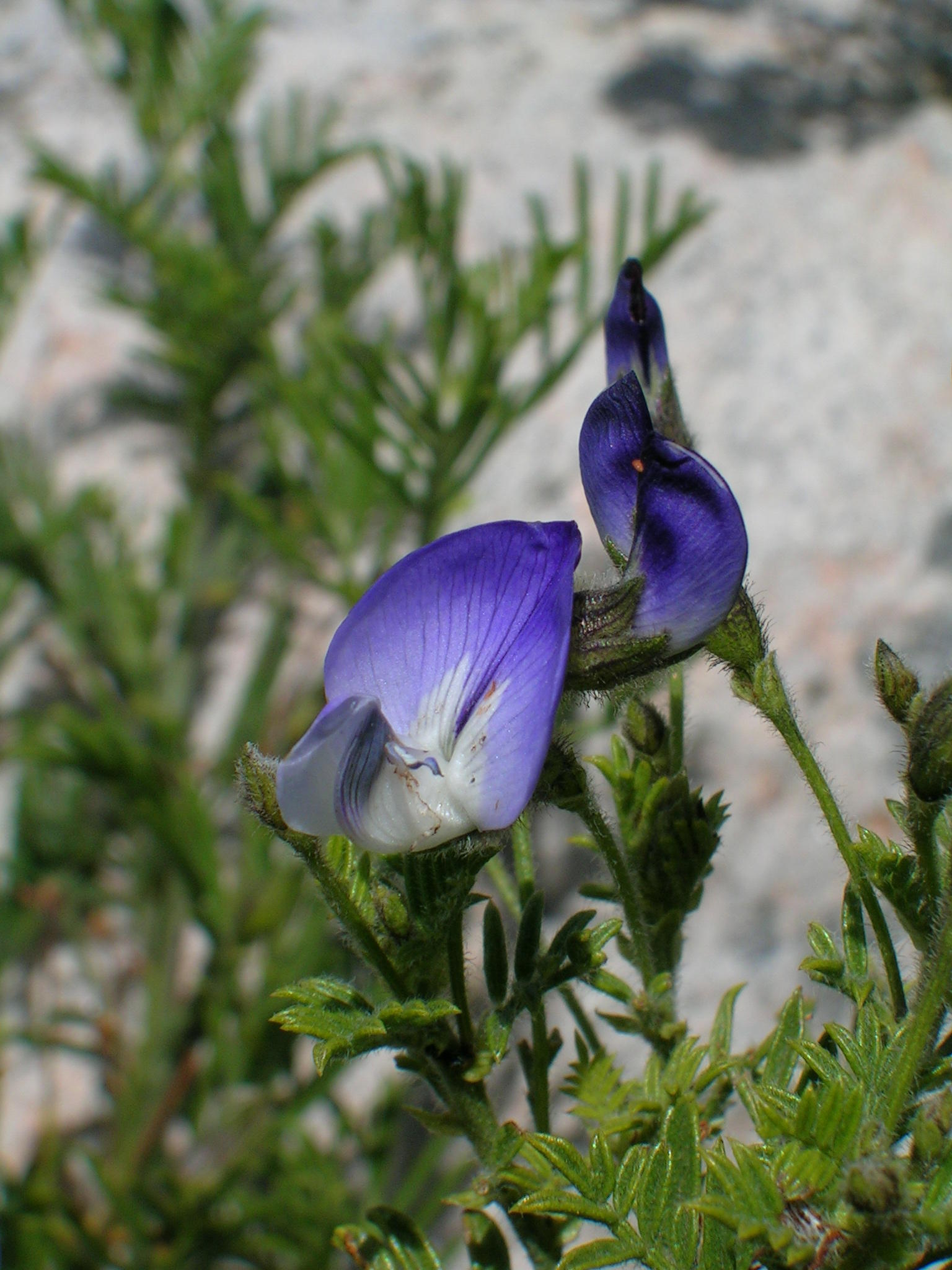
Multi-stemmed mound-like suffrutex up to 1 m tall and 1.5 m wide. Stems semi-erect to ascending, many, branching at or near the base, spreading laterally and sprawling or arching, rigid. Seasonal shoots pubescent, dark green. Leaves (9)11-13(15)-foliolate, distributed along the branches (at higher elevations branches bare and leaves tightly clustered at tips), patent, petiolate, sparsely pubescent, mucronate; leaflets 8-15 x 0.5-1.5 mm, linear to linear lanceolate; terminal leaflets shortest, basal pair longest, three uppermost pinnately inserted, upper surface of mature leaflets shiny, tips sinuous, glabrescent; petioles 1-2 mm long, shorter than terminal leaflet; rachis 5-7 mm long; stipules 1-2 x 0.5-1 mm persistent, becoming woody with age, shorter or equal in length to petiole, covered with black hairs. Inflorescences axillary, borne along the length of seasonal shoots, pseudo-spicate, lax, one flower per axil, fasciculate, 1-6 flowers per shoot, pedunculate, pedicellate; peduncles flexible, 30-40 mm long, longer than the subtending leaf, densely clothed with patent black hairs; cupulum shallowly bilobed, overlapping the base of the calyx, densely covered with patent black hairs, lobes equally developed, narrowly triangular; pedicels 1-2 mm long, clothed with black hairs. Flowers 12-13 mm long, deep blue. Calyx 5-6 mm long, tube 3-4 x 4 mm, covered with bristly black hairs both within and outside; lobes sub-equally developed, lower lobe slightly longer, lateral straight, triangular, acute, broader than the other four lobes, vexillar lobes fused for up to one third their length, inner face of the lobes covered with black bristle-like hairs. Standard petal 9-10 x 6-8 mm, elliptic, apex acute, deep blue with white striations, dark blue on the margins with nectar guide comprised of two narrowly triangular M-shaped patches, veins darker blue; claw 3-4 mm long. Wing petals 8-9 x 3-3.5 mm, white with purplish violet fading at the tip; claw 3-4 mm long. Keel 9 x 3-3.5 mm wide; claw 4-5 mm long. Androecium 10 mm long, scarcely fenestrate. Pistil 8 mm long, stipitate; ovary 1 mm long, glabrous, sparsely covered in club-shaped glands; style 6 mm long, straight then curved, glabrous, height of curvature 2.5 mm long, thickened at point of flexure. Fruits unknown. Seeds unknown. From: Bello, A; Stirton, CH; Chimphango, SBM; Muasya, AM. 2017. Taxonomic revision of African Psoralea pinnata species complex (Psoraleeae, Leguminosae). S. African J. Bot. 112: 128-179. [Copyright held by the South African Association of Botanists (2017); http://www.sciencedirect.com/science/journal/02546299] [CC BY]
Psoralea semota is similar to P. affinis from which it differs in being a compact sprawling to erect multi-stemmed suffrutex <1 m tall and up to 1.5 m wide (versus erect singlestemmed reseeding shrub to 3 m tall), with pubescent leaves (versus sparsely pubescent or glabrous leaves), densely black haired cupula, and pedicels (versus glabrous), peduncles longer than subtending leaflets (versus peduncles nearly as long as subtending leaflets), and flowers borne along the length of seasonal flowering shoot (versus flowers borne at the apex of seasonal flowering shoot). Psoralea semota is also similar to P. suaveolens in having more than 5 pairs of leaflets and elongated peduncles. They however differ in that P. semota is a compact resprouting suffrutex (up to 1.5 m wide and 1 m tall) whose leaves, peduncles, cupulum and calyx are covered with dense black hairs; whereas P. suaveolens is a tall multi-stemmed resprouting shrub up to 2 m tall with glabrous leaves and flowers. At higher elevations P. semota becomes a low spreading decumbent shrub with mostly bare stems with the leaves tightly clustered at the ends of branches. More fieldwork is needed to distinguish the Langeberg and Riviersonderend populations as they may represent distinct taxa. We have not studied this species in the field. From: Bello, A; Stirton, CH; Chimphango, SBM; Muasya, AM. 2017. Taxonomic revision of African Psoralea pinnata species complex (Psoraleeae, Leguminosae). S. African J. Bot. 112: 128-179. [Copyright held by the South African Association of Botanists (2017); http://www.sciencedirect.com/science/journal/02546299] [CC BY]
Has been recorded in Breede Shale Fynbos, North Hex Sandstone Fynbos, North Sonderend Sandstone Fynbos, South Sonderend Sandstone Fynbos, South Langeberg Sandstone Fynbos, Western Altimontane Sandstone Fynbos and Western Little Karoo (FFh 4, FFs 7, FFs 13, FFs 14, FFs 16, FFs 30 and SKv 8). From: Bello, A; Stirton, CH; Chimphango, SBM; Muasya, AM. 2017. Taxonomic revision of African Psoralea pinnata species complex (Psoraleeae, Leguminosae). S. African J. Bot. 112: 128-179. [Copyright held by the South African Association of Botanists (2017); http://www.sciencedirect.com/science/journal/02546299] [CC BY]
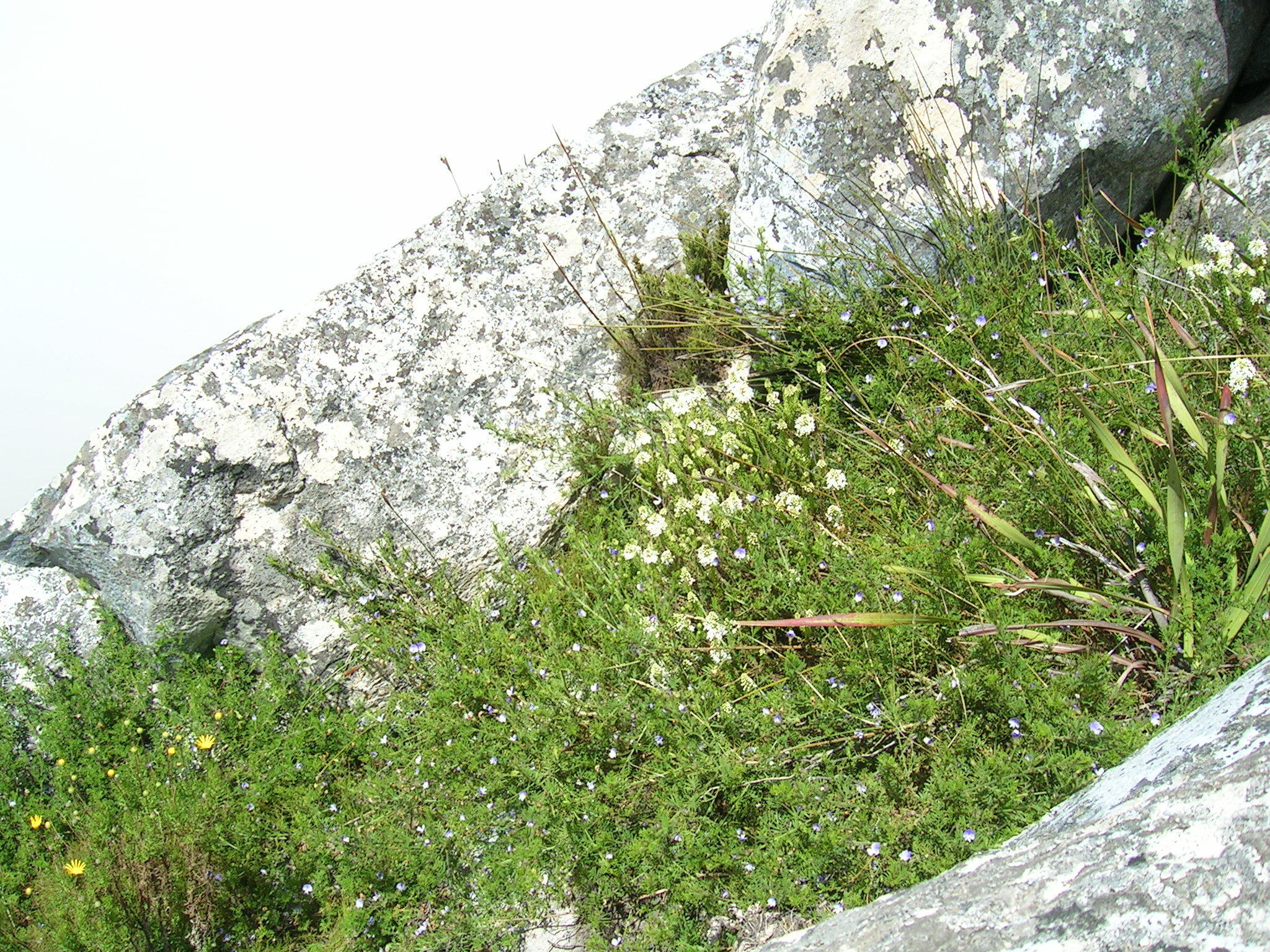
Psoralea semota is a high montane species and occurs on south and south east slopes in well-drained sandy soils in mountain fynbos. It extends from the Hex River Mountains to the Langeberg and Riviersonderend mountains in the Western Cape Province of South Africa. It is distributed entirely in protected areas. From: Bello, A; Stirton, CH; Chimphango, SBM; Muasya, AM. 2017. Taxonomic revision of African Psoralea pinnata species complex (Psoraleeae, Leguminosae). S. African J. Bot. 112: 128-179. [Copyright held by the South African Association of Botanists (2017); http://www.sciencedirect.com/science/journal/02546299] [CC BY]
This map contains point-based occurrences at different locations
Occurrence in the Flora of Southern Africa (FSA) countries and South African provinces. Residence status indicates if a taxon is indigenous, endemic, naturalised or invasive in a specific region. This data is based on specimen records and literature
FSA
SA
BOT
NAM
ESW
LES
WC
EC
NC
FS
GA
KZN
LP
MP
NW
Absent
Indigenous
Endemic
Naturalised
Invasive

Names and Sources
Published in: S. African J. Bot. 112: 135 (2017)
Type: South Africa, Western Cape, Caledon: Schilpadkop, Riviersonderend mountains, 2 Jan 1953, Esterhuysen E. 21,045 (PRE, holo.; BOL, NBG, iso.)
Classification
KINGDOM Plantae
SUBKINGDOM Phanerogamae
PHYLUM Anthophyta
ORDER Fabales
FAMILY Fabaceae
SUBFAMILY Papilionoideae
TRIBE Psoraleeae
GENUS Psoralea
SUBGENUS Psoralea
SPECIES semota
3 results for Psoralea semota C.H.Stirt.
Barcode: PRE0826048-0 Collector(s) & number: Esterhuysen, EE, 21045 | 1953-6-2
South Africa, Western Cape, Caledon District: Riviersonderend Mountains, Schilpadkop, shale band on top of ridge.
General notes: Det: G van Niekerk
Data Resource: BODATSA View record
Barcode: PRE0357382-0 Collector(s) & number: Esterhuysen, EE, 35708 | 1981-11-21
South Africa, Western Cape, Caledon District: Pilaarkop; Riviersonderend Mountains, near Lindeshof. Along the path along the ridge leading to the summit.
General notes: On the South slope only, the usual P. pinnata being on the North slope.
Data Resource: BODATSA View record
This map contains point-based occurrences at different locations
2022
PERIODICAL/JOURNAL
Phylogenetic relationships and biogeography of Psoraleeae (Fabaceae) Bello, A; Stirton, CH; Chimphango, SBM; Muasya, AMBotanical Journal of the Linnean Society 200: 39-74
2017
PERIODICAL/JOURNAL
Taxonomic revision of African Psoralea pinnata species complex (Psoraleeae, Leguminosae) Bello, A; Stirton, CH; Chimphango, SBM; Muasya, AMSouth African Journal of Botany 112: 128-179
No results found for Psoralea semota C.H.Stirt.
| Part(s) of plant used | Use(s) | Reference |
|---|
Coming soon...