PLANTAE / PHANEROGAMAE / ANTHOPHYTA / MALVALES / CYTINACEAE / CYTINUS / VISSERI

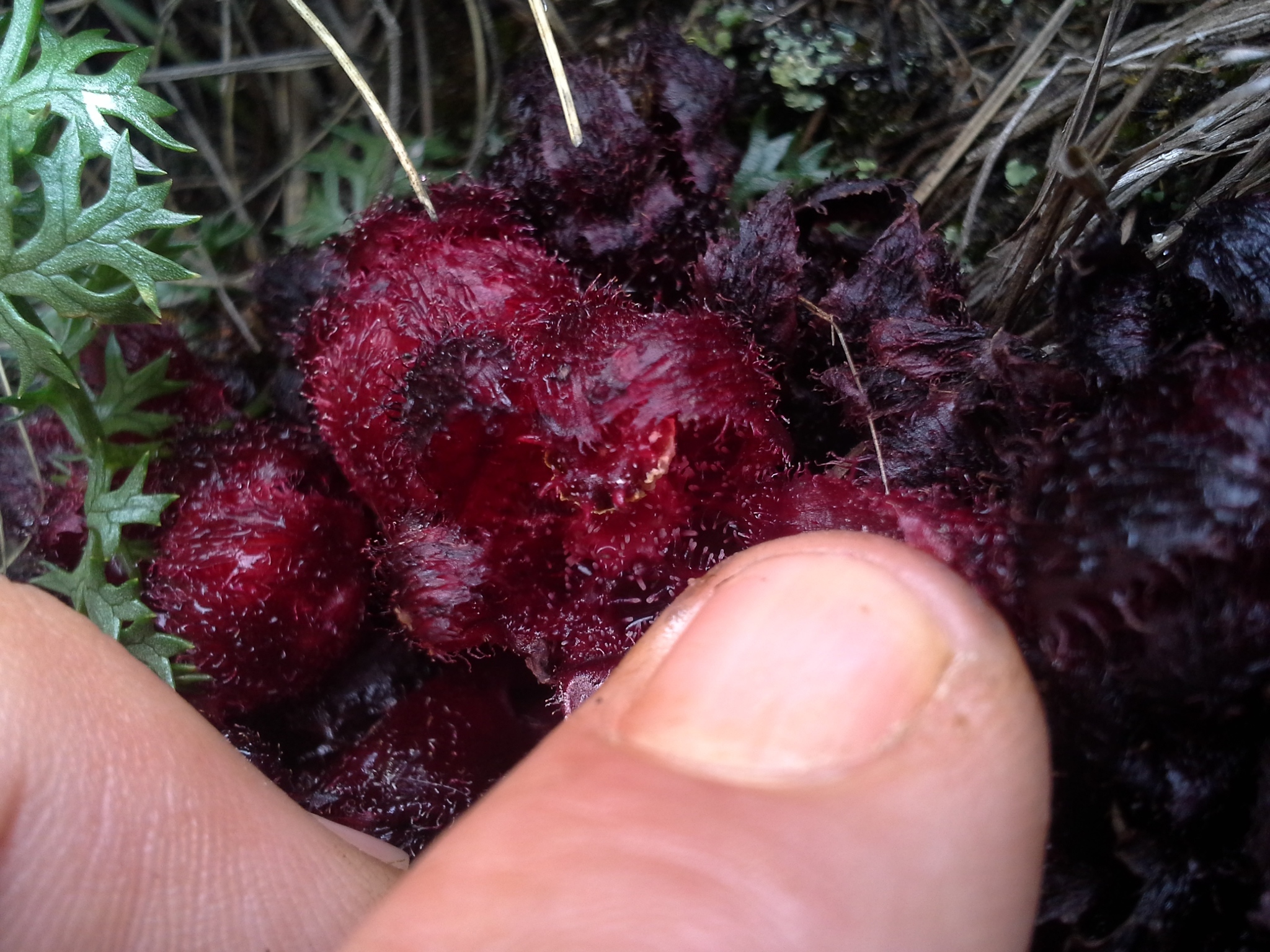
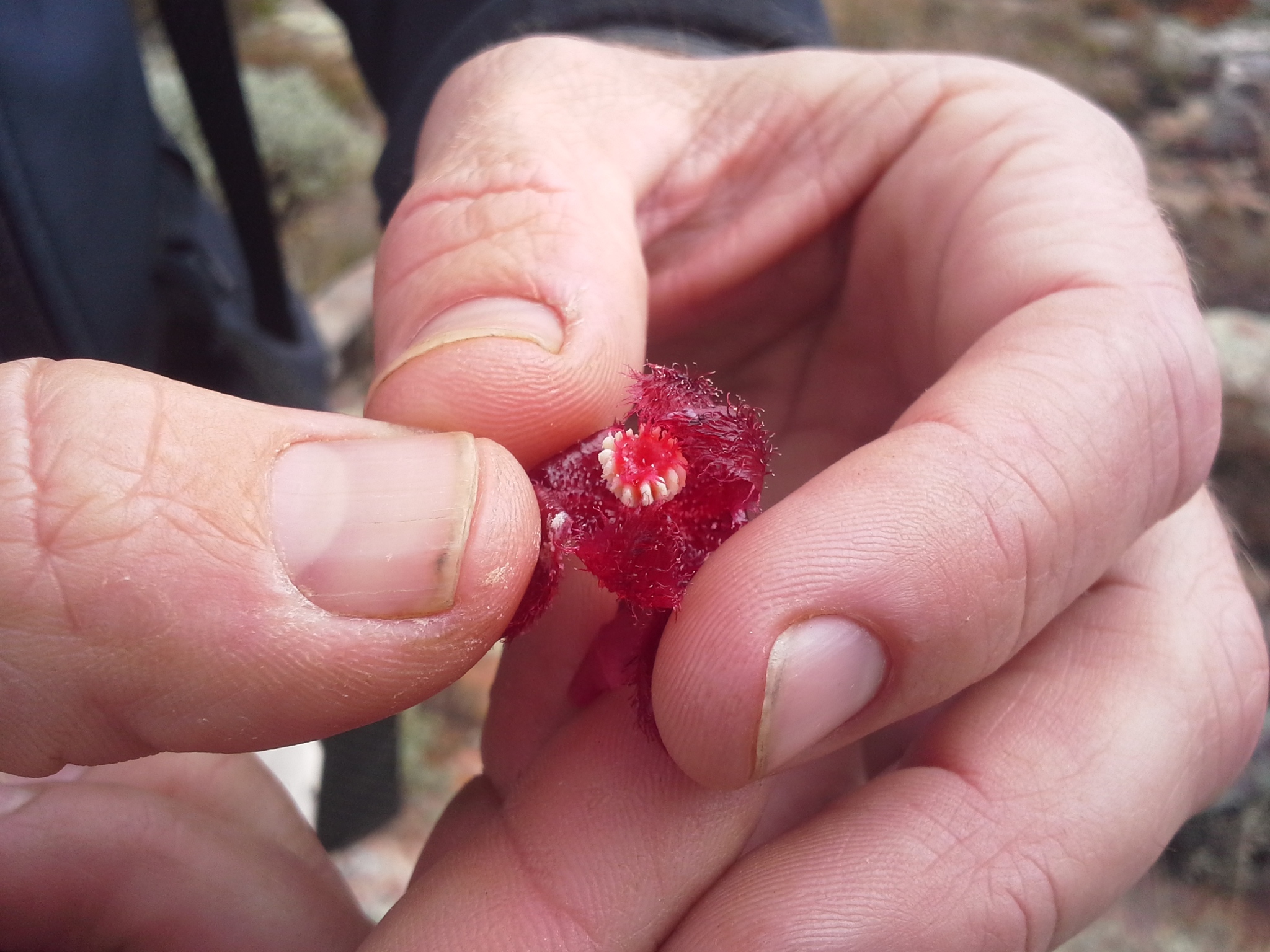
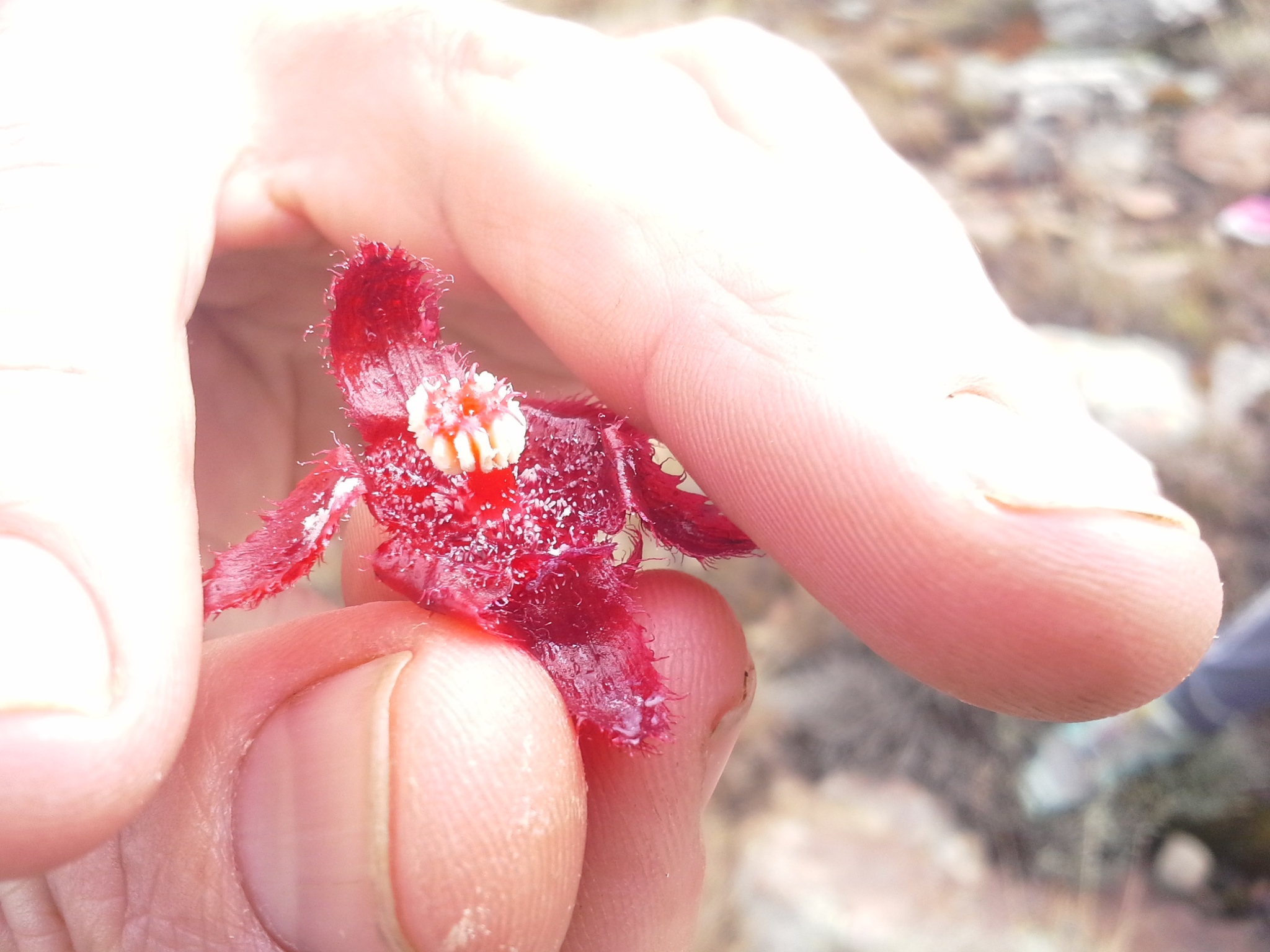
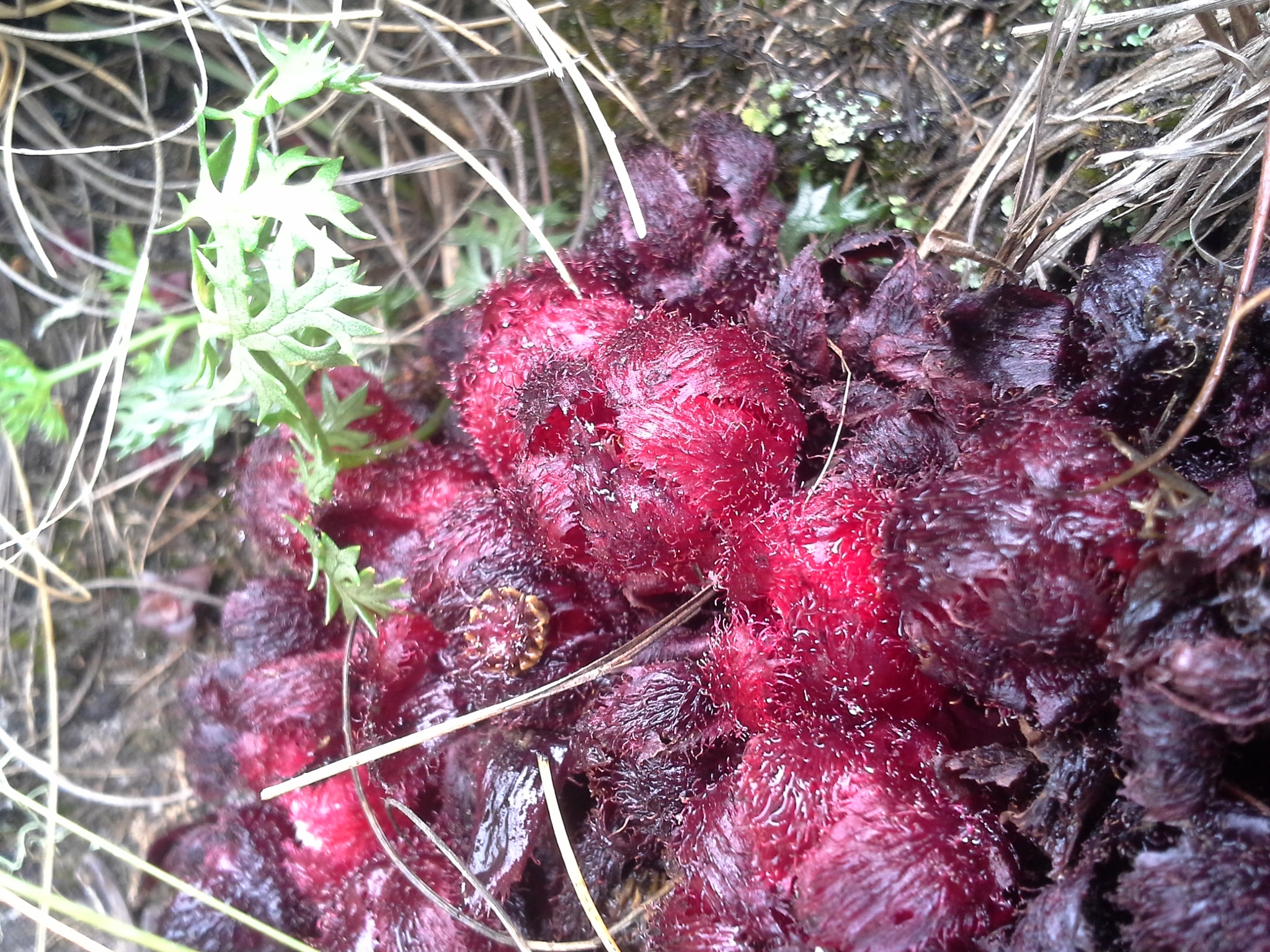
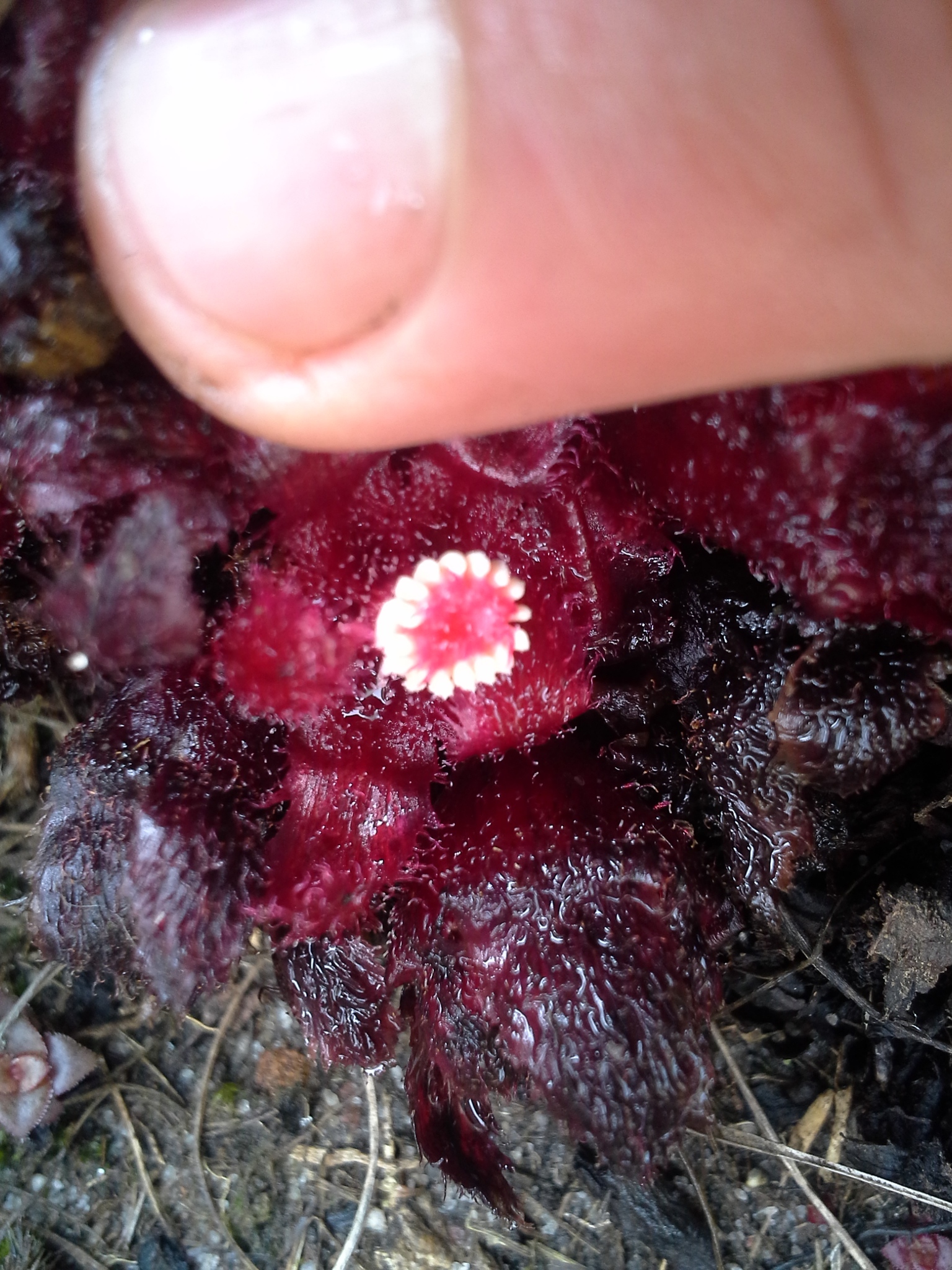
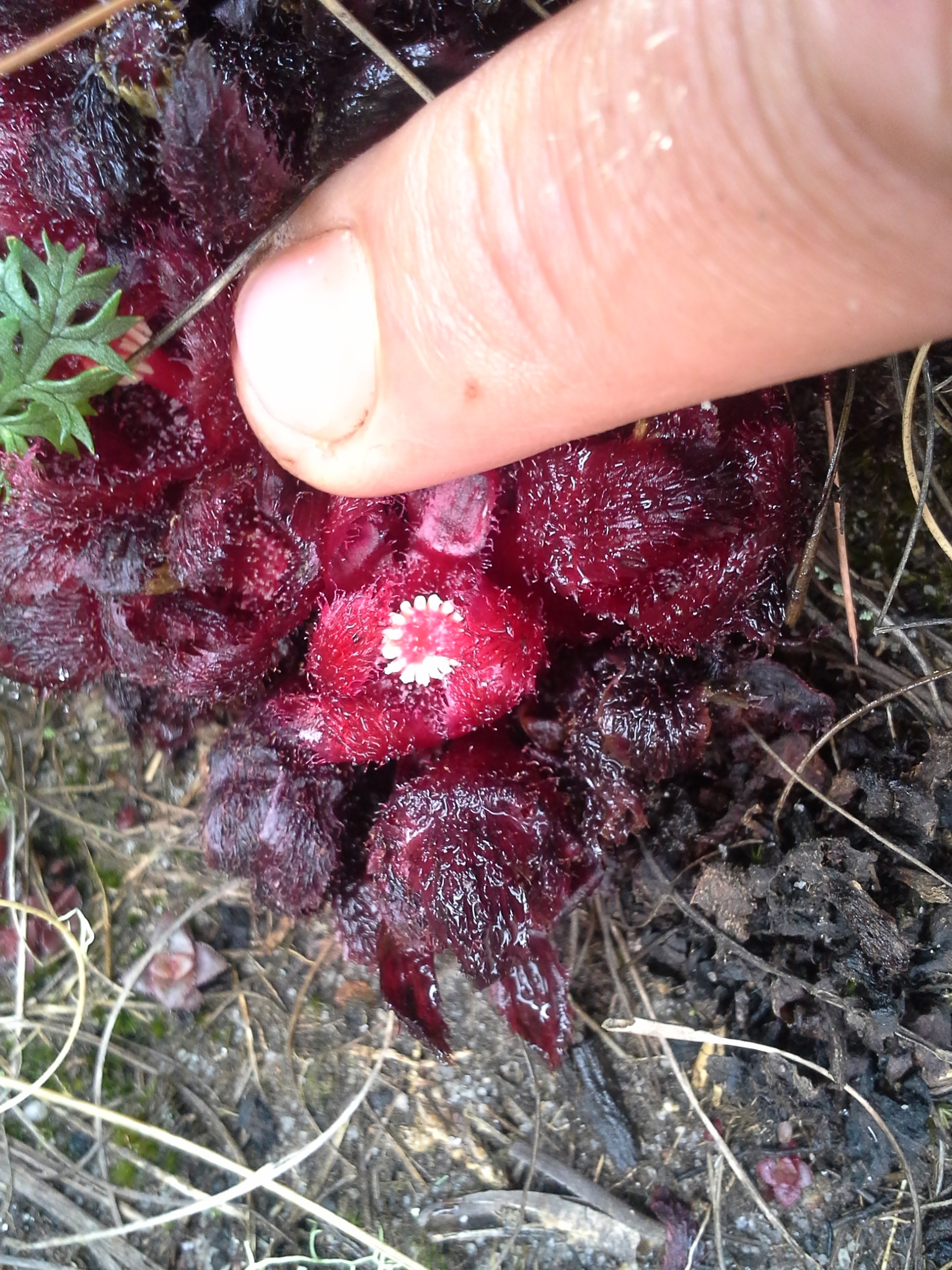
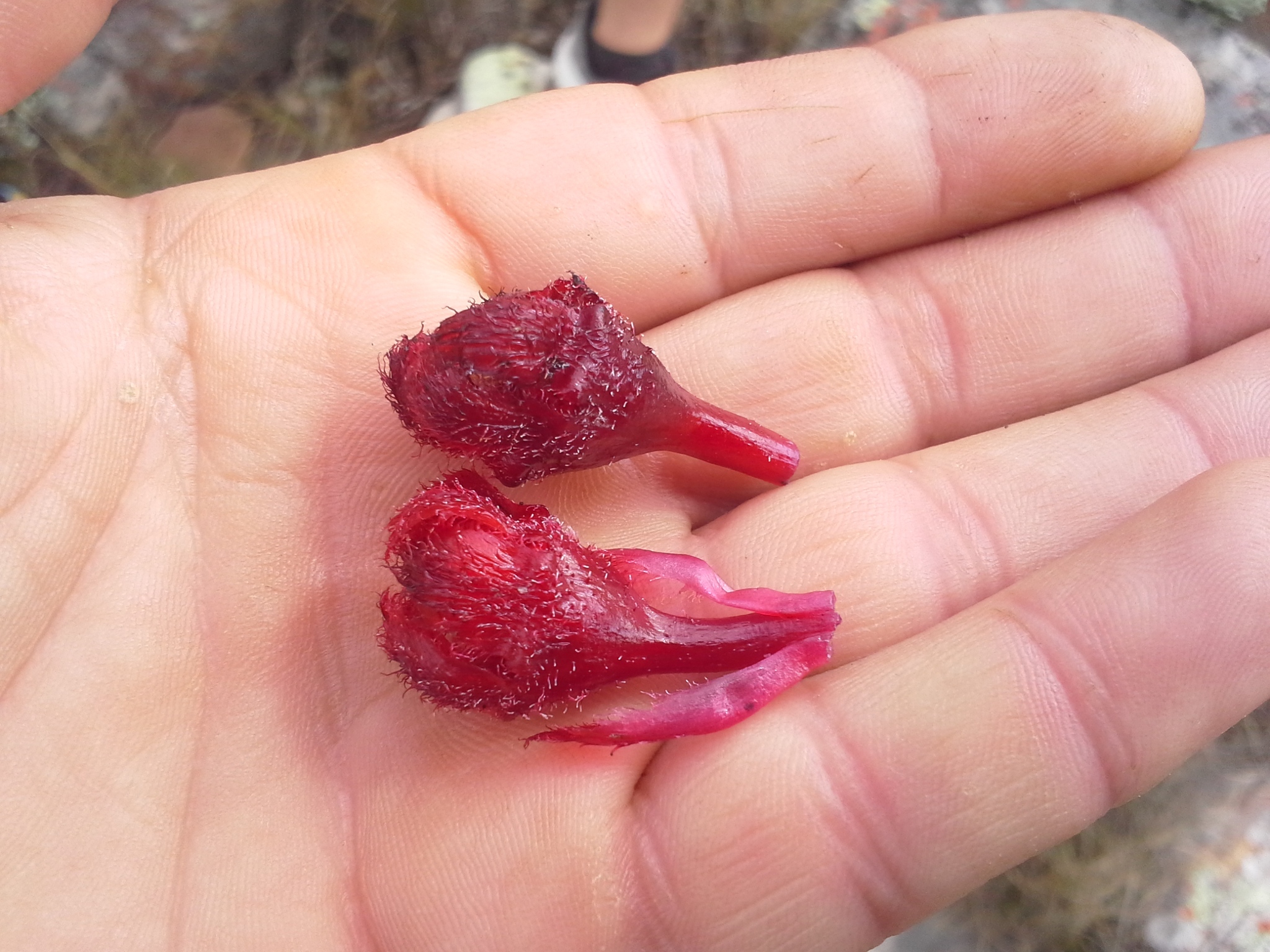
Perennial, upright, dioecious root holoparasite on woody species, male and female plants occurring on different individual host plants, color deep crimson; true roots absent but forming endophytic strands of cells within the tissue of host plants; inflorescence axis borne underground, branched or single; inflorescence formed by cells at the outer surface of the endophyte differentiating into an infloresecence primordium, growing, eventually bursting through the root epidermis of host forming buff-colored fleshy tissue growing upright to the soil surface, red upon emerging from soil; bearing red flowers at tips, underground parts not exposed to light remaining uncolored; inflorescence scales few, spiral, imbricate; surface smooth and buff-colored when borne underground, with multicellular appressed hairs and turning crimson upon appearing above ground; margins laciniate (ragged); inflorescences with solitary flowers or in 1- to 16(21)-flowered racemes, female inflorescences with up to 16 carpellate flowers, male inflorescences with up to 21 staminate flowers; inflorescence axes indeterminate, developing centripetally, 30-120 mm; bracteoles 1 or 2 per flower, bright crimson, 1.2-3.4 mm, with appressed hairs few or absent in central part; flowers with petals absent; perianth as one whorl comprising (5)6 tepals per flower; tepals 12-16 mm long, bright crimson, covered with multicellular, appressed hairs, laciniate, basally imbricate, with a hinge-like fold; carpellate flowers ovary inferior, epigynous, with a stout column terminated by a globose, viscous stigma with a velvety surface, with 6 receptacular pouches below these lined by blunt glandular hairs, nectariferous, ovary unilocular, forming a swelling at base of the flower, placentation intrusive parietal with 6 to 14 placental lobes; staminate flowers more slender than carpellate flowers, stamens fused into a column 12-14 mm diam., anthers united into a stout ring, pollen loculi 9 to 16, bithecous, extrorse, dehiscing longitudinal, with 6 receptacular nectariferous pouches lined with numerous blunt glandular hairs, top of staminal column tipped by multicellular antler-like projections; pollen pale, cream or white borne in tetrads; fruit a fleshy berry 12-17.1 mm diam. with a jelly-like center, falsely 6- to 14-locular; seeds numerous, surrounded by a jelly-like substance in fruit center, urceolate, 0.2-0.4 mm long, surface smooth, ripening in winter. From: Burgoyne, PM. 2006. A new species of Cytinus (Cytinaceae) from South Africa and Swaziland, with a key to the southern African species. Novon 16: 315-319. [Acknowledgement: Missouri Botanical Garden Press; St. Louis] [All rights reserved]
Limpopo (Visser, 1981) and Mpumalanga Provinces of South Africa and in Swaziland. From: Burgoyne, PM. 2006. A new species of Cytinus (Cytinaceae) from South Africa and Swaziland, with a key to the southern African species. Novon 16: 315-319. [Acknowledgement: Missouri Botanical Garden Press; St. Louis] [All rights reserved]
January to May
1400 to 2000 m
This map contains point-based occurrences at different locations
Occurrence in the Flora of Southern Africa (FSA) countries and South African provinces. Residence status indicates if a taxon is indigenous, endemic, naturalised or invasive in a specific region. This data is based on specimen records and literature
FSA
SA
BOT
NAM
ESW
LES
WC
EC
NC
FS
GA
KZN
LP
MP
NW
Absent
Indigenous
Endemic
Naturalised
Invasive
Names and Sources
Published in: Novon 16(3): 316 (2006)
Classification
KINGDOM Plantae
SUBKINGDOM Phanerogamae
PHYLUM Anthophyta
ORDER Malvales
FAMILY Cytinaceae
GENUS Cytinus
SPECIES visseri
8 results for Cytinus visseri Burgoyne
Barcode: PRE0770913-0 Collector(s) & number: Burgoyne, PM, 1 | 2001-3-29
South Africa, Mpumalanga, Lydenburg District. Long Tom Pass. Mauchsberg.
General notes: Moist/damp due to misty conditions. Slope: none. Locally common in rocky spots. Clustered flowers arising from roots of Helichrysum reflexum in most cases, but also on Cliffortia.
Data Resource: BODATSA View record
Barcode: PRE0770912-0 Collector(s) & number: Mort, ME, 05.190 | 2005-3-29
South Africa, Mpumalanga, Lydenburg. Long Tom Pass.
General notes: Parasite on Helichrysum sp.
Data Resource: BODATSA View record
Barcode: PRE0371770-0 Collector(s) & number: Thompson, EA, PRE 62172 | 1936-3-23
South Africa, Limpopo, PIETERSBURG DIST.; HAENERTSBURG; HELPMEKAAR RIVER , 40 MI. E. OF PIETERSBURG
General notes: Host: Helichrysum.
Data Resource: BODATSA View record
Barcode: PRE0755996-0 Collector(s) & number: Burgoyne, PM, 8173 | 2001-4-15
South Africa, Mpumalanga, Lyndenburg District. Long Tom Pass. Mauchsberg.
General notes: Root parasites on Helichrysum reflexum and sometimes Cliffortia sp. Common in densely rocky spots. Misty conditions in summer months. Partial shade of host plants. Clusters of crimson flowers appearing above ground. Male and female flowers apart, emitting chemical smell combined with smell of host plant.
Data Resource: BODATSA View record
Barcode: PRE0770911-0 Collector(s) & number: Burgoyne, PM, 8184 | 2001-5-1
South Africa, Mpumalanga, Lydenburg District. Mauchsberg. Long Tom Pass,
General notes: Moist/damp - misty. No slope. Height: ± 3-5 cm. Parasite on roots of Helichrysum reflexum. Fruit bright crimson. Fruits with thick rib.
Data Resource: BODATSA View record
Barcode: PRE0756505-0 Collector(s) & number: Burgoyne, PM, 8173 | 2001-4-15
South Africa, Mpumalanga, Lyndenburg District. Long Tom Pass. Mauchsberg.
General notes: Root parasites on Helichrysum reflexum and sometimes Cliffortia sp. Common in densely rocky spots. Misty conditions in summer months. Partial shade of host plants. Clusters of crimson flowers appearing above ground. Male and female flowers apart, emitting chemical smell combined with smell of host plant.
Data Resource: BODATSA View record
Barcode: PRE0756504-0 Collector(s) & number: Burgoyne, PM, 8173 | 2001-4-15
South Africa, Mpumalanga, Lyndenburg District. Long Tom Pass. Mauchsberg.
General notes: Root parasites on Helichrysum reflexum and sometimes Cliffortia sp. Common in densely rocky spots. Misty conditions in summer months. Partial shade of host plants. Clusters of crimson flowers appearing above ground. Male and female flowers apart, emitting chemical smell combined with smell of host plant.
Data Resource: BODATSA View record
This map contains point-based occurrences at different locations
2006
PERIODICAL/JOURNAL
A new species of Cytinus (Cytinaceae) from South Africa and Swaziland, with a key to the southern African species Burgoyne, PMNovon 16: 315-319
No results found for Cytinus visseri Burgoyne
Status and criteria
NE
Assessor(s)
Plantae Coordinator
| Part(s) of plant used | Use(s) | Reference |
|---|
Coming soon...