

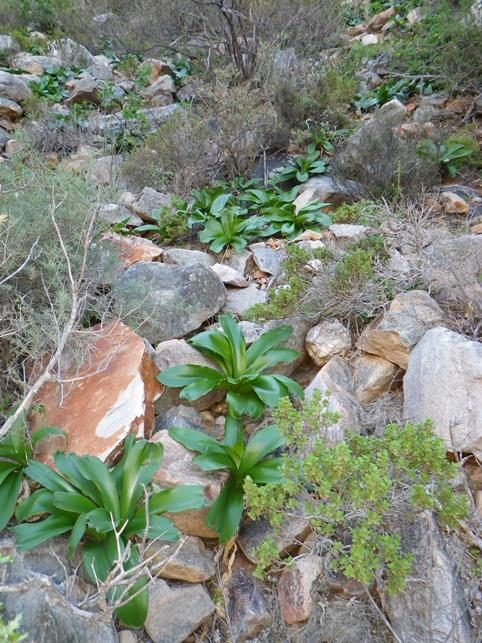
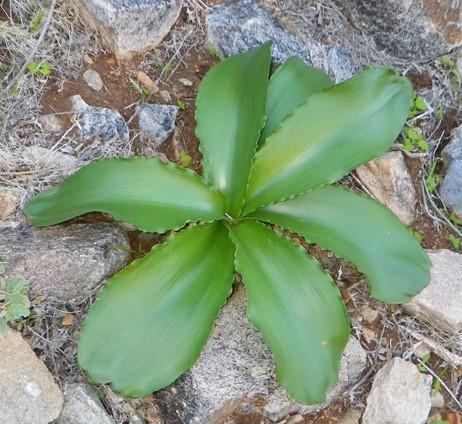
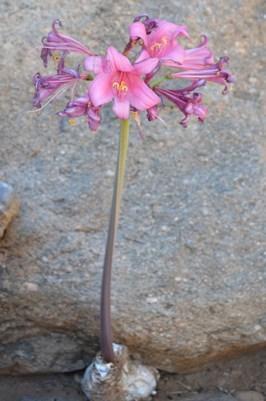
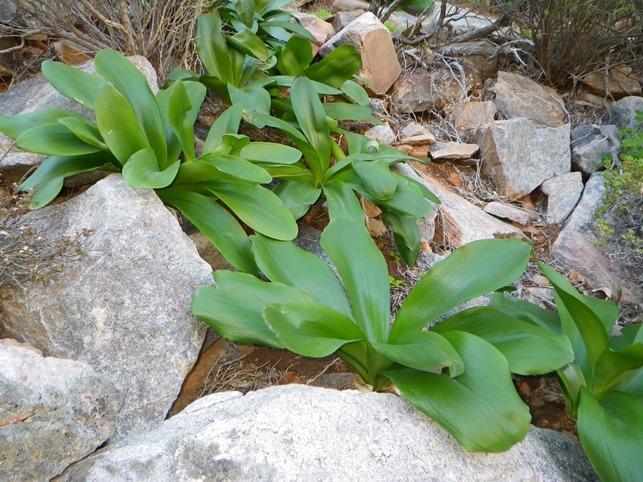
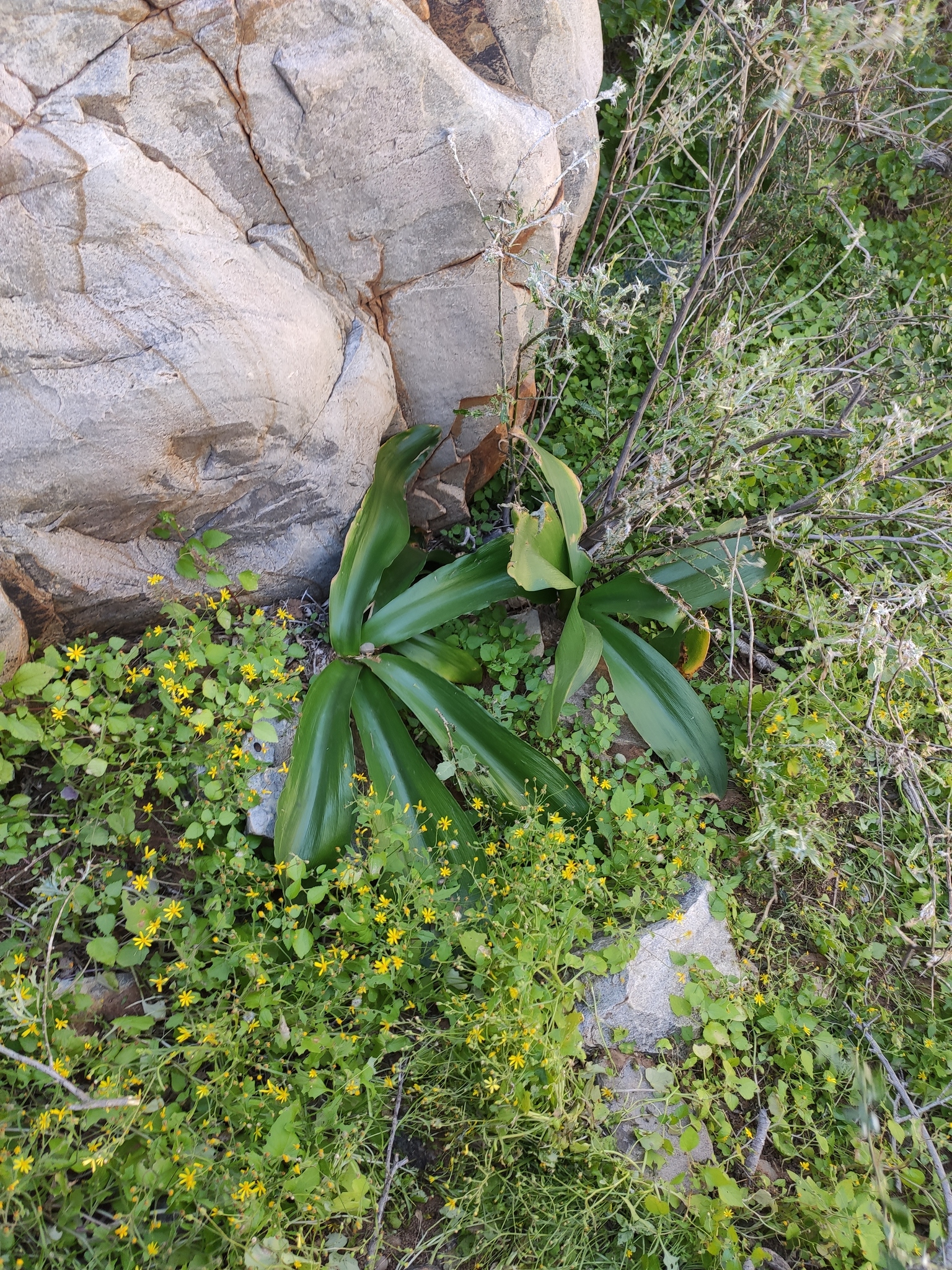
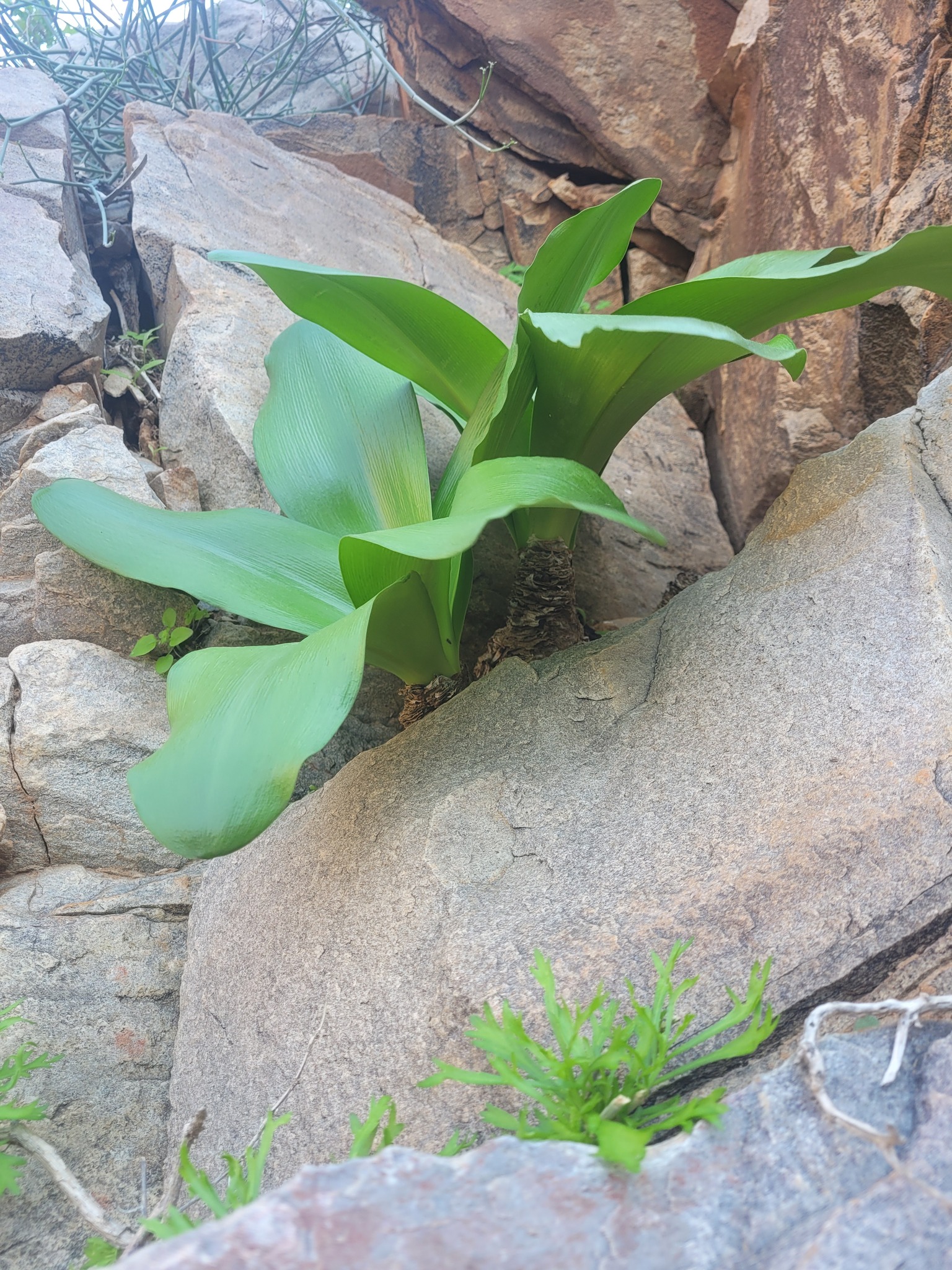
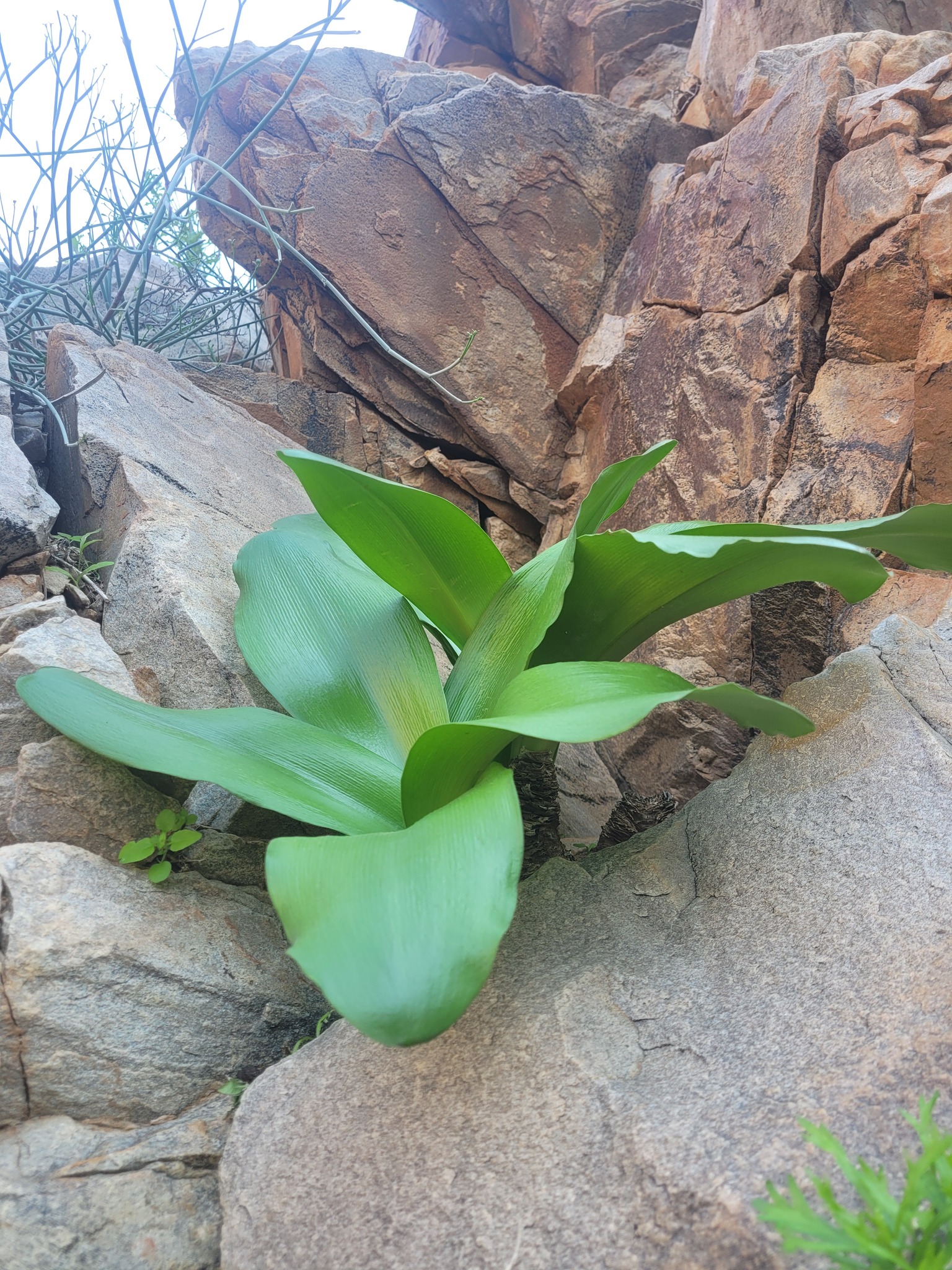
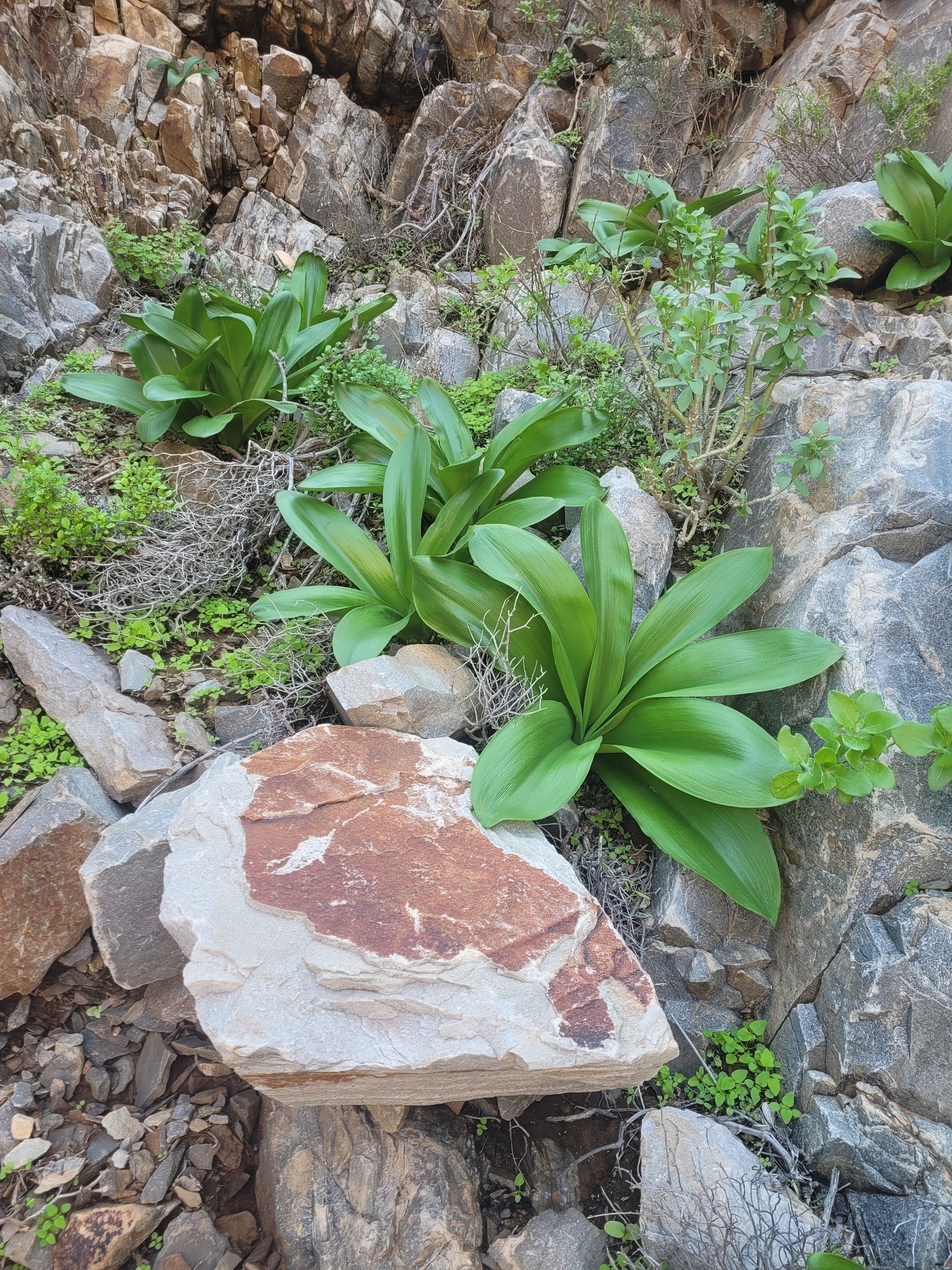
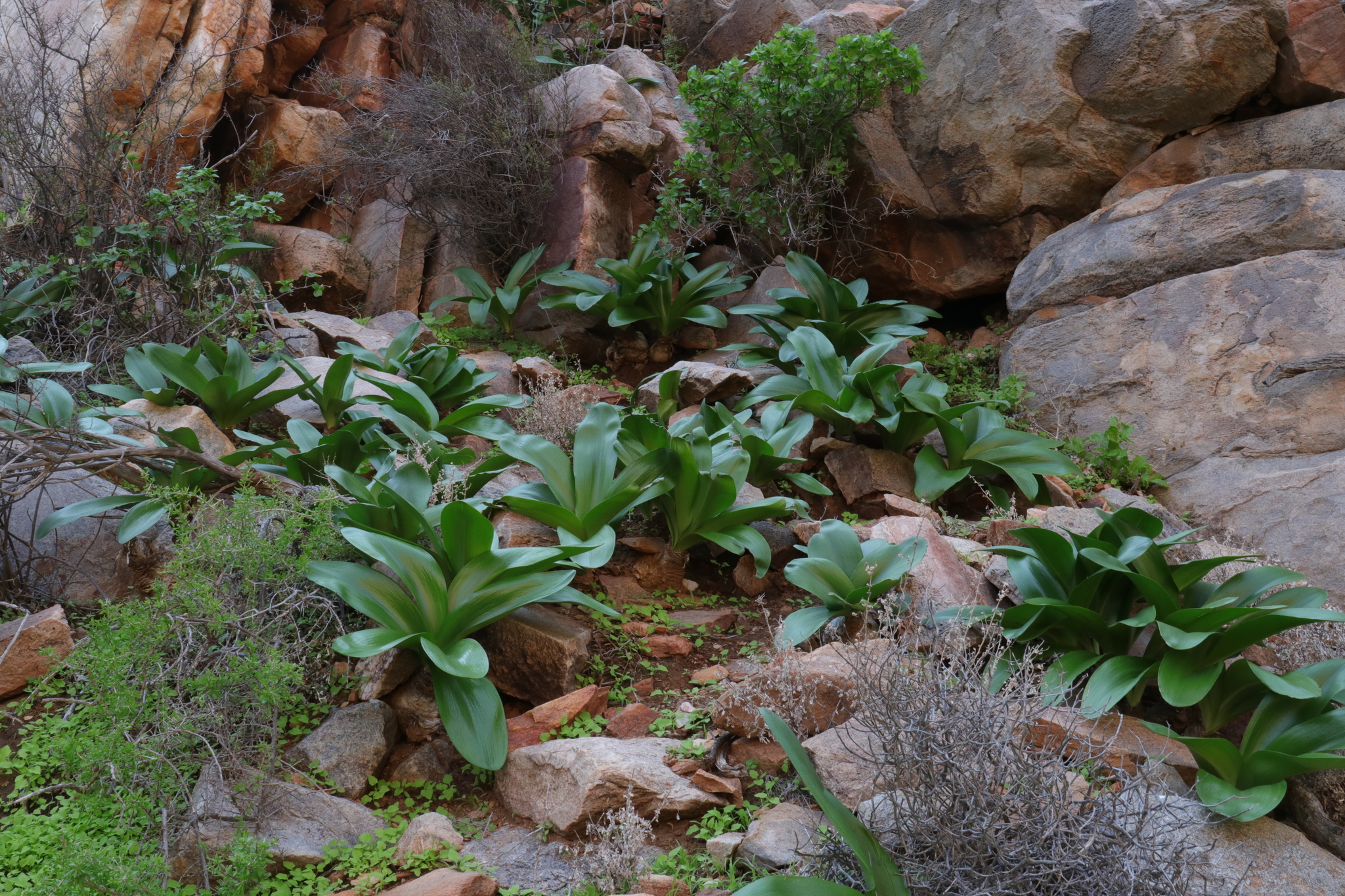
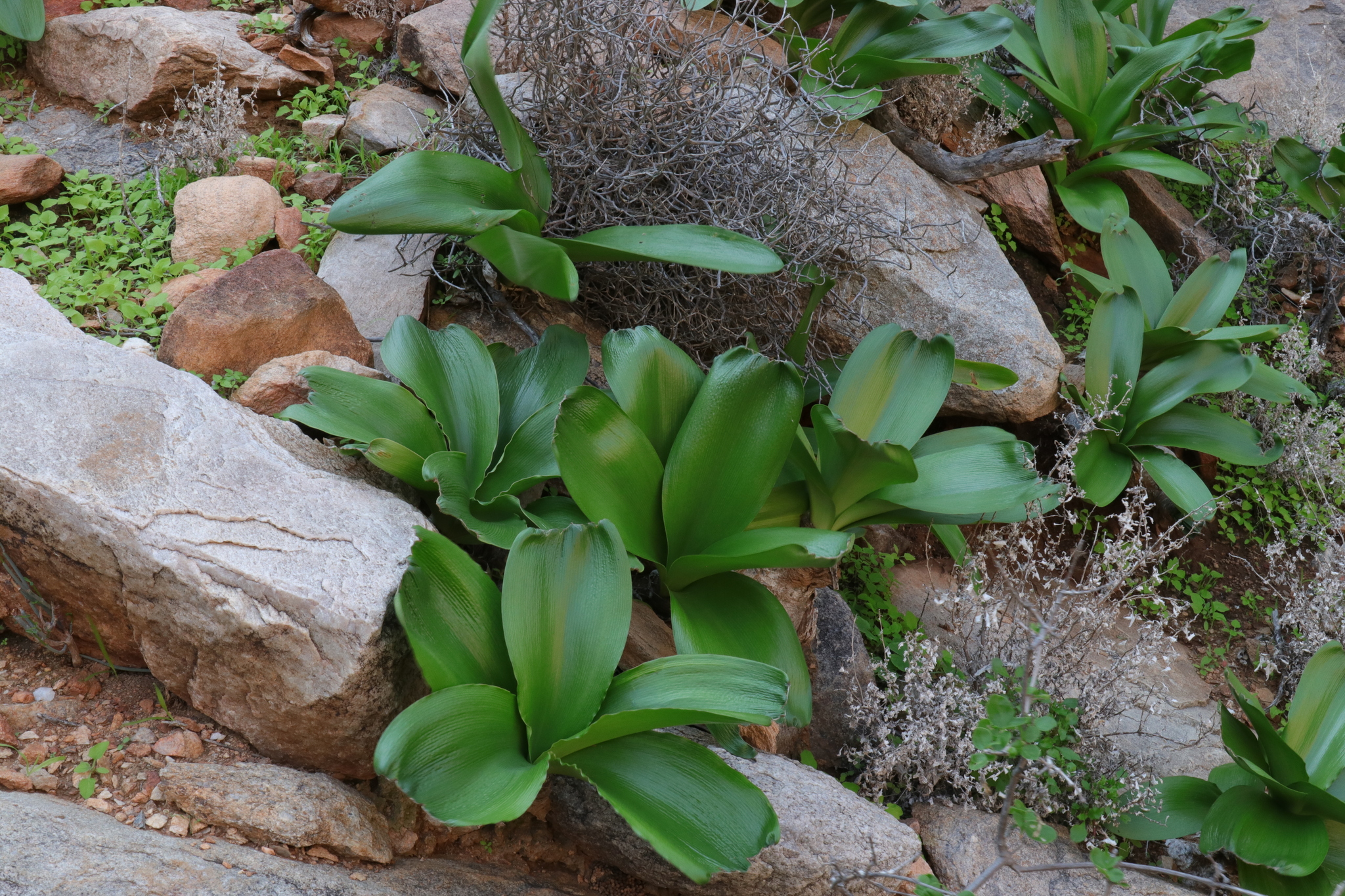
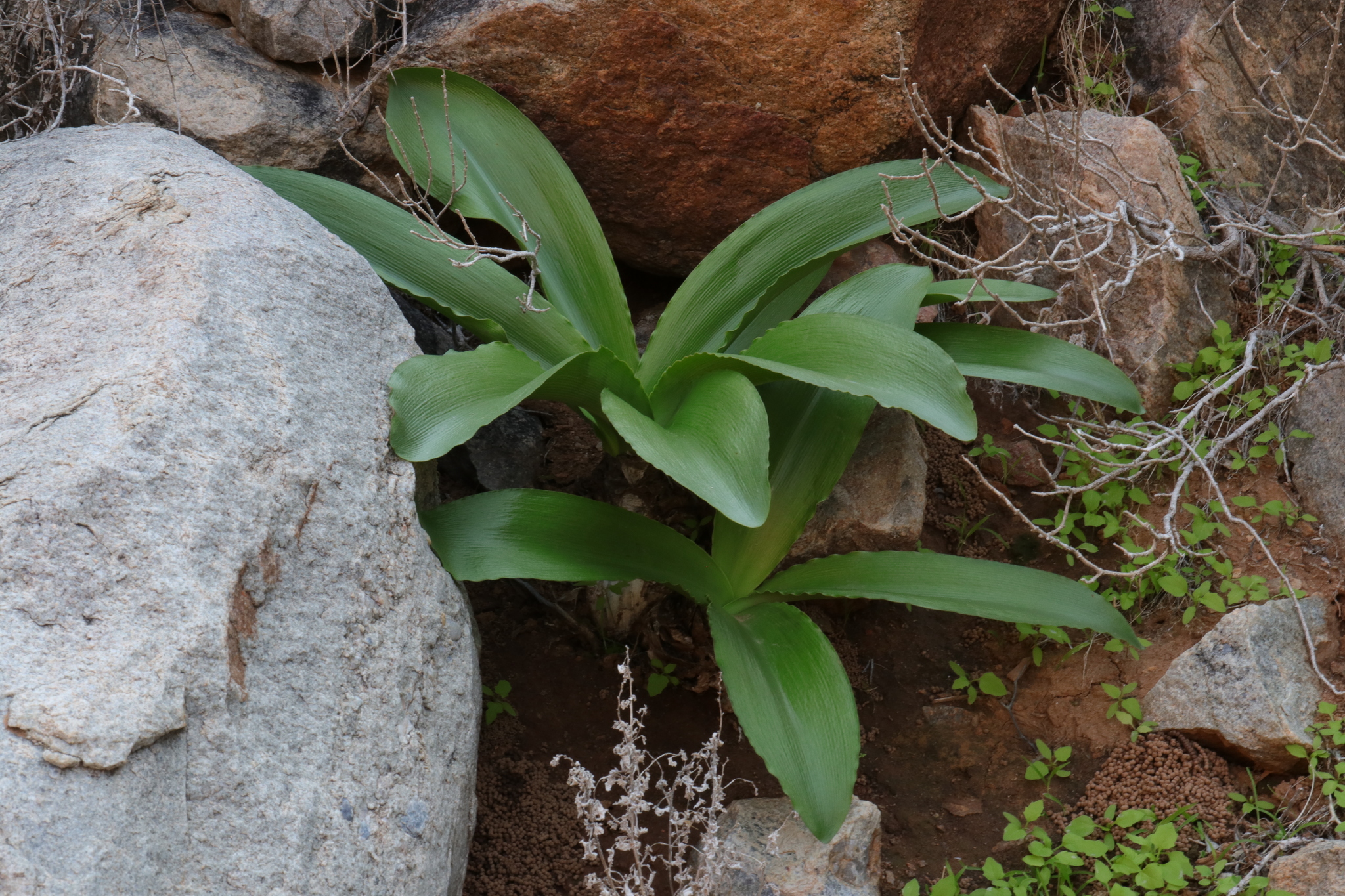
Deciduous bulbous herbs, up to 800 mm tall when flowering and fruiting. Bulbs solitary or sometimes clustered, large, ovoidal, ±100 x 140 mm, without a narrow neck, sometimes more than half exposed above ground; tunics numerous, cream-coloured, papery, producing extensible threads when torn. Leaves 6-9, hysteranthous, distichous, suberect when emerging, spreading and apparently rosulate when mature; blade ligulate when young to lingulate when mature, up to 70-130 x 350-500 mm, somewhat channelled, more or less thin-textured, bright green, covered with short patent hairs on both surfaces at least while developing, producing copious brown sap when cut and numerous extensible threads when torn; abaxial surface with a prominent midrib; margins sometimes slightly thickened, reddened and undulate, at least when young. Inflorescence upright; scape solid, stout, succulent, 20-40 x 480-800 mm, somewhat compressed, slightly ancipitous, glaucous-green, reddish brown proximally, smooth, withering after seed dispersal; spathe valves 2, papery and reflexed at anthesis, 20-25 x 50-55 mm; bracteoles numerous, flattened, up to 2 x 50 mm. Flowers 10-21, trumpet-shaped, with funnel 30-40 mm long, 15-20 mm wide at throat, 70-80 mm wide at rim, in an evenly spreading, umbel-like cluster, uniformly pink, without contrasting colours in veins or throat, turning darker pink with age, scented; pedicels evenly spreading, firm, 3-5 x 30-70 mm at anthesis, elongating to 250 mm in fruit, mostly subterete but slightly triangular in cross section below developing fruit. Tepals free, broadly lanceolate, 12-20 x 65-80 mm, slightly recurved apically. Stamens declinate, shorter than tepals, biseriate; filaments stout, pale pink, basally fused and adnate to perigone for ±7 mm; outer whorl ±35 mm long; inner whorl ±50 mm long, basally adnate to perigone for up to ±5 mm beyond tube; anthers versatile, dorsifixed, curved, 7-9 mm long, yellow; pollen yellow. Ovary green, trilocular, 5 mm across; ovules 4-6 per locule, axile; style declinate, ±65 mm long, longer than stamens, shorter than tepals, pale pink; stigma trifid with spreading, slender branches up to 1.5-2.5 mm long. Capsule loculicidal, subglobose, 20-30 mm across, leathery. Seeds fleshy, more or less ovoid, 12-17 mm across, glossy, whitish to pink; embryo green. From: Snijman, DA; Williamson, G. 1998. Amaryllidaceae: Amarillideae. A new species of Amaryllis from the Richtersveld. Bothalia 28(1&2): 192-196. [CC BY]
Bulbous geophyte, up to 0.8 m tall. Bulb half exposed. Leaves many, absent at flowering time, spreading in a basal rosette, broadly tongue-shaped, covered with short hairs, occasionally hairy only when young, midrib prominent, margins often undulate. Flowers large, trumpet-shaped, uniformly pink, fragrant. Apr., after good autumn showers. From: Snijman, DA. 2013. Amaryllidaceae. In: DA Snijman (ed.), Plants of the Greater Cape Floristic Region 2: The Extra Cape flora. Strelitzia 30: 33-42. South African National Biodiversity Institute, Pretoria. [CC BY]
Amaryllis paradisicola differs from A. belladonna in having broad, tongue-shaped leaves, 70-130 x 350-500 mm, covered with short, patent hairs on both surfaces, at least during their development. Although the hairs become increasingly sparsely spaced as the leaf blades enlarge, they remain evident under a hand lens in most plants and are only rarely absent at maturity. Studies in the field and of the herbarium material at NBG and BOL indicated that populations of A. belladonna in the southern Cape, the Agulhas Plain and the Cape Peninsula have widely spreading, narrow leaves, 13-26 x 270-680 mm, whereas the western populations from Saldanha and the Cederberg have somewhat upright, slightly broader leaves, 36-73 x 300-675 mm, that arise from an elongated basal sheath, 110-300 mm long. The leaves of A. belladonna are therefore perceptibly longer and narrower than those of A. paradisicola while the leaf surfaces are consistently glabrous, even when young. Amaryllis paradisicola is furthermore distinguished by several floral characters, of which flower colour and stigma shape are most diagnostic. The 10-21-flowered A. paradisicola is slightly more floriferous than A. belladonna, which has 6-12 or occasionally 21 flowers per inflorescence; and the tepals, although darkening with age, are uniformly pink, without the cream to lemon-yellow perigone throat of A. belladonna. The inner stamens relative to the outer stamens vary from 10 mm longer to almost equally long in A. belladonna, whereas the inner stamens of the new species exceed the outer stamens by 15 mm or more. Lastly, the mature stigma of A. paradisicola is distinctly trifid with slender, spreading branches that reach up to 1.5-2.5 mm long when mature, unlike the broader (up to 2 mm across), minutely trifid stigma of A. belladonna. Although not as strongly scented, the flowers of both species smell somewhat like those of Narcissus. From: Snijman, DA; Williamson, G. 1998. Amaryllidaceae: Amarillideae. A new species of Amaryllis from the Richtersveld. Bothalia 28(1&2): 192-196. [CC BY]
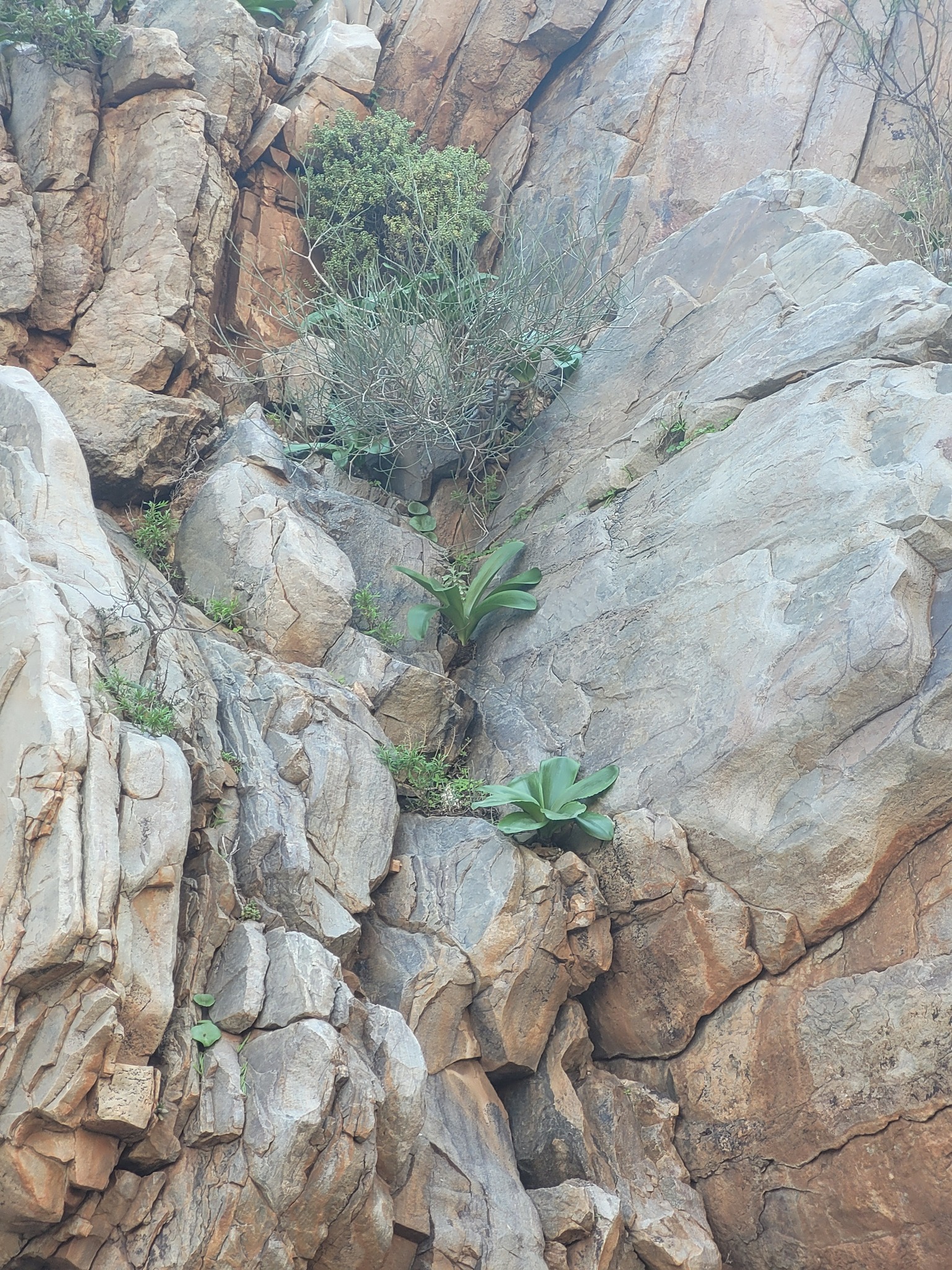
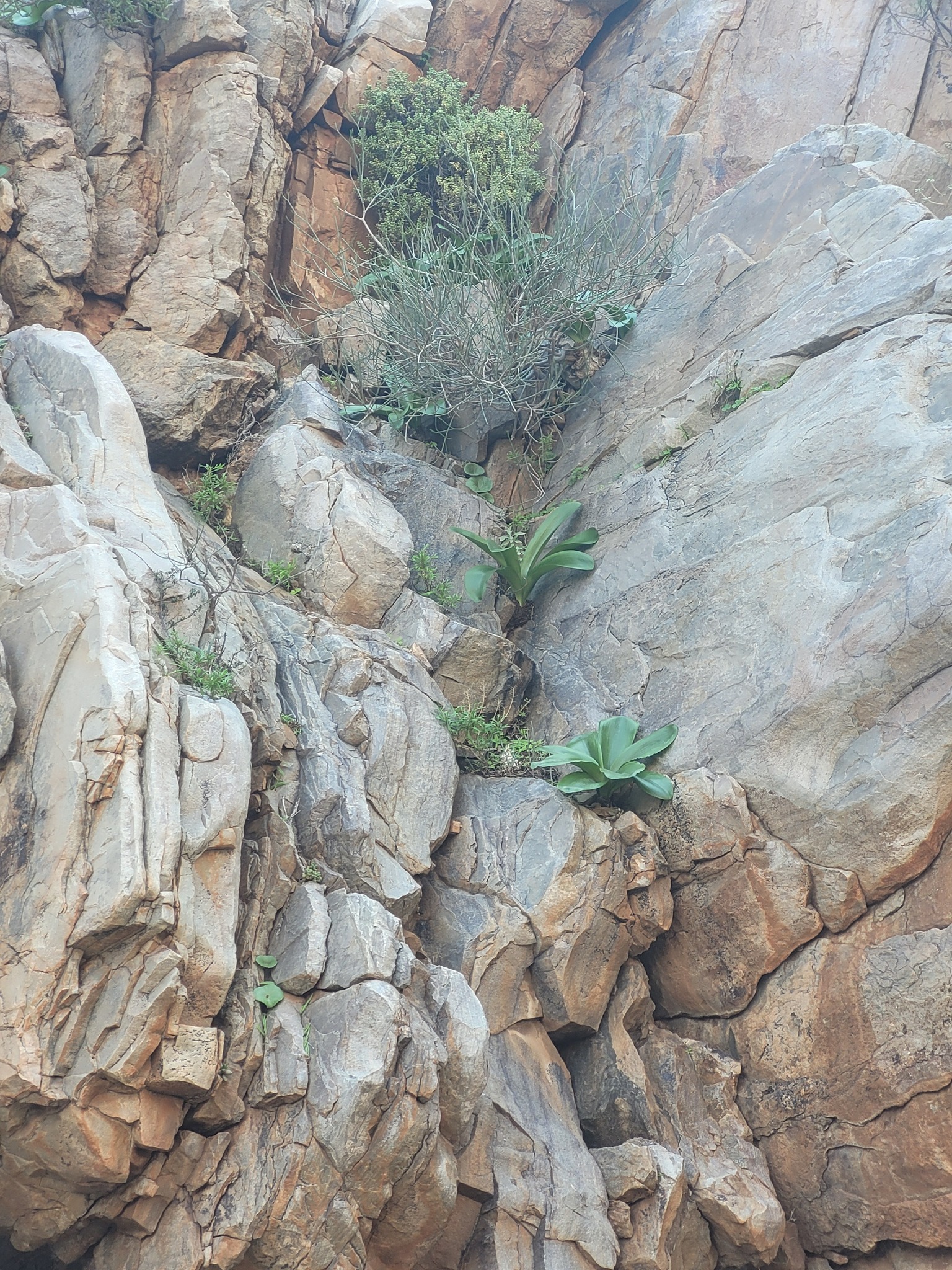
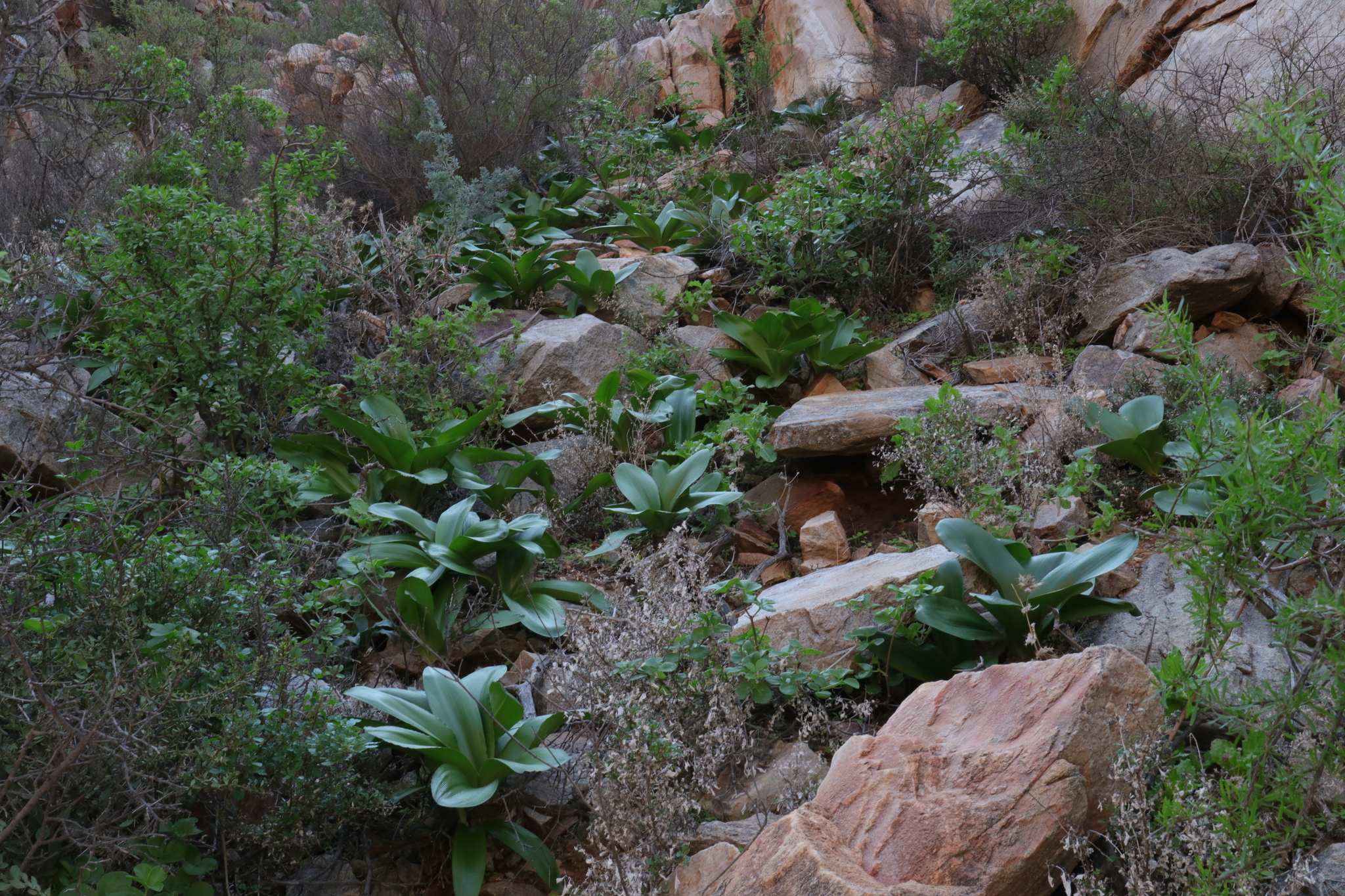
The bulbs grow on south and east-facing, quartzitic cliffs, on narrow rock ledges and partially vegetated screes that are shaded for much of the day. From: Snijman, DA; Williamson, G. 1998. Amaryllidaceae: Amarillideae. A new species of Amaryllis from the Richtersveld. Bothalia 28(1&2): 192-196. [CC BY]
Quartzite screes and rock ledges. From: Snijman, DA. 2013. Amaryllidaceae. In: DA Snijman (ed.), Plants of the Greater Cape Floristic Region 2: The Extra Cape flora. Strelitzia 30: 33-42. South African National Biodiversity Institute, Pretoria. [CC BY]
Amaryllis paradisicola is endemic to the Richtersveld National Park, an arid, mountainous region in the Northern Cape. From: Snijman, DA; Williamson, G. 1998. Amaryllidaceae: Amarillideae. A new species of Amaryllis from the Richtersveld. Bothalia 28(1&2): 192-196. [CC BY]
Richtersveld National Park. From: Snijman, DA. 2013. Amaryllidaceae. In: DA Snijman (ed.), Plants of the Greater Cape Floristic Region 2: The Extra Cape flora. Strelitzia 30: 33-42. South African National Biodiversity Institute, Pretoria. [CC BY]
April
0 to 550 m
This map contains point-based occurrences at different locations
 This is a sensitive species therefore data has been redacted, click here to login.
Occurrence in the Flora of Southern Africa (FSA) countries and South African provinces. Residence status indicates if a taxon is indigenous, endemic, naturalised or invasive in a specific region. This data is based on specimen records and literature
FSA
SA
BOT
NAM
ESW
LES
WC
EC
NC
FS
GA
KZN
LP
MP
NW
Absent
Indigenous
Endemic
Naturalised
Invasive

Names and Sources
Published in: Bothalia 28(2): 193 (1998)
Type: South Africa, Northern Cape, Richtersveld National Park, Paradyskloof, 11 Apr 1997, D.A. Snijman 1576 (NBG, holo.; K, KMG, PRE, iso.)
Classification
KINGDOM Plantae
SUBKINGDOM Phanerogamae
PHYLUM Anthophyta
ORDER Asparagales
FAMILY Amaryllidaceae
TRIBE Amaryllideae
GENUS Amaryllis
SPECIES paradisicola
22 results for Amaryllis paradisicola Snijman
Barcode: NBG0162009-4 Collector(s) & number: Snijman, DA, 1578 | 1997-5-3
Data Resource: BODATSA View record
Barcode: NBG0167230-0 Collector(s) & number: Du Plessis, N, s.n. | --
Data Resource: BODATSA View record
Barcode: NBG0162004-3 Collector(s) & number: Snijman, DA, 1576 | 1997-4-11
General notes: On SE facing rocky ledges. Hundreds of bulbs flowering in population but the majority having just faded after several days of dry east-winds. Flowers pink, scented. Tips of leaves emerging in some bulbs.
Data Resource: BODATSA View record
Barcode: PRE0461540-0 Collector(s) & number: Snijman, DA, 1576 | 1997-4-11
General notes: ISOTYPE Hundreds of bulbs flowering in population but the majority having just faded after several days of dry east-winds. Flowers scented. Tips of leaves emerging in some bulbs.
Data Resource: BODATSA View record
Barcode: NBG0162004-2 Collector(s) & number: Snijman, DA, 1576 | 1997-4-11
General notes: On SE facing rocky ledges. Hundreds of bulbs flowering in population but the majority having just faded after several days of dry east-winds. Flowers pink, scented. Tips of leaves emerging in some bulbs.
Data Resource: BODATSA View record
Barcode: NBG0167229-0 Collector(s) & number: Van Jaarsveld, s.n. | --
General notes: Leaves light green in a spreading rosette. Leaves ex hort 20:8:1997.
Data Resource: BODATSA View record
Barcode: NBG0162004-4 Collector(s) & number: Snijman, DA, 1576 | 1997-4-11
General notes: On SE facing rocky ledges. Hundreds of bulbs flowering in population but the majority having just faded after several days of dry east-winds. Flowers pink, scented. Tips of leaves emerging in some bulbs.
Data Resource: BODATSA View record
Barcode: NBG0162009-2 Collector(s) & number: Snijman, DA, 1578 | 1997-5-3
General notes: On SE - facing rocky ledges. Relatively few bulbs in fruit. Many scapes damaged, possibly by baboons. Leaves at various stages of growth. Some bulbs still not leafing. Leaves initially distichous, then spreading and rosulate.
Data Resource: BODATSA View record
Barcode: PRE0476002-0 Collector(s) & number: Snijman, DA, 1550 | 1996-9-2
General notes: On shaded rocky SE facing slopes. Hundreds of plants. Leaves shiny green producing brown juice when cut and threads when torn.
Data Resource: BODATSA View record
Barcode: NBG0162009-3 Collector(s) & number: Snijman, DA, 1578 | 1997-5-3
General notes: On SE - facing rocky ledges. Relatively few bulbs in fruit. Many scapes damaged, possibly by baboons. Leaves at various stages of growth. Some bulbs still not leafing. Leaves initially distichous, then spreading and rosulate.
Data Resource: BODATSA View record
Barcode: NBG0162009-5 Collector(s) & number: Snijman, DA, 1578 | 1997-5-3
General notes: On SE - facing rocky ledges. Relatively few bulbs in fruit. Many scapes damaged, possibly by baboons. Leaves at various stages of growth. Some bulbs still not leafing. Leaves initially distichous, then spreading and rosulate.
Data Resource: BODATSA View record
Barcode: NBG0162007-0 Collector(s) & number: Williamson, GF, 5904 | 1997-4-3
General notes: Montane Karoo Vegetation type. Substrate - quartzite cliffs. ±#m tall. No leaves. Abundant on step and cracks on vertical grey quartzitic cliffs.
Data Resource: BODATSA View record
Barcode: NBG0162005-0 Collector(s) & number: Snijman, DA, 1550 | 1996-9-2
General notes: On shaded rocky SE facing slopes. Hundreds of plants. Leaves shiny green producing brown juice when cut and threads when torn.
Data Resource: BODATSA View record
Barcode: PRE0476003-0 Collector(s) & number: Snijman, DA, 1578 | 1997-5-3
General notes: On S.E. facing rock ledges. Relatively few bulbs in fruit. Many scapes damaged, possibly by baboons. Leaves at various stages of growth. Some bulbs still not leafing. Leaves initially distichous, then spreading and rosulate.
Data Resource: BODATSA View record
Barcode: NBG0162009-1 Collector(s) & number: Snijman, DA, 1578 | 1997-5-3
General notes: On SE - facing rocky ledges. Relatively few bulbs in fruit. Many scapes damaged, possibly by baboons. Leaves at various stages of growth. Some bulbs still not leafing. Leaves initially distichous, then spreading and rosulate.
Data Resource: BODATSA View record
Barcode: NBG0162008-0 Collector(s) & number: Snijman, DA, 1654 | 1998-4-3
General notes: Only 2 bulbs in entire population in flower. Collected 2 loose bulbs for dissection.
Data Resource: BODATSA View record
Barcode: NBG0162006-0 Collector(s) & number: Snijman, DA, 1576 | --
General notes: First year seedlings. Leaves prostrate, green, glabrous.
Data Resource: BODATSA View record
Barcode: NBG0162004-1 Collector(s) & number: Snijman, DA, 1576 | 1997-4-11
General notes: On SE facing rocky ledges. Hundreds of bulbs flowering in population but the majority having just faded after several days of dry east winds. Flowers pink, scented. Tips of leaves emerging from bulbs.
Data Resource: BODATSA View record
This map contains point-based occurrences at different locations
This is a sensitive species therefore data has been redacted, click here to login.
2016
2013
SERIES CHAPTER
Amaryllidaceae Snijman, DAIn: DA Snijman (ed.), Plants of the Greater Cape Floristic Region 2: The Extra Cape flora. Strelitzia 30: 33-42
South African National Biodiversity Institute, Pretoria
1998
PERIODICAL/JOURNAL
Amaryllidaceae: Amarillideae. A new species of Amaryllis from the Richtersveld Snijman, DA; Williamson, GBothalia 28(1&2)192-196
No results found for Amaryllis paradisicola Snijman
Status and criteria
VU
Assessor(s)
Plantae Coordinator
| Part(s) of plant used | Use(s) | Reference |
|---|
Coming soon...


