
PLANTAE / PHANEROGAMAE / ANTHOPHYTA / ASPARAGALES / IRIDACEAE / CROCOIDEAE / IXIEAE / IXIA / MONADELPHA

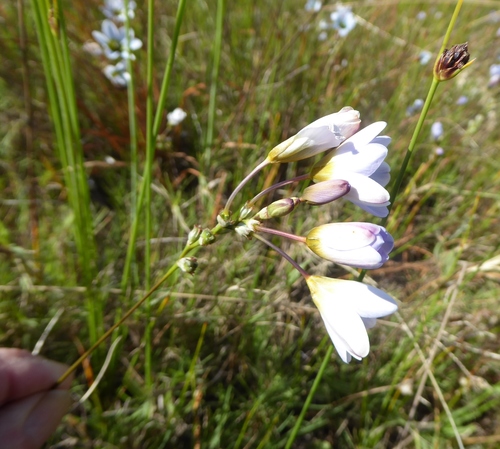
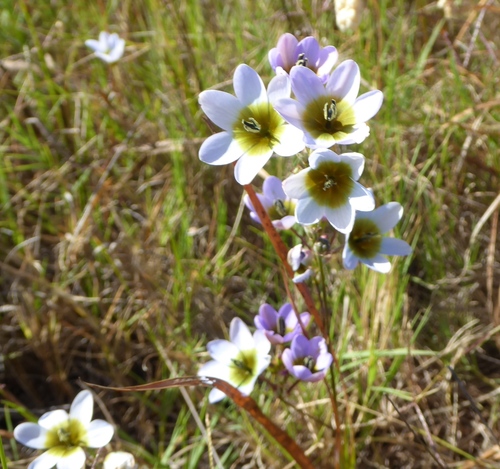
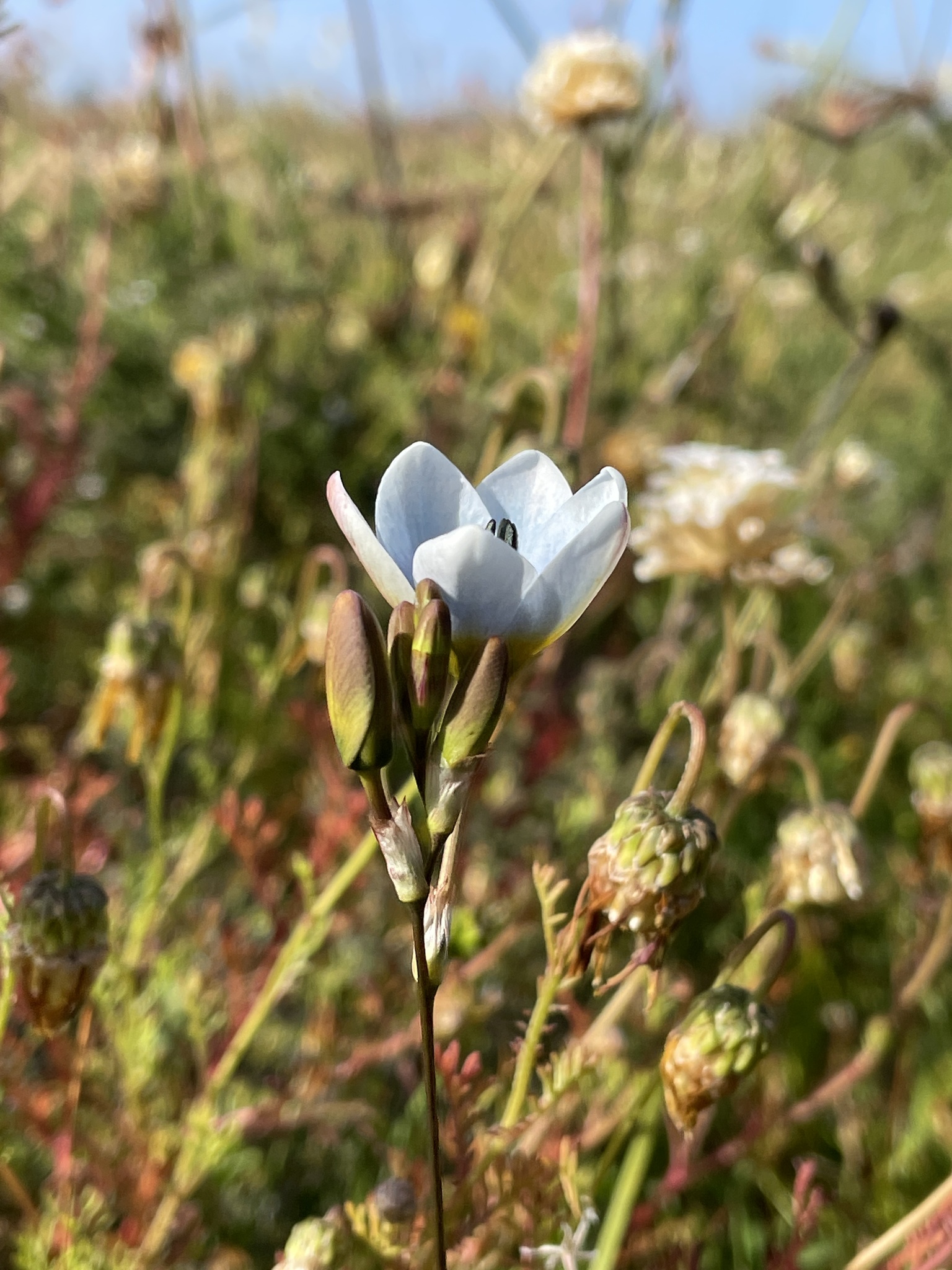
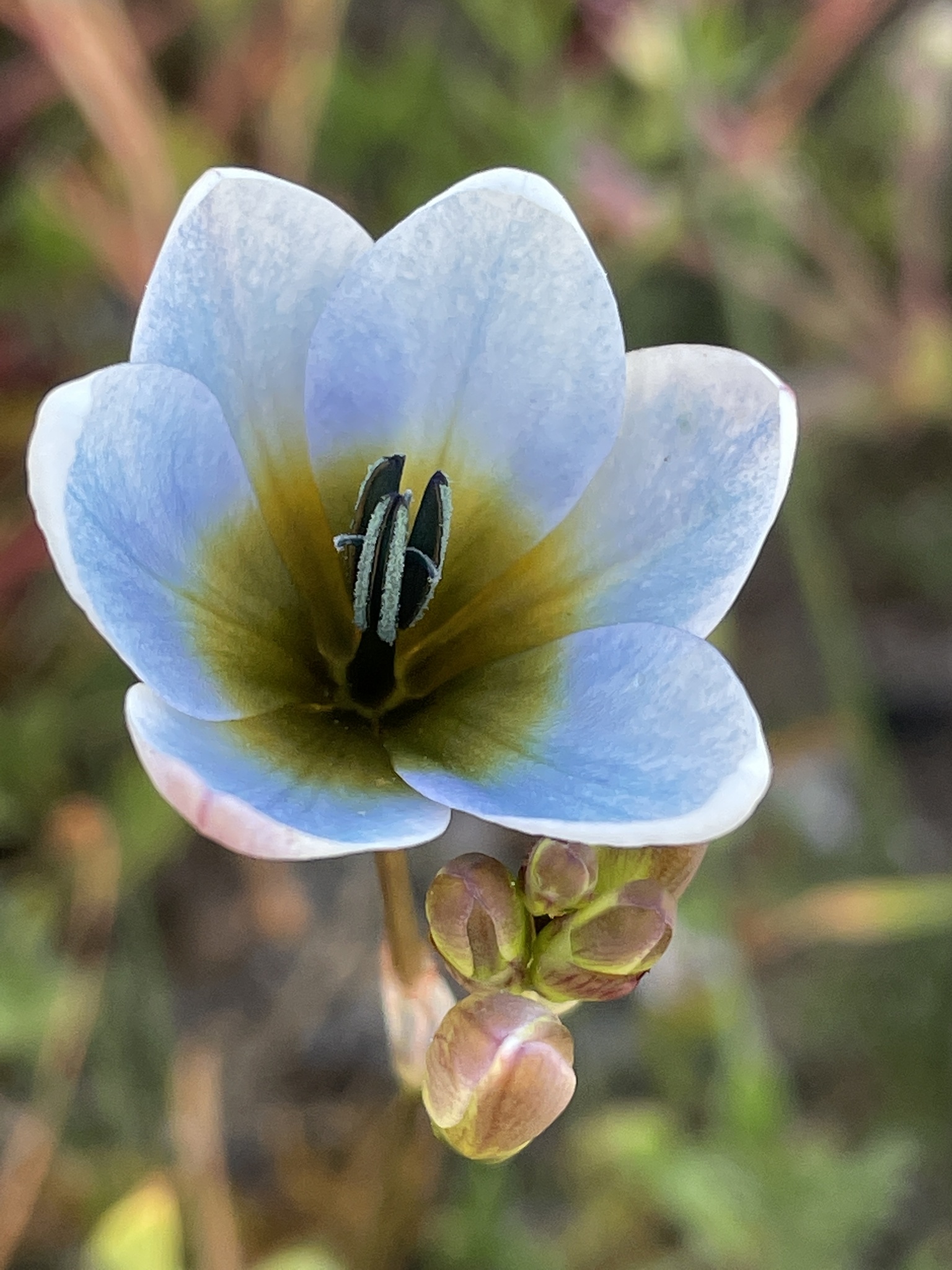
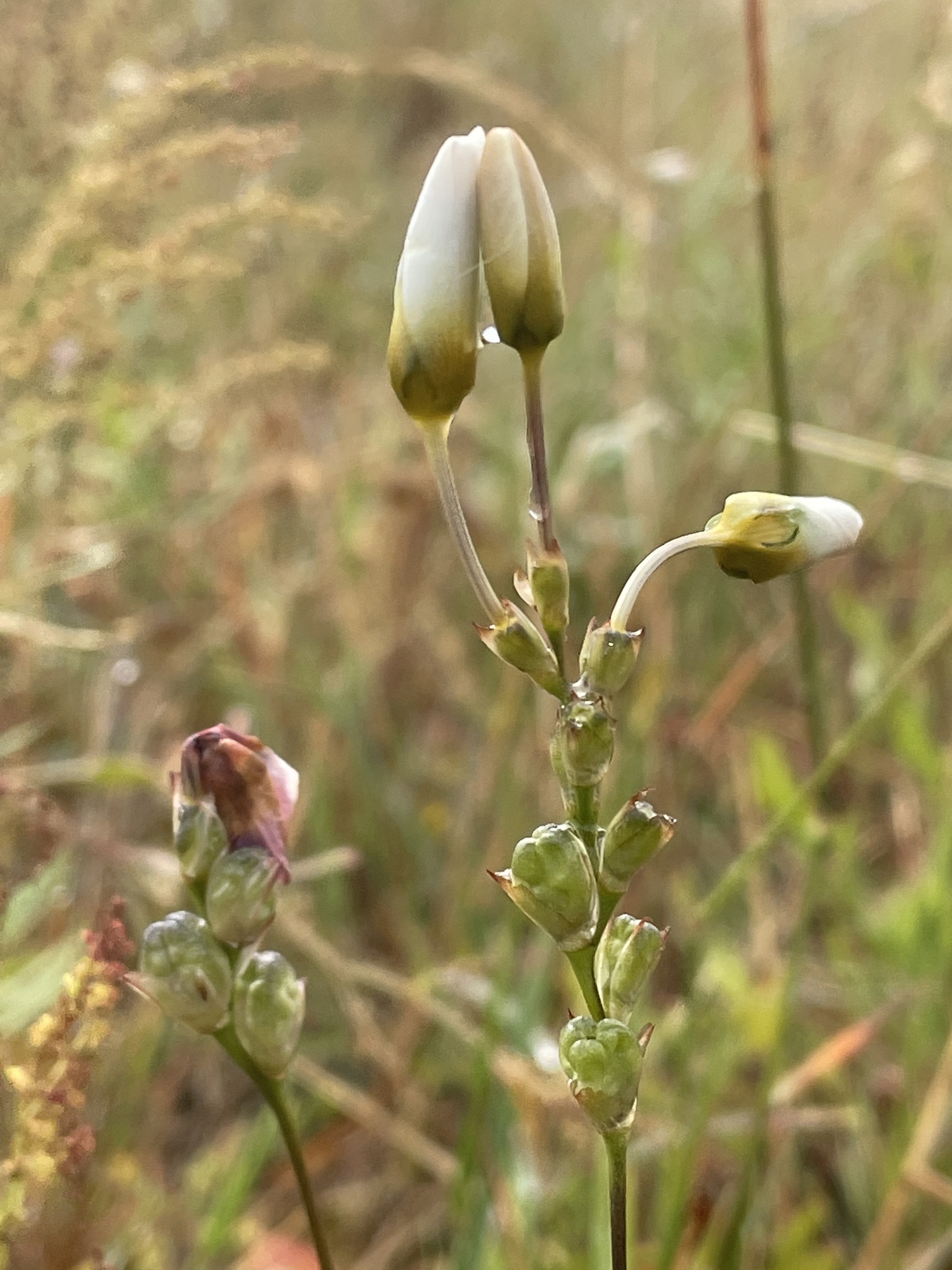
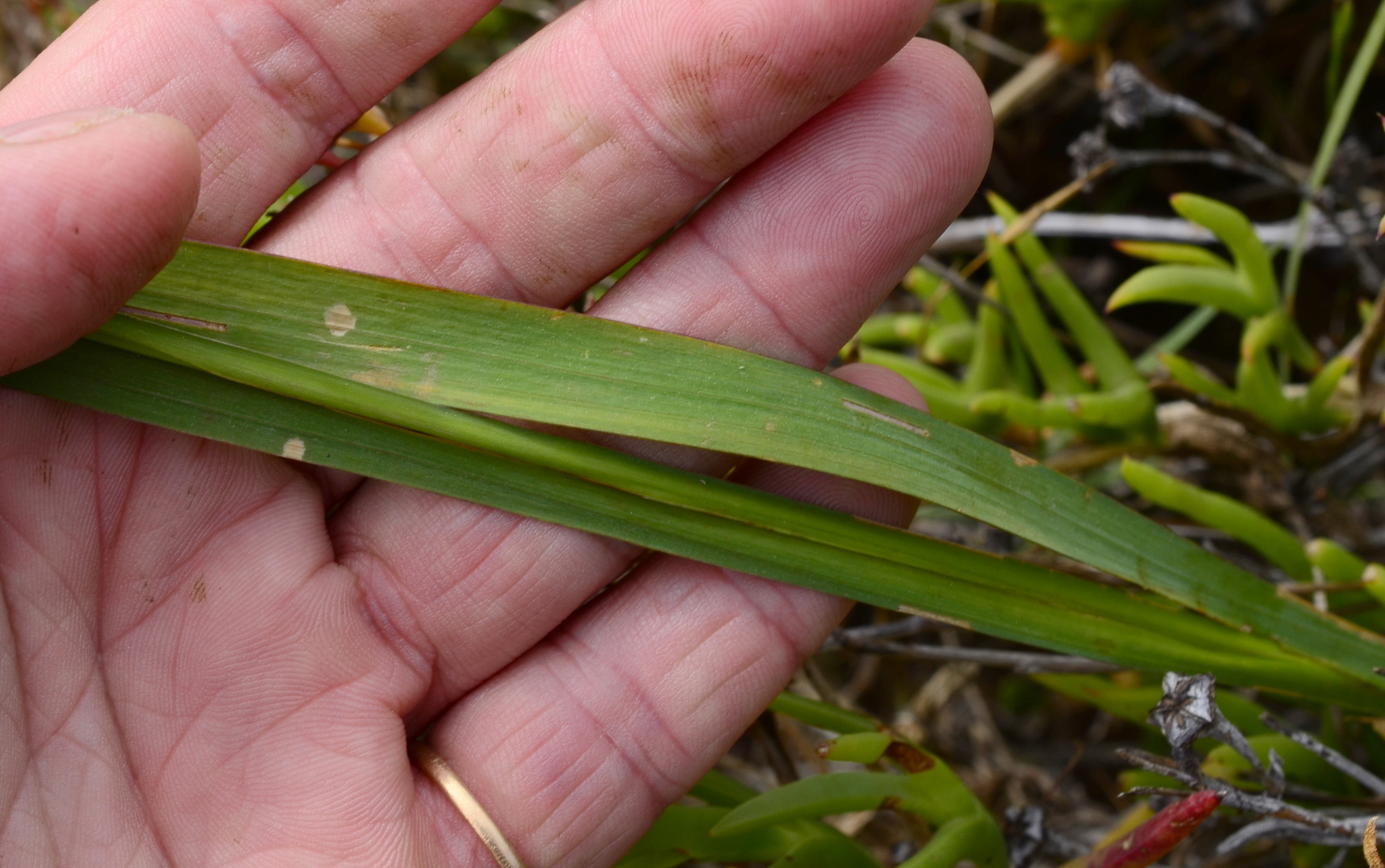
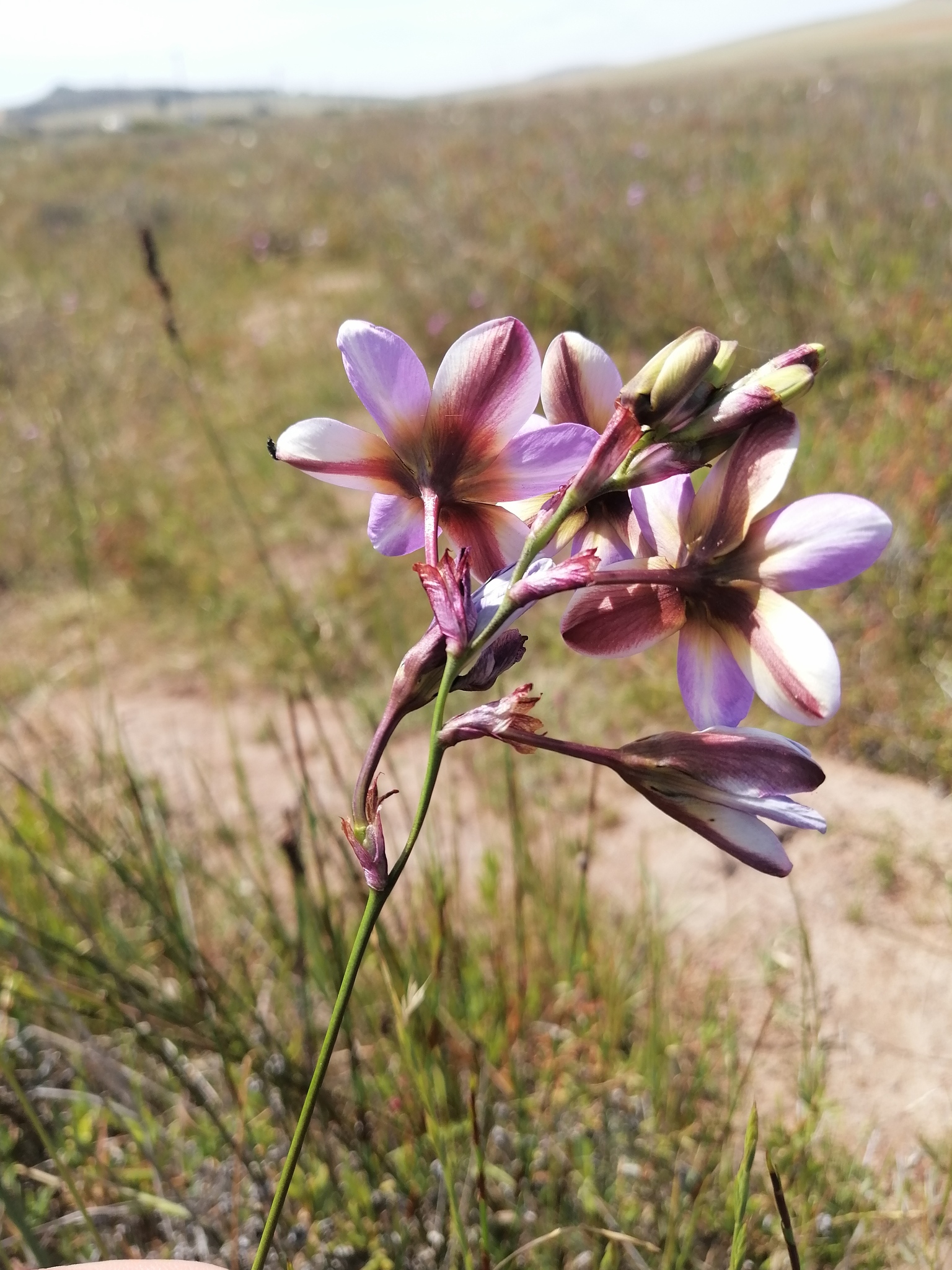
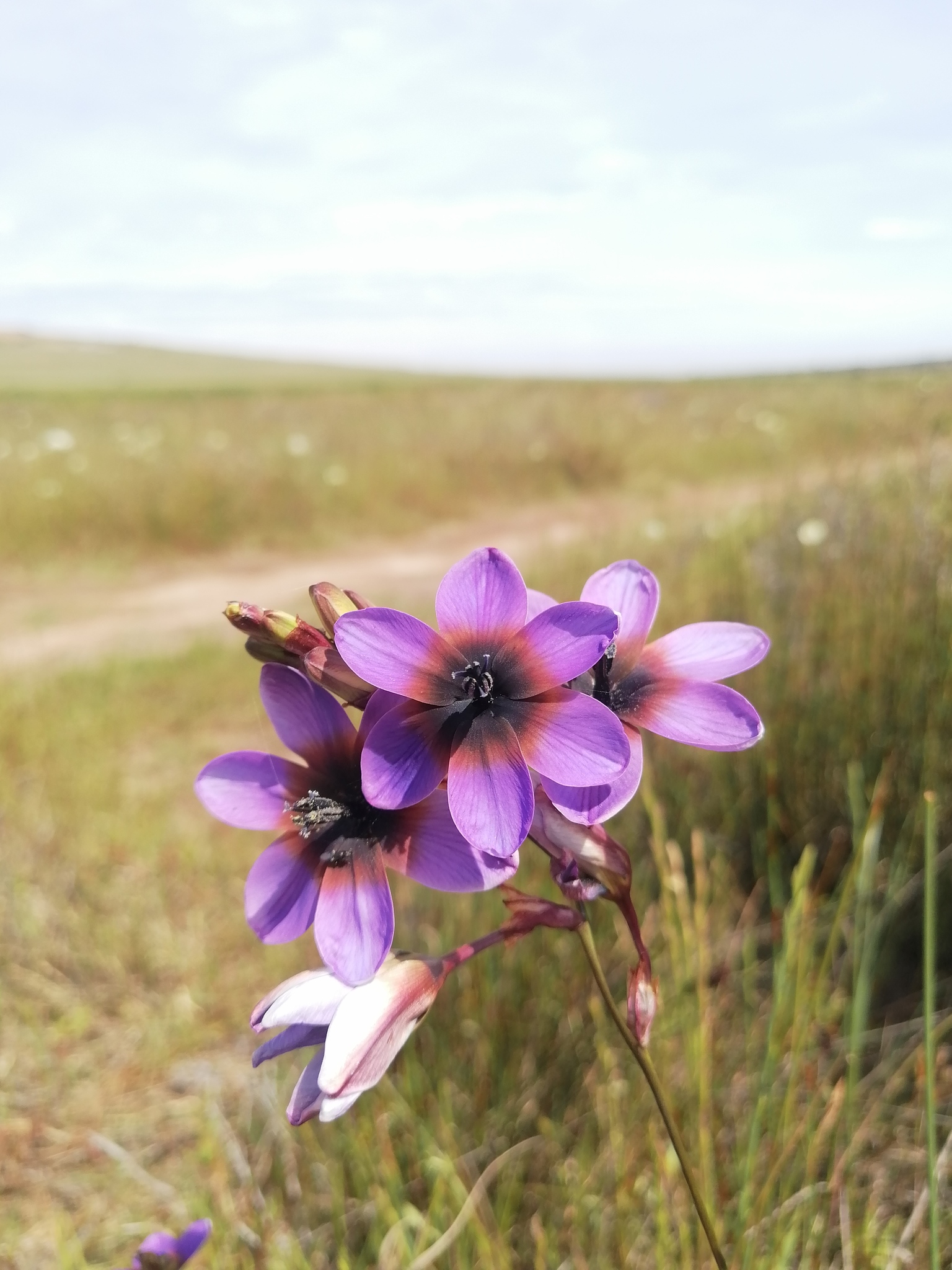
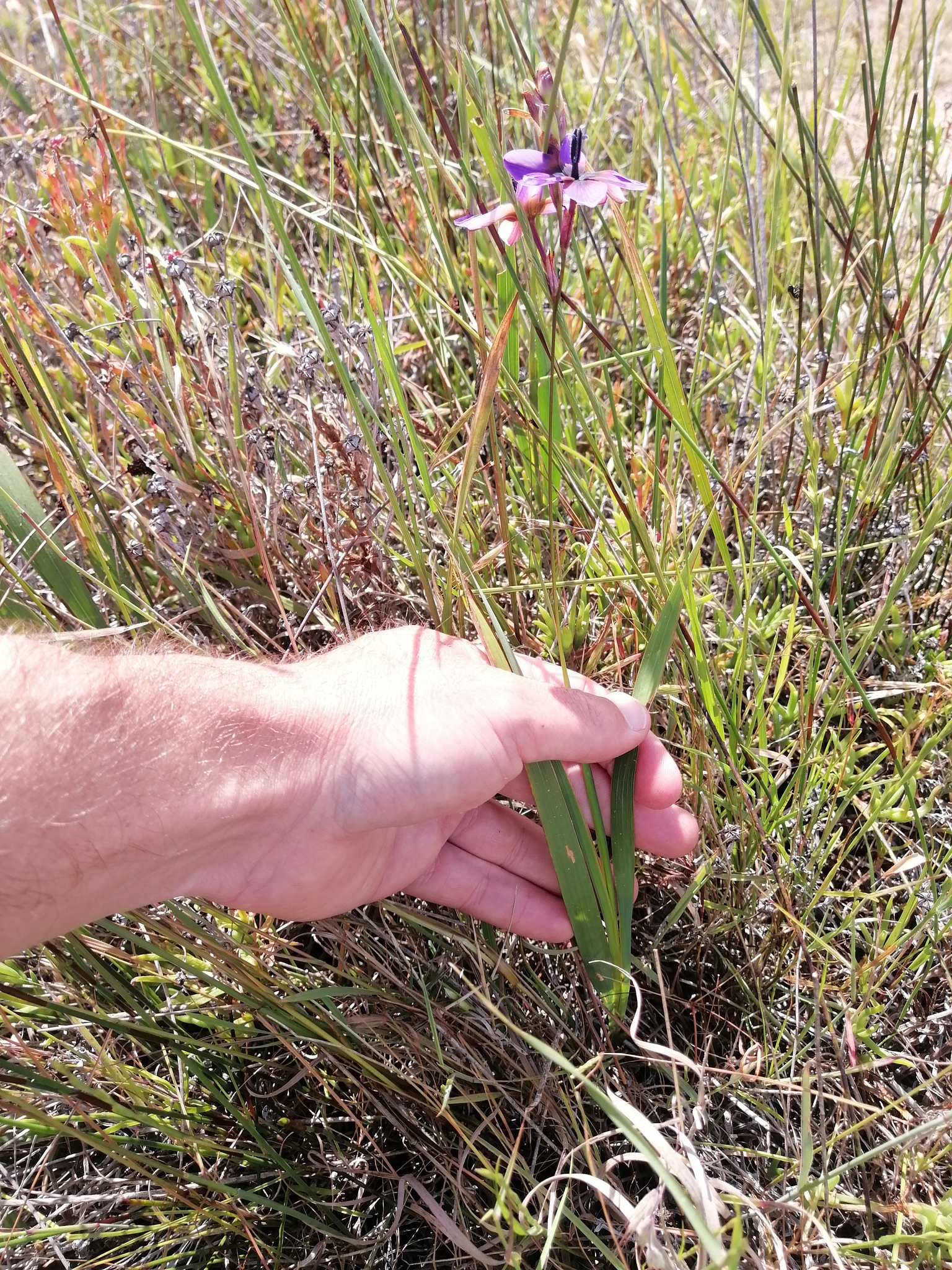
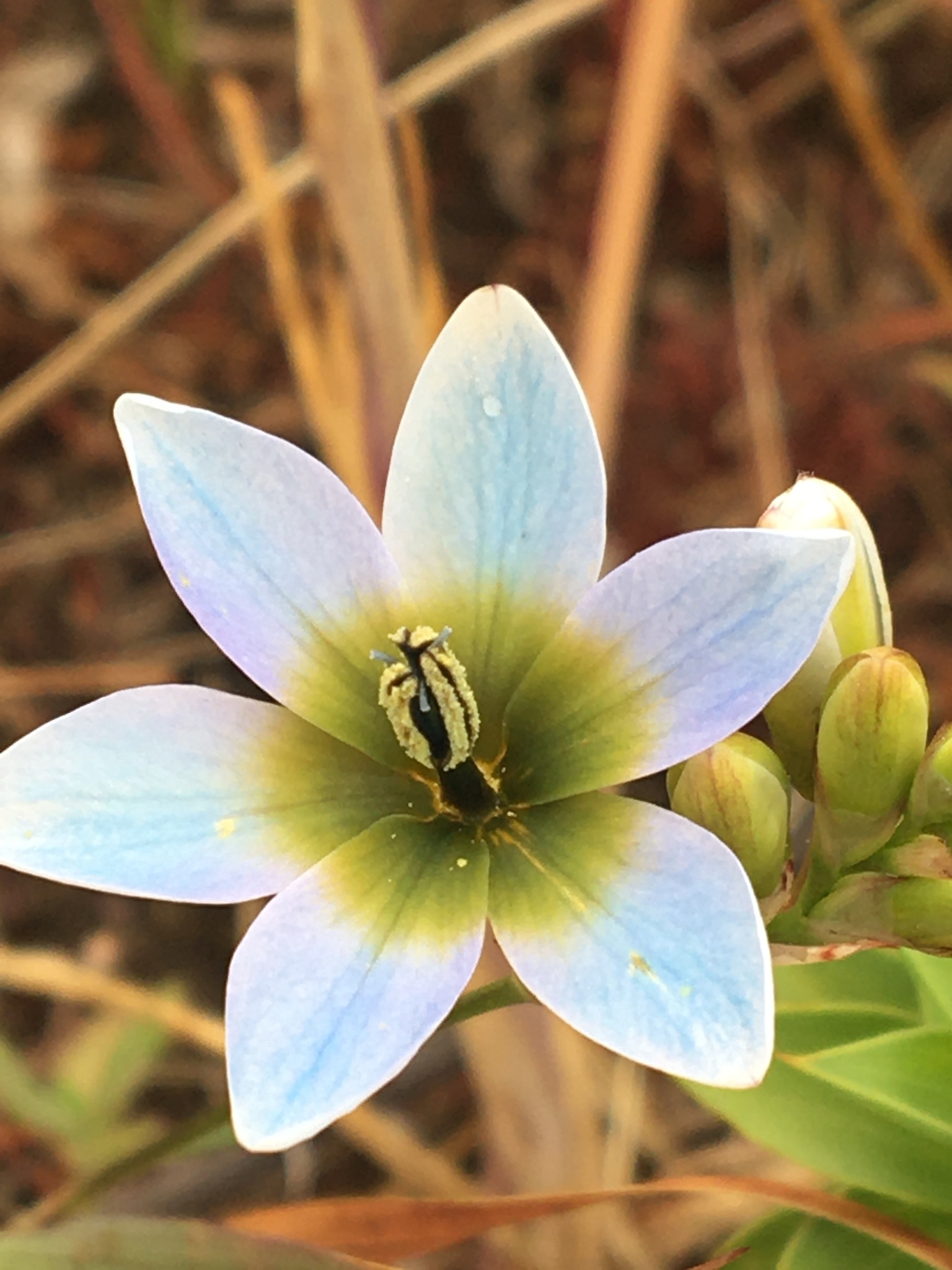
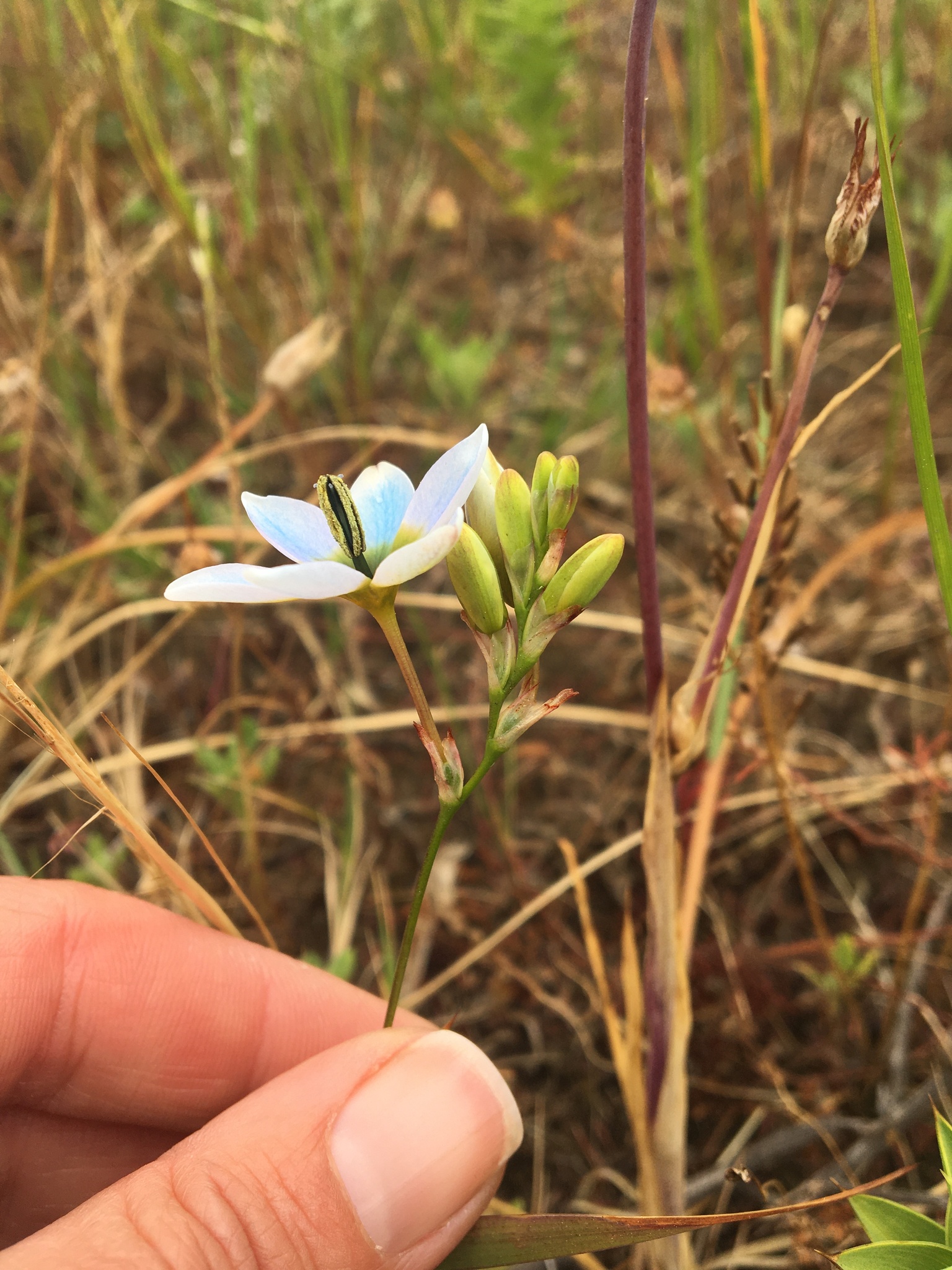
Plants 200-400 mm high. Corm ± globose, 12-20 mm diam.; tunics of soft, ± papery layers. Stem simple or with 1 or 2 short, spreading branches. Leaves 4 to 7, lanceolate, ± 1/2 as long as stem, mostly 3-12 mm wide, often loosely twisted, decreasing in size above, margins slightly thickened, hyaline when dry. Spike closely 4- to 12-flowered, flexuose; bracts 5-10 mm long, dry, pale below, spotted brown distally, in upper 1/2, outer ± truncate or with conspicuous dark brown, twisted central tooth and 2 smaller lateral lobes, inner with 2 dark brown, twisted cusps. Flowers salver-shaped, grey-blue, purple, violet, or pink (white or grey-yellow), with large, dark green, reddish, brown or purple central mark, unscented; perianth tube cylindric, 10-18 mm long; tepals ± elliptic, subequal, spreading, connate for up to 1.5 mm, 13-20 x 6-11 mm. Filaments 3-6 mm long, united in lower 1/2 or entirely, purple anthers erect, 7-8 mm long; pollen pale grey-blue. Style dividing between base and middle of anthers, branches 2-3 mm long. From: Goldblatt, P; Manning, JC. 2020. Iridaceae of southern Africa. Strelitzia 42: 1-1159. South African National Biodiversity Institute, Pretoria. [CC BY]
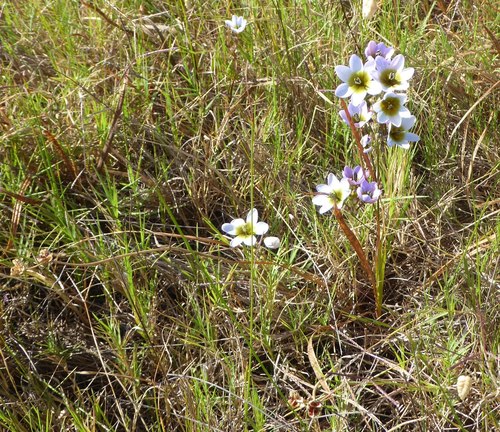
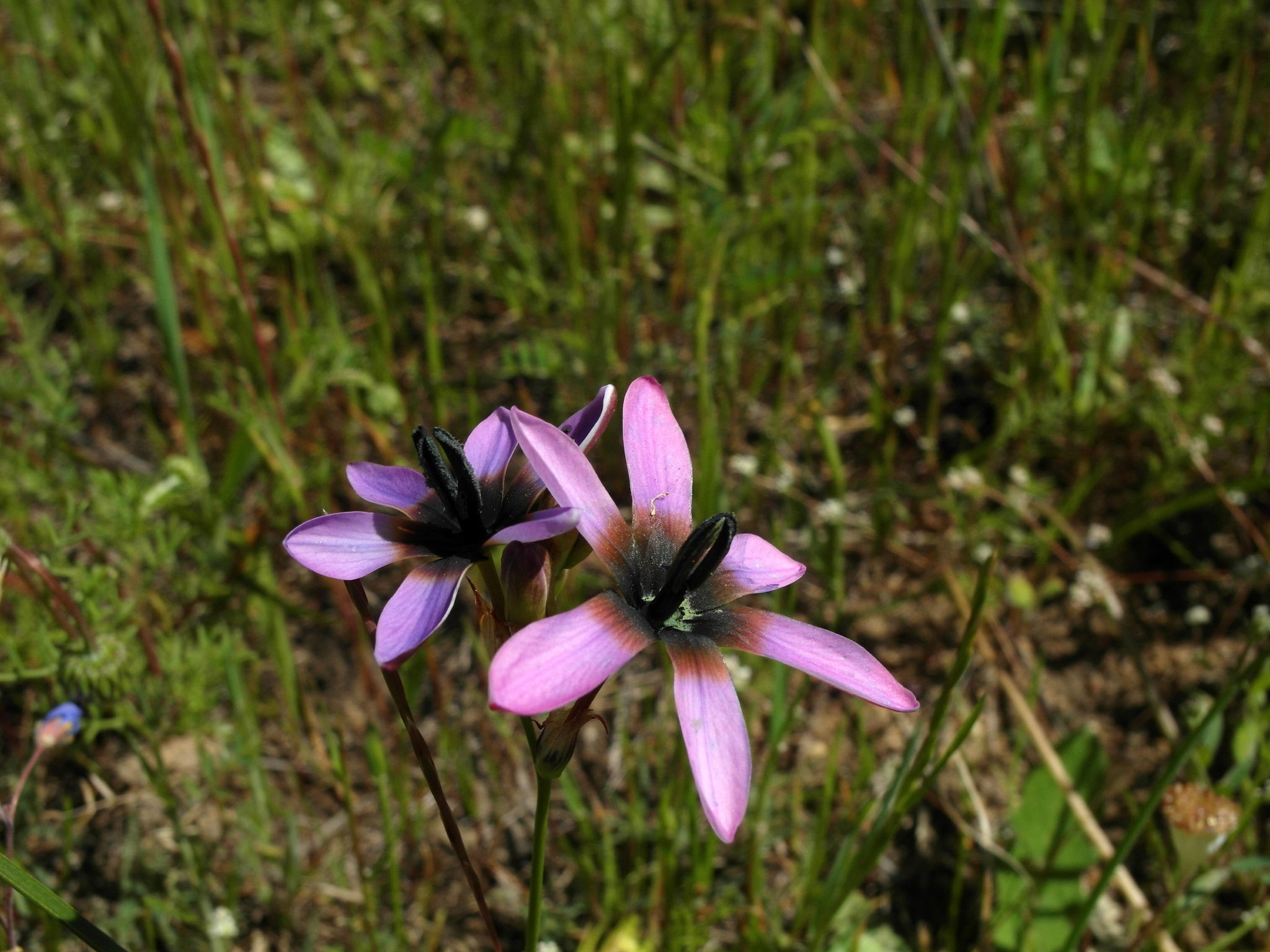
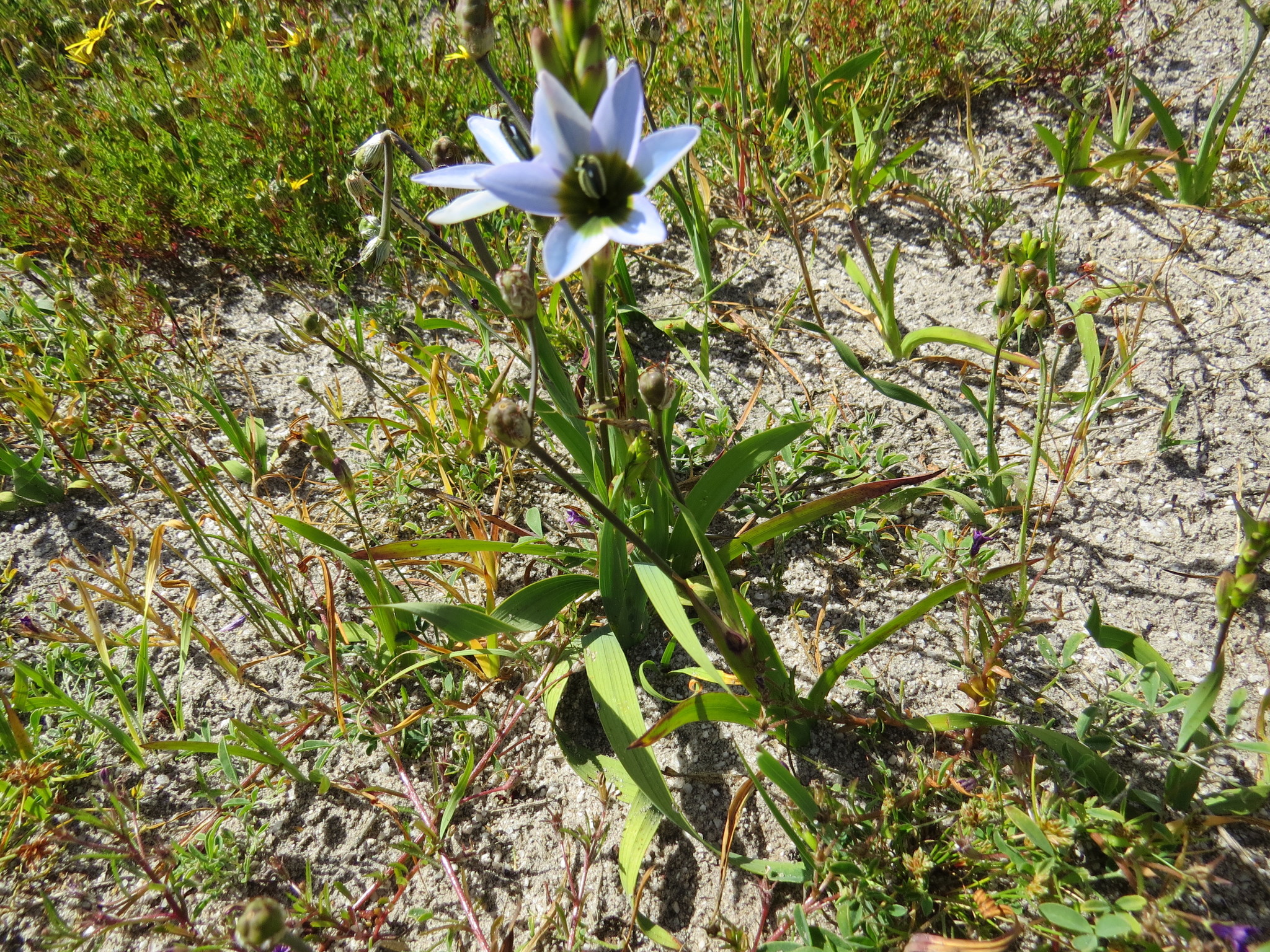
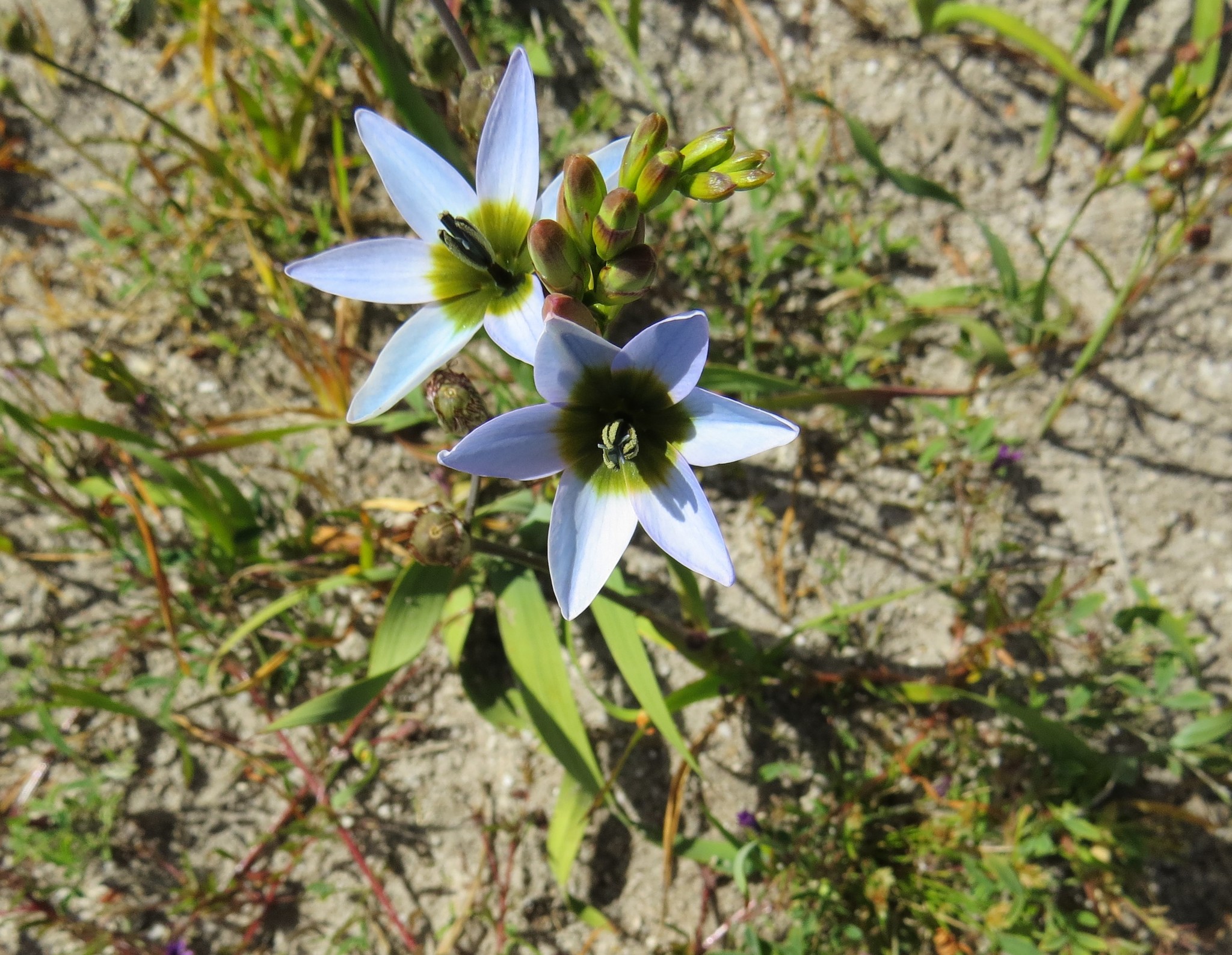
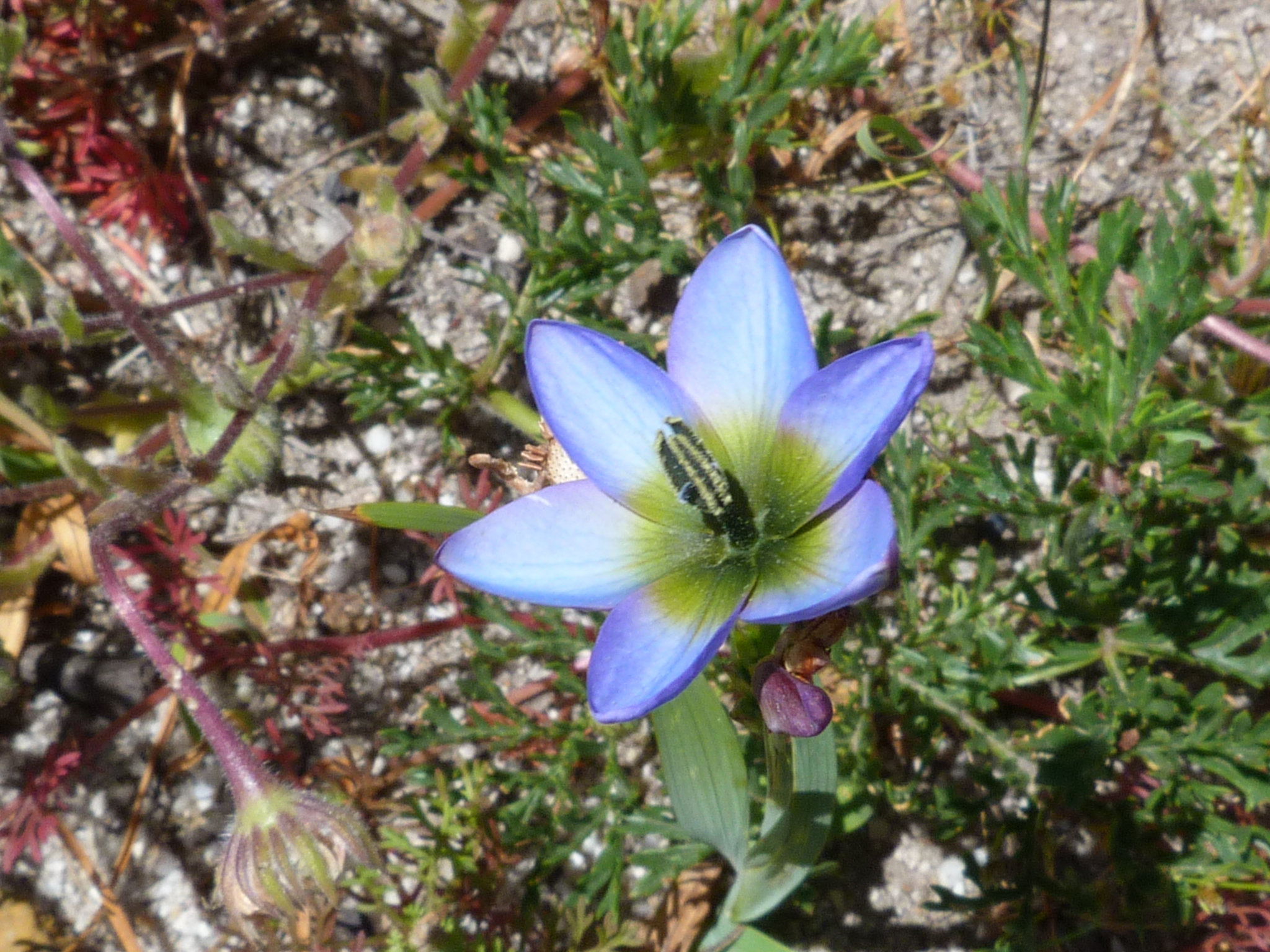
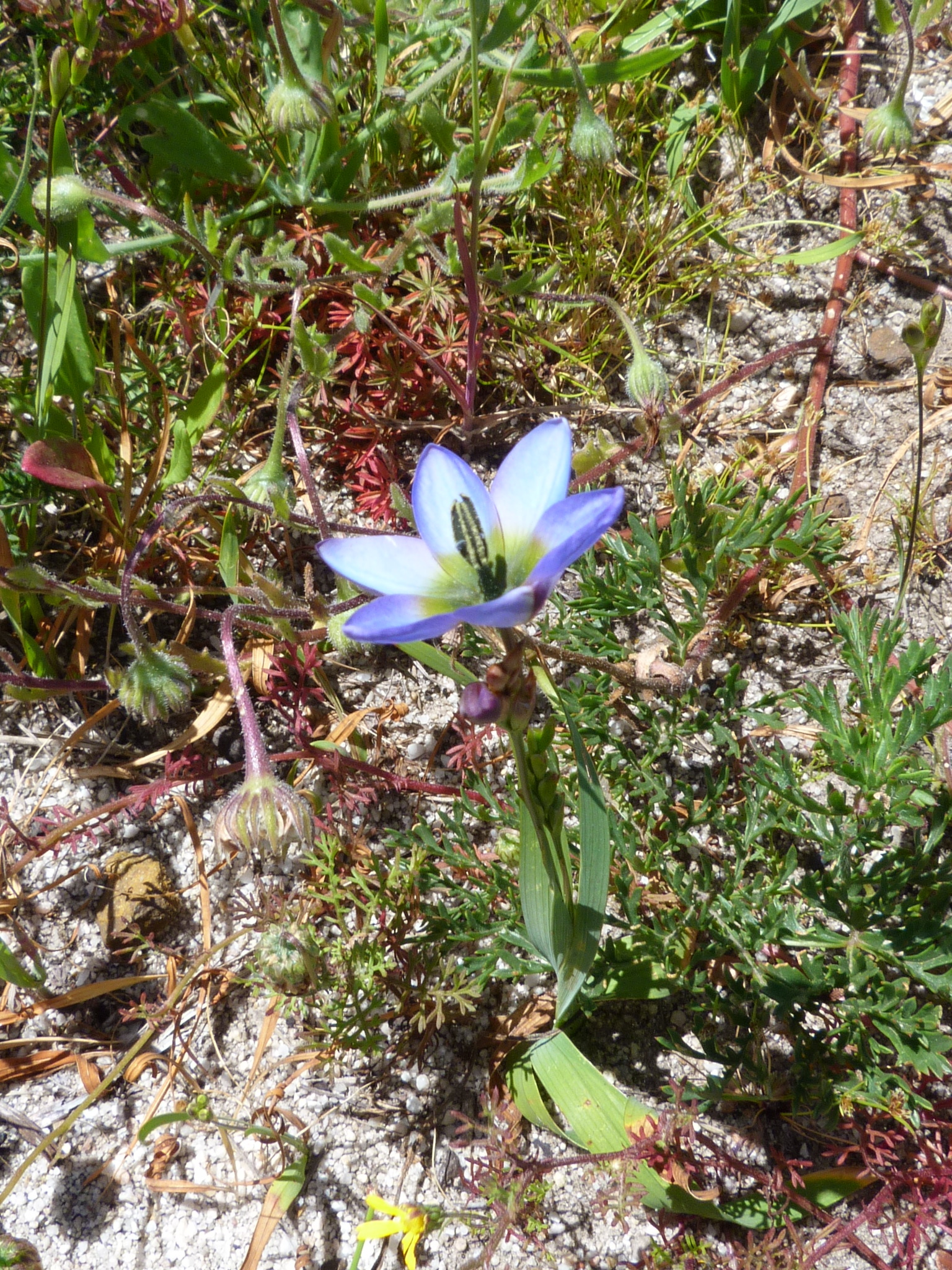
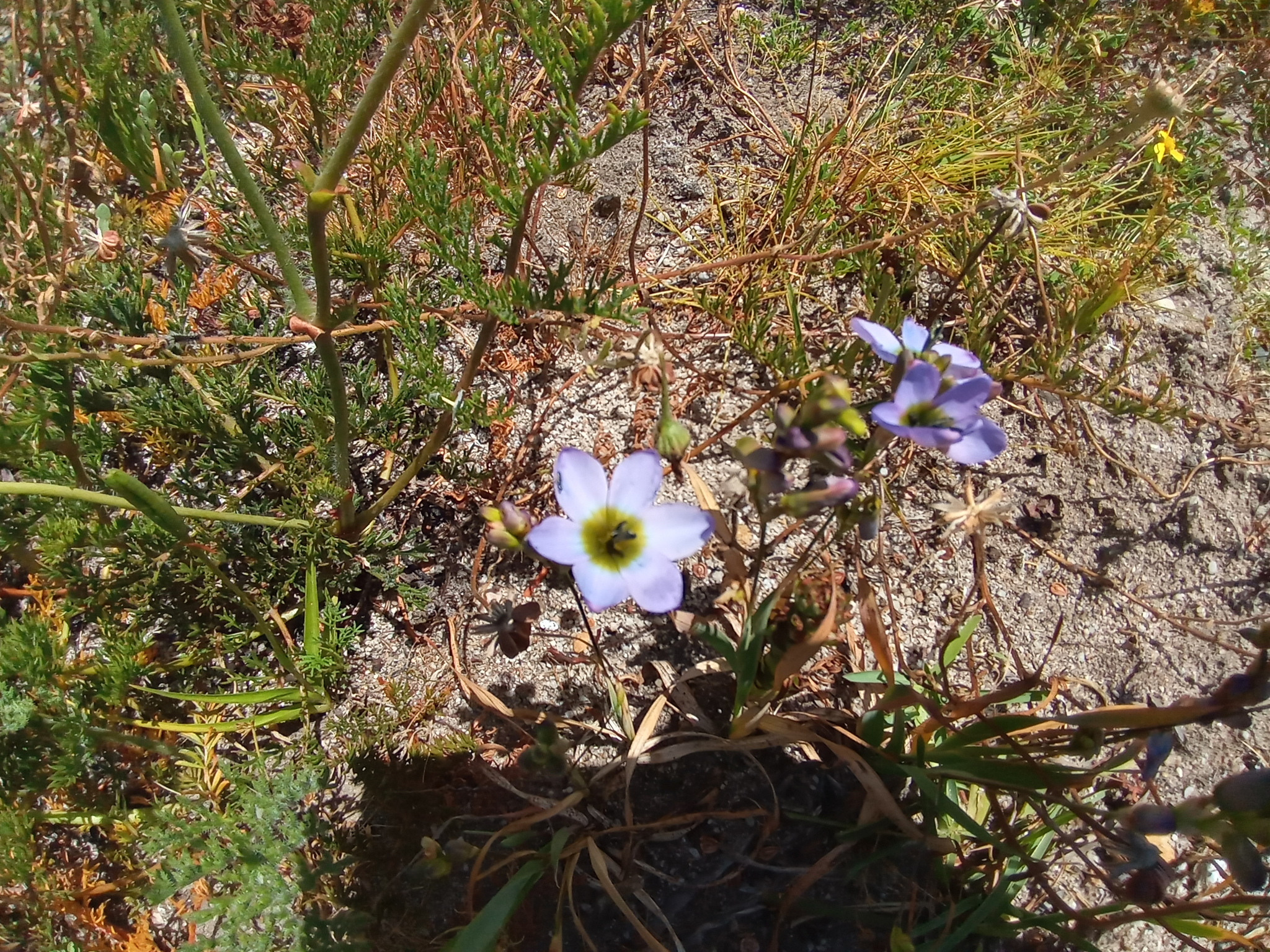
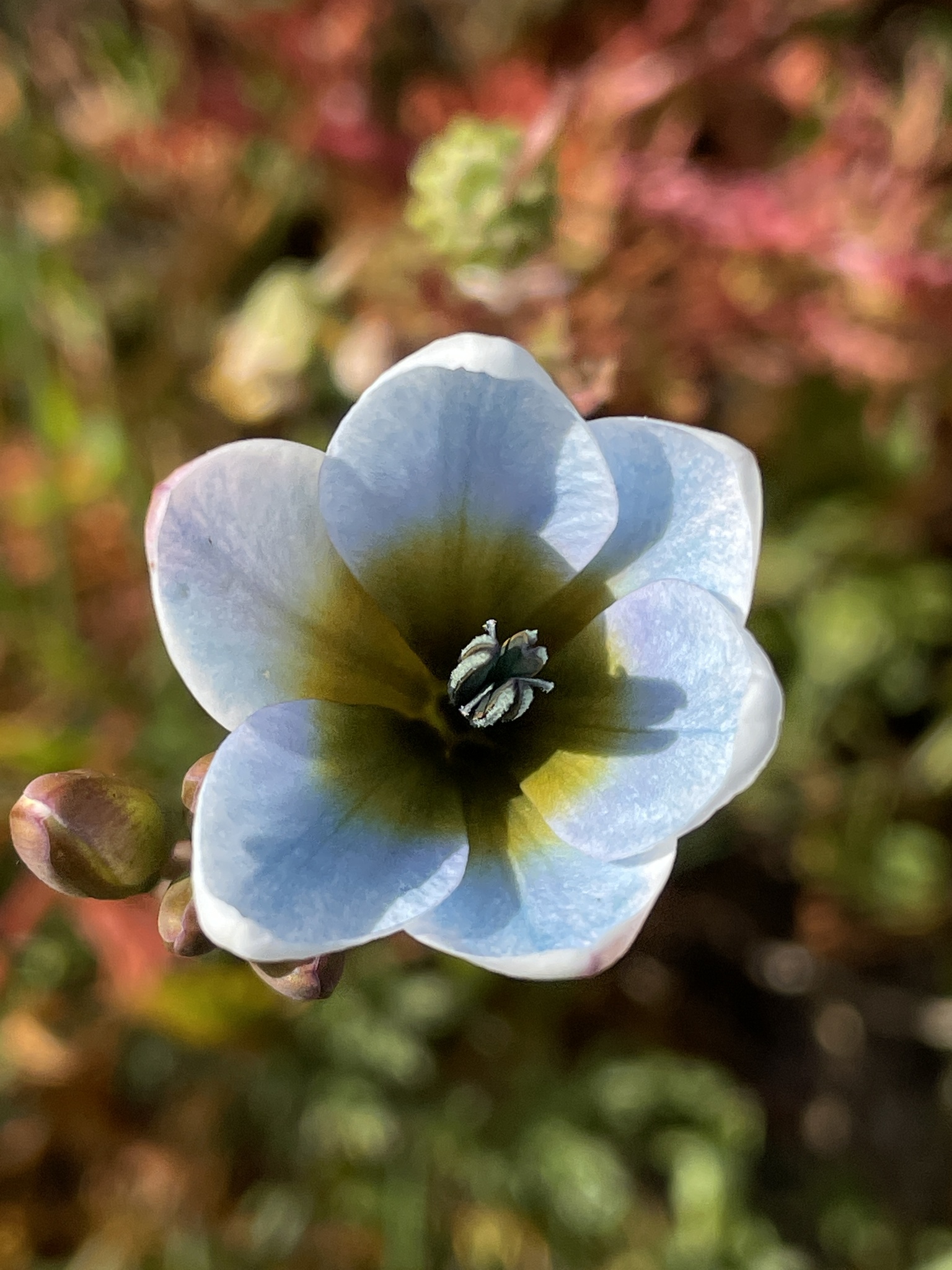
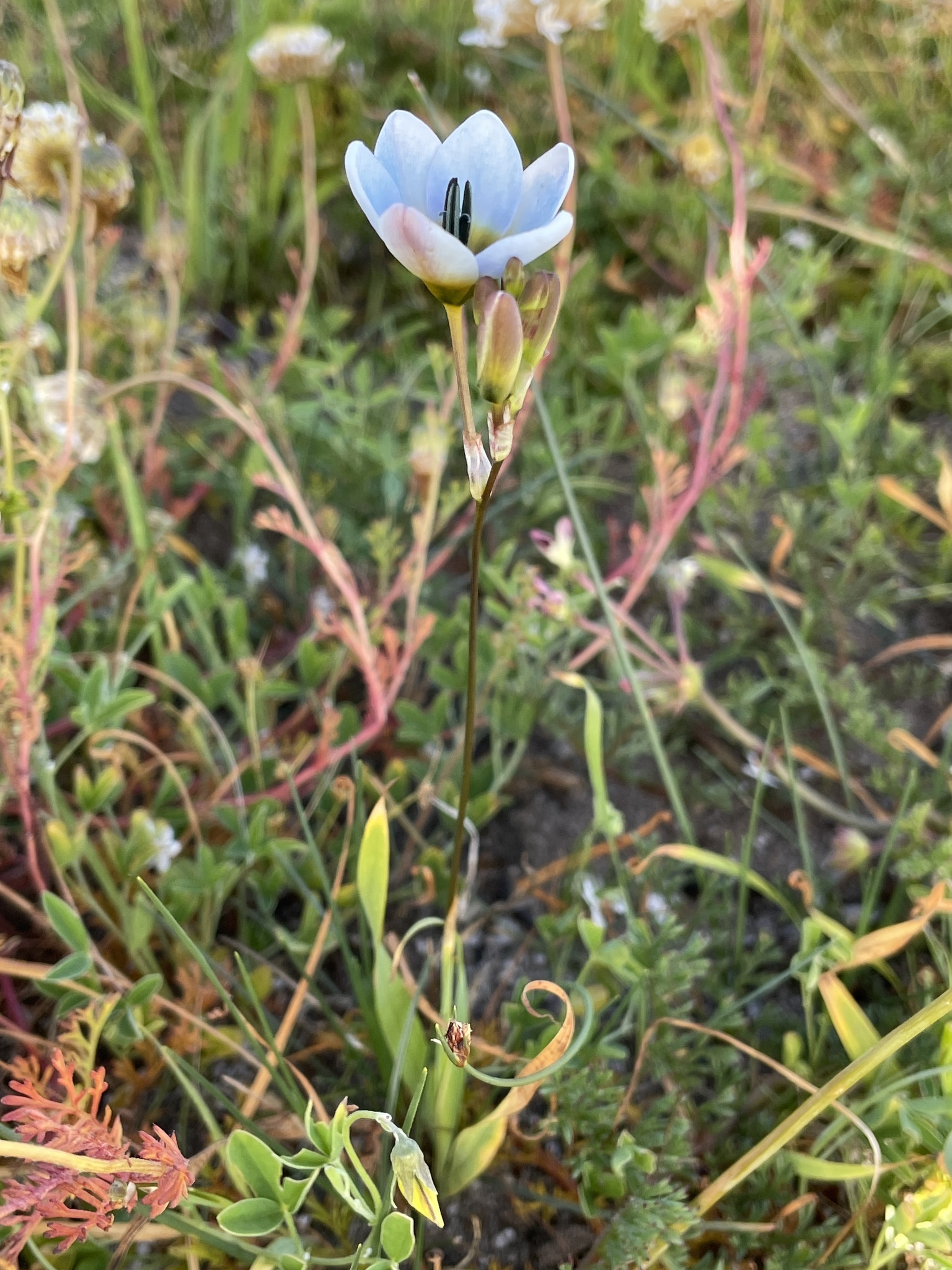
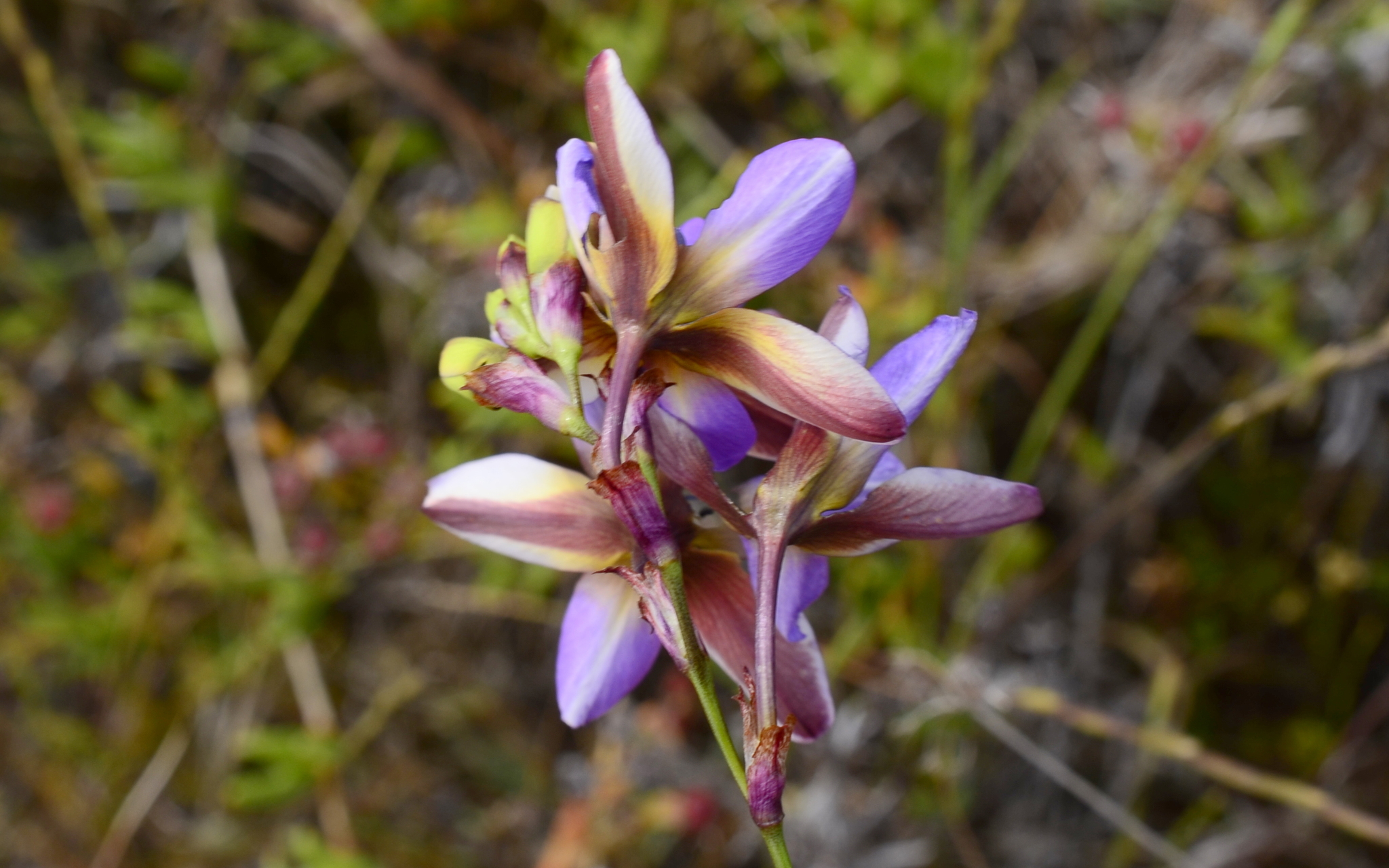
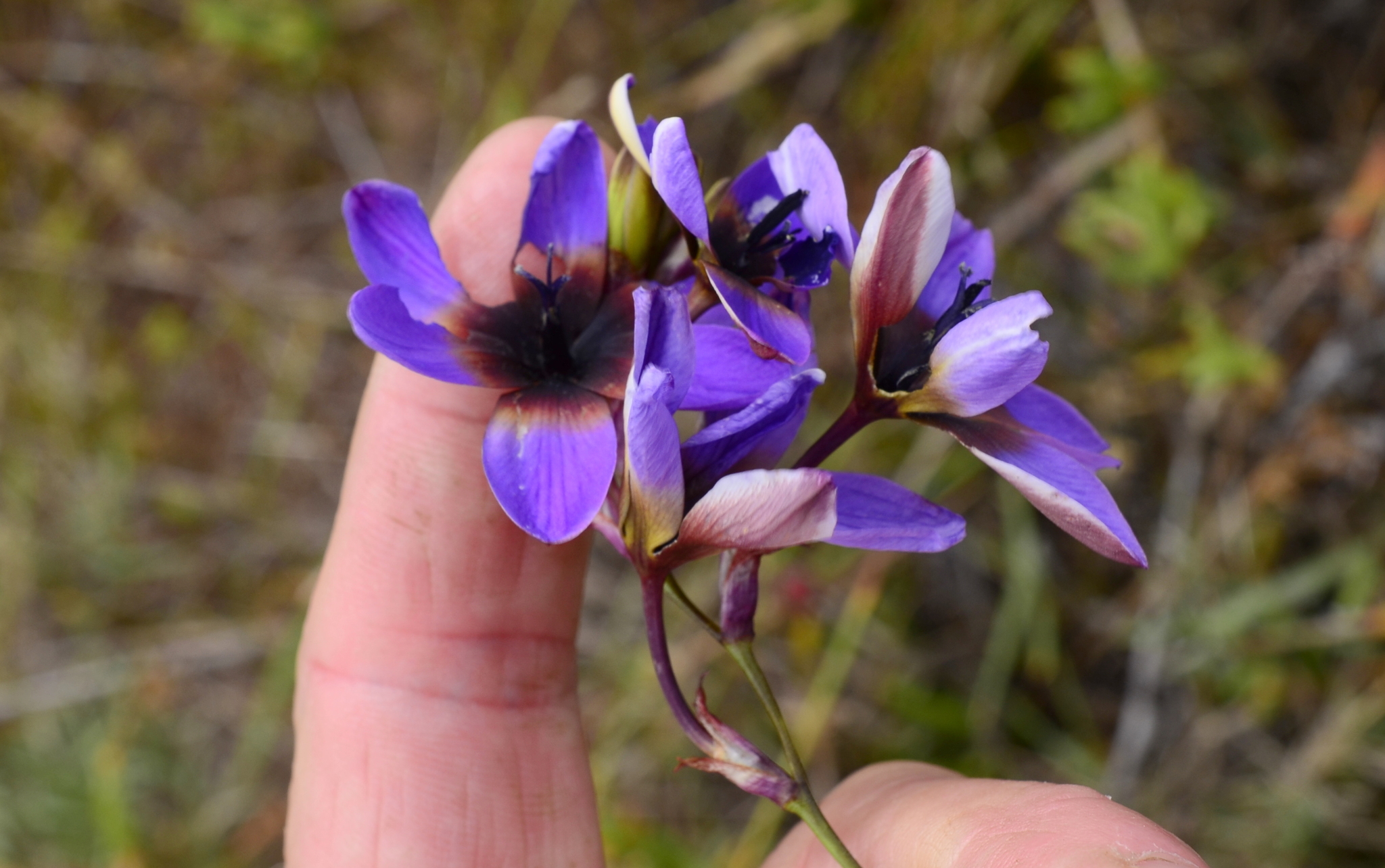
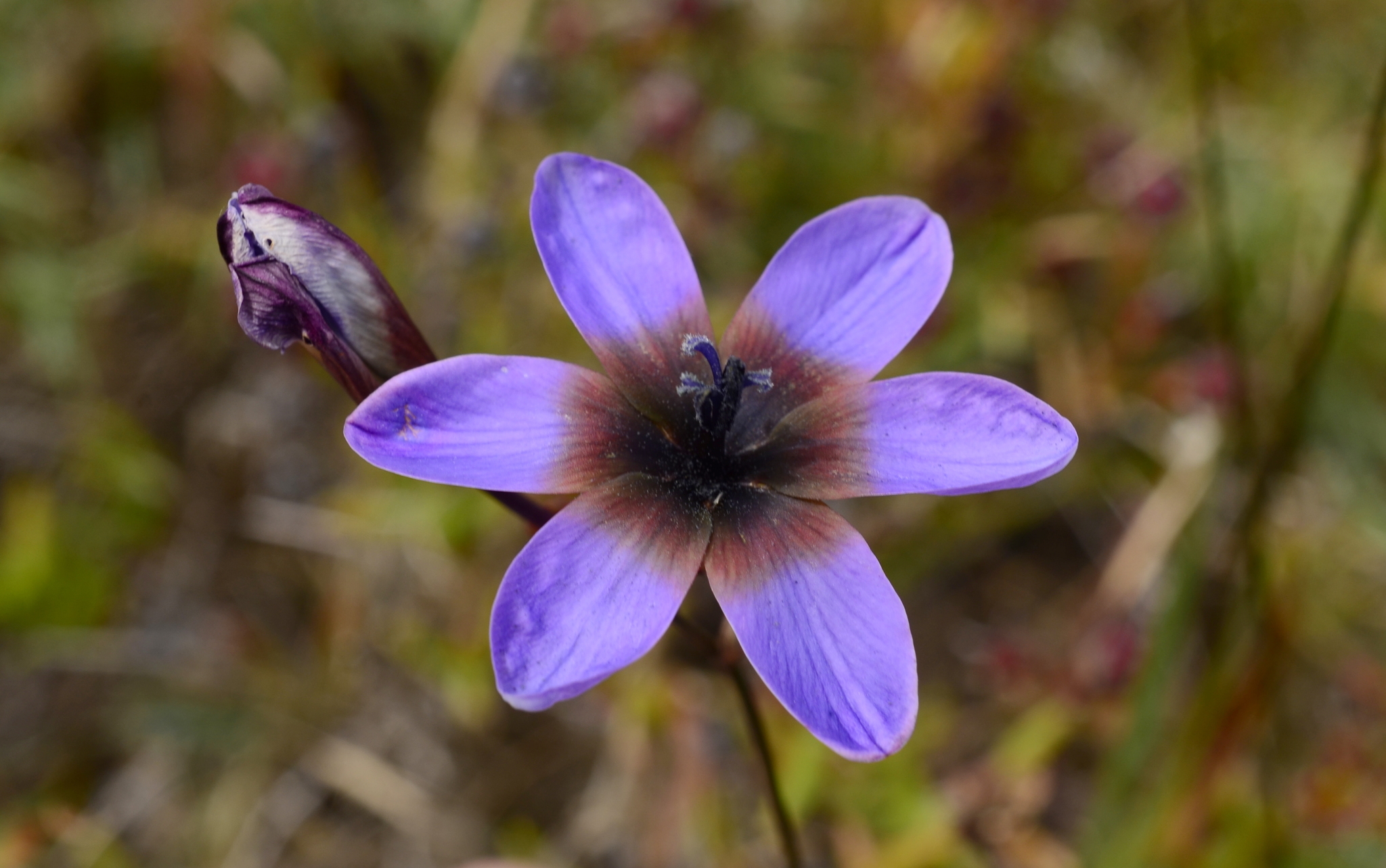
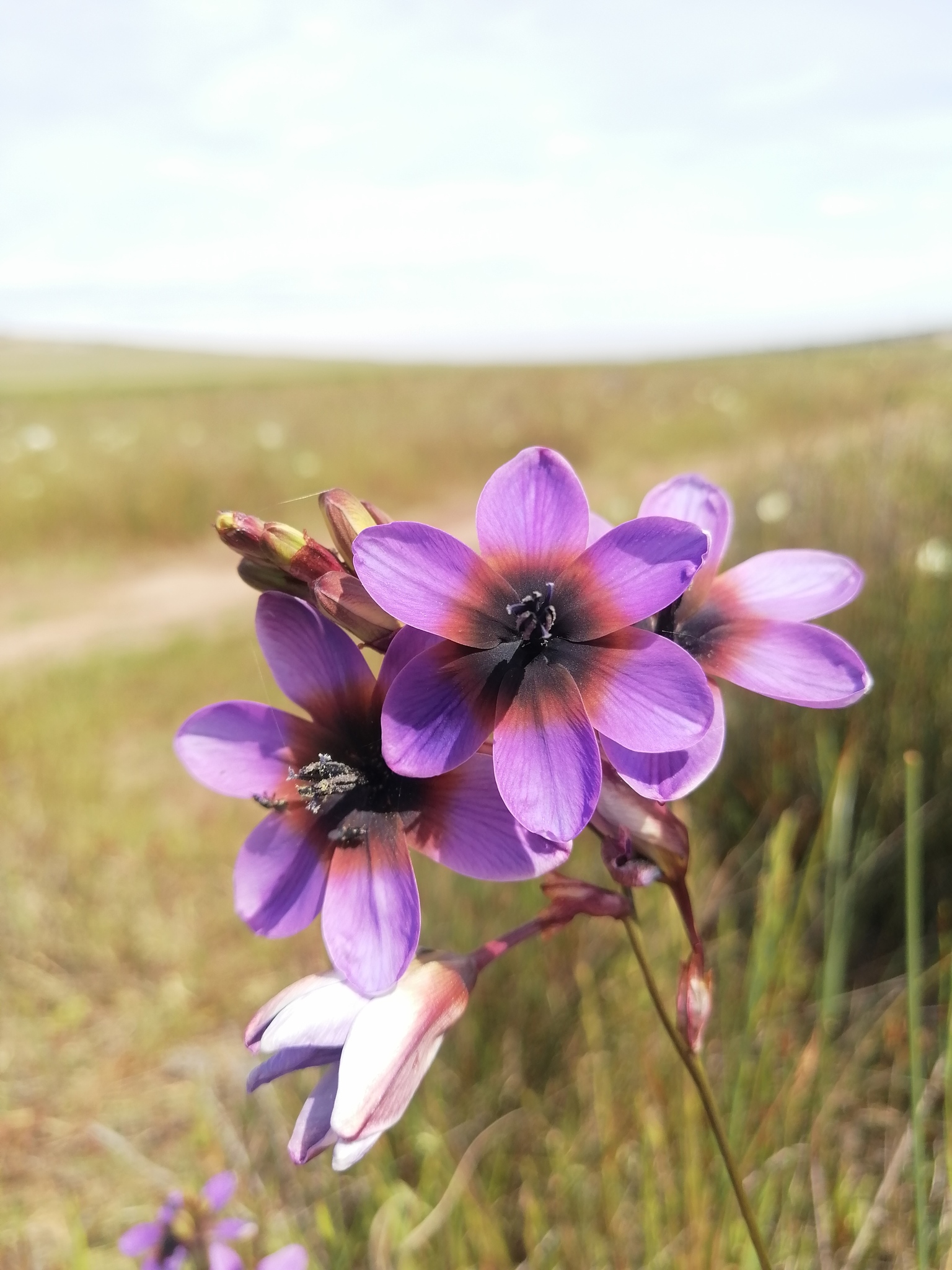
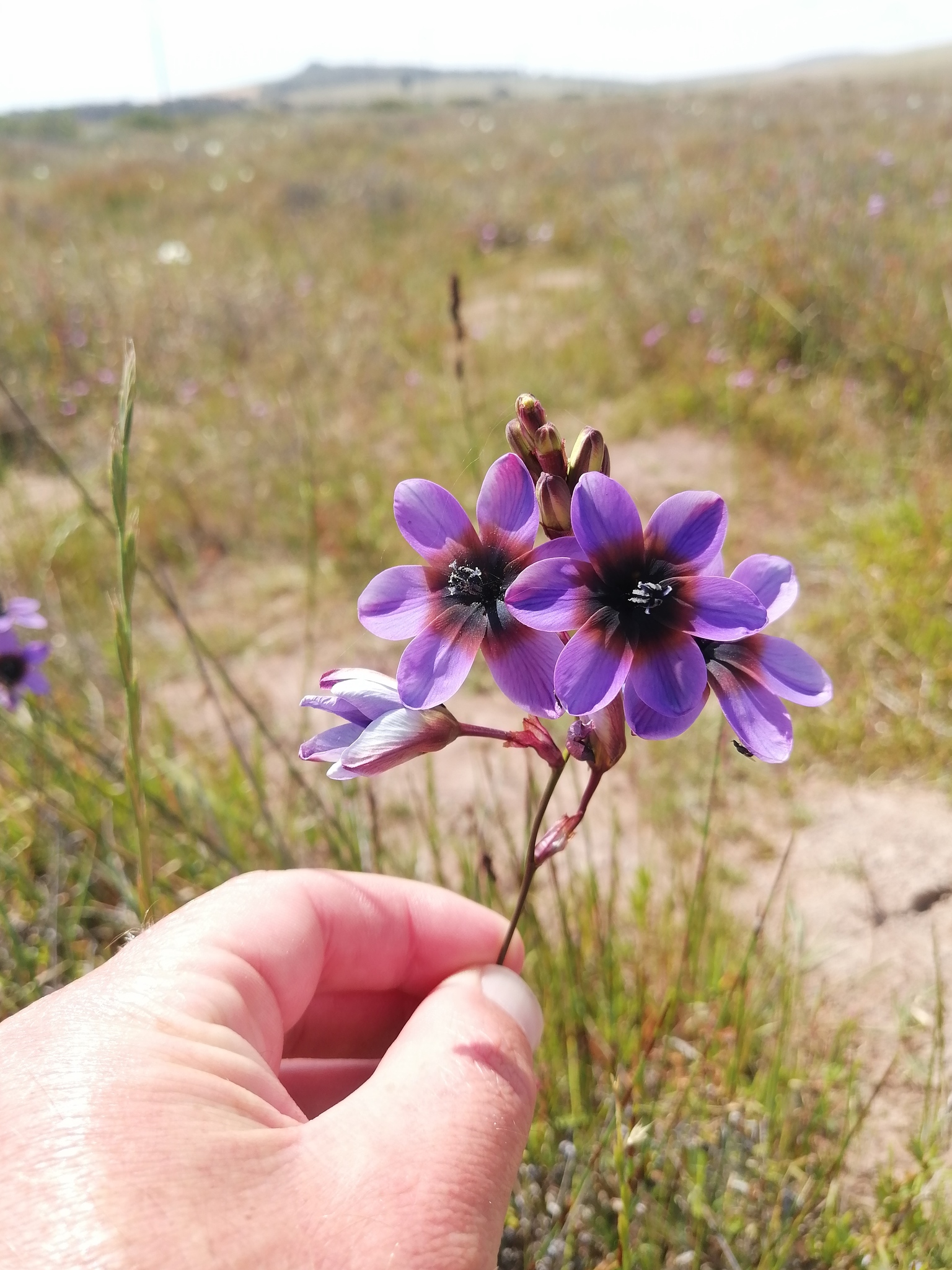
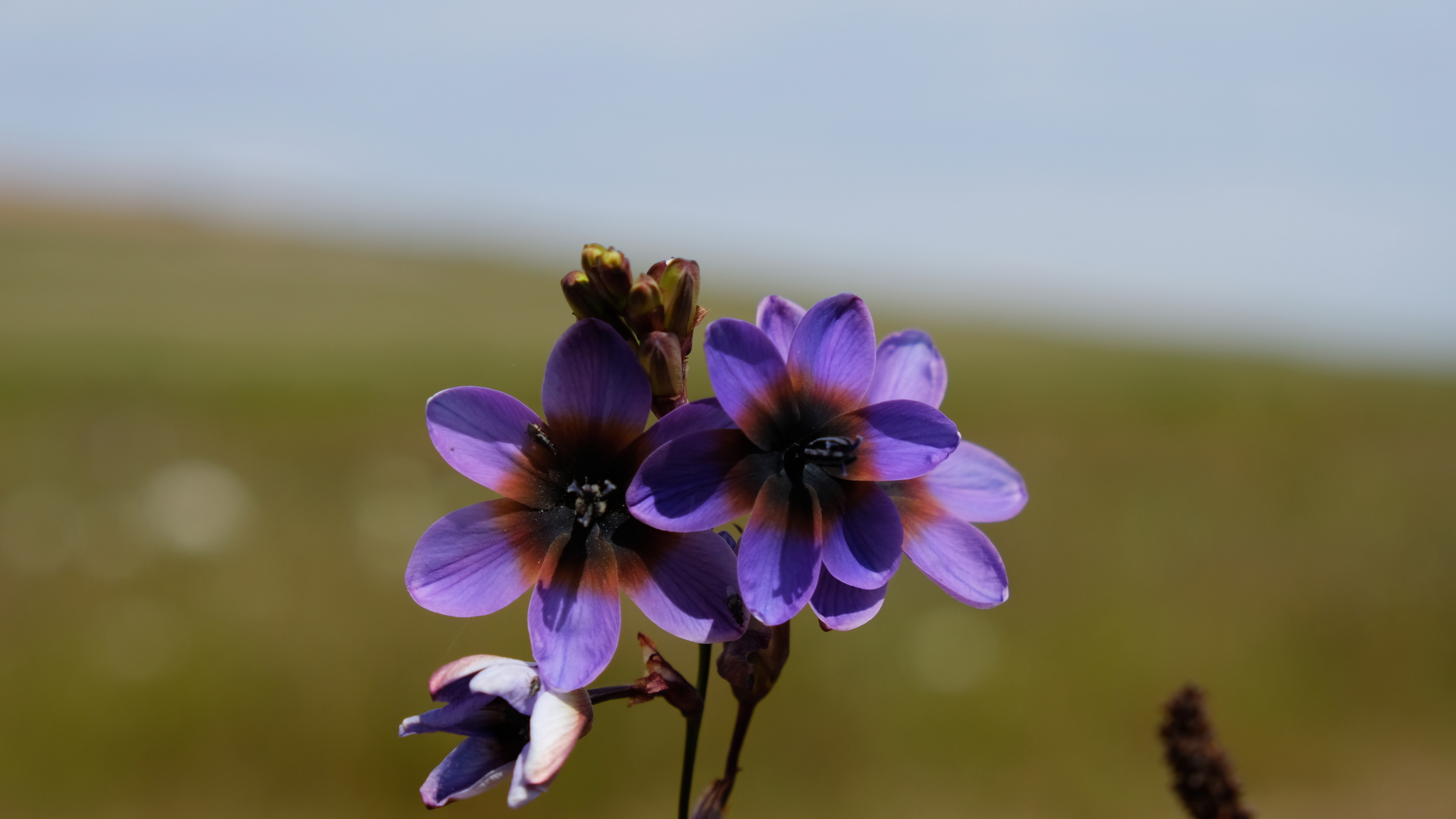
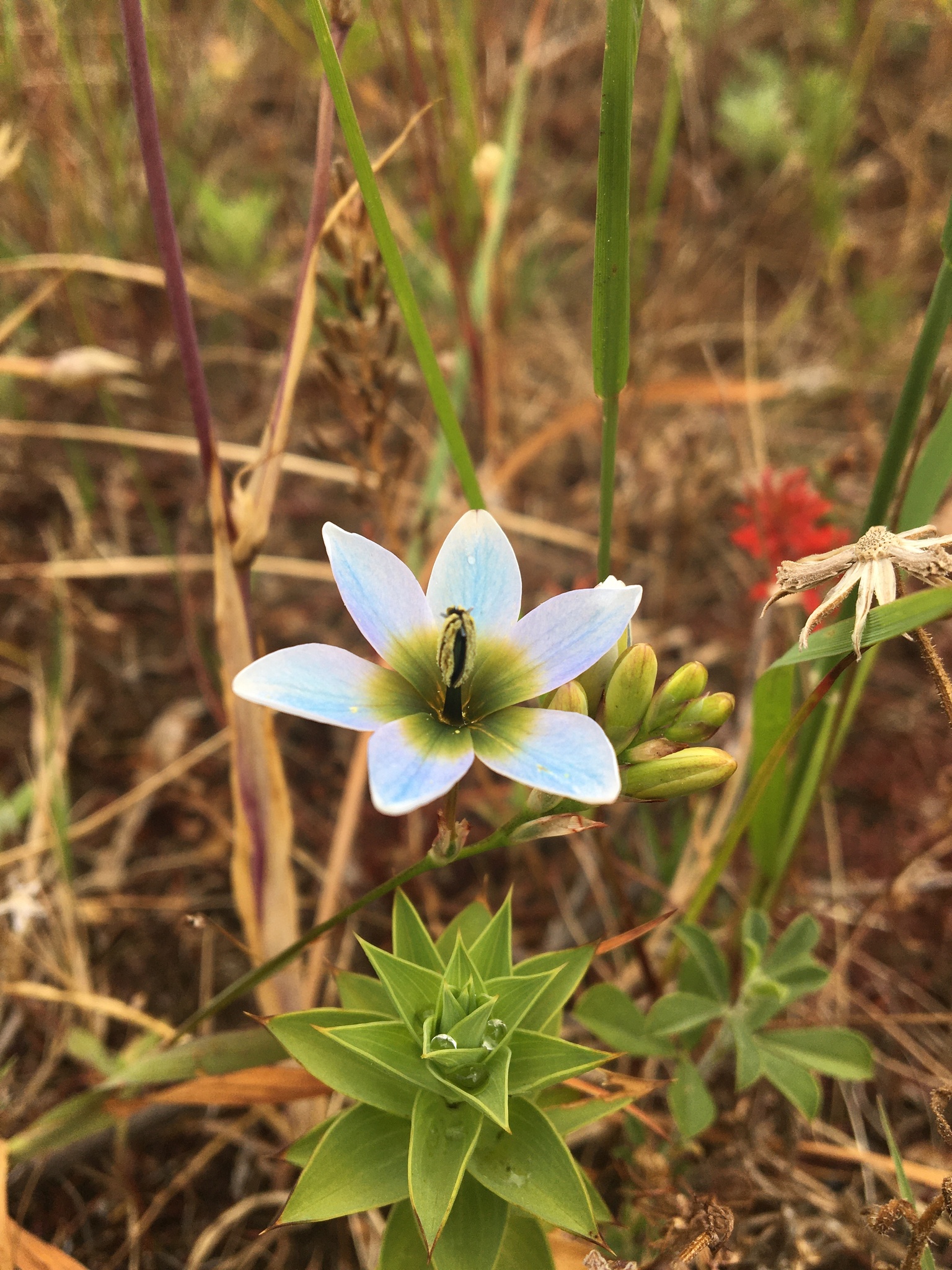
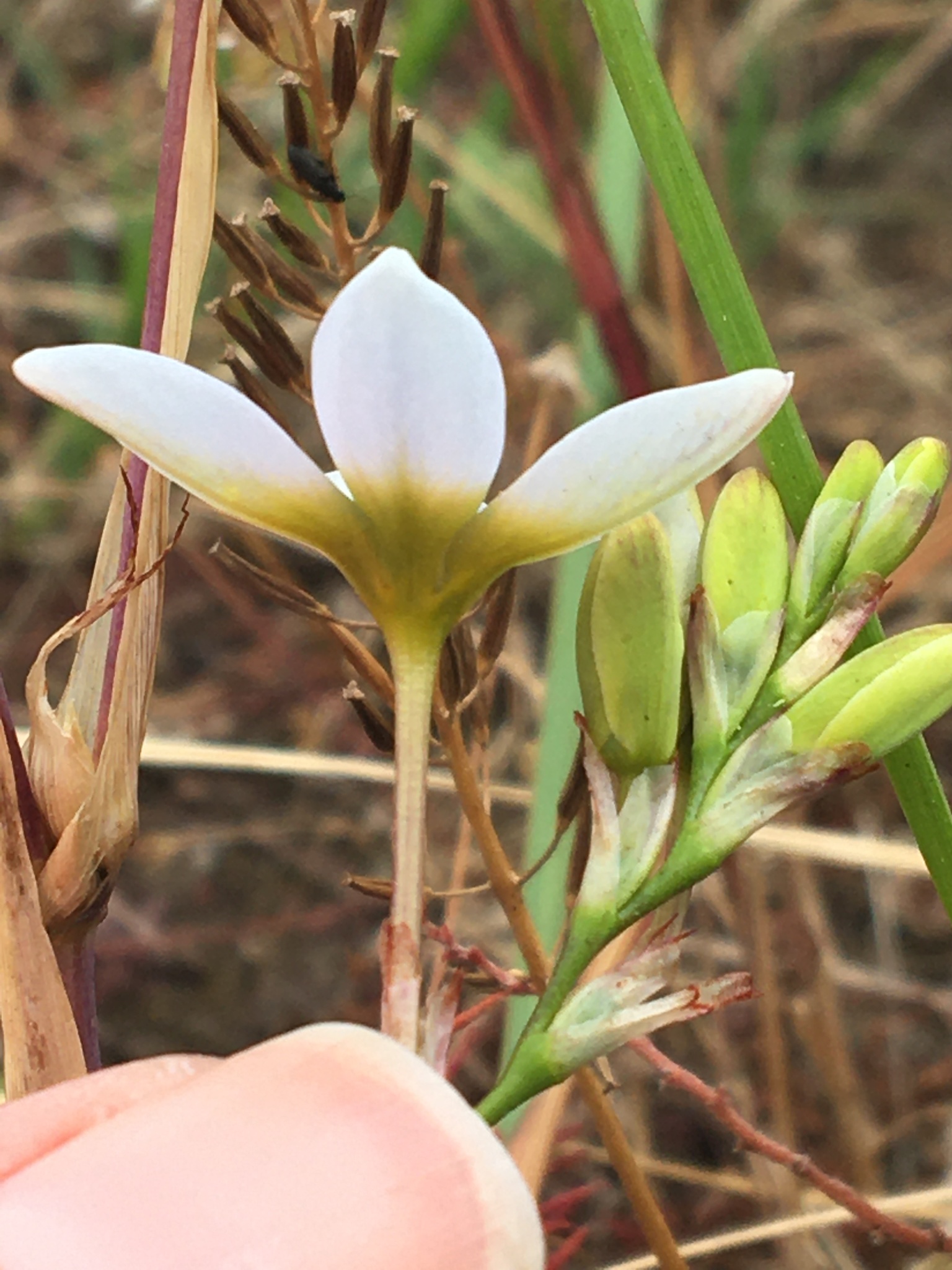
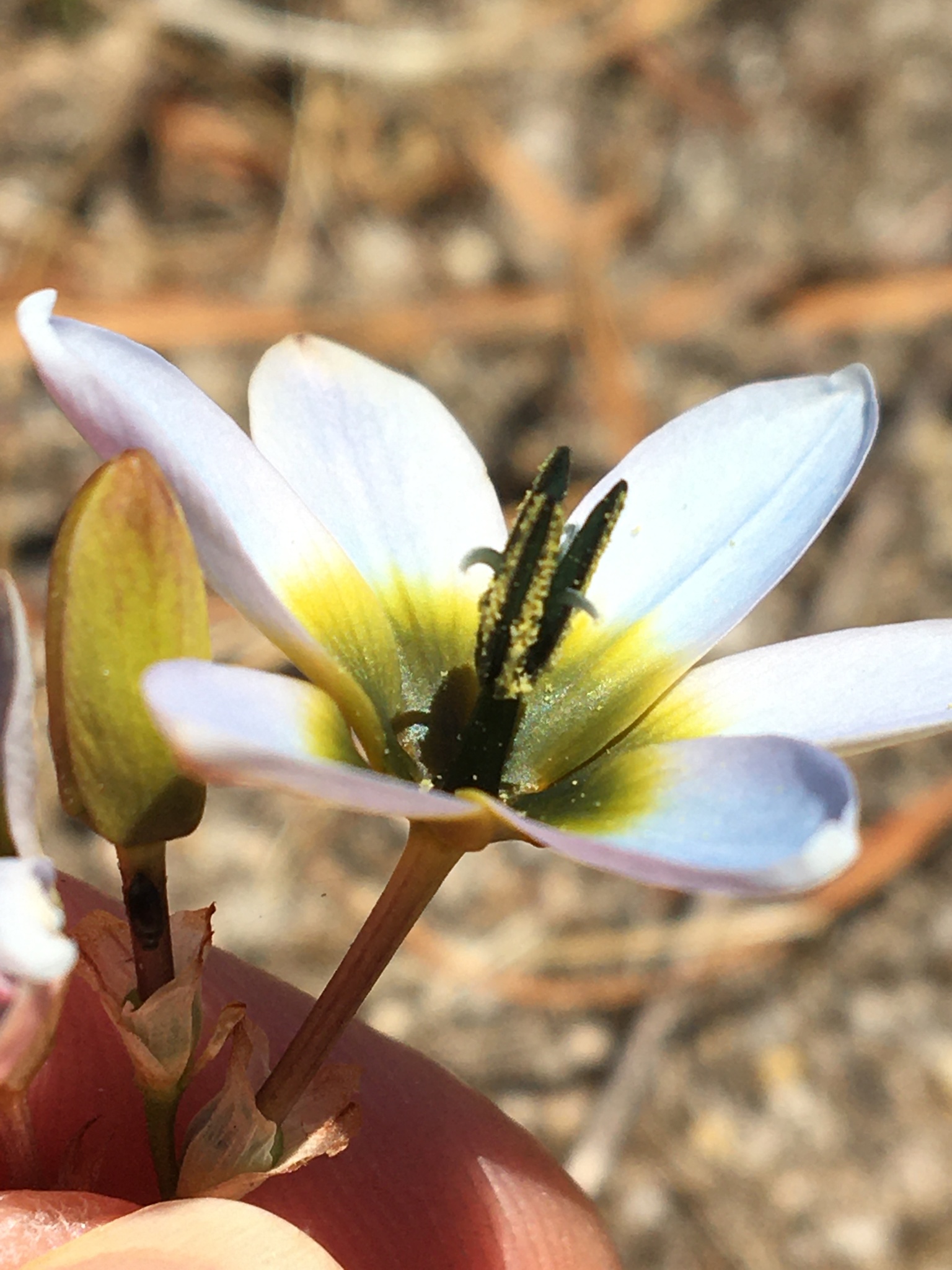
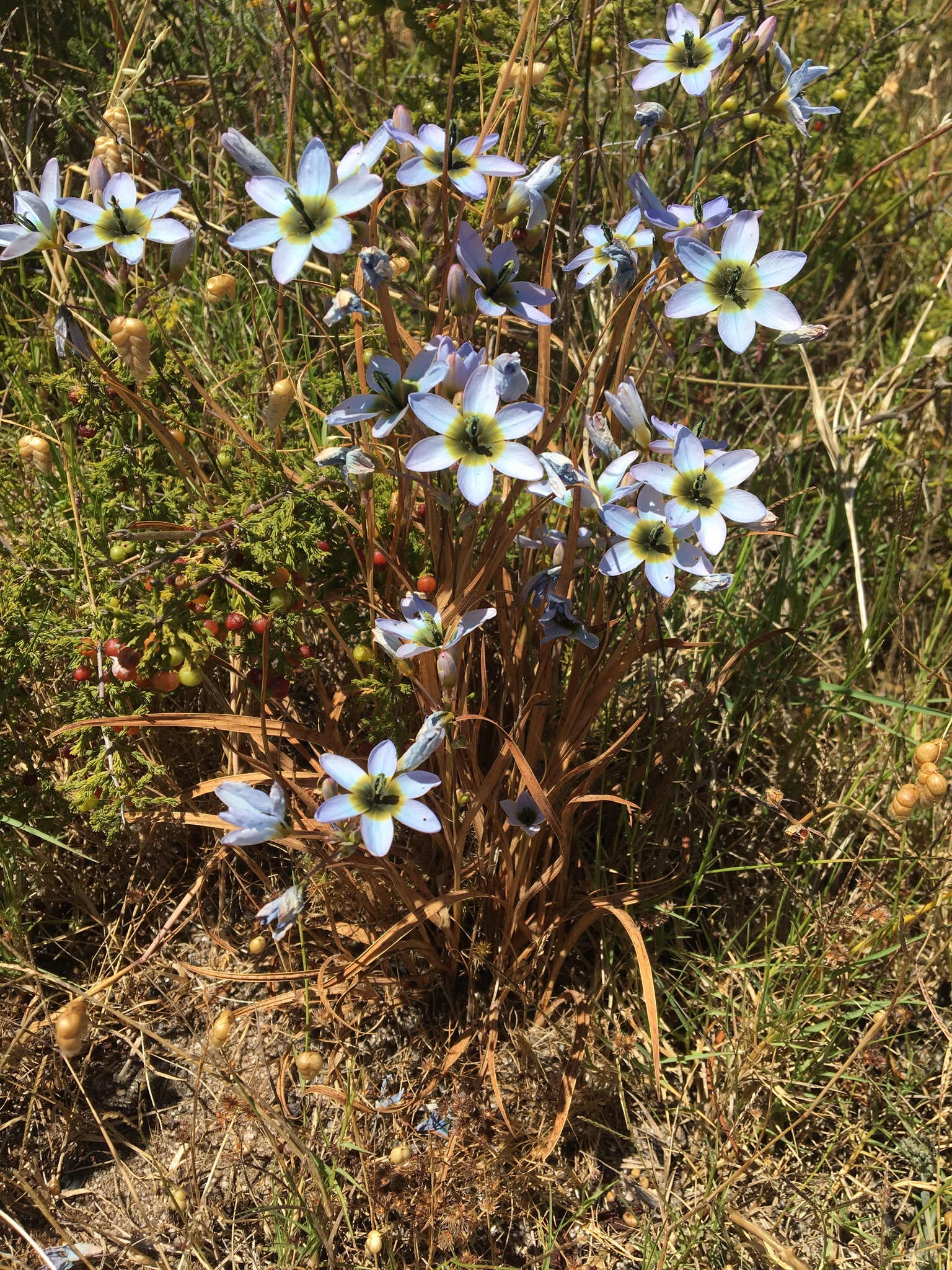
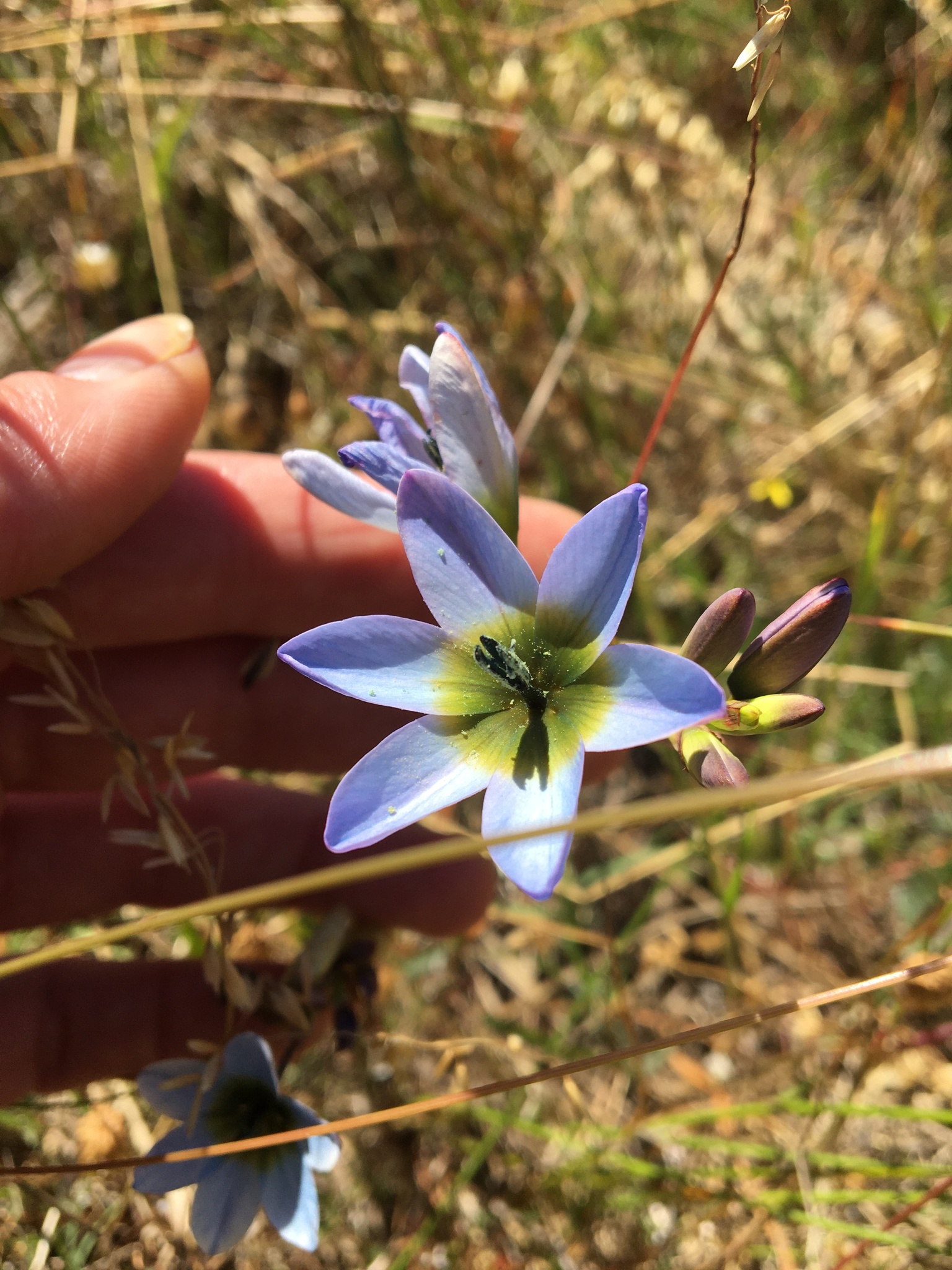
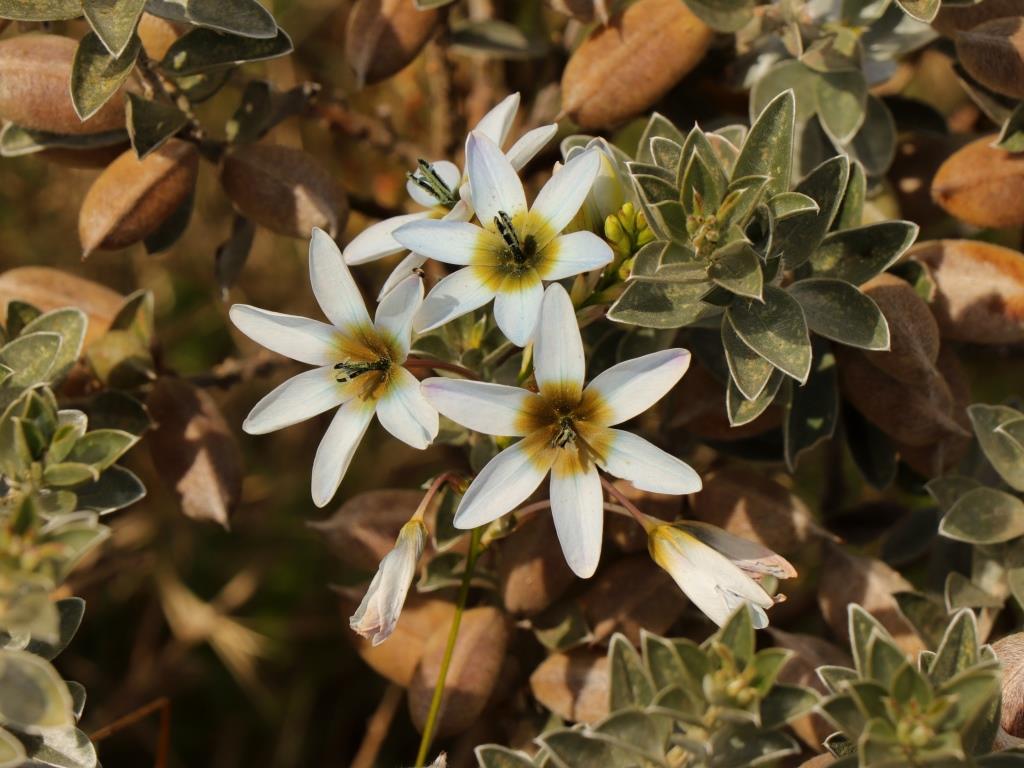
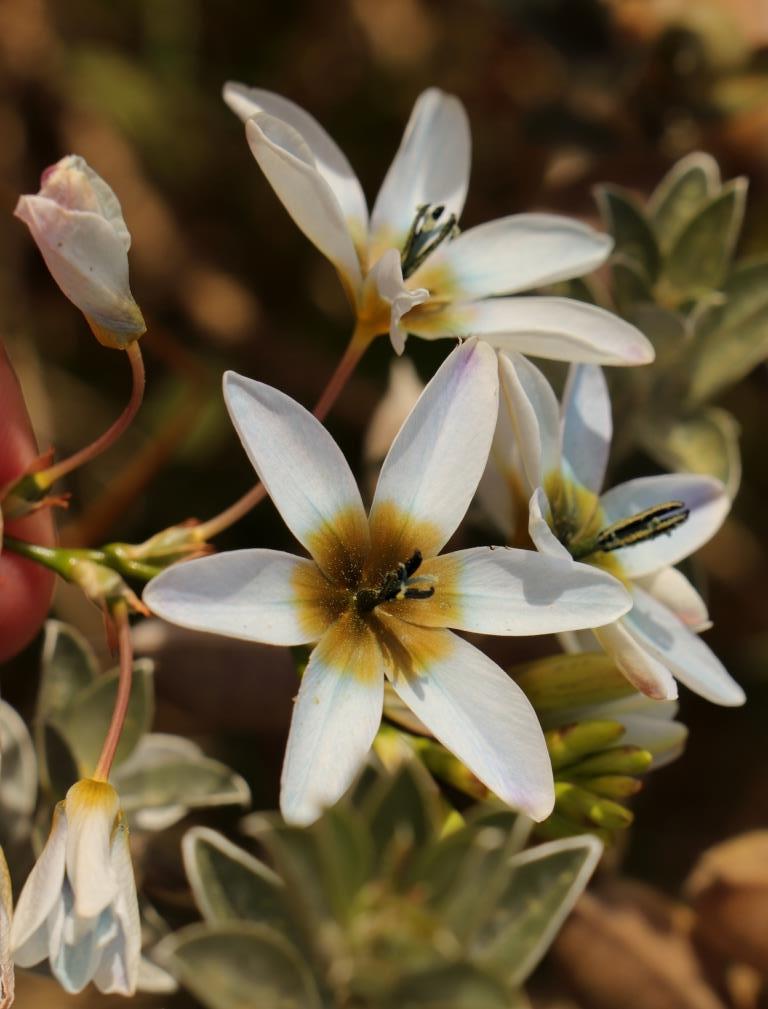
A very striking species, Ixia monadelpha has grey-blue to light purple, turquoise or sometimes pink (exceptionally greyish yellow) flowers with a dark purple to almost black center with a light brown to green halo. The stamens are also darkly colored, with blue to dull grey pollen. The filaments are united for half or more of their length, and the anthers are erect and contiguous. The pale floral bracts are minutely speckled brown or red distally and are distinctive in the somewhat thickened, twisted, blackish cusps, the outer bract with the central cusp more prominent than the laterals. Added to these unusual features are a perianth tube 10-18 mm long and a stem usually bearing two or more branches held at right angles to the main axis and curving upward distally. From: Goldblatt, P; Manning, JC. 2016. Systematics of the southern African genus Ixia (Iridaceae): 5. Synopsis of section Ixia, including five new species. S. African J. Bot. 104: 175-198. [http://dx.doi.org/10.1016/j.sajb.2015.11.011] [Copyright held by the South African Association of Botanists (2016); http://www.sciencedirect.com/science/journal/02546299] [CC BY]
Cormous geophyte, 15-40 cm. Leaves sword-shaped. Flowers shades of turquoise to purple, rarely whitish, with blackish centre, tube filiform, filaments united, black; bracts with prominent dark brown cusps. From: Manning, JC; Goldblatt, P. 2012. Iridaceae. In: J Manning & P Goldblatt (eds), Plants of the Greater Cape Floristic Region 1: The Core Cape flora. Strelitzia 29: 119-176. South African National Biodiversity Institute, Pretoria. [CC BY]
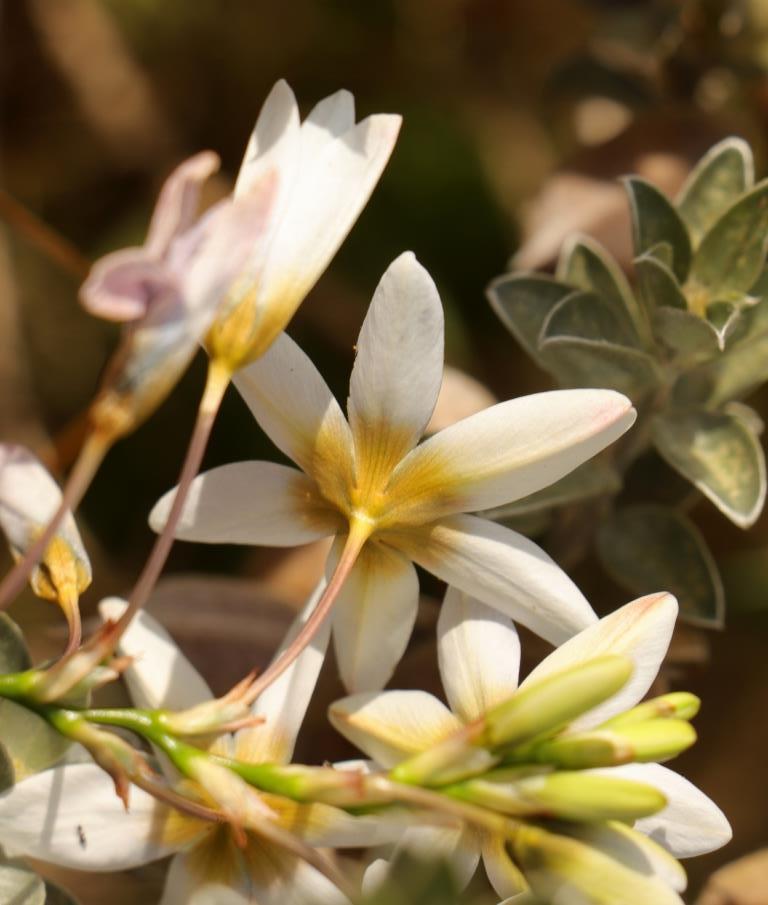
A striking species, Ixia monadelpha has grey-blue to light purple or even pink flowers (rarely white to grey-yellow), dark purple, iridescent green to almost black in the centre edged with a light brown to green halo. The stamens are also darkly coloured and even the pollen is blue to grey. The species was named for the united filaments, sometimes for only half their length, unusual in the genus, and even the anthers are erect and contiguous. The pale floral bracts are minutely speckled brown or red distally but are distinctive in the somewhat thickened, twisted, almost black cusps, the outer with the central cusp more prominent than the laterals. Added to these unusual features are a perianth tube 10-18 mm long and a stem usually bearing two or more branches held at right angles to the main axis and curving upward distally. Ixia monadelpha has often been associated with orange-flowered I. curta, which also has united filaments, contiguous anthers and an unusually long perianth tube, and the two have at times been treated as a single species. The two may well be closely related but can be separated not only by flower colour, but I. curta has corm tunics of fine, soft fibres, a markedly thicker perianth tube and the stem is rarely branched. From: Goldblatt, P; Manning, JC. 2020. Iridaceae of southern Africa. Strelitzia 42: 1-1159. South African National Biodiversity Institute, Pretoria. [CC BY]
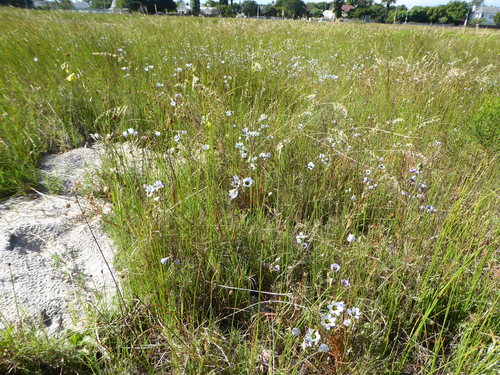
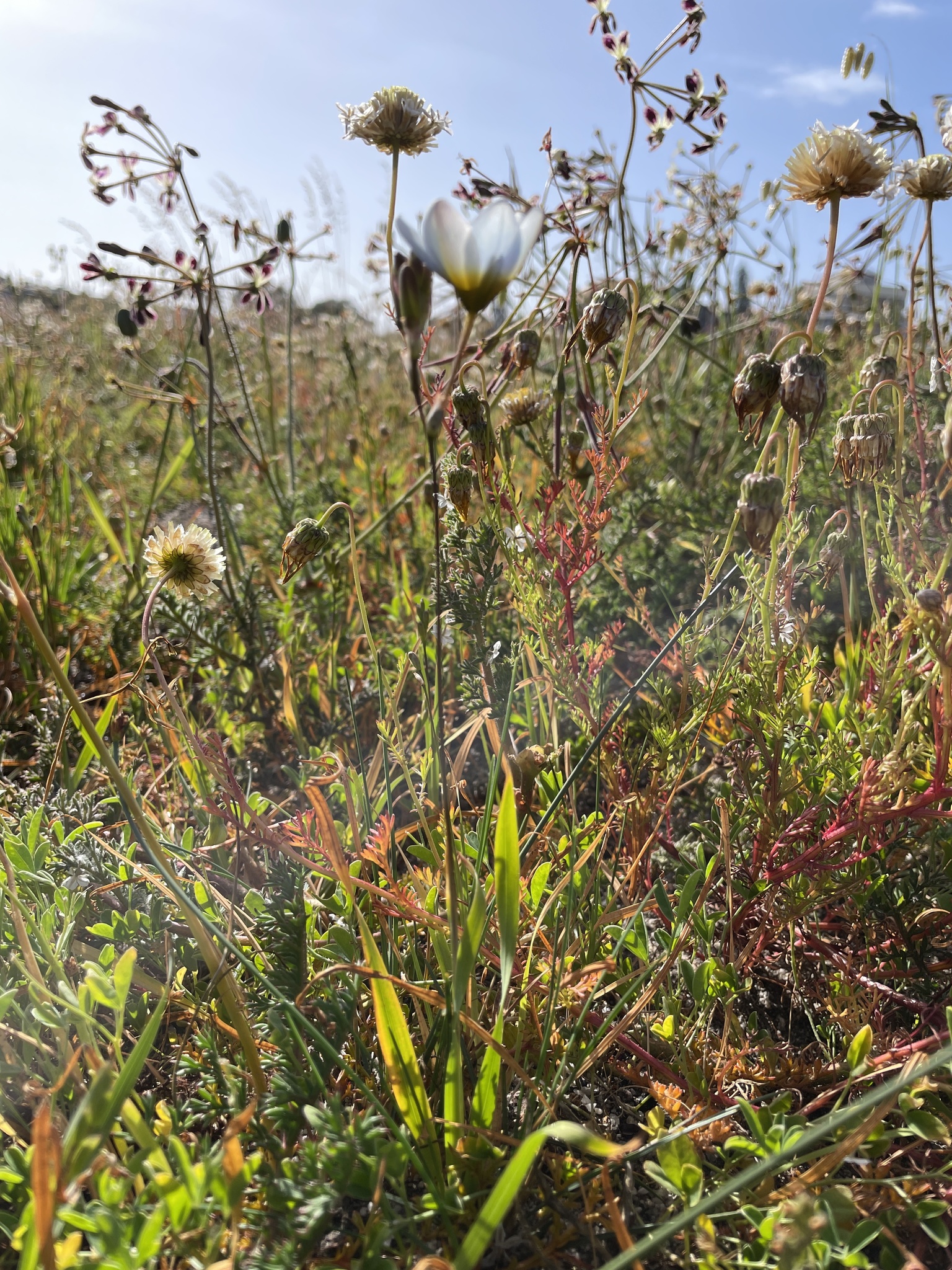
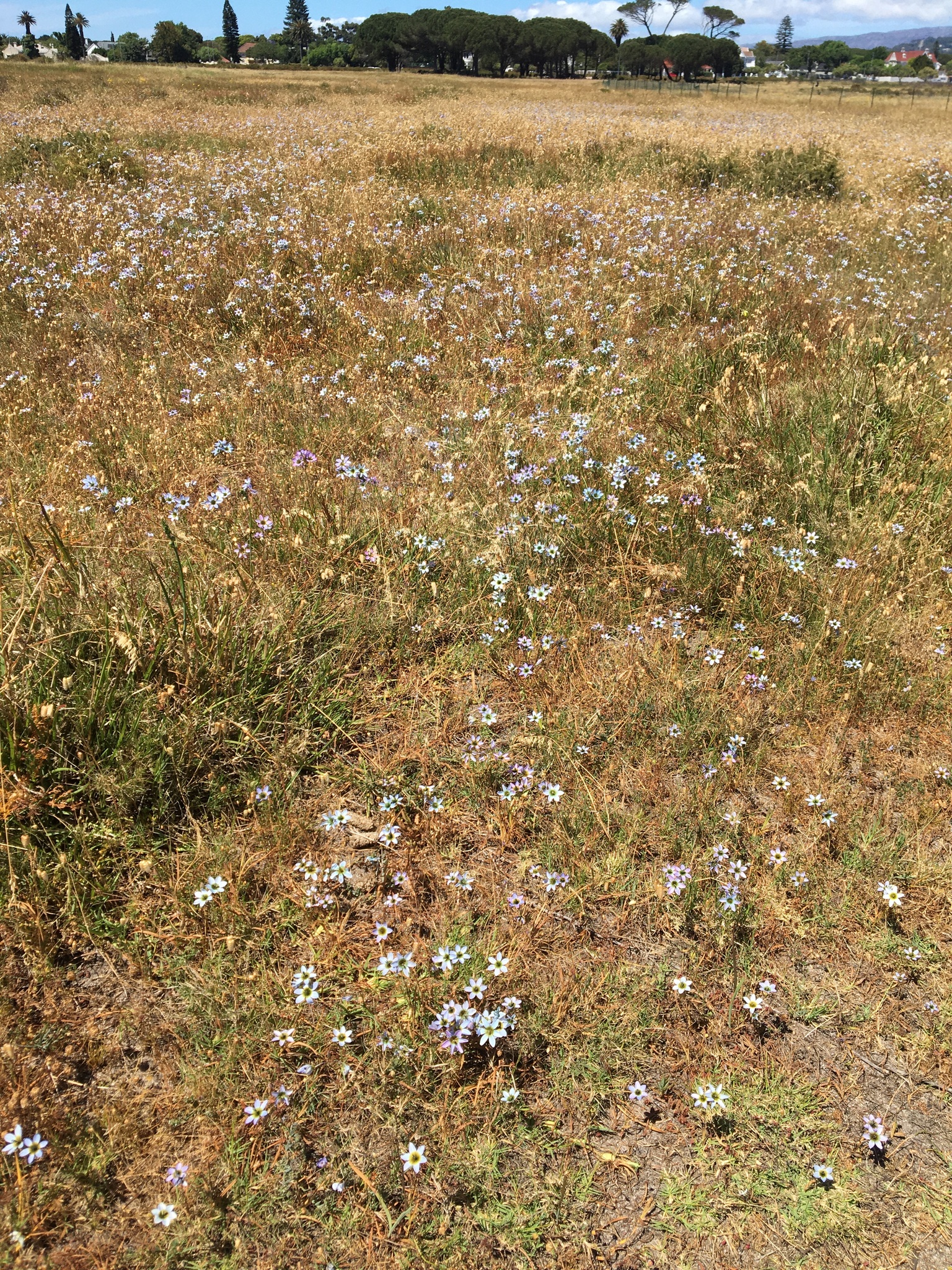
Seasonally wet, sandy gravel flats and lower mountain slopes. From: Goldblatt, P; Manning, JC. 2020. Iridaceae of southern Africa. Strelitzia 42: 1-1159. South African National Biodiversity Institute, Pretoria. [CC BY]
Plants grow on seasonally wet, sandy gravel flats and lower mountain slopes. From: Goldblatt, P; Manning, JC. 2016. Systematics of the southern African genus Ixia (Iridaceae): 5. Synopsis of section Ixia, including five new species. S. African J. Bot. 104: 175-198. [http://dx.doi.org/10.1016/j.sajb.2015.11.011] [Copyright held by the South African Association of Botanists (2016); http://www.sciencedirect.com/science/journal/02546299] [CC BY]
Wet, sandy flats and lower slopes. From: Manning, JC; Goldblatt, P. 2012. Iridaceae. In: J Manning & P Goldblatt (eds), Plants of the Greater Cape Floristic Region 1: The Core Cape flora. Strelitzia 29: 119-176. South African National Biodiversity Institute, Pretoria. [CC BY]
Restricted to a narrow stretch of the Western Cape Atlantic Coast between Darling and Hout Bay on the Cape Peninsula. From: Goldblatt, P; Manning, JC. 2020. Iridaceae of southern Africa. Strelitzia 42: 1-1159. South African National Biodiversity Institute, Pretoria. [CC BY]
Ixia monadelpha is restricted a narrow stretch of the Western Cape coast between Hout Bay on the Cape Peninsula and Darling, a distance of some 85 km. From: Goldblatt, P; Manning, JC. 2016. Systematics of the southern African genus Ixia (Iridaceae): 5. Synopsis of section Ixia, including five new species. S. African J. Bot. 104: 175-198. [http://dx.doi.org/10.1016/j.sajb.2015.11.011] [Copyright held by the South African Association of Botanists (2016); http://www.sciencedirect.com/science/journal/02546299] [CC BY]
Darling to Cape Peninsula. From: Manning, JC; Goldblatt, P. 2012. Iridaceae. In: J Manning & P Goldblatt (eds), Plants of the Greater Cape Floristic Region 1: The Core Cape flora. Strelitzia 29: 119-176. South African National Biodiversity Institute, Pretoria. [CC BY]
September to November
This map contains point-based occurrences at different locations
Occurrence in the Flora of Southern Africa (FSA) countries and South African provinces. Residence status indicates if a taxon is indigenous, endemic, naturalised or invasive in a specific region. This data is based on specimen records and literature
FSA
SA
BOT
NAM
ESW
LES
WC
EC
NC
FS
GA
KZN
LP
MP
NW
Absent
Indigenous
Endemic
Naturalised
Invasive
Names and Sources
Published in: Descr. Pl. Aliq. Nov.: 22 (1766)
Nomenclature note: orth.var. 'monadelphia' sensu Burm.f.
Type: South Africa, without precise locality or collector (G: Herb. Burman, L: Herb. A. van Royen, syn.)
Morphixia monadelpha (D.Delaroche) Klatt
Published in: Abh. Naturf. Ges. Halle 15: 384 (1882)
Ixia cartilaginea Lam.
Published in: Encycl. [J. Lamarck & al.] 3(1): 340 (1789)
Type: South Africa, without precise locality or collector (P: Herb. Lamarck, holo.)
Ixia columnaris Salisb.
Published in: Prodr. Stirp. Chap. Allerton: 36 (1796)
Type: unknown
Ixia columnaris Salisb. var. grandiflora Andrews
Published in: Bot. Repos. 4: t. 250 (1802)
Type: South Africa, without precise locality or collector, illustration in Andrews, Bot. Repos. 4: t. 250 (1802)
Ixia columnaris Salisb. var. latifolia Andrews
Published in: Bot. Repos. 3: t. 213 (1802)
Type: South Africa, without precise locality or collector, illustration in Bot. Repos. 3: t. 213 (1802)
Ixia columnaris Salisb. var. purpurea Andrews
Published in: Bot. Repos. 3: t. 203 (1802)
Type: South Africa, without precise locality or collector, illustration in Bot. Repos. 3: t. 203 (1802)
Ixia columnaris Salisb. var. versicolor Andrews
Published in: Bot. Repos.3: t. 211 (1802)
Type: South Africa, without precise locality or collector, illustratin in Bot. Repos. 3: t. 211 (1802)
Galaxia ixiiflora DC.
Published in: Liliac. [Redouté] 1: t. 41 (1803)
Type: South Africa, without precise locality or collector, illustration in Redouté, Liliac. 1: t. 41 (1803)
Galaxia ramosa DC.
Published in: Liliac. [Redouté] 1: sub t. 41 (1803)
Ixia columellaris Ker Gawl.
Published in: Bot. Mag. 17: t. 630 (1803)
Type: South Africa, without precise locality or collector, illustration in Curtis's Bot. Mag. 17: t. 630 (1803)
Ixia variegata Banks ex Ker Gawl.
Published in: Curtis's Bot. Mag. 15: t. 630 (1803)
Ixia columnaris Salisb. var. angustifolia Andrews
Published in: Bot. Repos. 6: t. 392 (1804)
Type: South Africa, without precise locality or collector, illustration in Bot. Repos. 6: t. 392 (1804)
Ixia grandiflora (Andrews) Pers., nom.illegit., non D.Delaroche (1766)
Published in: Syn. Pl. [Persoon] 1: 48 (1805)
Ixia columnaris Salisb. var. rhodolarynx Baker, nom.superfl.
Published in: J. Linn. Soc. Bot. 16: 91 (1877)
Morphixia angustifolia (Andrews) Klatt
Published in: Abh. Naturf. Ges. Halle 15: 384 (1882)
Morphixia columellaris (Ker Gawl.) Klatt
Published in: Abh. Naturf. Ges. Halle 15: 384 (1882)
Morphixia grandiflora (Andrews) Klatt
Published in: Abh. Naturf. Ges. Halle 15: 383 (1882)
Morphixia latifolia (Andrews) Klatt
Published in: Abh. Naturf. Ges. Halle 15: 385 (1882)
Morphixia purpurea (Andrews) Klatt
Published in: Abh. Naturf. Ges. Halle 15: 383 (1882)
Morphixia versicolor (Andrews) Klatt
Published in: Abh. Naturf. Ges. Halle 15: 385 (1882)
Ixia angustifolia (Andrews) Klatt
Published in: Consp. Fl. Afr. [T.A. Durand & H. Schinz] 5: 182 (1894)
Ixia galaxioides Klatt, nom.superfl.
Published in: Consp. Fl. Afr. [T.A. Durand & H. Schinz] 5: 184 (1894)
Ixia purpurea (Klatt) Klatt, nom.illegit., non Lam (1789), nec Jacq. (1791)
Published in: Consp. Fl. Afr. [T.A. Durand & H. Schinz] 5: 186 (1894)
| Common name | Language | Reference/barcode | Published as |
|---|---|---|---|
| bontkalossie | Afrikaans | Manning, JC; Goldblatt, P. 2012. Iridaceae. In: J Manning & P Goldblatt (eds), Plants of the Greater Cape Floristic Region 1: The Core Cape flora. Strelitzia 29: 119-176. South African National Biodiversity Institute, Pretoria. |
Classification
KINGDOM Plantae
SUBKINGDOM Phanerogamae
PHYLUM Anthophyta
ORDER Asparagales
FAMILY Iridaceae
SUBFAMILY Crocoideae
TRIBE Ixieae
GENUS Ixia
SPECIES monadelpha
32 results for Ixia monadelpha D.Delaroche
Barcode: NBG0179165-0 Collector(s) & number: De Vos, 2614 | 1985-9-27
South Africa, Western Cape, Oudepost Reserve just S of Darling.
Data Resource: BODATSA View record
Barcode: NBG0277448-0 Collector(s) & number: Tyambetyu, O, MSBP 4390 | 2010-12-31
South Africa, Western Cape, Rondebosch Common. Near Milner road, approximately 50 m from pine trees, next to footpath.
Data Resource: BODATSA View record
Barcode: SAM0020929-0 Collector(s) & number: MacOwan, P, 2481 | -10-
South Africa, Western Cape, Hout Bay.
Data Resource: BODATSA View record
Barcode: NH0007192-0 Collector(s) & number: Medley-Wood, J, s.n. | 1895-9-19
South Africa, Western Cape, National Botanical Gardens.
Data Resource: BODATSA View record
Barcode: NBG0061153-0 Collector(s) & number: Compton, RH, 16578 | 1944-11-30
South Africa, Western Cape, Cape Peninsula. Rondebosch Common.
General notes: Dull blue.
Data Resource: BODATSA View record
Barcode: PRE0061296-0 Collector(s) & number: Curator Pretoria Bot. Garden, PRE 21948 | -10-
South Africa, Western Cape, HOTTENTOTS HOLLAND.
Data Resource: BODATSA View record
Barcode: PRE0112703-0 Collector(s) & number: Van Breda, PAB, 1053 | 1960-10-22
South Africa, Western Cape, MALMESBURY DIST.; DARLING.
Data Resource: BODATSA View record
Barcode: PRE0061298-0 Collector(s) & number: Bolus, HML, 20996 | 1933-12-1
South Africa, Western Cape, CAPE PENINSULA; RONDEBOSCH; CAMP GROUND.
Data Resource: BODATSA View record
Barcode: PRE0683581-0 Collector(s) & number: De Vos, MP, 2614 | 1985-9-22
South Africa, Western Cape, DARLING; OUDEPOST RESERVAAT NET SUID VAN DARLING.
General notes: Verskillende kleur met verskillende kolle.
Data Resource: BODATSA View record
Barcode: NBG0061152-0 Collector(s) & number: Page, MM, s.n. | 1918-10-
South Africa, Western Cape, Cape Peninsula. Rondebosch, camp ground.
General notes: Fl. October.
Data Resource: BODATSA View record
Barcode: PRE0061295-0 Collector(s) & number: Marloth, HWR, 345 | 1884-11-
South Africa, Western Cape, CAMPS BAY.
Data Resource: BODATSA View record
Barcode: SAM0020928-0 Collector(s) & number: Pappe, s.n. | --
South Africa, Western Cape, Tulbagh.
Data Resource: BODATSA View record
Barcode: NBG0180420-0 Collector(s) & number: Louw, E, s.n. | 1933-9-
South Africa, Western Cape, Malmesbury.
General notes: Sandy soil.
Data Resource: BODATSA View record
Barcode: NBG0061151-0 Collector(s) & number: Maguire, B, 446 | 1950-9-23
South Africa, Western Cape, Darling Flower show.
General notes: Pale blue - purplish blue. Centre orange, shading dark blue brown.
Data Resource: BODATSA View record
Barcode: NH0009033-0 Collector(s) & number: Wolley-Dod, AH, 3638 | 1897-11-6
South Africa, Western Cape, Steenberg slopes.
Data Resource: BODATSA View record
Barcode: NBG0179167-0 Collector(s) & number: Rehm, SEA, s.n. | 1946-10-3
South Africa, Western Cape, Piquetberg.
Data Resource: BODATSA View record
Barcode: NBG0061154-0 Collector(s) & number: Van Breda, PAB, 1053 | 1960-10-22
South Africa, Western Cape, Malmesbury District. Darling.
General notes: In marshy vleis. Flowers vary from white to pale pink with variegated centres.
Data Resource: BODATSA View record
Barcode: NBG0180416-0 Collector(s) & number: De Vos, s.n. | 1985-10-27
South Africa, Western Cape, Oudepost Reserve, S of Darling.
General notes: Brown-orange. Scarce.
Data Resource: BODATSA View record
Barcode: PRE0095051-0 Collector(s) & number: Grant, A, 3424 | 1927-9-26
South Africa, Western Cape, MALMESBURY
Data Resource: BODATSA View record
Barcode: SAM0020927-0 Collector(s) & number: Pappe, s.n. | --
South Africa, Western Cape, Green Point.
Data Resource: BODATSA View record
Barcode: NBG0090919-0 Collector(s) & number: Barker, WF, 10787 | 1970-10-19
South Africa, Western Cape, Cape town. Darling. Oudepos Farm. In private Wild Flower Reserve.
General notes: In sandy soil on flats. Flowers blue or pink or whitish or mauve with dark centre. (some to N.B.G.)
Data Resource: BODATSA View record
Barcode: NBG0179166-0 Collector(s) & number: Zeyher, 1601 | --
South Africa, Western Cape, Rietvalley.
Data Resource: BODATSA View record
This map contains point-based occurrences at different locations
2020
SERIES
Iridaceae of southern Africa Goldblatt, P; Manning, JCStrelitzia 42: 1-1159
South African National Biodiversity Institute, Pretoria
2016
PERIODICAL/JOURNAL
Systematics of the southern African genus Ixia (Iridaceae): 5. Synopsis of section Ixia, including five new species Goldblatt, P; Manning, JCSouth African Journal of Botany 104: 175-198
2012
SERIES CHAPTER
Iridaceae Manning, JC; Goldblatt, PIn: J Manning & P Goldblatt (eds), Plants of the Greater Cape Floristic Region 1: The Core Cape flora. Strelitzia 29: 119-176
South African National Biodiversity Institute, Pretoria
1999
1962
PERIODICAL/JOURNAL
South African iridaceae: the genus Ixia Lewis, GJJournal of South African Botany 28: 45-195
1928
PERIODICAL/JOURNAL
Ixia monadelpha D.Delaroche Phillips, EP; Letty, CLFlowering Plants of South Africa 8: , t.317
No results found for Ixia monadelpha D.Delaroche
Status and criteria
EN
Assessor(s)
Plantae Coordinator
JOURNAL ARTICLE
Belton LE, Ball N, Waterman JM, Bateman PW. 2007. Do Cape ground squirrels (<i>Xerus inauris</i>) discriminate between olfactory cues in the faeces of predators versus non-predators?. African Zoology. 42:135–138
JOURNAL ARTICLE
Bennett AF, Huey RB, John-Alder H, Nagy KA. 1984. The parasol tail and thermoregulatory behavior of the Cape ground squirrel <i>Xerus inauris</i>. Physiological Zoology. 57:57–62
JOURNAL ARTICLE
Edwards S, Waterman JM. 2011. Vigilance and grouping in the southern African ground squirrel (<i>Xerus inauris</i>).. African Journal of Ecology. 49:286–291
JOURNAL ARTICLE
Ewacha MV, Kaapehi C, Waterman JM, Roth JD. 2016. Cape ground squirrels as ecosystem engineers: modifying habitat for plants, small mammals and beetles in Namib Desert grasslands.. African Journal of Ecology. 54:68–75
JOURNAL ARTICLE
Fick LG, Kucio TA, Fuller A, Matthee A, Mitchell D. 2009. The relative roles of the parasol-like tail and burrow shuttling in thermoregulation of free-ranging Cape ground squirrels, <i>Xerus inauris</i>. Comparative Biochemistry and Physiology Part A: Molecular & Integrative Physiology. 152:334–340
ELECTRONIC SOURCE
Griffin M, Coetzee N. 2008. <i>Xerus inauris</i>. The IUCN Red List of Threatened Species 2008
JOURNAL ARTICLE
Herron MD, Waterman JM, Parkinson CL. 2005. Phylogeny and historical biogeography of African ground squirrels: the role of climate change in the evolution of <i>Xerus</i>. Molecular Ecology. 14:2773–2788
JOURNAL ARTICLE
Hillegass MA, Waterman JM, Roth JD. 2008. The influence of sex and sociality on parasite loads in an African ground squirrel. Behavioral Ecology. 19:1006–1011
JOURNAL ARTICLE
Hillegass MA, Waterman JM, Roth JD. 2010. Parasite removal increases reproductive success in a social African ground squirrel.. Behavioral Ecology. 21:696–700
JOURNAL ARTICLE
Jackson TP, Waterman JM, Bennett NC. 2007. Pituitary luteinizing hormone responses to single doses of exogenous GnRH in female social Cape ground squirrels exhibiting low reproductive skew.. Journal of Zoology. 273:8–13
| Part(s) of plant used | Use(s) | Reference |
|---|
Coming soon...


