
PLANTAE / PHANEROGAMAE / ANTHOPHYTA / ASTERALES / ASTERACEAE / CICHORIOIDEAE / INCERTAE SEDIS / HETEROLEPIS / ANOMALA

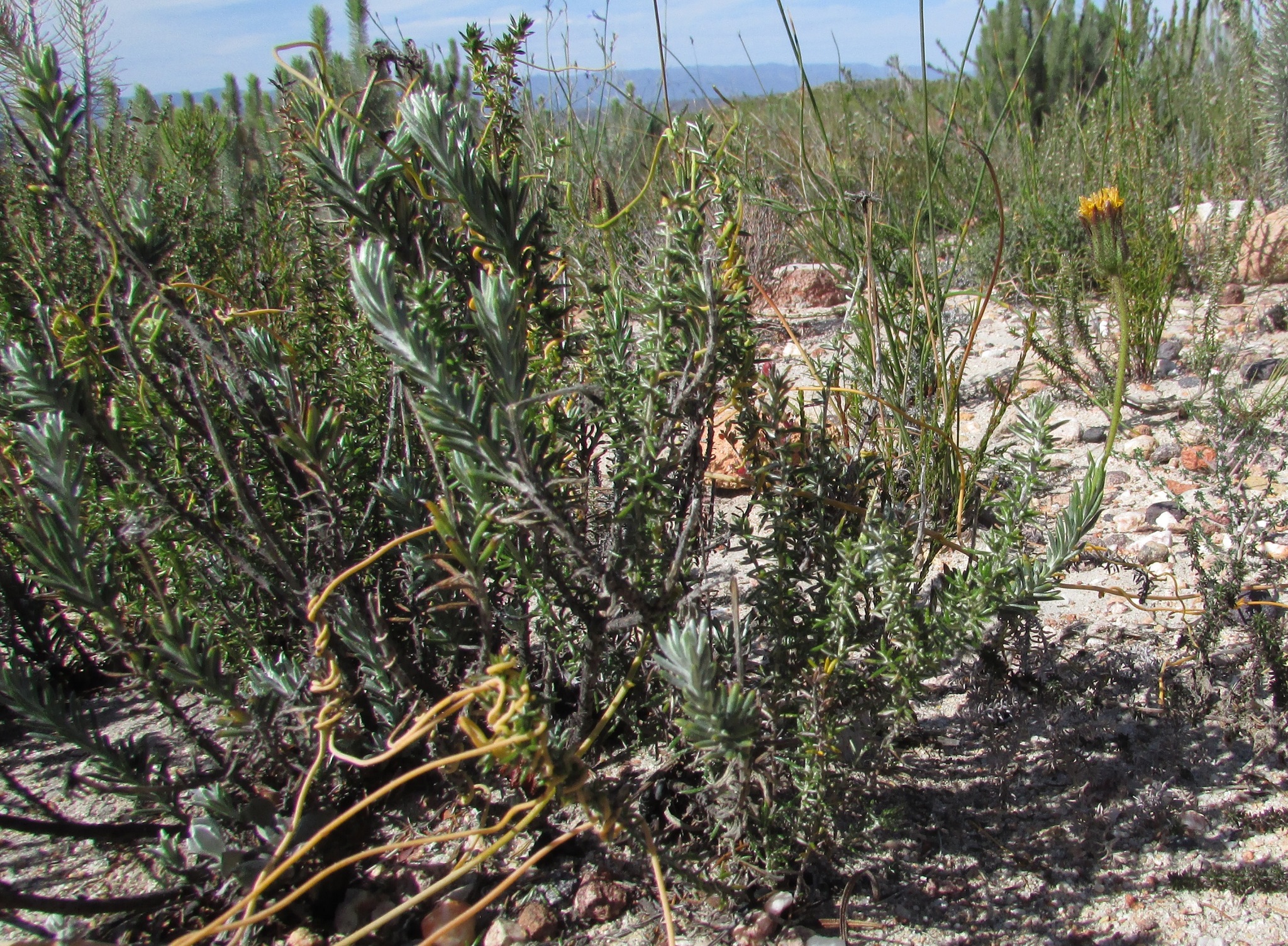
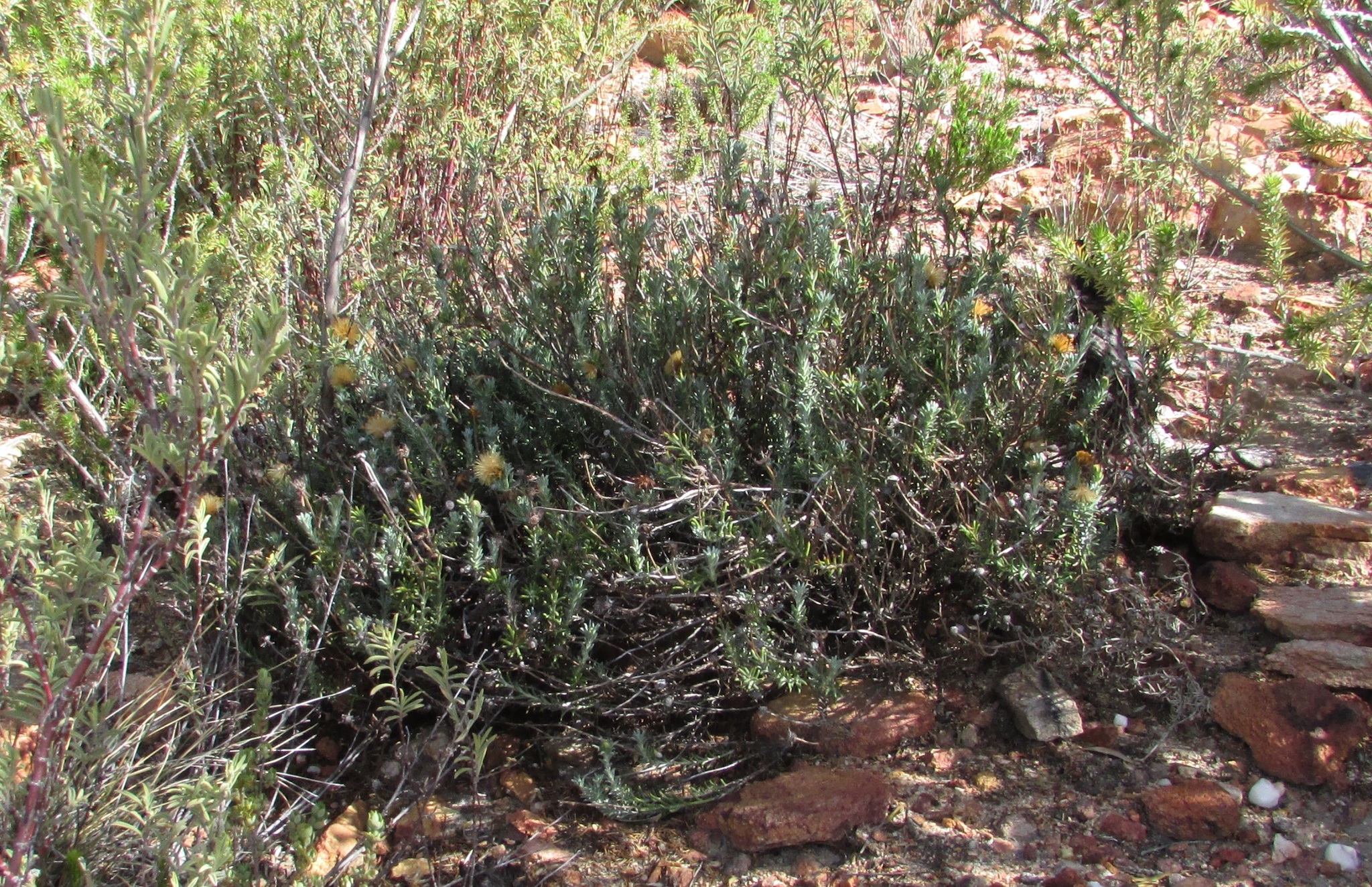
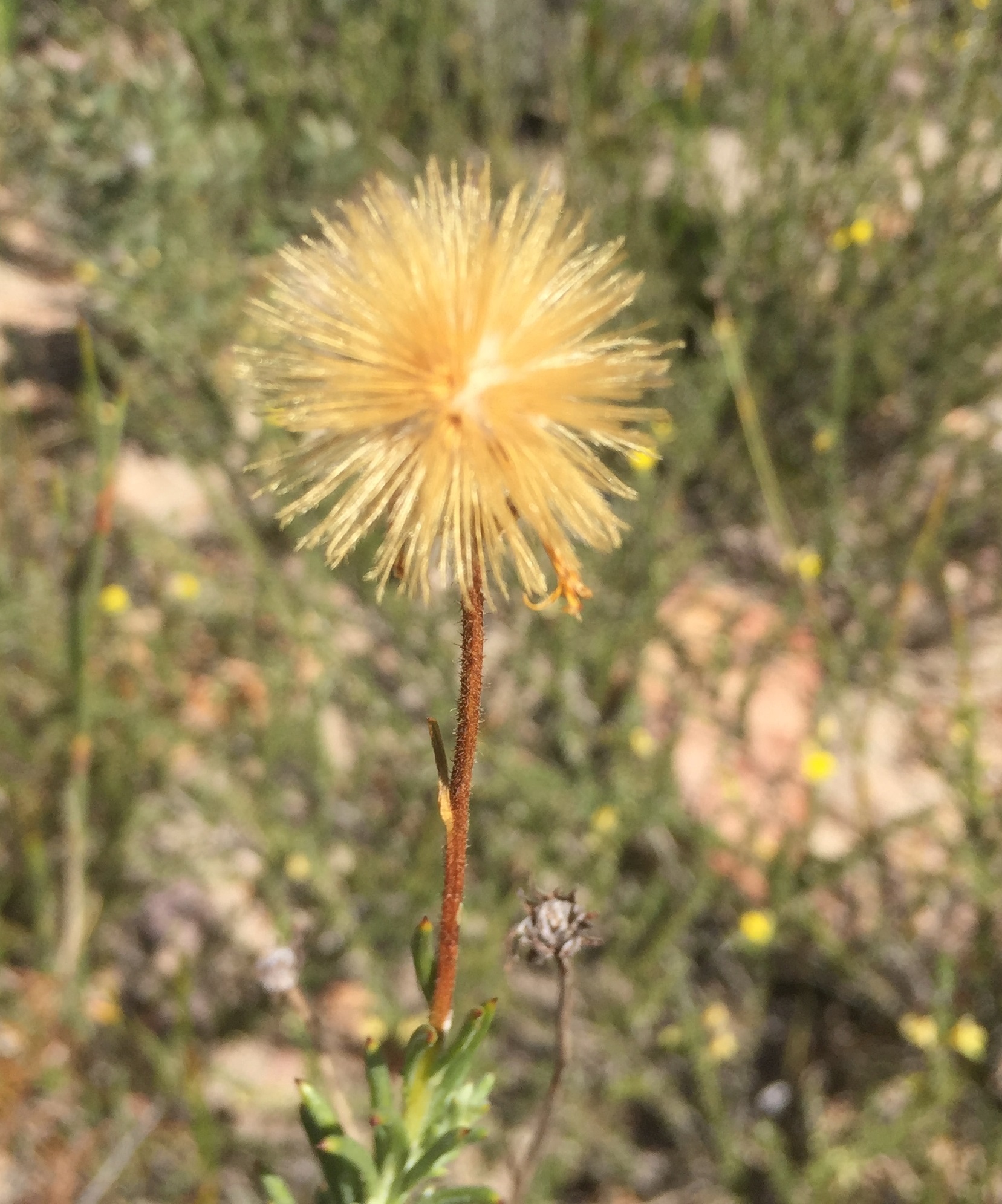
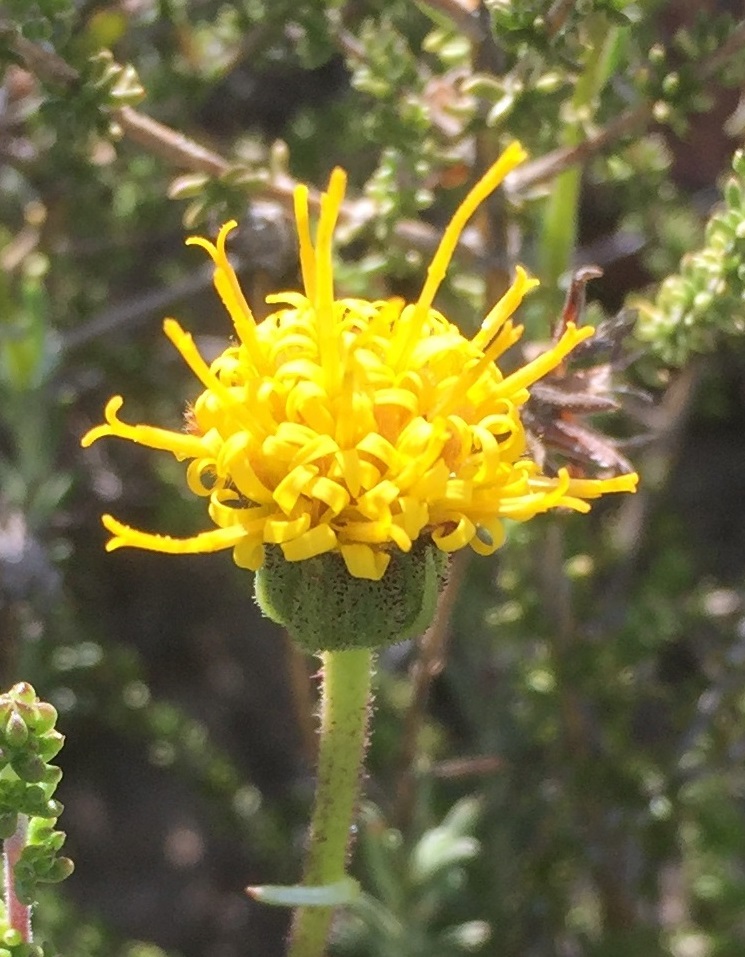
Habit: sparsely-branched, compact shrublet generally to about 0.3 m high. Stems: young stems densely white-woolly, older stems sparsely white-woolly with thin dark bark; longitudinally striate, eglandular. Leaves: most dense at the lower ends of the branches, densely imbricate, erect, linear, terete, 8-18 x 0.9-1.5 mm, not becoming shorter acropetally, sessile, apex shortly mucronate, thickened and leathery, margins strongly revolute and very sparsely dentate with only (0-)1-3 tubercle-like teeth per leaf, adaxially sparsely white-woolly when young, becoming glabrous, mid-rib visible on adaxial surface, abaxial leaf surface densely white-tomentose except on green midrib, but this surface mostly obscured by the revolute margins. Peduncle: 25-110 mm long when mature, elongating rapidly on floral maturation, bearing one or two leaflike bracteoles, not woolly or only sparsely so, reddish-brown, faintly striate and densely invested with very fine to stout trichomes of type A. Capitula: discoid, in pressed specimens mature heads are 20-25 mm in diameter, containing about 20 florets (21 in Bohnen 9129). involucre: 7-15 mm across, fleshy portion of bract covered with large, conical, reddish-brown or pale trichomes (type A), outermost bracts narrowly deltoid-lanceolate, free portion 6-9 x 1.0-1.2 mm, densely glandular-scabrid; innermost bracts lacking trichomes, with free portion 10-13 x 2.0-4.0 mm. Receptacle: alveole margins with irregular, very shallow projections. Disc florets: pale yellow, 9-10 mm long, tube sparsely glandular with type B trichomes, corolla lobes broadly acute, 3 mm in length, margins with a dark outline. Style apex slightly thickened at tuft of sweeping-hairs; stigmatic branches short, apices truncate to very slightly cleft. Apical anther appendages short, deltoid; anther bases with acute tails about 0.8 mm long. Pappus: of approximately 18-22 robust, brittle, cartilaginous straw-coloured bristle-like scales, free; inner series ± 8 mm long, slightly shorter than the corolla (coming to about halfway up the corolla lobes), outer series ± 6 mm long. Individual pappus bristles of both series widened near base (to about 0.4 mm wide), tapering towards apex. Bristle margins plumose, plumes golden-straw coloured, upwardly-directed. Cypsela: twin-hairs straw- coloured or reddish-brown. Flowering time: the five collections of this species are mostly from different months: three in late summer / early winter (March and April) and two in early to mid-summer (October and December). From: Bergh, NG; McKenzie, RJ. 2016. A revision of Heterolepis Cass. (Asteraceae: Cichorioideae). S. African J. Bot. 105: 194-210. [http://dx.doi.org/10.1016/j.sajb.2015.12.004] [Copyright held by the South African Association of Botanists (2016); http://www.sciencedirect.com/science/journal/02546299] [CC BY]
Sprawling, closely leafy, thinly cobwebby shrublet to 30 cm, with woody rootstock. Leaves linear-needle-like, pungent, margins closely revolute and concealing lower surface, 10-15 mm long. Flower heads discoid, solitary on roughly hairy peduncles, yellow. From: Manning, JC; Goldblatt, P. 2012. Asteraceae: Heterolepis Cass. In: J Manning & P Goldblatt (eds), Plants of the Greater Cape Floristic Region 1: The Core Cape flora. Strelitzia 29: 389-389. South African National Biodiversity Institute, Pretoria. [CC BY]
Distinguished from all other species by its discoid heads. It is, however, most similar to H. peduncularis, and specimens in herbaria may be filed with the latter species. The black colour characteristic of the pappus bristles in H. aliena and H. mitis, and some specimens of H. peduncularis, was not observed in any specimens of H. anomala, which has instead distinctly pale pappus bristles and corolla lobes. The style-branch apices are unique in H. anomala, being truncate and slightly cleft, whereas in all other species the style-branch apices are rounded to broadly acute. From: Bergh, NG; McKenzie, RJ. 2016. A revision of Heterolepis Cass. (Asteraceae: Cichorioideae). S. African J. Bot. 105: 194-210. [http://dx.doi.org/10.1016/j.sajb.2015.12.004] [Copyright held by the South African Association of Botanists (2016); http://www.sciencedirect.com/science/journal/02546299] [CC BY]
Growing in arid fynbos on well-drained, often rocky Table Mountain Sandstone- derived soil. From: Bergh, NG; McKenzie, RJ. 2016. A revision of Heterolepis Cass. (Asteraceae: Cichorioideae). S. African J. Bot. 105: 194-210. [http://dx.doi.org/10.1016/j.sajb.2015.12.004] [Copyright held by the South African Association of Botanists (2016); http://www.sciencedirect.com/science/journal/02546299] [CC BY]
Dry N-facing sandstone slopes. From: Manning, JC; Goldblatt, P. 2012. Asteraceae: Heterolepis Cass. In: J Manning & P Goldblatt (eds), Plants of the Greater Cape Floristic Region 1: The Core Cape flora. Strelitzia 29: 389-389. South African National Biodiversity Institute, Pretoria. [CC BY]
Currently known only from the farms Muiskraal and Fisantefontein, on the northern foothills of the Langeberg near Garcia's Pass. From: Bergh, NG; McKenzie, RJ. 2016. A revision of Heterolepis Cass. (Asteraceae: Cichorioideae). S. African J. Bot. 105: 194-210. [http://dx.doi.org/10.1016/j.sajb.2015.12.004] [Copyright held by the South African Association of Botanists (2016); http://www.sciencedirect.com/science/journal/02546299] [CC BY]
Langeberg: Garcia's Pass. From: Manning, JC; Goldblatt, P. 2012. Asteraceae: Heterolepis Cass. In: J Manning & P Goldblatt (eds), Plants of the Greater Cape Floristic Region 1: The Core Cape flora. Strelitzia 29: 389-389. South African National Biodiversity Institute, Pretoria. [CC BY]
October to April
This map contains point-based occurrences at different locations
Occurrence in the Flora of Southern Africa (FSA) countries and South African provinces. Residence status indicates if a taxon is indigenous, endemic, naturalised or invasive in a specific region. This data is based on specimen records and literature
FSA
SA
BOT
NAM
ESW
LES
WC
EC
NC
FS
GA
KZN
LP
MP
NW
Absent
Indigenous
Endemic
Naturalised
Invasive

Names and Sources
Published in: Strelitzia 29: 795 (2012)
Classification
KINGDOM Plantae
SUBKINGDOM Phanerogamae
PHYLUM Anthophyta
ORDER Asterales
FAMILY Asteraceae
SUBFAMILY Cichorioideae
TRIBE Incertae Sedis
GENUS Heterolepis
SPECIES anomala
6 results for Heterolepis anomala J.C.Manning & Goldblatt
Barcode: NBG0277154-0 Collector(s) & number: Bohnen, P, 9129 | 1990-10-4
South Africa, Western Cape, Klein Karoo, Muiskraal. Voetheuwels van Langeberg.
General notes: Fynbos on TMS in well-drained, sandy loamy soil. Slightly skew N slope in full sun. Undisturbed. Shrub 300 mm leaves heath-like. Smooth inside woolly outside. Flowers rough. Single head with fuse flowers. Very long style. Rare.
Data Resource: BODATSA View record
Barcode: NBG1573969-0 Collector(s) & number: McKenzie, RJ, 3570 | 2019-11-5
South Africa, Western Cape, Riversdale, Muiskraal farm, northern end of Garcia's Pass.
Data Resource: BODATSA View record
Barcode: PRE0581116-0 Collector(s) & number: Vlok, JHJ, 2780 | 2000-4-7
South Africa, Western Cape, Riversdale. On Fisantefontein Farm, on lower Northern slopes of Langeberg.
General notes: Arid Fynbos. Soil. Well-drained. Rocky, sand. Sandstone. Full sun. N aspect. Gentle slope. Prostrate shrublet, 0.30 m tall, resprouting after fire. Flowers yellow. Occasional.
Data Resource: BODATSA View record
Barcode: NBG0277155-0 Collector(s) & number: Bohnen, P, 8769 | 1987-3-7
South Africa, Western Cape, Muiskraal farm. North foothills from Langeberg, op T.M.S.
General notes: Shrubs 250 mm high. Hairy bracts. Yellow tube flowers.
Data Resource: BODATSA View record
Barcode: PRE0183390-0 Collector(s) & number: Acocks, JPH, 2285 | 1938-12-8
South Africa, Western Cape, GARCIA'S PASS; NORTH END OF PASS
Data Resource: BODATSA View record
This map contains point-based occurrences at different locations
2016
PERIODICAL/JOURNAL
A revision of Heterolepis Cass. (Asteraceae: Cichorioideae) Bergh, NG; McKenzie, RJSouth African Journal of Botany 105: 194-210
2012
SERIES CHAPTER
Asteraceae: Heterolepis Cass. Manning, JC; Goldblatt, PIn: J Manning & P Goldblatt (eds), Plants of the Greater Cape Floristic Region 1: The Core Cape flora. Strelitzia 29: 389-389
South African National Biodiversity Institute, Pretoria
No results found for Heterolepis anomala J.C.Manning & Goldblatt
Status and criteria
VU
Assessor(s)
Plantae Coordinator
| Part(s) of plant used | Use(s) | Reference |
|---|
Coming soon...


