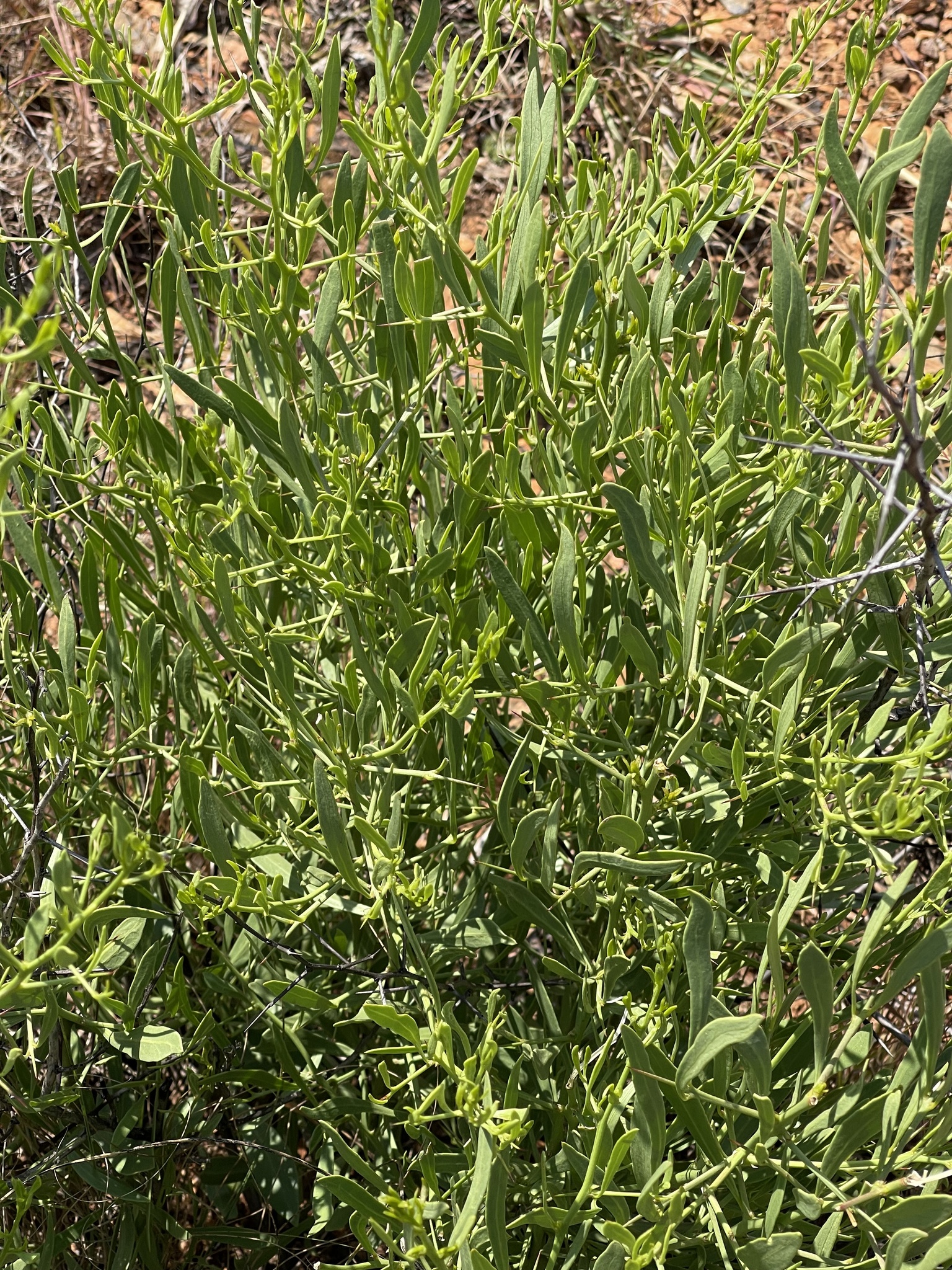
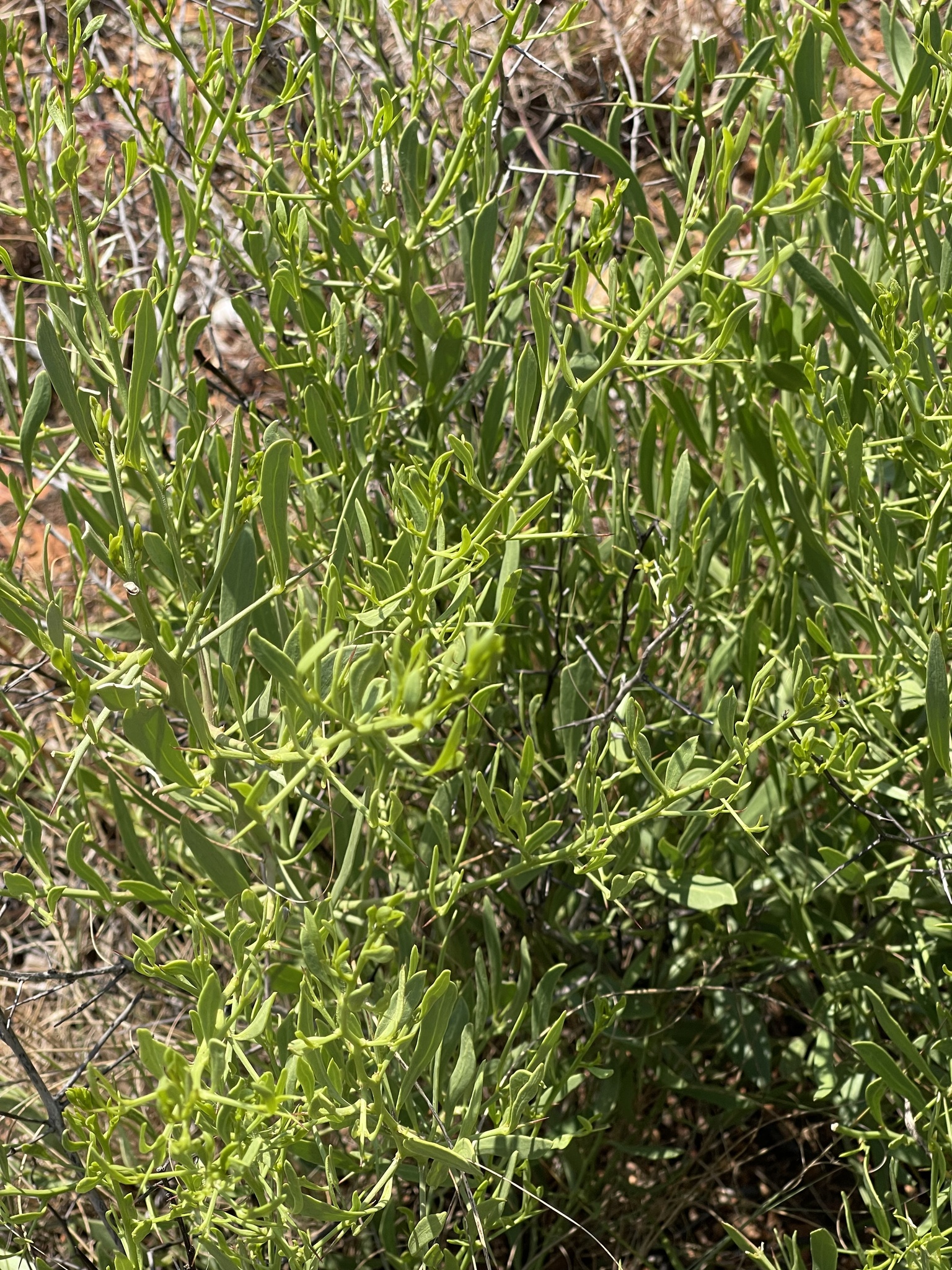
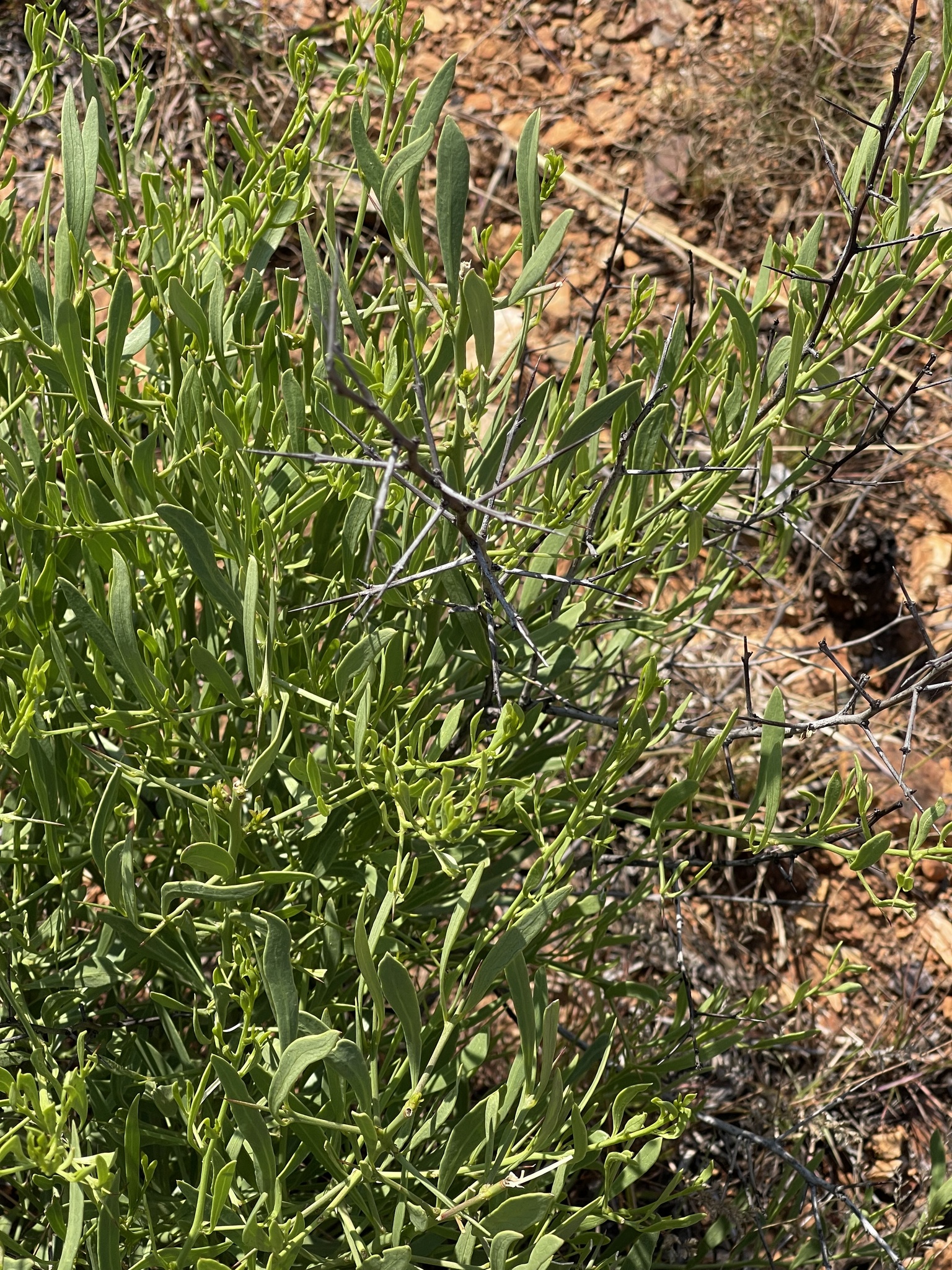
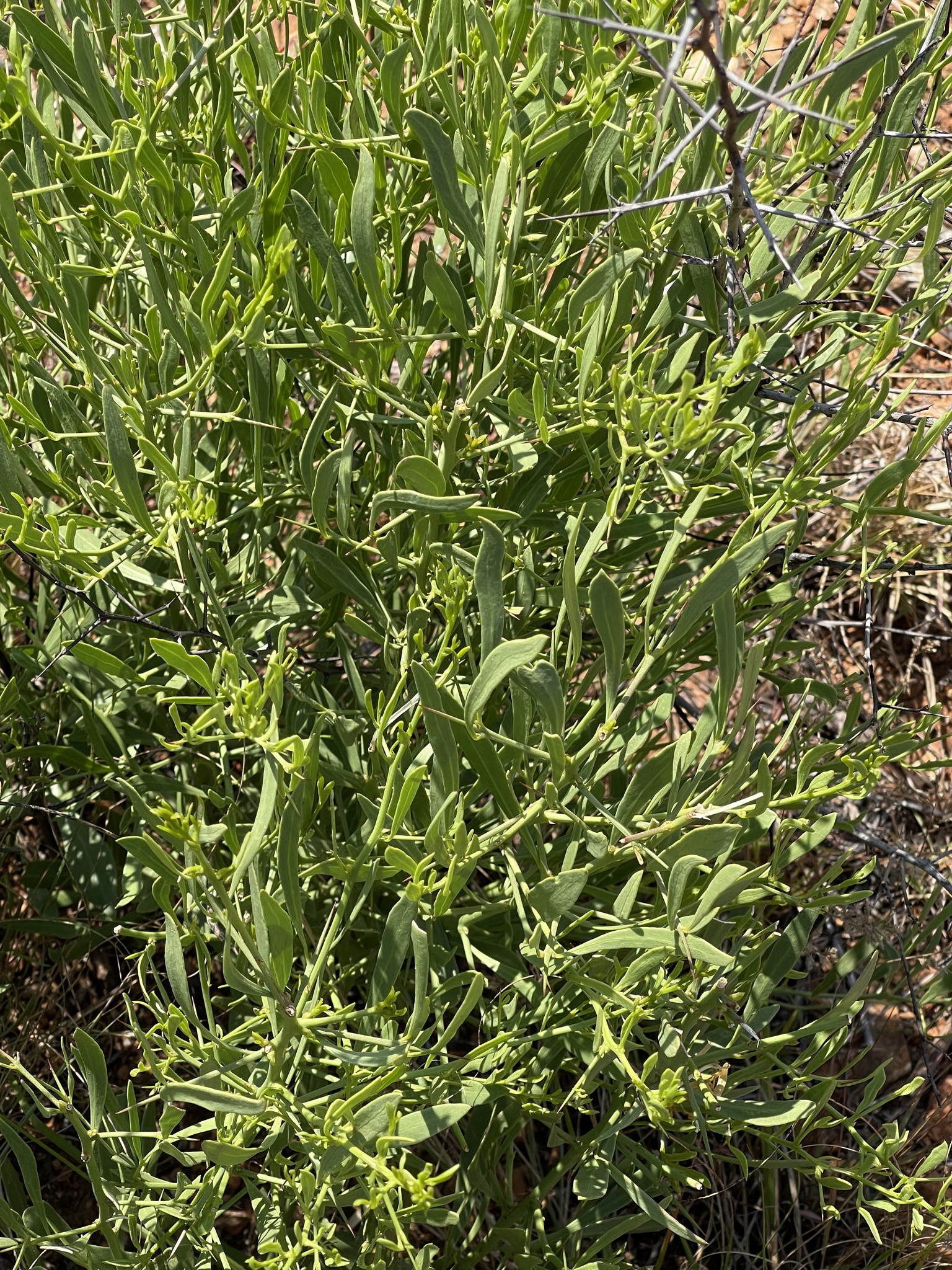
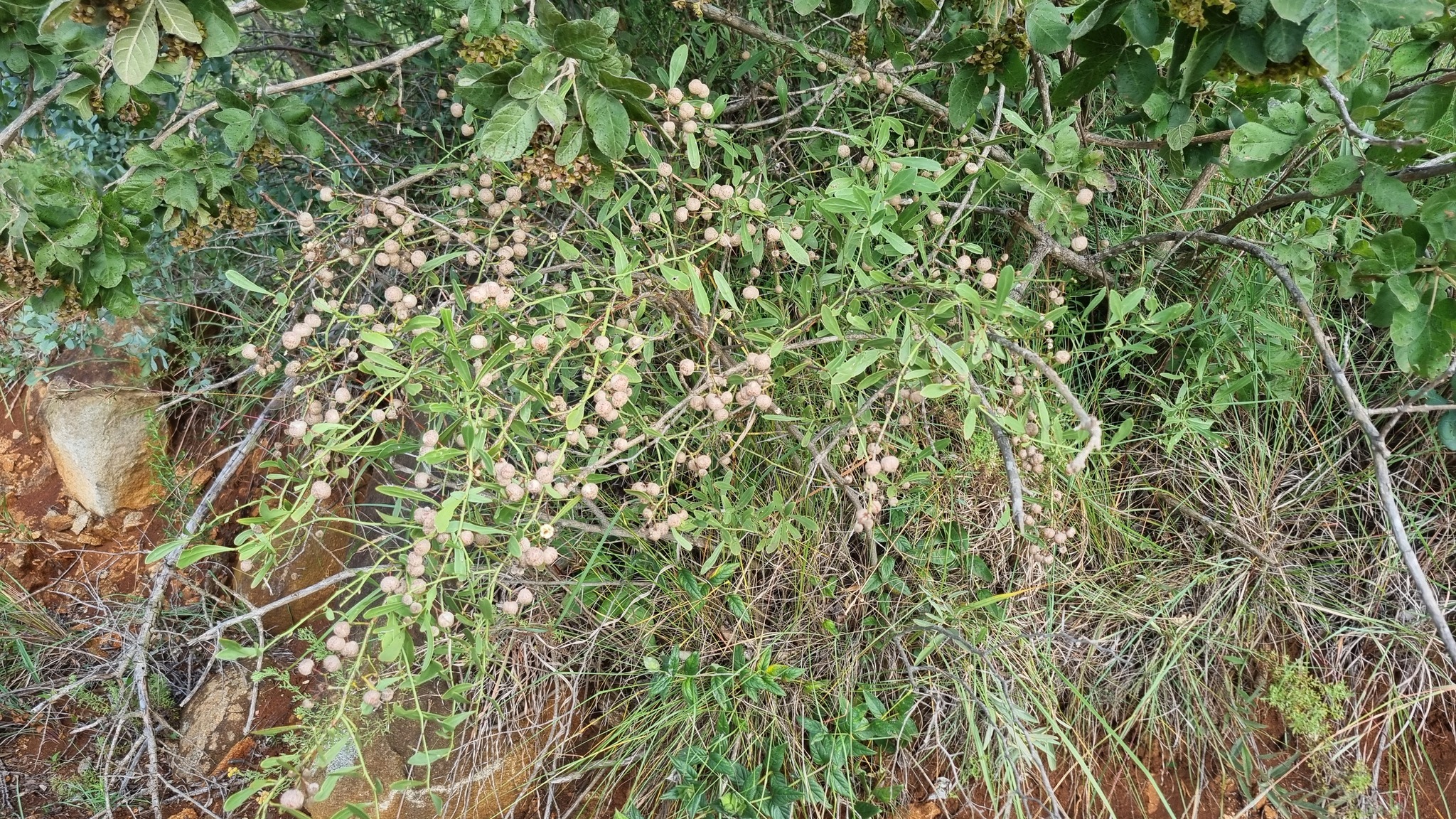
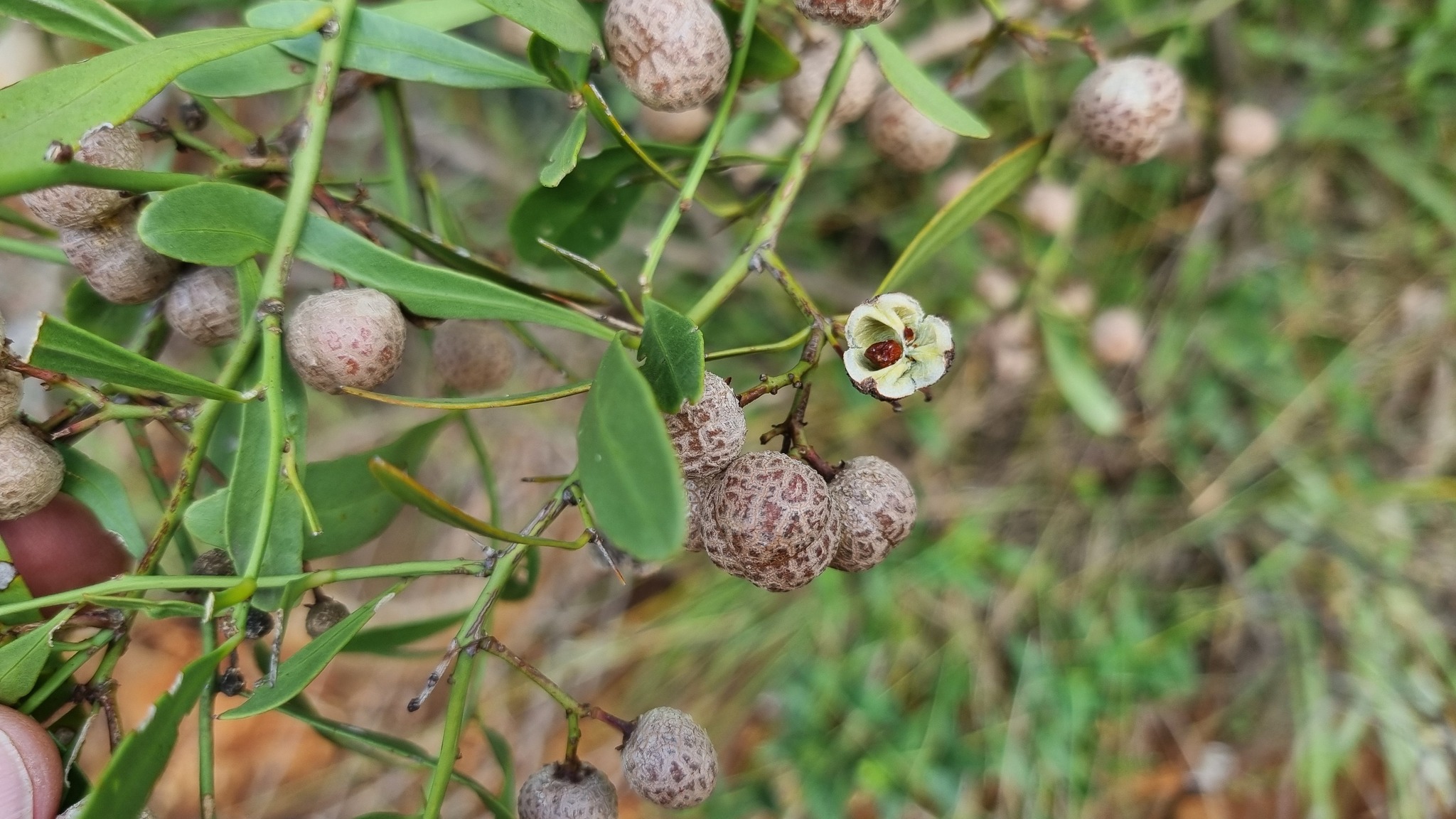
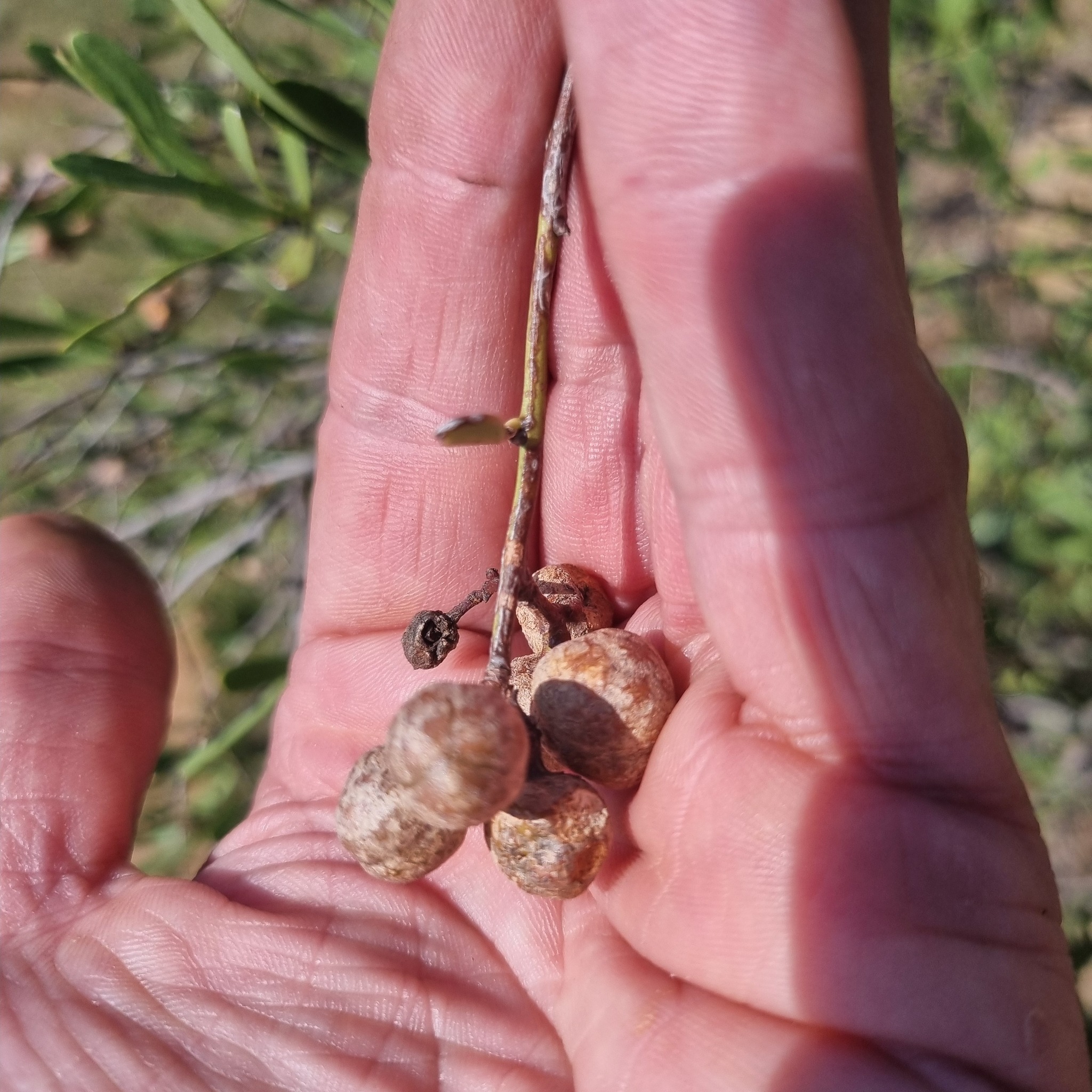
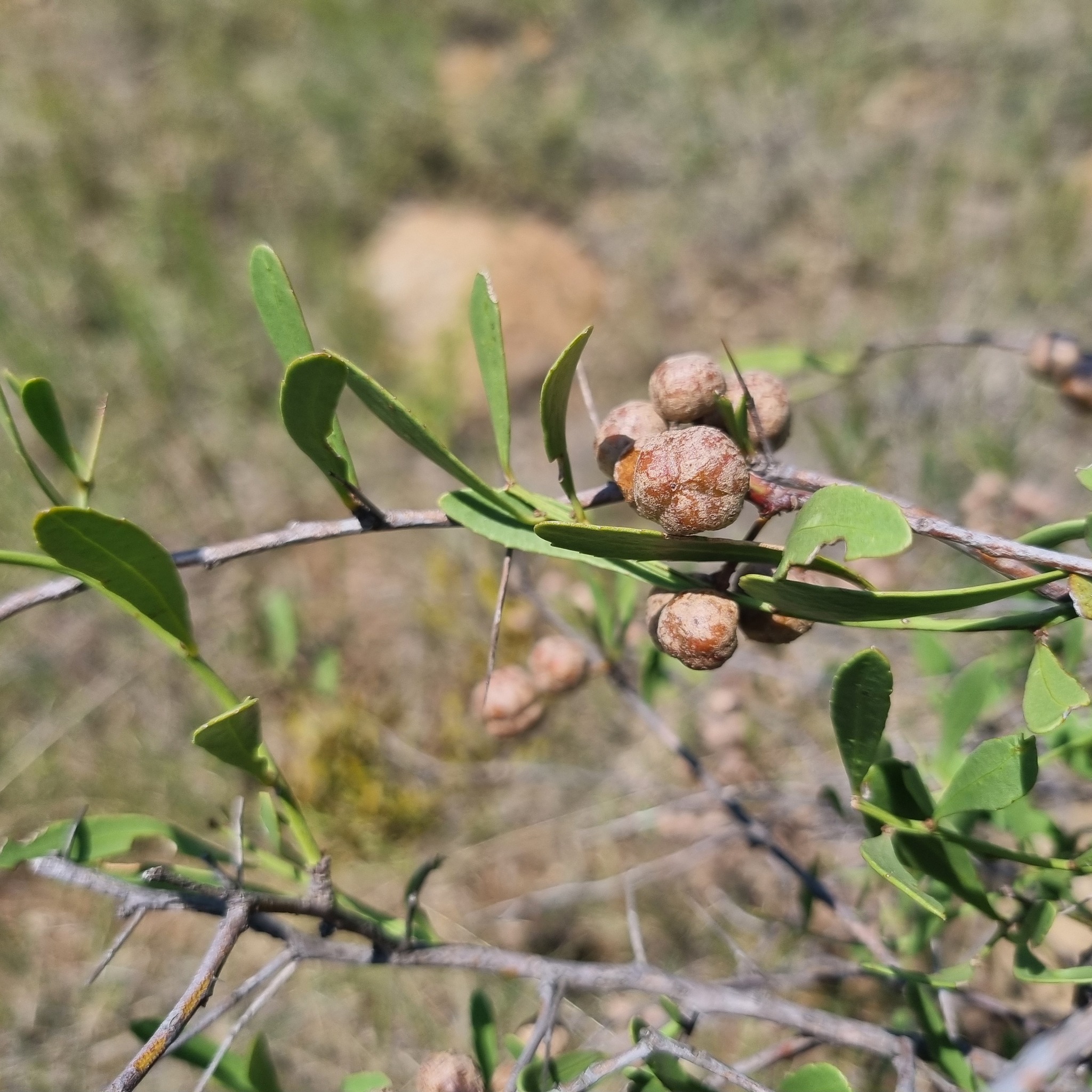
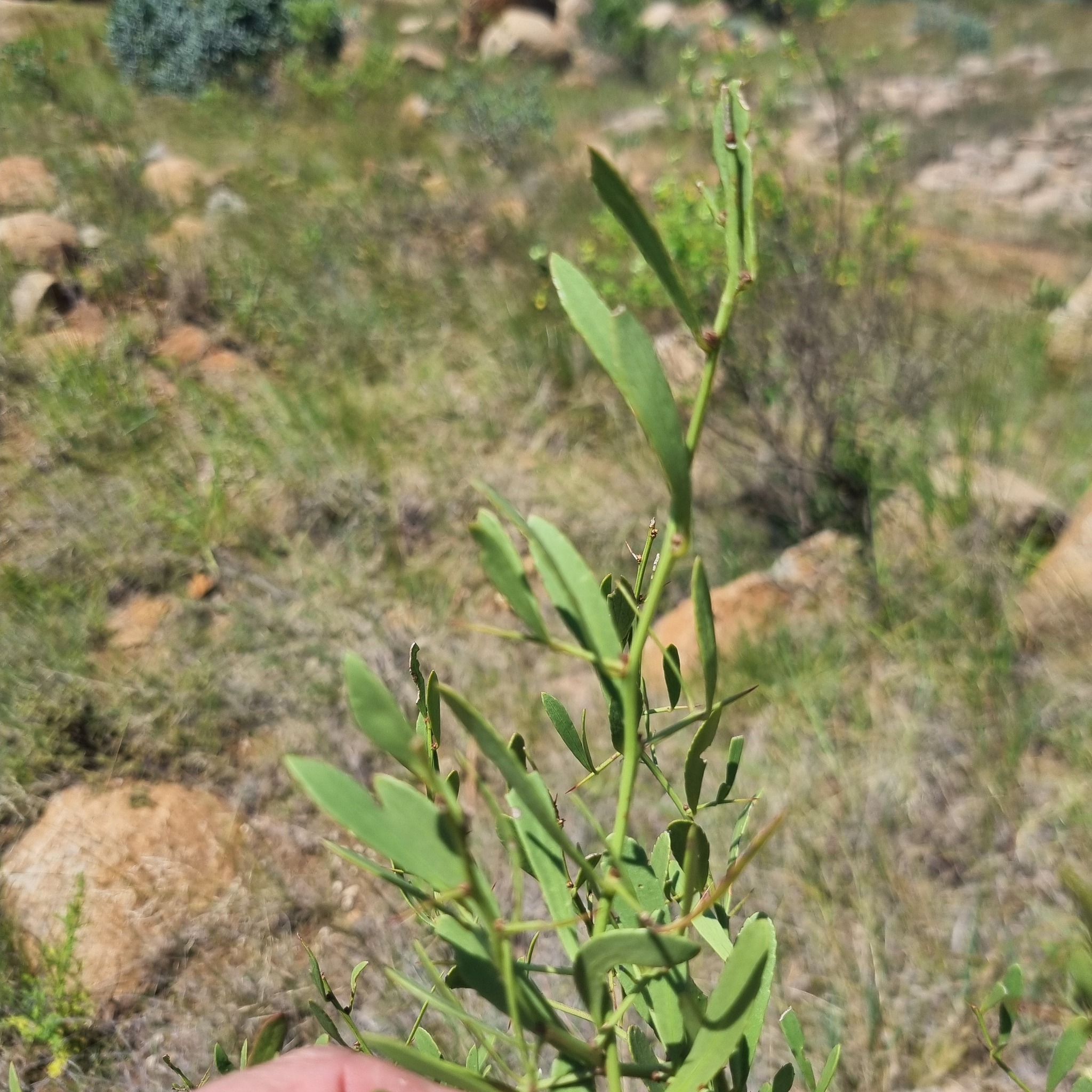
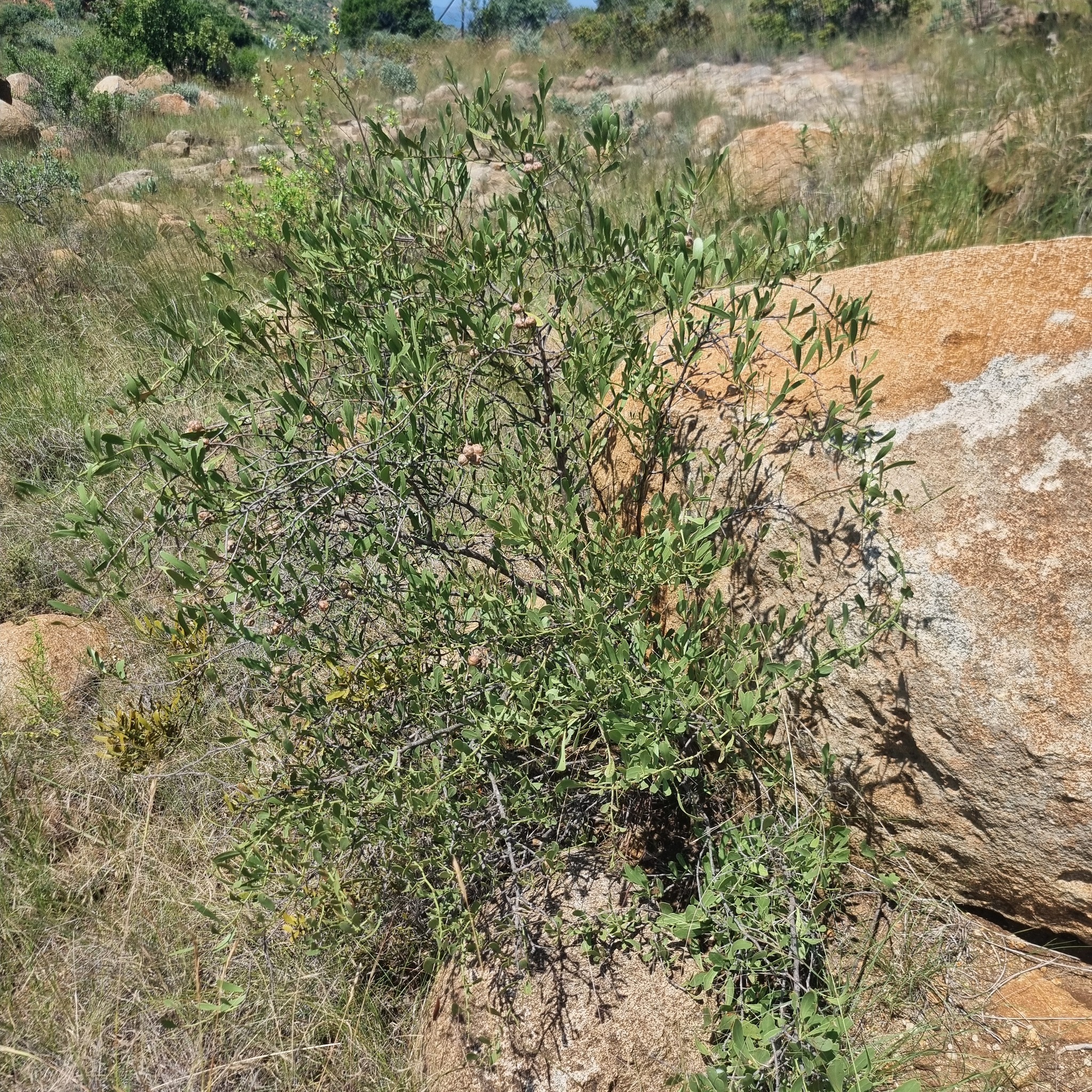
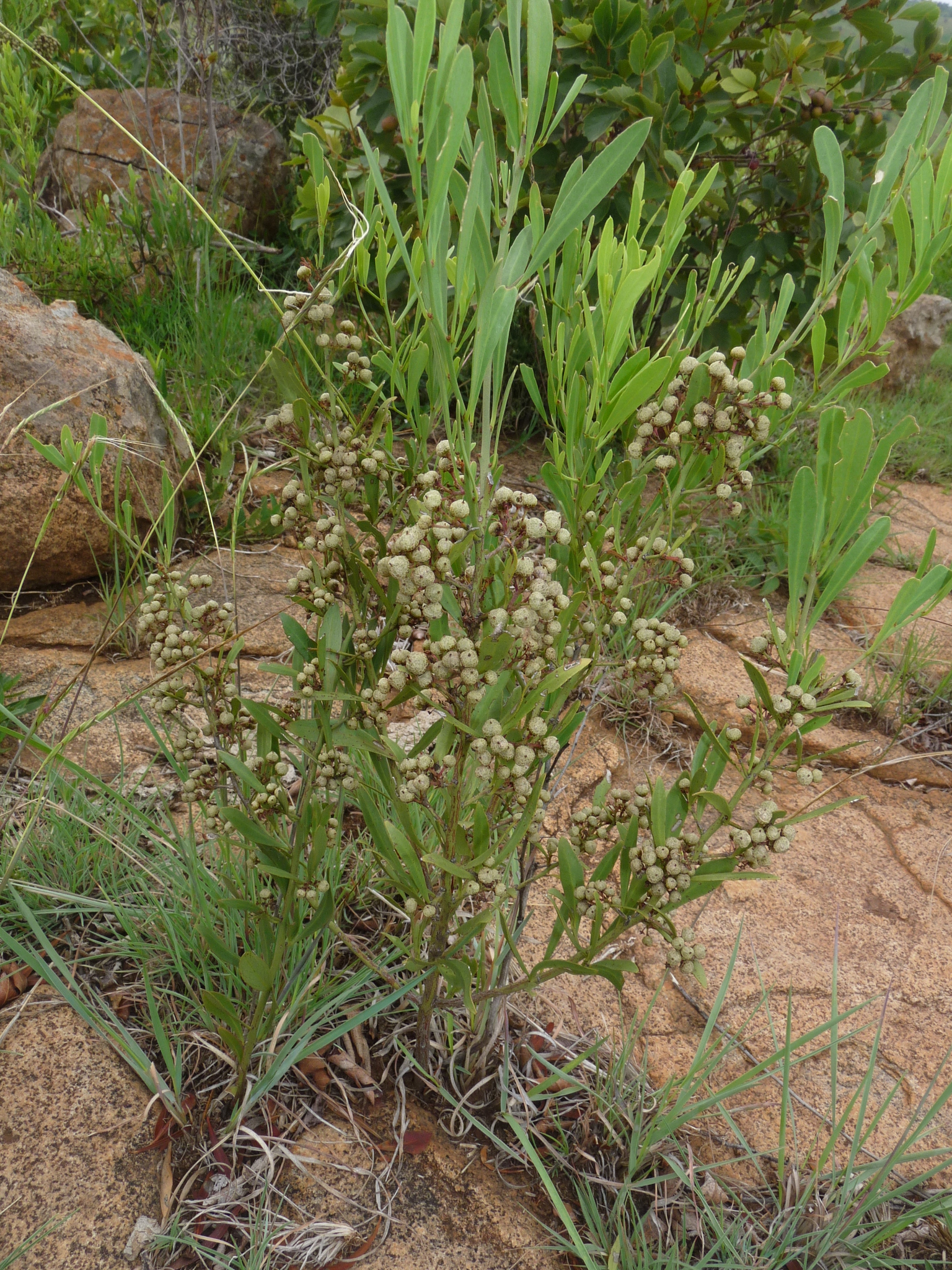
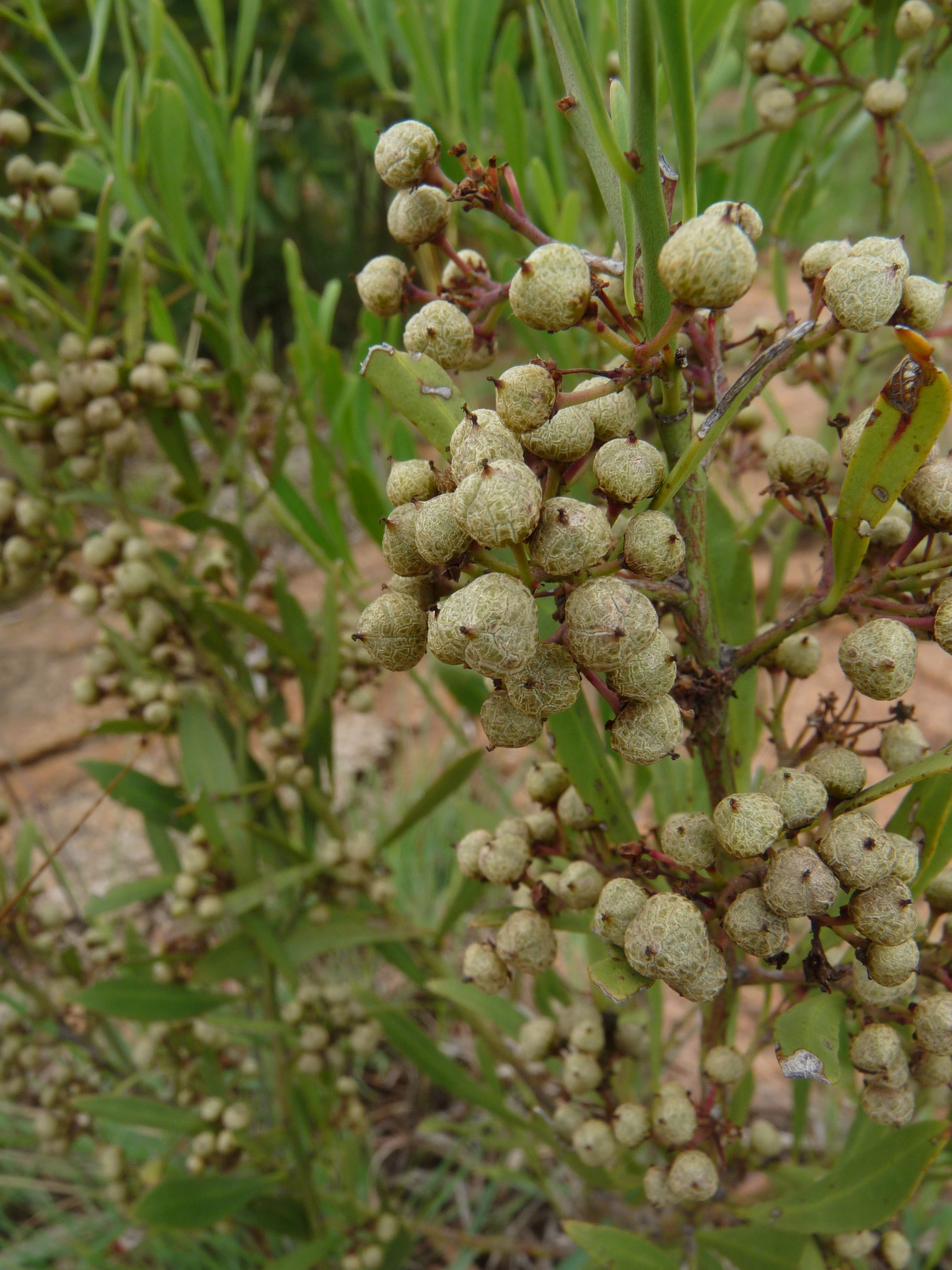
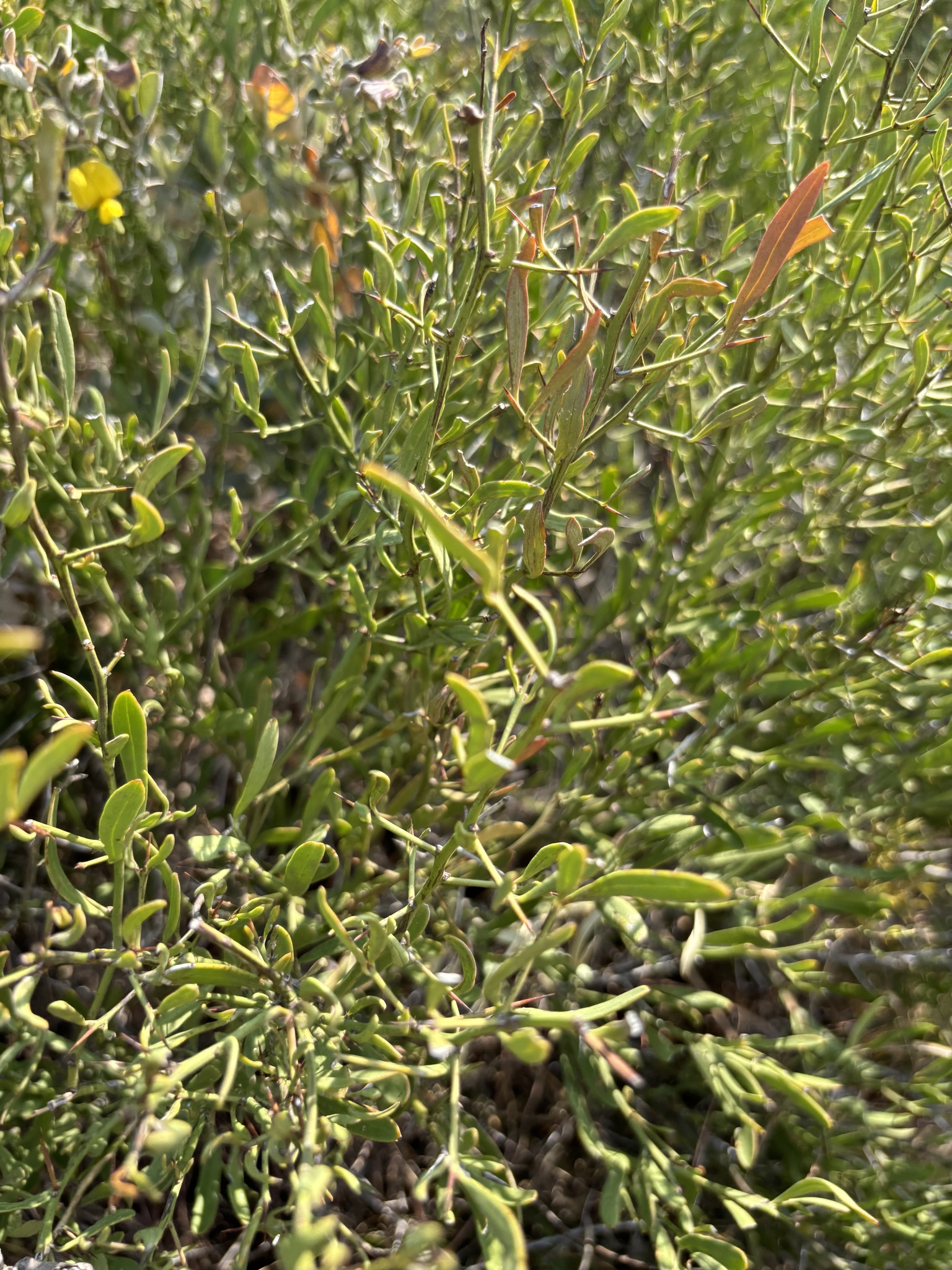
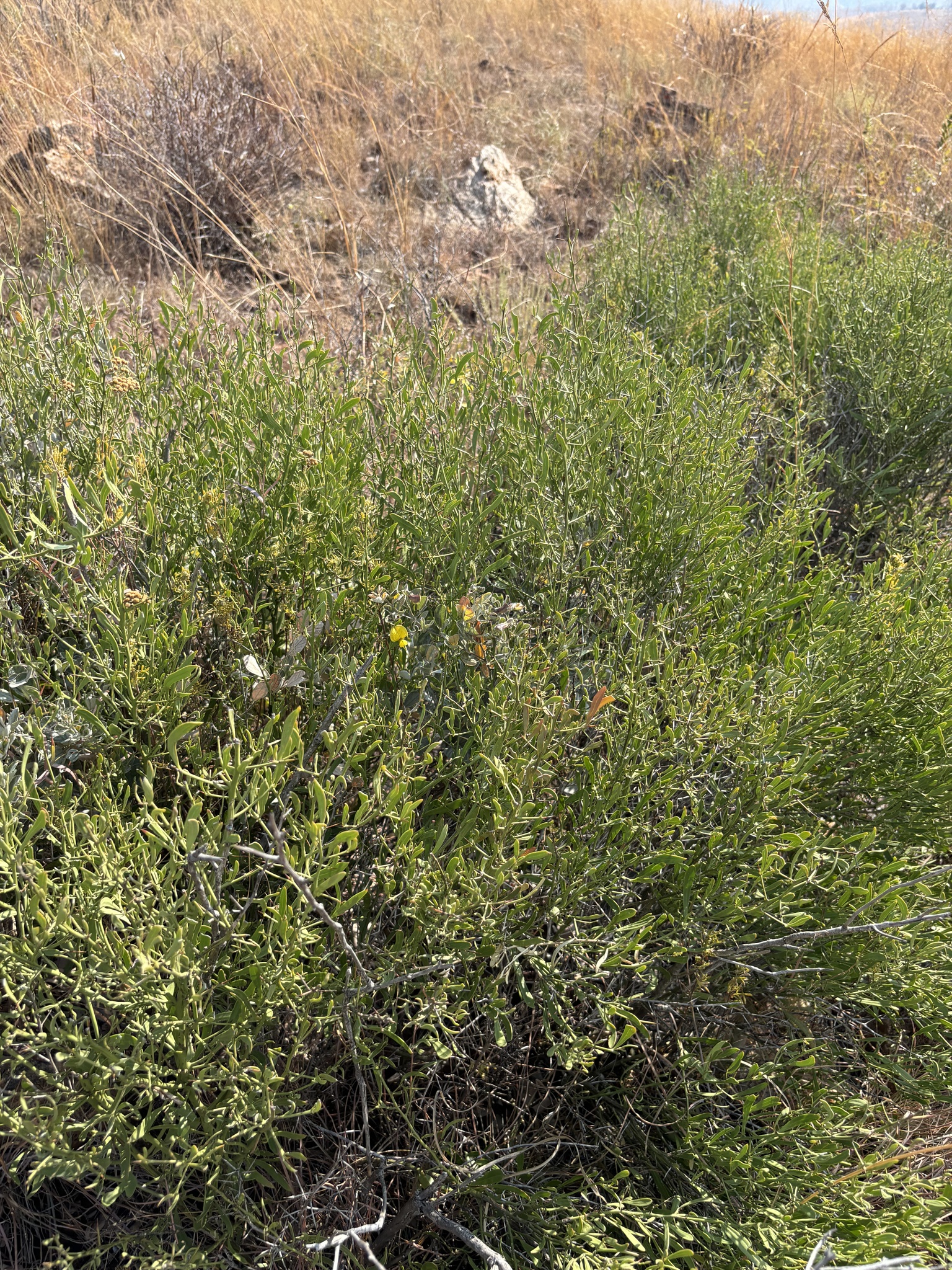
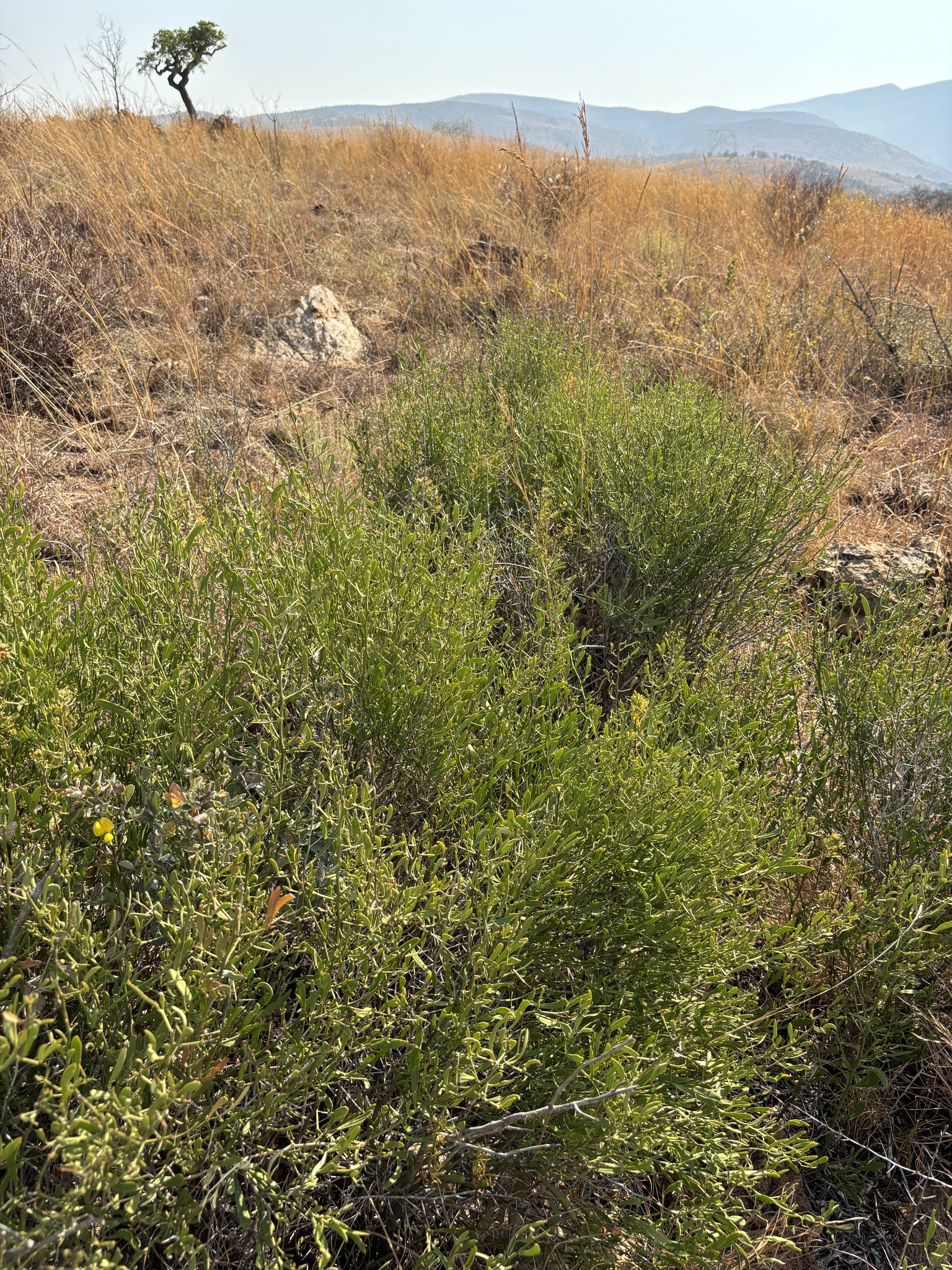
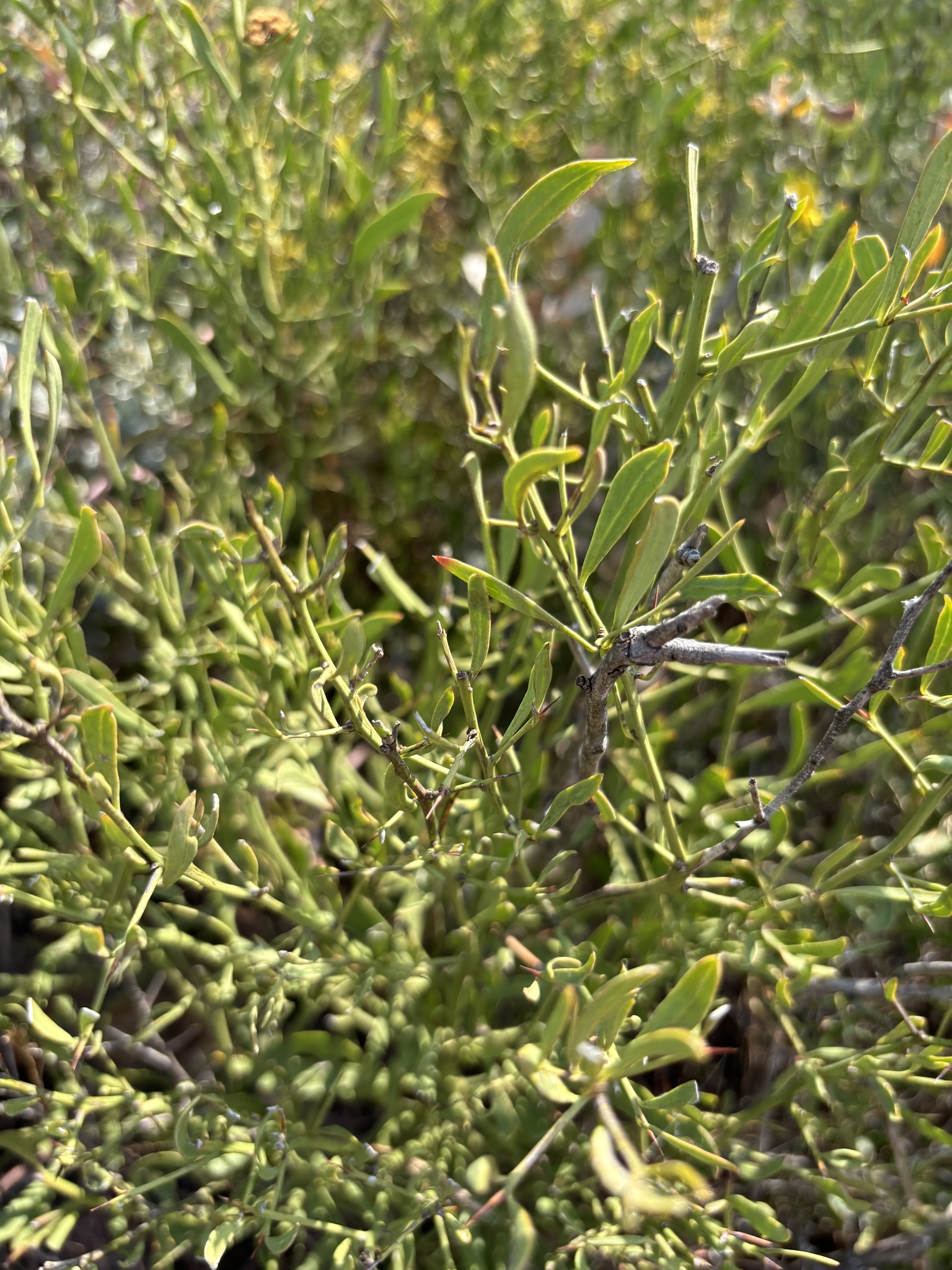
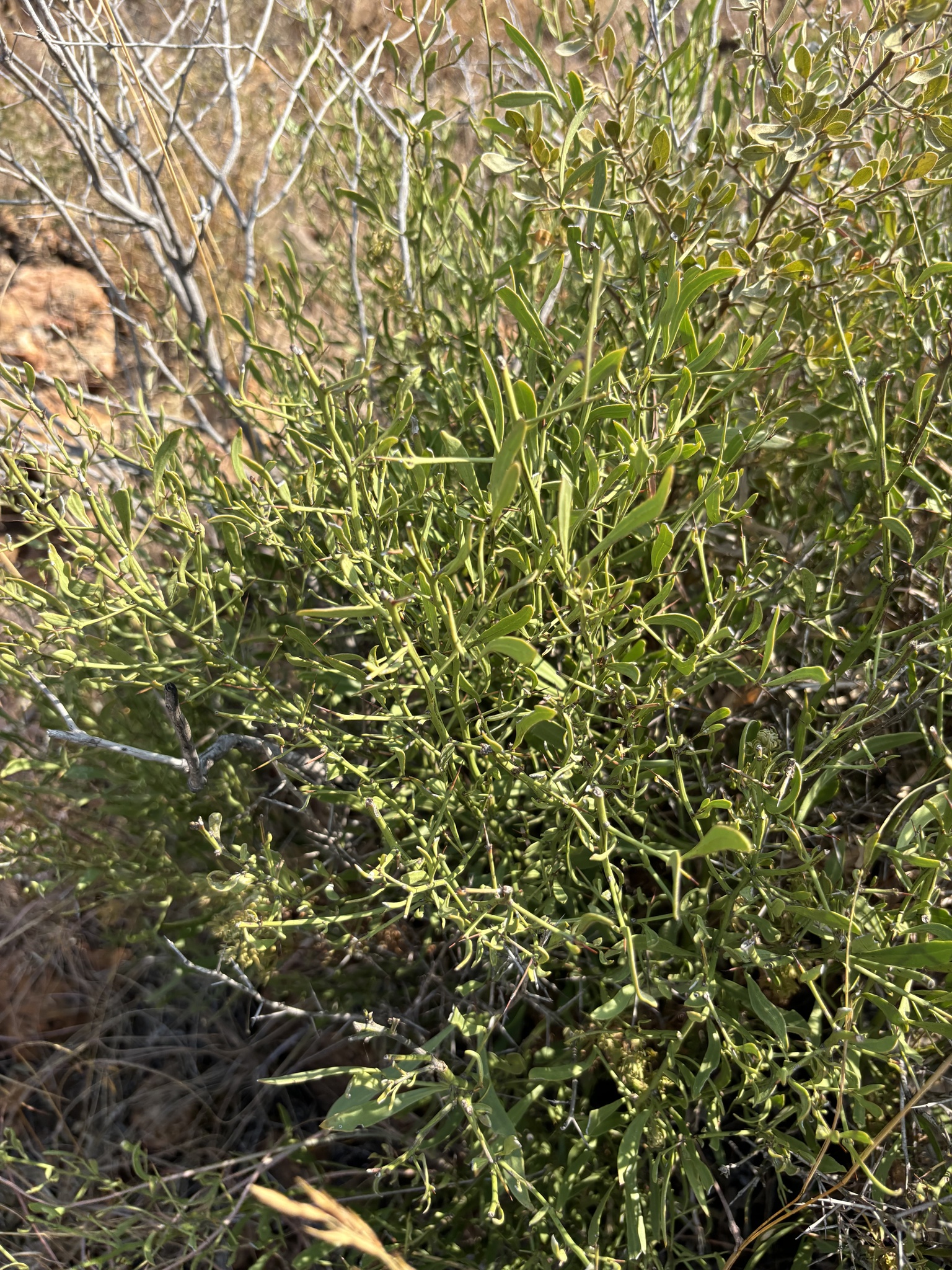
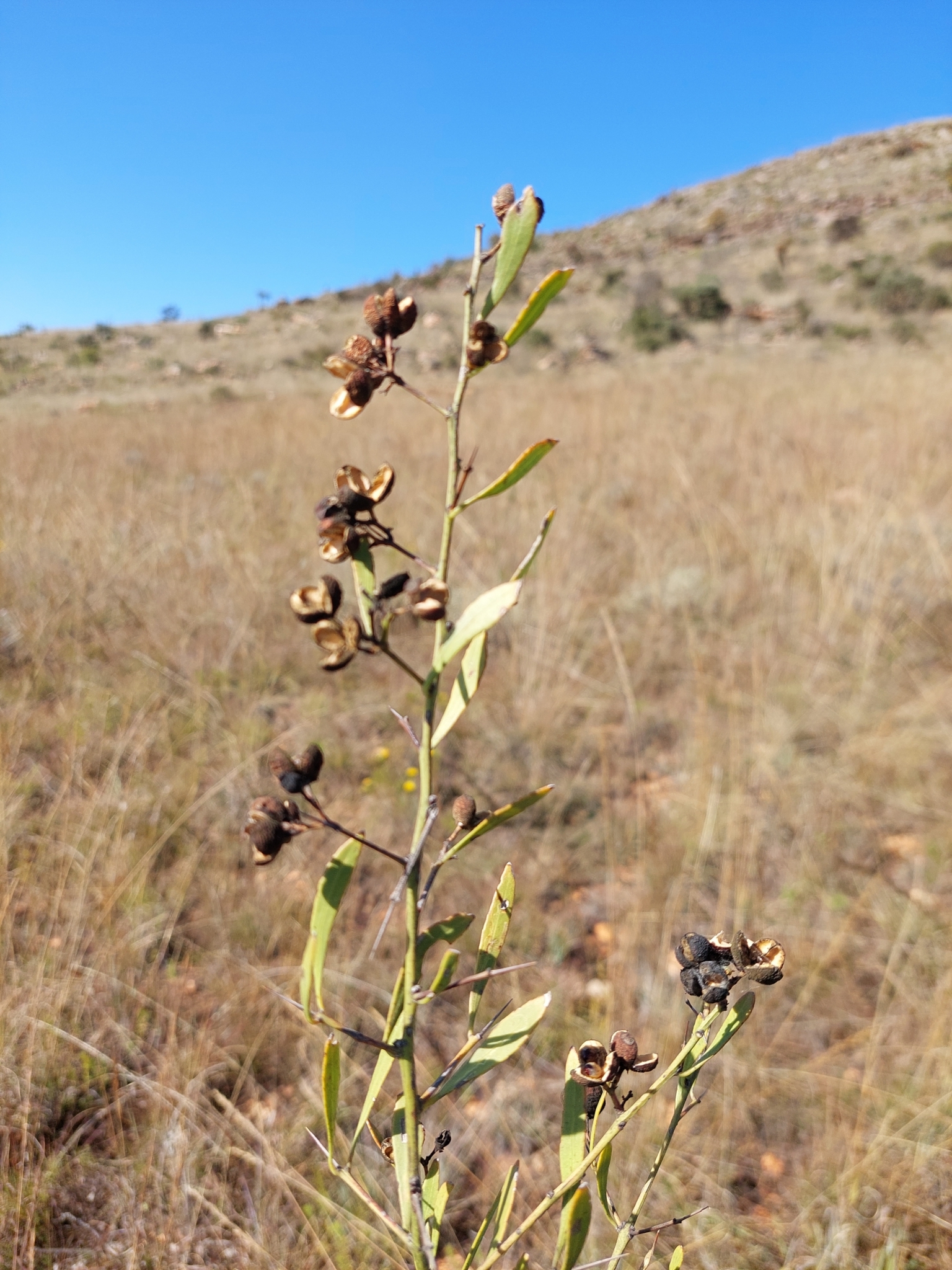
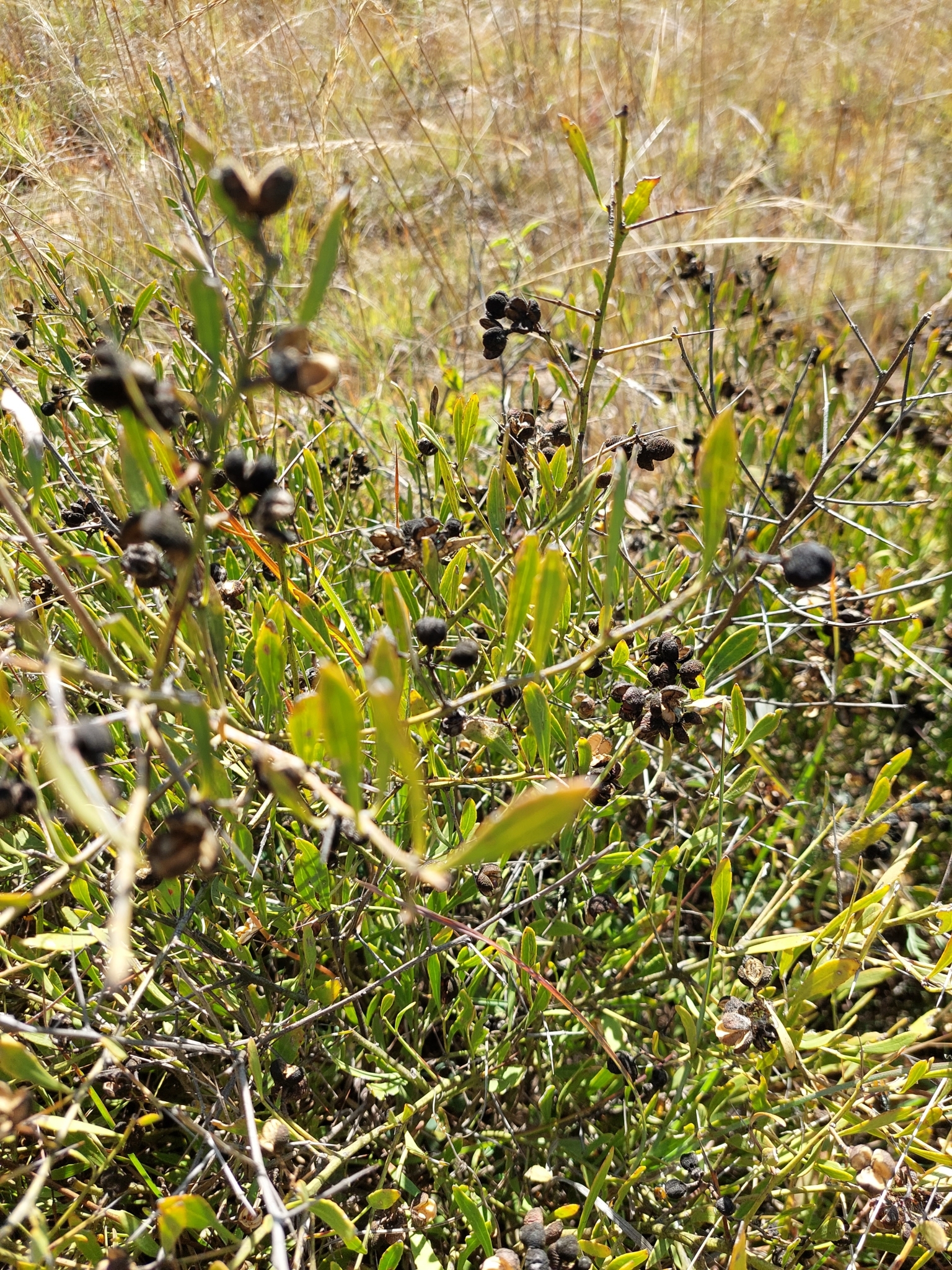
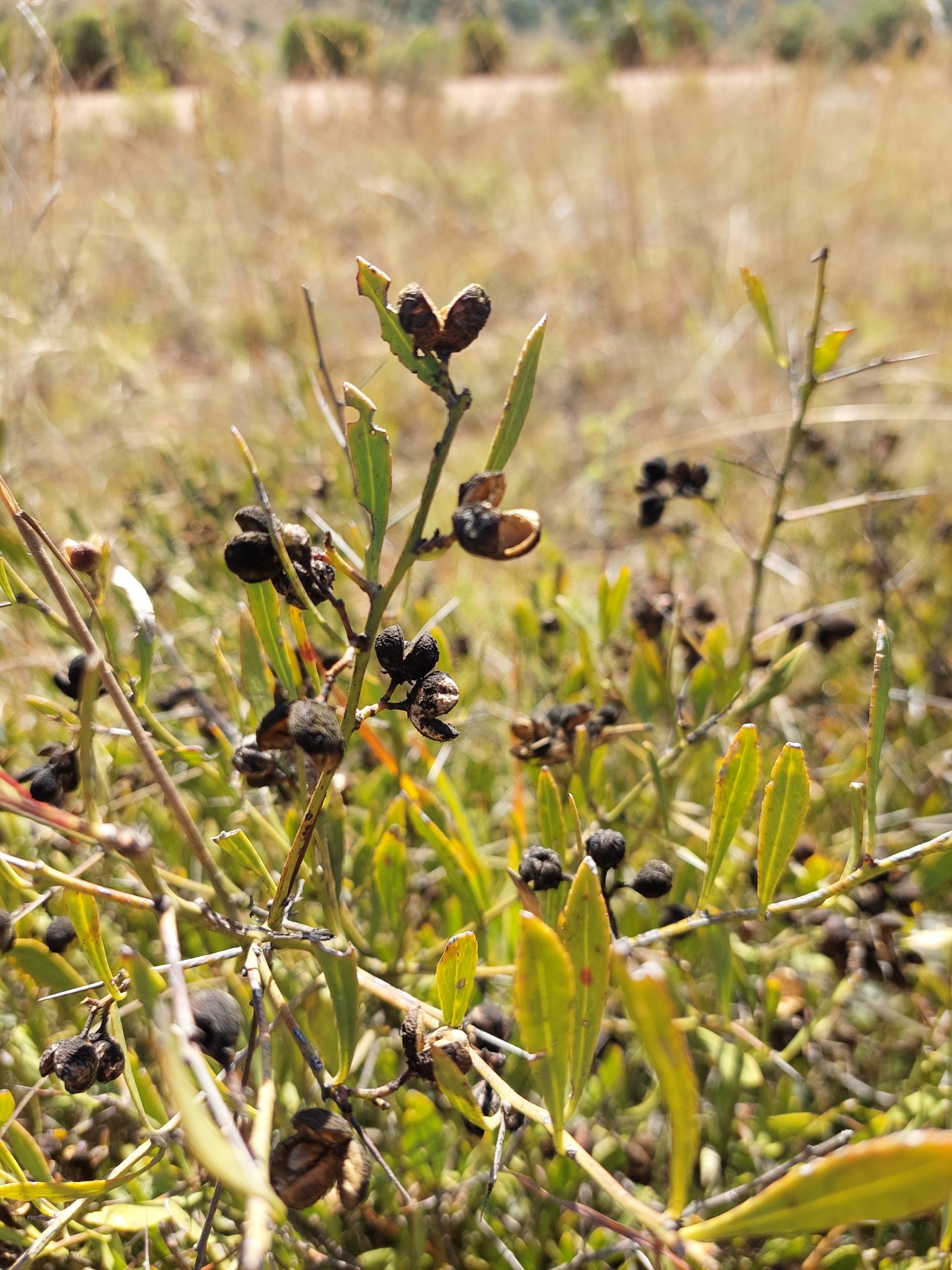
Slender dioecious suffrutex up to 1.6 m tall, usually smaller, multi-stemmed, few-branched, glabrous; branchlets green to reddish brown, angular-ribbed. Thorns few, slender, up to 30 mm long, often leafy. Leaves alternate or fasciculate, laxly arranged on stems, coriaceous, yellowish green; lamina linear to elliptic-linear, to narrowly oblanceolate, (20-)30-50(-75) x 3-7(-12) mm, apex acute or rounded to emarginate, base narrowly cuneate, margins serrate in distal half, otherwise entire, venation obscure; petiole very short, ±1 mm long. Inflorescences axillary, usually shorter than leaves; peduncles up to 4 mm long; bracts ±1 mm long, margin fimbriate. Flowers few per cyme, creamy white, ±5 mm in diam.; pedicels up to 5 mm long. Sepals ovate, ±1 mm long, with ciliolate margins. Petals oblong, ±3 mm long, margin uneven. Disc a narrow rim, wavy, 5-lobed. Male flowers: filaments ±2 mm long; pistillode short; style unbranched, ±0.5 mm long. Female flowers: staminodes shorter than stamens in male flowers; ovary 3-locular; style 3-branched, ±1.5 mm long. Capsules globose, 5-8 mm long, 3-valved, rugose, coriaceous, with apices apiculate, pale brownish. Seeds golden brown; aril pale yellow, partially covering the seed. From: Jordaan, M; Van Wyk, AE. 2019. Gymnosporia sekhukhuniensis (Celastraceae), a new species from South Africa. Phytotaxa 408(1): 69-76. [https://doi.org/10.11646/phytotaxa.408.1.5]
Gymnosporia sekhukhuniensis belongs to G. section Buxifoliae Group 1, for which an identification key to the members is supplied below. It has the same type of capsules and seed as in G. buxifolia, G. elliptica (Thunberg) Schonland, G. grandifolia (Davison) Jordaan, G. heterophylla and G. macrocarpa Jordaan, namely, brown or reddish brown and rugose, dehiscing into three parts and with the yellow aril partially covering the seed. Gymnosporia buxifolia is mainly a multi-stemmed shrub or tree and its capsules are relatively small, 2-5 mm long, whereas G. sekhukhuniensis is a dwarf shrub and has capsules longer than 5 mm. The new species differs from G. heterophylla in its leaves which are few and very laxly arranged on the stems, usually longer than 30 mm and often also present on the thorns. Gymnosporia heterophylla is a densely, stiffly branched shrub, often branched in the upper half, with dense foliage, the leaves usually less than 30 mm long, usually with the leaves larger proximally and gradually becoming smaller distally. Gymnosporia macrocarpa, confined to central KwaZulu-Natal (notably the Thugela River Valley), also has rugose capsules, but these are relatively large (12-15 mm long), thick and woody, sometimes dehiscing into four parts. Gymnosporia elliptica is a geoxylic suffrutex confined to coastal grassy fynbos in the Eastern Cape. Gymnosporia grandifolia is a forest tree with thick, woody capsules, usually longer than 8 mm, occurring from the Soutpansberg range in Limpopo, south-eastwards through Mpumalanga, Eswatini and KwaZulu-Natal to as far south as East London in the Eastern Cape. From: Jordaan, M; Van Wyk, AE. 2019. Gymnosporia sekhukhuniensis (Celastraceae), a new species from South Africa. Phytotaxa 408(1): 69-76. [https://doi.org/10.11646/phytotaxa.408.1.5]
The core area of the Sekhukhuneland Centre of Endemism is more or less congruent with surface outcrops of the Rustenburg Layered Suite, one of the stratigraphic units of the eastern Bushveld Complex. This igneous complex is characterised by mafic and ultramafic rocks, the latter that gives rise to soils that are often rich in heavy metals. The mountains and rocky ridges mainly consists of rocks in the form of norite, pyroxenite and anorthosite. As is the case with many plant species largely confined to the Sekhukhuneland Centre, Gymnosporia sekhukhuniensis also occurs on the Malmani Subgroup dolomites of the nearby Wolkberg Centre, most probably because of similarly high levels of calcium and magnesium in soils derived from dolomite and some rocks of the Bushveld Complex. Gymnosporia sekhukhuniensis grows mainly on rocky norite or dolomite outcrops and hillsides, amongst others in bushveld (savannah) that has been classified by Van Rooyen & Bredenkamp as Mixed Bushveld, or in ecotonal areas between bushveld and Highveld grassland. More specific vegetation types with which it is associated include open Sekhukhune Mountain Bushveld (mapping unit: SVcb 28) and Sekhukhune Plains Bushveld (mapping unit SVcb 27). Populations are usually small and localised. From: Jordaan, M; Van Wyk, AE. 2019. Gymnosporia sekhukhuniensis (Celastraceae), a new species from South Africa. Phytotaxa 408(1): 69-76. [https://doi.org/10.11646/phytotaxa.408.1.5]
Occurs along the north-eastern Great (Drakensberg) Escarpment of the Limpopo and Mpumalanga Provinces of South Africa and is considered near-endemic to the Sekhukhuneland Centre of Endemism, with marginal intrusion into the far northern adjoining part of the Wolkberg Centre of Endemism. From: Jordaan, M; Van Wyk, AE. 2019. Gymnosporia sekhukhuniensis (Celastraceae), a new species from South Africa. Phytotaxa 408(1): 69-76. [https://doi.org/10.11646/phytotaxa.408.1.5]
September to October
This map contains point-based occurrences at different locations
Occurrence in the Flora of Southern Africa (FSA) countries and South African provinces. Residence status indicates if a taxon is indigenous, endemic, naturalised or invasive in a specific region. This data is based on specimen records and literature
FSA
SA
BOT
NAM
ESW
LES
WC
EC
NC
FS
GA
KZN
LP
MP
NW
Absent
Indigenous
Endemic
Naturalised
Invasive

Names and Sources
Published in: Phytotaxa 408(1): 72 (2019)
Type: South Africa. Limpopo: Wolkberg, Bewaarkloof, Farm La Fleur 907KS, 1 February 1998, P. Winter 2585 (PRE, holo.)
Classification
KINGDOM Plantae
SUBKINGDOM Phanerogamae
PHYLUM Anthophyta
ORDER Celastrales
FAMILY Celastraceae
SUBFAMILY Celastroideae
TRIBE Celastreae
GENUS Gymnosporia
SPECIES sekhukhuniensis
6 results for Gymnosporia sekhukhuniensis Jordaan & A.E.van Wyk
This map contains point-based occurrences at different locations
2019
PERIODICAL/JOURNAL
Gymnosporia sekhukhuniensis (Celastraceae), a new species from South Africa. Jordaan, M; Van Wyk, AEPhytotaxa 408(1)69-76
No results found for Gymnosporia sekhukhuniensis Jordaan & A.E.van Wyk
| Part(s) of plant used | Use(s) | Reference |
|---|
Coming soon...