
PLANTAE / PHANEROGAMAE / ANTHOPHYTA / LAMIALES / SCROPHULARIACEAE / LIMOSELLEAE / TRIEENEA / SCHLECHTERI

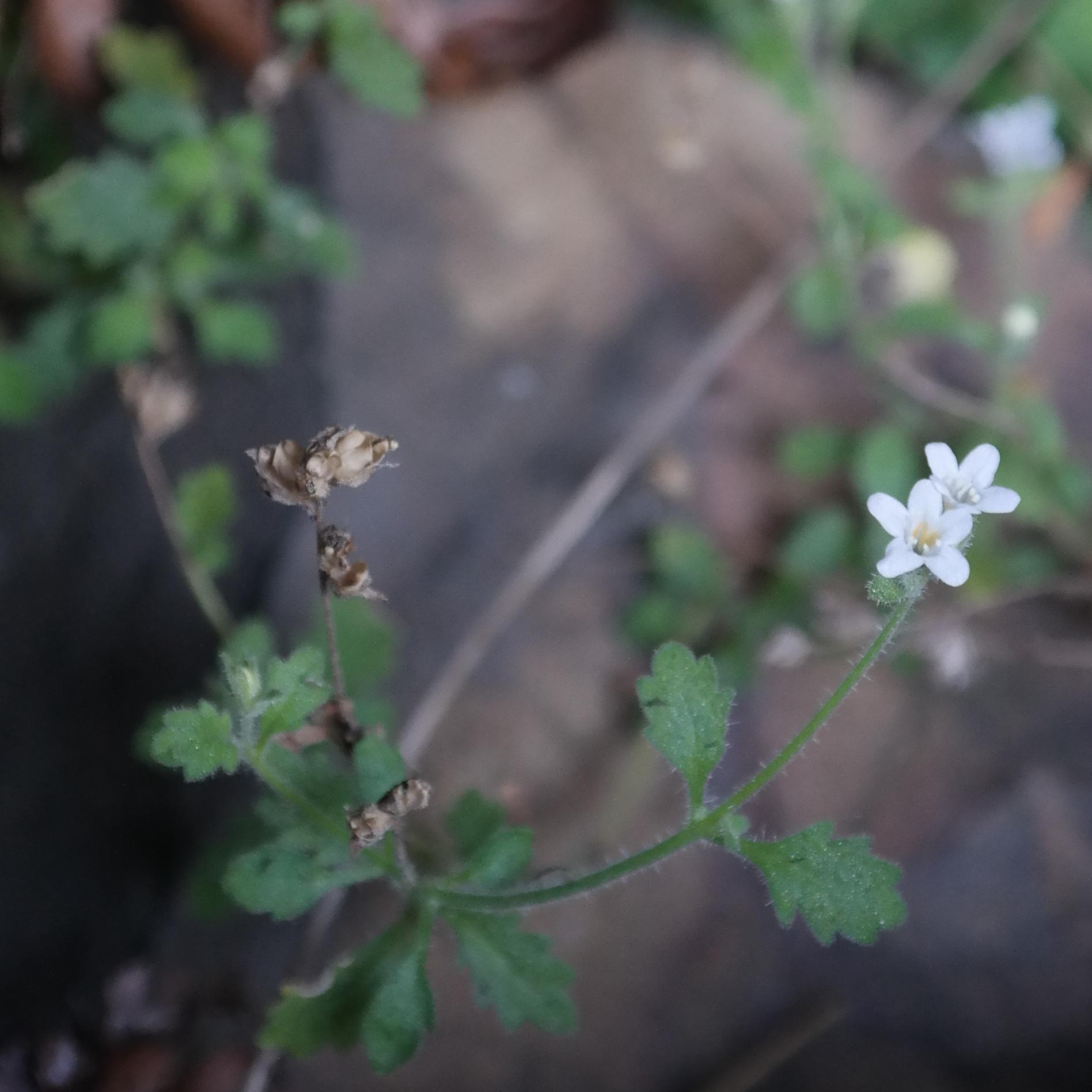
Perennial herb well branched from the base, base woody, stems there up to 2 mm diam., prostrate or diffuse, the inflorescences probably held erect, very leafy but the tips scapose below the racemes, glandular-pubescent, hairs patent, up to 0.4-0.5 mm long. Leaves opposite, occasionally the uppermost alternate, blade mostly 6-20 x 4-11 mm, elliptic, base cuneate and tapering into a flat petiolar part 2-7 mm long, shorter than blade, upper margins with 2-4 pairs of coarse teeth, both surfaces glandular-pubescent, hairs up to 0.25-0.4 mm long. Flowers rarely solitary, usually 2-12 in very lax racemes terminating all the branchlets, sometimes one or a few secondary racemes developing to produce a very open panicle. Bracts 2-5 x 0.3-0.8 mm, linear-oblong to linear-lanceolate, glandular-pubescent as in leaves, adnate to base of pedicel only. Pedicels up to 0.6-4 mm long, gradually shorter upwards. Calyx obscurely bilabiate, tube 0.25-0.5 mm long, anticous lobe 1.75-2.5 x 0.3-0.8 mm, anticous lip split 1.75-2.5 mm, calyx glandular-pubescent all over. Corolla tube c. 2-3 mm long, cylindric in lower half and there c. 0.5-0.8 mm broad, abruptly expanded above, c. 1-1.5 mm across mouth, whole corolla glandular-puberulous outside, limb c. 2-4 mm across lateral lobes, posticous lobes c. 0.5-1 x 0.4-1 mm, anticous lobe c. 0.75-1.5 x 0.5-1 mm, corolla smaller in autogamous flowers, all lobes subrotund, white with an orange patch at base of posticous lobe and extending down back of tube, glabrous. Stamens 4, shortly exserted, posticous filaments decurrent about halfway down tube, all anthers 0.3-0.5 mm long. Stigma either exserted, or malformed and twisted round and often attached to the anthers. Capsules 2-2.5(-3) x 1.5-2 mm Seeds up to 8-12 in each loculus, c. 0.5-0.75 x 0.5 mm, obscurely 3-angled, sinuously wrinkled in longitudinal bands, pallid. From: Hilliard, OM. 1994. The Manuleae: a tribe of Scrophulariaceae. Edinburgh University Press, Edinburgh. [All rights reserved]
Glandular-hairy perennial. Leaves mostly opposite. Flowers in lax racemes, often autogamous, tube short and glandular-hairy, white with orange patch at base of lower lobes and down back of tube. From: Manning, JC; Goldblatt, P. 2012. Scrophulariaceae: Trieenea Hilliard. In: J Manning & P Goldblatt (eds), Plants of the Greater Cape Floristic Region 1: The Core Cape flora. Strelitzia 29: 761-762. South African National Biodiversity Institute, Pretoria. [CC BY]
Trieenea schlechteri is easily recognized by its very lax racemes, sometimes forming few-branched panicles, and small narrow bracts, which are often adnate only to the extreme base of the pedicels; at the tip of the inflorescence, where the pedicels may be much abbreviated, the bract may be adnate nearly to the top of the pedicel. From: Hilliard, OM. 1994. The Manuleae: a tribe of Scrophulariaceae. Edinburgh University Press, Edinburgh. [All rights reserved]
The plants grow under rock overhangs. From: Hilliard, OM. 1994. The Manuleae: a tribe of Scrophulariaceae. Edinburgh University Press, Edinburgh. [All rights reserved]
Under sandstone overhangs. From: Manning, JC; Goldblatt, P. 2012. Scrophulariaceae: Trieenea Hilliard. In: J Manning & P Goldblatt (eds), Plants of the Greater Cape Floristic Region 1: The Core Cape flora. Strelitzia 29: 761-762. South African National Biodiversity Institute, Pretoria. [CC BY]
Trieenea schlechteri is obviously common in the northern Cedarberg, but there are no records from the southern Cedarberg, where its ally, T. elsiae, occurs. However, Schlechter's original collection came from a site in the Cold Bokkeveld, roughly 85 km south of the Cedarberg. From: Hilliard, OM. 1994. The Manuleae: a tribe of Scrophulariaceae. Edinburgh University Press, Edinburgh. [All rights reserved]
Cedarberg and Cold Bokkeveld Mtns. From: Manning, JC; Goldblatt, P. 2012. Scrophulariaceae: Trieenea Hilliard. In: J Manning & P Goldblatt (eds), Plants of the Greater Cape Floristic Region 1: The Core Cape flora. Strelitzia 29: 761-762. South African National Biodiversity Institute, Pretoria. [CC BY]
November to December
1370 to 1525 m
This map contains point-based occurrences at different locations
Occurrence in the Flora of Southern Africa (FSA) countries and South African provinces. Residence status indicates if a taxon is indigenous, endemic, naturalised or invasive in a specific region. This data is based on specimen records and literature
FSA
SA
BOT
NAM
ESW
LES
WC
EC
NC
FS
GA
KZN
LP
MP
NW
Absent
Indigenous
Endemic
Naturalised
Invasive

Names and Sources
Phyllopodium schlechteri Hiern
Polycarena schlechteri (Hiern) Levyns
Classification
KINGDOM Plantae
SUBKINGDOM Phanerogamae
PHYLUM Anthophyta
ORDER Lamiales
FAMILY Scrophulariaceae
TRIBE Limoselleae
GENUS Trieenea
SPECIES schlechteri
7 results for Trieenea schlechteri (Hiern) Hilliard
Barcode: NBG0247371-0 Collector(s) & number: Jardine, I, 908 | 2008-8-21
South Africa, Western Cape, Knolfontein, Swartruggens. 60 km NE of Ceres. 32°53'20.4''S, 19°37'46.5''E.
Data Resource: BODATSA View record
Barcode: PRE0138305-0 Collector(s) & number: Taylor, HC, 7523 | 1969-11-13
South Africa, Cape Province, CEDARBERG; WOLFBERG
Data Resource: BODATSA View record
Barcode: PRE1000091-0 Collector(s) & number: Jardine, I, 1067 | 2009-1-13
South Africa, Western Cape, Wuppertal. Knolfontein, Swartruggens, 60 km NE. of Ceres.
Data Resource: BODATSA View record
Barcode: PRE0138307-0 Collector(s) & number: Schlechter, FRR, 10113 | 1897-1-23
South Africa, Western Cape, Koue Bokkeveld; Sand River.
General notes: Number also Schlechter TM 1921. In rocky places near Sand River.
Data Resource: BODATSA View record
Barcode: PRE0744748-0 Collector(s) & number: Schlechter, FRR, 10113 | 1897-1-23
South Africa, Western Cape, Koude Bokkeveld Dist.; Sandrivier.
General notes: Locality not precisely pinpointed by Hilliard.
Data Resource: BODATSA View record
Barcode: PRE0600884-0 Collector(s) & number: Esterhuysen, EE, 29982 | 1962-12-28
South Africa, Western Cape, CLANWILLIAM DIST.; PLATEAU BETWEEN THE TAFELBERG AND THE WOLFBERG.
Data Resource: BODATSA View record
This map contains point-based occurrences at different locations
2012
SERIES CHAPTER
Scrophulariaceae: Trieenea Hilliard Manning, JC; Goldblatt, PIn: J Manning & P Goldblatt (eds), Plants of the Greater Cape Floristic Region 1: The Core Cape flora. Strelitzia 29: 761-762
South African National Biodiversity Institute, Pretoria
1994
1989
PERIODICAL/JOURNAL
New genera, species and combinations in Scrophulariaceae - Manuleae Hilliard, OMNotes from the Royal Botanic Garden, Edinburgh 45(3)481-491
No results found for Trieenea schlechteri (Hiern) Hilliard
Status and criteria
LC
Assessor(s)
Plantae Coordinator
JOURNAL ARTICLE
Hammer, S. 1998. A note on Conophytum obscurum and Conophytum bachelorum ssp. sponsaliorum. Mesemb Study Group Bulletin. 13:13
JOURNAL ARTICLE
Hammer, S. 1998. A note on Conophytum pellucidum Schwantes and C. terricolor Tischer. Mesemb Study Group Bulletin. 13:74-75
BOOK
Hammer, S. 2002. Dumpling and his wife: New view of the genus Conophytum. EAE Creative Colour
JOURNAL ARTICLE
Hammer, S. 2004. Haystacks and hot potatoes. Mesemb Study Group Bulletin. 19:12-13
| Part(s) of plant used | Use(s) | Reference |
|---|
Coming soon...


