
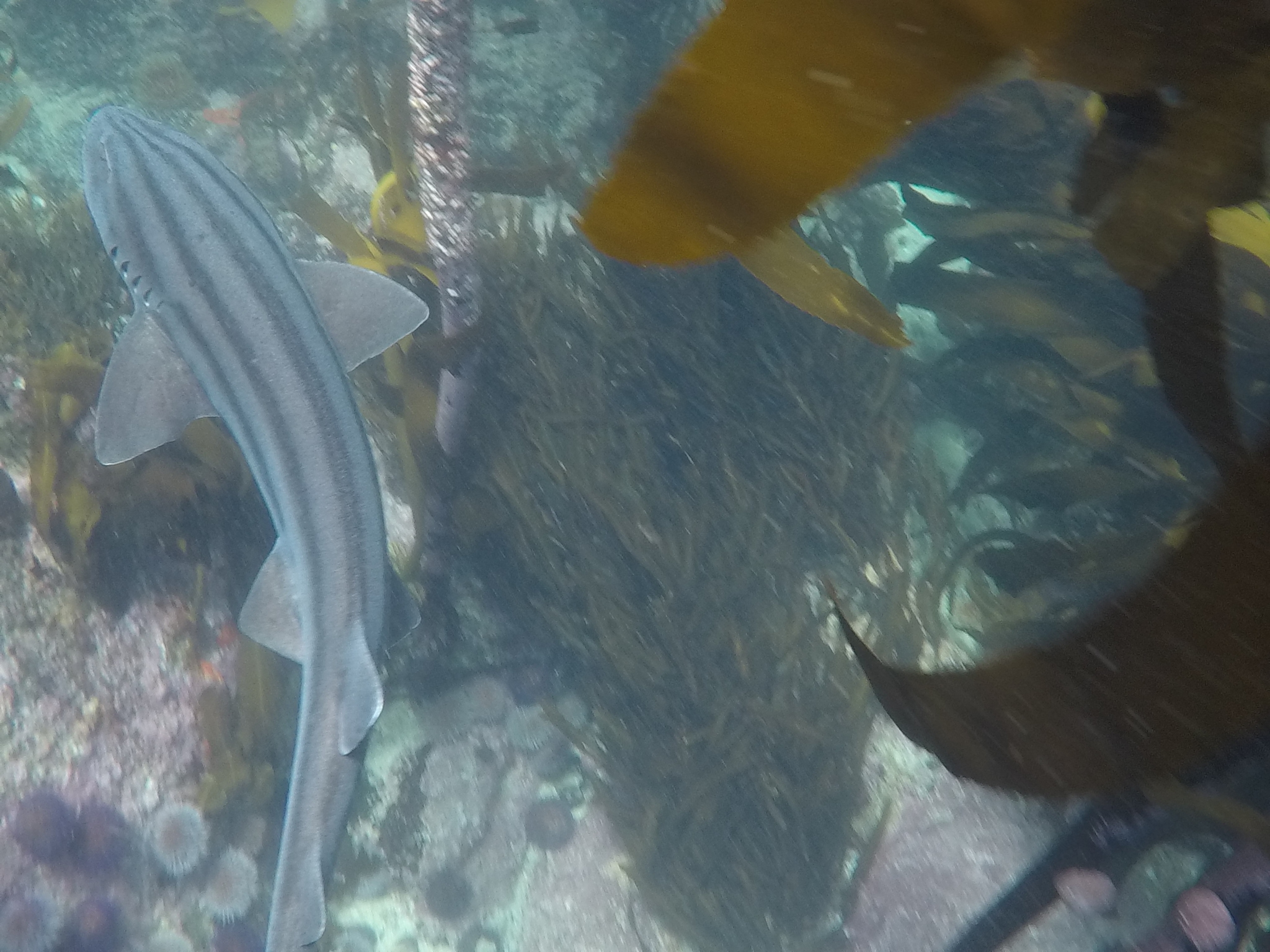
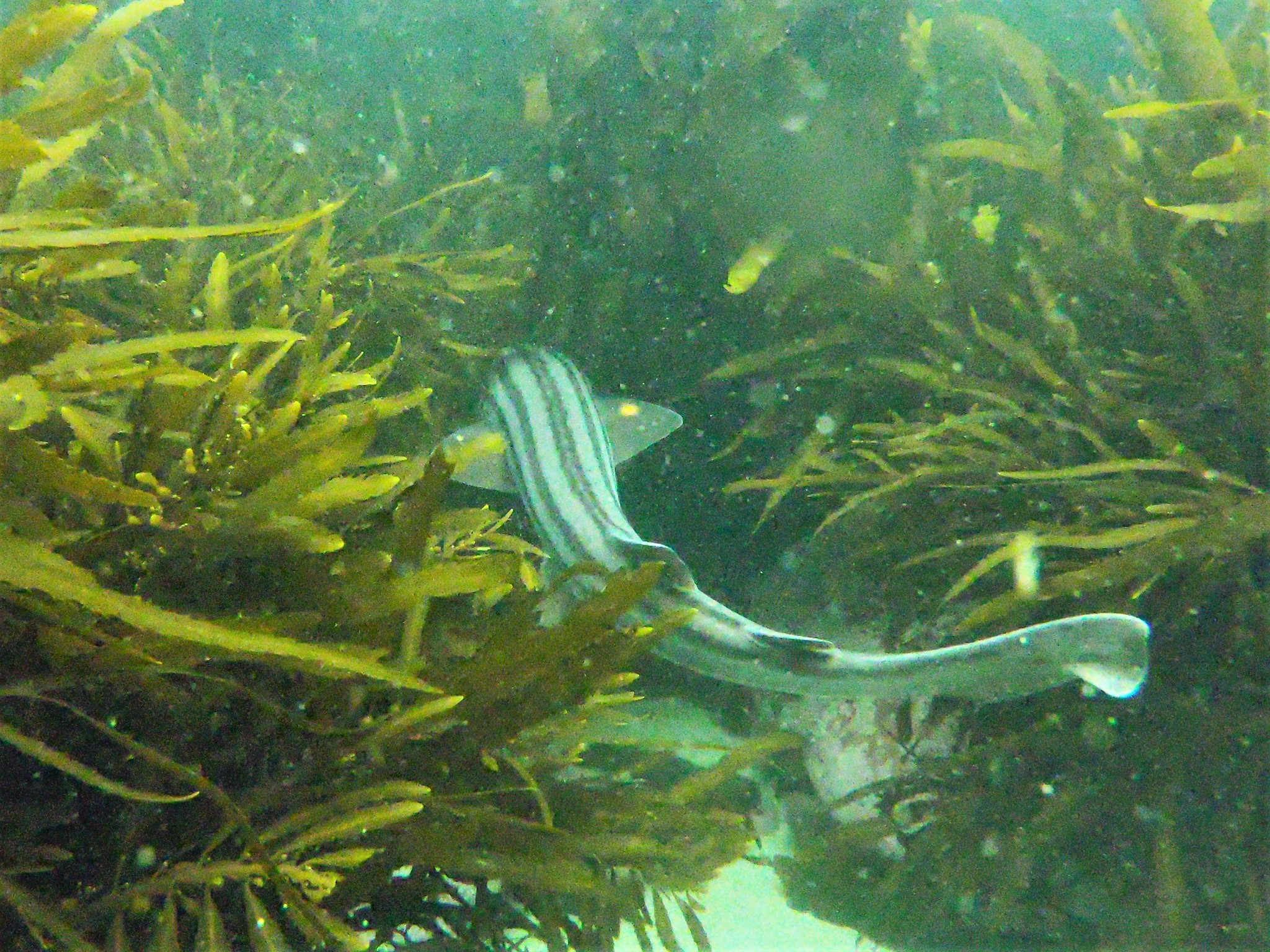
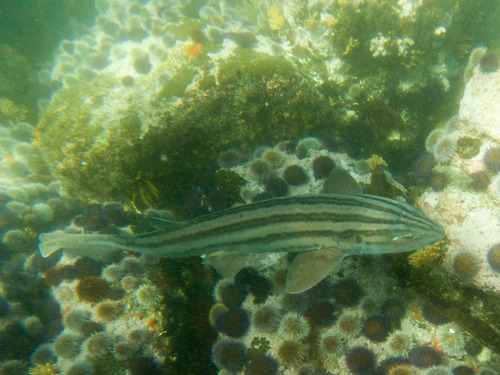
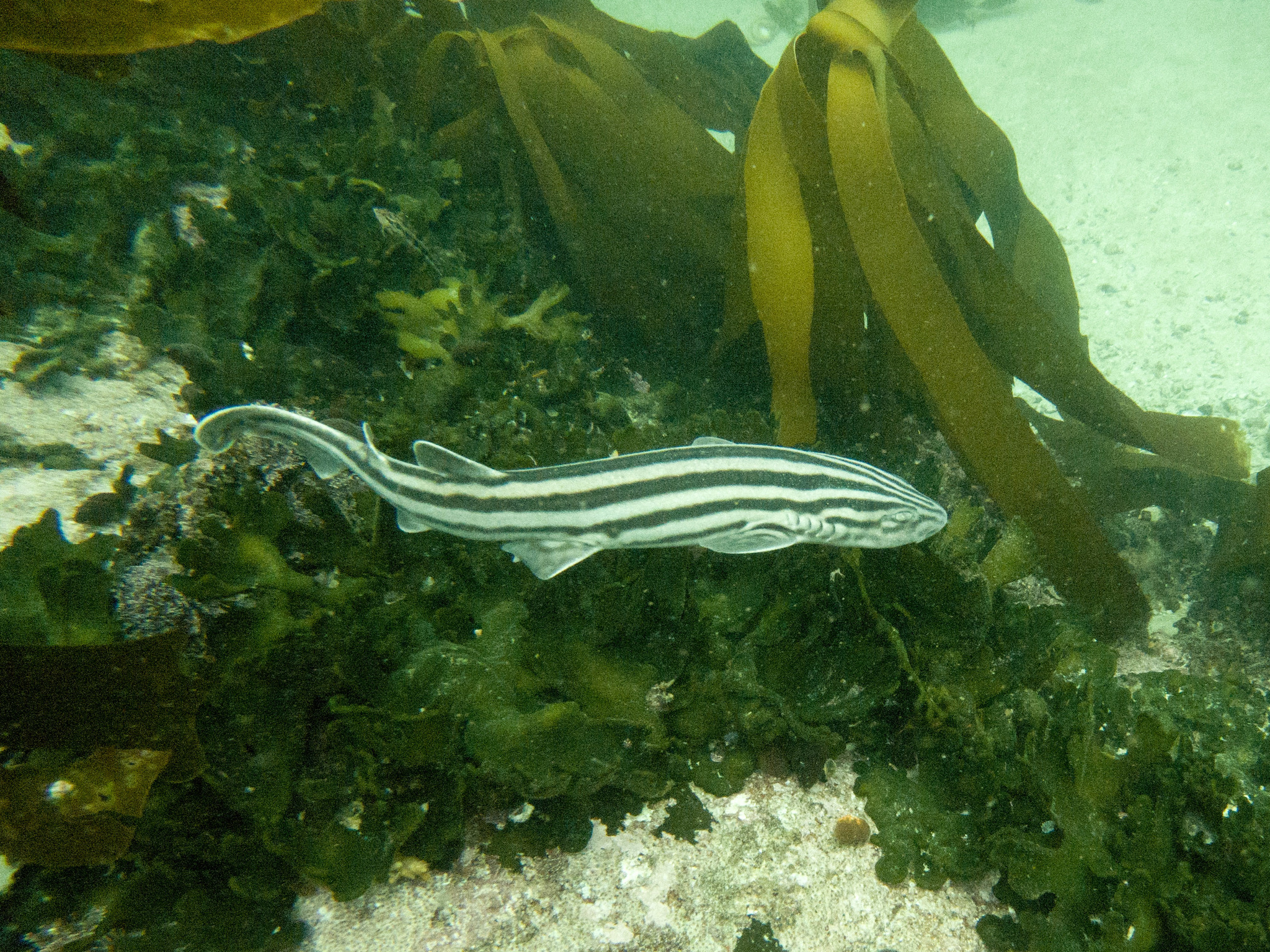
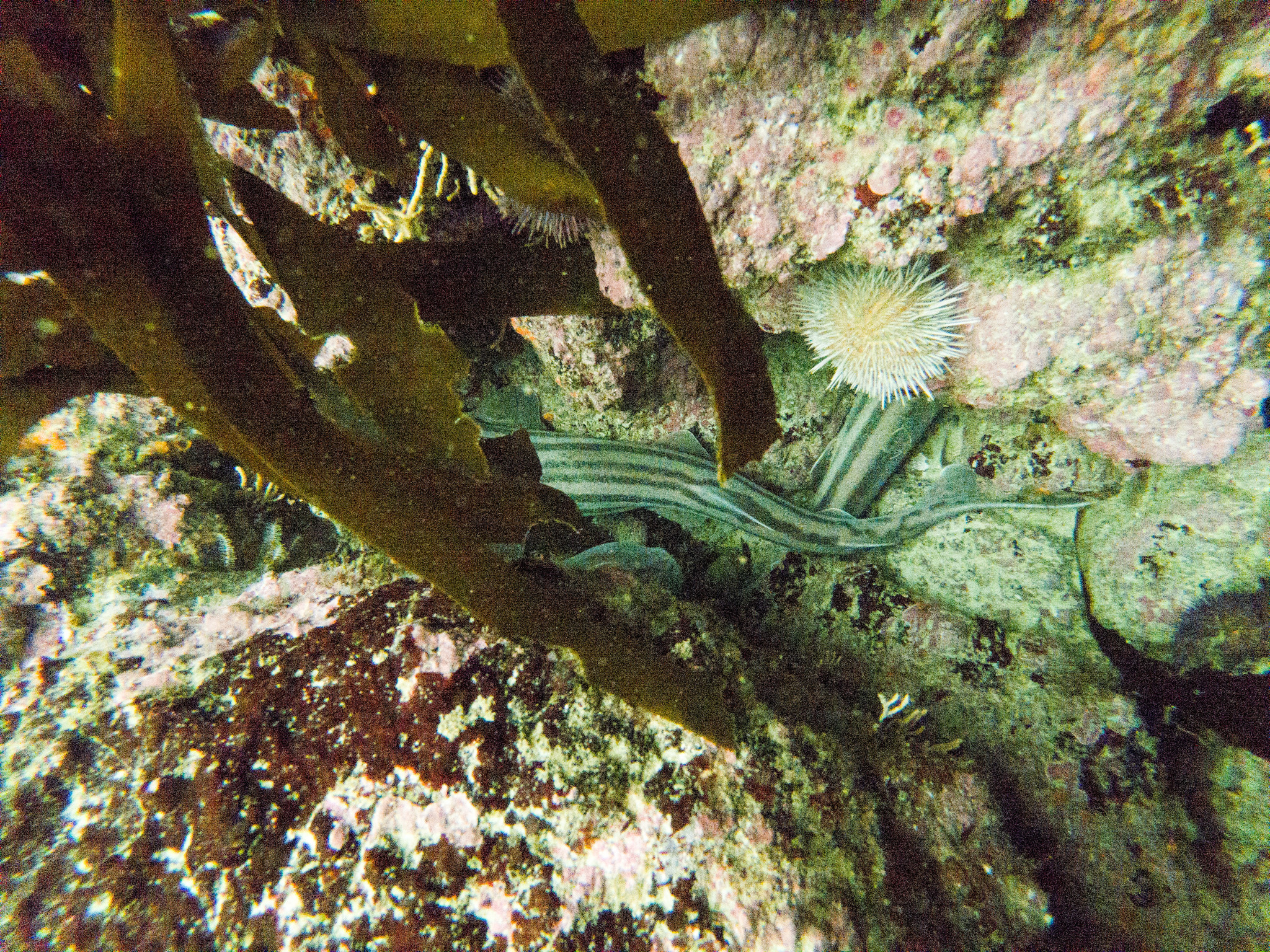
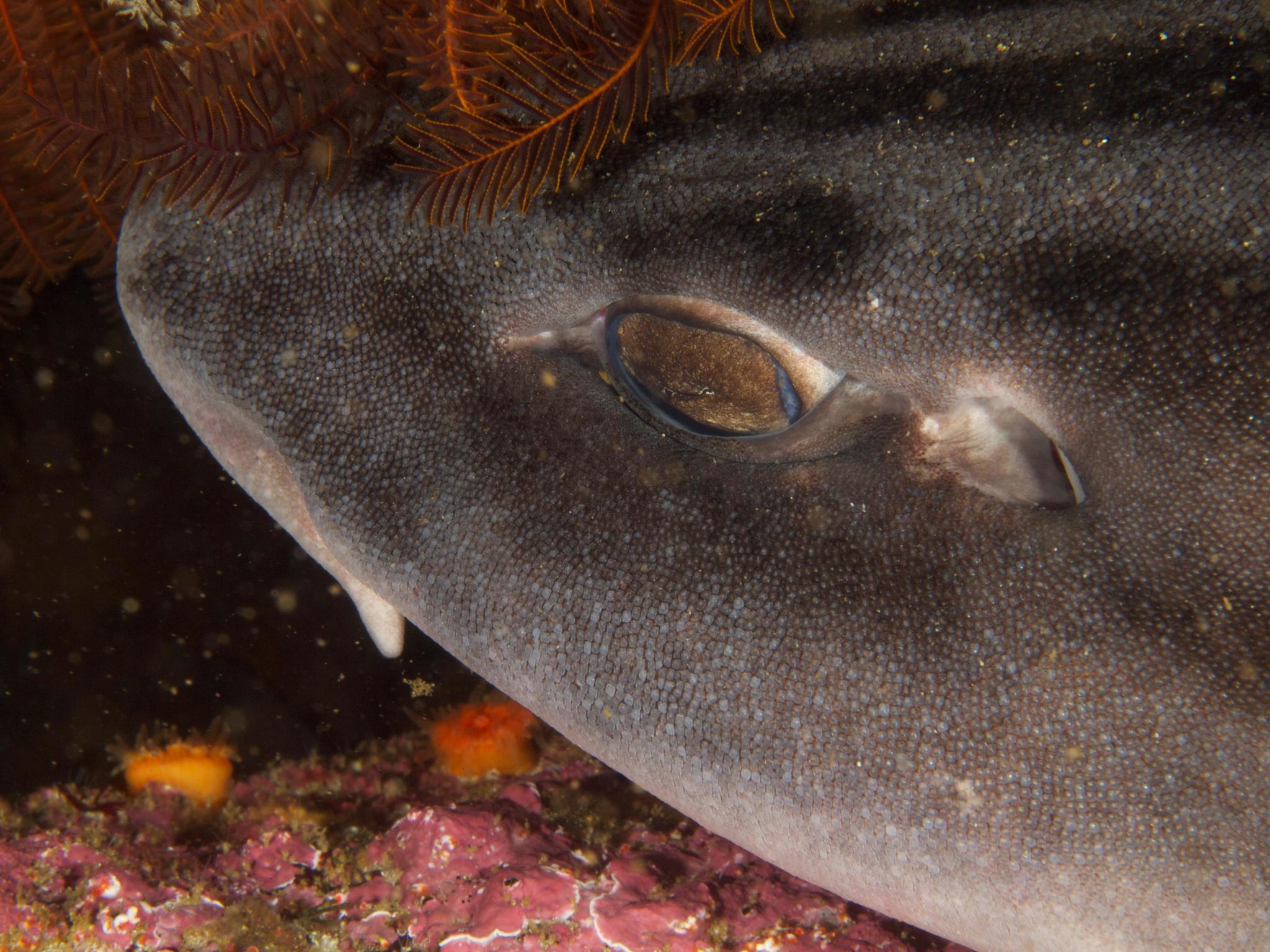
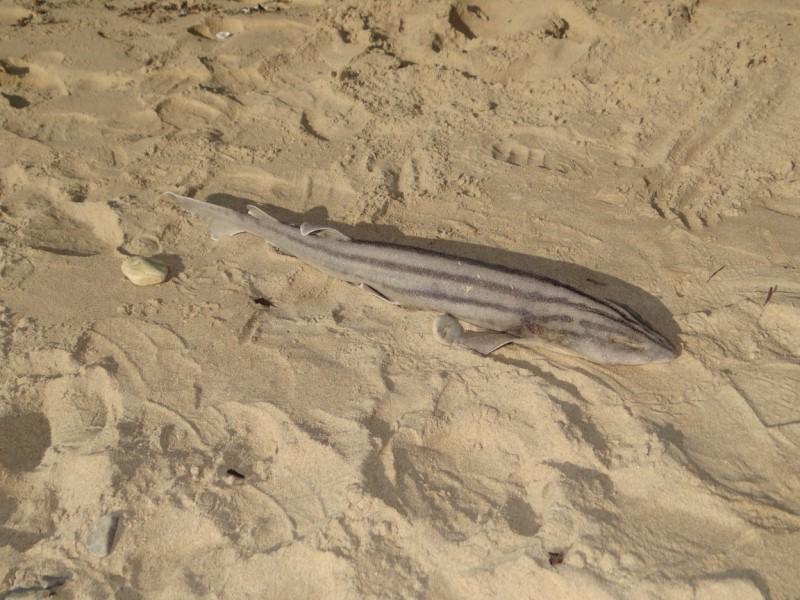
Pyjama catsharks patterns and colours vary with age and locality however have seven longitudinal dark stripes, one along the centre of the back and three parallel stripes on each side. In adults the stripes may have lighter centres. The background body colour is usually buff of creamy brown with a play belly. The dorsal fins are distinctive as they are placed close together well towards the tail, with the first dorsal origin behind the end of the pelvic fin (van der Elst 1993).
Endemic to South African waters in the Eastern Cape and Western Cape (Compagno et al. 1989).
Found from Saldanha Bay to just north east of East London (Compagno et al. 1989, Heemstra and Heemstra 2004).
Pyjama catsharks are resident species which show strong site fidelity and limited dispersal (Escobar-Porras 2009).
Adults prey on cephalopods, crustaceans, small bony fishes, bivalves and polychaete worms (Compagno et al. 1989, van der Elst 1993, Heemstra and Heemstra 2004) and juveniles have a similar diet.
Females are oviparous and lay two eggs, one egg per oviduct, at a time (Compagno et al. 1989) however the number of times each individual spawns per year is not known but thought to be twice or more. Eggs are attached to seaweeds and kelp on rocky reefs (van der Elst 1993, J. Escobar- Porras, UKZN, pers. obs.). When they hatch pups are ~14 cm TL (Heemstra and Heemstra 2004).Spawning season is not known and it is thought that reproduction take place year round (Roux 2002, Compagno 2005) throughout their distribution range although few eggs cases are seen in the northern parts of the Eastern Cape (Roux 2002, J. Escobar-Porras, UKZN, pers. obs.). They reach maturity at an average size of 10-13 years (Compagno 2005) when males are 845mm TL and females are 885mm TL (Roux 2002).
Inshore, Offshore (>30m)
This map contains point-based occurrences at different locations
Occurrence in African countries and South African provinces. Residence status indicates if a taxon is indigenous, endemic, or alien in a specific region. This data is based on specimen records and literature.
FSA
SA
BOT
NAM
ESW
LES
WC
EC
NC
FS
GA
KZN
LP
MP
NW
Absent
Indigenous
Endemic
Naturalised
Invasive
Click on images to enlarge
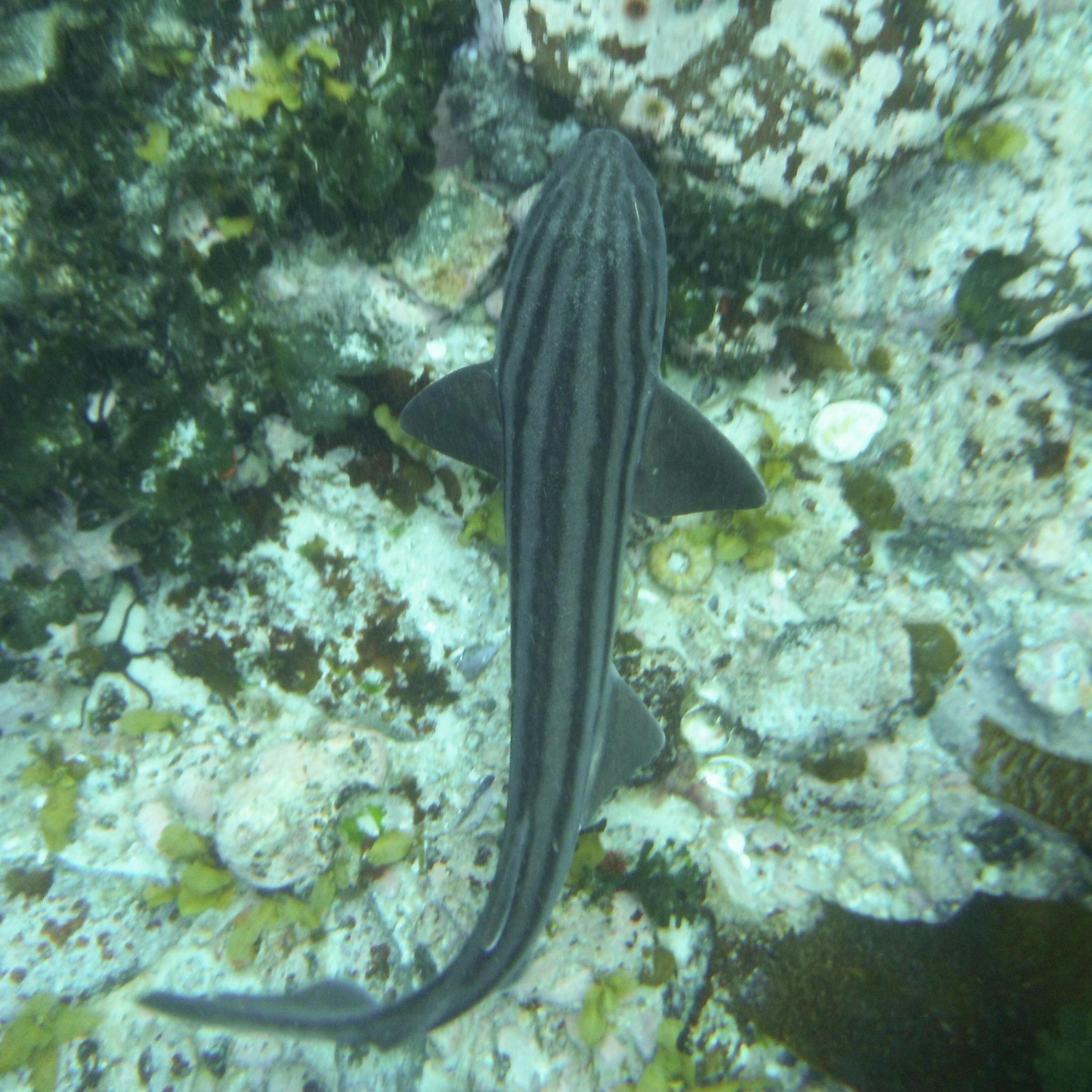
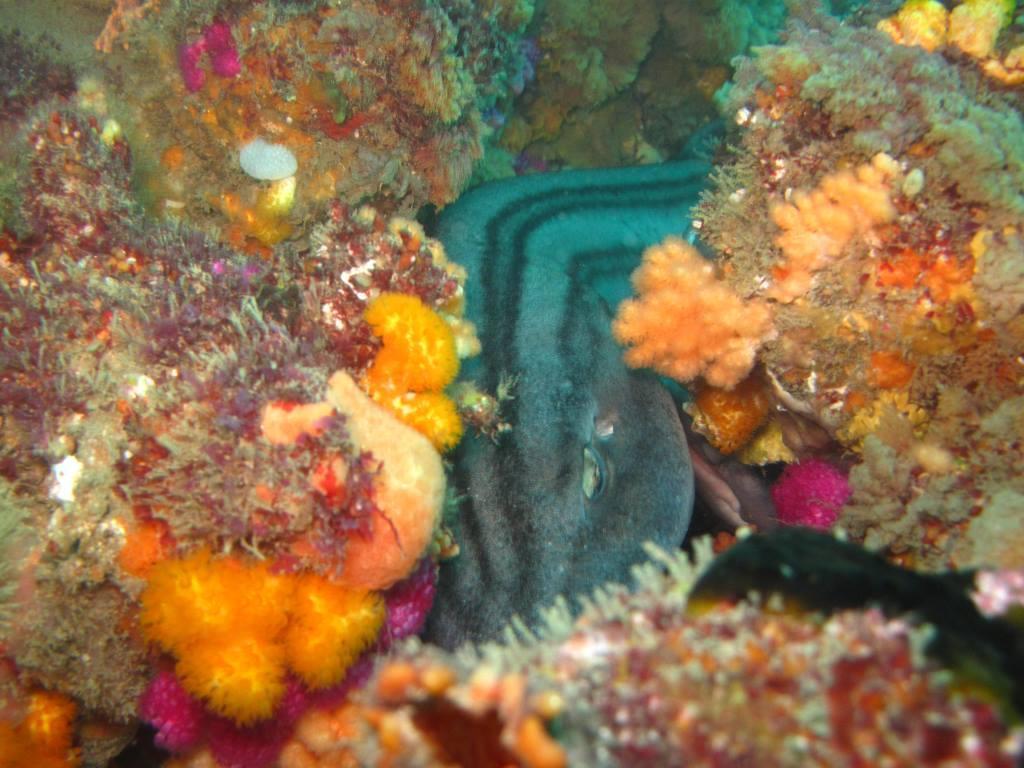
Poroderma africanum (Gmelin, 1789)
| Kingdom | animalia |
|---|---|
| Phylum | chordata |
| Class | elasmobranchii |
| Order | carcharhiniformes |
| Family | scyliorhinidae |
| Genus | poroderma |
| Species | africanum |
| Date | Place | Data Resource | Link |
|---|---|---|---|
| 2018-01-12 | Western Cape, South Africa | iNaturalist | View |
| 2018-02-23 | Western Cape | iNaturalist | View |
| 2018-02-06 | Western Cape | iNaturalist | View |
| 2018-03-24 | Western Cape | iNaturalist | View |
| 2018-03-24 | Western Cape | iNaturalist | View |
| 2018-03-24 | Western Cape | iNaturalist | View |
| 2013-04-15 | Western Cape | iNaturalist | View |
| 2014-06-29 | Western Cape, South Africa | iNaturalist | View |
| 2014-05-10 | Western Cape | iNaturalist | View |
| 2012-06-16 | Eastern Cape, South Africa | iNaturalist | View |
Caught as an unwanted bycatch in recreational and commercial linefisheries, demersal shark longline and inshore trawl fisheries. Although edible, flesh is seldom used or marketed (van der Elst 1993, Compagno 2005).