

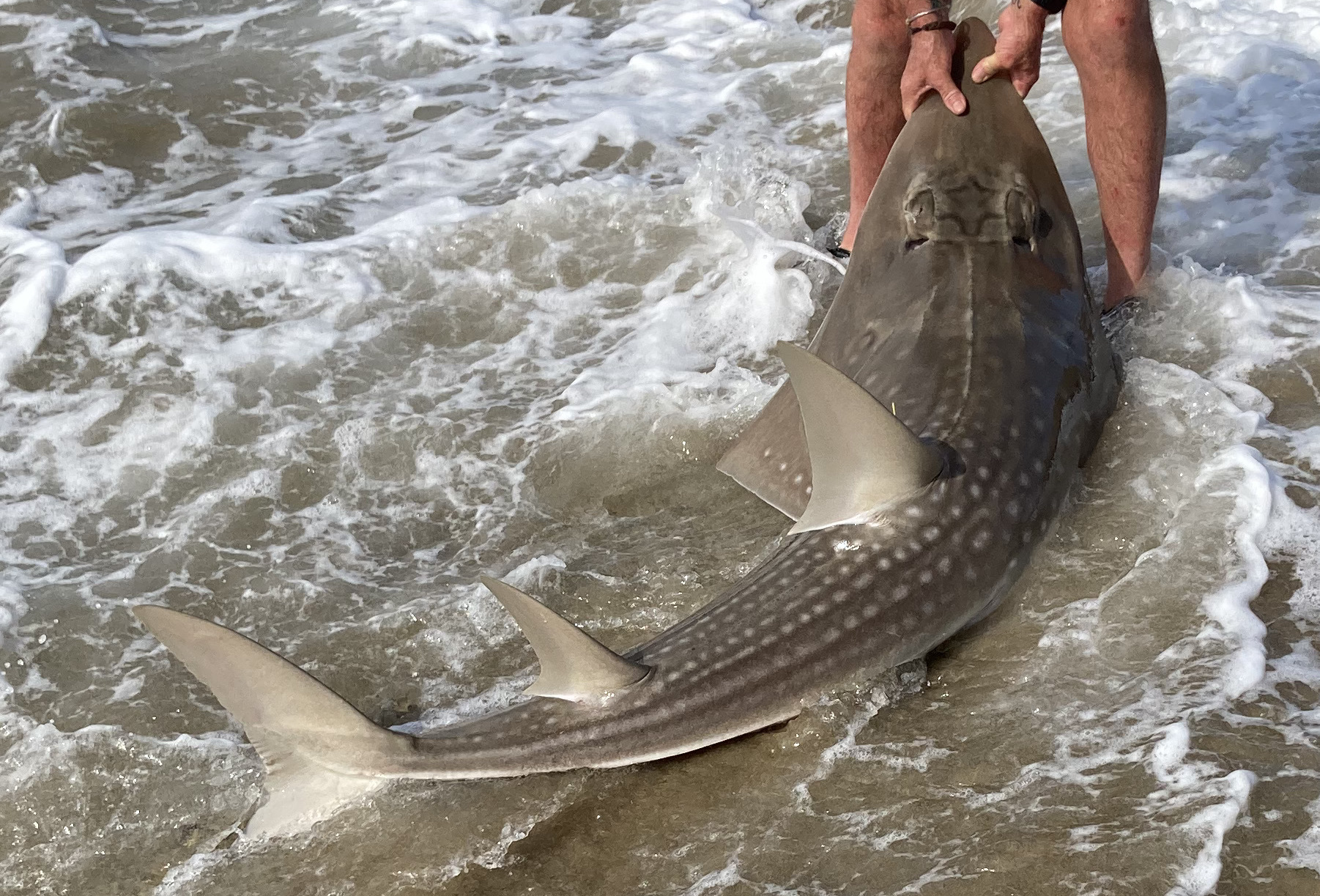
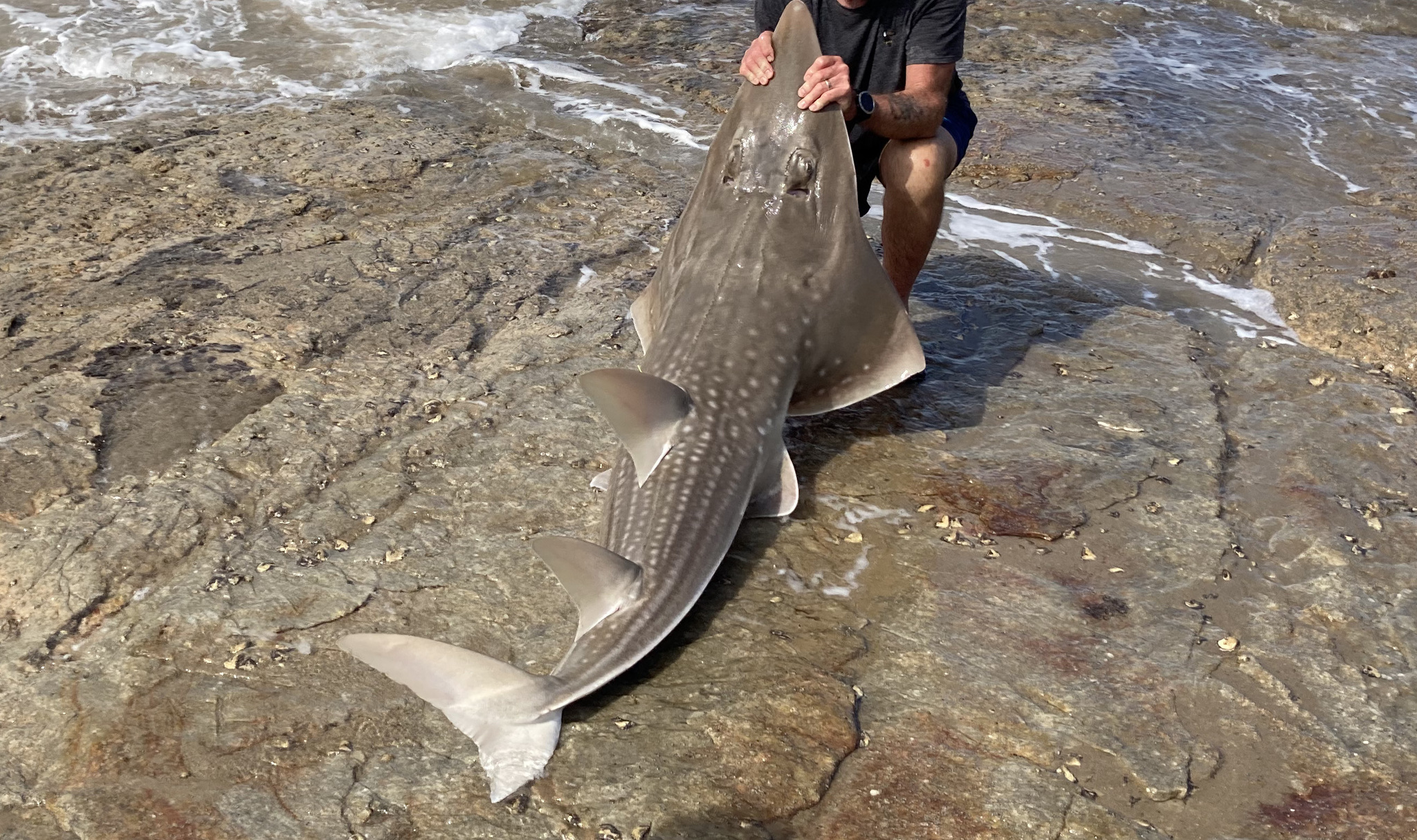
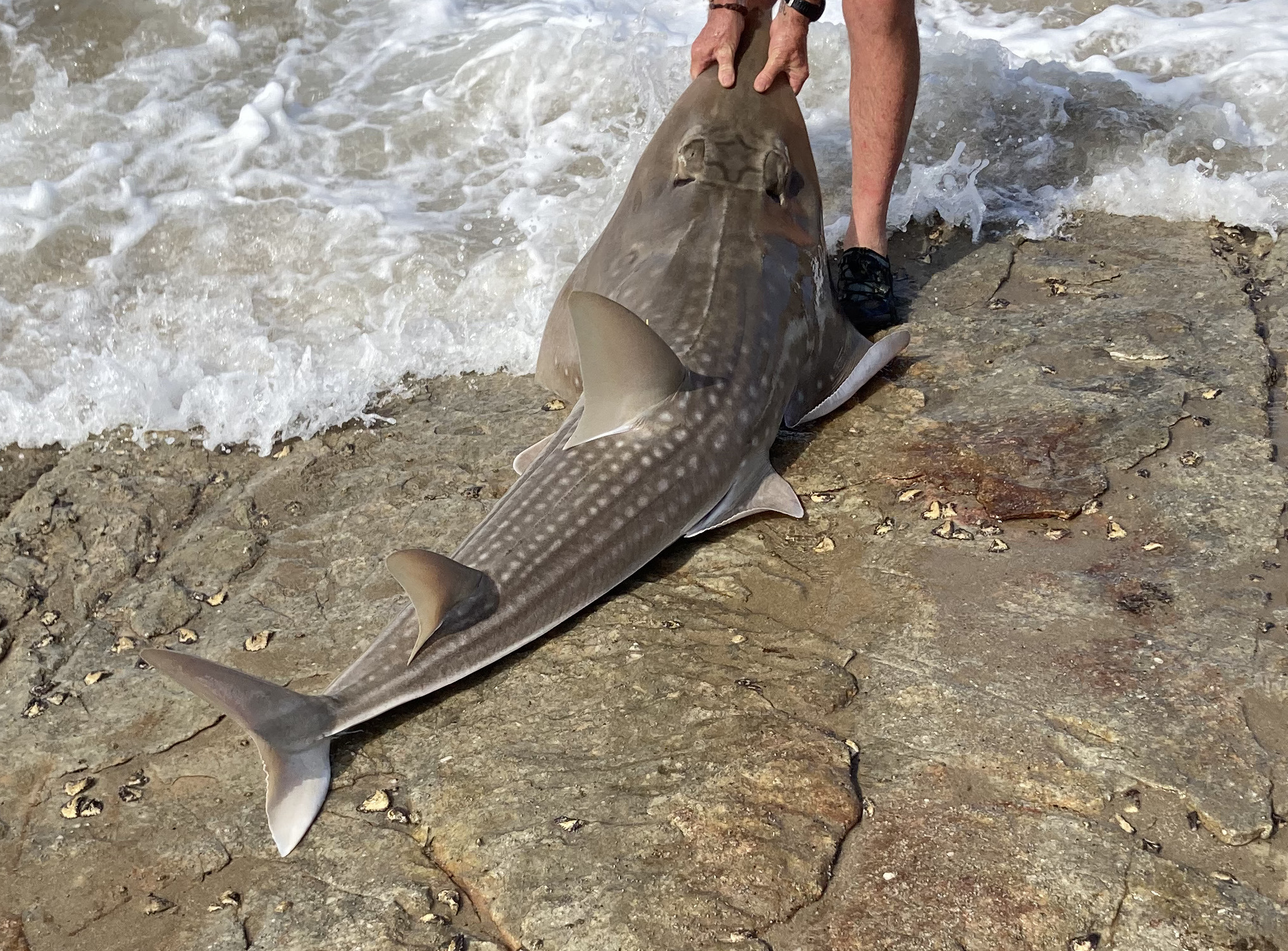
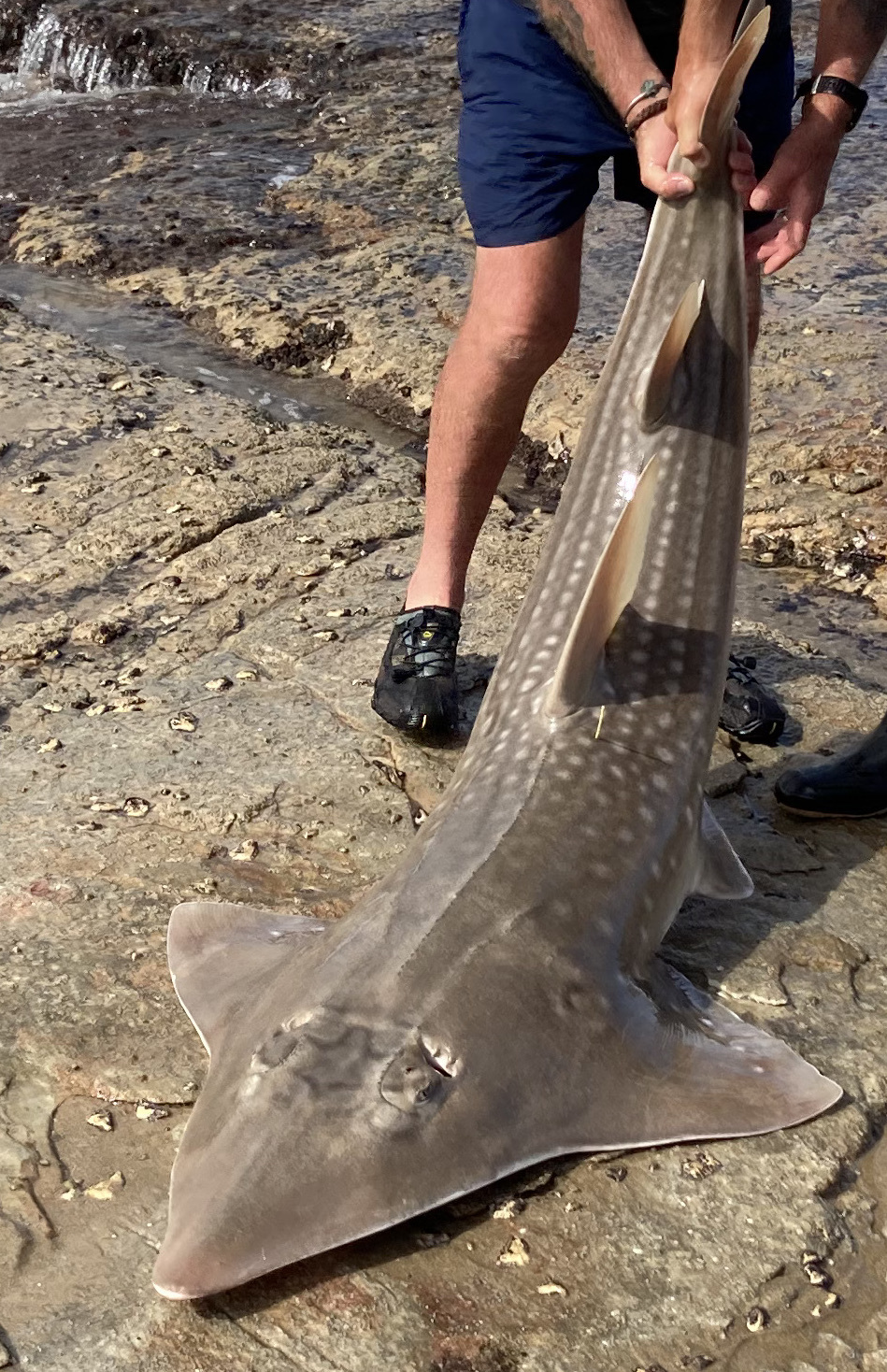
Giant guitarfish have the origin of the first dorsal fin over or in from the pelvic fins. The tail fin has a distinct lower lobe and the snout is wedge shaped merging into a concave lateral head profile. They are dark olive green dorsally and usually have pale spots in longitudinal stripes on the body and pectoral fins. They have a dark eyespot ringed with pale spots at the base of each pectoral fin and a dark polygonal mark between the eyes (Heemstra and Heemstra 2004).
Restricted to the Red Sea and tropical waters of the WIO south to SA (Wallace 1967, Smith and Heemstra 1991). May comprise a complex of three or more species (Heemstra and Heemstra 2004).
EC, KZN, MOZ Common in KZN and the Pondoland area of the EC during summer, known to occur as far south as Knysna (Heemstra and Heemstra 2004) but seldom found south of Port St Johns (Wallace 1967).
Giant guitarfish are nomadic. Based on tagging data and shore anglers’ catches, adults of this species appear to be fairly mobile and although movement patterns are difficult to interpret, it is likely that they move southwards down the coast during the summer months and return to northern KZN and MOZ with the onset of winter (Wallace 1967, Bullen and Mann 2003, Pradervand 2007). Juveniles appear to show some resident behaviour (ORI Tagging Project, unpubl. data).
Adults feed on benthic mollusks, crustaceans, polychaetes, squid and small fish (Wallace 1967, van der Elst 1993, Heemstra and Heemstra 2004 and the diet of juveniles is thought to be similar.
Giant guitarsharks are ovoviviparous, producing four young ~60cm TL at birth (Smith and Heemstra 1991, van der Elst 1993, Heemstra and Heemstra 2004). Breeding occurs from December to February (summer) in northern KZN (Wallace 1967, Smith and Heemstra 1991, van der Elst 1993) in the in shallow waters off sandy beaches in northern KZN and MOZ (Wallace 1967). Age at 50% maturity: Based on the approximate length of males and females at first maturity (Wallace 1967), the corresponding age would be about 1-2 years and 2-3 years for males and females respectively (van der Elst 1993) but ages need verification. Length at 50% maturity: Observed length at first maturity for males and females in KZN was 156 and 177cm TL respectively (Wallace 1967).
Inshore, Offshore (>30m)
This map contains point-based occurrences at different locations
Occurrence in African countries and South African provinces. Residence status indicates if a taxon is indigenous, endemic, or alien in a specific region. This data is based on specimen records and literature.
FSA
SA
BOT
NAM
ESW
LES
WC
EC
NC
FS
GA
KZN
LP
MP
NW
Absent
Indigenous
Endemic
Naturalised
Invasive
Names and Sources
| Common Name | Language |
|---|---|
| Giant Sandshark | En |
| Whitespot Wedgefish | En |
| Reussandkruiper | En |
| Reus-Sandkruiper | Af |
| Giant Guitarfish | En |
| Reuse Sandkruiper |
Classification
KINGDOM Animalia
PHYLUM Chordata
CLASS Elasmobranchii
ORDER Rajiformes
FAMILY Rhinobatidae
GENUS Rhynchobatus
SPECIES djiddensis
No results found for Rhynchobatus djiddensis (Forsskål, 1775)
Commonly caught by shore anglers in KZN and forms an important component of the competitive shore fishery where most fish are released (Pradervand 2007). Also taken in shark nets along the KZN coast but most (74%) are released alive (Young 2001). Comprises a small percentage (1.6%) of the bycatch taken by inshore prawn trawls off the Thukela Banks during summer (Fennessy 1994). However, due to an extended closed trawl season implemented between Aug-Feb each year and diminished inshore prawn catches (Olbers and Fennessy 2007), the impact of the prawn trawl fishery on R. djiddensis has greatly diminished. In MOZ and other East African countries, both artisanal fisheries operating inshore and foreign vessels offshore (longliners) target R. djiddensis for its flesh and high value fins (Dudley and Cavanagh 2006). Although this species faces fewer threats in SA, catches are seasonal and it is possible that animals may also move to MOZ, where they are being increasingly targeted (Dudley and Cavanagh 2006).
1 results for Rhynchobatus djiddensis (Forsskål, 1775)
This map contains point-based occurrences at different locations
2003
REPORT
Sedgwick's/ORI/WWF Tagging Programme: giant guitarfish (Rhynchobatus djiddensis)Mann, BQ., Bullen, E.. 2003. Sedgwick's/ORI/WWF Tagging Programme: giant guitarfish (Rhynchobatus djiddensis). Durban, South Africa. Oceanographic Research Institute pp.1-9.
2011
REPORT
Rhynchobatus djiddensisDudley, SFJ, Cavanagh, RD. 2011. Rhynchobatus djiddensis.
1994
JOURNAL ARTICLE
The impact of commercial prawn trawlers on linefish off the north coast of Natal, South AfricaFennessy, ST. 1994. The impact of commercial prawn trawlers on linefish off the north coast of Natal, South Africa Vol. 14 pp.263–279.
2004
BOOK
Coastal fishes of Southern AfricaHeemstra, P, Heemstra, E. 2004. Coastal fishes of Southern Africa. Grahamstown. NISC pp.488.
2013
JOURNAL ARTICLE
Southern African Marine Linefish Species ProfilesMann, B.Q. 2013. Southern African Marine Linefish Species Profiles pp.343.
2007
JOURNAL ARTICLE
A retrospective assessment of the stock status of Otolithes ruber (Pisces: Sciaenidae) as bycatch on prawn trawlers from KwaZulu-Natal, South AfricaFennessy, ST, Olbers, JM. 2007. A retrospective assessment of the stock status of Otolithes ruber (Pisces: Sciaenidae) as bycatch on prawn trawlers from KwaZulu-Natal, South Africa Vol. 29 pp.247–252.
2007
REPORT
Long-term trends in selected shore angling speciesPradervand, P.. 2007. Long-term trends in selected shore angling species. Cape town. Oceanographic Research Institute pp.37.
1991
JOURNAL ARTICLE
Smith's Sea Fishes (1st edition)Smith, M.M, Heemstra, P.C. 1991. Smith's Sea Fishes (1st edition) pp.104.
1993
JOURNAL ARTICLE
A guide to the common sea fishes of southern Africa (3rd edition)van der Elst, R.P.. 1993. A guide to the common sea fishes of southern Africa (3rd edition) pp.398p.
1967
BOOK
The batoid fishes of the east coast of southern Africa Part I: sawfishes and guitarfishesWallace, JH. 1967. The batoid fishes of the east coast of southern Africa Part I: sawfishes and guitarfishes Vol. 15. Durban, South Africa. Oceanographic Research Institute pp.32.
2001
THESIS
An analysis of the trends in by-catch of turtle species, angelsharks and batoid species protective gillnets off KwaZulu-Natal, South AfricaYoung, N. 2001. An analysis of the trends in by-catch of turtle species, angelsharks and batoid species protective gillnets off KwaZulu-Natal, South Africa. Msc. Thesis, University of Reading.


