PLANTAE / PHANEROGAMAE / ANTHOPHYTA / ASPARAGALES / IRIDACEAE / CROCOIDEAE / IXIEAE / GLADIOLUS / HUTTONII

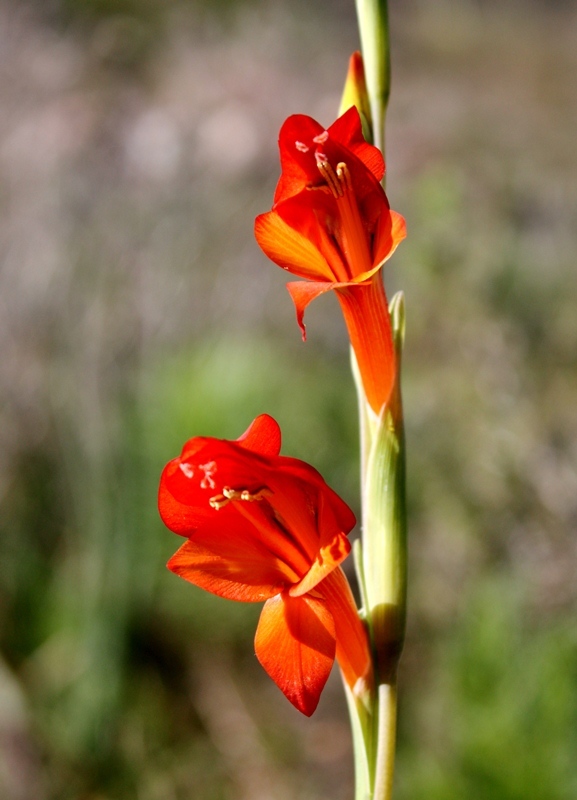
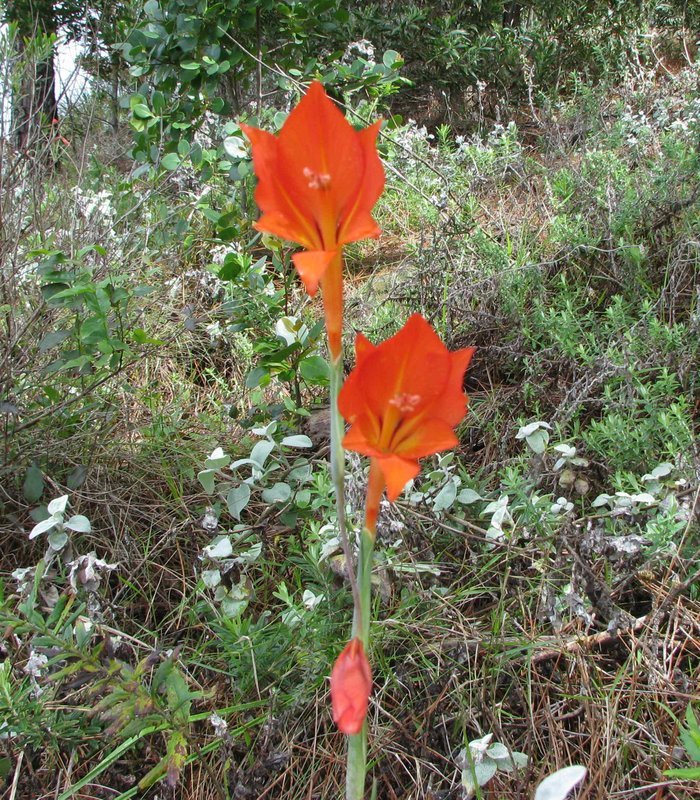
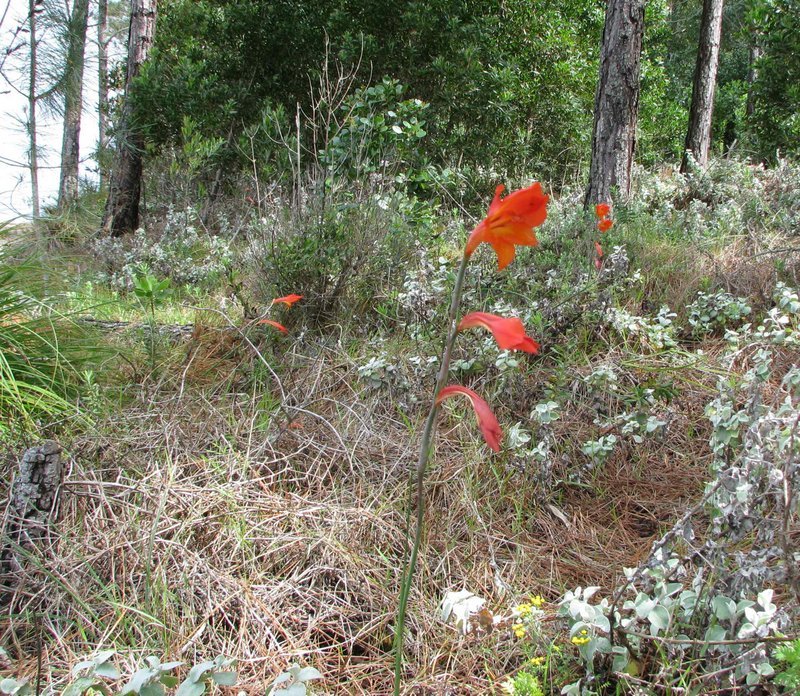
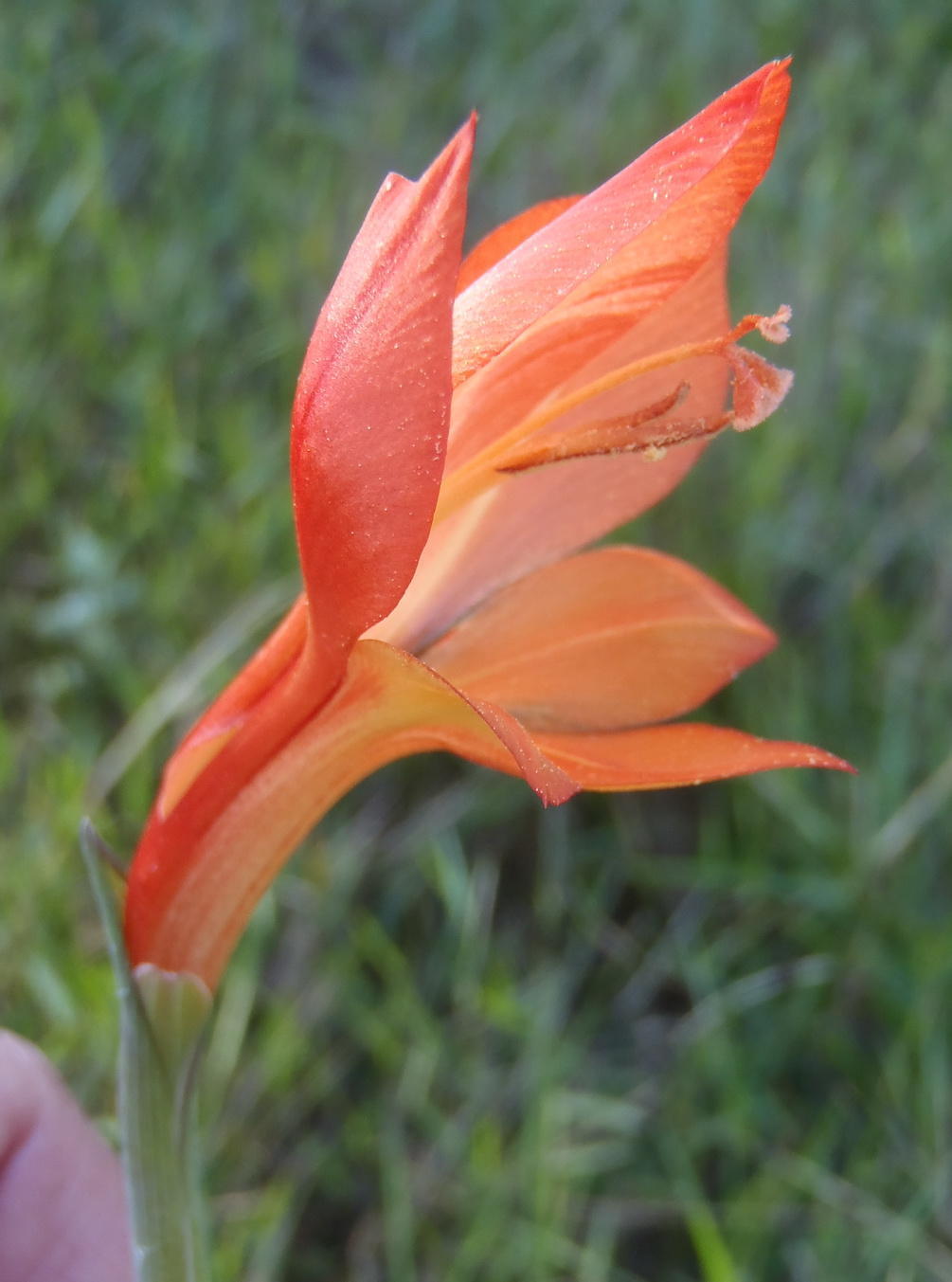
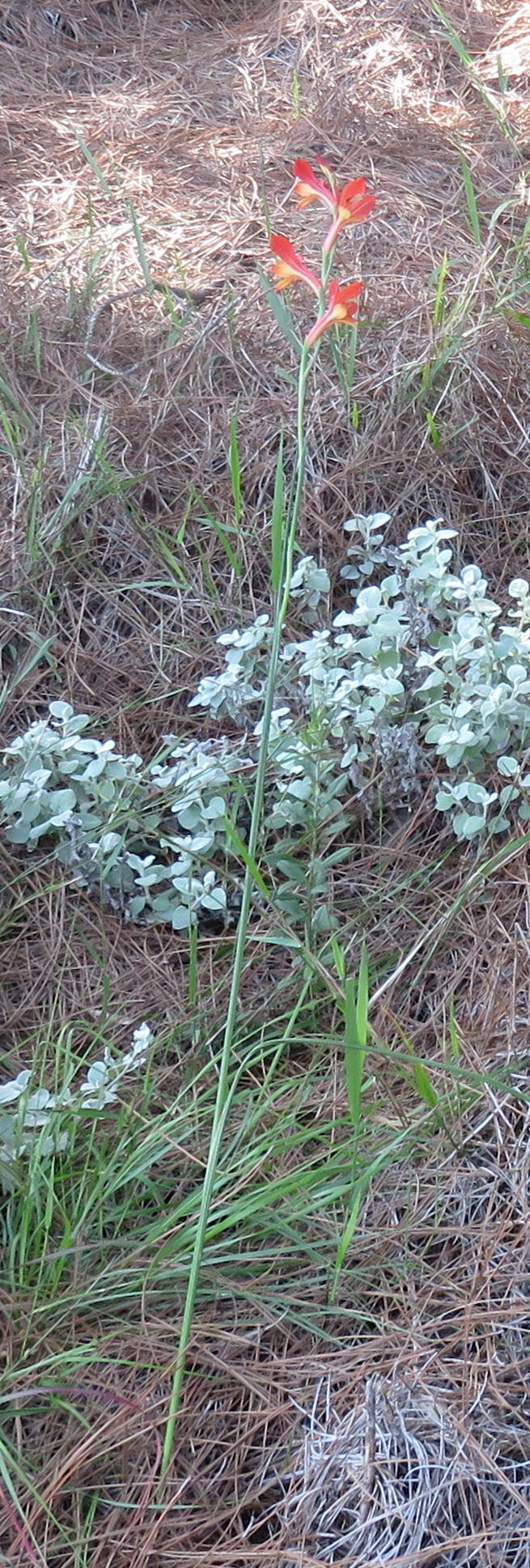
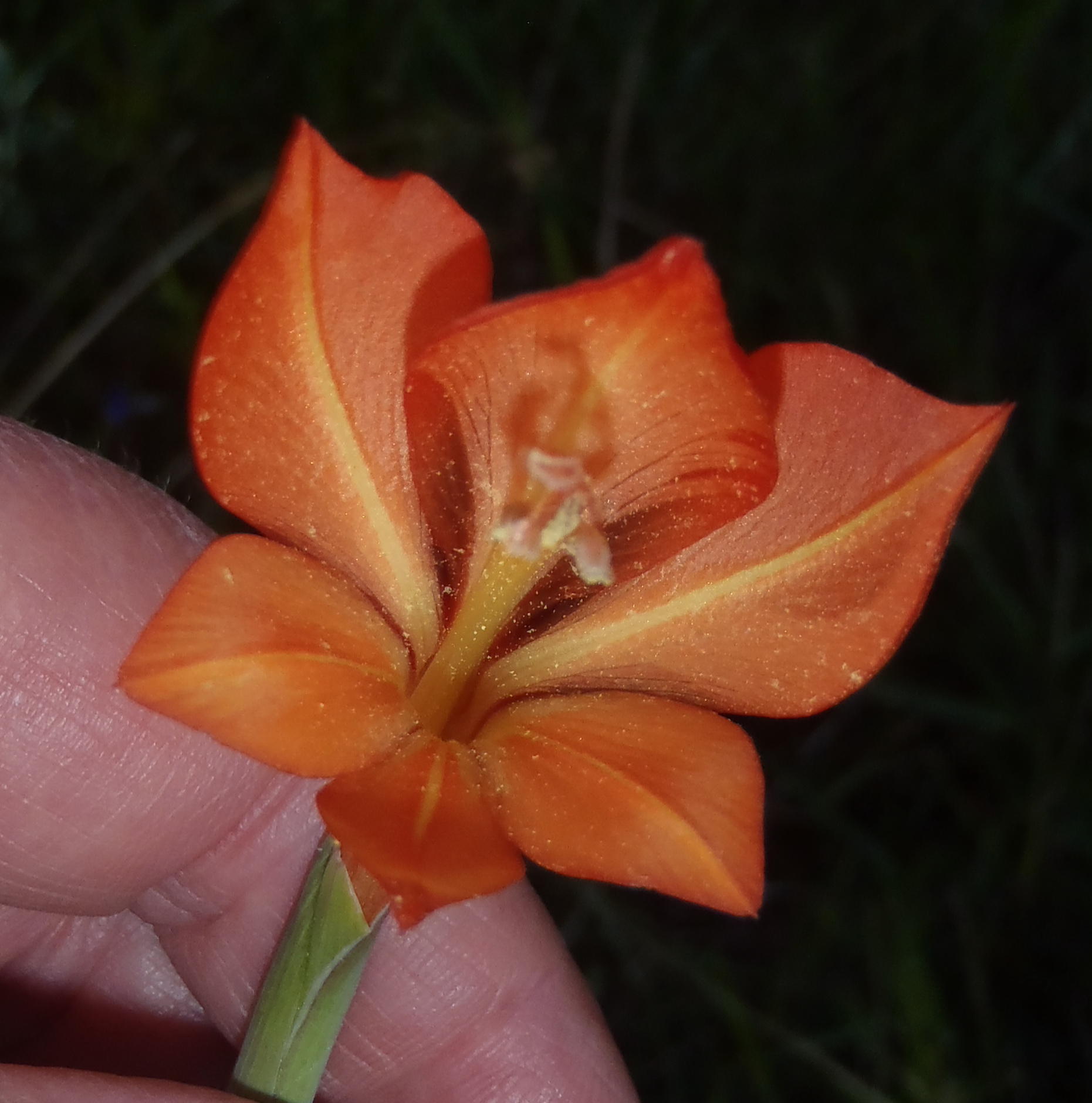
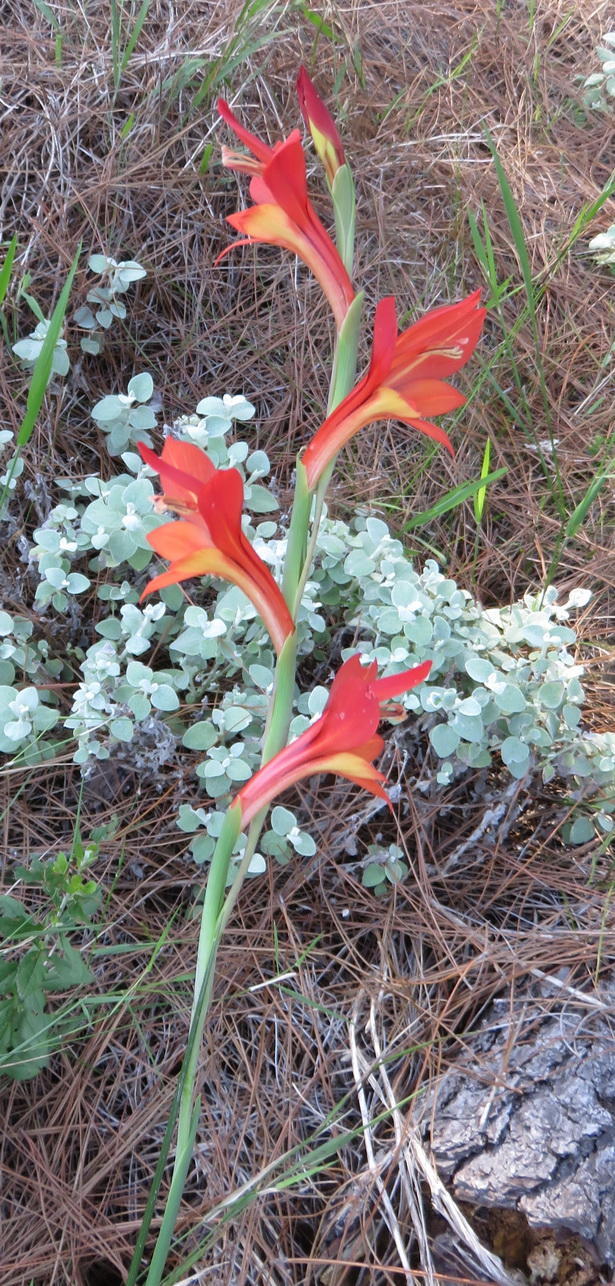
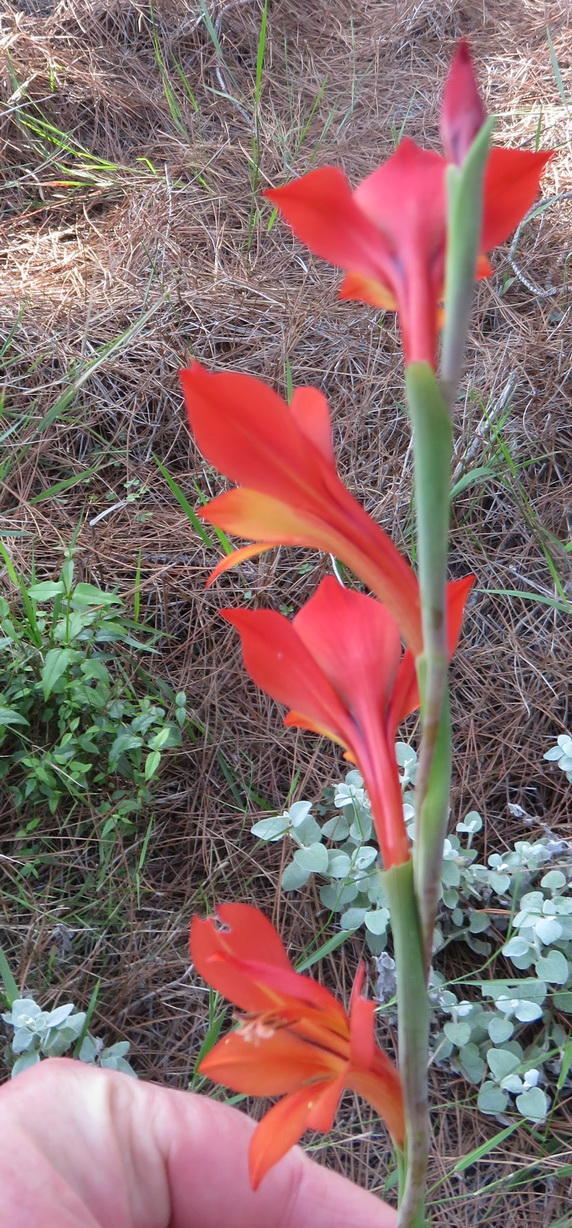
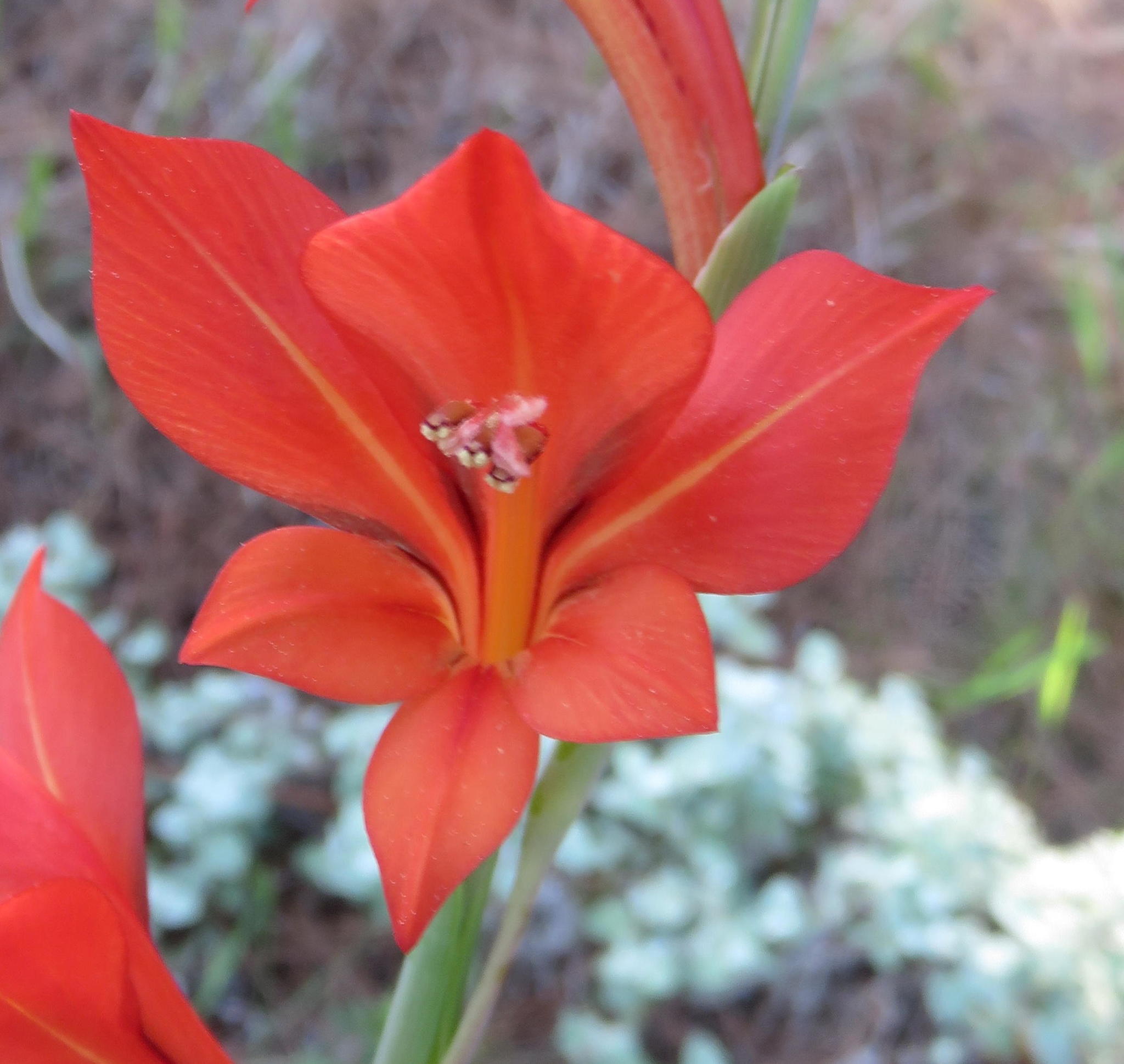
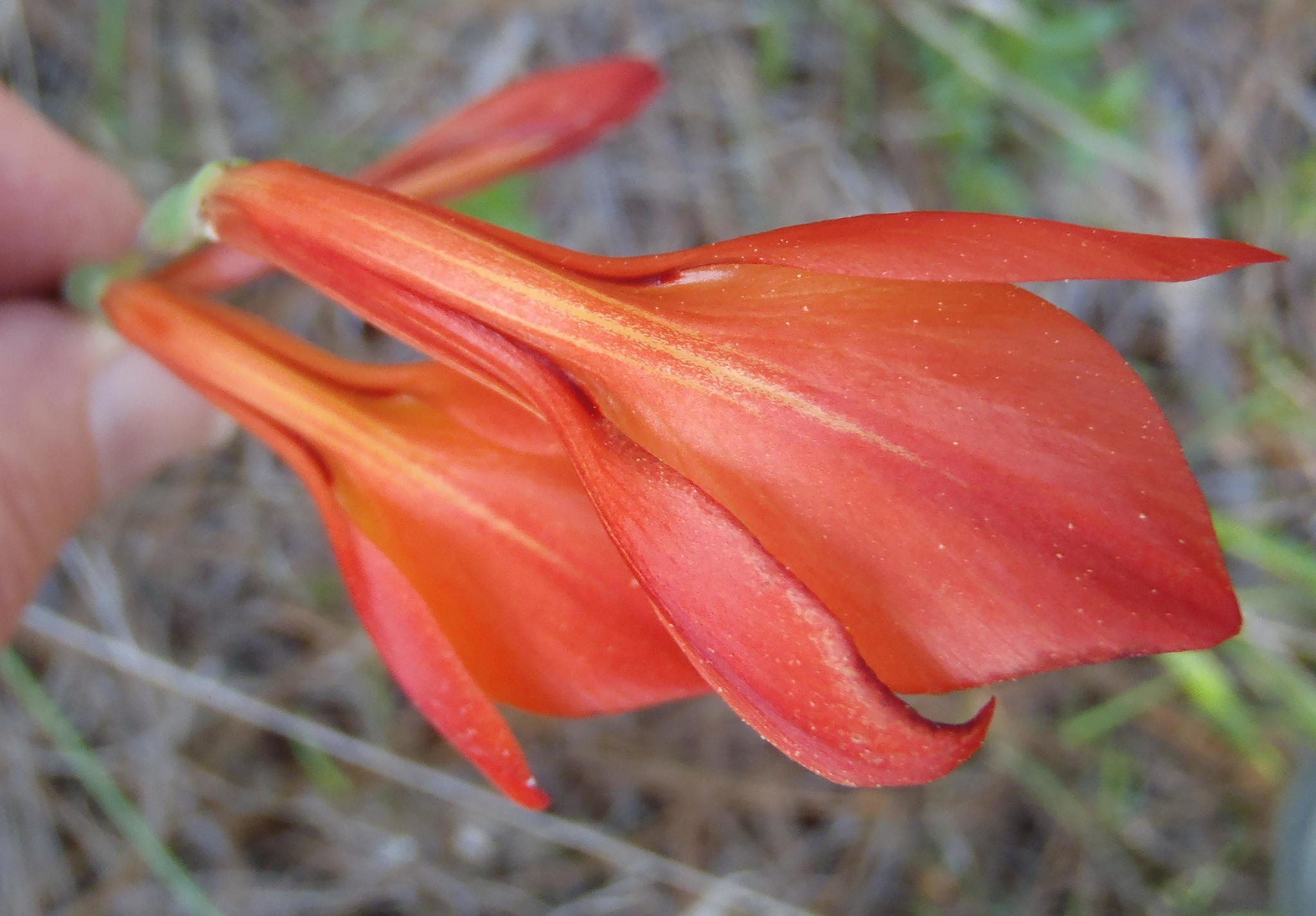
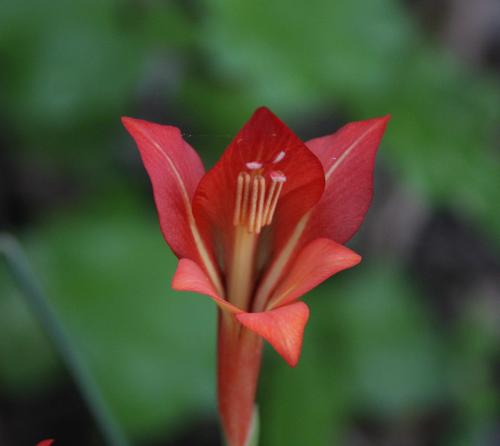
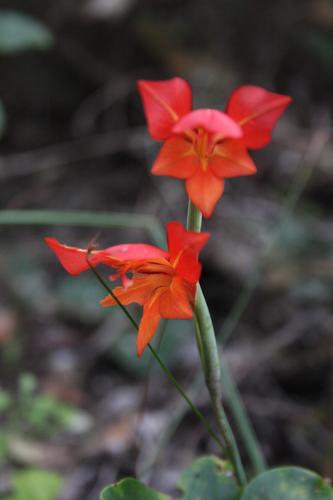
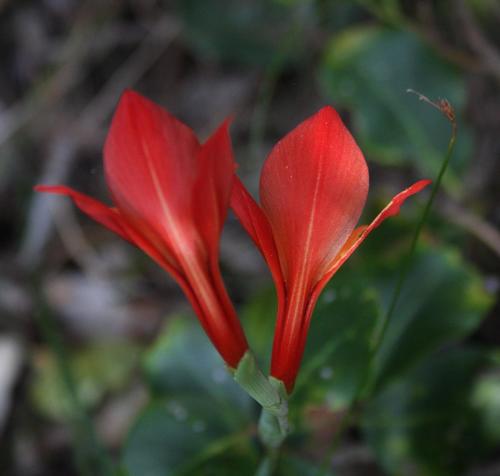
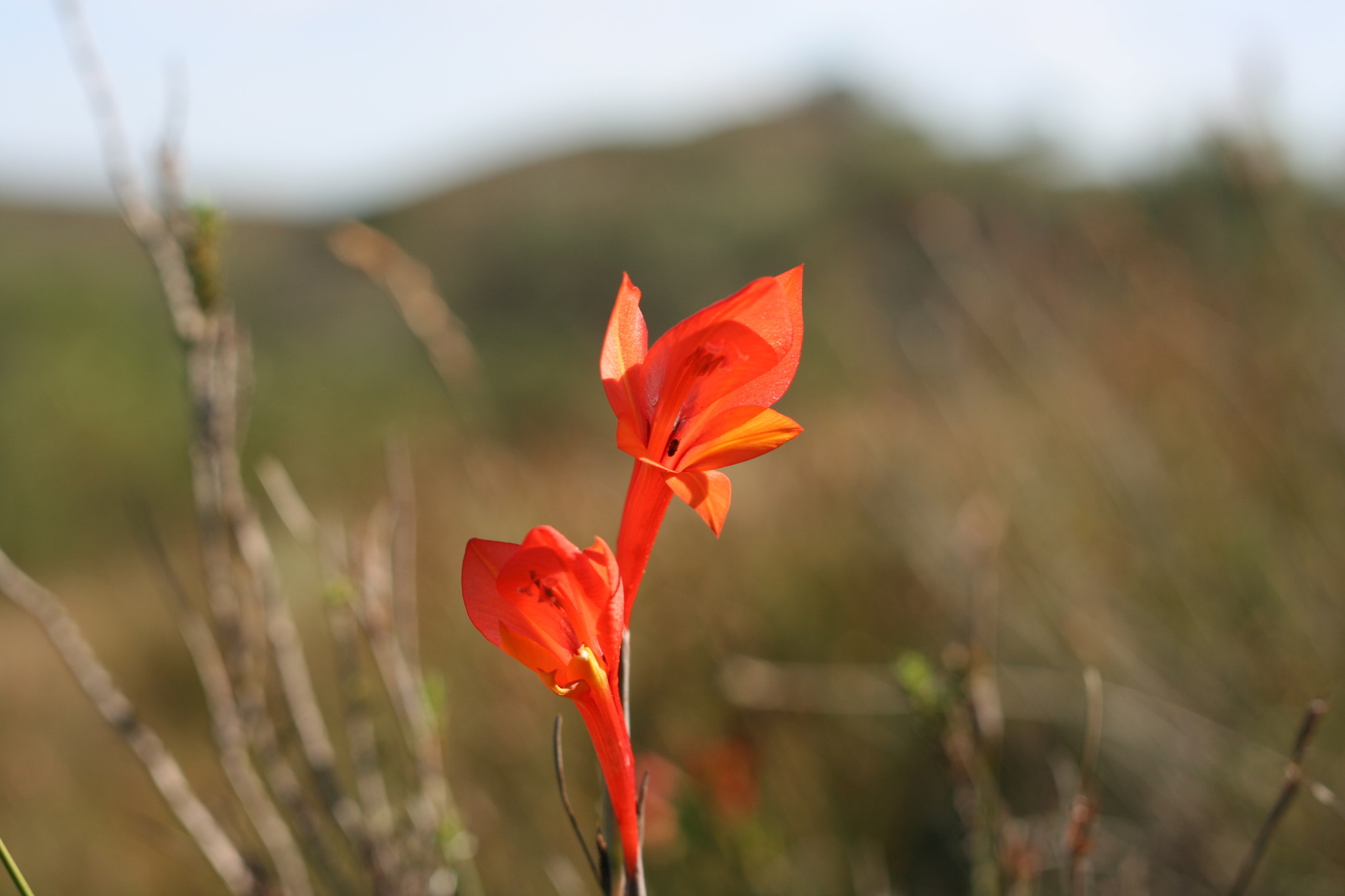
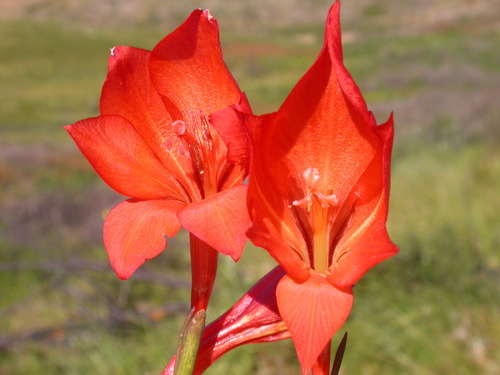
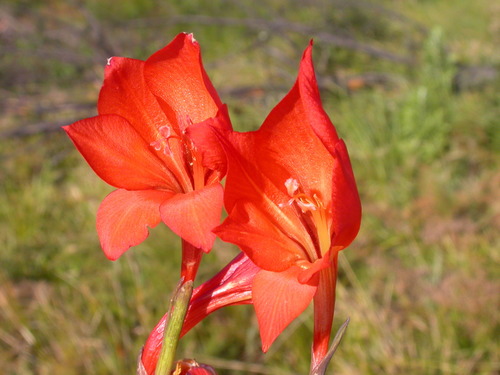
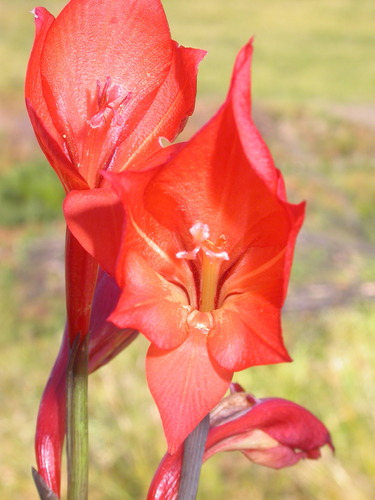
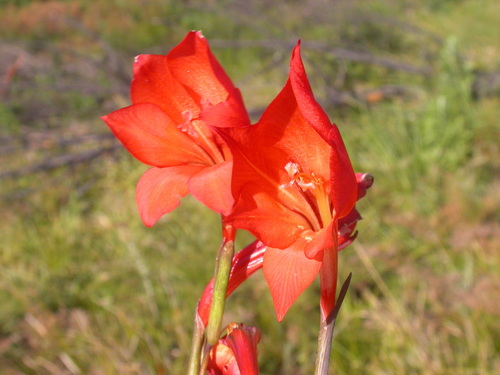
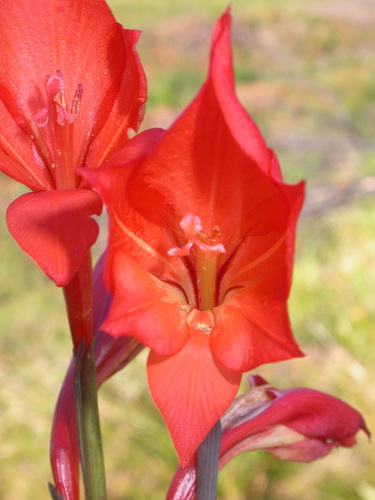
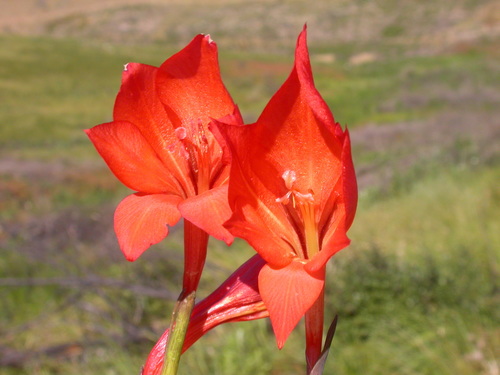
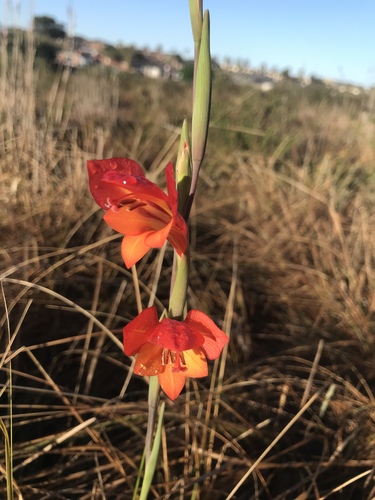
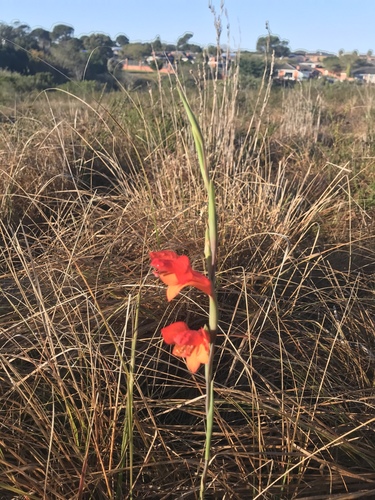
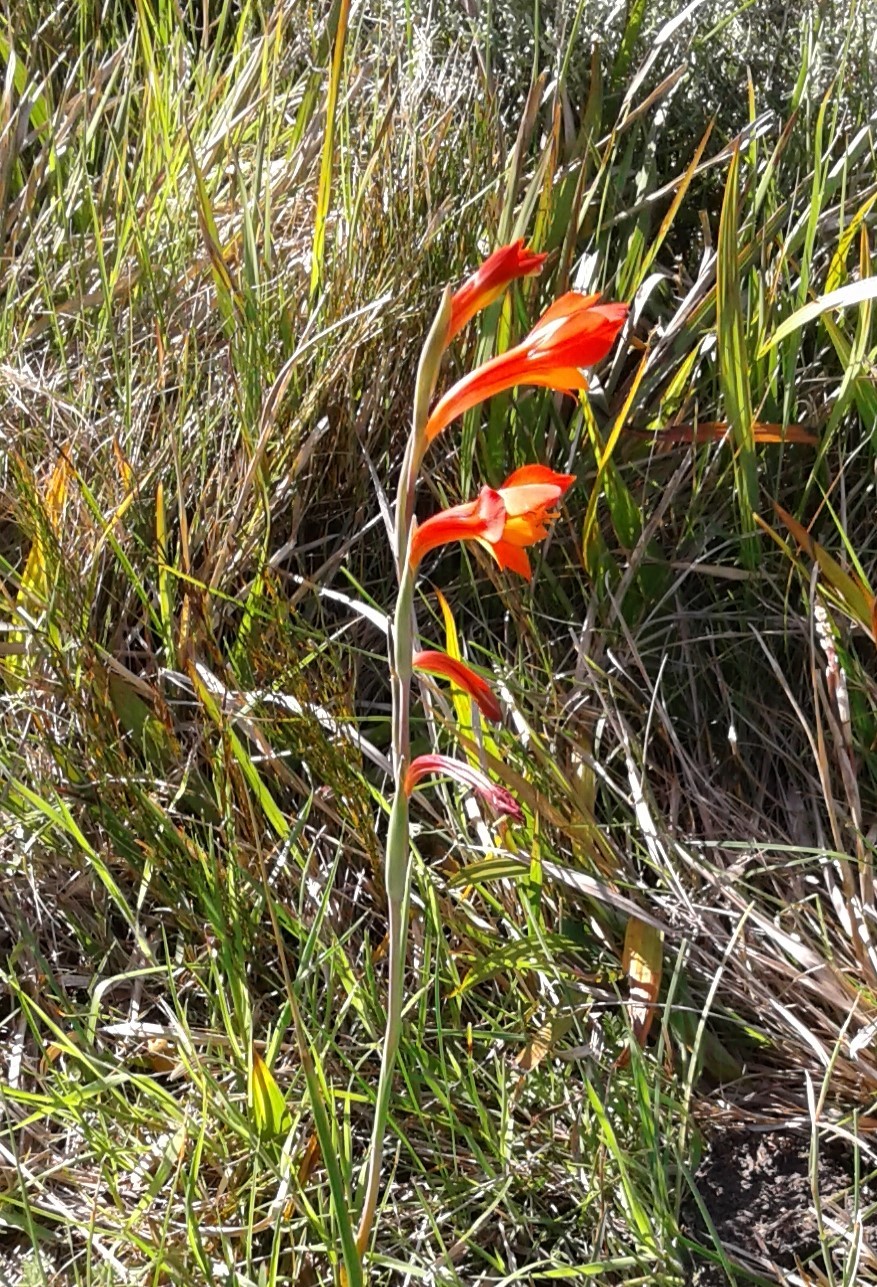
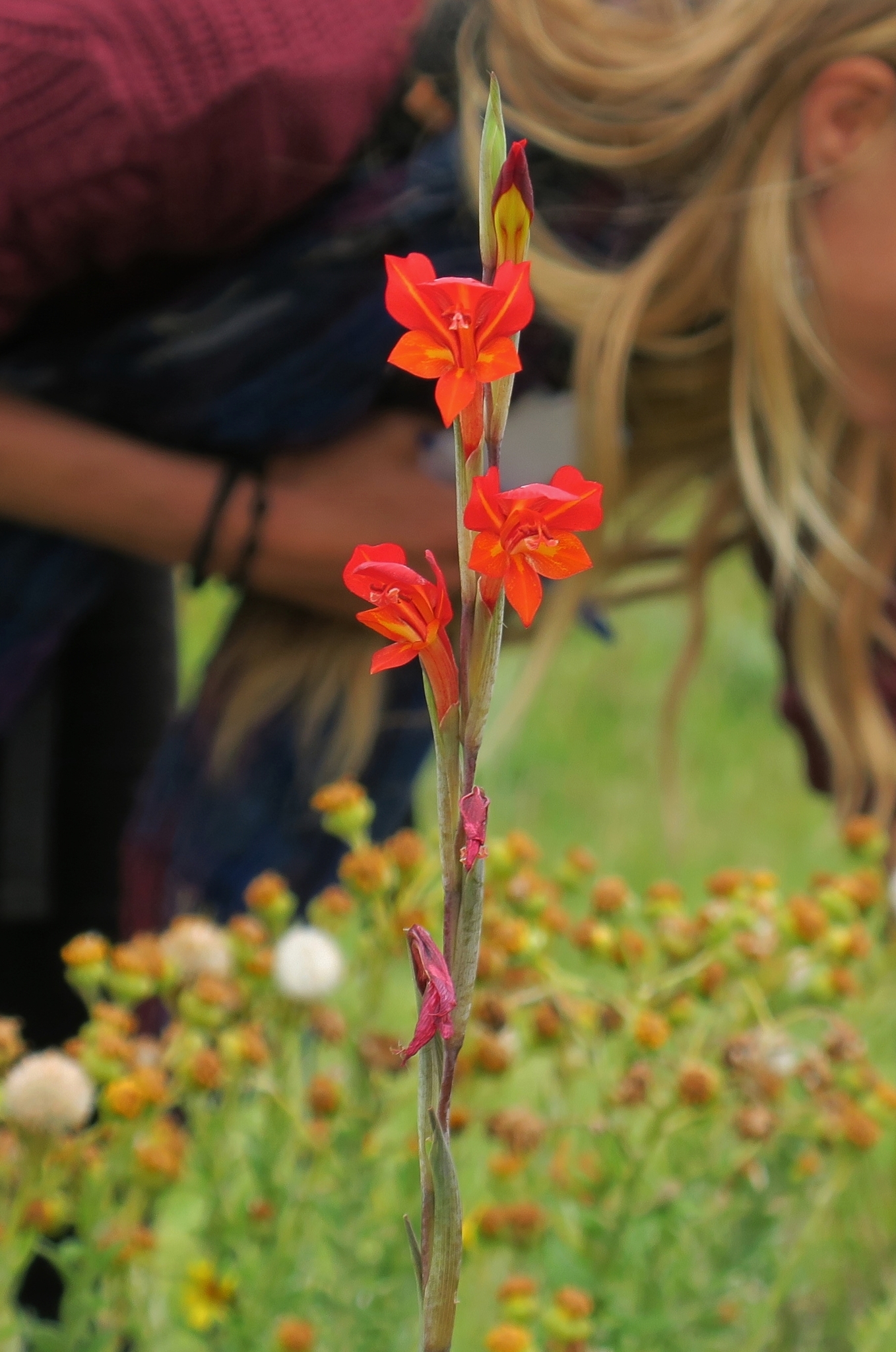
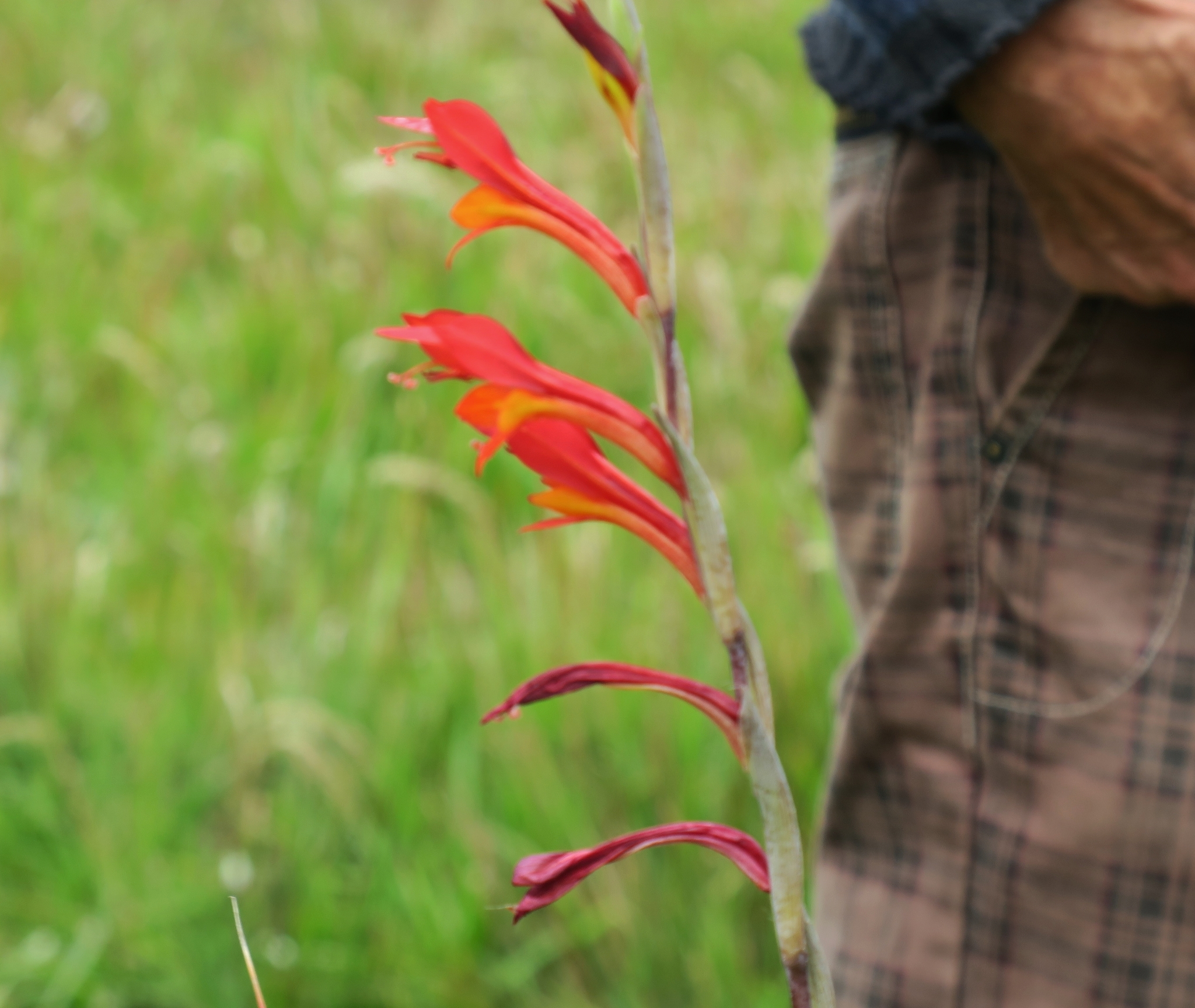
Plants 200-450(-800) mm high. Corm globose, 8-12 mm diam.; tunics cartilaginous, splitting from below into coarse fibres or woody segments. Stem very lightly flexed above sheathing part of second leaf, unbranched. Leaves 3, lower 2 basal, lowermost markedly longest, sheathing only near ground, ± as long or slightly longer than spike, centric and cross-shaped in section with main vein raised into flanges up to 1.2 as wide as blade, 2-3 mm wide, second leaf sheathing lower 2/3 of stem, blade short, uppermost leaf inserted in upper 1/3 of stem. Spike erect or very slightly inclined, 3- or 4(8)-flowered; bracts green or flushed purple, outer 30-55 mm long, clasping stem below, seldom exceeding lower part of tube, inner slightly shorter, notched. Flowers orange-red, dorsal tepal with broad translucent edges in lower 1/2, lower tepals light orange to yellow in lower half, sometimes yellow on reverse, reverse of tube with deep red along tepal sutures, unscented; perianth tube 50-53 mm long, narrow and cylindric below for 20-32 mm, abruptly expanded into a tubular upper part 22-33 mm long, 5-6.5 mm wide, ascending; tepals broadly lanceolate, dorsal largest, ascending, 25-40 x 15-25 mm, upper laterals 22-32 x 12-18 mm, spreading in upper 1/2, lower 3 tepals much smaller, lower laterals 12-20 x 10-14 mm, lower median 13-22 x 7-10 mm. Filaments 32-45 mm long, exserted 13-15 mm from tube; anthers 8-10 mm long, orange; pollen yellow. Style arching over stamens, dividing at or shortly beyond anther apices, branches ± 4 mm long. Capsules elongate-ellipsoid, 38-40 mm long, as long or slightly longer than outer bracts. Seeds oval, 5-6 x 3.5-4.5 mm, usually broadly and evenly winged. From: Goldblatt, P; Manning, JC. 2020. Iridaceae of southern Africa. Strelitzia 42: 1-1159. South African National Biodiversity Institute, Pretoria. [CC BY]
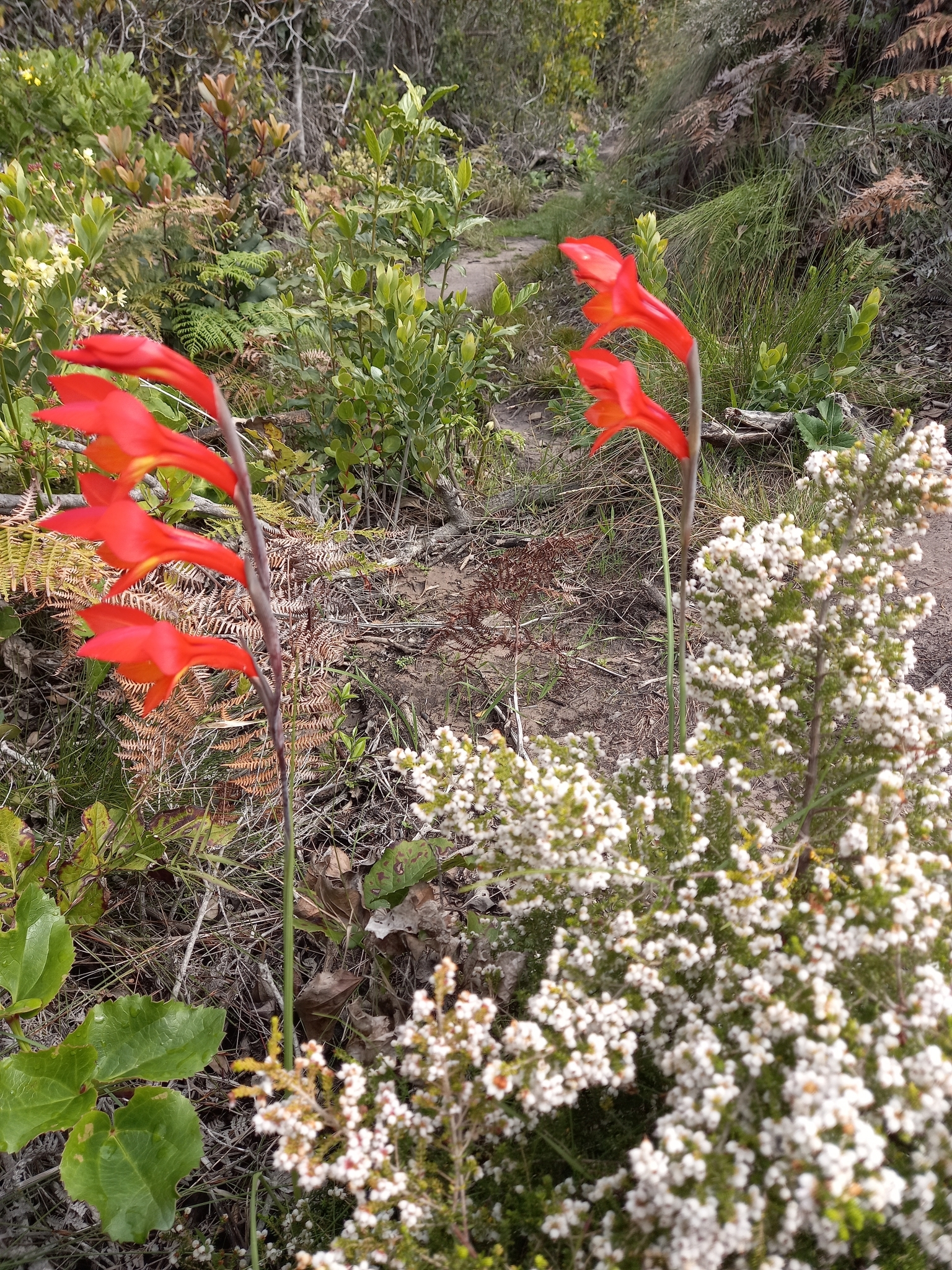
Perennial herb, geophyte, 0.3-0.6 m high; corm globose, tunics of firm cartilaginous layers; stem erect, lightly flexed above, simple. Leaves 3, erect or trailing above, 2.5-4.0 mm wide, centric; midribs raised. Bracts green or flushed purple. Inflorescence a 3- or 4-flowered spike, erect or slightly inclined; flowers orange-red, dorsal tepal with broad translucent edges below, lower tepals light orange to yellow below, sometimes yellow on reverse; perianth tube narrow and cylindric below, ascending; tepals unequal, broadly lanceolate, the dorsal largest, ascending. Stamens exserted; anthers orange; pollen yellow. Ovary cylindrical; style arching over stamens, branches broad above. Flowering time July-Dec. Capsule elongate-ellipsoid. From: Bredenkamp, CL; Magwaza, ZL. 2019. Iridaceae. In: CL Bredenkamp (ed.), A Flora of the Eastern Cape Province. Strelitzia 41(3): 1821-1882. South African National Biodiversity Institute, Pretoria. [CC BY]
Cormous geophyte, 30-60 cm, tunics coarsely fibrous. Leaves cross-shaped in section. Flowers long-tubed, red to orange with cylindrical tube streaked maroon, lower tepals smaller and sometimes yellow. From: Manning, JC; Goldblatt, P. 2012. Iridaceae. In: J Manning & P Goldblatt (eds), Plants of the Greater Cape Floristic Region 1: The Core Cape flora. Strelitzia 29: 119-176. South African National Biodiversity Institute, Pretoria. [CC BY]
Recognised by the long lower leaf with x-shaped blade and the large, orange flowers with dimorphic tube 50-53 mm long marked with characteristic red longitudinal lines, and the reduced lower tepals ± half as large as the upper. From: Goldblatt, P; Manning, JC. 2020. Iridaceae of southern Africa. Strelitzia 42: 1-1159. South African National Biodiversity Institute, Pretoria. [CC BY]
Loam or clay soils. From: Goldblatt, P; Manning, JC. 2020. Iridaceae of southern Africa. Strelitzia 42: 1-1159. South African National Biodiversity Institute, Pretoria. [CC BY]
In fertile soils derived from sandstones. Eastern Fynbos-Renosterveld, Albany Thicket. From: Bredenkamp, CL; Magwaza, ZL. 2019. Iridaceae. In: CL Bredenkamp (ed.), A Flora of the Eastern Cape Province. Strelitzia 41(3): 1821-1882. South African National Biodiversity Institute, Pretoria. [CC BY]
Sandstone slopes. From: Manning, JC; Goldblatt, P. 2012. Iridaceae. In: J Manning & P Goldblatt (eds), Plants of the Greater Cape Floristic Region 1: The Core Cape flora. Strelitzia 29: 119-176. South African National Biodiversity Institute, Pretoria. [CC BY]
Restricted to the southern coastal plain of Eastern Cape, South Africa, from Plettenberg Bay to East London and inland to near Grahamstown. From: Goldblatt, P; Manning, JC. 2020. Iridaceae of southern Africa. Strelitzia 42: 1-1159. South African National Biodiversity Institute, Pretoria. [CC BY]
Plettenberg Bay to Grahamstown. From: Manning, JC; Goldblatt, P. 2012. Iridaceae. In: J Manning & P Goldblatt (eds), Plants of the Greater Cape Floristic Region 1: The Core Cape flora. Strelitzia 29: 119-176. South African National Biodiversity Institute, Pretoria. [CC BY]
August to September
30 to 685 m
This map contains point-based occurrences at different locations
 This is a sensitive species therefore data has been redacted, click here to login.
Occurrence in the Flora of Southern Africa (FSA) countries and South African provinces. Residence status indicates if a taxon is indigenous, endemic, naturalised or invasive in a specific region. This data is based on specimen records and literature
FSA
SA
BOT
NAM
ESW
LES
WC
EC
NC
FS
GA
KZN
LP
MP
NW
Absent
Indigenous
Endemic
Naturalised
Invasive

Names and Sources
Homoglossum hollandii L.Bolus
Homoglossum hollandii L.Bolus var. hollandii
Homoglossum hollandii L.Bolus var. zitzikammense L.Bolus
Homoglossum huttonii N.E.Br.
| Common name | Language | Reference/barcode | Published as |
|---|---|---|---|
| Eastern Cape flame | English | Manning, JC; Goldblatt, P. 2012. Iridaceae. In: J Manning & P Goldblatt (eds), Plants of the Greater Cape Floristic Region 1: The Core Cape flora. Strelitzia 29: 119-176. South African National Biodiversity Institute, Pretoria. |
Classification
KINGDOM Plantae
SUBKINGDOM Phanerogamae
PHYLUM Anthophyta
ORDER Asparagales
FAMILY Iridaceae
SUBFAMILY Crocoideae
TRIBE Ixieae
GENUS Gladiolus
SPECIES huttonii
45 results for Gladiolus huttonii (N.E.Br.) Goldblatt & M.P.de Vos
Year
Barcode: PRE0083179-0 Collector(s) & number: Sidey, JL, 1687 | 1949-9-21
Data Resource: BODATSA View record
Barcode: PRE0819986-0 Collector(s) & number: Lange, PW, 17 | 1965-9-15
Data Resource: BODATSA View record
Barcode: PRE0083177-0 Collector(s) & number: Daly, MF, 298 | 1902-10-1
Data Resource: BODATSA View record
Barcode: NBG0064942-0 Collector(s) & number: Loubser, JW, 896 | 1958-9-5
Data Resource: BODATSA View record
Barcode: NH0006382-0 Collector(s) & number: Schonland, S, 761 | 1893-9-
Data Resource: BODATSA View record
Barcode: PRE0083174-0 Collector(s) & number: Schonland, S, 761 | 1893-9-
Data Resource: BODATSA View record
Barcode: PRE0612862-0 Collector(s) & number: Germishuizen, G, 1483 | 1980-12-6
Data Resource: BODATSA View record
Barcode: NBG0180798-0 Collector(s) & number: De Vos, M, 2292 | 1973-9-28
Data Resource: BODATSA View record
Barcode: PRE0083176-0 Collector(s) & number: Liversidge, R, A183 | 1965-8-17
General notes: PL16 No.3.
Data Resource: BODATSA View record
Barcode: PRE0592745-0 Collector(s) & number: Bolus, HML, BOL 20077 | 1931-7-
General notes: ISOLECTOTYPE of Homoglossum hollandii L.Bolus = G. huttonii Bought from flower sellers.
Data Resource: BODATSA View record
Barcode: PRE0857490-0 Collector(s) & number: Jacobsen, NHG, 6532 | 2010-8-11
General notes: FFs 29 Algoa Sandstone Fynbos. Partial shade to full sun. Slope: gentle. Locally uncommon. Plants recorded at one site. Recently burnt and surrounded by alien vegetation. Erect geophyte with carmine and yellow flowers. Plant height: 50 - 60cm.
Data Resource: BODATSA View record
Barcode: PRE0083172-0 Collector(s) & number: Bolus, HML, BOL 20077 | 1931-7-
General notes: ISOLECTOTYPE of Homoglossum hollandii L.Bolus = G. huttonii Bought from flower sellers.
Data Resource: BODATSA View record
Barcode: NBG0064944-0 Collector(s) & number: Acocks, JPH, 21290 | 1960-8-5
General notes: False fynbos. Locally frequent especially in potato land. Flowers bright red and lower petals yellow.
Data Resource: BODATSA View record
Barcode: PRE0083182-0 Collector(s) & number: Galpin, EE, 66 | 1888--
General notes: Fl. Aug.--Sept.
Data Resource: BODATSA View record
Barcode: NBG0078658-0 Collector(s) & number: Bayliss, RDA, 2318 | 1964-9-4
General notes: Flowers orange scarlet. Fine rolled leaf to 33". Grassland on ridge.
Data Resource: BODATSA View record
Barcode: PRE0112828-0 Collector(s) & number: Rodin, RJ, 1050 | 1947-8-26
Data Resource: BODATSA View record
Barcode: NBG0175853-0 Collector(s) & number: Keet, JDM, 537 | --
General notes: On sandy soil near mouth of river. Plant 2'. Yellow-brown. Common in small localities.
Data Resource: BODATSA View record
Barcode: NBG0064941-0 Collector(s) & number: Immelman, E, 86 | 1949-7-5
General notes: In rich black soil. Orange. Height: 18". Corm. Not very common.
Data Resource: BODATSA View record
Barcode: NBG0011119-0 Collector(s) & number: MacPherson, S, 14 | 1957--
General notes: Red/ orange.
Data Resource: BODATSA View record
Barcode: NBG0052725-0 Collector(s) & number: Wurts, TM, 2131 | 1961-9-13
General notes: Red. Occasional.
Data Resource: BODATSA View record
Barcode: PRE0083181-0 Collector(s) & number: Ecklon, CF, 141 | -8-
Data Resource: BODATSA View record
Barcode: PRE0083178-0 Collector(s) & number: Rogers, FA, 26713 | 1921-11-
Data Resource: BODATSA View record
Barcode: PRE0083175-0 Collector(s) & number: Long, FR, 659 | 1932-7-31
Data Resource: BODATSA View record
Barcode: PRE0083180-0 Collector(s) & number: Acocks, JPH, 21290 | 1960-8-5
Data Resource: BODATSA View record
Barcode: NBG0175852-0 Collector(s) & number: Fourcade, HG, 4006 | 1928-9-
Data Resource: BODATSA View record
Barcode: PRE0239704-0 Collector(s) & number: Fourcade, HG, 4006 | 1928-9-
Data Resource: BODATSA View record
Barcode: NBG0077152-0 Collector(s) & number: Thomas, M, s.n. | 1960-8-20
General notes: Flowers scarlet and orange-yellow, lower margins of dorsal lobe translucent. Yellow median stripe on uppper laterals and shorter broader ones in lower half of 3 lower. Fl. hort M. Thomas.
Data Resource: BODATSA View record
Barcode: PRE0112832-0 Collector(s) & number: Daly, MF, 298 | 1902-9-
Data Resource: BODATSA View record
Barcode: NBG0180795-0 Collector(s) & number: De Vos, M, 2291 | 1973-9-28
General notes: Common. ( = H. hollandii L. Bol)
Data Resource: BODATSA View record
Barcode: NBG0064943-0 Collector(s) & number: Urton, NR, s.n. | 1961-6-14
General notes: On S-facing slope overlooking sea in dense grass, bracken etc. Flowers reddish and yellow.
Data Resource: BODATSA View record
Barcode: PRE0592744-0 Collector(s) & number: Bolus, HML, BOL 20077 | 1931-7-
General notes: ISOLECTOTYPE of Homoglossum hollandii L.Bolus = G. huttonii Bought from flower sellers.
Data Resource: BODATSA View record
Barcode: NBG0067056-0 Collector(s) & number: Bokelmann, HL, 1Plate20 | 1962-7-
General notes: Grassveld - open. Flower bright red and yellow. Plant height: 2'.
Data Resource: BODATSA View record
This map contains point-based occurrences at different locations
This is a sensitive species therefore data has been redacted, click here to login.
2020
SERIES
Iridaceae of southern Africa Goldblatt, P; Manning, JCStrelitzia 42: 1-1159
South African National Biodiversity Institute, Pretoria
2019
SERIES CHAPTER
Iridaceae Bredenkamp, CL; Magwaza, ZLIn: CL Bredenkamp (ed.), A Flora of the Eastern Cape Province. Strelitzia 41(3)1821-1882
South African National Biodiversity Institute, Pretoria
2012
SERIES CHAPTER
Iridaceae Manning, JC; Goldblatt, PIn: J Manning & P Goldblatt (eds), Plants of the Greater Cape Floristic Region 1: The Core Cape flora. Strelitzia 29: 119-176
South African National Biodiversity Institute, Pretoria
1998
1989
1933
1932
No results found for Gladiolus huttonii (N.E.Br.) Goldblatt & M.P.de Vos
Status and criteria
VU
Assessor(s)
Plantae Coordinator
JOURNAL ARTICLE
Knoop, M.-C. and Owen-Smith, N. 2006. Foraging ecology of roan antelope: key resources during critical periods. African Journal of Ecology. 44:228-236
BOOK SECTION
Chardonnet, P. and Crosmary, W. 2013. <i>Hippotragus equinus</i>. Edited by J. S. Kingdon and M. Hoffmann. The Mammals of Africa. Academic Press
JOURNAL ARTICLE
Erasmus, B.F.N., van Jaarsveld, A.S., Chown, S.L., Kshatriya, M. and Wessels, K.J. 2002. Vulnerability of South African animal taxa to climate change. Global Change Biology. 8:679-693
JOURNAL ARTICLE
Kröger , R., and Rogers, K.H. 2005. Roan (Hippotragus equinus) population decline in Kruger National Park, South Africa: influence of a wetland boundary. European Journal of Wildlife Research. 51:25-30
JOURNAL ARTICLE
Heitkönig, I.M.A & Owen-Smith, N. 1998. Seasonal selection of grass swards by roan antelope in a South African savanna. African Journal of Ecology. 36:57-70
JOURNAL ARTICLE
Dorgeloh, W.G. 1998. Habitat selection of a roan antelope (Hippotragus equinus) in mixed bushveld, Nylsvlei Nature Reserve. South African Journal of Wildlife Research. 47:47 – 57
JOURNAL ARTICLE
Dorgeloh, W.G., Van Hoven, W. and Rethman, N.G. 1996. Population growth of roan antelope under different management systems. South African Journal of Wildlife Research. 26:113-116
JOURNAL ARTICLE
Owen-Smith, N., Chirimia, G.J., Macandza, V. and Le Roux, E. 2012. Shrinking sable antelope numbers in Kruger National Park: what is suppressing population recovery?. Animal Conservation. 15:195–204
| Part(s) of plant used | Use(s) | Reference |
|---|
Coming soon...