PLANTAE / PHANEROGAMAE / ANTHOPHYTA / ASTERALES / ASTERACEAE / ASTEROIDEAE / SENECIONEAE / CINERARIA / LONGIPES

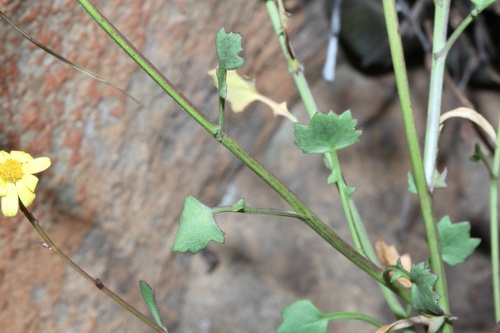
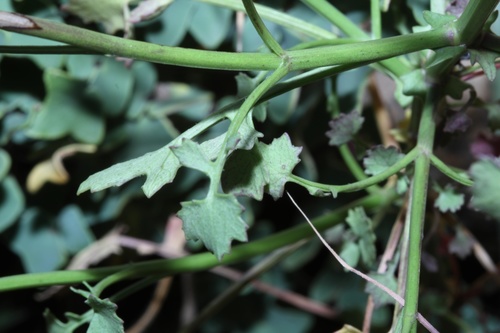
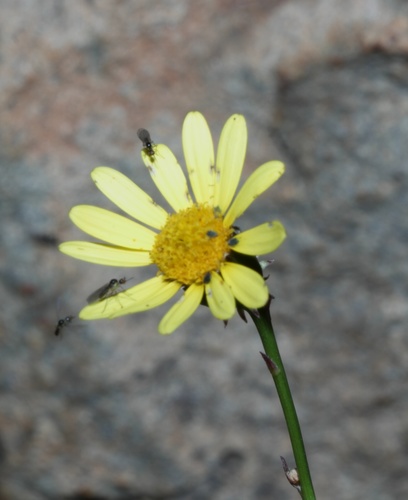
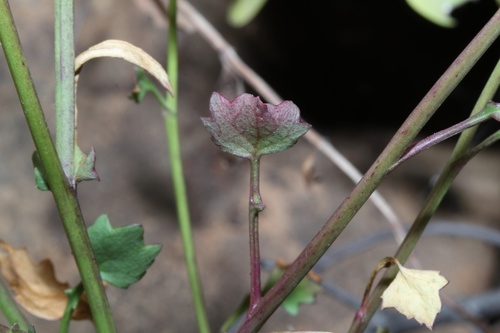
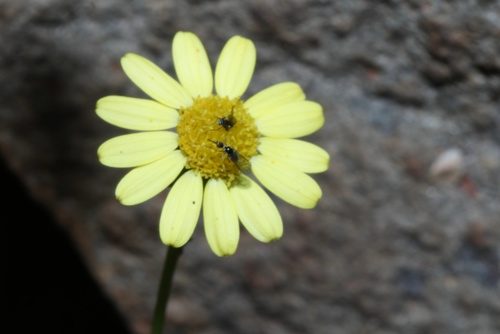
Perennial herbs or subshrublets, to about 0.6 m tall. Stems woody towards the base, usually slender, 2.0-4.0(-5.0) mm in diameter, branching mainly near the base, usually glabrous, occasionally sparsely hairy, but densely hairy or cobwebby, glabrescent in some forms. Leaves deltoid-reniform to reniform, distinctly (rarely shallowly)5-7-lobed, sometimes with one or two pairs of lateral pinnae on upper leaves; lamina 6-58 x 8-64 mm, glabrous, rarely sparsely hairy on veins below and at junction with petiole, very hairy in some forms, thinly cobwebby, glabrescent in others; apex obtuse to rounded (rarely acute); margin dentate; base truncate to subcordate to cordate; petiole 6-72(-87) mm long, glabrous or sparsely hairy (hairy in some forms, cobwebby glabrescent in some northern specimens), with white woolly hairs in axils; auricles present, small or conspicuous, persistent or caducous, auriform in the Western and Eastern Cape, lanceolate in the northern subspecies. Capitula heterogamous, radiate, few (2-12) to many (14-90) per stem branch (rarely as many as 120), usually small, arranged in a lax panicle (rarely compact); peduncles 2-55(-65) mm long, glabrous (or hairy in some forms, cobwebby, glabrescent in some northern specimens), bracteate. Involucre with few calyculus bracts, often descending peduncle; phyllaries (5-)8-10(-13), 3-5(-6) mm long, glabrous (or hairy in some south-western Cape forms); margins scarious. Ray florets (3-)5(-8, rarely 9), 3.5-7.5(-12.5) mm long; limb 3.0-6.0(-9.5) mm, 4-veined (rarely 6-veined). Disc florets (7-)16-28(-43); corolla 3.0-5.0 mm long. Cypselae obovate (to narrowly obovate in C. lobata subsp. lasiocaulis), laterally compressed, margined to narrow-winged, ray cypselae with broad wings in Eastern Cape forms, brown or dark brown (to black) with paler margin or wing, 2.0-4.0 mm long, ciliate and hairy to sparsely hairy on faces, inner faces often less hairy than outer, some almost glabrous. Pappus of scabrid bristles, usually two thirds of disc corolla length. From: Cron, GV; Balkwill, K; Knox, EB. 2006. A revision of the genus Cineraria (Asteraceae, Senecioneae). Kew Bull. 61(4): 449-535. [http://www.jstor.org/stable/20443295] [All rights reserved]
Herb. Leaves reniform-cordate, glabrous; petioles auricled. Achenes glabrous. From: Retief, E; Herman, PPJ. 1997. Plants of the northern provinces of South Africa: Keys and diagnostic characters. Strelitzia 6: 1-681. National Botanical Institute, Pretoria. [CC BY]
This species, based on specimens collected by Rand from the Klipriviersberg, south of Johannesburg, was uncollected for 45 years, until it was rediscovered after a determined search over a number of years in the hills in the southern suburbs of Johannesburg. It has since been rediscovered in both the Klipriviersberg Nature Reserve and the Suikerbosrand Nature Reserve, near Heidelberg. Cineraria longipes is a fairly weak (possibly short-lived) perennial herb, recognisable by its solitary or few capitula on relatively long glabrous peduncles, shallowly-lobed reniform (to deltoid-reniform) leaves with long petioles. The leaves are entirely glabrous and their base is characteristically cuneate to truncate. It could possibly be confused with C. lobata, but has glabrous cypselae, as opposed to the ciliate and hairy cypselae in that species, and generally larger capitula. From: Cron, GV; Balkwill, K; Knox, EB. 2006. A revision of the genus Cineraria (Asteraceae, Senecioneae). Kew Bull. 61(4): 449-535. [http://www.jstor.org/stable/20443295] [All rights reserved]
In grassland and seeps on south-and south-east-facing slopes of hills, amongst rocks and often associated with Protea caffra Meisn., Cussonia paniculata Eckl. & Zeyh. and ferns such as Pteridium and Cheilanthes, Ventersdorp Basic Lava or basalt. From: Cron, GV; Balkwill, K; Knox, EB. 2006. A revision of the genus Cineraria (Asteraceae, Senecioneae). Kew Bull. 61(4): 449-535. [http://www.jstor.org/stable/20443295] [All rights reserved]
South Africa, endemic to Gauteng, in the koppies/hills to the south and south-east of Johannesburg, notably in the Klipriviersberg. From: Cron, GV; Balkwill, K; Knox, EB. 2006. A revision of the genus Cineraria (Asteraceae, Senecioneae). Kew Bull. 61(4): 449-535. [http://www.jstor.org/stable/20443295] [All rights reserved]
August to January
0 to 1850 m
This map contains point-based occurrences at different locations
Occurrence in the Flora of Southern Africa (FSA) countries and South African provinces. Residence status indicates if a taxon is indigenous, endemic, naturalised or invasive in a specific region. This data is based on specimen records and literature
FSA
SA
BOT
NAM
ESW
LES
WC
EC
NC
FS
GA
KZN
LP
MP
NW
Absent
Indigenous
Endemic
Naturalised
Invasive

Names and Sources
No synonyms found.
Classification
KINGDOM Plantae
SUBKINGDOM Phanerogamae
PHYLUM Anthophyta
ORDER Asterales
FAMILY Asteraceae
SUBFAMILY Asteroideae
TRIBE Senecioneae
GENUS Cineraria
SPECIES longipes
9 results for Cineraria longipes S.Moore
Barcode: PRE0211003-0 Collector(s) & number: Pehrsson, A, TRV 5114 | 1908--
South Africa, Gauteng, JOHANNESBURG
Data Resource: BODATSA View record
Barcode: PRE0211045-0 Collector(s) & number: Murray, DP, 357 | 1927-4-
South Africa, Gauteng, HEIDELBERG
Data Resource: BODATSA View record
Barcode: PRE0582742-0 Collector(s) & number: Cron, GV, 336 | 1996-5-6
South Africa, Gauteng, Johannesburg District: Naturena. Koppie, amongst rocks.
Data Resource: BODATSA View record
Barcode: PRE0582743-0 Collector(s) & number: Cron, GV, 304 | 1994-4-24
South Africa, Gauteng, Johannesburg District: Mondeor. Near Riverside Road, possibly Thorntree Kloof.
General notes: Erect herb, slightly shrubby. Branching from base. Involucral bracts 13-14, tips still purplish. Calyculus bracts also purple-tipped. Capitula yellow. Ray florets 13.
Data Resource: BODATSA View record
Barcode: PRE0838881-0 Collector(s) & number: Cron, GV, 306 | 1995-6-2
South Africa, Gauteng, Johannesburg District: Mondeor; Near Riverside Road, possibly Thorntree Kloof. Kloof, in seepage.
Data Resource: BODATSA View record
Barcode: PRE0838880-0 Collector(s) & number: Cron, GV, 302 | 1994-4-5
South Africa, Gauteng, Johannesburg District: Mondeor; Near Riverside Road, Possibly Thorntree Kloof. Kloof, in seepage.
Data Resource: BODATSA View record
Barcode: PRE0872411-0 Collector(s) & number: Cron, GV, 485 | 1998-5-7
South Africa, Gauteng, Heidelberg District, Suikerbosrand Nature Reserve. Bokmakierie Trail, after crossing tourist route road.
General notes: Special collection (s): WITWATERSRAND.
Data Resource: BODATSA View record
This map contains point-based occurrences at different locations
2006
PERIODICAL/JOURNAL
A revision of the genus Cineraria (Asteraceae, Senecioneae) Cron, GV; Balkwill, K; Knox, EBKew Bulletin 61(4)449-535
1997
SERIES
Plants of the northern provinces of South Africa: Keys and diagnostic characters Retief, E; Herman, PPJStrelitzia 6: 1-681
National Botanical Institute, Pretoria
No results found for Cineraria longipes S.Moore
Status and criteria
VU
Assessor(s)
Plantae Coordinator
| Part(s) of plant used | Use(s) | Reference |
|---|
Coming soon...