
ANIMALIA / ARTHROPODA / INSECTA / DIPTERA / MYDIDAE / ARENOMYDAS / CAERULESCENS
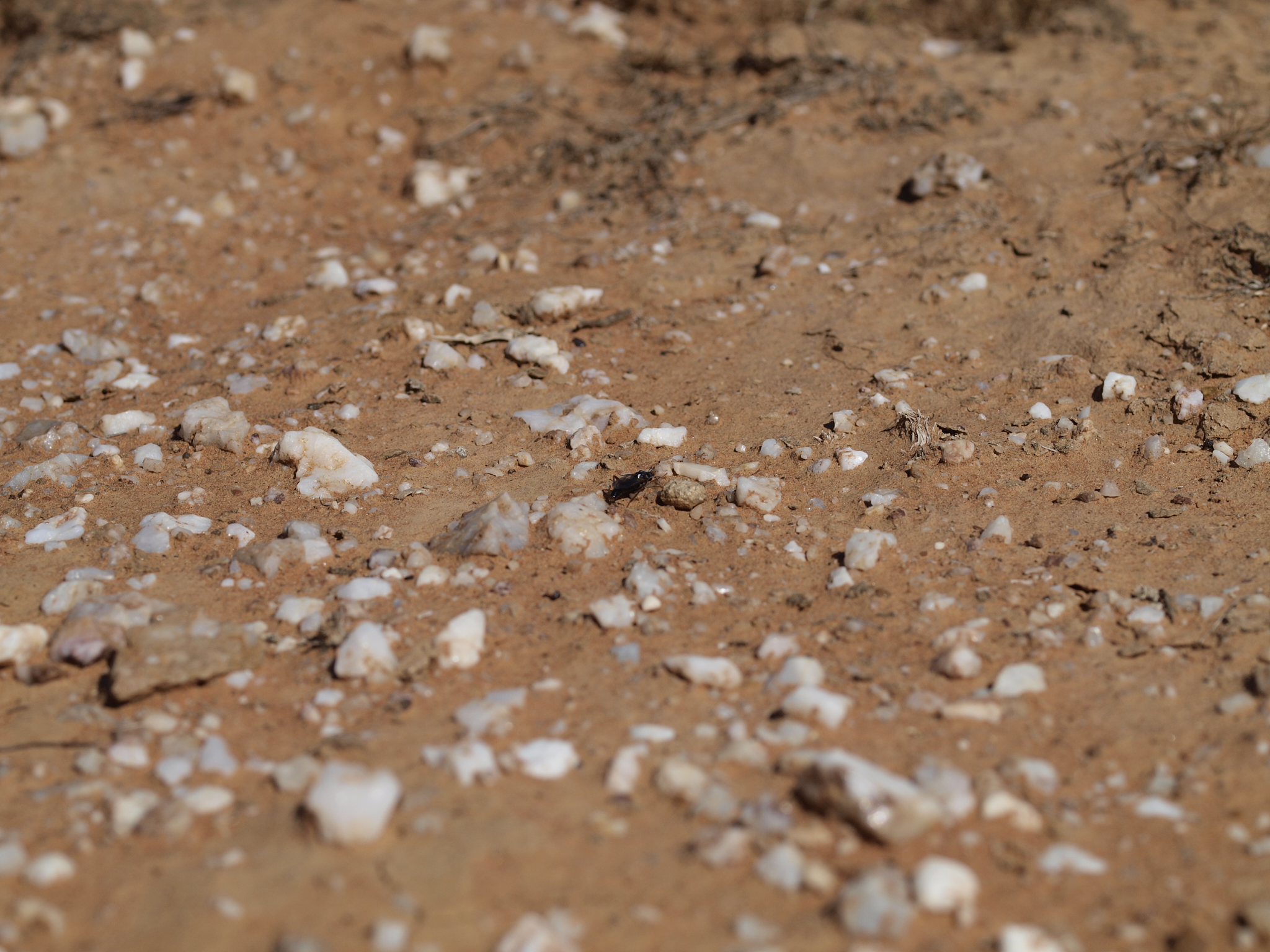
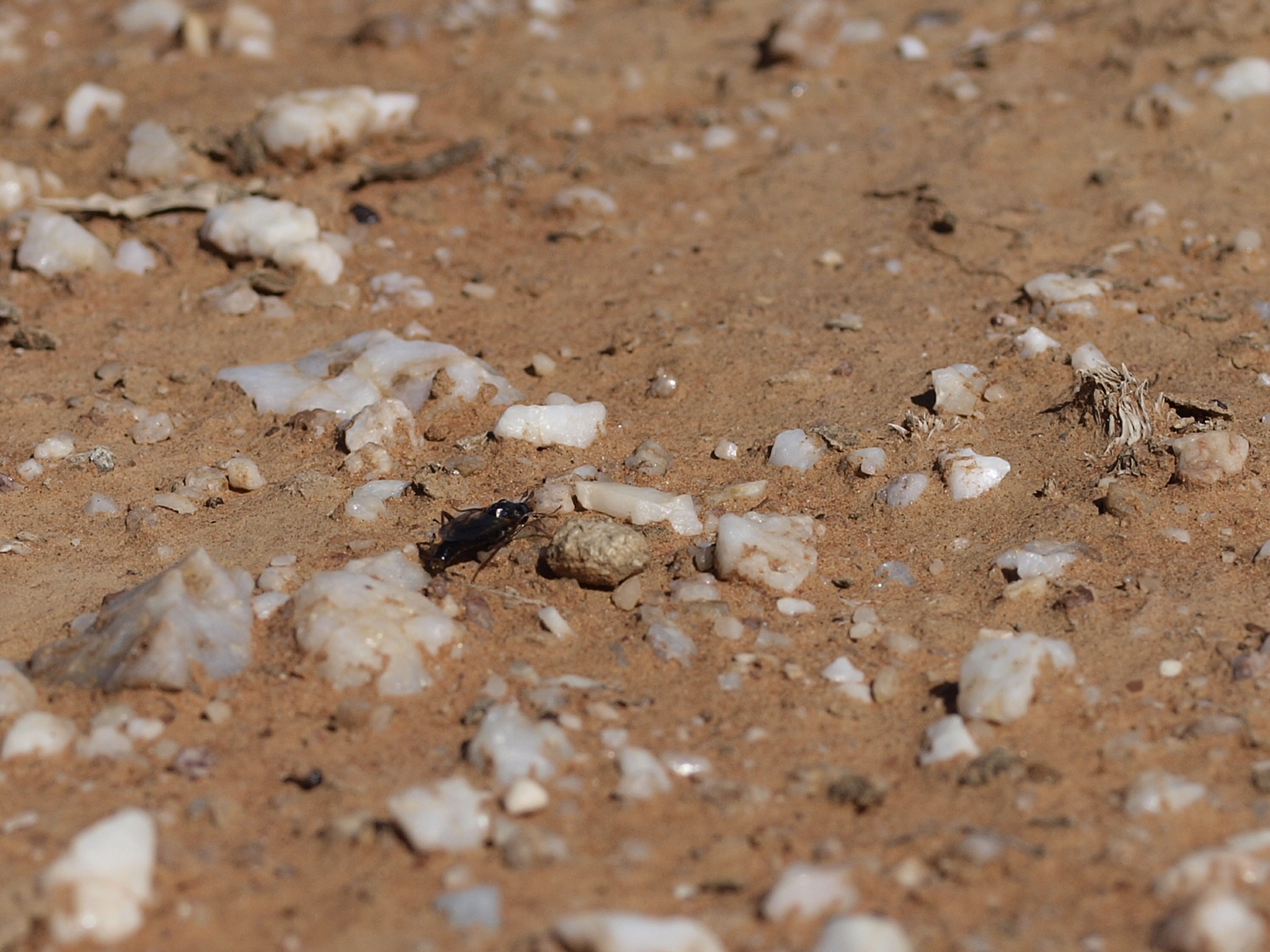
Hesse (1969) described this species as follows: Body almost entirely very dark or black, the vertex and frons on each side, pleurae, and to a variable extent abdomen above in female sometimes obscurely dark piceous brownish or very dark reddish brownish; antennae blackish brown, sometimes more brownish or yellowish brownish in female, the clubs in both sexes orange yellowish; an infusion on thorax anteriorly on inner sides of humeral tubercles in female sometimes reddish brownish and extending posteriorly streak-like on each side for a short distance; postalar calli and sometimes hind margin of scutellum in female sometimes obscurely piceous; hind margins of tergites obscurely dark reddish or reddish brownish to a variable extent, more so discally in some specimens; bullae relatively long and narrow, shining black; venter entirely dark, but hind margins of sternites usually slightly paler; apices of lobes of tergite 9 and apical halves of processes of sternite-9, and sometimes sternite-9, in male yellowish to a variable extent. Integument of middle part of frons and clypeus shining, and that of pleurae and abdomen also shining, but with distinct, dark bluish reflections, in female sometimes more violaceous; integument of sides of frons more rugulosely striate than in other species; that of thorax above finely and densely rugulose in three broadish streaks, separated submedially on each side by a narrower streak of coarser rugae and without any distinct setiferous granules, the sides of thorax with denser, or at least more, oblique rugae than in other species; integument of coxae shining, that of femora transversely wrinkled. Vestiture with the hairs dense only on head, shorter in female; those on rest of body relatively poorly developed as in other species belonging to this new genus; hairs on head greyish whitish in both sexes; shortish ones along two submedial streaks and on sides of thorax, those on pleurae and sides of tergite-1 also greyish whitish in both sexes, but much shorter and sparser in female; sparse hairs on rest of abdomen in male also greyish, becoming more greyish yellowish to yellowish posteriorly; abdomen in male almost bare, only reversed hairs on last two segments distinct, brownish or fulvous brownish; hairs on hypopygium of male more yellowish or fulvous like those on lobes below oviscape in female; hairs on legs short and sparse in both sexes, very sparse on coxae, longish ones only along inner lower parts of hind tibiae in male, with all the hairs on legs greyish yellowish to sericeous yellowish; spines and spicules on legs fulvous yellowish to reddish. Head with the antennae distinctly shorter than thorax (excluding scutellum); segment-1 short, about 2.0-2.3 times length of 2; segment-3 relatively short, slightly thickened apically, shorter than following articulation plus club, subequal in length to or even shorter than club alone; the latter inflated, subpyriform, nearly or about half as thick at broadest part as long, its base constricted bottle-neck-like; proboscis stoutish, usually longer than vertical length of eye, but sometimes subequal in length to it; palps distinct, longer than antennal segment-2. Wings tinted brownish in both sexes, but tending to be darker in some males, sometimes becoming clearer or more milky whitish apically and along hinder half and in anal and axillary cells; veins yellowish brownish, more brownish anteriorly; first posterior cell rather broadish, at broadest part usually broader than hind border; apex of discoidal cell shortly stalked; axillary lobe markedly broad, relatively broader than in A. namaquensis and A. lightfooti; squamal margin whitish; halteres dark brownish. Legs with the hind femora slightly clavately thickened, scarcely less so in female than in male, armed below with a double row of spines on slight tubercles from just before middle, without any dorso- or latero-apical ones; hind tibiae rather stoutish; basal segment of hind tarsi distinctly very much longer than claw-segment; claws, especially hind ones, longer in male and more rapidly curved down apically than in female, and pulvilli in latter reduced, slightly shorter. Oviscape in female with 8 or 9 fulvous reddish spines on a side. Length of body: about 11.0-14.5 mm (21.5 mm in large female); Length of wing: about 8.0-11.5 mm (14 mm in 1 large female).
This species is mainly black with slight bluish reflections and with inflated, subpyriform antennal clubs (Hesse 1969).
Type locality: South Africa, Western Cape, Papendorp.
Arenomydas is southern African endemic genus with about 9 described species, with one record from southern Namibia (Kirk-Spriggs and Sinclair 2017).
South Africa.
South Africa, Western Cape. Papendorp, mouth of Olifants River (Museum Expedition, Oct. 1950) (male holotype, female allotype and paratypes). Namaqualand: Droërivier between Van Rhynsdorp and Nieuwoudtville (Museum Expedition, 30 Sept. 1966) (1 male and 1 female paratypes) (Hesse 1969).
The information below was extracted from Cannings and Scudder (2005): Dipterans are primarily aerial insects and the mesothorax, which bears the only pair of wings, dominates the thorax - the prothorax and metathorax are greatly reduced. The legs are normally rather simple and are used primarily for perching; in some groups, they are modified for prey capture or for signaling during courtship. The tarsi are nearly always 5-segmented. The functional wings are membranous and their pattern of veins is critical in fly classification and identification. During the evolution of flies, there has been a trend towards a reduction in veins, especially in the rear half of the wing – changes that evidently relate to improvements in two-winged flight. The hind wings, present in most other insects, are reduced in Diptera to small, club-like organs, called halteres, used for stabilising flight.
Herbivore - Nectarivore (nectar-eating)
The flies in this family are not known to hunt, catch or prey upon other insects as asilids do, but mainly feed on nectar (Hesse 1969).
Like the others, flies in the Mydidae family begin life as an egg, which hatches into a grub-like larva. Most of the fly life is spent in the larval stage, mainly eating and growing, as well as molting several times. Some flies may spend at least a year as a larva. The next stage is a pupa, during which the insect transforms into its final stage, emerging from the pupa as a winged adult, able to mate and reproduce. In many species, males stake out positions at favourable egg-laying sites and wait for females to arrive (Hesse 1969).
Specimens have been collected from September - November (very few records for Aug and Dec) (Kirk-Spriggs and Sinclair 2017).
Fynbos
This map contains point-based occurrences at different locations
Occurrence in African countries and South African provinces. Residence status indicates if a taxon is indigenous, endemic, or alien in a specific region. This data is based on specimen records and literature.
FSA
SA
BOT
NAM
ESW
LES
WC
EC
NC
FS
GA
KZN
LP
MP
NW
Absent
Indigenous
Endemic
Naturalised
Invasive
Names and Sources
No known common names.
Classification
KINGDOM Animalia
PHYLUM Arthropoda
CLASS Insecta
ORDER Diptera
FAMILY Mydidae
GENUS Arenomydas
SPECIES caerulescens
No results found for Arenomydas caerulescens Hesse, 1969
No results found for Arenomydas caerulescens Hesse, 1969
5 results for Arenomydas caerulescens Hesse, 1969
This map contains point-based occurrences at different locations
1969
JOURNAL ARTICLE
The Mydaidae (Diptera) of Southern AfricaHesse, A.J.. 1969. The Mydaidae (Diptera) of Southern Africa Vol. 54 pp.1–388.
2005
WEB SERVICE
The True Flies (Diptera) of British ColumbiaCannings, R.A., Scudder, G.G.E.. 2005. The True Flies (Diptera) of British Columbia. University of British Columbia.
2017
BOOK
Manual of Afrotropical DipteraKirk-Spriggs, Ashley, Sinclair, Bradley. 2017. Manual of Afrotropical Diptera Vol. 2. Pretoria, South Africa. South African National Biodiversity Institute.
2021
WEBSITE
Asiloid Flies: deciphering their diversity and evolutionary historyDikow, Torsten. 2021. Asiloid Flies: deciphering their diversity and evolutionary history. National Museum of Natural History: Smithsonian.


