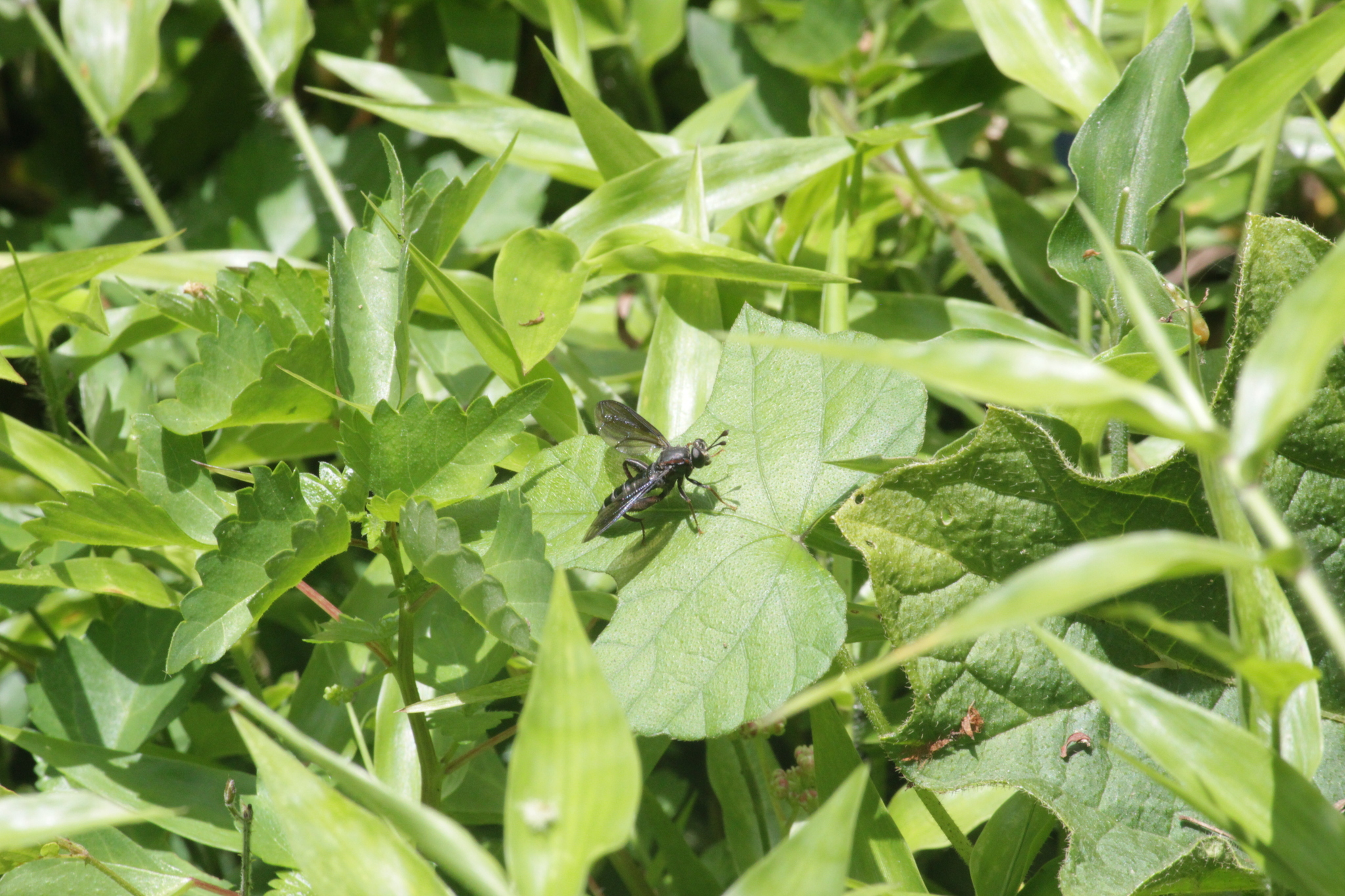
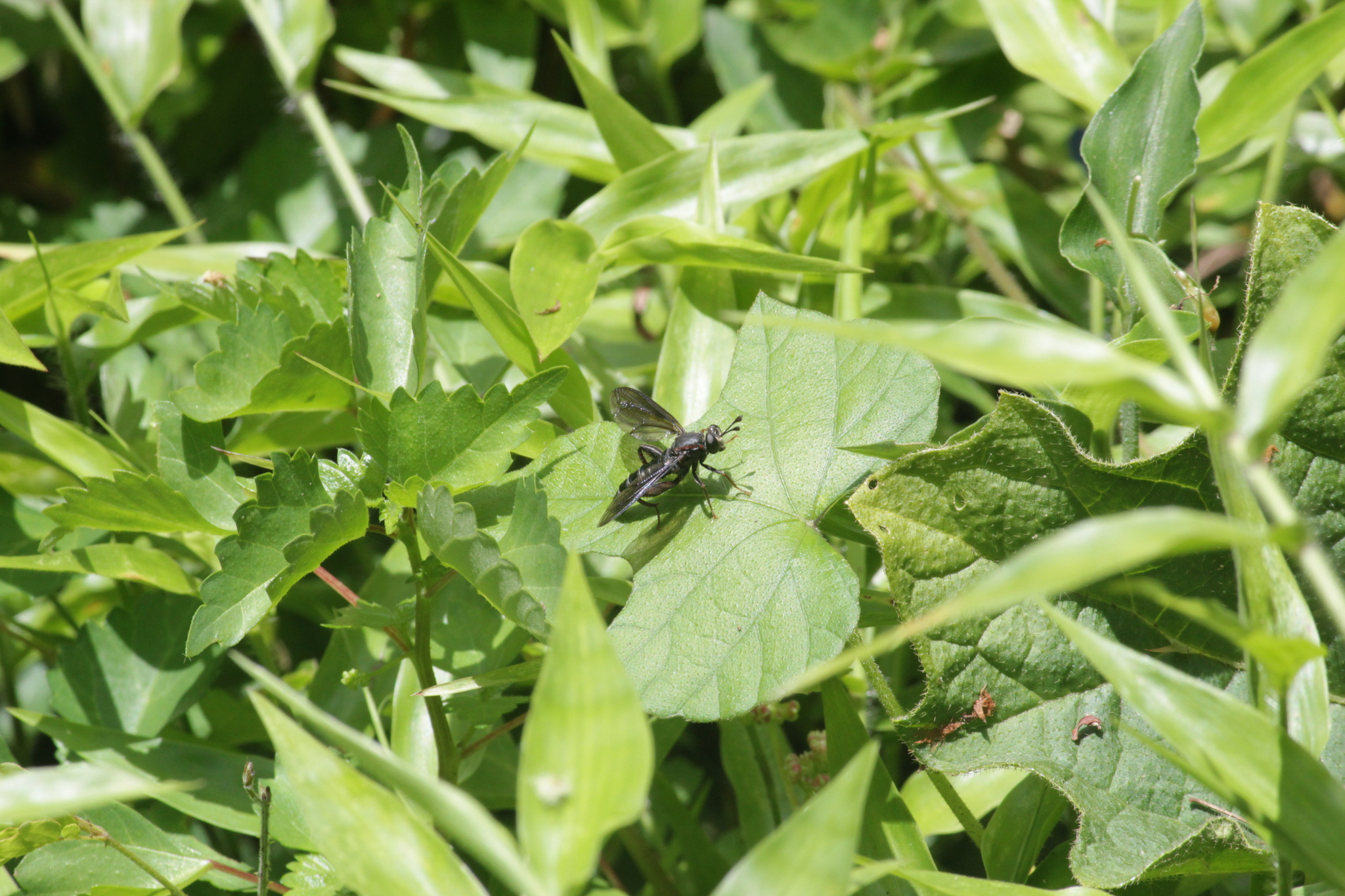
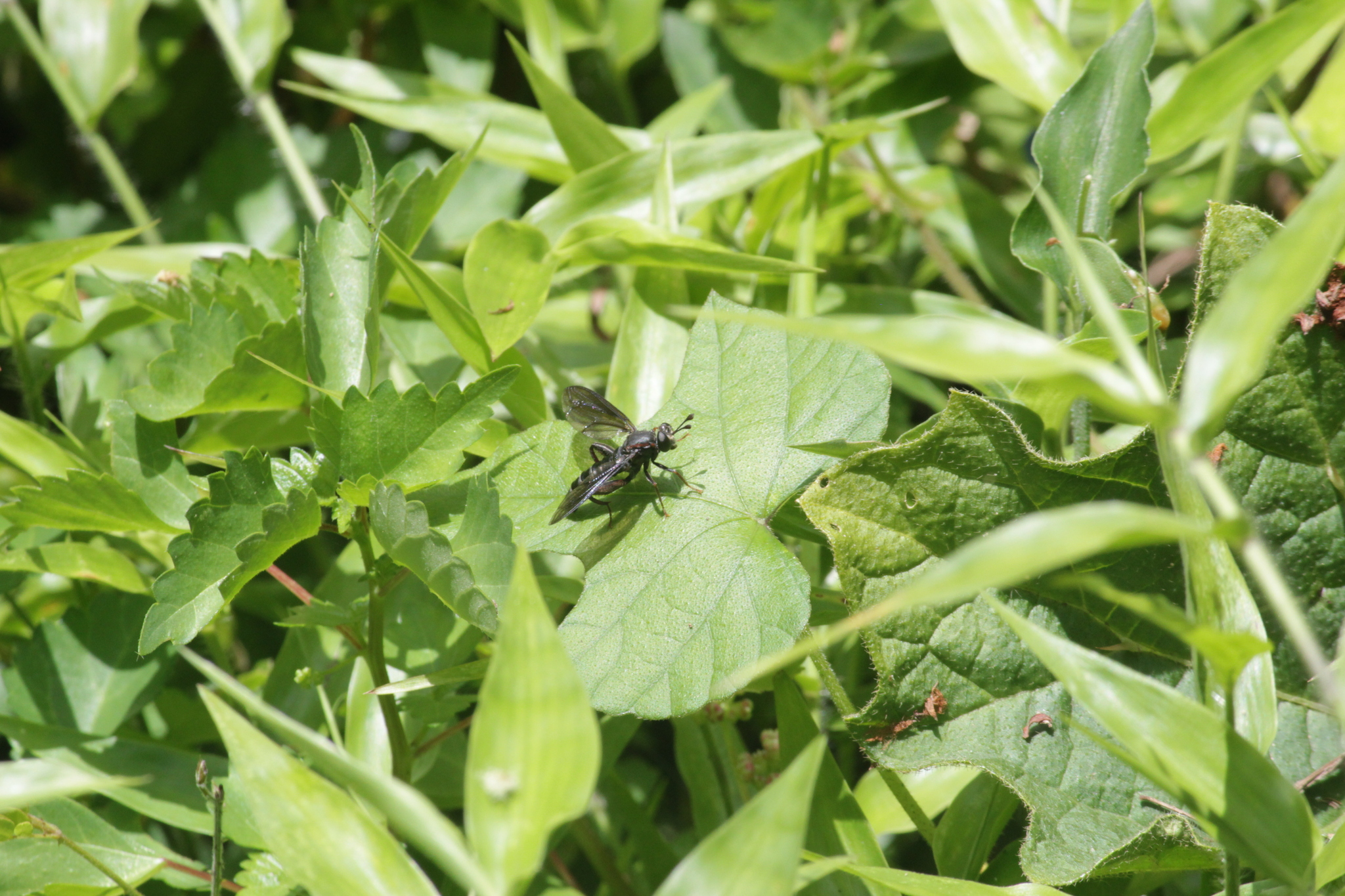
Lyons and Dikow (2010) re-described this species as follows: Male: Black, facial gibbosity light brown, in general predominantly apubescent, yellow pubescent on median eye margin; width distinctly greater than thorax, interocular distance on vertex larger than at ventral eye margin, vertex between compound eyes slightly depressed, parafacial area very narrow, facial gibbosity nearly touching median eye margin; facial gibbosity distinct, well-developed and discernible in lateral view; mystax white, covering entire facial gibbosity, sparse; frons predominantly apubescent, vertex apubescent, postgena lightly silver pubescent; setation: vertex white, frons white, ocp setae white, pocl setae white; ocellar triangle apubescent; proboscis light brown, long, reaching fronto-clypeal suture; labellum large, much wider than prementum, longer than prementum and as long as oral cavity, unsclerotised laterally; maxillary palpus cylindrical, light brown, about ½ length of proboscis. Antenna: brown, scape and pedicel white and yellow setose dorsally and ventrally; postpedicel cylindrical in proximal ½, symmetrically bulbous in distal ½, ≥ 6.0 times as long as combined length of scape and pedicel; apical ‚seta-like‘ sensory element situated apically in cavity on postpedicel. Thorax: dark brown to bluish-black, predominantly apubescent; scutum medially dark brown, laterally brown, surface entirely smooth, predominantly apubescent, only extreme lateral margin grey pubescent, scutal setation comprised of distinct rows of short dorsocentral setae and lateral scutal setae; dc setae pre- and postsuturally white, acr setae absent, lateral scutal setae white, npl, spal, and pal setae absent; postpronotal lobe light brown, partly silver pubescent; proepisternum, lateral postpronotum, and postpronotal lobe long white setose; scutellum apubescent, asetose medially, laterally yellow setose, apical scutellar setae absent; mesopostnotum, anatergite, and katatergite silver pubescent, asetose; katatergite elevated and smoothly convex; anterior anepisternum asetose, supero-posterior anepisternum asetose; posterior anepimeron long white setose, katepimeron asetose; metepimeron evenly elevated, same colour as T1, silver pubescent, asetose; metepisternum silver pubescent, asetose. Leg: brown, setation predominantly white; pro, mes, and met coxa apubescent, long white setose; met trochanter macrosetose medially; femur brown, met femur evenly clubbed in distal ¾, in distal ½ macrosetose, 1 antero-ventral and 1 postero-ventral row of macrosetae; pro, mes, and met tibia straight, met tibia cylindrical with distinct ventral keel terminating into a sharp spine; pro and mes tarsomere 1 as long as combined length of tarsomeres 2–3, met tarsomere 1 as long as combined length of tarsomeres 2–4; pulvillus well-developed, as long as well-developed claw, and as wide as base of claw; empodium absent. Wing: length = 12.2–14.1 mm; slightly brown stained, darker brown around veins, veins light brown, microtrichia absent; cells r1, r4, r5, m3, + cup closed; C well-developed, around entire wing; R4 terminates in R1; R5 terminates in R1; stump vein (R3 ) at base of R4 present, long but not reaching R2 ; R4 and R5 widest apart medially; r-m distinct, R4+5 and M1 apart, connected by cross-vein; M1 straight at r-m (not curving anteriorly), M1 (or M1 +M2 ) terminates in C; CuA1 and CuA2 split proximally to m-cu (cell m3 narrow proximally); M3 +CuA1 terminate together in C; A1 undulating, cell a1 wide, A1 and wing margin further apart proximally than distally; alula well-developed; halter light brown. Abdomen: brown; setation comprised of scattered white setae, surface entirely smooth; T1 brown, T2–7 brown with yellow posterior margin; T1 long white setose, T2–T3 sparsely white setose; T predominantly apubescent; S1–7 brown, yellow posterior margin; S1 asetose, S2–3 sparsely white setose; S predominantly apubescent; T2–4 parallel-sided and not constricted waist-like; bullae on T2 brown, transversely elongate, surface entirely smooth, T2 surface anterior to bullae smooth. Male terminalia: T1–7 well-developed, entirely sclerotised, T8 postero-medially weakly sclerotised, with anterior transverse sclerotised bridge connecting lateral sclerites; T7–8 anteriorly with 2 lateral apodemes; S6 regular, without any special setation postero-medially, S8 well-developed and simple, fused to T8 dorso-laterally, entire (undivided) ventro-medially; epandrium formed by single sclerite (fused medially ± entirely), pointed postero-laterally; subepandrial sclerite without lateral or median protuberances; hypandrium ± flat, rectangular to square sclerite, entirely fused with gonocoxite, forming a gonocoxite-hypandrial complex; gonocoxite dorso-ventrally flattened in distal ½, higher in proximal ½, with palp-like lateral appendage, gonocoxal apodeme present, short (at most slightly extending hypopygium anteriorly); 1 functional aedeagal prong, aedeagal epimere absent; lateral ejaculatory process absent; ejaculatory apodeme formed by single dorso-ventrally oriented plate; ventro-median margin of dorsal aedeagal sheath heavily sclerotised (appearing entirely closed); dorsal aedeagal sheath long, sperm sac entirely covered; sperm sac appearing ± heavily sclerotised. Female: Head: proboscis brown; maxillary palpus brown. Antenna: postpedicel ≥ 5.0 times as long as combined length of scape and pedicel. Thorax: light brown, predominantly grey-pubescent; scutum yellow, broad brown median presutural stripe and brown paramedial postsutural stripes; scutum lightly grey pubescent. Leg: yellow; pro, mes, and met coxa grey pubescent, white setose; femur yellow. Wing: length = 14.1–14.5 mm; hyaline throughout, slightly brown stained along veins. Abdomen: T1–7 brown, yellow posterior margin; T1–3 sparsely white setose; S1–7 brown; bullae on T2 black, transversely elongate. Female genitalia: densely arranged anteriorly directed setae absent, only a few on T7–8 and S7–8; T8 with broad anterior rectangular apodeme; T9 formed by wide, rectangular sclerite with median protuberance; T9+10 entirely fused, T10 divided into 2 heavily sclerotised acanthophorite plates, 11 acanthophorite spurs per plate; 3 spermathecae, all equally large, formed by ± expanded weakly sclerotised ducts; individual spermathecal duct long; S9 (furca) formed by 2 sclerites, separated anteriorly and posteriorly, anterior furcal apodeme present, 2 lateral projections forming divided apodeme, lateral furcal apodeme absent, median furcal bridge absent.
The species is distinguished from congeners by the long proboscis that is slightly longer than the oral cavity, the large labellum that occupies nearly the entire oral cavity, brown facial gibbosity and postpronotal lobe, and the dorso-ventrally flattened ‘palp-like’ appendage on the gonocoxite in males.
Type locality: Stellabush (now Pigeon Valley Nature Reserve, 29°51'51"S 30°59'13"E), Durban, KwaZulu-Natal, South Africa.
South Africa.
This species is known to occur in Durban, KwaZulu-Natal, South Africa, which is part of the Maputaland-Pondoland-Albany biodiversity hotspot (Lyons and Dikow 2010).
The information below was extracted from Cannings and Scudder (2005): Dipterans are primarily aerial insects and the mesothorax, which bears the only pair of wings, dominates the thorax - the prothorax and metathorax are greatly reduced. The legs are normally rather simple and are used primarily for perching; in some groups, they are modified for prey capture or for signaling during courtship. The tarsi are nearly always 5-segmented. The functional wings are membranous and their pattern of veins is critical in fly classification and identification. During the evolution of flies, there has been a trend towards a reduction in veins, especially in the rear half of the wing – changes that evidently relate to improvements in two-winged flight. The hindwings, present in most other insects, are reduced in Diptera to small, club-like organs, called halteres, used for stabilising flight.
Herbivore - Nectarivore (nectar-eating)
Lyons and Dikow (2010) reported that all species have functional mouthparts, although these can be short as in E. abdominalis, E. amboseli, E. capillatus, E. pinguis, and E. pretoriensis, and so probably visit flowers and feed on pollen and nectar. The larvae of Ectyphus and Parectyphus remain unknown.
Like the others, flies in the Mydidae family begin life as an egg, which hatches into a grub-like larva. Most of the fly life is spent in the larval stage, mainly eating and growing, as well as molting several times. Some flies may spend at least a year as a larva. The next stage is a pupa, during which the insect transforms into its final stage, emerging from the pupa as a winged adult, able to mate and reproduce. In many species, males stake out positions at favourable egg-laying sites and wait for females to arrive (Hesse 1969).
Seasonal incidence of E. armipes occurs between November–April, and July–September every year.
Grassland.
This map contains point-based occurrences at different locations
Occurrence in African countries and South African provinces. Residence status indicates if a taxon is indigenous, endemic, or alien in a specific region. This data is based on specimen records and literature.
FSA
SA
BOT
NAM
ESW
LES
WC
EC
NC
FS
GA
KZN
LP
MP
NW
Absent
Indigenous
Endemic
Naturalised
Invasive
Names and Sources
No known common names.

No results found for Ectyphus armipes Bezzi, 1924
No results found for Ectyphus armipes Bezzi, 1924
9 results for Ectyphus armipes Bezzi, 1924
This map contains point-based occurrences at different locations
1924
JOURNAL ARTICLE
The South African Mydaidae (Diptera) as represented in the South African Museum.Bezzi, M. 1924. The South African Mydaidae (Diptera) as represented in the South African Museum. Vol. 19 pp.191-234.
1969
JOURNAL ARTICLE
The Mydaidae (Diptera) of Southern AfricaHesse, A.J.. 1969. The Mydaidae (Diptera) of Southern Africa Vol. 54 pp.1–388.
2021
WEBSITE
Asiloid Flies: deciphering their diversity and evolutionary historyDikow, Torsten. 2021. Asiloid Flies: deciphering their diversity and evolutionary history. National Museum of Natural History: Smithsonian.
2005
WEB SERVICE
The True Flies (Diptera) of British ColumbiaCannings, R.A., Scudder, G.G.E.. 2005. The True Flies (Diptera) of British Columbia. University of British Columbia.
2017
BOOK
Manual of Afrotropical DipteraKirk-Spriggs, Ashley, Sinclair, Bradley. 2017. Manual of Afrotropical Diptera Vol. 2. Pretoria, South Africa. South African National Biodiversity Institute.
2010
JOURNAL ARTICLE
Taxonomic revision of Ectyphus Gerstaecker, 1868 and Parectyphus Hesse, 1972 with a key to world Ectyphinae (Insecta, Diptera, Mydidae)Dikow, T., Lyons, K.M.. 2010. Taxonomic revision of Ectyphus Gerstaecker, 1868 and Parectyphus Hesse, 1972 with a key to world Ectyphinae (Insecta, Diptera, Mydidae) Vol. 73 pp.25-59.