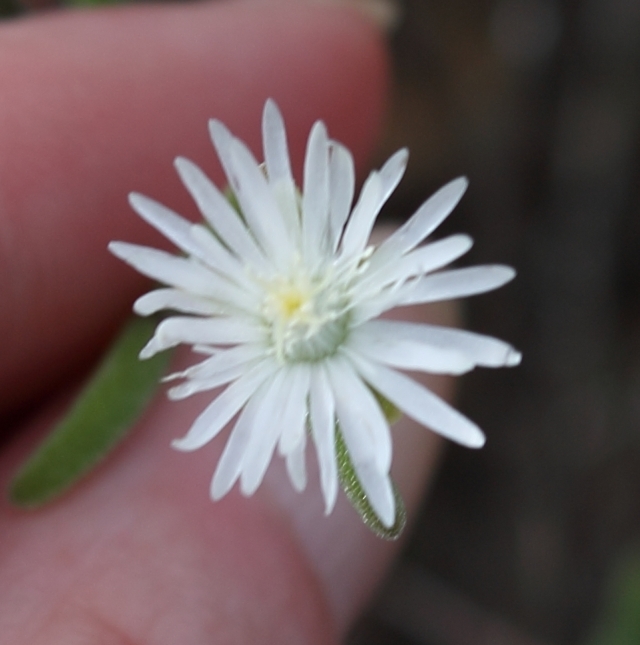
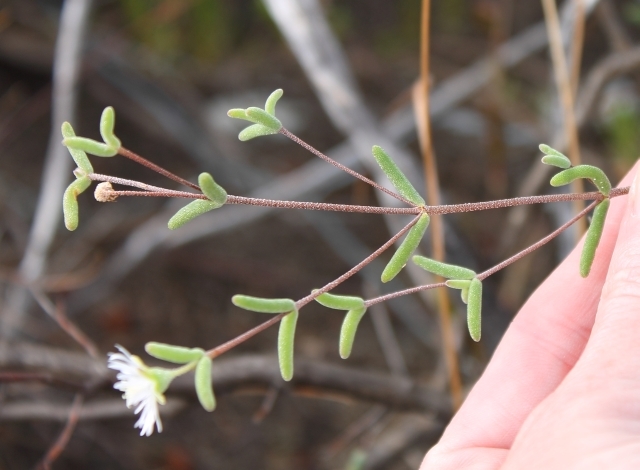
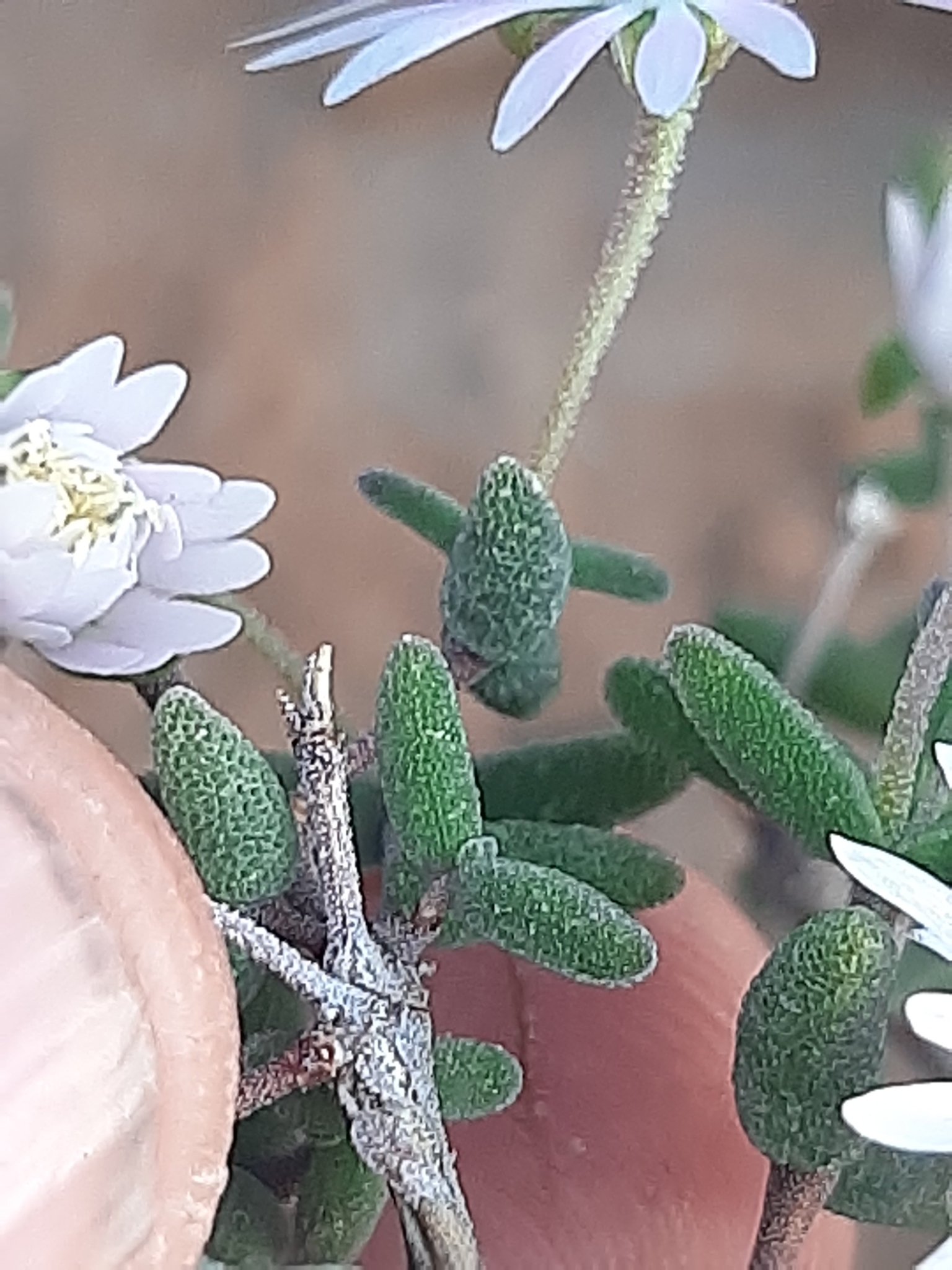
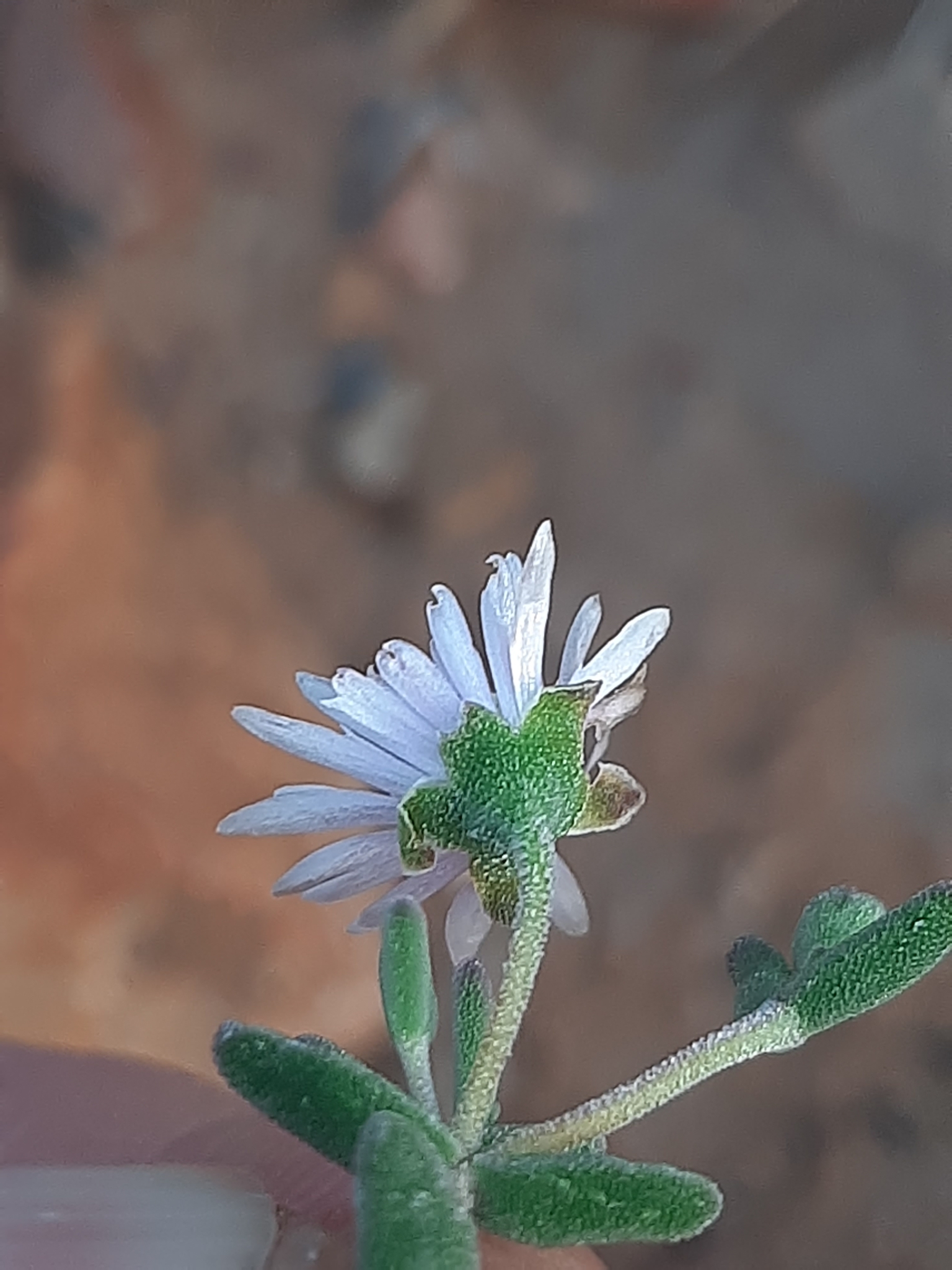
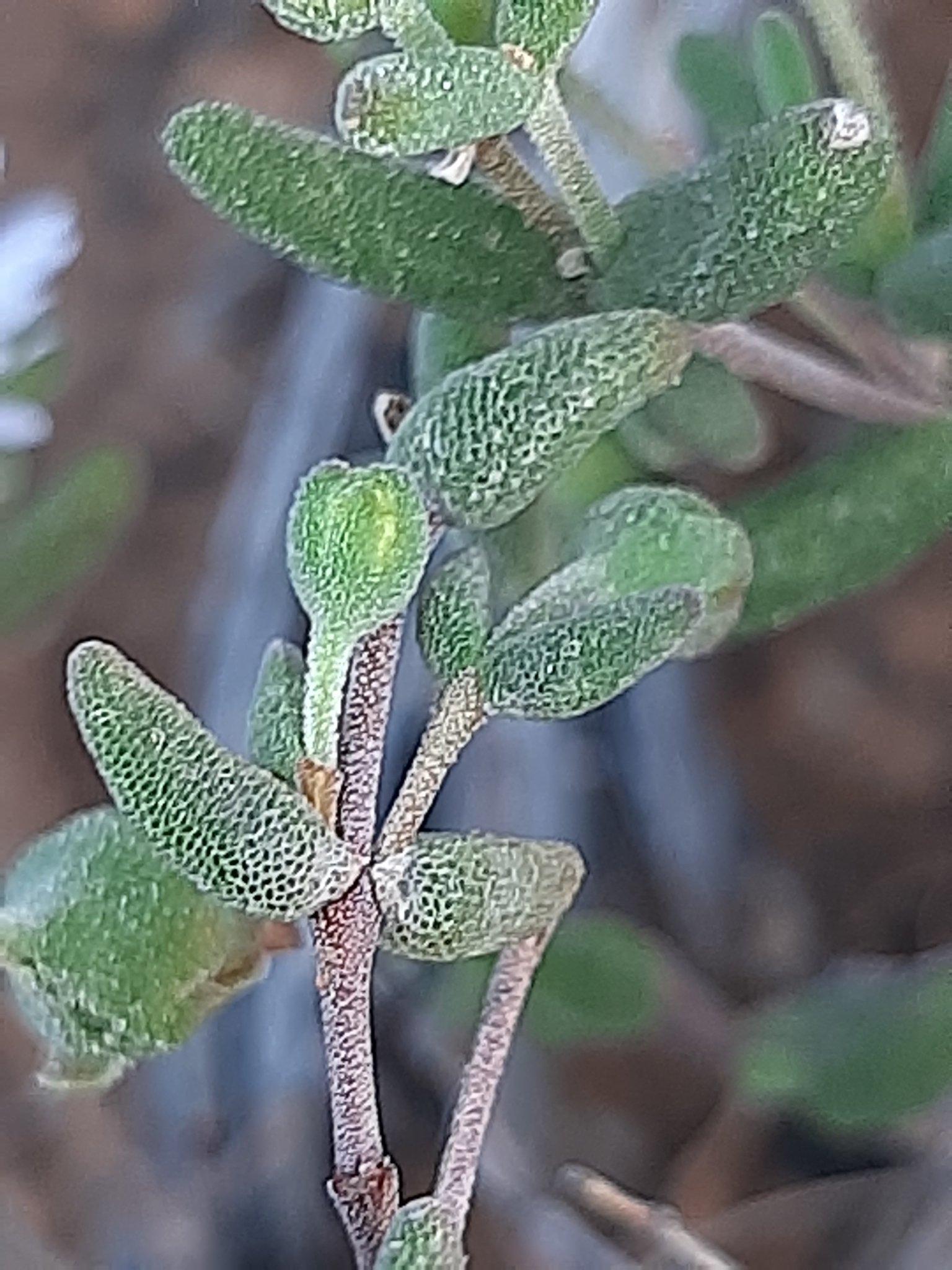
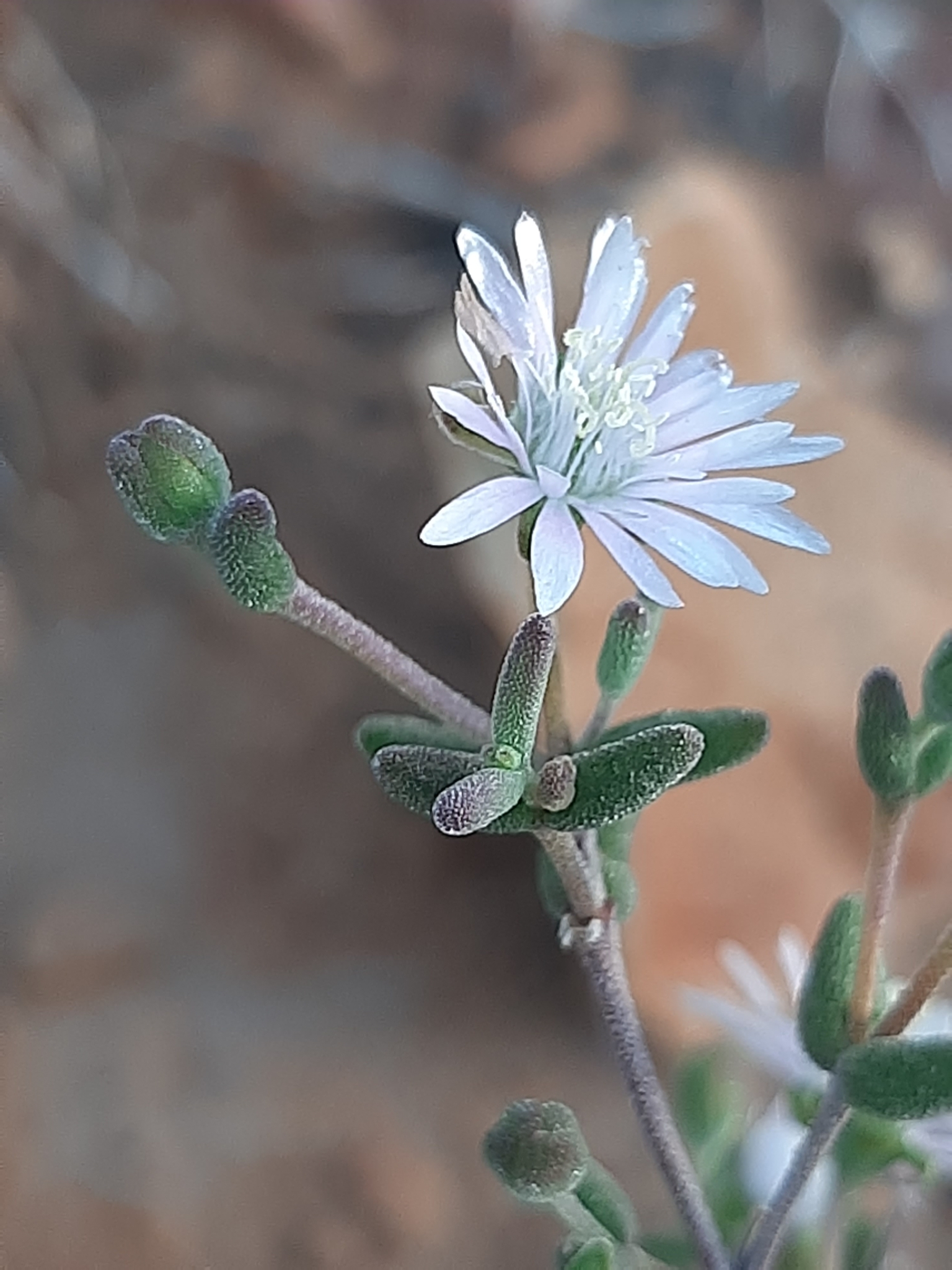
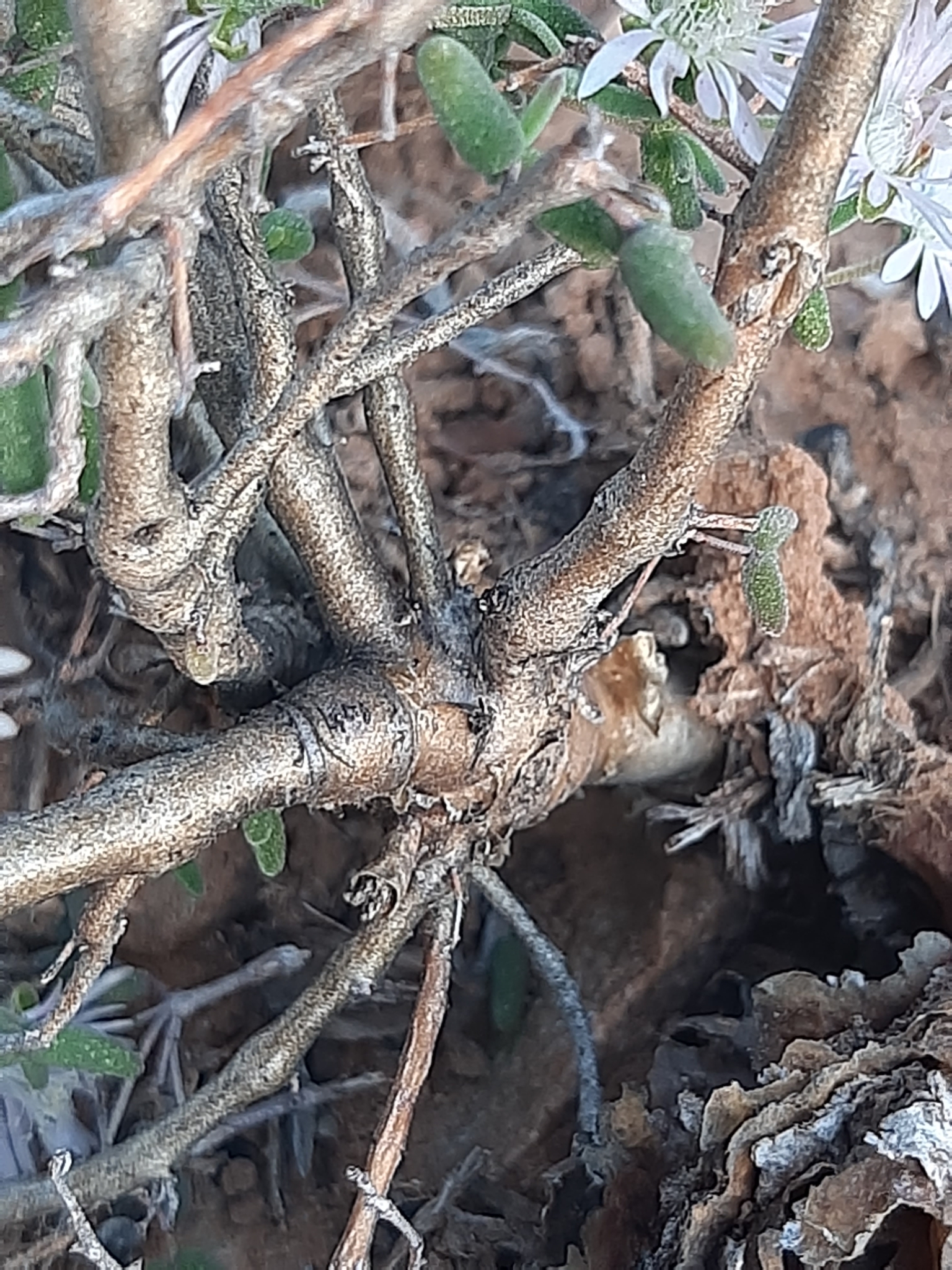
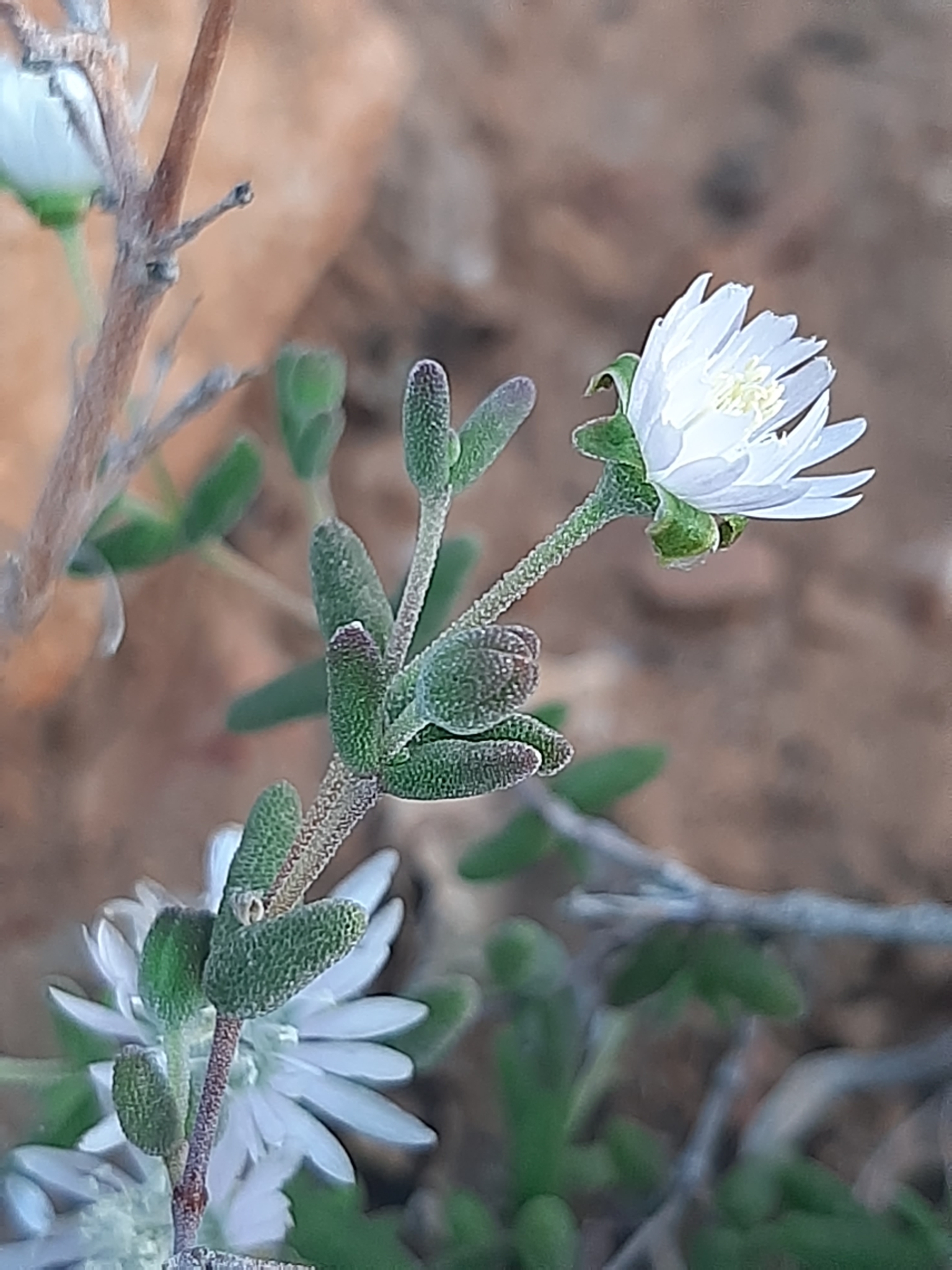
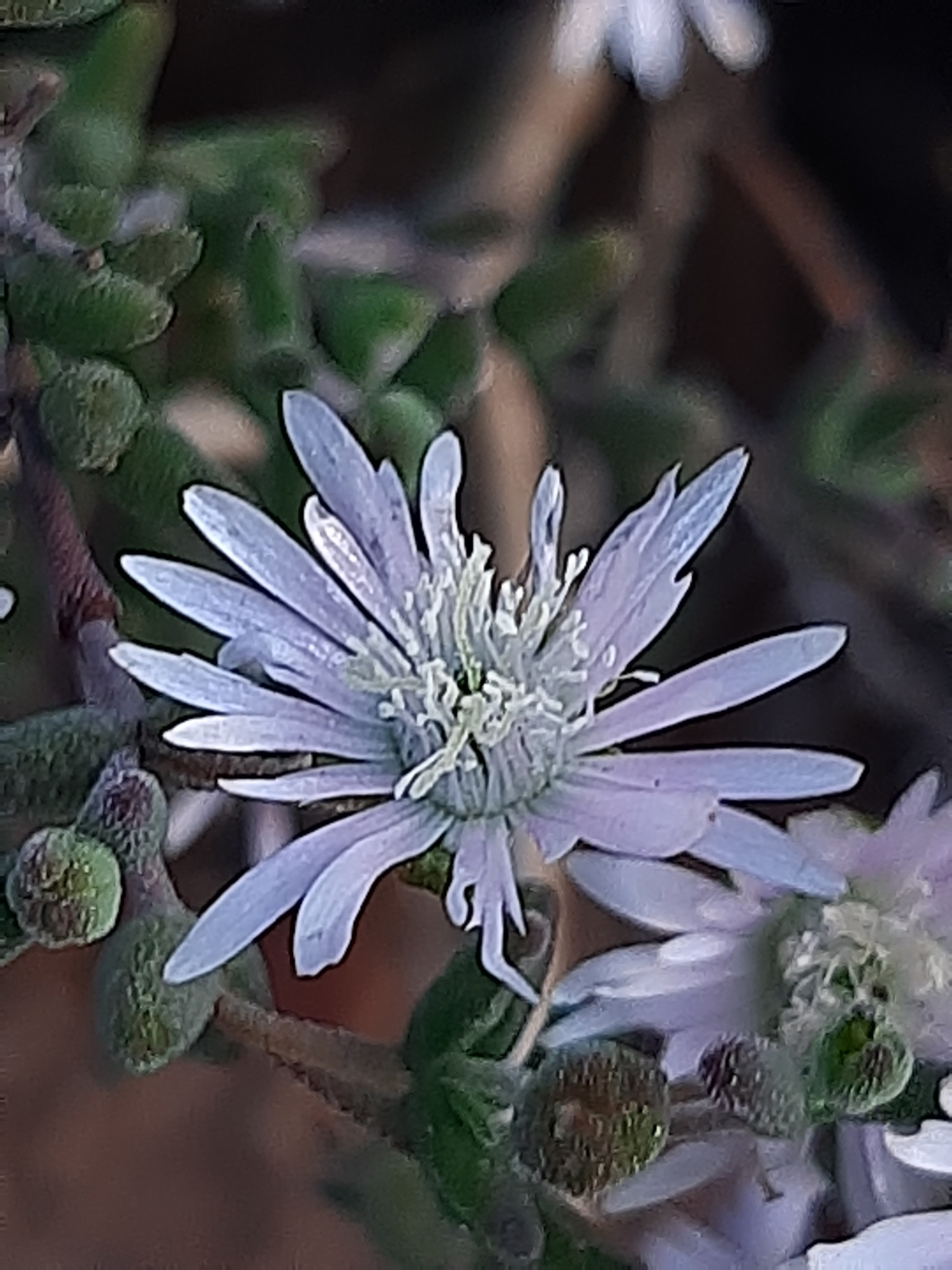
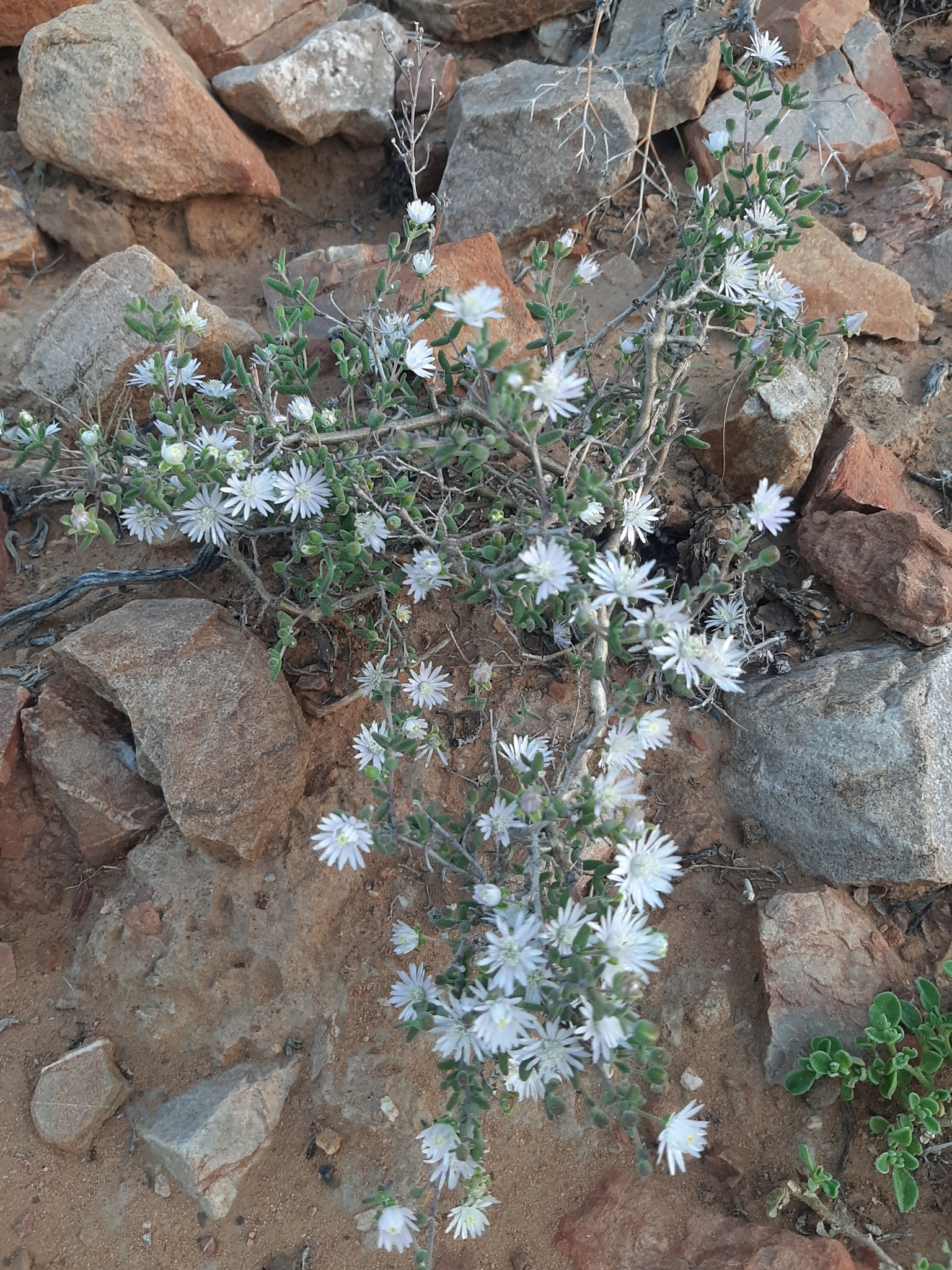
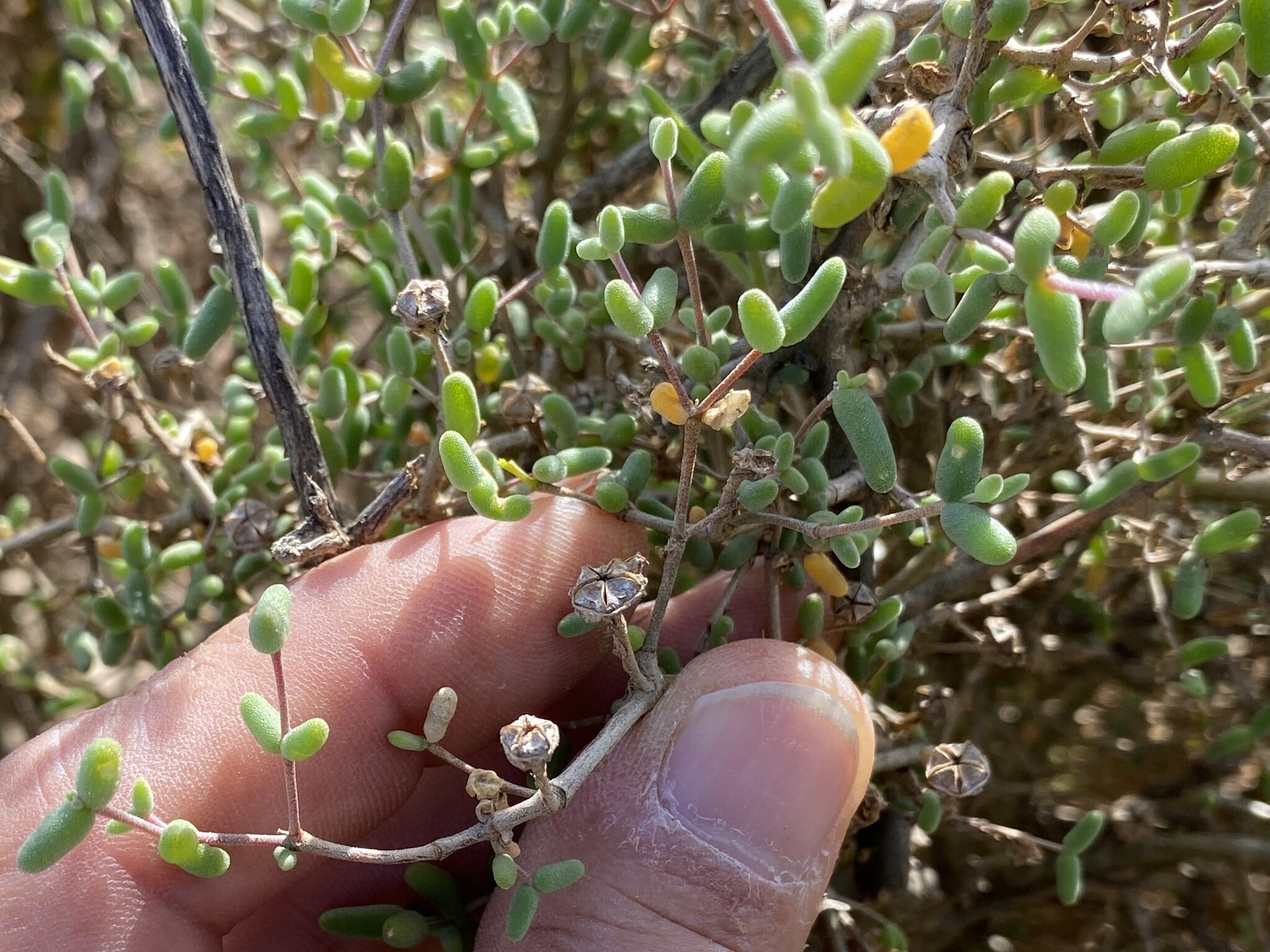
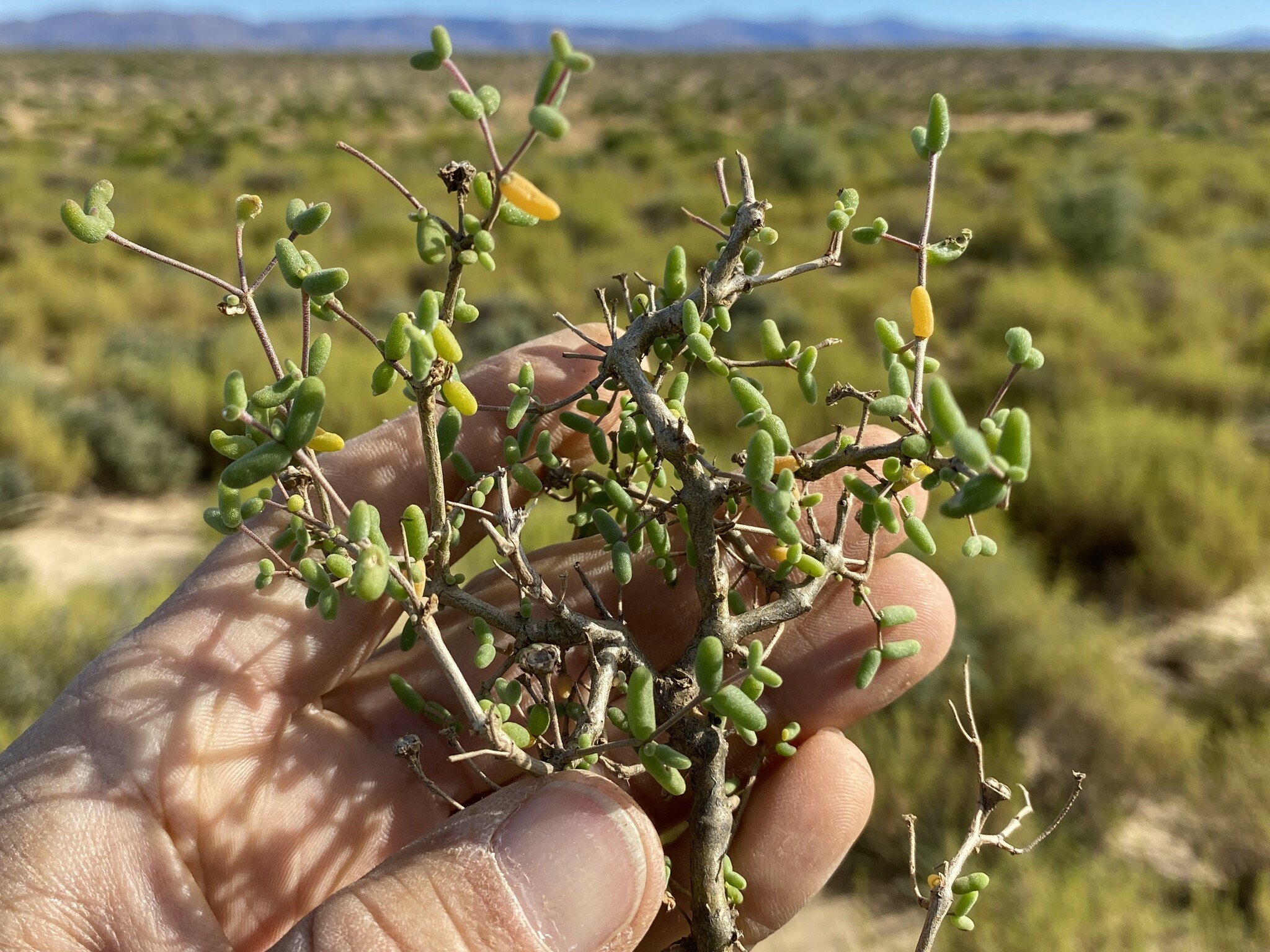
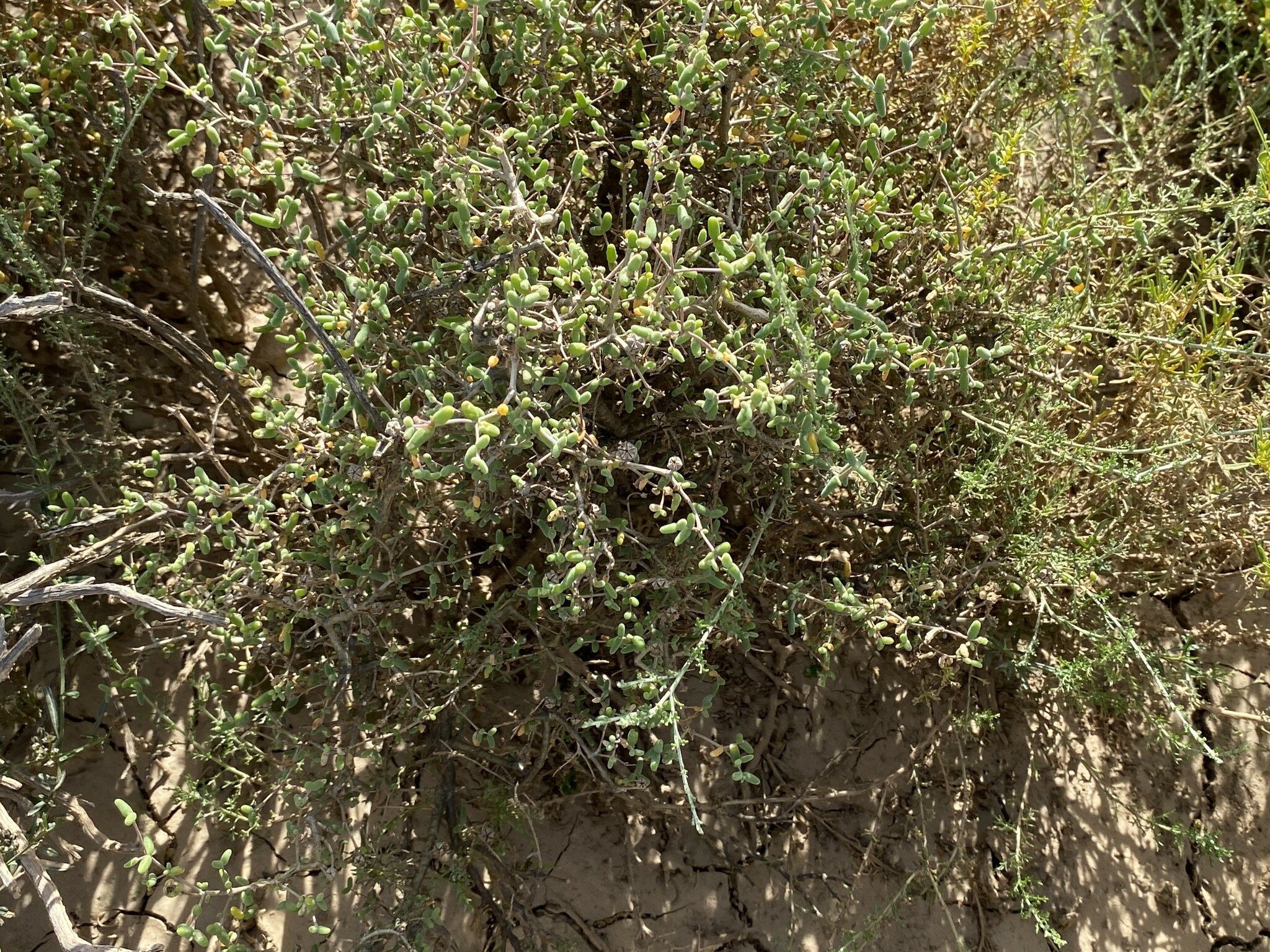
Perennial, dwarf shrublet, up to 0.3 m high, stems laxly branched. Leaves opposite, subglobose to subcylindrical, bladder cells rounded, dull. Flowers solitary, white or pale pink. Flowering time Oct.-Apr. Capsules 5-locular, covering membranes complete, valve wings broad, expanding keels diverging, closing body absent. From: Burgoyne, PM; Bredenkamp, CL. 2019. Aizoaceae: Drosanthemum Schwantes. In: CL Bredenkamp (ed.), A Flora of the Eastern Cape Province. Strelitzia 41(1): 225-227. South African National Biodiversity Institute, Pretoria. [CC BY]
Plants erect. Laxly branched, papillate shrublet to 30 cm. Leaves subglobose to subcylindrical. Flowers to 14 mm diam., white or pale pink, opening in late afternoon. Fruits 5-locular, false septa only partly developed. From: Klak, C. 2012. Aizoaceae: Drosanthemum Schwantes. In: J Manning & P Goldblatt (eds), Plants of the Greater Cape Floristic Region 1: The Core Cape flora. Strelitzia 29: 275-280. South African National Biodiversity Institute, Pretoria. [CC BY]
Flats or hills of karoo sediments. Eastern Fynbos-Renosterveld, Rainshadow Valley Karoo. From: Burgoyne, PM; Bredenkamp, CL. 2019. Aizoaceae: Drosanthemum Schwantes. In: CL Bredenkamp (ed.), A Flora of the Eastern Cape Province. Strelitzia 41(1): 225-227. South African National Biodiversity Institute, Pretoria. [CC BY]
Uncertain. From: Klak, C. 2012. Aizoaceae: Drosanthemum Schwantes. In: J Manning & P Goldblatt (eds), Plants of the Greater Cape Floristic Region 1: The Core Cape flora. Strelitzia 29: 275-280. South African National Biodiversity Institute, Pretoria. [CC BY]
Loeriesfontein to Karoopoort, Little Karoo to Prince Albert. From: Klak, C. 2012. Aizoaceae: Drosanthemum Schwantes. In: J Manning & P Goldblatt (eds), Plants of the Greater Cape Floristic Region 1: The Core Cape flora. Strelitzia 29: 275-280. South African National Biodiversity Institute, Pretoria. [CC BY]
July
500 to 980 m
This map contains point-based occurrences at different locations
Occurrence in the Flora of Southern Africa (FSA) countries and South African provinces. Residence status indicates if a taxon is indigenous, endemic, naturalised or invasive in a specific region. This data is based on specimen records and literature
FSA
SA
BOT
NAM
ESW
LES
WC
EC
NC
FS
GA
KZN
LP
MP
NW
Absent
Indigenous
Endemic
Naturalised
Invasive

Names and Sources
Published in: Notes Mesembryanthemum [H.M.L. Bolus] 2: 184 (1930)
Drosanthemum vespertinum L.Bolus var. suffusum L.Bolus
Published in: Notes Mesembryanthemum [H.M.L. Bolus] 2: 249(1931)
Classification
KINGDOM Plantae
SUBKINGDOM Phanerogamae
PHYLUM Anthophyta
ORDER Caryophyllales
FAMILY Aizoaceae
SUBFAMILY Ruschioideae
TRIBE Drosanthemeae
GENUS Drosanthemum
SPECIES vespertinum
6 results for Drosanthemum vespertinum L.Bolus
Barcode: NBG0127114-0 Collector(s) & number: Van Jaarsveld, EJ, s.n. | 1983-5-18
South Africa, Eastern Cape, Steytlerville. Boskloof farm. Witpantjie (Baviaanskloof)
General notes: Succulent mountain scrub (Spekboomveld) Acocks veldtype No. 25. Succulent herb. Flat area.
Data Resource: BODATSA View record
Barcode: PRE0588691-0 Collector(s) & number: Burgoyne, PM, 9650 | 2003-8-31
South Africa, Northern Cape, Sutherland District: ± 18km north of Sutherland below Snyders Poort.
General notes: Moderate slope. Forming rounded bushes with procumbent branches. Flowers absent, fruit present.
Data Resource: BODATSA View record
Barcode: PRE0714918-0 Collector(s) & number: Braack, AL, 57 | 1983-9-15
South Africa, Western Cape, BEAUFORT WEST DIST.; KAROO NAT. PARK; BOESMANKLIPPE K7D
Data Resource: BODATSA View record
This map contains point-based occurrences at different locations
2019
SERIES CHAPTER
Aizoaceae: Drosanthemum Schwantes Burgoyne, PM; Bredenkamp, CLIn: CL Bredenkamp (ed.), A Flora of the Eastern Cape Province. Strelitzia 41(1)225-227
South African National Biodiversity Institute, Pretoria
2012
SERIES CHAPTER
Aizoaceae: Drosanthemum Schwantes Klak, CIn: J Manning & P Goldblatt (eds), Plants of the Greater Cape Floristic Region 1: The Core Cape flora. Strelitzia 29: 275-280
South African National Biodiversity Institute, Pretoria
2001
No results found for Drosanthemum vespertinum L.Bolus
Status and criteria
LC
Assessment date
2016-01-14
Assessor(s)
Plantae Coordinator
Range
This species has been recorded from southern and northern Zimbabwe, Zambia, Malawi and the extreme northeastern regions of South Africa. One specimen is known from Chicoa in Mozambique but is probably more widespread along the Limpopo, Save and Zambezi valleys (Cotterill 2013). Similarly, one specimen has been recorded from southwestern Tanzania (Cotterill 2013). It is generally a lowland species (ACR 2015). In the assessment region, it occurs in the extreme northern areas of Limpopo (Limpopo valley) in the Great Limpopo Transfrontier Park and Greater Mapungubwe Transfrontier Conservation Area, with an estimated extent of occurrence of 8,922 km².
Major system
Major habitats
No major threats have been identified for this species within the assessment region. Although much of this species range in the assessment region is within protected regions in the Limpopo Province, roost sites outside of these reserves may be impacted by human disturbance (as caves are frequently utilised during traditional ceremonies and ecotourism) and habitat loss due to agricultural expansion (particularly cotton farming). Pesticide use and the loss of hollow Baobabs used as roosts are likely to cause local population decline (Cotterill 2013).
Population trend
JOURNAL ARTICLE
Pinhey, E. 1965. Odonata from Luanda and the Lucala River, Angola. Revista de Biologia, Lisboa. 5:159-164
JOURNAL ARTICLE
Pinhey, E. 1975. A collection of Odonata from Angola. Arnoldia. 23:1–16
JOURNAL ARTICLE
Pinhey, E. 1976. Dragonflies (Odonata) of Botswana, with ecological notes. Occasional papers of the national Museums and Monuments of Rhodesia, Series B. 5:524-601
JOURNAL ARTICLE
Dijkstra, K.-D.B. and Clausnitzer, V. 2005. An annotated checklist of the dragonflies (Odonata) of eastern Africa, with critical lists for Ethiopia, Kenya, Malawi, Tanzania and Uganda, new records, taxonomic notes and descriptions of new species. in prep.
| Part(s) of plant used | Use(s) | Reference |
|---|
Coming soon...