
PLANTAE / PHANEROGAMAE / ANTHOPHYTA / LAMIALES / SCROPHULARIACEAE / LIMOSELLEAE / MANULEA / CEPHALOTES

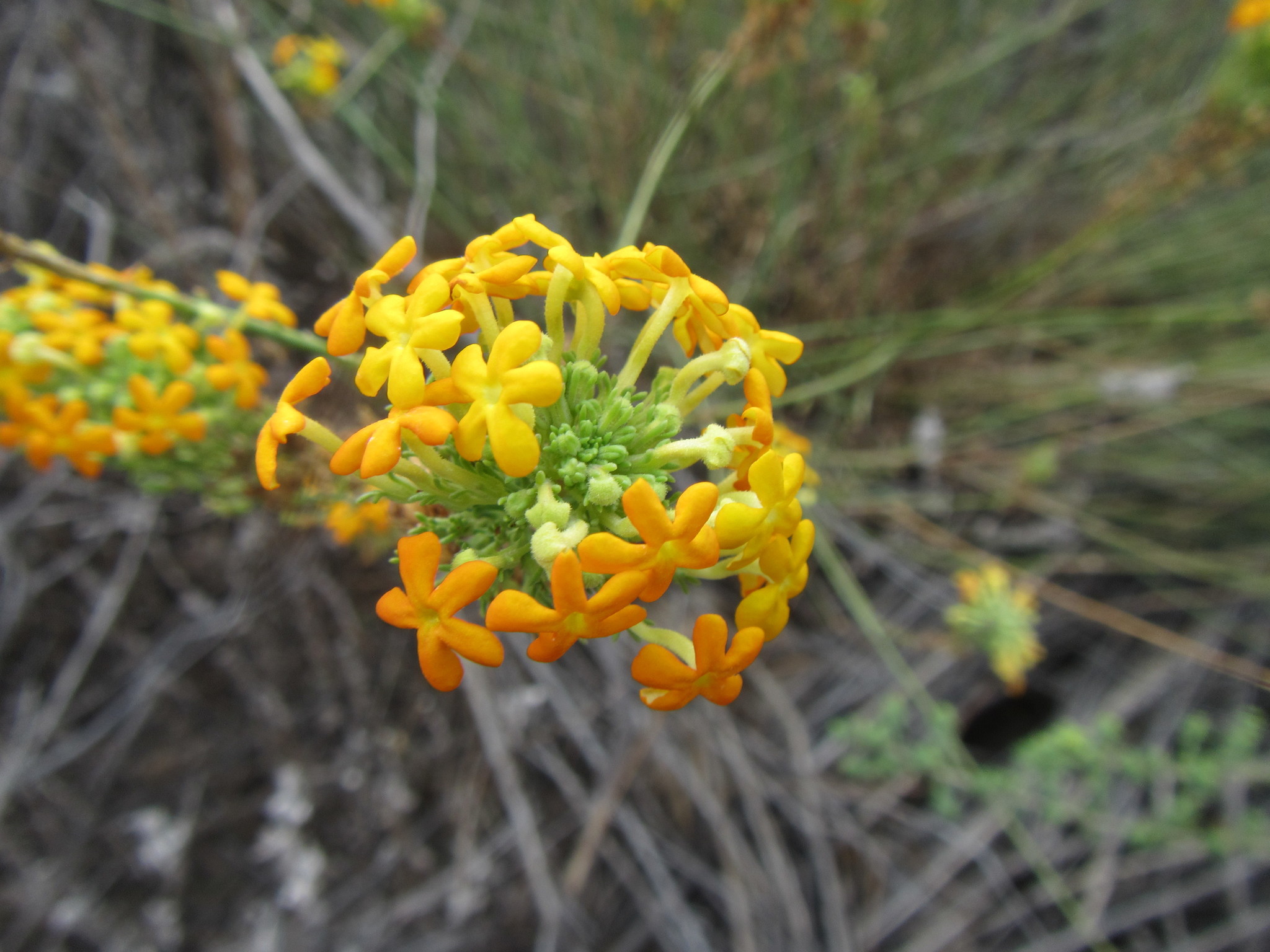
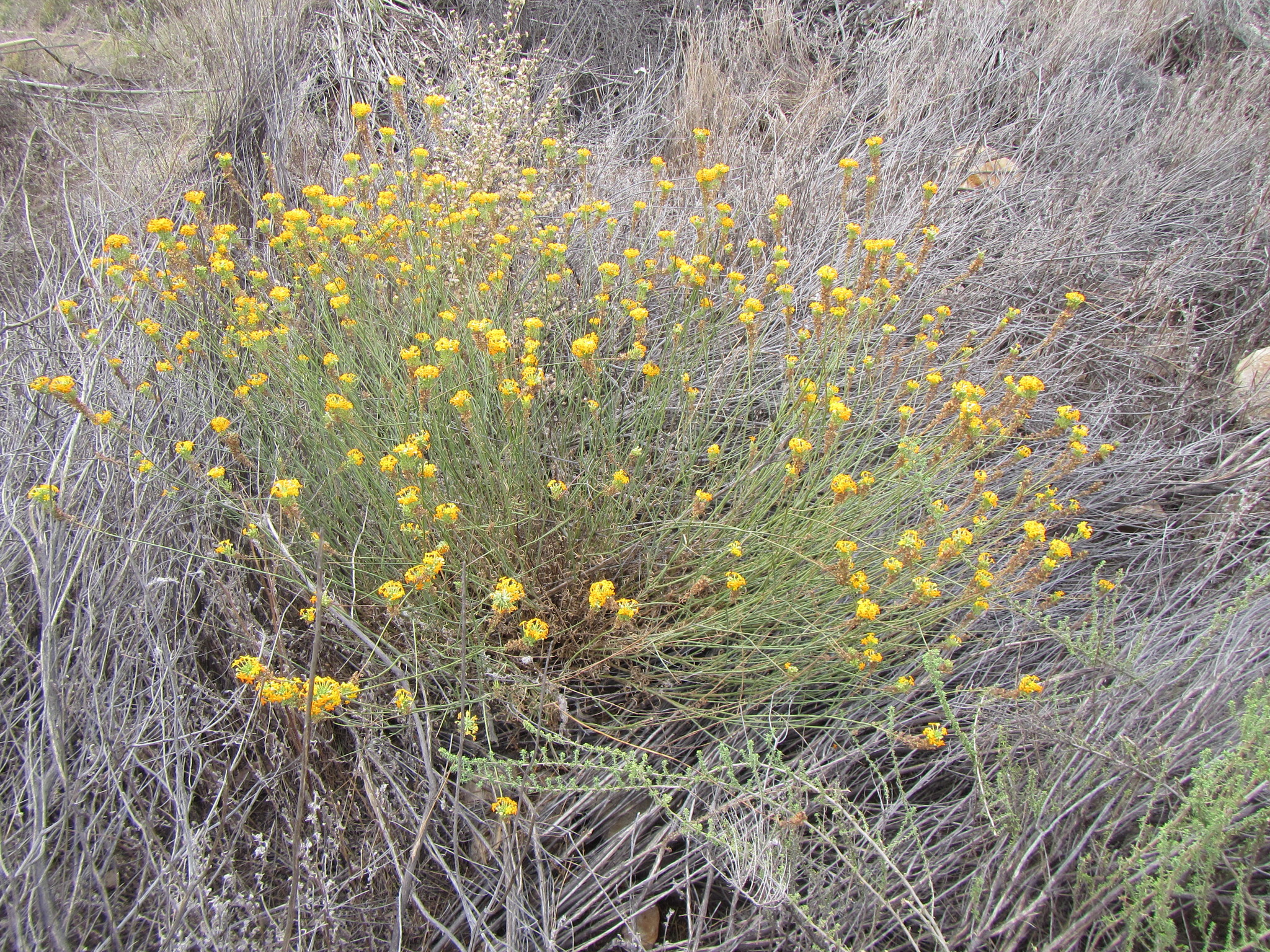
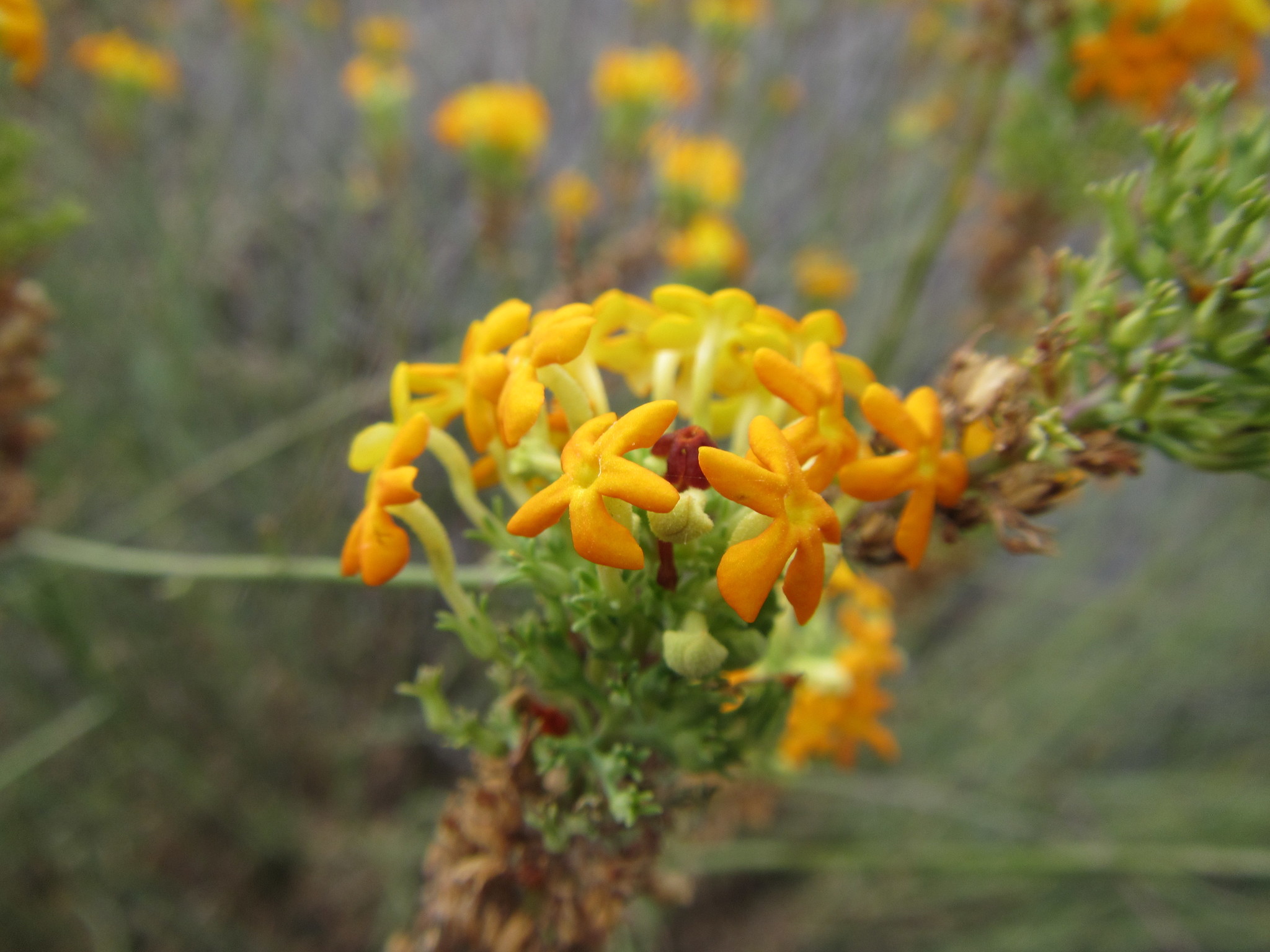
Coarse herb, probably perennial, stems probably several from the base, up to c. 1 m tall, c. 3-5 mm diam. at base, either simple or laxly branched from base, simple to branched above, pubescent throughout (including inflorescence axes) with glandular hairs up to c. 0.3 mm long, many of these broad-based and eventually ± scabrid, together with longer (to c. 1 mm) eglandular hairs, leafy particularly in lower part becoming more distantly bracteate upwards. Leaves alternate, up to c. 25-50(-60) x 4-6(-10) mm, those on dwarf axillary shoots smaller, oblong to oblanceolate, apex ± acute, base somewhat narrowed and decurrent on stem in two very narrow ridges, margins sometimes entire (and usually so when passing into bracts), often with 24 pairs of teeth in upper half, both surfaces pubescent with broad-based glandular hairs and longer eglandular ones to 0.5-0.75 mm. Flowers many in short (up to c. 80 mm) narrow thyrses, either solitary and terminal or paniculately arranged, flowers sometimes solitary (and often aborted?) and distant at base of thyrse, otherwise crowded and arranged in 3-7-flowered dichasial cymules. Bracts small, c. 2-7 x 0.5-1 mm. Pedicels (or peduncles) c. 1.5-2 mm long. Calyx obscurely bilabiate, tube c. 0.2-0.5 mm long, anticous lobes 2.4-4(4.5) x 0.5-0.8 mm, posticous lobes slightly smaller, lanceolate, minutely glandular-puberulous all over together with coarser broad-based glandular hairs to c. 0.25 mm on backs and eglandular hairs to 0.4-0.6 mm long on margins. Corolla tube c. 5.5-7.5(-9) x 1.2-1.8 mm in throat, cylindric, upper half abruptly expanded, limb almost regular, c. 5-8(-9) mm across lateral lobes, posticous lobes c. 1.75-2.5(-3.75) x 1.75-2.2(-3) mm, anticous lobe c. 1.6-2.5(-3.25) x 1.4-2.2(-3) mm, all lobes broadly elliptic to suborbicular, very obtuse, yellow to orange-brown, outside of lobes and tube pubescent, hairs up to c. 0.2-0.4 mm, somewhat retrorse, upper surface of lobes with tiny white clavate hairs forming a star-shaped pattern, inside of tube glabrous in upper half, minutely glandular-puberulous below insertion of posticous filaments. Stamens 4, anticous anthers 0.4-0.75(-1) mm long, included, posticous anthers 1-1.5 mm long, deeply included, posticous filaments bearded with clavate hairs. Stigma 0.3-0.8(-1.2) mm long, often bifid, very deeply included. Style 0.3-0.8 mm long. Ovary c. 1-1.5 x 0.8 mm. Capsules c. 3-3.5 x 2 mm. Seeds c. 1 x 0.5 mm, pallid. The plants probably begin flowering in December or early January; by April they are mostly in fruit. From: Hilliard, OM. 1994. The Manuleae: a tribe of Scrophulariaceae. Edinburgh University Press, Edinburgh. [All rights reserved]
Coarse, glandular-hairy shrublet, up to 1 m tall, stems sometimes sparsely leafy. Leaves oblong to oblanceolate, toothed or entire, pubescent with broad-based glandular hairs. Flowers in panicles, sometimes solitary and ?aborted, corolla tube 5.5-9 mm long, inflated above, lobes rounded, obtuse and entire at apex, yellow to brown, with club-shaped hairs in a star-shaped pattern around mouth. From: Snijman, DA. 2013. Scrophulariaceae: Manulea. In: DA Snijman (ed.), Plants of the Greater Cape Floristic Region 2: The Extra Cape flora. Strelitzia 30: 465-467. South African National Biodiversity Institute, Pretoria. [CC BY]
Coarse, glandular-hairy ?perennial to 1 m, stems ridged. Leaves coarsely toothed. Flowers in panicles, tube inflated above, lobes rounded, yellow to brown. From: Manning, JC; Goldblatt, P. 2012. Scrophulariaceae: Manulea L. In: J Manning & P Goldblatt (eds), Plants of the Greater Cape Floristic Region 1: The Core Cape flora. Strelitzia 29: 745-747. South African National Biodiversity Institute, Pretoria. [CC BY]
Salient feature of the species, namely the congested thyrse. From: Hilliard, OM. 1994. The Manuleae: a tribe of Scrophulariaceae. Edinburgh University Press, Edinburgh. [All rights reserved]
There is scant information on either the habit or habitat of M. cephalotes. From: Hilliard, OM. 1994. The Manuleae: a tribe of Scrophulariaceae. Edinburgh University Press, Edinburgh. [All rights reserved]
Rocky slopes. From: Snijman, DA. 2013. Scrophulariaceae: Manulea. In: DA Snijman (ed.), Plants of the Greater Cape Floristic Region 2: The Extra Cape flora. Strelitzia 30: 465-467. South African National Biodiversity Institute, Pretoria. [CC BY]
Rocky sandstone slopes. From: Manning, JC; Goldblatt, P. 2012. Scrophulariaceae: Manulea L. In: J Manning & P Goldblatt (eds), Plants of the Greater Cape Floristic Region 1: The Core Cape flora. Strelitzia 29: 745-747. South African National Biodiversity Institute, Pretoria. [CC BY]
Manulea cephalotes appears to range from the environs of Lokenburg south to Wupperthal and the Olifants River Mountains. It is also in the mountains around Ceres; 56 km from Calvinia on Blomfontein to Middelpos road; N of farm de Hoop on Middelpos to Calvinia road; Calvinia 4 km from Klein Roggeveld on way down pass; 'Kopje SW of Leliefontein Mission Station' near Khamiesberg, 3018AB. The presence of M. cephalotes in Namaqualand needs confirmation. From: Hilliard, OM. 1994. The Manuleae: a tribe of Scrophulariaceae. Edinburgh University Press, Edinburgh. [All rights reserved]
Kamiesberg Mountains, Damsberg and Bokkeveld Mountains to Ceres and ?Roggeveld. From: Snijman, DA. 2013. Scrophulariaceae: Manulea. In: DA Snijman (ed.), Plants of the Greater Cape Floristic Region 2: The Extra Cape flora. Strelitzia 30: 465-467. South African National Biodiversity Institute, Pretoria. [CC BY]
Kamiesberg, Bokkeveld Mtns to Ceres. From: Manning, JC; Goldblatt, P. 2012. Scrophulariaceae: Manulea L. In: J Manning & P Goldblatt (eds), Plants of the Greater Cape Floristic Region 1: The Core Cape flora. Strelitzia 29: 745-747. South African National Biodiversity Institute, Pretoria. [CC BY]
December to April
640 to 1070 m
This map contains point-based occurrences at different locations
Occurrence in the Flora of Southern Africa (FSA) countries and South African provinces. Residence status indicates if a taxon is indigenous, endemic, naturalised or invasive in a specific region. This data is based on specimen records and literature
FSA
SA
BOT
NAM
ESW
LES
WC
EC
NC
FS
GA
KZN
LP
MP
NW
Absent
Indigenous
Endemic
Naturalised
Invasive

Names and Sources
Manulea densiflora Benth.
Manulea rigida Benth.
Sutera cephalotes (Thunb.) Kuntze
Published in: Revis. Gen. Pl. 2: 467 (1891)
Classification
KINGDOM Plantae
SUBKINGDOM Phanerogamae
PHYLUM Anthophyta
ORDER Lamiales
FAMILY Scrophulariaceae
TRIBE Limoselleae
GENUS Manulea
SPECIES cephalotes
11 results for Manulea cephalotes Thunb.
Barcode: PRE0120321-0 Collector(s) & number: Schlechter, FRR, 1781 | 1897-1-19
South Africa, Western Cape, KOUE BOKKEVELD; GYDOUW MTS.
Data Resource: BODATSA View record
Barcode: PRE0119435-0 Collector(s) & number: Ecklon, CF, 9917 | 1916-3-
South Africa, Eastern Cape, Clanwilliam. Olifantrivier and Brakfontein.
Data Resource: BODATSA View record
Barcode: PRE0682933-0 Collector(s) & number: Perry, PL, 3406 | 1986-1-7
South Africa, Northern Cape, N OF DE HOOP FARM ON MIDDELPOS TO CALVINIAROAD.
Data Resource: BODATSA View record
Barcode: PRE0117225-0 Collector(s) & number: Acocks, JPH, 17574 | 1954-1-23
South Africa, Northern Cape, CALVINIA DIV.; LOKENBURG
Data Resource: BODATSA View record
Barcode: NBG0197426-0 Collector(s) & number: Rourke, JP, 2261 | 2004-1-11
South Africa, Northern Cape, Springbok. Damsberg, south of Wallekraal, Namaqualand. 30°26'36"S; 17°31'14"E.
General notes: Among granite slabs on NE side of summit. Flowers deep yellow-orange. Perennial with aromatic foliage. Occasional.
Data Resource: BODATSA View record
Barcode: PRE0613769-0 Collector(s) & number: Goldblatt, P, 5527 | 1980-6-4
South Africa, Northern Cape, 56 KM FROM CALVINIA ON BLOMFONTEIN ROAD TO MIDDELPOS
Data Resource: BODATSA View record
Barcode: PRE0124990-0 Collector(s) & number: Theiler, AC, 47 | 1926-1-3
South Africa, Western Cape, PIQUETBERG DIV.; PIEKENIERSKLOOF
Data Resource: BODATSA View record
Barcode: NBG0196259-0 Collector(s) & number: Pretorius, WAJ, 800 | 2002-11-6
South Africa, Northern Cape, Nieuwoudtville. Oorlogsklook Nature Reserve. S14. Lat: 31°28'40"S; Long: 19°04'20"E.
General notes: Mountain. Well-drained brown loamy, stony soil. Acocks Veld Type.69. Fynbos vegetation. Eroded disturbance. S aspect. Moderate slope. Locally abundant. ephemeral erect dwarf shrub. Flowers yellow. No fruit. Plant height.0,60m. Common name: Langstingel blommetjie.
Data Resource: BODATSA View record
Barcode: PRE0850402-0 Collector(s) & number: Rourke, JP, 2261 | 2004-1-11
South Africa, Northern Cape, Namaqualand. Hondeklipbaai. Damsberg, south of Wallekraal.
General notes: On granite slabs on NE side of summit. Perennial with aromatic foliage. Flowers deep yellow-orange.
Data Resource: BODATSA View record
Barcode: PRE0120332-0 Collector(s) & number: Schlechter, FRR, 816B | 1896-7-2
South Africa, Cape Province, OLIFANTS RIVER
Data Resource: BODATSA View record
This map contains point-based occurrences at different locations
2013
SERIES CHAPTER
Scrophulariaceae: Manulea Snijman, DAIn: DA Snijman (ed.), Plants of the Greater Cape Floristic Region 2: The Extra Cape flora. Strelitzia 30: 465-467
South African National Biodiversity Institute, Pretoria
2012
SERIES CHAPTER
Scrophulariaceae: Manulea L. Manning, JC; Goldblatt, PIn: J Manning & P Goldblatt (eds), Plants of the Greater Cape Floristic Region 1: The Core Cape flora. Strelitzia 29: 745-747
South African National Biodiversity Institute, Pretoria
1994
1904
FLORA CHAPTER
XCV. Scrophulariaceae Hiern, WPIn: WT Thiselton-Dyer (ed.). Flora Capensis 4(1-3)121-420
Lovell Reeve & Co., London
1836
1800
BOOK
Prodromus plantarum Capensium: Quas in promontorio Bonæ Spei Africes, annis 1772-1775, Vol. 2 Thunberg, CPJoh. Fr. Edman, Uppsala
No results found for Manulea cephalotes Thunb.
Status and criteria
LC
Assessor(s)
Plantae Coordinator
BOOK
Kirkbridge, J.H. 1993. Biosystematic monograph of the genus Cucumis (Cucurbitaceae). Parkway Publishers
JOURNAL ARTICLE
Kirkman, K.P. 2002. The influence of various types and frequencies of rest on the production and condition of sourveld grazed by sheep or cattle. 2. Vigour. African Journal of Range and Forage Science. 19:93-105
JOURNAL ARTICLE
Kirkwood, D. and Midgley, J. 1999. The floristics of sand forest in northern KwaZulu-Natal, South Africa. Bothalia. 29:293-304
GENERIC
Kirschner, J. 2002. Part 7. Juncaceae 2: Juncus subg. Juncus. Species Plantarum. Australian Biological Resources Study
JOURNAL ARTICLE
Kirschner, J. and Kaplan, Z. 2002. Taxonomic monographs in relation to global Red Lists. Taxon. 51:155-158
JOURNAL ARTICLE
Kissling, J. 2012. Taxonomy of Exochaenium and Lagenias: Two resurrected genera of tribe Exaceae (Gentianaceae). Systematic Botany. 37:238-253
| Part(s) of plant used | Use(s) | Reference |
|---|
Coming soon...


