

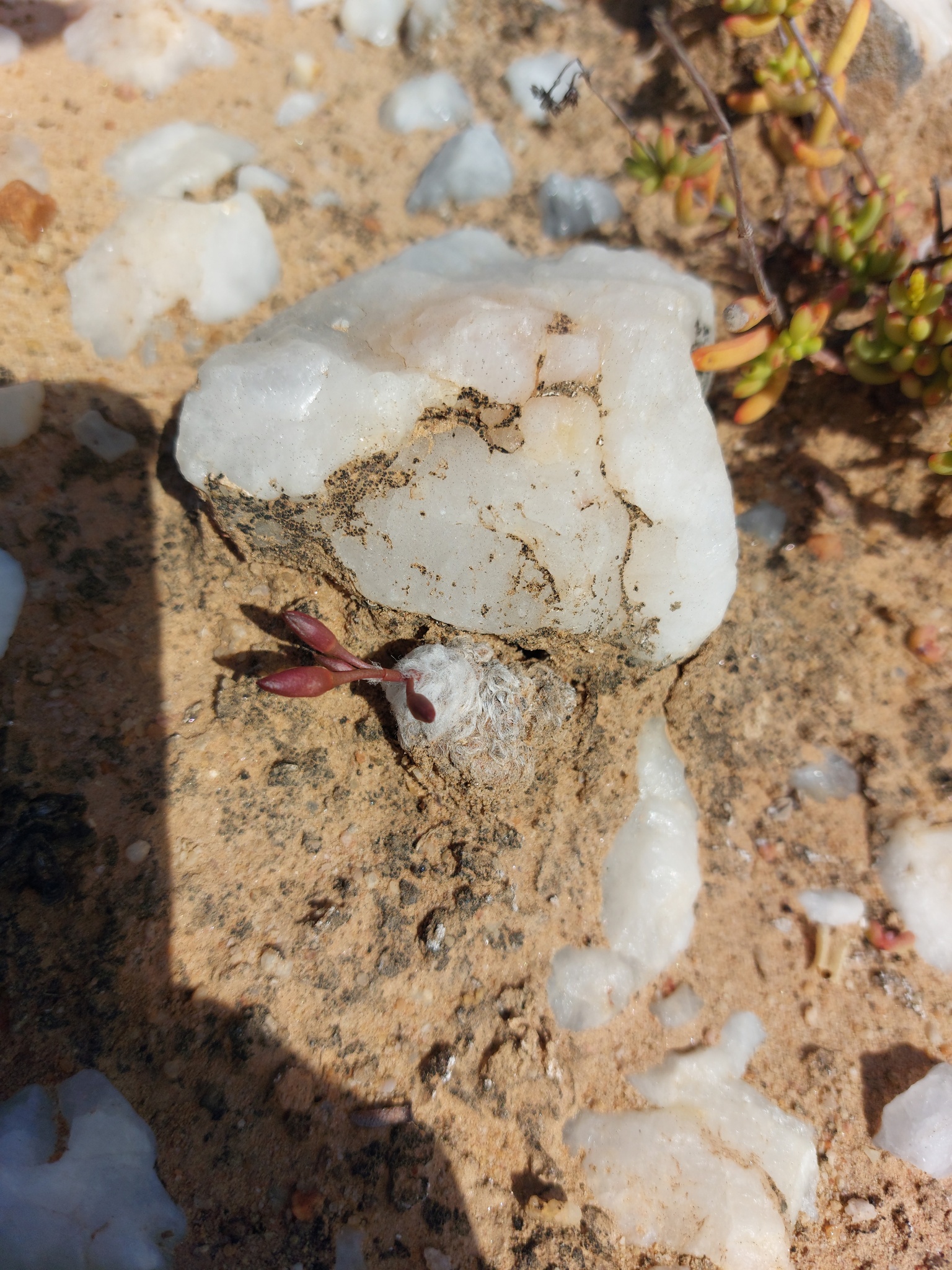
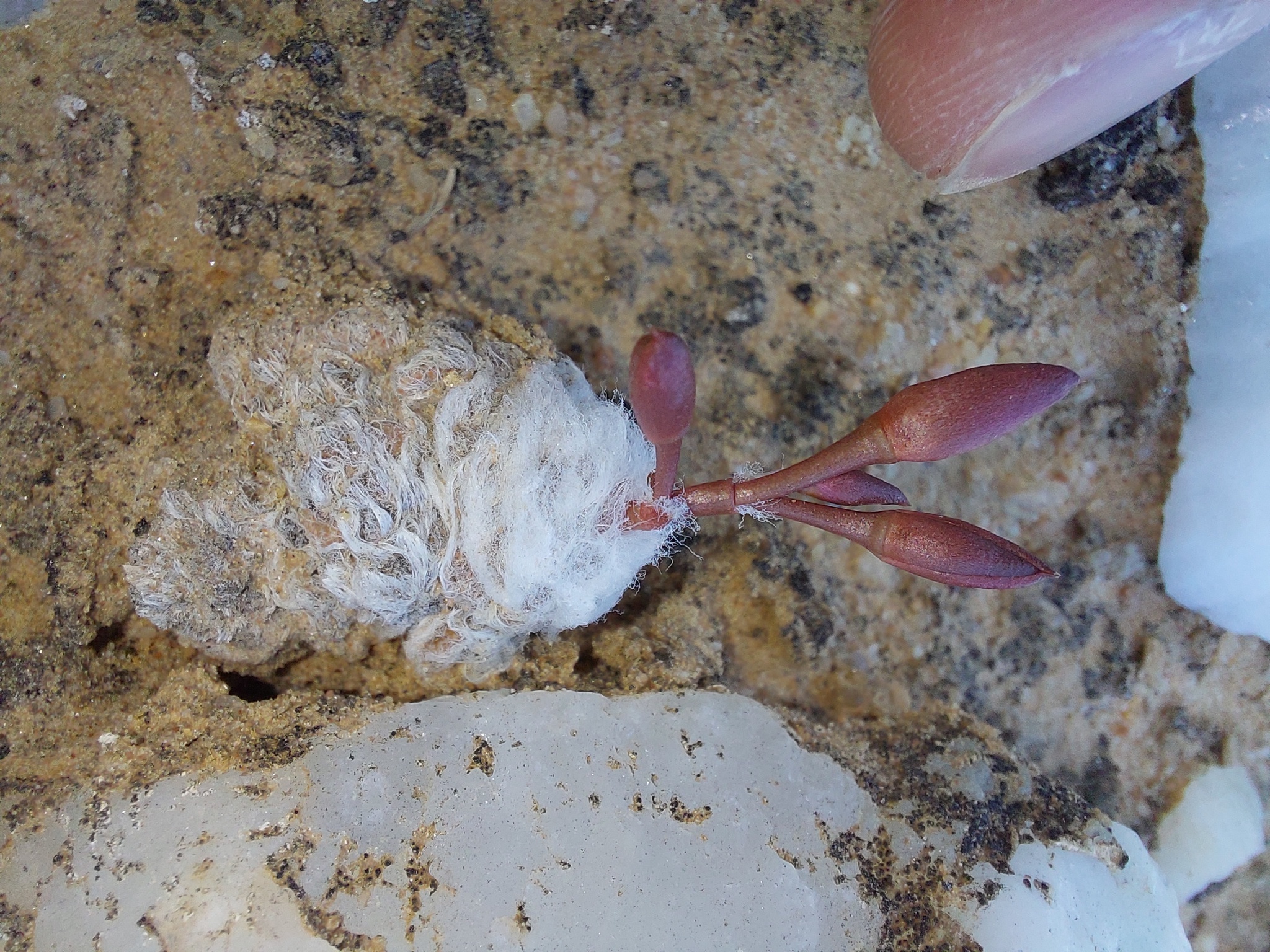
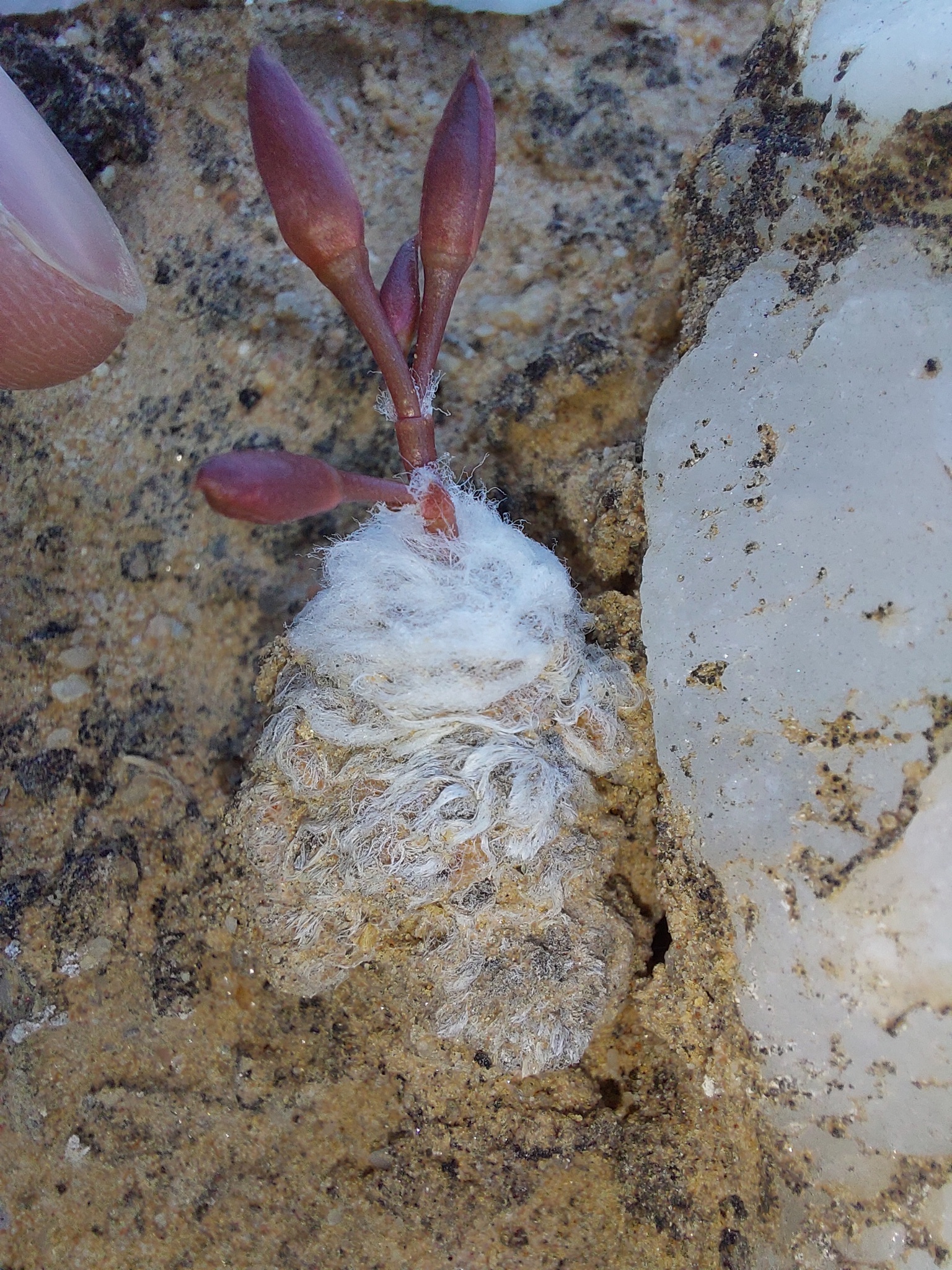
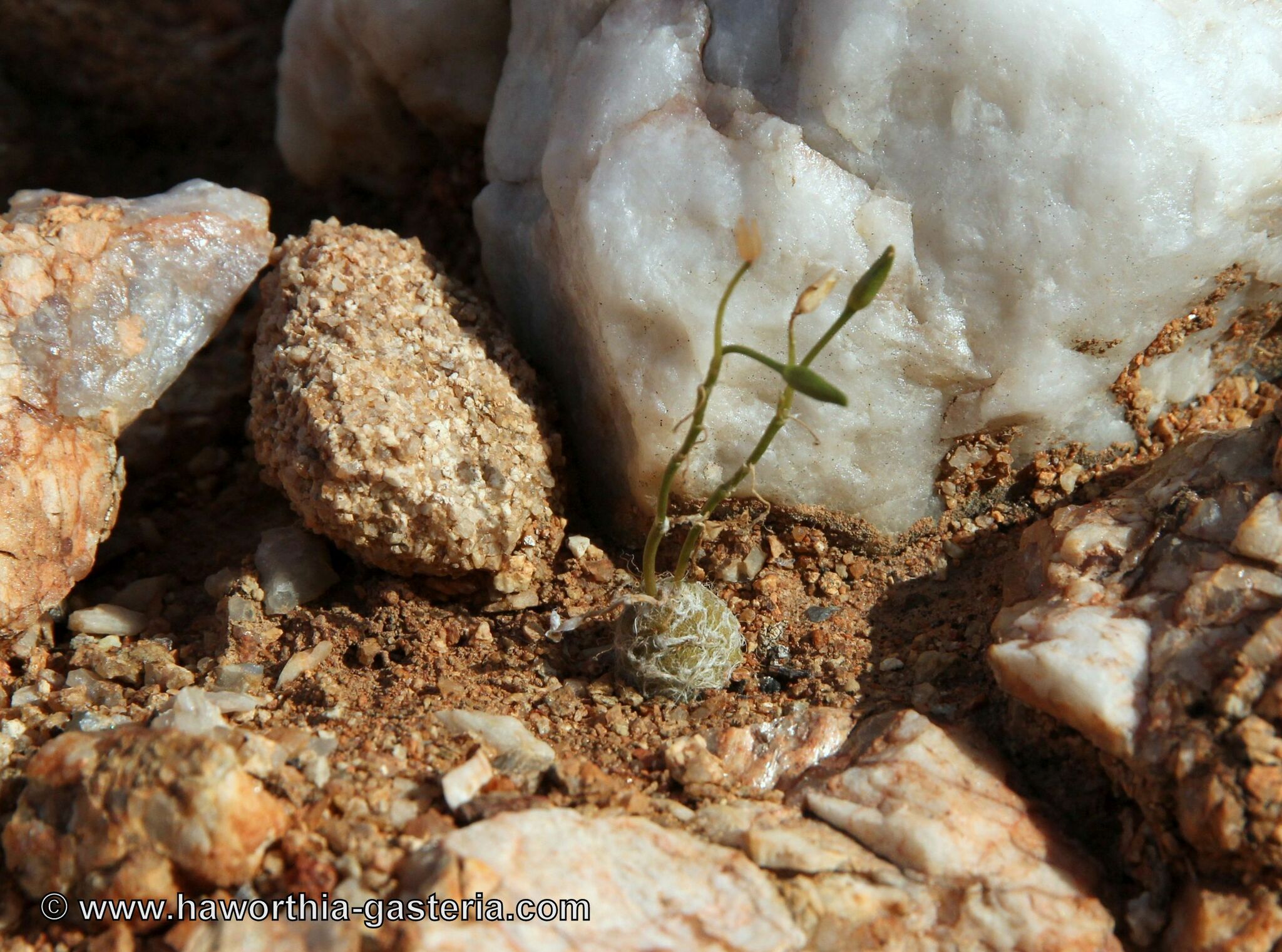
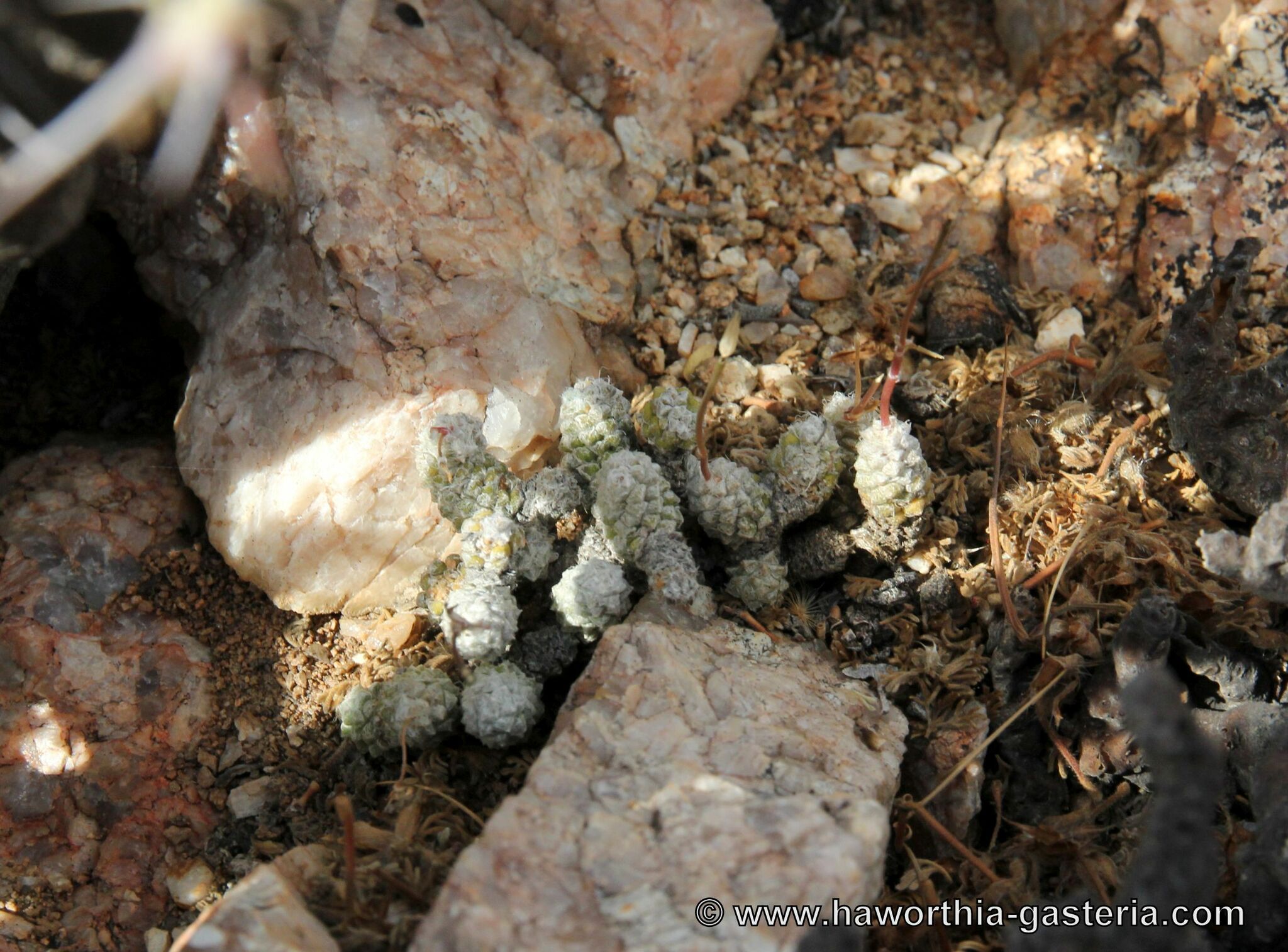
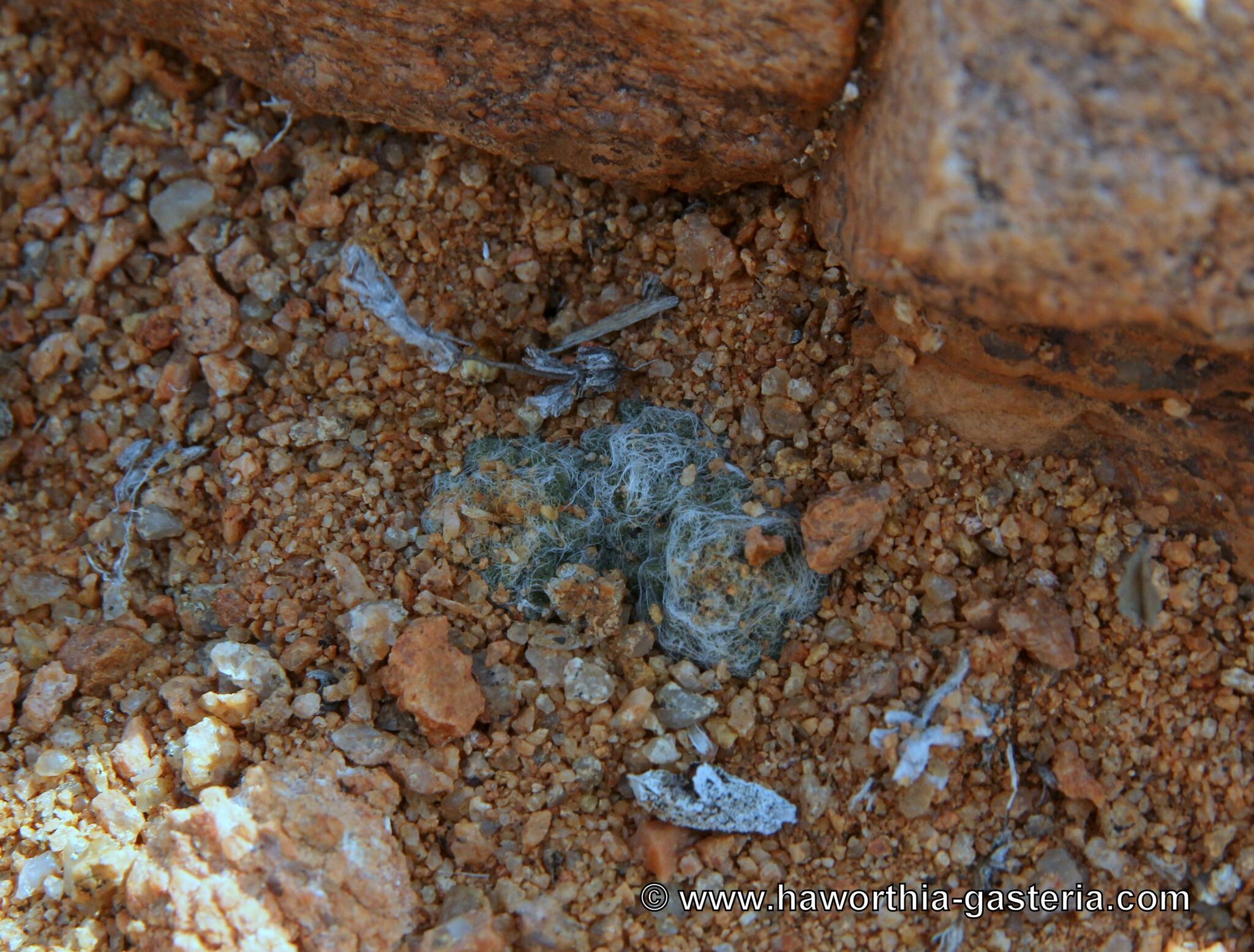
Plant with above ground portion up to 37 mm high and 17 mm across (not including inflorescence) but often much shorter; stem ca. 15 mm high x 20 mm broad, branches up to 3, 7 mm x 10 mm broad. Leaves in a tight rosette 12-17 mm across; leaf 5 x 5 mm with narrow, very light green base merging into a dark green, finely tuberculate, subapical portion, apex maroon-brown, retuse with rugose to tuberculate epidermis and covered with an extremely dense, mass of entwined web, of very fine white hairs, about 1.5 mm thick. Flowers can be quite large and up to 17 mm across. Seeds are typical of the retusa group. From: Williamson, G. 2003. Notes on Anacampseros retusa Poelln. (Portulacaceae) with descriptions of two new forms and one subspecies. Excelsa 20: 27-33. [All rights reserved]
This remarkable new subspecies is completely separate from the other forms of A. retusa. The woolly covering of densely entwined long hairs is not seen in any other form or the typical subspecies. A further interesting feature is the thick stem and branches which act as storage organs. The tubers are not well developed as is often seen in the typical subspecies. The large storage tubers of other forms are illustrated in the Alexander Bay plants and in the parva forms. The thick, almost impenetrable cover of lanugo gives full protection from the sun’s penetrating rays and also acts as a trap for storing moisture condensation and provides protection from the occasional ferocious winds. From: Williamson, G. 2003. Notes on Anacampseros retusa Poelln. (Portulacaceae) with descriptions of two new forms and one subspecies. Excelsa 20: 27-33. [All rights reserved]
The Knersvlakte is a mosaic of bright, quartz, pebbly flats and low, undulating hills. The altitude is from about 100 to 300 m and the whole area arid. Annual rainfall is between 60 and 150 mm which falls mainly in winter but the whole area is periodically bathed in light fogs which flow in from the western Atlantic seaboard. Summer temperatures can be in the upper 30°s to early 40°C, often tempered by the cold Atlantic fogs. There are occasionally seasonal flash floods in mid to late summer. Phyllite-schistose outcrops, quartz intrusive dykes and quartz depression pebbly pavements coupled with the strange climatic extremes allows for the existence of a unique succulent flora. The whole area is host to numerous endemics. From: Williamson, G. 2003. Notes on Anacampseros retusa Poelln. (Portulacaceae) with descriptions of two new forms and one subspecies. Excelsa 20: 27-33. [All rights reserved]
Republic of S. Africa, Western Cape Province. From: Williamson, G. 2003. Notes on Anacampseros retusa Poelln. (Portulacaceae) with descriptions of two new forms and one subspecies. Excelsa 20: 27-33. [All rights reserved]
100 to 300 m
This map contains point-based occurrences at different locations
Occurrence in the Flora of Southern Africa (FSA) countries and South African provinces. Residence status indicates if a taxon is indigenous, endemic, naturalised or invasive in a specific region. This data is based on specimen records and literature
FSA
SA
BOT
NAM
ESW
LES
WC
EC
NC
FS
GA
KZN
LP
MP
NW
Absent
Indigenous
Endemic
Naturalised
Invasive

Names and Sources
Published in: Excelsa 20: 29 (2003)
Classification
KINGDOM Plantae
SUBKINGDOM Phanerogamae
PHYLUM Anthophyta
ORDER Caryophyllales
FAMILY Anacampserotaceae
GENUS Anacampseros
SPECIES retusa
SUBSPECIES lanuginosa
3 results for Anacampseros retusa Poelln. subsp. lanuginosa G.Will.
This map contains point-based occurrences at different locations
2003
PERIODICAL/JOURNAL
Notes on Anacampseros retusa Poelln. (Portulacaceae) with descriptions of two new forms and one subspecies Williamson, GExcelsa 20: 27-33
1997
No results found for Anacampseros retusa Poelln. subsp. lanuginosa G.Will.
| Part(s) of plant used | Use(s) | Reference |
|---|
Coming soon...


