
PLANTAE / PHANEROGAMAE / ANTHOPHYTA / CARYOPHYLLALES / AIZOACEAE / RUSCHIOIDEAE / RUSCHIEAE / ACRODON / CAESPITOSUS

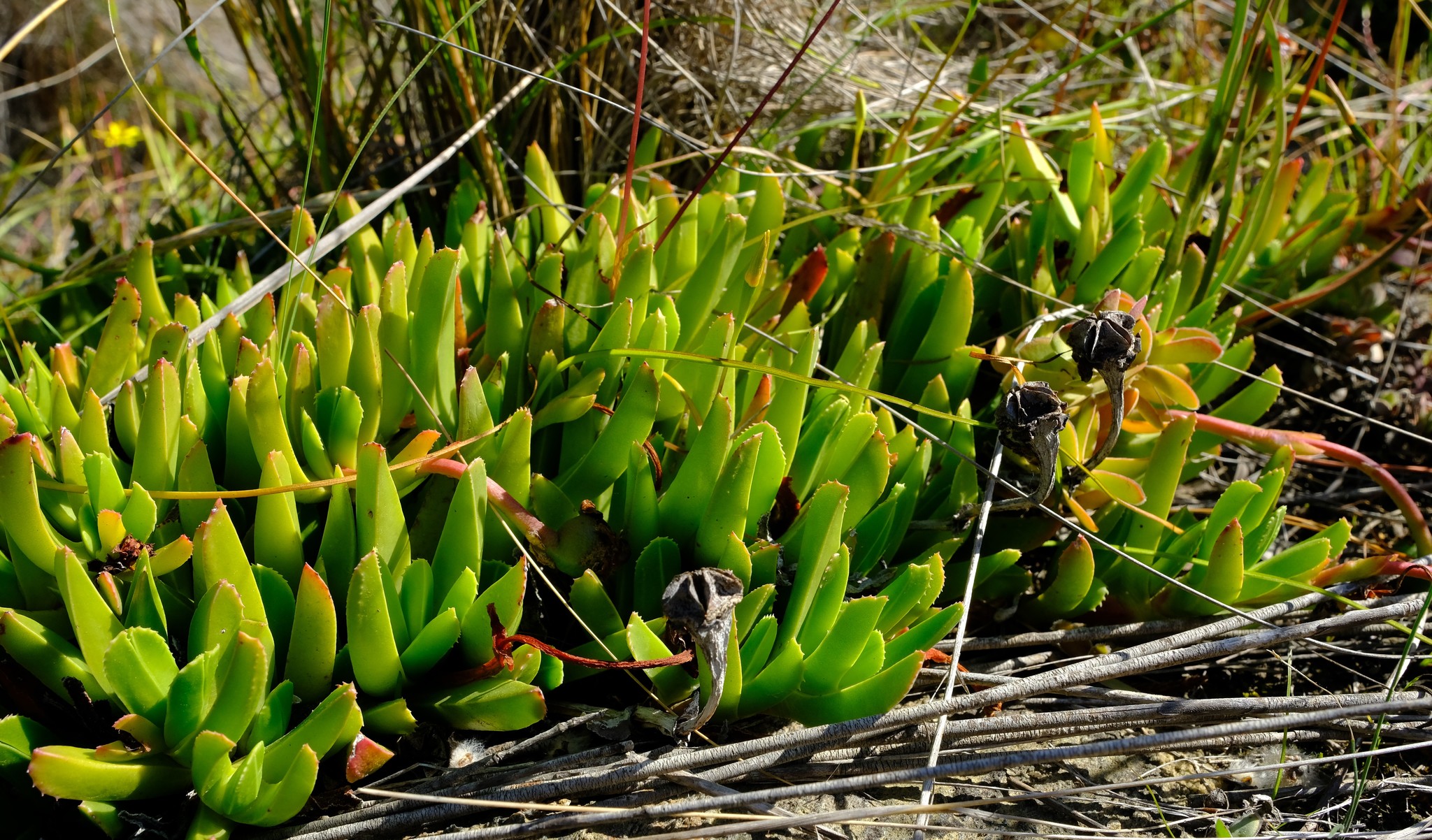
Plants forming cushion-shaped big and low shrubs, with 60 cm in diameter and a height of 30cm the biggest in the genus. Internodes spongy with a smooth surface, orange and with two lateral folds. Leaves about 50 mm long, 5-9 mm broad and thick, the biggest in the genus, 3-12 keel teeth, only 1-2along margins. Flowers solitary, bracteoles reaching up to the calyx and embracing its base, but starting from near the base of the stalk, the calyx lobes overtopping the petals in the young flower, the flower itself of the short cone type, like those of A. bellidiflorus and A. subulatus, the central cone of about 300 stamens with only few or no filamentous staminodes that are equipped with long basal papillae pointing inwards forming an interwoven layer like a thick ring of felt; the 45-55 petals vittate and with marginal purple margins. Fruits borne on long stalks of about 85 mm above the plant, their stalks bent upwards, the capsule proper the biggest in the genus with diameters and heights of about 12 mm, the top with 5 mm exceeding the sizes of all other species. From: Hartmann, HEKO; Niesler, IM. 2012. A Gordion knot in Ruschioideae (Aizoaceae): Acrodon and Brianhuntleya in an attempt to disentangle the confusion. Bradleya 30: 33-60. [https://doi.org/10.25223/brad.n30.2012.a8] [All rights reserved]
On coastal limestone or sandy patches in open spaces among shrubby coastal Fynbos with many invaders like Acacia cyclops or A. longifolia, expecting rainfall at all seasons. From: Hartmann, HEKO; Niesler, IM. 2012. A Gordion knot in Ruschioideae (Aizoaceae): Acrodon and Brianhuntleya in an attempt to disentangle the confusion. Bradleya 30: 33-60. [https://doi.org/10.25223/brad.n30.2012.a8] [All rights reserved]
In the lower ranges of the Breede River near its mouth, Swellendam, WC, South Africa. From: Hartmann, HEKO; Niesler, IM. 2012. A Gordion knot in Ruschioideae (Aizoaceae): Acrodon and Brianhuntleya in an attempt to disentangle the confusion. Bradleya 30: 33-60. [https://doi.org/10.25223/brad.n30.2012.a8] [All rights reserved]
This map contains point-based occurrences at different locations
Occurrence in the Flora of Southern Africa (FSA) countries and South African provinces. Residence status indicates if a taxon is indigenous, endemic, naturalised or invasive in a specific region. This data is based on specimen records and literature
FSA
SA
BOT
NAM
ESW
LES
WC
EC
NC
FS
GA
KZN
LP
MP
NW
Absent
Indigenous
Endemic
Naturalised
Invasive

Names and Sources
Published in: Bradleya 30: 51 (2012)
Type: South Africa, Western Cape province, Hartmann & Bayer 34493 (HBG, holo.)
Classification
KINGDOM Plantae
SUBKINGDOM Phanerogamae
PHYLUM Anthophyta
ORDER Caryophyllales
FAMILY Aizoaceae
SUBFAMILY Ruschioideae
TRIBE Ruschieae
GENUS Acrodon
SPECIES caespitosus
1 results for Acrodon caespitosus H.E.K.Hartmann
This map contains point-based occurrences at different locations
No literature available.
No results found for Acrodon caespitosus H.E.K.Hartmann
| Part(s) of plant used | Use(s) | Reference |
|---|
Coming soon...


