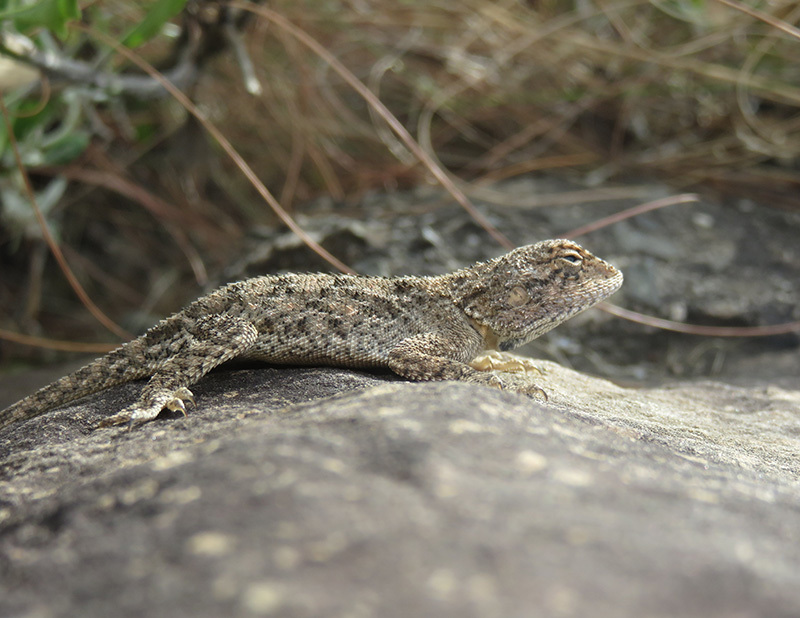
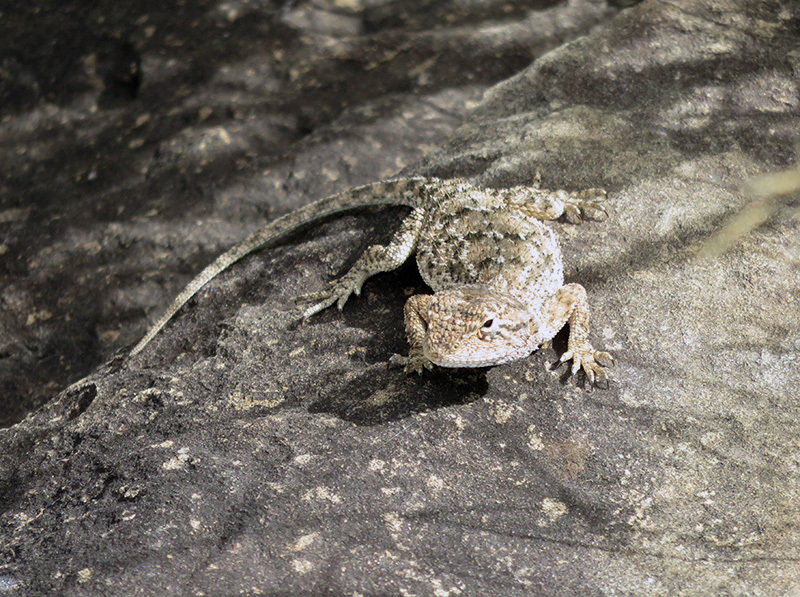
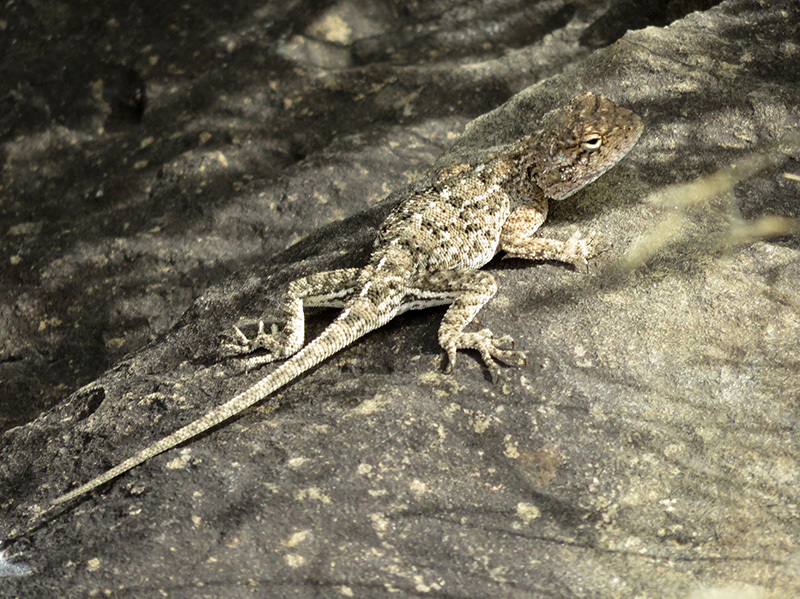
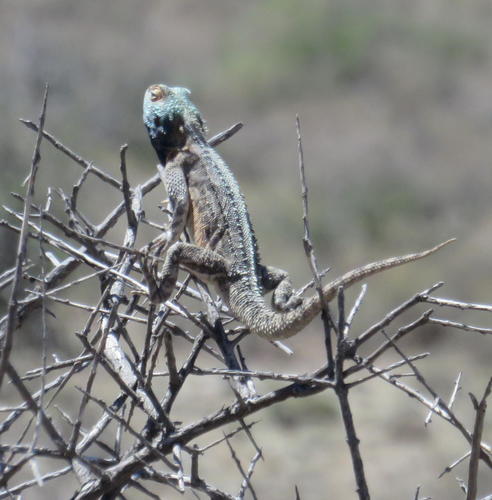
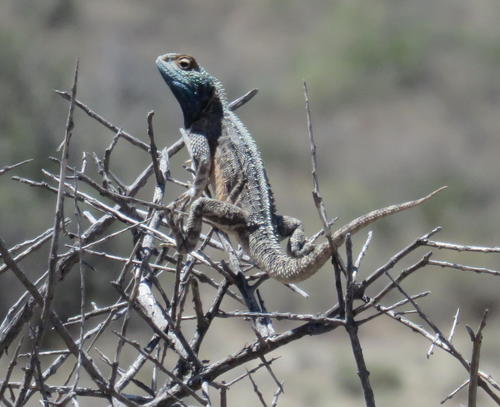
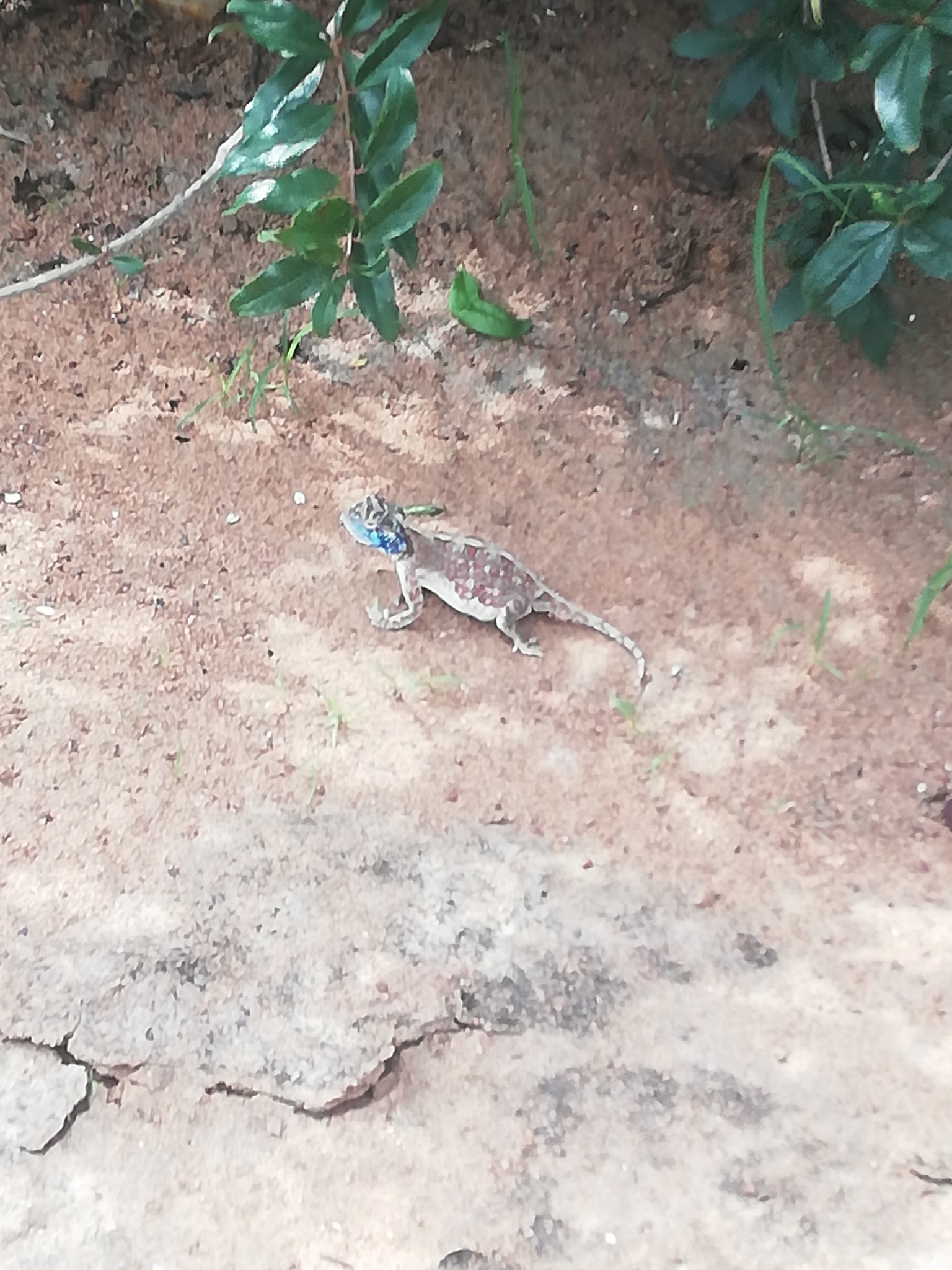
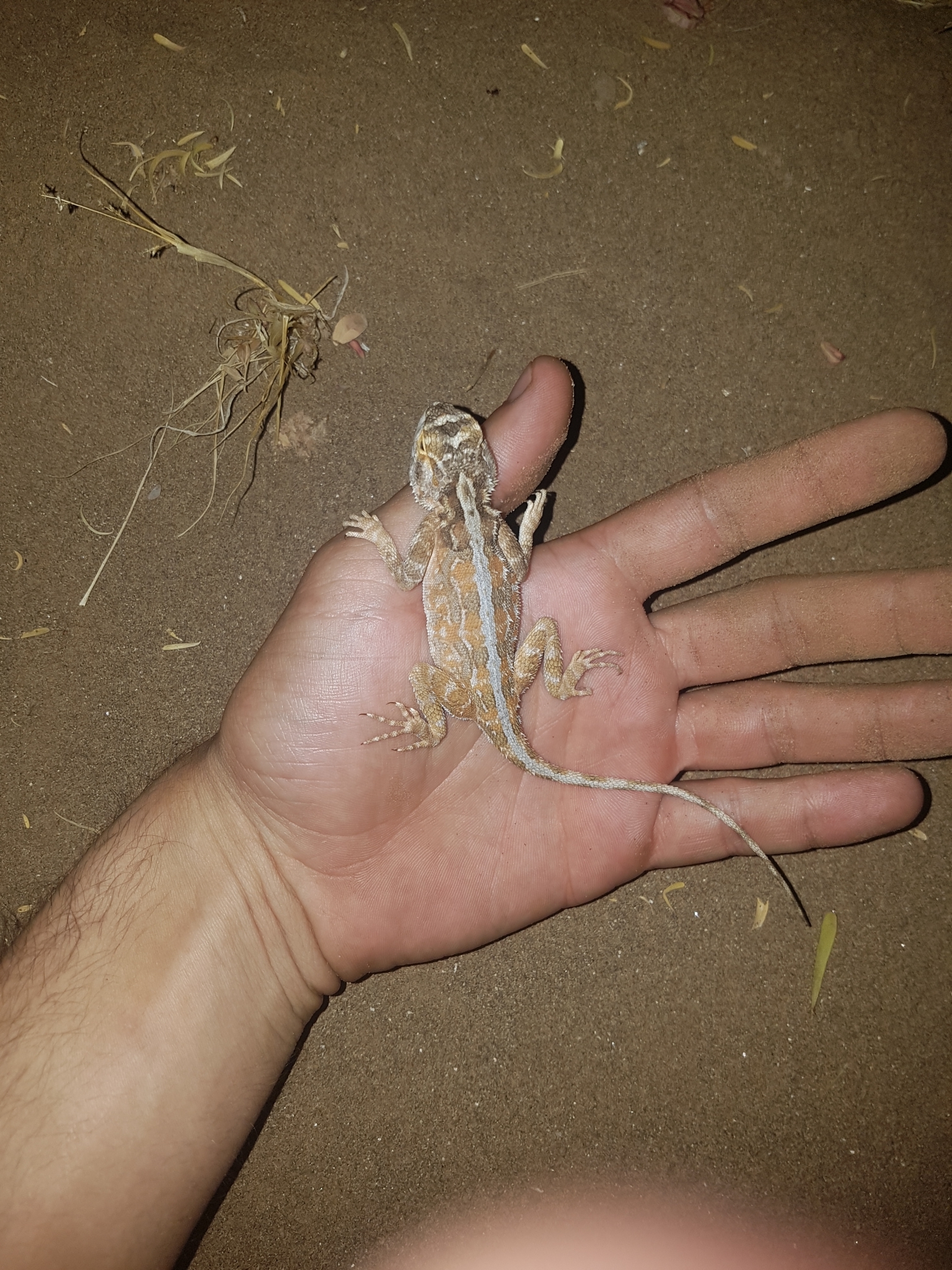
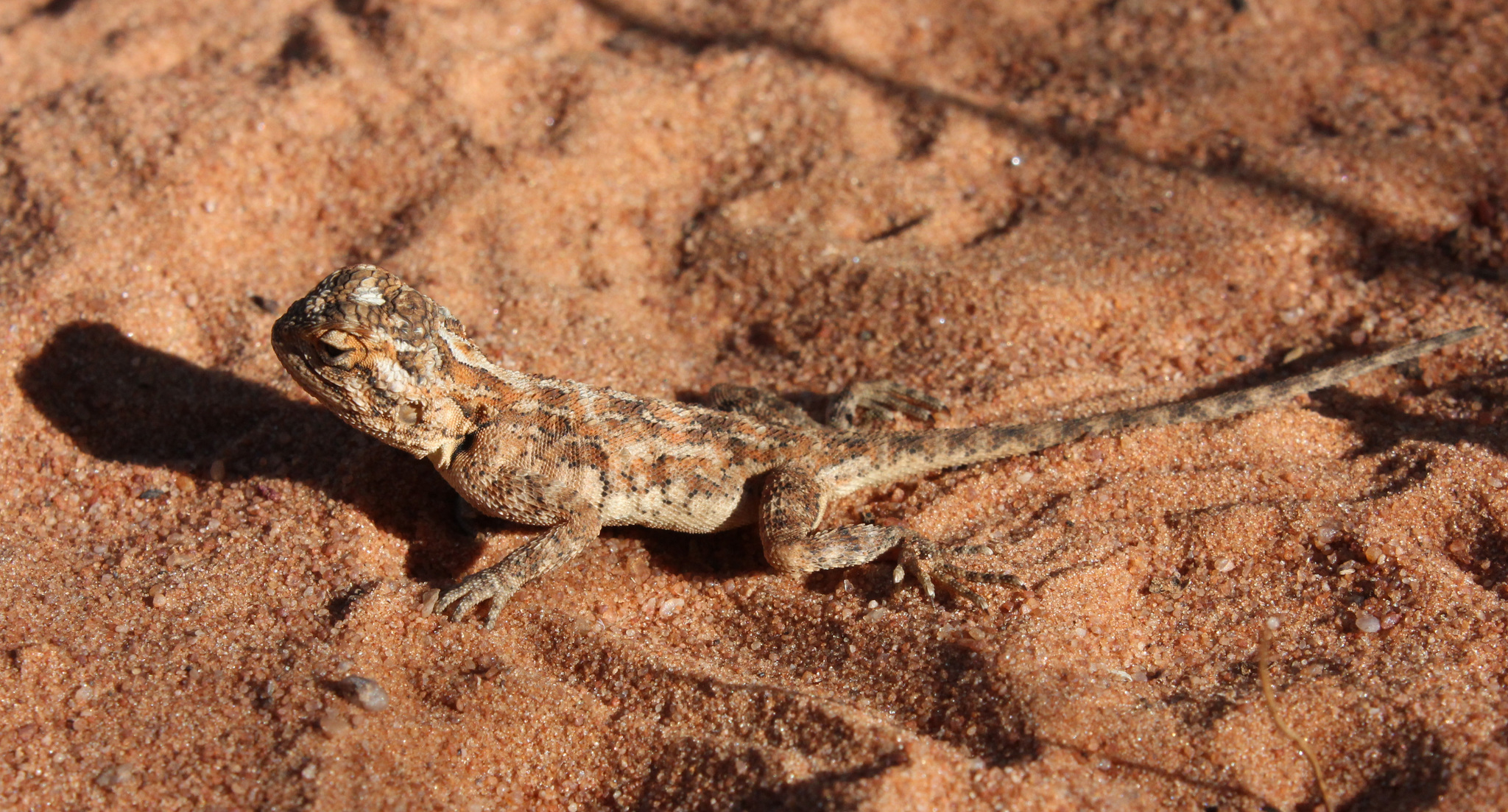
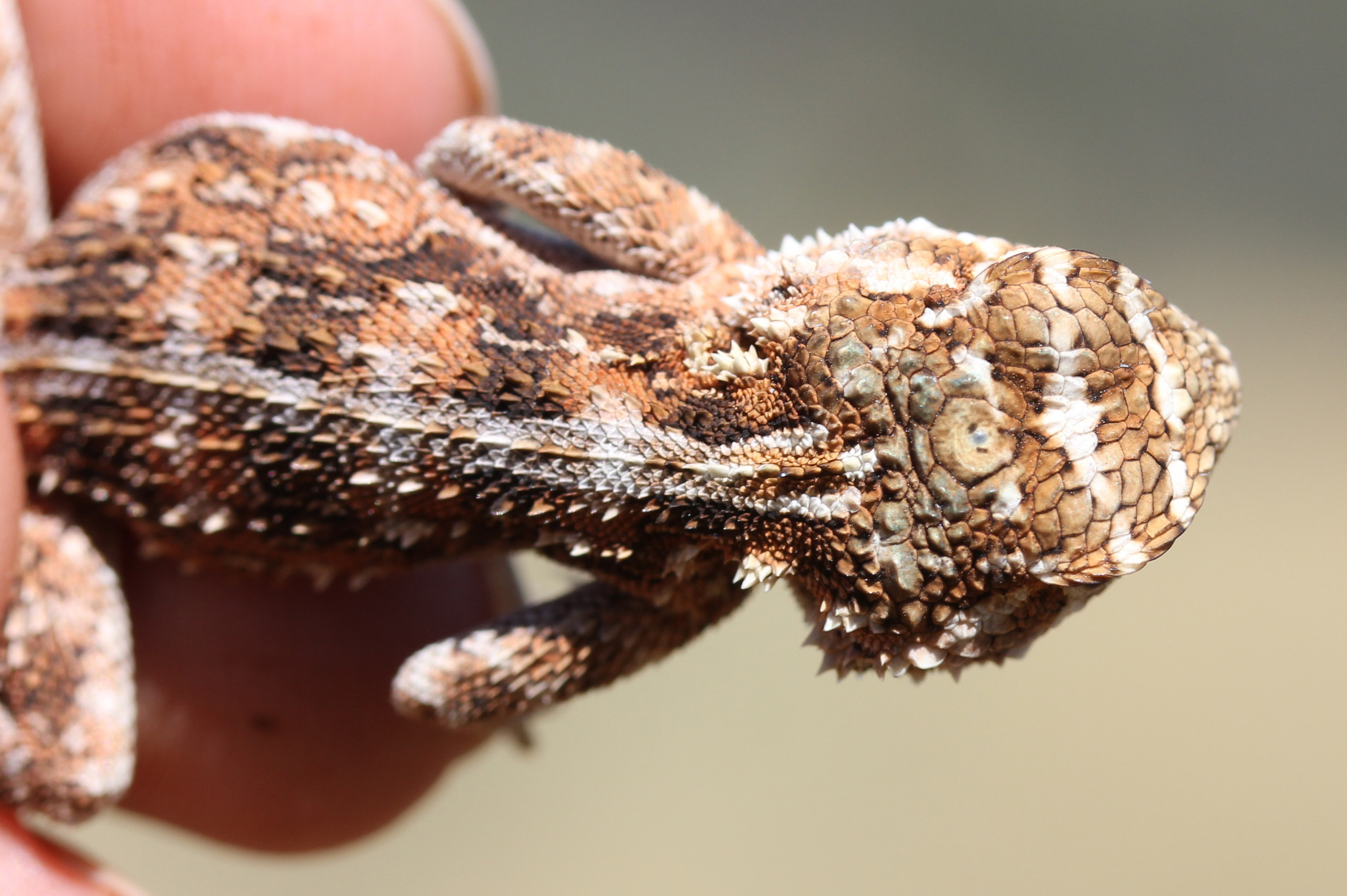
Boulenger (1885) re-described this species as follows: Head short, convex, subcordiform. Nostril slightly tubular, pierced on the canthus rostalis or just below, in a convex nasal. Upper head-scales smooth or feebly keeled; forehead slightly convex; occipital enlarged; sides of head posteriorly and neck with spinose scales; ear-opening larger than the eye-opening. Male without a regular gular pouch. Body depressed, covered with moderately large, imbricate, strongly keeled scales intermixed with strongly enlarged ones; a feeble but very distinct dorsal and nuchal crest; ventral scales perfectly smooth.Limbs moderate; tibia as long as the skull(to occiput); third finger very slightly longer than fourth, fourth toe slightly longer than third, fifth extending as far as first. Tail nearly twice as long as the distance from gular fold to vent, rounded in the female, a little compressed in the male, covered strongly with keeled scales. Male with a row of praeanal pores. Yellowish or olive-brown above, with a double series of large brown spots on the back; lower surfaces whitish, the throat with longitudinal brown lines in the female, blackish blue in the breeding male. Total length 252 mm, Head 24mm, width of head 23 mm, body 81 mm, forelimb 48 mm, hindlimb 69 mm, tail 147 mm.
No separate diagnostic description was provided. Refer to the morphological description.
Type locality: Otjimbingue [Namibia] [Agama infralineata PETERS 1877] Holotype: MNHN-RA ([Agama aculeata DUMÉRIL & BIBRON 1837]) Lectotype: iconotype, Fig. 7 of Seba (1735, II, tomus 8); Holotype: ZMB 750, "in promontorio bonae spei", leg. v. Borcke (actually a Paralectotypus fide TILLACK, pers. comm. 22 Jan 2014, Wagner et al. 2012) Holotype: BMNH 1946.8.27.98-99 A (unclear fide P. Campbell, pers. comm., March 2019) [distanti] Syntypes: ZMB 4217, 4218, 4219 [Agama infralineata PETERS 1877]
The information below was extracted from Bates and de Villiers (2014). "The taxonomic status of the Agama aculeata species complex (A. aculeata aculeata, A. a. distanti, A. armata) should be investigated (Branch et al., 2006a). Taxa are currently based on morphological differences (McLachlan, 1981), but a molecular analysis is required. There has been much confusion about the identification and geographical range of A. armata (e.g. Branch, 1998), a species that is easily confused with A. aculeata distanti. Agama armata was considered a subspecies of A. aculeata by McLachlan (1981). However, a taxonomic study by Jacobsen (1992) determined that A. armata, sometimes sympatric with A. aculeata distanti, has a different gular pattern. According to Jacobsen (1992) the distribution of A. armata in South Africa, Lesotho and Swaziland, is restricted to the northern half of Limpopo in South Africa, with the exception of a Swaziland record which is considered to probably be referable to A. aculeata distanti. The findings of Jacobsen (1992) are accepted for the time being because there is no contradictory evidence. The species information in this page is therefore for A. a. aculeata and A. a. distanti".
Namibia, Botswana, Zimbabwe, South Africa, Mozambique, S Angola, Zambia, Swaziland, Republic of South Sudan.
The Common Ground Agama is widely distributed in the Northern Cape, the western parts of North West province, Free State and Eastern Cape, and the eastern parts of the Western Cape (Bates et al., 2014).
In general, lizards can sprint, crawl, climb, jump, and glide. When sprinting on four legs, lizards often move their fore feet diagonally in unison—the right fore foot with the left hand and the left fore foot with the right hand. The body's bent is simultaneously reversed. The shoulders, hips, and other joints in the legs as well as the bending of the back all contribute to moving the feet forward. Leg and back muscles work together to power running (Alexander, 2012).
Carnivore - Insectivore (insect-eating)
Common Ground Agama’s diet consists almost exclusively of termites or ants, and they can often be seen browsing on a stream of ants passing to form a nest. Predators include the greater kestrel and other small raptors (Branch, 1998).
Reproduction is oviparous. The female lays 8-18 eggs, usually 11-12, (13-16 × 9-11) in a hole in sandy soil; the hole is often dug under a stone or at the base of a bush. Incubation is rapid at 30℃.taking 45-50 days. Hatchlings measure 56-65mm Tl. Breeding starts in early summer, and a second clutch of eggs may be laid in February (Branch, 1998).
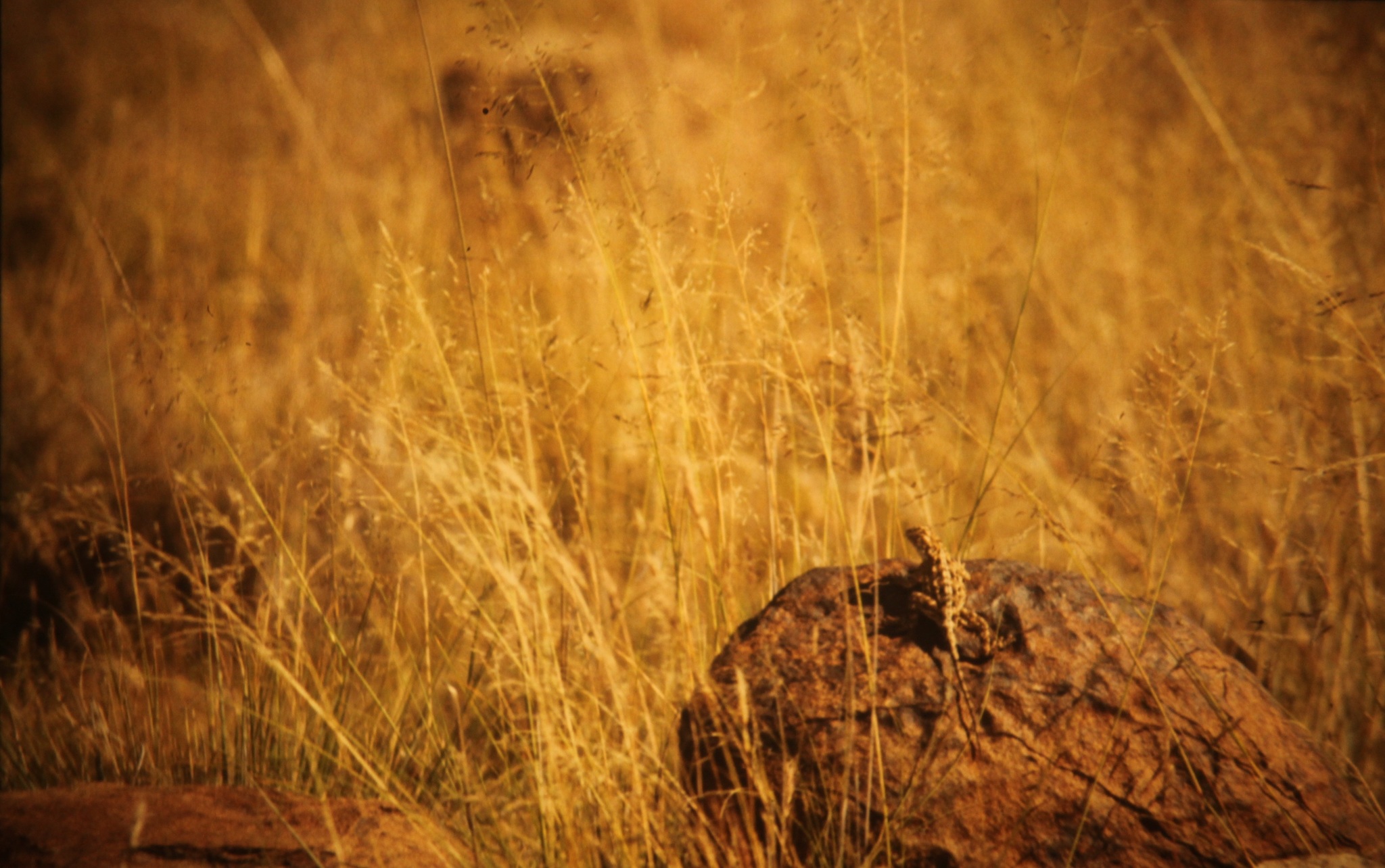
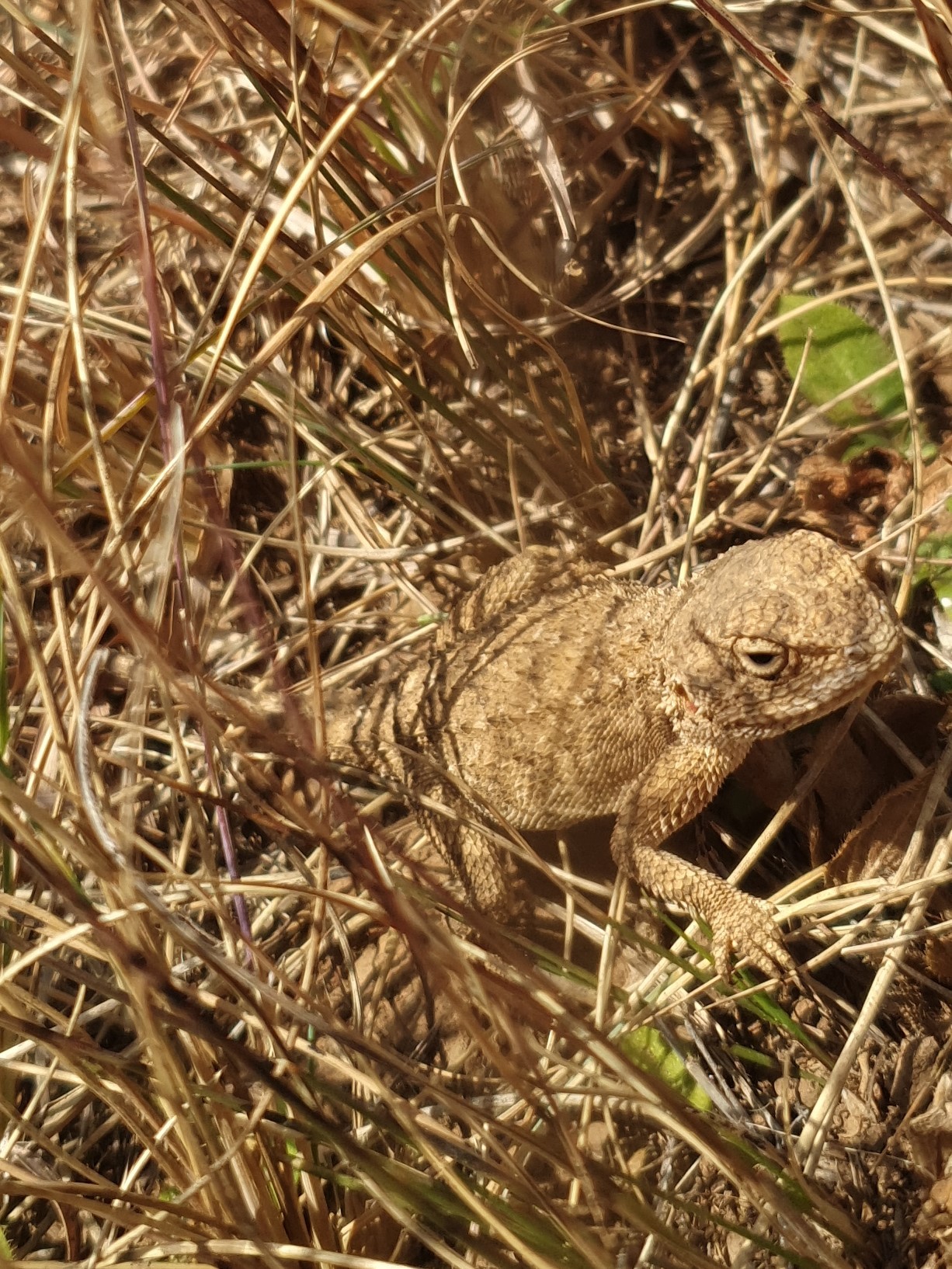
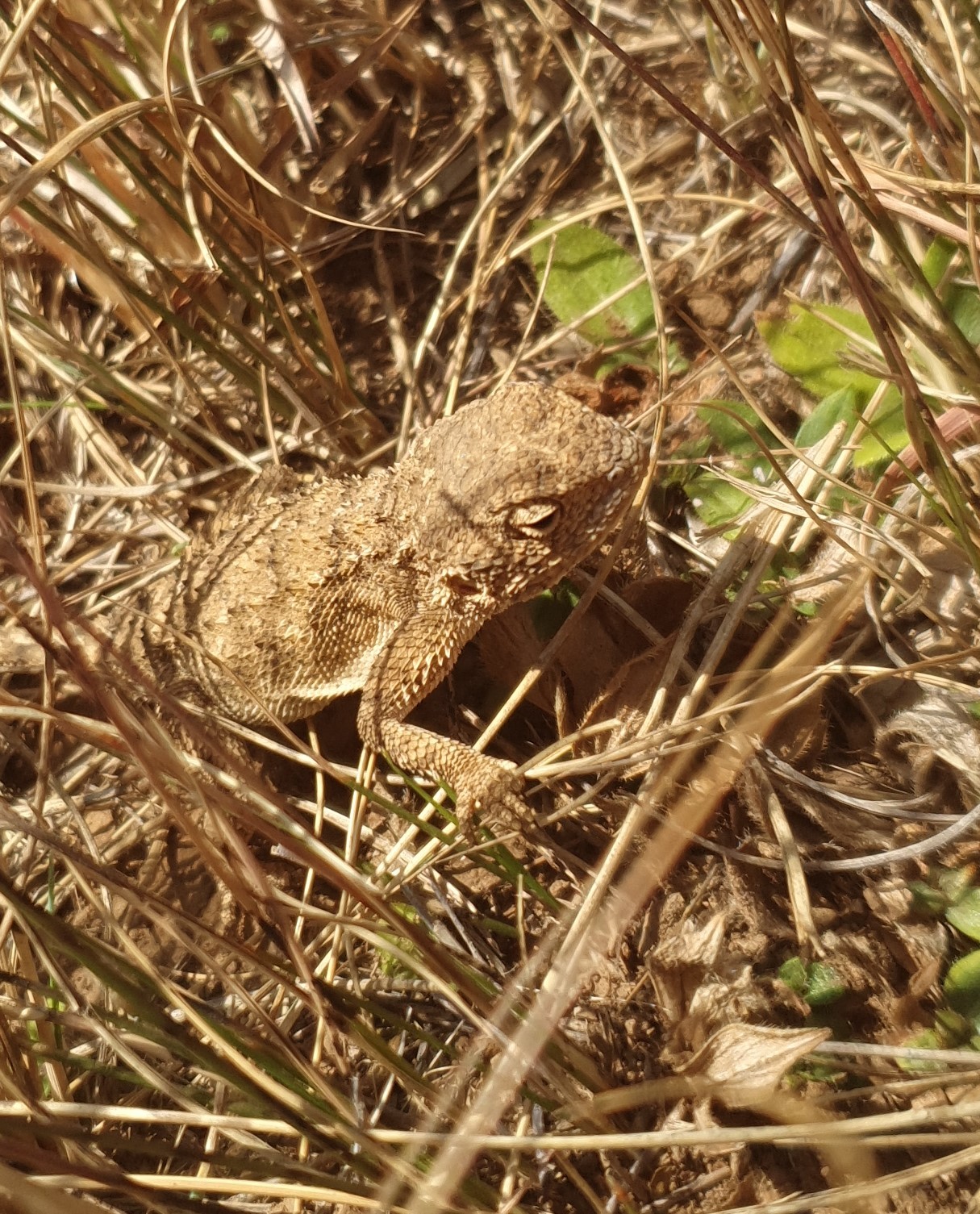
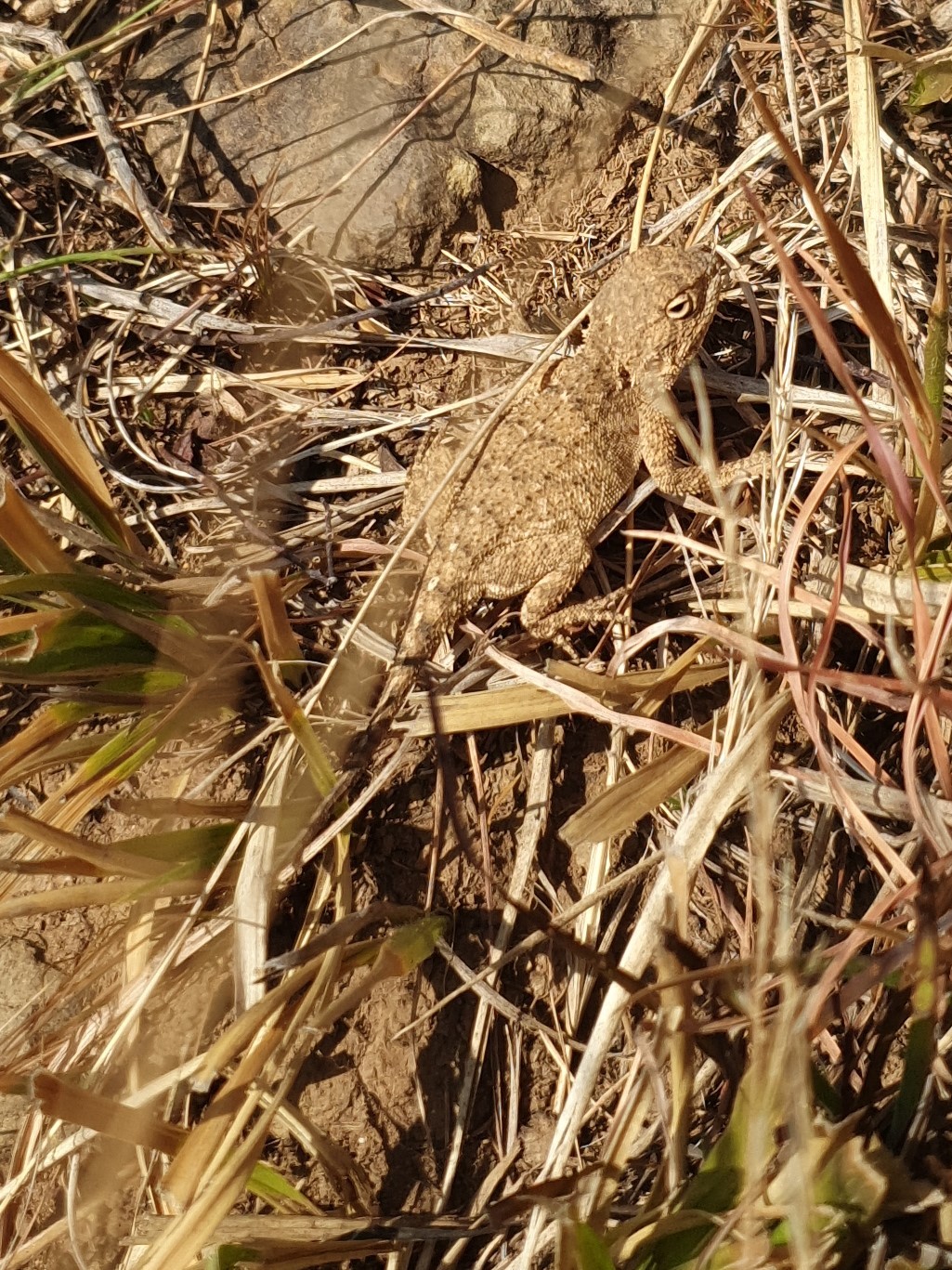
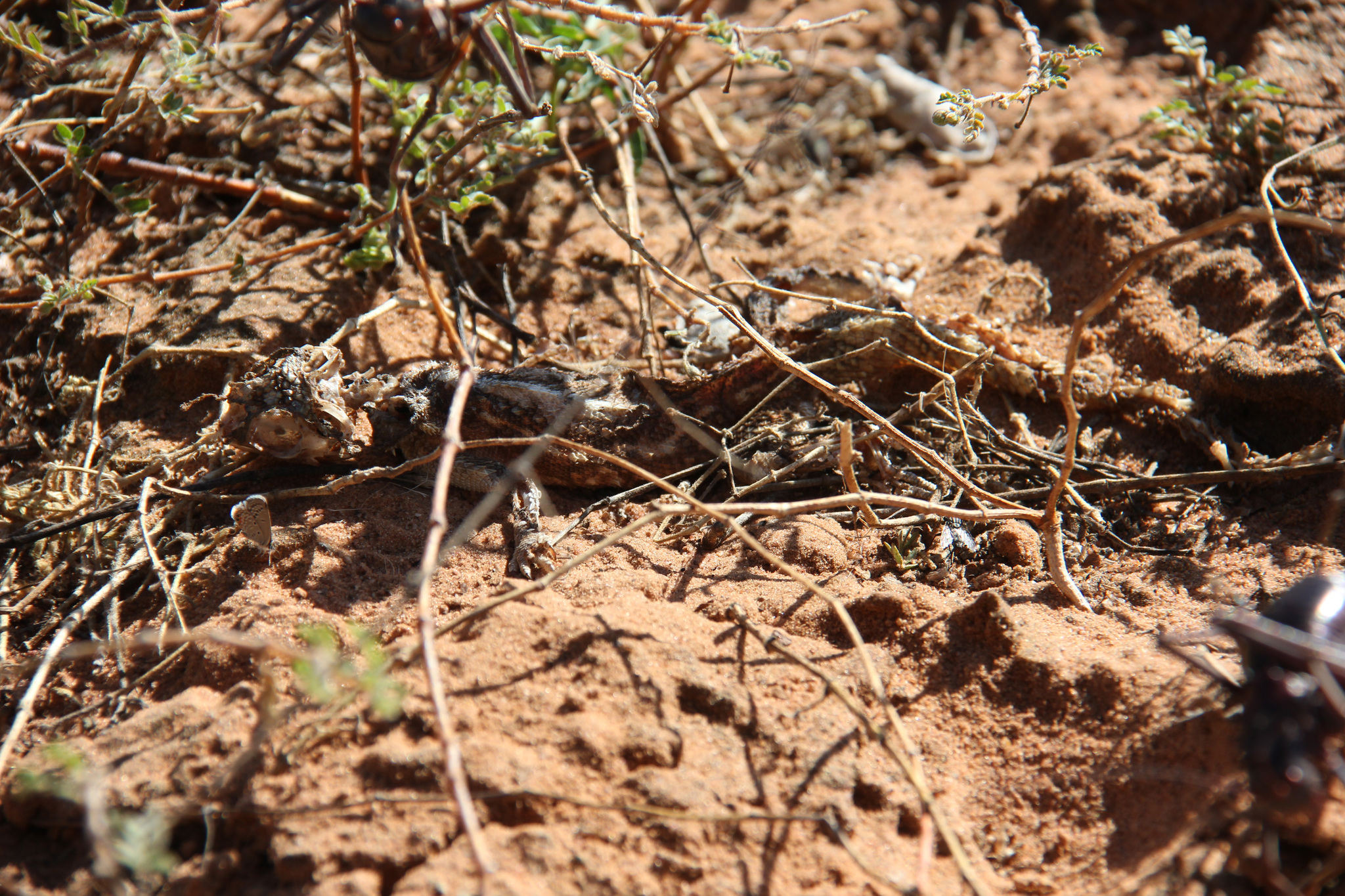
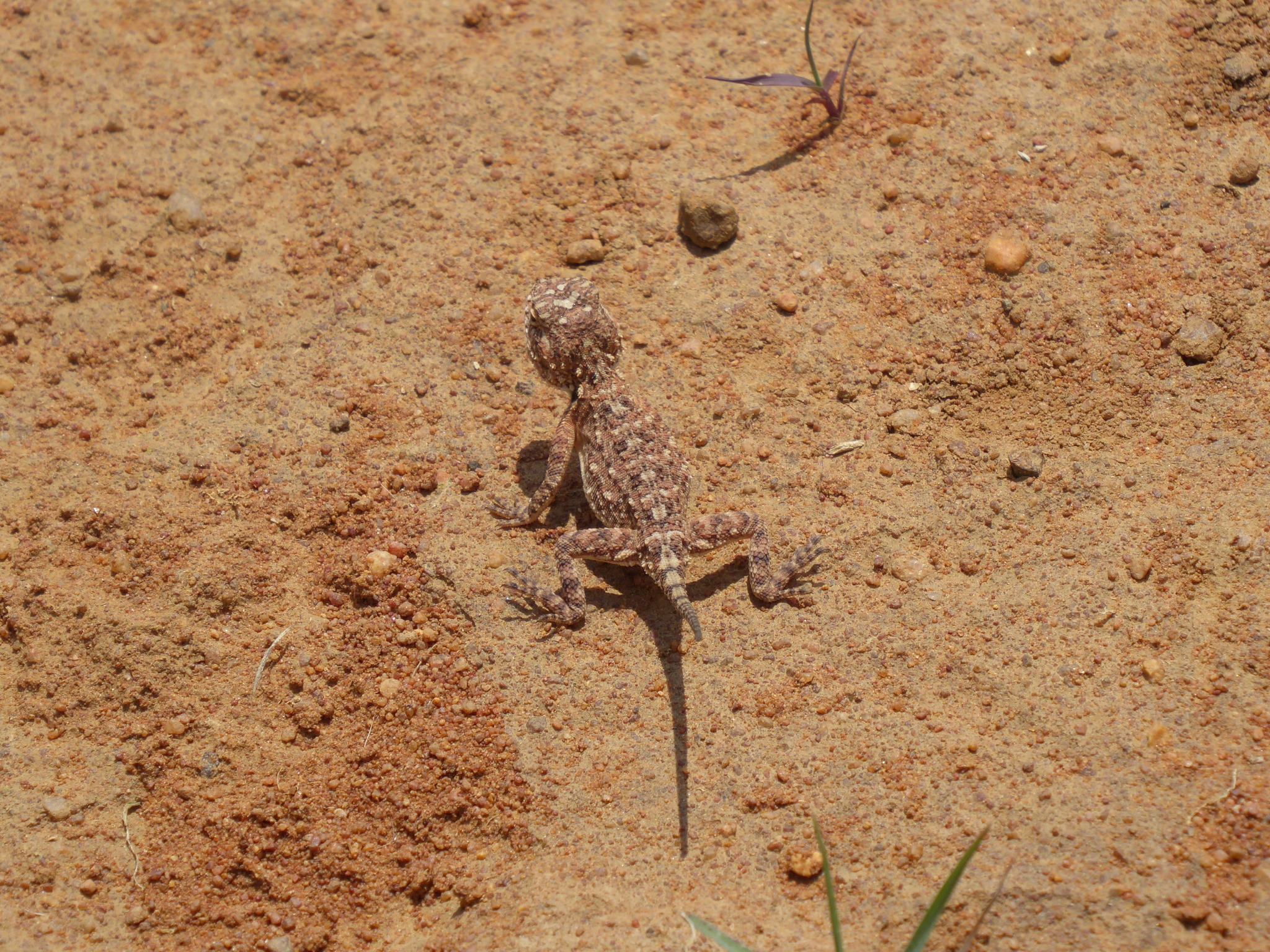
The Common Ground Agama often climb into low scrub to bask. A short hole dug in loose soil at the base of the bush serves as a retreat. Usually solitary but comes together to form monogamous pairs in the breeding season. When disturbed they run at top speed with the tail curved upwards, and then stop abruptly, hugging the ground and relying on their superb camouflage to escape detection (Branch, 1998).
Albany Thicket, Desert, Fynbos, Grassland, Indian Ocean Coastal Belt, Nama Karoo, Savanna: Arid, Succulent Karoo
This map contains point-based occurrences at different locations
Occurrence in African countries and South African provinces. Residence status indicates if a taxon is indigenous, endemic, or alien in a specific region. This data is based on specimen records and literature.
FSA
SA
BOT
NAM
ESW
LES
WC
EC
NC
FS
GA
KZN
LP
MP
NW
Absent
Indigenous
Endemic
Naturalised
Invasive
Names and Sources
| Common Name | Language |
|---|---|
| Ground Agama, Common Ground Agama | EN |
No results found for Agama aculeata Merrem, 1820
No data.
20 results for Agama aculeata Merrem, 1820
Year
This map contains point-based occurrences at different locations
2007
BOOK
A Guide to the Reptiles of southern AfricaAlexander, G., Marais, J.. 2007. A Guide to the Reptiles of southern Africa. Cape Town. Struik Publishers.
2014
BOOK
Atlas and red list of the reptiles of South Africa, Lesotho and Swaziland, , Bauer, A., Burger, M., Marais, J., Alexander, G., De Villiers, M., Branch, W., Bates, M.. 2014. Atlas and red list of the reptiles of South Africa, Lesotho and Swaziland. Pretoria, South Africa. South African National Biodiversity Institute.
1998
BOOK
Field Guide to the Snakes and Other Reptiles of Southern AfricaBranch, B.. 1998. Field Guide to the Snakes and Other Reptiles of Southern Africa Vol. . Cape Town. Struik Publishers pp..
1937
BOOK
A catalogue of the African Hesperiidae indicating the classification and nomenclature adopted in the British MuseumEvans, W.. 1937. A catalogue of the African Hesperiidae indicating the classification and nomenclature adopted in the British Museum Vol. xii pp.1-212.
1992
JOURNAL ARTICLE
The Status of Agama Aculeata armata PETERS 1854, (REPTILIA: AGAMIDAE)Jacobsen, N.. 1992. The Status of Agama Aculeata armata PETERS 1854, (REPTILIA: AGAMIDAE) Vol. 41 pp.30-34.
1981
JOURNAL ARTICLE
Taxonomy of Agama hispida (Sauria: Agamidae) in southern AfricaMcLachlan, G.. 1981. Taxonomy of Agama hispida (Sauria: Agamidae) in southern Africa Vol. 5(6) pp.219–227.
1989
REPORT
The distribution and conservation status of reptiles and amphibians in the Transvaal. Final report. Project TN 6Jacobsen, N.. 1989. The distribution and conservation status of reptiles and amphibians in the Transvaal. Final report. Project TN 6.
1978
JOURNAL ARTICLE
The Squamata (Reptilia) of the Orange Free State, South AfricaDe Waal, S.. 1978. The Squamata (Reptilia) of the Orange Free State, South Africa Vol. 11 pp.1-160.
1984
JOURNAL ARTICLE
Akkedisse van Suider-Afrika 32. Gepantserde akkedisse- geslepe klein bloustert 'n kulkunstenaarVisser, J.. 1984. Akkedisse van Suider-Afrika 32. Gepantserde akkedisse- geslepe klein bloustert 'n kulkunstenaar Vol. 1984 pp.72-73, 75.
2012
JOURNAL ARTICLE
Locomotion of ReptilesAlexander, R.. 2012. Locomotion of Reptiles Vol. 121 pp.1-4.
1985
BOOK
Catalogue of the lizards in the British Museum (Natural history)Boulenger, G.. 1985. Catalogue of the lizards in the British Museum (Natural history) Vol. Second Edition. London. British Museum (Natural history) pp.349 - 350.
Status and criteria
LC
Assessor(s)
Michael Bates
Contributors
Stuart Nielsen
Reviewer(s)
John Measey