
ANIMALIA / CHORDATA / REPTILIA / SQUAMATA / CHAMAELEONIDAE / BRADYPODION / NGOMEENSE
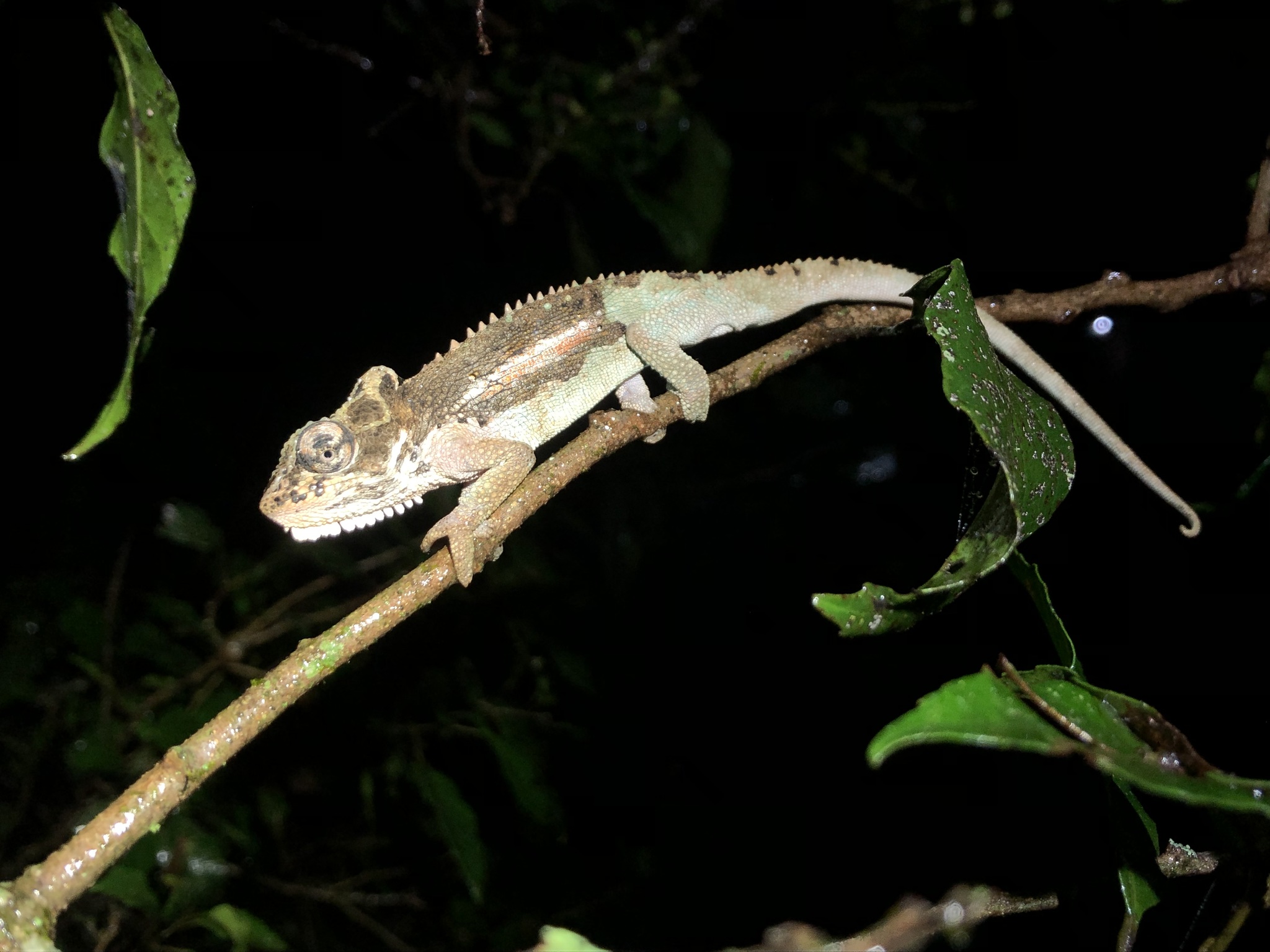
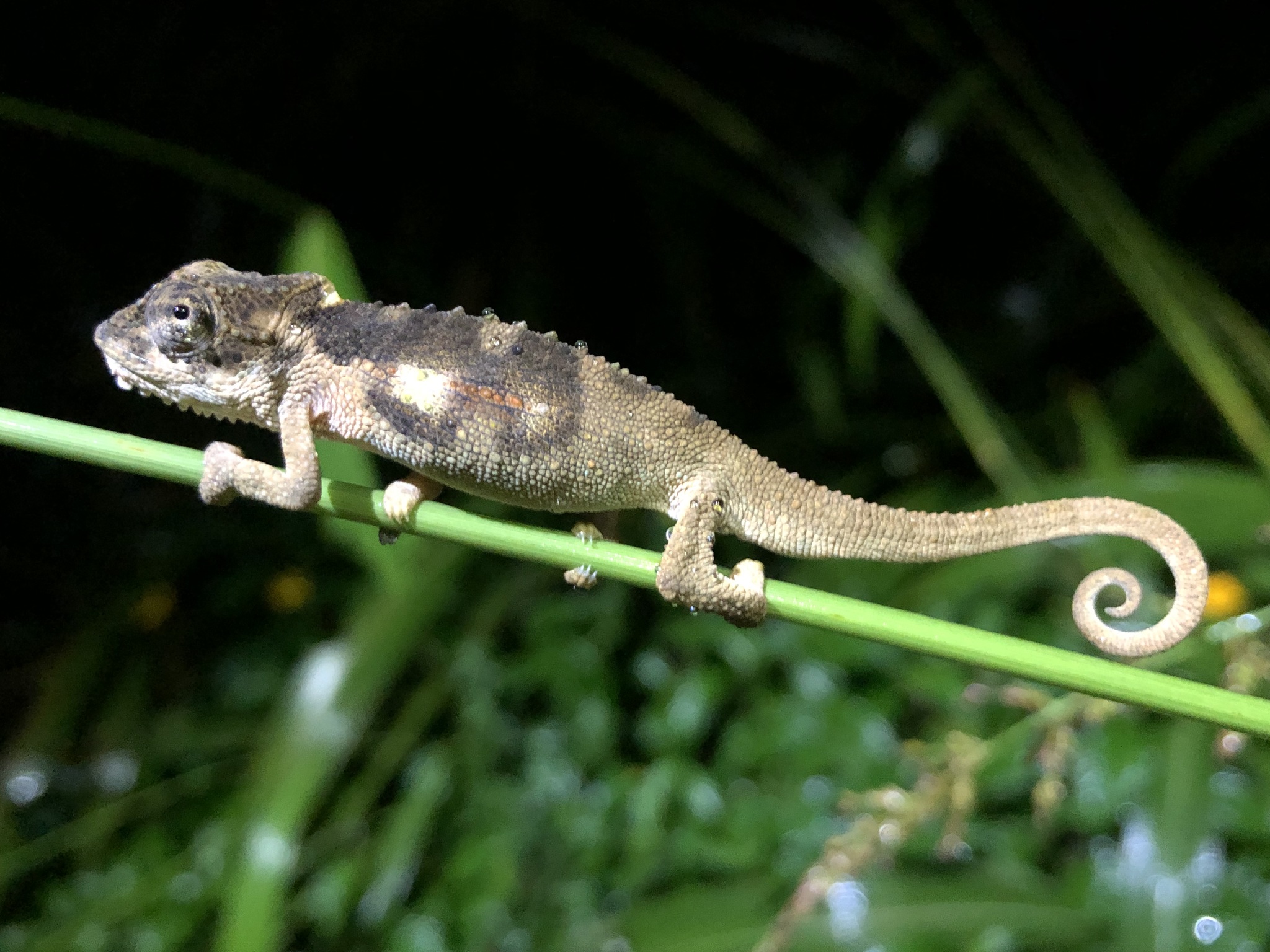
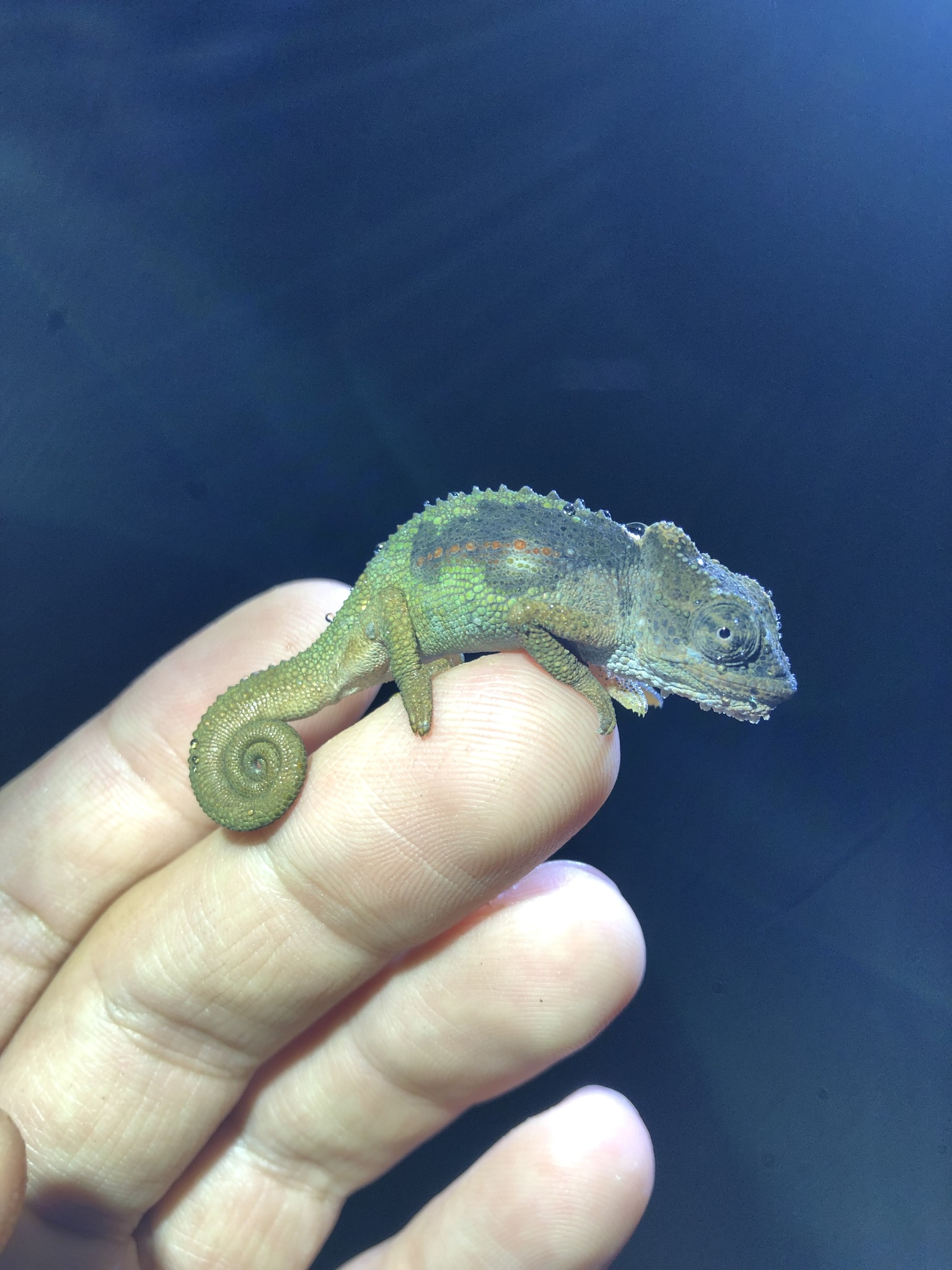
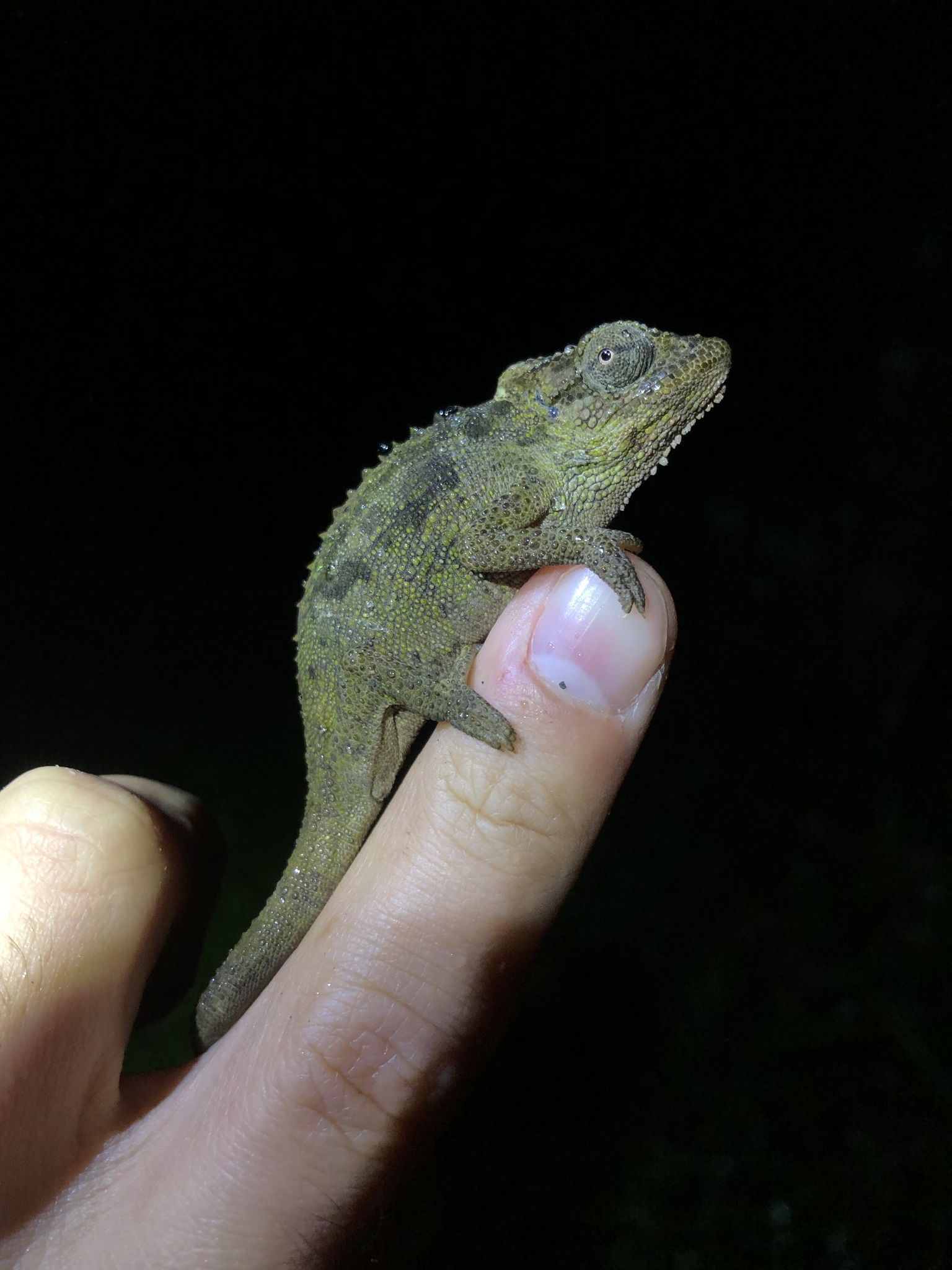
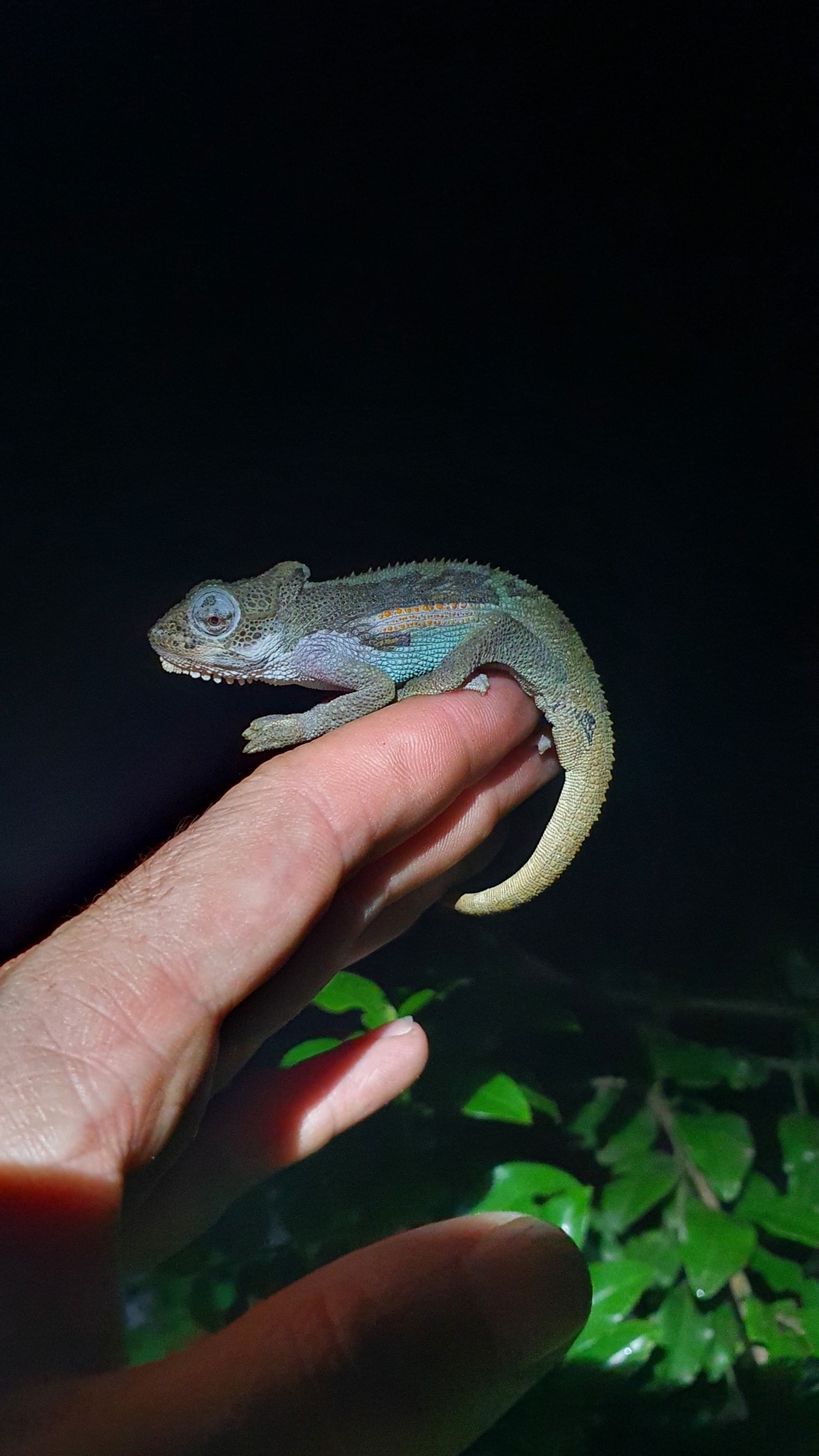
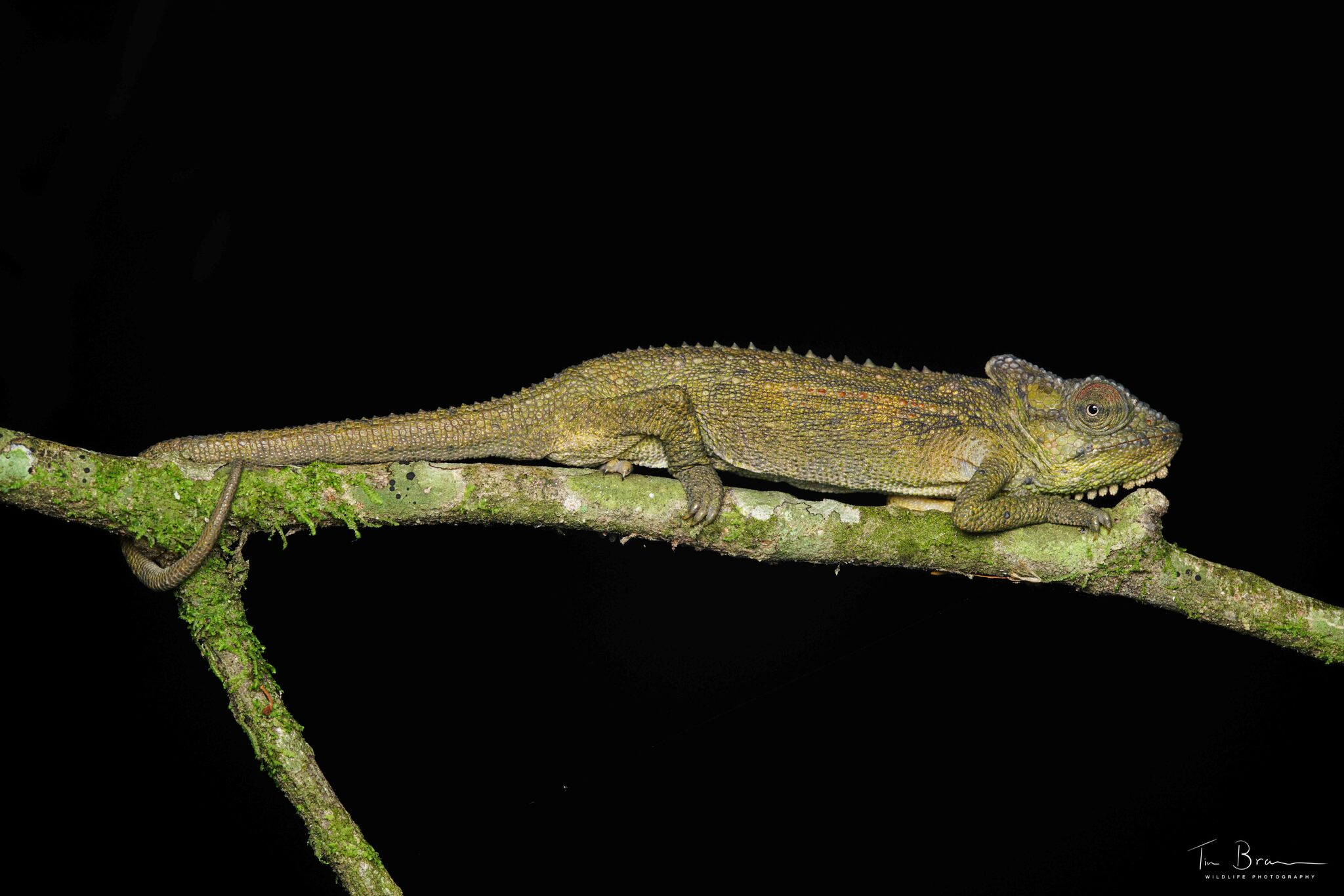
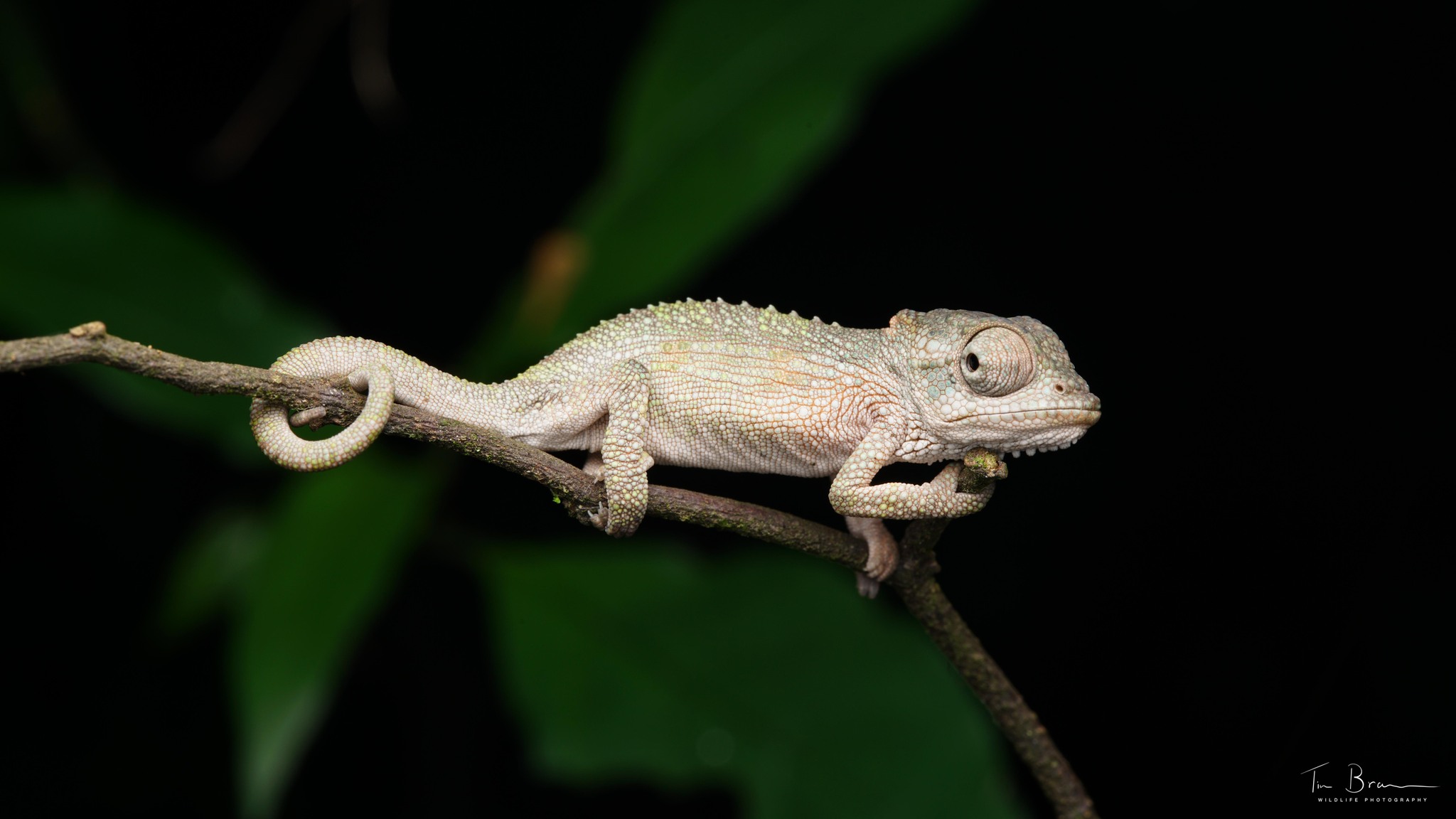
Tilbury and Tolley (2009) described this species as follows: Adult male: Snout/vent length 65mm, Tail 81mm. Casque sharply elevated posteriorly. Pre-orbital, supra-orbital, and temporal crests rugose and composed of thick conical and subconical tubercles. A low median parietal crest extends forwards from the apex of the casque to terminate just before the mid-orbital region. The temporal crests originate from the mid post-orbital rim, are prominent and composed of a row of 6 more or less equally enlarged tubercles on the right side and 5 on the left. Posteriorly, the temporal crest then rises almost vertically as the squamosal crest to run parallel and adjacent to the lateral parietal crest to the apex of the casque. A prominent gular crest is present, composed of 14 granulated composite lobes, numbers 2 – 6 overlapping and numbers 2 – 4 are broader than long. The free distal edges of the lobes have a denticulated fringe. Five to six thin white gular interstitial grooves are present on each side of the throat, enclosing chains of enlarged rounded tubercles. A prominent dorsal crest is present, composed of 26 conical tubercles roughly triangular in outline, extending from the nuchal area to the sacrum and then extending along the proximal third of the tail. The tubercles of the dorsal crest are highest over the anterior to mid vertebral line and lowest over the sacral region, none of the cones are taller than the diameter of the eye opening. Background scalation of heterogeneous, rounded to polygonal tubercles with no obvious interstitial venation between the tubercles. A short row of slightly enlarged flattened tubercles skirts the upper mid-flank. Enlarged tubercles are scattered along the para-vertebral zone. Belly tubercles arranged in pallisades of more or less homogeneous rounded tubercles. Variation in the Paratypes: The largest specimen, a female (PEM-R 16617) has a total length of 166mm (snout/vent 77mm + tail 89mm). Considerable variation in the gular crest is present among the types. The gular crest varies from 11 to 19 individual lobes or tubercles. The length and width of the lobes is variable, in some specimens all the lobes are longer than wide, in others the length / width may be similar and in some the overlapping lobes may be broader than long. Although overlap of between 2 to 7 lobes is common, in several specimens there is no overlap of any of the lobes. In 9/12 specimens, the first gular projection is a simple conical tubercle, and in all specimens, the last gular projection is a simple cone. Up to the last 3 gular ornaments may be simple cones. In most specimens the flanks appear to have no interstitial web, but in 2/14 specimens, an indication of interstitial webbing was present. The dorsal crest in the type series consisted of between 19 – 26 tubercles extending between the nuchal fold to the mid-sacrum. It may additionally extend for a variable distance along the tail from being almost imperceptible to easily discernable up to half of the length of the tail. The tail is always longer than the snout/vent length in both sexes. Sexual dimorphism: Males tend to have a more rugose scalation, better developed body and head crests, and a prominent hemipenal bulge at the base of the tail. Tail length differs between the sexes, being 53–57% of the total length in males compared to 53–55% in females. Colour differences between the sexes are discussed below. Colour in life: Male—Head above the upper labials mostly black – labials and all cranial crests pale yellow. Gular region and gular crest white. Nuchal fold - white to pale yellow. Skin of eyeball, heavily flecked with red around the periphery and a single dark horizontal stripe transects the eye. Background colour of the body is blue-green as is the dorsal crest. A bright red to orange flash over the mid flank is fully enclosed within a black flank patch which terminates abruptly about 2/3rds of the way along the flank. The colour of the flash is variable from white to various shades of red. Belly, front legs and tail blue-green. Female – Background pale green. The superior and inferior temporal zones have white patches. The superior half of the anterior 2/3rds of the flank is dark green, with scattered lighter tubercles. Hemipenes: None of the specimens currently present in any museum collection have fully everted hemipenes so the structure of these organs remains un-described for the present.
This information was extracted from Tilbury and Tolley (2009): A moderately large-bodied, long-tailed species of the genus Bradypodion demonstrating the characteristics of the genus (Tilbury et al. 2006). This species differs from its various congeners in the following respects: the adults have a relatively tall casque angled at (usually) over 30 degrees or more to the supra-orbital line in keeping with 6 other South African species - viz: B. damaranum (Boulenger 1887), B. dracomontanum Raw 1976, some B. ventrale (Gray 1845), B. thamnobates Raw 1976, B. transvaalense (Fitzsimons 1930) and B. nemorale Raw, 1978 (Qudeni ecomorph). It differs from B. ventrale which has a tail that is less than 50% of its snout /vent length; from B. thamnobates which has prominent enlarged plate-like flank tubercles; from B. damaranum which has areas of “naked” interstitium around the axilla and along the anterior para-vertebral zone; from B. nemorale which has a relatively much reduced gular crest, and a dorsal crest of cones larger than the diameter of the eye-opening; and from B. transvaalense (sensu stricta) where most adult specimens usually have dorsal cones larger than the eye opening and in which the superior temporal zone is pale coloured and the black mid-temporal stripe continues uninterrupted over the upper and mid flank.
Type locality: Ngome Forest, KZN 27° 49’S, 31° 25’ E. Holotype: PEM R 16621, an adult male collected by Devi Stuart-Fox and Adnan Moussalli on 6th January 2004.
No notable issues.
South Africa
The species occurs only in Ngome Forest (a small forest patch) in KwaZulu-Natal province, South Africa (Tolley and Burger, 2007; Tilbury and Tolley, 2009; Tilbury, 2018).
All Bradypodion are very slow-moving animals, walking and climbing, with at least one foot touching a surface (e.g., branch) at all times during movement. Their prehensile tail assists in locomotion by providing stability and balance when they move vertically through vegetation and between gap areas. Their fused digits on their feet aids in grasping branches without slipping (Tolley and Burger, 2007).
Carnivore - Insectivore (insect-eating)
All Bradypodion species are primarily insectivores, using their long, projectile tongue to catch small insects like flies, grasshoppers, crickets, insect larvae and other small invertebrates. Water is required regularly and is licked from dew or raindrops on foliage (Tolley and Burger, 2007).
As with other Bradypodion species, B. ngomeense has aseasonal reproduction and is ovoviviparous, capable of birthing 5-15 babies per litter and several litters maybe produced per years (Tolley and Burger, 2007). Females may mate with several males and are thought to store sperm (Tolley et al., 2014). Fertilized eggs take several months to develop, and babies have rapid growth, reaching maturity in about nine months (Tolley and Burger, 2007). No parental care is given.
All Bradypodion species are active during the day. Like all Bradypodion, these chameleons have the ability to change colour as a physiological response to external conditions such as light and temperature, when sick, stressed, males displaying when courting females, as a defense mechanism and camouflage (Tolley and Burger, 2007).
Forest
This map contains point-based occurrences at different locations
Occurrence in African countries and South African provinces. Residence status indicates if a taxon is indigenous, endemic, or alien in a specific region. This data is based on specimen records and literature.
FSA
SA
BOT
NAM
ESW
LES
WC
EC
NC
FS
GA
KZN
LP
MP
NW
Absent
Indigenous
Endemic
Naturalised
Invasive
Names and Sources
| Common Name | Language |
|---|---|
| Ngome Dwarf Chameleon | En |
| Ngome Dwergverkleurmannetjie | En |
Classification
KINGDOM Animalia
PHYLUM Chordata
CLASS Reptilia
ORDER Squamata
FAMILY Chamaeleonidae
GENUS Bradypodion
SPECIES ngomeense
No results found for Bradypodion ngomeense Tilbury & Tolley, 2009
There is no known trade in this species (UNEP-WCMC 2020).
8 results for Bradypodion ngomeense Tilbury & Tolley, 2009
This map contains point-based occurrences at different locations
2009
JOURNAL ARTICLE
A new species of dwarf chameleon (Sauria; Chamaeleonidae, Bradypodion Fitzinger) from KwaZulu Natal South Africa with notes on recent climatic shifts and their influence on speciation in the genusTilbury, C., Tolley, K.. 2009. A new species of dwarf chameleon (Sauria; Chamaeleonidae, Bradypodion Fitzinger) from KwaZulu Natal South Africa with notes on recent climatic shifts and their influence on speciation in the genus Vol. 2226 pp.43–57.
2007
BOOK
Chameleons of Southern AfricaBurger, M., Tolley, K.. 2007. Chameleons of Southern Africa. Cape Town. Struik Publishers.
2023
BOOK
Conservation status of the reptiles of South Africa, Eswatini and LesothoTolley, K., Burger, M., Alexander, G., Pietersen, D., Conradie, W., Weeber, J.. 2023. Conservation status of the reptiles of South Africa, Eswatini and Lesotho Vol. Suricata 10. Pretoria. South African National Biodiversity Institute.
2014
JOURNAL ARTICLE
Multiple paternity and sperm storage in the Cape Dwarf Chameleon (Bradypodion pumilum)Tolley, K., Feldheim, K., Chauke, L., Jackson, J.. 2014. Multiple paternity and sperm storage in the Cape Dwarf Chameleon (Bradypodion pumilum) Vol. 63 (1) pp.47-56.
2018
BOOK
Chameleons of Africa - An Atlas including the chameleons of Europe, the Middle East and AsiaTilbury, C.. 2018. Chameleons of Africa - An Atlas including the chameleons of Europe, the Middle East and Asia. Frankfurt am Main. Chimaria.
2020
WEBSITE
CITES Trade DatabaseUNEP-WCMC, . 2020. CITES Trade Database. https:// trade.cites.org/. (Accessed: 15 September 2020).
Status and criteria
NT
Assessor(s)
Krystal Tolley
Reviewer(s)
Nicolas Telford


