
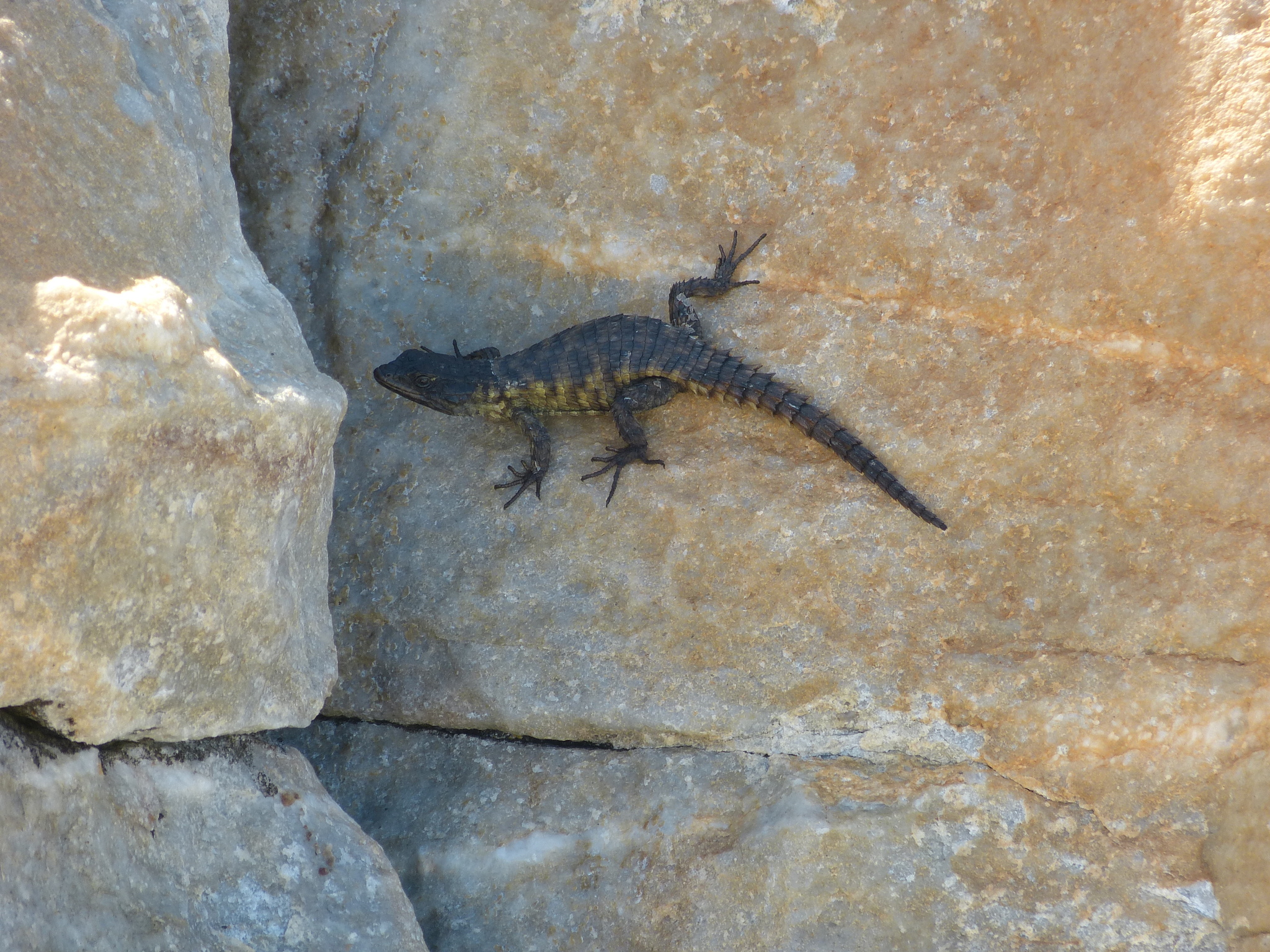
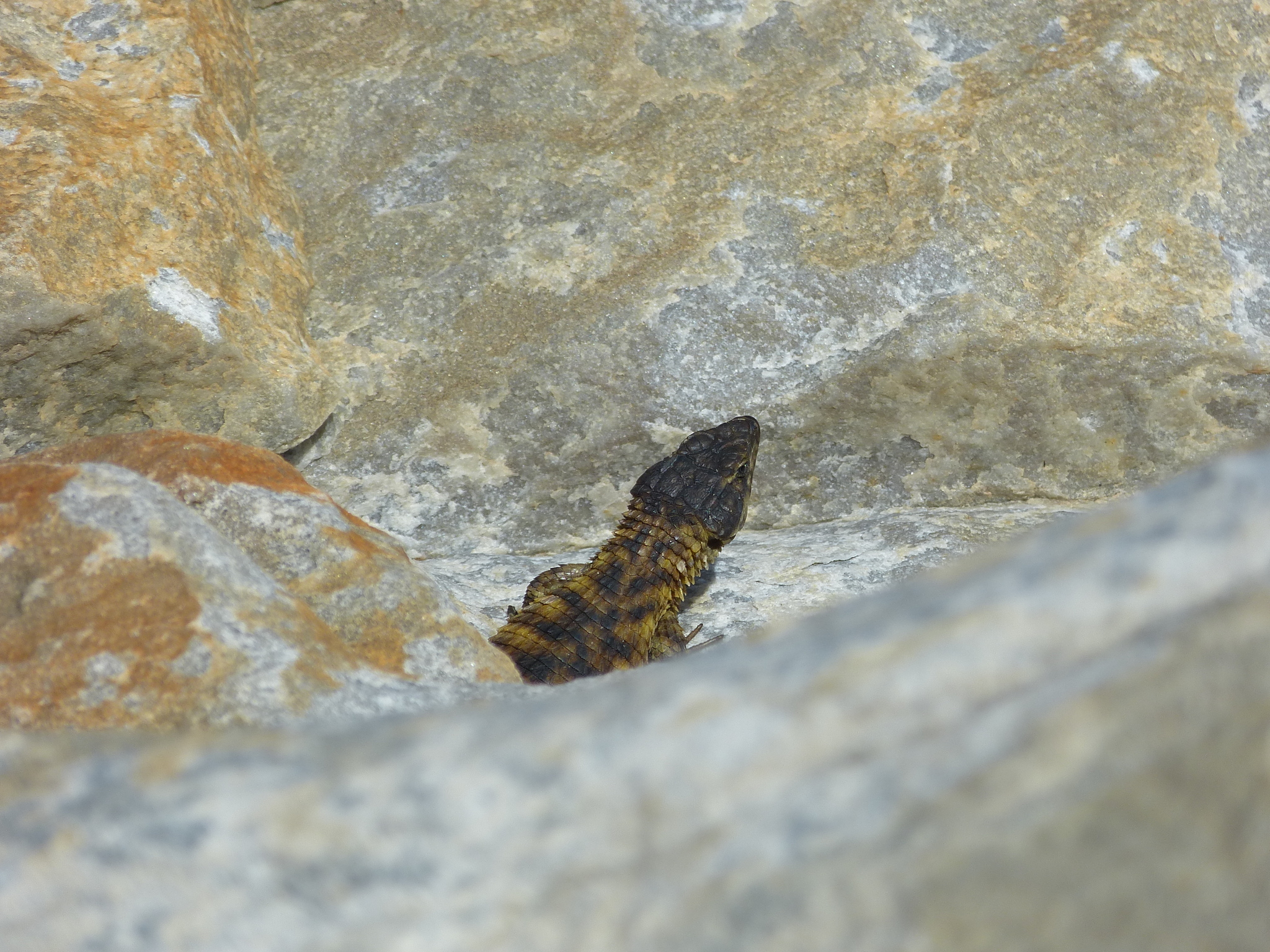
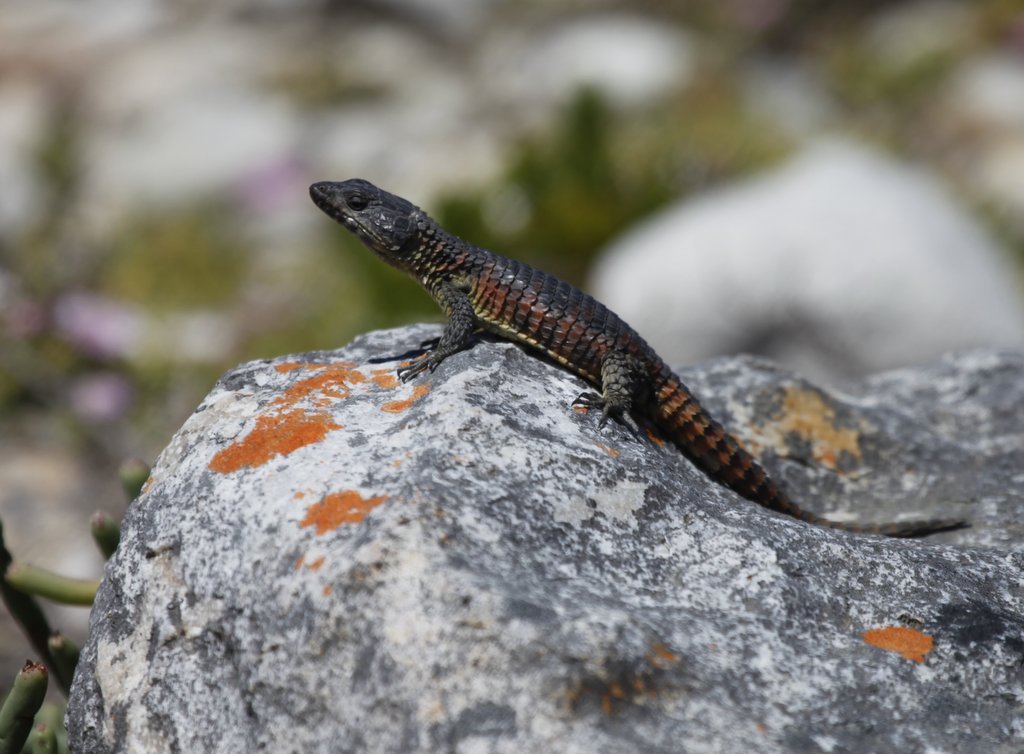
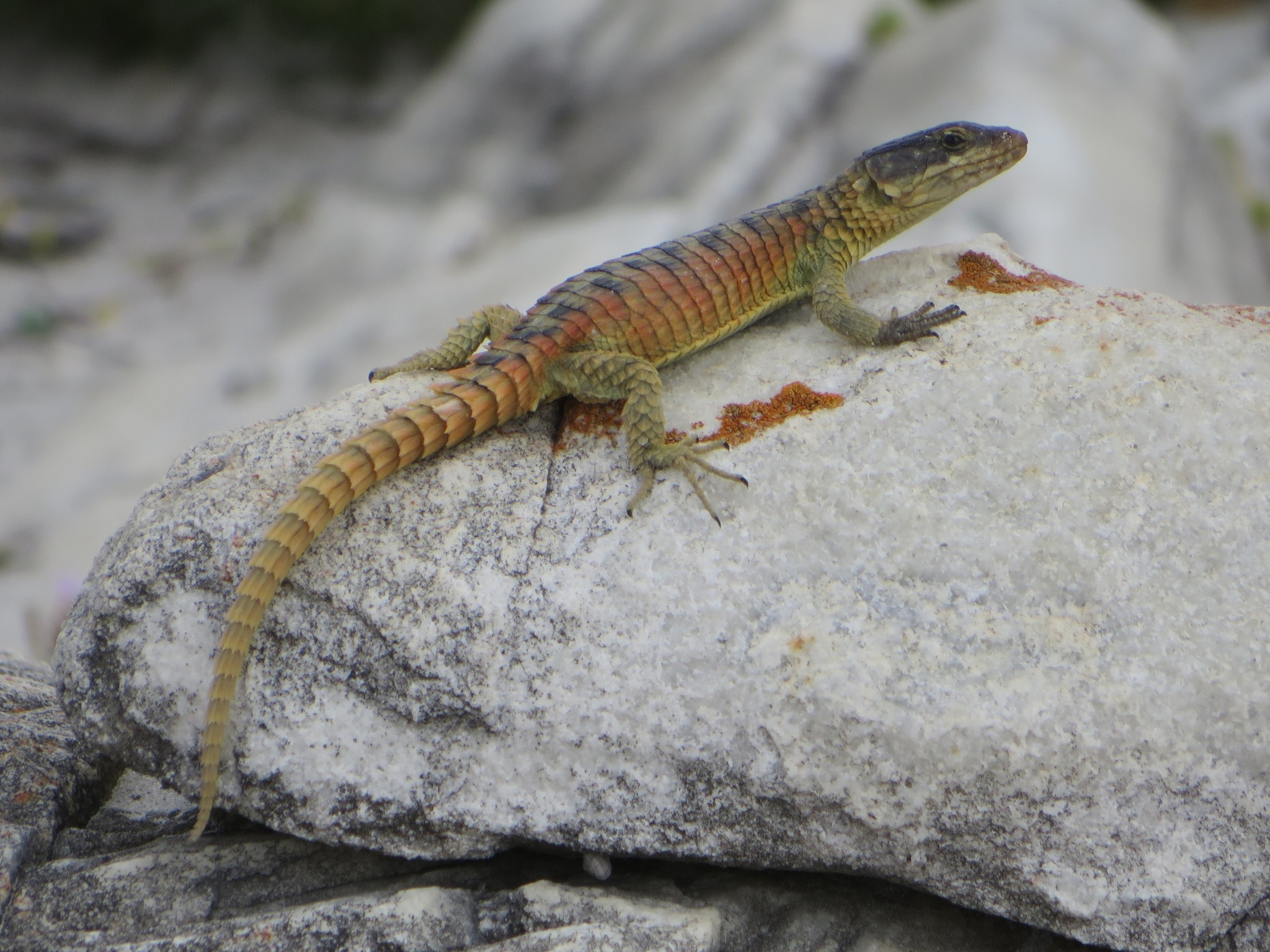
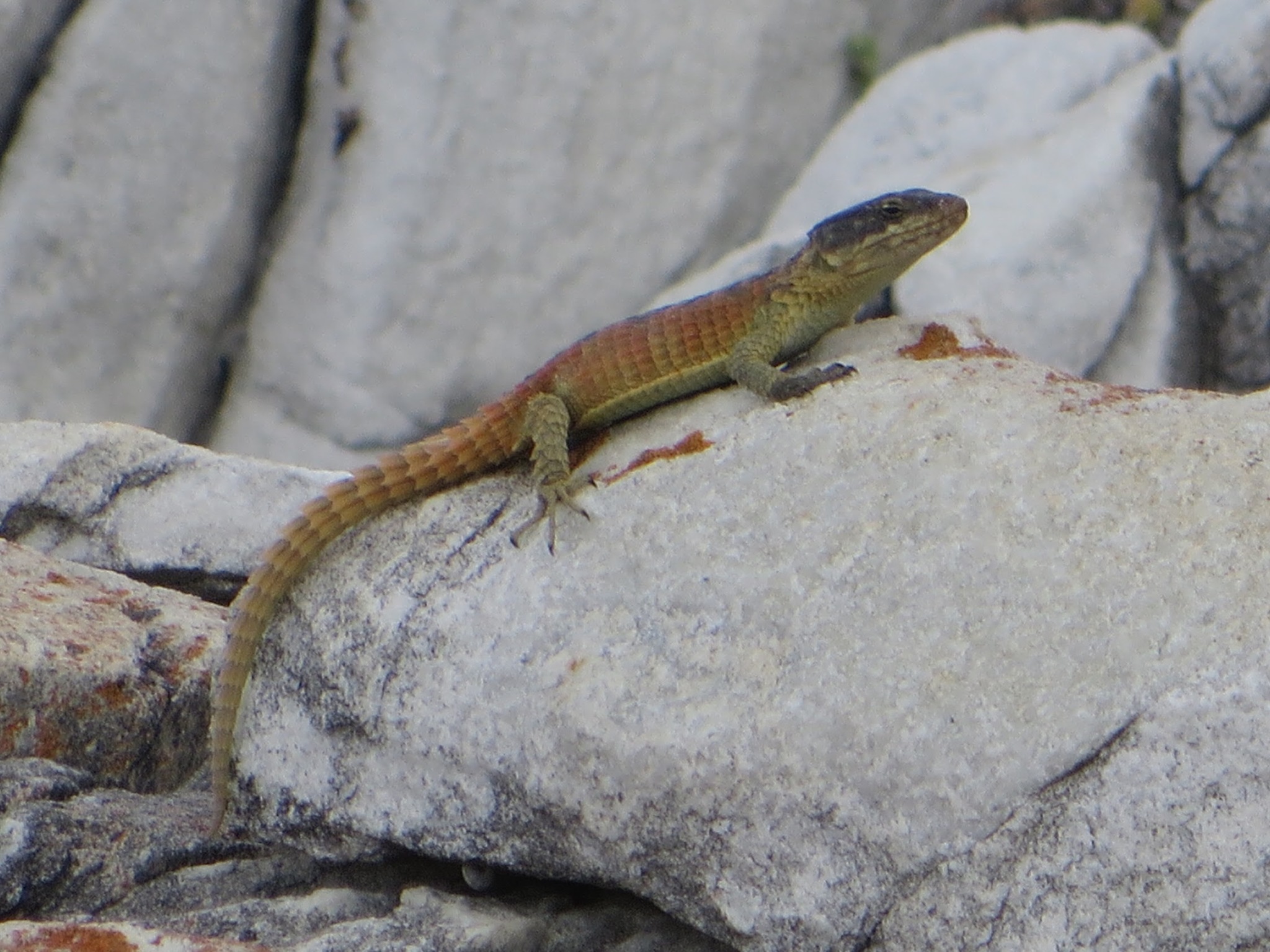
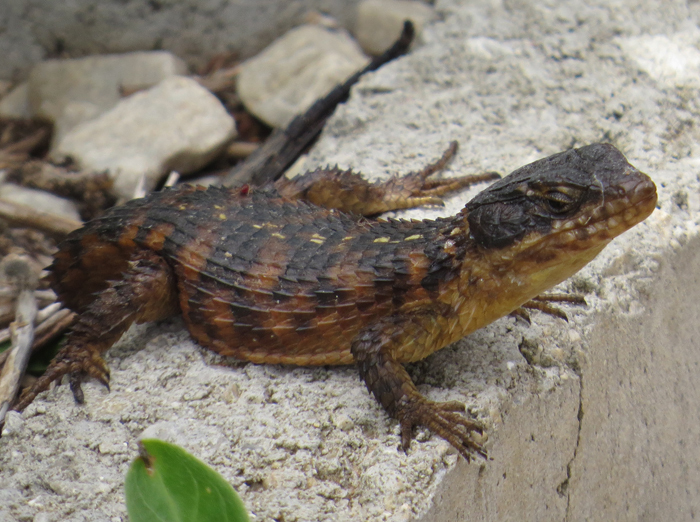
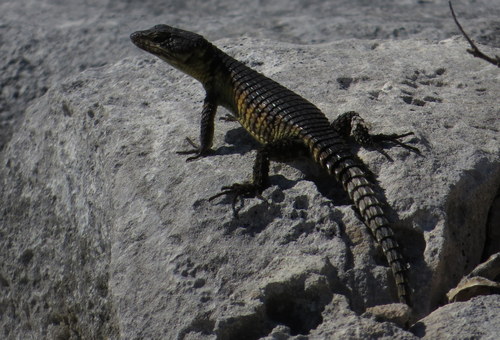
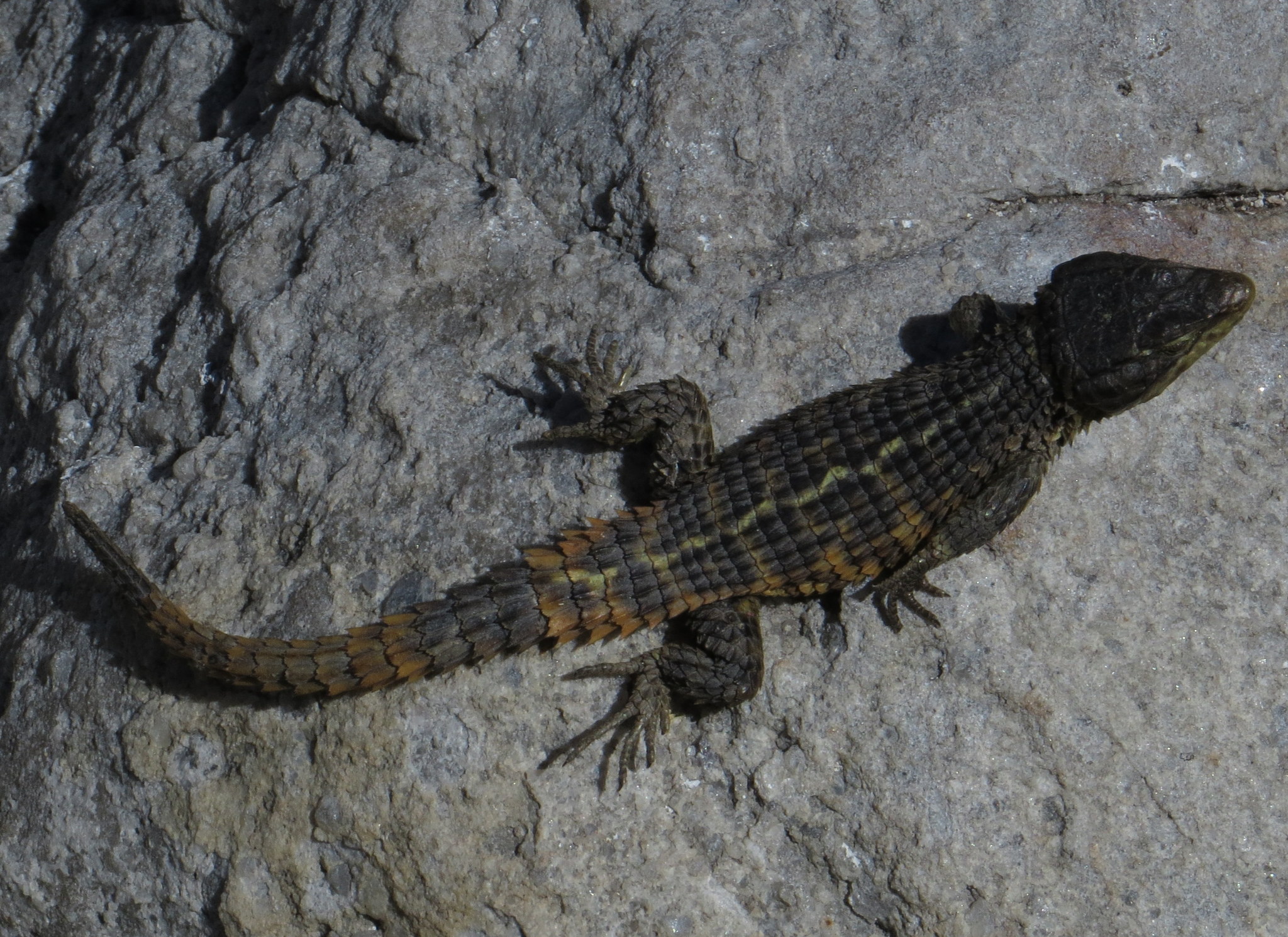
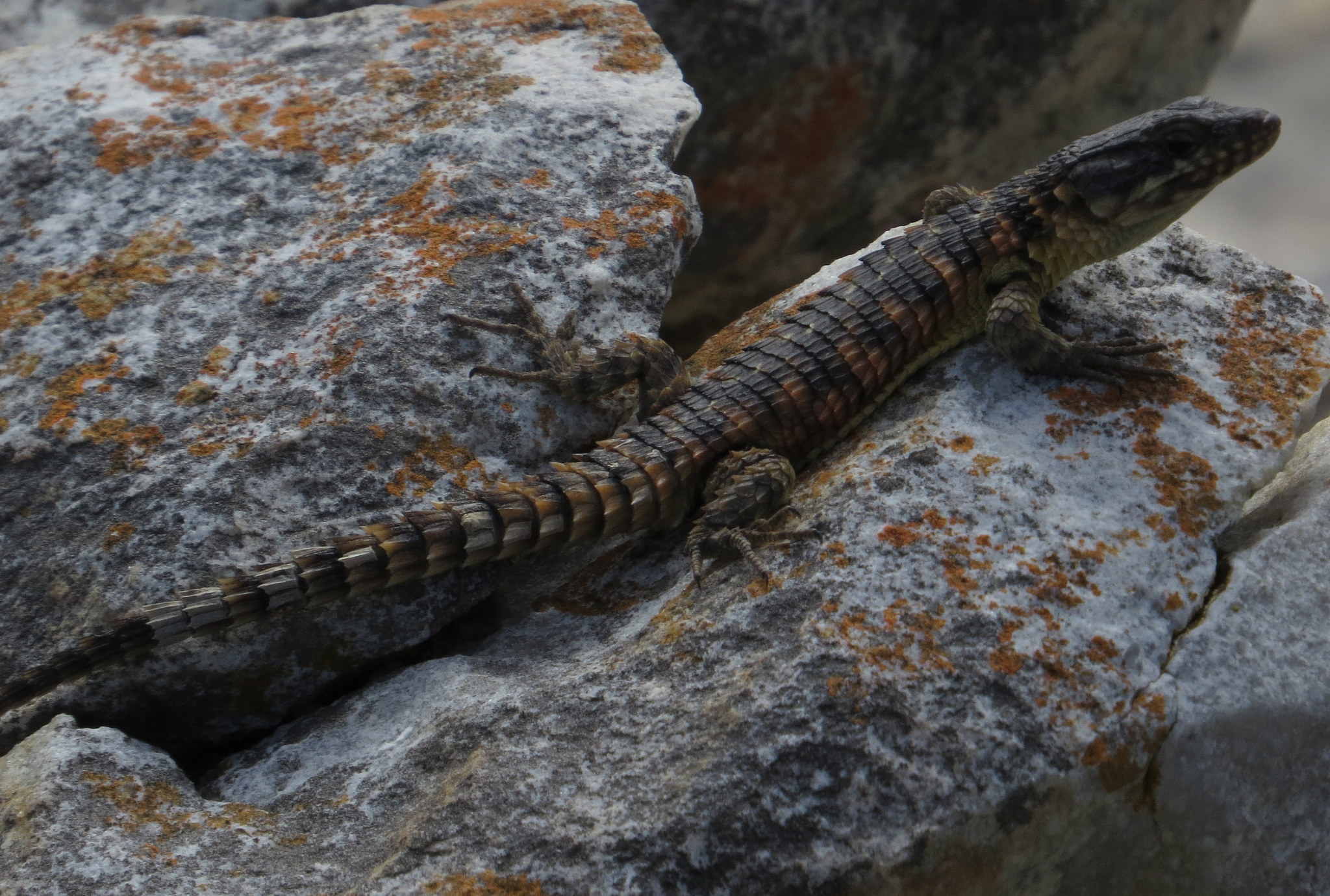
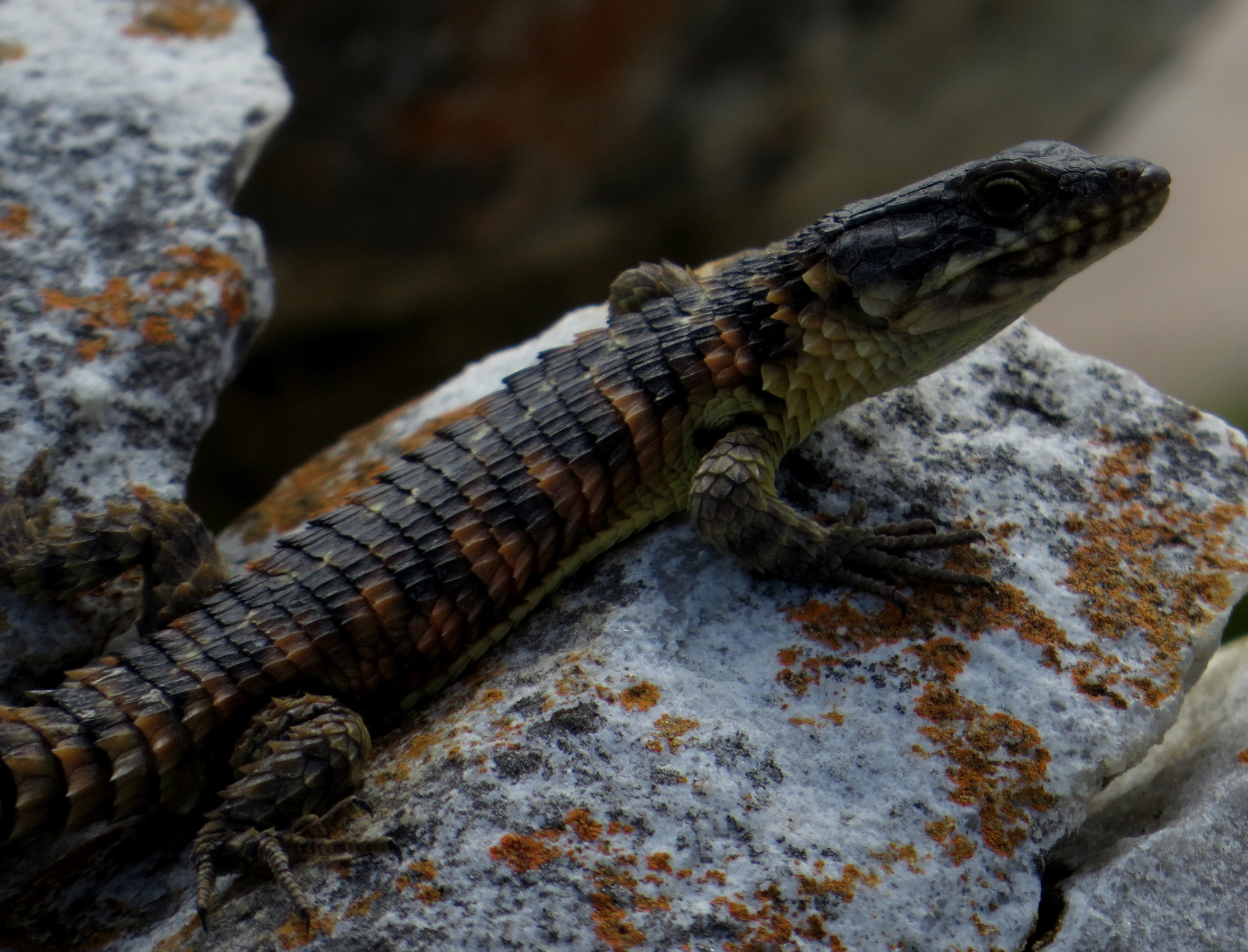
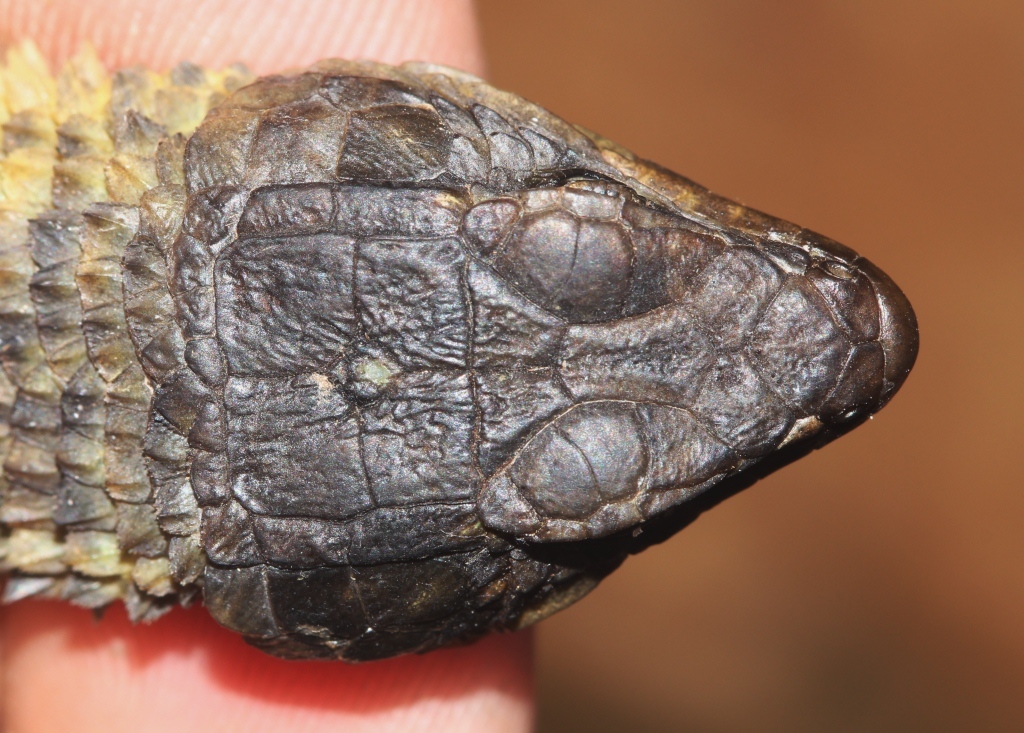
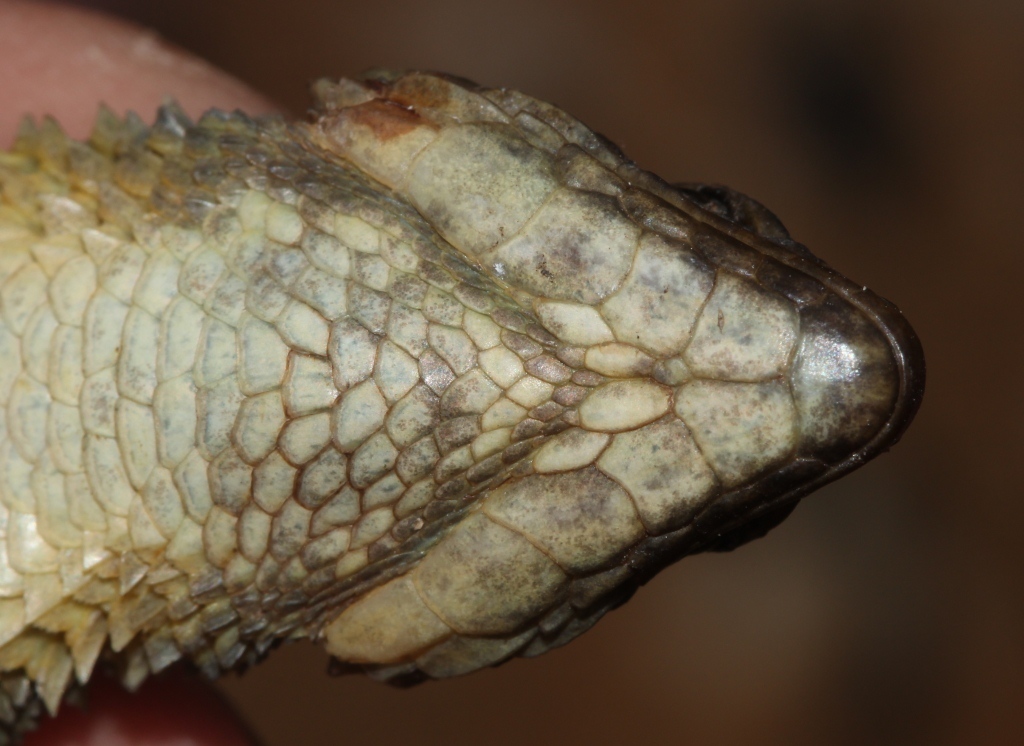
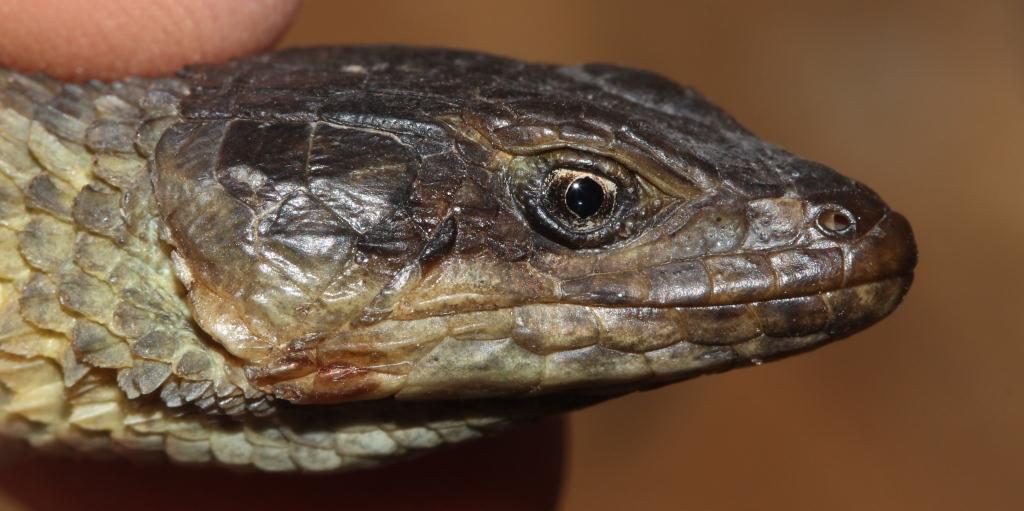
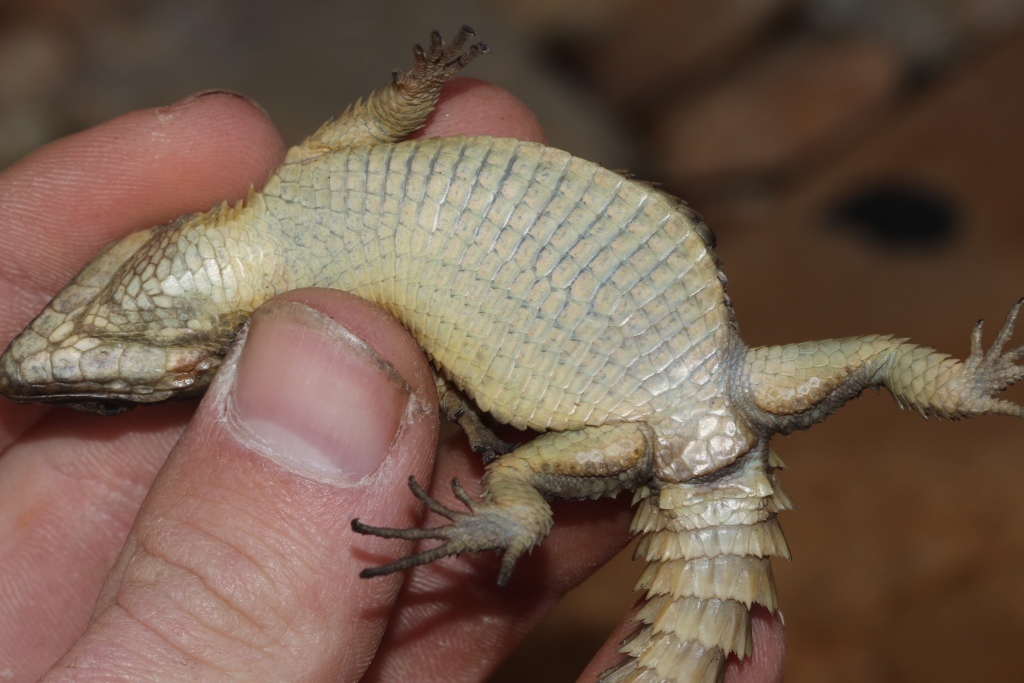
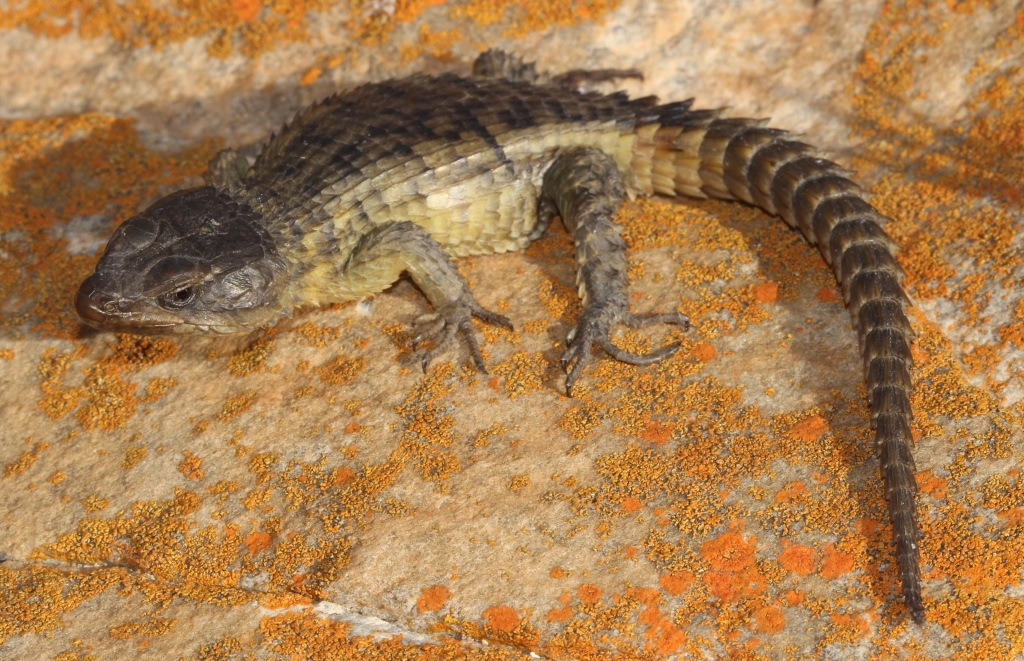
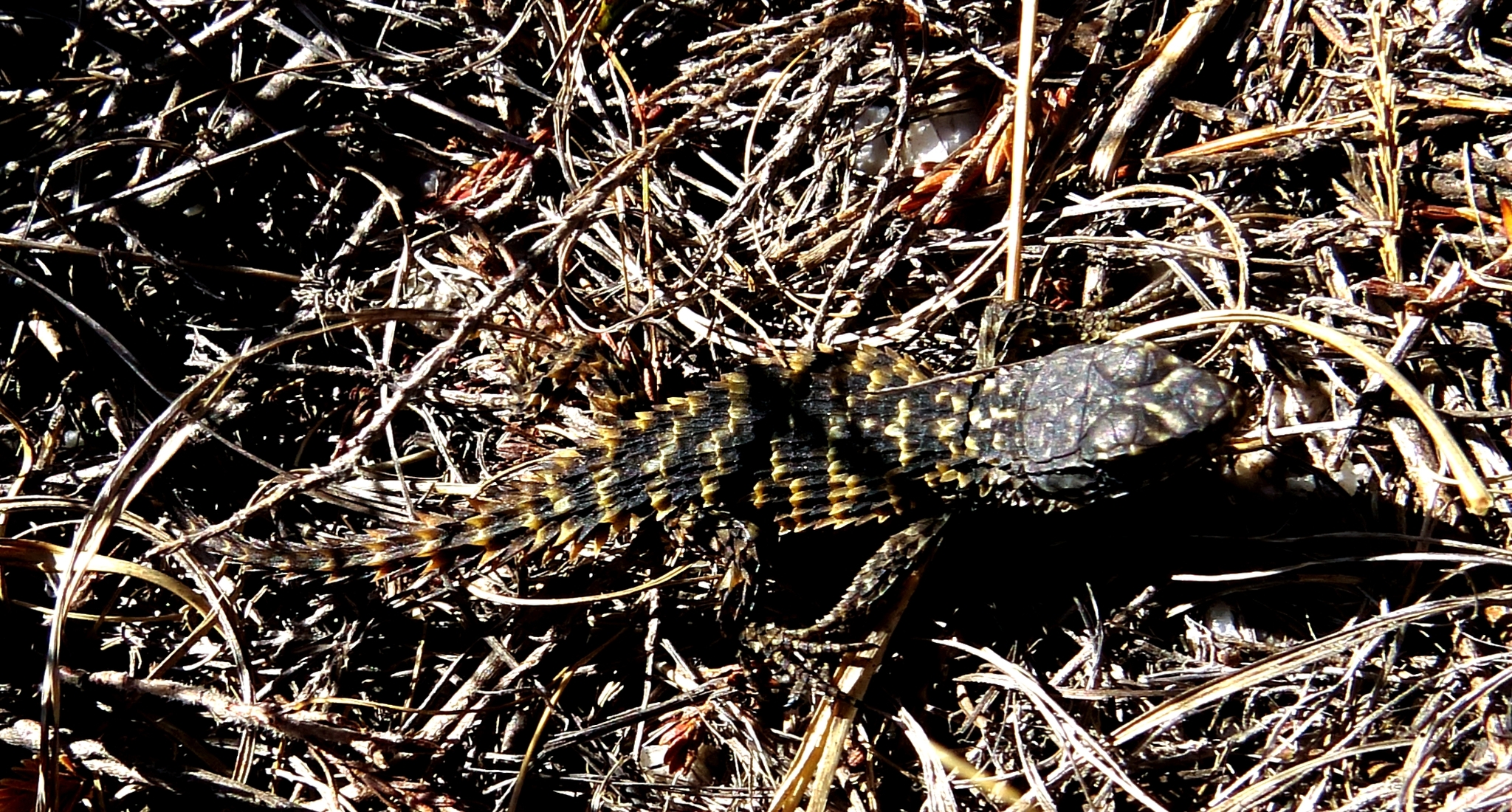
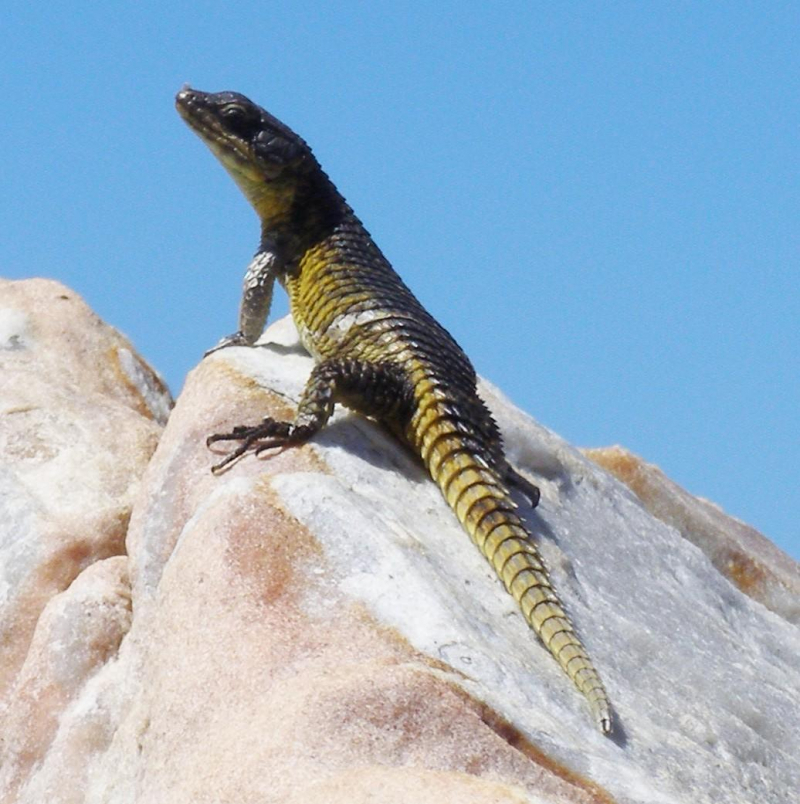
Boulenger (1885) re-described this species as Zonurus cordylus: Head much depressed, much longer than broad. Head-shields slightly rugose, nasals not swollen in contact, pierced in their posterior part, frontonasal hexagonal, broader than long, followed by a pair of praefrontals forming a suture; frontal pentagonal, a little wider anteriorly, interparietal small quadrangular in the middle between the two pairs of parietals, of which the posterior is the largest, temporals slightly keeled, in four longitudinal rows, no spines, four supraoculars, three supraciliaries, lower eyelid opaque, a small loreal, a large praeorbital, three infraorbitals, five or six upper labial, posterior largest; rostral three or four times as broad as high. Mental rather large, tetragonal or pentagonal, five or six lower labials, posterior largest and keeled, bordered by a row of five large shields, the fourth of which is the largest: gular scales moderate, subquadrangular, imbricate, larger and more rounded on the neck, sides of neck with spinose keeled scales. Dorsal scales large, forming regular transverse series, imbricate, subquadrangular, more or less strongly keeled, shortly mucronate, frequently serrated, on the flanks similar but more strongly keeled; a distinct lateral fold; twenty-five to twenty-eight cross series of scales from occiput to base of tail, the largest containing sixteen or eighteen scales. Ventral scales smooth, quadrangular, a little broader than long, slightly imbricate, forming ten to fourteen regulars longitudinal, and twenty-three to twenty-seven transverse series, those of the outermost series shortly mucronate and frequently feebly keeled. A pair of enlarged posterior preanal scales. Limbs above with large spinose, serrated, imbricate keeled scales, inferiorly with smooth or feebly keeled ones. Femoral pores six to nine on each side. Tail with whorls of large, strongly keeled, spinose, serrated scales, the spines strongest on the sides. Upper parts yellowish, olive, or blackish-brown, uniform or variegated with darker, sometimes a reddish band along each side, lower surfaces yellowish or greenish white. Measurement: Total length 174 mm, Forelimb 30 mm, Head 24 mm, Hindlimb 41 mm, Width of head 19 mm, Tail 90 mm, Body 60 mm.
This information was extracted from Stanley et al. (2011): Body moderately flattened in cross-section, small to medium-sized (maximum SVL 66–95 mm), robust. Limbs of moderate length, digits unreduced. Dorsal scales small and smooth to keeled in 16–30 transverse rows; caudal scales enlarged and spinose; head triangular; no occipital spines present. Lower eyelid without transparent disc. Tongue unpigmented. Osteoderms distributed across entire body.
Type locality: “Africa, Asia” Holotype: NRM (Royal Museum Stockholm) Syntypes (13): a) PEM R13518–22 (formerly AMG 5183) [tasmani]
A phylogenetic analysis revealed that C. tasmani is paraphyletic with C. cordylus and it is therefore treated as a junior synonym of C. cordylus (Stanley et al., 2011). Although a phylogeographic study showed there are two clades (southwestern Cape and another covering the rest of the distribution), the divergence between these clades is not at the species level (Diedericks and Daniels, 2013). There are no other outstanding taxonomic issues (Tolley et al., 2023).
Lesotho, South Africa
Cape Girdled lizard is distributed across most of southern South Africa, from the southwest coastal regions through the Cape Fold Mountains and the Great Escarpment, to the eastern coastal regions, extending marginally into southwestern Lesotho (De Waal, 1978; Bates, 2007). It also occurs on St Croix Island off the southeast coast near Gqeberha (as C. tasmani; Branch, 1998).
This species relies on running to move around.
Carnivore - Invertivore (invertebrate-eating)
Cape Girdled lizards are active in early morning and evening (and all day on overcast days), foraging for insects in the veld and dashing back to cover when danger threatens (Branch, 1998).
Cape Girdled lizards are viviparous. They mate in spring and give birth to 1-3 young in January-February (Branch, 1998).
Adult Cape Girdled lizards are aggressive and form social hierarchies with dominant males. In territorial disputes males circle one another, bobbing their heads and arching their backs. The weaker male usually signals submission by moving its tail. Fights may ensure if dominance is not resolved in these rituals (Branch, 1998). They may evade predators by wedging themselves firmly in rock cracks by inflating their body and shortening and thickening their skull, which has a hinged structure (Branch, 1998).
Grassland, Fynbos, Savanna
This map contains point-based occurrences at different locations
Occurrence in African countries and South African provinces. Residence status indicates if a taxon is indigenous, endemic, or alien in a specific region. This data is based on specimen records and literature.
FSA
SA
BOT
NAM
ESW
LES
WC
EC
NC
FS
GA
KZN
LP
MP
NW
Absent
Indigenous
Endemic
Naturalised
Invasive
Names and Sources
Cordylus cordylus ((Linnaeus, 1758))
Cordylus verus
Author: Laurenti, 1768
Cordylus dorsalis
Author: Cuvier, 1829
| Common Name | Language |
|---|---|
| Kaap Gordelakkedis, Cape Girdled Lizard | En |
| Cape Girdle Lizard | En |
| Cape Girdled Lizard |
419 bp linear DNA
Accession: MZ646227
349 bp linear DNA
Accession: MZ646230
359 bp linear DNA
Accession: MZ646231
419 bp linear DNA
Accession: MZ646228
490 bp linear DNA
Accession: HQ167518
419 bp linear DNA
Accession: MZ646229
477 bp linear DNA
Accession: HQ167561
This species is listed in CITES Appendix II and was most recently recorded as exported from South Africa for pet trade in the 1990s in small numbers (UNEP-WCMC, 2020). Significant numbers (thousands) of wild-caught individuals were reported as exported from Tanzania to the USA, Europe and Japan in the 1990s but there are no such recent exports. These exports are unusual because Tanzania is not within this species' distribution. The records could represent exports of a Cordylus species (e.g. C. tropidosternum or C. beraduccii) from Tanzania exported under the name Cordylus cordylus (Tolley et al., 2023).
20 results for Cordylus cordylus (Linnaeus, 1758)
This map contains point-based occurrences at different locations
2020
WEBSITE
CITES Trade DatabaseUNEP-WCMC, . 2020. CITES Trade Database. https:// trade.cites.org/. (Accessed: 15 September 2020).
2011
JOURNAL ARTICLE
Between a rock and a hard polytomy: rapid radiation in the rupicolous girdled lizards (Squamata: Cordylidae)Branch, W., Bauer, A., Stanley, E., Jackman, T., Mouton, P.. 2011. Between a rock and a hard polytomy: rapid radiation in the rupicolous girdled lizards (Squamata: Cordylidae) Vol. 58 pp.53–70.
1978
JOURNAL ARTICLE
The Squamata (Reptilia) of the Orange Free State, South AfricaDe Waal, S.. 1978. The Squamata (Reptilia) of the Orange Free State, South Africa Vol. 11 pp.1-160.
2007
JOURNAL ARTICLE
First records of the Cape Girdled Lizard, Cordylus cordylus (Linnaeus, 1758), in Lesotho: results and discussionBates, M.. 2007. First records of the Cape Girdled Lizard, Cordylus cordylus (Linnaeus, 1758), in Lesotho: results and discussion Vol. 23 pp.188–190.
1885
BOOK
Catalogue of the lizards in the British Museum (Natural History)Boulenger, G.. 1885. Catalogue of the lizards in the British Museum (Natural History) Vol. 2. London. Natural History Museum pp.349 - 350.
2023
BOOK
Conservation status of the reptiles of South Africa, Eswatini and LesothoTolley, K., Burger, M., Alexander, G., Pietersen, D., Conradie, W., Weeber, J.. 2023. Conservation status of the reptiles of South Africa, Eswatini and Lesotho Vol. Suricata 10. Pretoria. South African National Biodiversity Institute.
2013
JOURNAL ARTICLE
Ain’t no mountain high enough, ain’t no valley low enough? Phylogeography of the rupicolous Cape girdled lizard (Cordylus cordylus) reveals a generalist patternDaniels, S., Diedericks, G.. 2013. Ain’t no mountain high enough, ain’t no valley low enough? Phylogeography of the rupicolous Cape girdled lizard (Cordylus cordylus) reveals a generalist pattern Vol. 71 pp.234-248.
Status and criteria
LC
Assessor(s)
Michael Bates
Reviewer(s)
Graham Alexander


