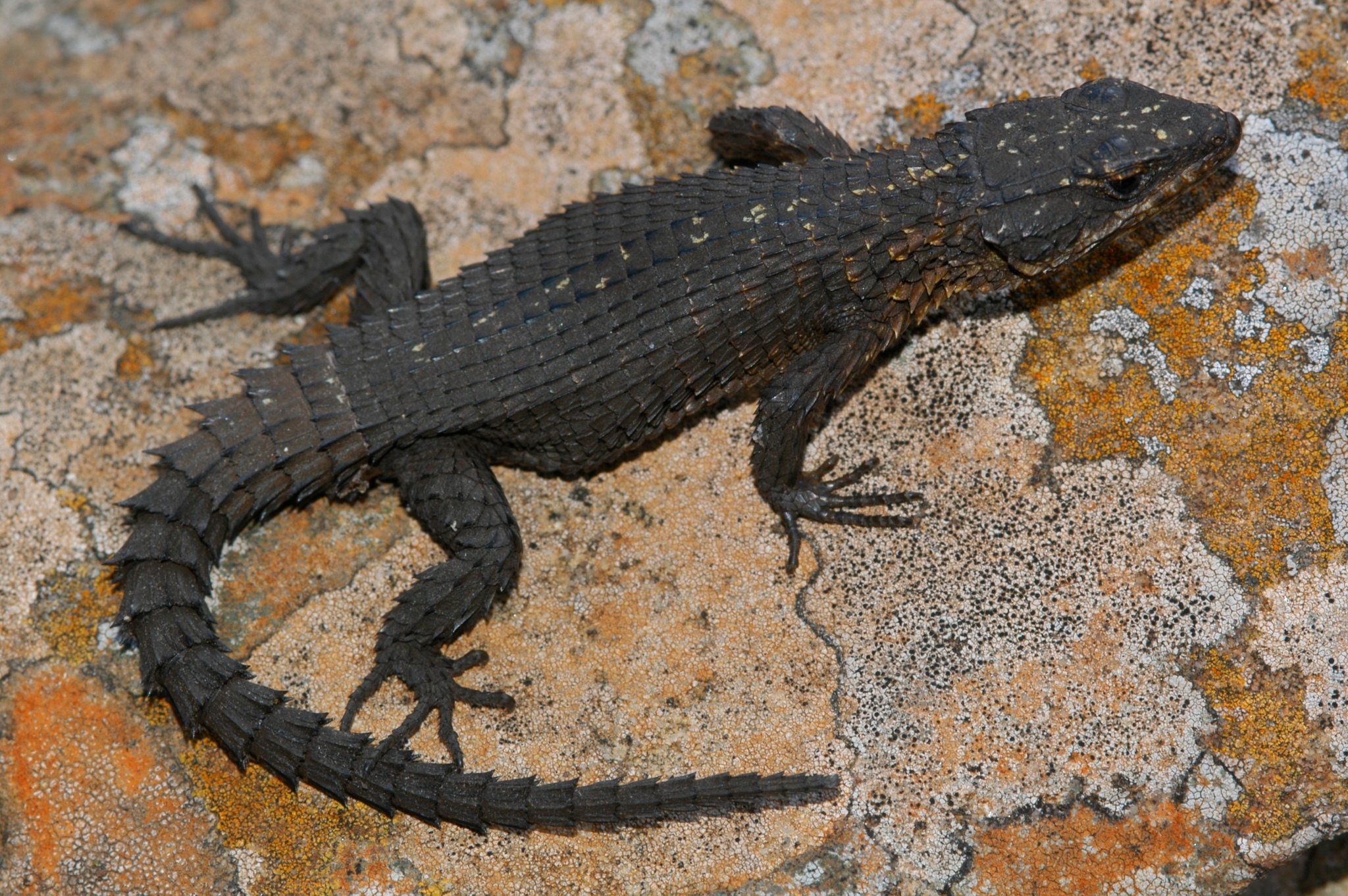
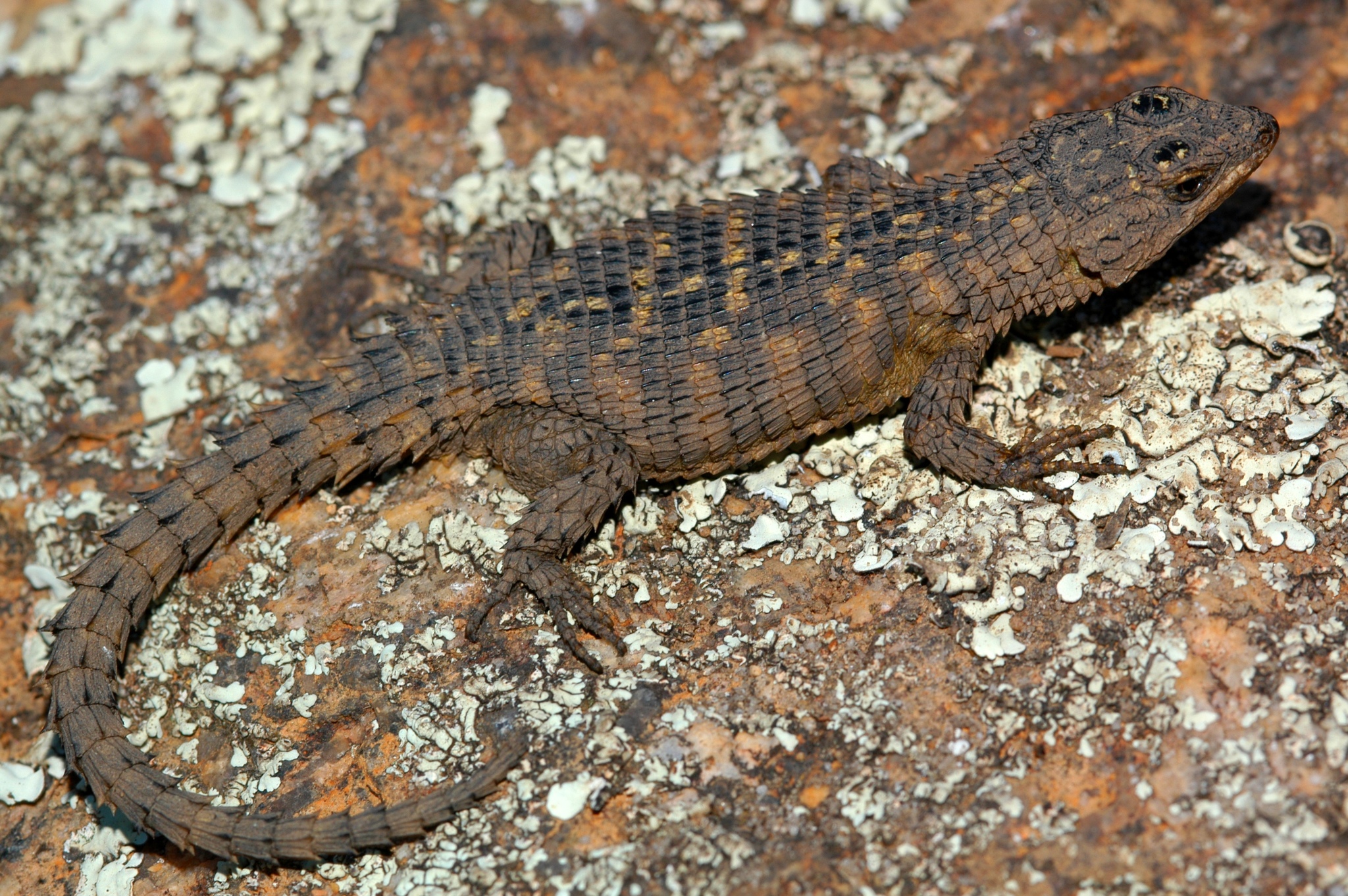
Mouton and Van Wyk (1994) described the species as follows: Snout-vent length 68 mm, tail 70 mm. Head and body strongly depressed. Head slightly longer than broad, triangular in shape. Upper head shields rugose and striated. A pair of nasals on each side, a narrow infranasal surrounding nostril and a large supranasal; infranasal slightly protruding below and nostril directed slightly upward and forward. Left supranasal superficially divided into two scales; supranasals not swollen and in good contact behind rostral. Frontonasal pentagonal, in good contact on sides with loreals, but separated from rostral and frontal. Prefrontals in broad contact mesially. Frontal six-sided, broader in front than behind and longer than broad. Two pairs of parietals, posterior pair slightly larger than anterior pair. Interparietal large; quadrangular and produced anteriorly, but not separating anterior parietals. Eight occipitals, quadrangular to pentagonal in form, keeled and striated but not spinose. Temporal scales keeled and striated, non-spinose and arranged in four regular transverse rows; two flattened, projecting temporal scales posteriorly partly covering ear opening. Four supraoculars and three supraciliaries on each side. Lower eyelid scaly. Preocular notably larger than loreal. Three suboculars, not reaching lip. Postocular separated from eye by smaller scales. Rostral is 2.8 times as broad as deep. Five upper labials on each side, the posteriormost one the largest and strongly keeled, the penultimate one with the posterior half keeled. Five lower labials on each side, the last one the largest and strongly keeled, the second last one with only the posterior part keeled. Five sublabials per side, the last the smallest and well-keeled. Mental 1.9 times as broad as long. Five chin shields not well-delimited, a single anterior one. Sublingual scales smooth and imbricate, in the front polygonal to rounded and at the back quadrangular and arranged in regular transverse rows; two rows of sublinguals next to sublabials smaller and longer than broad; 13 sublinguals between edges of jaw. Gulars strongly imbricate with rounded posterior edges. Sides of neck with strongly keeled and spinose scales. Two median rows of dorsal body scales slightly larger than other dorsals, trapezoid to rectangular in form and longitudinally keeled. Other dorsals small, imbricate, rectangular in form, keeled obliquely outward and with the lateral sides faintly ribbed and the posterior edges slightly serrated; dorsolaterals moderately keeled and spinose and slightly larger than dorsals; dorsals and laterals arranged in 24 longitudinal and 28 transverse rows. Ventral scales quadrangular in form, smooth and imbricate, broader than long except the two outer rows which are longer than broad; arranged in 14 longitudinal and 26 transverse series. A pair of moderately enlarged preanal plates. Scales on limbs above large, imbricate, strongly keeled and sharply spinose. Eleven scales under fourth finger and 12 under fourth toe. Six femoral pores on one side and seven on the other; generation glands six on one side in a single row and seven on the other side in two rows of five and two. Tail with whorls of large, elongate, mucronate, strongly keeled and sharply spinose scales, spines longest on the sides and pointing backwards.
The diagnostics was extracted from Mouton and Van Wyk (1994): Displays all the diagnostic characters of the C. minor species group. Differs from C. minor, C. aridus and C. cloetei in possessing the following combination of characters: a bright body coloration (i.e. straw coloured with black blotches and many bright yellow infusions), a fourth subocular scale and a fifth transverse row of temporal scales normally absent, the infranasal slightly swollen and protruding, the head small, the dorsolaterals only moderately keeled and spinose, 26-29 transverse series of dorsals, normally five upper labials per side, the posterior pair of parietals slightly larger than the anterior pair and the postocular large.
Type locality: Lower slopes of the Rooiberg on the farm Wolfhok, Garies District, Namaqualand, South Africa, 30°24'27"S, 18°06'11" E. Holotype: SAM 50897, adult female. Allotype: SAM 50898, adult male. Paratypes: SAM 50899-508900, one adult male, one adult female.
This information was extracted from Tolley et al. (2023): The taxonomic status of forms in the C. minor species complex (Mouton and Van Wyk, 1994), to which C. imkeae belongs, were evaluated in a phylogenetic framework, and this species is considered valid (Tolley et al., 2022). There have not been any taxonomic issues with C. imkeae noted to date.
South Africa
This species is endemic to the Rooiberg in the Kamiesberg range near Garies in Namaqualand, Northern Cape province, South Africa (Mouton and Van Wyk, 1994).
These lizards are known to run and hide. When running on four legs, lizards often move their fore feet diagonally in unison—the right fore foot with the left hand and the left fore foot with the right hand. The body's bent is simultaneously reversed. The shoulders, hips, and other joints in the legs as well as the bending of the back all contribute to moving the feet forward. Leg and back muscles work together to power running (Alexander, 2012).
Carnivore - Invertivore (invertebrate-eating)
Cordylus lizards feed on a variety of large invertebrates, while some of the bigger species also eat small vertebrates and plant matter (Branch, 1998).
All girdled lizards are viviparous, giving birth to a few (1-6) large babies each year. Some live in diffuse colonies, in which the males are territorial during the breeding season. Although they usually have drab coloration, adult males do have active femoral and glandular pores, and appear to use chemical clues to signal status and territorial boundaries. Sexual maturity is reached 2-4 years (Branch, 1998).
Girdled lizards form dense aggregation or colonies that may number hundreds. They appear to have relatively complex social structure including the formation of family units and a degree of kin recognition. They can also be more solitary and are usually only observed in singles or pairs (Alexander & Marais, 2007).
Fynbos
This map contains point-based occurrences at different locations
Occurrence in African countries and South African provinces. Residence status indicates if a taxon is indigenous, endemic, or alien in a specific region. This data is based on specimen records and literature.
FSA
SA
BOT
NAM
ESW
LES
WC
EC
NC
FS
GA
KZN
LP
MP
NW
Absent
Indigenous
Endemic
Naturalised
Invasive
Names and Sources
| Common Name | Language |
|---|---|
| Rooiberg girdled lizard | En |
| Rooiberg Girdle Lizard | En |
490 bp linear DNA
Accession: HQ167527
478 bp linear DNA
Accession: HQ167526
This information was extracted from Tolley et al. (2023): This species is listed in CITES Appendix II, but only 11 live individuals have been exported for scientific purposes under permit from the wild since 2006, with none prior to that time. No permitted exports for the pet trade are on record (UNEP-WCMC, 2020), so trade is unlikely to be a threat to this species. It is possible that the live individuals exported for scientific purposes are being captive bred in Europe (see photos in Reissig 2014).
3 results for Cordylus imkeae Mouton & Van Wyk, 1994
This map contains point-based occurrences at different locations
1994
BOOK
Taxonomic status of geographical isolates in the Cordylus minor complex (Reptilia: Cordylidae): A description of three new speciesMouton, le F., Van Wyk, J.. 1994. Taxonomic status of geographical isolates in the Cordylus minor complex (Reptilia: Cordylidae): A description of three new species Vol. 43 pp.6-18..
1998
BOOK
Field Guide to Snakes and Other Reptiles of Southern AfricaBranch, B.. 1998. Field Guide to Snakes and Other Reptiles of Southern Africa. Cape Town. Struik Publishers.
2023
BOOK
Conservation status of the reptiles of South Africa, Eswatini and LesothoTolley, K., Burger, M., Alexander, G., Pietersen, D., Conradie, W., Weeber, J.. 2023. Conservation status of the reptiles of South Africa, Eswatini and Lesotho Vol. Suricata 10. Pretoria. South African National Biodiversity Institute.
2022
JOURNAL ARTICLE
Taxonomic inflation due to inadequate sampling: Are girdled lizards (Cordylus minor species complex) from the Great Karoo one and the same?Tolley, K., Bates, M., Makhubo, B., Alexander, G., Conradie, W., Telford, N., Taft, J.. 2022. Taxonomic inflation due to inadequate sampling: Are girdled lizards (Cordylus minor species complex) from the Great Karoo one and the same? Vol. 135(1) pp.1-24.
2007
BOOK
A Guide to Reptiles of Southern AfricaAlexander, G., Marais, J.. 2007. A Guide to Reptiles of Southern Africa. Cape Town. Struik Publishers.
2012
JOURNAL ARTICLE
Locomotion of ReptilesAlexander, R.. 2012. Locomotion of Reptiles Vol. 121 pp.1-4.
Status and criteria
LC
Assessor(s)
Michael Bates
Contributors
Josh Weeber
Reviewer(s)
Graham Alexander