
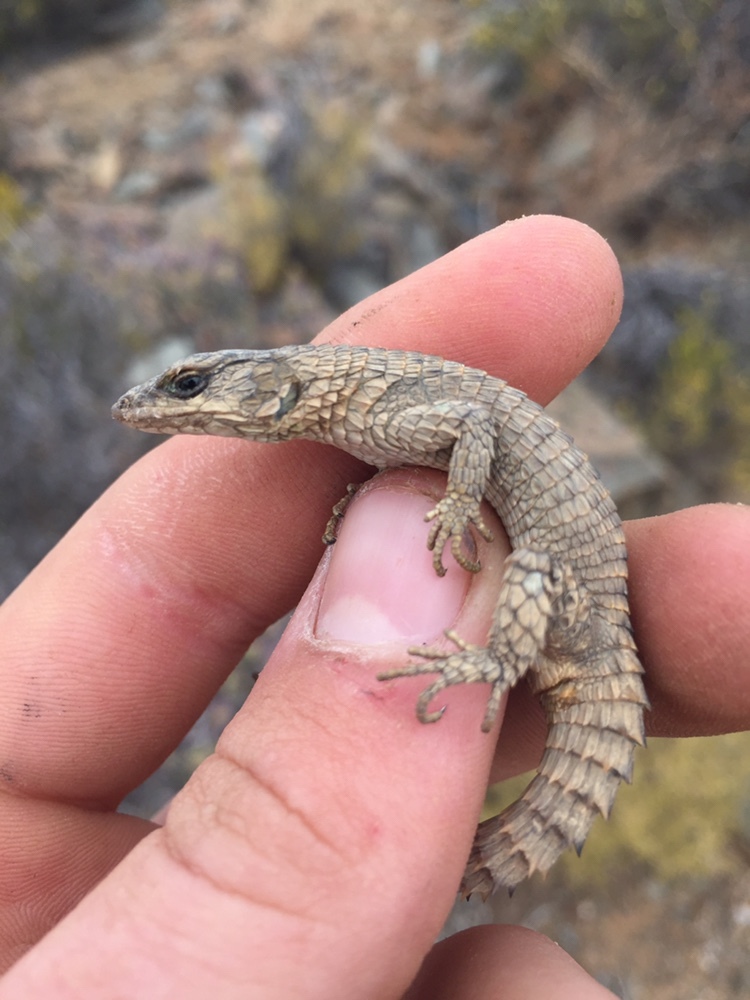
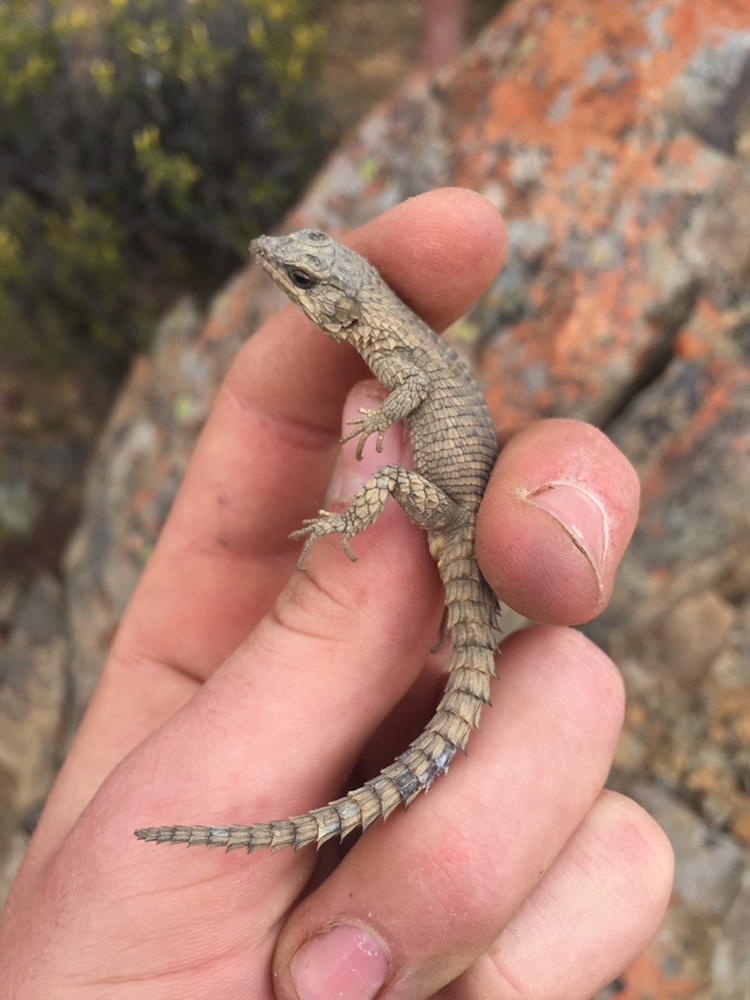
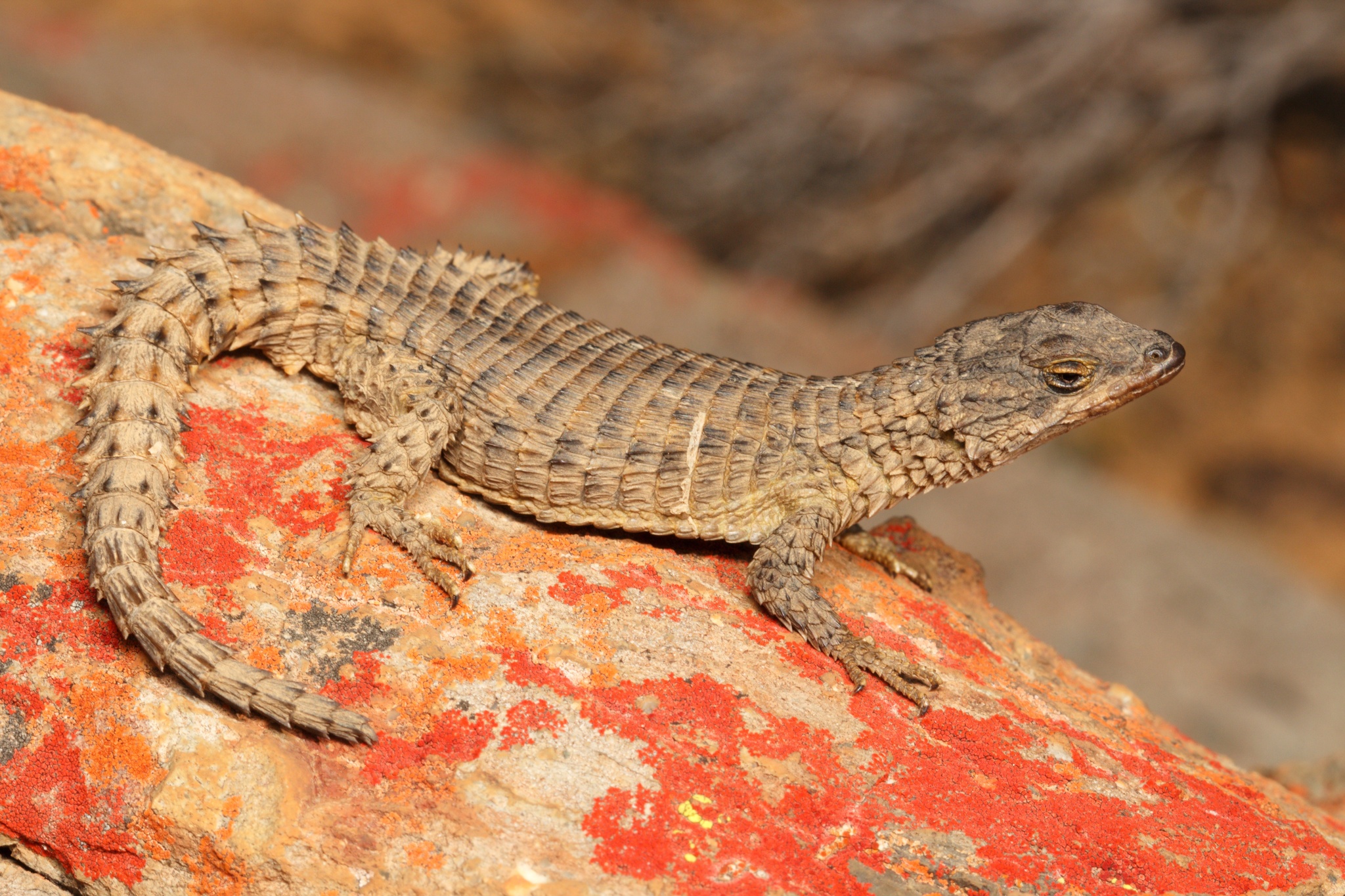
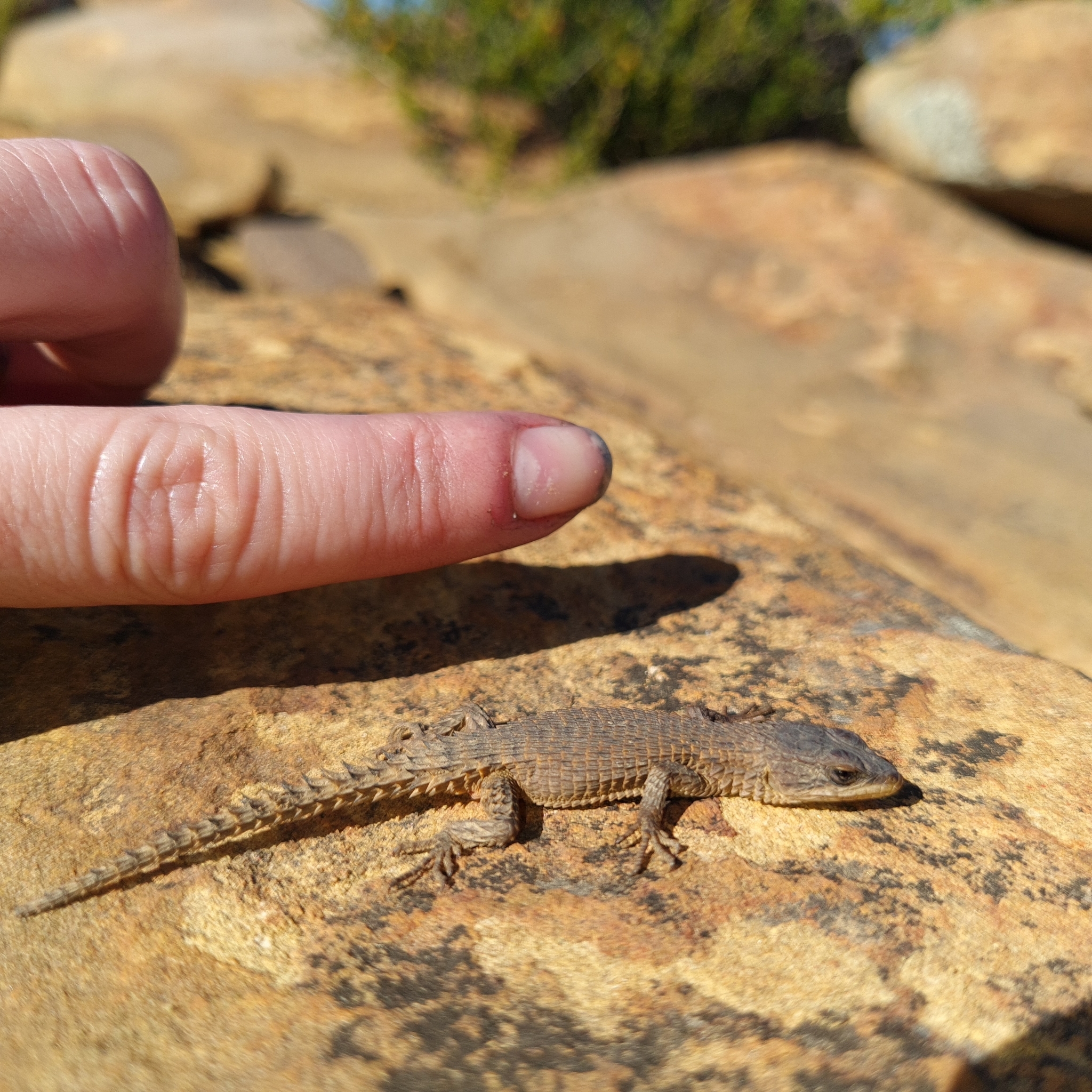
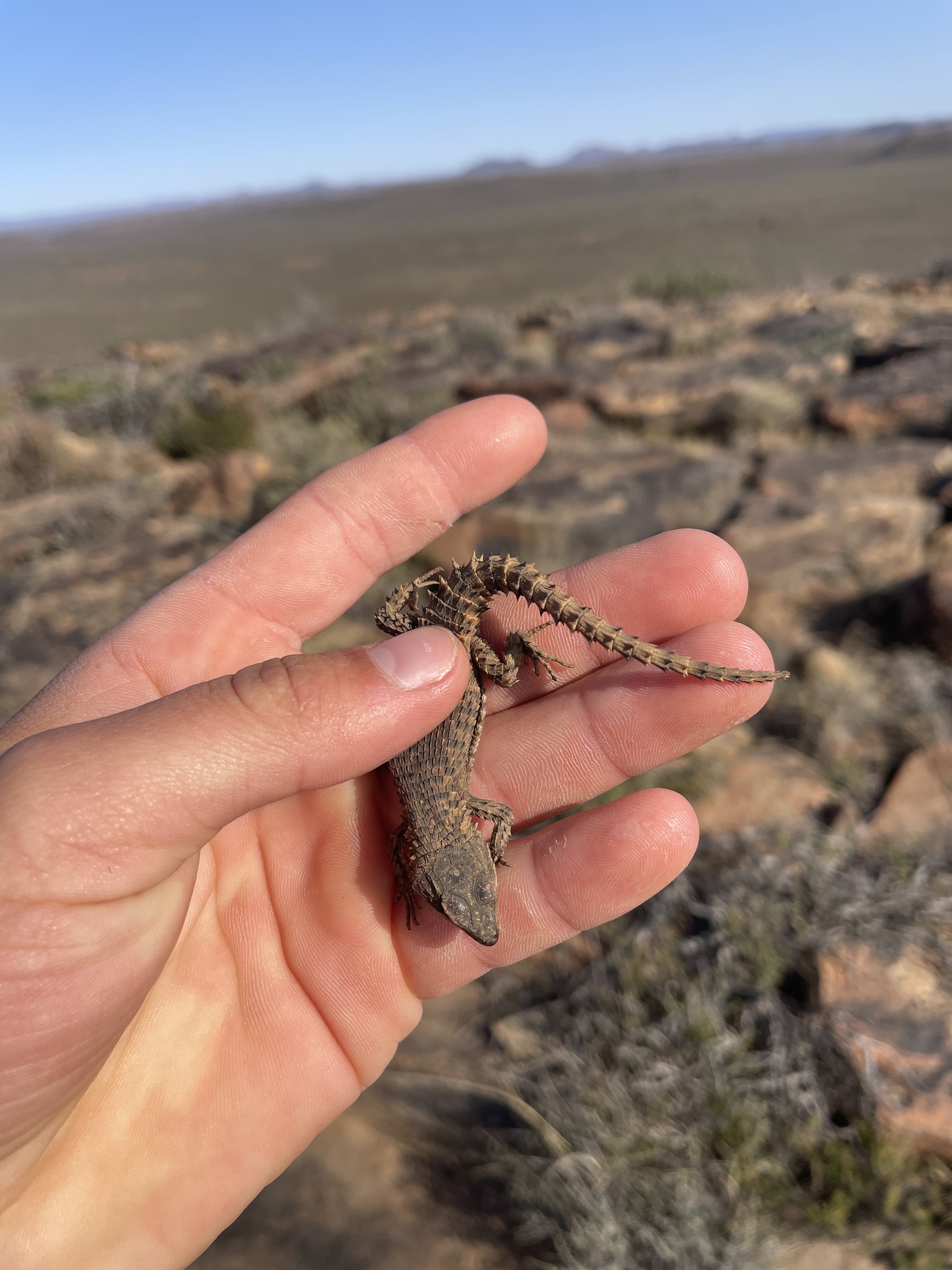
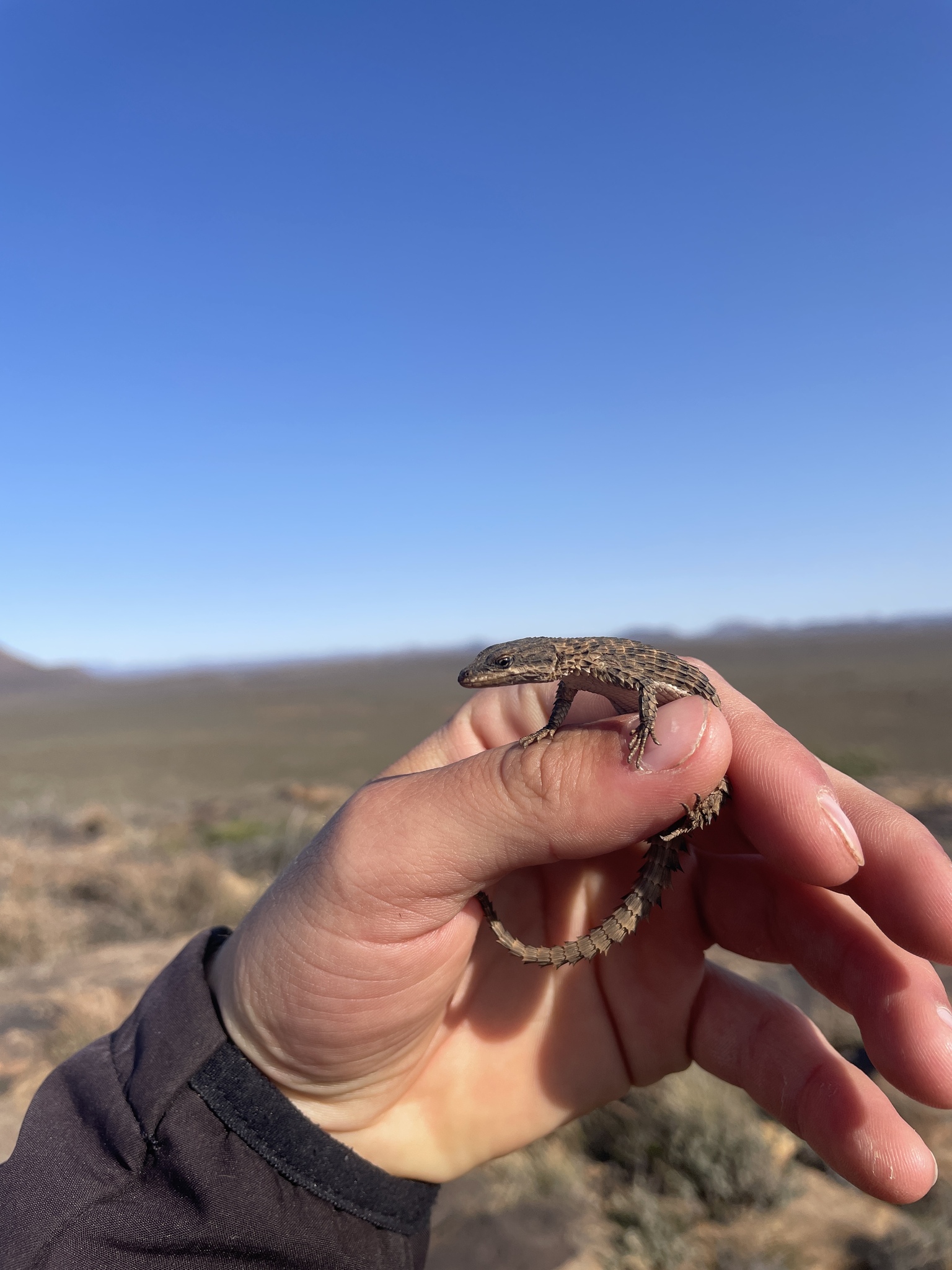
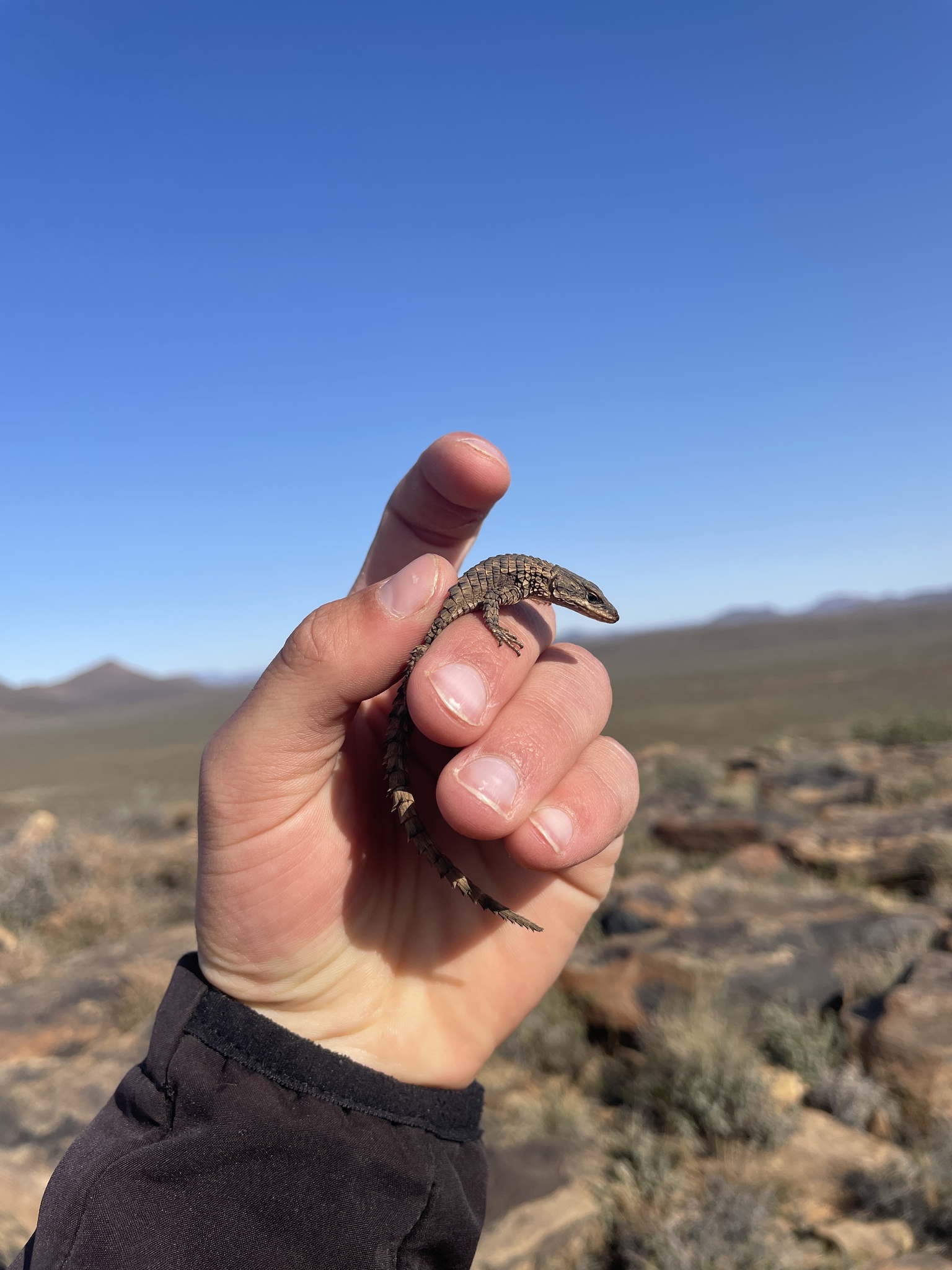
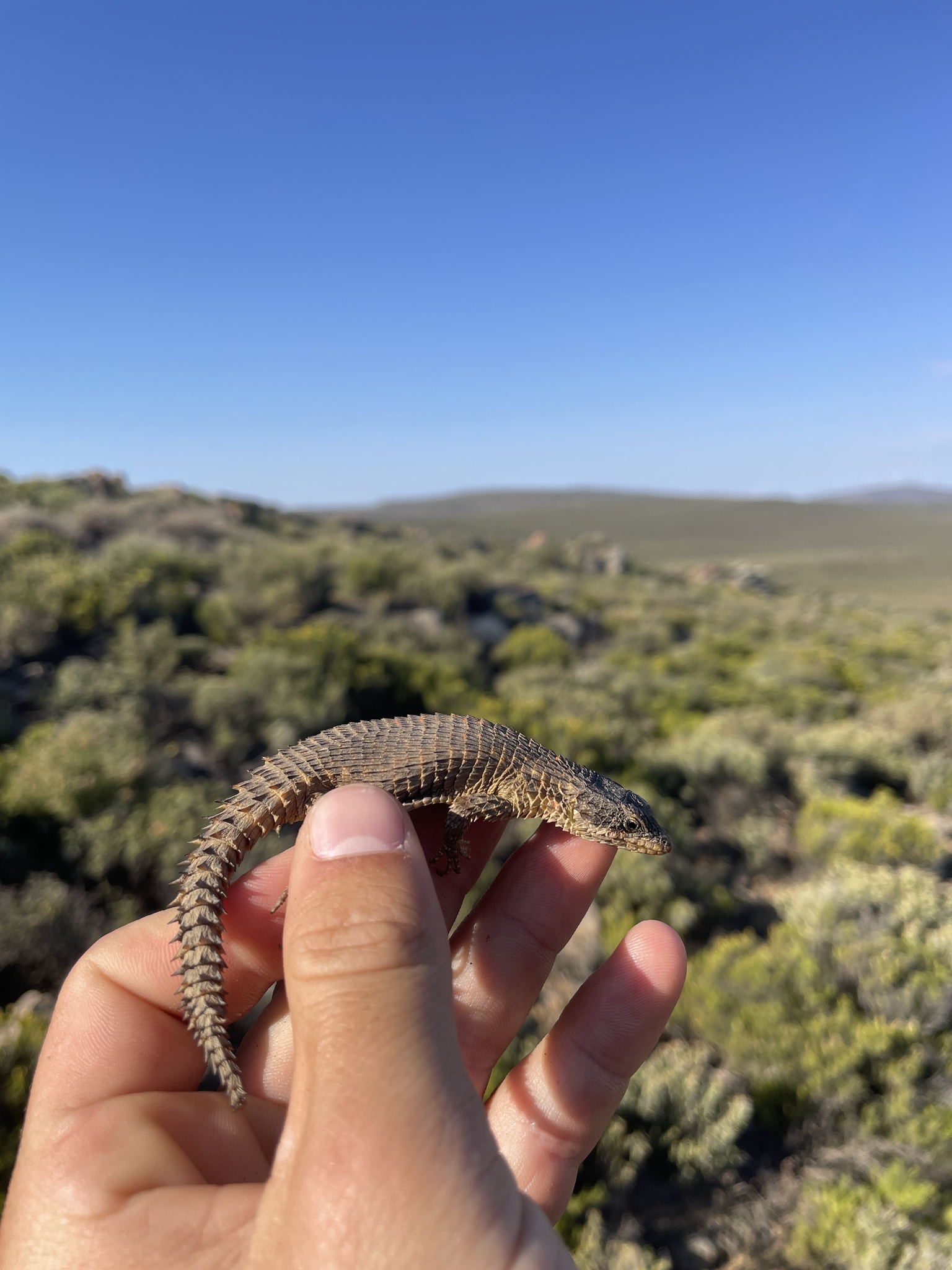
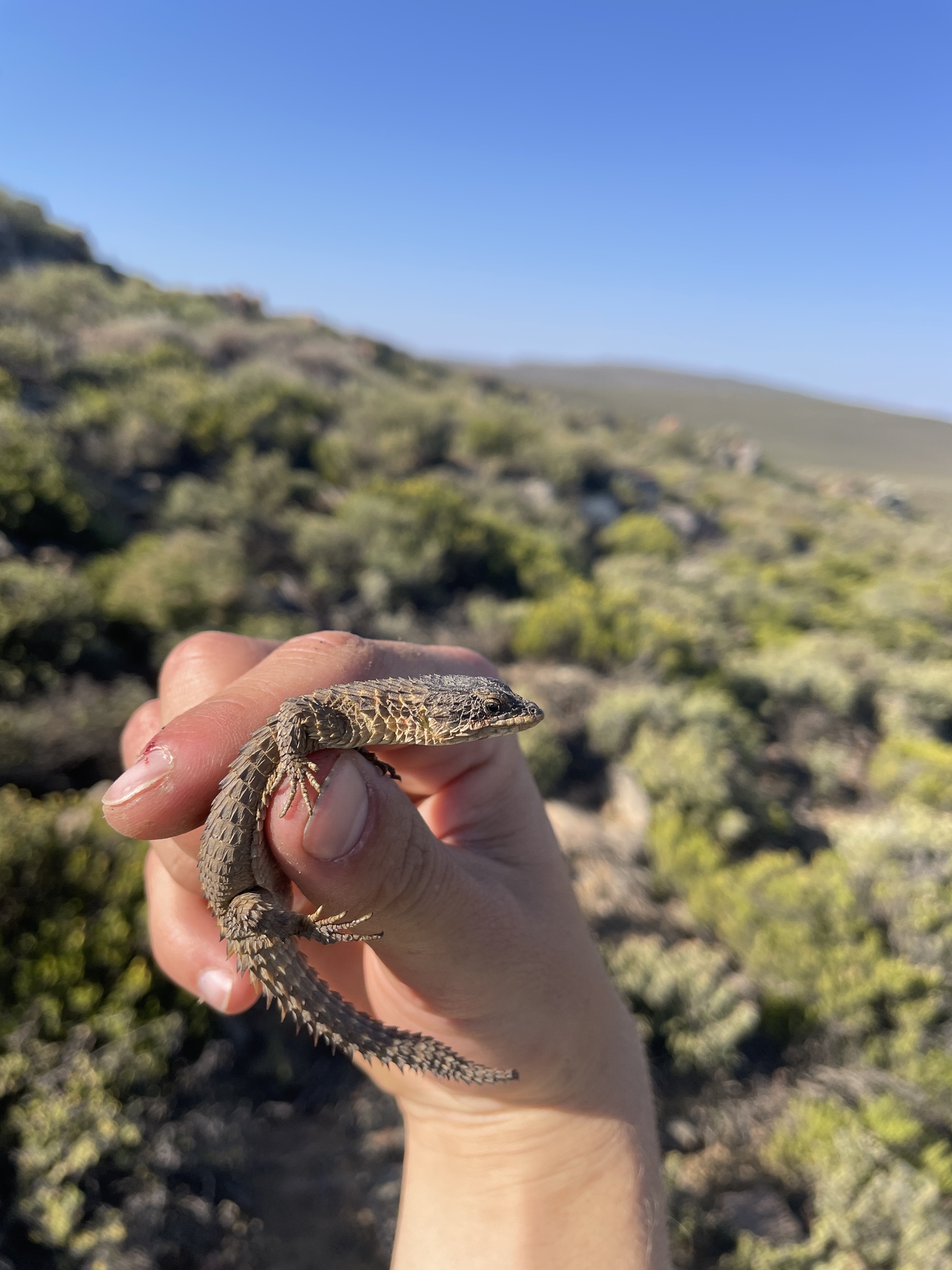
The description was extracted from Branch (1998): This small girdled lizard has a flattened body and a triangular head with rough head shields. There are three supraciliaries. The supranasals are in contact, separating the rostral and frontonasal. The nasals are small and not tubular. There are 5-6, usually 6, upper labials. The anterior parietals are larger than the posterior ones. There are six occipitals, and no enlarged chin shields. The dorsal scales are small, obliquely keeled, and in 26-28 transverse and 24-26 longitudinal rows. The laterals are spiny and larger than the dorsals. The ventrals are smooth, in 14-16 longitudinal rows. There is a pair of feebly enlarged preanal plates, and both sexes have 3-6 femoral pores on each thigh. The tail has whorls of large spines. The back, tail and limbs are dirty brown in colour, with diffuse irregular black markings. The head is dark brown to blackish. The belly and upper labials are dirty white.
No separate diagnostic description was provided. Refer to the morphological description.
Type locality: just north of Matjesfontein [Western Cape Province], South Africa. Holotype: SAM 50901, adult female. Allotype: SAM 50902, adult male. Paratypes: SAM 50903, adult female and SAM 50904, adult male [aridus]
Cordylus aridus and C. cloetei have been synonymised with C. minor (Tolley et al., 2022).
South Africa
This species occurs from the low-lying southcentral Karoo region extending into the Great Karoo along the Great Escarpment from the southern Roggeveld (southwestern Karoo) and Nuweveld Mountains, eastwards along the Great Escarpment into the Eastern Cape province and extending northwards into the Great Karoo. Current records suggest there might be some gaps in the distribution, but this perception could be the result of poor survey efforts (Tolley et al., 2023).
These lizards are known to run and hide. When running on four legs, lizards often move their fore feet diagonally in unison—the right fore foot with the left hand and the left fore foot with the right hand. The body's bent is simultaneously reversed. The shoulders, hips, and other joints in the legs as well as the bending of the back all contribute to moving the feet forward. Leg and back muscles work together to power running (Alexander, 2012).
Carnivore - Invertivore (invertebrate-eating)
This species feed on a variety of large invertebrates (Branch, 1998).
All igrdled lizards are viviparous, giving birth to a few (1-6) large babies each year. Some live in diffuse colonies, in which the males are territorial during the breeding season. Although they usually have drab coloration, adult males do have active femoral and glandular pores, and appear to use chemical clues to signal status and territorial boundaries. Sexual maturity is reached 2-4 years (Branch, 1998).
No data.
Nama-Karoo, Succulent Karoo
This map contains point-based occurrences at different locations
Occurrence in African countries and South African provinces. Residence status indicates if a taxon is indigenous, endemic, or alien in a specific region. This data is based on specimen records and literature.
FSA
SA
BOT
NAM
ESW
LES
WC
EC
NC
FS
GA
KZN
LP
MP
NW
Absent
Indigenous
Endemic
Naturalised
Invasive
Names and Sources
| Common Name | Language |
|---|---|
| Westelike Dwerg Gordelakkedis, Dwarf Girdled Lizard; Western Dwarf Girdled Lizard | En |
| Western Dwarf Girdle Lizard | En |
| Dwarf Girdle Lizard | En |






419 bp linear DNA
Accession: MZ646205
419 bp linear DNA
Accession: MZ646206
419 bp linear DNA
Accession: MZ646207
419 bp linear DNA
Accession: MZ646218
419 bp linear DNA
Accession: MZ646210
419 bp linear DNA
Accession: MZ646211
419 bp linear DNA
Accession: MZ646199
419 bp linear DNA
Accession: MZ646209
419 bp linear DNA
Accession: MZ646201
This species is listed in CITES Appendix II but there is no recorded trade (UNEP-WCMC 2020).
17 results for Cordylus minor FitzSimons, 1943
This map contains point-based occurrences at different locations
1943
JOURNAL ARTICLE
The Lizards of South AfricaFitzsimons, V.. 1943. The Lizards of South Africa Vol. 1. Pretoria pp.1-528.
1998
BOOK
Field Guide to Snakes and Other Reptiles of Southern AfricaBranch, B.. 1998. Field Guide to Snakes and Other Reptiles of Southern Africa. Cape Town. Struik Publishers.
2020
WEBSITE
CITES Trade DatabaseUNEP-WCMC, . 2020. CITES Trade Database. https:// trade.cites.org/. (Accessed: 15 September 2020).
2012
JOURNAL ARTICLE
Locomotion of ReptilesAlexander, R.. 2012. Locomotion of Reptiles Vol. 121 pp.1-4.
2023
BOOK
Conservation status of the reptiles of South Africa, Eswatini and LesothoTolley, K., Burger, M., Alexander, G., Pietersen, D., Conradie, W., Weeber, J.. 2023. Conservation status of the reptiles of South Africa, Eswatini and Lesotho Vol. Suricata 10. Pretoria. South African National Biodiversity Institute.
2022
JOURNAL ARTICLE
Taxonomic inflation due to inadequate sampling: Are girdled lizards (Cordylus minor species complex) from the Great Karoo one and the same?Tolley, K., Bates, M., Makhubo, B., Alexander, G., Conradie, W., Telford, N., Taft, J.. 2022. Taxonomic inflation due to inadequate sampling: Are girdled lizards (Cordylus minor species complex) from the Great Karoo one and the same? Vol. 135(1) pp.1-24.
Status and criteria
LC
Assessor(s)
Michael Bates
Contributors
Josh Weeber
Reviewer(s)
Graham Alexander


