ANIMALIA / CHORDATA / REPTILIA / SQUAMATA / CORDYLIDAE / PLATYSAURUS / BROADLEYI
Branch and Whiting (1997) described this species as follows: Head strongly depressed, much longer than broad. Head length (tip of snout to anterior border of ear-opening, HL): 16.9 mm; Head width (HW): 13.1 mm; HL/HW: 1.29). Large supranasals in contact behind rostral; nostril directed slightly backwards and piercing the upper region of a very small nasal that contacts the rostral, first supralabial, a small postnasal and the large supranasal. Frontonasal hexagonal, as broad as long and in good contact on sides with loreal. Prefrontals in median contact, with a small azygous granule at this suture, slightly posterior to its junction with the frontal. Frontal longer (3.47 mm) than broad (max. width 2.71 mm), much wider in front than behind. A pair of frontoparietals, each in contact laterally with middle pair of supraoculars. Interparietal small, diamond-shaped, set in the middle of the two pairs of parietals, the anterior pair the smallest. Occipital absent, slightly enlarged granules in its position. Four supraoculars, the first triangular and contacting the pentagonal preocular, the last the smallest. Four supraciliaries, anterior elongate, middle pair largest. Lower eyelid with a semitransparent disc divided into a number of vertical septa. Three temporals bordering parietals on each side, middle one largest and longitudinally elongate, twice the length of posterior one. Two additional rows of enlarged scales present in dorsal temporal region, upper row vertically elongate and more than twice the size of lower row. Ventral temporal region covered with six rows of irregular granules, slightly larger than those along backbone. A small postnasal; a loreal and a preocular, the former much smaller than the latter. Four suboculars, only the second extensively bordering the lip below. Rostral pentagonal, broader than deep (rostral width: 2.82 mm; rostral depth: 1.35 mm). Six supralabials, four anterior to subocular. Mental subpentagonal. Infralabials five, with a row of five large sublabials, the fourth by far the largest, the fifth the smallest. A longitudinal median series of five enlarged quadrangular or polygonal gular scales, remainder smaller, elongate and rectangular; towards base of throat scales become smaller (particularly laterally), subgranular and rounded, increasing again in size towards collar, which consists of eight enlarged scales. Dorsal scales smooth, small, flat and rounded, with minute granules at junctions, and largest along backbone and on flanks, smallest dorso-Iaterally and minute on sides. Ventrals square or a little broader than long medially, arranged in 43 mainly regular transverse and 22 longitudinal series. Eight preanal plates, median pair largest, a little larger than ventrals. Limbs long and slender, length of tibia (17.3 right, 17.2 mm left) subequal to head length. Upper forelimb and thighs with subequal granules above. Forearm and tibia with enlarged keeled scales; a row of nine large transverse plates on underside of tibia, largest at midcalf. A series of 16 femoral pores on lower surface of right thigh, 17 on left, with 4 - 5 rows of modified granular scales anterior to these pores. Tail partially regenerated (distal 51 mm), depressed, tapering, with regular whorls of elongate, quadrangular scales, feebly keeled above, more strongly keeled and often shortly spinose on sides, smooth below.
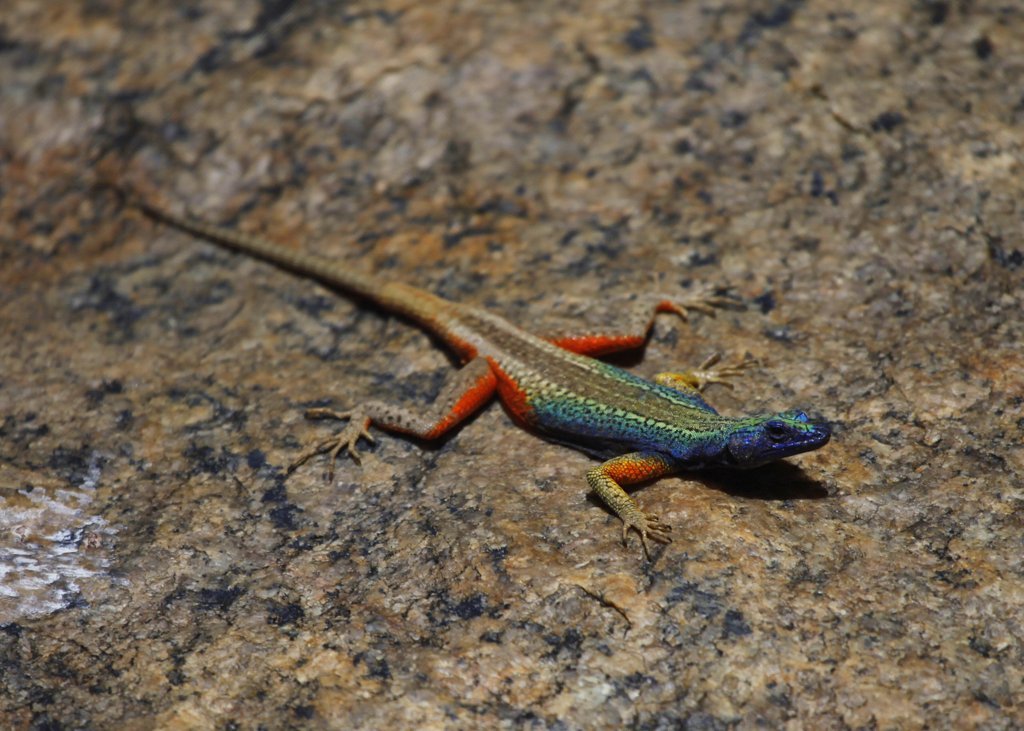
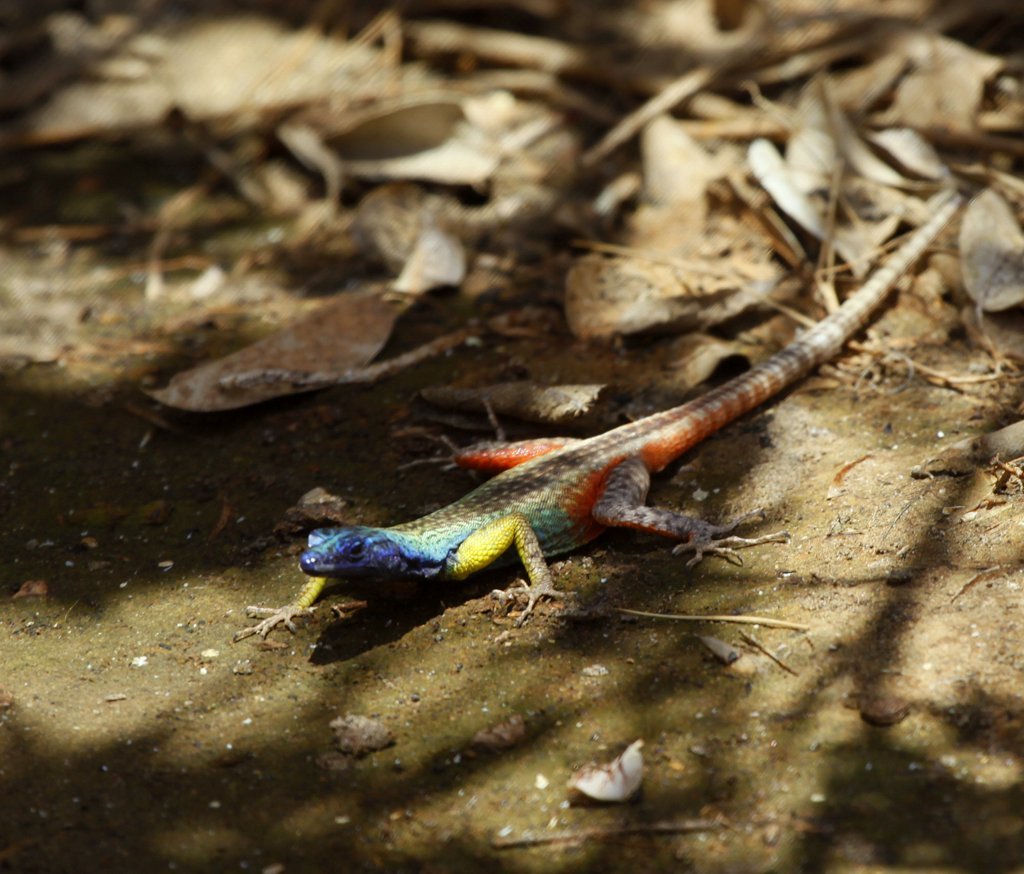
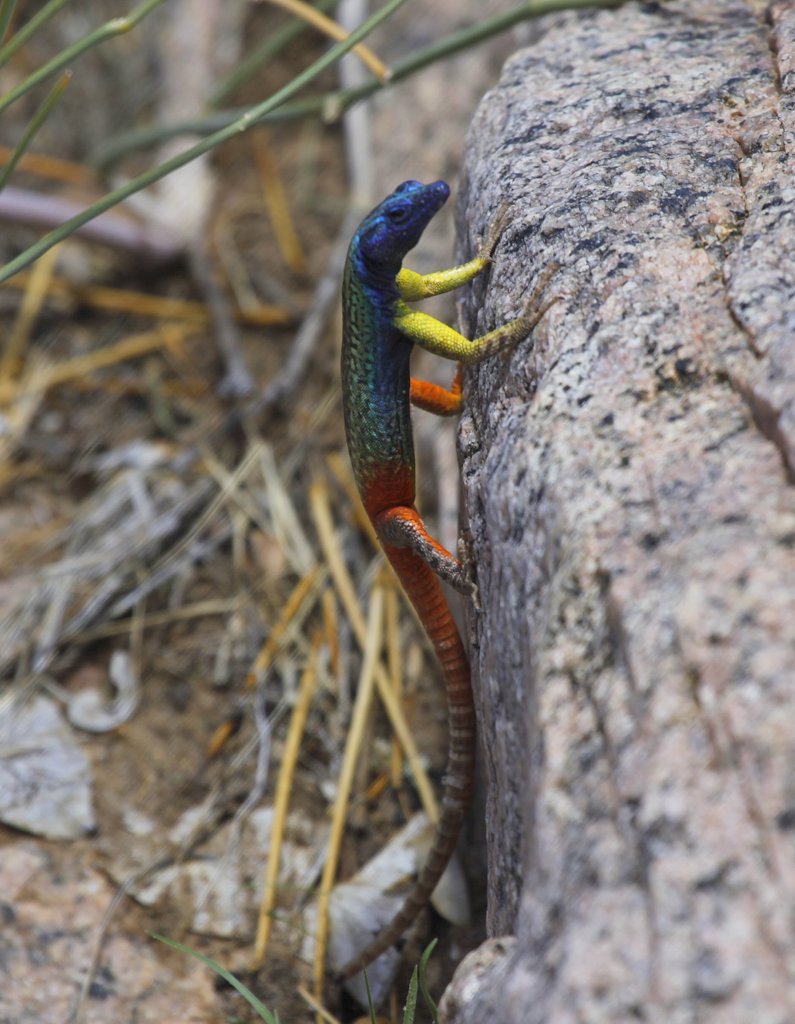
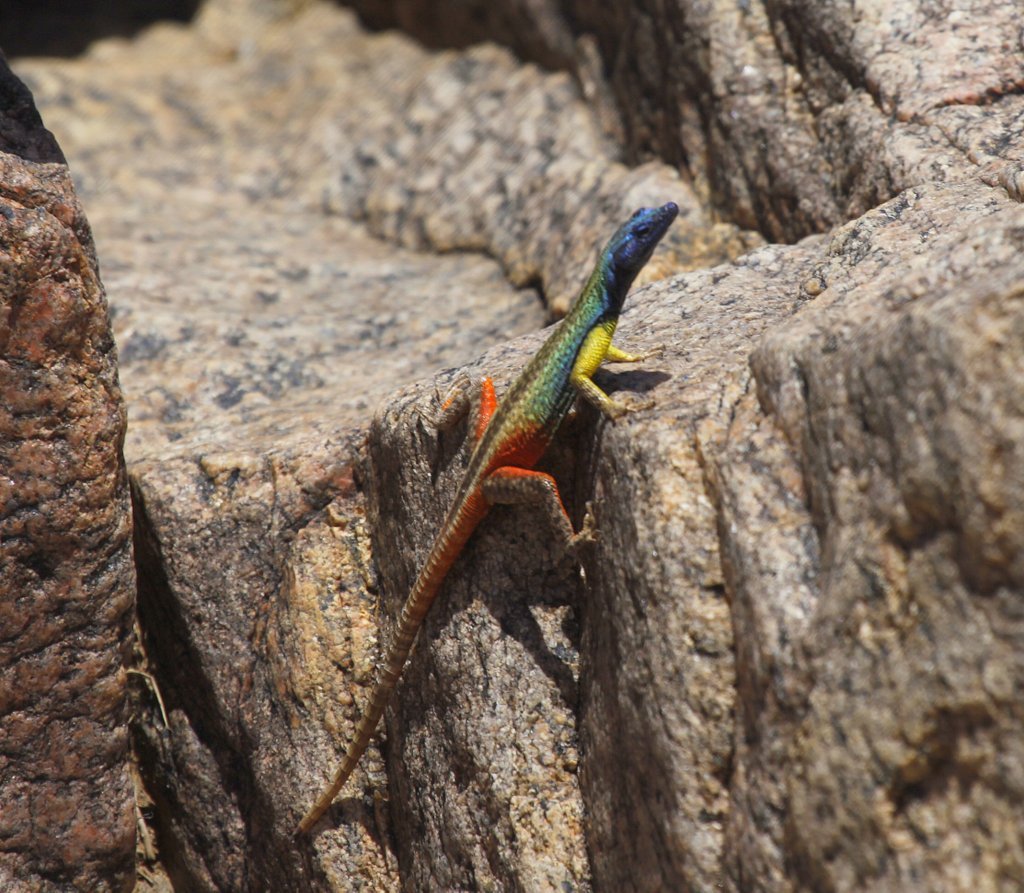
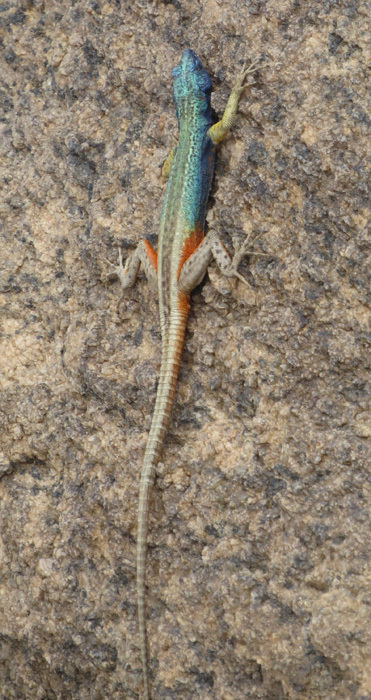
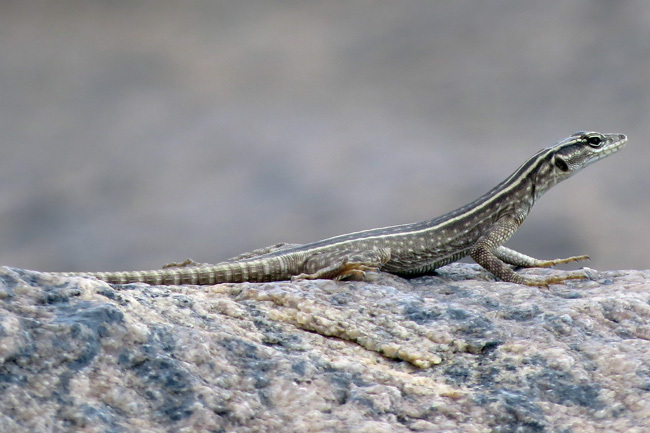
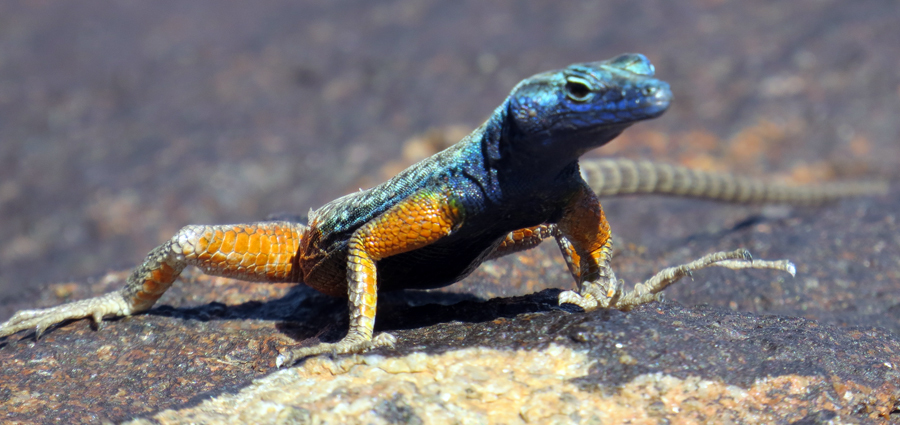
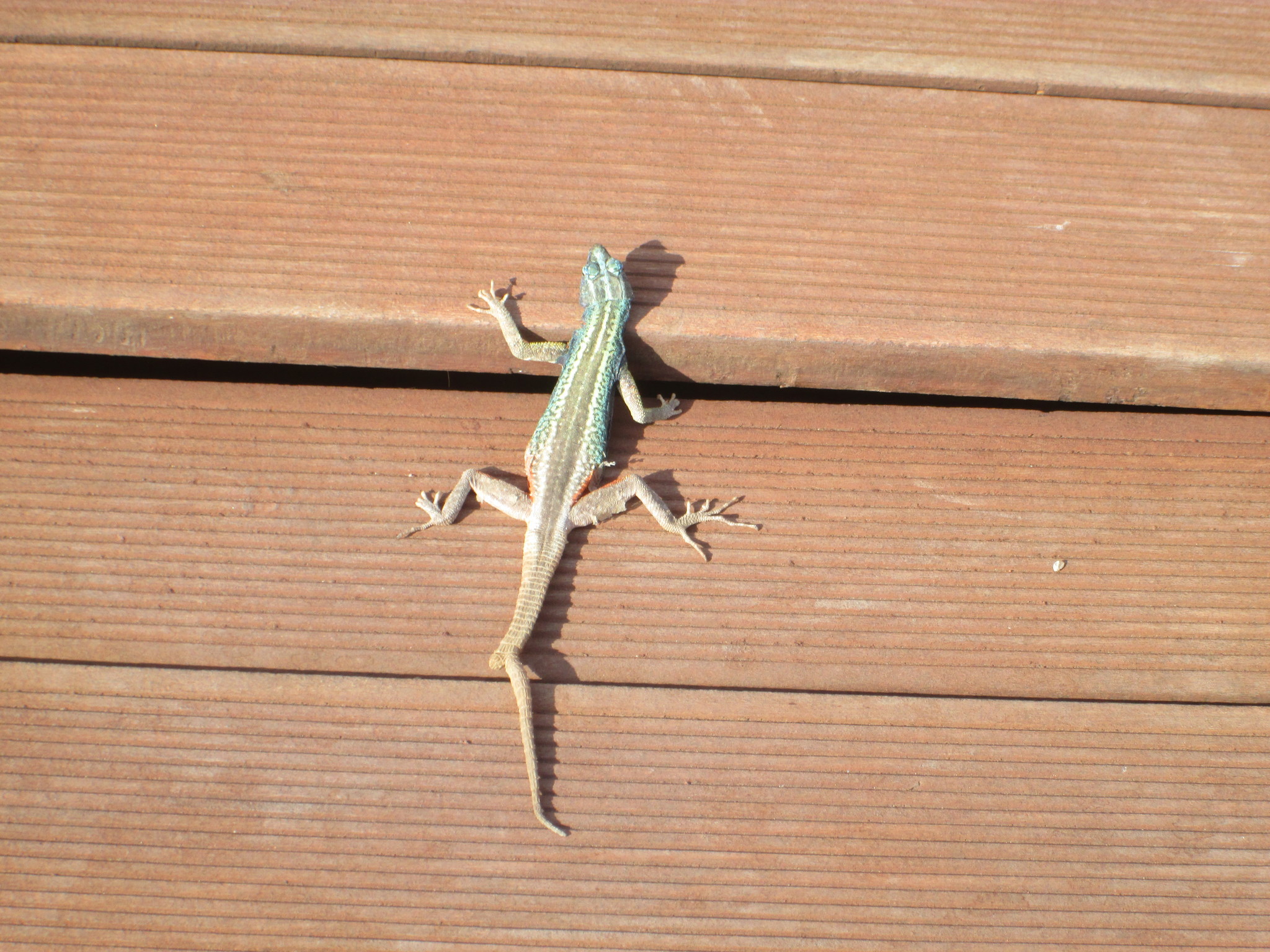
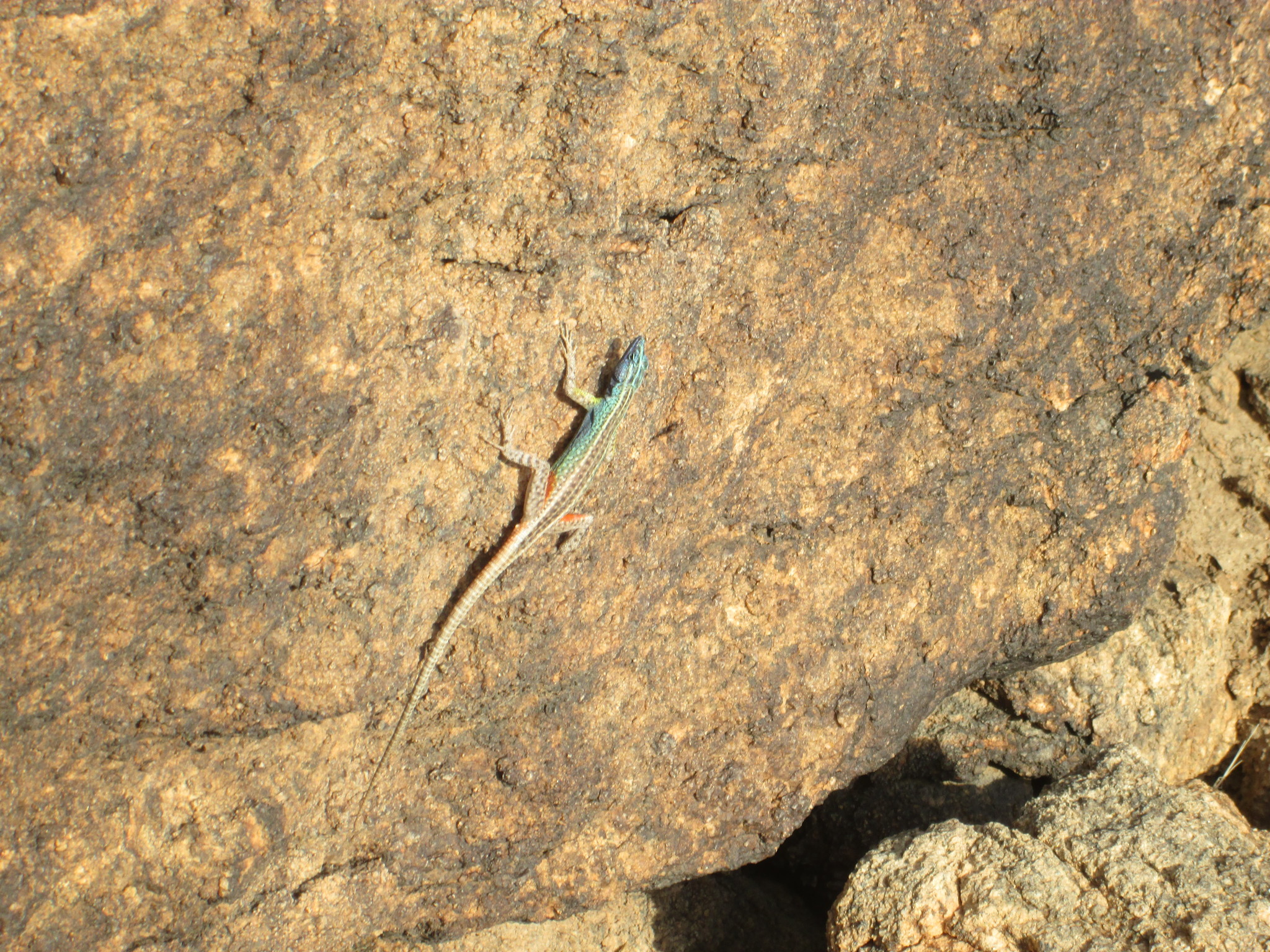
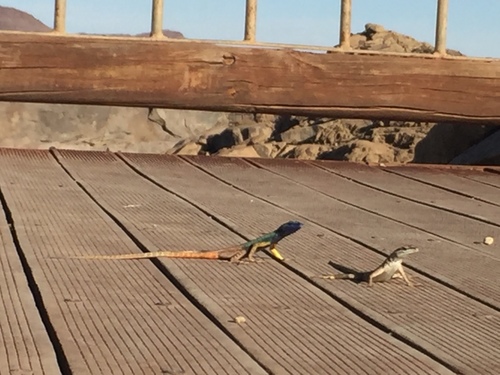
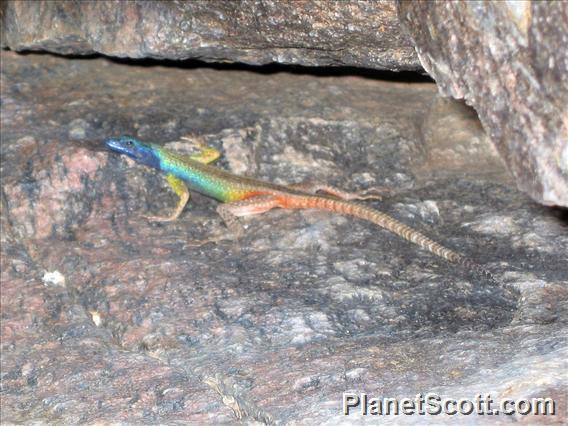
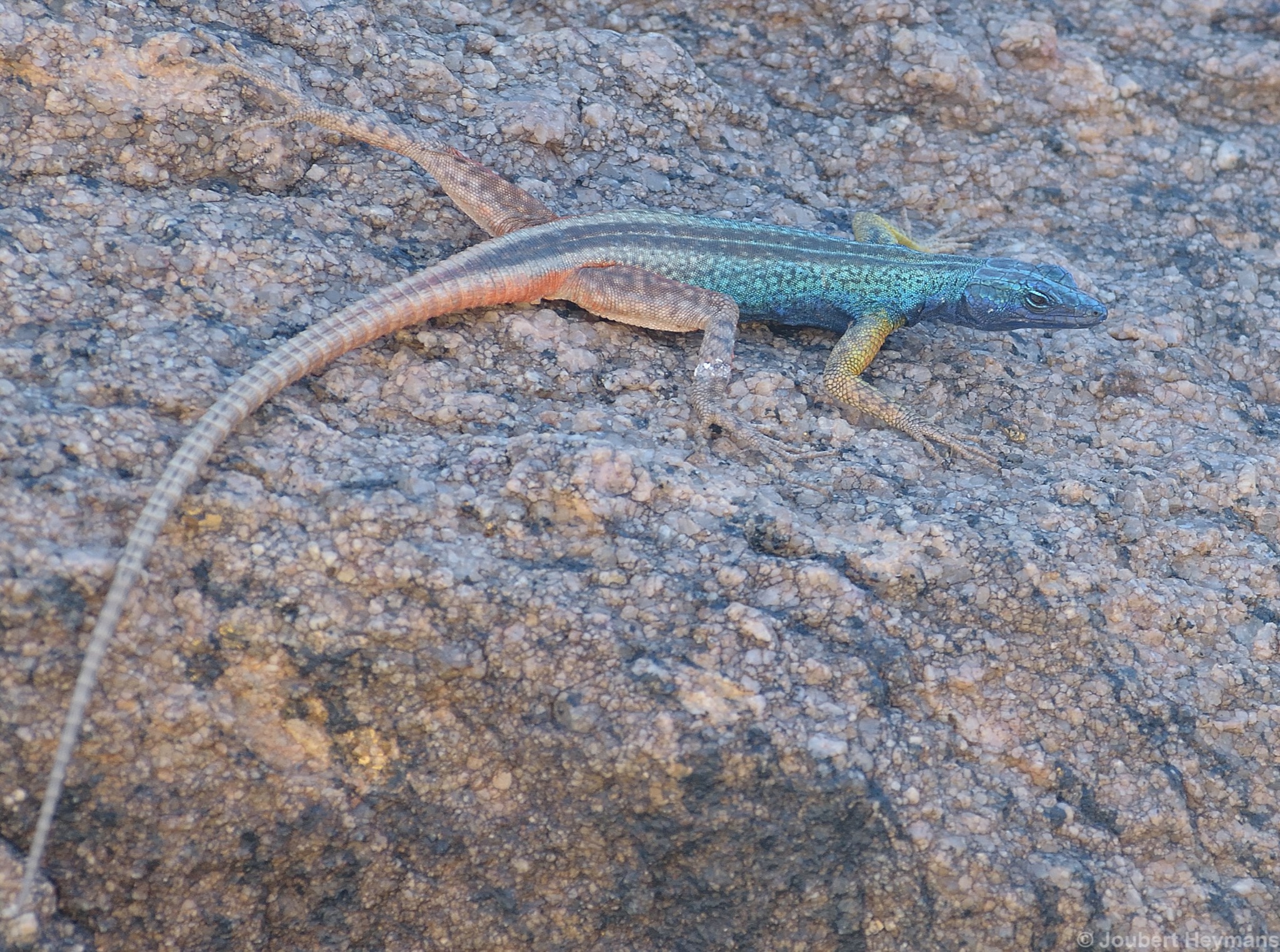
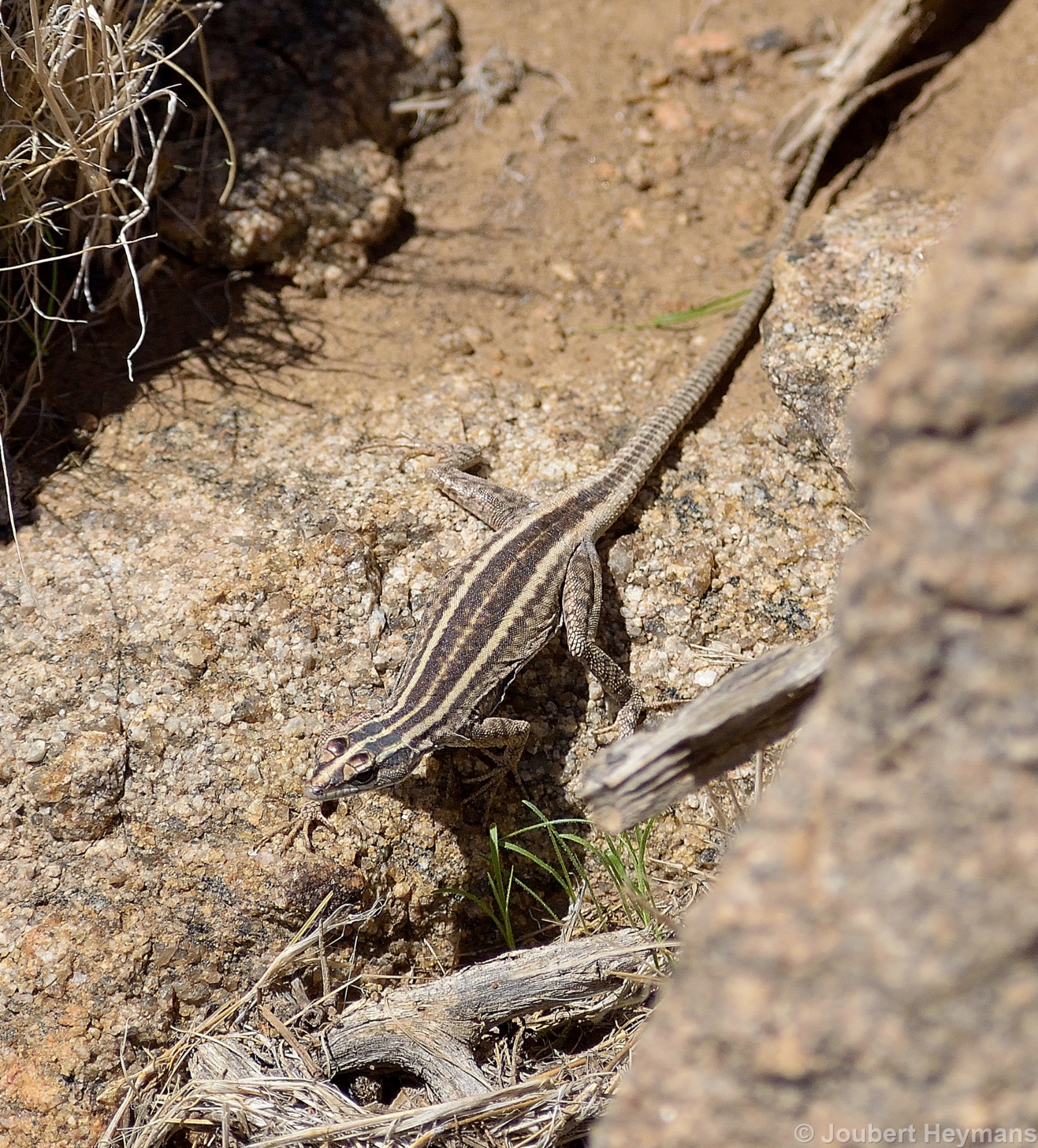
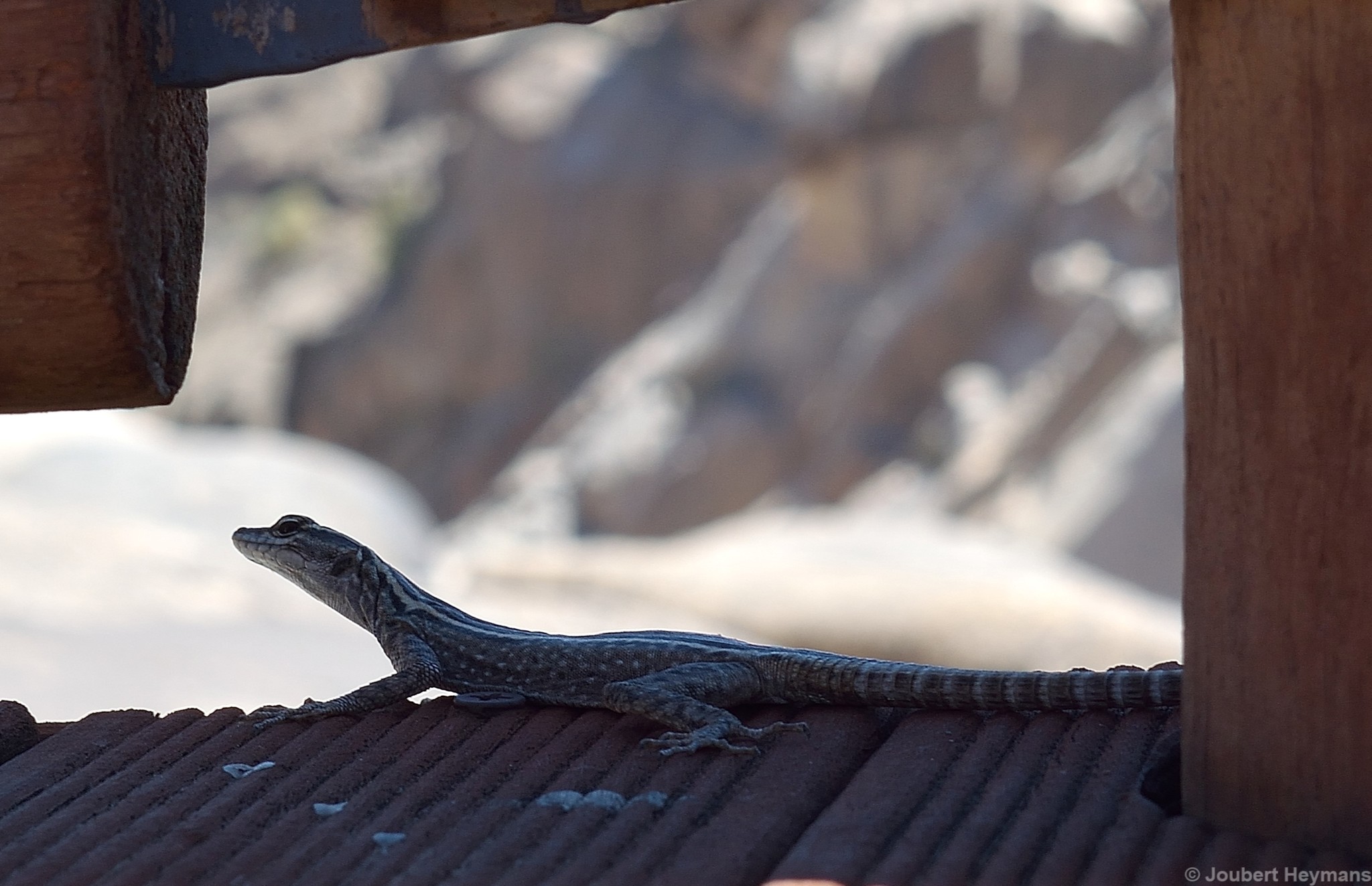
This information was extracted from Branch and Whiting (1997): A medium-sized Platysaurus (adult SVL: 64-84 mm) distinguished from all other congenerics, except the Cape Flat Lizard P. capensis, in that the scales on the side of the neck are indistinguishable from those on the dorsum. From its nearest neighbour, P. capensis, it differs in many features of adult male colouration (condition in male P. capensis in brackets), most noticeably the possession of yellow, orange, or mixed yellow-orange upper surfaces to the forelimbs (blue); a tan dorsum on the tail (orange); a dark blue throat (light blue); and an extensive black belly (blue peripherally with a relatively smaller black central patch). It also differs from P. capensis in having significantly different numbers of gulars, longitudinal rows of ventrals, transverse rows of ventrals, dorsal forelimb scale rows, lamellae beneath the fourth toe, collar scales, and transverse dorsal scale rows (Tables 1- 3). Platysaurus broadleyi is further distinguished from P. capensis by its smaller upper forelimb scales, these being subequal to those on the hindlimb (autapomorphic); and the nostril usually (58.4 %) piercing a large nasal, the latter in contact with its counterpart behind the rostral.
Type locality: Augrabies Falls National Park, Gordonia District, Northern Cape Province, South Africa. Holotype: DNMNH (= TM) 79828 (= Transvaal Museum, Pretoria), paratypes: PEM
No notable issues.
South Africa
This species occurs along the Orange River Valley and tributaries, centred on Augrabies Falls to 200 km west and 50 km north along the Bak Putz River Valley. The distribution appears to be linked to the river valleys, because lizard density declines with distance from the river valley. It has not been recorded from Namibia but may be present there (Tolley et al., 2023).
In general, lizards can sprint, crawl, climb, jump, and glide. When running on four legs, lizards often move their fore feet diagonally in unison—the right fore foot with the left hand and the left fore foot with the right hand. The body's bent is simultaneously reversed. The shoulders, hips, and other joints in the legs as well as the bending of the back all contribute to moving the feet forward. Leg and back muscles work together to power running (Alexander, 2012).
Omnivore (eats plants, animals, fungi, bacteria)
In summer, Broadley’s flat lizard perform acrobatic leaps to catch black flies on the wing from the swarms that gather near rivers. It can also be seen feeding on the ripe berries of Namaqua fig trees. A major predator is the rock kestrel (Branch, 1998).
This lizard is oviparous, with females lay two eggs in early summer. Sexual maturity is reached at around 64 mm SVL in both sexes (Branch, 1998).
No data.
Nama-Karoo
This map contains point-based occurrences at different locations
Occurrence in African countries and South African provinces. Residence status indicates if a taxon is indigenous, endemic, or alien in a specific region. This data is based on specimen records and literature.
FSA
SA
BOT
NAM
ESW
LES
WC
EC
NC
FS
GA
KZN
LP
MP
NW
Absent
Indigenous
Endemic
Naturalised
Invasive
Names and Sources
| Common Name | Language |
|---|---|
| Augrabies Flat Lizard | En |
| Augrabies Platakkedis | En |
Classification
KINGDOM Animalia
PHYLUM Chordata
CLASS Reptilia
ORDER Squamata
FAMILY Cordylidae
GENUS Platysaurus
SPECIES broadleyi
No results found for Platysaurus broadleyi Branch & Whiting, 1997
This species, as well as others in the genus, are readily available for sale online, but the level of trade has not been quantified. Because this species is not listed on CITES and the trade is not quantified, collecting and overexploitation could be a potential threat (Tolley et al., 2023).
14 results for Platysaurus broadleyi Branch & Whiting, 1997
This map contains point-based occurrences at different locations
1997
BOOK
A new Platysaurus (Squamata: Cordylidae) from the Northern Cape Province, South AfricaBranch, W., Whiting, M.. 1997. A new Platysaurus (Squamata: Cordylidae) from the Northern Cape Province, South Africa Vol. 46(2) pp.124-136.
1998
BOOK
Field Guide to Snakes and Other Reptiles of Southern AfricaBranch, B.. 1998. Field Guide to Snakes and Other Reptiles of Southern Africa. Cape Town. Struik Publishers.
1997
JOURNAL ARTICLE
Facultative frugivory in the Cape flat lizard, Platysaurus capensis (Sauria: Cordylidae)Greeff, J., Whiting, M.. 1997. Facultative frugivory in the Cape flat lizard, Platysaurus capensis (Sauria: Cordylidae) Vol. 4 pp.811-818.
2012
JOURNAL ARTICLE
Locomotion of ReptilesAlexander, R.. 2012. Locomotion of Reptiles Vol. 121 pp.1-4.
2023
BOOK
Conservation status of the reptiles of South Africa, Eswatini and LesothoTolley, K., Burger, M., Alexander, G., Pietersen, D., Conradie, W., Weeber, J.. 2023. Conservation status of the reptiles of South Africa, Eswatini and Lesotho Vol. Suricata 10. Pretoria. South African National Biodiversity Institute.
Status and criteria
LC
Assessor(s)
Michael Bates
Contributors
Josh Weeber
Reviewer(s)
Graham Alexander