
ANIMALIA / CHORDATA / REPTILIA / SQUAMATA / CORDYLIDAE / PLATYSAURUS / MONOTROPIS
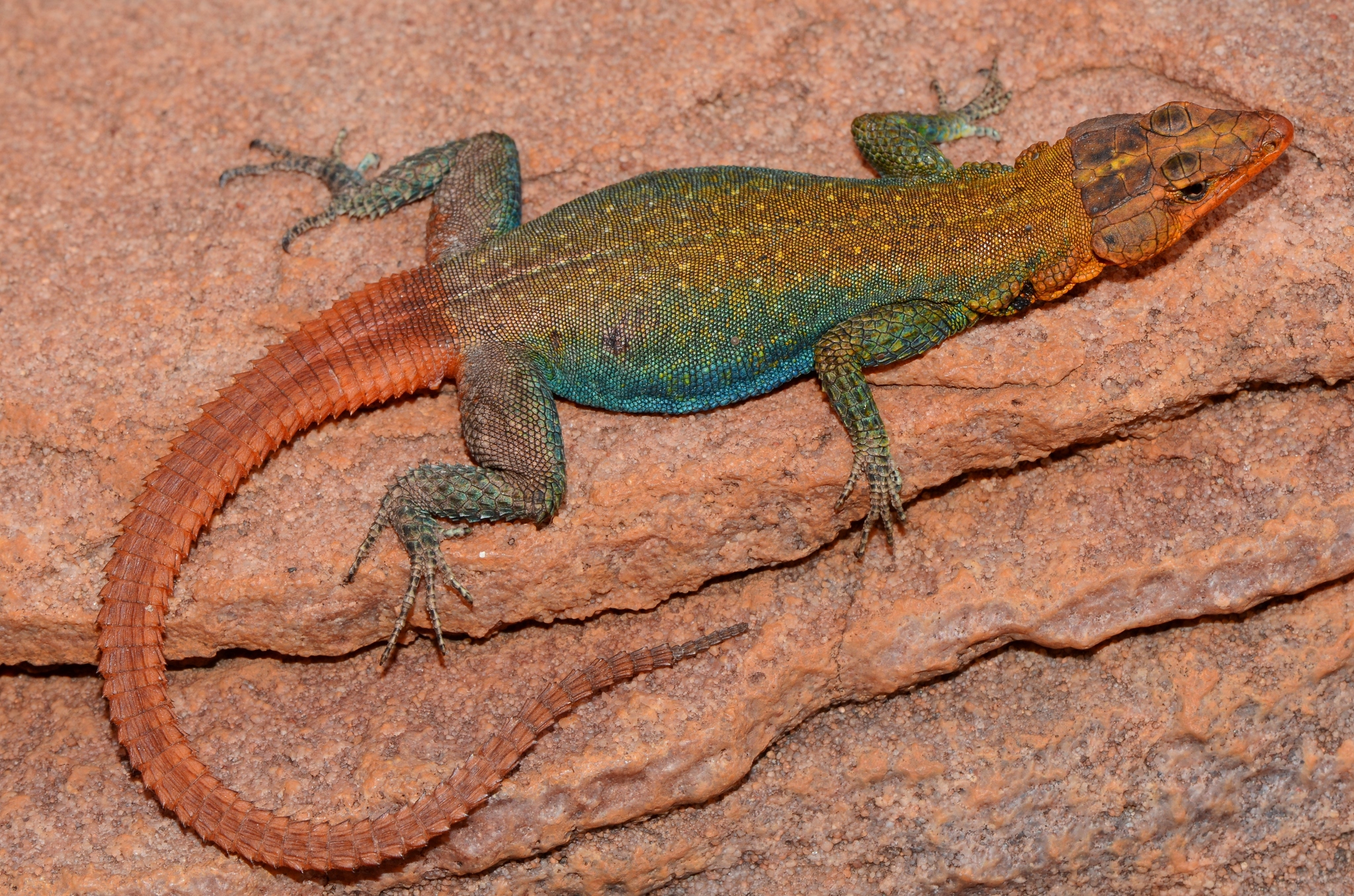
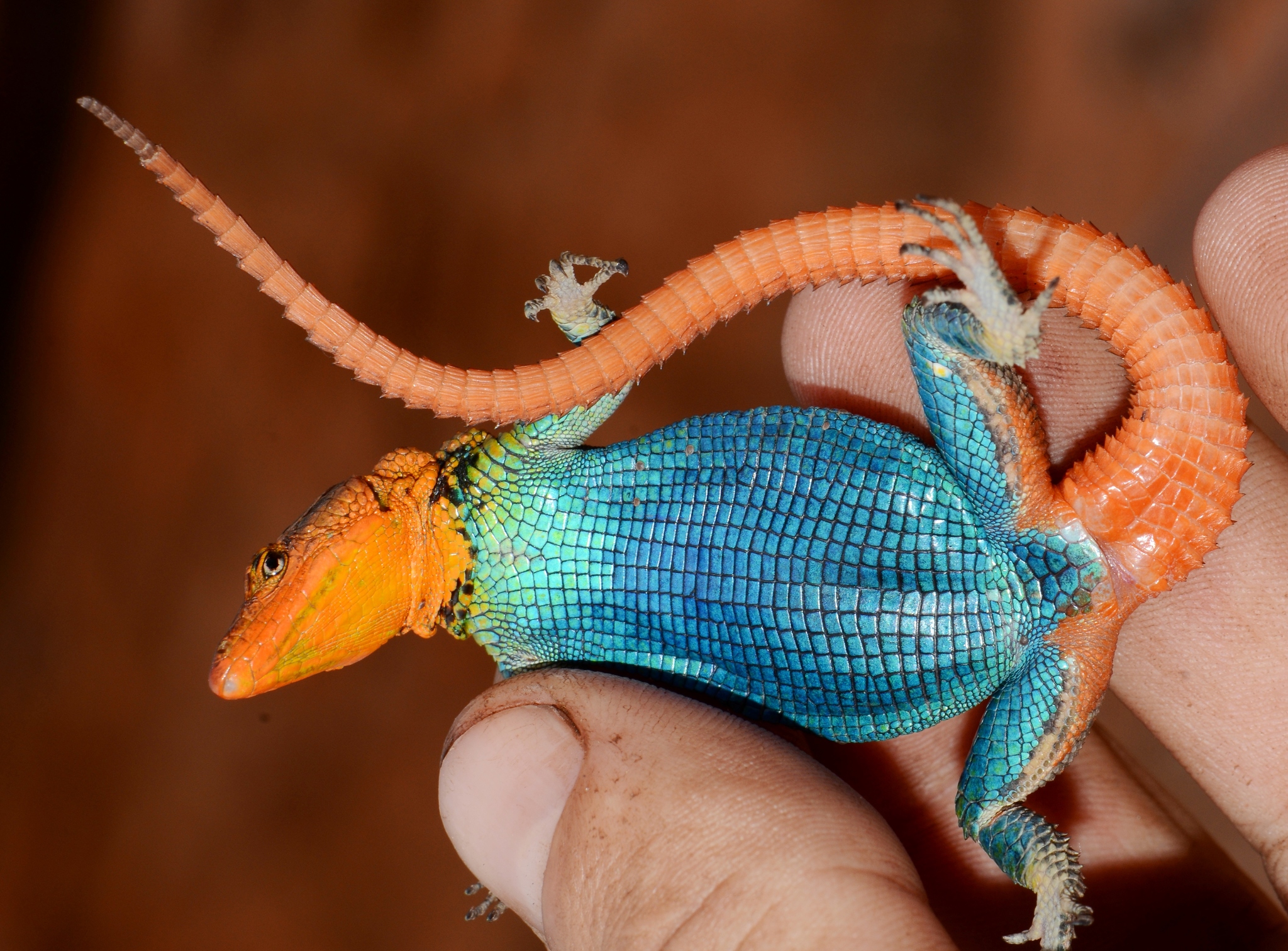
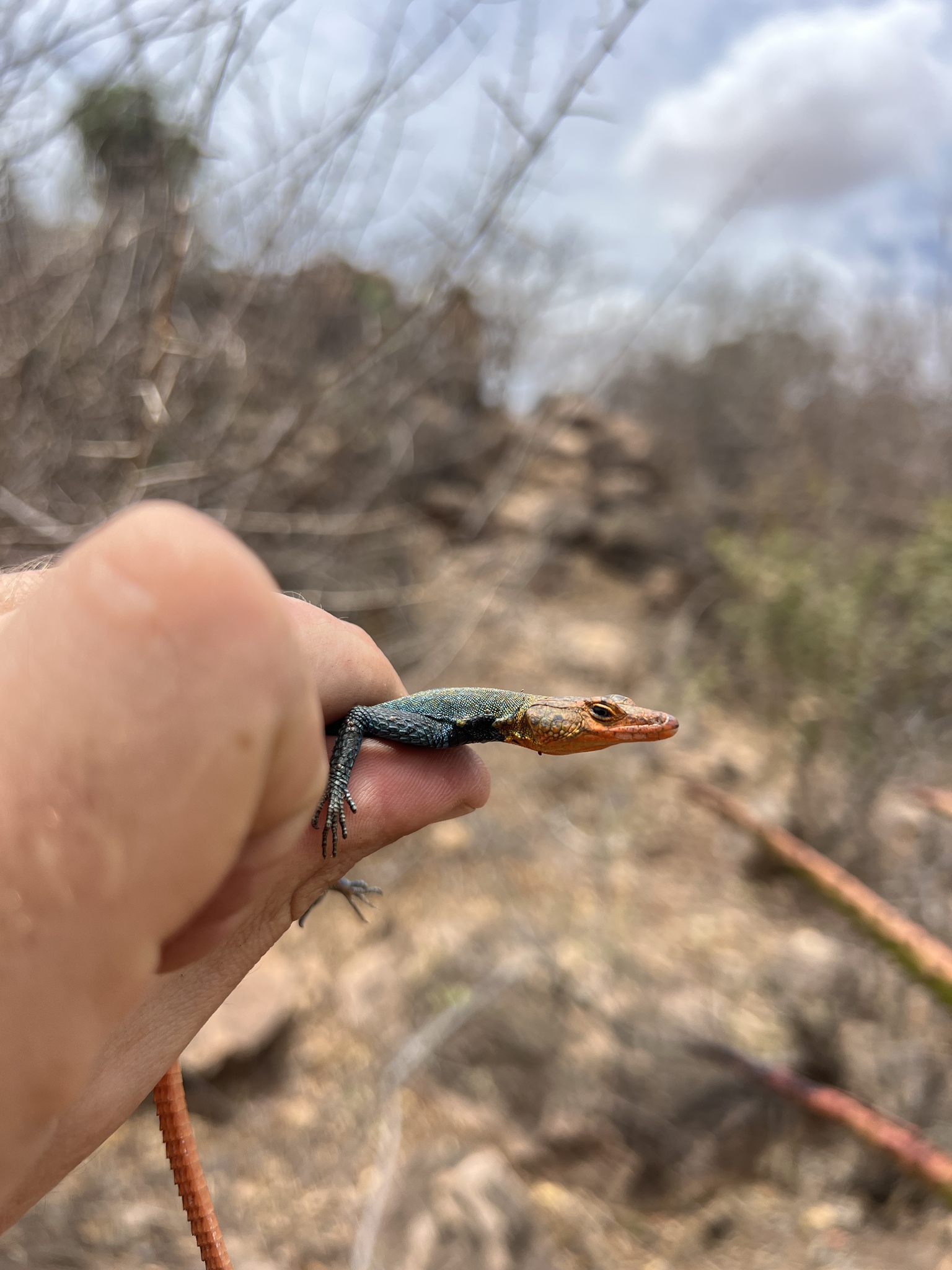
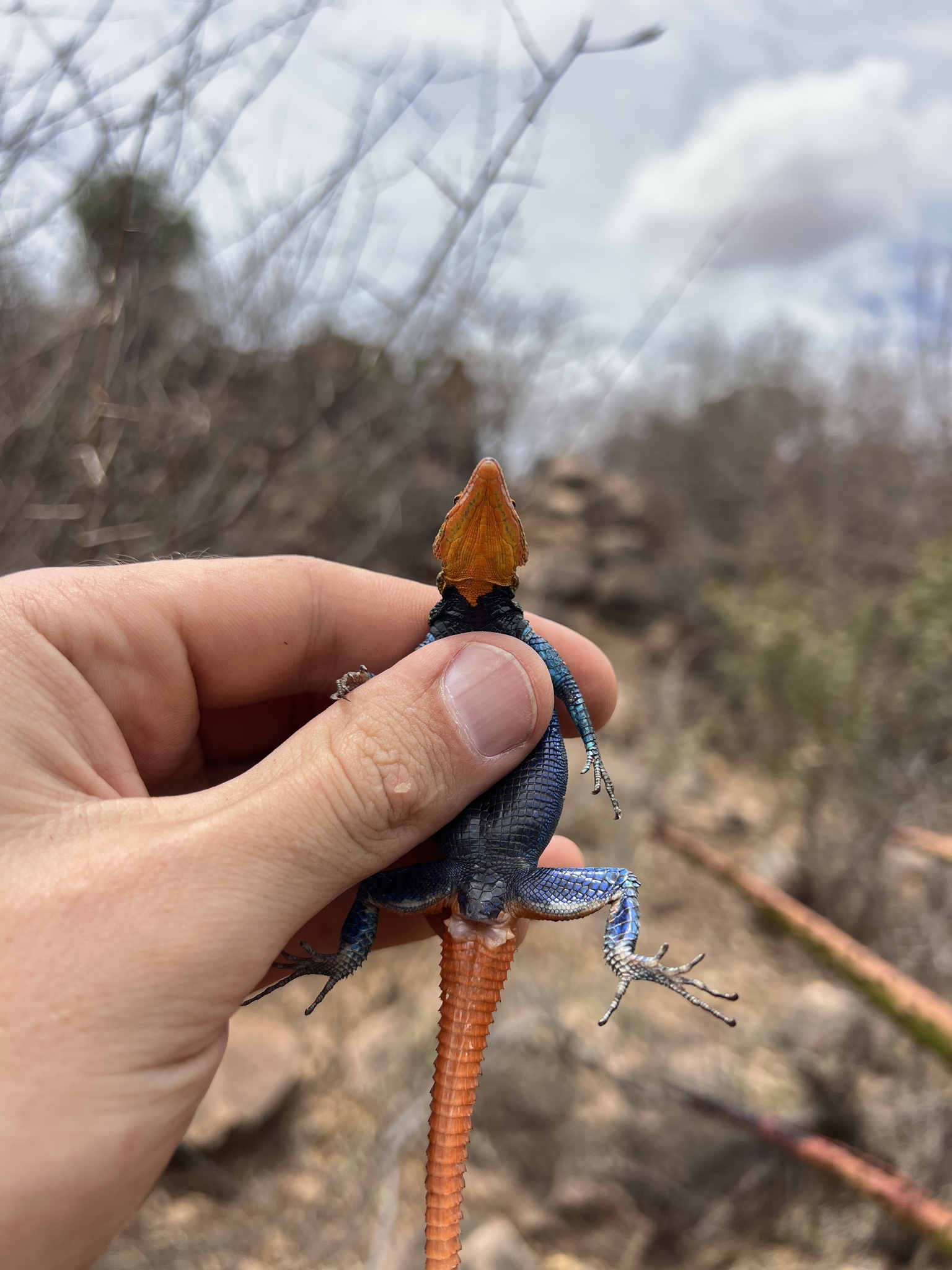
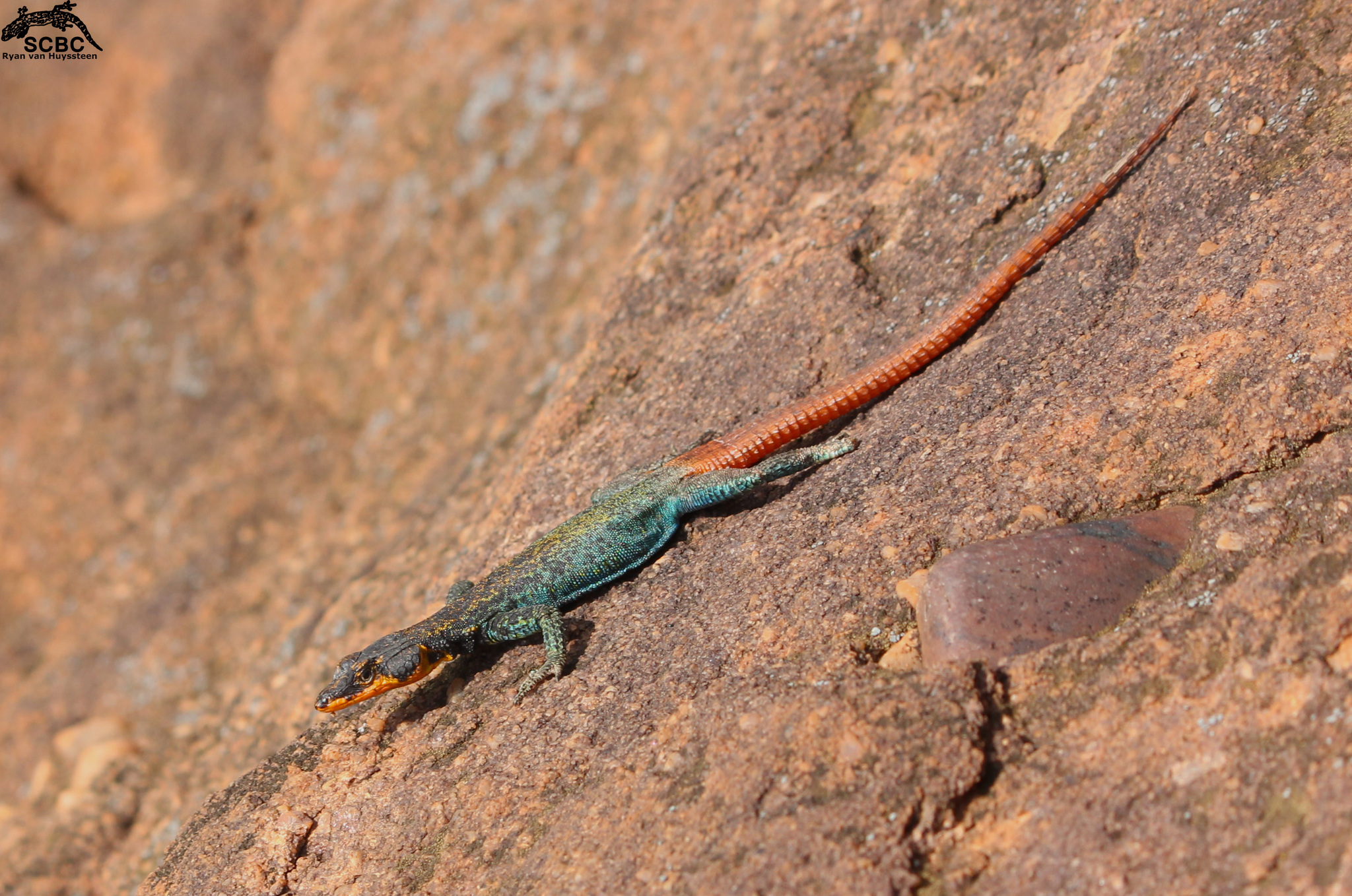
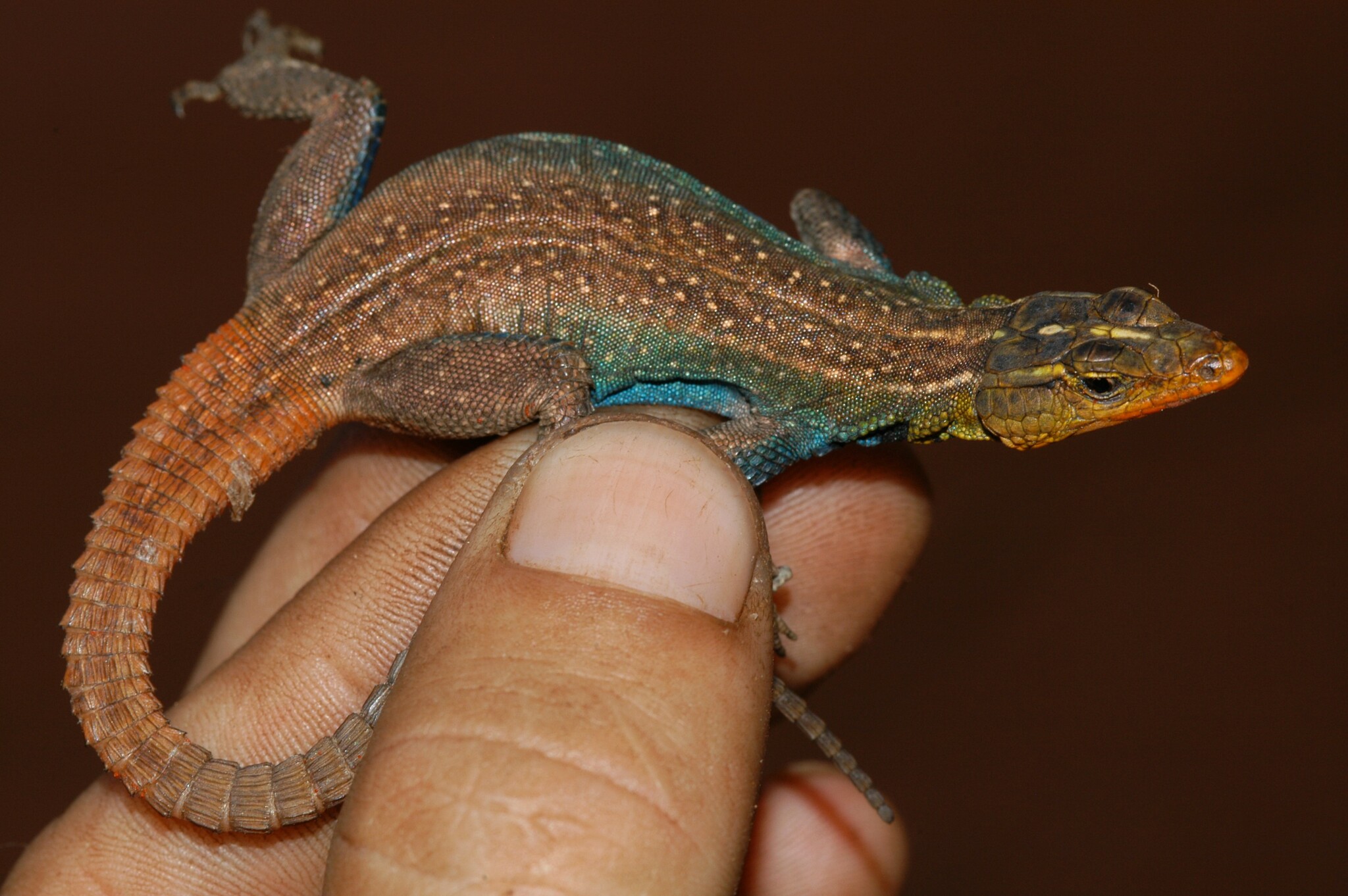
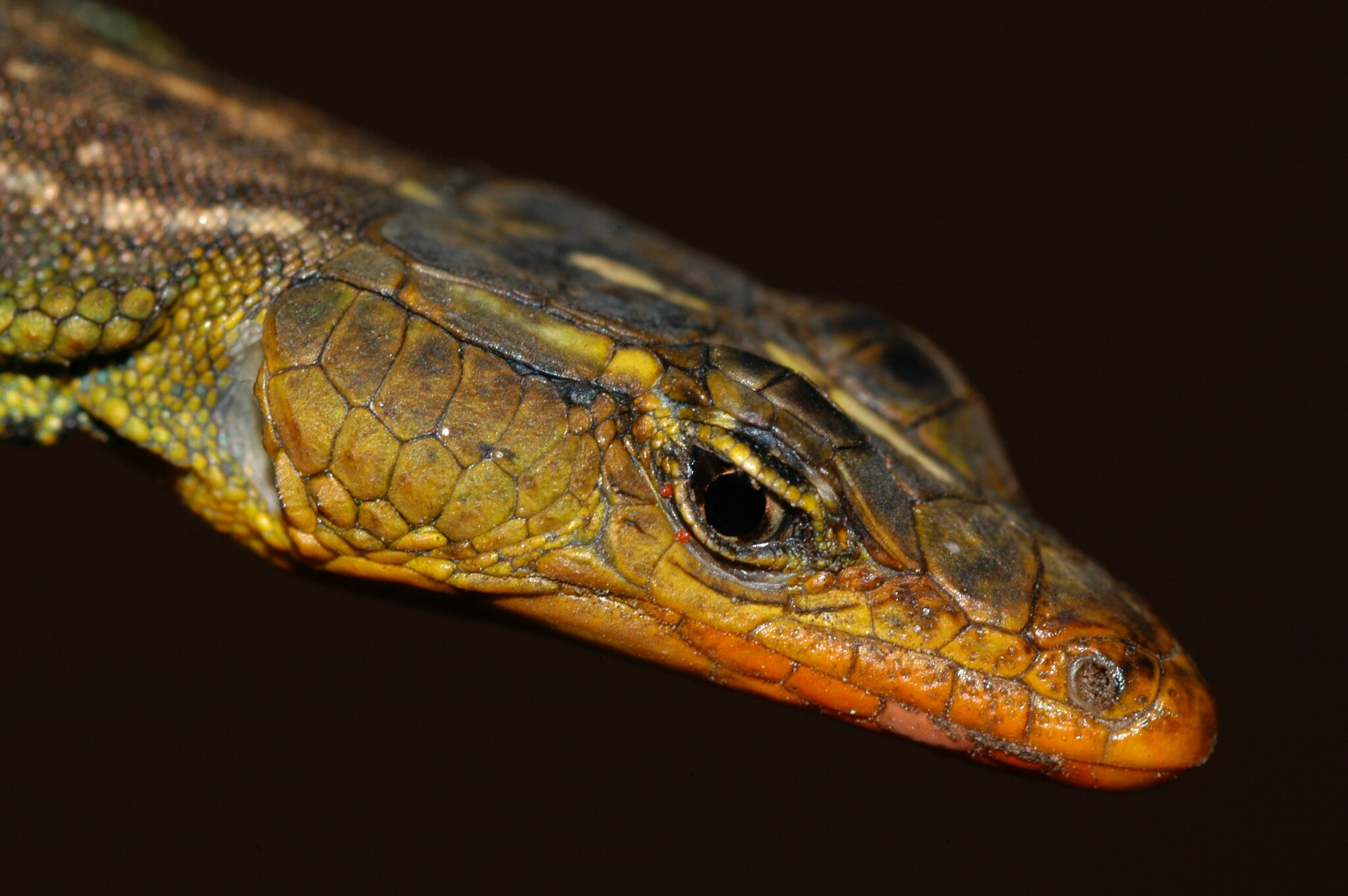
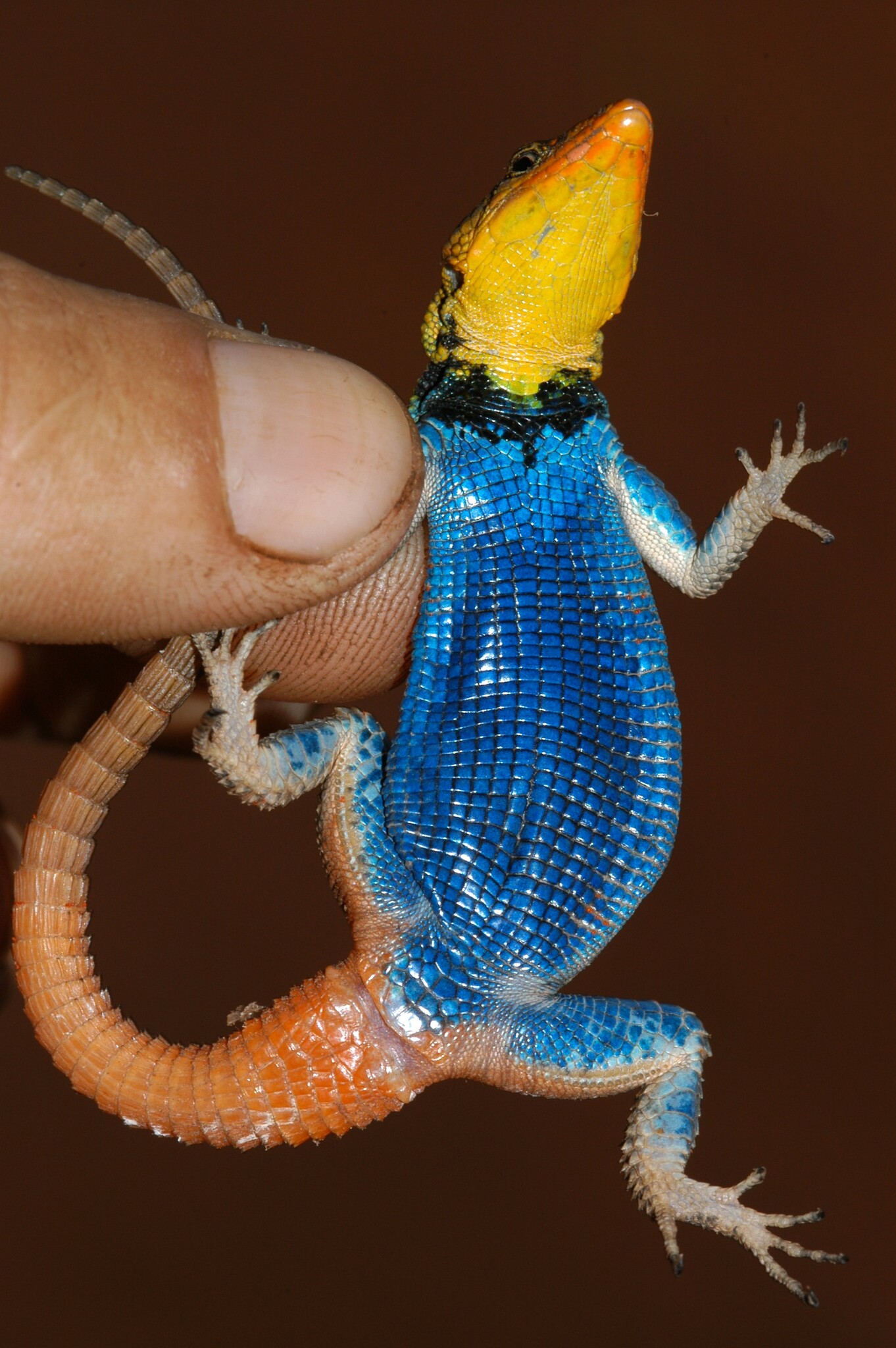
Jacobsen (1994) described this species as follows: Adult male: Snout/vent length 75,0 mm; tail 107,0 mm; mass 9,5 g. Head triangular and slightly wider than the neck. Neck with two lateral flanges edged with enlarged conical scales. Rostral hexagonal, large and as wide as deep. Nostril situated near posterior margin of nasal, narrowly separated from 1st upper labial, posterior nasal and frontonasal. Nasals separated by rostral and frontonasal. Frontonasal heptagonal, wider than long, in contact with nasals, rostral, loreal and prefrontals. Frontal small, longer than broad and hexagonal, tapering posteriorly. Frontoparietals in broad median contact, and narrowly with the posterior supraoculars. Anterior parietals in broad contact anteriorly but separated by trapezoid interparietal posteriorly. Interparietal in contact with occipital. Posterior parietals large and pentagonal and separated from each other by the occipital. Superior temporals three. Supraoculars four. Supraciliaries four. A single loreal in contact with frontonasal, posterior nasal, preocular, prefrontals and second upper labial. A single preocular present. Suboculars five with the 3rd in contact with the lip and 4th narrowly excluded from the lip. Temporals in roughly two rows, uppermost much larger than lower. Lower eyelid opaque and septate. Upper labials four anterior to the subocular. Mental about as broad as deep. Lower labials five. Sublabials five, anterior pair in contact behind mental. Median row of 13 enlarged gulars. Gulars between posterior sublabials 21. Dorsum covered in relatively homogeneous rounded and flattened granules with larger almost conical scales laterally. Scales at midbody 78, those along the vertebrae slightly enlarged. Ventra Is in 20 longitudinal and 40 transverse rows between collar and groin. Feet small, heels spinose and 20 lamellae under the 4th toe. One to one and a half rows of generation glands anterior to a row of 18(19 femoral pores at the posterior margin of the thighs. Caudal scales in whorls, flat to slightly keeled dorsally, spinose laterally and smooth ventrally becoming keeled distally. Colour: Head blackish-tinged with orange including the interior margins of the supraoculars. Three orange-brown stripes on the head, one from the snout to the occipital and one on either side from the posterior margin of the eye through the supratemporals to the back of the head. Dorsally body blue-green suffused with orange anteriorly. Limbs blackish tinged with green. Laterally the upper and lower labials orange brown, the temporals are tinged with the same colour and the conical scales on the side of the neck are orange. The sides of the body are blue becoming blue-green dorso-Iaterally. The tail is brick red tinged with blackish dorsally. Ventrally chin and throat bright orange bordered posteriorly by a partial black collar. Chest blue with a few green scales, the interstices between the scale rows blackish, the lower chest and abdomen dark blue. The underside of the fore limbs greenish blue and that of the hindlimbs blue. Underside of tail coral red. Allotype: TM 69990 Adult female: Snout/vent length 71,0 mm; tail 94,0 mm; mass 8,0 g. Lepidosis similar to that of holotype with the exception of the suboculars which number four, with both three and four in contact with the lip. The supratemporals number four. A median row of 12 enlarged gular scales present and there are 20 gulars between the posterior sublabials. Dorsals relatively homogeneous, the interstices between the granules taken up by very small granules. Dorsal scales at midbody 90 with the lateral scales much larger than those on the back. Ventrals in 22 longitudinal and 37 transverse rows between collar and groin. Feet similar to that of the holotype, with 20 lamellae under the 4th toe. A row of 17(19 indented non-functional femoral pores. Caudal scales as for the holotype. Colour: Dorsally the head blackish-grey with three white stripes, one median from snout to occiput which continues posteriorly as a thin line terminating at the sacrum, and one on either side from the supraoculars to the rear of the head and continuing posteriorly fading anterior to the groin. The back is blackish brown with paler mottling in the area between the stripes. Limbs blackish. Tail buffy brown with blackish infusion mesially. Laterally buffy-brown. Ventrally chin and gular with blue blotches and ocelli. Collar and chest blue with darker margins on some scales, this becoming more frequent posteriorly. Abdomen pinkish brown, almost obscured by the blackish infusions on each scale. Underside of forelimbs pale bluish with blackish markings and of hindlimbs whitish with scattered blackish infusions. Underside of tail pale pinkish brown.
Diagnosis was extracted from Jacobsen(1994): A medium-sized Plarysaurus, differing markedly from any other Transvaal species in having an orange head in males. with or without a black collar. The ventrals are mostly in less than 22 longitudinal rows and femoral pores in males number 17 or more. The tail is short, averaglng 58% of total length, which appearsto be the shortest of all Platysaurus taxa.
Type locality: Farm Blackhill 317 LR, Potgietersrust district(2328 BB), Transvaal. Holotype: DNMNH (= TM) 70003,adult male; collector R.E.Newbery, 4 November,1985. Allotype: DNMNH (= TM) 69990, adult female; same data as holotype. Paratypes: DNMNH (= TM) 69992-3,69995,iW2, 7m06, same data as holotype DNMNH (= TM) 69991,69996-9,70001, etc.
No current taxonomic issues, but see Jacobsen (1989) for historic taxonomic context (Tolley et al., 2023).
South Africa
This species has a small distribution, occurring on the Blouberg, the Makgabeng Plateau and nearby rock outcrops in Limpopo province, South Africa (Tolley et al., 2023).
In general, lizards can sprint, crawl, climb, jump, and glide. When sprinting on four legs, lizards often move their fore feet diagonally in unison—the right fore foot with the left hand and the left fore foot with the right hand. The body's bent is simultaneously reversed. The shoulders, hips, and other joints in the legs as well as the bending of the back all contribute to moving the feet forward. Leg and back muscles work together to power running (Alexander, 2012).
Carnivore - Invertivore (invertebrate-eating)
The Orange-Throated Flat Lizard feeds on small invertebrates such as flies, beetles and larvae (Branch, 1998).
This species is oviparous and lays two eggs, usually in November-December. The eggs are large, elongate and soft-shelled, and are laid in deep cracks, usually in damp leaf mould (Branch, 1998).
No data.
Savanna
This map contains point-based occurrences at different locations
Occurrence in African countries and South African provinces. Residence status indicates if a taxon is indigenous, endemic, or alien in a specific region. This data is based on specimen records and literature.
FSA
SA
BOT
NAM
ESW
LES
WC
EC
NC
FS
GA
KZN
LP
MP
NW
Absent
Indigenous
Endemic
Naturalised
Invasive
Names and Sources
| Common Name | Language |
|---|---|
| Geelkeel Platakkedis, Orange-throated Flat Lizard | En |
| Orange-throated Flat Lizard | En |
Classification
KINGDOM Animalia
PHYLUM Chordata
CLASS Reptilia
ORDER Squamata
FAMILY Cordylidae
GENUS Platysaurus
SPECIES monotropis
No results found for Platysaurus monotropis Jacobsen, 1994
This species is not known to be traded at present, although other species in the genus are in the pet trade. This species might be vulnerable to local overharvesting (Tolley et al., 2023).
14 results for Platysaurus monotropis Jacobsen, 1994
This map contains point-based occurrences at different locations
1989
TECHNICAL REPORT
The distribution and conservation status of reptiles and amphibians in the Transvaal. Final Report Project TN 6/4/1/30Jacobsen, N.. 1989. The distribution and conservation status of reptiles and amphibians in the Transvaal. Final Report Project TN 6/4/1/30. Pretoria. Chief Directorate of Nature and Environmental Conservation.
2000
JOURNAL ARTICLE
Interspecific aggression in flat lizards suggests poor species recognitionKorner, P., Whiting, M., Willem, J., Ferguson, H.. 2000. Interspecific aggression in flat lizards suggests poor species recognition Vol. 49(2) pp.139-146.
1930
JOURNAL ARTICLE
Descriptions of new South African Reptilia and Batrachia, with distribution records of allied species in the Transvaal Museum collectionFitzSimons, V.. 1930. Descriptions of new South African Reptilia and Batrachia, with distribution records of allied species in the Transvaal Museum collection Vol. 14. Transvaal Museum. pp.20-48.
2012
JOURNAL ARTICLE
Locomotion of ReptilesAlexander, R.. 2012. Locomotion of Reptiles Vol. 121 pp.1-4.
1998
BOOK
Field Guide to Snakes and Other Reptiles of Southern AfricaBranch, B.. 1998. Field Guide to Snakes and Other Reptiles of Southern Africa. Cape Town. Struik Publishers.
2023
BOOK
Conservation status of the reptiles of South Africa, Eswatini and LesothoTolley, K., Burger, M., Alexander, G., Pietersen, D., Conradie, W., Weeber, J.. 2023. Conservation status of the reptiles of South Africa, Eswatini and Lesotho Vol. Suricata 10. Pretoria. South African National Biodiversity Institute.
Status and criteria
NT
Assessor(s)
Michael Bates
Reviewer(s)
Graham Alexander


