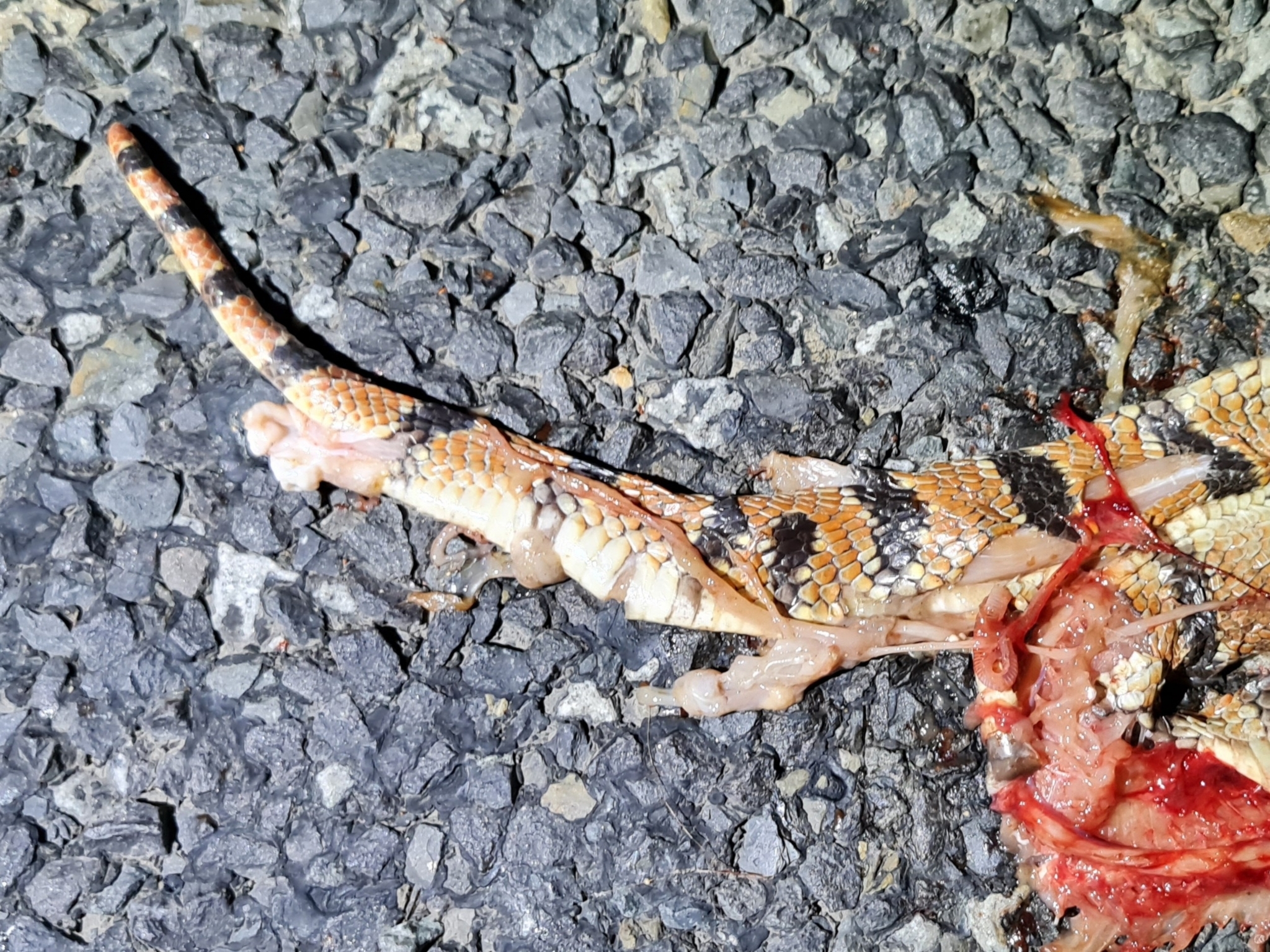
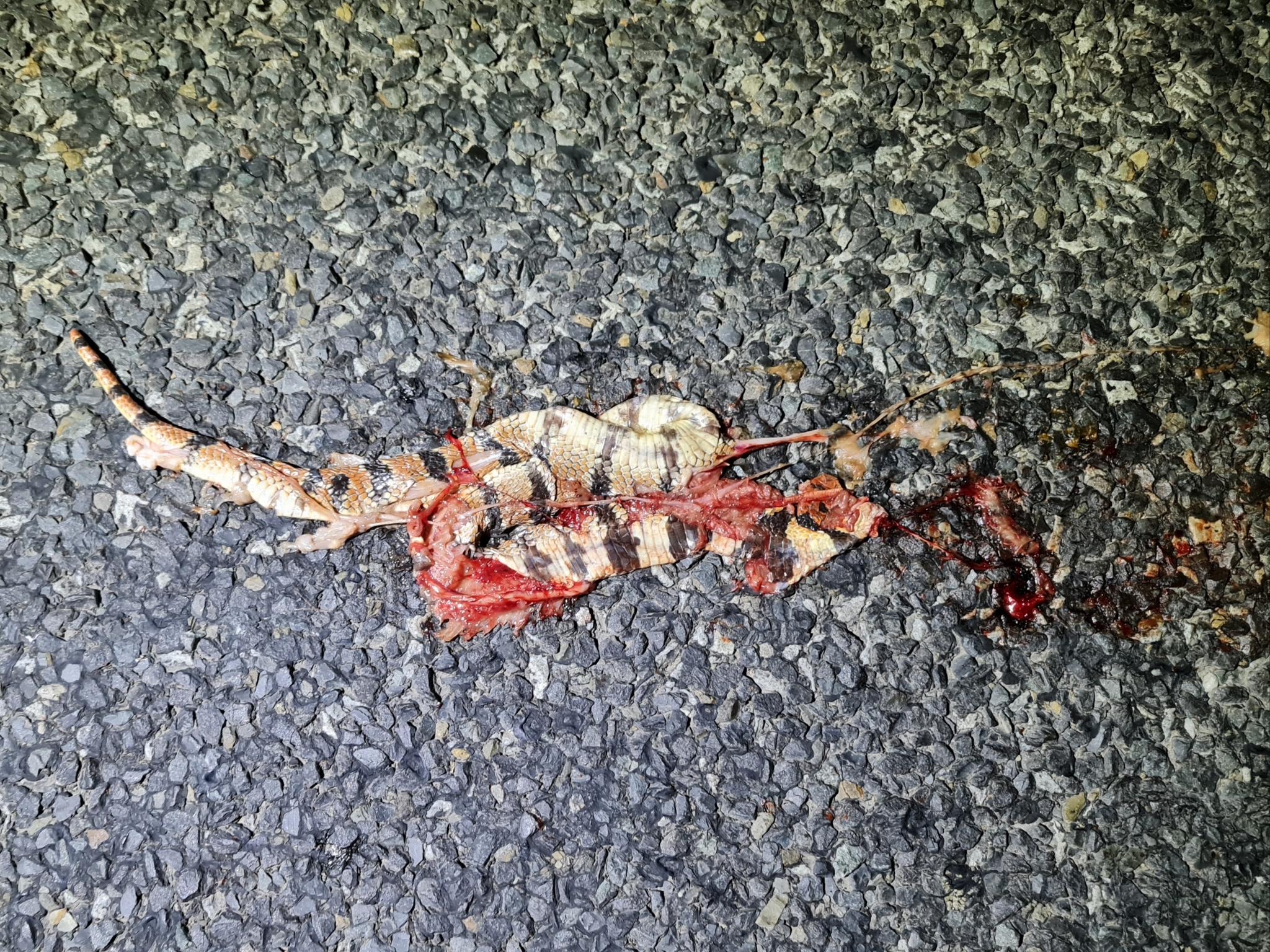
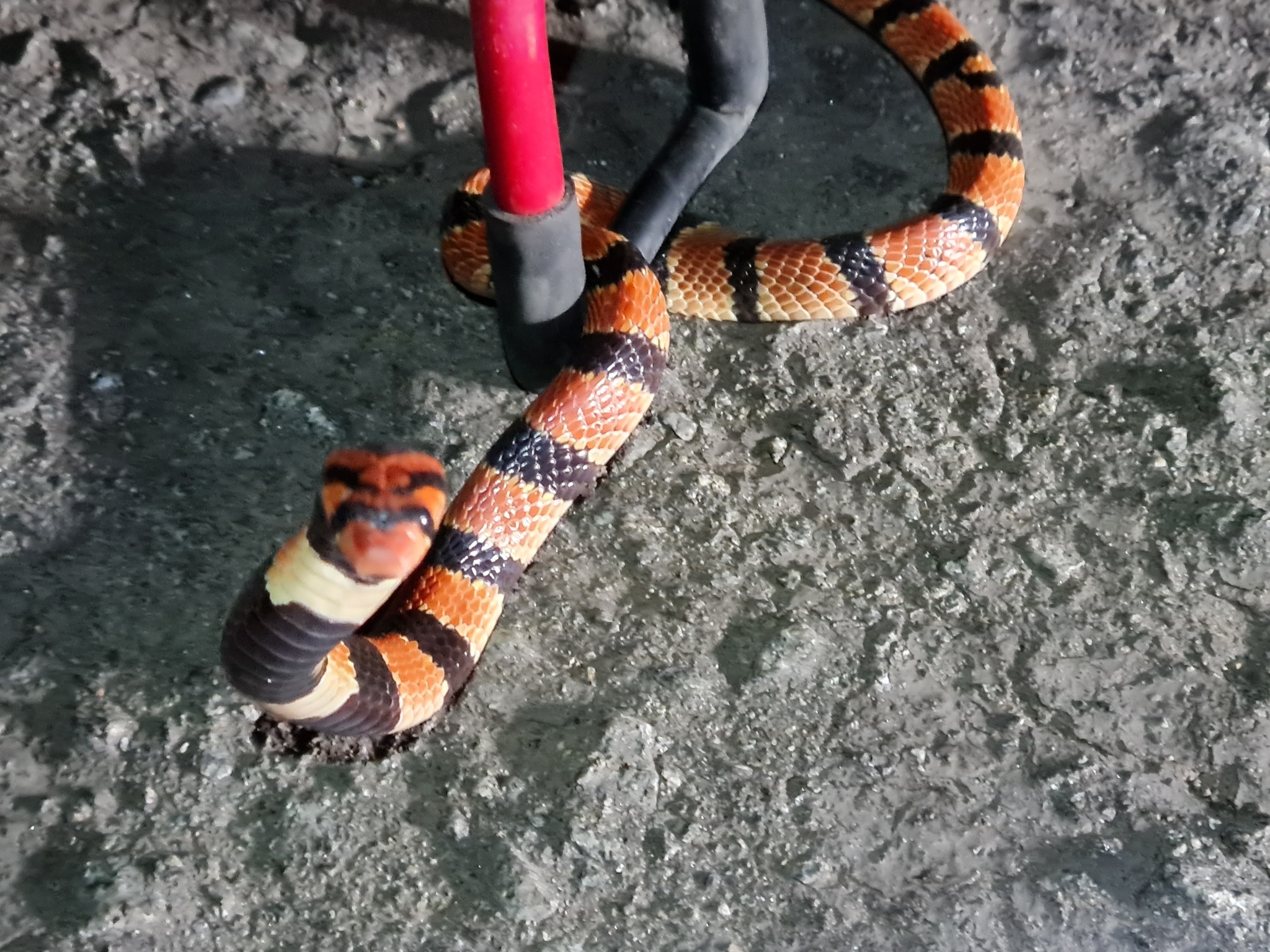
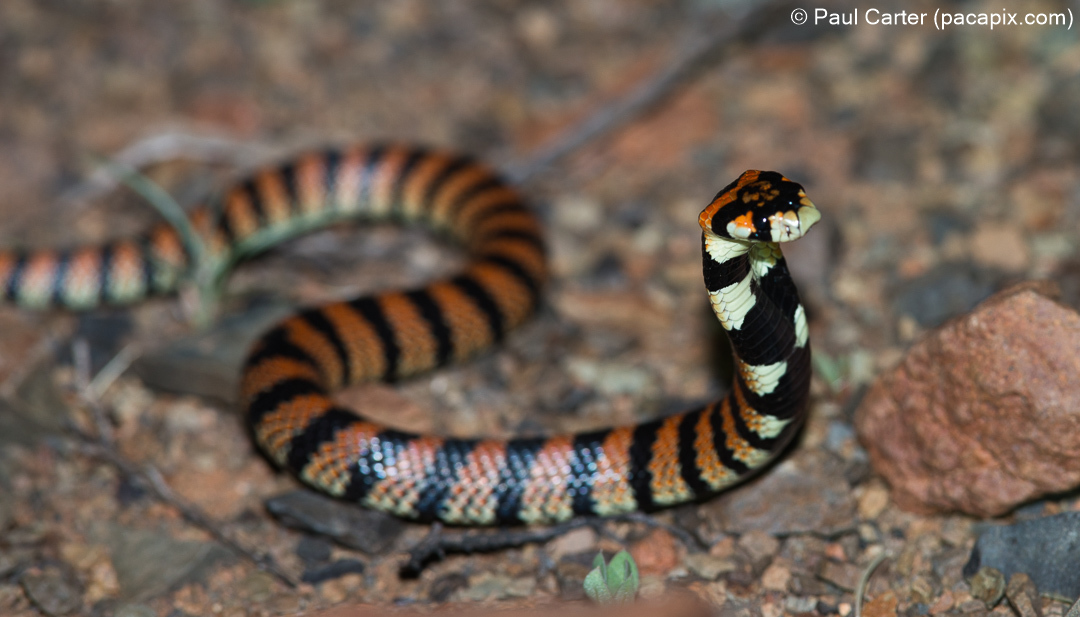
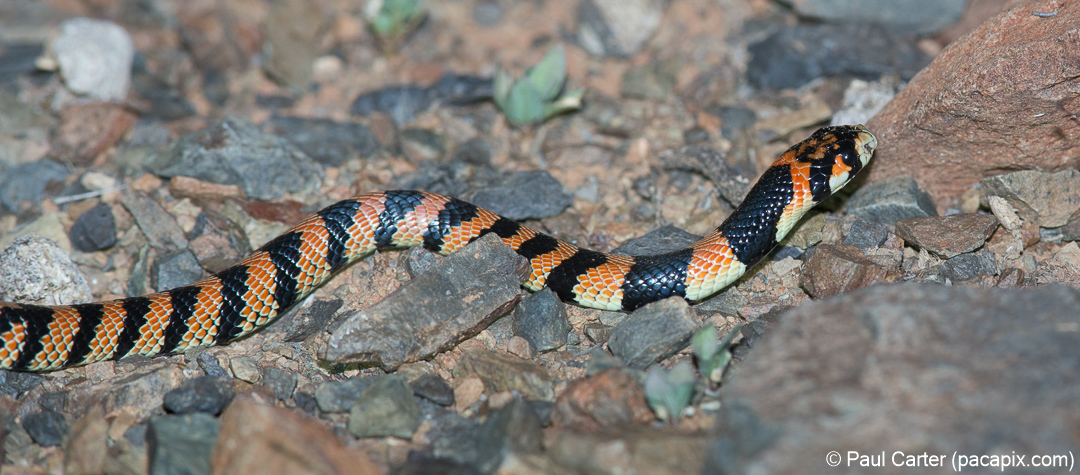
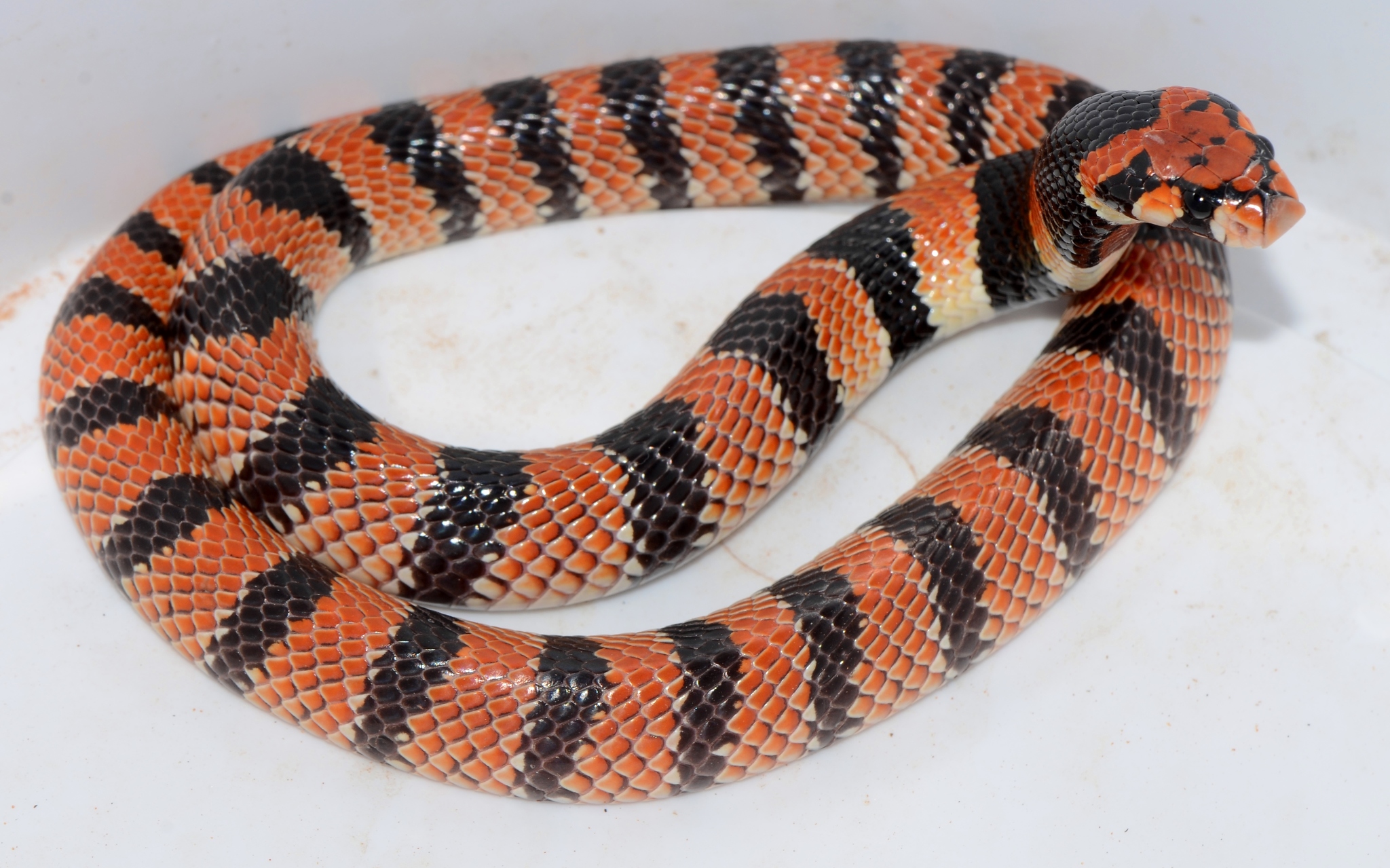
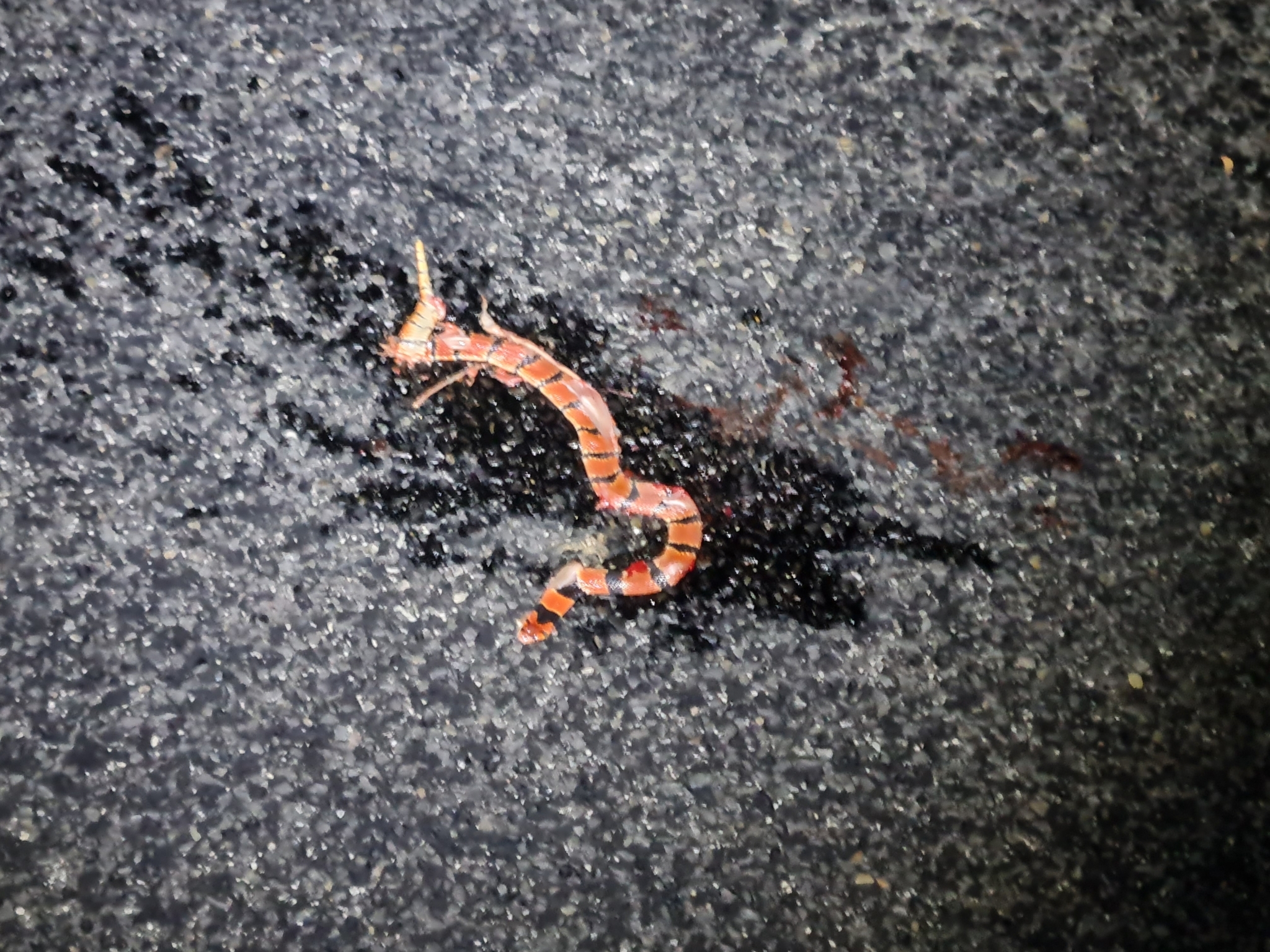
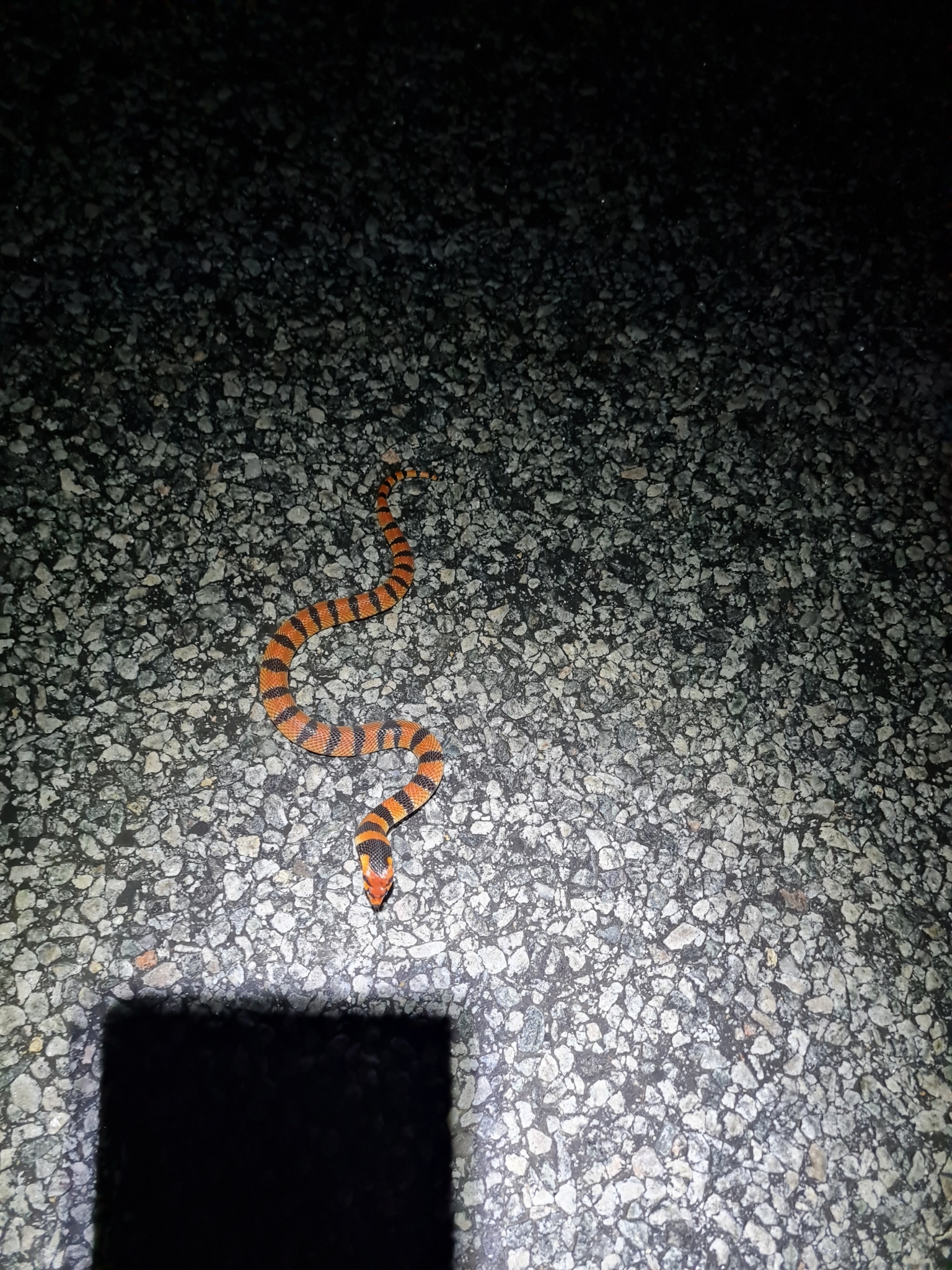
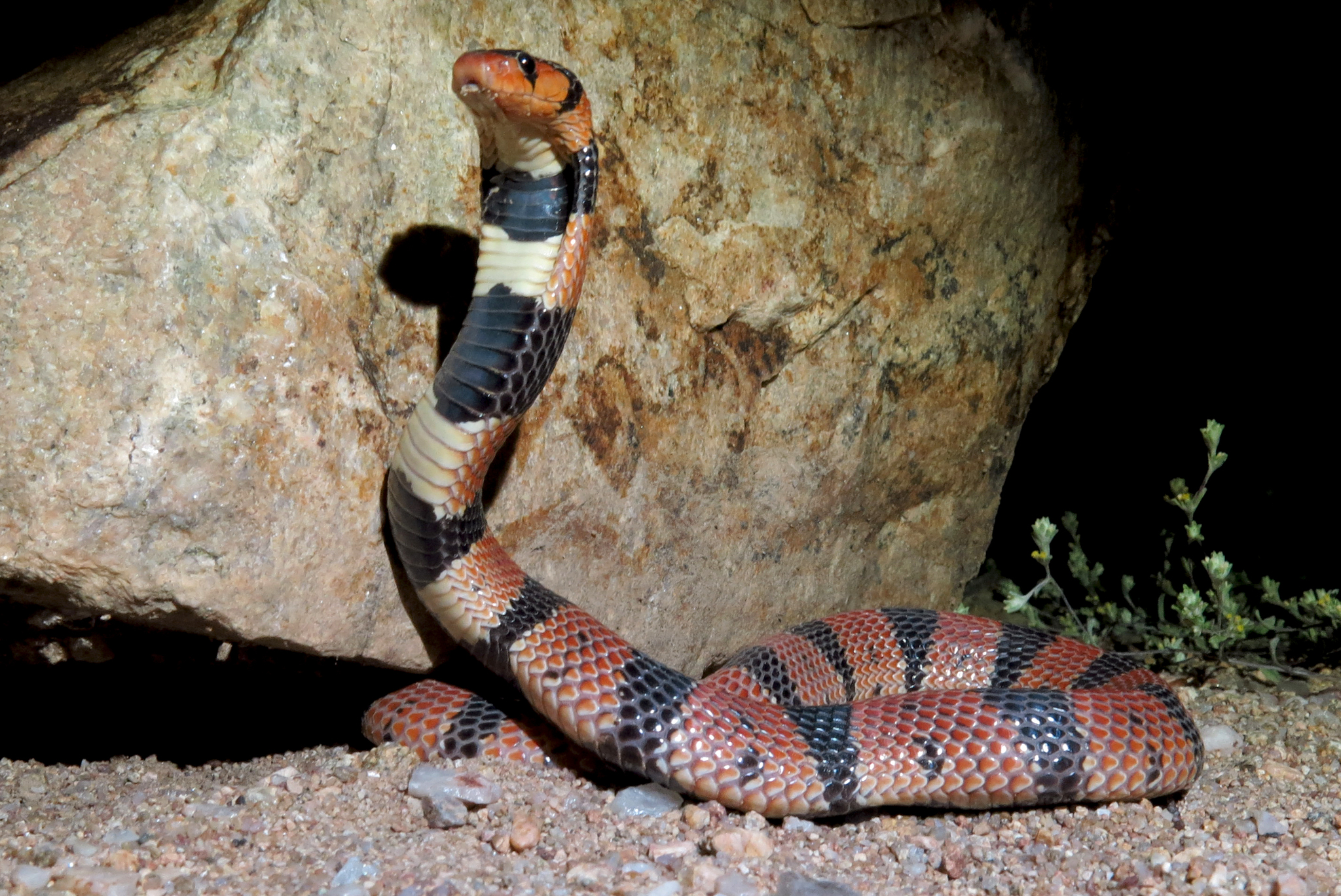
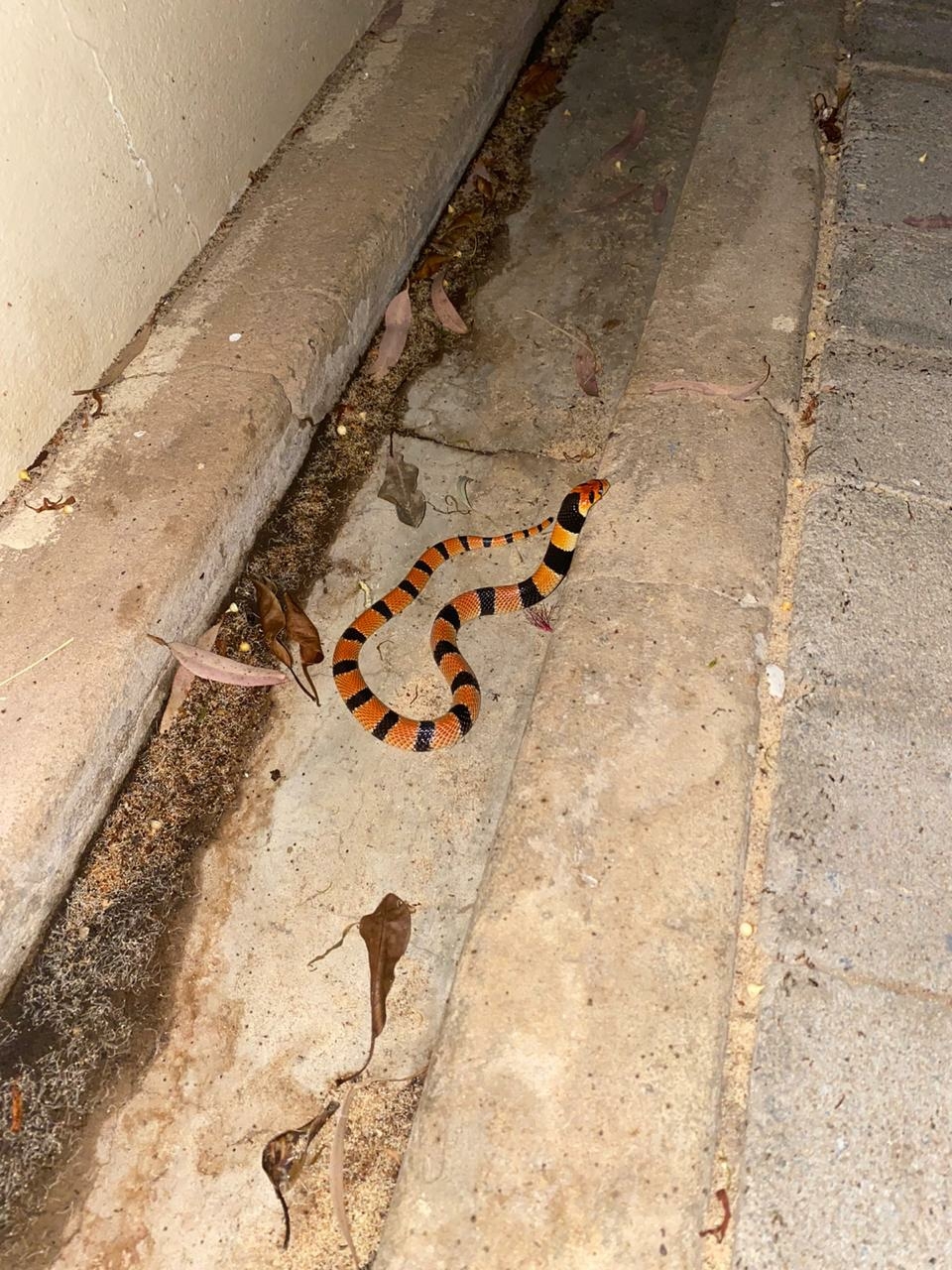
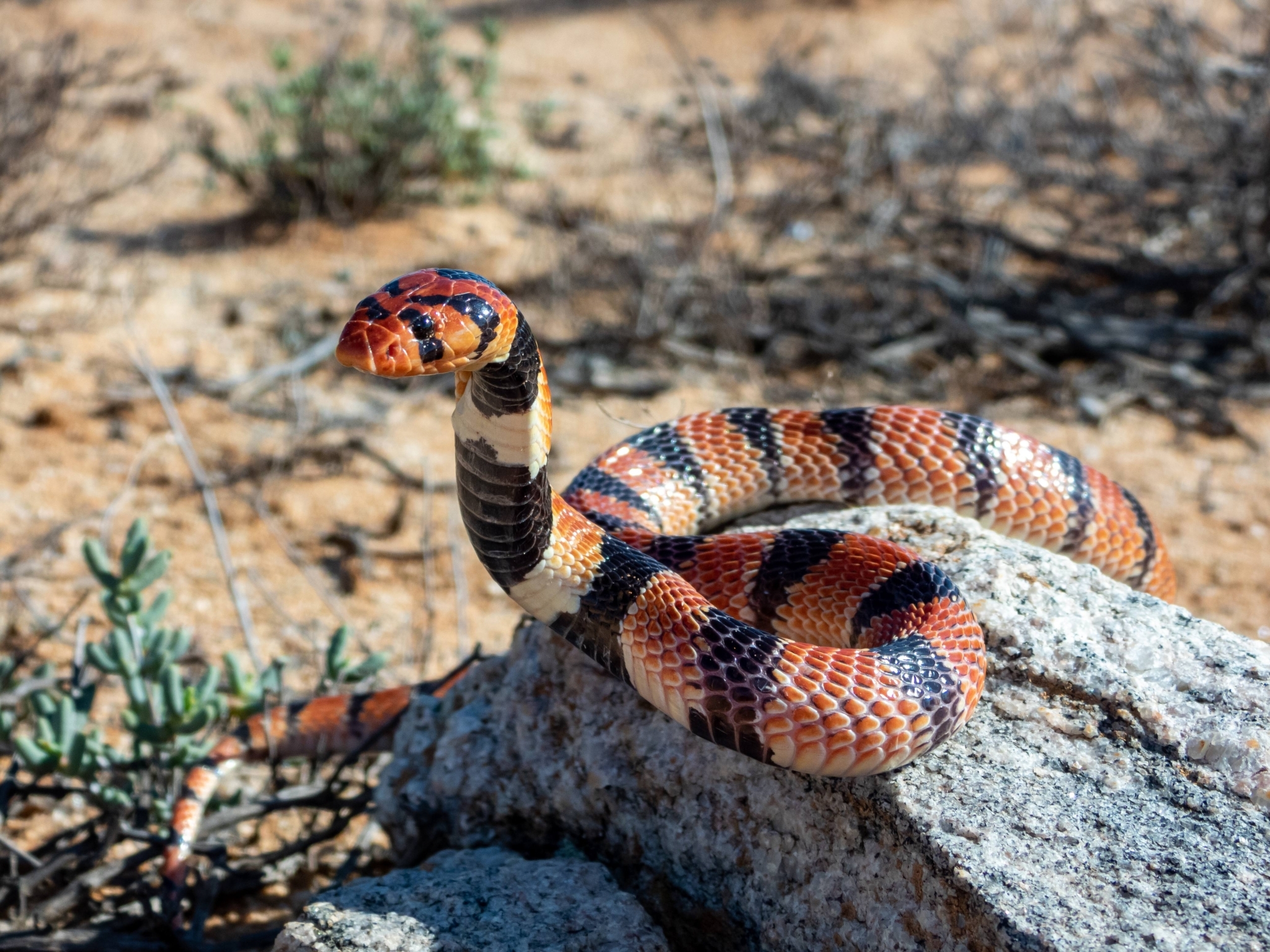
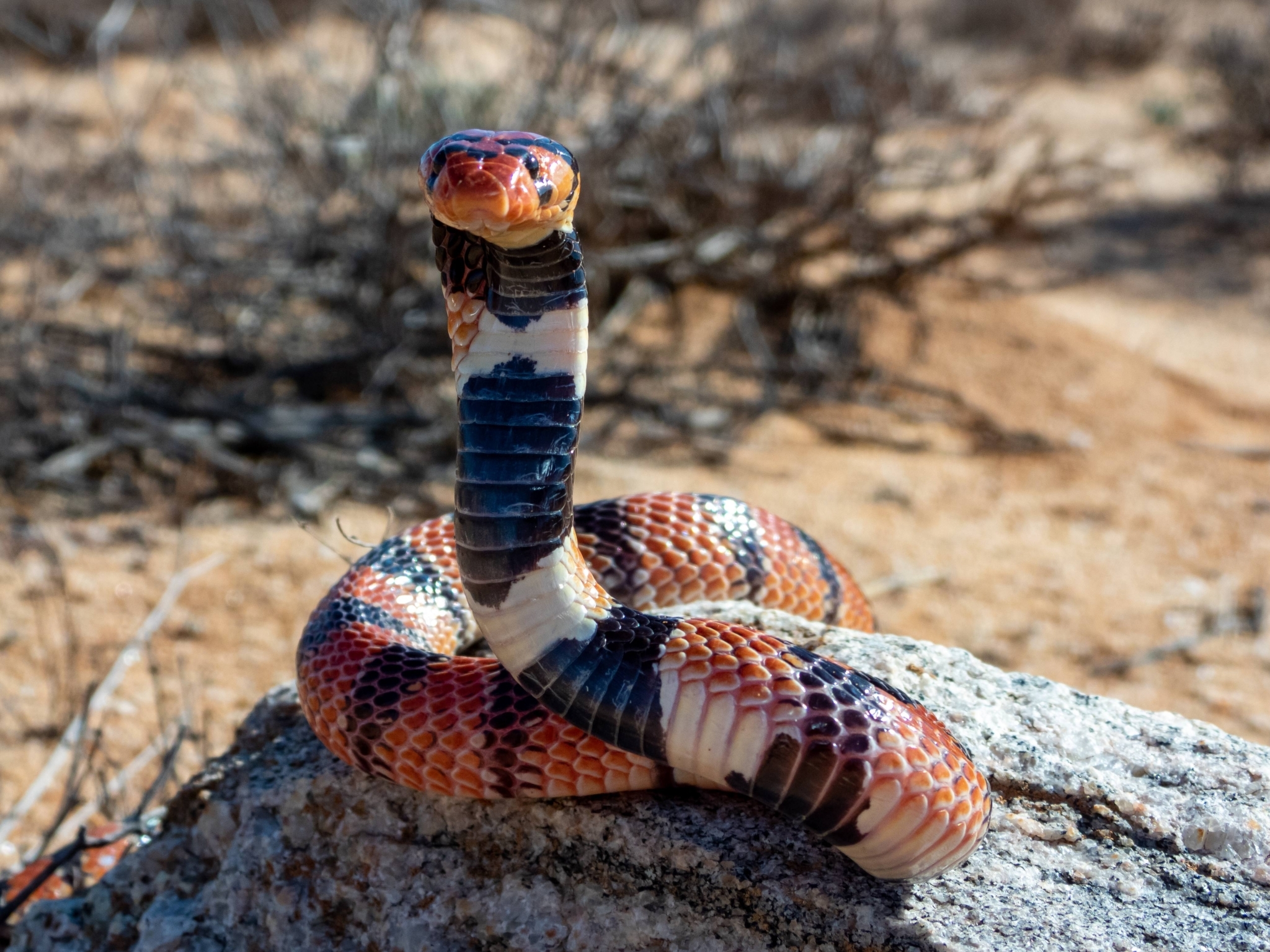
Branch (1981) re-described this species as follows: A small, brightly-coloured snake, which may reach 750 mm in length, although adults usually average up to 600 mm. The enlarged rostral, that characterizes the genus, is not as large as in scutatus , although it still remains the most distinctive feature of the head, which is small and not distinct from the neck. The eye is of moderate size, and the 3rd and 4th upper labials enter the orbit. The body scales are smooth throughout, and in 19 rows at mid-body. Ventrals range from 142-168, but rarely exceed 160. The anal is entire, and the subcaudals 20-28. The tail is short. Coloration: Beautifully marked in alternating bands of orange to coral red and black (from which the snake derives its common name), it is possibly southern Africa's most attractive snake. 20-47 bands (15-39 on body, 3-10 on tail) occur, the first black band forming a broad nuchal collar, from which a forwardIy-directed chevron extends onto the crown of the head. The black bands are always narrower than the red interspaces and may form anteriorIy-directed chevrons. The head is reddish, with a black crossbar between the eyes, that may extend through the eyes onto the labial margin. A second black crossbar may extend in a chevron over the head, connecting the angles of the mouth, although this may be reduced to two oblique bars on the posterior temporals. The ventrum is yellowish, except for at least the first two or three black crossbands, which completely encircle the body. Occasionally the remaining black crossbands extend, in paler form, across the ventrum. This is particularly so in juveniles but fades with growth.
No separate diagnostic description was provided. Refer to the morphological description.
Type locality: “Munhino (101 km east of Mossamedes, via railroad)” (Bogert 1940:95) [= Muninho, 101 km east of Namibe], Namibe Province, Angola. Type locality: Cape of Good Hope Holotype: iconotype, based on specimen in Seba, 1735: pl. 43, Holotype: AMNH 32801 (collectors A.S. Vernay, H. Lang and R. Boulton). [cowlesi]
Taxonomic notes below are as reported by Tolley et al. (2023): Although three subspecies have been described (A. l. lubricus, A. l. cowlesi and A. l. infuscatus), A. l. infuscatus Mertens, 1954 from Namibia was referred to the synonymy of A. lubricus cowlesi from western Namibia and southwestern Angola (Broadley & Baldwin 2006). The validity of these subspecies has not been investigated in a phylogenetic framework.
South Africa, Angola, Namibia
This species occurs from southern Angola southwards through Namibia to the western parts of South Africa (Broadley and Baldwin, 2006). In South Africa it is widespread in the Northern and Western Cape provinces, the western half of the Eastern Cape province, and the southern Free State province. The subspecies A. l. lubricus occurs in South Africa and southwestern Namibia, whereas A. l. cowlesi occurs in southern Angola and western Namibia, south to Lüderitz (Broadley and Baldwin, 2006). Historical records from the Gqeberha region and south of the Cape Fold Mountains are thought to be erroneous (tolley et al., 2023).
Snakes have no limbs. They move by making looping motions with their bodies. Consequently, snakes move in a creeping or slithering manner.
Carnivore-Reptiles, Frogs& Mammals
The species feeds on small vertebrates, particularly other reptiles (Branch, 1998).
The Cape Coral Snake is oviparous. It lays 3-11 eggs (50-54 × 15 mm) in December; these hatch in 59-71 days. The young measure 170-180 mm TL. In captivity, lay clutches every two months during summer (Branch, 1998).
This species is bad-tempered, although it does well in captivity. Its venom is poorly known but is apparently neurotoxic. Venom yield for A.l.infuscatus has been recorded at 50 mg, with an LD50 300 µg/kg. The effectiveness of antivenom is unknown. Bites from the southern race have not resulted in serious symptoms, but a bite from A.l. infuscatus was reported to have killed two children (Branch, 1998).
Fynbos, Grassland, Savanna
This map contains point-based occurrences at different locations
Occurrence in African countries and South African provinces. Residence status indicates if a taxon is indigenous, endemic, or alien in a specific region. This data is based on specimen records and literature.
FSA
SA
BOT
NAM
ESW
LES
WC
EC
NC
FS
GA
KZN
LP
MP
NW
Absent
Indigenous
Endemic
Naturalised
Invasive
Names and Sources
| Common Name | Language |
|---|---|
| Coral Shield Cobra, Cape Coral Snake | EN |
| Coral Snake | |
| Cape Coral Snake |

No results found for Aspidelaps lubricus (Laurenti, 1768)
No data.
20 results for Aspidelaps lubricus (Laurenti, 1768)
This map contains point-based occurrences at different locations
1998
BOOK
Field Guide to the Snakes and Other Reptiles of Southern AfricaBranch, B.. 1998. Field Guide to the Snakes and Other Reptiles of Southern Africa Vol. . Cape Town. Struik Publishers pp..
2006
JOURNAL ARTICLE
Taxonomy, natural history, and zoogeography of the southern African shield cobras, genus Aspidelaps (Serpentes: Elapidae)Broadley, D., Baldwin, A.. 2006. Taxonomy, natural history, and zoogeography of the southern African shield cobras, genus Aspidelaps (Serpentes: Elapidae) Vol. 9(2) pp.163–176.
2004
BOOK
A complete guide to the snakes of southern AfricaMarais, J.. 2004. A complete guide to the snakes of southern Africa. Cape Town. Struik Publishers.
2023
BOOK
Conservation status of the reptiles of South Africa, Eswatini and LesothoTolley, K., Burger, M., Alexander, G., Pietersen, D., Conradie, W., Weeber, J.. 2023. Conservation status of the reptiles of South Africa, Eswatini and Lesotho Vol. Suricata 10. Pretoria. South African National Biodiversity Institute.
1981
JOURNAL ARTICLE
The venomous snakes of southern Africa 2. Elapidae and HydrophidaeBranch, W.. 1981. The venomous snakes of southern Africa 2. Elapidae and Hydrophidae Vol. 17 pp.1-47.
Status and criteria
LC
Assessor(s)
Graham Alexander
Reviewer(s)
Michael Bates