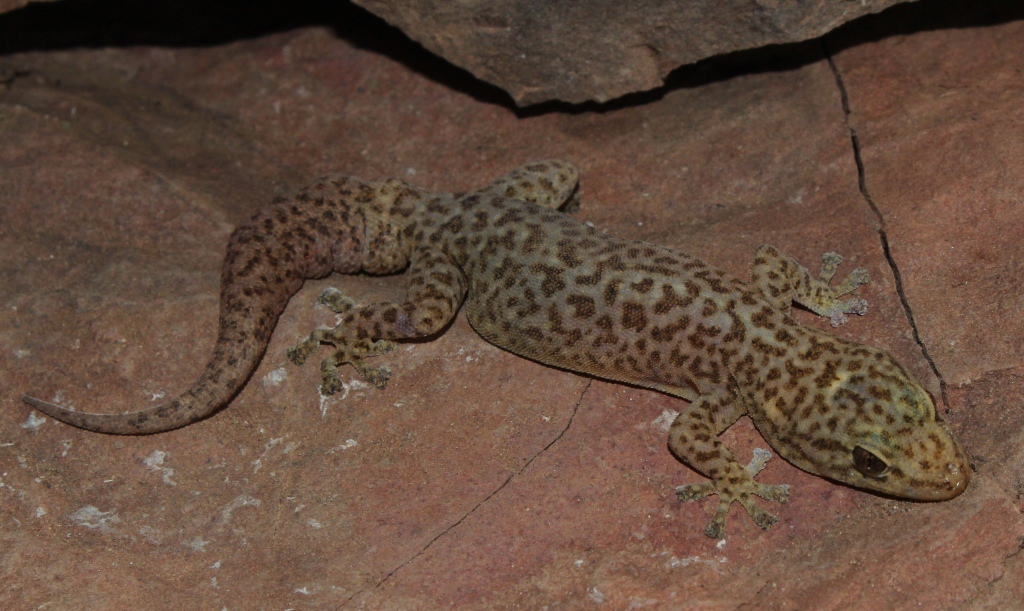
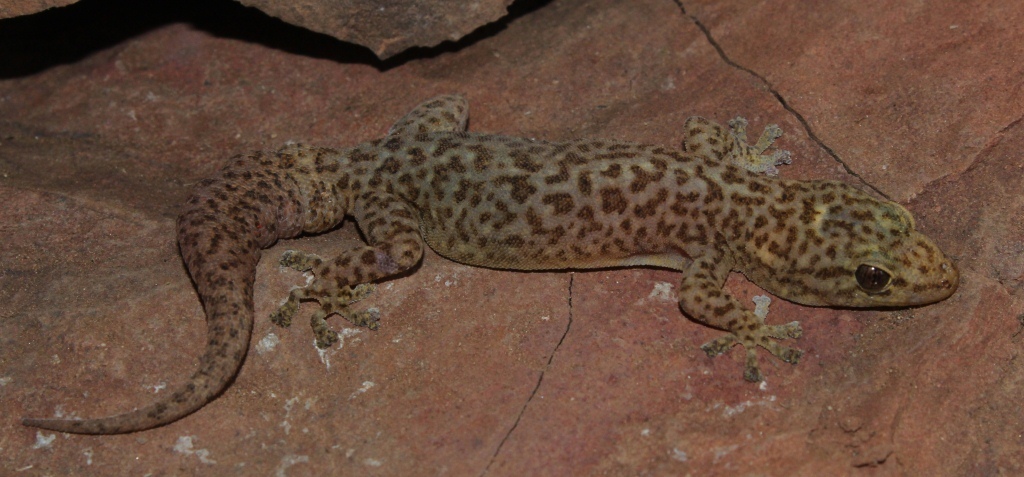
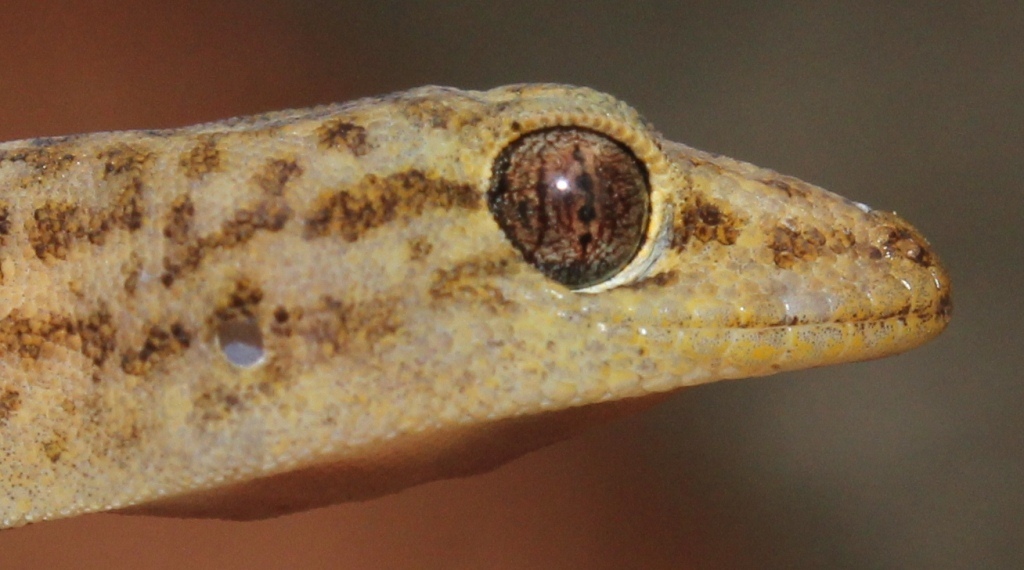
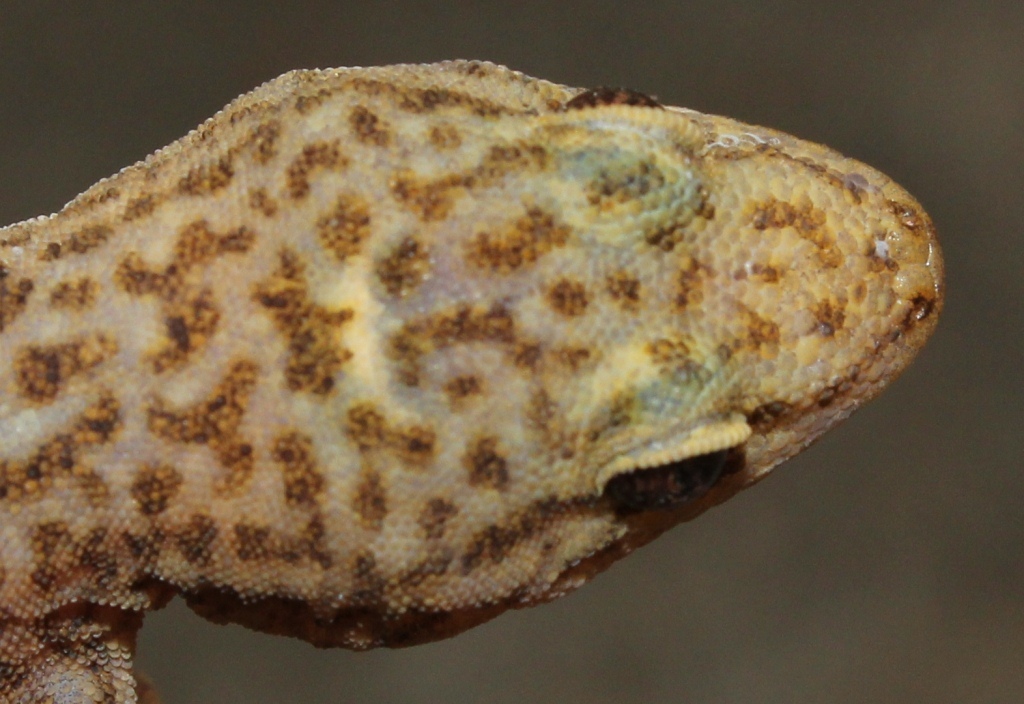
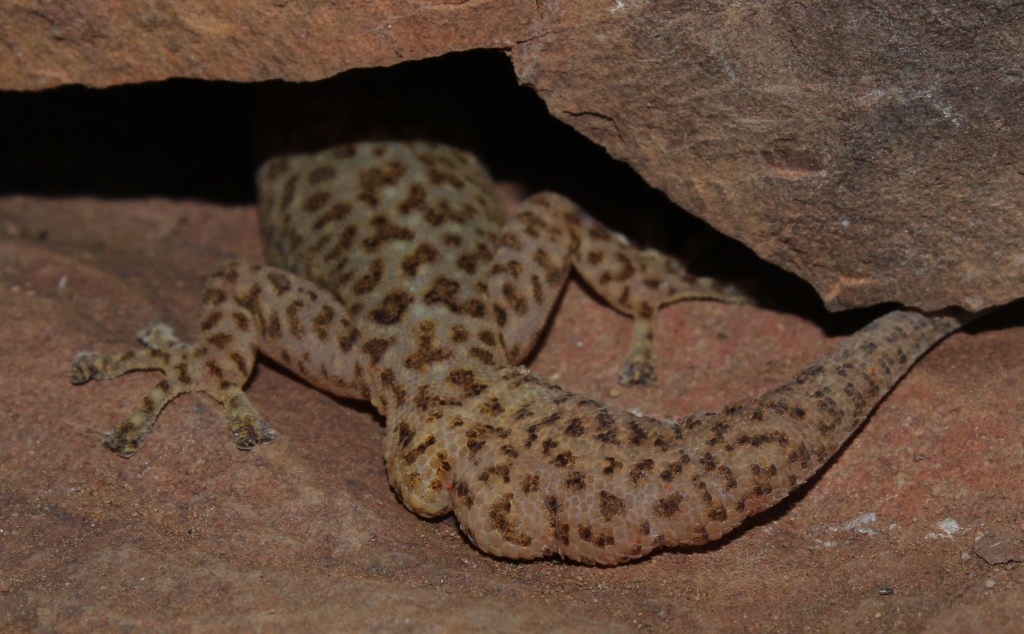
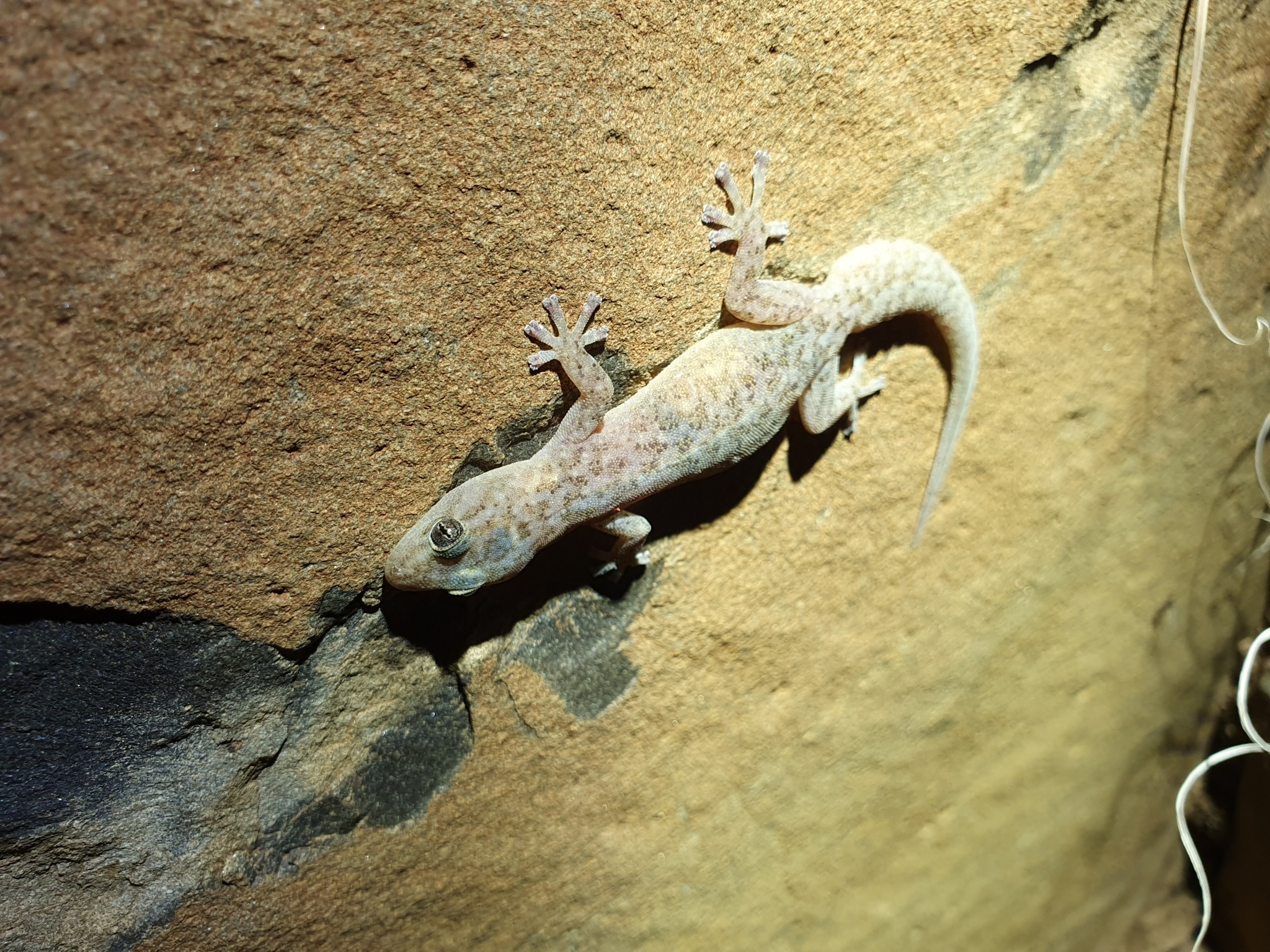
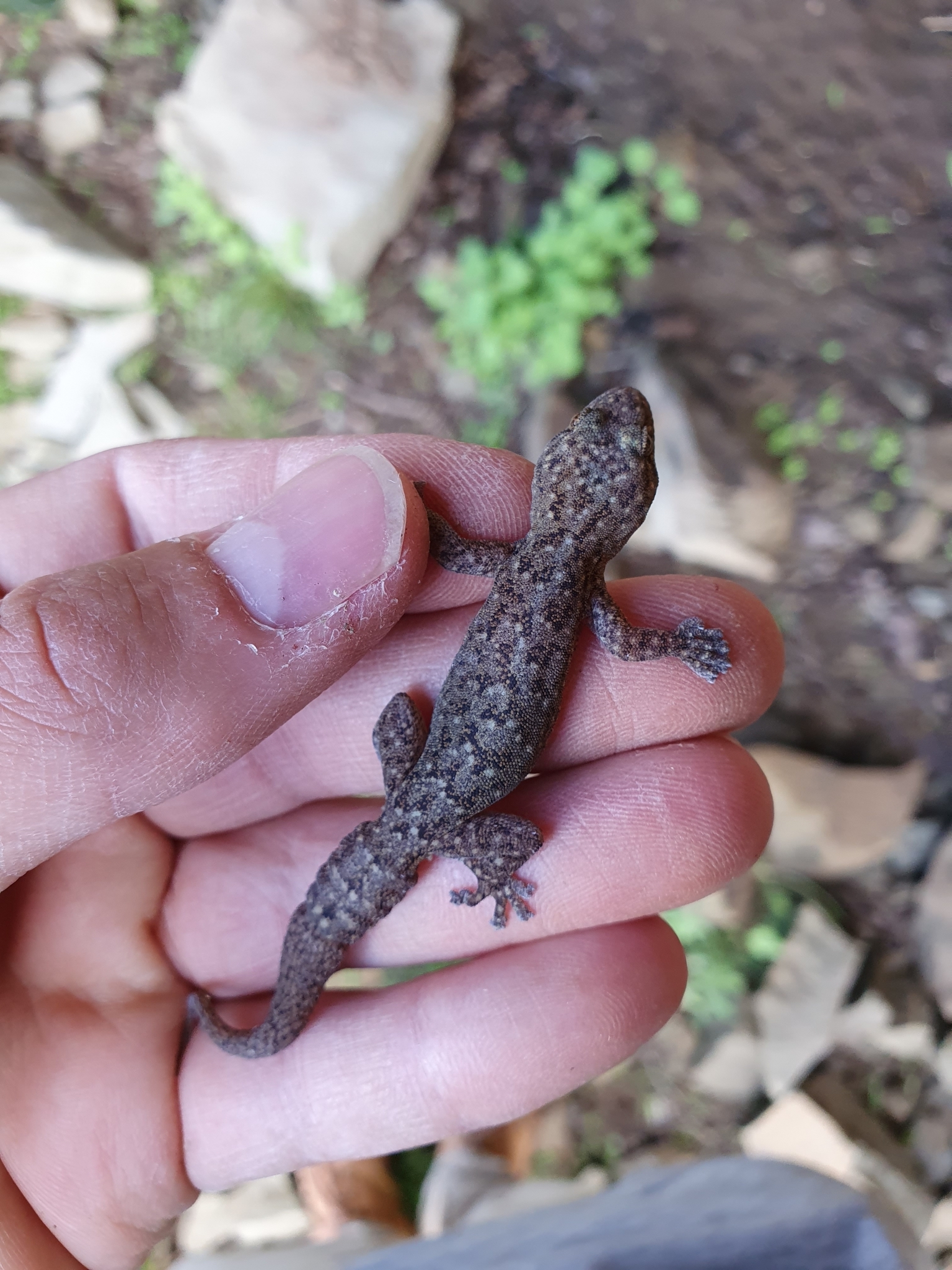
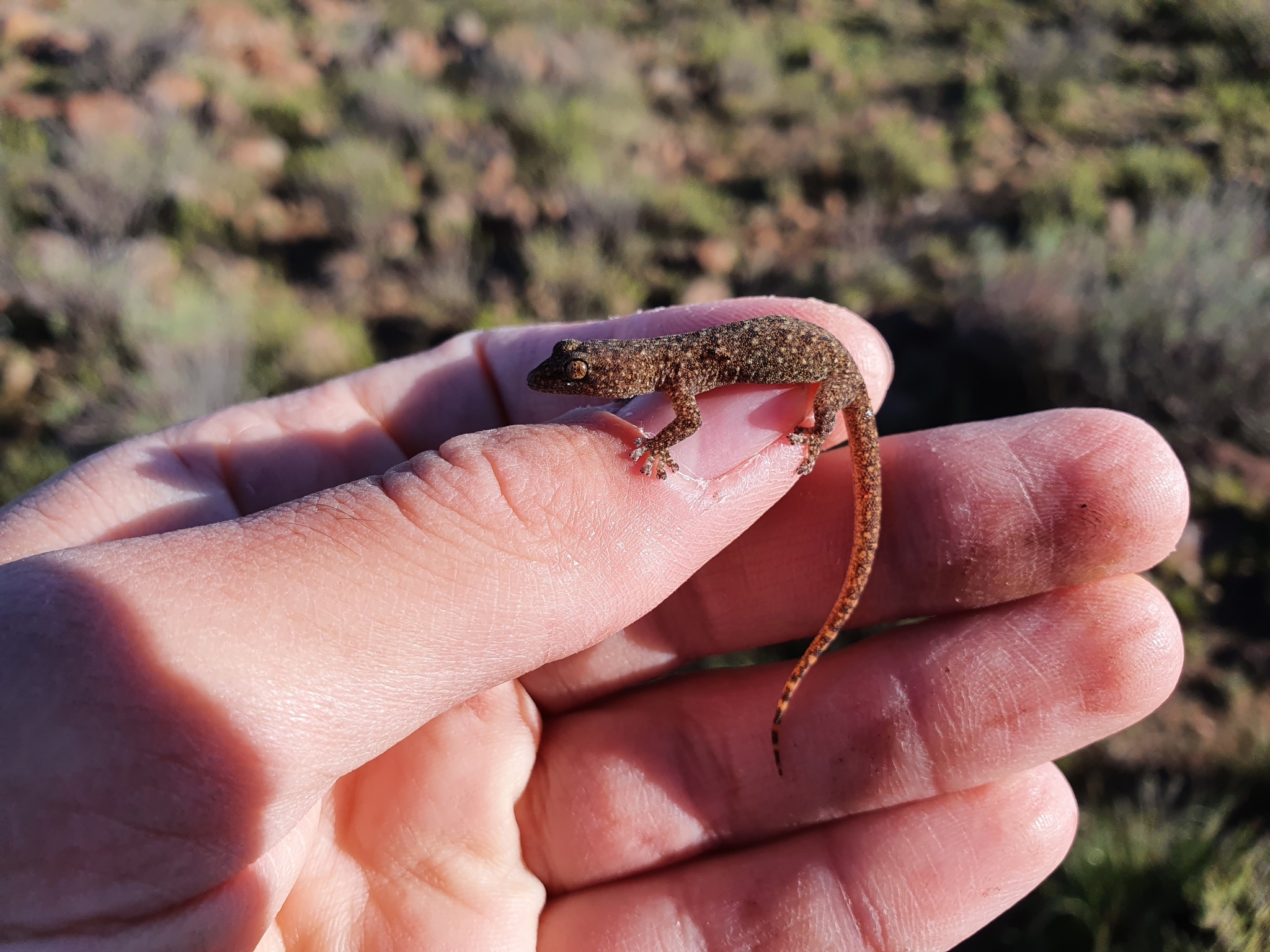
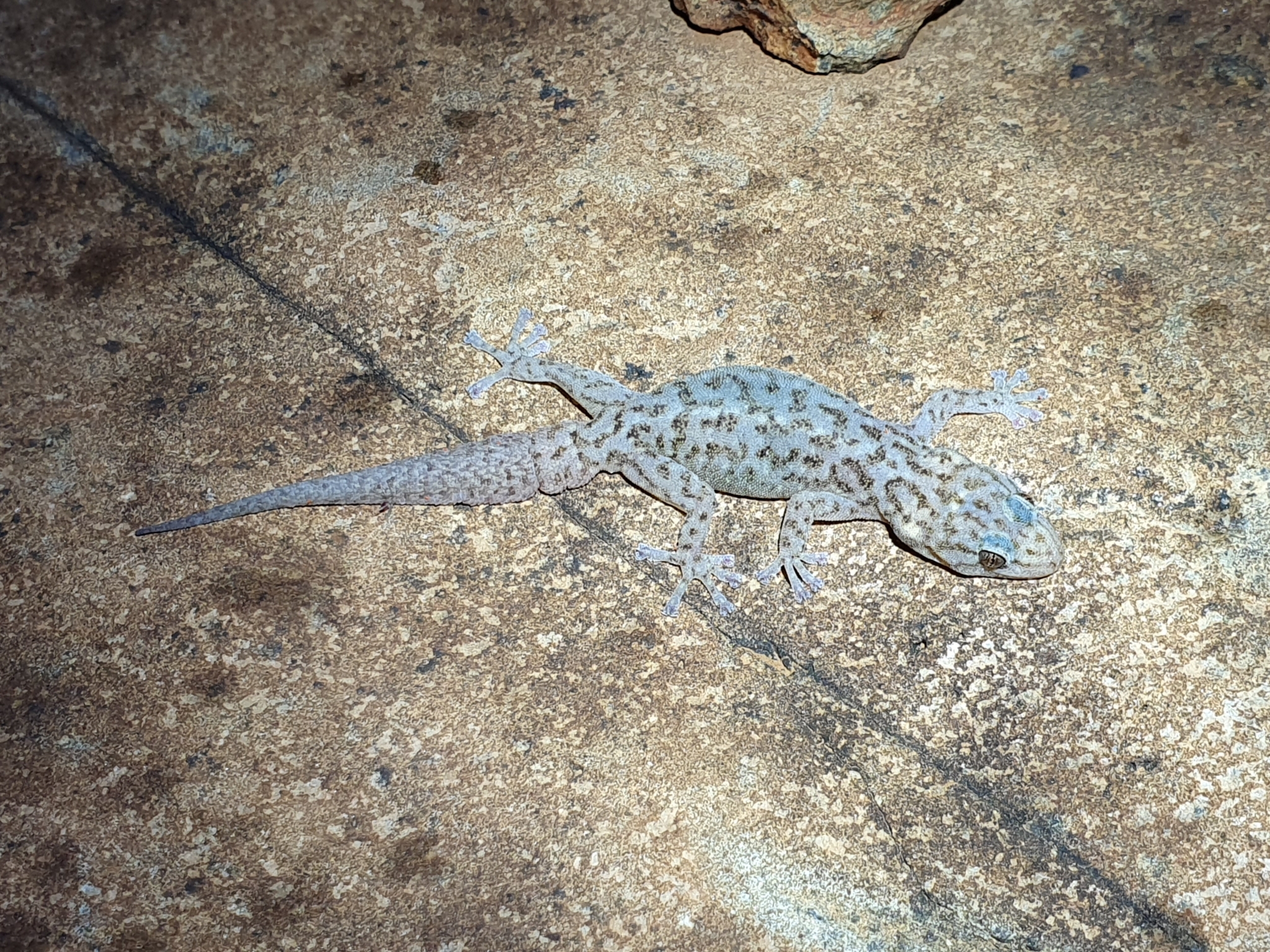
Loveridge (1947) re-described this species as follows: Snout slightly longer than the distance between the eye and the ear-opening; mental and lower labials bordered by scales which are subequal to those in the row following. Ventrals subimbricate; preanal pores of male forming a transverse series; limbs moderate, the adpressed hind limb reaching the elbow of the backward pressed forelimb; proximal pair of scansors beneath digital expansion followed by a series of scales which: may, or may not, be transversely dilated; tail much depressed, its width at base about two-thirds that of body, verticillate, covered with smocth scales, those above subimbricate, those below imbricate. Color: Above, grayish; back with about six to eleven, irregular or disintegrating brown crossbars; tail with dark, transversely arranged spots. Below, whitish, tail edged with grayish. Size: Total length of unsexed type of wilmoti (Albany Mus.), 98 (44 + 54) mm. of karroica type female (S.A.M. 11019) 43 mm. from snout to vent, tail lacking and condition poor.
No separate diagnostic description was provided. Refer to the morphological description.
Type locality: Albany district, Cape Province Syntypes: PEM R9479–503 (formerly AMG 5069), MCZ R-22090 etc. Syntypes (25): PEM R9479–503 (formerly AMG 5069) [wilmoti]
Afroedura langi originally contained several undescribed species (Jacobsen, 1989, 1992), but with a taxonomic revision and the description of six new species (Jacobsen et al., 2014), there are no other taxonomic issues.
South Africa.
This species occurs in the Olifants River Valley in northeastern South Africa, from southeastern Limpopo province into northeastern Mpumalanga province (Jacobsen, 1989). Although previously mapped as occurring in adjacent southwestern Mozambique (Visser 1984), this was in error as the record is from Lydenburg District, South Africa (Tolley et al., 2023)
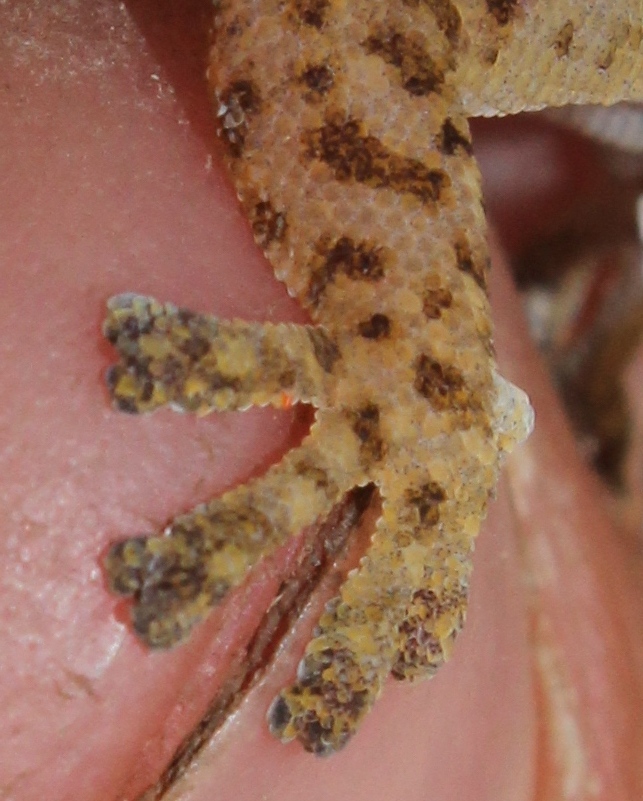
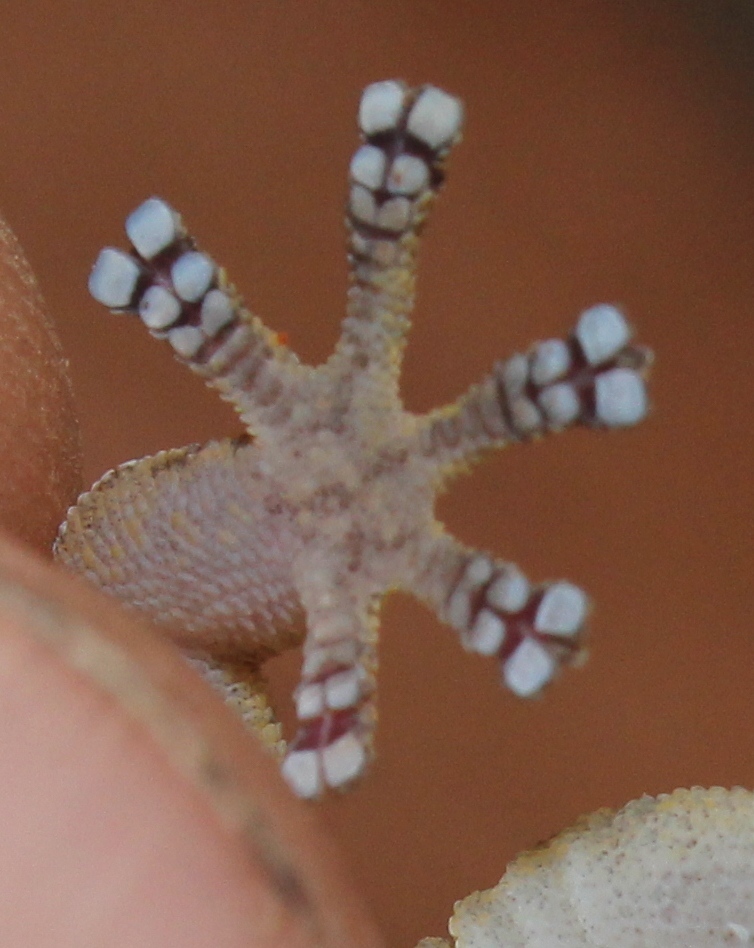
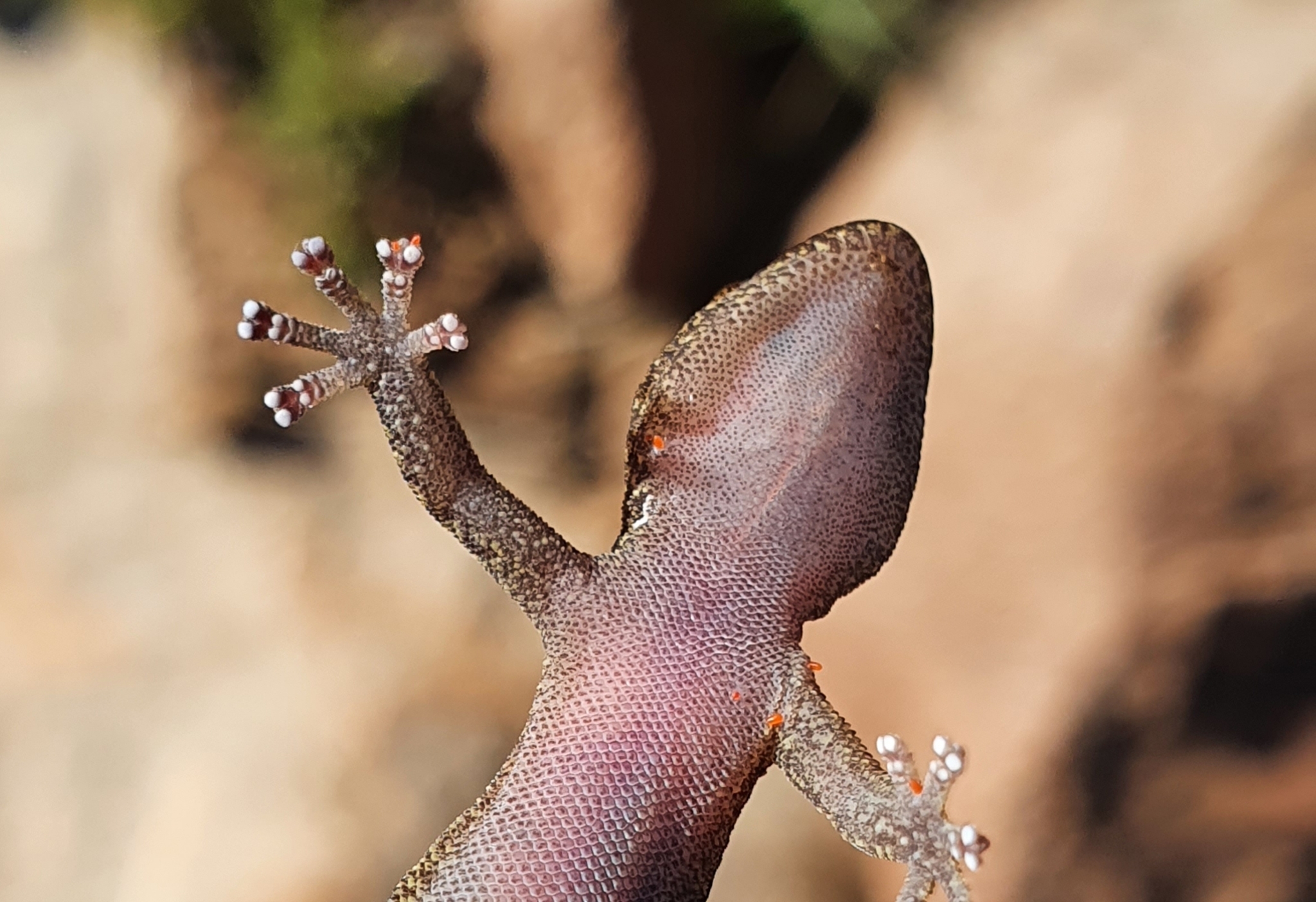
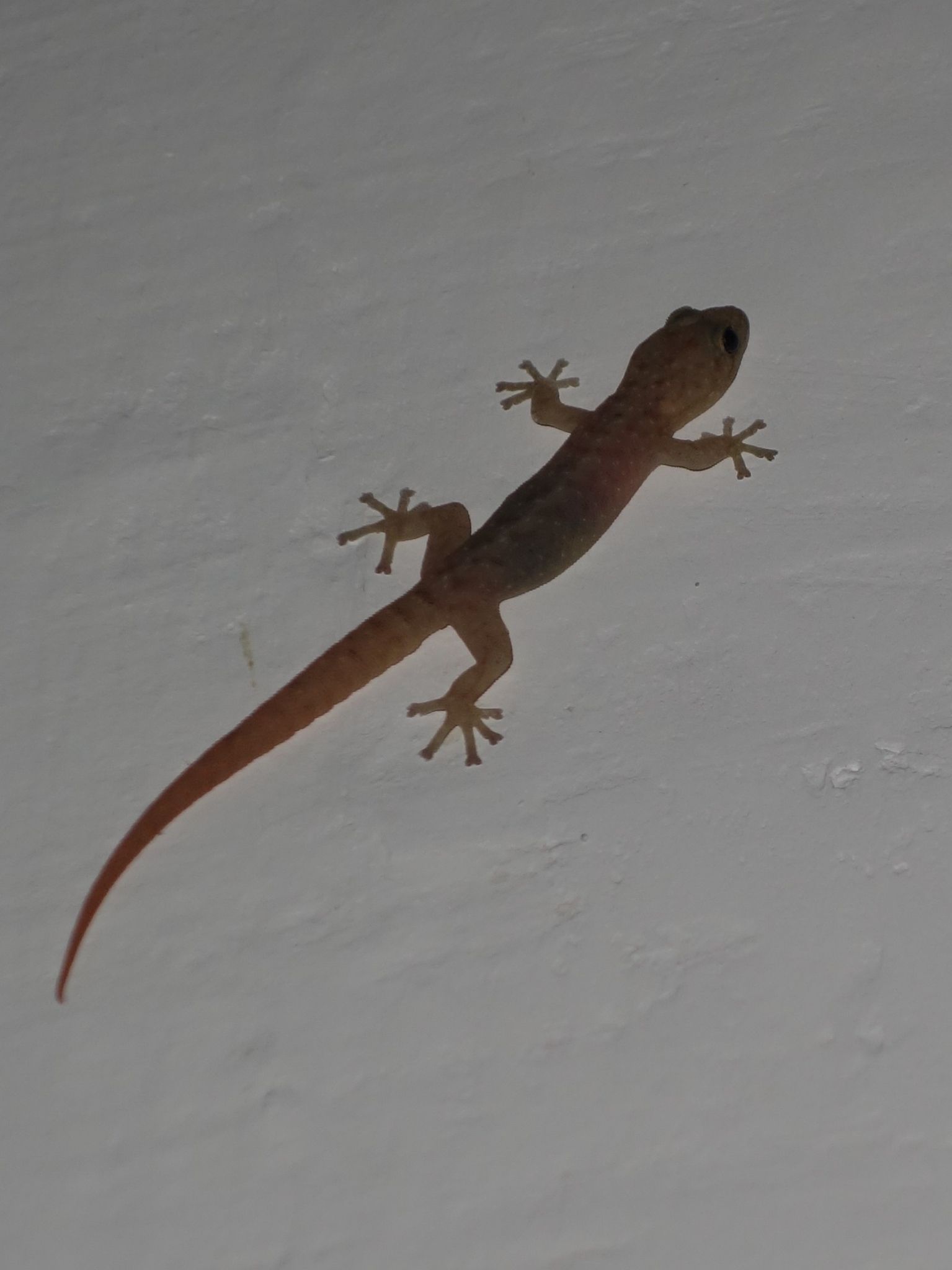
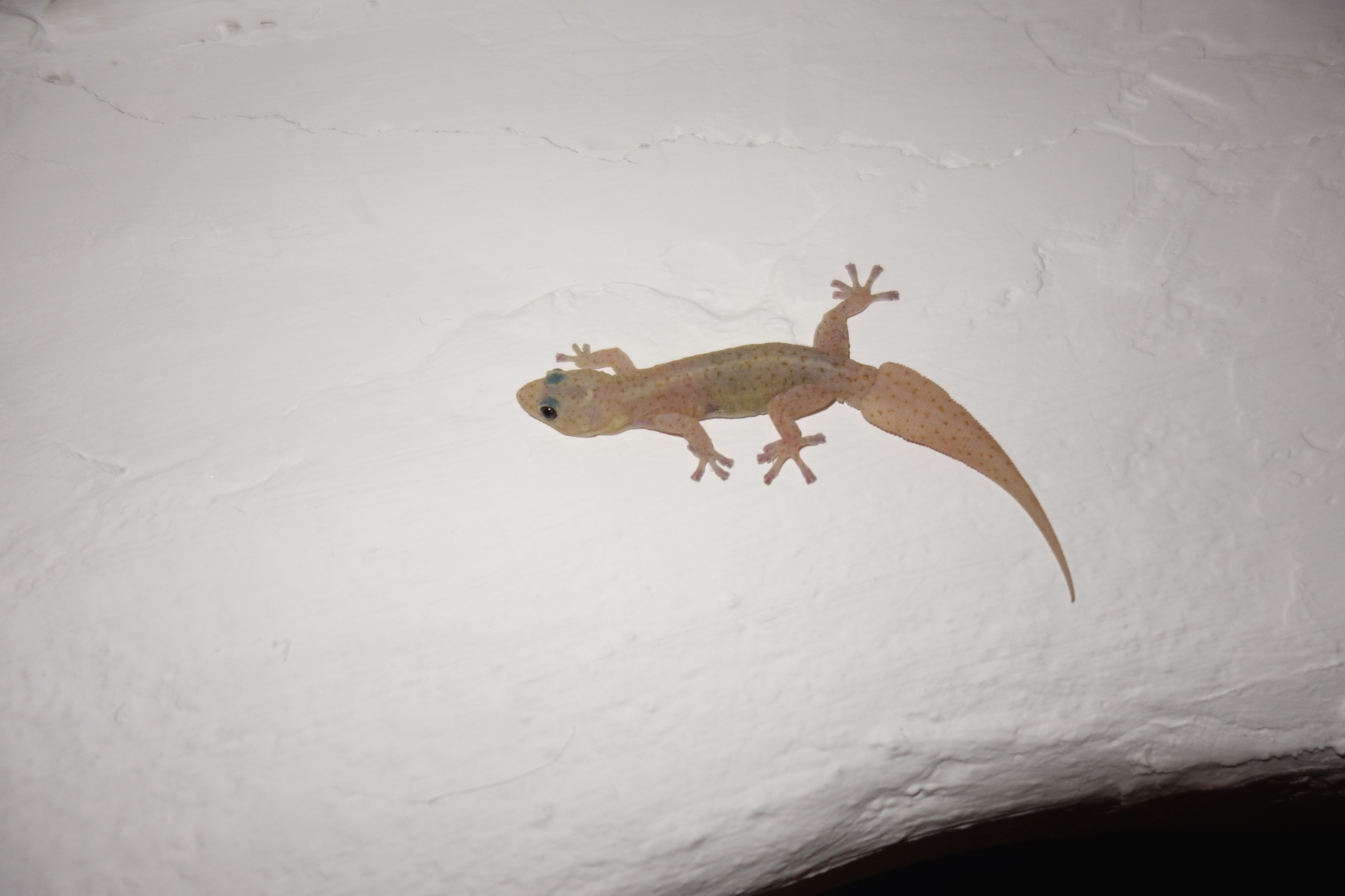
This species has adhesive toe pads, which allow them to stick onto even smooth surfaces, making them extremely good climbers (Branch, 1998). They also have strong legs, allowing for very rapid movements if necessary.
Carnivore - Insectivore (insect-eating)
The Karoo Flat Gecko feeds on ants and small beetles (Branch, 1998).
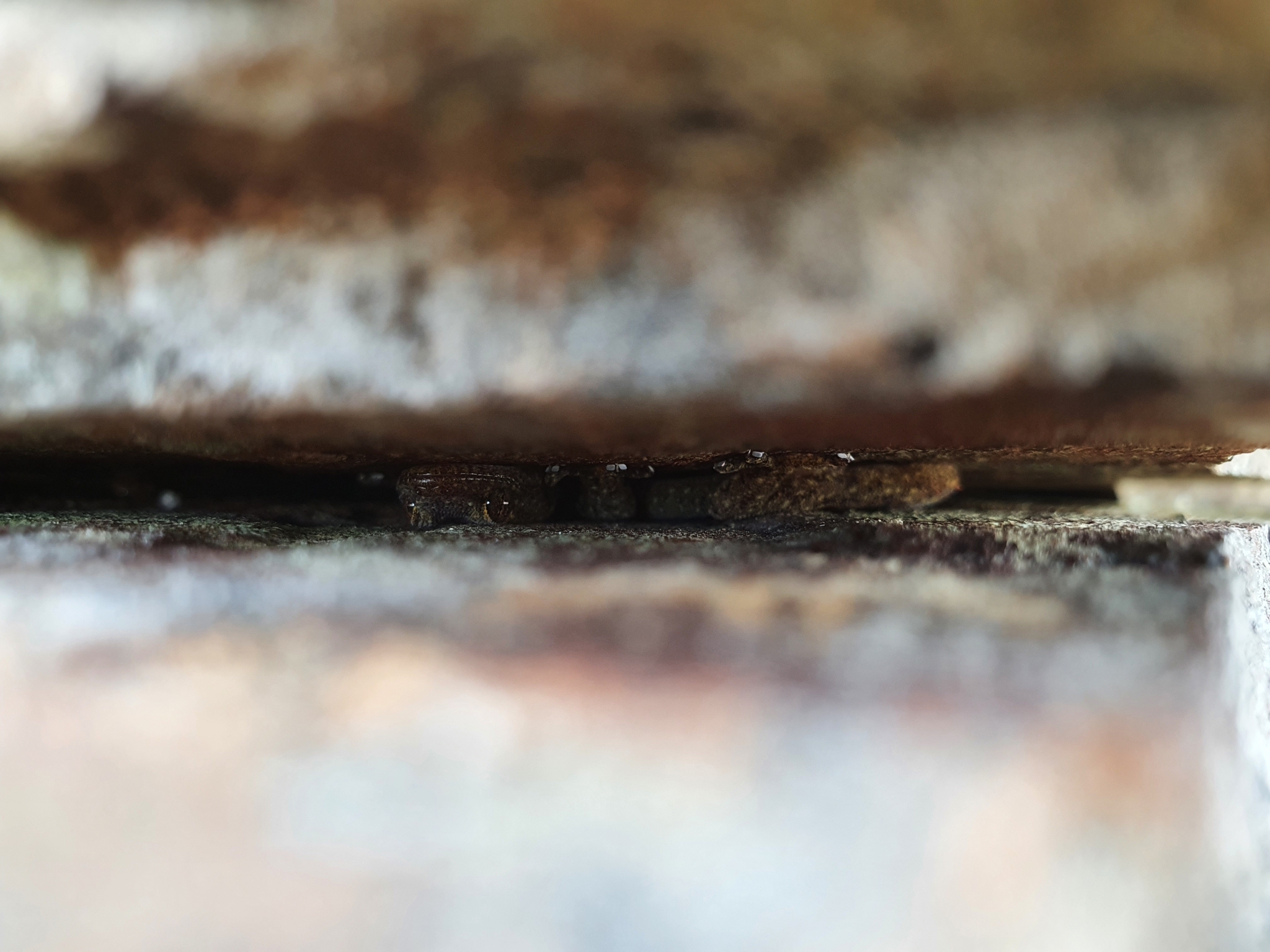
The Karoo Flat Gecko is oviparous, with females laying two eggs during summer. Communal egg sites are used (Branch, 1998).
No data.
Grassland, Nama-Karoo
This map contains point-based occurrences at different locations
Occurrence in African countries and South African provinces. Residence status indicates if a taxon is indigenous, endemic, or alien in a specific region. This data is based on specimen records and literature.
FSA
SA
BOT
NAM
ESW
LES
WC
EC
NC
FS
GA
KZN
LP
MP
NW
Absent
Indigenous
Endemic
Naturalised
Invasive
Names and Sources
| Common Name | Language |
|---|---|
| Karoo Flat Gecko- Inland Rock Gecko | En |
| Karoo Platgeitjie | En |
| Inland Rock Gecko | En |


No results found for Afroedura karroica (Hewitt, 1925)
No data.
20 results for Afroedura karroica (Hewitt, 1925)
This map contains point-based occurrences at different locations
1925
JOURNAL
On some new species of Reptiles and Amphibians from South AfricaHewitt, J.. 1925. On some new species of Reptiles and Amphibians from South Africa Vol. 3. Grahamstown. pp.343-370.
1998
BOOK
Field Guide to Snakes and Other Reptiles of Southern AfricaBranch, B.. 1998. Field Guide to Snakes and Other Reptiles of Southern Africa. Cape Town. Struik Publishers.
1947
JOURNAL ARTICLE
Revision of the African lizards of the family GekkondiaeLoveridge, A.. 1947. Revision of the African lizards of the family Gekkondiae Vol. 98 pp.1-469.
2023
BOOK
Conservation status of the reptiles of South Africa, Eswatini and LesothoTolley, K., Burger, M., Alexander, G., Pietersen, D., Conradie, W., Weeber, J.. 2023. Conservation status of the reptiles of South Africa, Eswatini and Lesotho Vol. Suricata 10. Pretoria. South African National Biodiversity Institute.
1989
TECHNICAL REPORT
The distribution and conservation status of reptiles and amphibians in the Transvaal. Final Report Project TN 6/4/1/30Jacobsen, N.. 1989. The distribution and conservation status of reptiles and amphibians in the Transvaal. Final Report Project TN 6/4/1/30. Pretoria. Chief Directorate of Nature and Environmental Conservation.
1992
JOURNAL ARTICLE
New Lygodactylus taxa (Reptilia: Gekkonidae) from the TransvaalJacobsen, N.. 1992. New Lygodactylus taxa (Reptilia: Gekkonidae) from the Transvaal Vol. 43 pp.527–542.
2014
JOURNAL ARTICLE
A phylogenetic analysis of the southern African gecko genus Afroedura Loveridge (Squamata: Gekkonidae), with the description of nine new species from Limpopo and Mpumalanga provinces of South AfricaJacobsen, N., Kuhn, A., Jackman, T., Bauer, A.. 2014. A phylogenetic analysis of the southern African gecko genus Afroedura Loveridge (Squamata: Gekkonidae), with the description of nine new species from Limpopo and Mpumalanga provinces of South Africa Vol. 3846 pp.451–501.
1984
JOURNAL ARTICLE
Akkedisse van Suider-Afrika 14. Diksterte sukkel nie met blyplekVisser, J.. 1984. Akkedisse van Suider-Afrika 14. Diksterte sukkel nie met blyplek Vol. 22 June 1984 pp.60-61,63.
Status and criteria
LC
Assessor(s)
Michael Bates
Contributors
Josh Weeber
Reviewer(s)
Buyisile Makhubo