
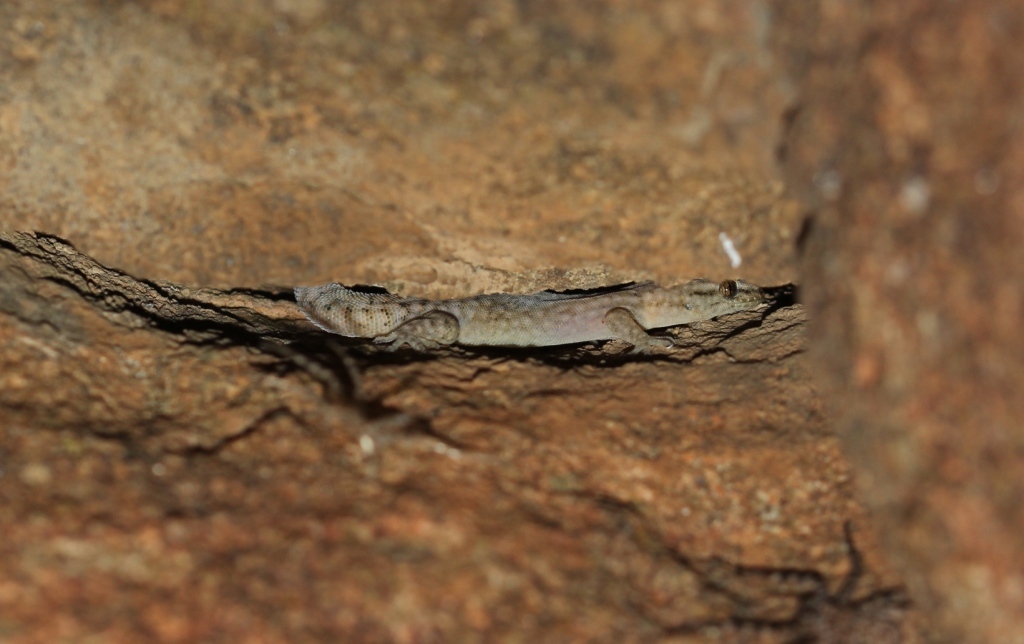
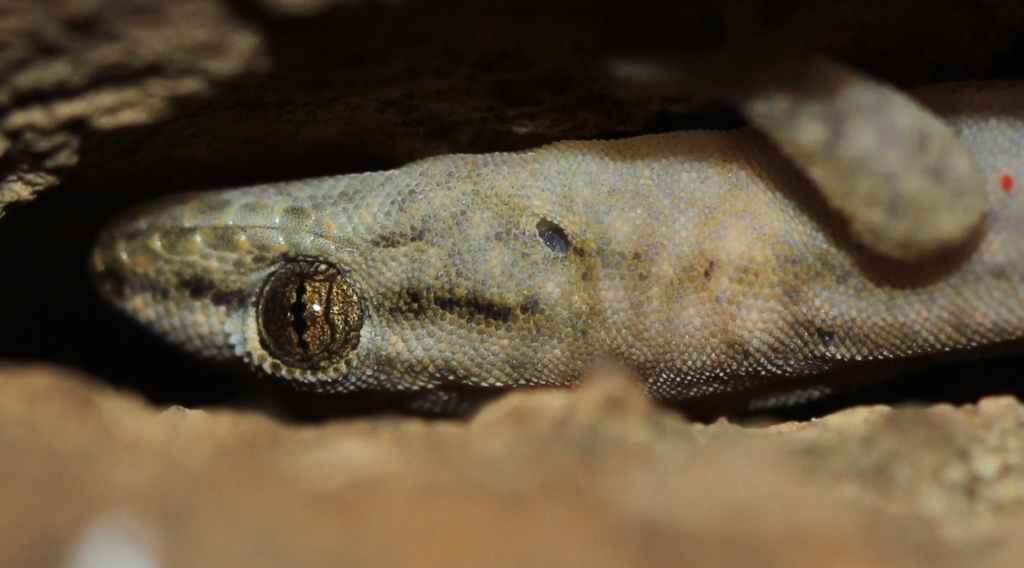
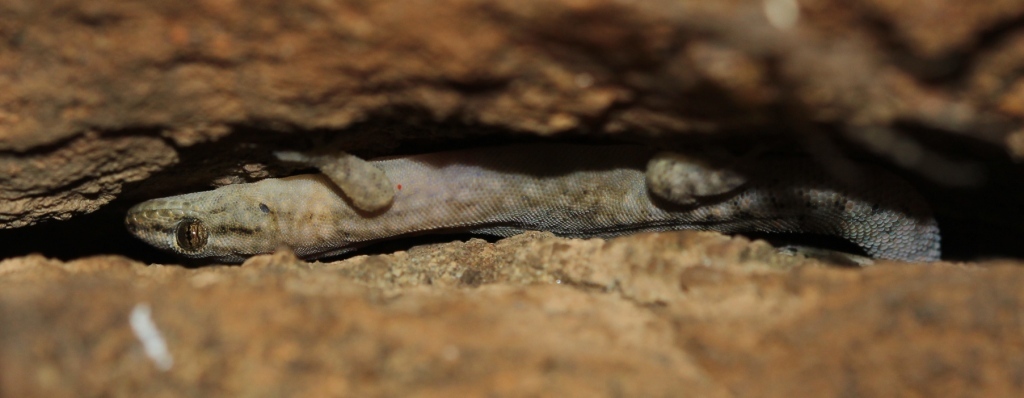
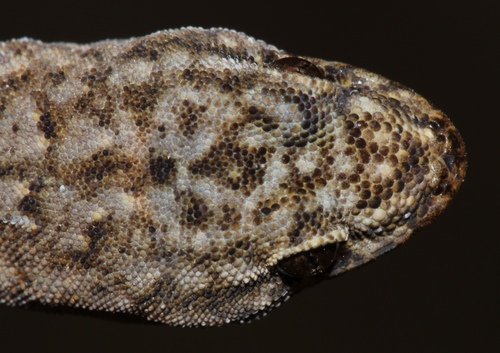
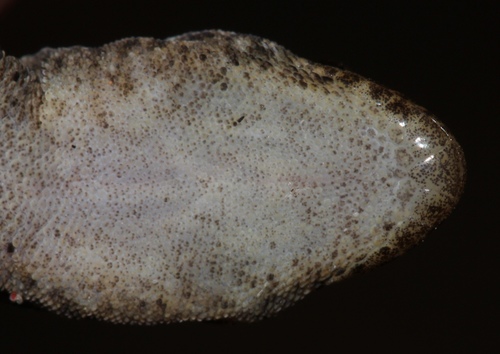
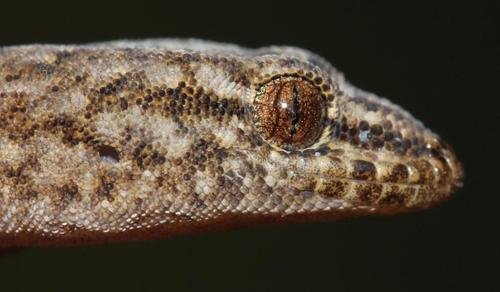
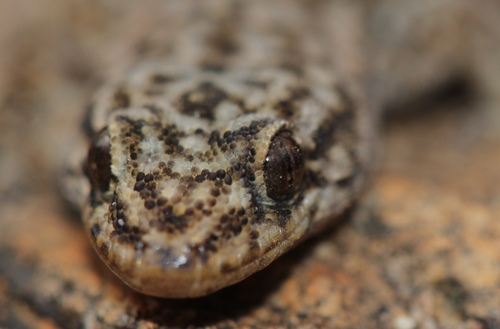
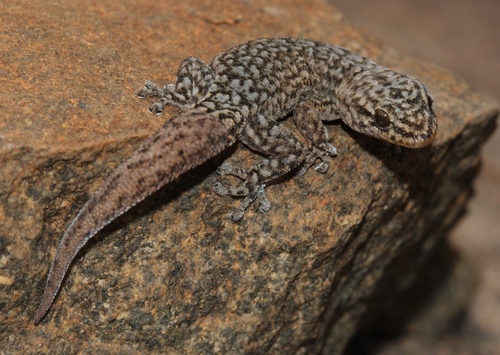
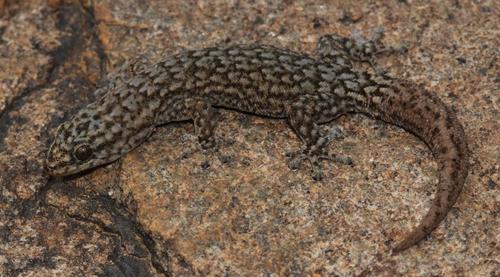
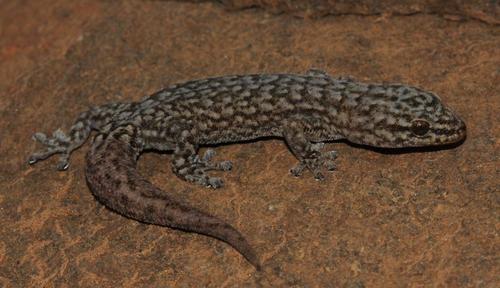
Description is extracted from Branch (1998): Almost identical to Hewitt`s dwarf leaf-toed gecko, G. hewitti, but geographically isolated. A very small gecko with a flattened head and body. There is no mental cleft, usually only one nasorostrals scale and 9-12 scales between the nostril and front of the eye. Scales on the back are smooth and uniform. And in 79-88 midbody rows. The back is light brown-tan with dark brown markings forming scalloped or reticulate patterns. The belly is pale cream with faint dark stripping. The original tail is slightly longer and paler than the body, with up to 12 dark cross bands, which are absent from the original tail. Males have 4 preanal pores.
This information was extracted from Good et al. (1996): A large species of the Phyllodactylus linealus complex, adult snout-vent length (SVL) 27-35 mm. Distinguished from other species in the genus and in the species complex by the following combination of characters: head depressed; dorsal body scalation homogeneous; midbody scale rows 79-88; 4 preanal pores in males; usually one nasorostral scale; granules across crown between orbits usually 15-17; dorsal coloration pattern dominated by a scalloped or reticulate pattern. Phyllodactylus braacki differs from P. microlepidolus, P. porphyreus, and P. swartbergensis by its smaller size, and from the last species and P. peringueyi by its homogeneous body scalation. It may be distinguished from P. linealus and P. gemmulus by its higher number of scales around mid-body (usually more than 80 vs. usually less than 80). It is distinguished from P. linealus and P. hexaporus by the presence of four (versus 5-7) preanal pores in males. The presence of a single nasorostral granule (usually) and a greater body size (maximum SVL > 32 mm) serve to distinguish P. braacki from the vel)' similar species P. essexi and P. rupicolus. Phyllodactylus braacki is morphologically indistinguishable from P. hewitti, from which it is geographically isolated, but may be diagnosed from this species on the basis of three uniquely occurring allozyme alleles.
Type locality: Nuweveld escarpment near radio mast, Karoo National Park, Western Cape Province [then Cape Province], South Africa (32°16' S, 22°30'E; 3222BC), approx. 1800 m elevation. Holotype: PEM R4361, adult male Paratypes (10 specimens): CAS 199989-91, LSUM 57330-2, PEM R1!890, Rll922, R12379-80, Mountain View, 4.9 km from Puttersvlei Gate, Karoo National Park, Western Cape Province, South Africa (3222BA), 1790 m, all collected 10 September 1995 by W.R. Branch, A.M. Bauer, and D.A. Good.
Initially placed in the genus Phyllodactylus (Good et al. 1996) but transferred to Goggia by Bauer et al. (1997).
South Africa
Braack’s Pygmy Gecko occurs along the south-central portion of the Great Escarpment in the Western Cape province, South Africa, at high elevations (Good et al., 1996; Branch, 1998).
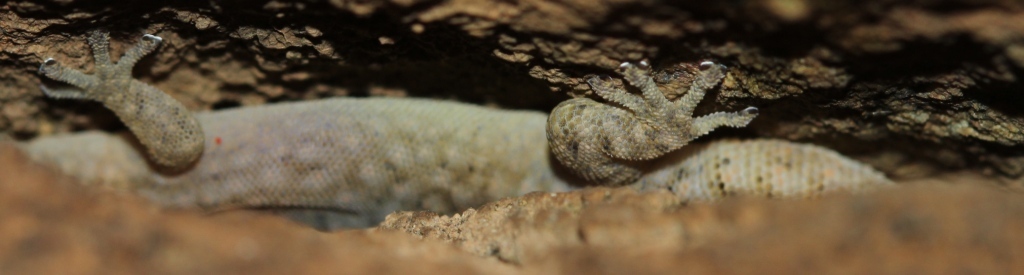
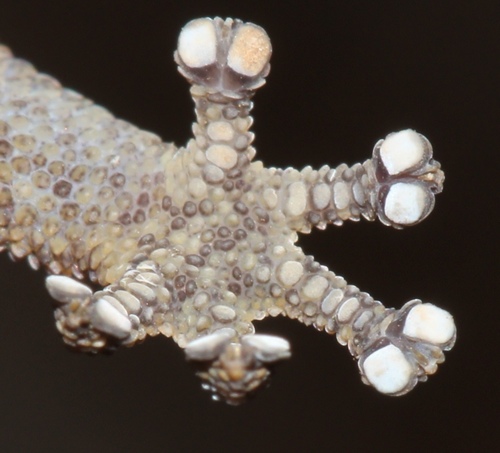
This species has adhesive toe pads, which allow them to stick onto even smooth surfaces, making them extremely good climbers (Branch, 1998). They also have strong legs, allowing for very rapid movements if necessary.
Carnivore - Insectivore (insect-eating)
Braack’s Pygmy Gecko is oviparous, with fameles laying two small eggs under sun-warmed rock flakes (Branch, 1998).
This species is nocturnal and hibernates in deep cracks when winter snow carpets the escarpment (Branch, 1998).
Nama-Karoo, Succulent Karoo
This map contains point-based occurrences at different locations
Occurrence in African countries and South African provinces. Residence status indicates if a taxon is indigenous, endemic, or alien in a specific region. This data is based on specimen records and literature.
FSA
SA
BOT
NAM
ESW
LES
WC
EC
NC
FS
GA
KZN
LP
MP
NW
Absent
Indigenous
Endemic
Naturalised
Invasive
Names and Sources
| Common Name | Language |
|---|---|
| Braack's Pygmy Gecko | En |
| Braack se Pigmeegeitjie | En |
No results found for Goggia braacki (Good, Bauer & Branch, 1996)
No data.
2 results for Goggia braacki (Good, Bauer & Branch, 1996)
This map contains point-based occurrences at different locations
1996
JOURNAL ARTICLE
A new species of Phyllodactylus (Squamata: Gekkonidae) from the Karoo National Park, South Africa.Branch, W., Good, D., Bauer, A.. 1996. A new species of Phyllodactylus (Squamata: Gekkonidae) from the Karoo National Park, South Africa. Vol. 45. . pp.49-58.
1998
BOOK
Field guide to snakes and other reptiles of southern AfricaBranch, B.. 1998. Field guide to snakes and other reptiles of southern Africa. Cape Town, South Africa.. Struik Publishers.
2014
BOOK
Atlas and Red List of the Reptiles of South Africa, Lesotho and SwazilandBates, M., Bauer, A., Marais, J., Burger, M., Alexander, G., de Villiers, M.. 2014. Atlas and Red List of the Reptiles of South Africa, Lesotho and Swaziland Vol. Suricata 1. Pretoria. South African National Biodiversity Institute pp..
2012
JOURNAL ARTICLE
Locomotion of ReptilesAlexander, R.. 2012. Locomotion of Reptiles Vol. 121 pp.1-4.
Status and criteria
LC
Assessor(s)
Michael Bates
Contributors
Josh Weeber
Reviewer(s)
Adrian Armstrong


