ANIMALIA / ARTHROPODA / INSECTA / ORTHOPTERA / ACRIDIDAE / ACRIDA / BICOLOR
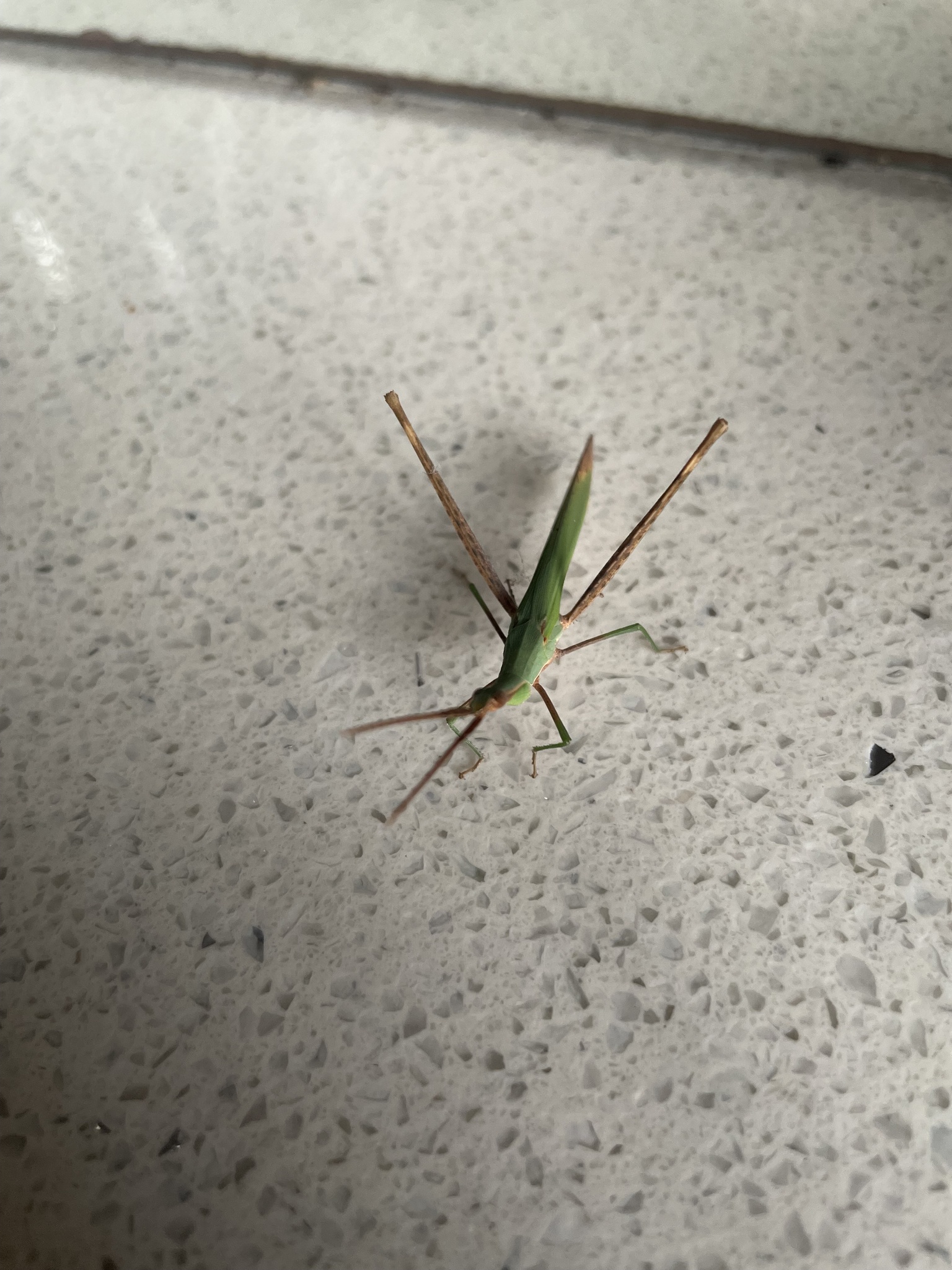
This description of this species is in Latin and extracted from Thunberg (1815). "viridis antennis, thoracis lineis quatuor hemelytrorumque dorso rufescentibus. Inter mediocres, sequipollicaris, virescens: antennis, lineis thoracis; dorso hemelytrorum; abdomine pedibusque testaceo-rufescentibus. Thoracis margo infimus et latera rufa, cum adjecta duplici dorsali linea atra, tribusque costis elevatis. Hemelytra inferne viridia, superne rufescentia". Reynecke (1941) described it as a form readily recognised by its slender body, tapering head, oval dark eyes dorso-ventrally compressed setaceous antennae and relatively long slender legs. The typical colour is green but ashen grey specimens are found in areas with dried vegetation. Length of males and females: about 40 and 50 mm. respectively.
Unknown
Unknown
This species is found in Africa (i.e. South Africa, Lesotho); the Mediterranean region of Europe and the Middle East (Naran & Bazelet 2013).
In South Africa, this species is found in the Western Cape, KwaZulu-Natal and Eastern Cape Provinces (Naran & Bazelet 2013).
Grasshoppers usually move by walking or jumping, but most adults fly, often exposing brightly coloured hindwings. Their adaptations for movement include the forewings (called tegmina) which are thickened and with numerous veins; the hind wings also contain many veins but are membranous, fanlike, and folded when in repose. Most orthopterans display hind legs enlarged and adapted for jumping (Gibb et al. 2006). However, in this species, adult specimens are wild and take to the wing very quickly, settling about 10 or more yards further. They are occasionally seen crawling about and could perhaps be mistaken for young mantids by the uninitiated (Reynecke 1941).
Herbivore - Graminivore (grass-eating)
Orthopterans have well-developed mandibles and their mouthparts are adapted for chewing. They are mainly herbivorous, favouring a range of grasses and often consuming more even than antelope and cattle (up to 130 kg of grass yearly per hectare) (Gibb et al. 2006; Picker et al. 2012).
Very little is known of the life history of this species. Females have been observed ovipositing in low-lying sandy areas, during the mid-summer months. Hoppers of the first instar were observed on 5/2/41; those of the third on 7/9/39, fourth on 15/9/39, 20/10/39 and 22/6/40, and fifth on 27/9/39 (Reynecke 1941).
Unknown
Fynbos, Grassland
This map contains point-based occurrences at different locations
Occurrence in African countries and South African provinces. Residence status indicates if a taxon is indigenous, endemic, or alien in a specific region. This data is based on specimen records and literature.
FSA
SA
BOT
NAM
ESW
LES
WC
EC
NC
FS
GA
KZN
LP
MP
NW
Absent
Indigenous
Endemic
Naturalised
Invasive
Names and Sources
Acrida bicolor ((Thunberg, 1815))
Acrida orientalis
Author: (Bolívar, 1919)
Acrida algeriana
Author: (Dirsh, 1949)
Acrida bosphorica
Author: (Dirsh, 1949)
Acrida deminuta
Author: (Bolívar, 1922)
Acrida leopoldi
Author: (Sjöstedt, 1934)
Acrida lombardica
Author: (Dirsh, 1949)
Acrida tesselata
Author: (Sjöstedt, 1931)
Acrida palaestina
Author: (Dirsh, 1949)
Acrida pellucida
Author: (Klug, 1830)
Acrida stalii
Author: (Bolívar, 1893)
| Common Name | Language |
|---|---|
| The Long-headed Green Grasshopper |
Classification
KINGDOM Animalia
PHYLUM Arthropoda
CLASS Insecta
ORDER Orthoptera
FAMILY Acrididae
GENUS Acrida
SPECIES bicolor
No results found for Acrida bicolor (Thunberg, 1815)
Unknown
2 results for Acrida bicolor (Thunberg, 1815)
This map contains point-based occurrences at different locations
1941
JOURNAL ARTICLE
Notes on some common Karroo grasshoppersReynecke, AL. 1941. Notes on some common Karroo grasshoppers Vol. 4 pp.197–205.
1870
JOURNAL ARTICLE
"On a new species of roller (Coracias) from the Zambesi".TRIMEN, R.. 1870. "On a new species of roller (Coracias) from the Zambesi". Vol. 29(5). London. pp.238.
2006
BOOK
Arthropod collection and identification laboratory and field techniquesGibb, Timothy, Oseto, Christian. 2006. Arthropod collection and identification laboratory and field techniques. Academic Press.
2020
WEB ARTICLE
Orthoptera Species File Version 2020Cigliano, MM, Braun, H, Eades, DC, Otte, D. 2020. Orthoptera Species File Version 2020.
2013
WEB ARTICLE
Checklist of South African OrthopteraBazelet, CS, Naran, D. 2013. Checklist of South African Orthoptera Vol. . Pretoria. South African National Biodiversity Insitute.
1815
BOOK
Hemipterorum maxillosorum genera illustrata plurimisque novis speciebus ditata ac descripta.Thunberg, CP. 1815. Hemipterorum maxillosorum genera illustrata plurimisque novis speciebus ditata ac descripta. Vol. 5 pp.211-301.