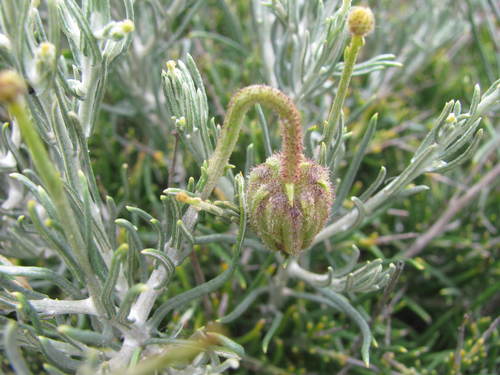
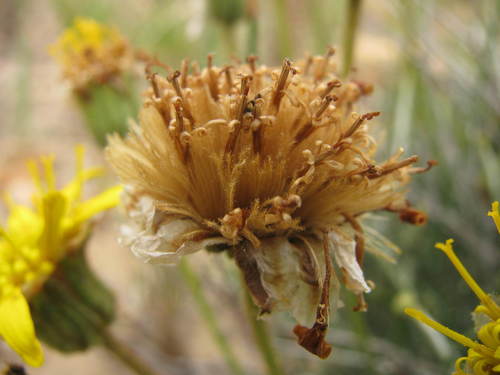
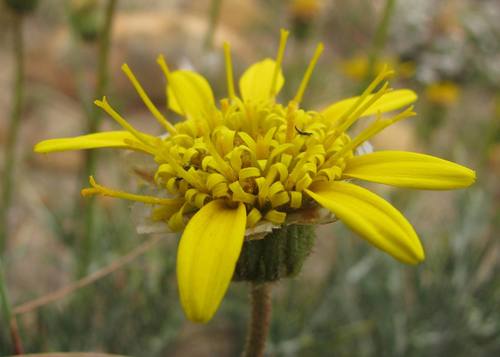
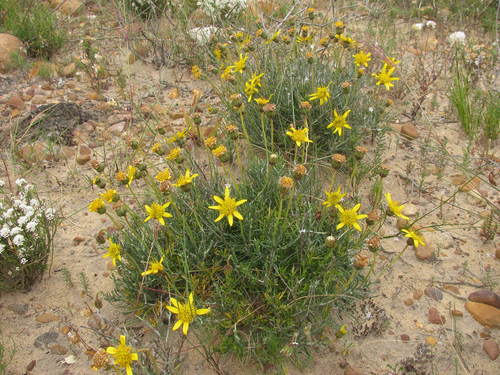
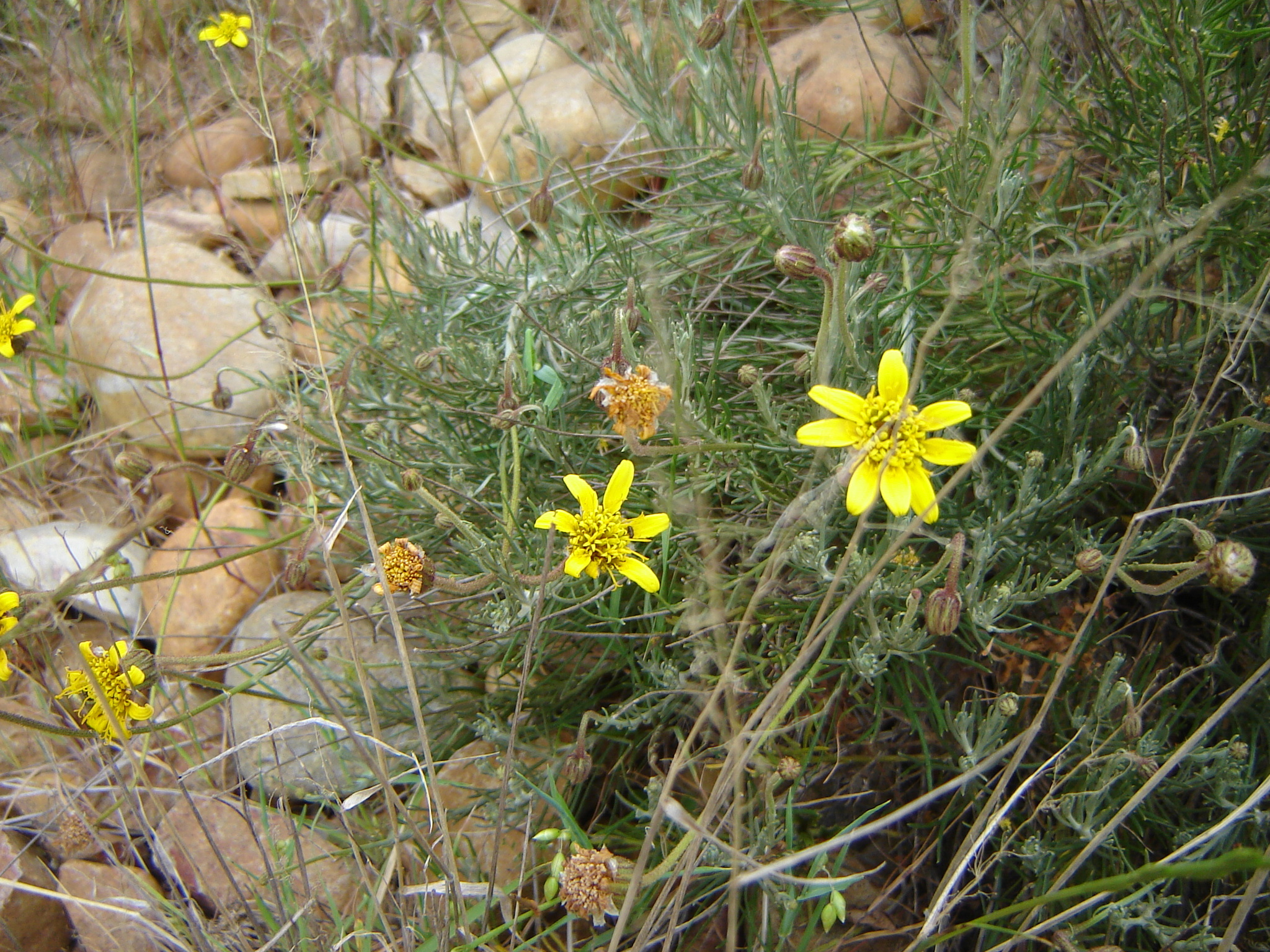
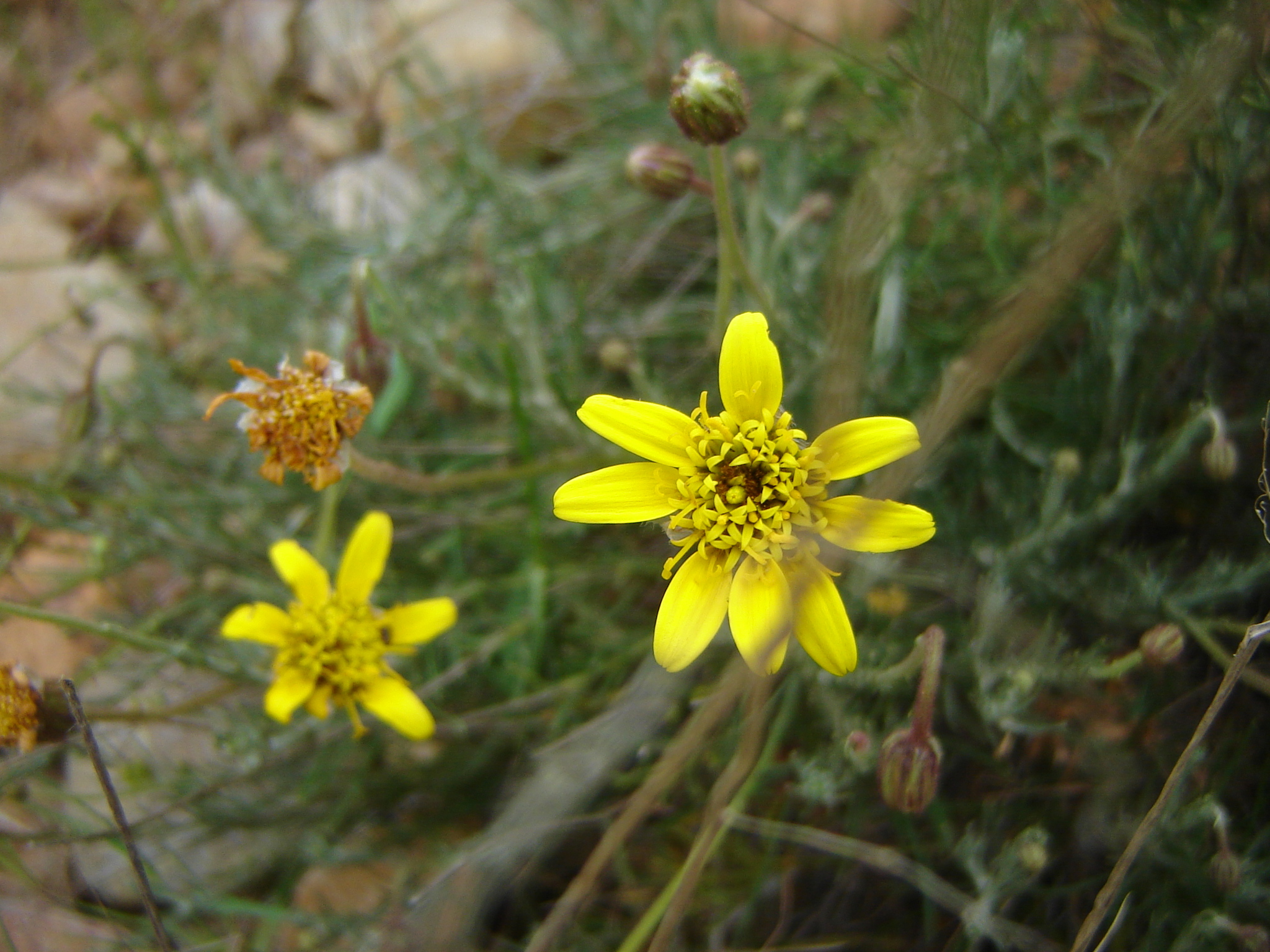
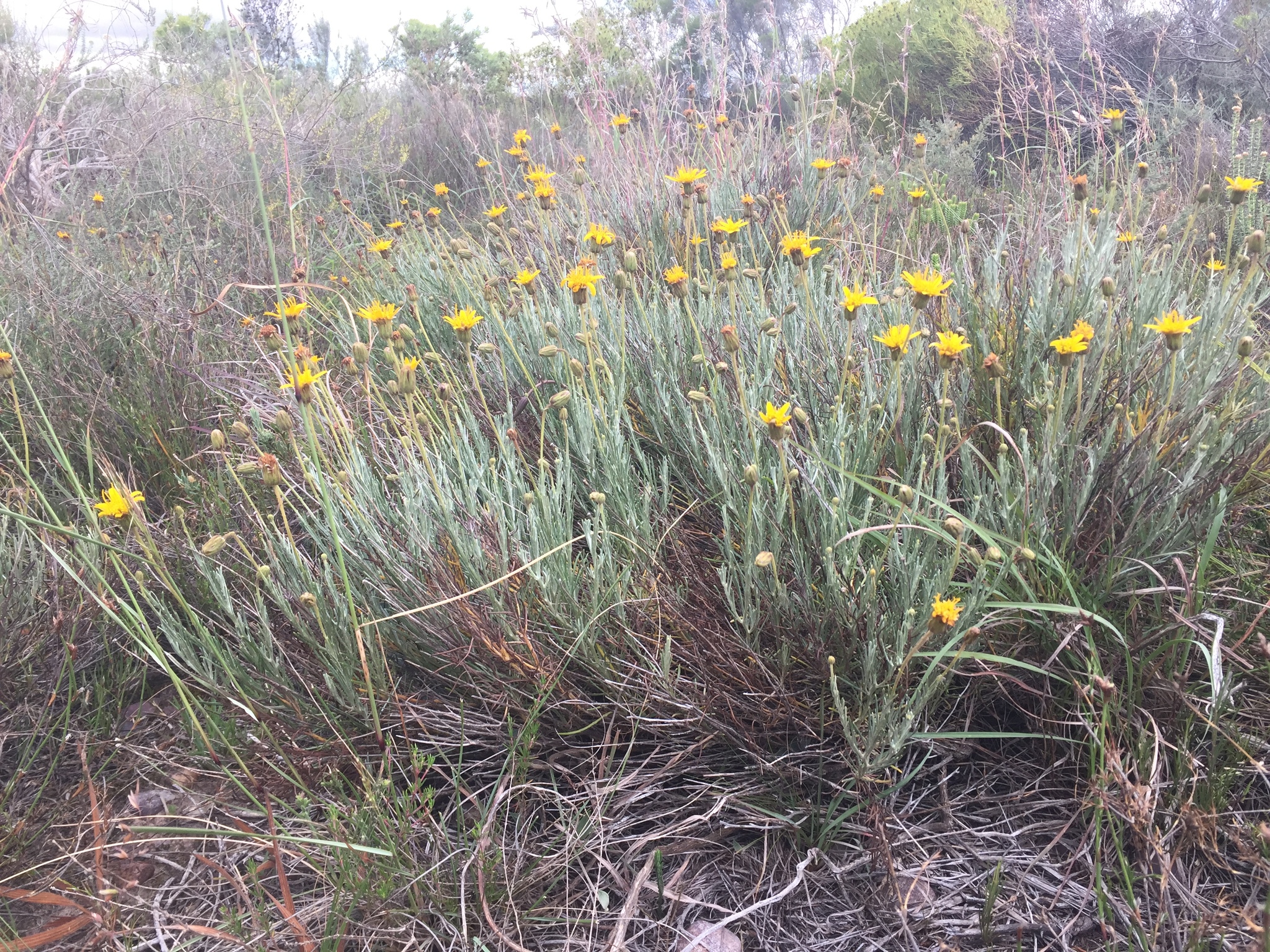
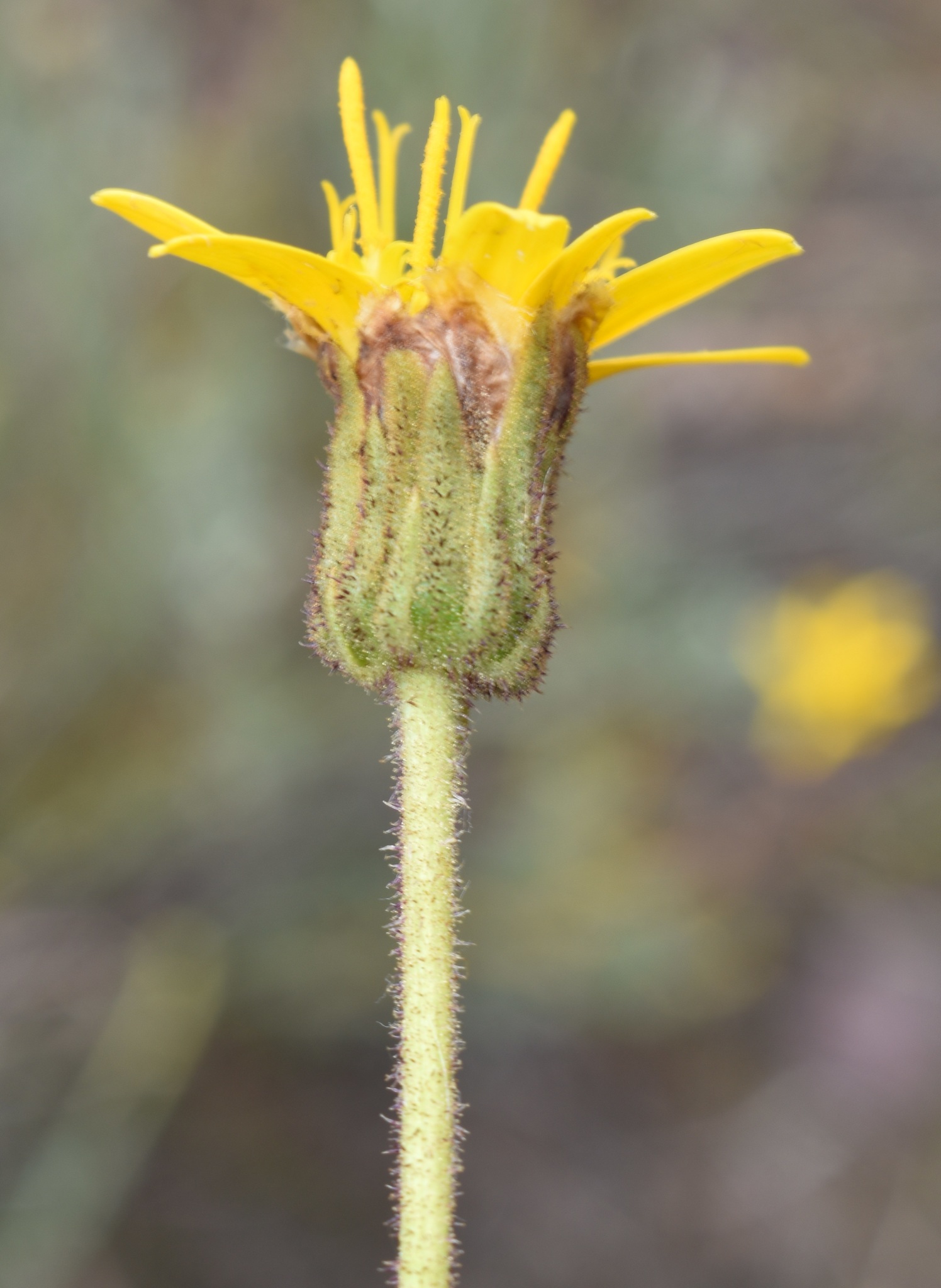
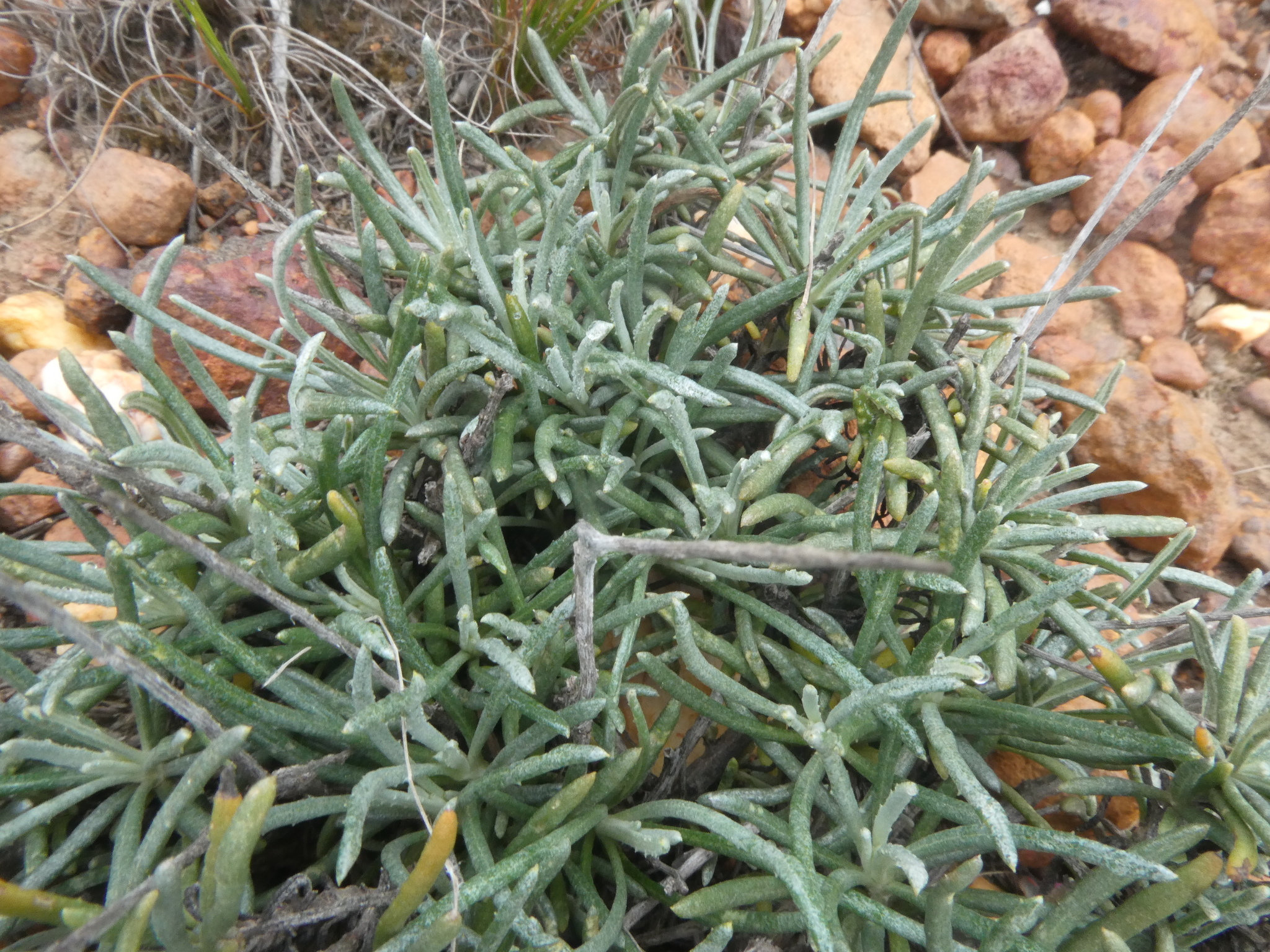
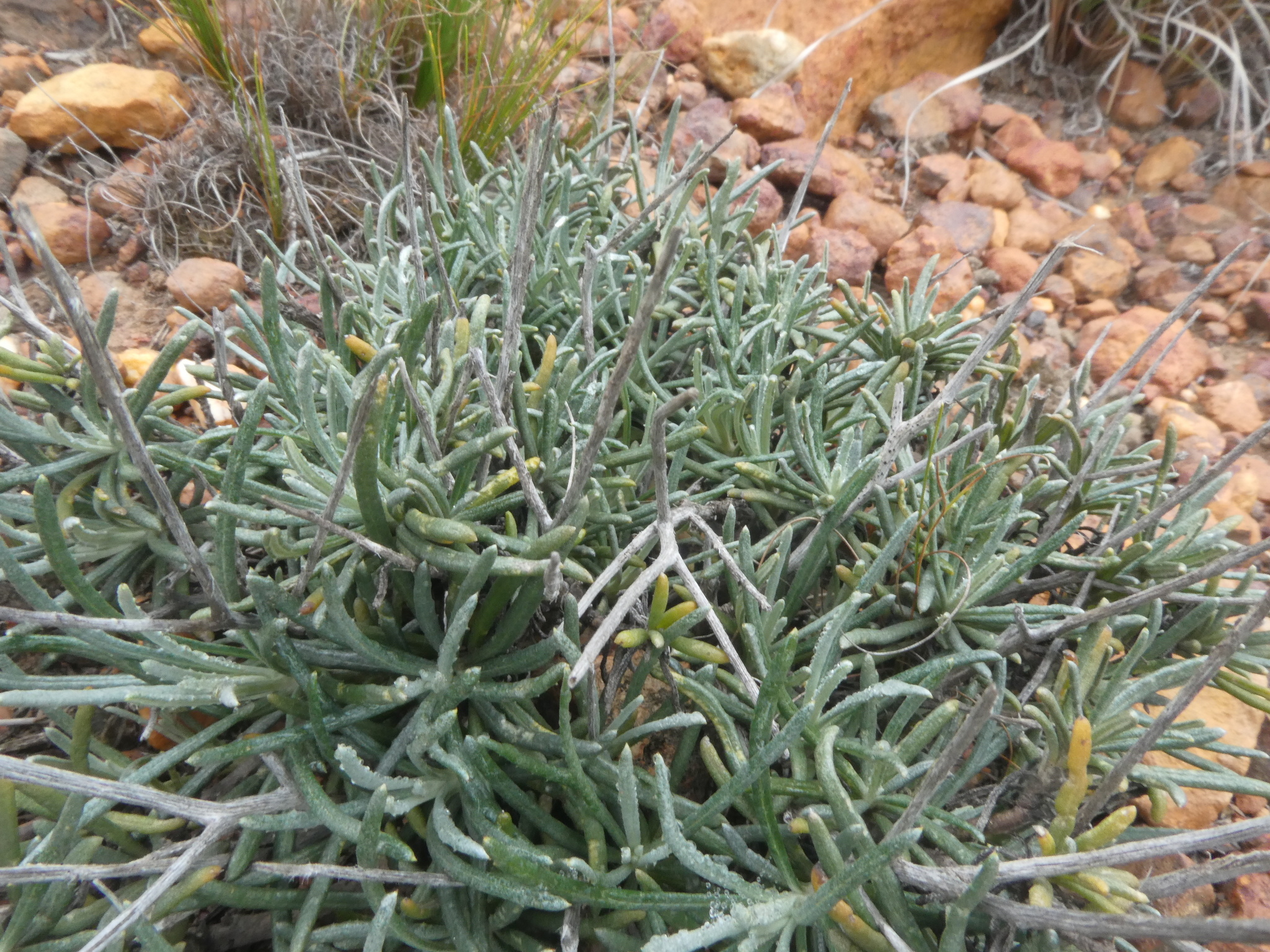
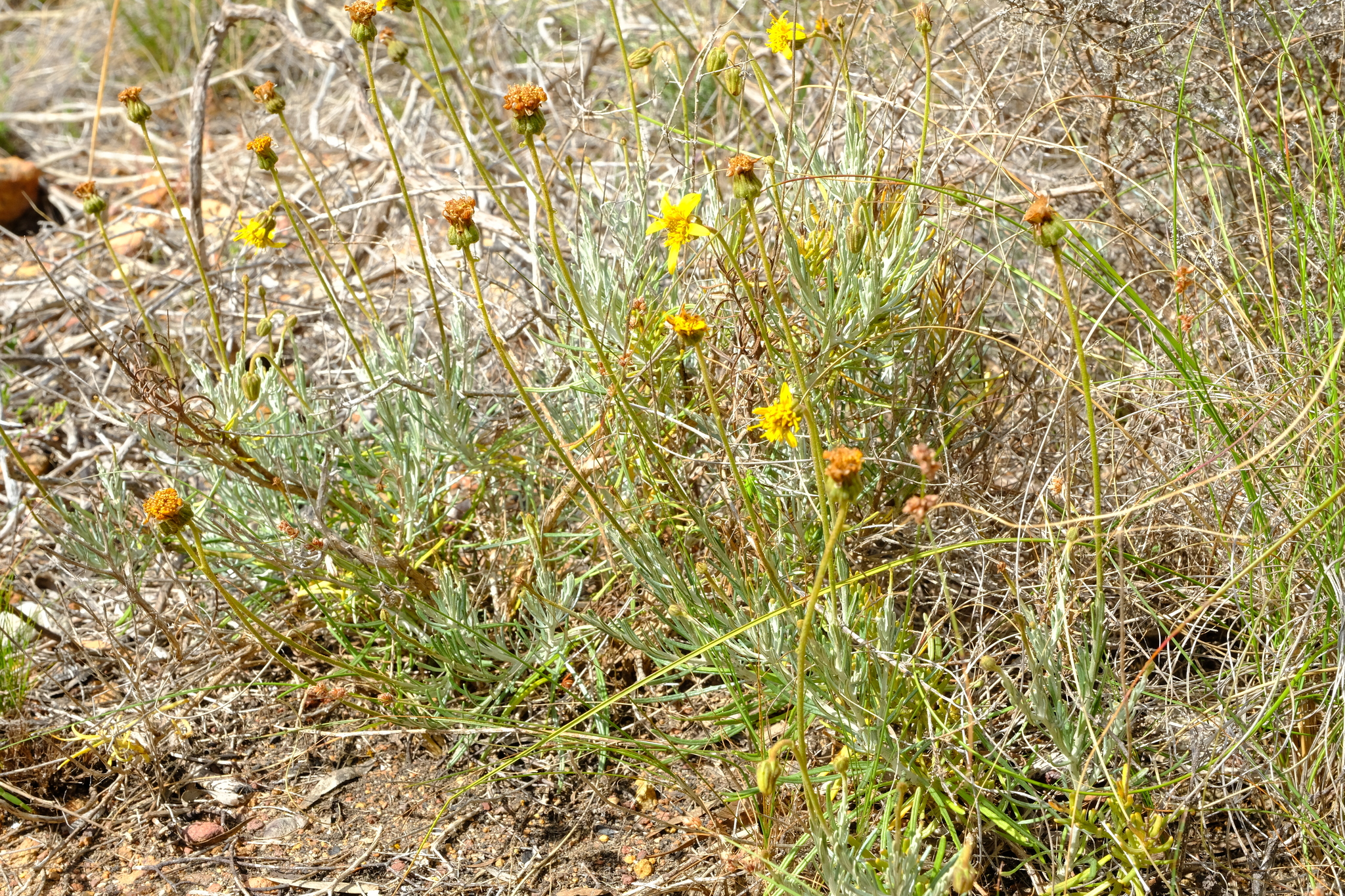
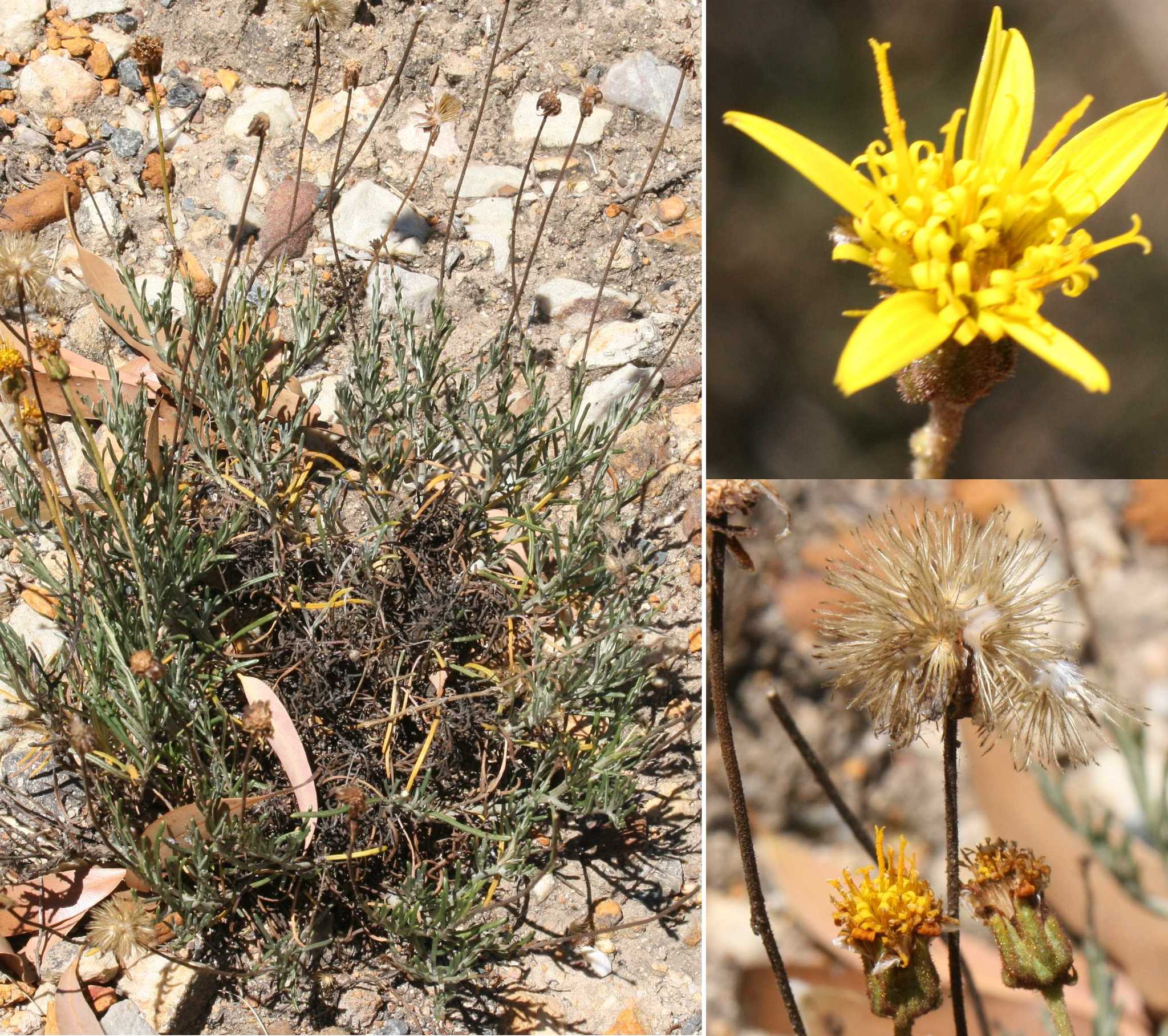
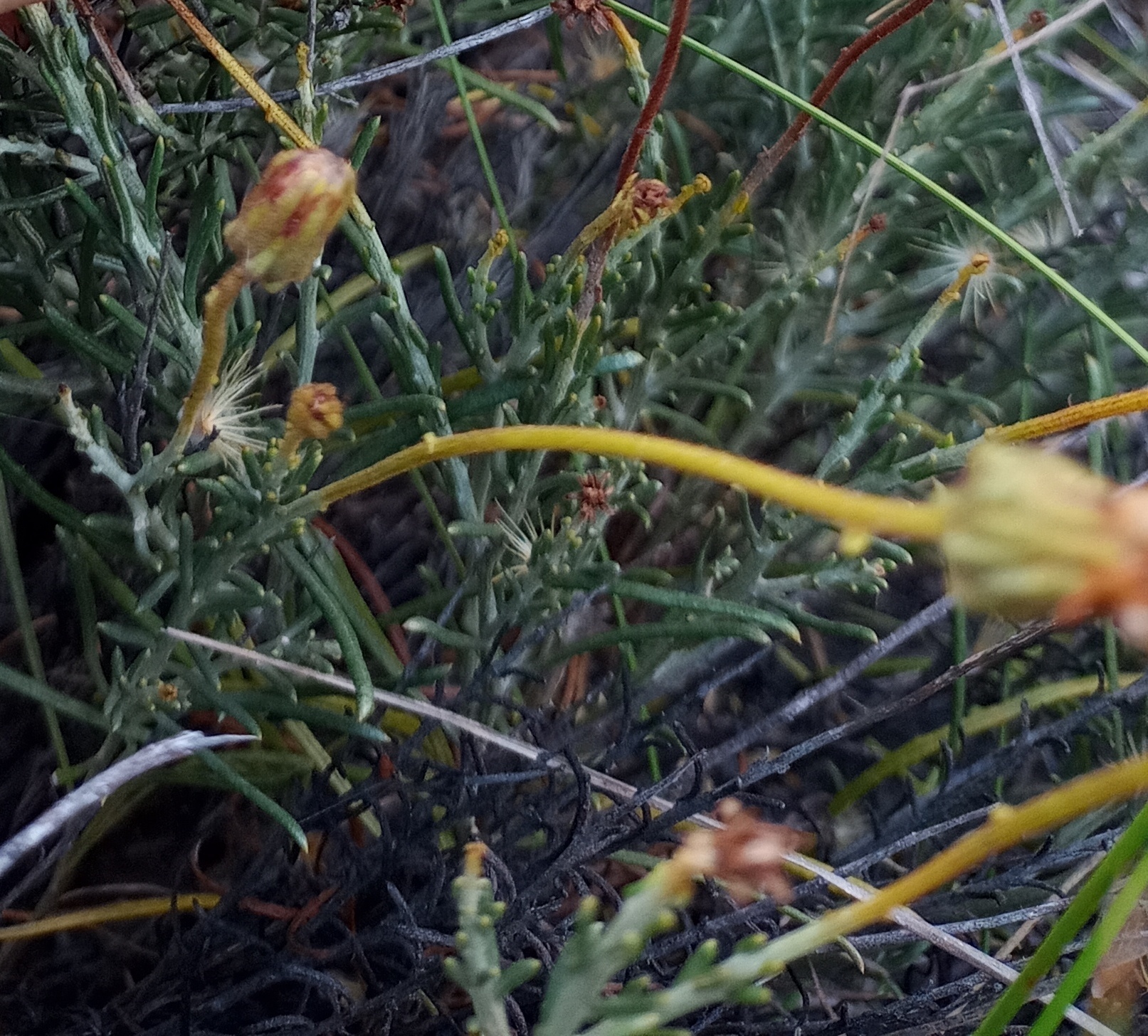
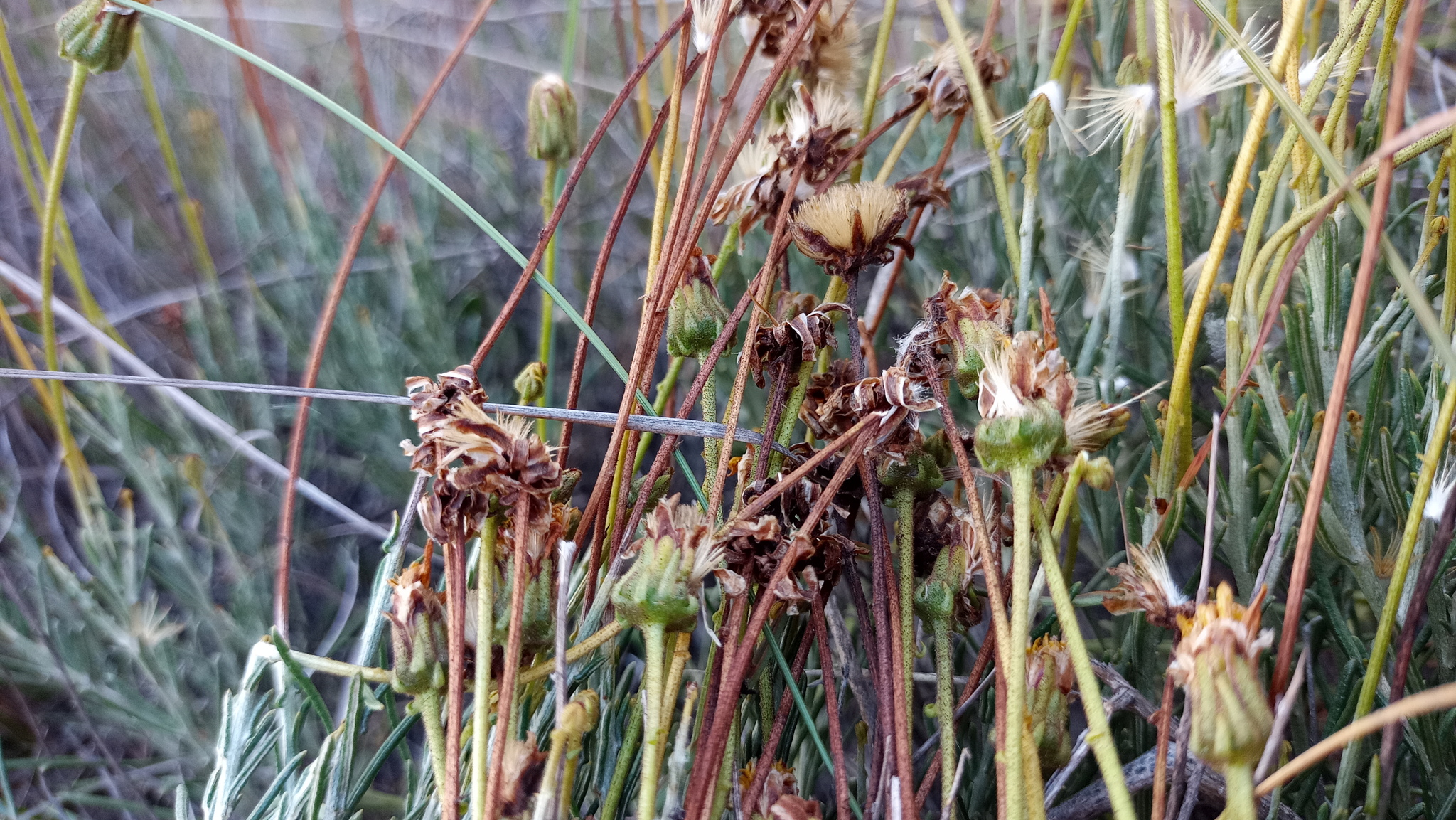
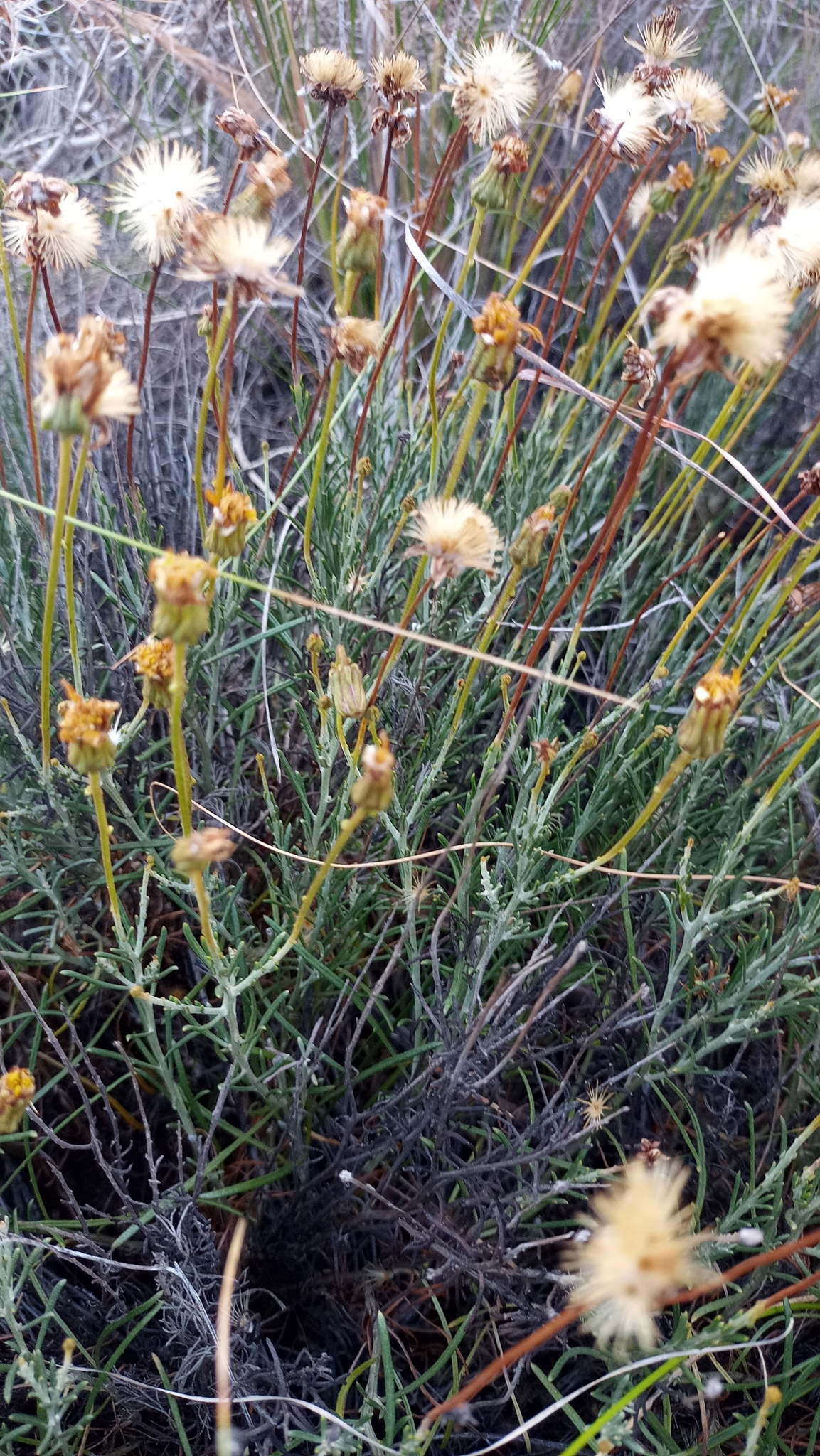
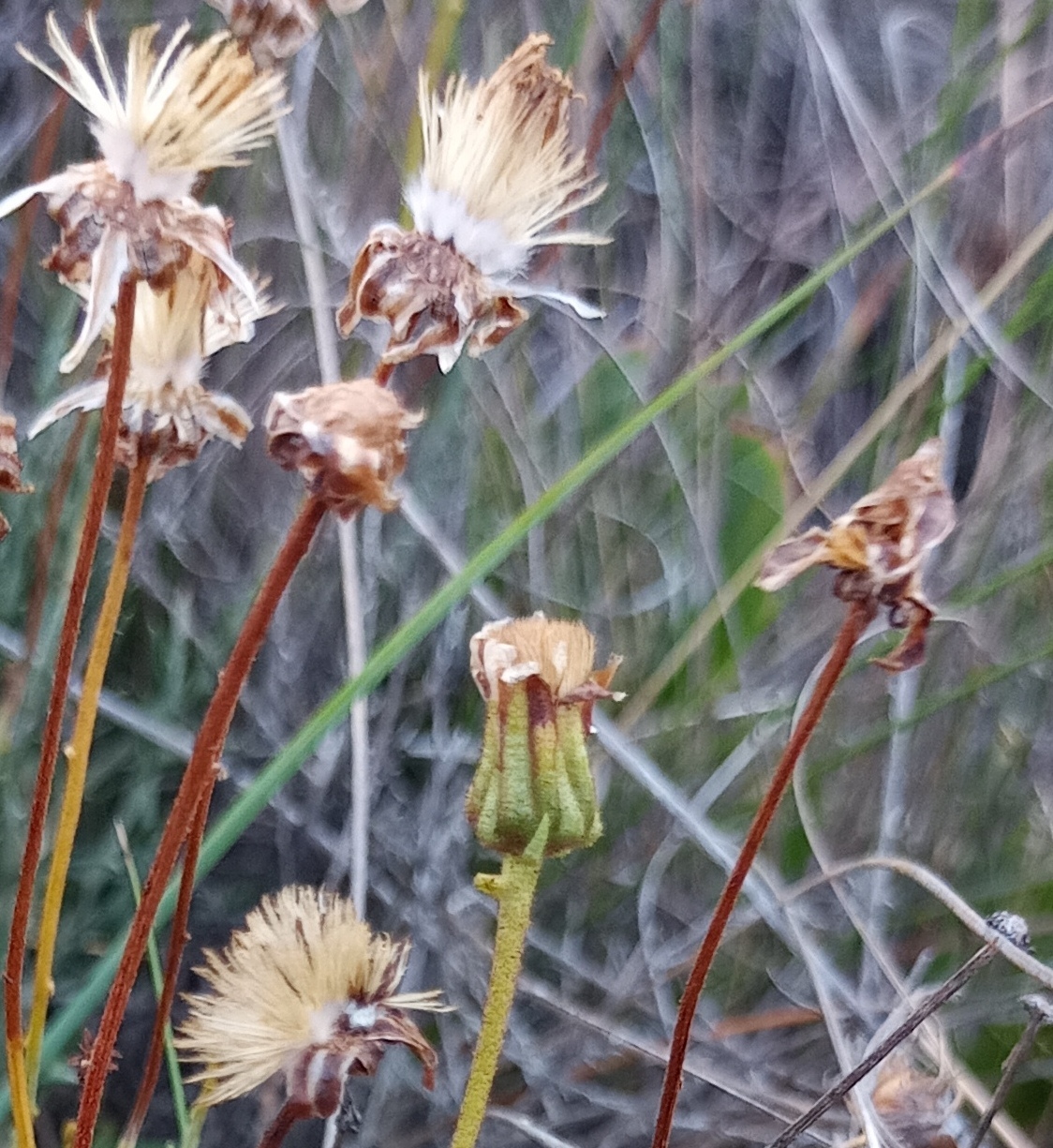
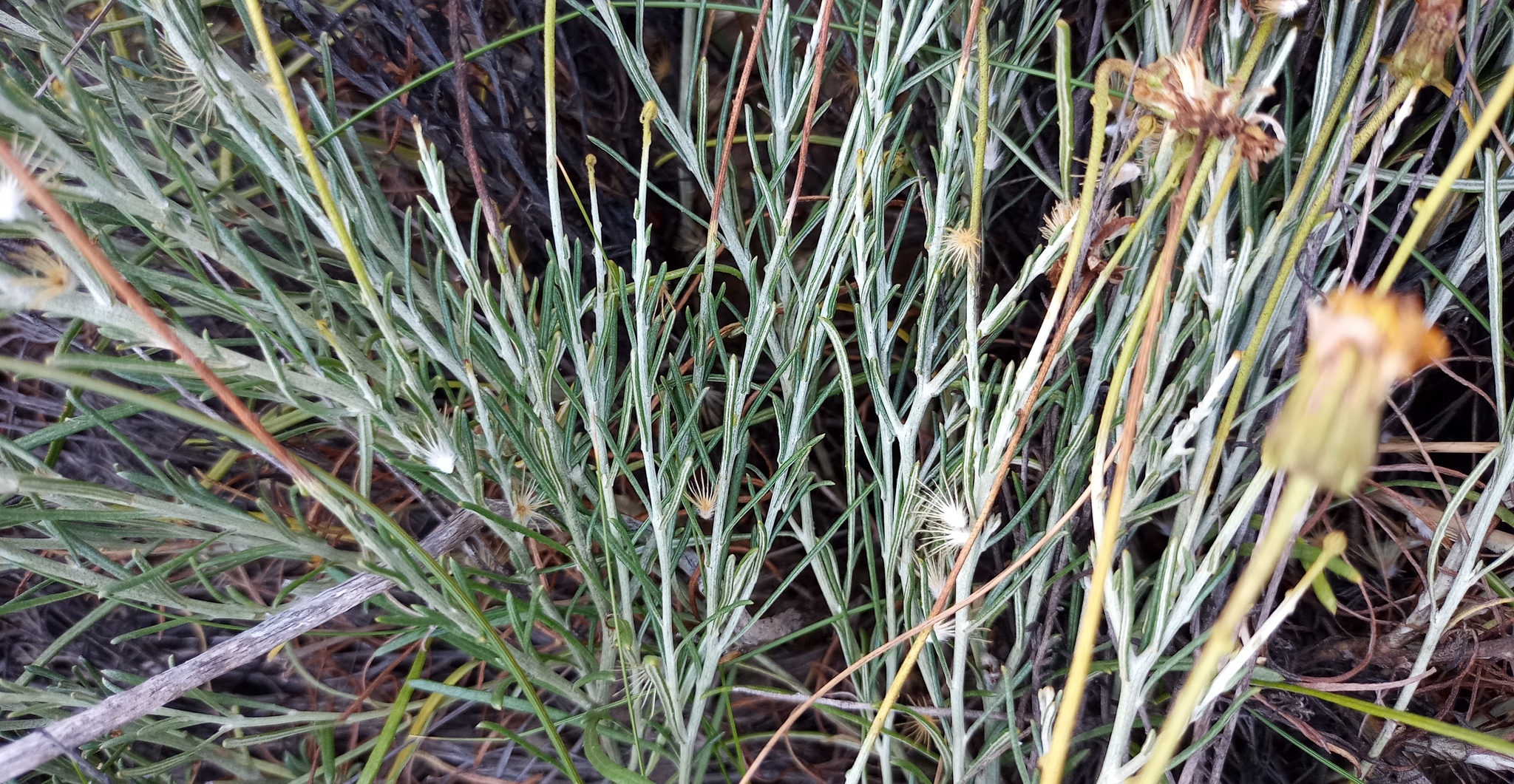
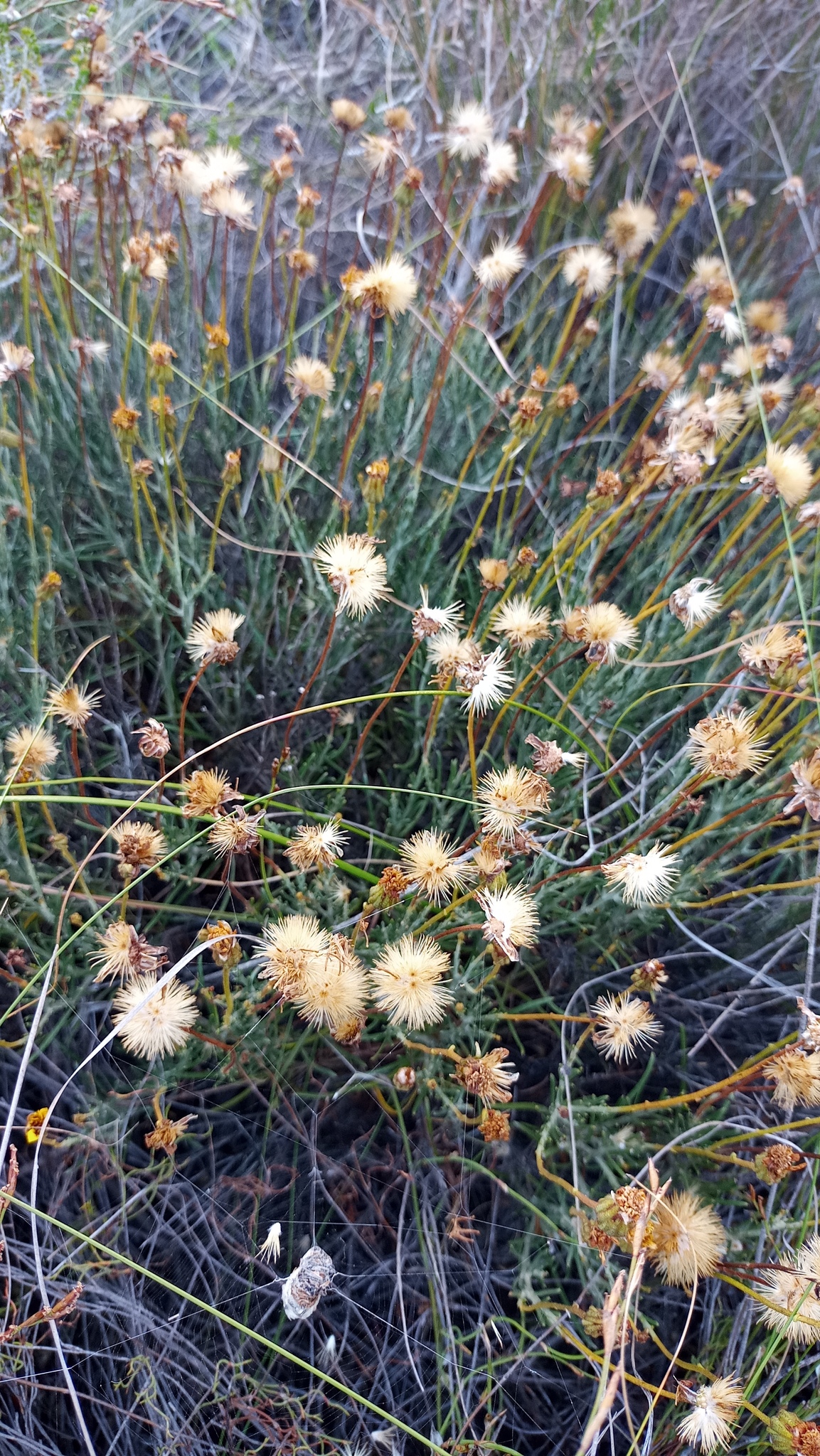
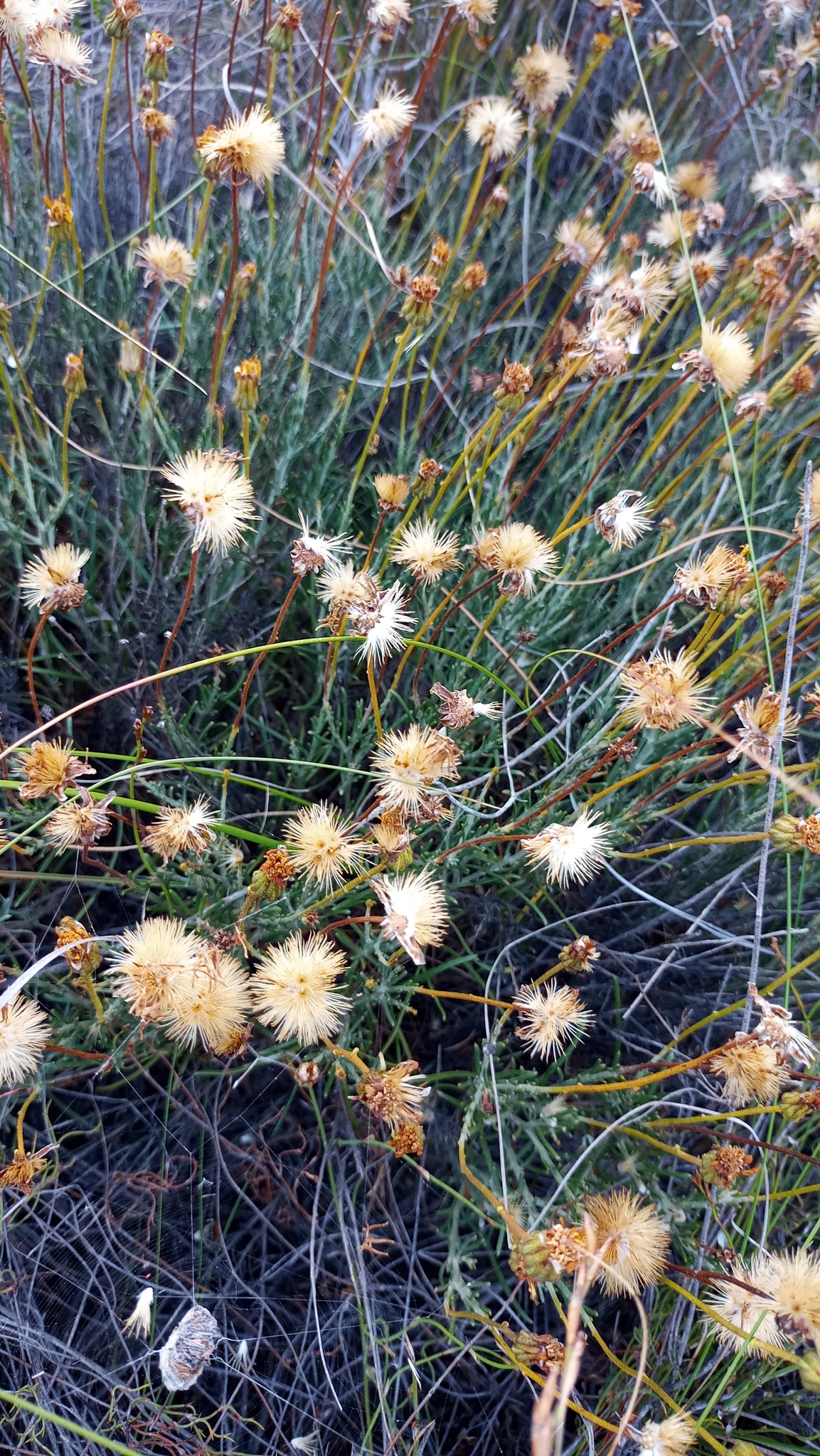
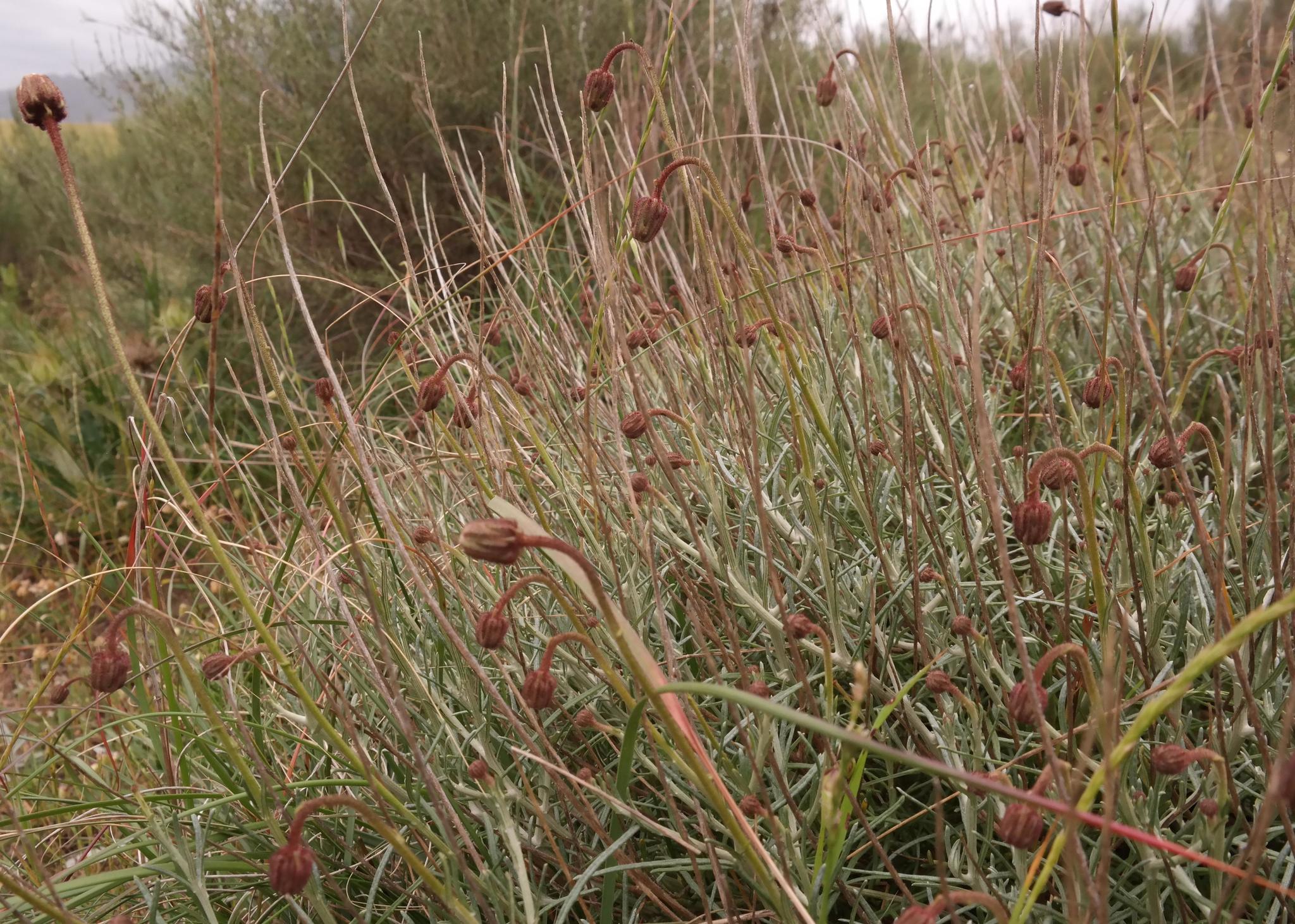
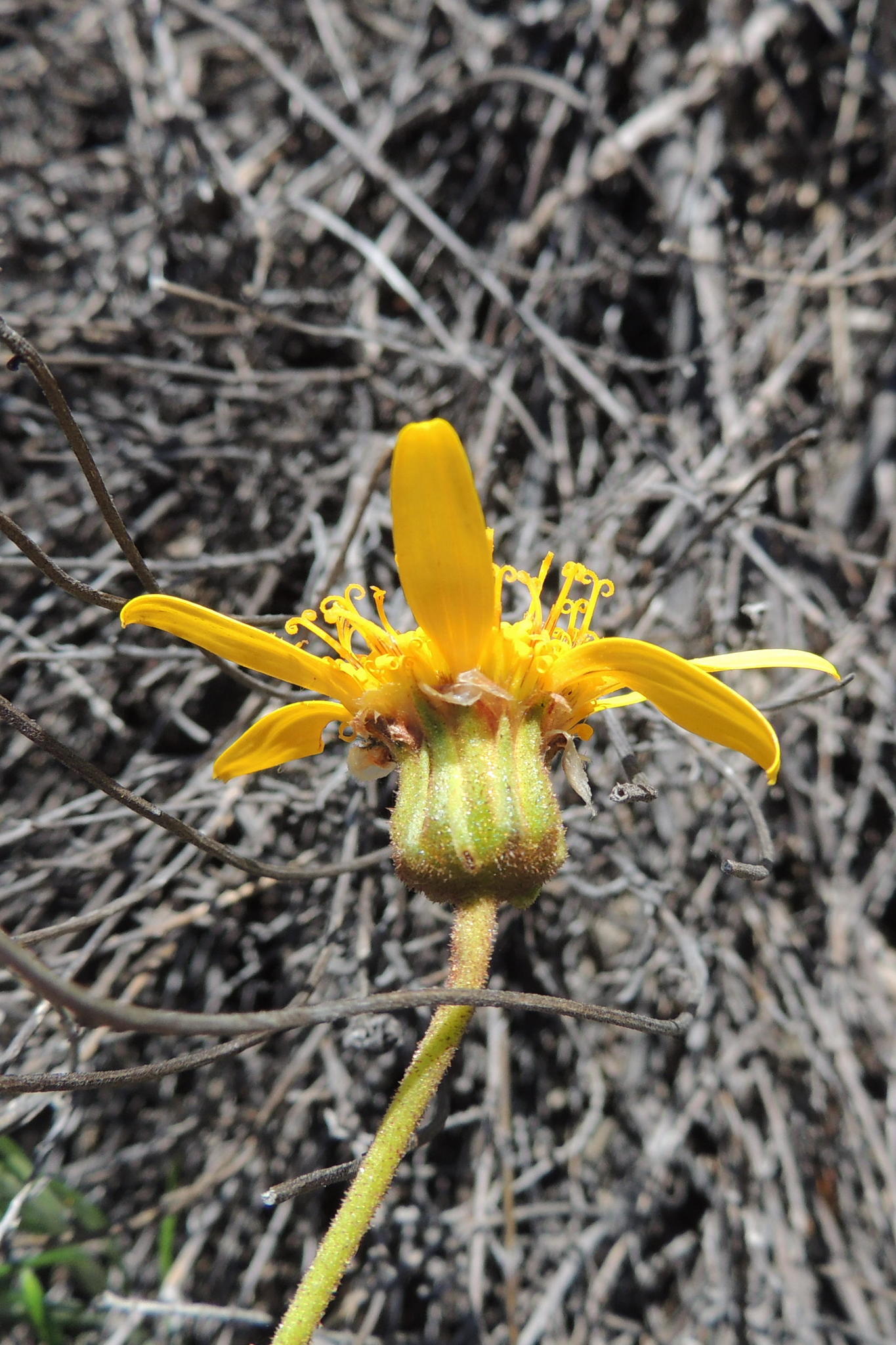
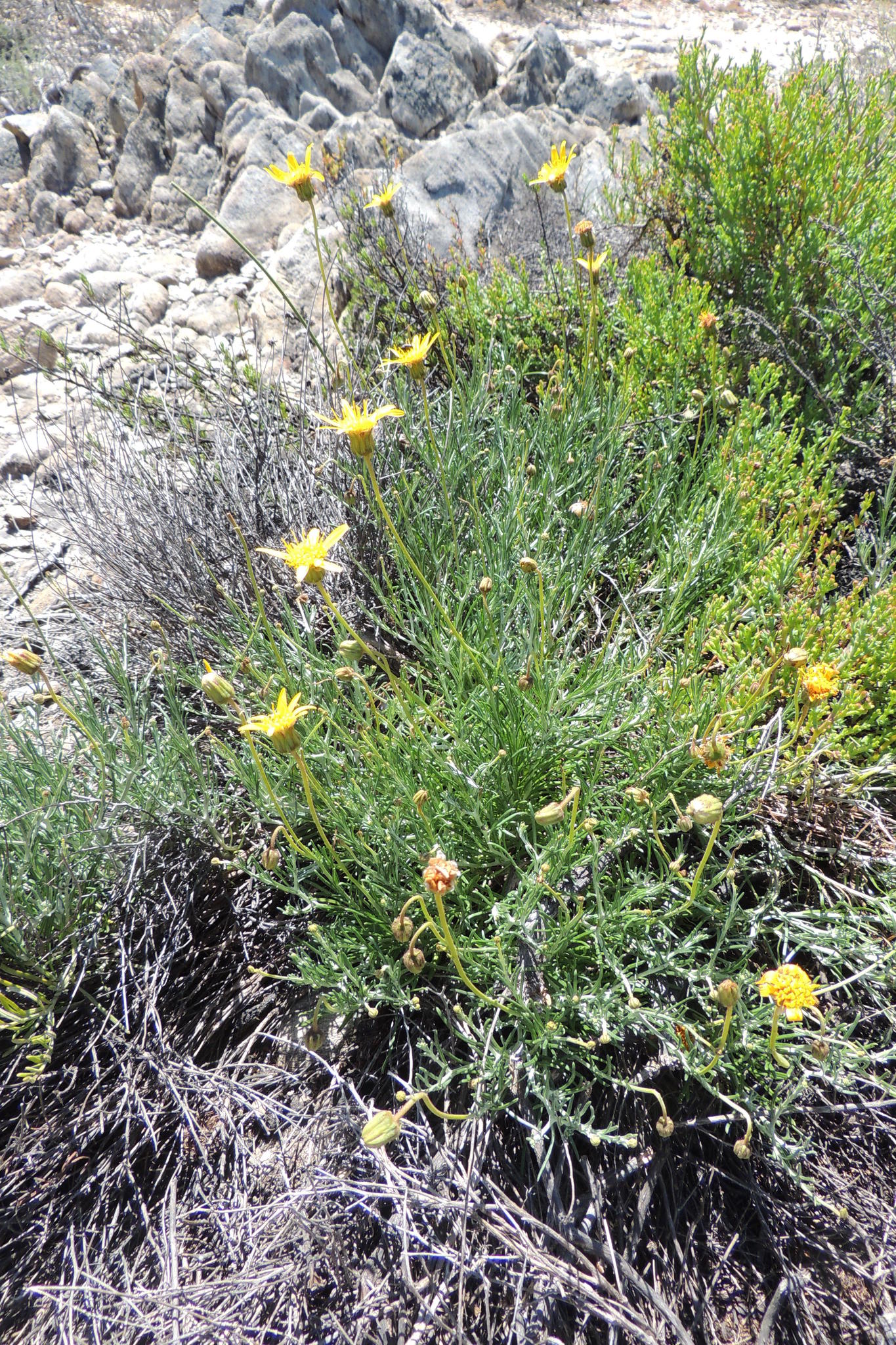
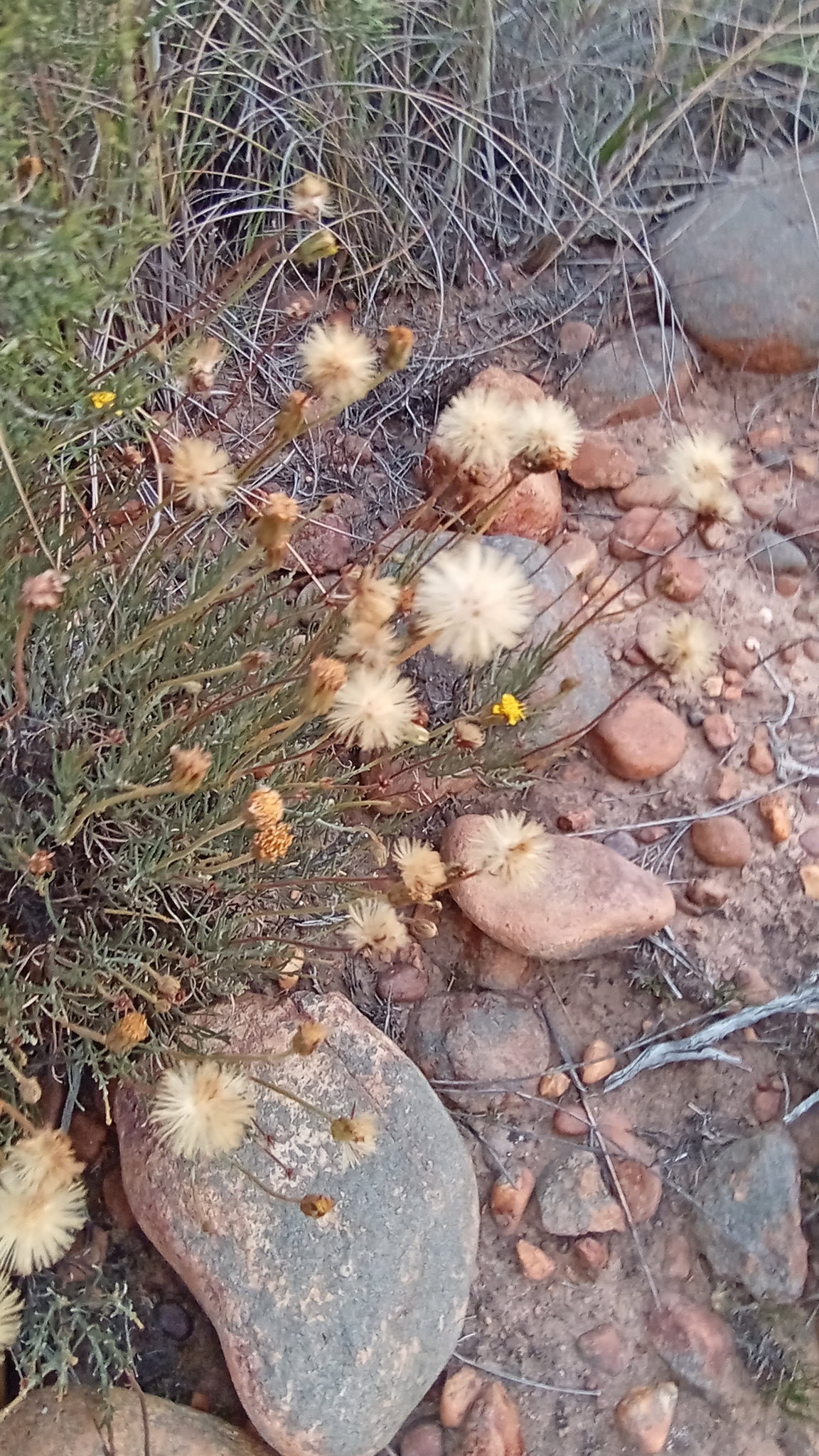
Habit: sparsely-branched, twiggy shrublet 0.20-1.0 m high. Stems: younger stems slender and pale with a dense white-woolly indumentum; older stems with thin dark bark; longitudinally striate, eglandular. Leaves: borne mainly on the lower stems, loosely imbricate, erect or erect-spreading, linear, lower leaves 20-60 x 1.5-2.0 mm, leaves decreasing in length acropetally, upper leaves <10 mm long; sessile, obscurely auricled at base, apex bluntly acute, somewhat thickened and leathery, margins strongly revolute and covering the edges of the abaxial surface, with small sparse marginal teeth or sometimes entire, adaxial surface grey-green, glabrous to glabrescent, abaxial surface densely white-tomentose except on midrib which is prominent and green. Peduncle: 40-190 mm long when mature, elongating rapidly on floral maturation, bearing one or two minute leaflike bracteoles; not woolly or only sparsely so; reddish-brown, faintly striate and densely invested with very fine to stout stalked trichomes (type A). Capitula: radiate, occasionally discoid, in pressed specimens mature heads are 12-35 mm in diameter including expanded rays, containing ± 25-42 discs and ± 6-12 rays (based on dissection of heads from two specimens). Involucre: 8-15 mm across, green, fleshy portion of bracts glabrous or sparsely white-woolly, as well as densely glandular with trichomes of type A. Outermost bracts narrowly deltoid-lanceolate, free portion 4-6 x 1.0-1.2 mm, innermost bracts with free portion 14-18 x 2.5-5 mm. Receptacle: alveole margin projections irregular and slightly thickened. Ray florets: corolla golden yellow, tube with stalked trichomes of type B, lamina 3-4 x 8-12 mm. Point at which style sweeping-hair covering begins is unmarked by any swelling or hair tuft. Style branches short, broadly acute. Sterile anthers reduced, with no or very short filaments. Cypsela and pappus as in disc florets. Disc florets: golden yellow, 10 mm long, tube sparsely covered in elongate, multicellular clavate-tipped trichomes (type B); corolla lobes broadly acute, 2-3 mm in length, strongly recurved after anthesis, abaxially invested with blunt-ended multicellular trichomes (type C) near apex. Style exserted ± 6 mm beyond corolla tube; point at which sweeping-hair covering begins marked by a ring of longer hairs. Style branches short, broadly acute. Anther tube narrow, apical anther appendages thin, flat, short, obtuse, with a central patch of pigmented cells; anther bases sagittate with elongate, rounded tails. Pappus: of approximately 25-35 straw-coloured or black-tinged bristle-like scales, inner series coming to about halfway up the corolla lobes, outer series shorter than this, to between half and three-quarters of the length of the inner. Pappus scales fused at base, individual bristles conspicuously widened near base (to about 0.5 mm wide), tapering towards apex. Bristle margins and apex plumose, plumes upwardly-directed. Cypsela: twin-hairs straw-coloured or reddish-brown. Flowers mainly in early summer, with the peak flowering period in October and November, tailing off in December. However, flowering specimens have been collected in several other months (January, February, June, July and September). From: Bergh, NG; McKenzie, RJ. 2016. A revision of Heterolepis Cass. (Asteraceae: Cichorioideae). S. African J. Bot. 105: 194-210. [http://dx.doi.org/10.1016/j.sajb.2015.12.004] [Copyright held by the South African Association of Botanists (2016); http://www.sciencedirect.com/science/journal/02546299] [CC BY]
Like H. aliena but flower heads on elongate peduncles. From: Manning, JC; Goldblatt, P. 2012. Asteraceae: Heterolepis Cass. In: J Manning & P Goldblatt (eds), Plants of the Greater Cape Floristic Region 1: The Core Cape flora. Strelitzia 29: 389-389. South African National Biodiversity Institute, Pretoria. [CC BY]
Heterolepis peduncularis is most easily confused with the discoid-headed H. anomala. However, H. anomala has thicker leaves that do not noticeably decrease in length upwards on the stem, and also has a very narrow distribution range only on the northern slopes of the Langeberg in the Garcia's Pass area. Heterolepis peduncularis is distinguished from the remaining members of the genus by its long peduncles, usually 100 mm or longer, and by its lax, slender leaves that decrease in length moving acropetally up the stem. It is a plant with a very ‘straggly’ appearance, which is probably exacerbated by grazing. Several collectors noted an aromatic or sharp odour associated with this species, with one collector classifying the odour as lanolin, and another as apples. One specimen of (le Roux 1452, collected between Worcester and Robertson) has discoid heads. However, in all other characteristics, this is clearly H. peduncularis. From: Bergh, NG; McKenzie, RJ. 2016. A revision of Heterolepis Cass. (Asteraceae: Cichorioideae). S. African J. Bot. 105: 194-210. [http://dx.doi.org/10.1016/j.sajb.2015.12.004] [Copyright held by the South African Association of Botanists (2016); http://www.sciencedirect.com/science/journal/02546299] [CC BY]
Grows in soil in open scrubland in South Coast renosterveld vegetation, or possibly in the renosterveld-fynbos transition. Recorded substrates are frequently a mixture of shales and sandstone, for example, collectors note the substrate type to be shale overlain by Table Mountain Sandstone gravel, or silcrete. Renosterveld vegetation is frequently noted on herbarium labels, as is rocky, loamy soil and occurrence on flats or flat areas. From collector's notes it seems that post-fire resprouting may be present in H. peduncularis, although it is not known to what extent this is obligatory. From: Bergh, NG; McKenzie, RJ. 2016. A revision of Heterolepis Cass. (Asteraceae: Cichorioideae). S. African J. Bot. 105: 194-210. [http://dx.doi.org/10.1016/j.sajb.2015.12.004] [Copyright held by the South African Association of Botanists (2016); http://www.sciencedirect.com/science/journal/02546299] [CC BY]
Rocky slopes. From: Manning, JC; Goldblatt, P. 2012. Asteraceae: Heterolepis Cass. In: J Manning & P Goldblatt (eds), Plants of the Greater Cape Floristic Region 1: The Core Cape flora. Strelitzia 29: 389-389. South African National Biodiversity Institute, Pretoria. [CC BY]
Occurs almost entirely on the Southern Cape coastal platform south of the east-west trending Cape Fold ranges (Langeberg and Riviersonderend mountains), but there are collections from between Worcester and Touwsriver, and from the Warmwaterberg area in the Little Karoo. From: Bergh, NG; McKenzie, RJ. 2016. A revision of Heterolepis Cass. (Asteraceae: Cichorioideae). S. African J. Bot. 105: 194-210. [http://dx.doi.org/10.1016/j.sajb.2015.12.004] [Copyright held by the South African Association of Botanists (2016); http://www.sciencedirect.com/science/journal/02546299] [CC BY]
Hex River Mtns to Hottentots Holland Mtns, Potberg to Langeberg. From: Manning, JC; Goldblatt, P. 2012. Asteraceae: Heterolepis Cass. In: J Manning & P Goldblatt (eds), Plants of the Greater Cape Floristic Region 1: The Core Cape flora. Strelitzia 29: 389-389. South African National Biodiversity Institute, Pretoria. [CC BY]
September to December
50 to 430 m
This map contains point-based occurrences at different locations
Occurrence in the Flora of Southern Africa (FSA) countries and South African provinces. Residence status indicates if a taxon is indigenous, endemic, naturalised or invasive in a specific region. This data is based on specimen records and literature
FSA
SA
BOT
NAM
ESW
LES
WC
EC
NC
FS
GA
KZN
LP
MP
NW
Absent
Indigenous
Endemic
Naturalised
Invasive



Names and Sources
Classification
KINGDOM Plantae
SUBKINGDOM Phanerogamae
PHYLUM Anthophyta
ORDER Asterales
FAMILY Asteraceae
SUBFAMILY Cichorioideae
TRIBE Incertae Sedis
GENUS Heterolepis
SPECIES peduncularis
32 results for Heterolepis peduncularis DC.
Barcode: PRE0705119-0 Collector(s) & number: Bohnen, P, 8557 | 1985-6-29
South Africa, Western Cape, RIVERSDALE; MEENT
Data Resource: BODATSA View record
Barcode: NBG1465344-2 Collector(s) & number: Bergh, NG, 2043 | 2009-10-2
South Africa, Western Cape, Langeberg. S of Garcias Pass. Farm Vetrivier. Pasture land west of Pass road.
Data Resource: BODATSA View record
Barcode: PRE0778767-0 Collector(s) & number: Schutte, AL, 759B | 1991-12-29
South Africa, Western Cape, Heidelberg Hill N of Verkykerskop road between Malgas and Heidelberg
Data Resource: BODATSA View record
Barcode: PRE0619631-0 Collector(s) & number: Mauve, AA, 196 | 1981-10-12
South Africa, Western Cape, RIVERSDALE; 2 KM ONTO KWEEKKRAAL
Data Resource: BODATSA View record
Barcode: NBG1465344-1 Collector(s) & number: Bergh, NG, 2043 | 2009-10-2
South Africa, Western Cape, Langeberg. S of Garcias Pass. Farm Vetrivier. Pasture land west of Pass road.
General notes: DNA collection, photos.
Data Resource: BODATSA View record
Barcode: PRE0749922-0 Collector(s) & number: Bohnen, P, 9046 | 1989-10-10
South Africa, Western Cape, SPRINGFONTEIN; BRANDRIVIER ON STONETOP
Data Resource: BODATSA View record
Barcode: NBG0195937-0 Collector(s) & number: Helme, NA, 2600 | 2002-11-10
South Africa, Western Cape, Caledon, E shore of Botrivervlei on Afdaksrivier 575.
Data Resource: BODATSA View record
Barcode: PRE0183389-0 Collector(s) & number: Schlechter, FRR, 1649 | 1896-11-27
South Africa, Western Cape, BOT RIVER; MONTIBUS
Data Resource: BODATSA View record
Barcode: PRE0471233-0 Collector(s) & number: van der Merwe, CV, 2650 | 1975-10-
South Africa, Western Cape, SWELLENDAM DIV.; BUFFELSJAGSDAM
Data Resource: BODATSA View record
Barcode: PRE0183391-0 Collector(s) & number: Alexander-Prior, RC, PRE 42925 | 1846-10-10
South Africa, Western Cape, CALEDON DIST.; GENADENDAL
Data Resource: BODATSA View record
Barcode: PRE0183383-0 Collector(s) & number: Ecklon, 905 | 1835-11-9
South Africa, Western Cape, SWELLENDAM
Data Resource: BODATSA View record
Barcode: NBG0213670-0 Collector(s) & number: Unknown, s.n. | 2006-10-28
South Africa, Western Cape, Dassiesfontein Farm area, Transect 2 area. 34°23800119"S: 19°29670215.
General notes: Renosterveld fringing rocky fynbos, near ridge, sandy soil mixed with clays.Tepals like Ursinia and disc florets erect hairy pedundes are long.
Data Resource: BODATSA View record
Barcode: PRE0613187-0 Collector(s) & number: Burgers, CJ, 2608 | 1980-12-3
South Africa, Western Cape, DE HOOP; POTBERG NAT. RES.; POTBERG; 1.2 KM WEST OF RESIDENCE
Data Resource: BODATSA View record
Barcode: NBG1461777-0 Collector(s) & number: Le Roux, A, 1322 | 2014-11-
South Africa, Western Cape, SW Cape. Range of hills, southeast from the Greater Brandvlei Dam (South of Worcester).
General notes: Cuttings.
Data Resource: BODATSA View record
Barcode: PRE0650983-0 Collector(s) & number: Van Breda, 4539 | 1983-10-19
South Africa, Western Cape, CALEDON DIST.; "VOLMOED" FARM NEAR PROTEM
Data Resource: BODATSA View record
Barcode: PRE0183381-0 Collector(s) & number: Ecklon, 1082 | 1835-11-9
South Africa, Western Cape, SWELLENDAM
Data Resource: BODATSA View record
Barcode: PRE0183392-0 Collector(s) & number: Acocks, JPH, 21745 | 1960-12-4
South Africa, Western Cape, MOSSEL BAY DIV; GOURITZ RIVER BRIDGE; 1 MI. E. OF BRIDGE
Data Resource: BODATSA View record
Barcode: PRE0469673-0 Collector(s) & number: van der Merwe, CV, 2506 | 1974-9-27
South Africa, Western Cape, VROLIJKHEID NAT. RES
Data Resource: BODATSA View record
Barcode: PRE0613833-0 Collector(s) & number: Burgers, CJ, 1641A | 1978-11-30
South Africa, Western Cape, POTBERG; NORTHERN SIDE ABOVE DIEPKLOOF
Data Resource: BODATSA View record
Barcode: NBG0274954-0 Collector(s) & number: Helme, NA, 7391 | 2012-6-1
South Africa, Western Cape, Broken Hill 88, south slopes of Langeberg east of Grootvadersbos. Lat: 33°59'40.5"S; Long:20°54'42.6"E
General notes: Altitude 290 m. Fynbos. Mountain slope. Shale loam soil. Full sun. Gentle slope. NW aspect. No biotic effect seen. Shrub. Rays and disc yellow. Flowers present. Plant height 0.4 m. Uncommon, usually on drier slopes. Cytology voucher.
Data Resource: BODATSA View record
Barcode: NBG0252739-0 Collector(s) & number: Helme, NA, 5368 | 2008-2-25
South Africa, Western Cape, Bontebok National Park, western edge of plateau overlooking N2. 34°03'30.3"S; 20°25'21.9" E.
General notes: Fynbos biome. Plateau. Well-drained, sandy, loam, stony soil. Sandstone, shale. Full sun. Gentle slope. NW aspect. No biotic effect seen. Shrub. Rays yellow. Flowers and fruit present. Plant height 0.3 m. Fairly common amongst sandstone boulders on shale soils. Veld 7 years old.
Data Resource: BODATSA View record
Barcode: PRE0853504-0 Collector(s) & number: Kraaij, T, 34750 | 2003-9-2
South Africa, Western Cape, Bontebok National Park. BB12 plot.
General notes: Slope: 4-8°. Vaalgroen lang/naaldblare, skerp reuk.
Data Resource: BODATSA View record
This map contains point-based occurrences at different locations
2016
PERIODICAL/JOURNAL
A revision of Heterolepis Cass. (Asteraceae: Cichorioideae) Bergh, NG; McKenzie, RJSouth African Journal of Botany 105: 194-210
2012
SERIES CHAPTER
Asteraceae: Heterolepis Cass. Manning, JC; Goldblatt, PIn: J Manning & P Goldblatt (eds), Plants of the Greater Cape Floristic Region 1: The Core Cape flora. Strelitzia 29: 389-389
South African National Biodiversity Institute, Pretoria
No results found for Heterolepis peduncularis DC.
Status and criteria
LC
Assessor(s)
Plantae Coordinator
| Part(s) of plant used | Use(s) | Reference |
|---|
Coming soon...