PLANTAE / PHANEROGAMAE / ANTHOPHYTA / ASPARAGALES / ASPHODELACEAE / ALOOIDEAE / ALOIDENDRON / PILLANSII

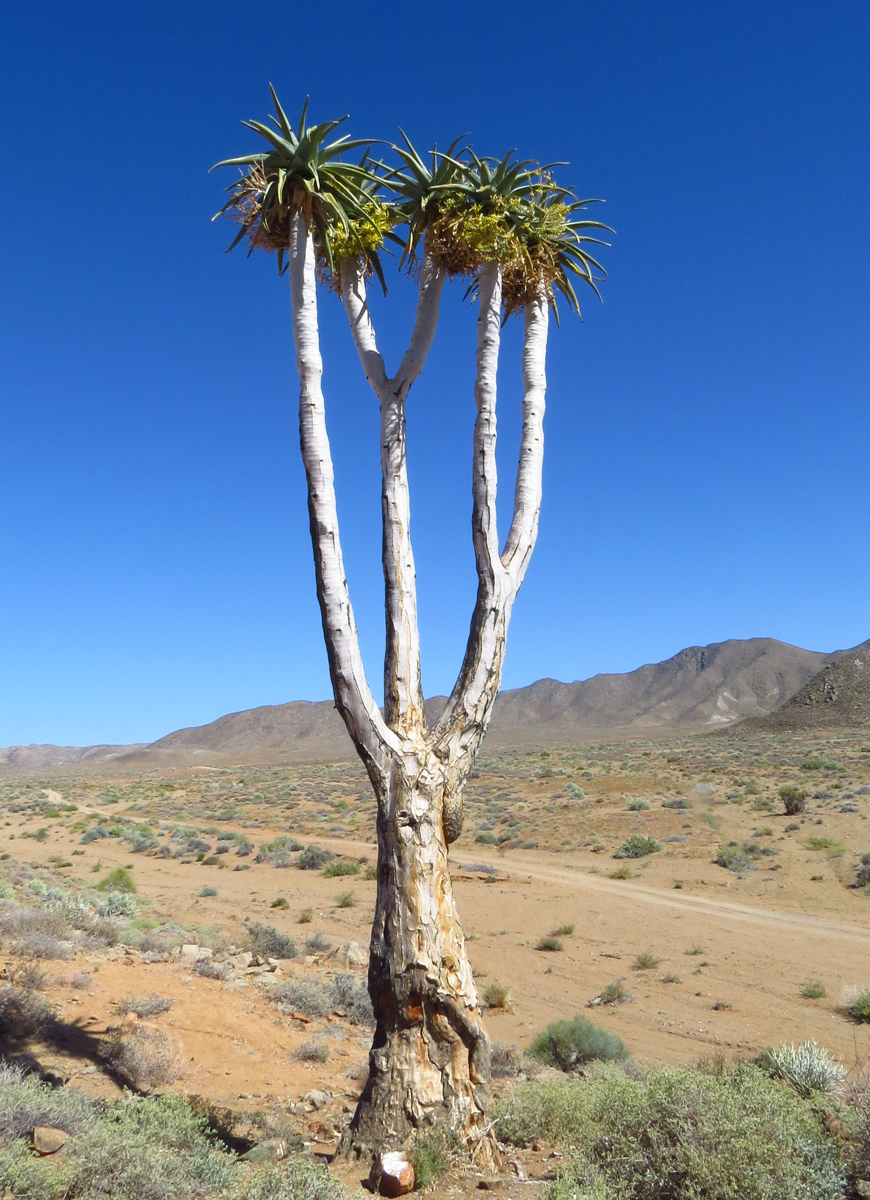
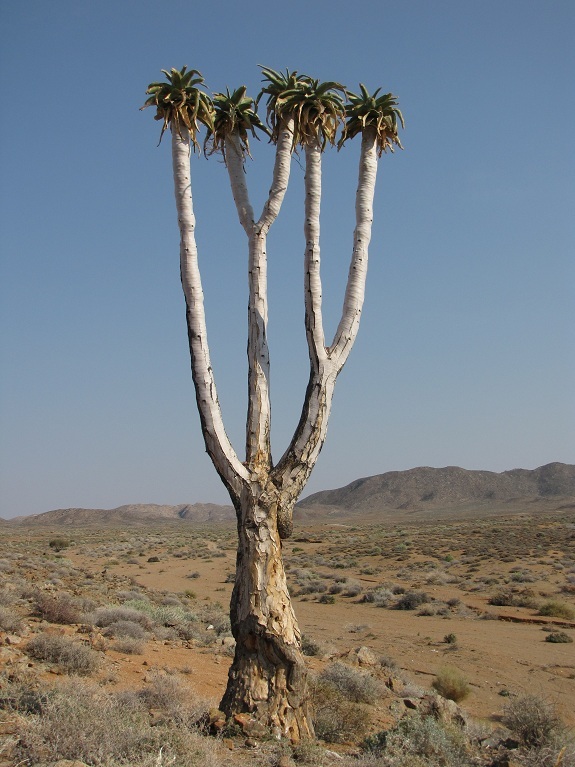
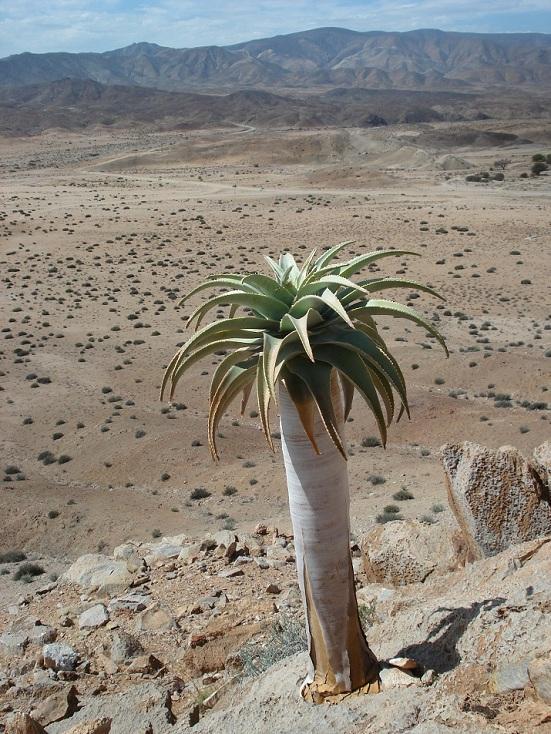
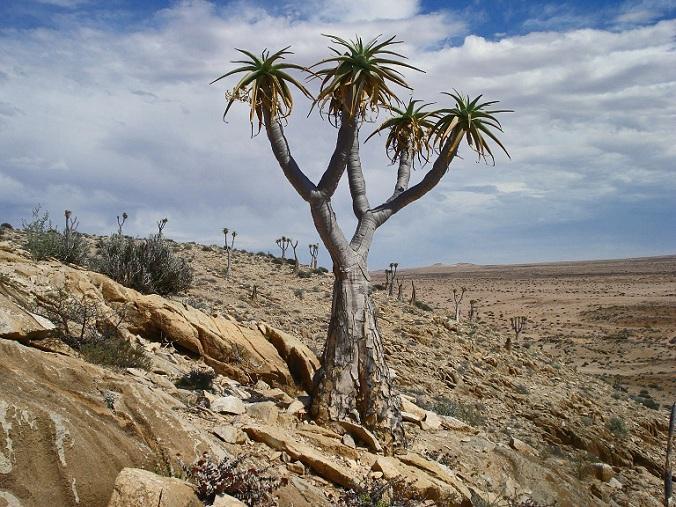
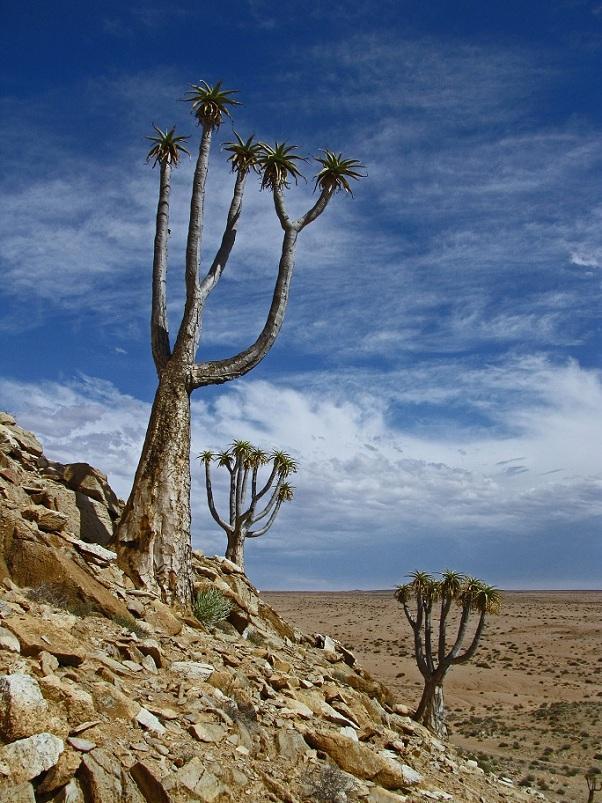
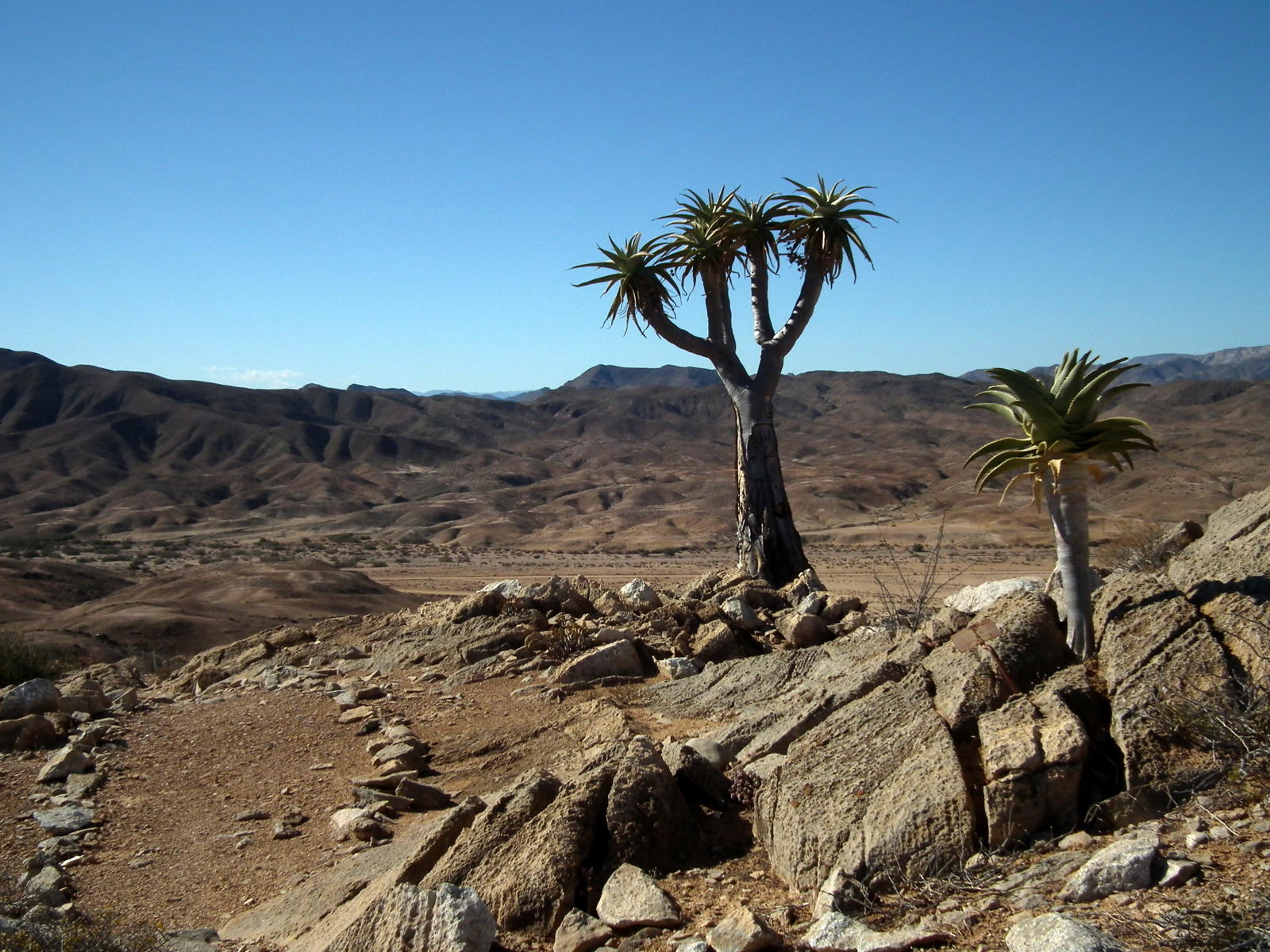
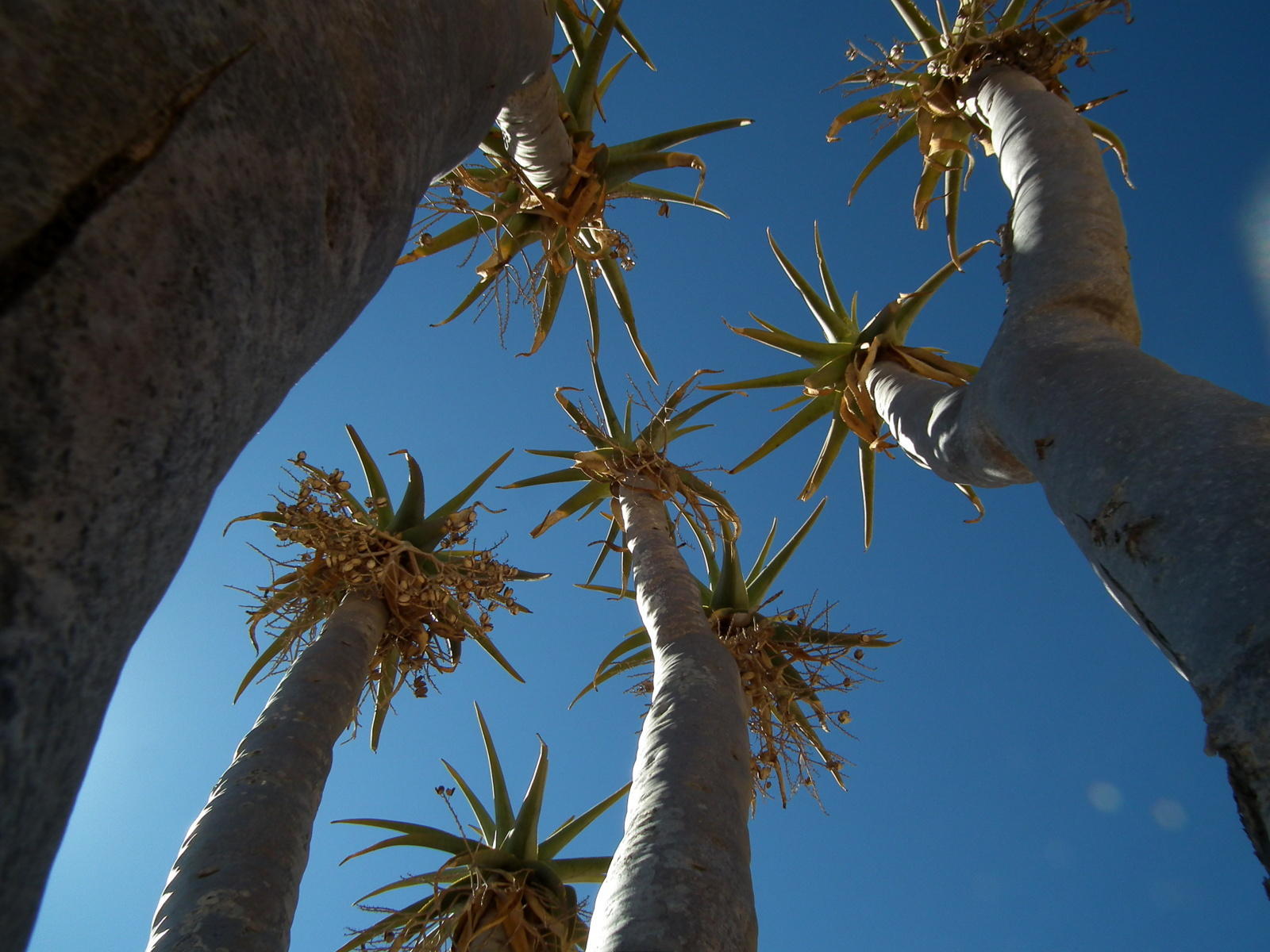
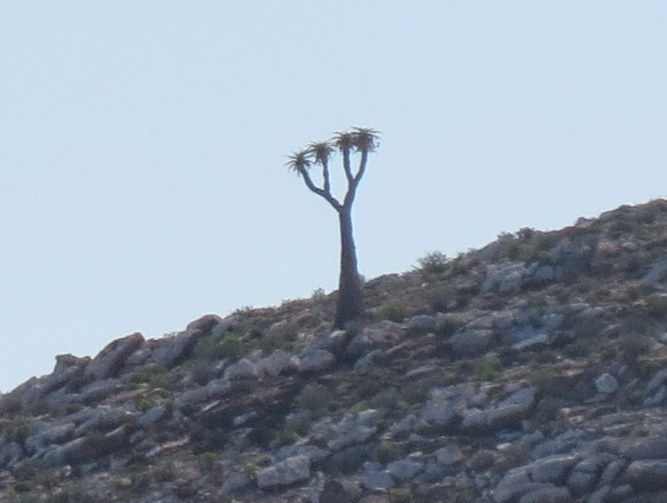
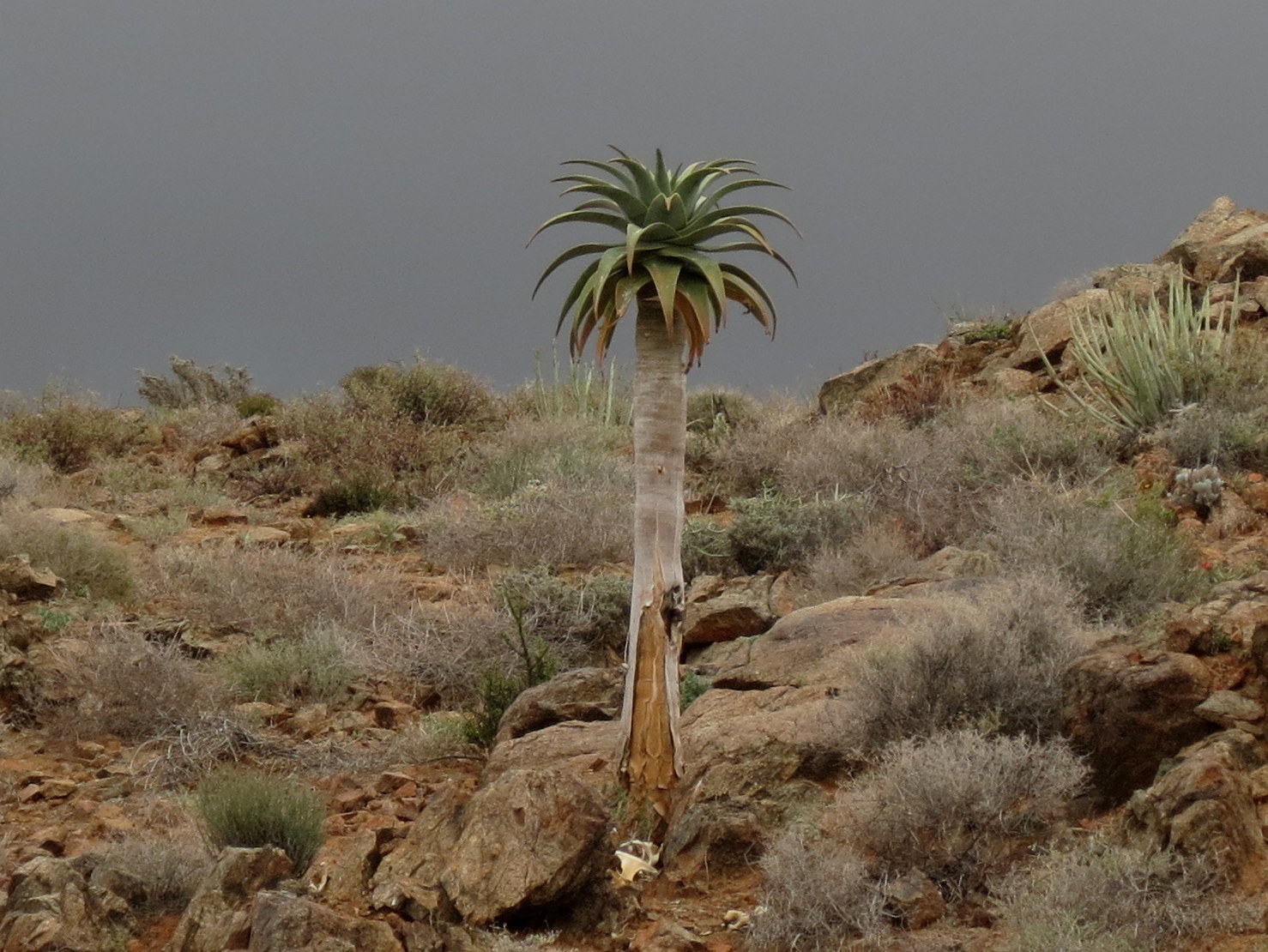
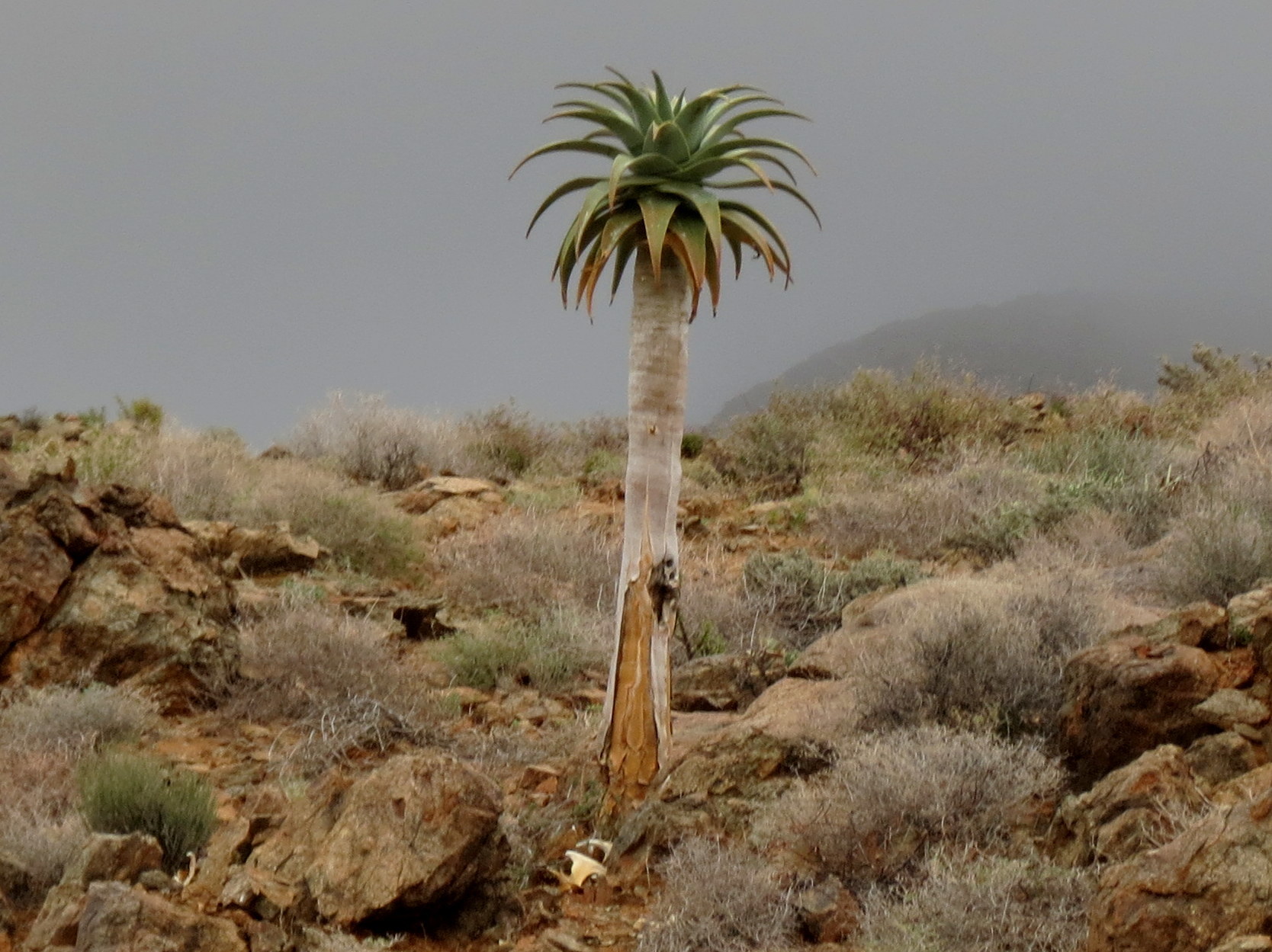
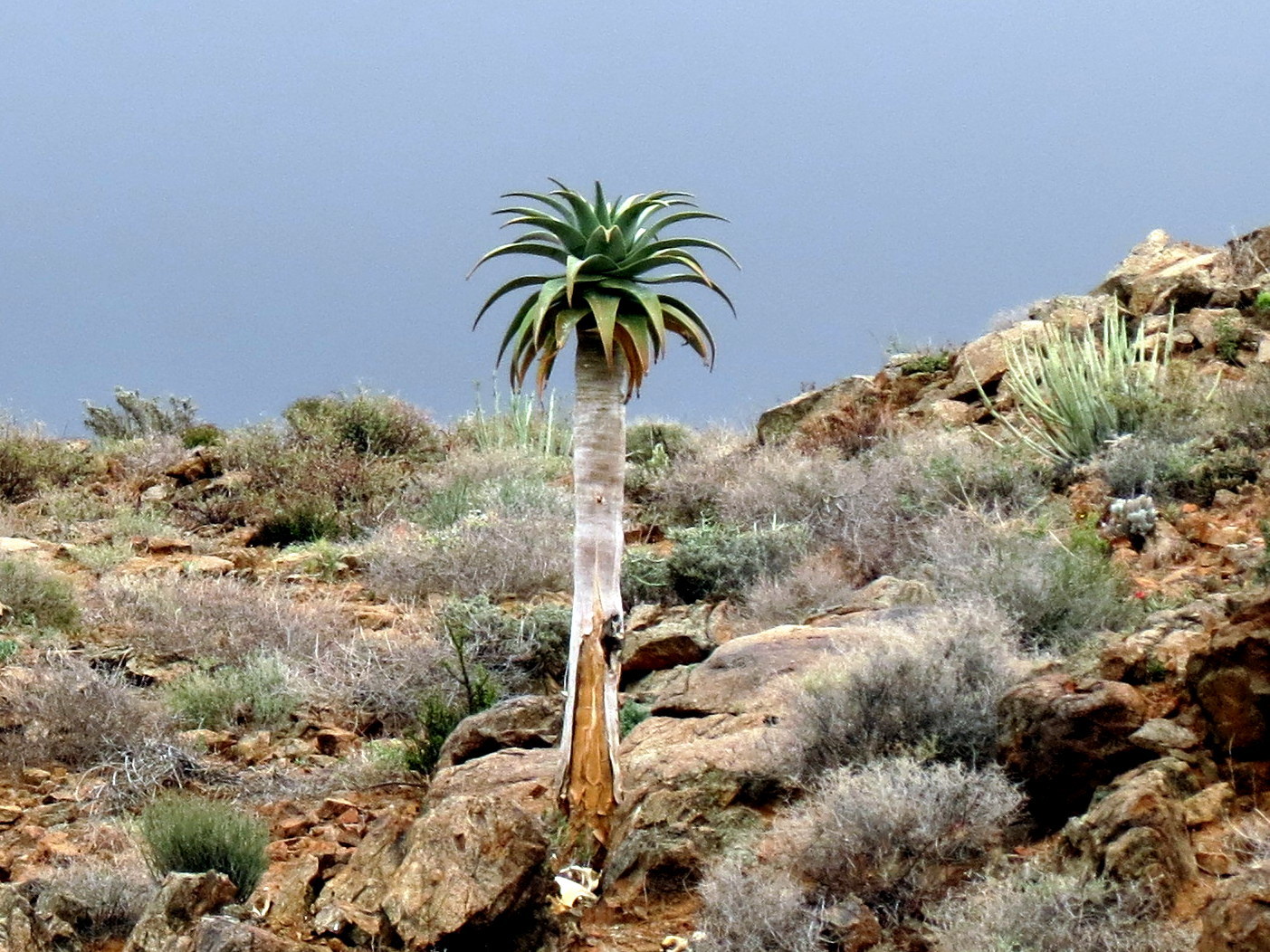
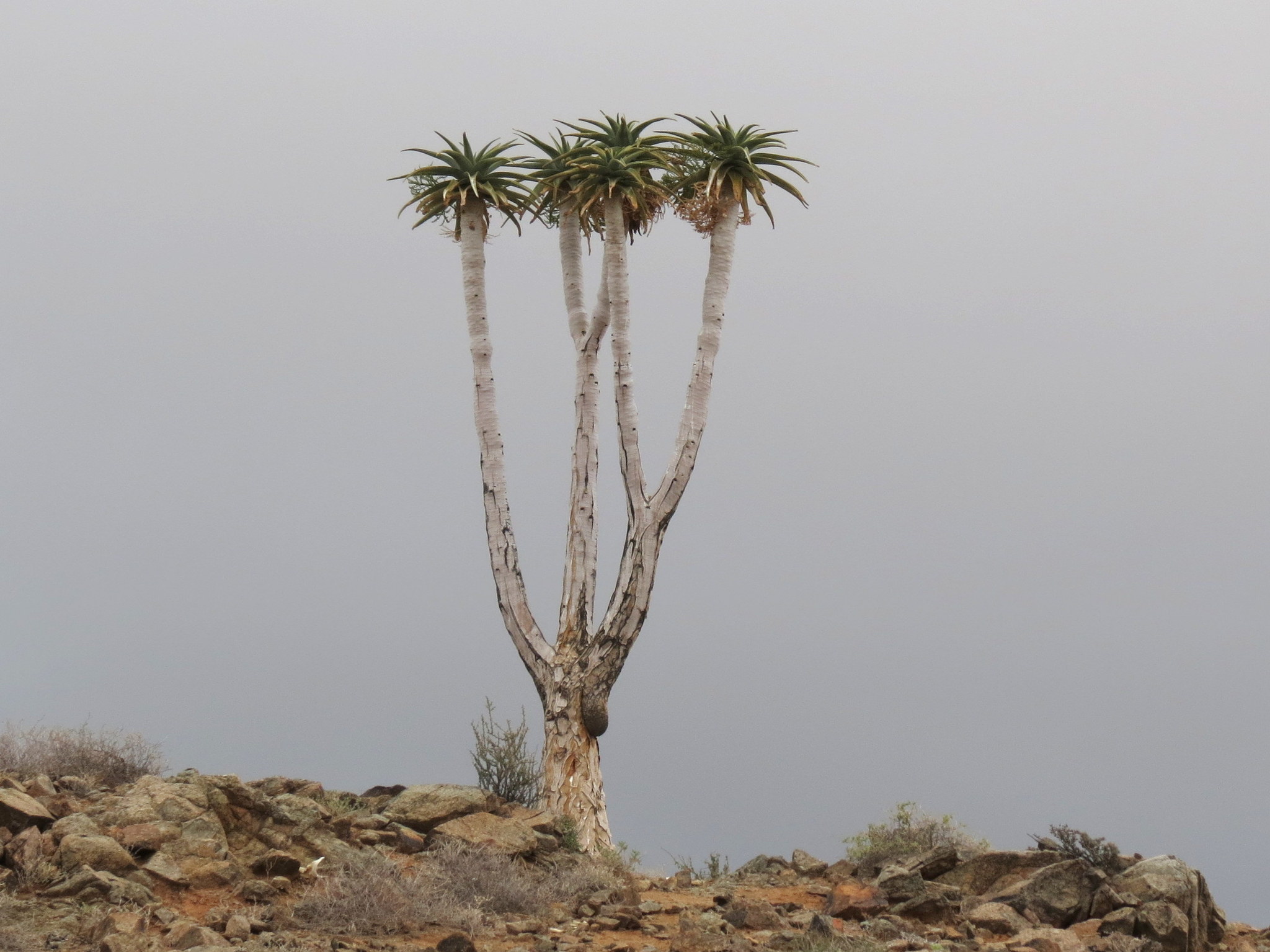
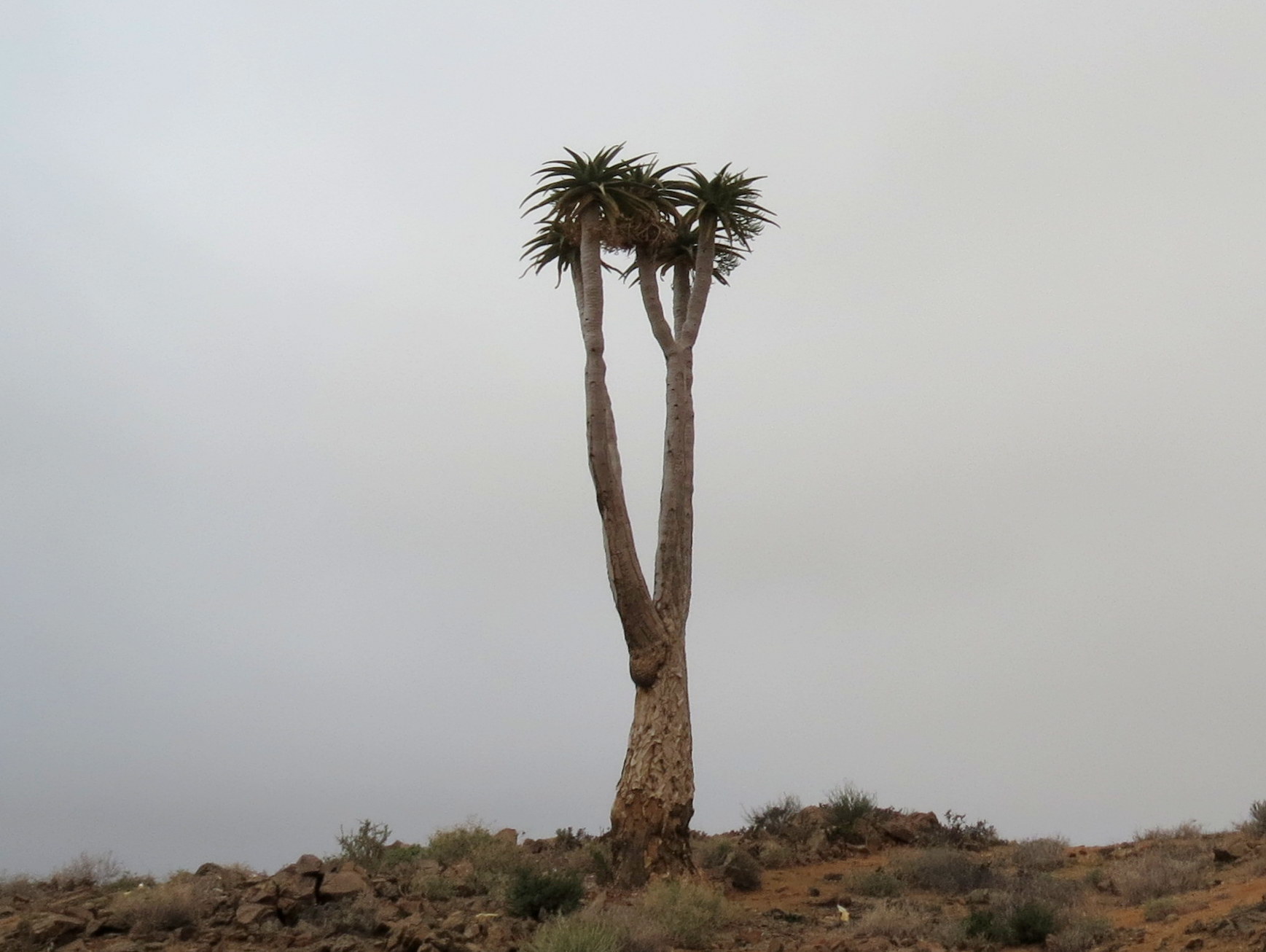
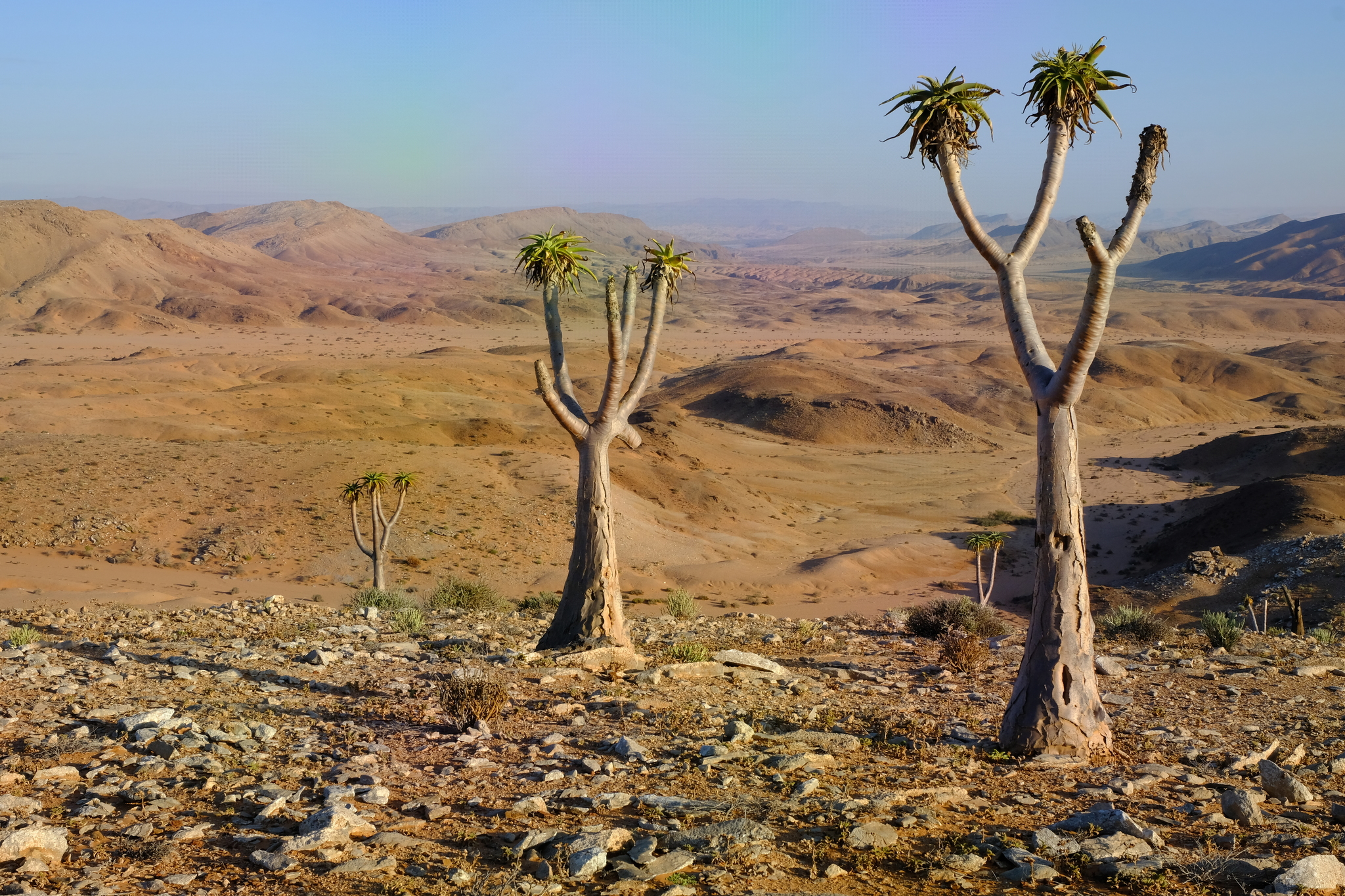
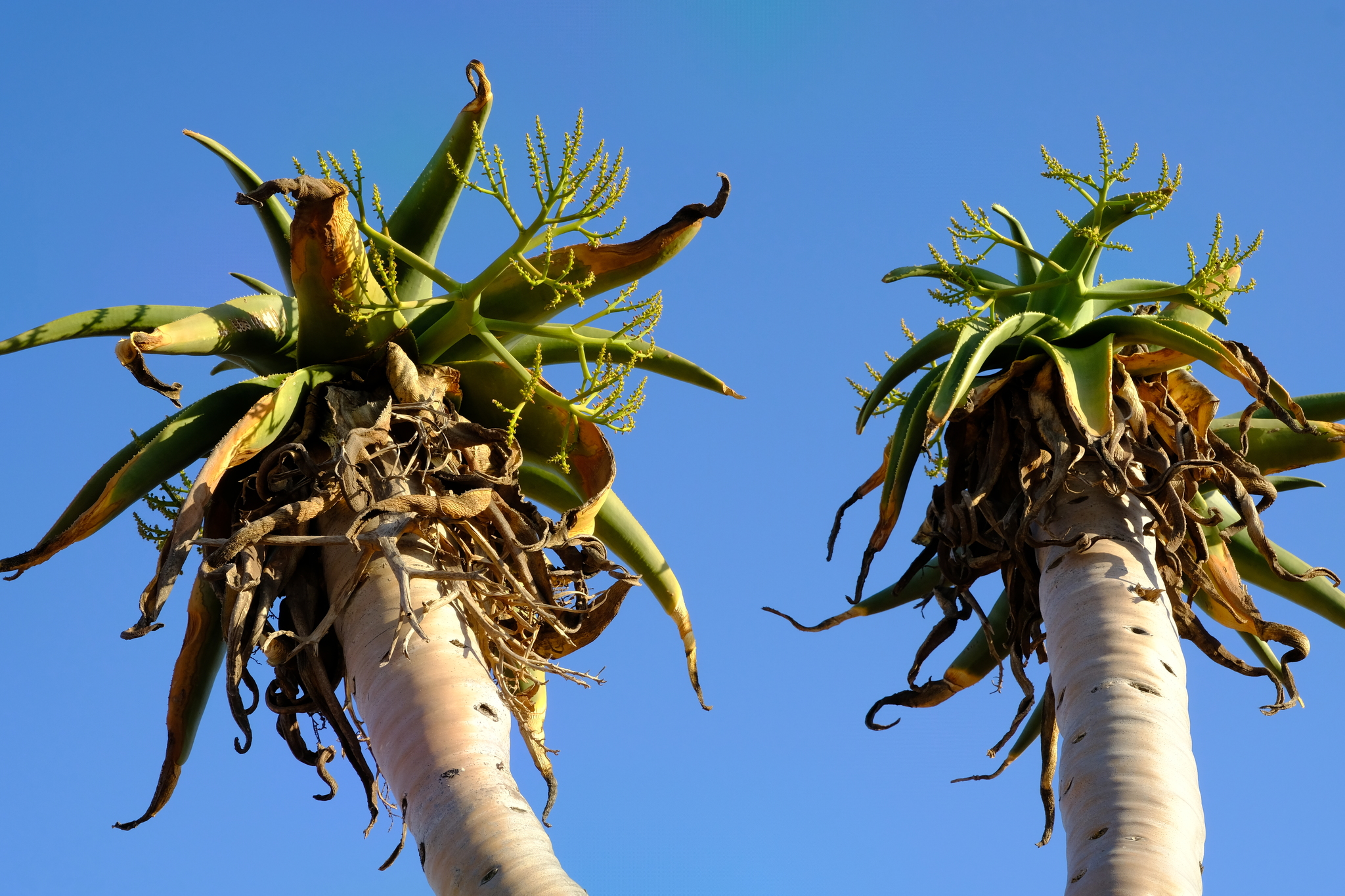
Plant a tree up to 10 met. high (sometimes higher), 1-2 met. diam. at base, gradually narrowing upwards, dichotomously branched about the middle, with few to many branches, the branches smooth, erect or slightly divergent, about 20 cm diam., simple to dichotomously branched and rebranched. Leaves lanceolate-attenuate, densely rosulate at apices of branches, spreading to slightly falcate, 50-60 cm long, 10-12 cm broad at base, about 15 mm thick near base, smooth, without spots or lines, grey-green to brownish-green; upper surface flat near base, canaliculate upwards; lower surface convex; margins denticulate, with a white edge and crowded white 1 mm long teeth in lower half of leaf, larger (2 mm) and about 5-8 mm distant upwards. Inflorescence a branched panicle, 1-3 simultaneously, springing laterally from the axils of the lowest leaves, about 50 cm long, and bearing up to 50 racemes. Peduncle flattened at base and about 4 cm diam., severely decurved shortly above the base, branched from the middle, thence ascending, with the racemes oblique to erect. Racemes cylindric, laxly flowered, the terminal up to 15 cm long and about 30-flowered, the lateral shorter and fewer flowered, the shortest racemes 6-8 cm long and about 14-flowered, in erect racemes the flowers evenly distributed around the axis, in oblique racemes the flowers erectly sub-secund. Bracts filiform, almost hair-like, slightly broadened at base, a little shorter than their pedicels. Pedicels pale green, 10 mm long. Perianth lemon-yellow to yellow, up to 35 mm long, thick and fleshy, rounded and markedly stipitate at base, about 12 mm diam. near base and almost circular in cross-section, slightly narrowing to the throat; outer segments free for 25 mm (tube 10 mm), obscurely nerved, the apices green, sub-acute, revolute; inner segments free, narrower and slightly longer than the outer, with thin white edges and a slight keel turning green at apex, the apices more obtuse, spreading to revolute. Filaments markedly flattened, the 3 inner narrower and lengthening in advance of the 3 outer which are 3 mm broad at the middle. Anthers reddish-brown, the 3 inner and 3 outer in turn exserted 10 mm Style filiform, with the stigma at length exserted 15 mm. Ovary globose, light green, 6 mm long, 6 mm diam. Capsule 33 mm long, 25 mm diam. at the middle, markedly stipitate. From: Reynolds, GW. 1974. Aloes of South Africa, 3rd ed. A.A. Balkema, Cape Town. [All rights reserved] As: Aloe pillansii L.Guthrie
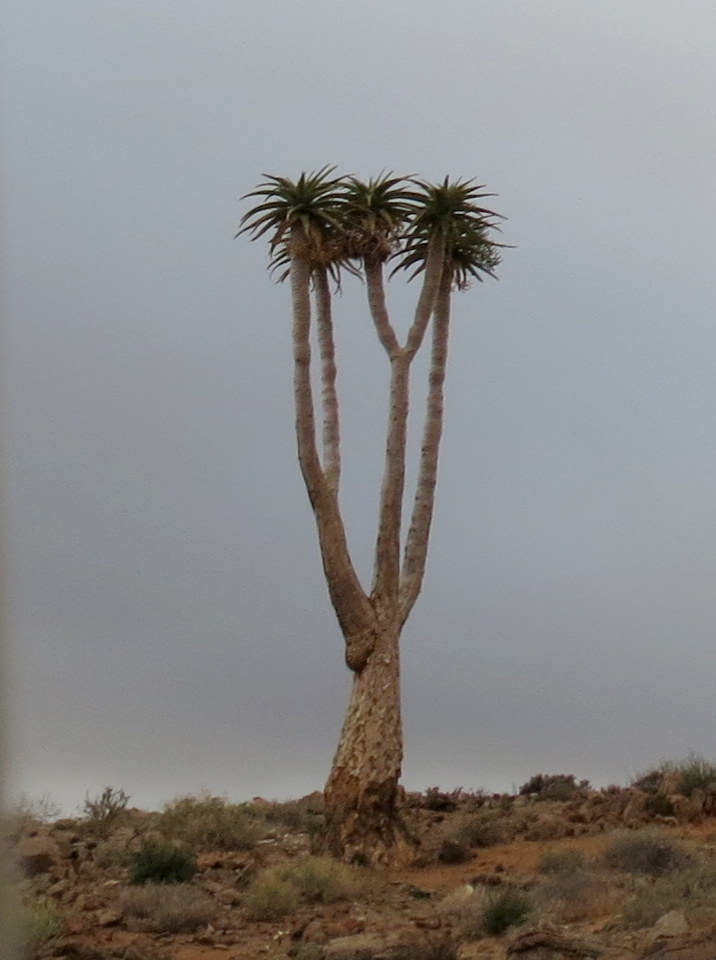
Tree aloe, 1-12 m tall. Branches robust, erect, never spreading, carrying large rosettes at terminal ends. Leaves grey-green, fairly large, up to 600 mm long, ± 100 mm wide at base, distinctly clasping branches, margins with small white teeth. Flowers in branched, recurved racemes arising from lowest leaves of rosettes, yellow, slightly swollen in middle. From: Klopper, RR; Smith, GF. 2013. Asphodelaceae: Aloe. In: DA Snijman (ed.), Plants of the Greater Cape Floristic Region 2: The Extra Cape flora. Strelitzia 30: 45-48. South African National Biodiversity Institute, Pretoria. [CC BY] As: Aloe pillansii L.Guthrie
Trees 10-12 m or more tall, sparsely branched. Leaves many per rosette, 350-600 x 100-120 mm, shallowly biconvex to shallowly channelled, grey-green to brownish green. Inflorescence lateral, pendent, with up to 50 racemes; these oblique to erect, lax to subdense; bracts filiform, 3-6 mm long. Flowers lemon-yellow to butter-yellow, 25-35 mm long; outer segments connate for 7-10 mm, inner segments free; pedicels 7-15 mm long. Anthers exserted 7-10 mm. Ovary 6-7 x 2-6 mm, pale green; style exserted 12-20 mm. Fruit 24-50 x 18-25 mm, pale buff. Seeds buff, ±14 x 7 x 2 mm, including a broad wing. From: Glen, HF; Hardy, DS. 2000. Aloe. In: G Germishuizen & E du Plessis (eds), Aloaceae (first part). Fl. S. Africa 5(1,1): 1-167. National Botanical Institute, Pretoria. [http://www.biodiversitylibrary.org/item/209564#page/3/mode/1up] [CC BY] As: Aloe pillansii L.Guthrie
Apart from its general habit of growth and its thick smooth dichotomous branches, the most distinctive (and unexpected) feature of A. pillansii is the method of producing the inflorescences laterally from the axils of the lowest leaves. The peduncle is sharply decurved near base, branched about the middle, with the branches ascending and the racemes sub-erect to erect. The whole inflorescence (about 50 cm long) hangs downwards in between the lowest leaves, with the racemes upturned, so that the base of the peduncle is usually a little higher than the terminal raceme. This character appears to be unique in the genus Aloe. In racemes which are erect, the flowers are evenly distributed around the axis, but in oblique racemes the flowers are erectly sub-secund. A. pillansii is usually branched about the middle or lower, and ranges from few to many compactly or divaricately branched trees. Young simple-stemmed plants reach a height of 1.8-2.7 m [as '6-9 ft.'] before dividing at the summit and branching commences. Occasionally one sees a simple-stemmed plant 6-9 m [as '20-30 ft.'] high, forked at the summit, but this is not typical. In structure, size, shape and yellow flowers, A. pillansii, A. ramosissima and A. dichtoma are almost indistinguishable, but in size, branching and leaves, they could never be confused, while the inflorescence of A. pillansii immediately separates it from all other species. From: Reynolds, GW. 1974. Aloes of South Africa, 3rd ed. A.A. Balkema, Cape Town. [All rights reserved] As: Aloe pillansii L.Guthrie
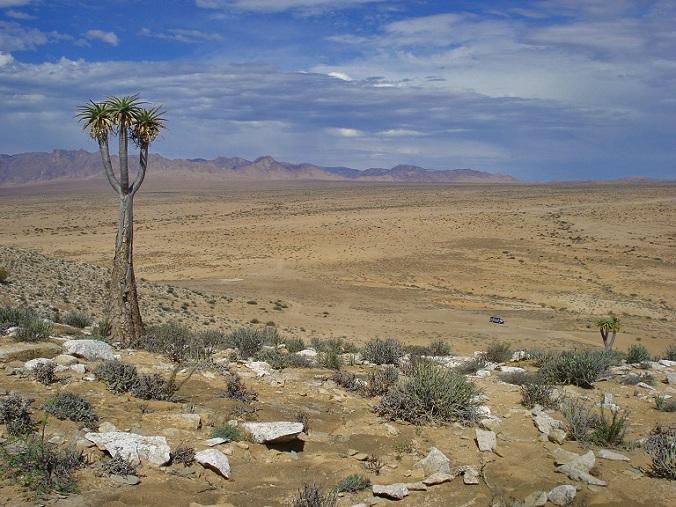
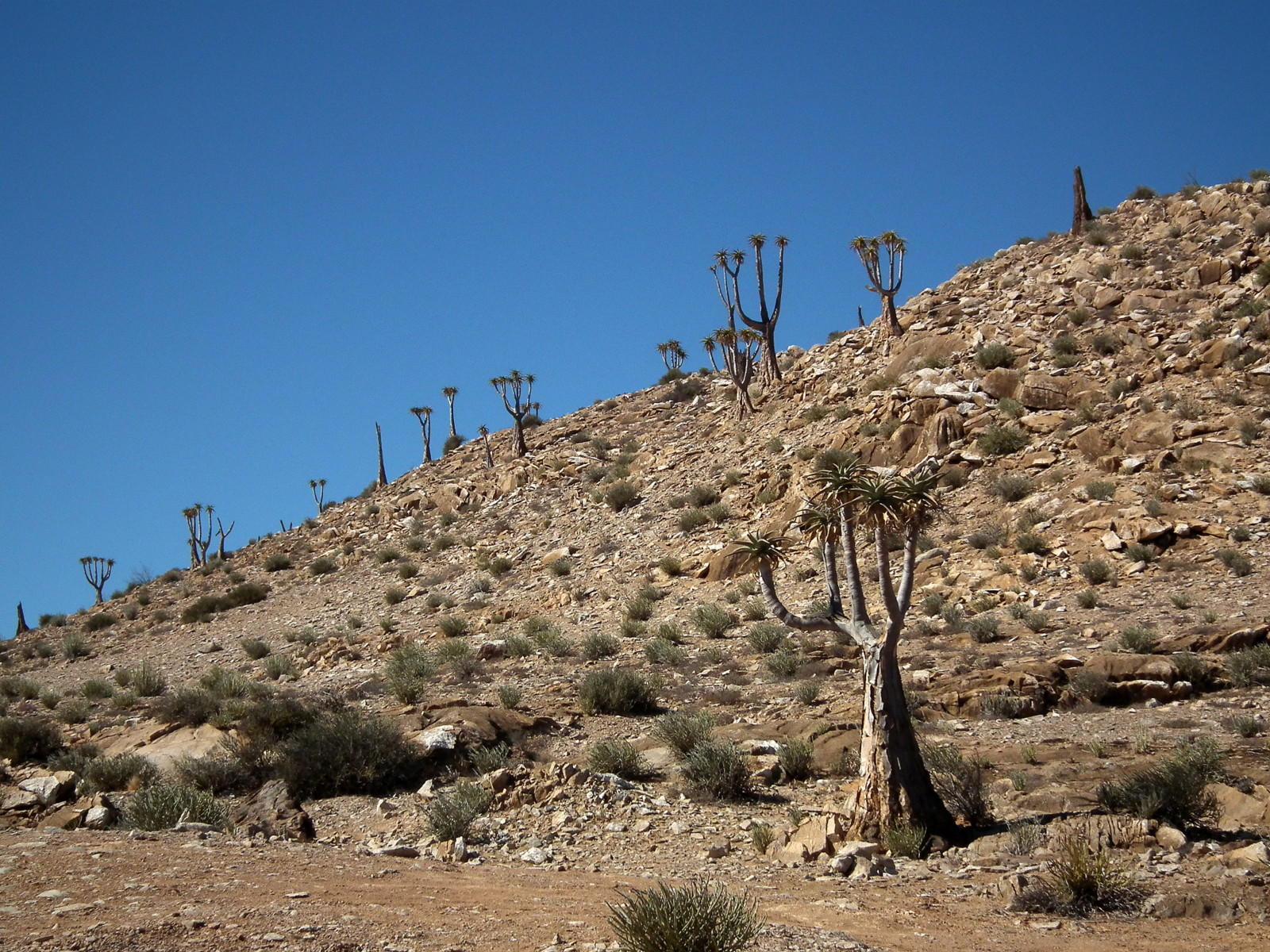
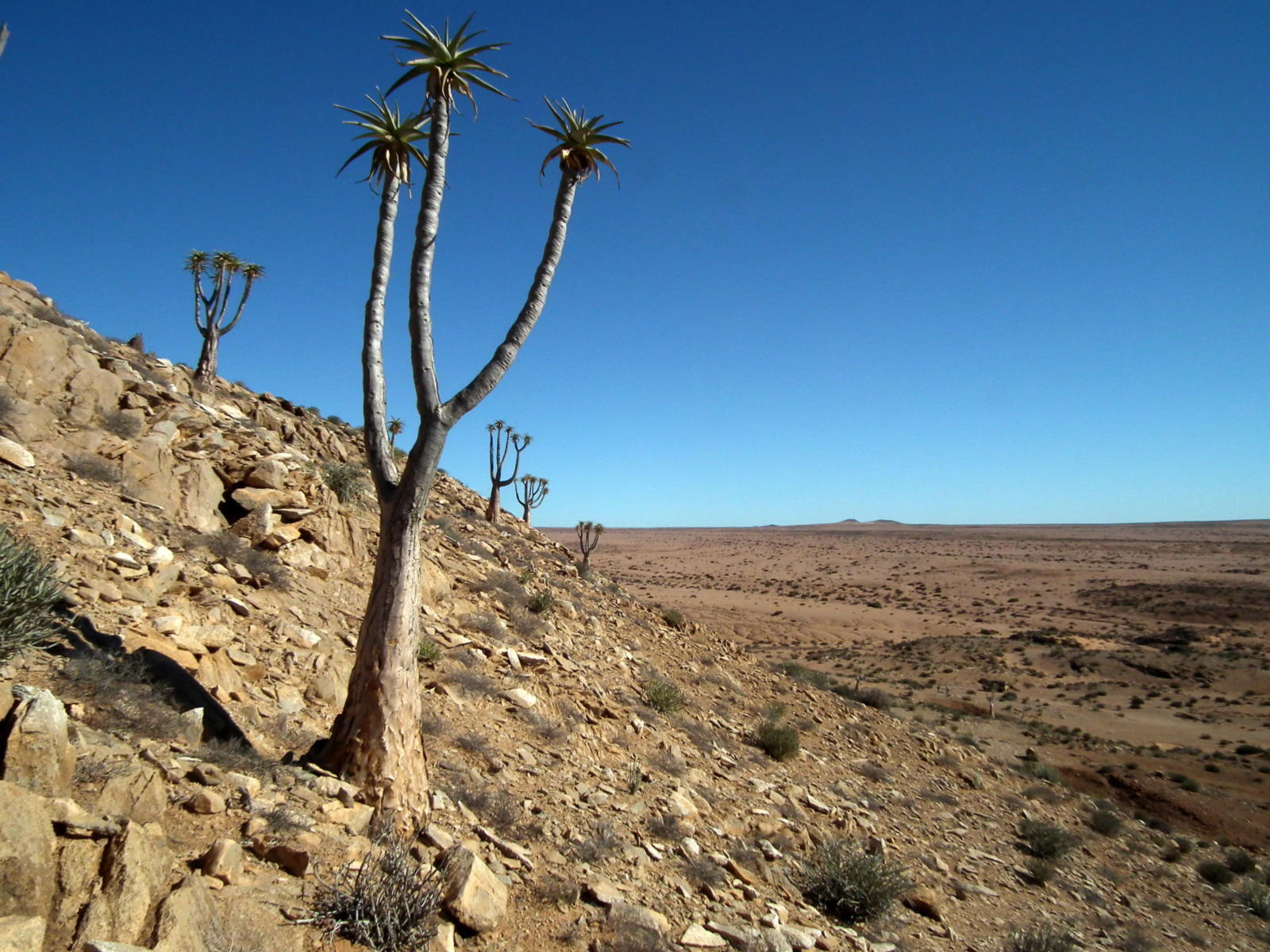
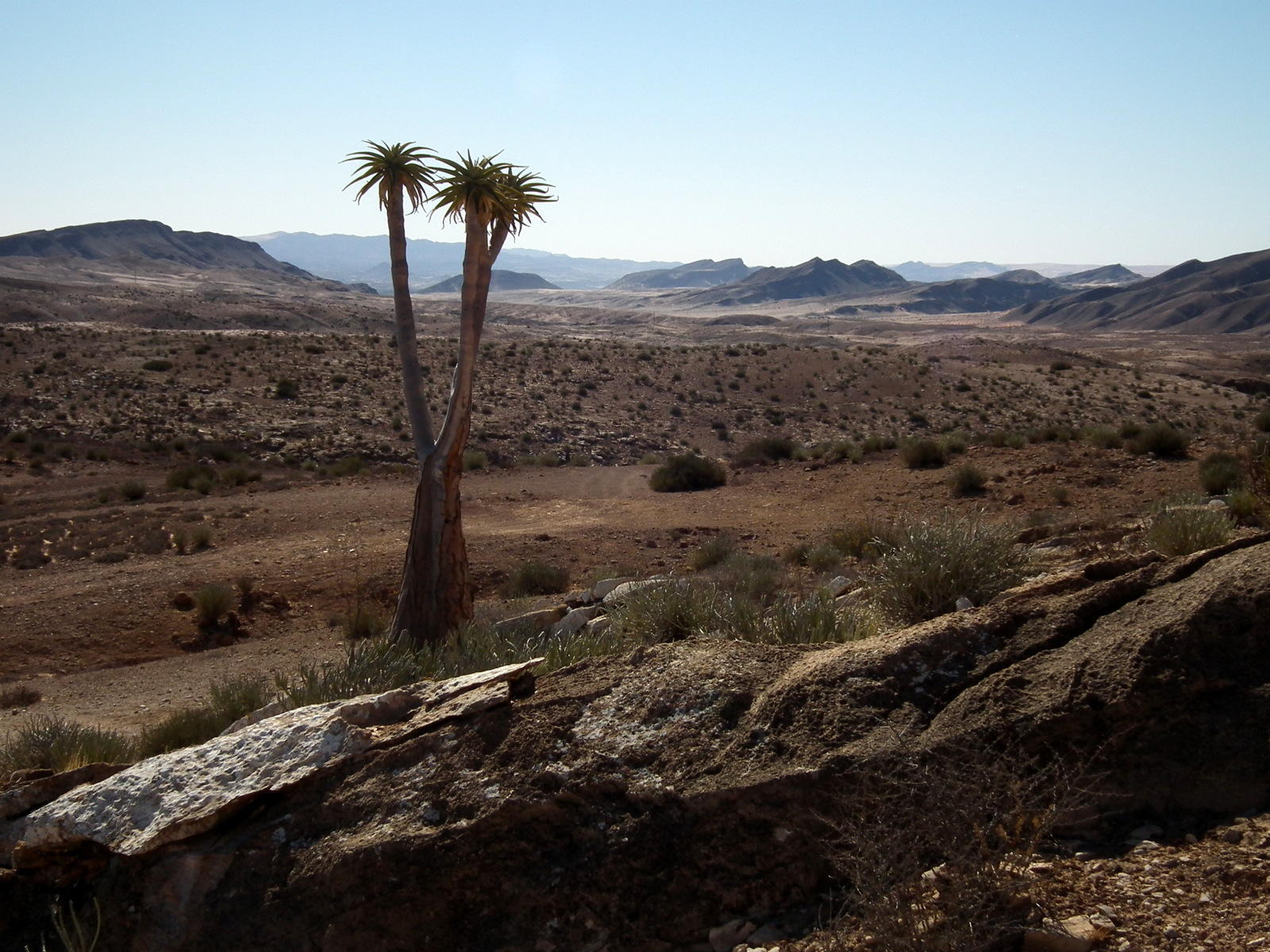
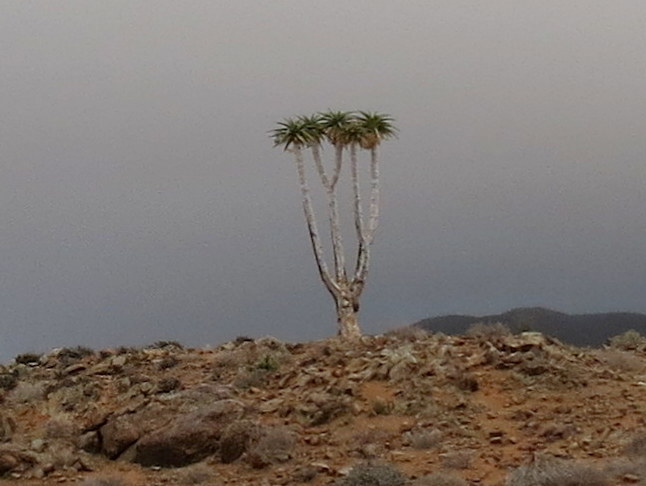
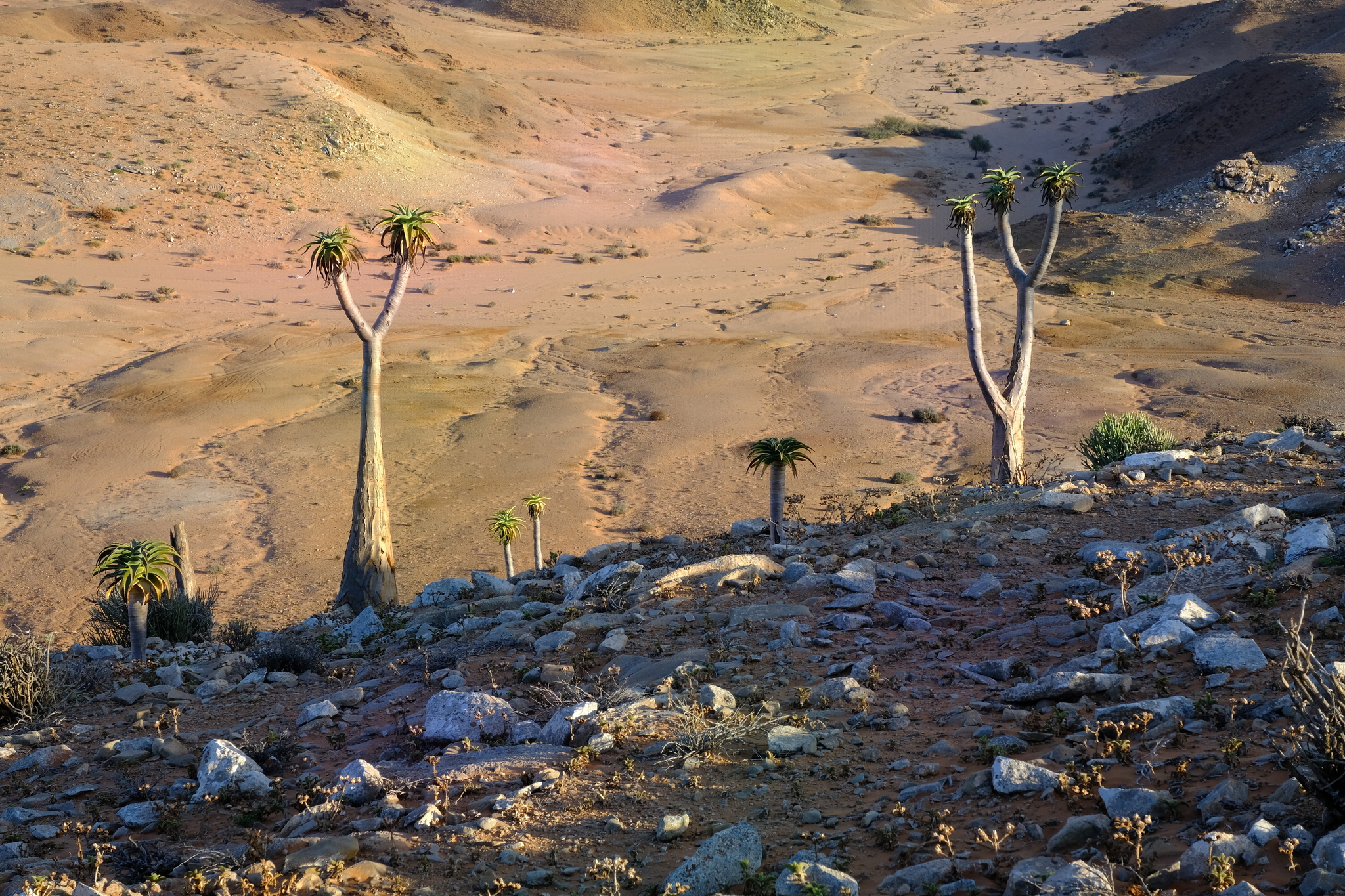
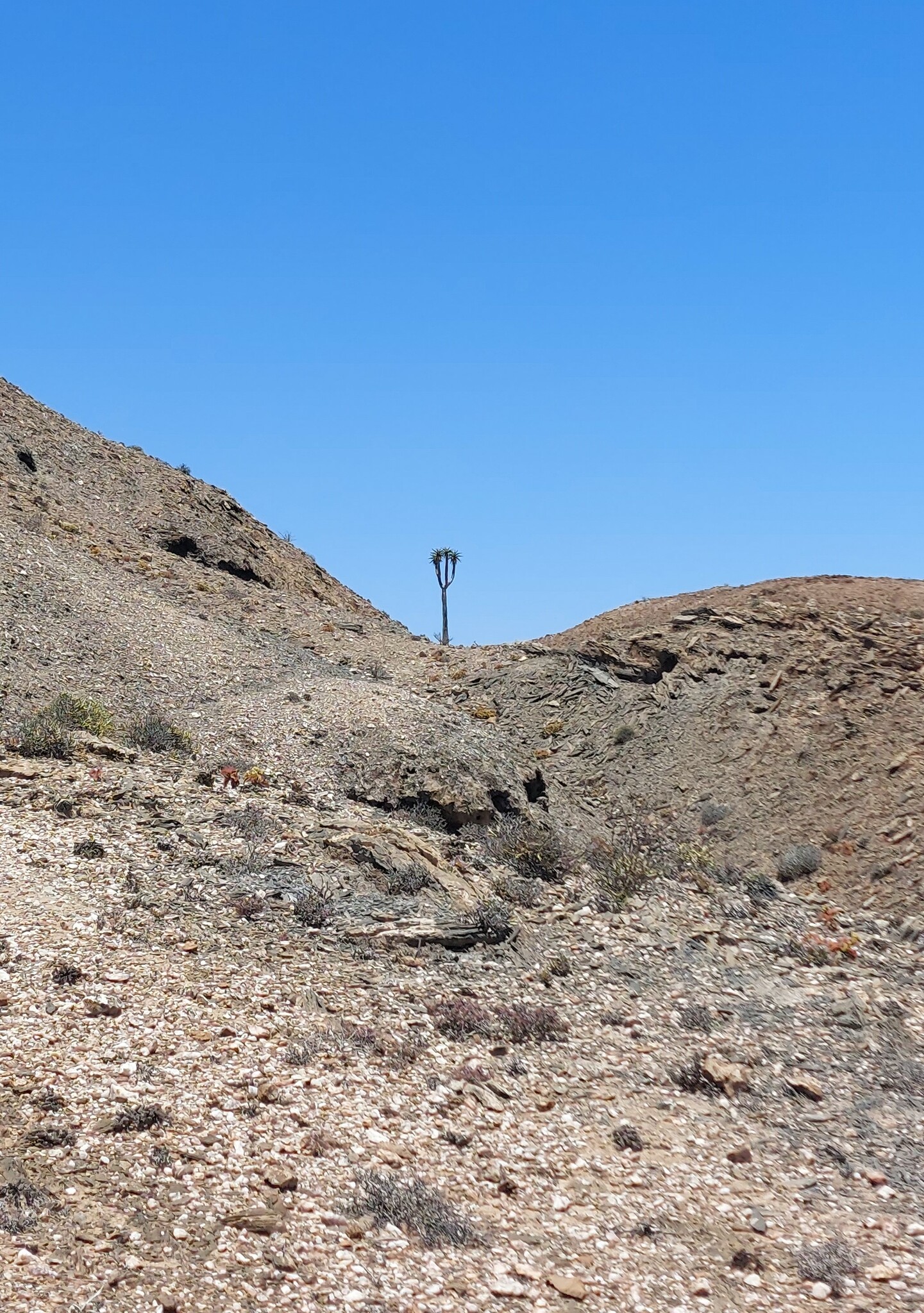
A. pillansii grows under intensely hot and arid conditions. Summer temperatures not infrequently reach 110 deg. F., while sometimes a few years pass without rain falling. From: Reynolds, GW. 1974. Aloes of South Africa, 3rd ed. A.A. Balkema, Cape Town. [All rights reserved] As: Aloe pillansii L.Guthrie
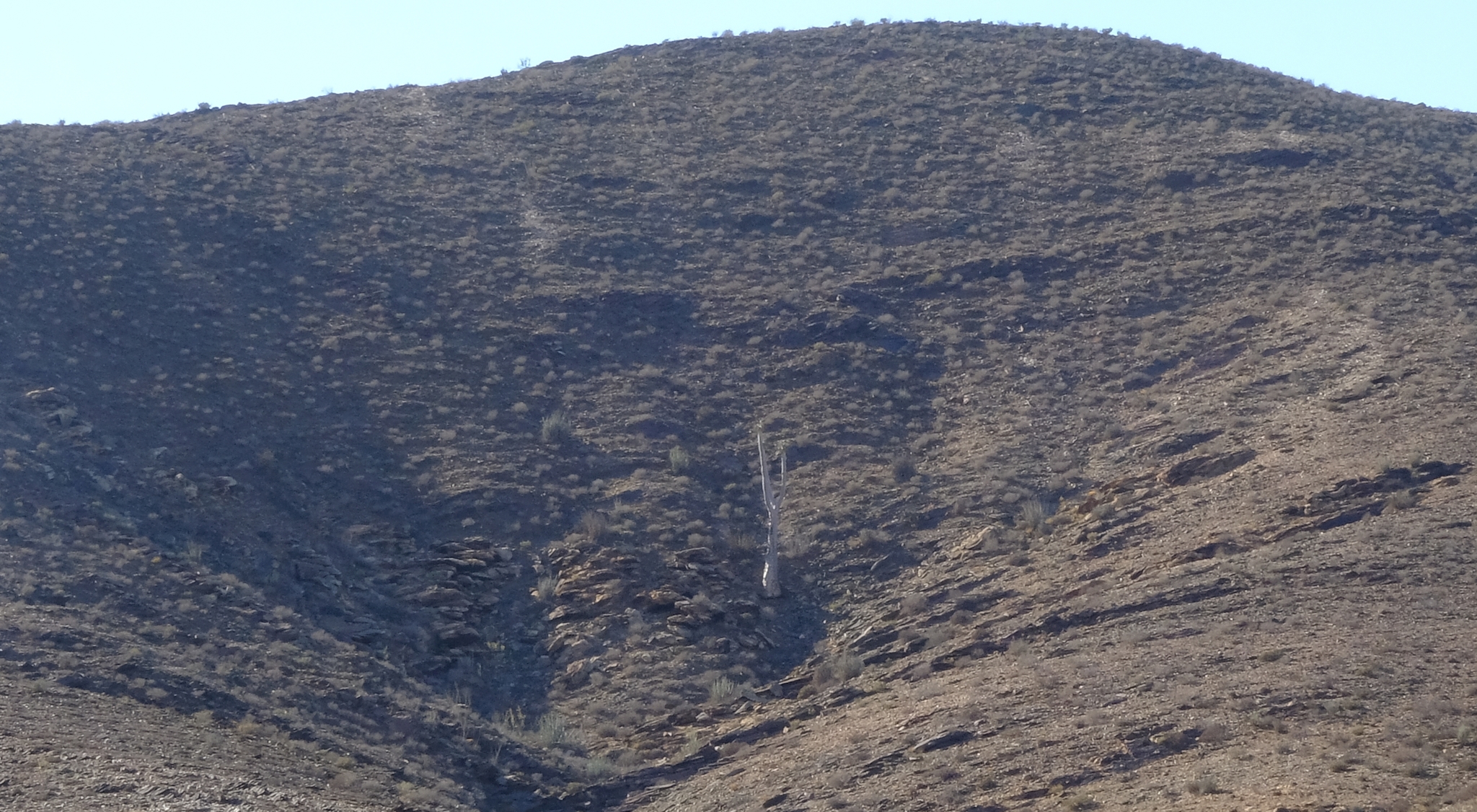
Stony hillsides. From: Klopper, RR; Smith, GF. 2013. Asphodelaceae: Aloe. In: DA Snijman (ed.), Plants of the Greater Cape Floristic Region 2: The Extra Cape flora. Strelitzia 30: 45-48. South African National Biodiversity Institute, Pretoria. [CC BY] As: Aloe pillansii L.Guthrie
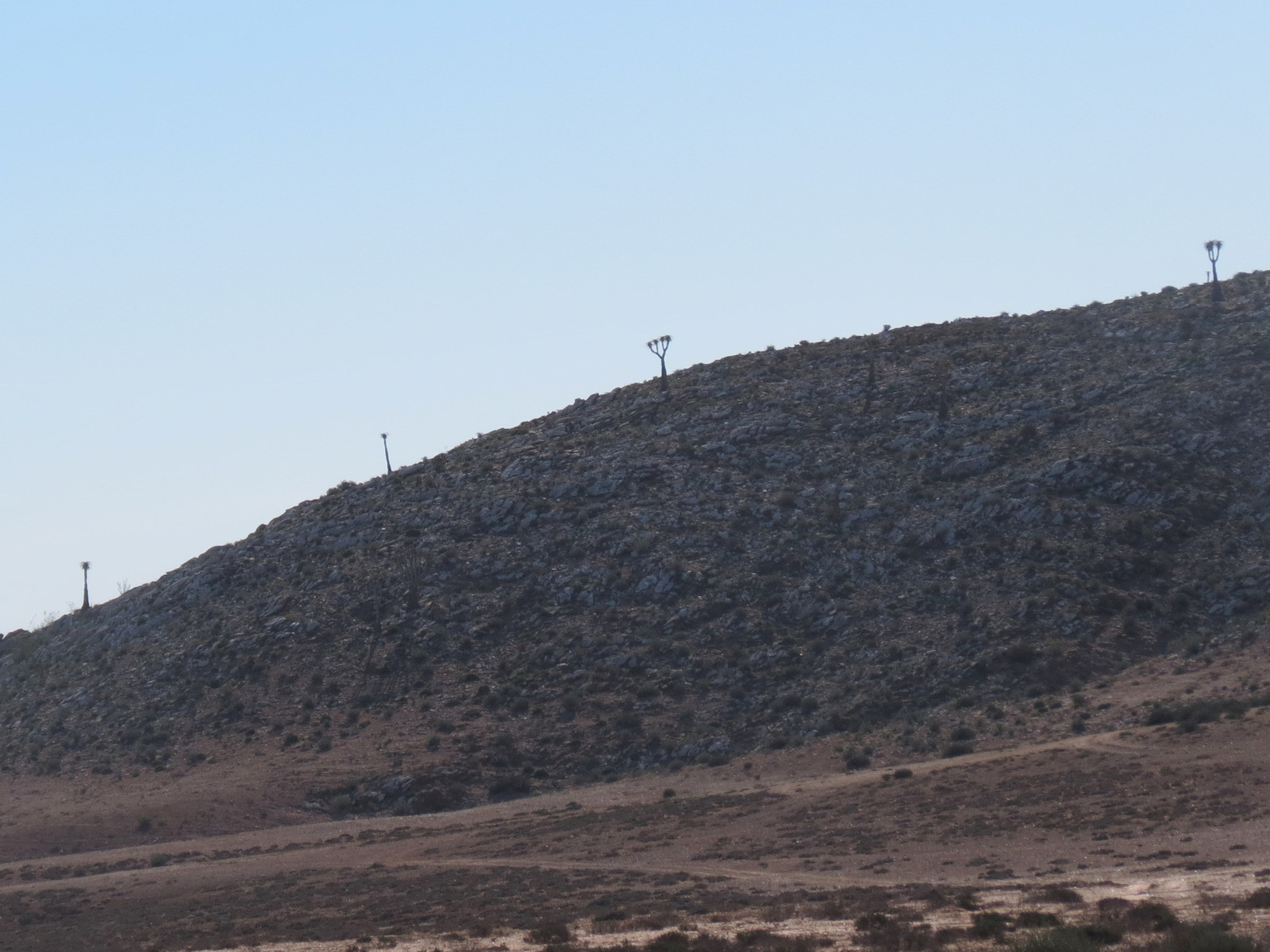
Aloe pillansii is restricted to stony hillsides almost devoid of soil in succulent karoo at low altitude. From: Glen, HF; Hardy, DS. 2000. Aloe. In: G Germishuizen & E du Plessis (eds), Aloaceae (first part). Fl. S. Africa 5(1,1): 1-167. National Botanical Institute, Pretoria. [http://www.biodiversitylibrary.org/item/209564#page/3/mode/1up] [CC BY] As: Aloe pillansii L.Guthrie
It therefore seems that A. pillansii extends from Cornell's Kop in the south, to the Brandberg 120 miles north of Swakopmund in the north. From: Reynolds, GW. 1974. Aloes of South Africa, 3rd ed. A.A. Balkema, Cape Town. [All rights reserved] As: Aloe pillansii L.Guthrie
Richtersveld and adjacent parts of southern Namibia. From: Klopper, RR; Smith, GF. 2013. Asphodelaceae: Aloe. In: DA Snijman (ed.), Plants of the Greater Cape Floristic Region 2: The Extra Cape flora. Strelitzia 30: 45-48. South African National Biodiversity Institute, Pretoria. [CC BY] As: Aloe pillansii L.Guthrie
In the Richtersveld and adjacent parts of Namibia. In Namibia it seems to be an indicator of heavy-metal soils. From: Glen, HF; Hardy, DS. 2000. Aloe. In: G Germishuizen & E du Plessis (eds), Aloaceae (first part). Fl. S. Africa 5(1,1): 1-167. National Botanical Institute, Pretoria. [http://www.biodiversitylibrary.org/item/209564#page/3/mode/1up] [CC BY] As: Aloe pillansii L.Guthrie
This map contains point-based occurrences at different locations
 This is a sensitive species therefore data has been redacted, click here to login.
Occurrence in the Flora of Southern Africa (FSA) countries and South African provinces. Residence status indicates if a taxon is indigenous, endemic, naturalised or invasive in a specific region. This data is based on specimen records and literature
FSA
SA
BOT
NAM
ESW
LES
WC
EC
NC
FS
GA
KZN
LP
MP
NW
Absent
Indigenous
Endemic
Naturalised
Invasive

Names and Sources
Published in: Phytotaxa 76(1): 9 (2013)
Type: South Africa, Northern Cape: Cornell's Kop, west of Annisfontein, October 1926, N.S. Pillans 5012 (BOL140227, BOL140228, holo.; K000256752, iso.)
Aloe pillansii L.Guthrie
Published in: J. Bot. 66: 15 (1928)
Type: South Africa, Northern Cape: Cornell's Kop, west of Annisfontein, October 1926, N.S. Pillans 5012 (BOL140227, BOL140228, holo.; K000256752, iso.)
Aloe dichotoma Masson subsp. pillansii (L.Guthrie) Zonn.
Published in: Bradleya 20: 10 (2002)
Type: South Africa, Northern Cape: Cornell's Kop, west of Annisfontein, October 1926, N.S. Pillans 5012 (BOL140227, BOL140228, holo.; K000256752, iso.)
| Common name | Language | Reference/barcode | Published as |
|---|---|---|---|
| die lange | Afrikaans | Glen, HF; Hardy, DS. 2000. Aloe. In: G Germishuizen & E du Plessis (eds), Aloaceae (first part), Fl. S. Africa 5(1),1: 1-167. National Botanical Institute, Pretoria. [http://www.biodiversitylibrary.org/item/209564#page/3/mode/1up]. |
Aloe pillansii L.Guthrie |
| die lange | Afrikaans | Van Wyk, AE; Van den Berg, E; Coates Palgrave, M; Jordaan, M. 2011. Dictionary of names for southern African trees. Briza, Arcadia. |
Aloe pillansii L.Guthrie |
| die lange | Afrikaans | Von Breitenbach, JM; De Winter, B; Poynton, R; Van den Berg, E; Van Wyk, AE. 2001. Pocket list of southern Africa indigenous trees. Briza publications & Dendrological foundation, Pretoria. |
Aloe pillansii L.Guthrie |
| false quiver tree | English | Von Breitenbach, JM; De Winter, B; Poynton, R; Van den Berg, E; Van Wyk, AE. 2001. Pocket list of southern Africa indigenous trees. Briza publications & Dendrological foundation, Pretoria. |
Aloe pillansii L.Guthrie |
| false quivertree | English | Van Wyk, AE; Van den Berg, E; Coates Palgrave, M; Jordaan, M. 2011. Dictionary of names for southern African trees. Briza, Arcadia. |
Aloe pillansii L.Guthrie |
| giant quiver tree | English | Klopper, RR; Smith, GF. 2013. Asphodelaceae: Aloe. In: DA Snijman (ed.), Plants of the Greater Cape Floristic Region 2: The Extra Cape flora. Strelitzia 30: 45-48. South African National Biodiversity Institute, Pretoria. |
Aloe pillansii L.Guthrie |
| giant quiver tree | English | Von Breitenbach, JM; De Winter, B; Poynton, R; Van den Berg, E; Van Wyk, AE. 2001. Pocket list of southern Africa indigenous trees. Briza publications & Dendrological foundation, Pretoria. |
Aloe pillansii L.Guthrie |
| giant quivertree | English | Van Wyk, AE; Van den Berg, E; Coates Palgrave, M; Jordaan, M. 2011. Dictionary of names for southern African trees. Briza, Arcadia. |
Aloe pillansii L.Guthrie |
| giant quivertree aloe | English | Van Wyk, AE; Van den Berg, E; Coates Palgrave, M; Jordaan, M. 2011. Dictionary of names for southern African trees. Briza, Arcadia. |
Aloe pillansii L.Guthrie |
| reuse kokerboom | Afrikaans | Klopper, RR; Smith, GF. 2013. Asphodelaceae: Aloe. In: DA Snijman (ed.), Plants of the Greater Cape Floristic Region 2: The Extra Cape flora. Strelitzia 30: 45-48. South African National Biodiversity Institute, Pretoria. |
Aloe pillansii L.Guthrie |
| Reusekokerboom | Afrikaans | Smith, GF; Van Wyk, B-E. 1996. Guide to the Aloes of South Africa, 1st ed. Briza, Pretoria. |
Aloe pillansii L.Guthrie |
| reusekokerboom | Afrikaans | Van Wyk, AE; Van den Berg, E; Coates Palgrave, M; Jordaan, M. 2011. Dictionary of names for southern African trees. Briza, Arcadia. |
Aloe pillansii L.Guthrie |
| reuse-kokerboom | Afrikaans | Von Breitenbach, JM; De Winter, B; Poynton, R; Van den Berg, E; Van Wyk, AE. 2001. Pocket list of southern Africa indigenous trees. Briza publications & Dendrological foundation, Pretoria. |
Aloe pillansii L.Guthrie |
Classification
KINGDOM Plantae
SUBKINGDOM Phanerogamae
PHYLUM Anthophyta
ORDER Asparagales
FAMILY Asphodelaceae
SUBFAMILY Alooideae
GENUS Aloidendron
SPECIES pillansii
47 results for Aloidendron pillansii (L.Guthrie) Klopper & Gideon F.Sm.
Barcode: PRE0093556-0 Collector(s) & number: Werdermann, E, 609 | 1958-8-15
Data Resource: BODATSA View record
Barcode: PRE0093552-0 Collector(s) & number: Reynolds, GW, 4770 | 1946-12-7
Data Resource: BODATSA View record
Barcode: PRE0093554-0 Collector(s) & number: Hardy, DS, 549 | 1961-9-10
Data Resource: BODATSA View record
Barcode: PRE0111458-0 Collector(s) & number: Hardy, DS, 2624 | 1968-9-22
Data Resource: BODATSA View record
Barcode: PRE0093555-0 Collector(s) & number: Rodin, RJ, 1583 | 1947-10-10
Data Resource: BODATSA View record
Barcode: PRE0093557-0 Collector(s) & number: Leistner, OA, 3472 | 1969-5-15
Data Resource: BODATSA View record
Barcode: PRE0093553-0 Collector(s) & number: Reynolds, GW, 5282 | 1947-10-9
Data Resource: BODATSA View record
Barcode: NBG0067884-4 Collector(s) & number: Hall, H, 869 | 1953-9-21
General notes: Rich yellow.
Data Resource: BODATSA View record
Barcode: SAM0065528A-0 Collector(s) & number: van Heerden, P, s.n. | 1947-10-9
Data Resource: BODATSA View record
Barcode: NBG0273540-0 Collector(s) & number: Unknown, s.n. | -10-
General notes: Flowers in October. Plant height about 25 ft.
Data Resource: BODATSA View record
Barcode: NBG0191205-2 Collector(s) & number: Reynolds, GW, 5282 | 1947-10-9
Data Resource: BODATSA View record
Barcode: NBG0191204-0 Collector(s) & number: Reynolds, GW, 4769 - 4771 | 1946-12-6
Data Resource: BODATSA View record
Barcode: PRE0893448-0 Collector(s) & number: Klaassen, ES, EK181 | 2001-11-6
Data Resource: BODATSA View record
Barcode: NBG0067884-2 Collector(s) & number: Hall, H, 869 | 1953-9-21
General notes: Rich yellow.
Data Resource: BODATSA View record
Barcode: NBG0191205-1 Collector(s) & number: Reynolds, GW, 5282 | 1947-10-9
Data Resource: BODATSA View record
Barcode: NBG0191202-0 Collector(s) & number: Hall, H, s.n. | 1953-2-
General notes: Blooms in the Spring and the seeds ripen in May, we found a few seeds left in the old flowers heads. Photograph taken mid July 1961. E.A.K. Middlemost.
Data Resource: BODATSA View record
Barcode: NBG0095186-2 Collector(s) & number: Wisura, W, 656 | 1969-9-26
Data Resource: BODATSA View record
Barcode: NBG0067884-3 Collector(s) & number: Hall, H, 869 | 1953-9-21
General notes: Rich yellow.
Data Resource: BODATSA View record
Barcode: NBG0067885-1 Collector(s) & number: Hall, H, 623 | 1953-2-18
General notes: Fruiting lateral peduncle.
Data Resource: BODATSA View record
Barcode: NBG0095186-1 Collector(s) & number: Wisura, W, 656 | 1969-9-26
Data Resource: BODATSA View record
Barcode: NBG0095186-4 Collector(s) & number: Wisura, W, 656 | 1969-9-26
Data Resource: BODATSA View record
Barcode: NBG0067884-1 Collector(s) & number: Hall, H, 869 | 1953-9-21
General notes: Rich yellow.
Data Resource: BODATSA View record
Barcode: NBG0191224-0 Collector(s) & number: Unknown, s.n. | --
General notes: Flowers in October. Height about 25 ft.
Data Resource: BODATSA View record
Barcode: NBG0067885-2 Collector(s) & number: Hall, H, 623 | 1953-2-18
General notes: Fruiting lateral peduncle.
Data Resource: BODATSA View record
Barcode: NBG0067885-3 Collector(s) & number: Hall, H, 623 | 1953-2-18
General notes: Fruiting lateral peduncle.
Data Resource: BODATSA View record
Barcode: NBG0191201-0 Collector(s) & number: Middlemost, EAR, s.n. | --
General notes: Photo E.A.K. Middlemost.
Data Resource: BODATSA View record
Barcode: NBG0067884-5 Collector(s) & number: Hall, H, 869 | 1953-9-21
General notes: Rich yellow.
Data Resource: BODATSA View record
Barcode: NBG0095186-3 Collector(s) & number: Wisura, W, 656 | 1969-9-26
Data Resource: BODATSA View record
Collector(s) & number: User 1054872 , Unkown | 2014-11-05
South Africa , Northern Cape
Data Resource: View record
Collector(s) & number: User 1207922 , Unkown | 2012-05-05
South Africa , Northern Cape
Data Resource: View record
Collector(s) & number: User 1058750 , Unkown | 1991-07-08
South Africa , Northern Cape
Data Resource: View record
Barcode: BHD390 | Collector(s) & number: Barnabas H. Daru, Bruce Bayer , Unkown | 2010-05-25
South Africa , Northern Cape
Data Resource: Research Collection of Bruce Bayer View record
This map contains point-based occurrences at different locations
This is a sensitive species therefore data has been redacted, click here to login.
2013
2013
SERIES CHAPTER
Asphodelaceae: Aloe Klopper, RR; Smith, GFIn: DA Snijman (ed.), Plants of the Greater Cape Floristic Region 2: The Extra Cape flora. Strelitzia 30: 45-48
South African National Biodiversity Institute, Pretoria
2011
SERIES
The aloe names book Grace, OM; Klopper, RR; Figueiredo, E; Smith, GFStrelitzia 28: 1-232
South African National Biodiversity Institute, Pretoria
2000
FLORA
Aloe Glen, HF; Hardy, DSIn: G Germishuizen & E du Plessis (eds), Aloaceae (first part). Flora of Southern Africa 5(1),11-167
National Botanical Institute, Pretoria
1974
No results found for Aloidendron pillansii (L.Guthrie) Klopper & Gideon F.Sm.
| Part(s) of plant used | Use(s) | Reference |
|---|
Coming soon...