
PLANTAE / PHANEROGAMAE / ANTHOPHYTA / ASPARAGALES / ASPHODELACEAE / ALOOIDEAE / ALOE / ALOOIDES

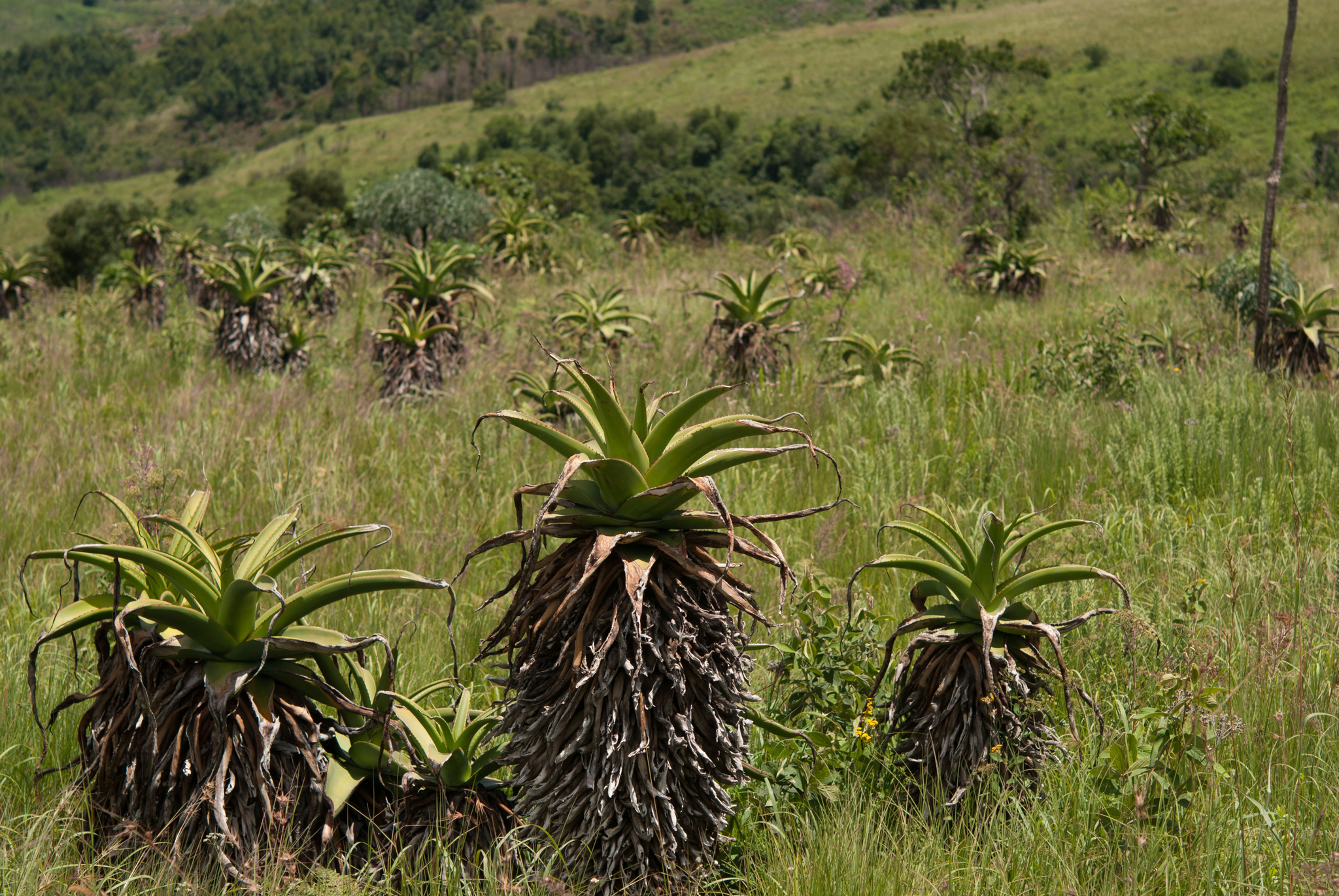
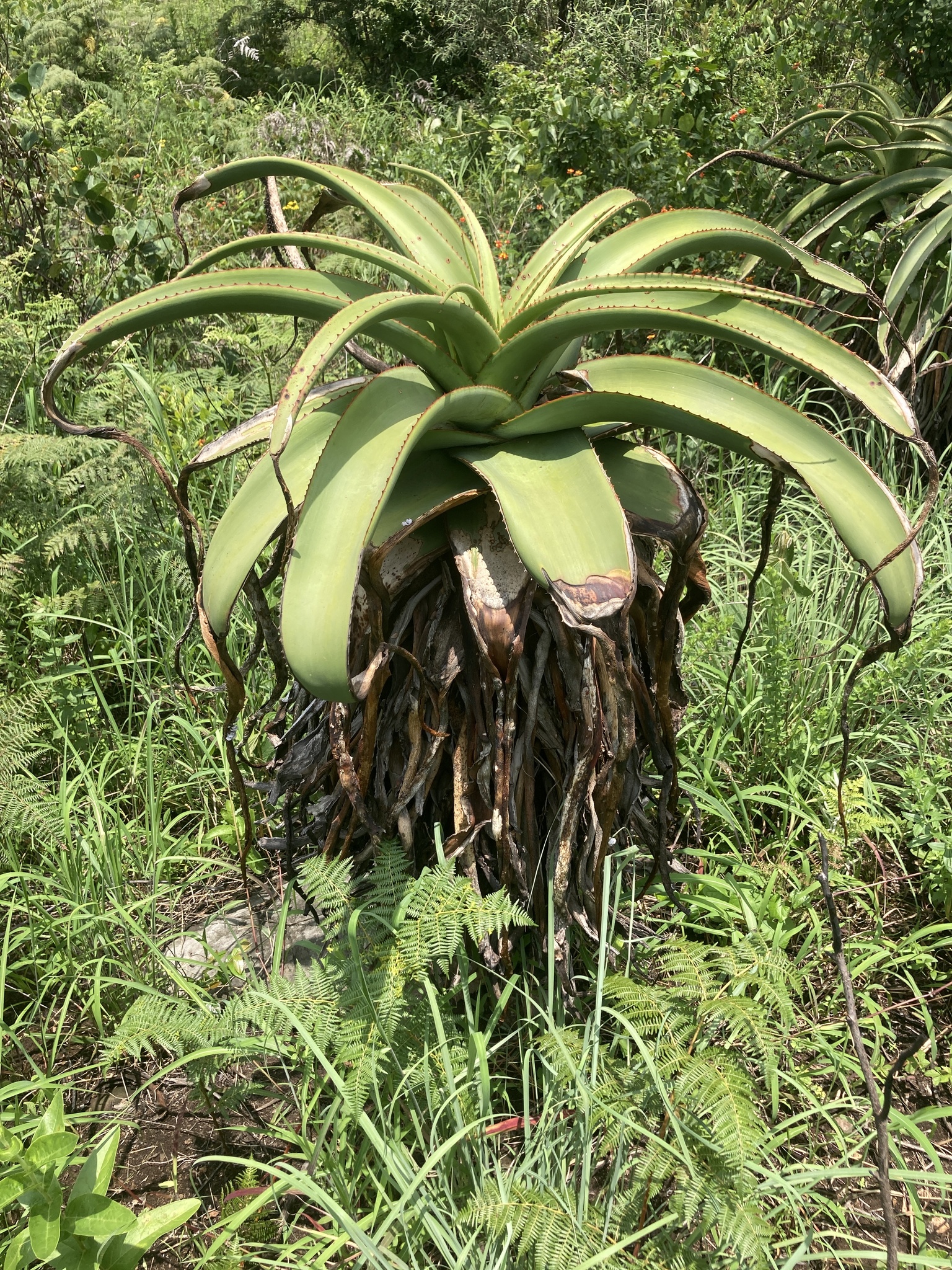
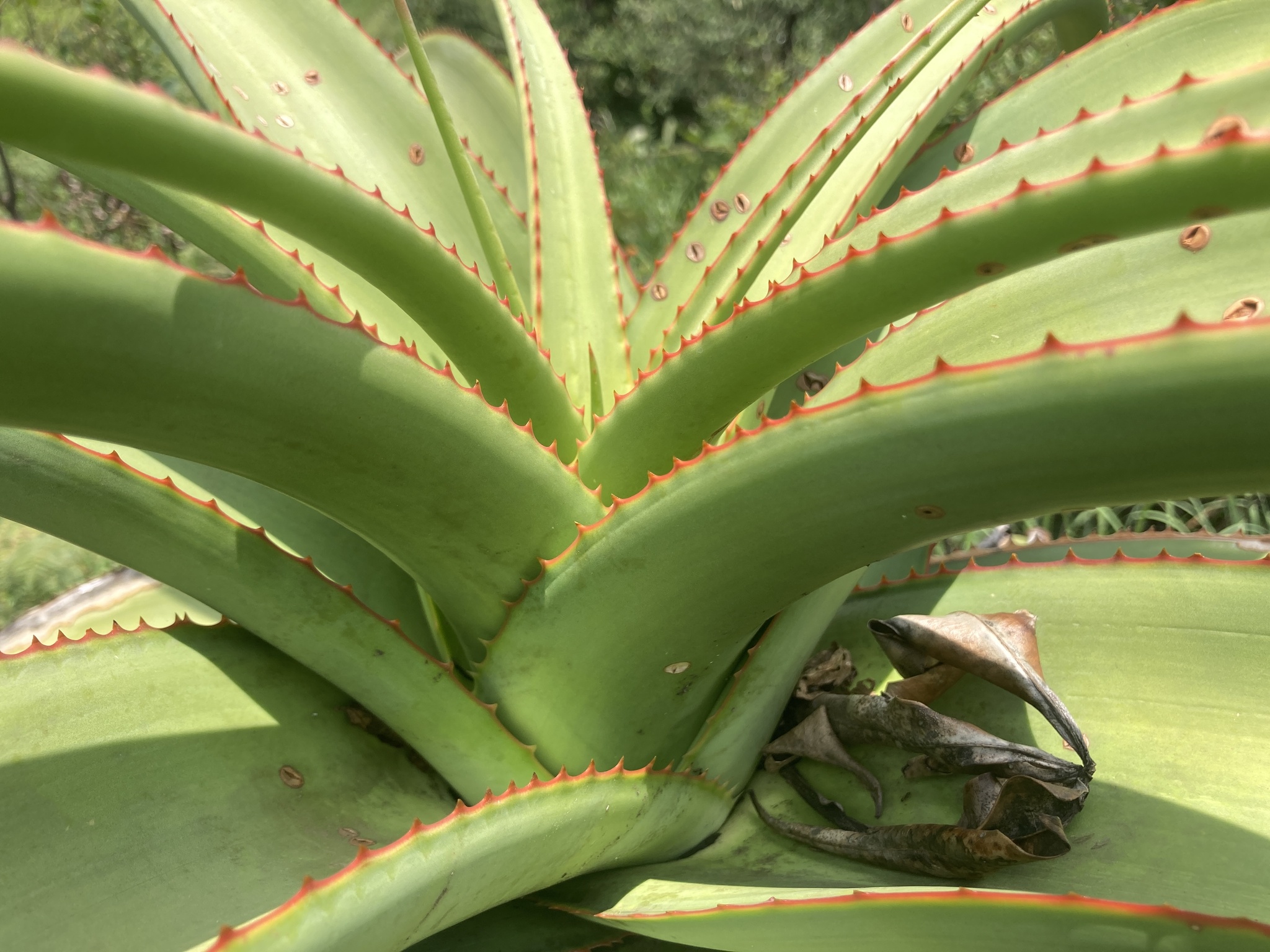
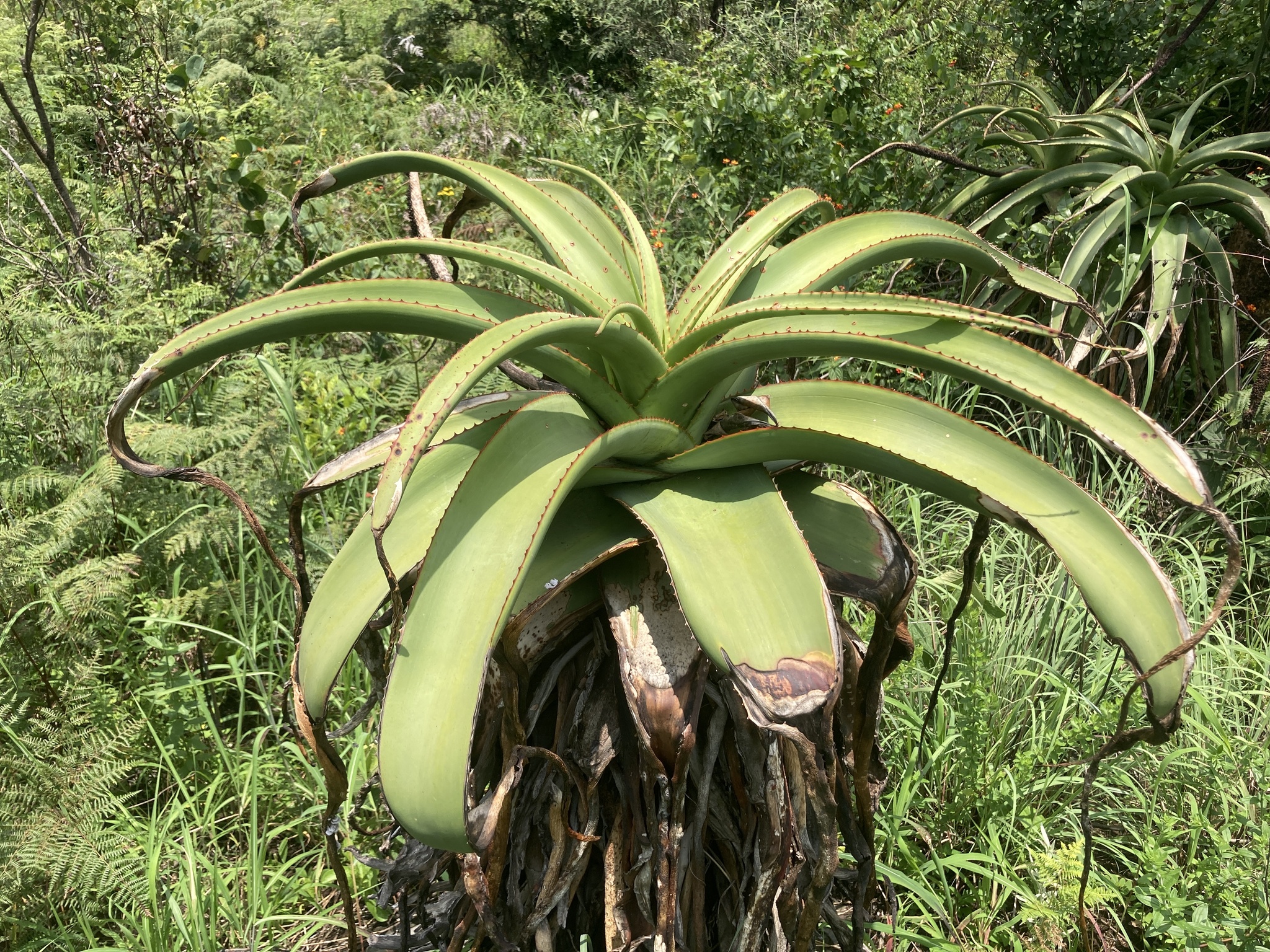
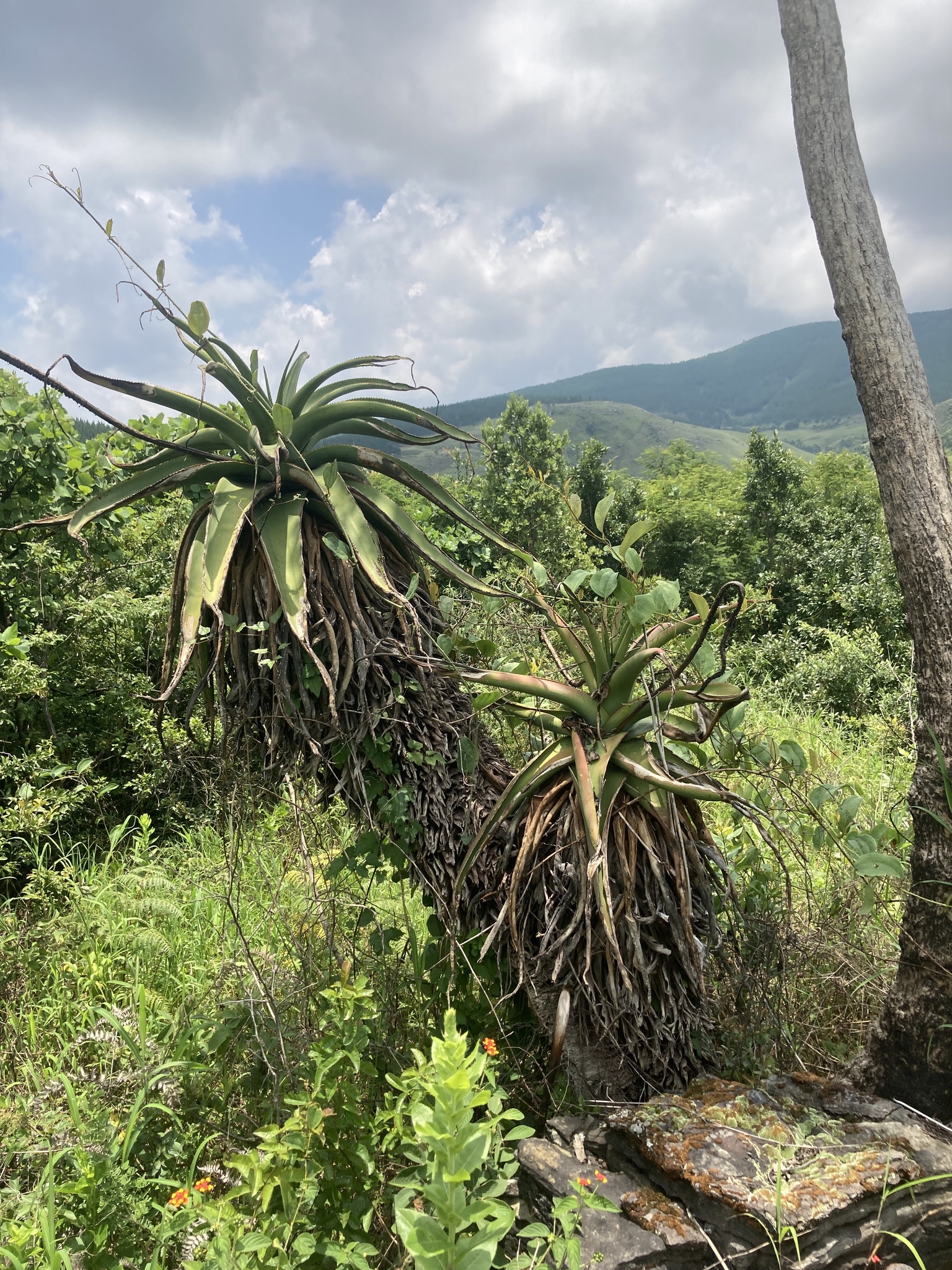
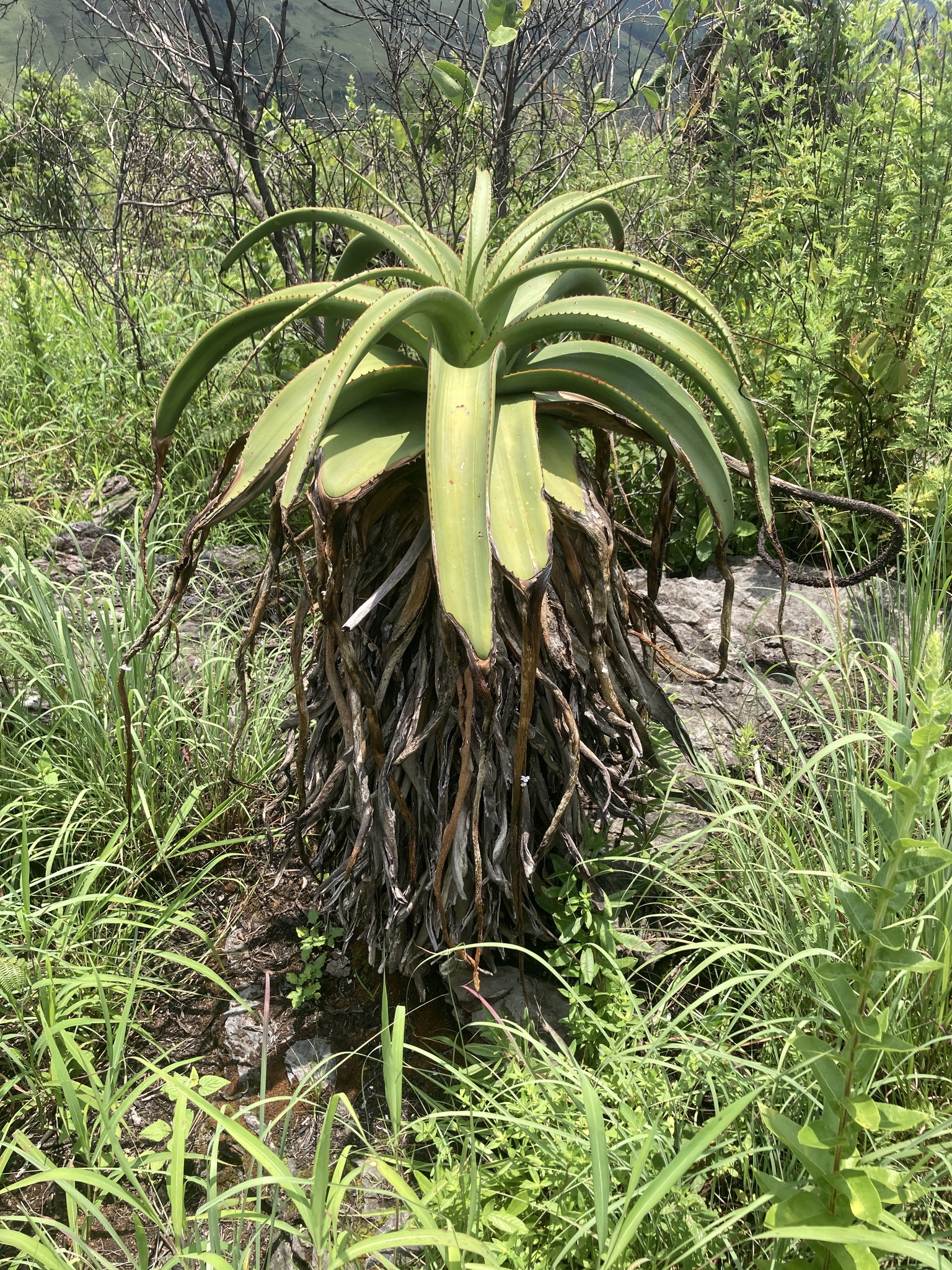
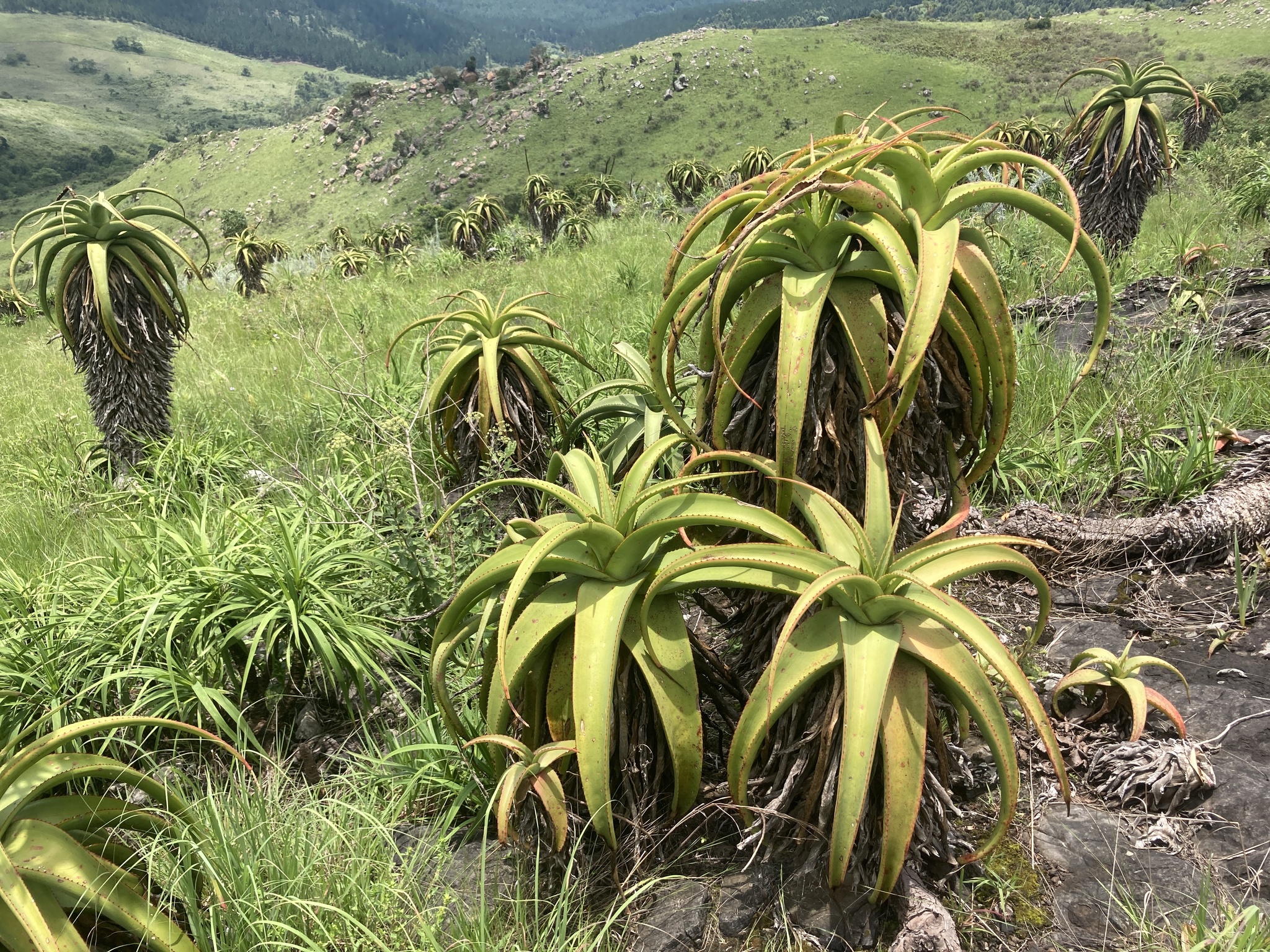
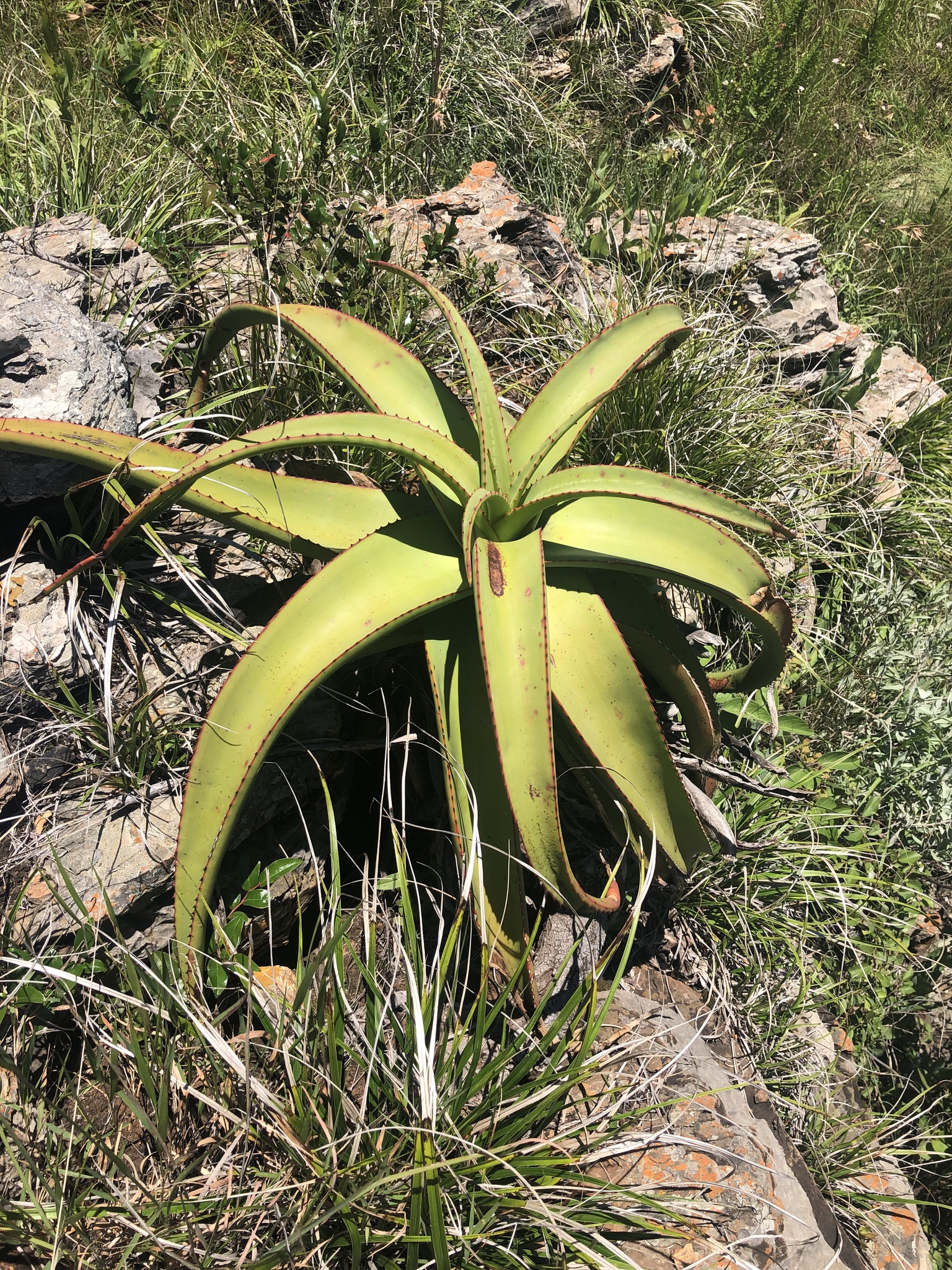
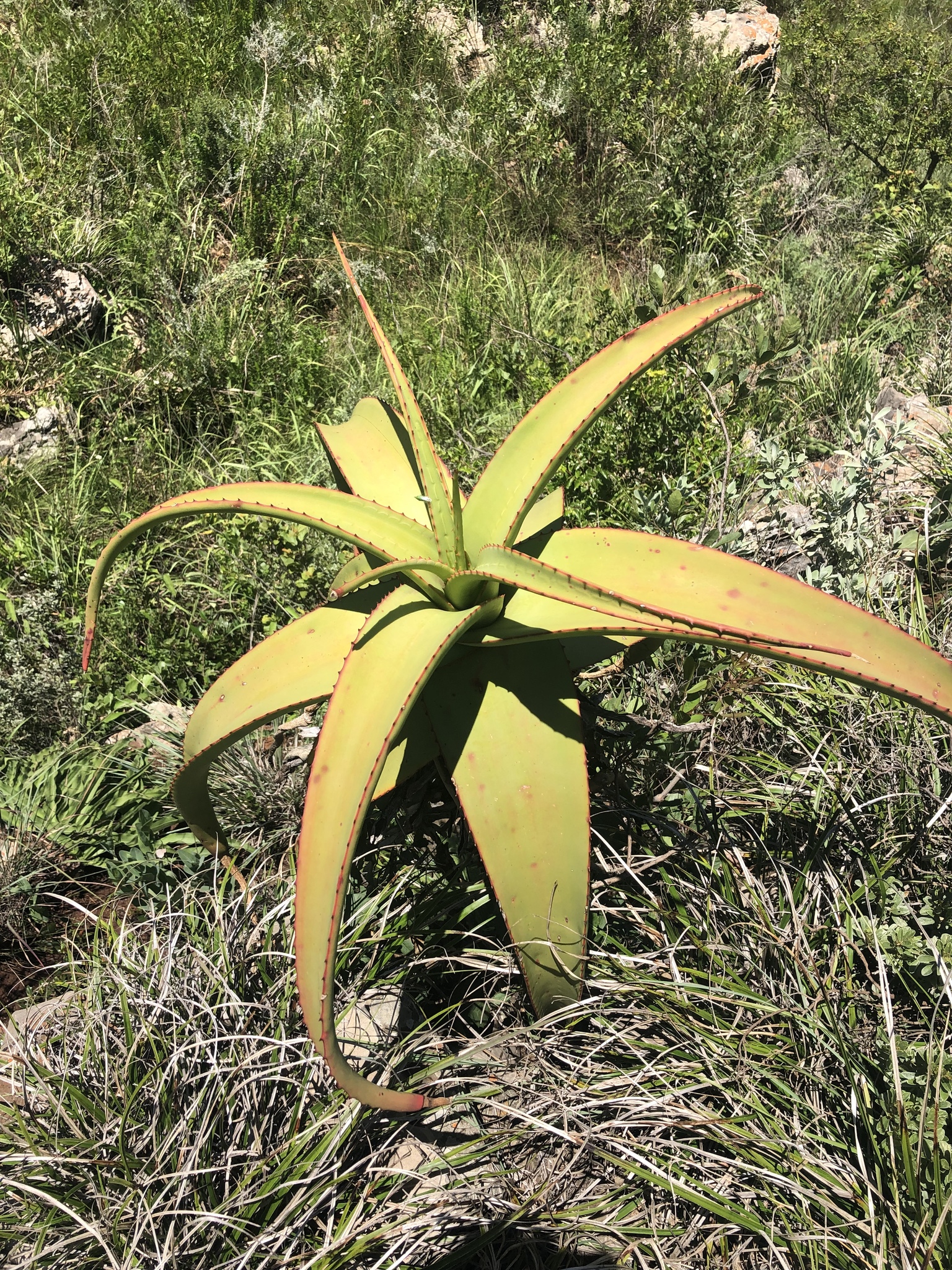
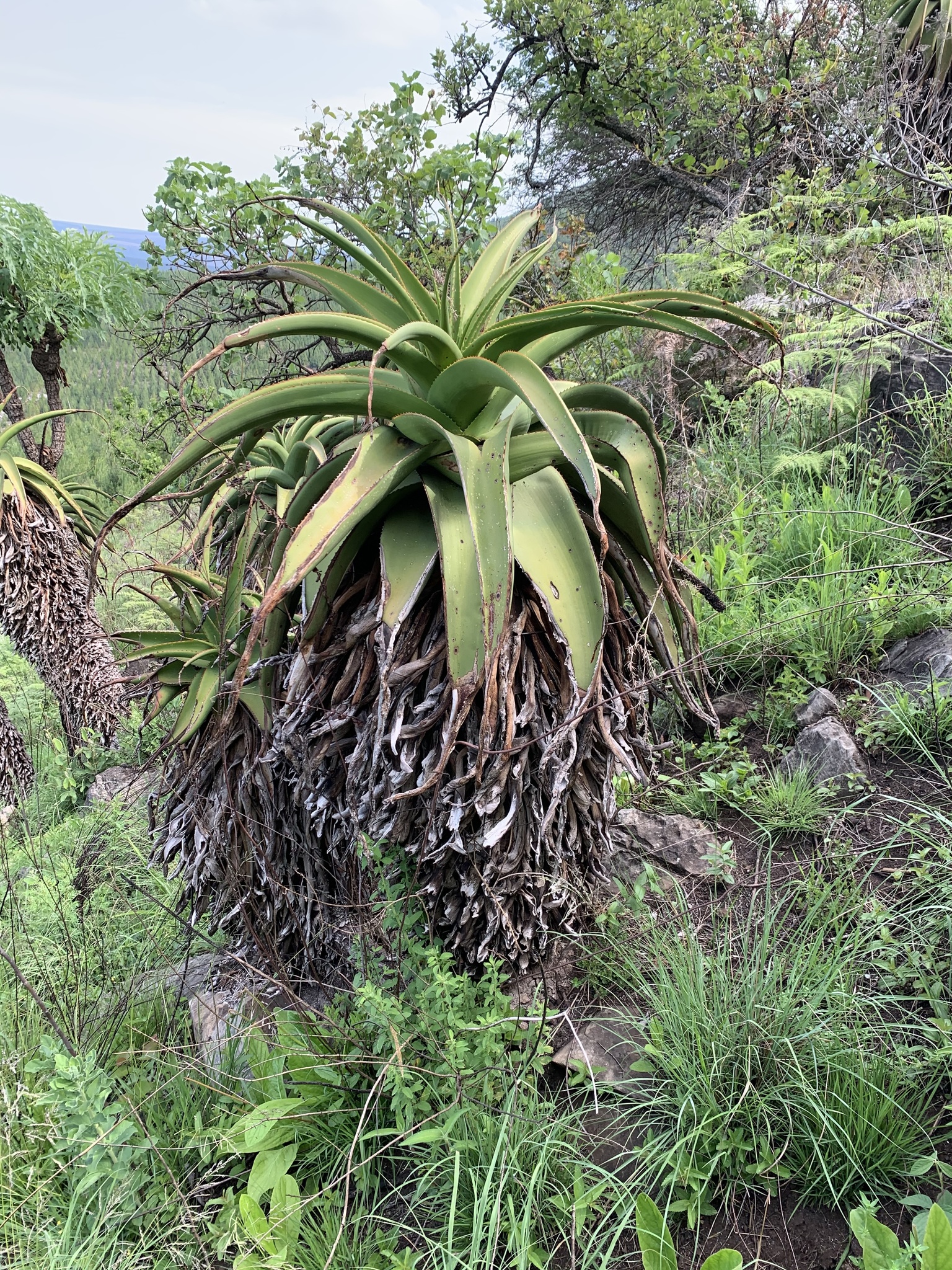
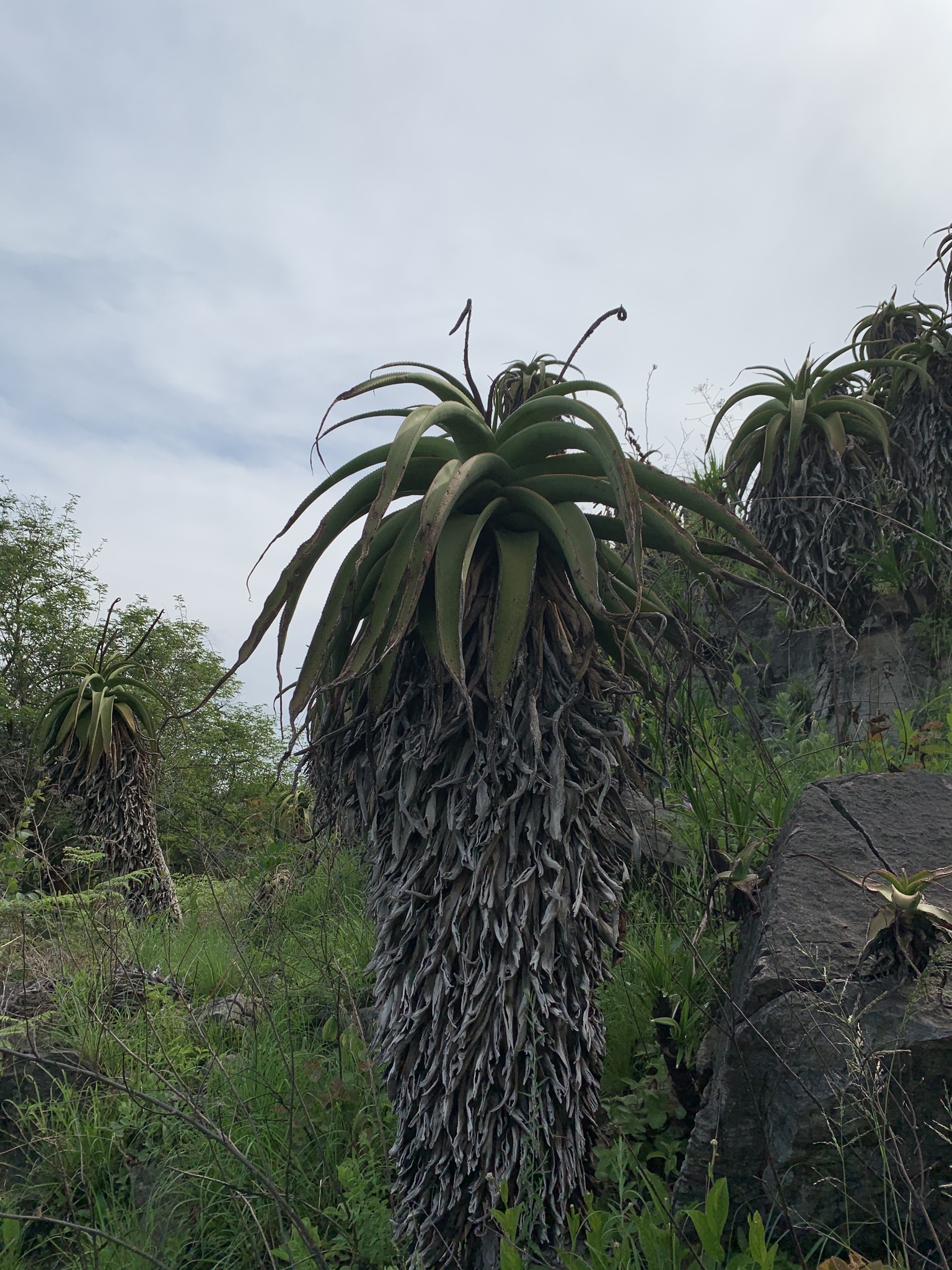
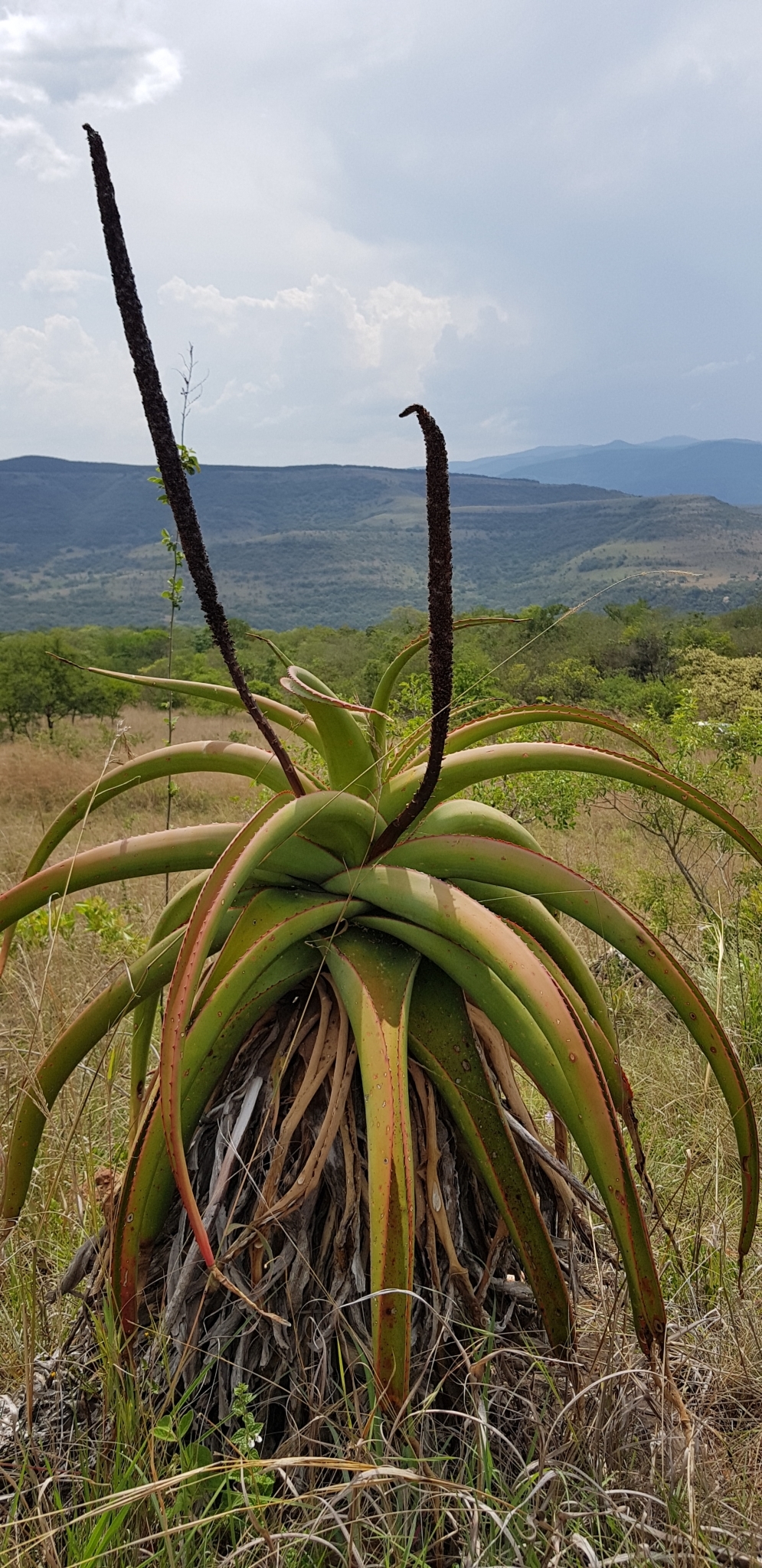
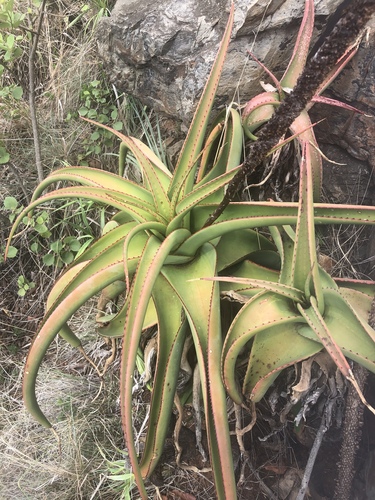
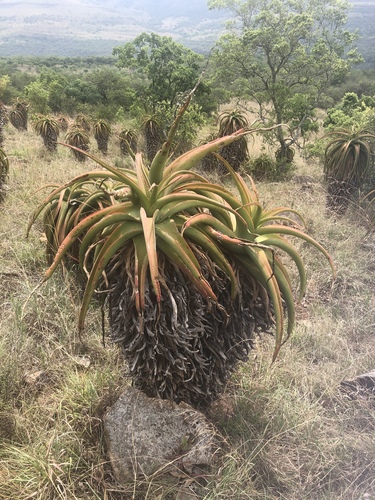
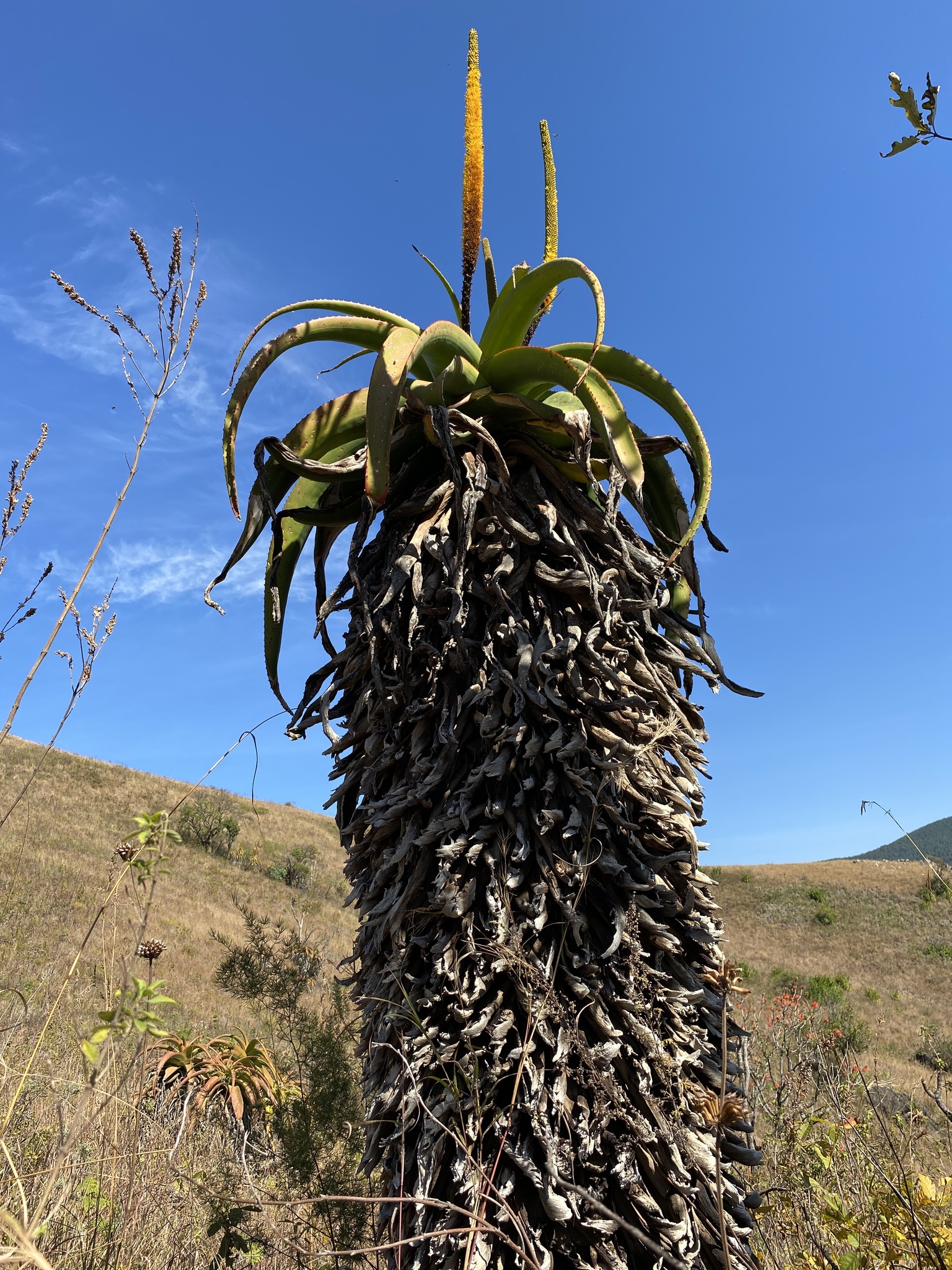
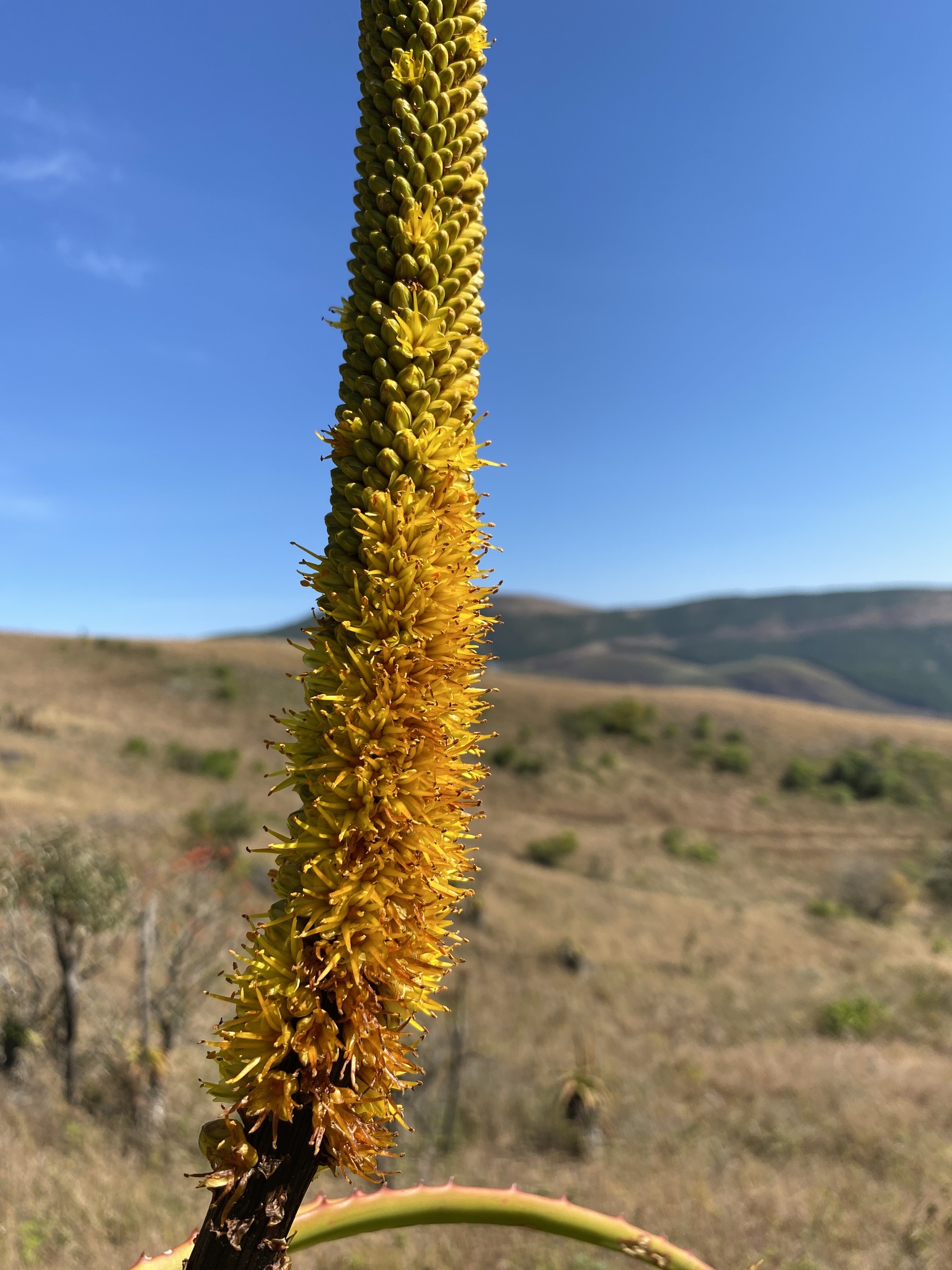
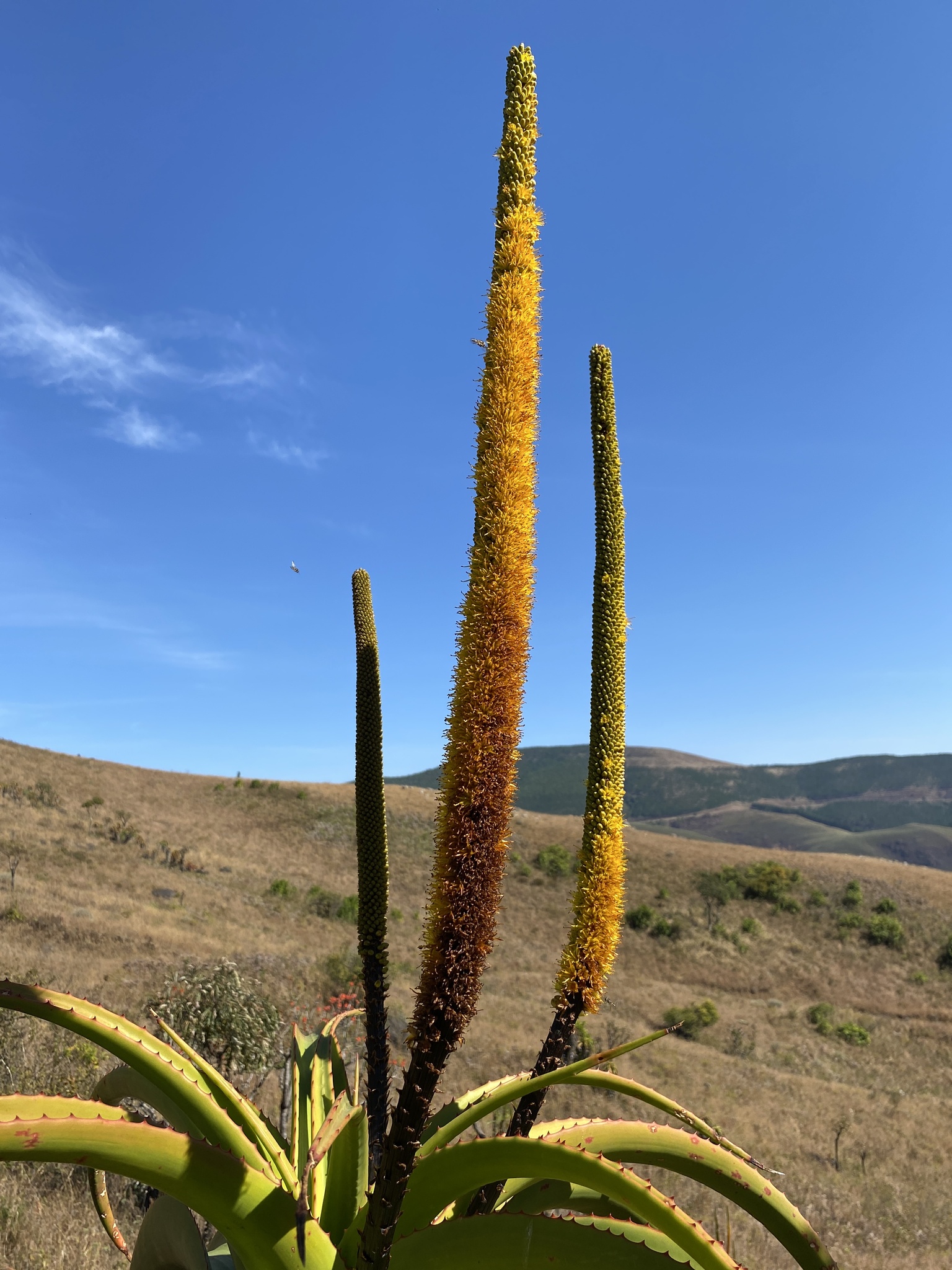
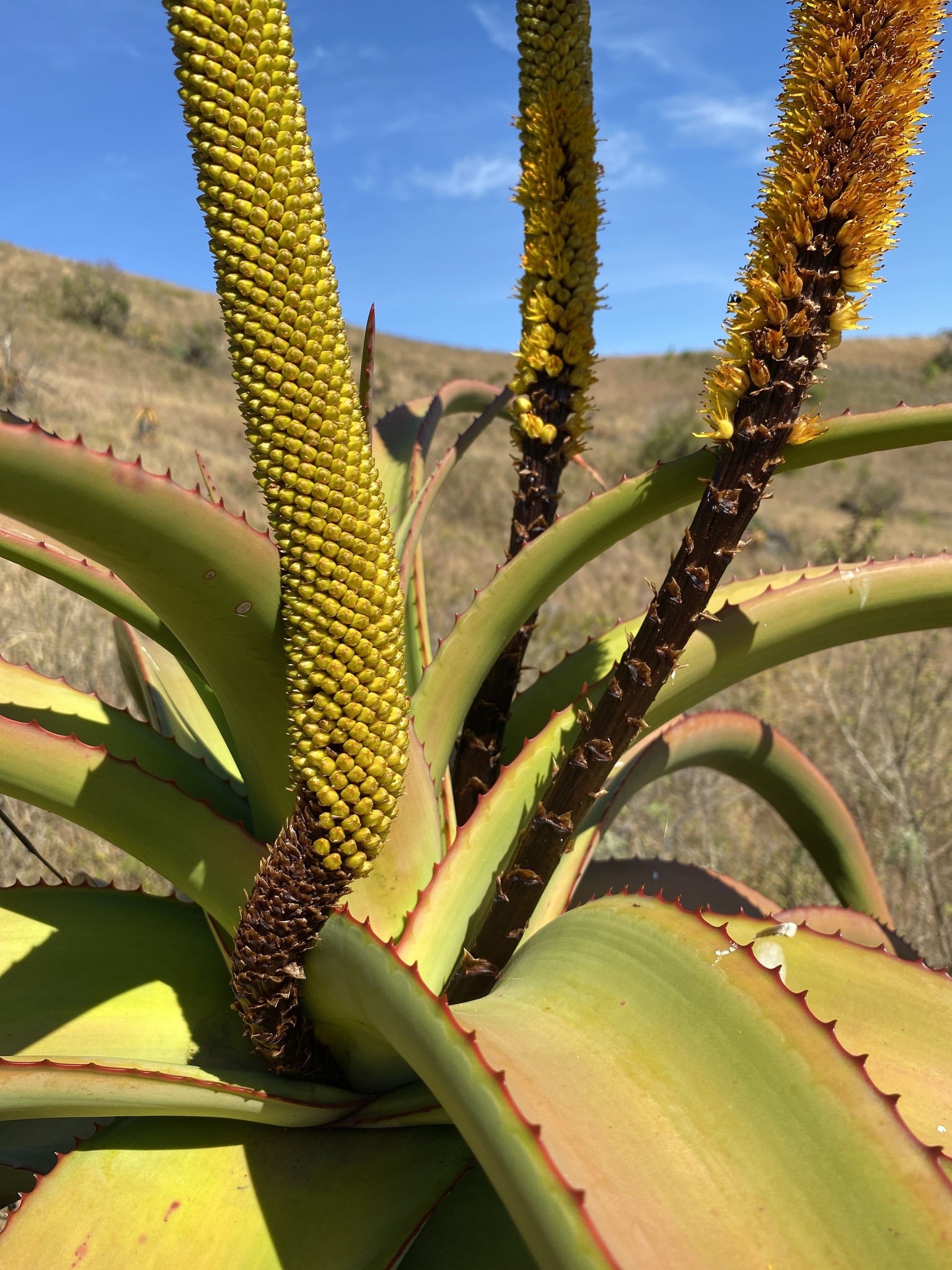
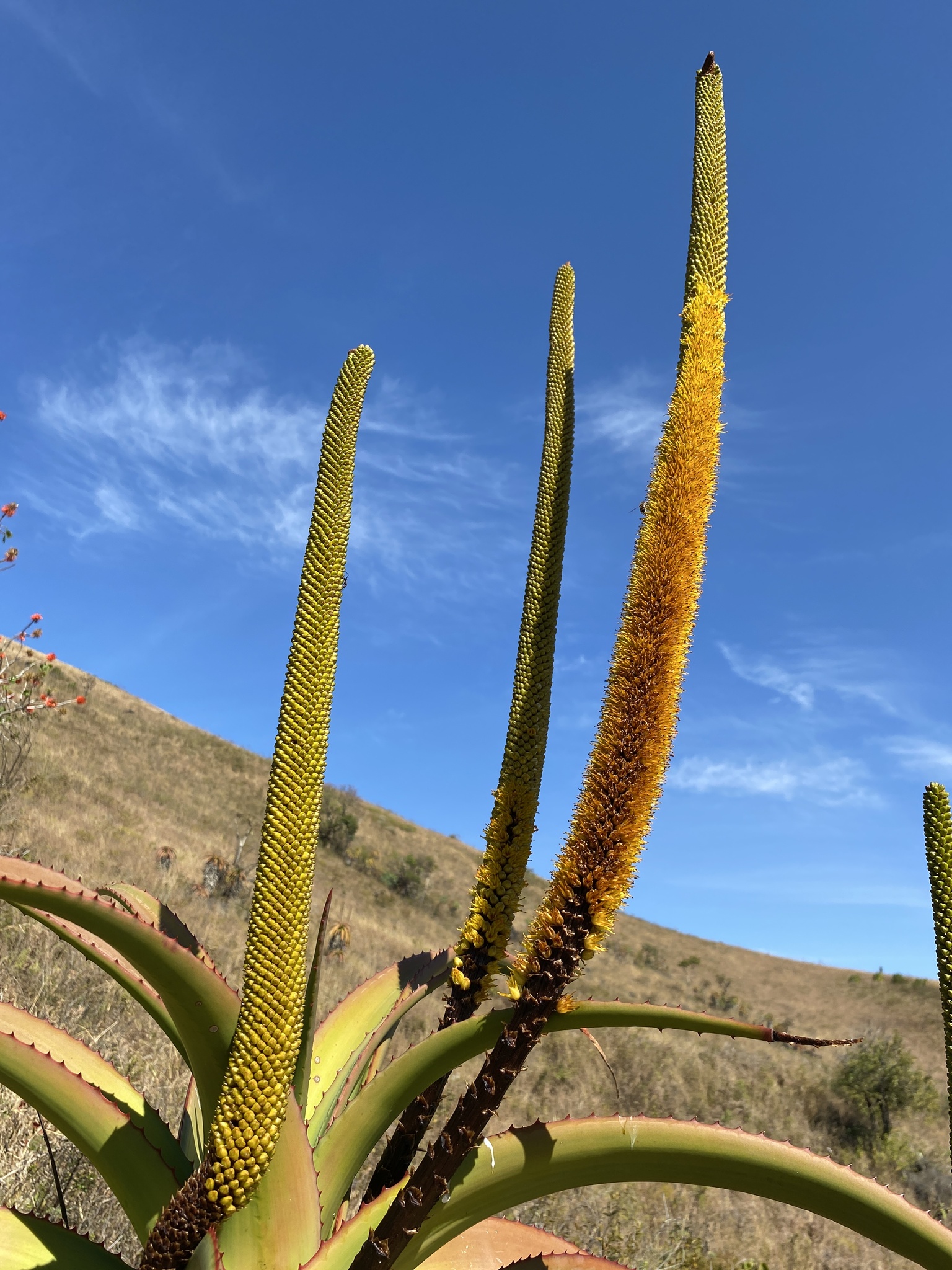
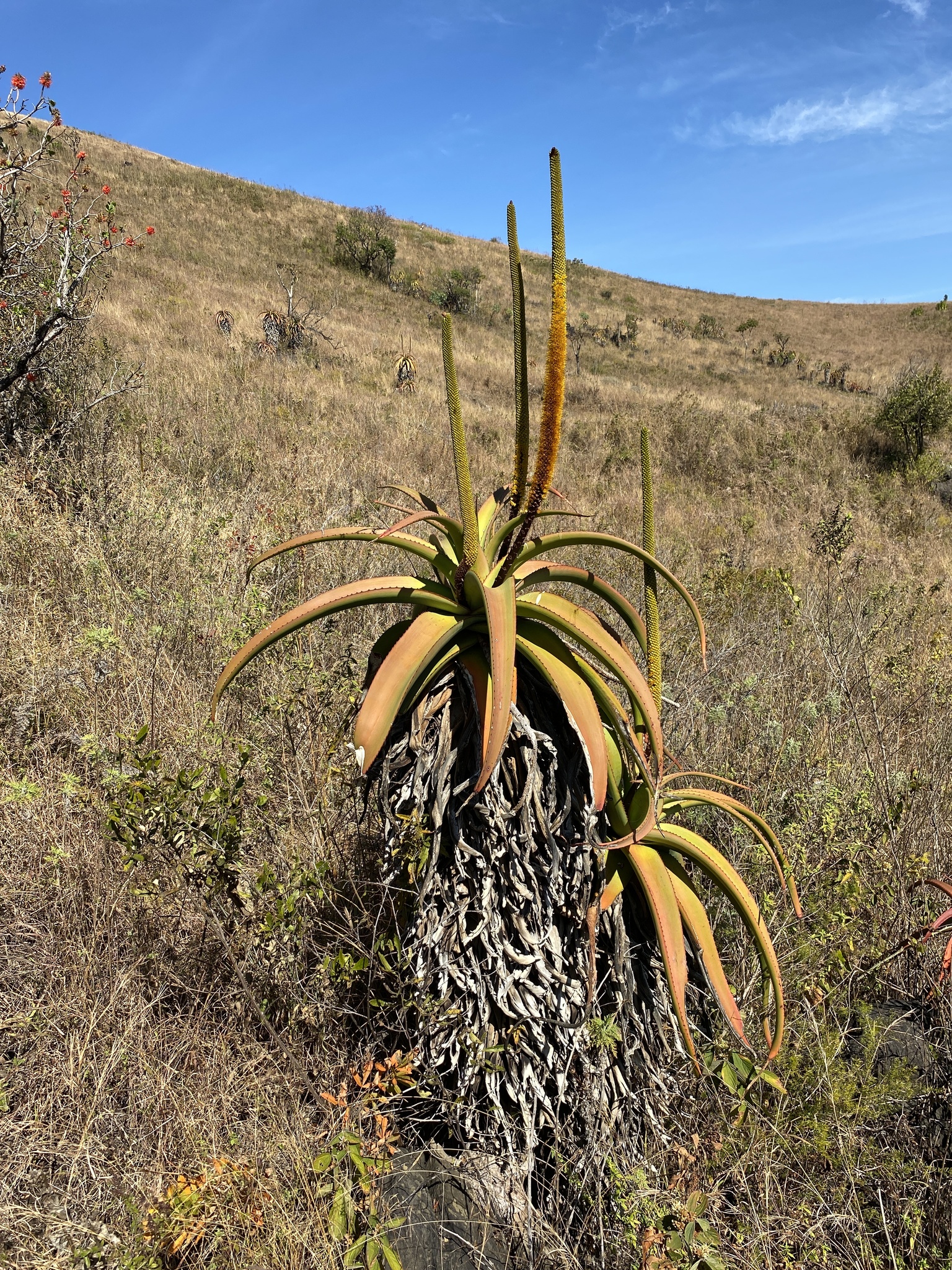
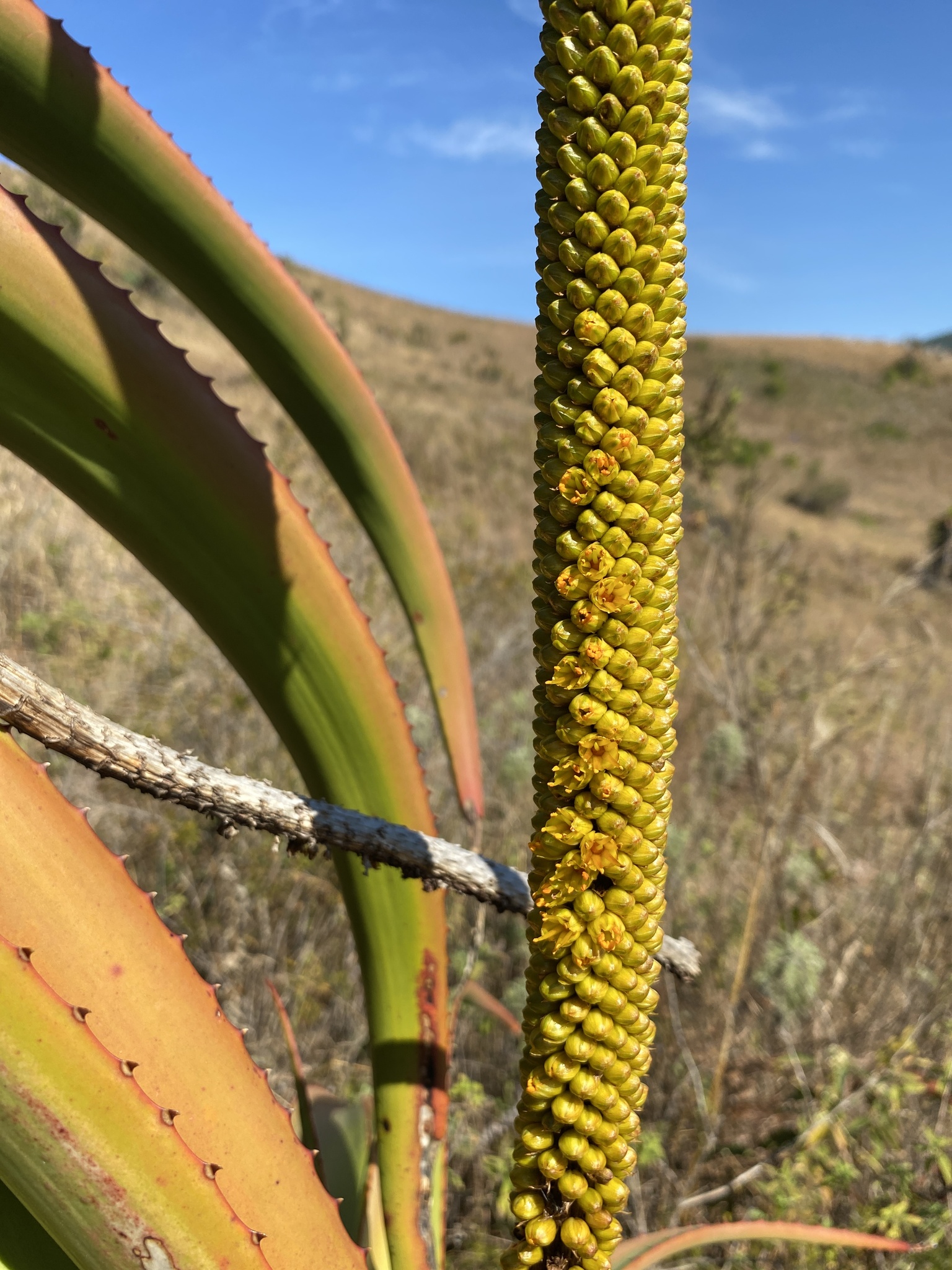
Plants always growing on dolomite formation in mountainous country, with stout stems mostly simple, rarely branched low down, and covered with old dried persistent leaf remains. Stem stout, erect, up to 2 met. tall. Leaves densely rosulate, lanceolate-ensiform, long-attenuate, up to 1.3 met, long, 18 cm broad at base when pressed flat, younger leaves spreading to recurved, older leaves spreading and considerably arcuate-recurved with the apices of the lowest leaves often touching the stem; upper surface deeply canaliculate, 'U' shaped in cross-section, green to sometimes slightly reddish: lower surface convex, green; margins usually with a distinct reddish edge 1-1.5 mm wide, armed with brownish-tipped red teeth 2-3 mm long, 10 mm distant, usually curved towards leaf apex. Inflorescence always simple, up to 1.3 met. tall, 3-5 from a rosette, the racemes erect, sometimes with a twist. Peduncle 20-40 cm long, flattened low down, terete upwards, deep brown, slightly sulcate, with numerous ovate-acute scarious thin many-nerved sterile brads about 8 mm, long, 5 mm broad. Racemes very densely multiflowered, narrowly cylindric, slightly acuminate, averaging 80 cm long, 4-5 cm diam., the buds rather greenish, the exserted filaments yellow, giving the raceme a slightly green-yellow bicoloured effect; the flowers half filled with almost dear nectar. Bracts ovate-acute, thin sub-scarious, 5-7 mm long, 4-5 mm broad, 3-5-nerved. Pedicels none (flowers sessile). Perianth lemon-yellow, sessile, cylindric-campanulate, 9 mm long and about 8 mm across the mouth; outer segments free, spathulate, 5-6 mm broad at the middle, 3-5-nerved, the apices obtuse; inner segments 8-9 mm long and almost as broad at the middle, with thin white edges and very obtuse almost rounded apices. Filaments pale yellow, flattened, the 3 inner narrower and lengthening in advance of the 3 outer. Anthers exserted 7 mm Stigma at length exserted 7-8 mm. Ovary orange, 3 mm long and almost as broad at the middle. Capsule oblong, 9 mm, long, 7 mm diam. From: Reynolds, GW. 1974. Aloes of South Africa, 3rd ed. A.A. Balkema, Cape Town. [All rights reserved] As: Aloe recurvifolia Groenew.
Trees 2-4 m tall; stems usually simple, rarely branched near base. Leaves many, recurved, 600-1300 x 70-180 mm, deeply channelled, olive-green, sometimes slightly reddish. Inflorescence simple, 3-5 simultaneously, up to 1.3 m tall; bracts ovate-acute, 5-8 x 3-5 mm, 3-5-nerved. Flowers sessile, lemon-yellow, 8-10 mm long. Anthers exserted 3-7 mm. Ovary ±3 x 3 mm, orange; style exserted 3-8 mm. Fruit ±9 x 7 mm. From: Glen, HF; Hardy, DS. 2000. Aloe. In: G Germishuizen & E du Plessis (eds), Aloaceae (first part). Fl. S. Africa 5(1,1): 1-167. National Botanical Institute, Pretoria. [http://www.biodiversitylibrary.org/item/209564#page/3/mode/1up] [CC BY]
Arborescent succulent, up to 4 m high. Inflorescence simple, up to 1.3 m high. Racemes narrowly cylindrical, over 500 mm long. Perianth shorter than 12 mm. Flowers sessile, lemon-yellow. From: Retief, E; Herman, PPJ. 1997. Plants of the northern provinces of South Africa: Keys and diagnostic characters. Strelitzia 6: 1-681. National Botanical Institute, Pretoria. [CC BY]
A. recurvifolia is an imposing and distinctive species. Young stemless plants of A. recurvifolia closely resemble the Zululand A. vanbalenii with their deeply channelled recurved leaves, but they could never be confused when in flower. Large plants of A. recurvifolia with stems 1.8 m [as '6 ft.'] high, look very much like the Natal A. thraskii in general habit of growth, but the latter could never be confused with its much-branched inflorescence and entirely different flowers. The chief distinguishing characters of A. recurvifolia, are the deeply channelled much recurved leaves, with the apices of the lowest leaves almost touching the stem, the red marginal edge and teeth, and flowers only 9 mm long and almost as broad, which is the smallest known in the genus except for the 'lost' A. parviflora. The buds of A. recurvifolia are almost globular and are not covered by the apical bracts, while the ovary also is almost globular, being only 3 mm long and broad. The nectar is almost clear, but when viewed in the flower, the reflection of the orange-coloured ovary below, gives the nectar a darker appearance than it is. From: Reynolds, GW. 1974. Aloes of South Africa, 3rd ed. A.A. Balkema, Cape Town. [All rights reserved] As: Aloe recurvifolia Groenew.
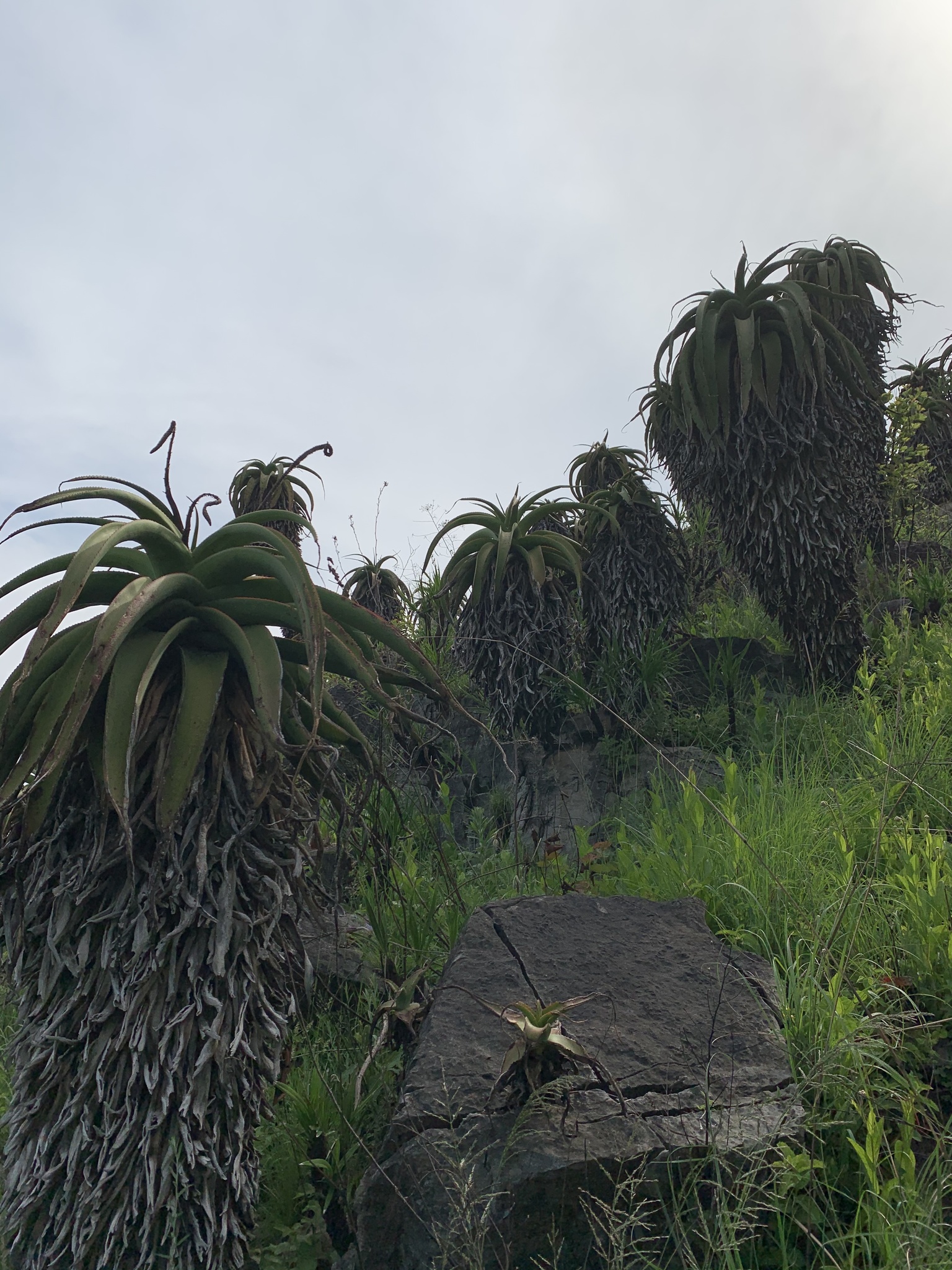
Dolomite outcrops and krantz faces in the mountainous parts of the Eastern Transvaal. Plants are never found in deep soil, only on dolomite ridges. From: Reynolds, GW. 1974. Aloes of South Africa, 3rd ed. A.A. Balkema, Cape Town. [All rights reserved] As: Aloe recurvifolia Groenew.
Aloe alooides grows in shallow soil on dolomite outcrops. It sometimes occurs in association with Encephalartos humilis. The summers in this area are warm and rainy, the winters dry and cold. The summers in this area are warm and rainy, the winters dry and cold. From: Glen, HF; Hardy, DS. 2000. Aloe. In: G Germishuizen & E du Plessis (eds), Aloaceae (first part). Fl. S. Africa 5(1,1): 1-167. National Botanical Institute, Pretoria. [http://www.biodiversitylibrary.org/item/209564#page/3/mode/1up] [CC BY]
Thin soil on dolomite outcrops. From: Retief, E; Herman, PPJ. 1997. Plants of the northern provinces of South Africa: Keys and diagnostic characters. Strelitzia 6: 1-681. National Botanical Institute, Pretoria. [CC BY]
Southern limit appears to be high up on mountain slopes near Coetzeestroom south of Godwan River, thence northwards high up in the mountains to Houtbosloop, Hendriksdal, Spitzkop, various ridges near Sabie, west of Graskop, on most dolomite outcrops and krantz faces near Pilgrims Rest, and northwards to near Vaalhoek which appears to be the northern limit, all of these localities being in the mountainous parts of the Eastern Transvaal. From: Reynolds, GW. 1974. Aloes of South Africa, 3rd ed. A.A. Balkema, Cape Town. [All rights reserved] As: Aloe recurvifolia Groenew.
In a limited area of the Mpumalanga escarpment. From: Glen, HF; Hardy, DS. 2000. Aloe. In: G Germishuizen & E du Plessis (eds), Aloaceae (first part). Fl. S. Africa 5(1,1): 1-167. National Botanical Institute, Pretoria. [http://www.biodiversitylibrary.org/item/209564#page/3/mode/1up] [CC BY]
July to August
1200 to 1800 m
This map contains point-based occurrences at different locations
Occurrence in the Flora of Southern Africa (FSA) countries and South African provinces. Residence status indicates if a taxon is indigenous, endemic, naturalised or invasive in a specific region. This data is based on specimen records and literature
FSA
SA
BOT
NAM
ESW
LES
WC
EC
NC
FS
GA
KZN
LP
MP
NW
Absent
Indigenous
Endemic
Naturalised
Invasive
Names and Sources
Published in: Bothalia 6: 544 (1956)
Urginea alooides Bolus
Published in: J. Linn. Soc., Bot. 18: 395 (1881)
Notosceptrum alooides (Bolus) Benth.
Published in: Gen. Pl. [Bentham & Hooker f.] 3(2): 775 (1883)
Aloe recurvifolia Groenew.
Published in: Tydskr. Wetensk. Kuns 13: 39 (1935)
| Common name | Language | Reference/barcode | Published as |
|---|---|---|---|
| Graskop Aloe | English | Smith, GF; Van Wyk, B-E. 1996. Guide to the Aloes of South Africa, 1st ed. Briza, Pretoria. | |
| Graskop aloe | English | Van Wyk, AE; Van den Berg, E; Coates Palgrave, M; Jordaan, M. 2011. Dictionary of names for southern African trees. Briza, Arcadia. | |
| Graskop aloe | English | Von Breitenbach, JM; De Winter, B; Poynton, R; Van den Berg, E; Van Wyk, AE. 2001. Pocket list of southern Africa indigenous trees. Briza publications & Dendrological foundation, Pretoria. | |
| Graskopaalwyn | Afrikaans | Smith, GF; Van Wyk, B-E. 1996. Guide to the Aloes of South Africa, 1st ed. Briza, Pretoria. | |
| graskopaalwyn | Afrikaans | Van Wyk, AE; Van den Berg, E; Coates Palgrave, M; Jordaan, M. 2011. Dictionary of names for southern African trees. Briza, Arcadia. | |
| Graskop-aalwyn | Afrikaans | Von Breitenbach, JM; De Winter, B; Poynton, R; Van den Berg, E; Van Wyk, AE. 2001. Pocket list of southern Africa indigenous trees. Briza publications & Dendrological foundation, Pretoria. | |
| sekgopha | Northern Sotho (Pedi) | Von Breitenbach, JM; De Winter, B; Poynton, R; Van den Berg, E; Van Wyk, AE. 2001. Pocket list of southern Africa indigenous trees. Briza publications & Dendrological foundation, Pretoria. | |
| sekgopha | Pedi; Sepedi; Northern Sotho | Van Wyk, AE; Van den Berg, E; Coates Palgrave, M; Jordaan, M. 2011. Dictionary of names for southern African trees. Briza, Arcadia. |
Classification
KINGDOM Plantae
SUBKINGDOM Phanerogamae
PHYLUM Anthophyta
ORDER Asparagales
FAMILY Asphodelaceae
SUBFAMILY Alooideae
GENUS Aloe
SPECIES alooides
20 results for Aloe alooides (Bolus) Druten
Barcode: PRE0091888-0 Collector(s) & number: Van der Merwe, FZ, 73 | 1934-7-
South Africa, Mpumalanga, PILGRIMS REST; GRASKOP; KOPPIEKOPPIE
Data Resource: BODATSA View record
Barcode: NBG0273416-0 Collector(s) & number: Henderson, MR, s.n. | 1944-8-29
South Africa, Western Cape, Hort. Kirstenbosch. Rock Garden.
General notes: Hort. Kirstenbosch. Rock Garden. Photo: M.R. Henderson, Negative No.589.
Data Resource: BODATSA View record
Barcode: NBG0067801-1 Collector(s) & number: Henderson, MR, 1771 | 1943-8-23
South Africa, Western Cape, Hort. Kirstenbosch. Rock Garden.
General notes: Hort. Kirstenbosch. Rock Garden. No particulars.
Data Resource: BODATSA View record
Barcode: PRE0896935-0 Collector(s) & number: McMahon, M, MM00090 | 2002-6-17
South Africa, Mpumalanga, ± 8 km's north of Graskop, turn left towards SAFCOL sawmill (Berlin Falls). On SAFCOL property.
General notes: Afro - montane. Mist/fog. Steep slope.
Data Resource: BODATSA View record
Barcode: NBG0273417-0 Collector(s) & number: Reynolds, GW, 5498 & 5499 | 1948-8-2
South Africa, Mpumalanga, Eastern Transvaal. Pilgrims Rest Dist. South of Sabie. Houtbosloop.
General notes: Photos: G.W. Reynolds.
Data Resource: BODATSA View record
Barcode: NBG0273418-0 Collector(s) & number: Unknown, s.n. | -8-
South Africa, Transvaal, Eastern Transvaal. Mountain top south of Rosehaugh.
General notes: Mountain top. Flowers in August. Plant height, 8 ft.
Data Resource: BODATSA View record
Barcode: NBG0273419-0 Collector(s) & number: Reynolds, GW, N.B.G. 1130/35 | 1941-8-25
South Africa, Mpumalanga, Transvaal. Pilgrims Rest.
General notes: Leaves green. Inflorescence unbranched. Buds green. Flowers yellow.
Data Resource: BODATSA View record
Barcode: PRE0112542-0 Collector(s) & number: Reynolds, GW, 1324 | 1935-7-17
South Africa, Mpumalanga, NELSPRUIT DIST.; HOUTBOSLOOP; 25 MI. W. OF NELSPRUIT
Data Resource: BODATSA View record
Barcode: PRE0091889-0 Collector(s) & number: Reynolds, GW, 1459 | 1935-7-19
South Africa, Mpumalanga, PILGRIMS REST; GRASKOP; THE BONNET FARM
Data Resource: BODATSA View record
Barcode: NBG0067801-2 Collector(s) & number: Henderson, MR, 1771 | 1943-8-23
South Africa, Western Cape, Hort. Kirstenbosch. Rock Garden.
General notes: Hort. Kirstenbosch. Rock Garden. No particulars.
Data Resource: BODATSA View record
This map contains point-based occurrences at different locations
2011
SERIES
The aloe names book Grace, OM; Klopper, RR; Figueiredo, E; Smith, GFStrelitzia 28: 1-232
South African National Biodiversity Institute, Pretoria
2000
FLORA
Aloe Glen, HF; Hardy, DSIn: G Germishuizen & E du Plessis (eds), Aloaceae (first part). Flora of Southern Africa 5(1),11-167
National Botanical Institute, Pretoria
1997
SERIES
Plants of the northern provinces of South Africa: Keys and diagnostic characters Retief, E; Herman, PPJStrelitzia 6: 1-681
National Botanical Institute, Pretoria
1997
1982
1979
1974
1936
PERIODICAL/JOURNAL
Aloe recurvifolia Groenewald Reynolds, GW; Letty, CLFlowering Plants of South Africa 16: , t.601
No results found for Aloe alooides (Bolus) Druten
Status and criteria
LC
Assessor(s)
Plantae Coordinator
| Part(s) of plant used | Use(s) | Reference |
|---|
Coming soon...


