PLANTAE / PHANEROGAMAE / ANTHOPHYTA / ASPARAGALES / IRIDACEAE / CROCOIDEAE / TRITANIOPSIDEAE / TRITONIOPSIS / BICOLOR

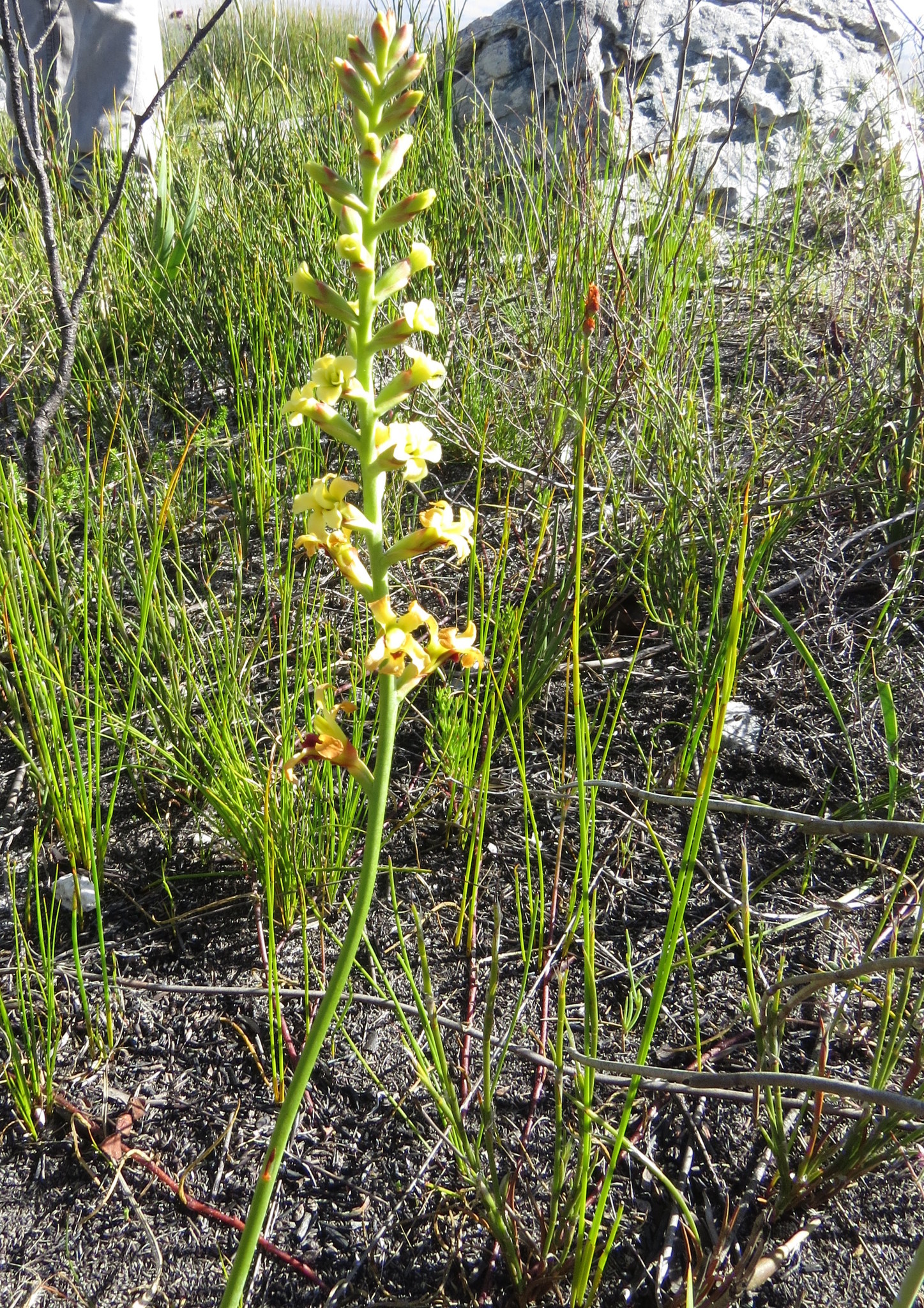
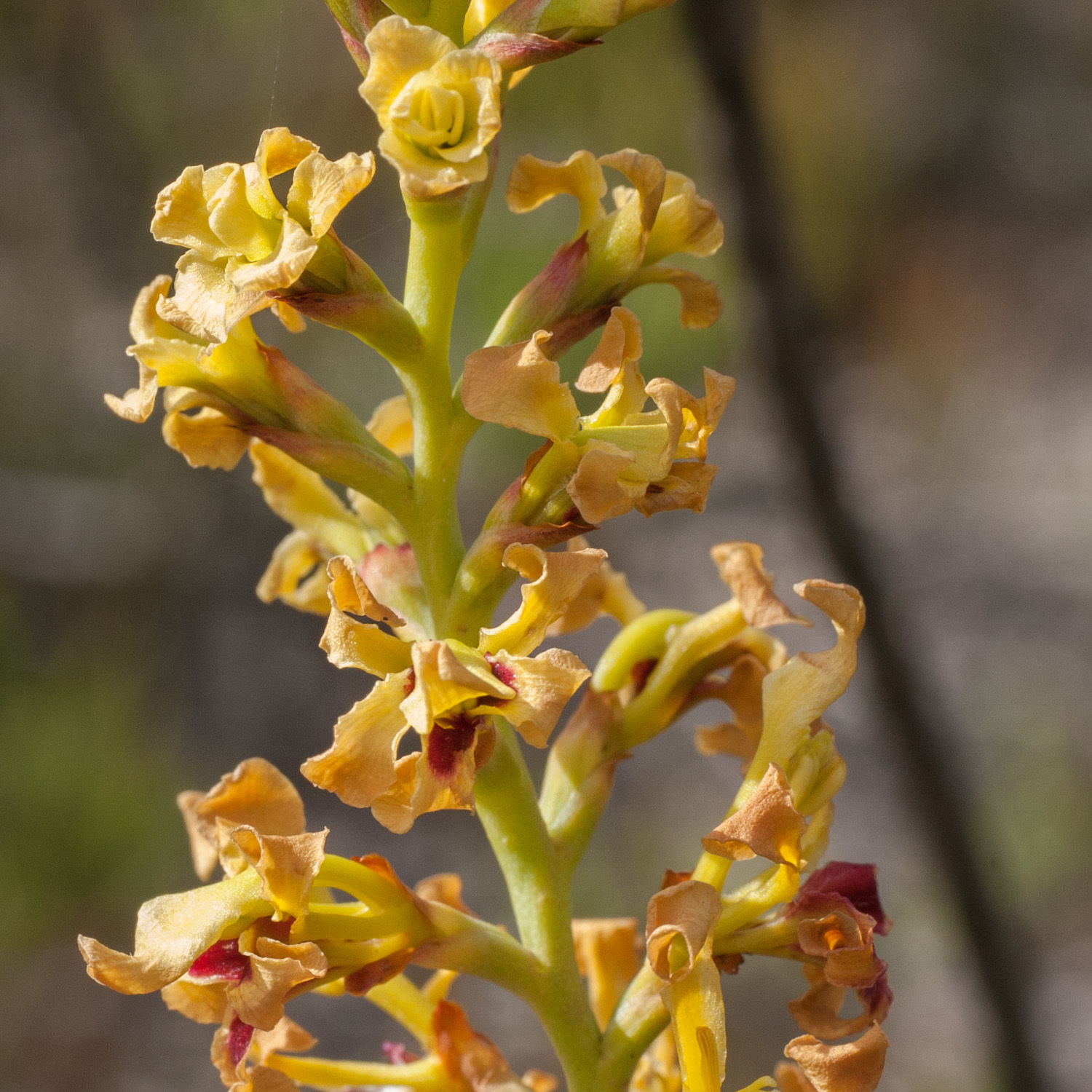
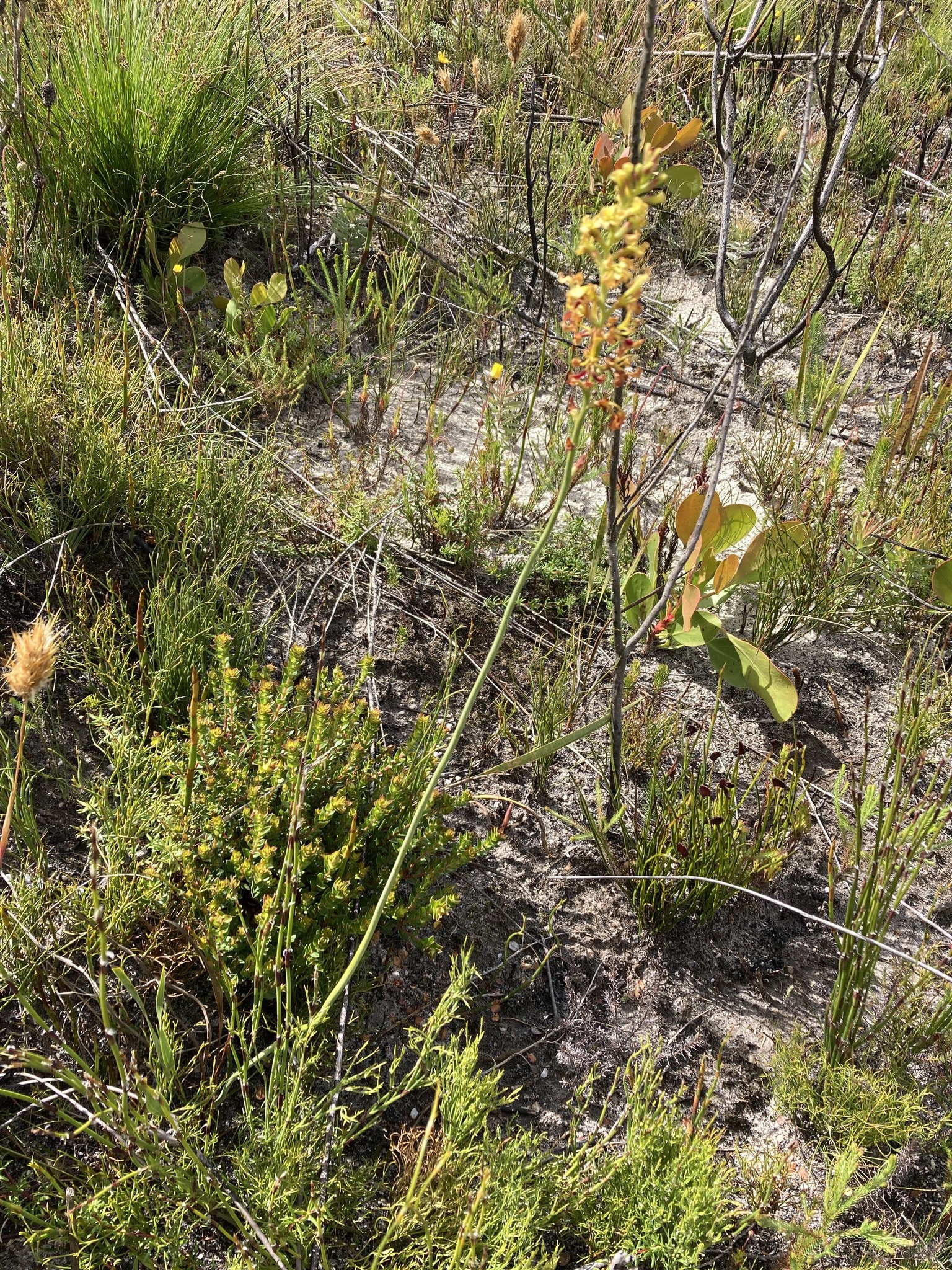
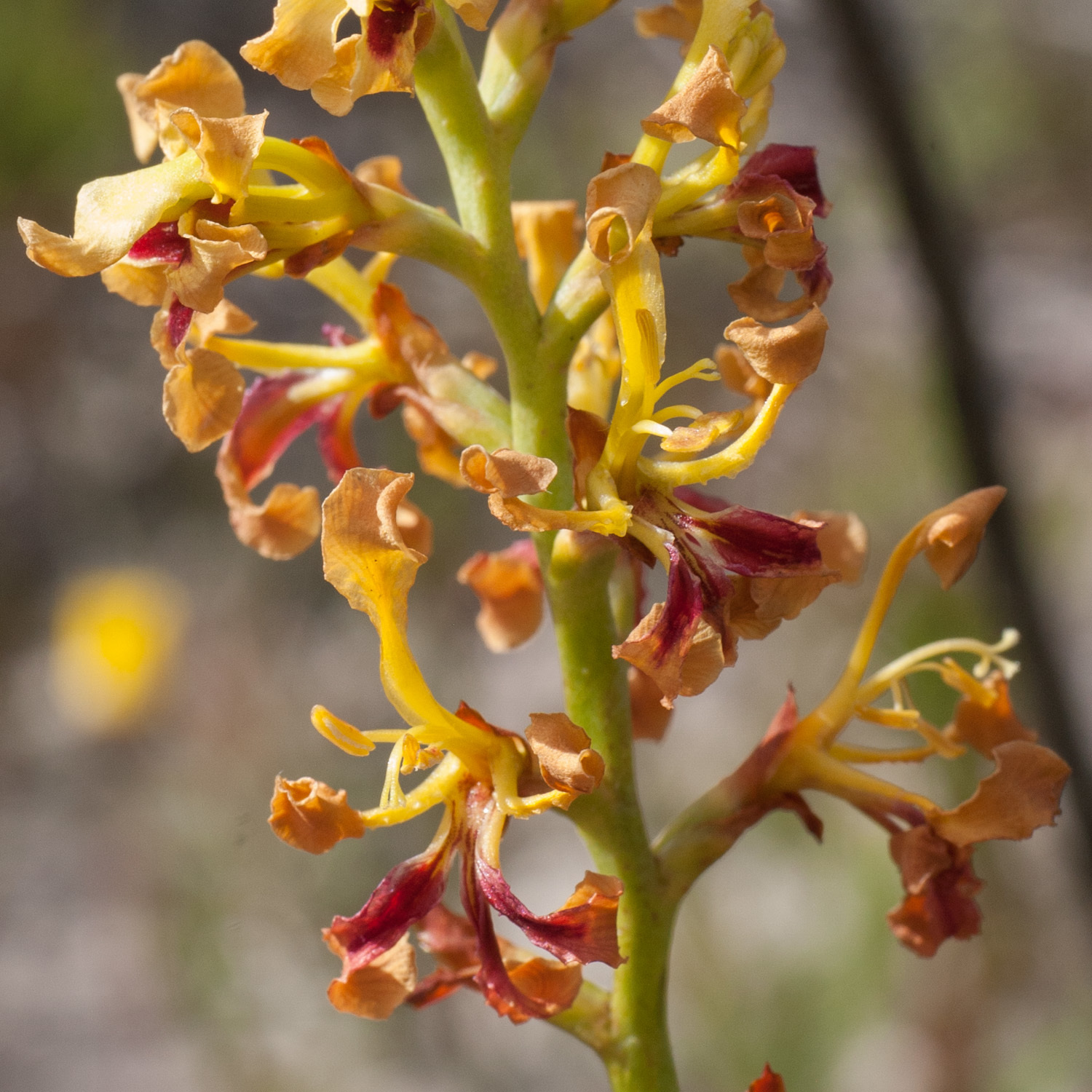
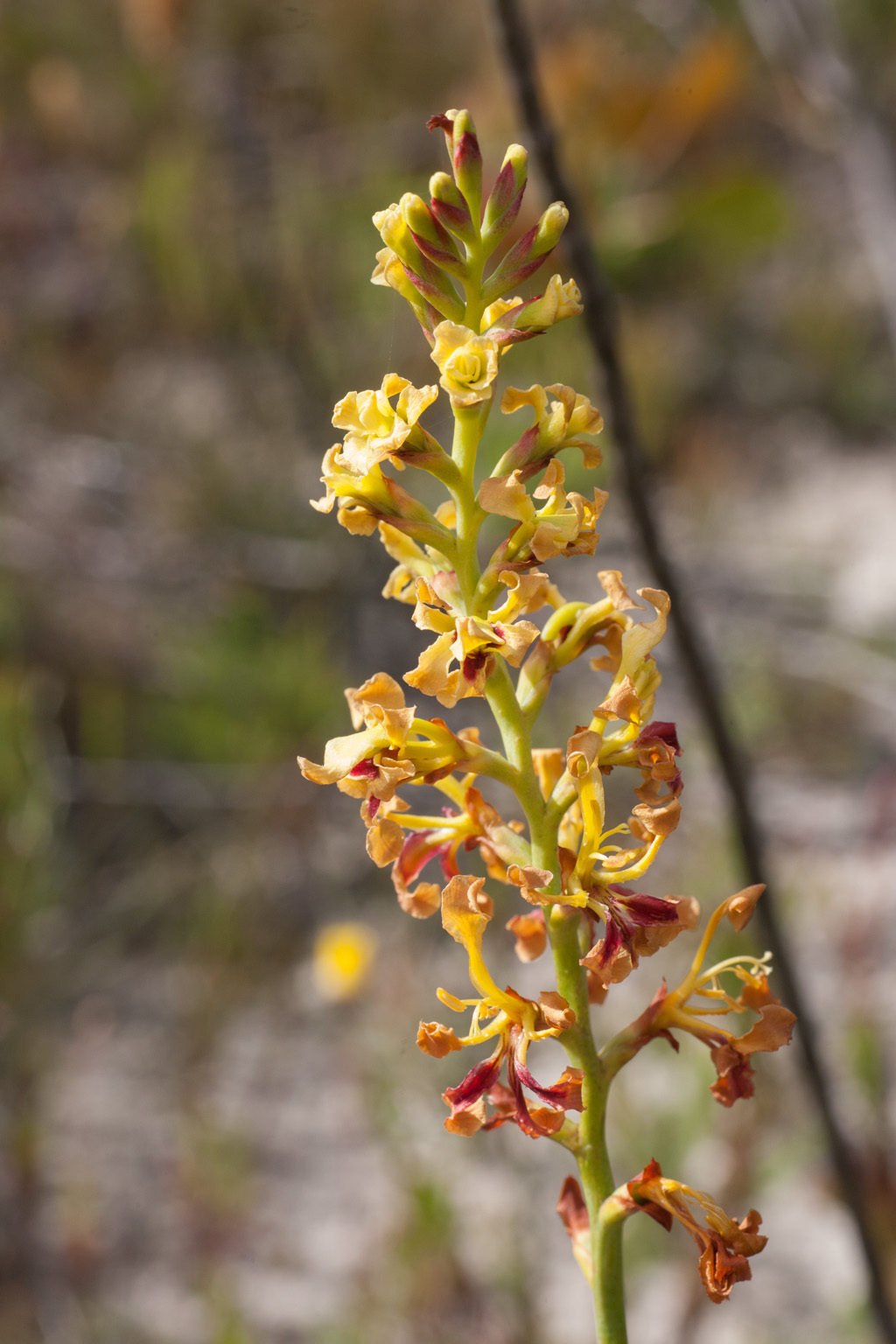
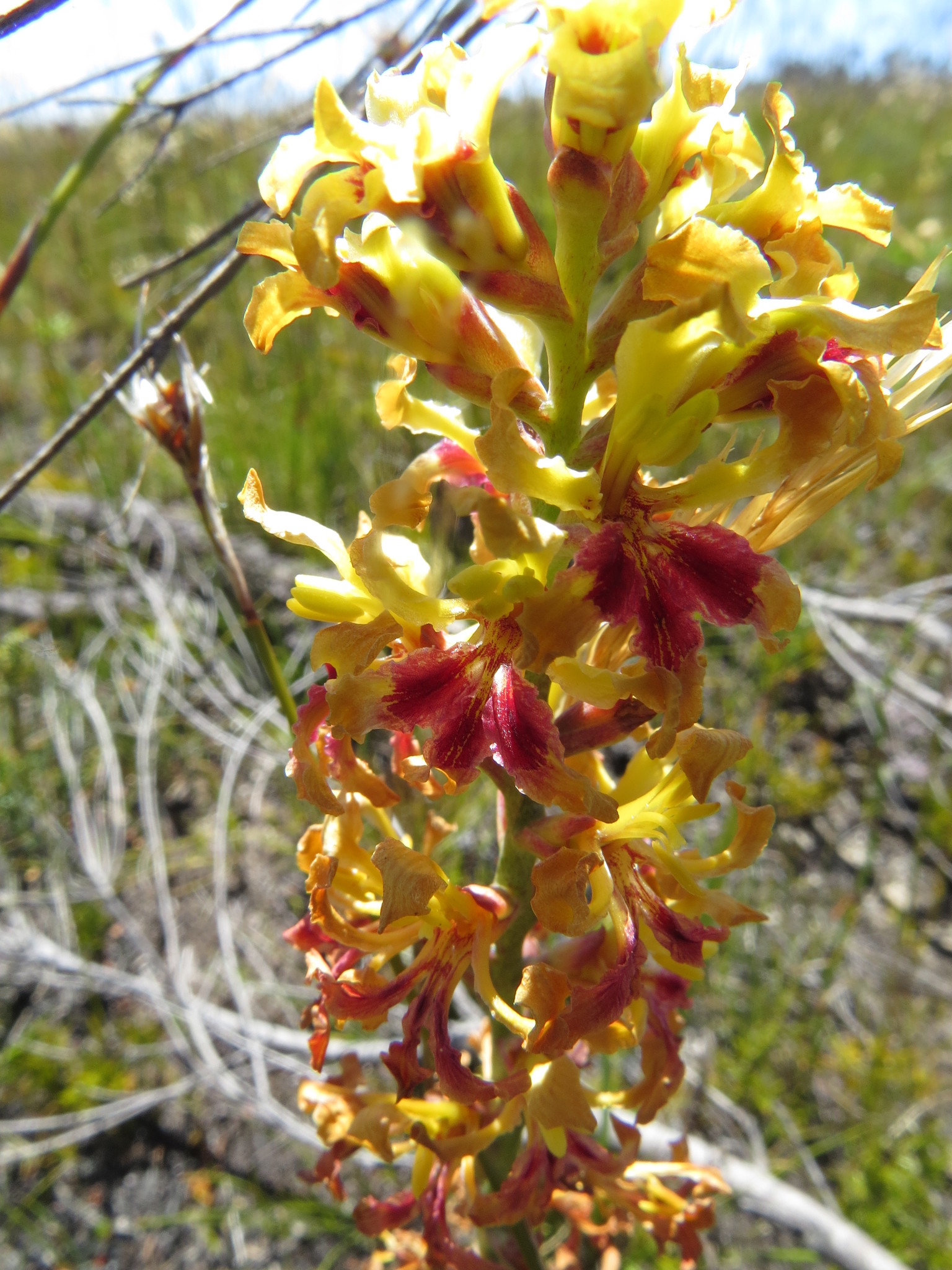
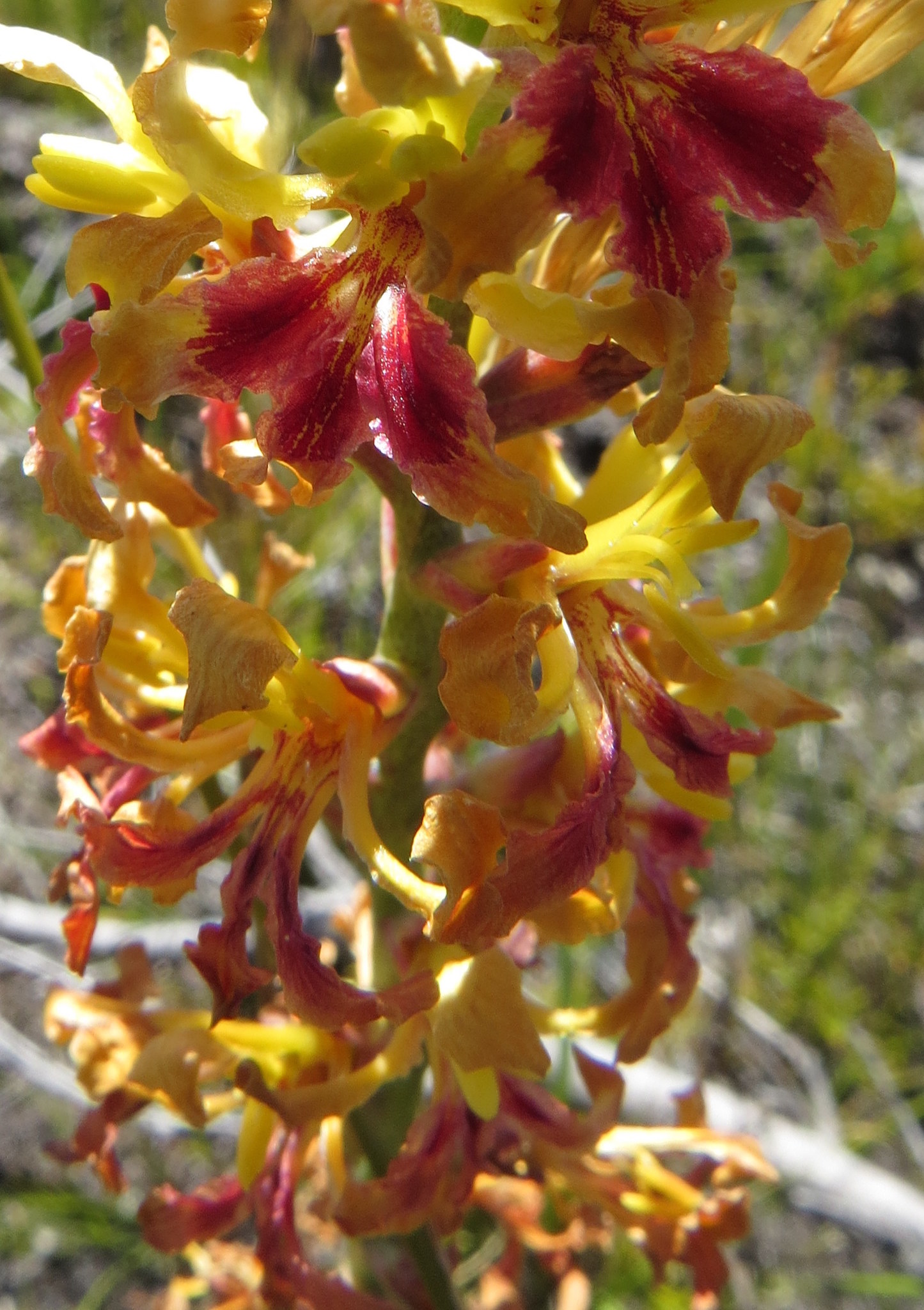
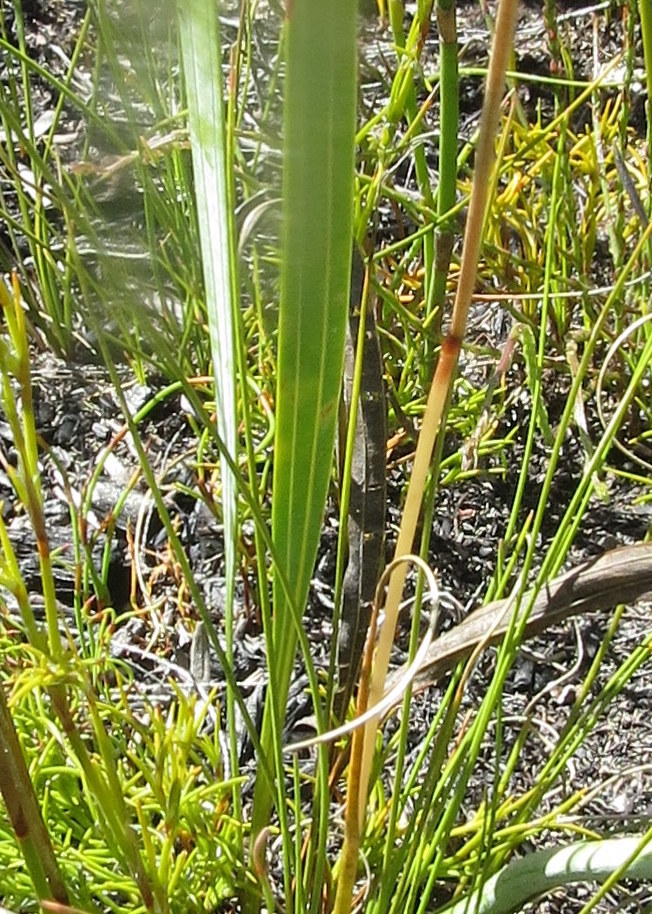
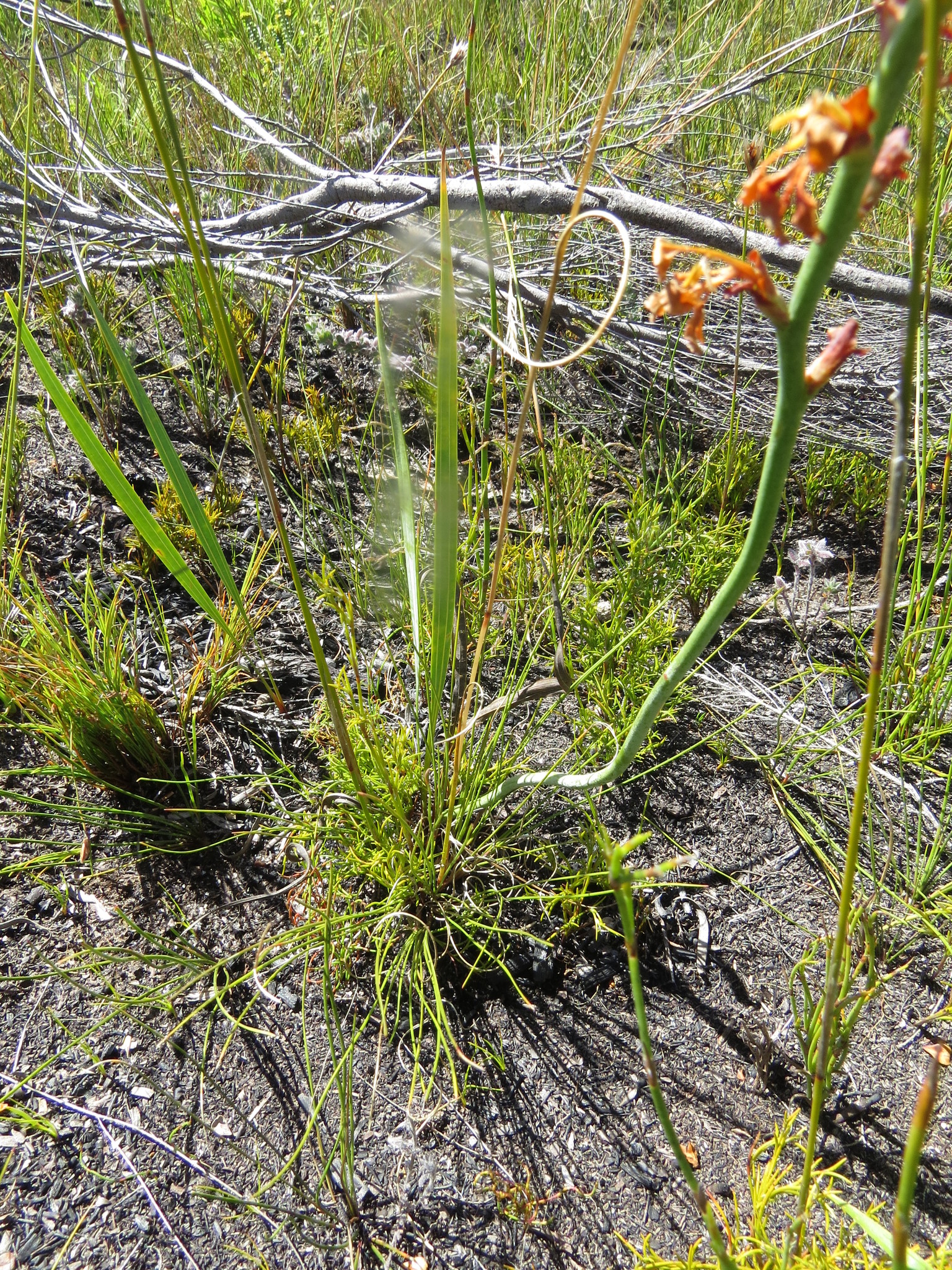
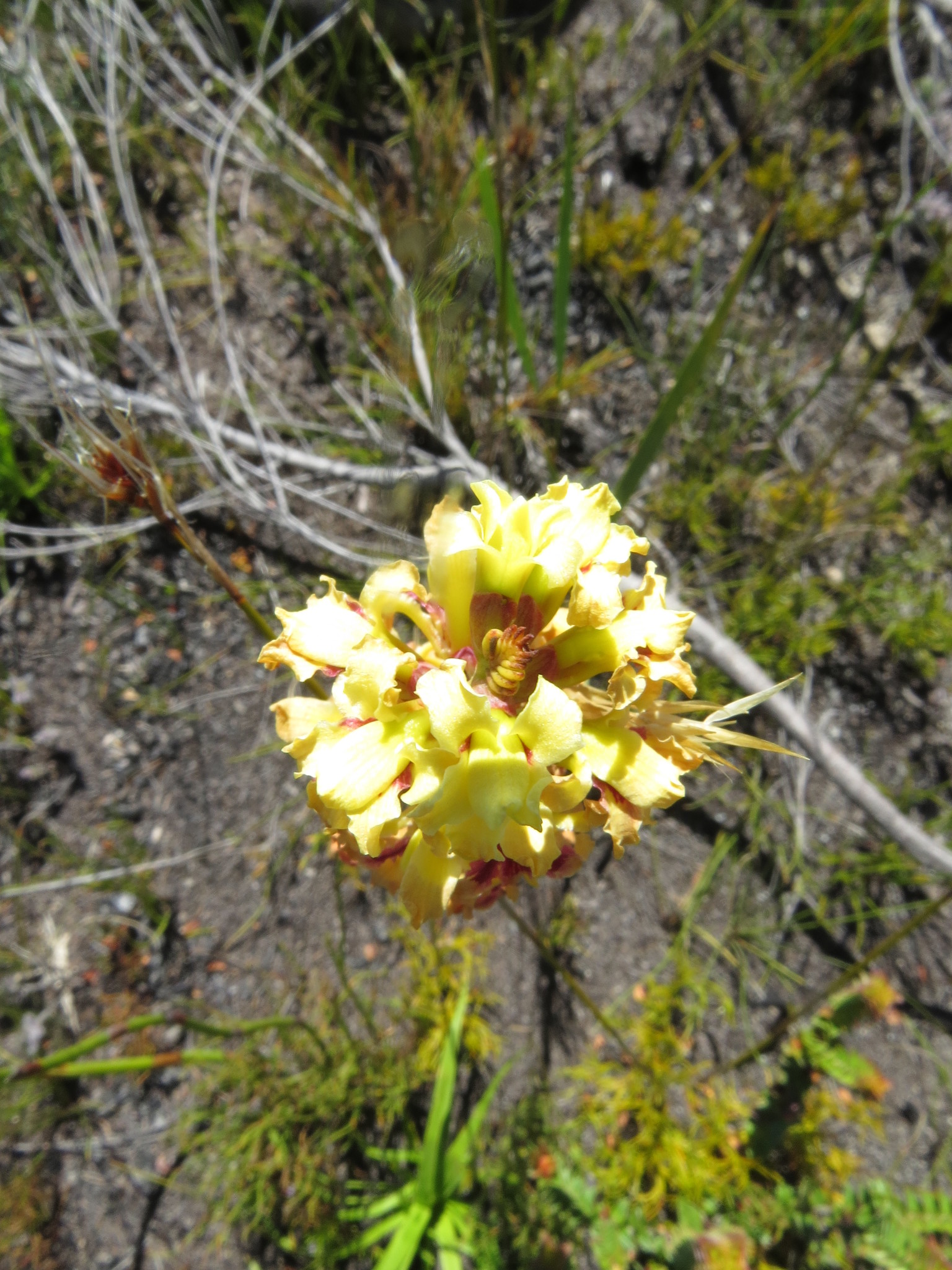
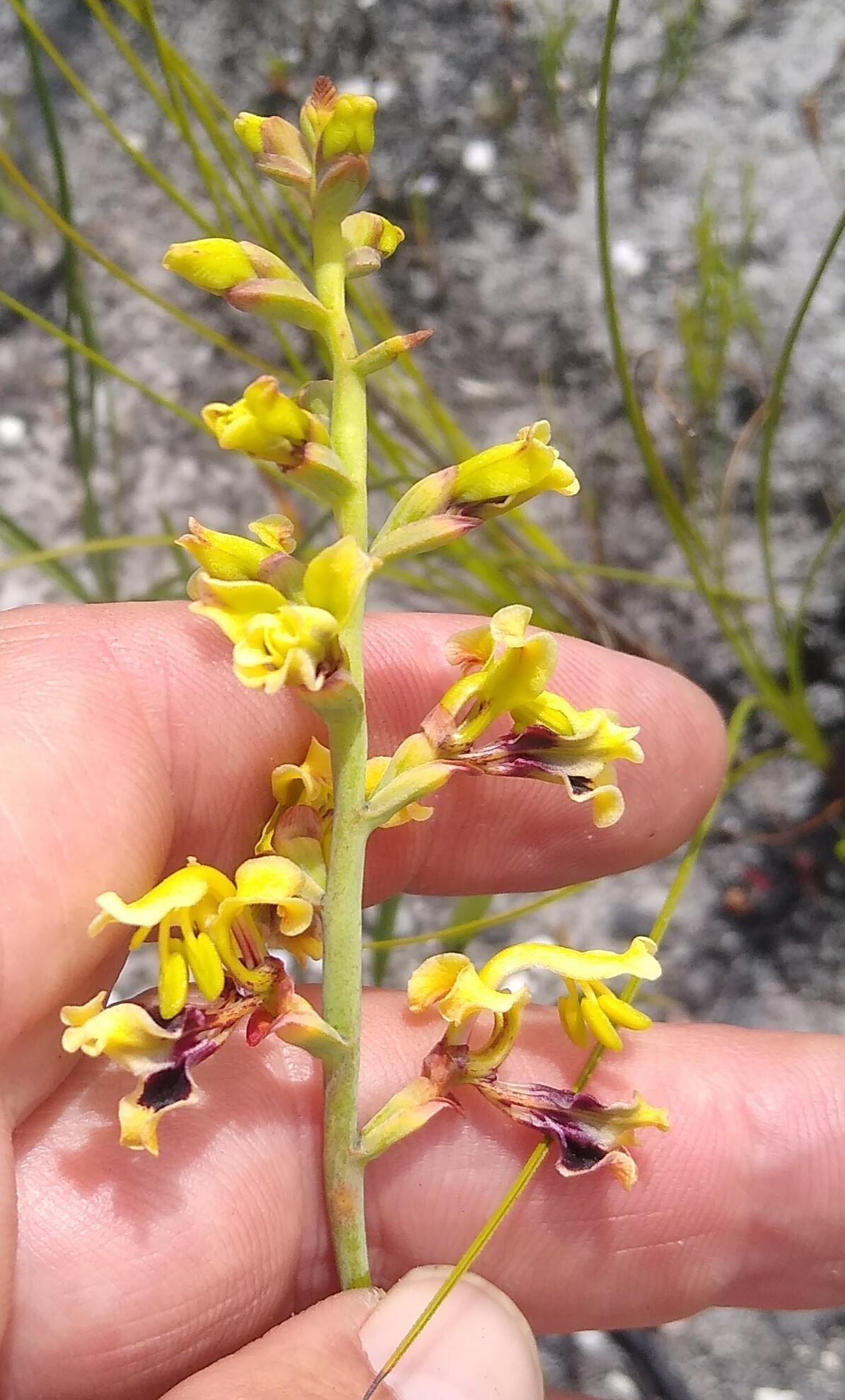
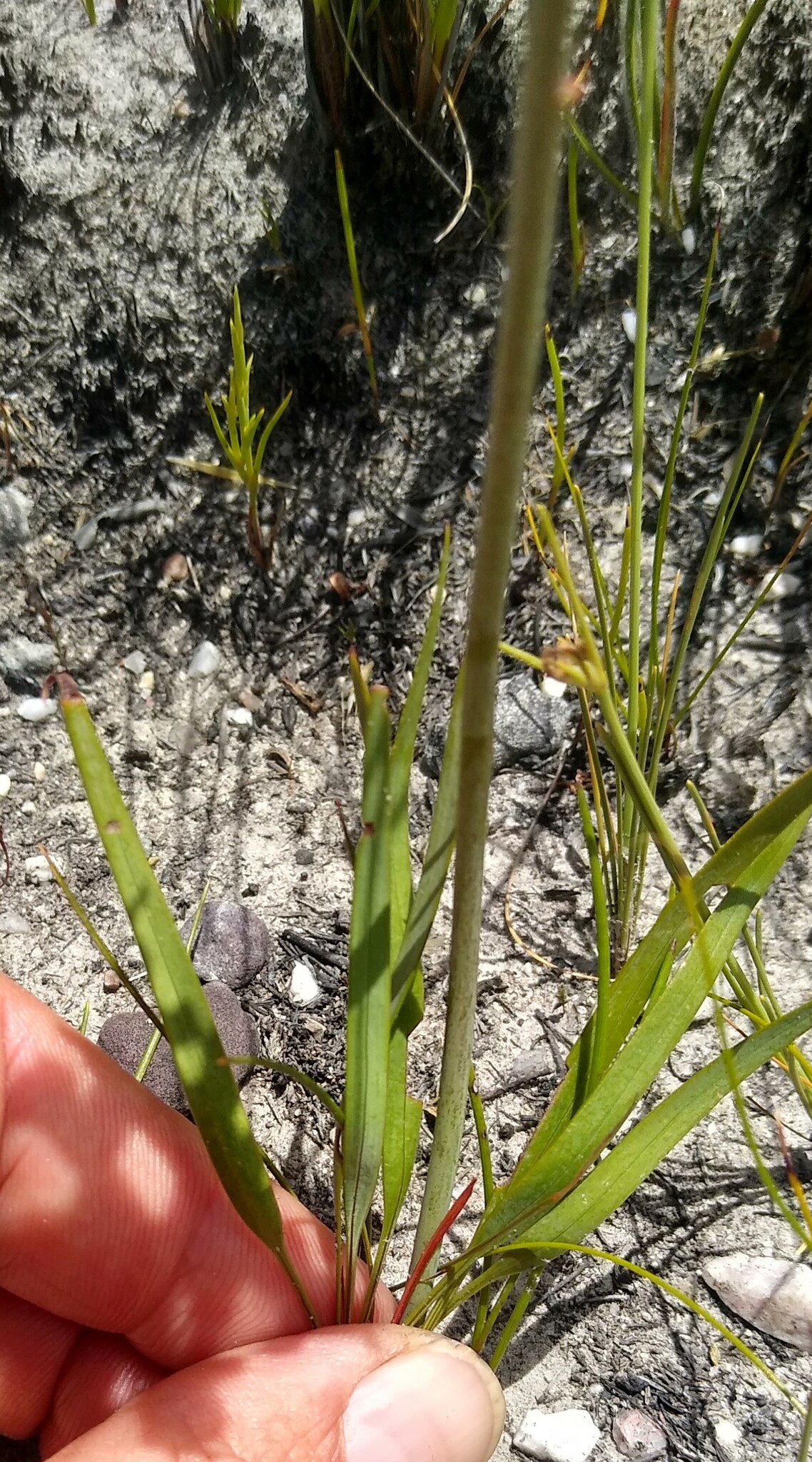
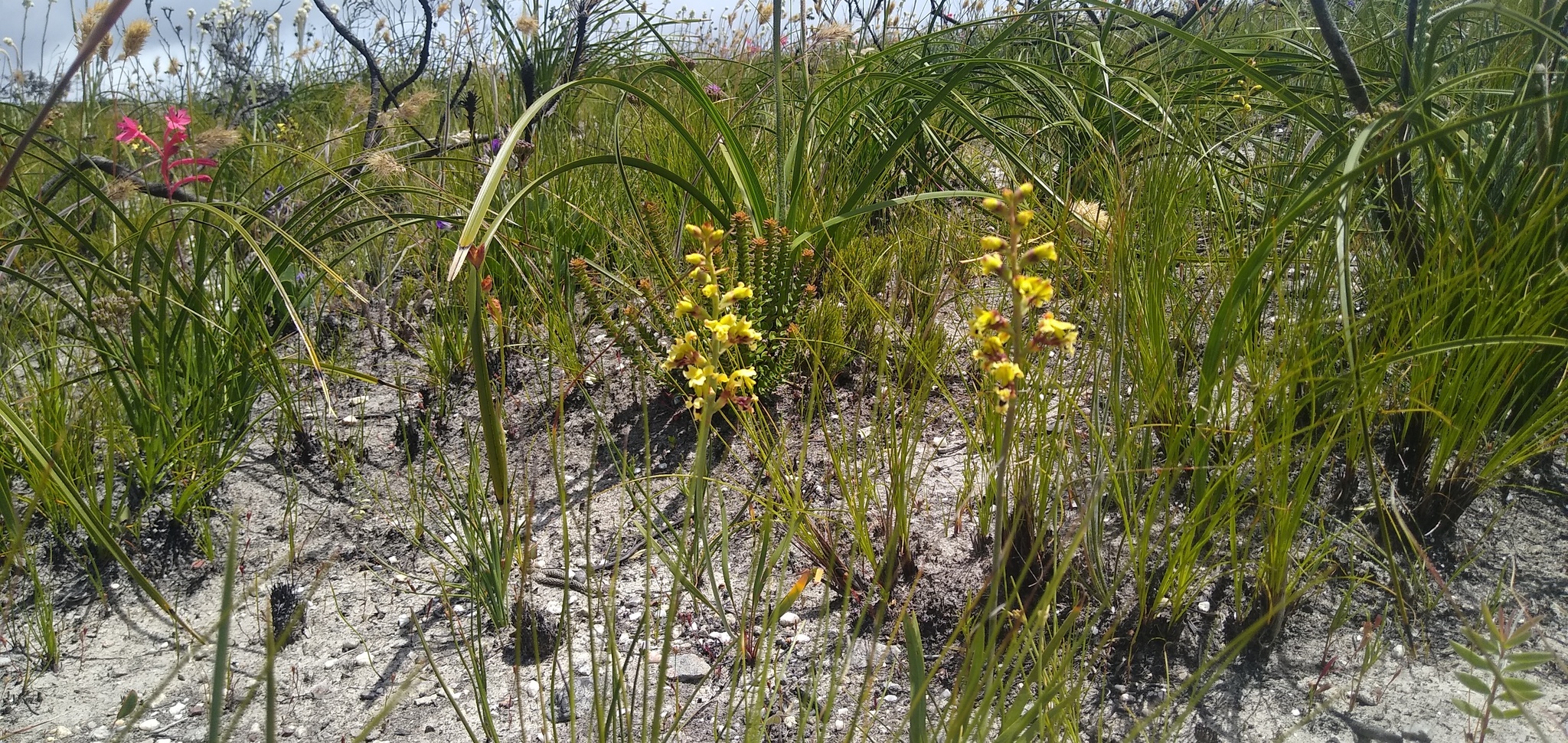
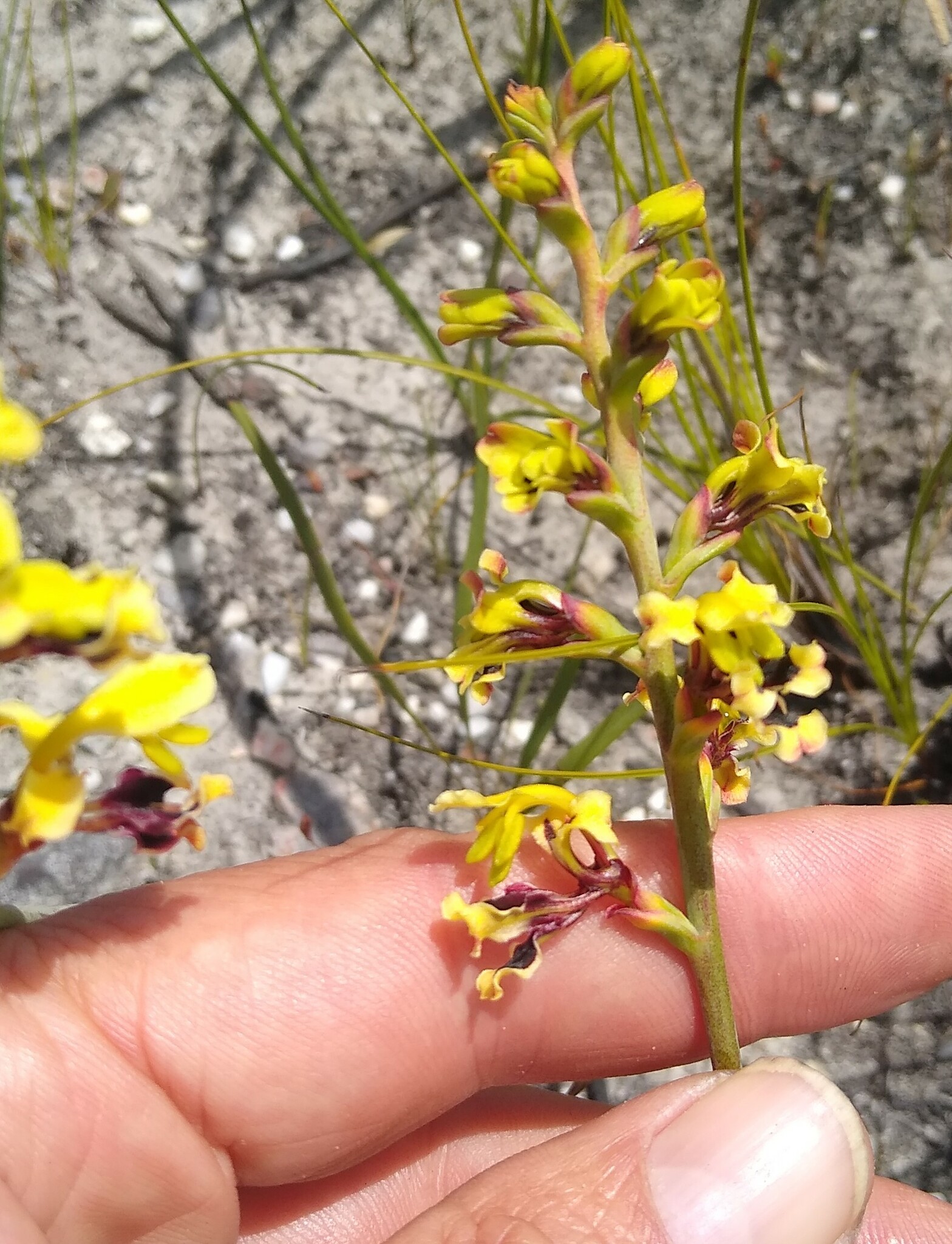
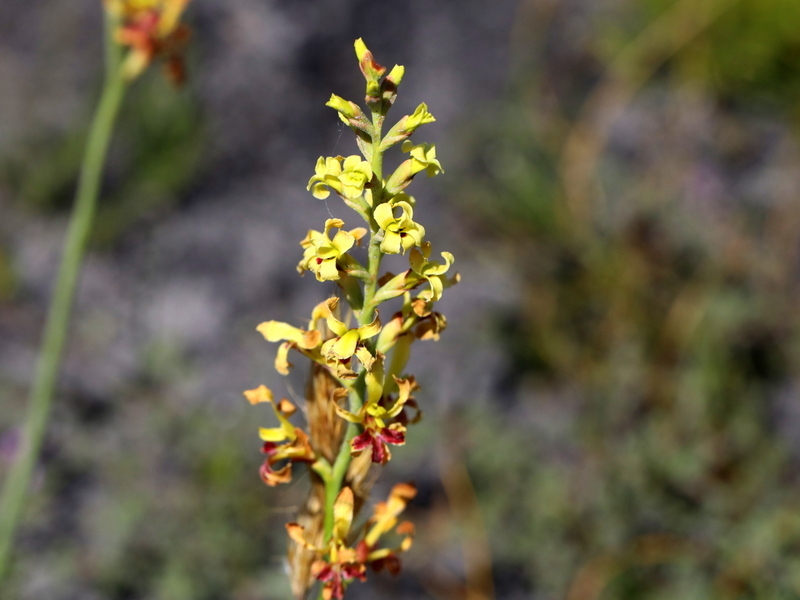
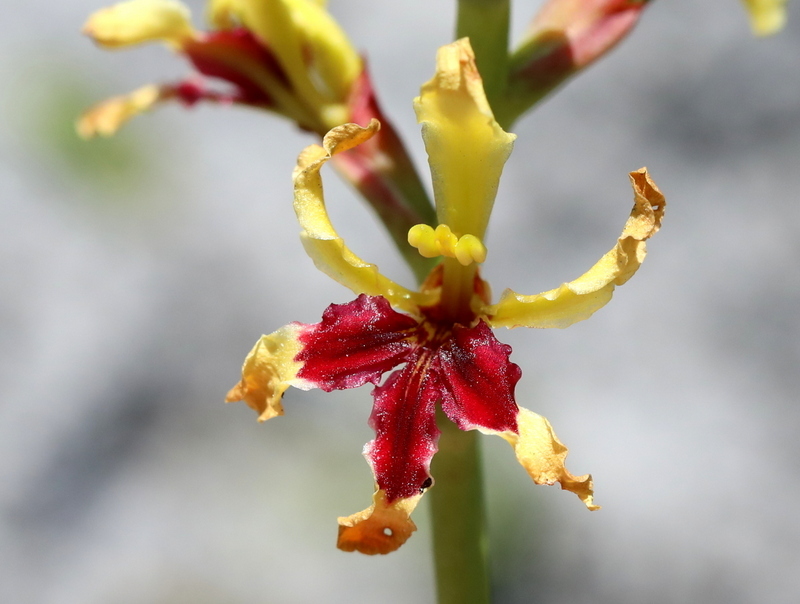
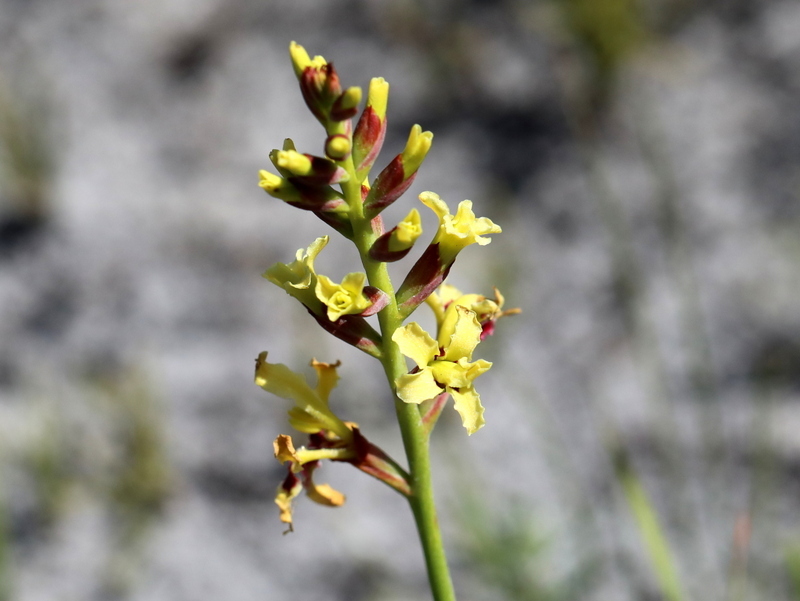
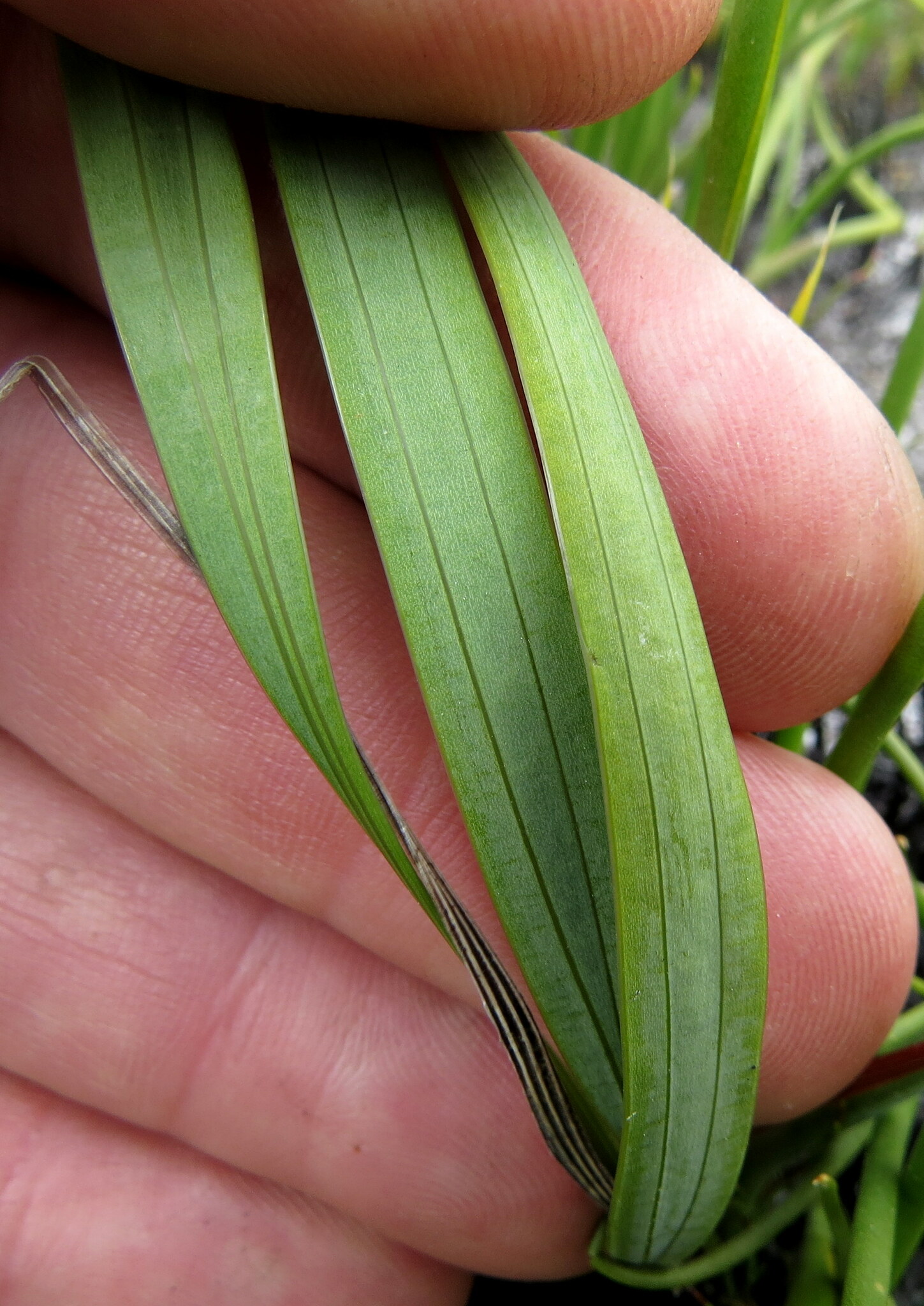
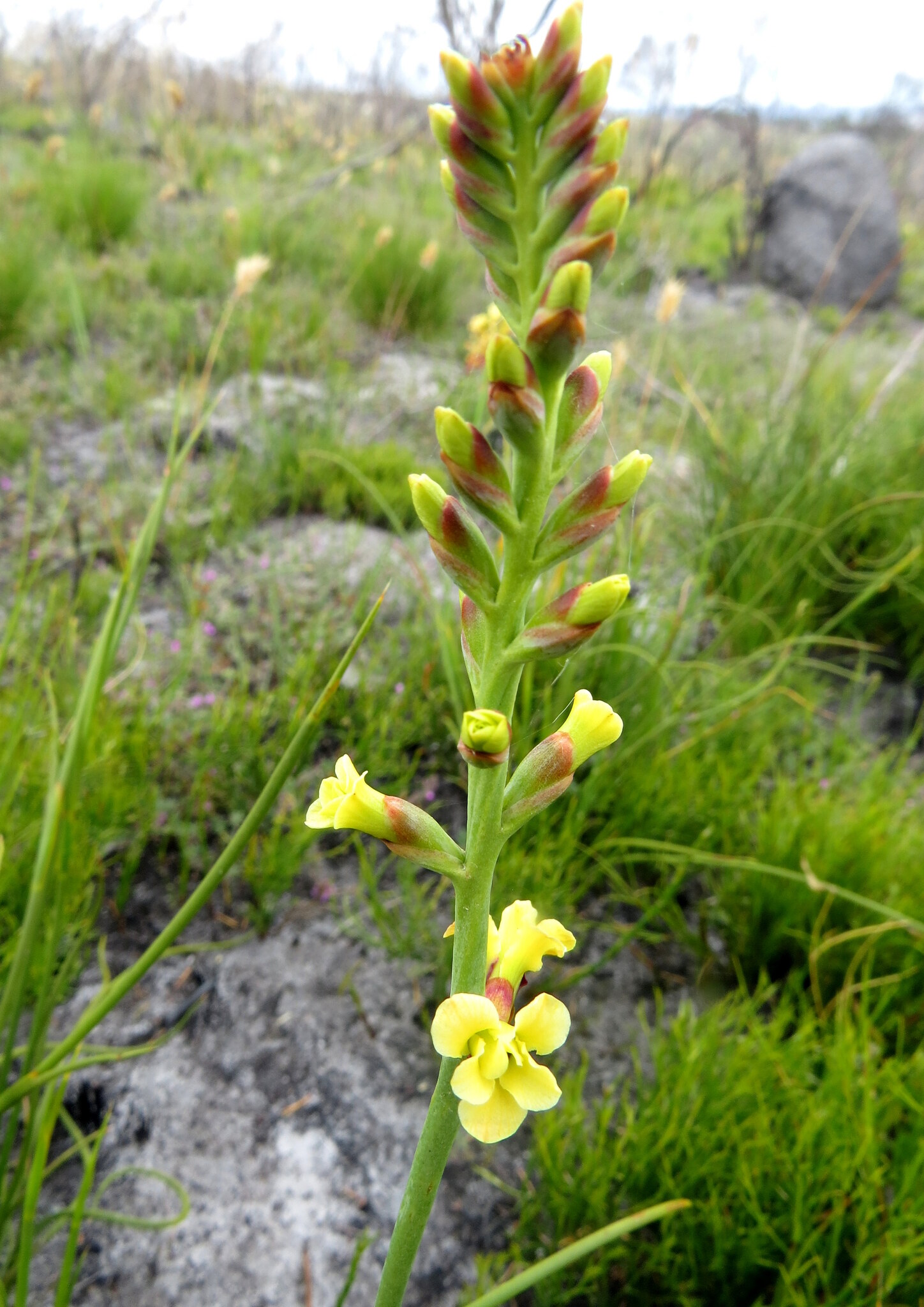
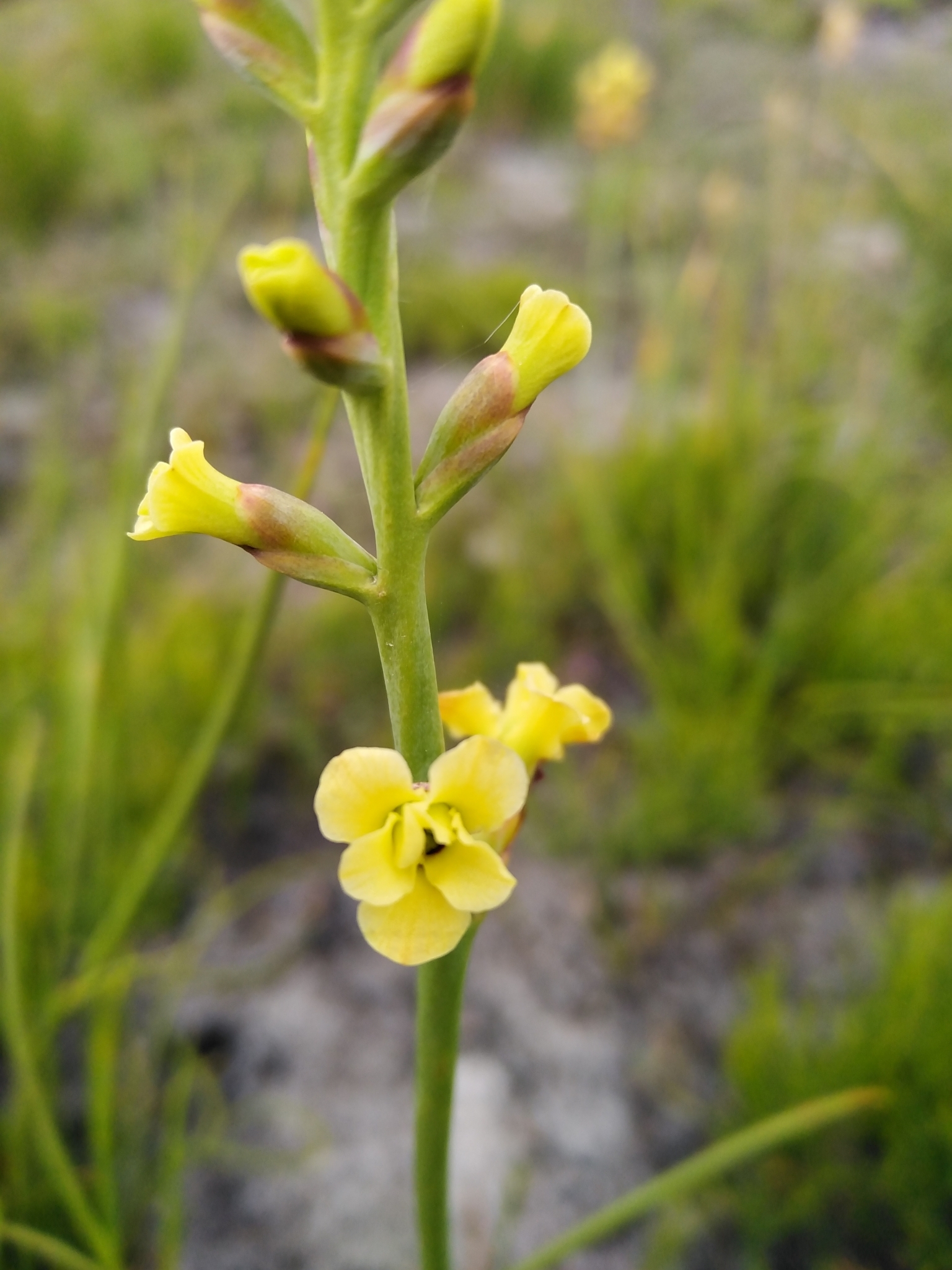
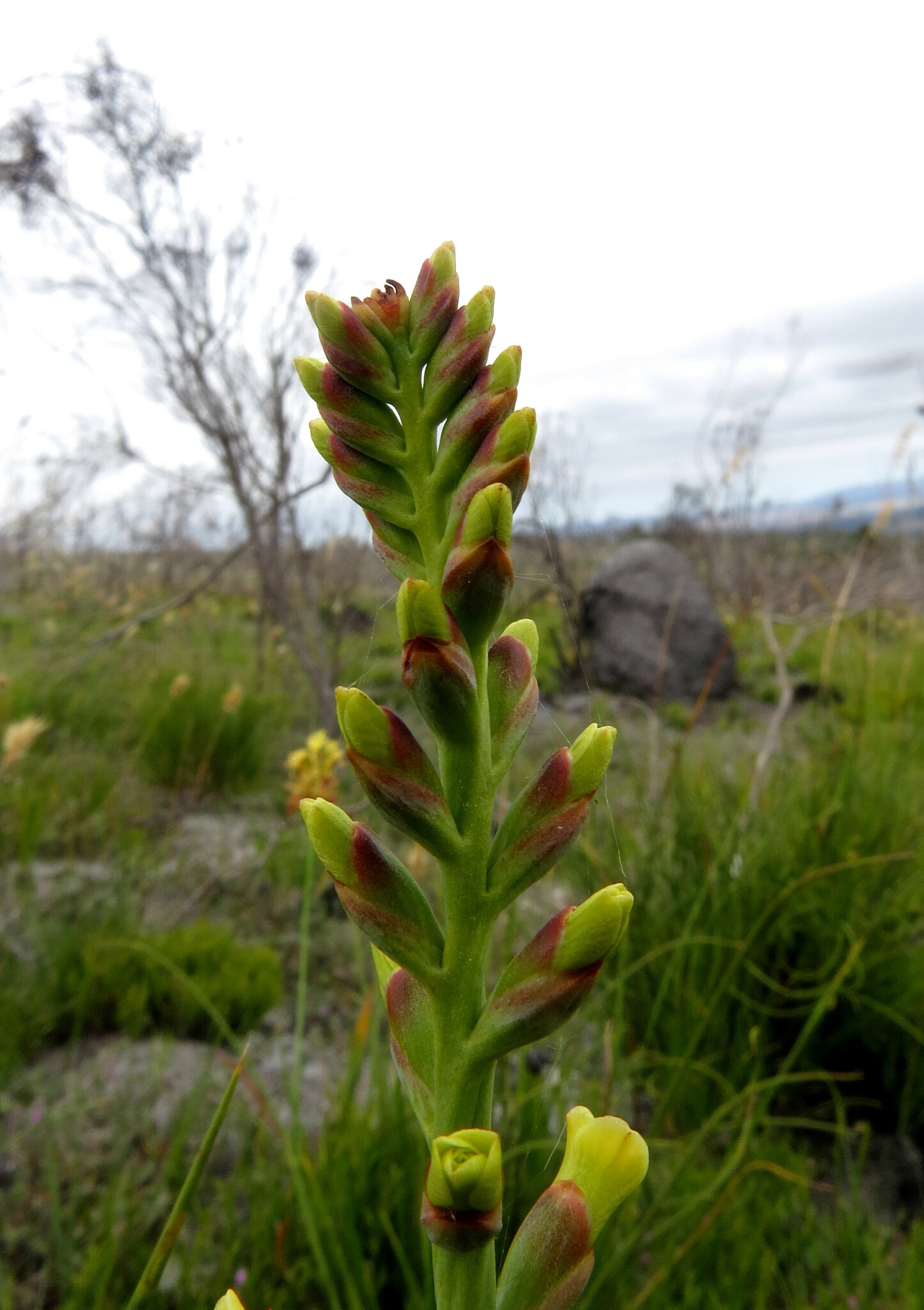
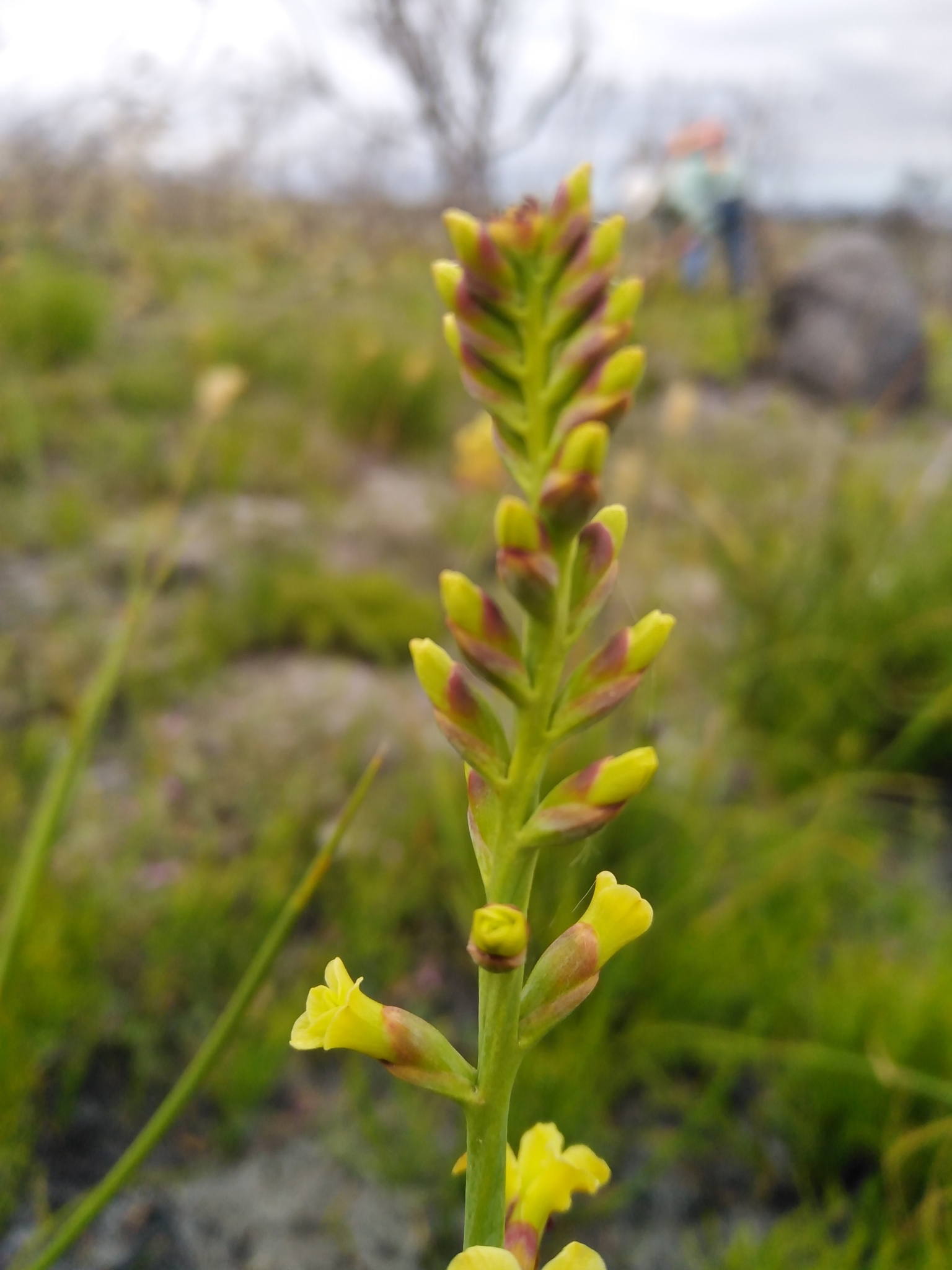
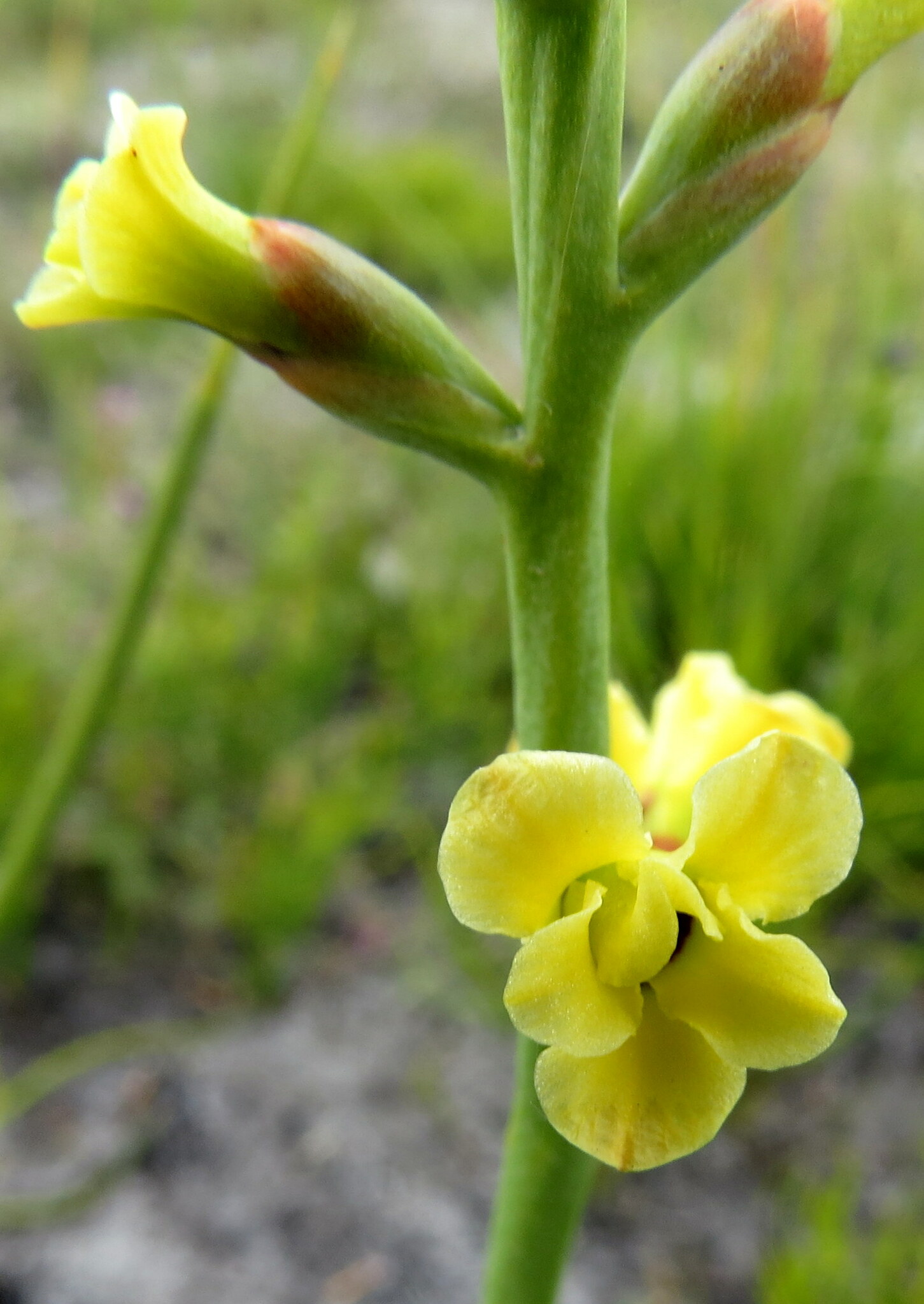
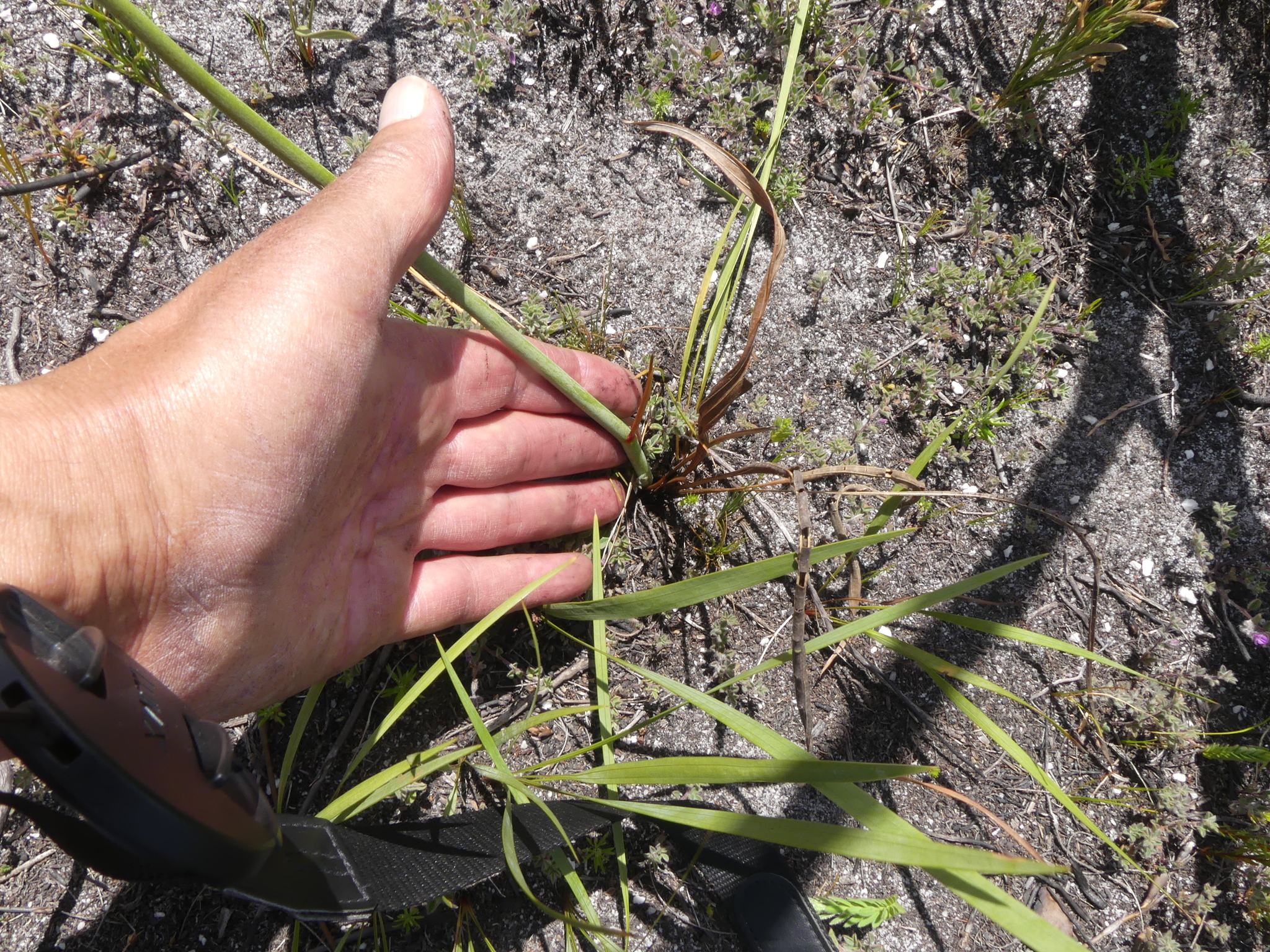
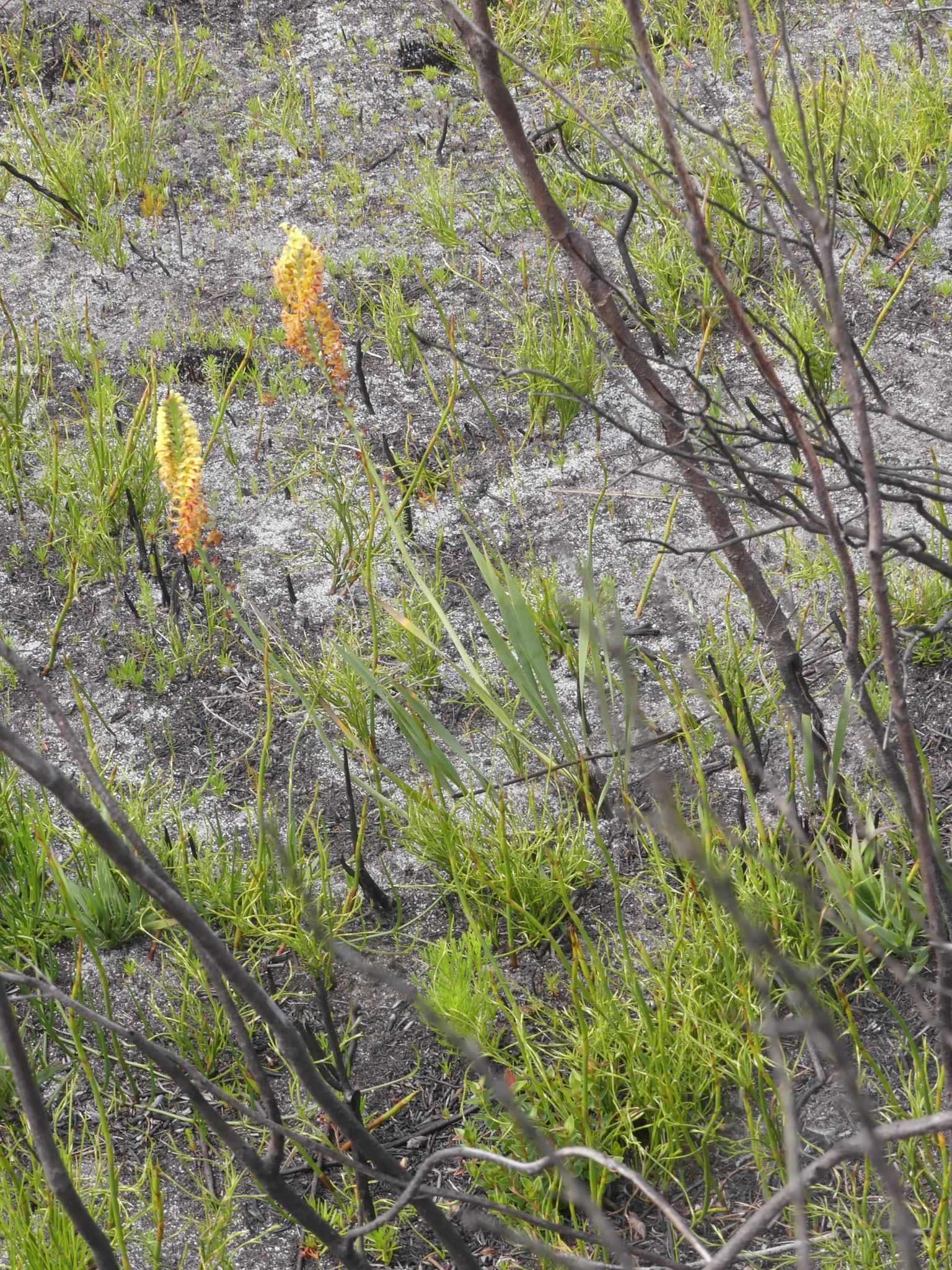
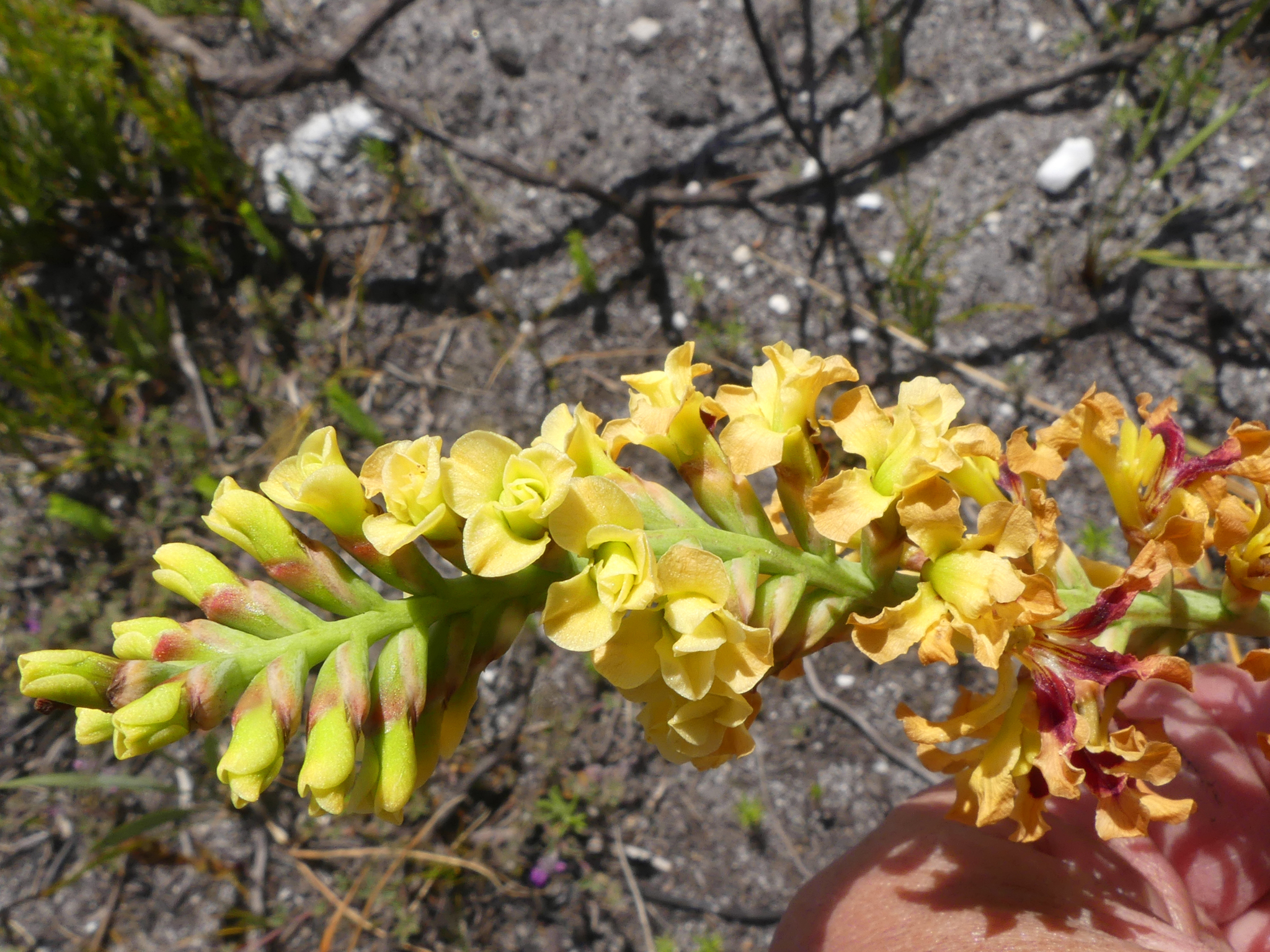
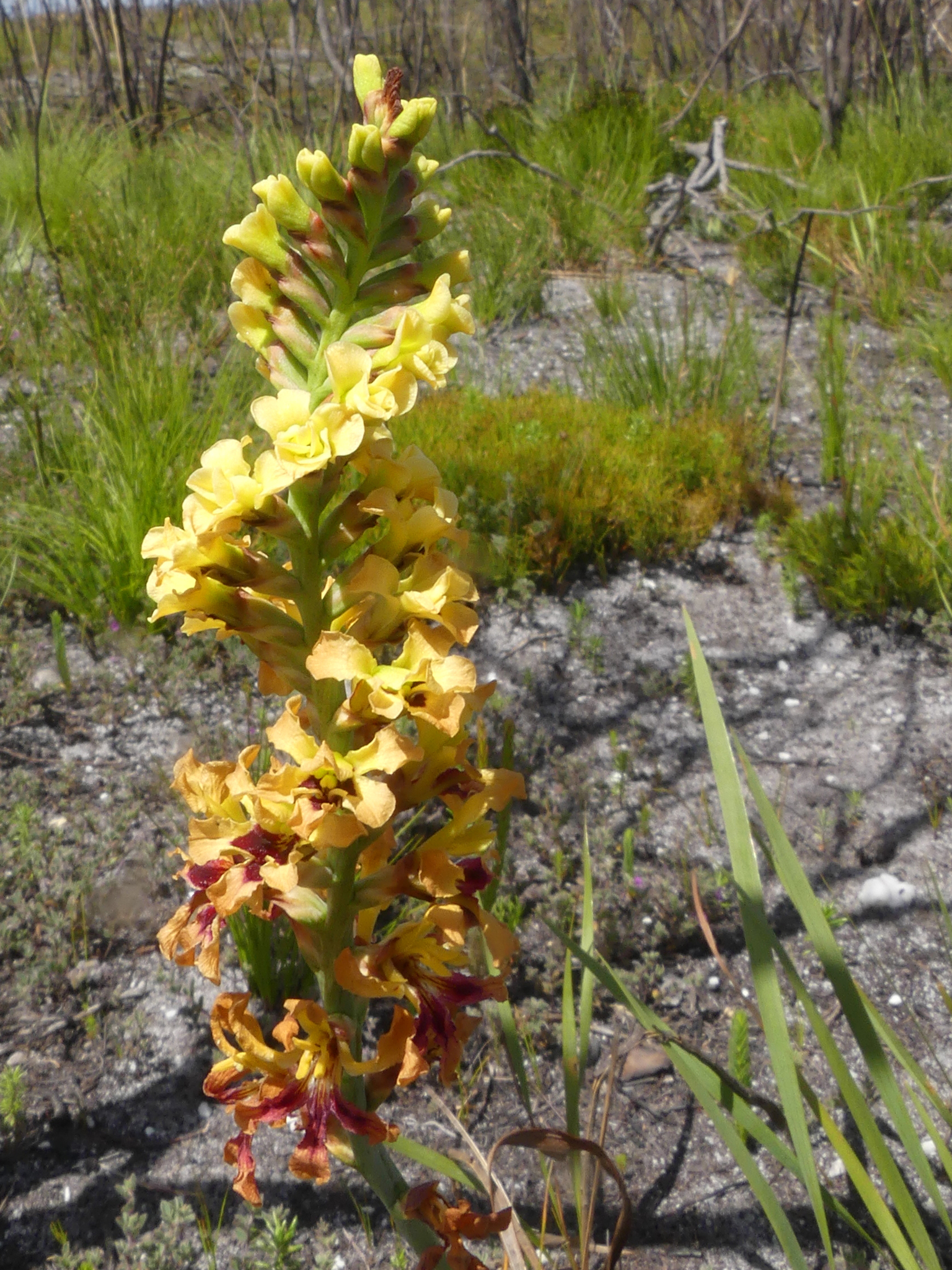
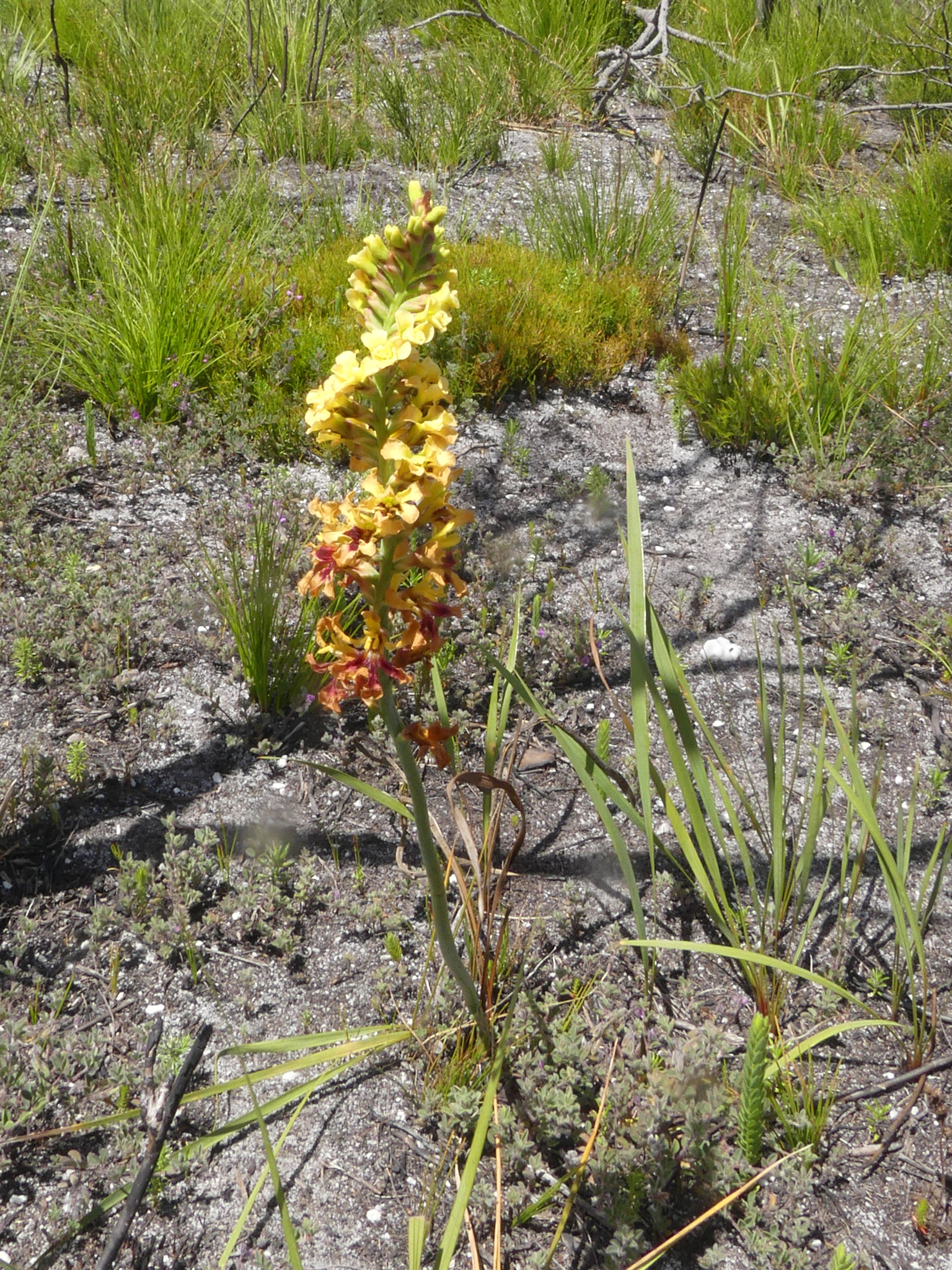
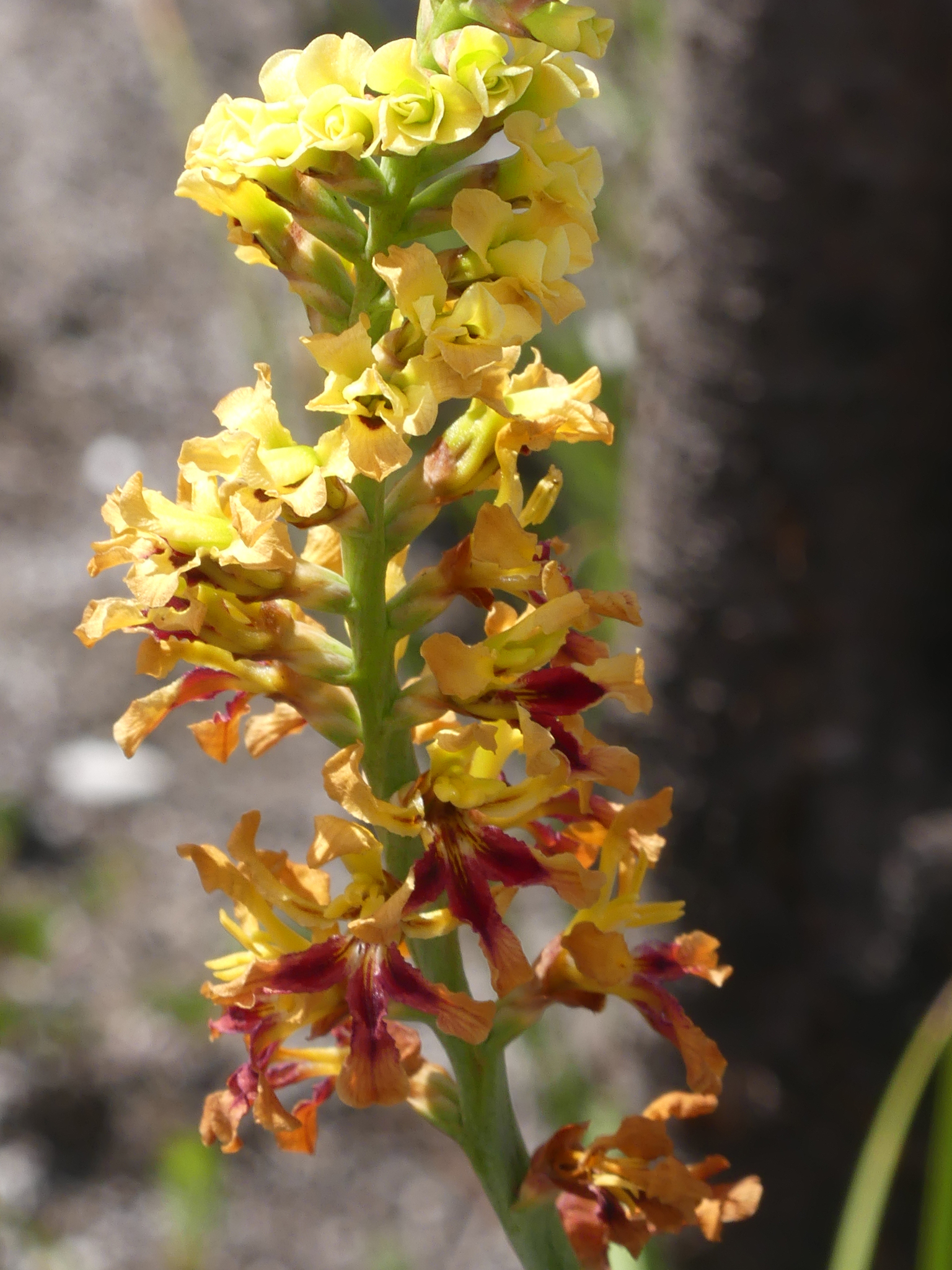
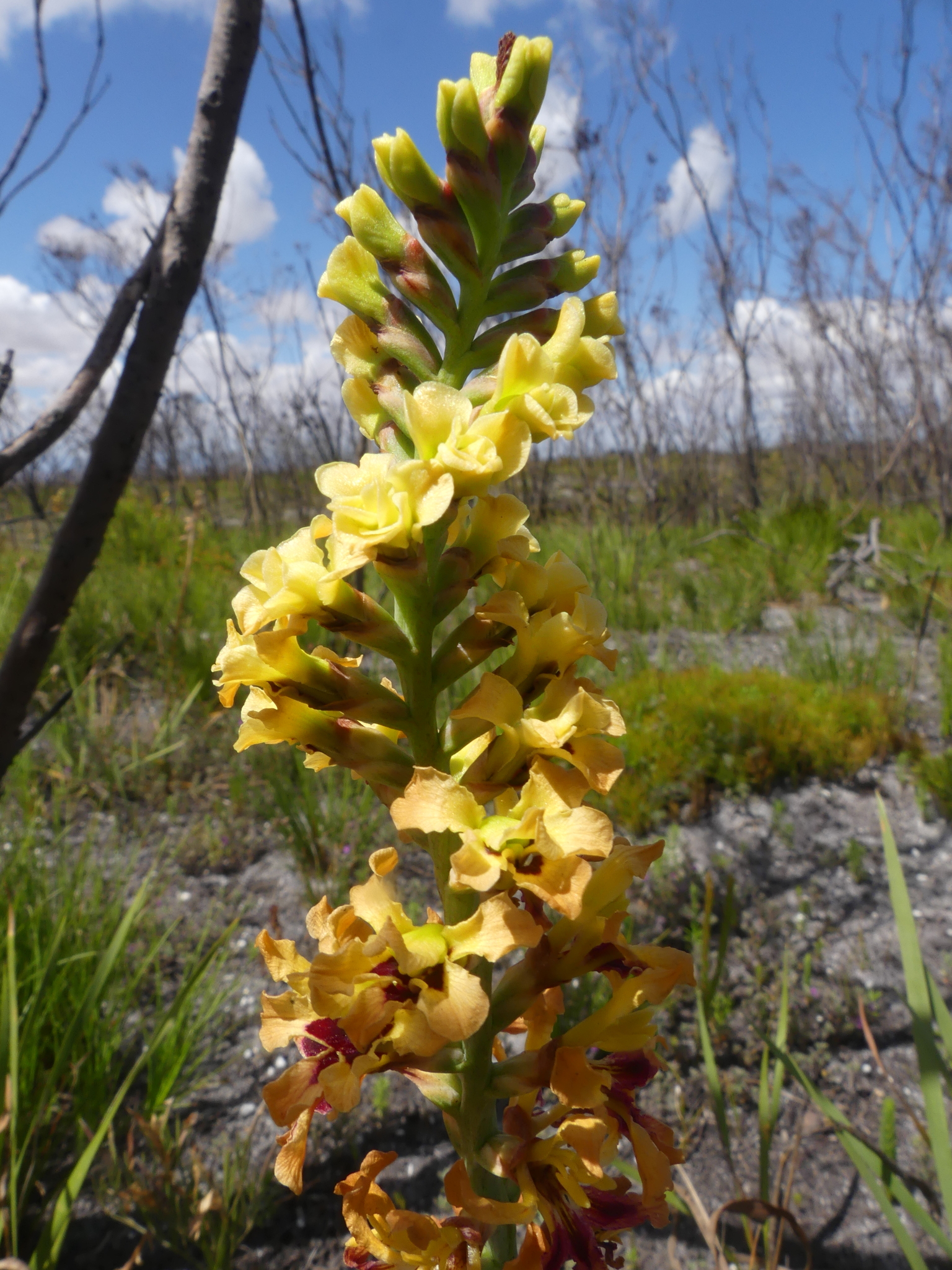
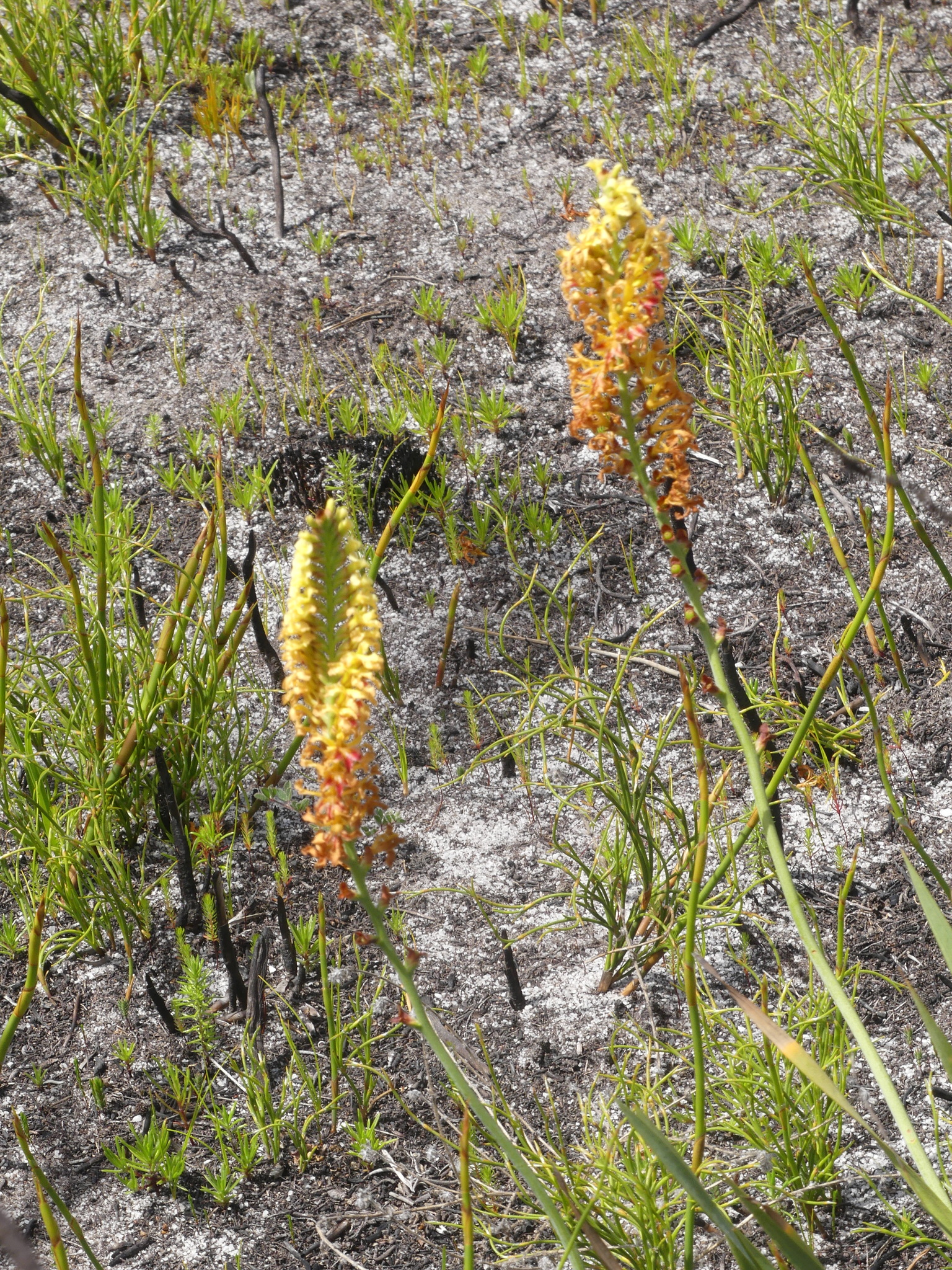
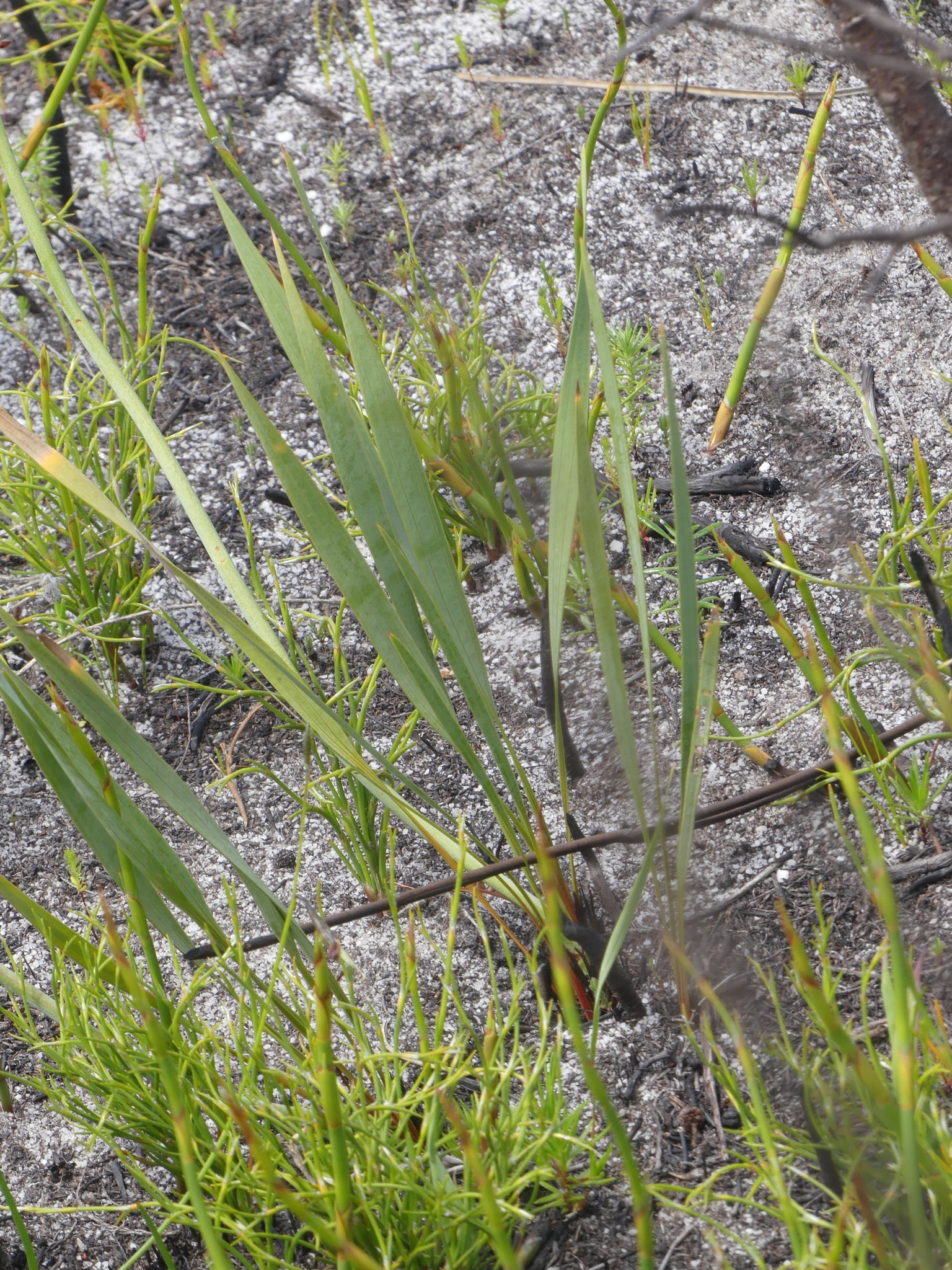
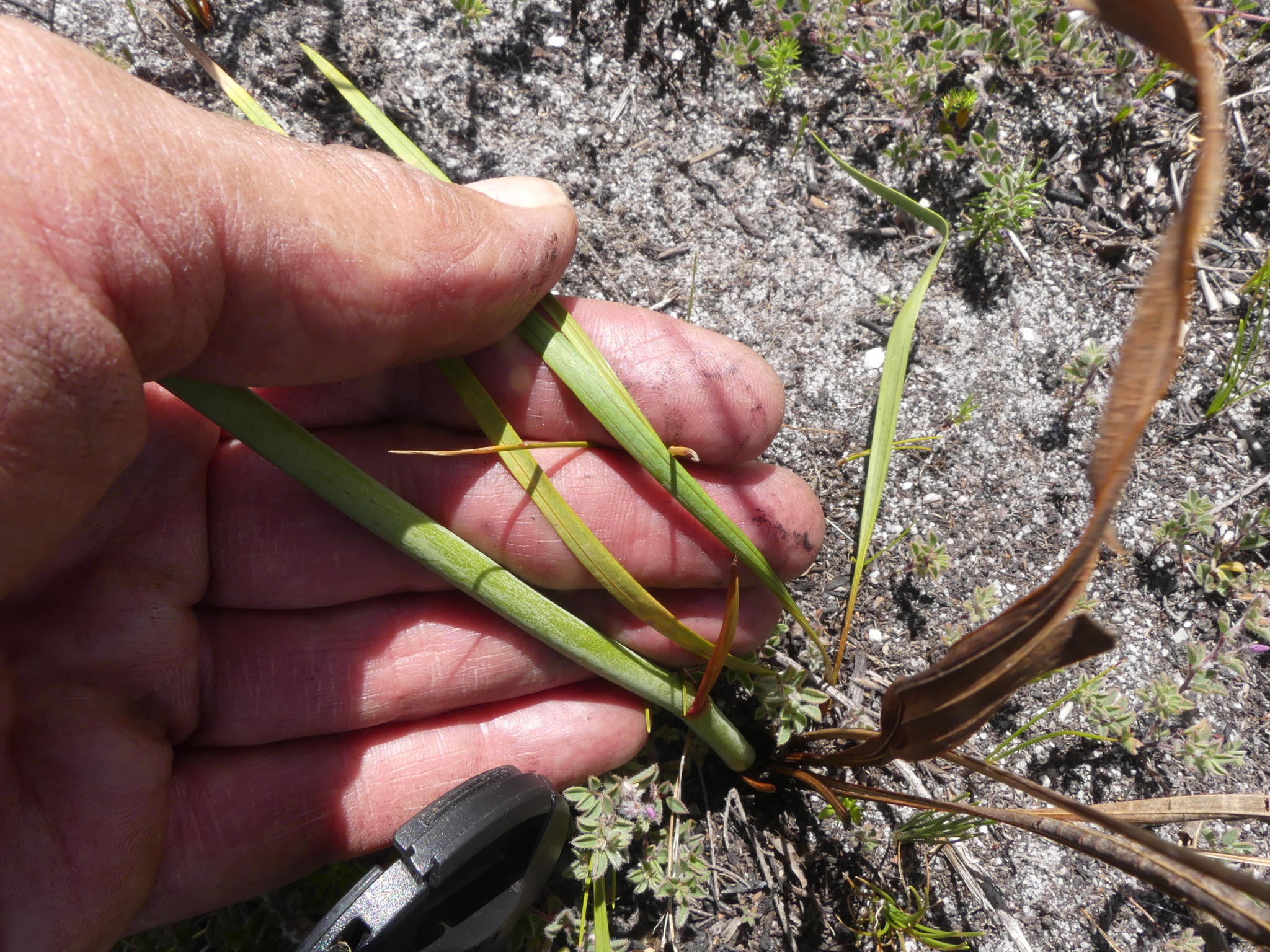
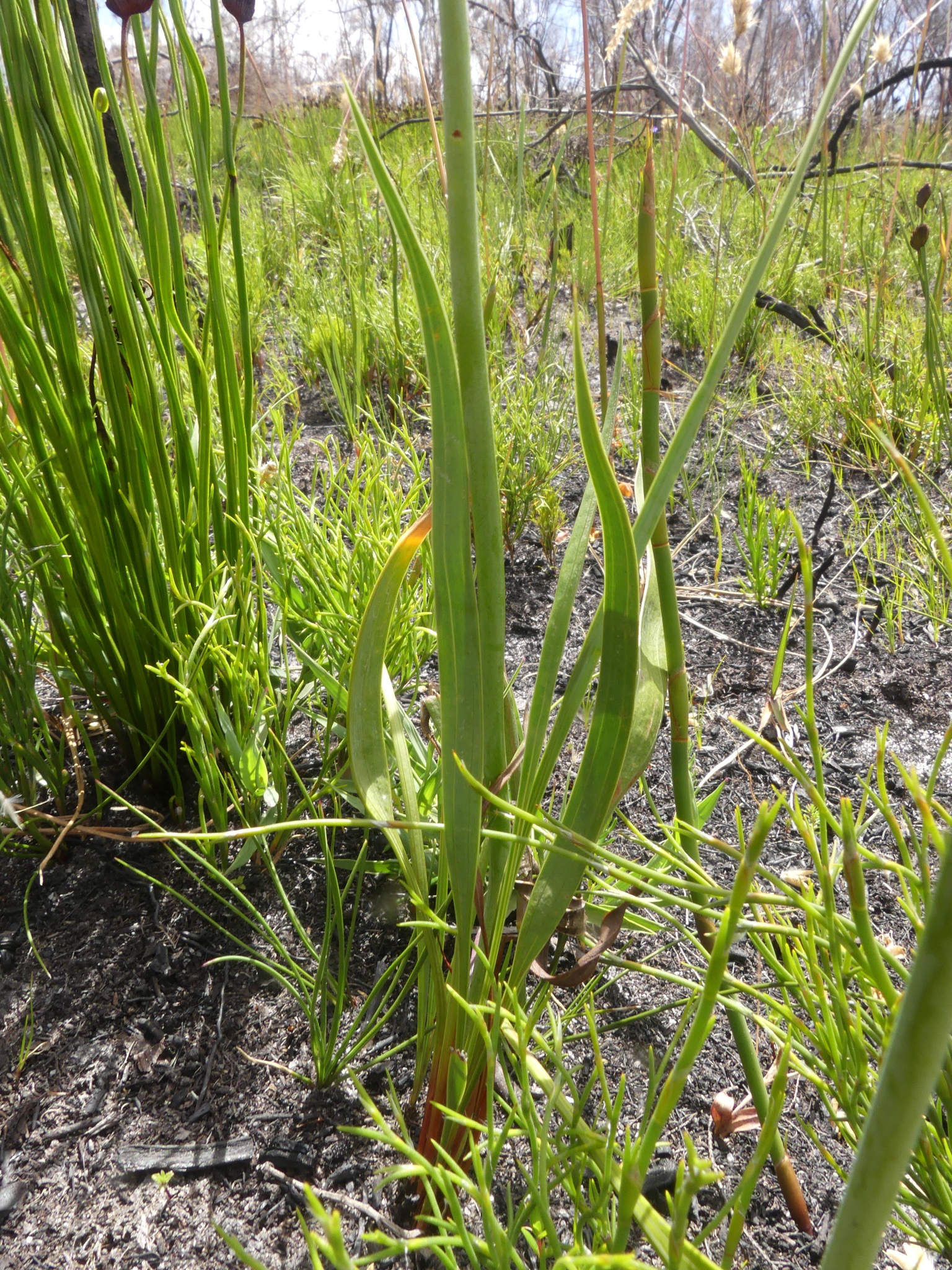
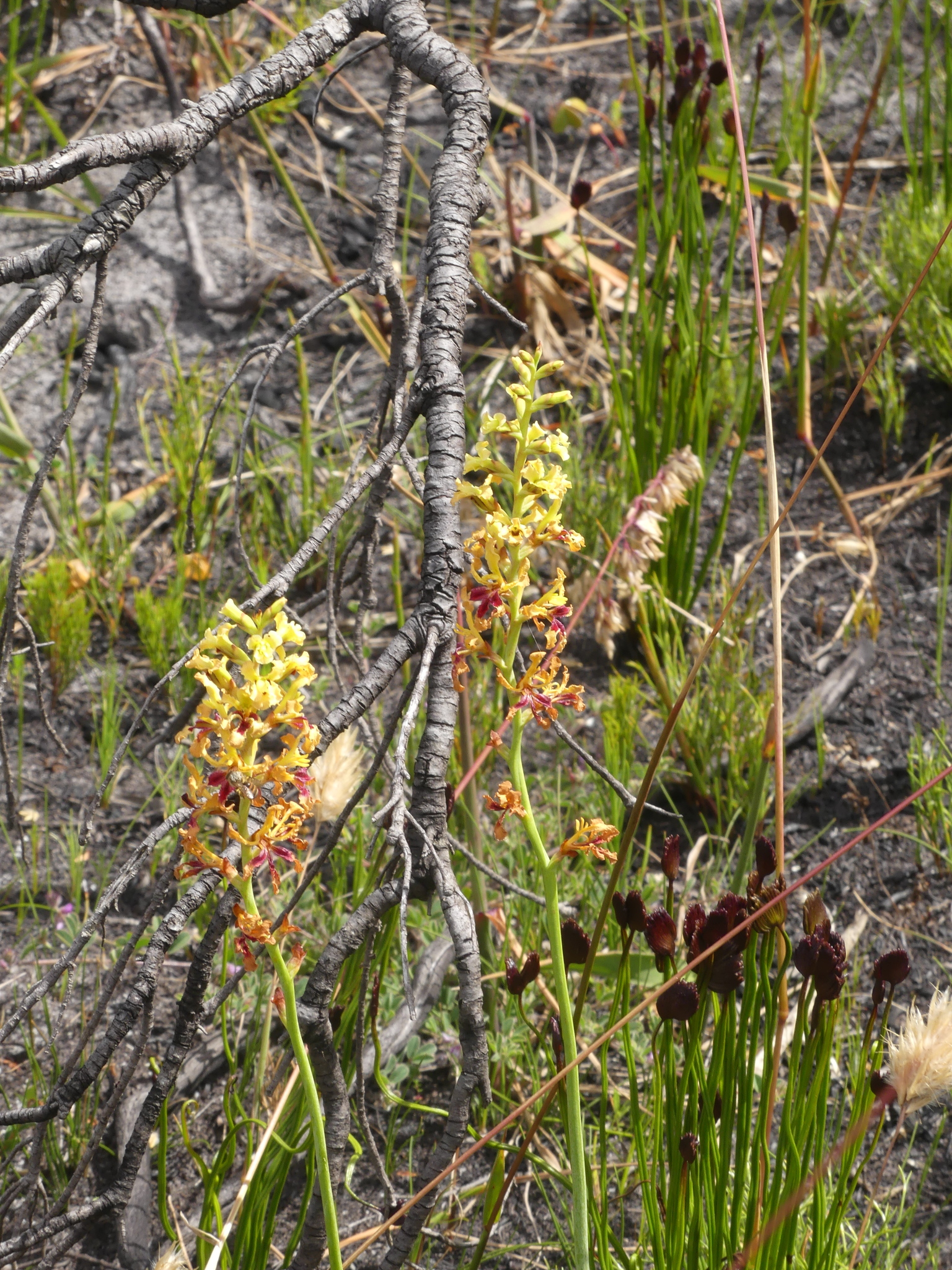
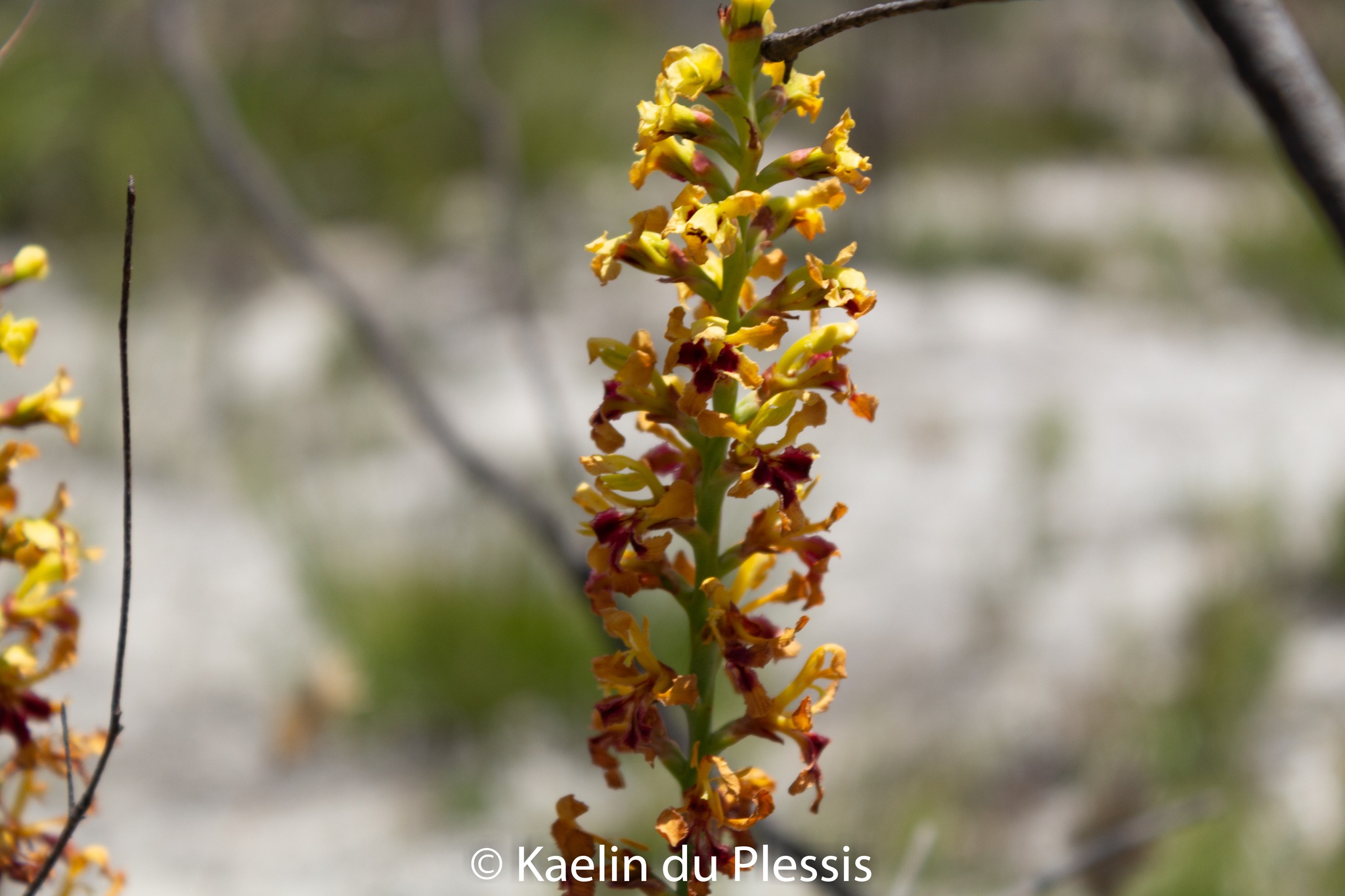
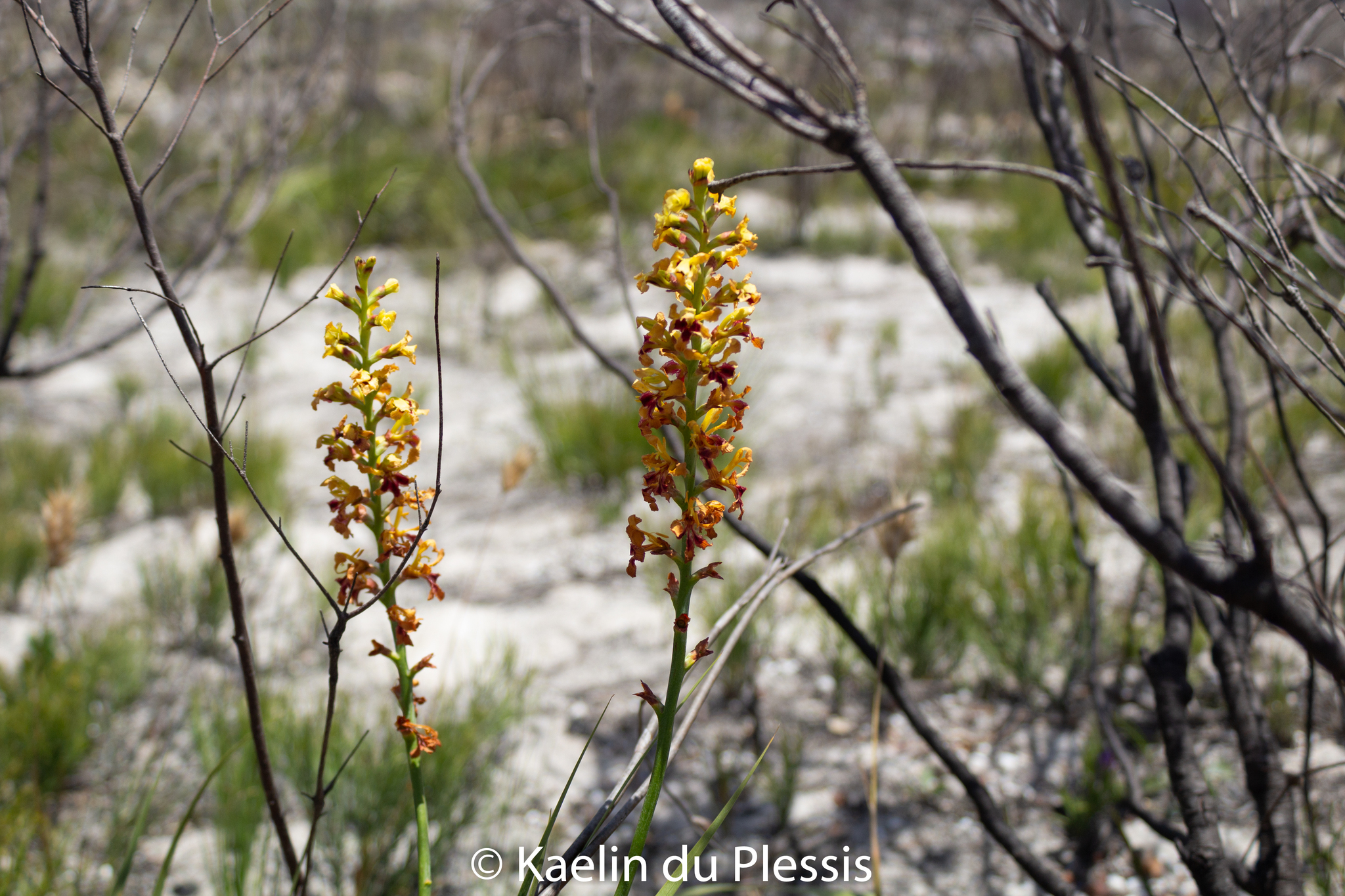
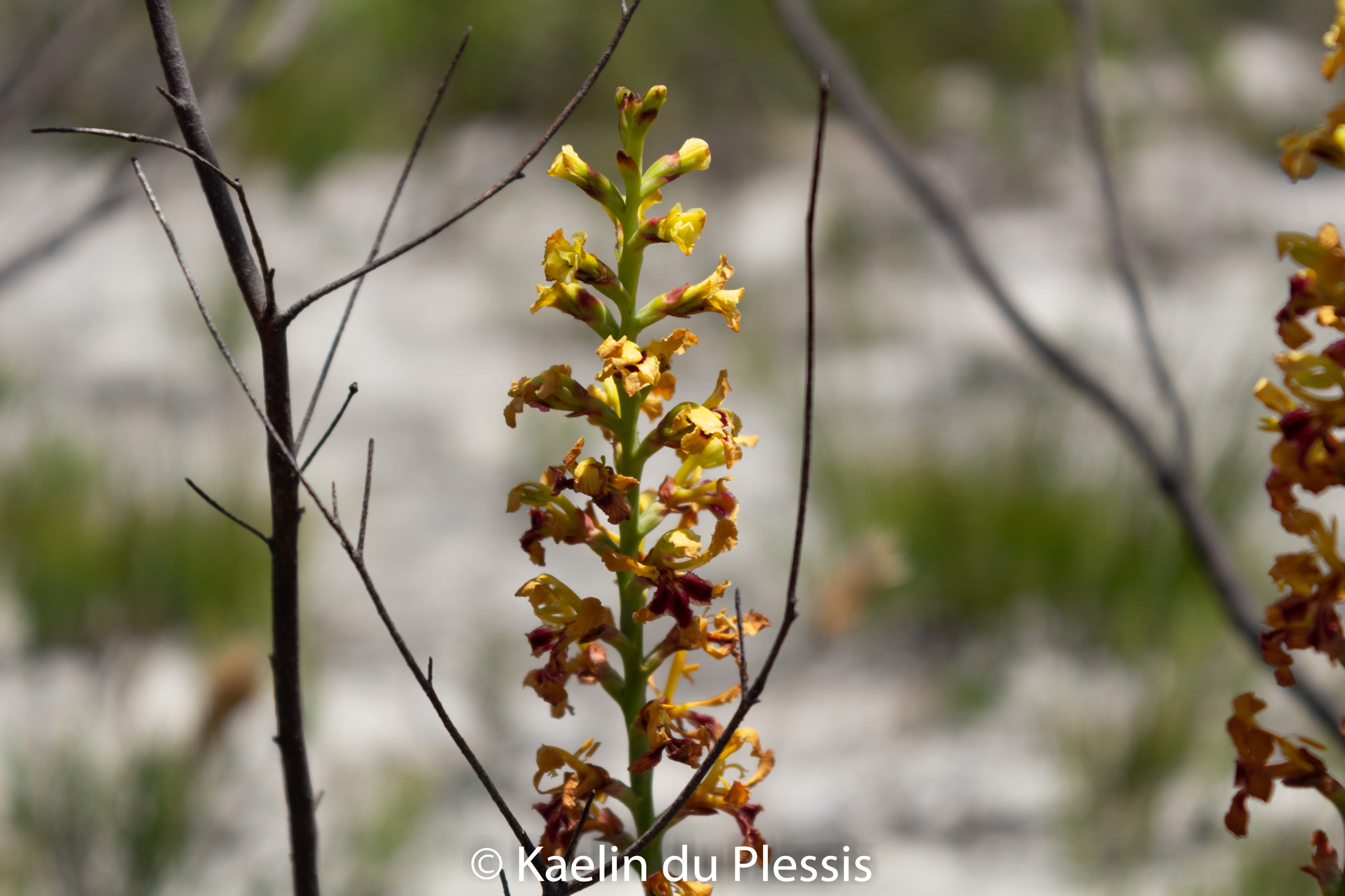
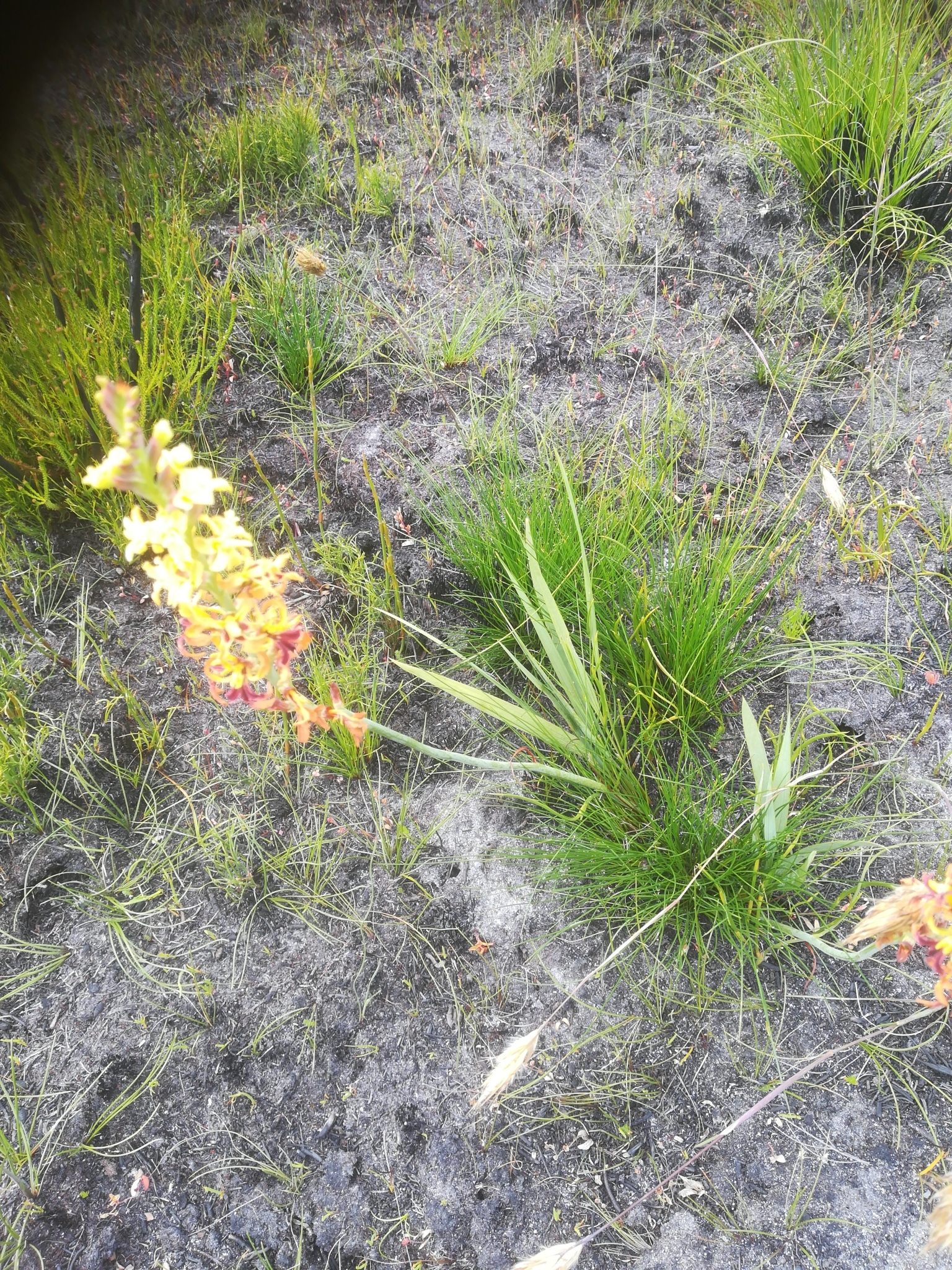
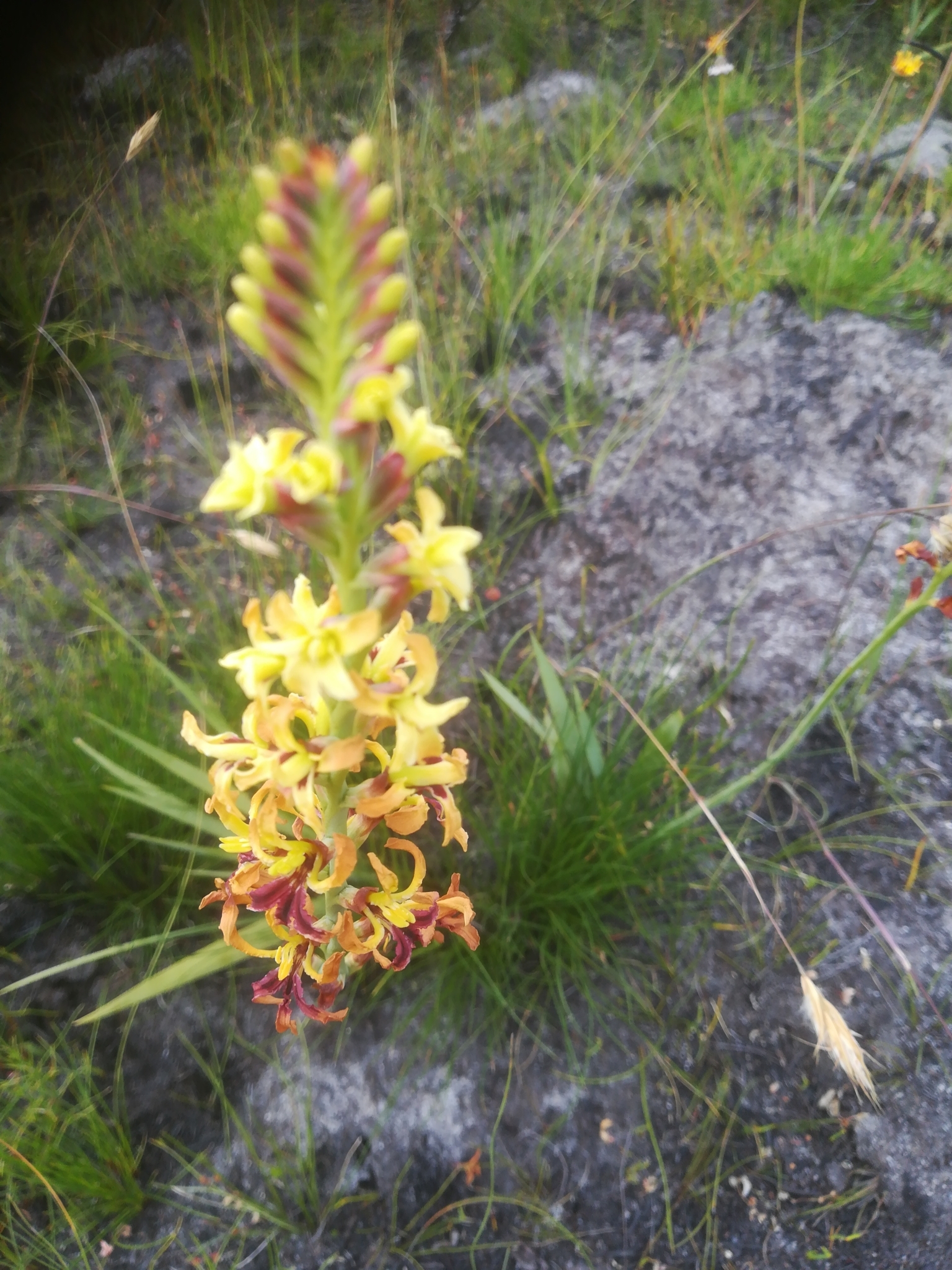
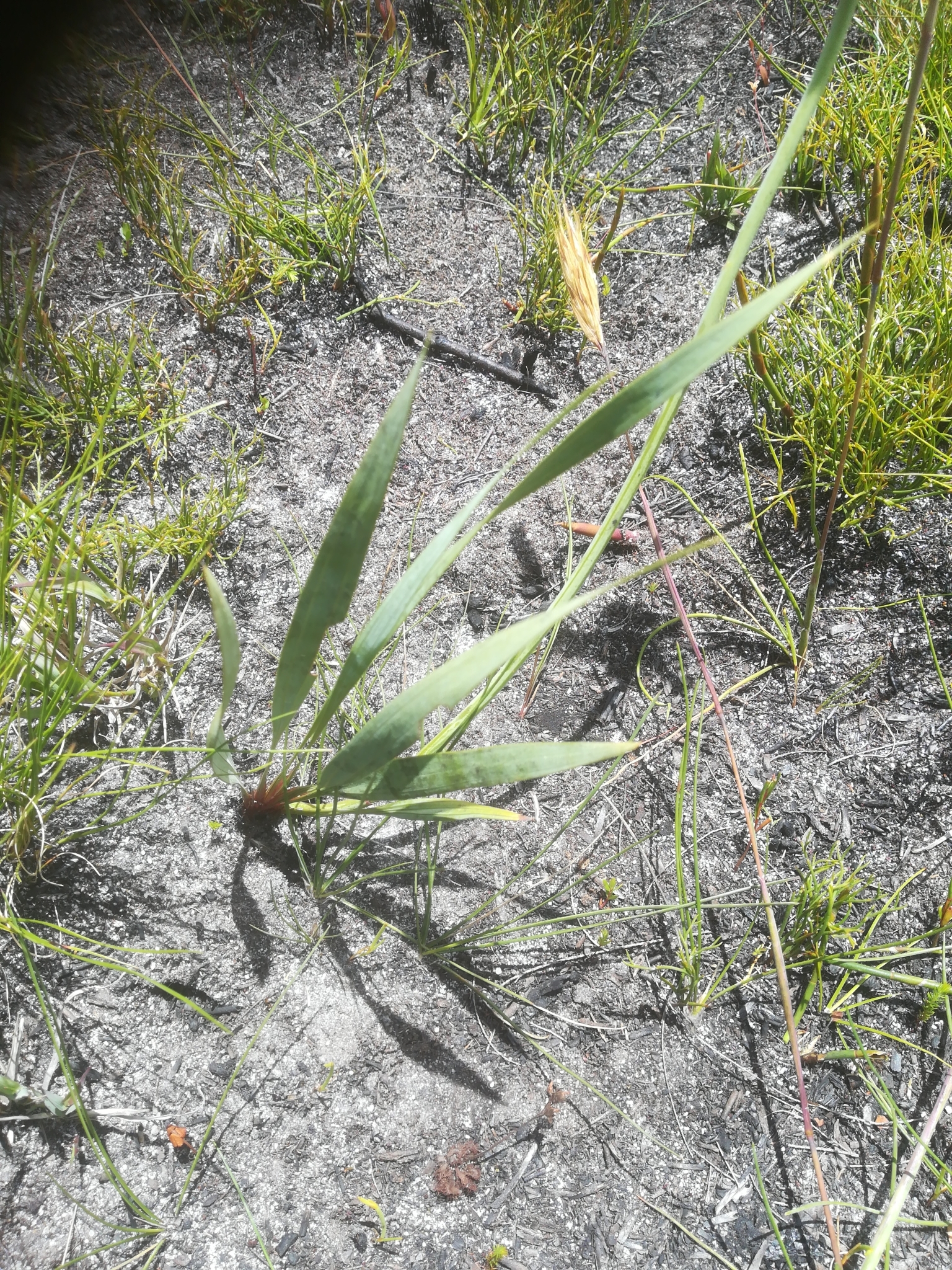
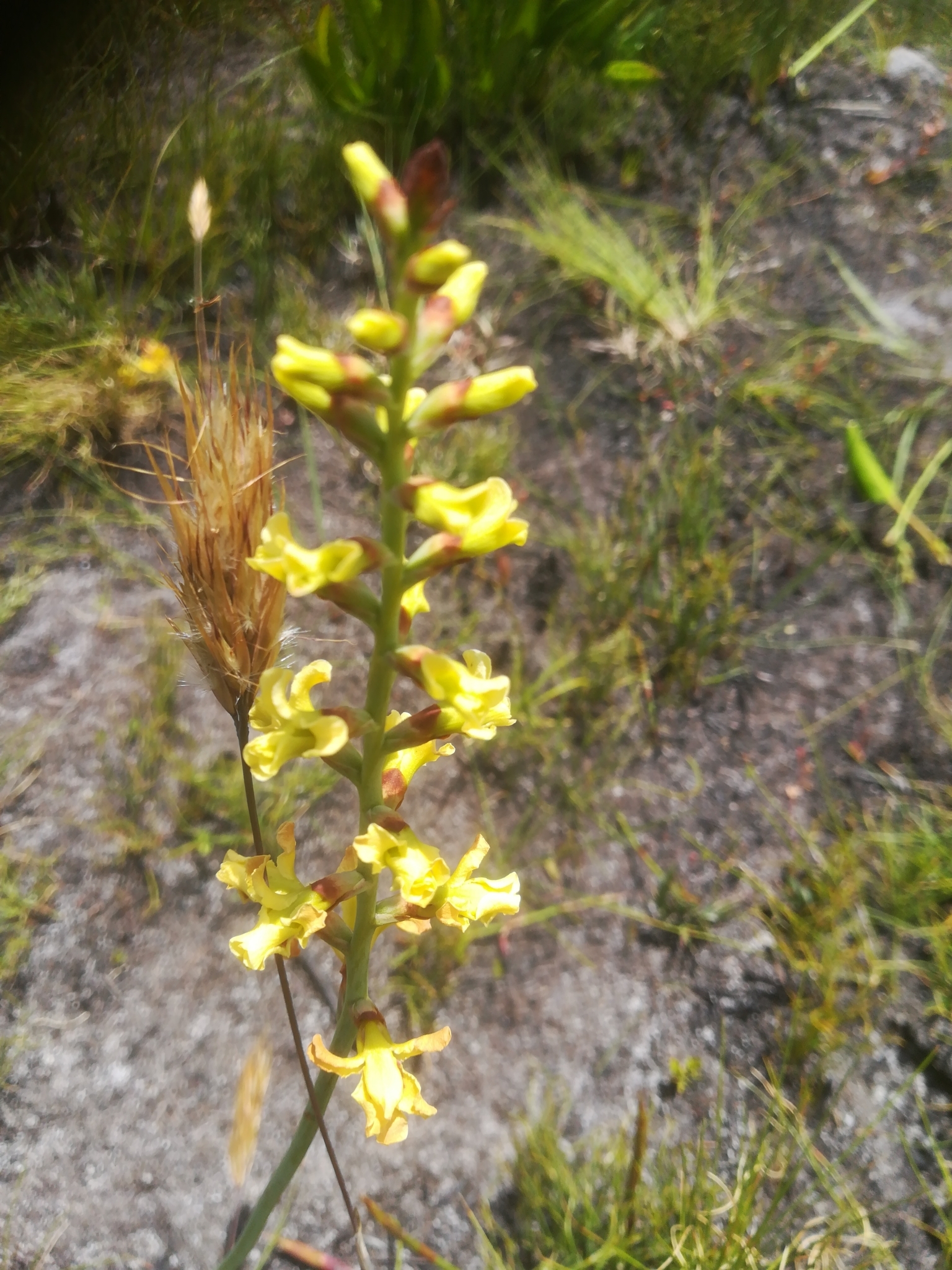
Plants 200-400(-600) mm high. Corm 20-30 mm diam.; tunics of densely matted brown fibres, with well-developed collar. Stem moderately slender to robust, curved outward at ground level, then suberect or weakly inclined, unbranched, 2.5-4.0 mm diam. Basal leaves (4)5 to 7, green at flowering or outermost drying, blades narrowly lanceolate, acuminate, with 1 or 2(3) veins, (85-)100-150 x (5-)6-10 mm, contracted abruptly into semiterete pseudopetiole 30-35 mm long; cauline leaves 1 or 2, lowermost concealed by corm fibres, scale-like. Spike densely 20- to 35-flowered, 80-100(-150) mm long; bracts green at base, dry and brown above, leathery, oblong, outer 7-10 mm long, obtuse or acute, inner slightly longer. Flowers zygomorphic, yellow with lower 3 tepals flushed maroon in basal half and with darker median streak, strongly acrid or musty scented; perianth tube 2-5 mm long; tepals unequal, dorsal slightly larger, suberect and recurved distally, crisped or undulate, base of lower tepals and mouth of tube minutely papillate, dorsal tepal narrowly oblanceolate, 14-16 x 3-4 mm, obtuse, upper laterals oblanceolate- to obovate-spathulate, 9-13 x 2-4 mm, obtuse, strongly clawed in basal 2-4 mm, lower 3 tepals joined for 1.0-1.5 mm, oblong-spathulate, 9-10 x 2.0-4.5 mm, truncate, with or without short claw up to 1.5 mm long. Filaments arcuate, later erect, 6-7 mm long, base of median filament minutely papillate; anthers 3 mm long, yellow, with short apiculus 0.5 mm long. Style ± 9 mm long, dividing opposite anther bases, branches 1.0-1.5 mm long. Capsules much inflated, ovoid to broadly ellipsoid, 23-28 x 15-20 mm. Seeds 10-12 x 10 mm, winged on angles. From: Goldblatt, P; Manning, JC. 2020. Iridaceae of southern Africa. Strelitzia 42: 1-1159. South African National Biodiversity Institute, Pretoria. [CC BY]
Like T. parviflora but leaves narrowly lanceolate, abruptly narrowed below into a pseudopetiole, and filaments shorter, 6-7 mm long. From: Manning, JC; Goldblatt, P. 2012. Iridaceae. In: J Manning & P Goldblatt (eds), Plants of the Greater Cape Floristic Region 1: The Core Cape flora. Strelitzia 29: 119-176. South African National Biodiversity Institute, Pretoria. [CC BY]
Tritoniopsis bicolor is recognised by its moderately-sized, bright yellow flowers with the bicoloured lower tepals maroon in the lower third and joined at the base for up to 1.5 mm without forming a well-defined lower lip. The perianth tube is short, 2-5 mm long, and the filaments are 6-7 mm long, with the base of the tepals and mouth of the tube minutely papillate. The leaves are conspicuously petiolate with a narrowly lanceolate blade 6-10 mm wide, with 1 or 2(3) veins, and the capsules are conspicuously inflated. From: Goldblatt, P; Manning, JC. 2020. Iridaceae of southern Africa. Strelitzia 42: 1-1159. South African National Biodiversity Institute, Pretoria. [CC BY]
Seasonally waterlogged flats. From: Goldblatt, P; Manning, JC. 2020. Iridaceae of southern Africa. Strelitzia 42: 1-1159. South African National Biodiversity Institute, Pretoria. [CC BY]
Seasonally waterlogged sandstone plateau. From: Manning, JC; Goldblatt, P. 2012. Iridaceae. In: J Manning & P Goldblatt (eds), Plants of the Greater Cape Floristic Region 1: The Core Cape flora. Strelitzia 29: 119-176. South African National Biodiversity Institute, Pretoria. [CC BY]
A highly local endemic from the summit plateau of the Bredasdorp Mtns, Western Cape. From: Goldblatt, P; Manning, JC. 2020. Iridaceae of southern Africa. Strelitzia 42: 1-1159. South African National Biodiversity Institute, Pretoria. [CC BY]
Bredasdorp Mtns and Baardskeedersbos. From: Manning, JC; Goldblatt, P. 2012. Iridaceae. In: J Manning & P Goldblatt (eds), Plants of the Greater Cape Floristic Region 1: The Core Cape flora. Strelitzia 29: 119-176. South African National Biodiversity Institute, Pretoria. [CC BY]
November to December
400 to 500 m
This map contains point-based occurrences at different locations
Occurrence in the Flora of Southern Africa (FSA) countries and South African provinces. Residence status indicates if a taxon is indigenous, endemic, naturalised or invasive in a specific region. This data is based on specimen records and literature
FSA
SA
BOT
NAM
ESW
LES
WC
EC
NC
FS
GA
KZN
LP
MP
NW
Absent
Indigenous
Endemic
Naturalised
Invasive
Names and Sources
Classification
KINGDOM Plantae
SUBKINGDOM Phanerogamae
PHYLUM Anthophyta
ORDER Asparagales
FAMILY Iridaceae
SUBFAMILY Crocoideae
TRIBE Tritaniopsideae
GENUS Tritoniopsis
SPECIES bicolor
14 results for Tritoniopsis bicolor J.C.Manning & Goldblatt
Barcode: PRE0587592-0 Collector(s) & number: Manning, JC, 2286 | 2000-12-6
South Africa, Western Cape, W end of Bredasdorp Mountains, watershed on plateau W of Normankop near head of Huisrivierkloof, Lot VI.
General notes: Flowers yellow maroon, strongly scented; local after fire.
Data Resource: BODATSA View record
Barcode: NBG0207257-0 Collector(s) & number: McMaster, JC, 1 | --
South Africa, Western Cape, Napier Mountain. 34°30.326' S; 19°52.841' E.
General notes: Mountain fynbos. Common. Bulb. Moist in winter. Sandy soil. Full sun. Bulbous plant. Flowering period: 11 November. Yellow flowers.
Data Resource: BODATSA View record
Barcode: NBG0198644-2 Collector(s) & number: Manning, JC, 2286 | 2000-12-6
South Africa, Western Cape, W end of Bredasdorp Mountains, watershed on plateau W of Normankop near head of Huisrivierkloof, Lot VI;
General notes: Fynbos. Plateau. Seasonally waterlogged soil. Sandstone. Full sun. Recently burned. Geophyte. Flowers yellow maroon, strongly scented; local after fire.
Data Resource: BODATSA View record
Barcode: NBG0198644-1 Collector(s) & number: Manning, JC, 2286 | 2000-12-6
South Africa, Western Cape, W end of Bredasdorp Mountains, watershed on plateau W of Normankop near head of Huisrivierkloof, Lot VI;
General notes: Fynbos. Plateau. Seasonally waterlogged soil. Sandstone. Full sun. Recently burned. Geophyte. Flowers yellow maroon, strongly scented; local after fire.
Data Resource: BODATSA View record
This map contains point-based occurrences at different locations
2020
SERIES
Iridaceae of southern Africa Goldblatt, P; Manning, JCStrelitzia 42: 1-1159
South African National Biodiversity Institute, Pretoria
2012
SERIES CHAPTER
Iridaceae Manning, JC; Goldblatt, PIn: J Manning & P Goldblatt (eds), Plants of the Greater Cape Floristic Region 1: The Core Cape flora. Strelitzia 29: 119-176
South African National Biodiversity Institute, Pretoria
2001
PERIODICAL/JOURNAL
Three new species of Tritoniopsis (Iridaceae: Crocoideae) from the Cape Region of South Africa Goldblatt, P; Manning, JCBothalia 31(1&2)175-181
No results found for Tritoniopsis bicolor J.C.Manning & Goldblatt
Status and criteria
VU
Assessor(s)
Plantae Coordinator
EDITED BOOK
Groombridge, B. 1994. 1994 IUCN Red List of Threatened Animals. IUCN
JOURNAL ARTICLE
Chakona, A. and Swartz, E.R. 2013. A new redfin species, <i>Pseudobarbus skeltoni</i> (Cyprinidae, Teleostei), from the Cape Floristic Region, South Africa. Zootaxa. 3686:565-577
REPORT
Jordaan, M., Impson, D. and de Villiers, P 2016a. CapeNature policy on the transport and utilisation of indigenous freshwater fishes of the Western Cape Province. Cape Nature
COMPUTER PROGRAM
SAIAB 2016. Specimen-records of preserved specimens and observations in the database of the National Collection of Fishes of South Africa. Dataset/Occurrence. South African Institute for Aquatic Biodiversity
JOURNAL ARTICLE
Swartz ER, Skelton PH and Bloomer P 2009. Phylogeny and biogeography of the genus Pseudobarbus (Cyprinidae): Shedding light on the drainage history of rivers associated with the Cape Floristic Region. Molecular Phylogenetics and Evolution. 51:75-84
JOURNAL ARTICLE
Chakona A, Swartz ER, Gouws G 2013. Evolutionary drivers of diversification and distribution of a southern temperate stream fish assemblage: testing the role of historical isolation and spatial range expansion. PLoS ONE. 8
| Part(s) of plant used | Use(s) | Reference |
|---|
Coming soon...