PLANTAE / PHANEROGAMAE / ANTHOPHYTA / ASPARAGALES / IRIDACEAE / CROCOIDEAE / IXIEAE / IXIA / VIRIDIFLORA

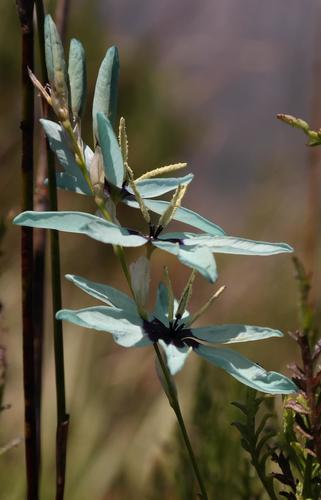
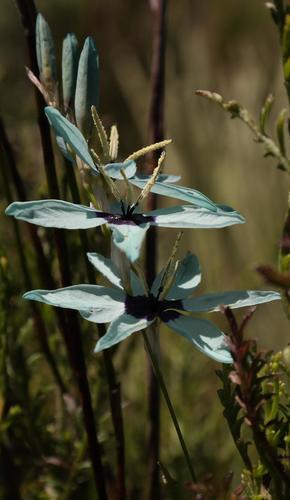
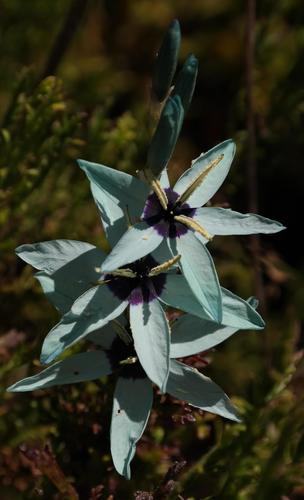
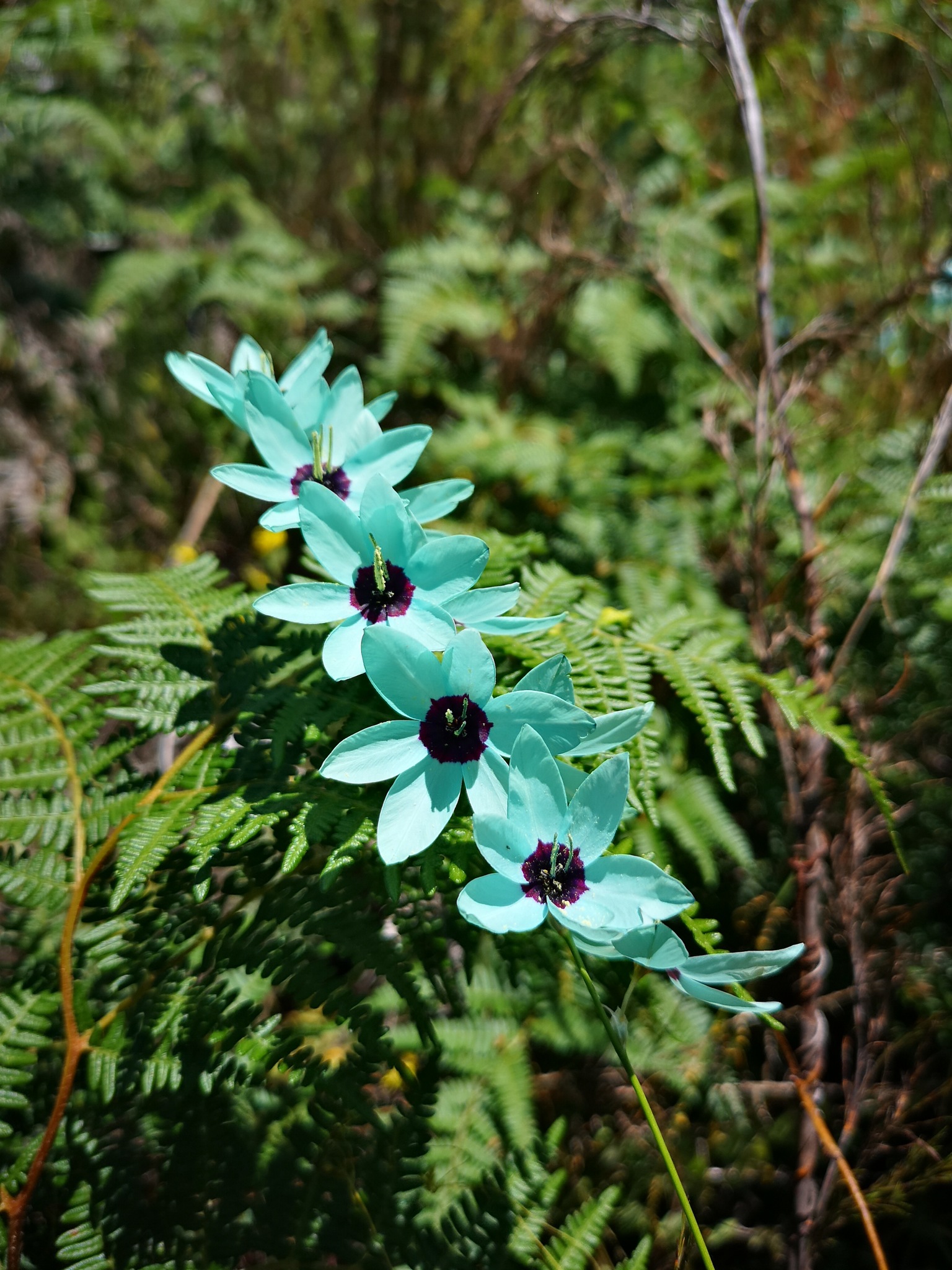
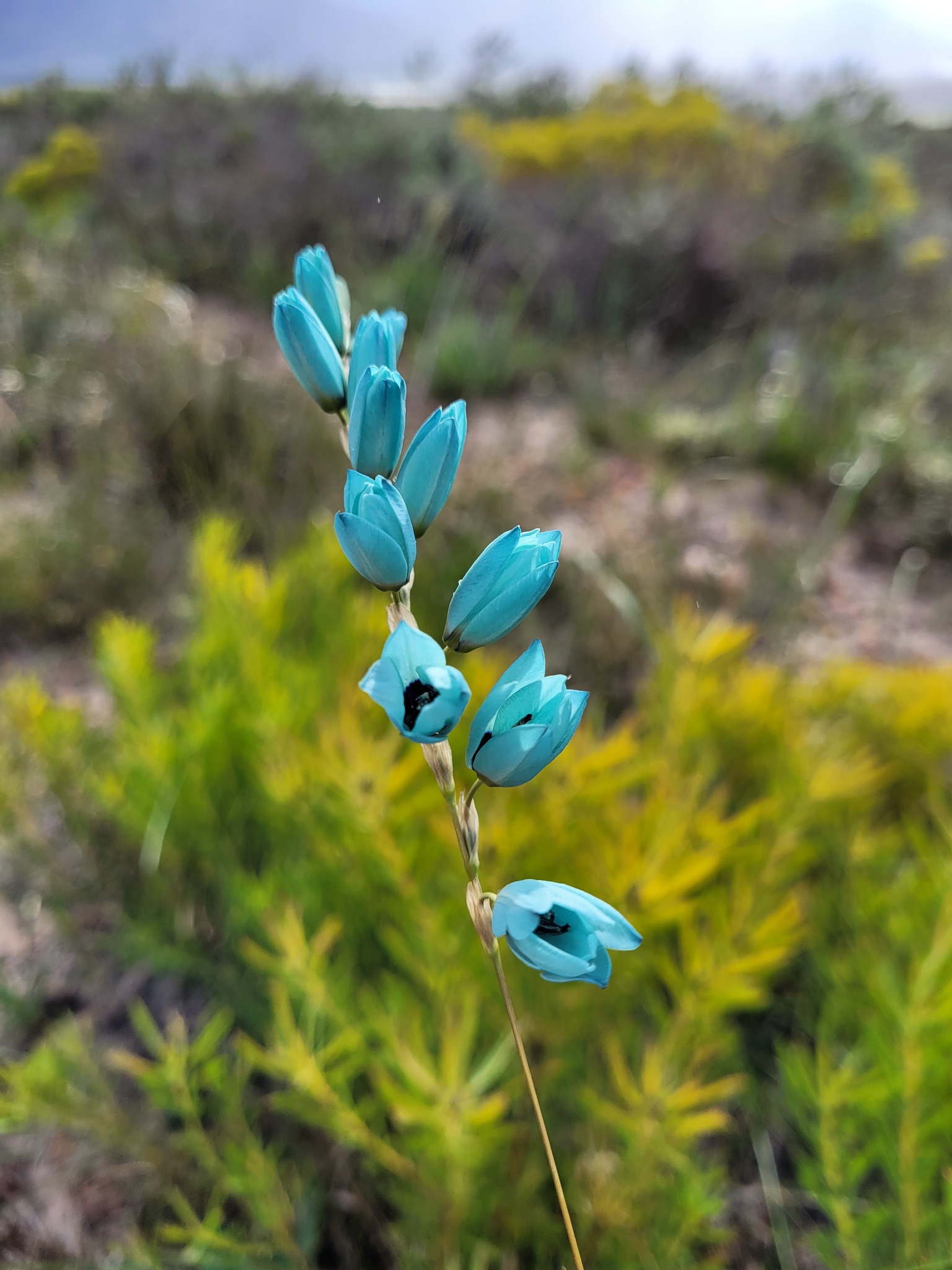
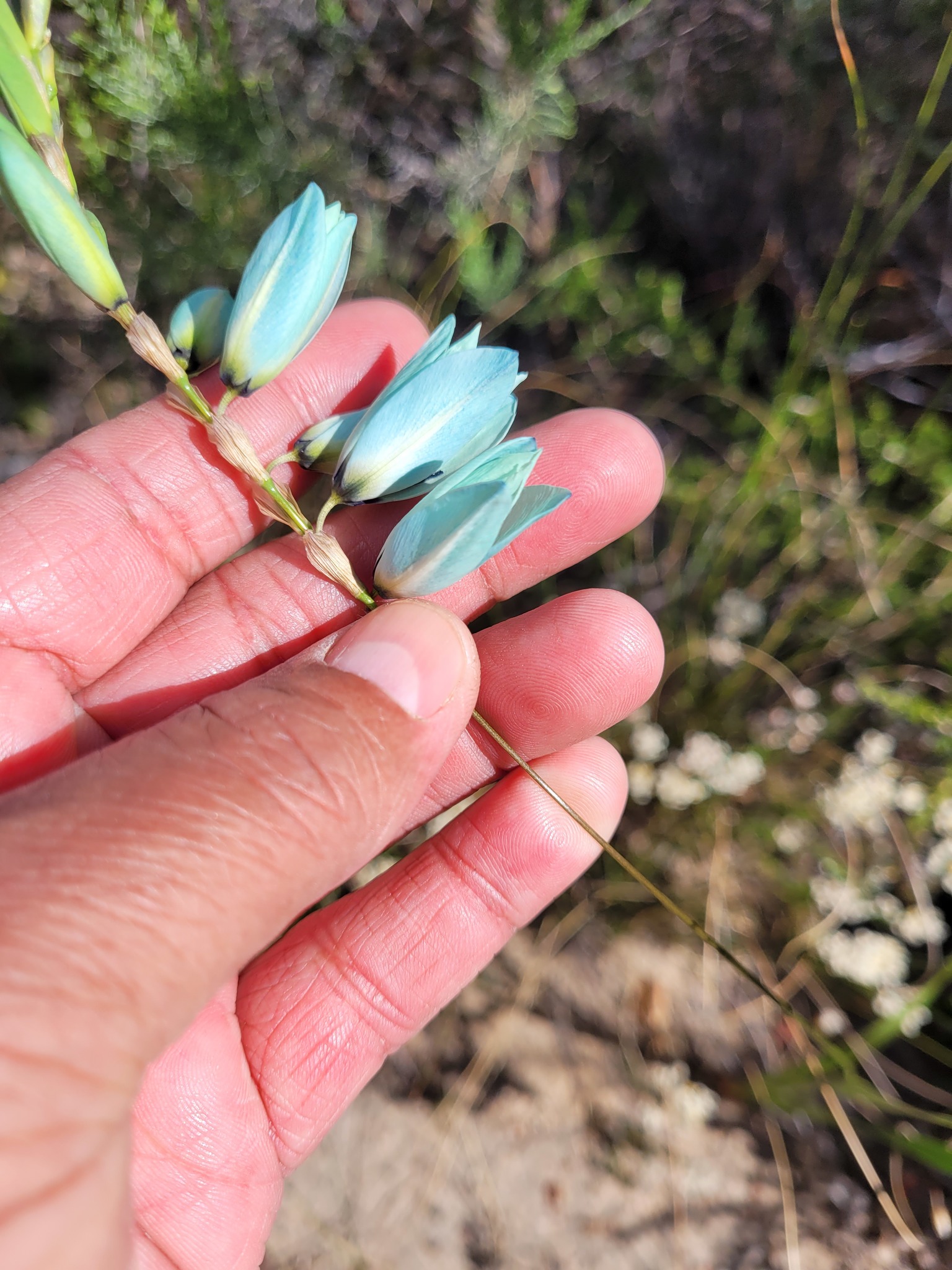
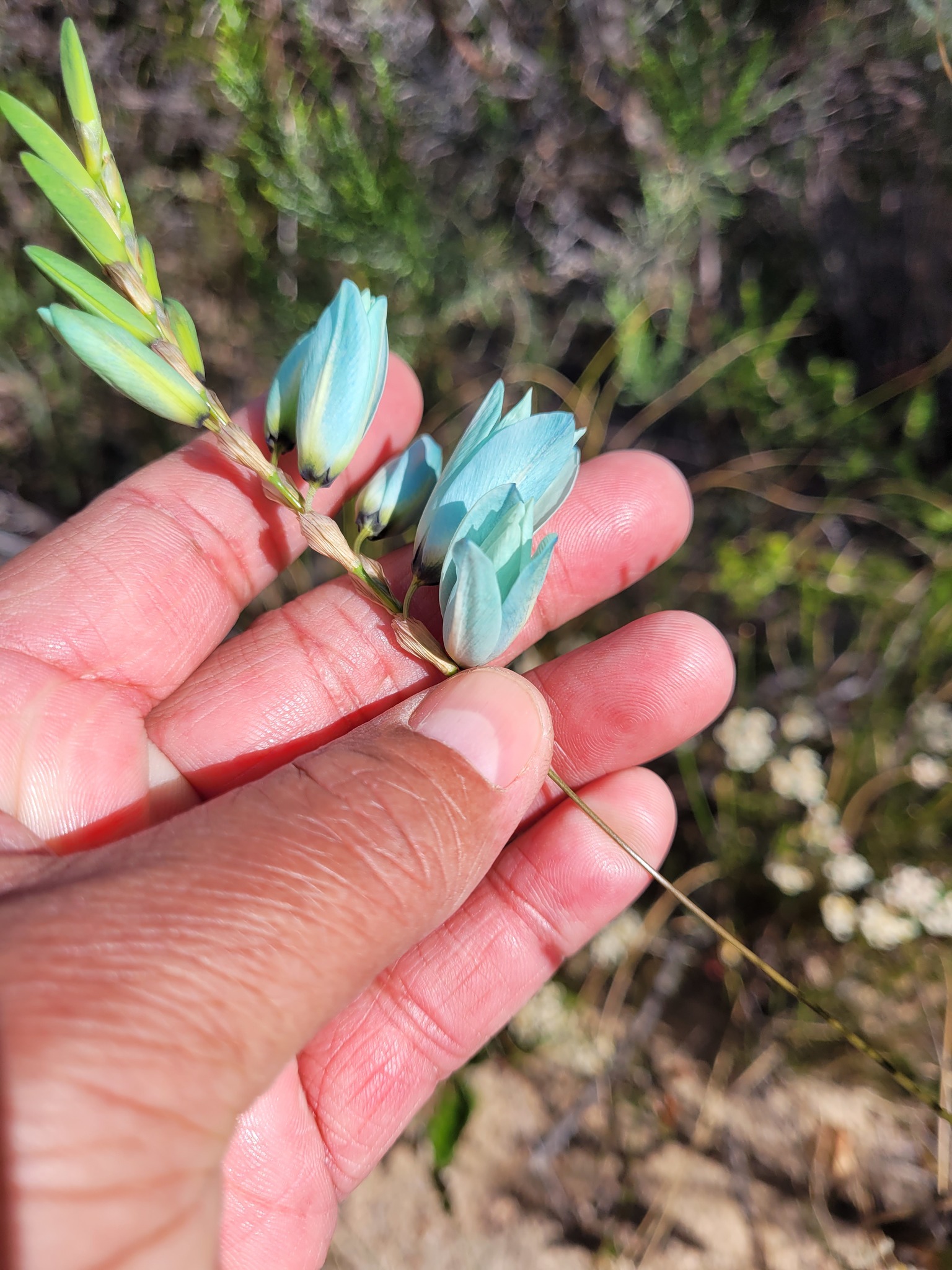
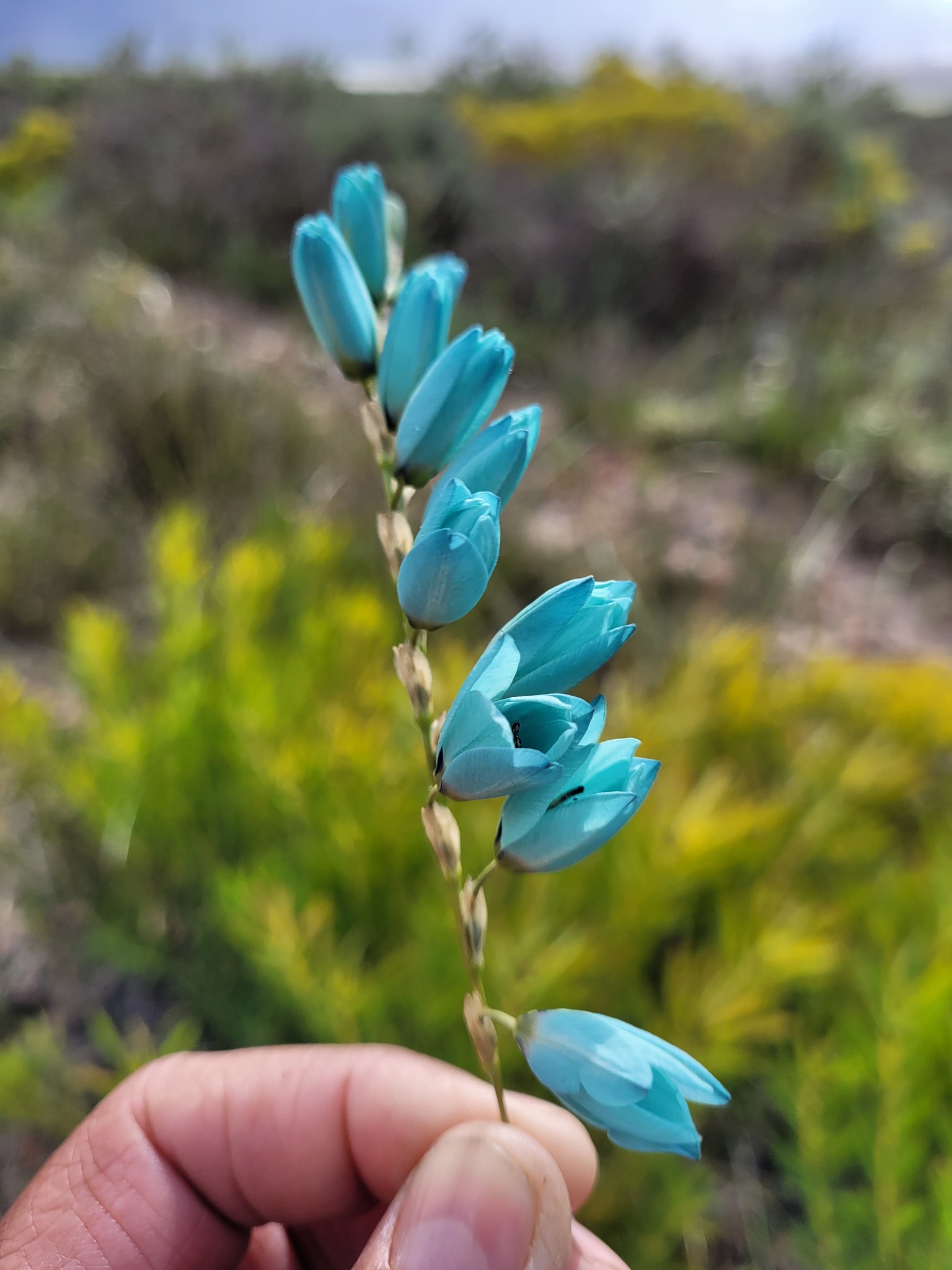
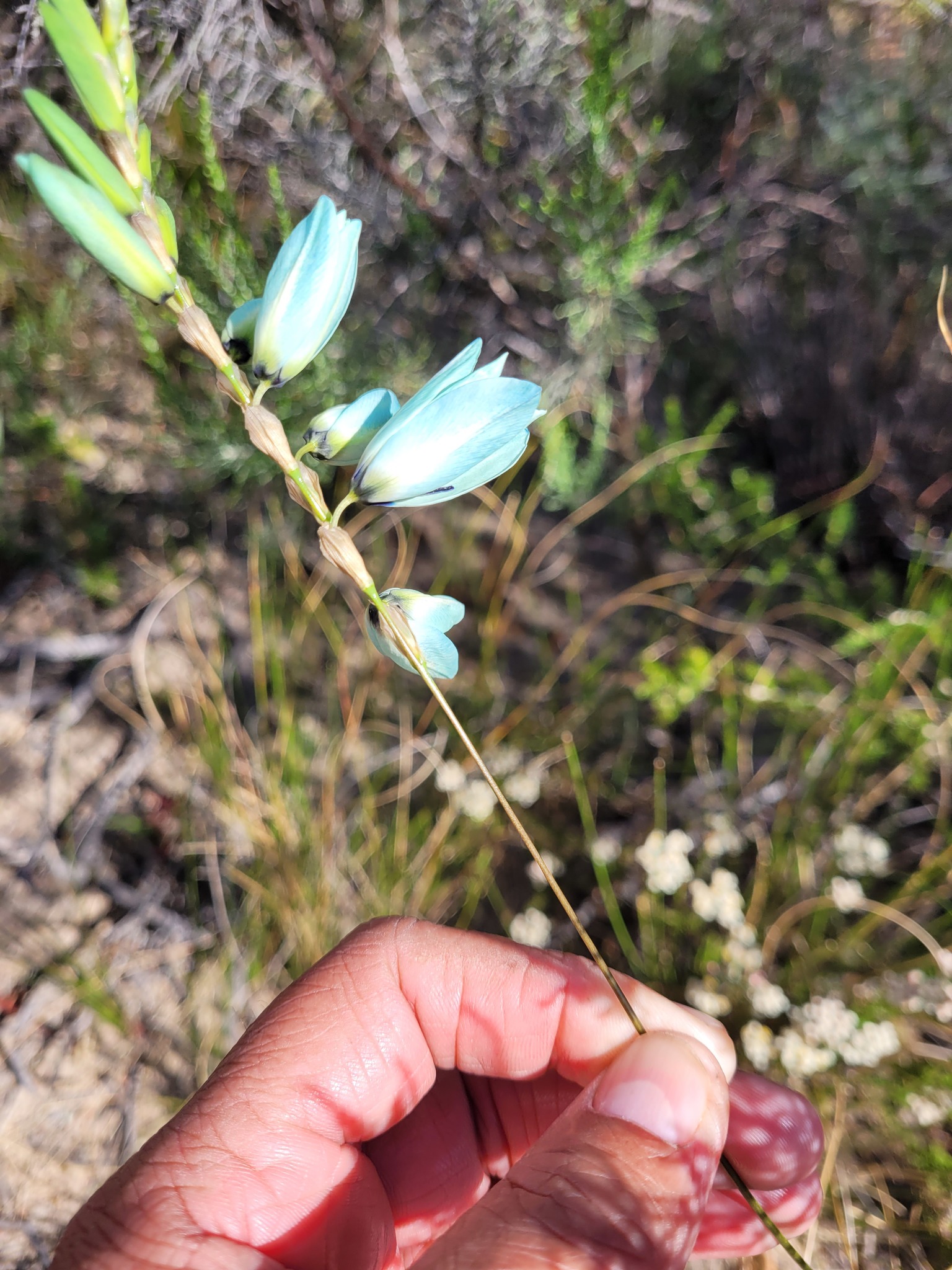
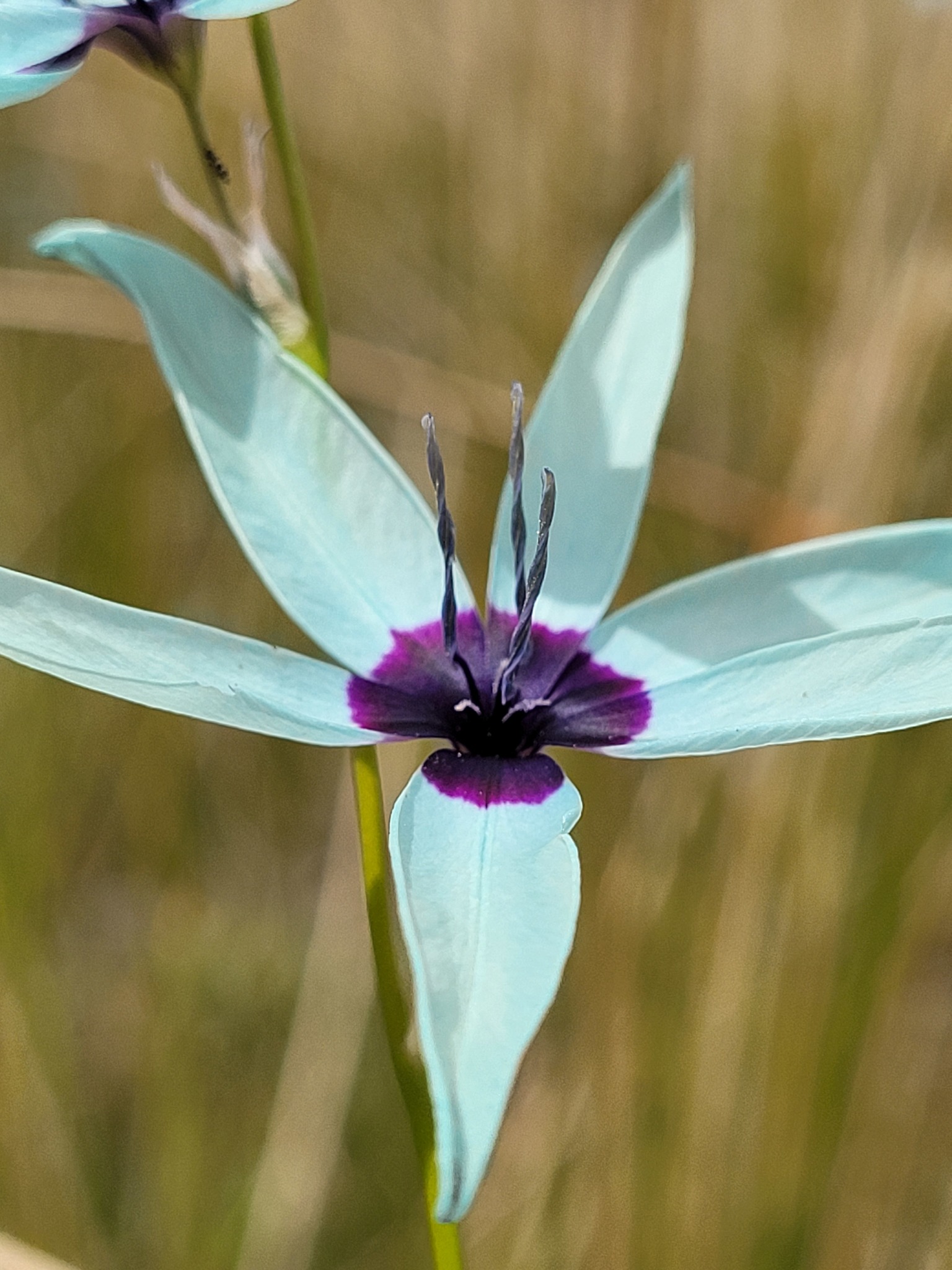
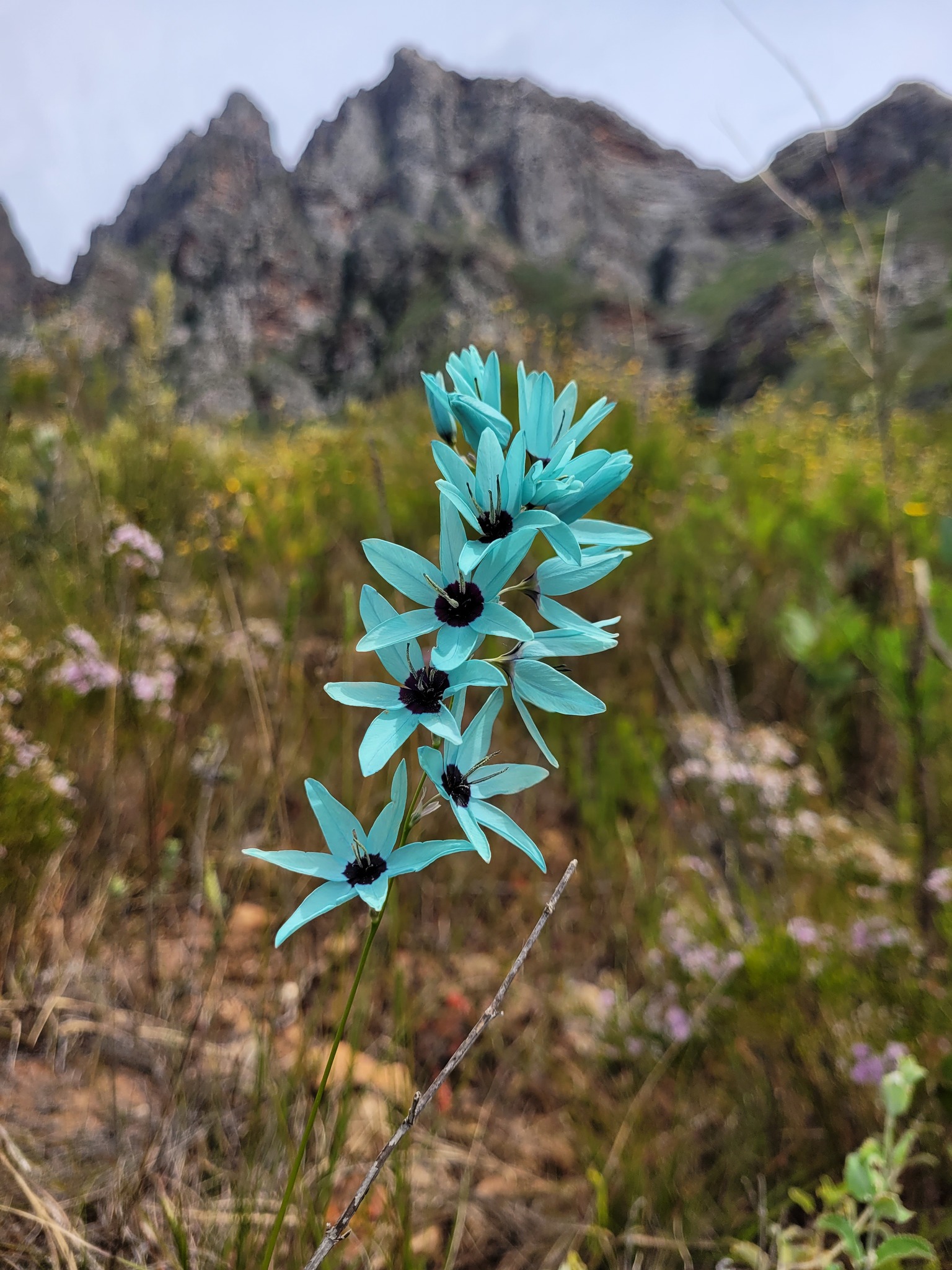
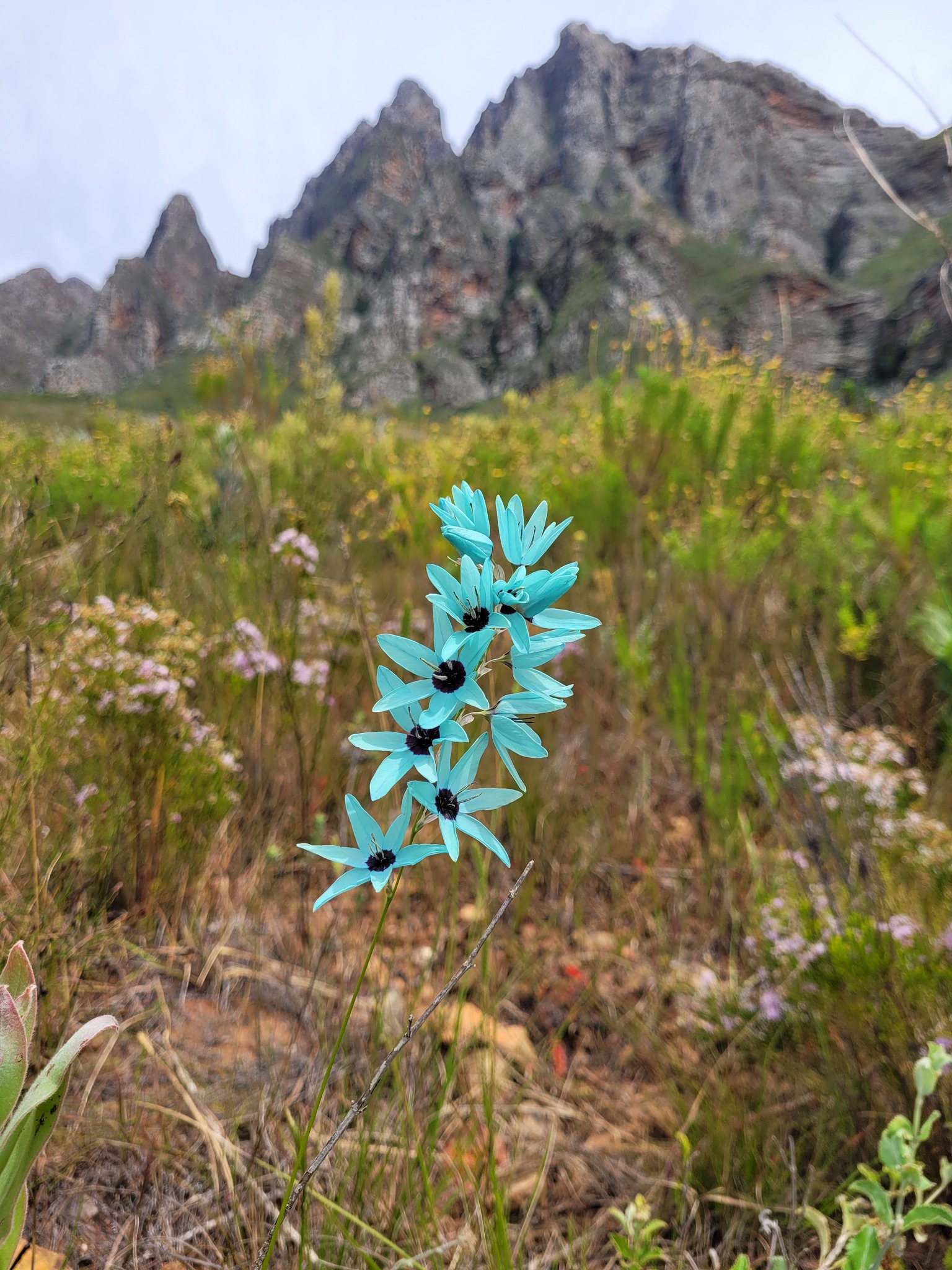
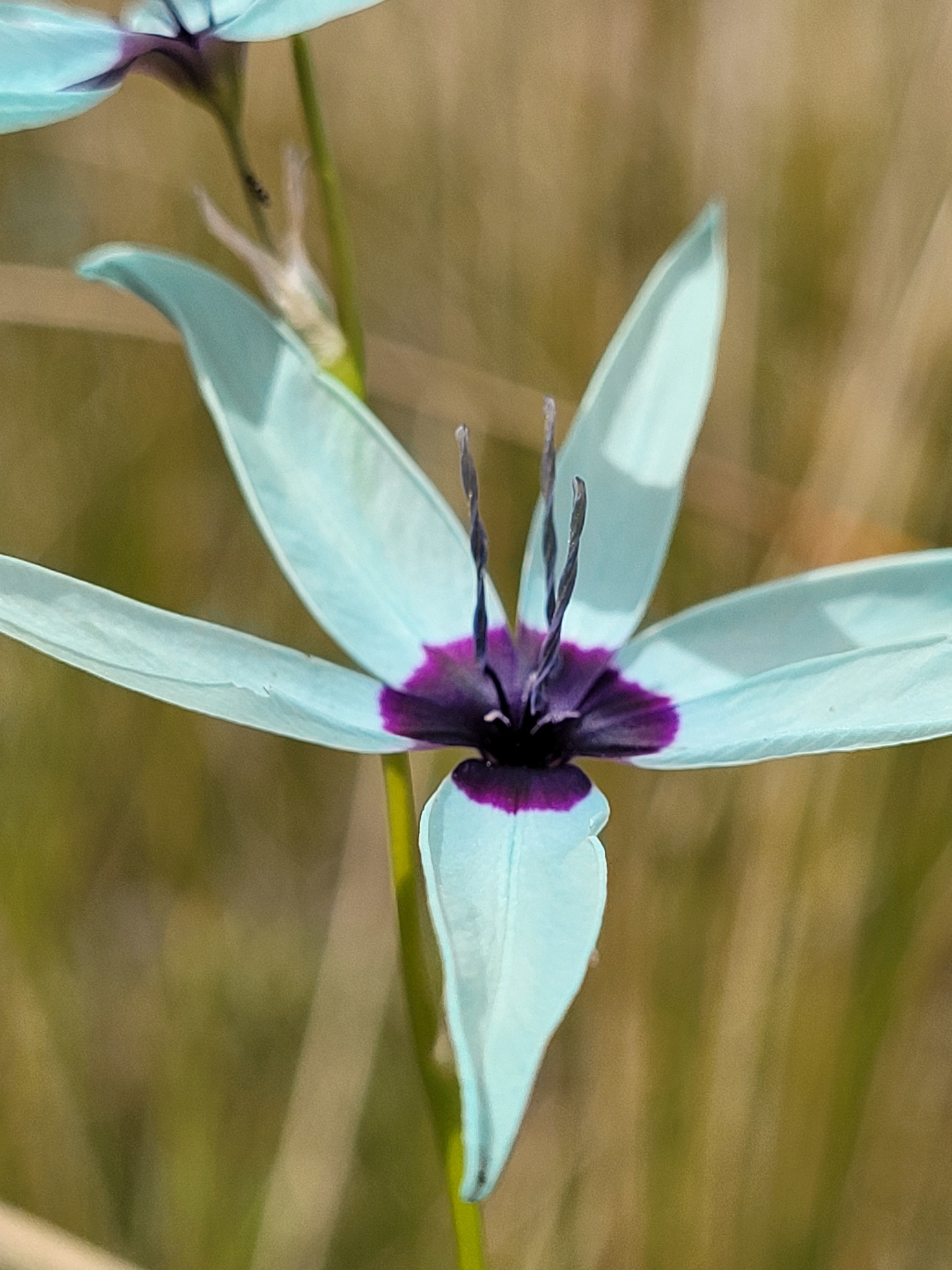
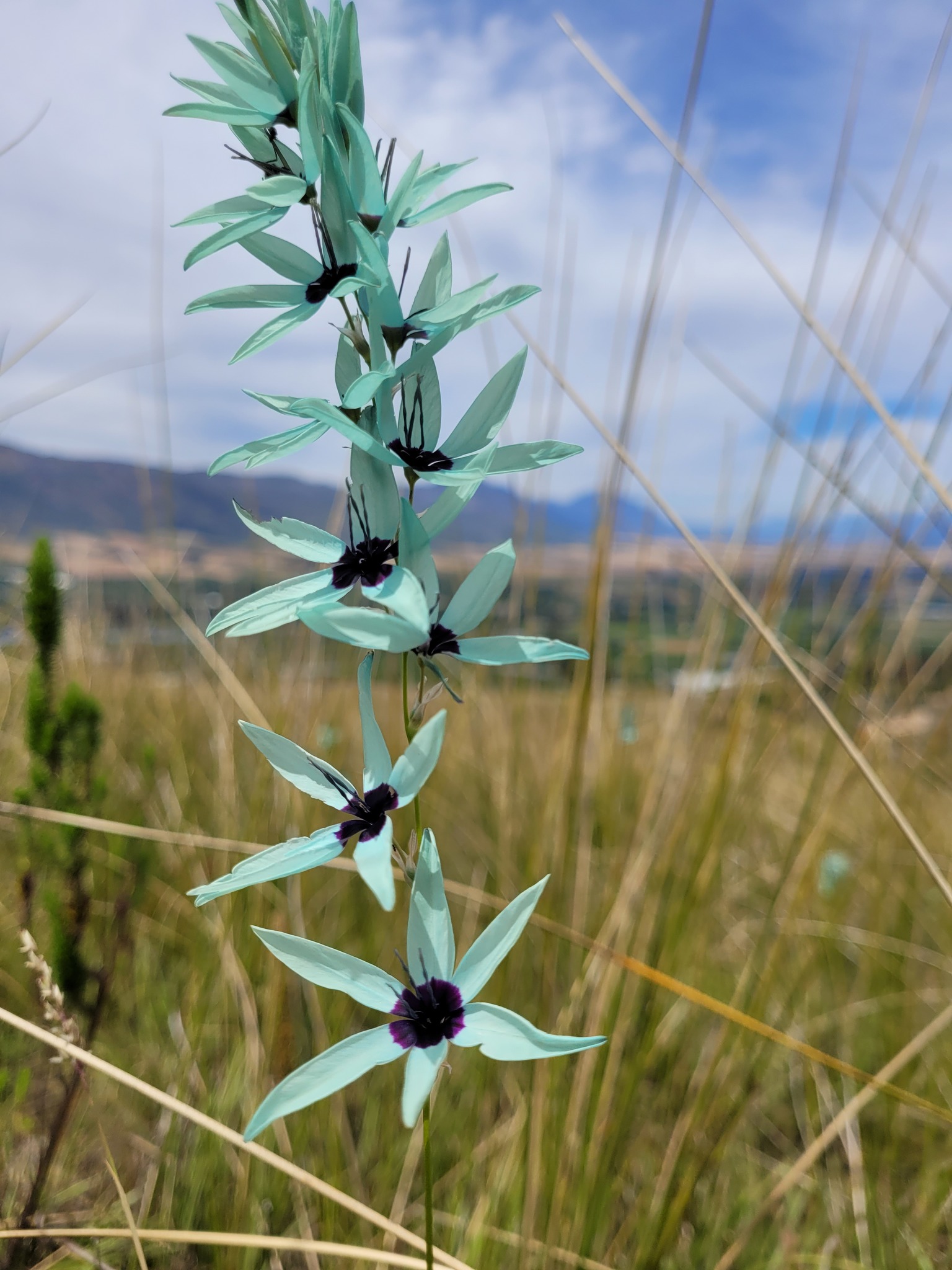
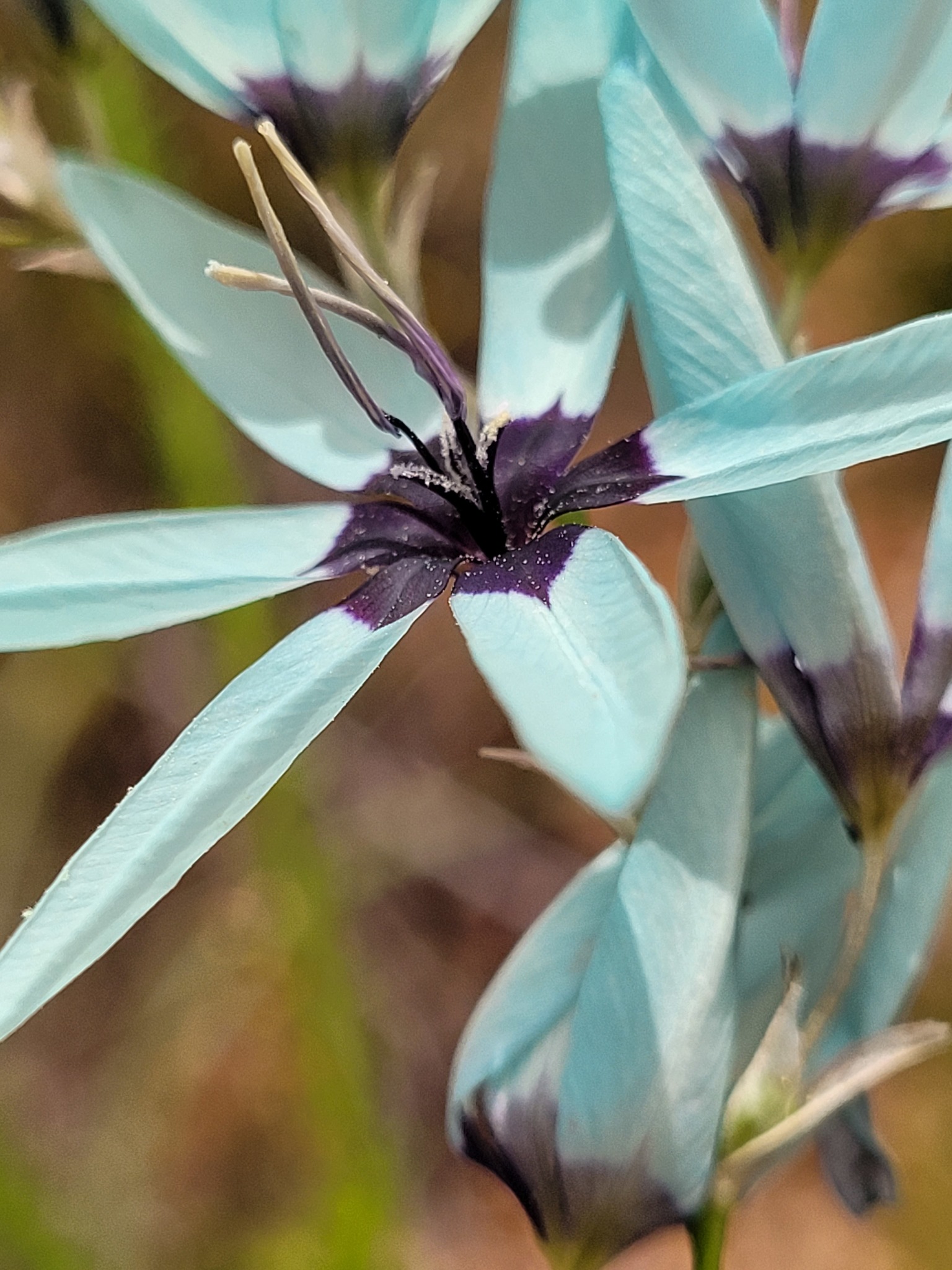
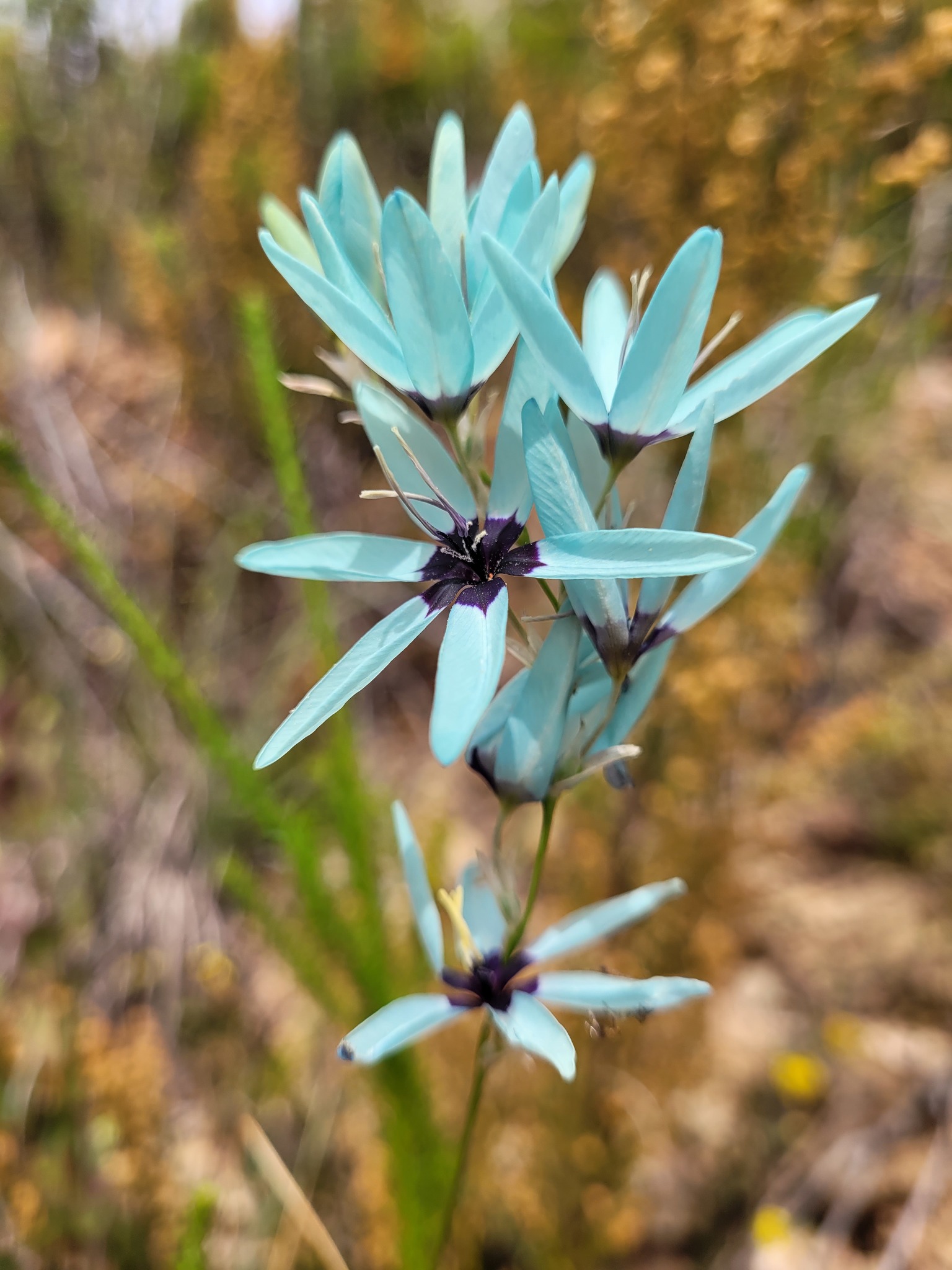
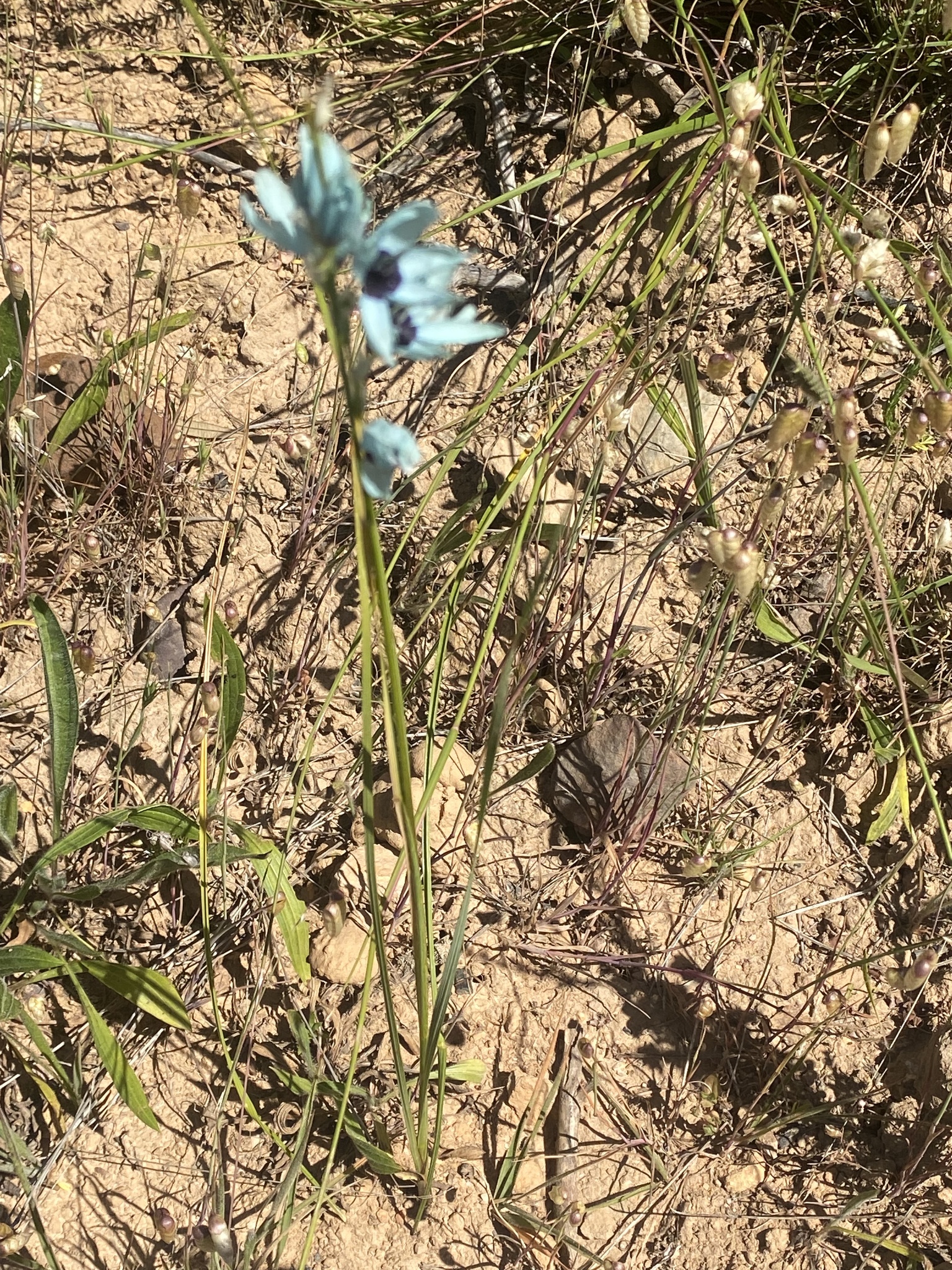
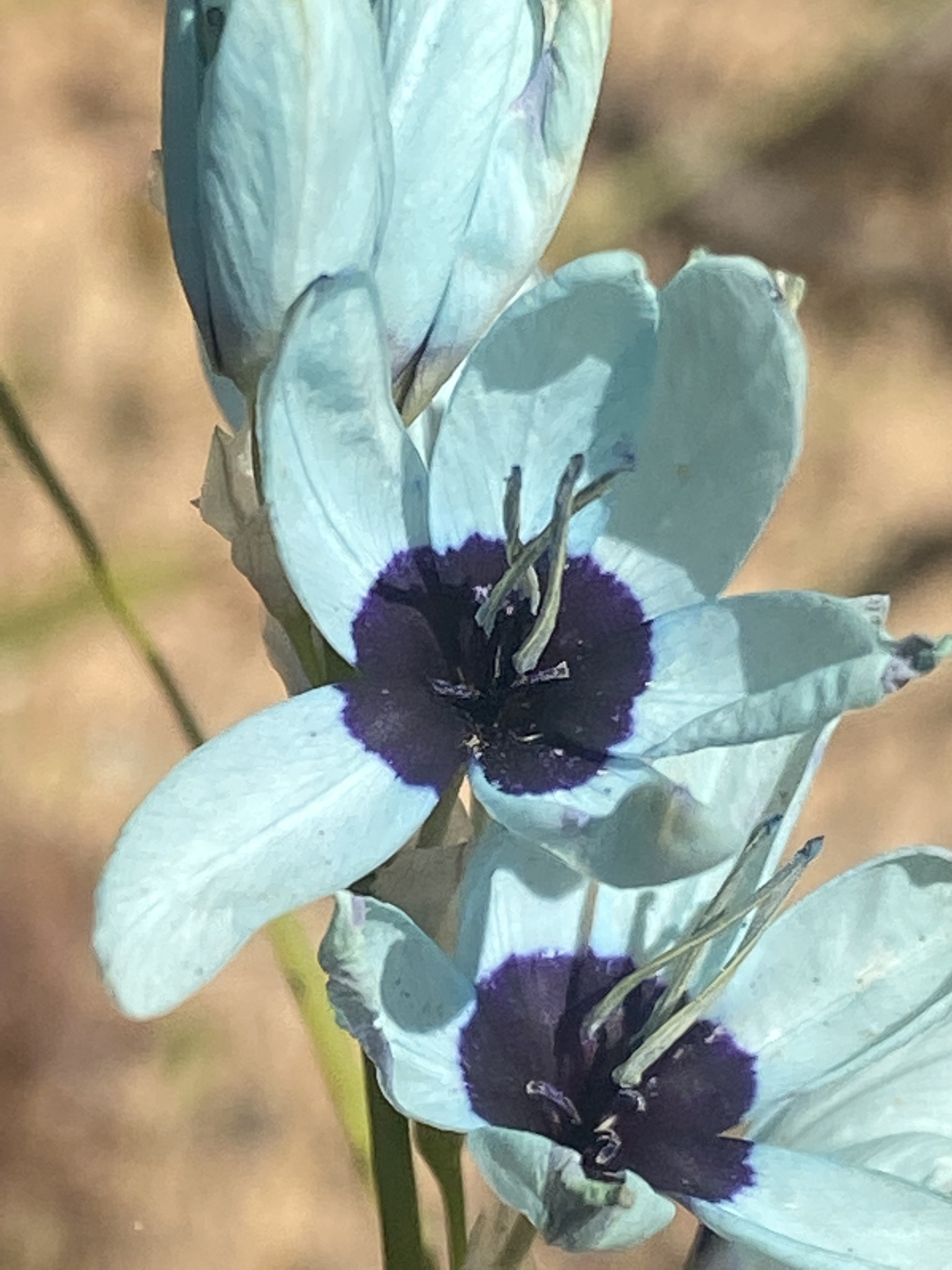
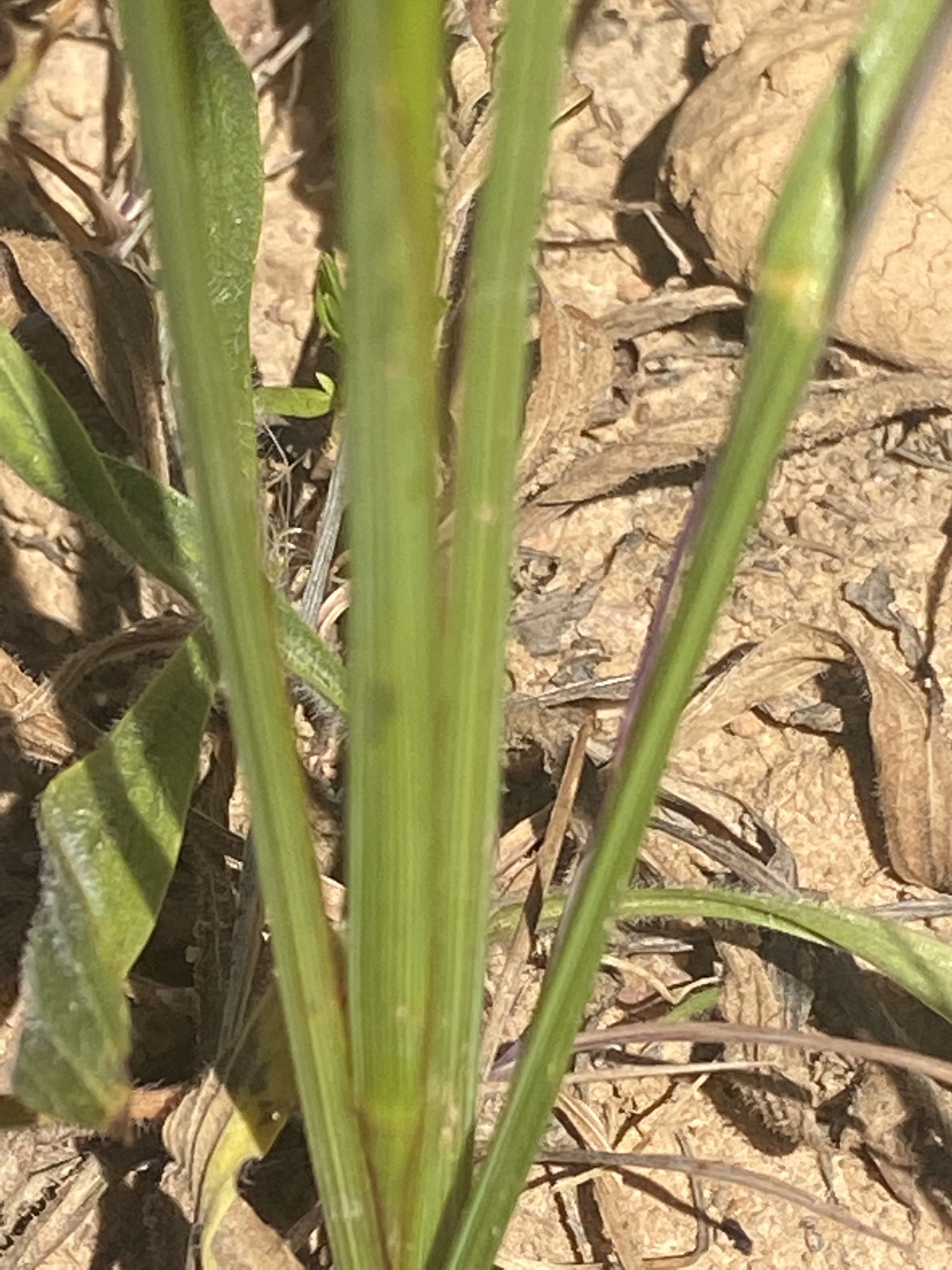
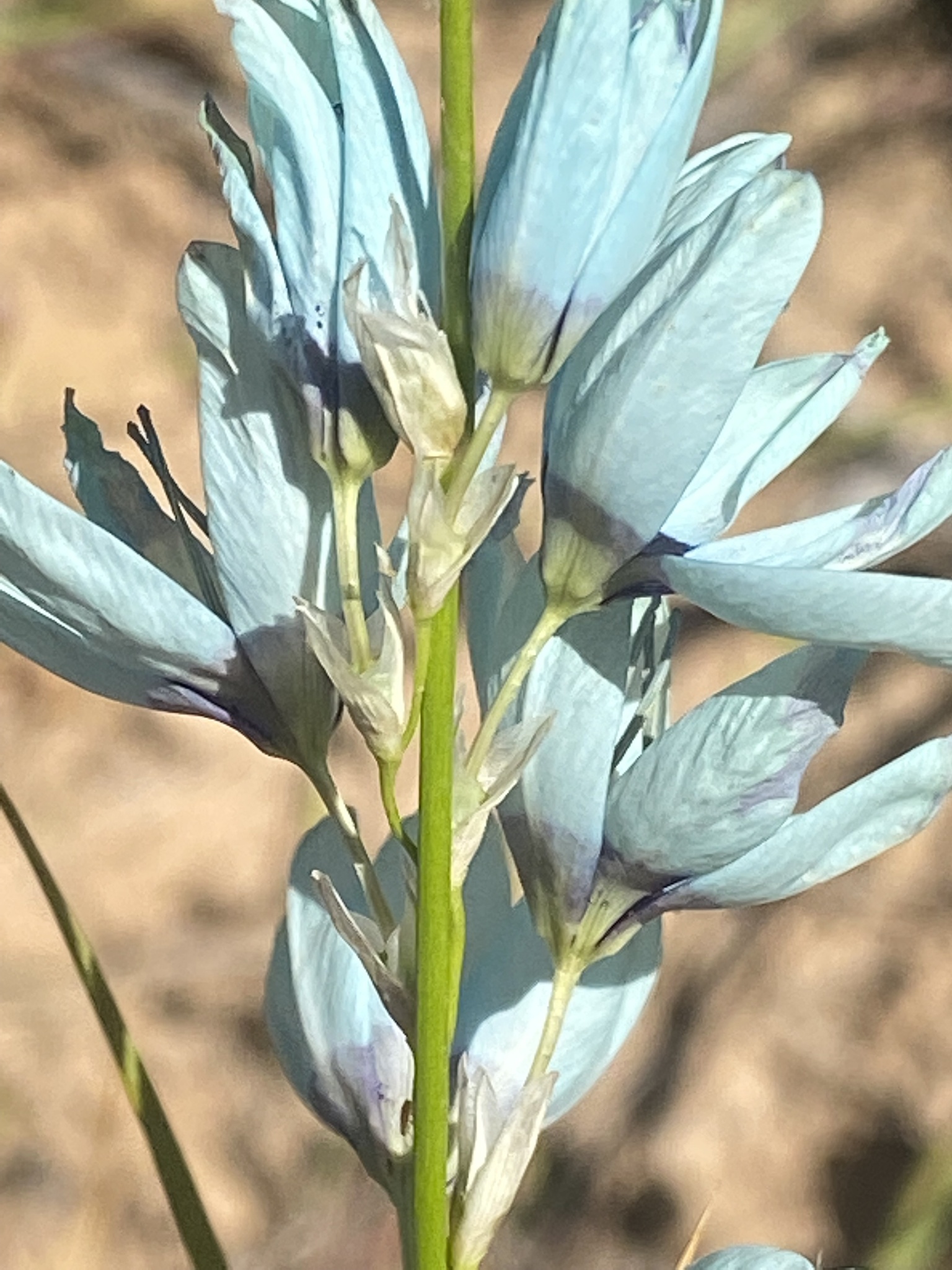
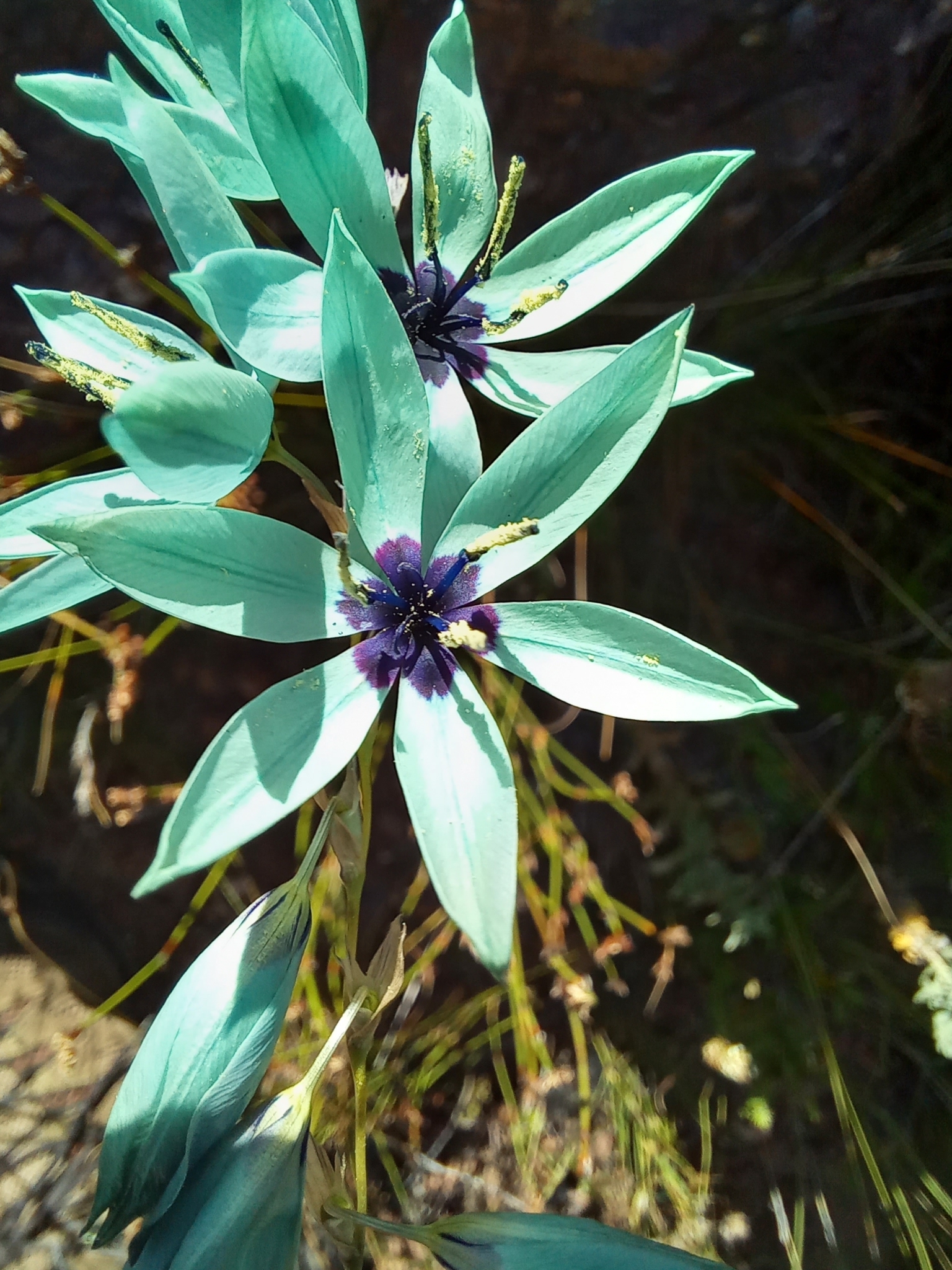
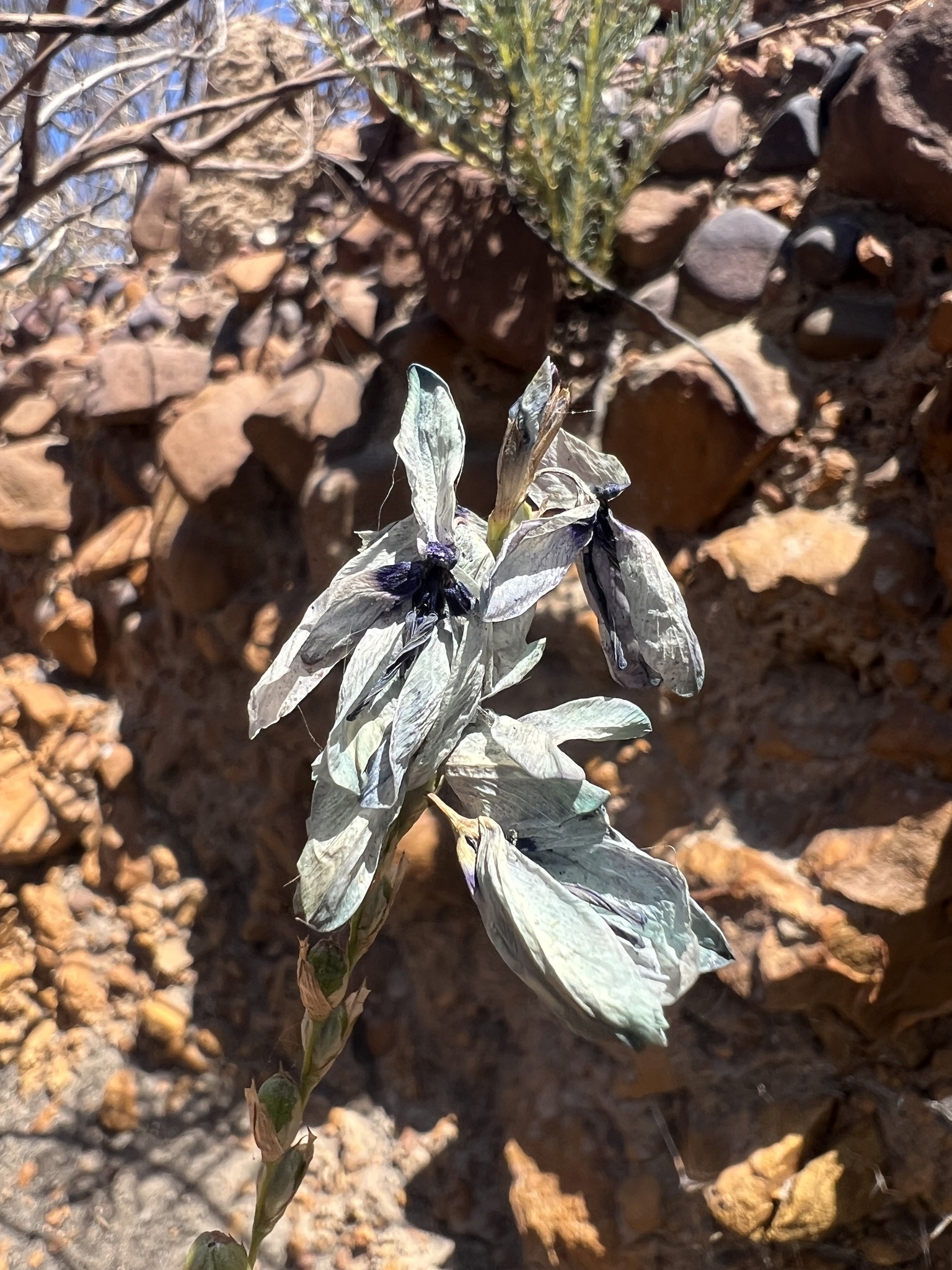
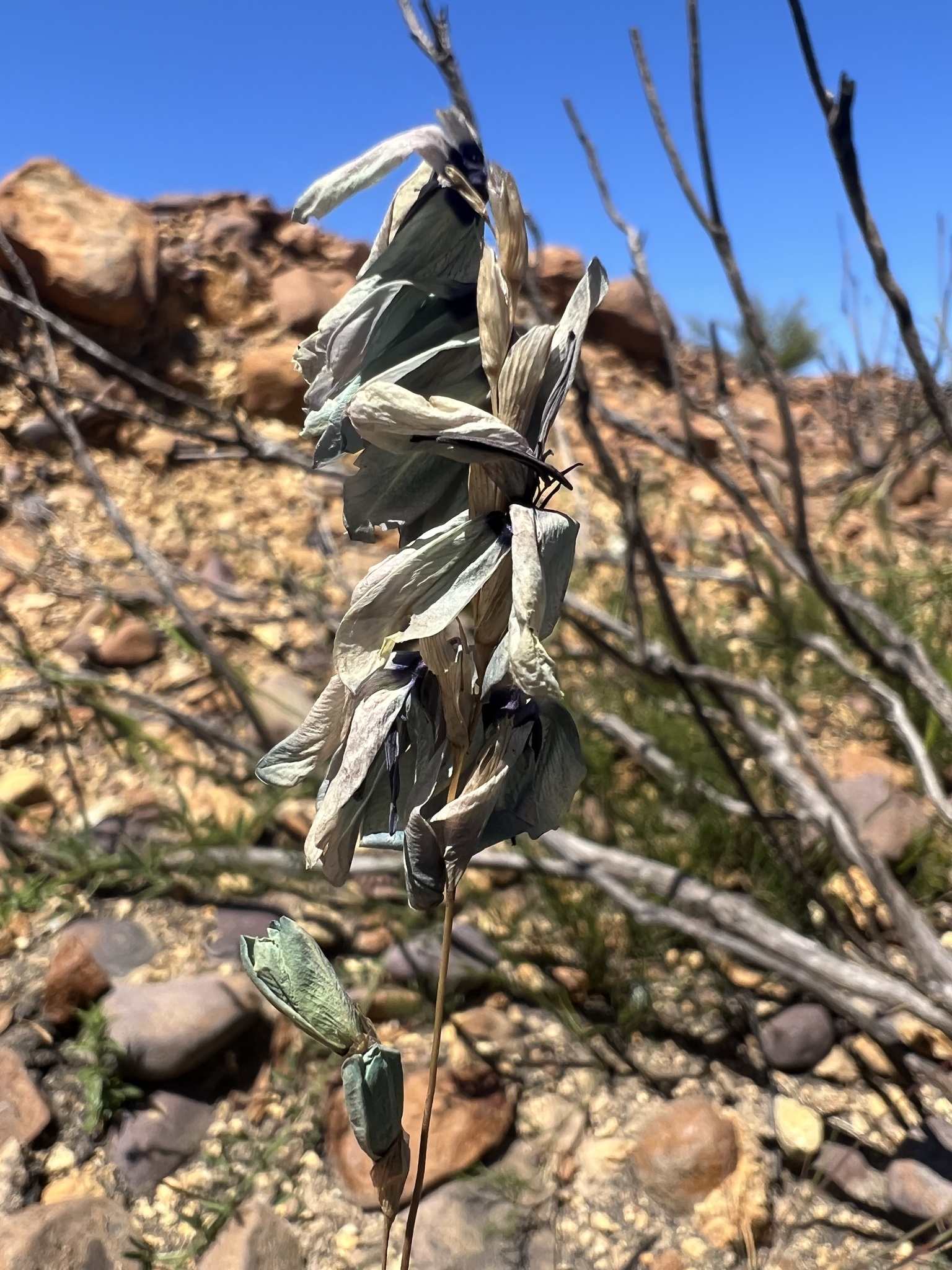
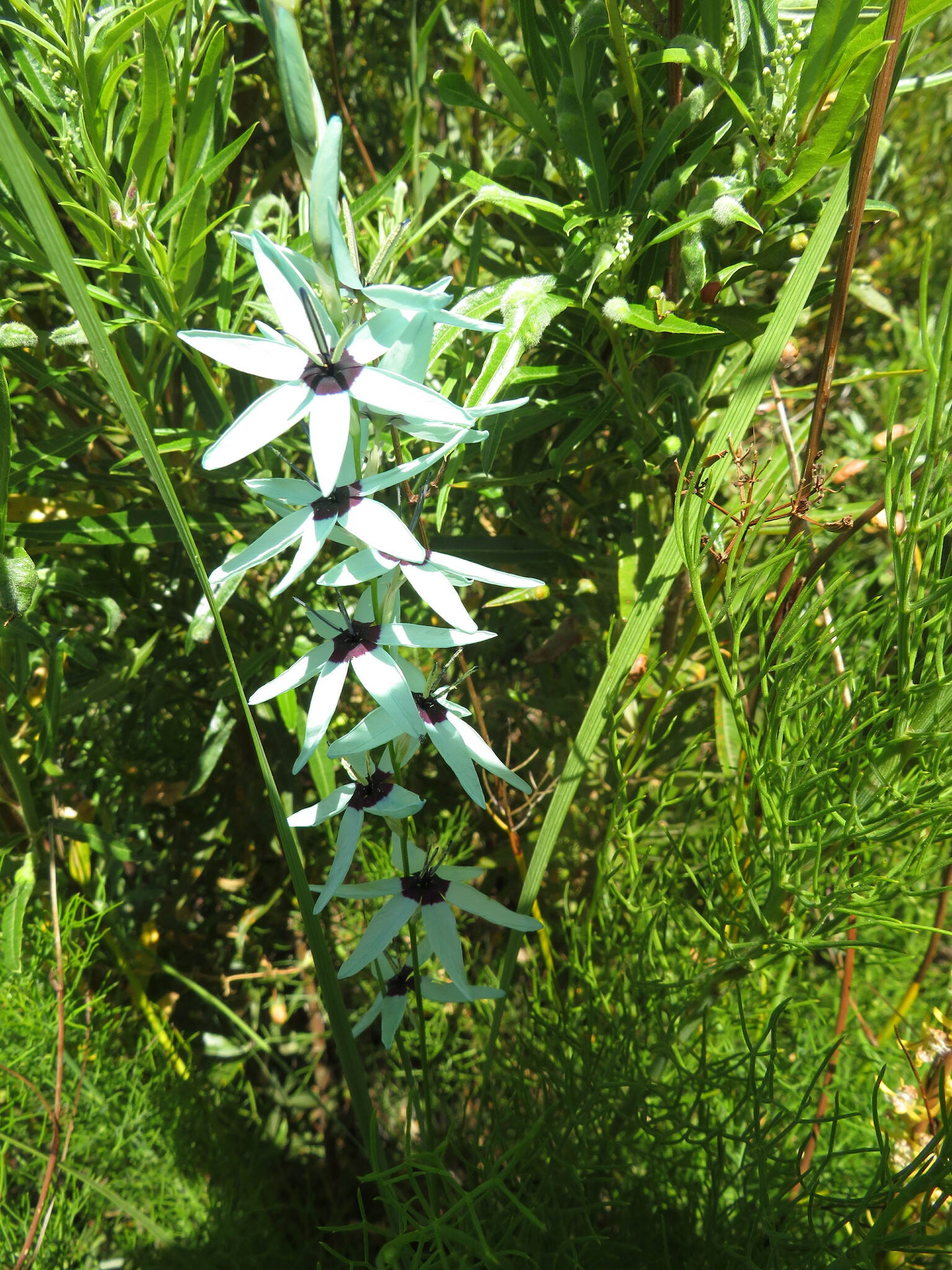
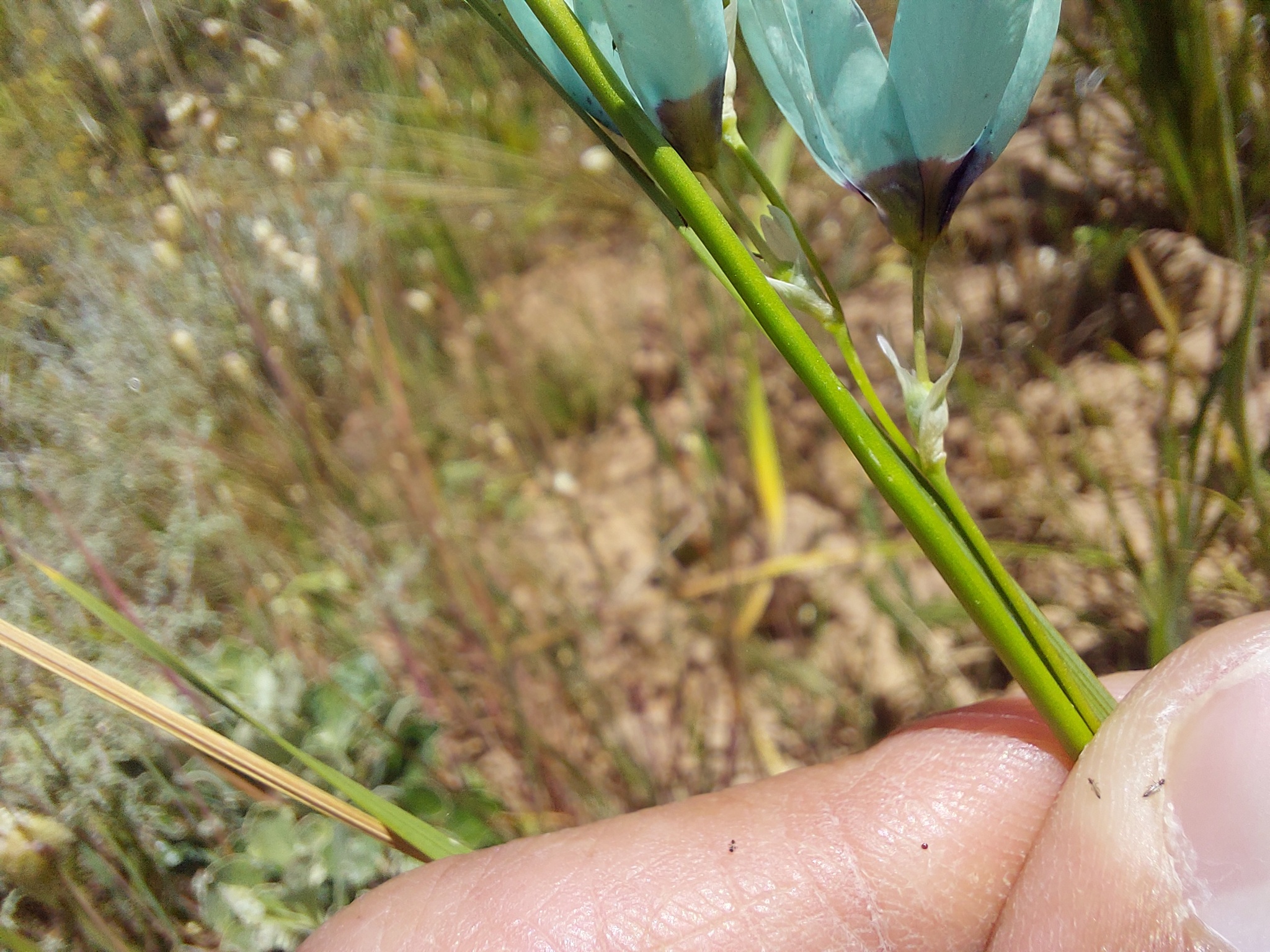
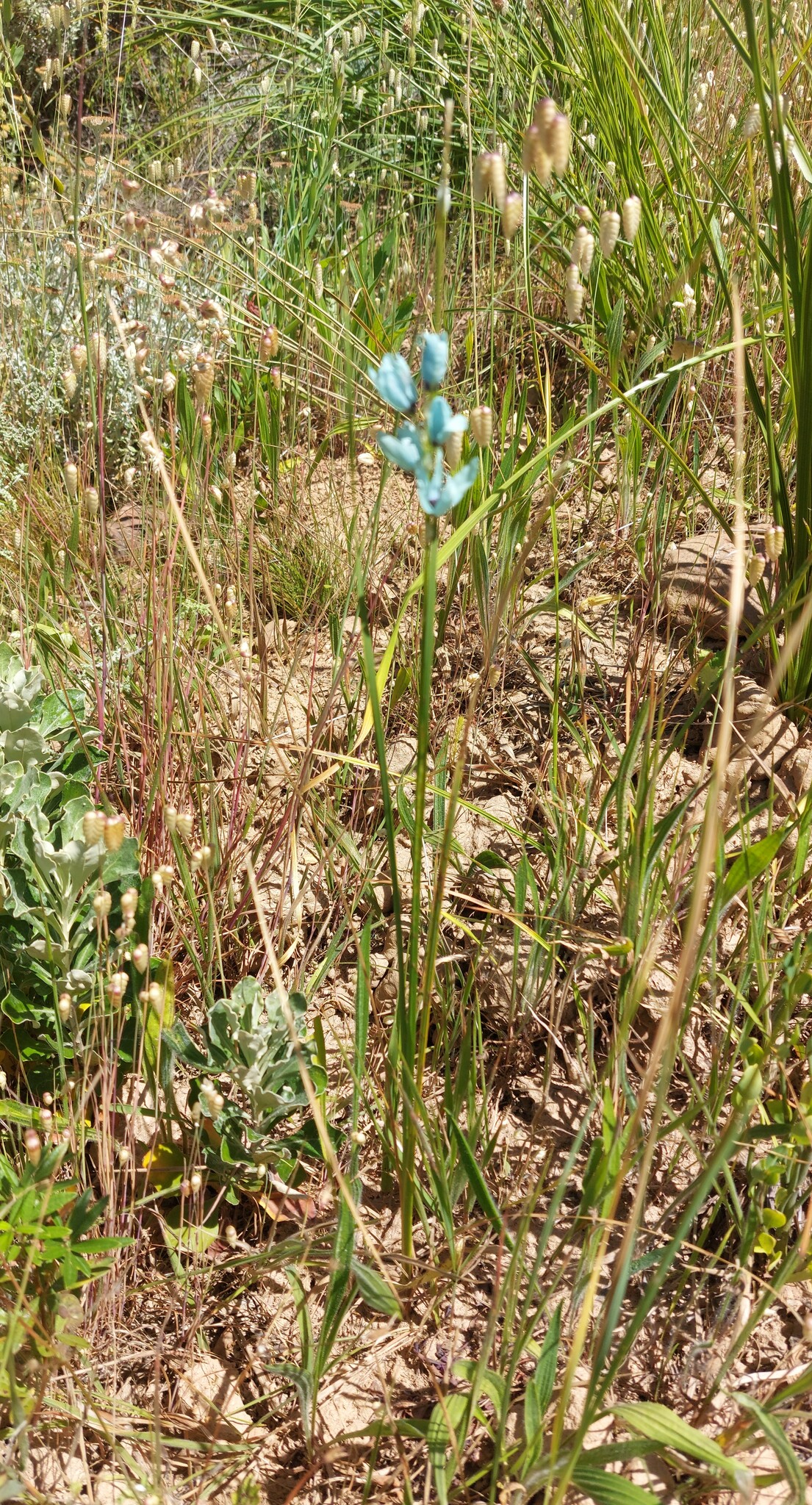
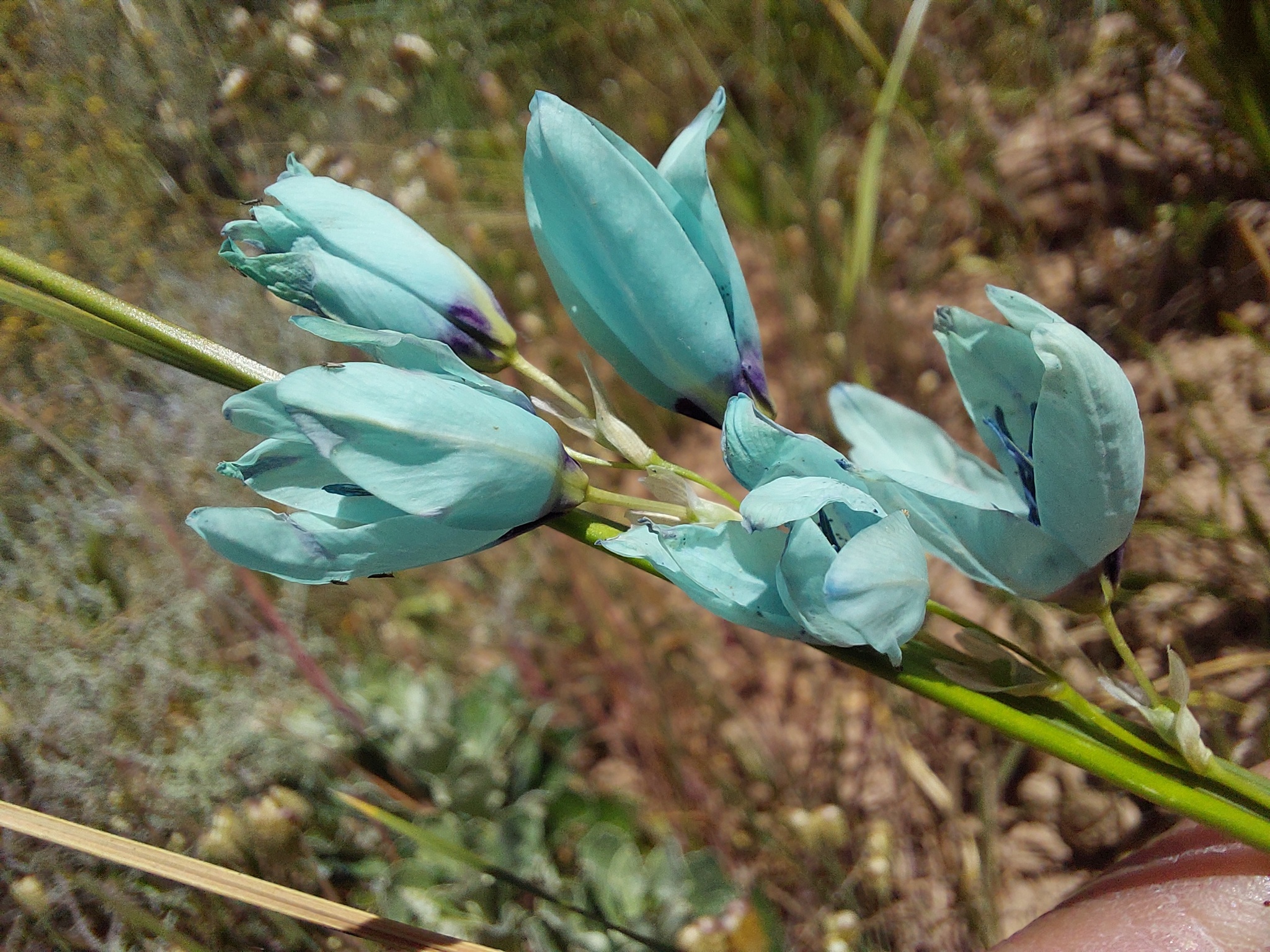
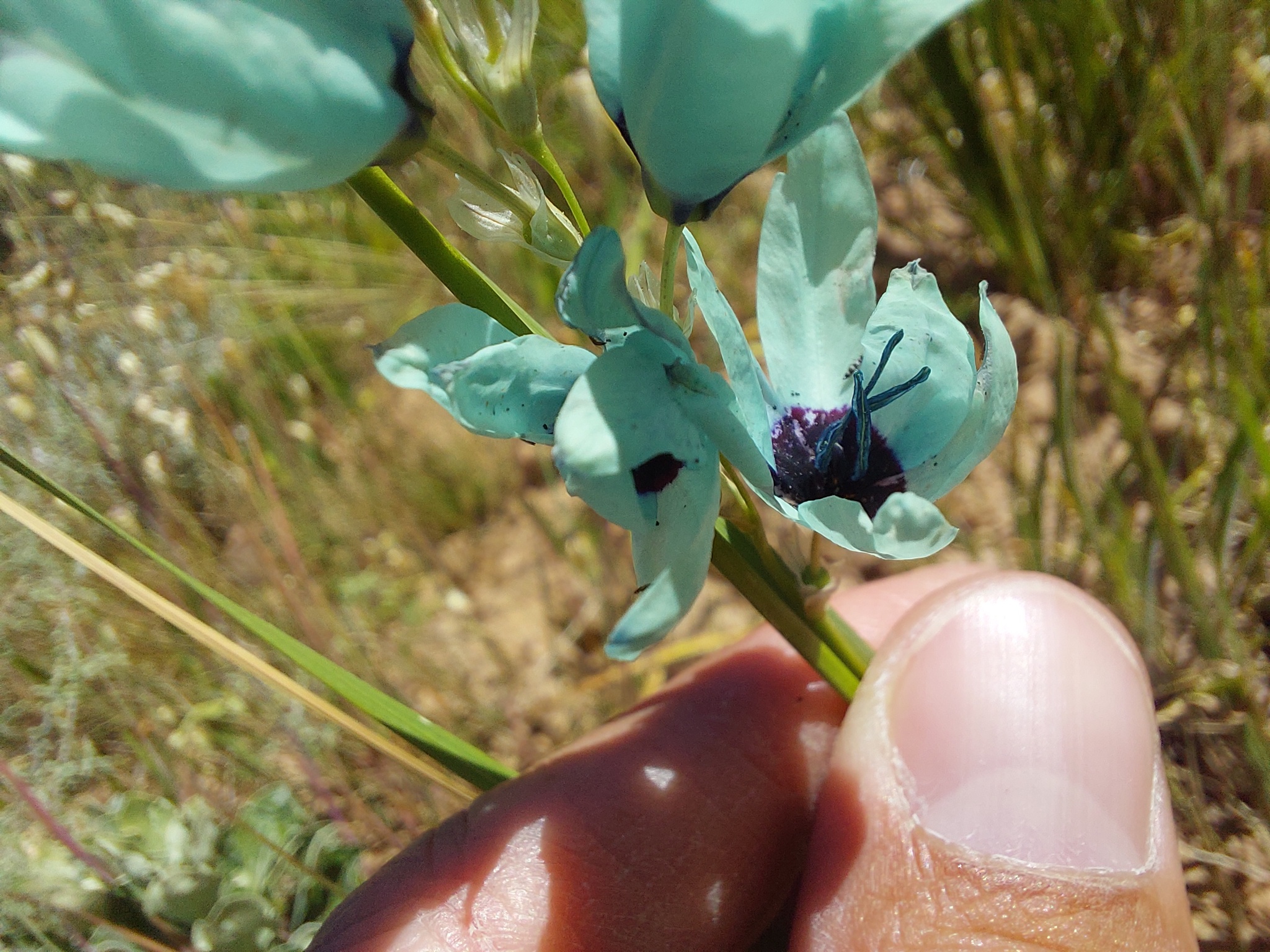
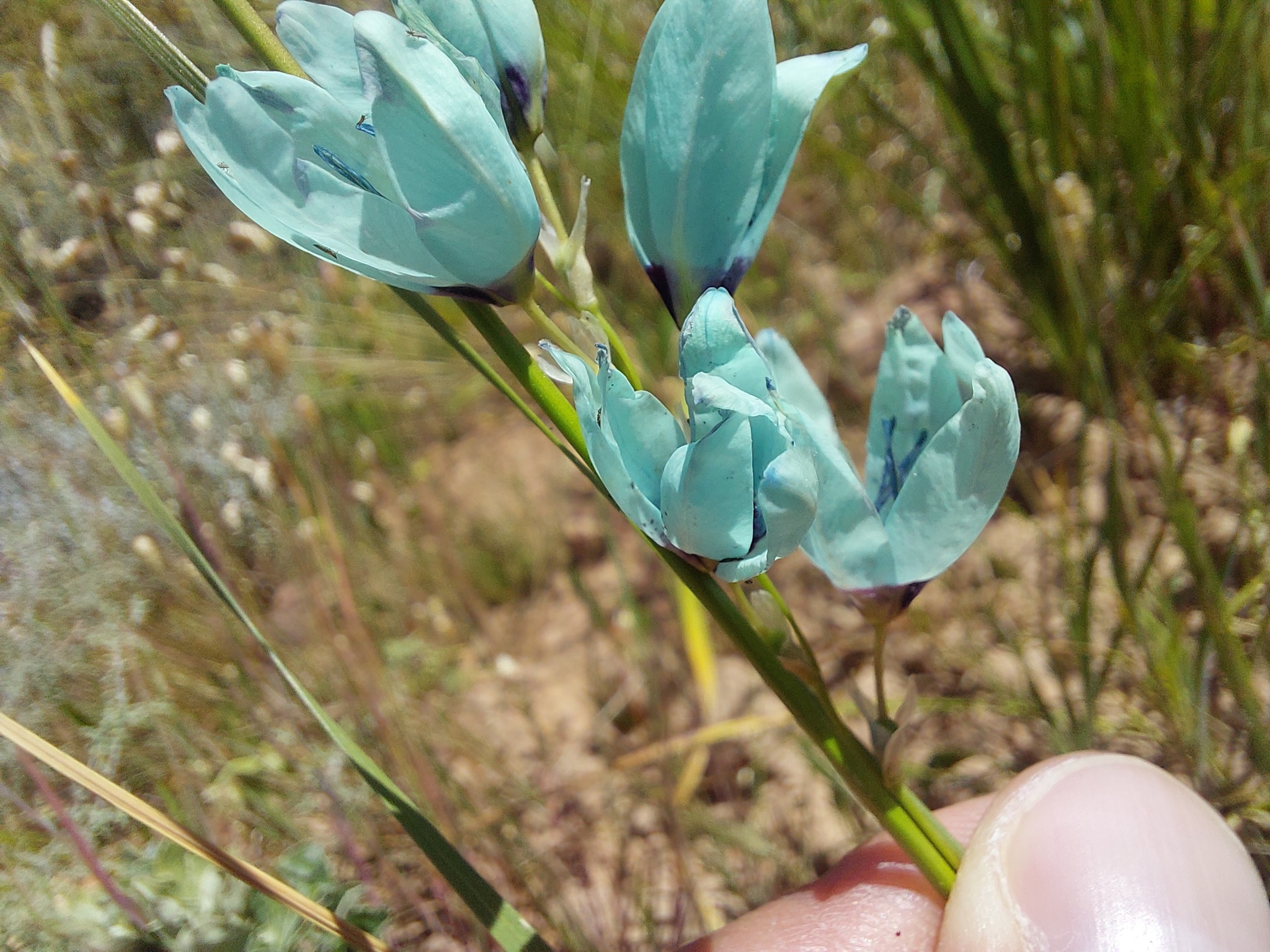
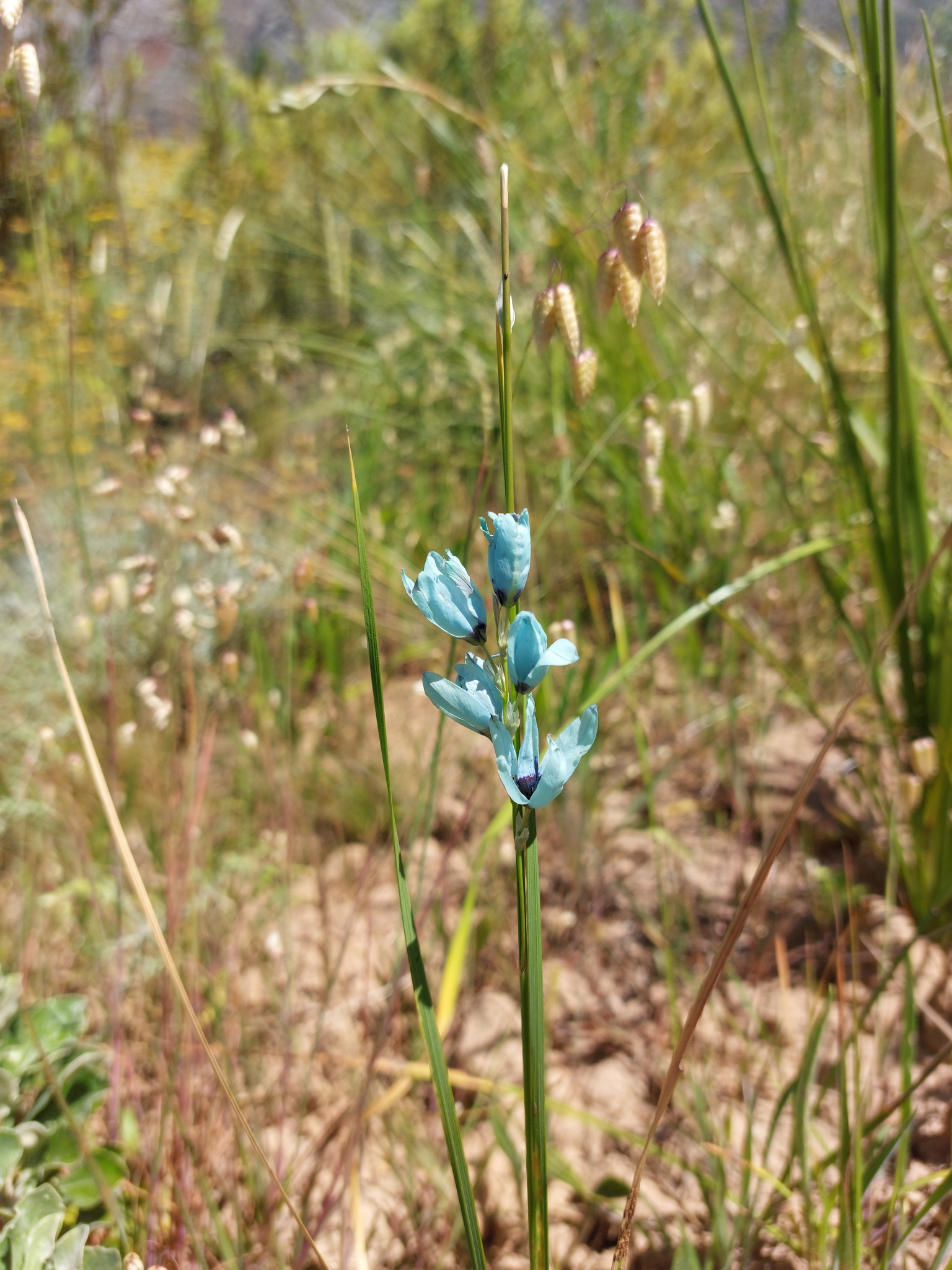
Plants 500-950 mm high. Corm ± globose, 10-18 mm diam.; tunics of fine, pale, netted dark fibres. Stem usually with 1 or 2 short, erect branches held close to main stem. Leaves 5 to 7, ± linear, leathery, reaching to between middle of stem and nearly to base of spike, 2-7 mm wide, firm, with 3 or 4 prominent veins. Spike laxly 10- to many-flowered; bracts ± dry, straw-coloured, outer 8-10 mm long, with 1 prominent vein, mostly 1-toothed, inner slightly shorter than outer, 2-veined, 2-toothed. Flowers half nodding, salver-shaped, green, blue-green or grey-blue, usually with prominent, dark purple or reddish to ± black centre (rarely whitish in centre); perianth tube filiform, 6-9 mm long; tepals subequal, ± elliptic, spreading, connate in lower ± 1 mm, (10-)16-25 x (4-)7-11 mm. Filaments (2-)3-4 mm long, parallel, purple (rarely whitish); anthers suberect, (5-)9-13 mm long; pollen yellow. Style dividing opposite base (rarely middle) of filaments, purple (rarely whitish), branches falcate, ± 3 mm long. From: Goldblatt, P; Manning, JC. 2020. Iridaceae of southern Africa. Strelitzia 42: 1-1159. South African National Biodiversity Institute, Pretoria. [CC BY]
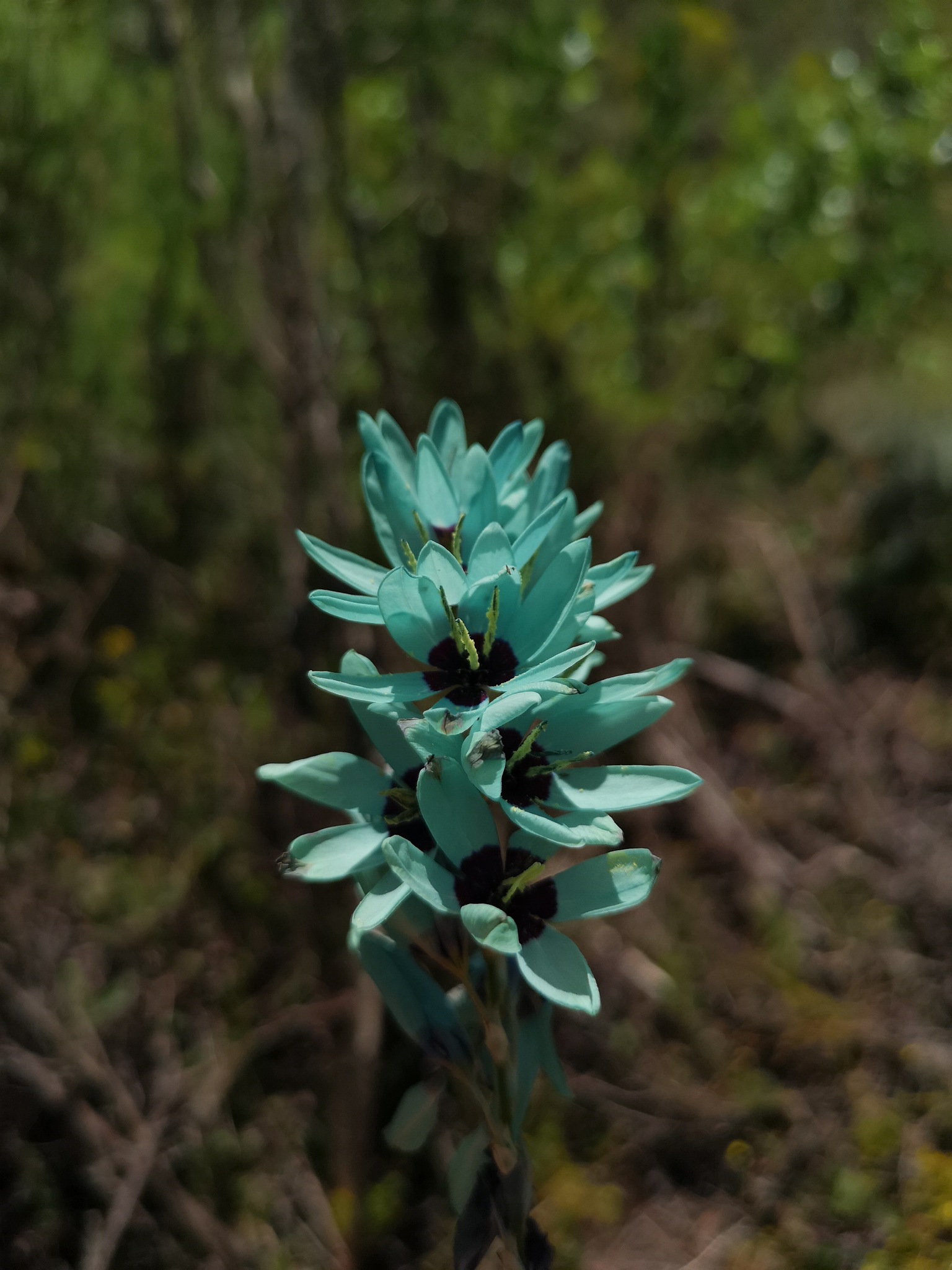
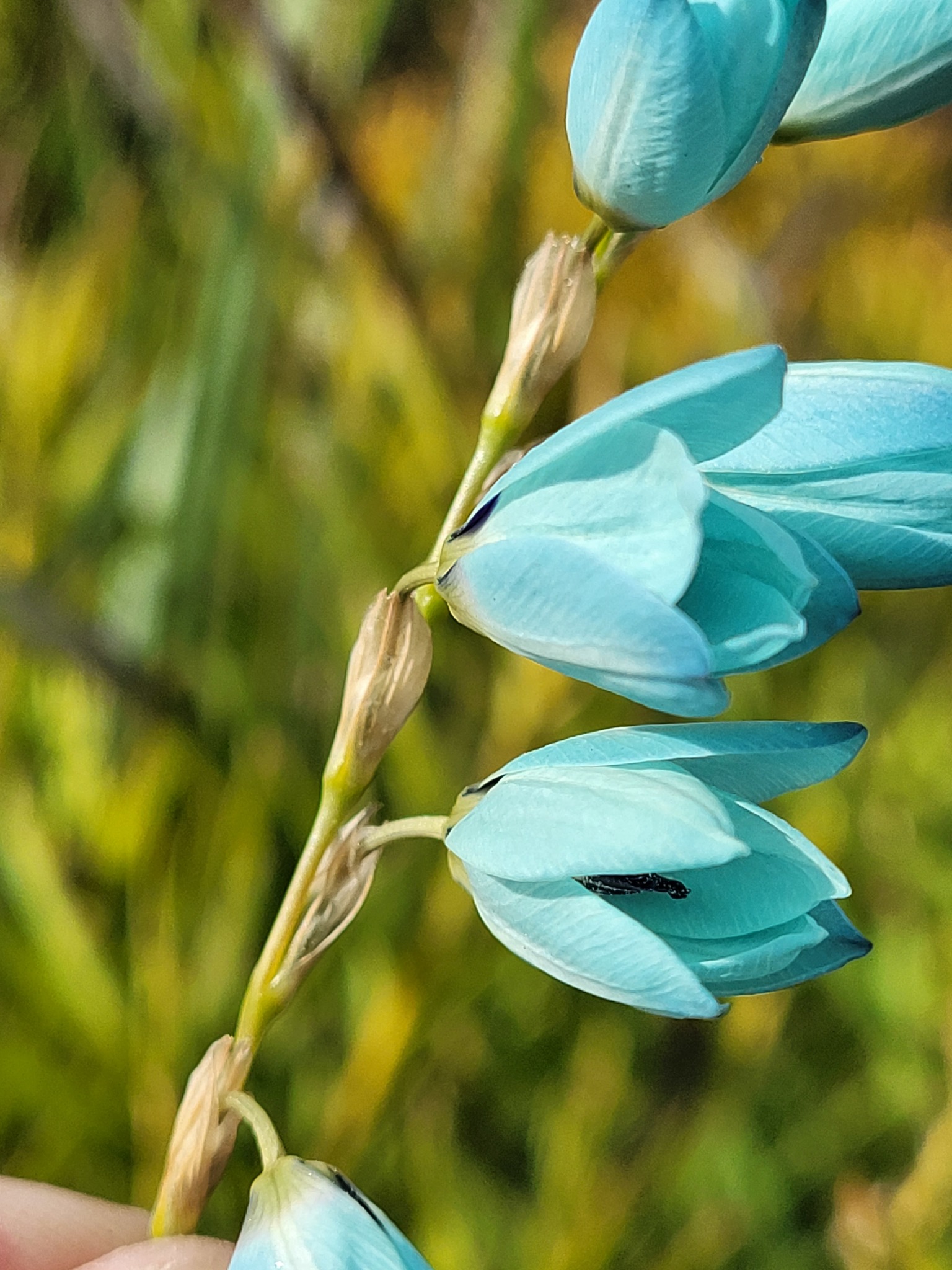
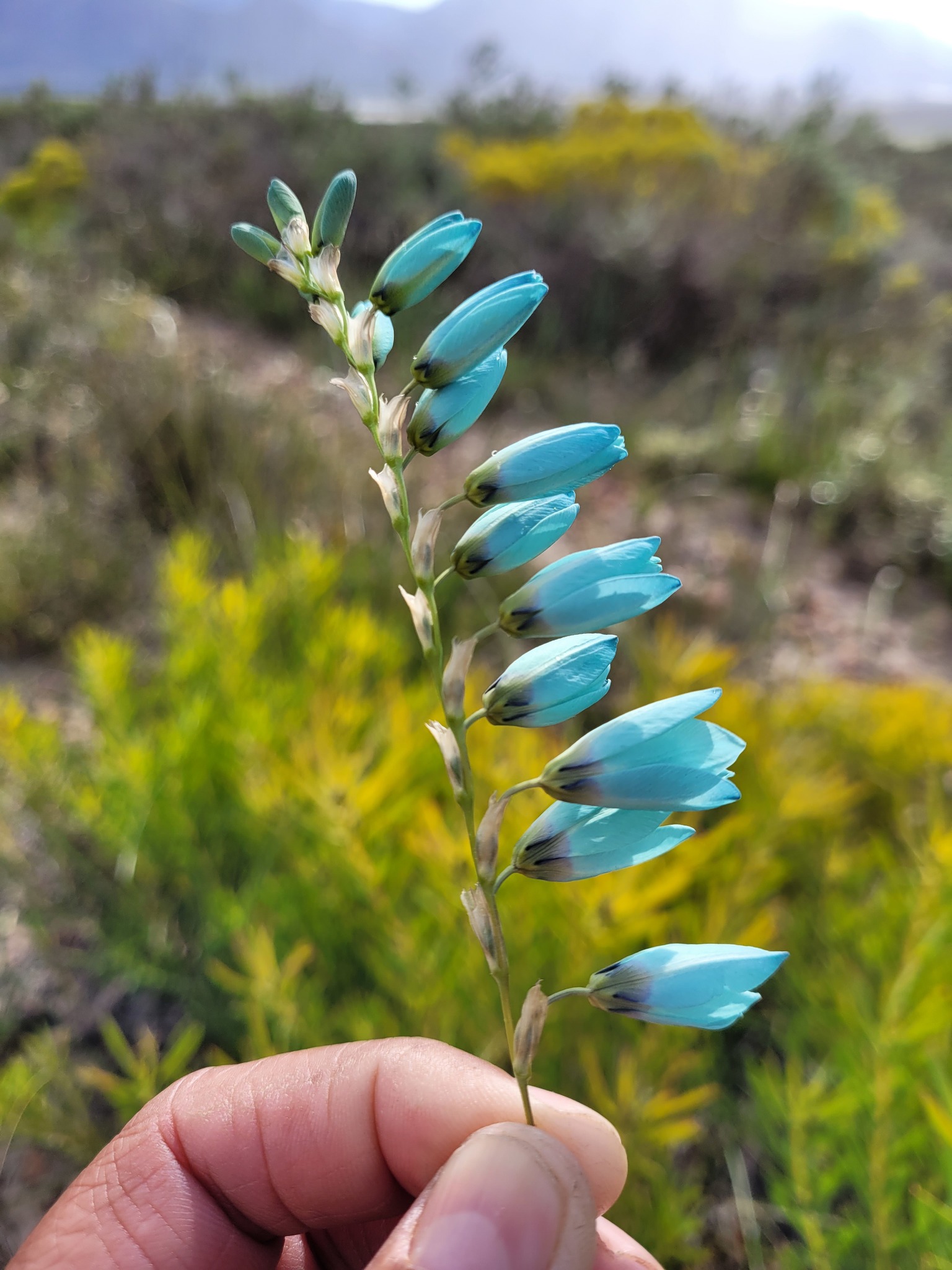
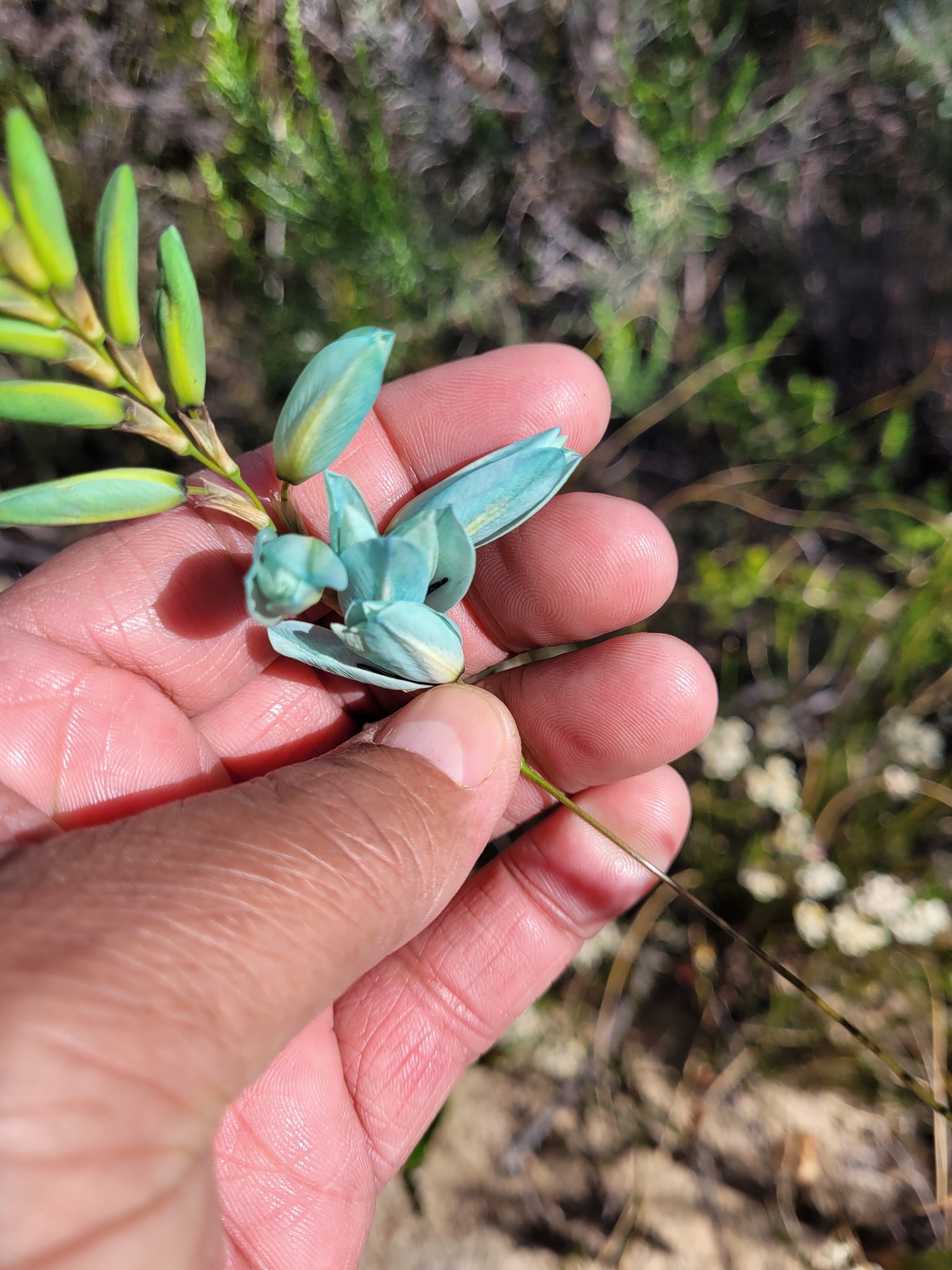
With its extraordinary green to turquoise, or sometimes grey-blue flowers, almost black in the center, Ixia viridiflora is unmistakeable. Added to the unique flower color is the elongate spike with several large blooms open at the same time and spaced well apart from one another. The particularly long, suberect anthers, mostly 10-13 mm long but occasionally only 5-7 mm long, a style dividing at or shortly above the bases of the filaments, and dark-colored style branches are other important diagnostic features. The elongate spike is unique in the genus. From: Goldblatt, P; Manning, JC. 2016. Systematics of the southern African genus Ixia (Iridaceae): 5. Synopsis of section Ixia, including five new species. S. African J. Bot. 104: 175-198. [http://dx.doi.org/10.1016/j.sajb.2015.11.011] [Copyright held by the South African Association of Botanists (2016); http://www.sciencedirect.com/science/journal/02546299] [CC BY]
Cormous geophyte, 50-100 cm, stem with several, short, few-flowered branches. Leaves narrow. Flowers in elongate, lax spikes, green to pale blue with dark purple-black centre, tube filiform. From: Manning, JC; Goldblatt, P. 2012. Iridaceae. In: J Manning & P Goldblatt (eds), Plants of the Greater Cape Floristic Region 1: The Core Cape flora. Strelitzia 29: 119-176. South African National Biodiversity Institute, Pretoria. [CC BY]
This lovely plant, with its extraordinary green to turquoise, or sometimes grey-blue flowers usually with maroon to almost black centre, is unmistakeable. Added to the unique flower colour is an elongate spike with large blooms open at the same time and spaced well apart from one another. The particularly long anthers are mostly 9-13 mm long (occasionally only 5-7 mm long) and always suberect and the style divides at or shortly above the bases of the free filaments. The elongate spike is unique in the genus Small-flowered populations with a pale centre, including the anthers, are recorded from Romans River Farm and from Weltevrede Farm near Botha, along with typical large-flowered, dark-centred populations. These anomalous populations may represent pollination ecotypes. From: Goldblatt, P; Manning, JC. 2020. Iridaceae of southern Africa. Strelitzia 42: 1-1159. South African National Biodiversity Institute, Pretoria. [CC BY]
Loamy clay and gravel. From: Goldblatt, P; Manning, JC. 2020. Iridaceae of southern Africa. Strelitzia 42: 1-1159. South African National Biodiversity Institute, Pretoria. [CC BY]
Rocky, mostly clay slopes. From: Manning, JC; Goldblatt, P. 2012. Iridaceae. In: J Manning & P Goldblatt (eds), Plants of the Greater Cape Floristic Region 1: The Core Cape flora. Strelitzia 29: 119-176. South African National Biodiversity Institute, Pretoria. [CC BY]
A rare, relatively narrow endemic of Western Cape, South Africa, extending from near Porterville and the upper Tulbagh Valley south to the southern end of the Paardeberg. From: Goldblatt, P; Manning, JC. 2020. Iridaceae of southern Africa. Strelitzia 42: 1-1159. South African National Biodiversity Institute, Pretoria. [CC BY]
A rare, relatively narrow endemic, Ixia viridiflora has long been believed to be restricted to lower mountain slopes in the Tulbagh Valley and nearby, extending from near Tulbagh to Romans River. There are however, reliable records from near Porterville, some distance to the north (Roux s.n. BOL) and from Slent Farm at the southern end of the Paardeberg (Cowell, Stoll & Tyambetyu MSBP4141 NBG), expanding the range significantly. From: Goldblatt, P; Manning, JC. 2016. Systematics of the southern African genus Ixia (Iridaceae): 5. Synopsis of section Ixia, including five new species. S. African J. Bot. 104: 175-198. [http://dx.doi.org/10.1016/j.sajb.2015.11.011] [Copyright held by the South African Association of Botanists (2016); http://www.sciencedirect.com/science/journal/02546299] [CC BY]
Tulbagh to Wolseley. From: Manning, JC; Goldblatt, P. 2012. Iridaceae. In: J Manning & P Goldblatt (eds), Plants of the Greater Cape Floristic Region 1: The Core Cape flora. Strelitzia 29: 119-176. South African National Biodiversity Institute, Pretoria. [CC BY]
September to October
This map contains point-based occurrences at different locations
Occurrence in the Flora of Southern Africa (FSA) countries and South African provinces. Residence status indicates if a taxon is indigenous, endemic, naturalised or invasive in a specific region. This data is based on specimen records and literature
FSA
SA
BOT
NAM
ESW
LES
WC
EC
NC
FS
GA
KZN
LP
MP
NW
Absent
Indigenous
Endemic
Naturalised
Invasive
Names and Sources
Published in: Encycl. [J. Lamarck & al.] 3(1): 340 (1789)
Type: South Africa, without precise locality or collector (P: Herb. Lamarck, holo.)
Ixia spectabilis Salisb.
Published in: Prodr. Stirp. Chap. Allerton: 35 (1796)
Type: unknown
Ixia maculata L. var. viridis Jacq., nom.nud.
Published in: Pl. Hort. Schoenbr. 1: t. 23 (1797)
Ixia spicata Burm.f. var. viridinigra Andrews
Published in: Bot. Repos. 1: t. 29 (1798)
Type: South Africa, without precise locality or collector, illustration in Bot. Repos. 1: t 29 (1798)
Ixia maculata L. var. viridis Ker Gawl.
Published in: Curtis's Bot. Mag. 16: t. 549 (1802)
Type: South Africa, without precise locality or collector, illustration in Curtis's Bot. Mag. 16: t. 549 (1802)
Ixia maculata L. var. amethystina Ker Gawl.
Published in: Curtis's Bot. Mag. 18: t. 789 (1804)
Type: South Africa, without precise locality or collector, illustration in Curtis's Bot. Mag. 18: t. 789 (1804)
Ixia viridis Thunb.
Published in: Fl. Cap. 1: 242 (1811)
Type: South Africa, Western Cape, ‘Roode Sand,’ Thunberg s.n. (S, UPS, syn.)
Ixia pulchra Salisb., nom.nov. pro I. maculata var. viridis Ker Gawl. (1802)
Published in: Trans. Hort. Soc. London 1: 320 (1812)
Ixia cana Eckl.
Published in: Topogr. Verz. Pflanzensamml. Ecklon: 26 (1827)
Type: South Africa, without precise locality, cultivated in Cape Town, Ecklon s.n. (S, lecto.) Lectotype designated by Nordenstam, Journal of South African Botany 38: 285 (1972).
Ixia prasina Sol. ex Baker
Published in: J. Linn. Soc., Bot. 16: 92 (1877)
Ixia viridiflora Lam. var. cana (Eckl.) Baker
Published in: Handbk. Irid.: 164 (1892)
Ixia viridiflora Lam. var. minor M.P.de Vos
Published in: Fl. S. Africa 7(2:1): 45 (1999)
Type: South Africa, Western Cape Province, Wolseley, Mostertshoek, Mostert sub De Vos 2722 (NBG [as STE], holo.)
| Common name | Language | Reference/barcode | Published as |
|---|---|---|---|
| groenkalossie | Afrikaans | Manning, JC; Goldblatt, P. 2012. Iridaceae. In: J Manning & P Goldblatt (eds), Plants of the Greater Cape Floristic Region 1: The Core Cape flora. Strelitzia 29: 119-176. South African National Biodiversity Institute, Pretoria. |
Classification
KINGDOM Plantae
SUBKINGDOM Phanerogamae
PHYLUM Anthophyta
ORDER Asparagales
FAMILY Iridaceae
SUBFAMILY Crocoideae
TRIBE Ixieae
GENUS Ixia
SPECIES viridiflora
21 results for Ixia viridiflora Lam.
Barcode: PRE0061216-0 Collector(s) & number: MacOwan, P, PRE 36360 | -10-
South Africa, Western Cape, TULBAGH
Data Resource: BODATSA View record
Barcode: NBG0178990-0 Collector(s) & number: De Vos, 2609 | 1985-9-22
South Africa, Western Cape, Romansrivier, Wolseley.
Data Resource: BODATSA View record
Barcode: PRE0061221-0 Collector(s) & number: Flanagan, HG, 2213 | 1893-9-
South Africa, Western Cape, MALMESBURY.
Data Resource: BODATSA View record
Barcode: PRE0061218-0 Collector(s) & number: Ecklon, CF, PRE 22403 | 1830-9-
South Africa, Western Cape, Clanwilliam Division; On the Olifants River and at Villa Brakfontein. [Locality is probably incorrect]
General notes: Ex Berlin Herbarium 11936. [Locality is probably incorrect]
Data Resource: BODATSA View record
Barcode: NBG0206887-0 Collector(s) & number: Snijman, DA, 2099 | 2006-9-18
South Africa, Western Cape, Near Wolseley, Farm Romans River, above farm dam below Mostertshoek Twins.
General notes: Fynbos biome. Recently burnt renosterveld. Moderate, mountain slope. Moist/damp, clay soil. Shale. Full sun. Recently burned. Geophyte. Flowers turquoise, with a dark blue centre. Localised.
Data Resource: BODATSA View record
Barcode: NBG0277489-0 Collector(s) & number: Nicholson, G, 972 | 2012-10-16
South Africa, Western Cape, Paardeberg, between Wellington & Malmesbury. Skyhouse, High slant, next to drive way. 33.61936' S; 18.82272' E.
Data Resource: BODATSA View record
Barcode: NBG0207335-0 Collector(s) & number: Manning, JC, 3053 | --
South Africa, Western Cape, Wolseley, Romansrivier Farm.
General notes: Fynbos biome. Hill slope. Moist/damp, gravel, stony soil. Shale. Full sun. Recently burned. Local in renosterveld on alluvium.
Data Resource: BODATSA View record
Barcode: NBG1481797-0 Collector(s) & number: Manning, JC, 3699 | 2018-10-13
South Africa, Western Cape, Wellington. Bo-Hermon. Bosplaas, behind farm house.
Data Resource: BODATSA View record
Barcode: NBG1540707-0 Collector(s) & number: Manning, JC, 3761 | 2019-10-11
South Africa, Western Cape, Botha. Weltevrede. Foot of Waaihoek Mountains.
Data Resource: BODATSA View record
Barcode: NBG0248468-0 Collector(s) & number: Ebrahim, I, CR2675 | 2007-10-2
South Africa, Western Cape, Romansrivier. SE of the dam, next to the farm road going up to the mountain (L.H.S). [ 32.282100 S 19.133600 E llres 50 m by collector]
General notes: Alt. 364 m. Fynbos. Renosterveld. Hill slope. Loamy, rocky soil. Sandstone. Recently burned site. Flowers creamy-white.
Data Resource: BODATSA View record
Barcode: NBG0180436-0 Collector(s) & number: De Vos, MP, 2716 | 1989-10-1
South Africa, Western Cape, Foothills. Mostertshoek near Wolseley.
Data Resource: BODATSA View record
This map contains point-based occurrences at different locations
2020
SERIES
Iridaceae of southern Africa Goldblatt, P; Manning, JCStrelitzia 42: 1-1159
South African National Biodiversity Institute, Pretoria
2016
PERIODICAL/JOURNAL
Systematics of the southern African genus Ixia (Iridaceae): 5. Synopsis of section Ixia, including five new species Goldblatt, P; Manning, JCSouth African Journal of Botany 104: 175-198
2012
SERIES CHAPTER
Iridaceae Manning, JC; Goldblatt, PIn: J Manning & P Goldblatt (eds), Plants of the Greater Cape Floristic Region 1: The Core Cape flora. Strelitzia 29: 119-176
South African National Biodiversity Institute, Pretoria
1999
1999.
BOOK
Kleurryke groenkalossies en die nut van 'n blaarkombers [Ixia viridiflora]. Van Jaarsveld, E.)Harry Molteno Library
[Cape Town] : Die Burger, 1999.
No results found for Ixia viridiflora Lam.
Status and criteria
EN
Assessor(s)
Plantae Coordinator
BOOK SECTION
Barlow, J. 1999. Trackline detection probability for long-diving whales. Edited by G. W. Garner, S. C. Amstrup, J. L. Laake, B. J. F. Manley, L. L. McDonald and D. G. Robertson. Marine mammal survey and assessment methods. Balkema Press
JOURNAL ARTICLE
Fernández, A., Edwards, J. F., Rodriguez, F., Espinosa, A., De Los Monteros, Herraez, P., Castro, P., Jaber, J. R., Martin, V. and Arebelo, M. 2005. "Gas and fat embolic syndrome" involving a mass stranding of beaked whales (family Ziphiidae) exposed to anthropogenic sonar signals. Veterinary Pathology. 42:446-457
JOURNAL ARTICLE
Gomercic, H., Gomercic, M. D., Gomericic, T., Lucic, H., Dalebout, M., Galov, A., Skrtic, D., Curkovic, S., Vukovic, S. and Huber, D. 2006. Biological aspects of Cuvier's beaked whale (<i>Ziphius cavirostris</i>) recorded in the Croatian part of the Adriatic Sea. European Journal of Wildlife Research. 52:182-187
JOURNAL ARTICLE
Waring, G. T., Hamazaki, T., Sheehan, D., Wood, G. and Baker, S. 2001. Characterization of beaked whale (Ziphiidae) and sperm whale (<i>Physeter macrocephalus</i>) summer habitat in shelf-edge and deeper waters off the northeast US. Marine Mammal Science. 17:703-717
JOURNAL ARTICLE
Scott, M. D., Hohn, A. A., Westgate, A. J., Nicolas, J. R., Whitaker, B. R. and Campbell, W. B. 2001. A note on the release and tracking of a rehabilitated pygmy sperm whale (<i>Kogia breviceps</i>). Journal of Cetacean Research and Management. 3:87-94
JOURNAL ARTICLE
Barlow, J. 2003. Preliminary estimates of the abundance of cetaceans along the U.S. west coast: 1991-2001. Southwest Fisheries Center Administrative Report. LJ-03-03:31 pp.
JOURNAL ARTICLE
Ferguson, M. C. and Barlow, J. 2001. Spatial distribution and density of cetaceans in the eastern Pacific Ocean based on summer/fall research vessel surveys in 1986-96. Southwest Fisheries Science Center Adminstrative Report. LJ-01-04:61 pp.
JOURNAL ARTICLE
Heyning, J. E. and Mead, J. G. 1996. Suction feeding in beaked whales: morphological and observational evidence. Natural History Museum of Los Angeles County, Contributions in Science. 464:12
JOURNAL ARTICLE
Barlow, J. 2006. Cetacean abundance in Hawaiian waters estimated from a summer/fall survey in 2002. Marine Mammal Science. 22:446-464
JOURNAL ARTICLE
Sibert, J., Hampton, J., Kleiber, P. and Maunder, M. 2006. Biomass, size, and trophic status of top predators in the Pacific Ocean. Science. 314:1773-1776
JOURNAL ARTICLE
Baum, J. K., Myers, R. A., Kehler, D. G., Word, B., Harley, S. J. and Doherty, P. A. 2003. Collapse and conservation of shark populations in the Northwest Atlantic. Science. 299:389-392
JOURNAL ARTICLE
Wade, P.R. and Gerrodette, T. 1993. Estimates of cetacean abundance and distribution in the eastern tropical Pacific. Reports of the International Whaling Commission. 43:477-493
JOURNAL ARTICLE
Julian, F. and Beeson, M. 1998. Estimates of marine mammal, turtle, and seabird mortality for two California gillnet fisheries: 1990-95. Fishery Bulletin. 96:271-284
BOOK SECTION
Heyning, J. E. 2002. Cuvier's beaked whale <i>Ziphius cavirostris</i>. Edited by W. F. Perrin, B. Wursig and J. G. M. Thewissen. Encyclopedia of Marine Mammals. Academic Press
| Part(s) of plant used | Use(s) | Reference |
|---|
Coming soon...