
PLANTAE / PHANEROGAMAE / ANTHOPHYTA / ASPARAGALES / IRIDACEAE / CROCOIDEAE / IXIEAE / BABIANA / LOBATA

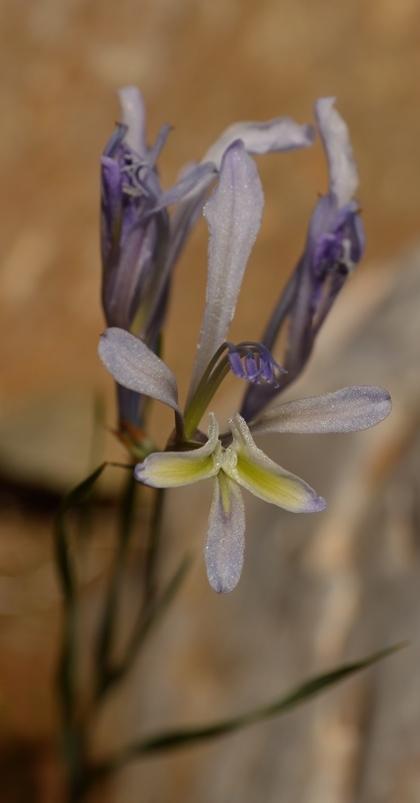
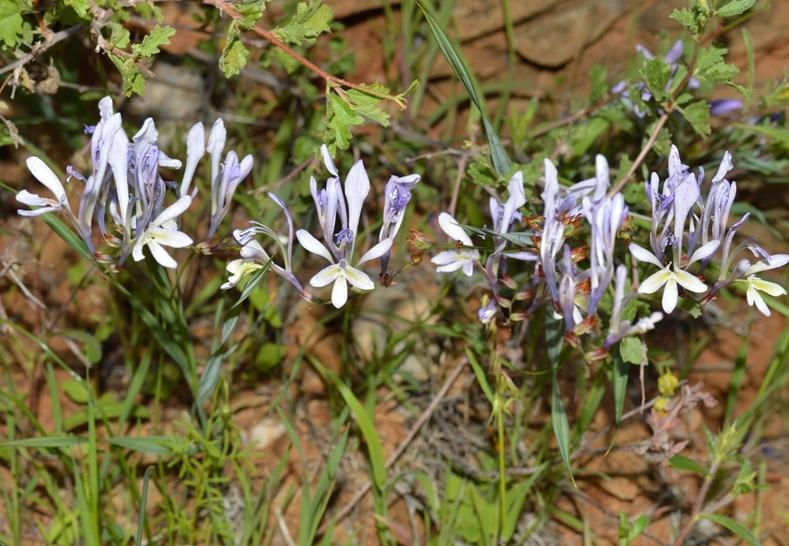
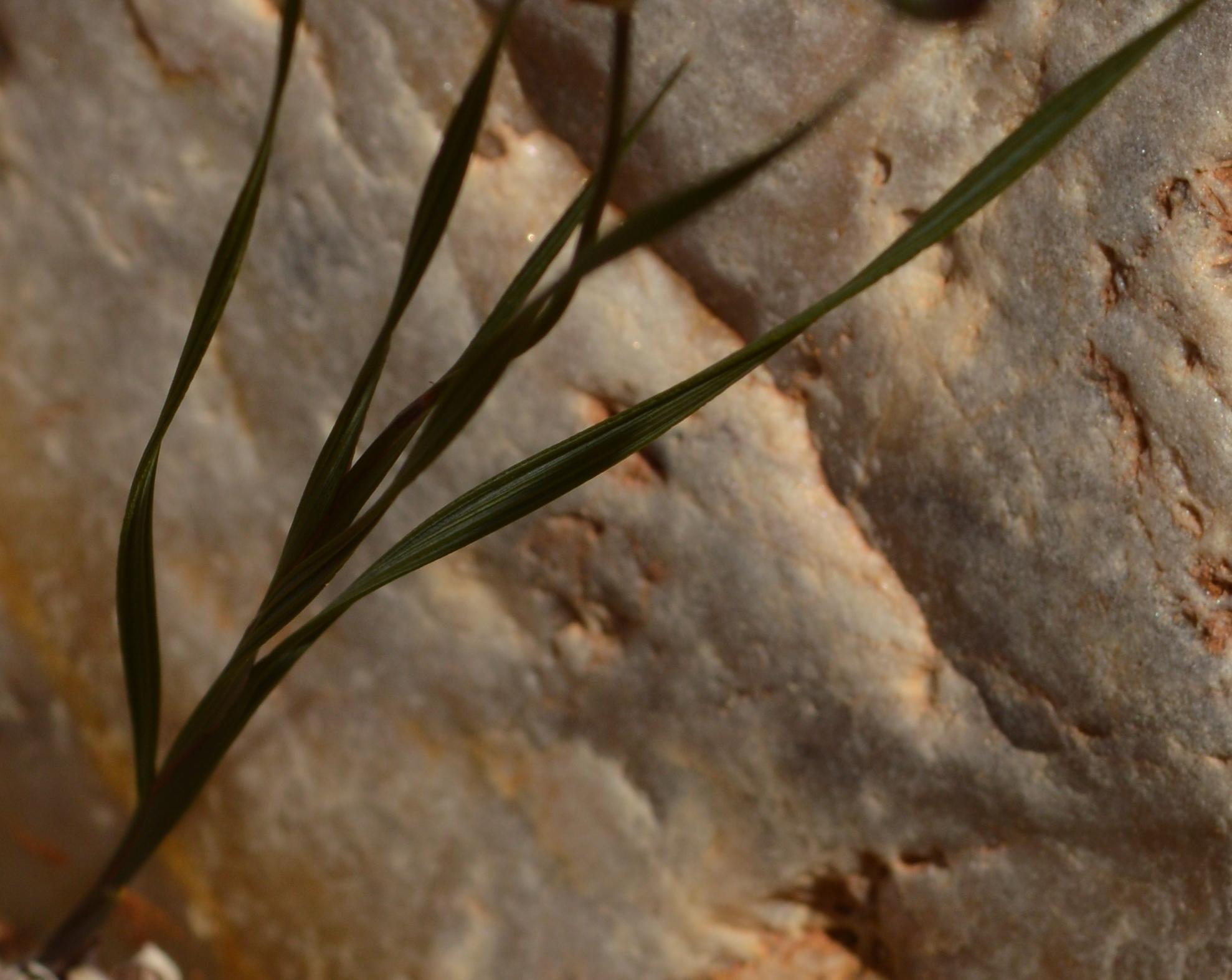
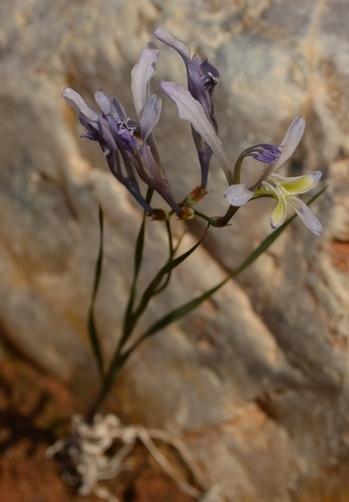
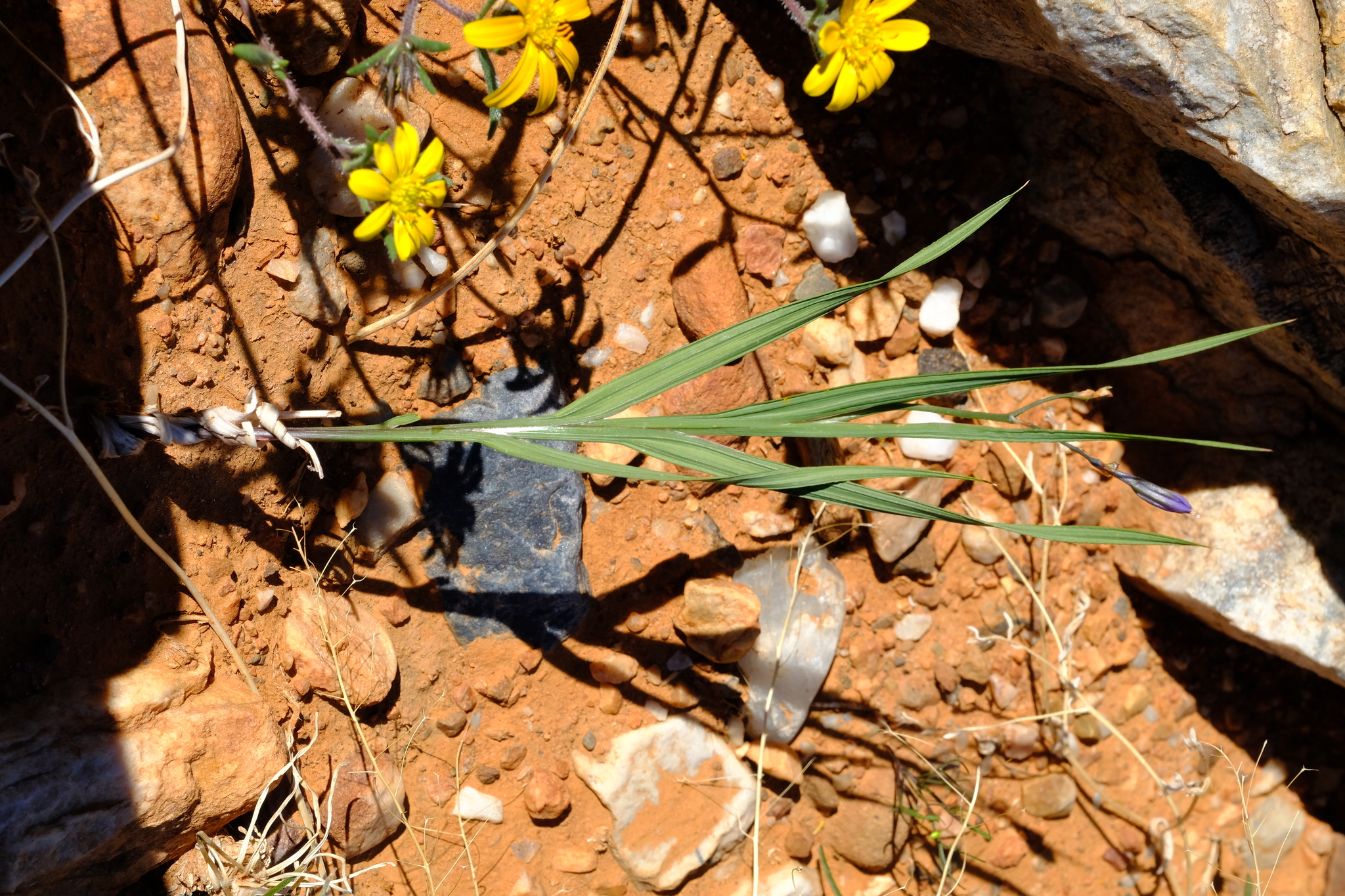
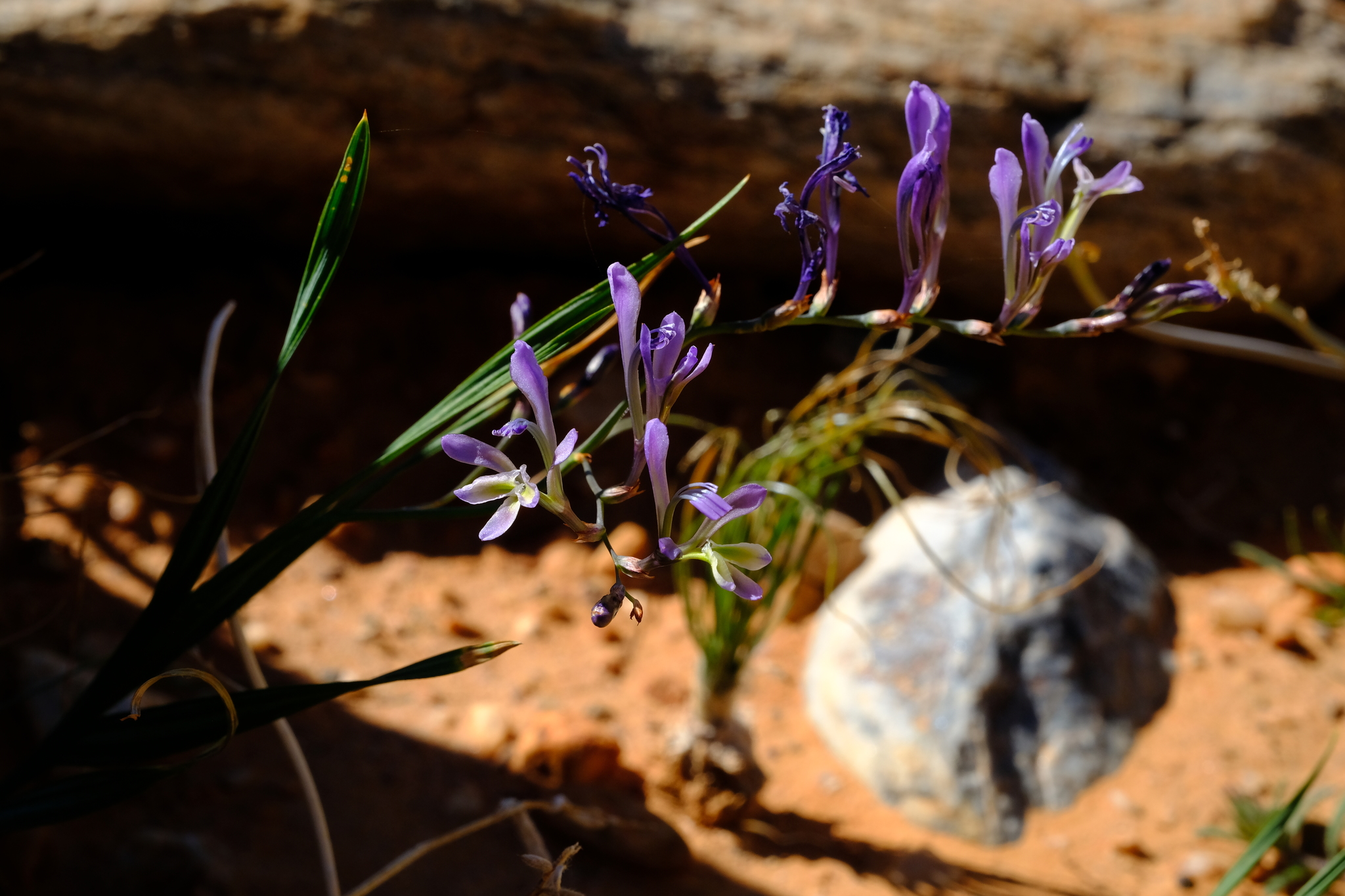
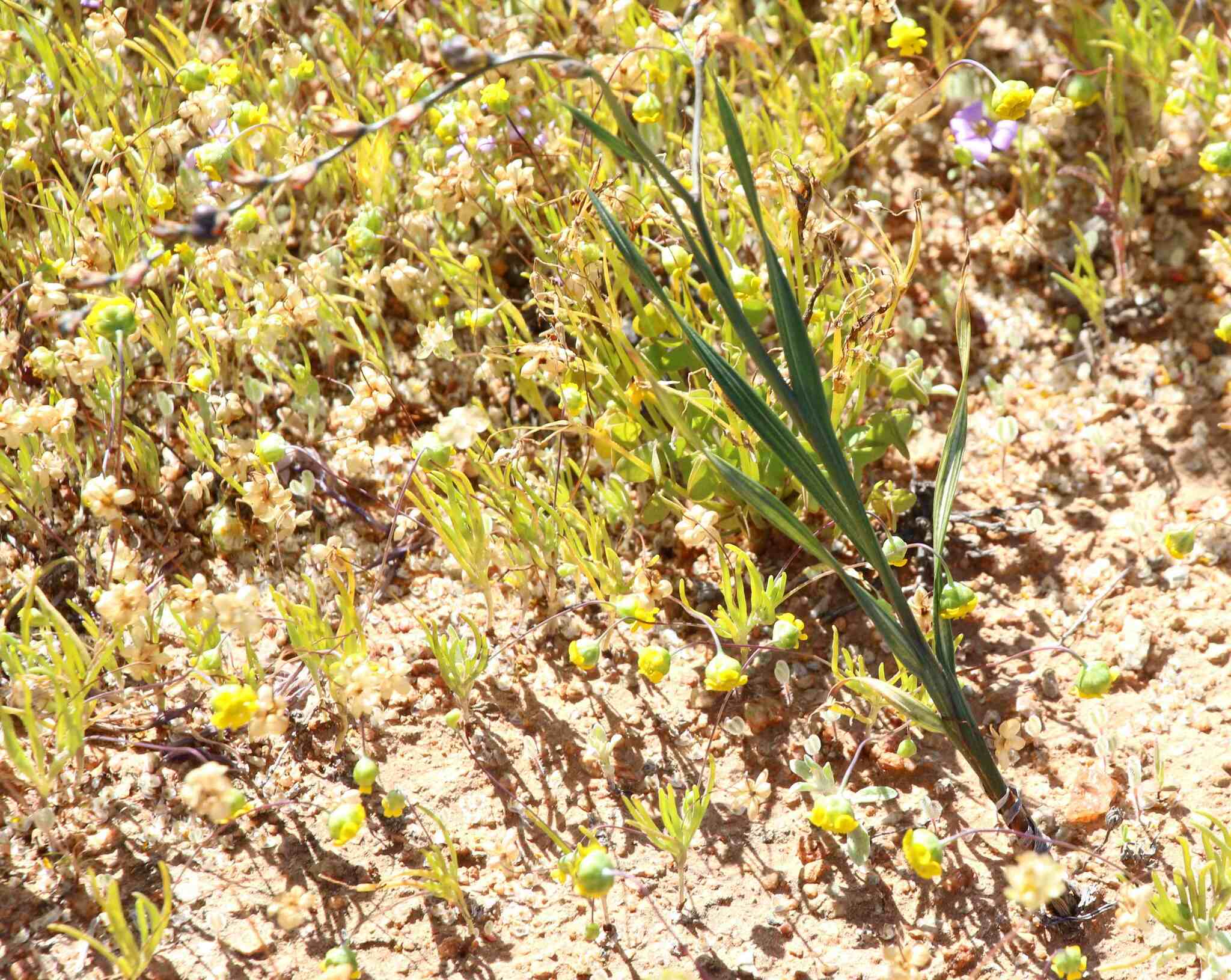
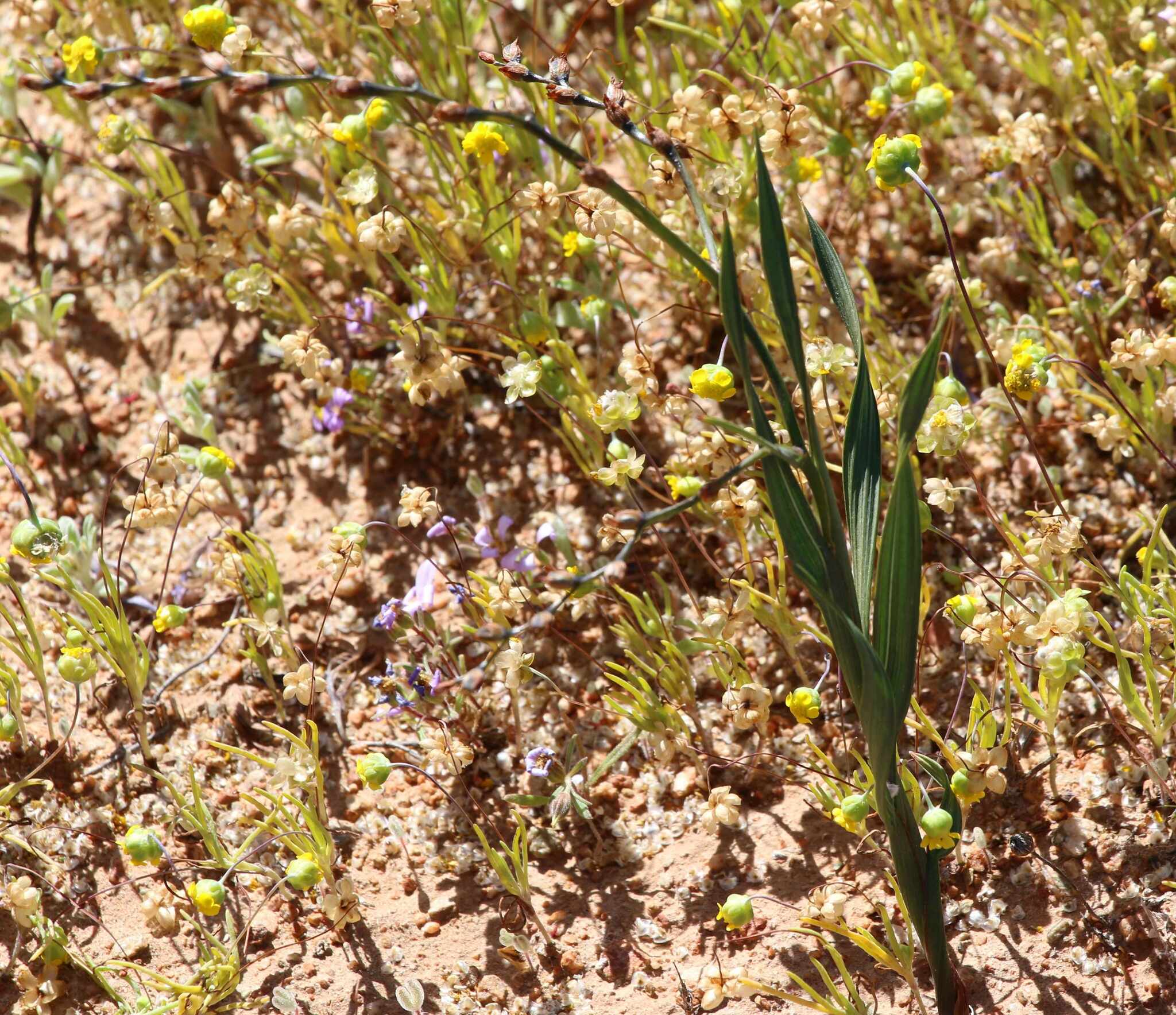
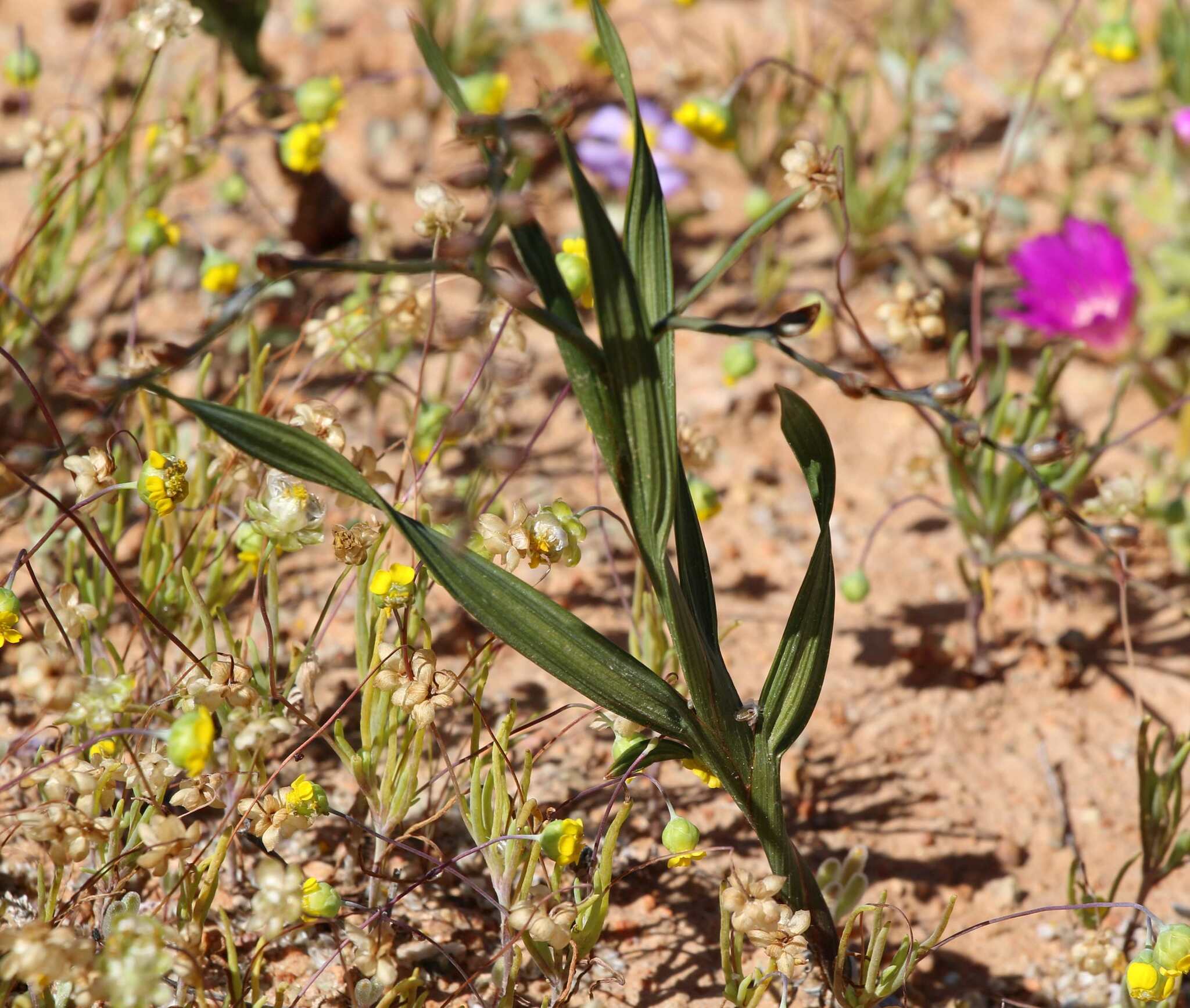
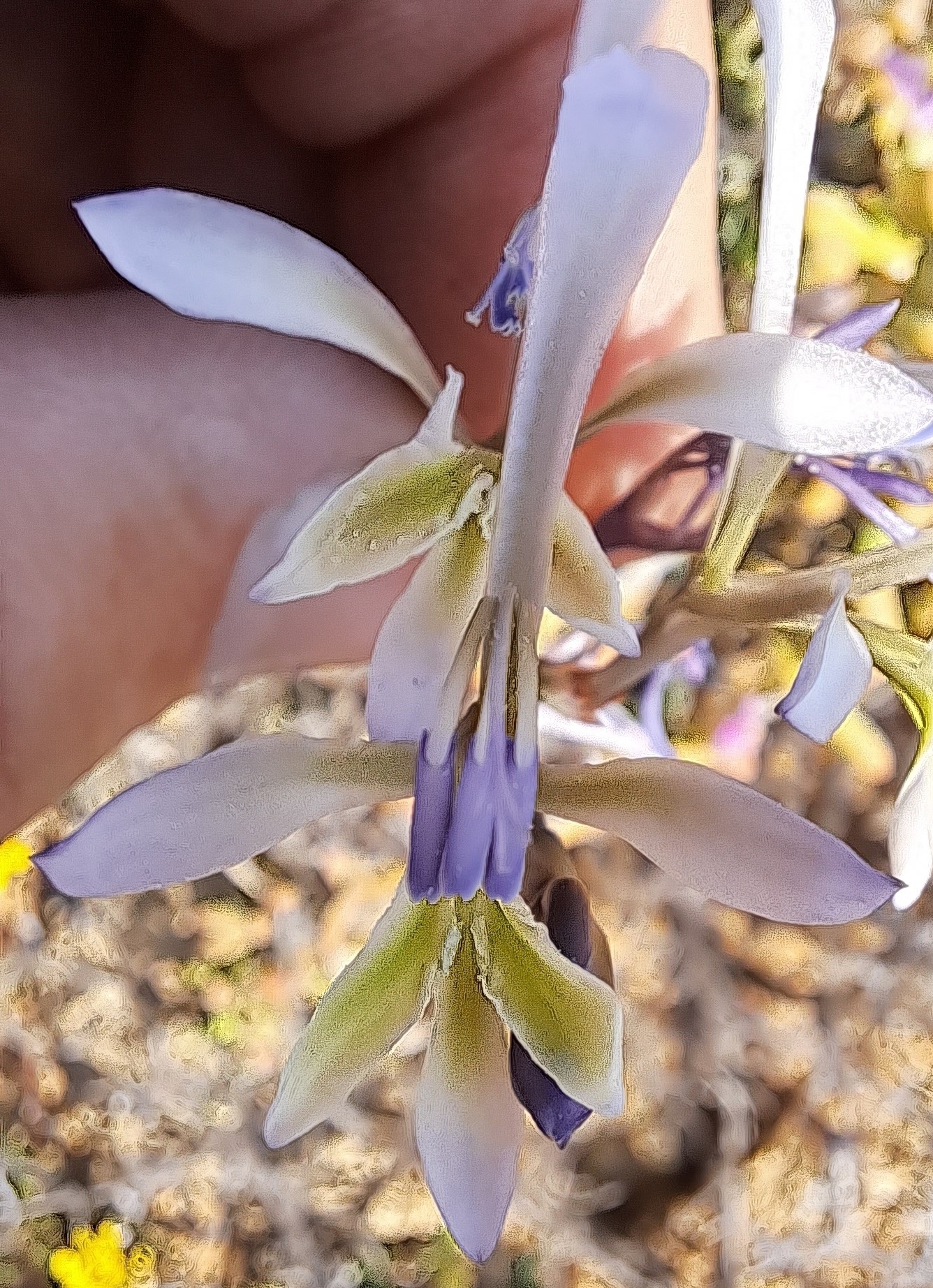
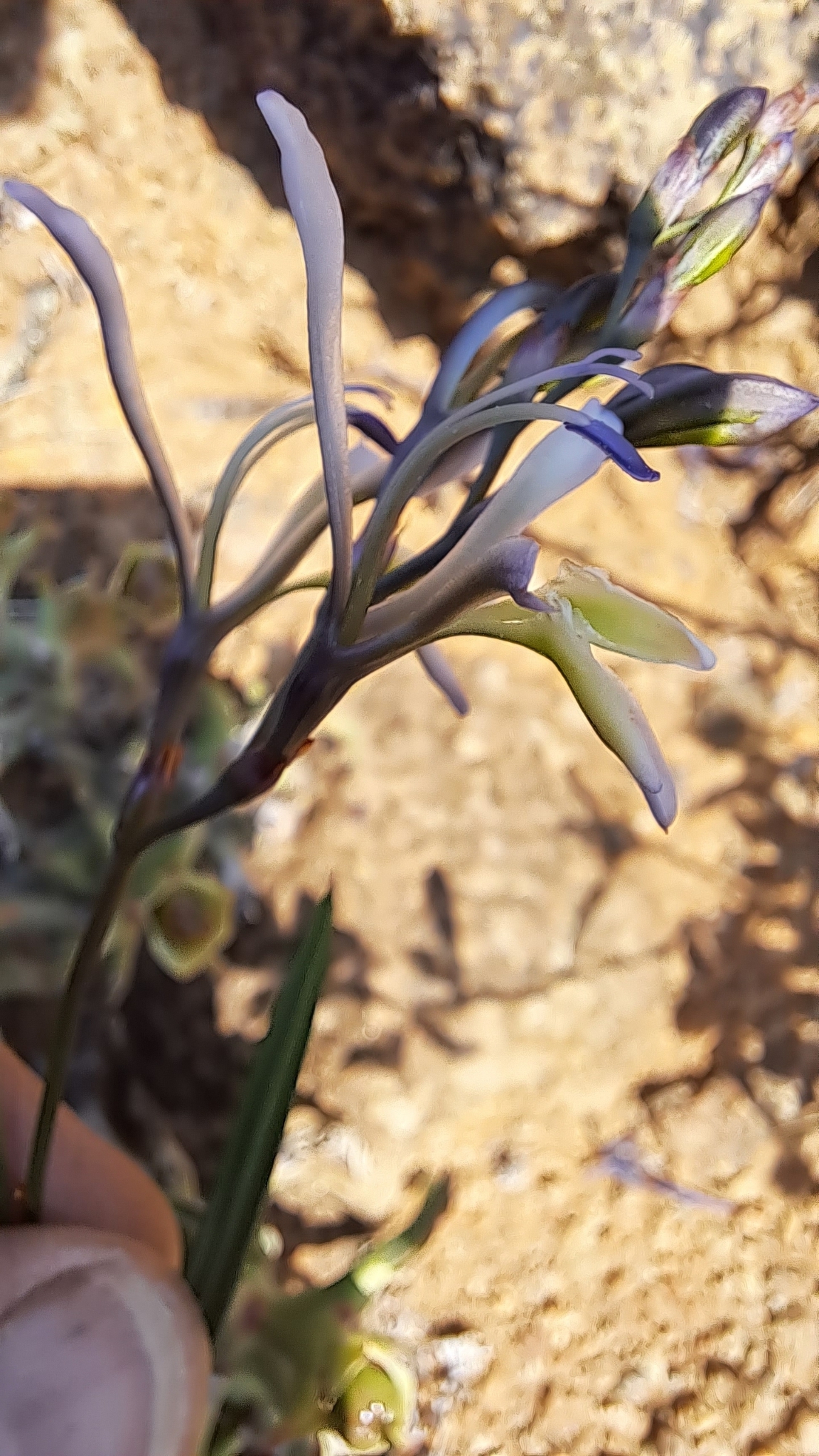
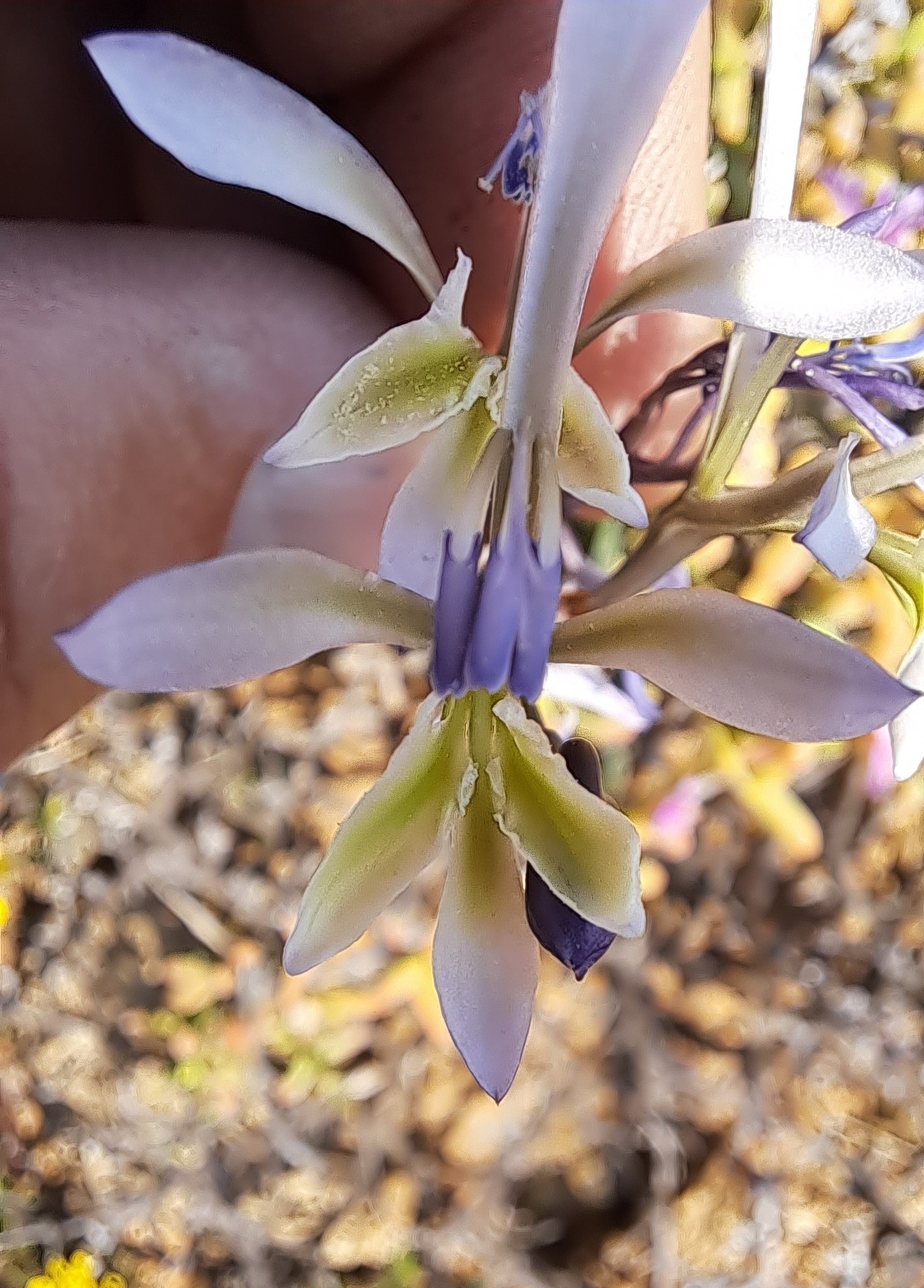
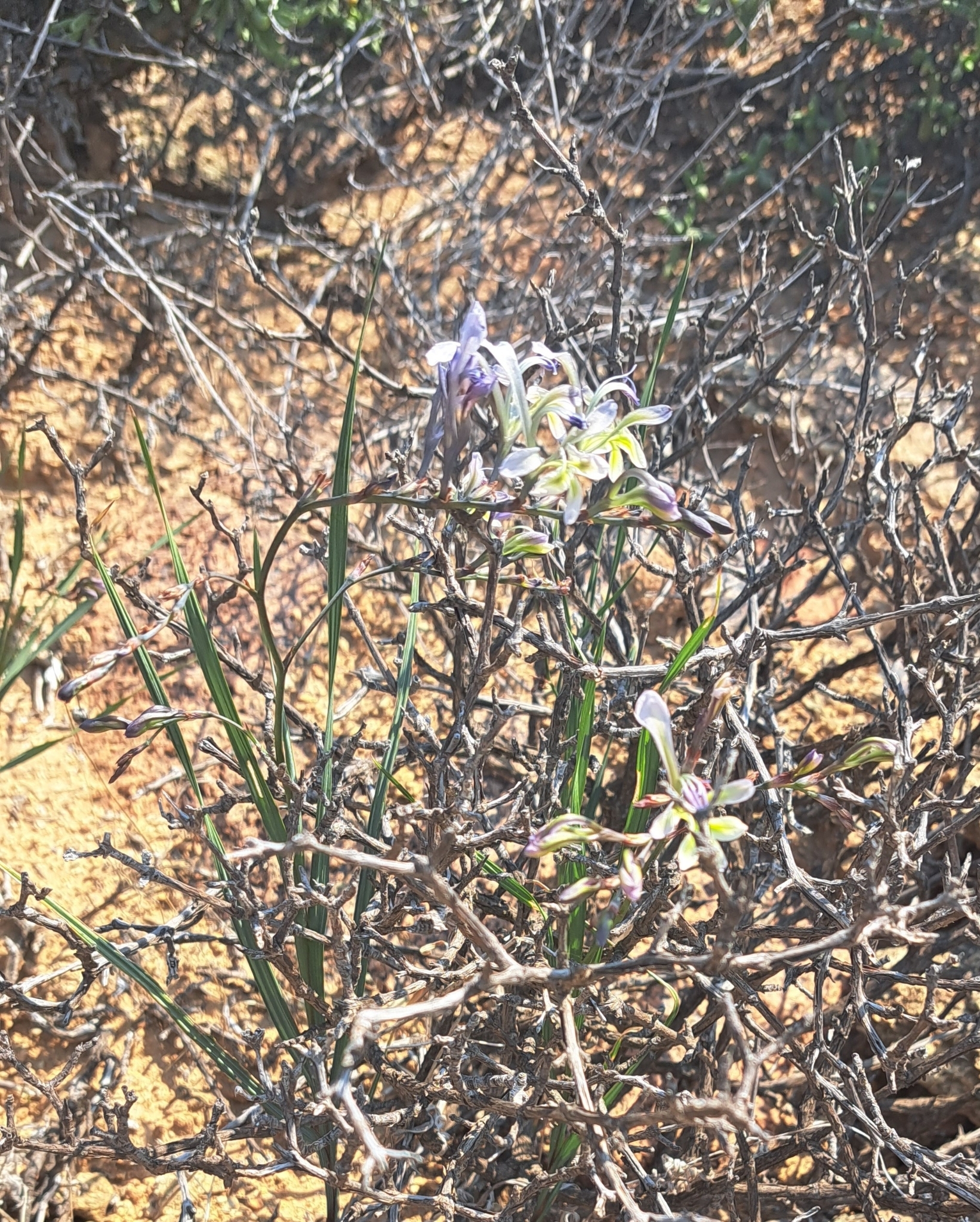
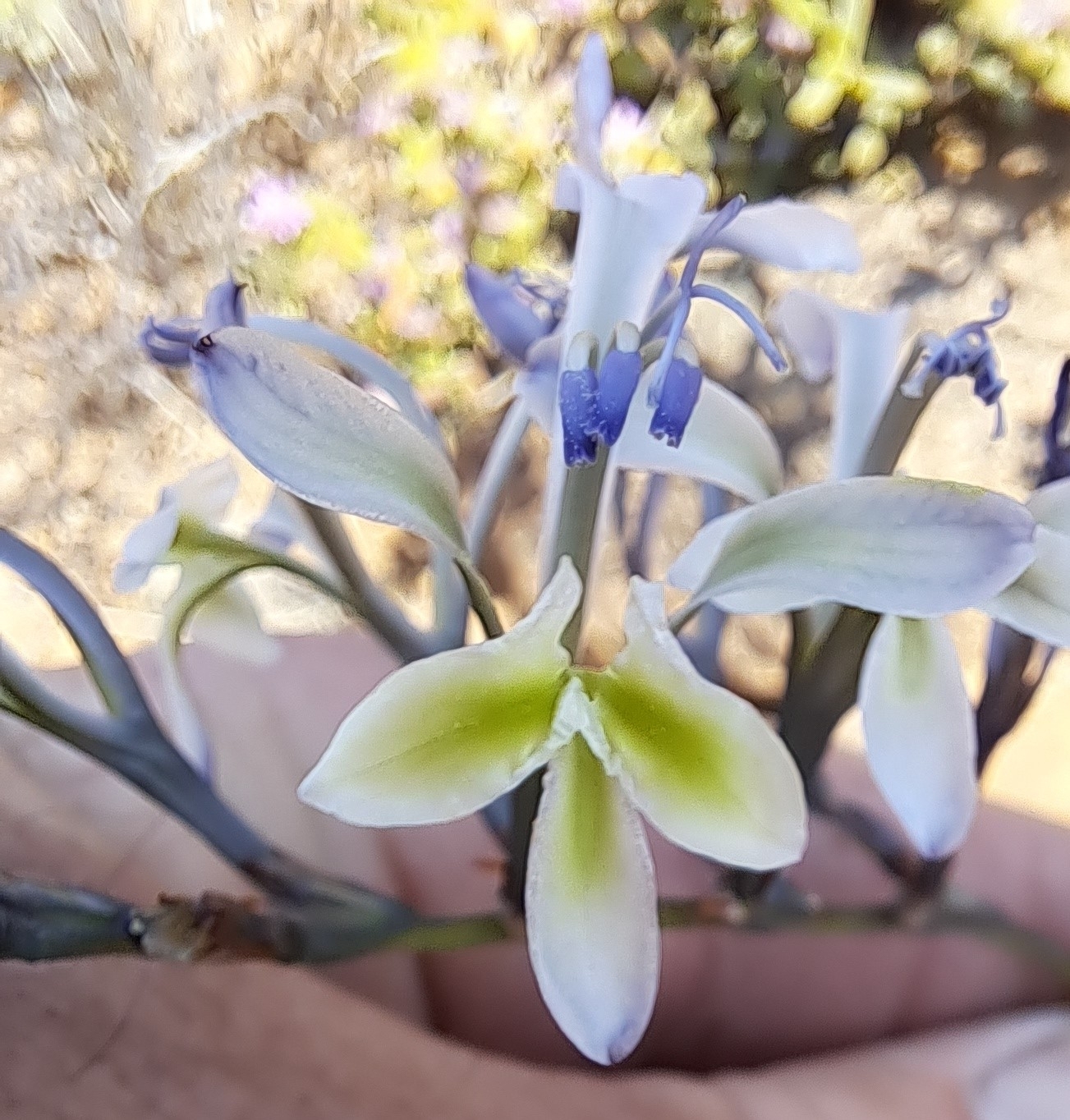
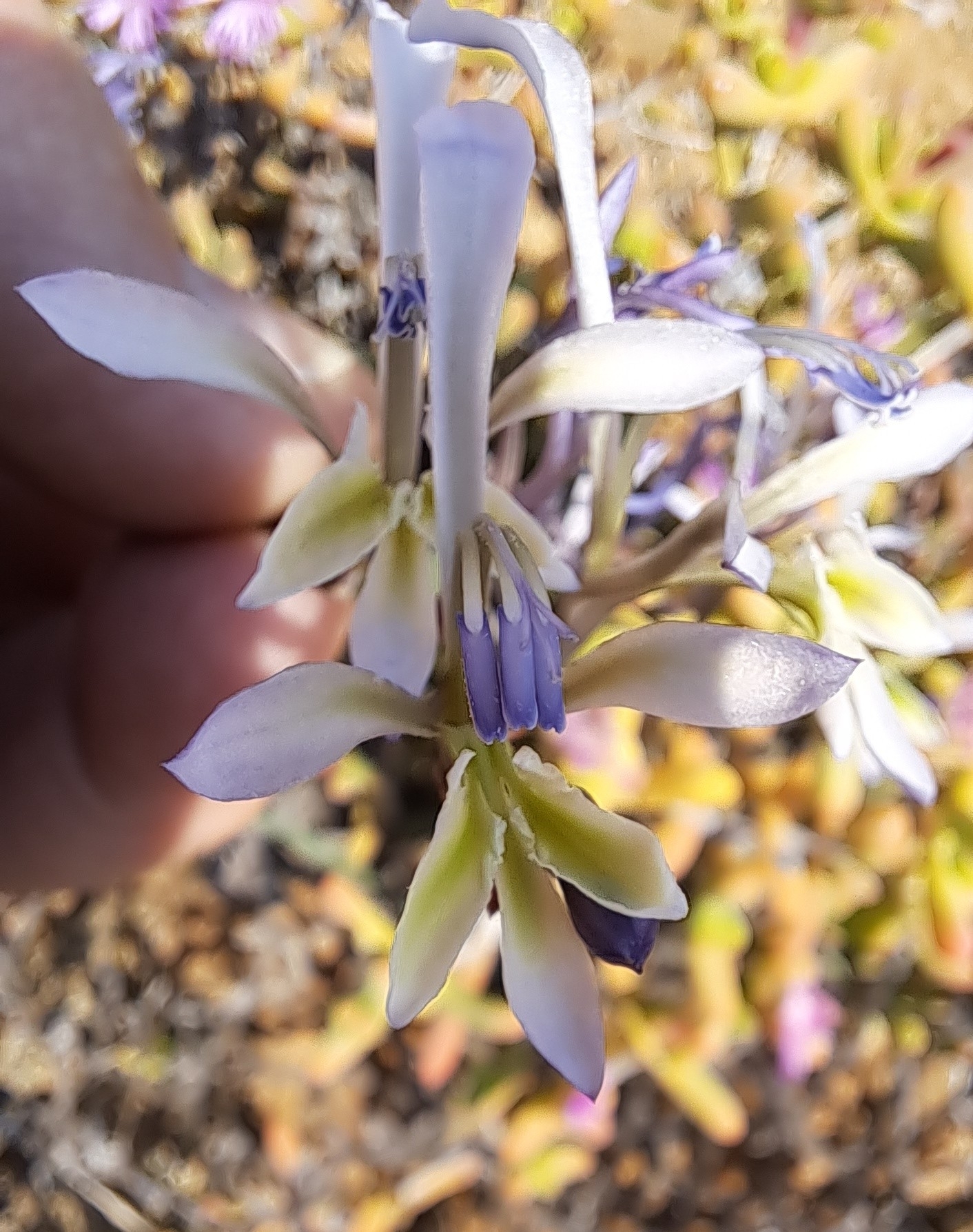
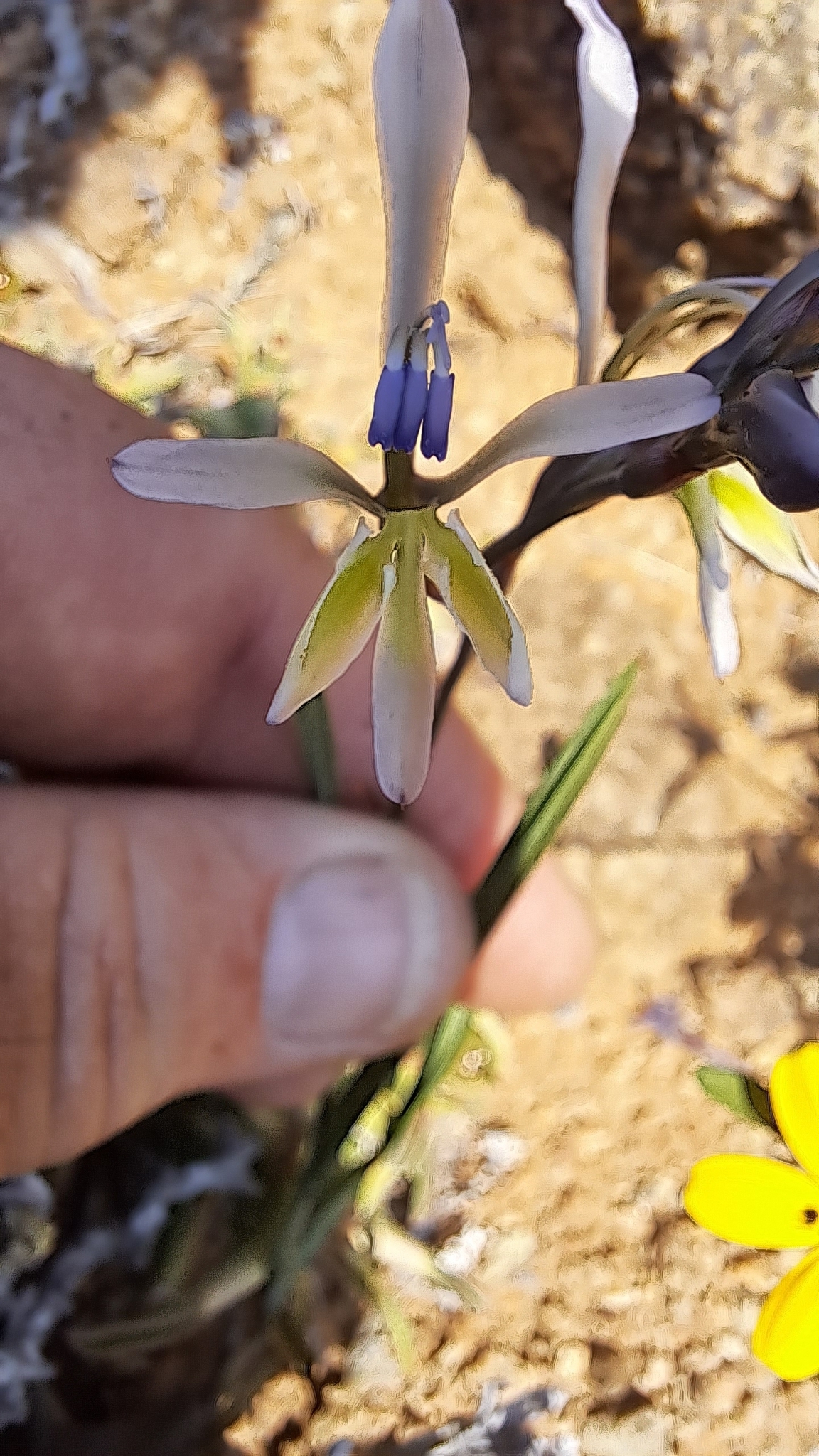
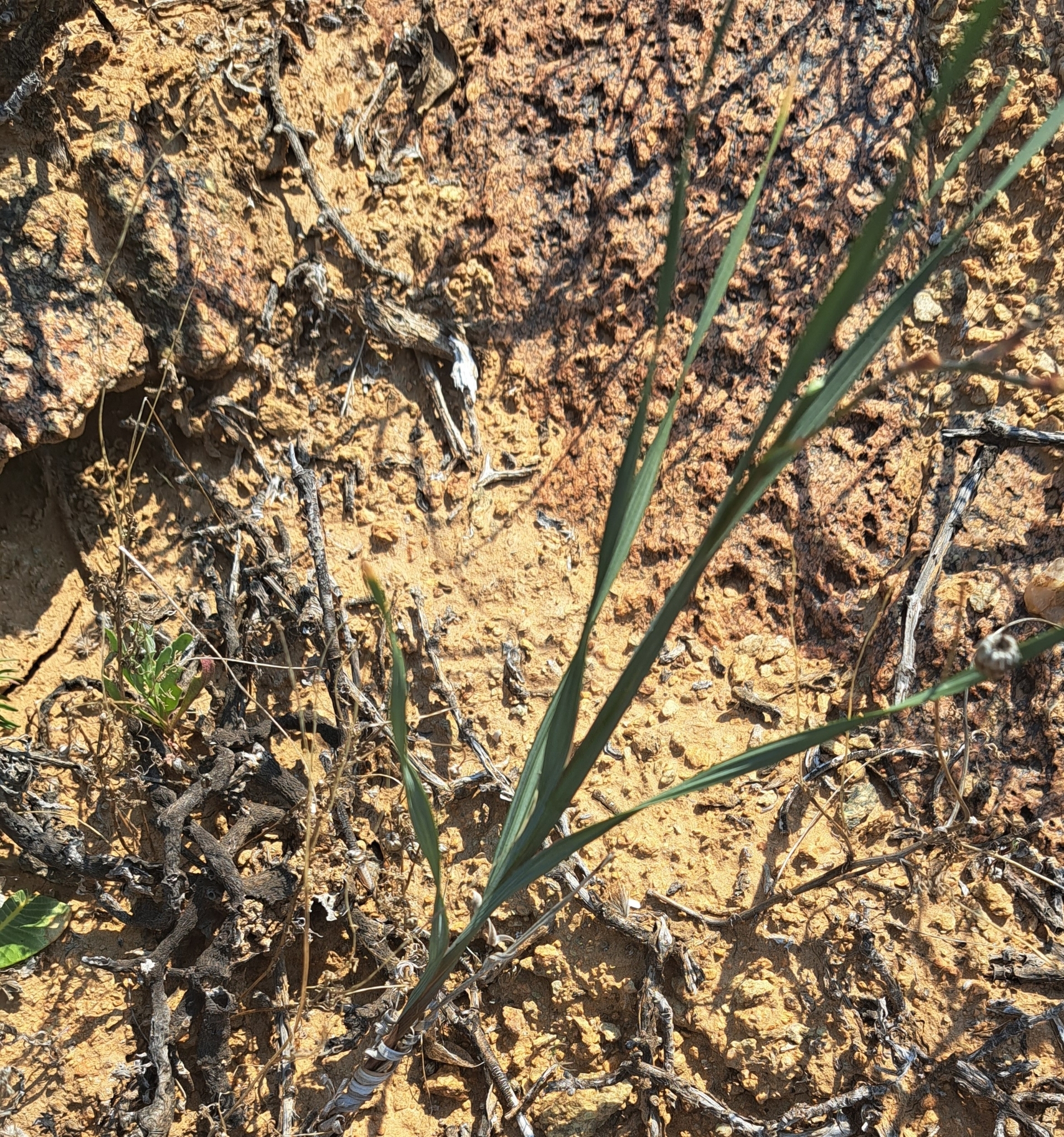
Plants 120-250 mm high, hairless throughout, with depressed globose corm up to 15 mm diam. Stem simple or few-branched, sometimes ± dichotomously with branches widely diverging, sheathed by smooth cataphylls, old dry leaves coiled around stem base. Leaves narrowly linear-sword-shaped, reaching or shortly exceeding spike, 2.5-4.0 mm wide, scarcely plicate, smooth, slightly twisted, veins thickened, prominent when dry. Spike inclined to ± horizontal, (4-)7- to 12-flowered; bracts subequal, smooth, dry and rust-coloured in upper 1/3, 5-8 mm long, inner ± as long or slightly longer than outer, forked apically or in upper 1/3. Flowers pale blue-mauve to violet, limbs of lower lateral tepals pale yellow or with mauve tips, with light acrid-metallic scent; perianth tube 7-9 mm long, funnel-shaped; tepals unequal, dorsal 18-23 x 4-5 mm, erect, later curving back in distal 1/3, lower lateral tepals joined to upper laterals for ± 5 mm and to one another for ± 3 mm, abruptly clawed at base, claws ± 2 mm long, limbs with conspicuous auriculate lobes at bases, margins lightly crisped. Stamens unilateral; filaments ± 15 mm long; anthers ± 4 mm long, purple; pollen cream-coloured. Ovary smooth; style dividing between base and middle of anthers, branches tangled in anthers. Capsules depressed-globose, ± 6 x 7-8 mm. From: Goldblatt, P; Manning, JC. 2020. Iridaceae of southern Africa. Strelitzia 42: 1-1159. South African National Biodiversity Institute, Pretoria. [CC BY]
Cormous geophyte, 120-250 mm tall, stem simple or dichotomously branched. Leaves narrowly sword-shaped, scarcely plicate, smooth, with much thickened veins. Flowers mostly 7-12 in a secund, nearly horizontal spike, bilabiate, blue-mauve with yellow nectar guides, perianth tube 7-8 mm long, dorsal tepal 18-23 mm long, ovary smooth, bracts smooth, inner forked in upper third. From: Goldblatt, P; Manning, JC. 2013. Iridaceae. In: DA Snijman (ed.), Plants of the Greater Cape Floristic Region 2: The Extra Cape flora. Strelitzia 30: 94-124. South African National Biodiversity Institute, Pretoria. [CC BY]
With blue flowers with yellow markings on the lower tepals, Babiana lobata is recognised by the simple or dichotomously branched stem with flowers borne on the upper side of horizontal spikes, the lower tepals with auricular lobes at the bases of the limbs. The plants are hairless throughout and the floral bracts are short, 5-8 mm long, dry distally with the inner forked in the upper third. Somewhat unusual, the dry remains of past season’s leaves are twisted around the base of the stem. Babiana lobata has been associated with two related species, B. fimbriata and B. spiralis from central Namaqualand, both also with auriculate lobes on the lower lateral tepal limbs. Babiana fimbriata has leaves twisted distally, woolly-cobwebby cataphylls, and lightly hairy bracts 12-14 mm long, much exceeding those of B. lobata. The related B. spiralis has velvety hairy stems but smooth cataphylls and leaf sheaths, and bracts 8-10 mm long. The hairless habit, short floral bracts, and more-or-less divaricate branching suggest that B. tritonioides is most closely related to B. lobata. Centred in the Komaggas area of northwestern Namaqualand, B. tritonioides has short, relatively broad leaves, the blades borne at right angles to the sheaths and twisted or folded back on themselves in concertina fashion and is typically a shorter plant, 100-150 mm high. From: Goldblatt, P; Manning, JC. 2020. Iridaceae of southern Africa. Strelitzia 42: 1-1159. South African National Biodiversity Institute, Pretoria. [CC BY]
Rocky lower slopes and flats. From: Goldblatt, P; Manning, JC. 2020. Iridaceae of southern Africa. Strelitzia 42: 1-1159. South African National Biodiversity Institute, Pretoria. [CC BY]
Rocky slopes and flats. From: Goldblatt, P; Manning, JC. 2013. Iridaceae. In: DA Snijman (ed.), Plants of the Greater Cape Floristic Region 2: The Extra Cape flora. Strelitzia 30: 94-124. South African National Biodiversity Institute, Pretoria. [CC BY]
Endemic to the Richtersveld of Northern Cape, South Africa, extending from Armanshoek in the Richtersveld National Park to the foot of the Stinkfontein Mtns. From: Goldblatt, P; Manning, JC. 2020. Iridaceae of southern Africa. Strelitzia 42: 1-1159. South African National Biodiversity Institute, Pretoria. [CC BY]
Richtersveld. From: Goldblatt, P; Manning, JC. 2013. Iridaceae. In: DA Snijman (ed.), Plants of the Greater Cape Floristic Region 2: The Extra Cape flora. Strelitzia 30: 94-124. South African National Biodiversity Institute, Pretoria. [CC BY]
July to August
0 to 500 m
This map contains point-based occurrences at different locations
 This is a sensitive species therefore data has been redacted, click here to login.
Occurrence in the Flora of Southern Africa (FSA) countries and South African provinces. Residence status indicates if a taxon is indigenous, endemic, naturalised or invasive in a specific region. This data is based on specimen records and literature
FSA
SA
BOT
NAM
ESW
LES
WC
EC
NC
FS
GA
KZN
LP
MP
NW
Absent
Indigenous
Endemic
Naturalised
Invasive

Names and Sources
Classification
KINGDOM Plantae
SUBKINGDOM Phanerogamae
PHYLUM Anthophyta
ORDER Asparagales
FAMILY Iridaceae
SUBFAMILY Crocoideae
TRIBE Ixieae
GENUS Babiana
SPECIES lobata
14 results for Babiana lobata G.J.Lewis
Barcode: PRE0712523-0 Collector(s) & number: Oliver, EGH, 372 | 1977-8-30
Data Resource: BODATSA View record
Barcode: NBG1570199-0 Collector(s) & number: Van Wyk, P, PC2424 | 2020-7-26
Data Resource: BODATSA View record
Barcode: NBG0201280-0 Collector(s) & number: Goldblatt, P, 12111 | 2002-8-23
General notes: In fruit, evidently rare.
Data Resource: BODATSA View record
Barcode: PRE0068420-0 Collector(s) & number: Verdoorn, IC, 1892 | 1937-7-29
Data Resource: BODATSA View record
Barcode: NBG0181045-0 Collector(s) & number: Goldblatt, P, 11756 | 2001-8-23
General notes: Flowers pale dull yellow, upper tepals flushed purple, fading darker purple; musk-scented.
Data Resource: BODATSA View record
Barcode: PRE0835972-0 Collector(s) & number: Goldblatt, P, 9901 | 1994-8-3
Data Resource: BODATSA View record
Barcode: NBG0158798-0 Collector(s) & number: Williamson, GF, 5648 | 1995-7-
General notes: In gorge. Rare.
Data Resource: BODATSA View record
Barcode: NBG0158811-0 Collector(s) & number: Williamson, GF, 5684 | 1995-8-
General notes: Rare.
Data Resource: BODATSA View record
Barcode: NBG0180503-0 Collector(s) & number: Verdoorn, IC, s.n. | 1937--
Data Resource: BODATSA View record
Barcode: NBG0168896-0 Collector(s) & number: Williamson, GF, 4368 | 1990-9-
General notes: Karoo vegetation. Sandstone. Plant growing in tight rock cracks.
Data Resource: BODATSA View record
This map contains point-based occurrences at different locations
This is a sensitive species therefore data has been redacted, click here to login.
2020
SERIES
Iridaceae of southern Africa Goldblatt, P; Manning, JCStrelitzia 42: 1-1159
South African National Biodiversity Institute, Pretoria
2013
SERIES CHAPTER
Iridaceae Goldblatt, P; Manning, JCIn: DA Snijman (ed.), Plants of the Greater Cape Floristic Region 2: The Extra Cape flora. Strelitzia 30: 94-124
South African National Biodiversity Institute, Pretoria
2007
SERIES
A revision of the southern African genus Babiana, Iridiceae: Crocoideae Goldblatt, P; Manning, JCStrelitzia 18: 98-98
South African National Biodiversity Institute, Pretoria
1983
PERIODICAL/JOURNAL
Babiana lobata G.J.Lewis Goldblatt, P; Weber, AMFlowering Plants of Africa 47: , t.1866
No results found for Babiana lobata G.J.Lewis
Status and criteria
EN
Assessor(s)
Plantae Coordinator
JOURNAL ARTICLE
Bennett, N.C. and Spinks, A.C. 1995. Thermoregulation and metabolism in the Cape golden mole (Insectivora: <i>Chrysochloris asiatica</i>). Journal of Zoology (London). 76:957–971
ELECTRONIC SOURCE
Afrotheria Specialist Group 2014. Specialist Group website
BOOK SECTION
Bronner, G.N. 2013. <i>Chrysochloris asiatica</i>. Edited by J. Kingdon, D. Happold, T. Butynski, M. Hoffmann, M. Happold and J. Kalina. Mammals of Africa, Volume I: Introductory Chapters and Afrotheria. Bloomsbury Publishing
ELECTRONIC SOURCE
IUCN 2015. The IUCN Red List of Threatened Species. Version 2015.2
JOURNAL ARTICLE
Lynch, C.D. 1994. The mammals of Lesotho. Navorsinge van die Nasionale Museum Bloemfontein. 10:177-241
EDITED BOOK
Skinner, J.D. and Chimimba, C.T. 2005. The Mammals of the Southern African Subregion. Cambridge University Press, United Kingdom
JOURNAL ARTICLE
Herselman, J. C. and Norton, P. M. 1985. The distribution and status of bats (Mammalia: Chiroptera) in the Cape Province. Annals of the Cape Provincial Museums. 16:74-126
JOURNAL ARTICLE
Rautenbach, I. L., Bronner, G. N. and Schlitter, D. A. 1993. Karyotypic data and attendant systematic implications for the bats of southern Africa. Koedoe. 36:87-104
JOURNAL ARTICLE
Watson, J. P. 1998. New distributional records for three microchiropteran bats (Vespertillionidae [Vespertilionidae], Rhinolophidae) from the Free State Province, South Africa. South African Journal of Wildlife Research. 28:127-131
JOURNAL ARTICLE
Seamark, E. C. J. and Brand, M. 2005. Bat survey in the Cedarberg Wilderness Area, Western Cape, South Africa (28 January - 3 February 1999). African Bat Conservation News. 3:7-9
BOOK
Friedmann, Y. and Daly, B. 2004. Red Data Book of the Mammals of South Africa: A Conservation Assessment. Conservation Breeding Specialist Group (SSC/IUCN) and Endangered Wildlife Trust
REPORT
ACR 2013. African Chiroptera Report 2013. AfricanBats, African Chiroptera Project,i-xix6330 pp
JOURNAL ARTICLE
Pacifici, M., Santini, L., Di Marco, M., Baisero, D., Francucci, L., Grottolo Marasini, G., Visconti, P. and Rondinini, C. 2013. Generation length for mammals. Nature Conservation. 5:87–94
BOOK
Monadjem, A., Taylor, P.J., Cotterill, F.P.D. and Schoeman M.C. 2010. Bats of Southern and Central Africa: a biogeographic and taxonomic synthesis. University of Witwatersrand Press
| Part(s) of plant used | Use(s) | Reference |
|---|
Coming soon...


