PLANTAE / PHANEROGAMAE / ANTHOPHYTA / GERANIALES / GERANIACEAE / PELARGONIUM / DESERTORUM

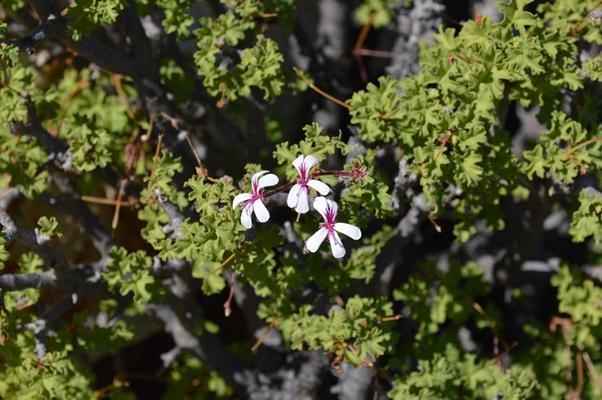
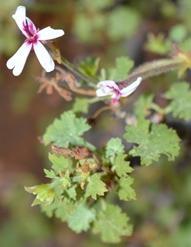
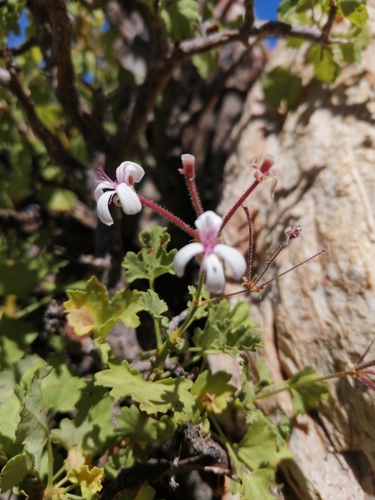
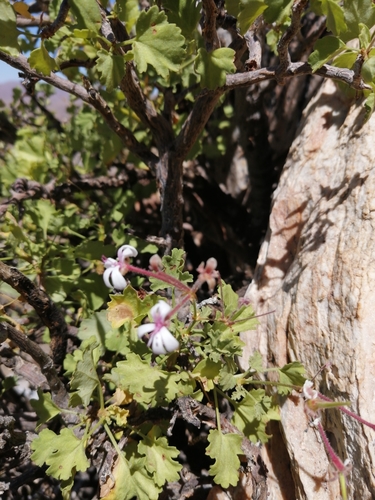
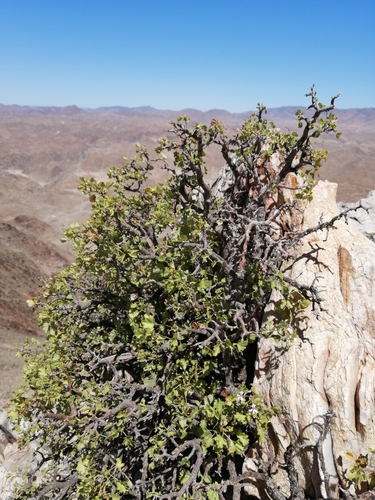
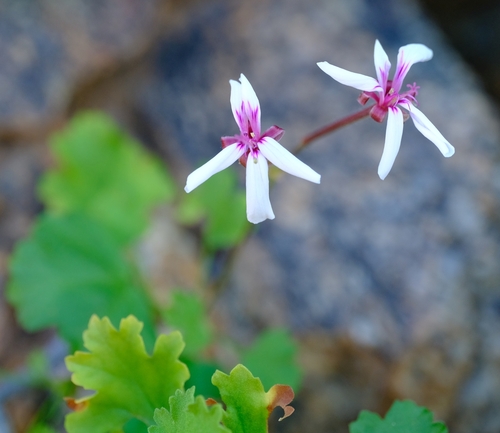
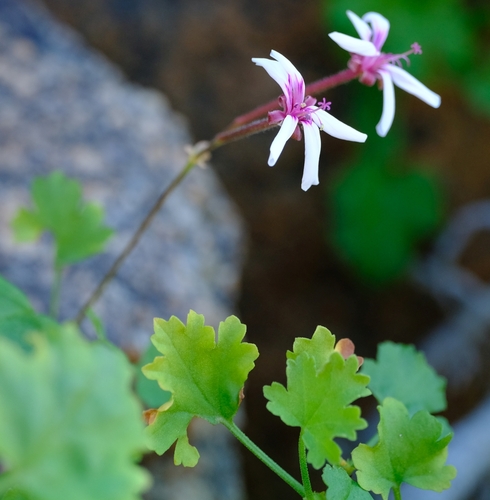
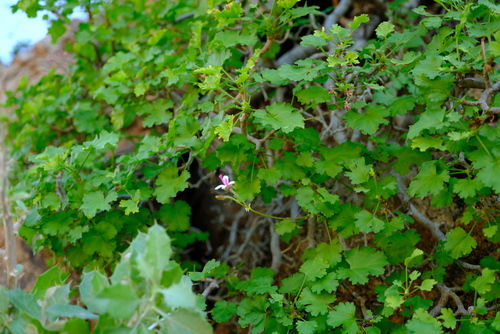
An erect aromatic shrublet with slender stems, fairly well branched, deciduous in nature, up to 300 mm tall and slightly less in diameter. Stems initially smooth but becoming rough with age, succulent, densely covered with very short-stalked glandular hairs and reddish brown at first but turning glabrous and greyish brown with age. Leaves simple, membranous, densely covered in short-stalked glandular hairs, green; lamina orbicular in outline, base decurrent, apex rounded, margin shallowly 5-lobed and lobes obtusely dentate, 10-20(30) mm long and 10-20(25) mm wide; petiole 8-20(50) mm long, persistent after lamina has fallen; stipules triangular, 1.5-2.0 mm long and ±1 mm wide, glandular-like lamina, persistent. Inflorescence of 2(3)-4(6)-flowered pseudo-umbels borne sub-terminally on either ordinary branches or on inflorescence branches distinguished by longer internodes; bracts subtending umbel usually more than number of flowers developing, narrowly ovate with apices acute, gradually recurving, 7-8 mm long and 1.5-2.0 mm wide, pale green. Pedicel 20-35 mm long, sparsely pubescent and with short-stalked glandular hairs. Hypanthium variable: usually shorter than but occasionally equalling pedicel, 2-23 mm long. Sepals narrowly ovate with apices acute, recurved after anthesis, indumentum as on pedicel, green and often tinged with purple at base and along margins, 7-8 mm long and 1.5-2.0 mm wide. Petals 5, narrowly spathulate with margins slightly revolute, white; posterior two slightly wider than anterior three: 12-13 mm long and 4-5 mm wide, spaced close together, reflexed at less than 90° in middle, with a purple tinge near base of claw; anterior three gradually recurved, 12-13 mm long and 3.5-4.0 mm wide, spaced at more or less right angles relative to each other, with a diffuse purple tinge at base. Stamens 10, consisting of 3 staminodes and 7 fertile stamens, of different lengths as per illustration, basally fused into a staminal column, filaments and anthers purple, pollen orange. Ovary ovoid, densely pilose with apically directed trichomes, green; stigma with 5 recurved branches, purple; fruit unknown. From: Vorster, PJ. 1986. Pelargonium desertorum (Geraniaceae): a new species from the north-western Cape Province. S. African J. Bot. 52(2): 184-186. [Copyright held by the South African Association of Botanists (1986); http://www.sciencedirect.com/science/journal/02546299] [CC BY]
Aromatic shrublet, up to 300 mm tall, with slender, succulent, well-branched stems. Leaves with persistent petioles 8-50 mm long, blade orbicular, shallowly 5-lobed, 10-25 mm wide. Flowers 2-6 in subterminal clusters, pedicel 20-35 mm long, petals 5, white, 12-13 mm long, upper 2 tinged purple near base, hypanthium 2-23 mm long. From: Snijman, DA. 2013. Geraniaceae. In: DA Snijman (ed.), Plants of the Greater Cape Floristic Region 2: The Extra Cape flora. Strelitzia 30: 401-410. South African National Biodiversity Institute, Pretoria. [CC BY]
P. desertorum is an erect aromatic shrublet with slender succulent stems, growing up to 300 mm tall. Its leaves are membranous, simple, orbicular in outline, shallowly lobed, and the margins are obtusely dentate. The inflorescence is an apparently terminal pseudo-umbel of (2)3-4(6) flowers. The hypanthium is variable in length, from inconspicuously short to as long as the pedicel; the petals are white, narrowly spathulate, and recurved to expose the sexual parts. It closely resembles P. otaviense Knuth in its vegetative morphology and habit. It is distinguished, however, by petals which recurve to expose the sexual parts instead of being straight and nearly parallel to each other to hide the sexual parts, by the base of the lamina being decurrent, the joint between pedicel and hypanthium which is not geniculate, and the stems which are more succulent rather than woody. On morphological similarities, P. desertorum can be grouped with P. abrotanifolium (L.f.) Jacq., P. exstipulatum (Cav.) L' Herit., P. grandicalcaratum Knuth, P. karooicum Compton & Barnes, P. otaviense Knuth, P. plurisectum Salter, and P. xerophyton Schltr. ex Knuth. These species are, however, readily distinguishable by their leaf morphology and various floral characteristics. From: Vorster, PJ. 1986. Pelargonium desertorum (Geraniaceae): a new species from the north-western Cape Province. S. African J. Bot. 52(2): 184-186. [Copyright held by the South African Association of Botanists (1986); http://www.sciencedirect.com/science/journal/02546299] [CC BY]
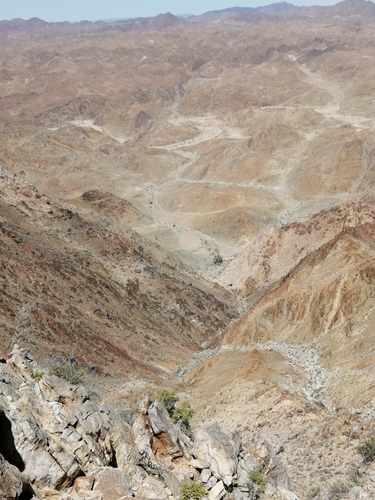
This area, hemmed in by high granite hills, becomes very hot in summer and is virtually frost-free in winter, although it may become chilly at night. The rainfall of less than 100 mm per annum occurs during the winter months only, but is probably augmented by condensation from early morning mist which occurs frequently throughout the year in the lower Orange River valley. This species occurs south of the southernmost known limit of the distribution range of P. otaviense. From: Vorster, PJ. 1986. Pelargonium desertorum (Geraniaceae): a new species from the north-western Cape Province. S. African J. Bot. 52(2): 184-186. [Copyright held by the South African Association of Botanists (1986); http://www.sciencedirect.com/science/journal/02546299] [CC BY]
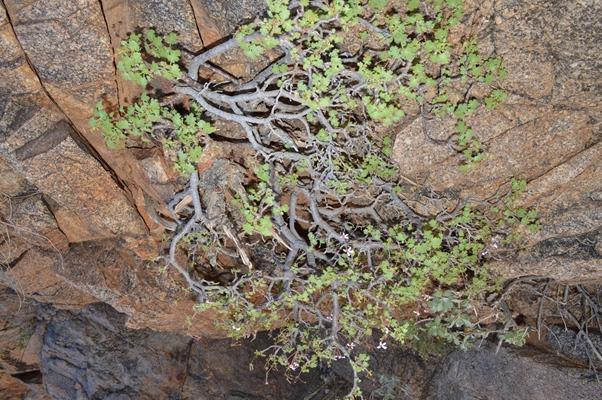
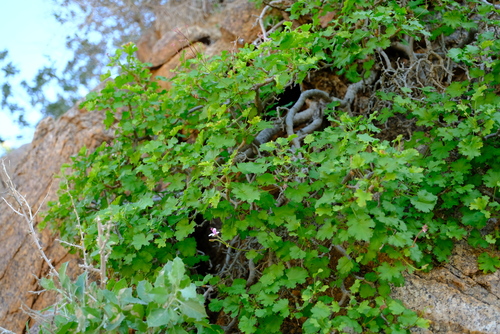
S-facing slopes on granitic gravel. From: Snijman, DA. 2013. Geraniaceae. In: DA Snijman (ed.), Plants of the Greater Cape Floristic Region 2: The Extra Cape flora. Strelitzia 30: 401-410. South African National Biodiversity Institute, Pretoria. [CC BY]
P. desertorum is known only from two collections from the Rosyntjieberge in the Richtersveld (north-western Cape Province), just south of the Orange River, where it was found on south-facing slopes. From: Vorster, PJ. 1986. Pelargonium desertorum (Geraniaceae): a new species from the north-western Cape Province. S. African J. Bot. 52(2): 184-186. [Copyright held by the South African Association of Botanists (1986); http://www.sciencedirect.com/science/journal/02546299] [CC BY]
Richtersveld National Park. From: Snijman, DA. 2013. Geraniaceae. In: DA Snijman (ed.), Plants of the Greater Cape Floristic Region 2: The Extra Cape flora. Strelitzia 30: 401-410. South African National Biodiversity Institute, Pretoria. [CC BY]
0 to 1500 m
This map contains point-based occurrences at different locations
Occurrence in the Flora of Southern Africa (FSA) countries and South African provinces. Residence status indicates if a taxon is indigenous, endemic, naturalised or invasive in a specific region. This data is based on specimen records and literature
FSA
SA
BOT
NAM
ESW
LES
WC
EC
NC
FS
GA
KZN
LP
MP
NW
Absent
Indigenous
Endemic
Naturalised
Invasive
Names and Sources
Classification
KINGDOM Plantae
SUBKINGDOM Phanerogamae
PHYLUM Anthophyta
ORDER Geraniales
FAMILY Geraniaceae
GENUS Pelargonium
SPECIES desertorum
16 results for Pelargonium desertorum Vorster
Barcode: NBG0147326-0 Collector(s) & number: Williamson, GF, 3922 | 1988-8-27
South Africa, Northern Cape, Richtersveld. Nababiepsberg. Gorge below Cone Peak.
General notes: Gorge. Granite and quartzite slope. No flowers. Just over but according to leaf and shape of plants second locality for this plant.
Data Resource: BODATSA View record
Barcode: NBG0151042-0 Collector(s) & number: Williamson, GF, 3931 | 1988-10-8
South Africa, Northern Cape, Richtersveld. Nababiepsberg. Gorge below Cone Peak.
Data Resource: BODATSA View record
Barcode: NBG0201018-0 Collector(s) & number: Vorster, PJ, 1454 | 1975-11-29
South Africa, Northern Cape, Alexander Bay. Richtersveld. Rosyntjieberge.
General notes: South facing lower slopes. Between big granite rocks.
Data Resource: BODATSA View record
Barcode: NBG0199126-0 Collector(s) & number: Drijfhout, P, 1454 | 1975-11-29
South Africa, Northern Cape, Rosyntjieberge: lower southern slope.
General notes: On gravel amongst granite boulders. This specimen prepared when plant flowered in Stellenbosch under cultivation, 21.4.1982.
Data Resource: BODATSA View record
Barcode: NBG0200075-0 Collector(s) & number: Desmet, PG, 3506 | 2003-5-11
South Africa, Northern Cape, Richtersveld, Namaqualand. Eksteenfontein, Richtersveld National Park, SE slopes of Mount Terror. Lat: 28.46725; Long: 17.28093.
General notes: Succulent Karoo. Well-drained, sandy-loam, rocky soil. Quartzite. Partial shade. South, steep slope. Frequent. Plant height 0.4 m. Shrub, perennial. Phenology: flower. White flowers.
Data Resource: BODATSA View record
Barcode: PRE0782808-0 Collector(s) & number: Dreyer, LL, 63 | 1991-10-5
South Africa, Northern Cape, Tatasberg.
General notes: Sukkulente Karoo. Regopgroeiende aromatiese substruik, ca. .3 m hoog. Blare orbikuler, vlak gelob, rande stomp getand. Kroonblare wit met pers merke naby aan nael.
Data Resource: BODATSA View record
Barcode: PRE0059564-0 Collector(s) & number: Dreyer, LL, 469 | 1995-1-4
Namibia, Maltahöhe District: Ou Kampkas Farm; Near natural rock garden.
General notes: Found growing in rock crevices. Woody shrublet ca 0.2 m tall.
Data Resource: BODATSA View record
Barcode: NBG0201852-0 Collector(s) & number: Drijfhout, P, 2959 | 1980-6-11
South Africa, Northern Cape, Rosyntjieberg: upper part of ravine above Soetfontein.
General notes: South-facing slope. Flowers white with red markings. Common. This sheet prepared from a cultivated plant flowering in Stellenbosch, 24.5.
Data Resource: BODATSA View record
Barcode: PRE0775617-0 Collector(s) & number: Van Wyk, AE, 9015 | 1989-9-3
Namibia, NAMIBIA; DIAMOND AREA NO 1; OBIB MOUNTAIN PEAK ON S-FACING SLOPE
Data Resource: BODATSA View record
Barcode: PRE0202639-0 Collector(s) & number: Drijfhout, P, 2959(cult) | 1980-6-11
South Africa, Northern Cape, Rosyntjieberg: upper part of ravine above Soetfontein.
General notes: South-facing slope. Flowers white with red markings. This sheet prepared from a cultivated plant flowering in Stellenbosch.
Data Resource: BODATSA View record
Barcode: PRE0777773-0 Collector(s) & number: Erens, J, 634 | 1977-9-
South Africa, Northern Cape, RICHTERSVELD; ROSYNTJIESBERG; VIOOLSDRIF DISTRICT PNBG 23215
Data Resource: BODATSA View record
Barcode: PRE0775971-0 Collector(s) & number: Drijfhout, P, 1454 | 1975-11-29
South Africa, Northern Cape, ROSYNTJIEBERGE; LOWER SOUTHERN SLOPE.
General notes: This specimen prepared when plant flowered in Stellenbosch under cultivation, 21/4/1982.
Data Resource: BODATSA View record
This map contains point-based occurrences at different locations
2013
SERIES CHAPTER
Geraniaceae Snijman, DAIn: DA Snijman (ed.), Plants of the Greater Cape Floristic Region 2: The Extra Cape flora. Strelitzia 30: 401-410
South African National Biodiversity Institute, Pretoria
1997
1986
PERIODICAL/JOURNAL
Pelargonium desertorum (Geraniaceae): a new species from the north-western Cape Province Vorster, PJSouth African Journal of Botany 52(2)184-186
No results found for Pelargonium desertorum Vorster
Status and criteria
LC
Assessor(s)
Plantae Coordinator
| Part(s) of plant used | Use(s) | Reference |
|---|
Coming soon...