
PLANTAE / PHANEROGAMAE / ANTHOPHYTA / POALES / POACEAE / DANTHONIOIDEAE / CAPEOCHLOA / CINCTA / SERICEA

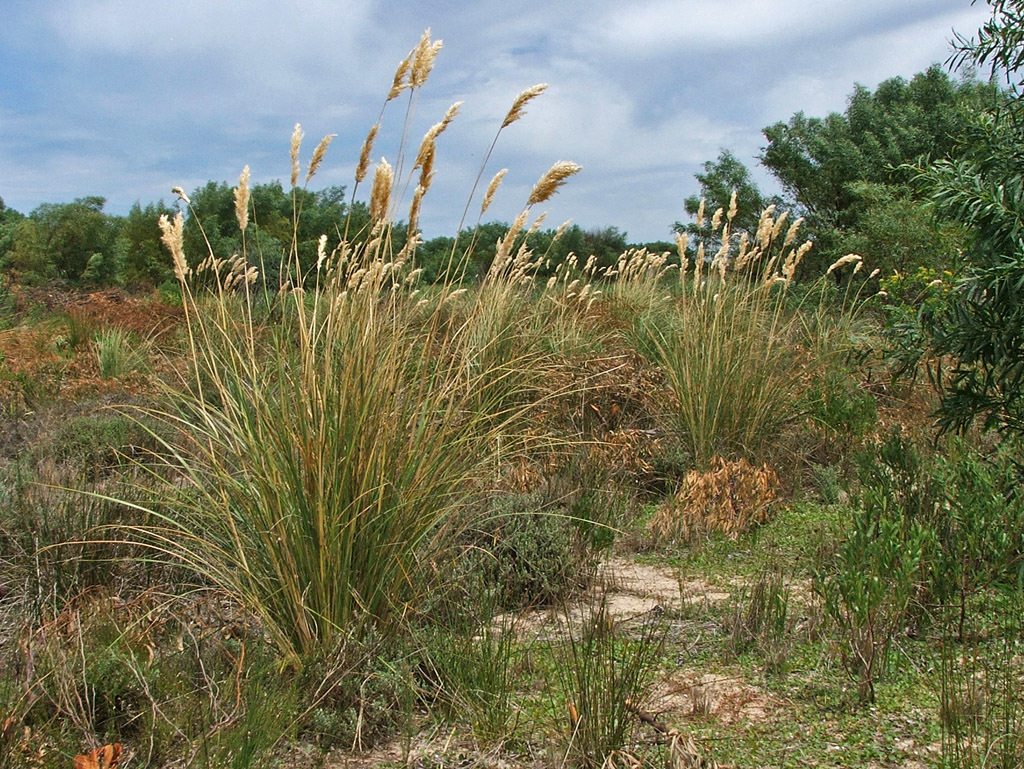
A perennial; base of plant glabrous; culm erect. Leaf blade up to 1000 mm long, flat to somewhat rolled; lacunae present. Inflorescence up to 500 mm long, contracted, shortly branched, upper half drooping. Spikelet 14-23 mm long, 2-3 flowered; glume 14-23 mm long, 1-nerved; lemma 3-6 mm long, lobes 4-6 mm long, lobes awned, a row of long, silky hairs 10-11 mm long in tufts across the back above, glabrous below; central awn 14-17 mm long, occasionally slightly contorted at base and then geniculate; anther 2.0-3.0 mm long. From: Mashau, AC; Fish, L. 2015. Capeochloa H.P.Linder & N.P.Barker. In: L Fish, AC Mashau, MJ Moeaha & MT Nembudani (eds), Identification guide to the southern Africa grasses. An identification manual with keys, descriptions and distributions. Strelitzia 36: 150-153. South African National Biodiversity Institute, Pretoria. [CC BY]
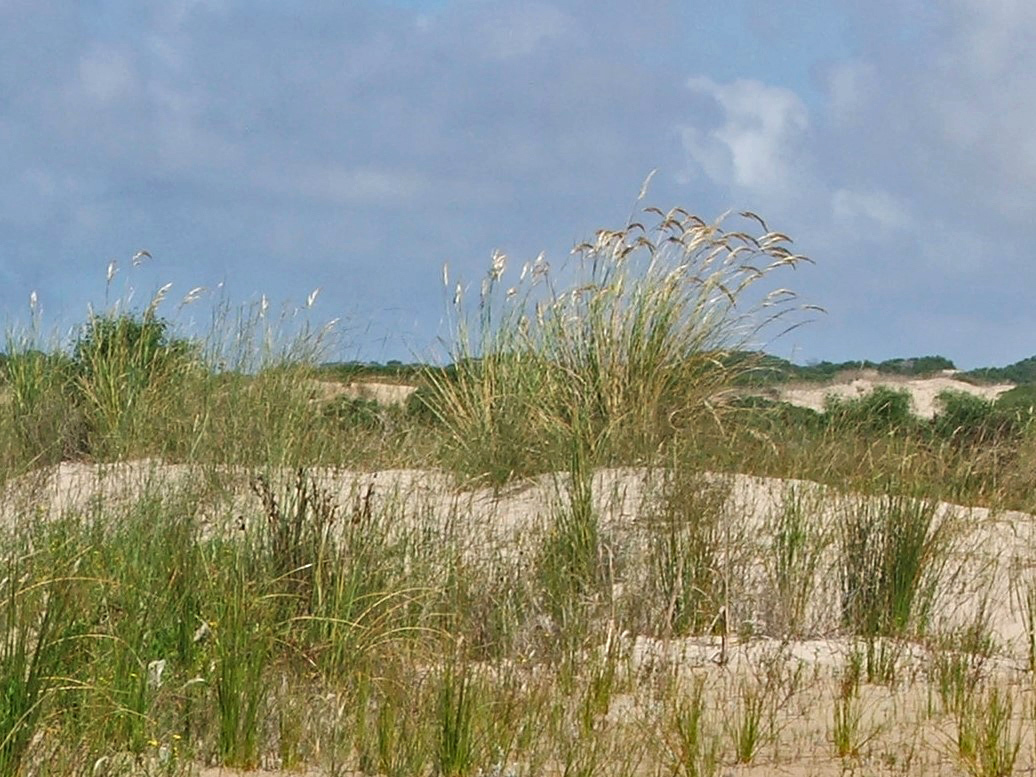
In coastal dune slacks and seeps in dune areas where water is forced to the surface by rock strata; one inland locality on an outcrop of silcrete. Ellis noted the presence of lacunae in the leaf blades, an apparent adaptation to aquatic environments. From: Mashau, AC; Fish, L. 2015. Capeochloa H.P.Linder & N.P.Barker. In: L Fish, AC Mashau, MJ Moeaha & MT Nembudani (eds), Identification guide to the southern Africa grasses. An identification manual with keys, descriptions and distributions. Strelitzia 36: 150-153. South African National Biodiversity Institute, Pretoria. [CC BY]
Endemic. EC. From: Mashau, AC; Fish, L. 2015. Capeochloa H.P.Linder & N.P.Barker. In: L Fish, AC Mashau, MJ Moeaha & MT Nembudani (eds), Identification guide to the southern Africa grasses. An identification manual with keys, descriptions and distributions. Strelitzia 36: 150-153. South African National Biodiversity Institute, Pretoria. [CC BY]
September to November
This map contains point-based occurrences at different locations
Occurrence in the Flora of Southern Africa (FSA) countries and South African provinces. Residence status indicates if a taxon is indigenous, endemic, naturalised or invasive in a specific region. This data is based on specimen records and literature
FSA
SA
BOT
NAM
ESW
LES
WC
EC
NC
FS
GA
KZN
LP
MP
NW
Absent
Indigenous
Endemic
Naturalised
Invasive
Names and Sources
Merxmuellera cincta (Nees) Conert subsp. sericea N.P.Barker
Classification
KINGDOM Plantae
SUBKINGDOM Phanerogamae
PHYLUM Anthophyta
ORDER Poales
FAMILY Poaceae
SUBFAMILY Danthonioideae
GENUS Capeochloa
SPECIES cincta
SUBSPECIES sericea
10 results for Capeochloa cincta (Nees) N.P.Barker & H.P.Linder subsp. sericea (N.P.Barker) N.P.Barker & H.P.Linder
Barcode: PRE0640569-0 Collector(s) & number: Britten, LL, 1889A | 1919-11-9
South Africa, Eastern Cape, KOWIE
Data Resource: BODATSA View record
Barcode: PRE0641587-0 Collector(s) & number: Dahlstrand, KA, 589 | 1967-11-5
South Africa, Eastern Cape, PORT ELIZABETH; WALNER COMMONAGE
Data Resource: BODATSA View record
Barcode: PRE0481117-0 Collector(s) & number: Barker, NP, 1546 | 1997-11-14
South Africa, Eastern Cape, Peddie. Dune slacks below Fish River Lighthouse.
Data Resource: BODATSA View record
Barcode: PRE0070865-0 Collector(s) & number: Acocks, JPH, 21447 | 1960-9-9
South Africa, Eastern Cape, SEA VIEW; NEAR SEA VIEW TO E.
Data Resource: BODATSA View record
Barcode: PRE0511348-0 Collector(s) & number: Ellis, RP, 3268 | 1978-3-18
South Africa, Eastern Cape, TSITSIKAMA FOR.; STORMS RIVER DIST.; 15KM W OF STORMS RIVER BRIDGE
Data Resource: BODATSA View record
Barcode: PRE0726936-0 Collector(s) & number: Spies, JJ, 3504 | 1987-10-7
South Africa, Eastern Cape, 16 KM FROM HUMANSDORP TO CAPE ST FRANCES
Data Resource: BODATSA View record
Barcode: PRE0030343-0 Collector(s) & number: Flanagan, HG, 2586 | 1896-10-
South Africa, Eastern Cape, KOMGA DIST.; KEI MOUTH; SAND HILLS
Data Resource: BODATSA View record
Barcode: PRE0461814-0 Collector(s) & number: Barker, NP, 1545 | 1997-11-9
South Africa, Eastern Cape, Grahamstown: Rufanes River Mounth; about 10km East of Port Alfred.
General notes: ISOTYPE Growing in sandy seep underlain by rock shelf. Some plants becoming smothered in wind blown dune sand. Large tussock, 50-80cm in diameter, leaves erect. Flowering culms 2m tall, inflorescences somewhat nodding. Vouchers: Molecular, cytological, herbarium.
Data Resource: BODATSA View record
Barcode: NBG0163620-0 Collector(s) & number: Barker, NP, 1545 | 1997-11-9
South Africa, Eastern Cape, Grahamstown, Rufanes River Mouth, about 10 km East of Port Alfred.
General notes: Growing in sandy seep underlain by rock shelf. Some plants becoming smothered in wind blown dune sand. Large tussock, 50-80 cm in diameter, Leaves erect. Flowering culms 2 m tall, inflorescences somewhat nodding.
Data Resource: BODATSA View record
This map contains point-based occurrences at different locations
2015
SERIES CHAPTER
Capeochloa H.P.Linder & N.P.Barker Mashau, AC; Fish, LIn: L Fish, AC Mashau, MJ Moeaha & MT Nembudani (eds), Identification guide to the southern Africa grasses. An identification manual with keys, descriptions and distributions. Strelitzia 36: 150-153
South African National Biodiversity Institute, Pretoria
2010
PERIODICAL/JOURNAL
A generic classification of the Danthonioideae (Poaceae) Linder, HP; Baeza, CM; Barker, NP; Galley, CA; Humphreys, AM; Lloyd, KM; Orlovich, DA; Pirie, MD; Simon, BK; Walsh, N; Verboom, GAAnnals of the Missouri Botanical Garden 97(3)306-364
1999
PERIODICAL/JOURNAL
Merxmuellera cincta subsp. sericea (Poaceae), a new subspecies from the Eastern Cape, South Africa Barker, NPSouth African Journal of Botany 65: 104-109
No results found for Capeochloa cincta (Nees) N.P.Barker & H.P.Linder subsp. sericea (N.P.Barker) N.P.Barker & H.P.Linder
Status and criteria
VU
Assessor(s)
Plantae Coordinator
JOURNAL ARTICLE
Mutere, F. A. 1973. A comparative study of reproduction in two populations of the insectivorous bats, <i>Otomops martiensseni</i>, at latitudes 15°0'S and 2°30'S. Journal of Zoology (London). 171:79-92
JOURNAL ARTICLE
Long, J. K. 1995. <i>Otomops martiensseni</i>. Mammalian Species. 493:1-5
BOOK
Monadjem, A., Taylor, P.J., Cotterill, F.P.D. and Schoeman M.C. 2010. Bats of Southern and Central Africa: a biogeographic and taxonomic synthesis. University of Witwatersrand Press
JOURNAL ARTICLE
Schoeman, M.C. and Jacobs, D.S. 2008. The relative influence of competition and prey defences on the phenotypic structure of insectivorous bat ensembles in southern Africa.. PLoS one. 3:e3715
JOURNAL ARTICLE
Lamb, J.M.; Ralph, T.M.C.; Goodman, S.M.; Bogdanowicz, W.; Fahr, J.; Gajewska, M.; Bates, P.J.J.; Eger, J.; Benda, P. and Taylor, P.J. 2008. Phylogeography and predicted distribution of African-Arabian and Malagasy populations of giant mastiff bats, Otomops spp. (Chiroptera: Molossidae).. Acta Chiropterologica. 10:21-40
JOURNAL ARTICLE
Richards, L.R.; Taylor, P.J.; Schoeman, M.C.; Goodman, S.M.; Van Daele, P.A.A.G. and Lamb, J.M. 2012. Cranial size and shape variation in Afrotropical Otomops (Mammalia: Chiroptera: Molossidae) testing species limits using a morphometric approach.. Biological Journal of the Linnean Society. 106:910-925
| Part(s) of plant used | Use(s) | Reference |
|---|
Coming soon...


