

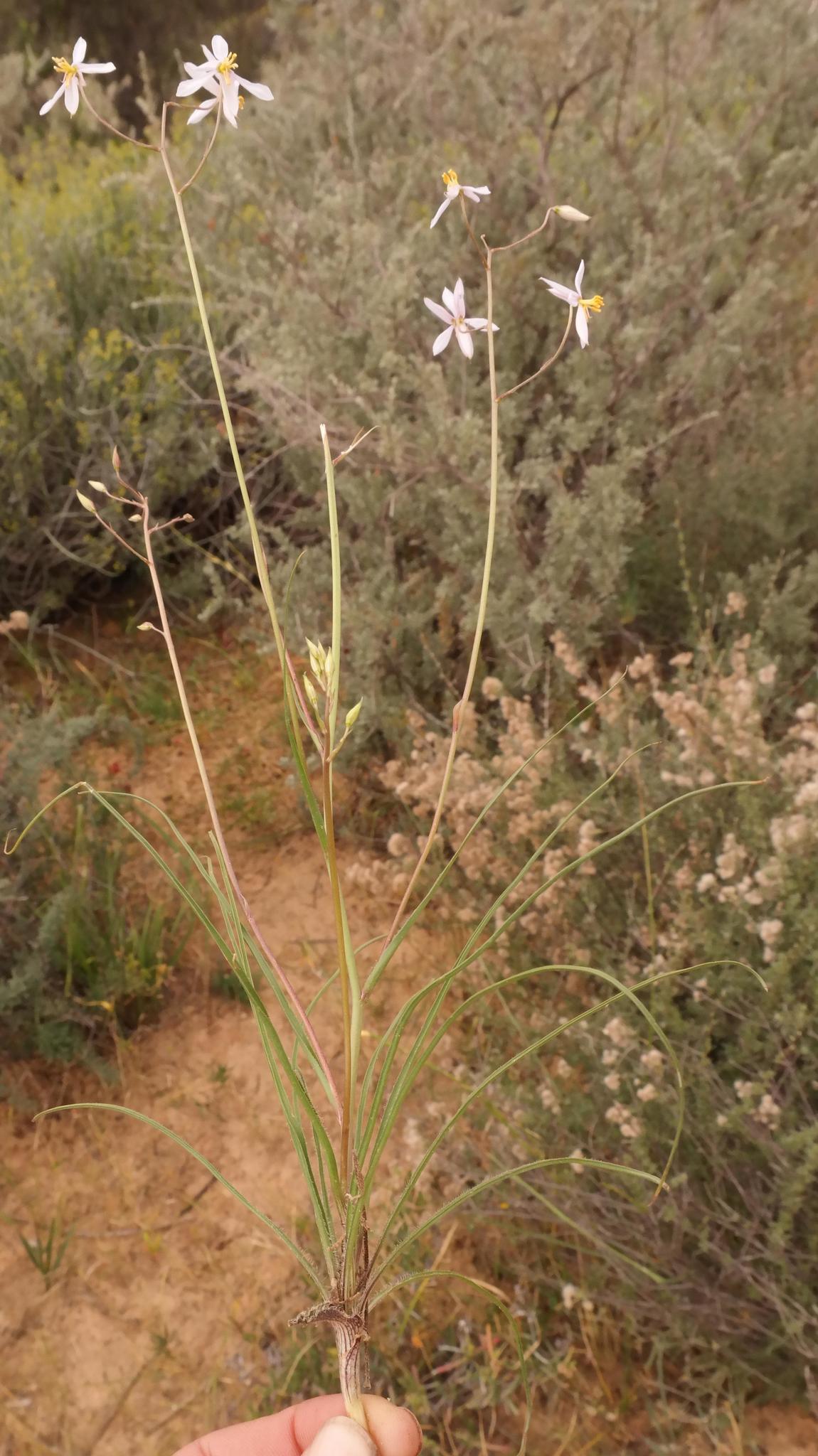
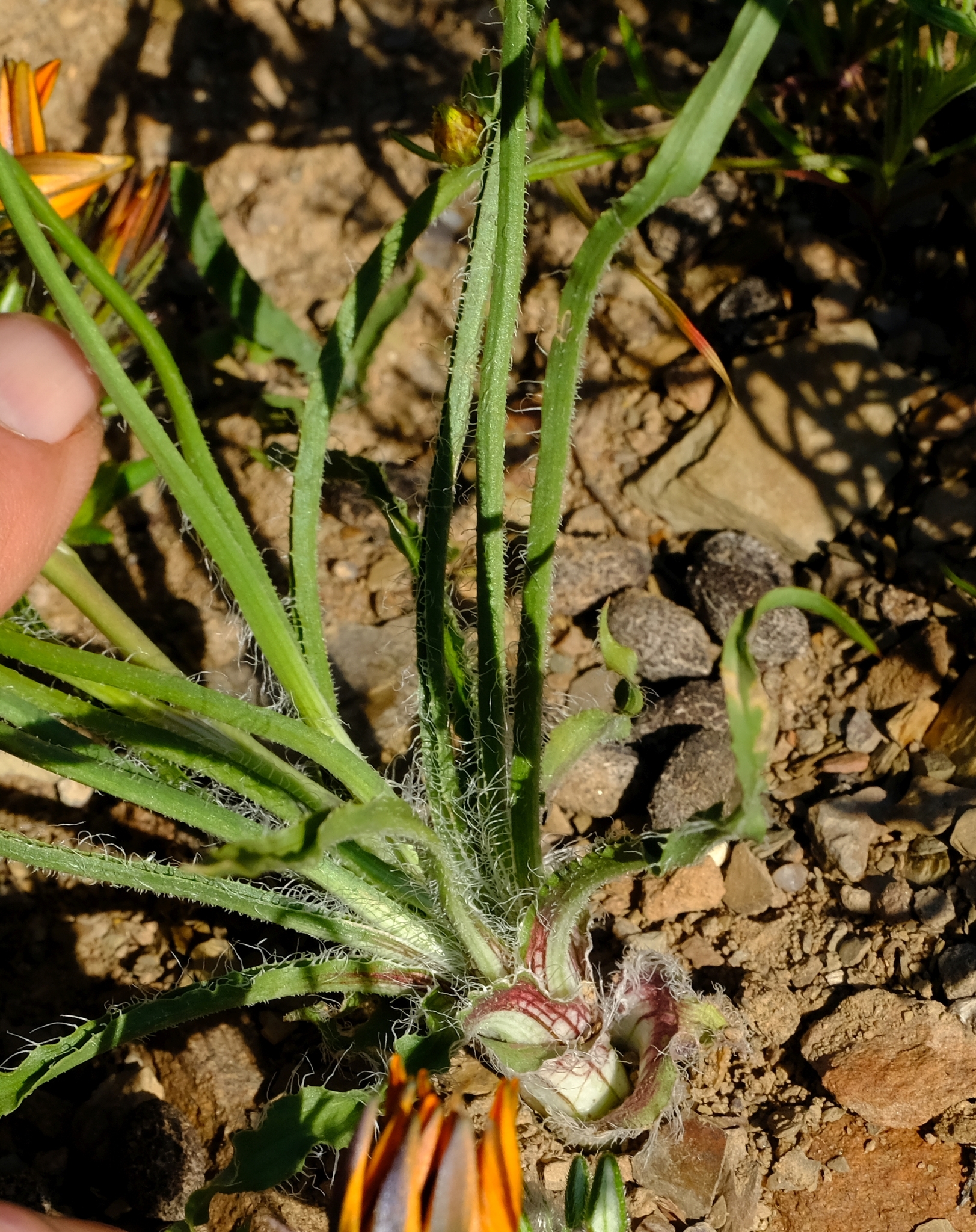
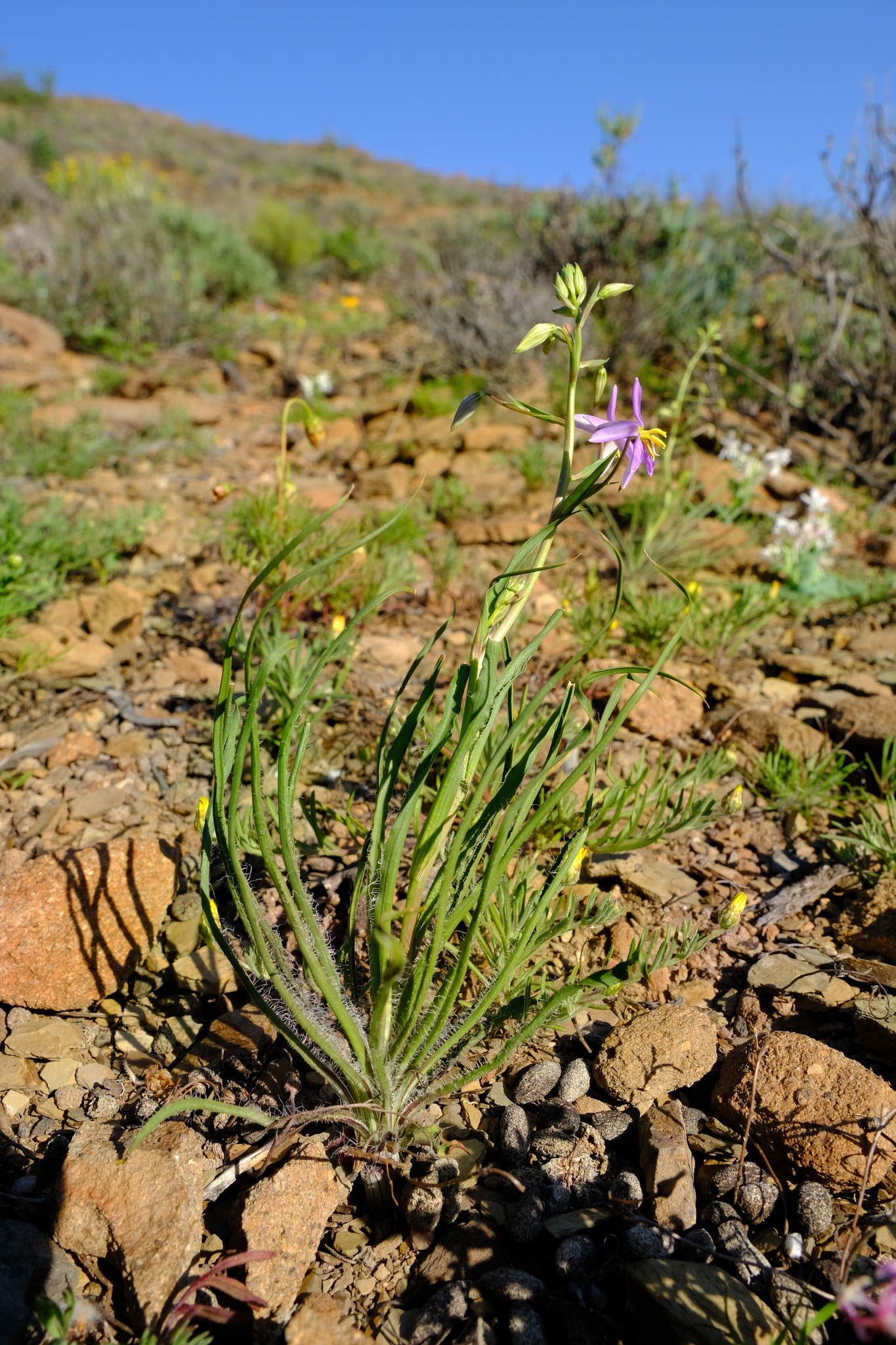
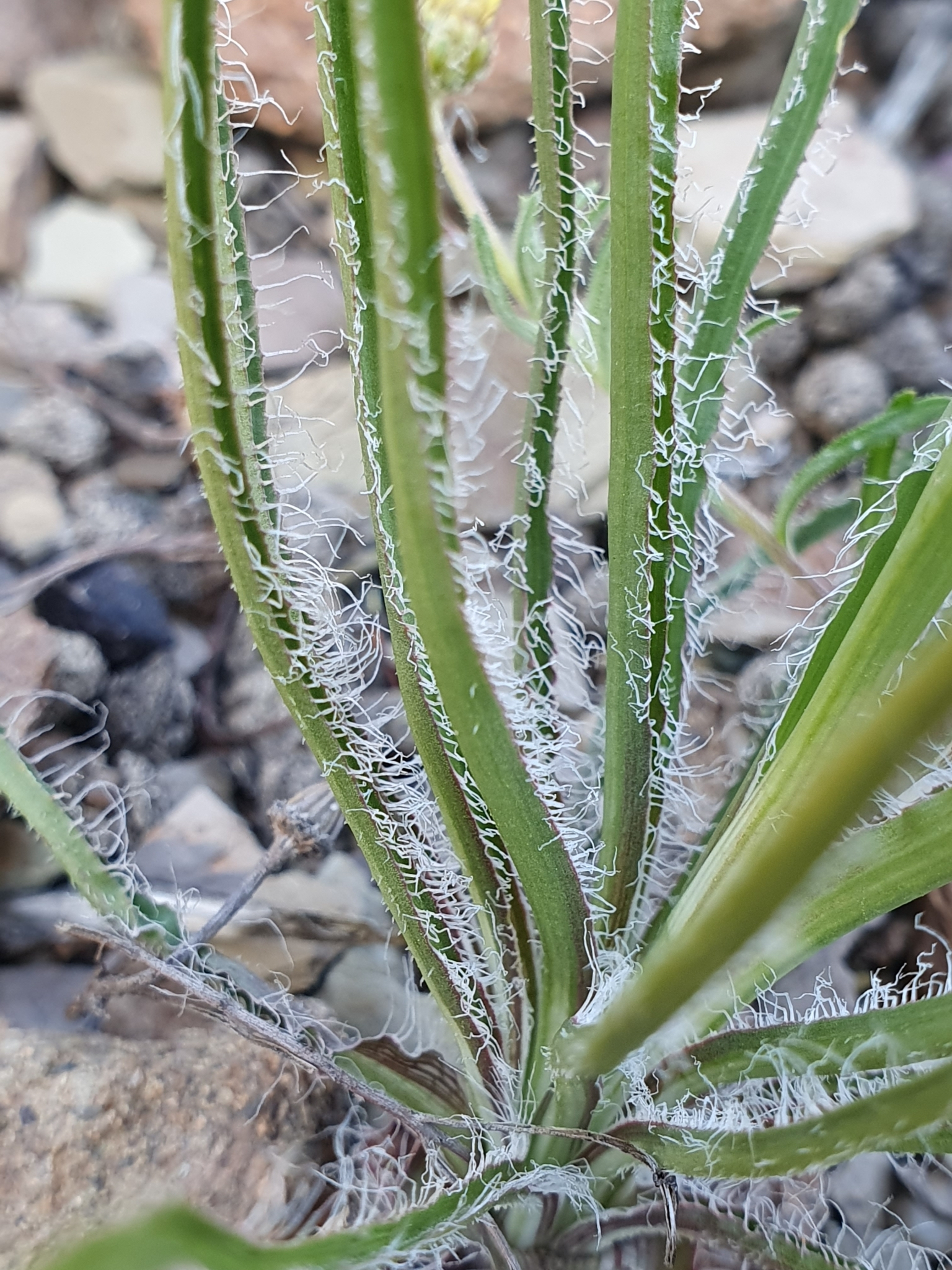
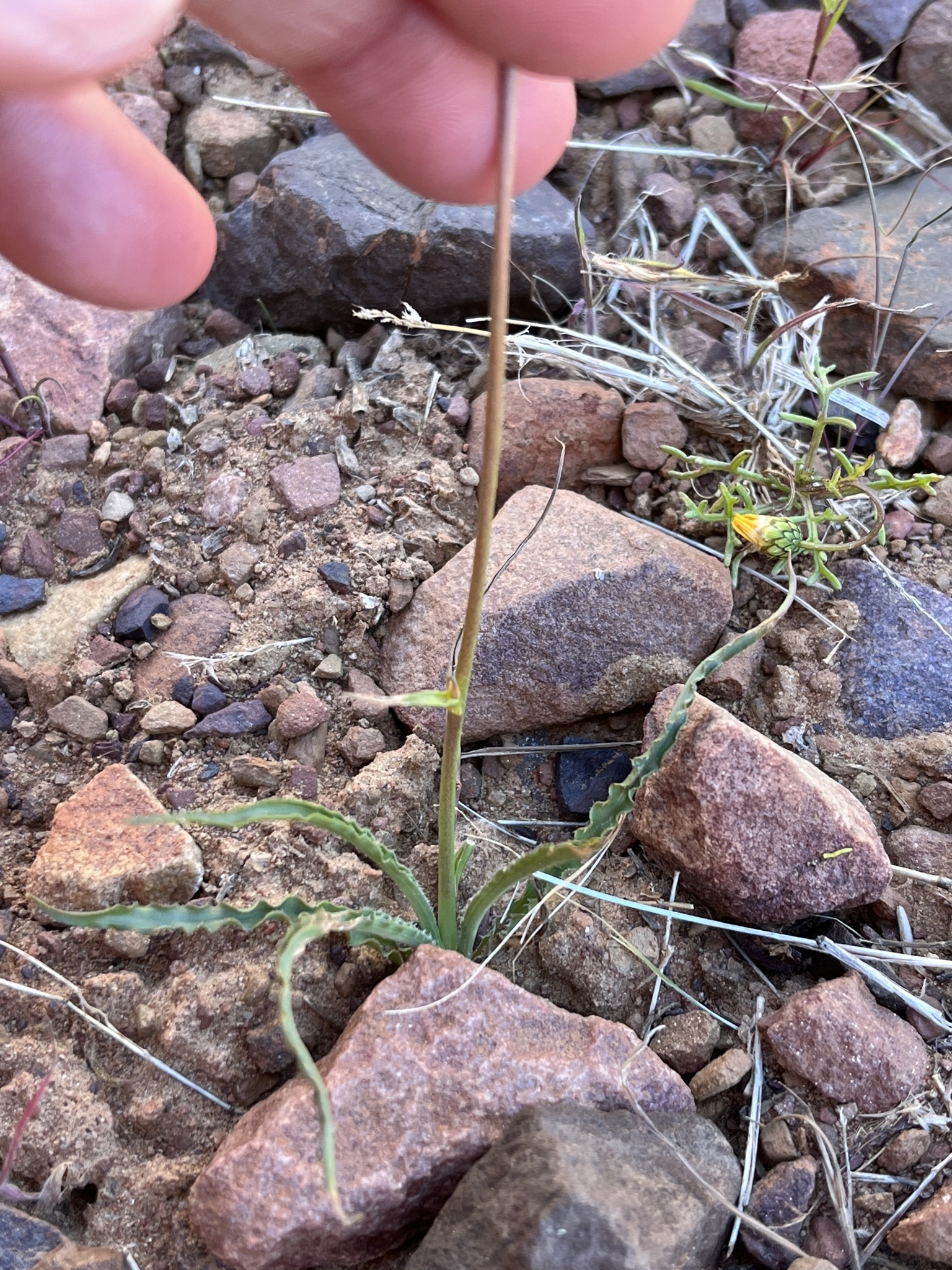
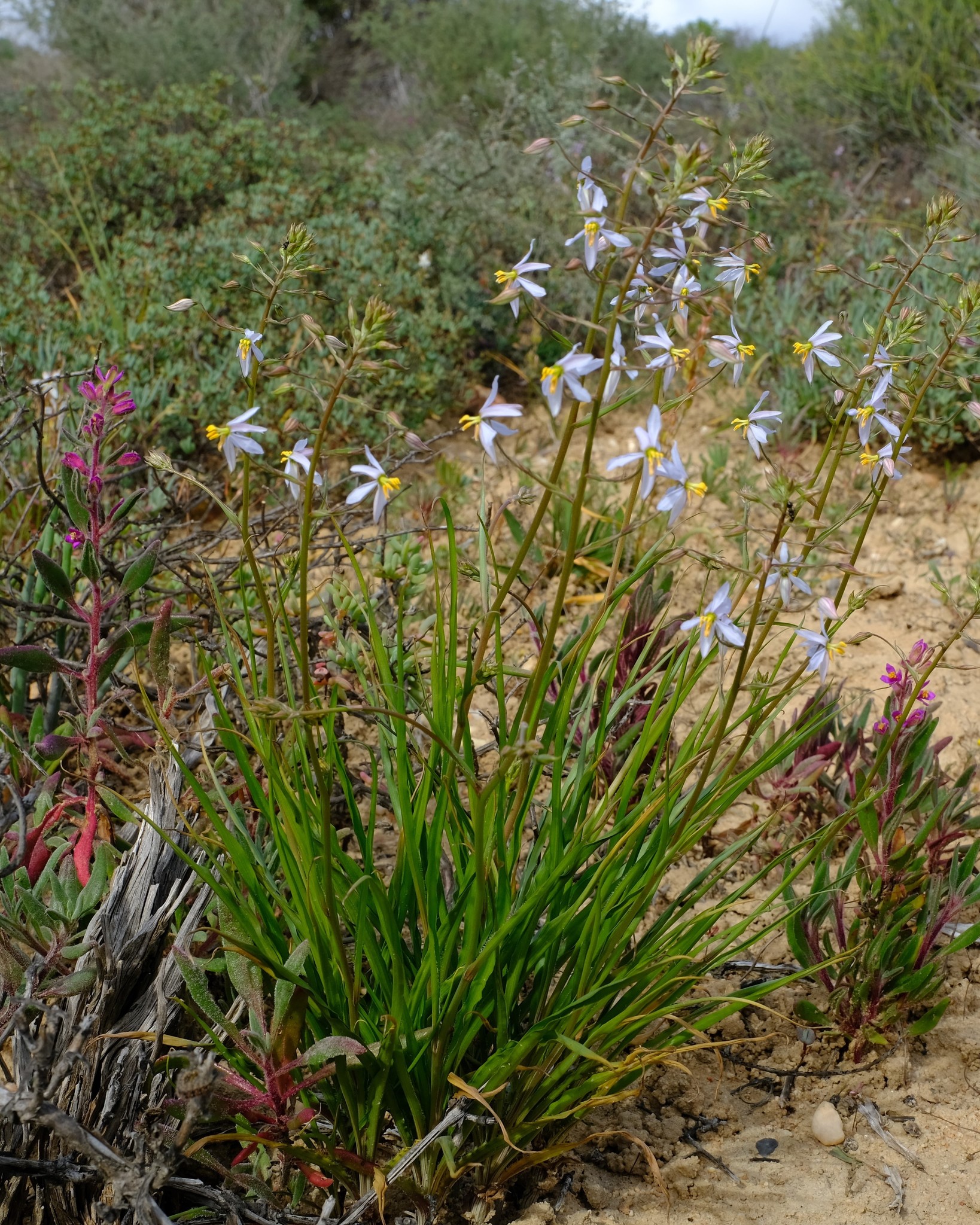
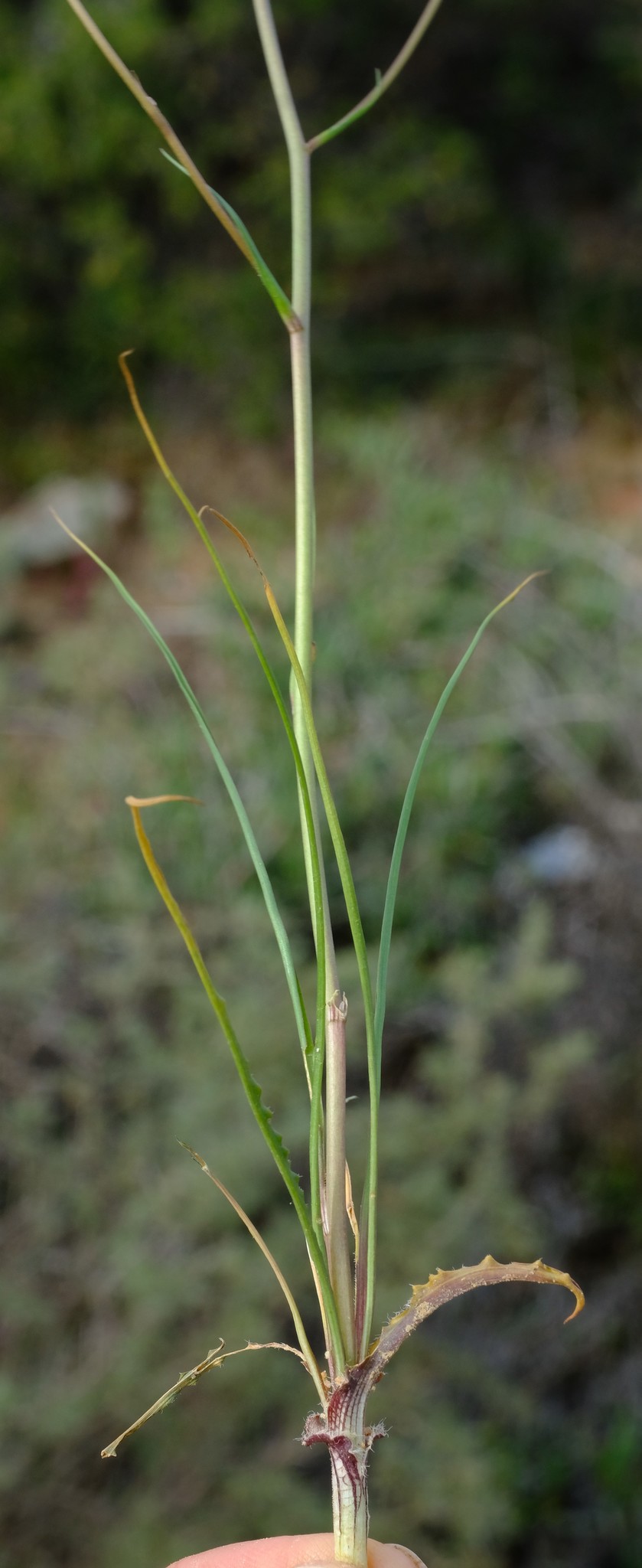
Like C. hyacinthoides but leaves linear and fringed basally with 2-3 mm long whiskers, also upper cataphyll which is maroon-reticulate. From: Manning, JC. 2013. Tecophilaeaceae. In: DA Snijman (ed.), Plants of the Greater Cape Floristic Region 2: The Extra Cape flora. Strelitzia 30: 161-162. South African National Biodiversity Institute, Pretoria. [CC BY]
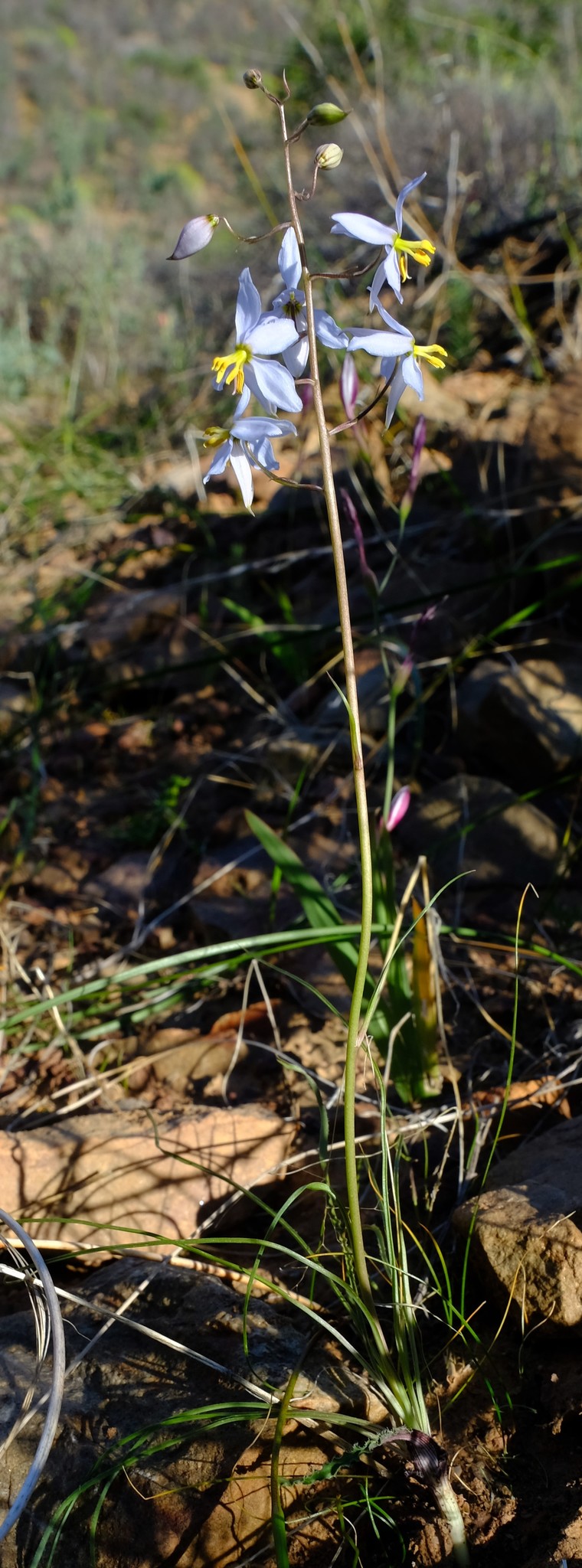
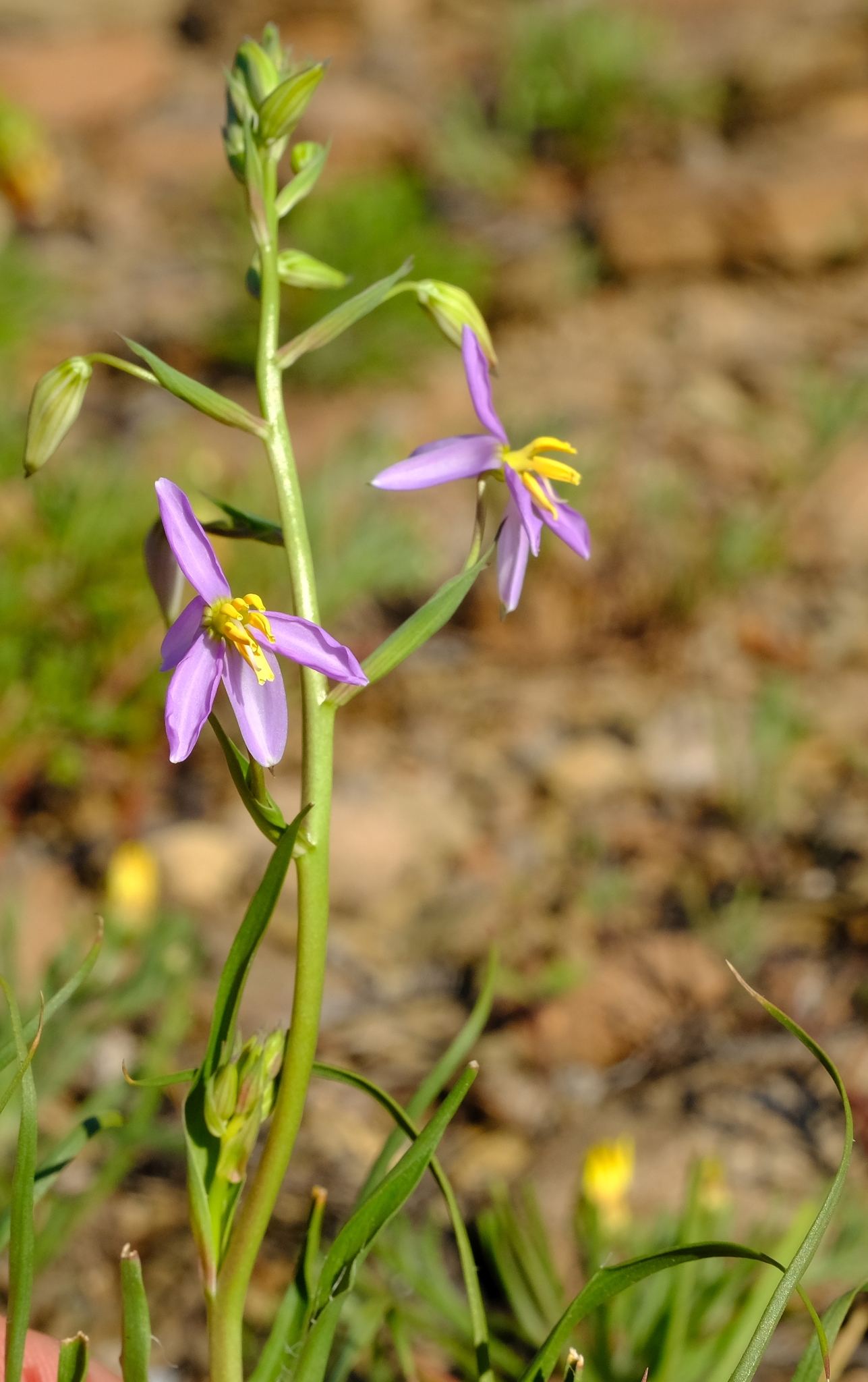
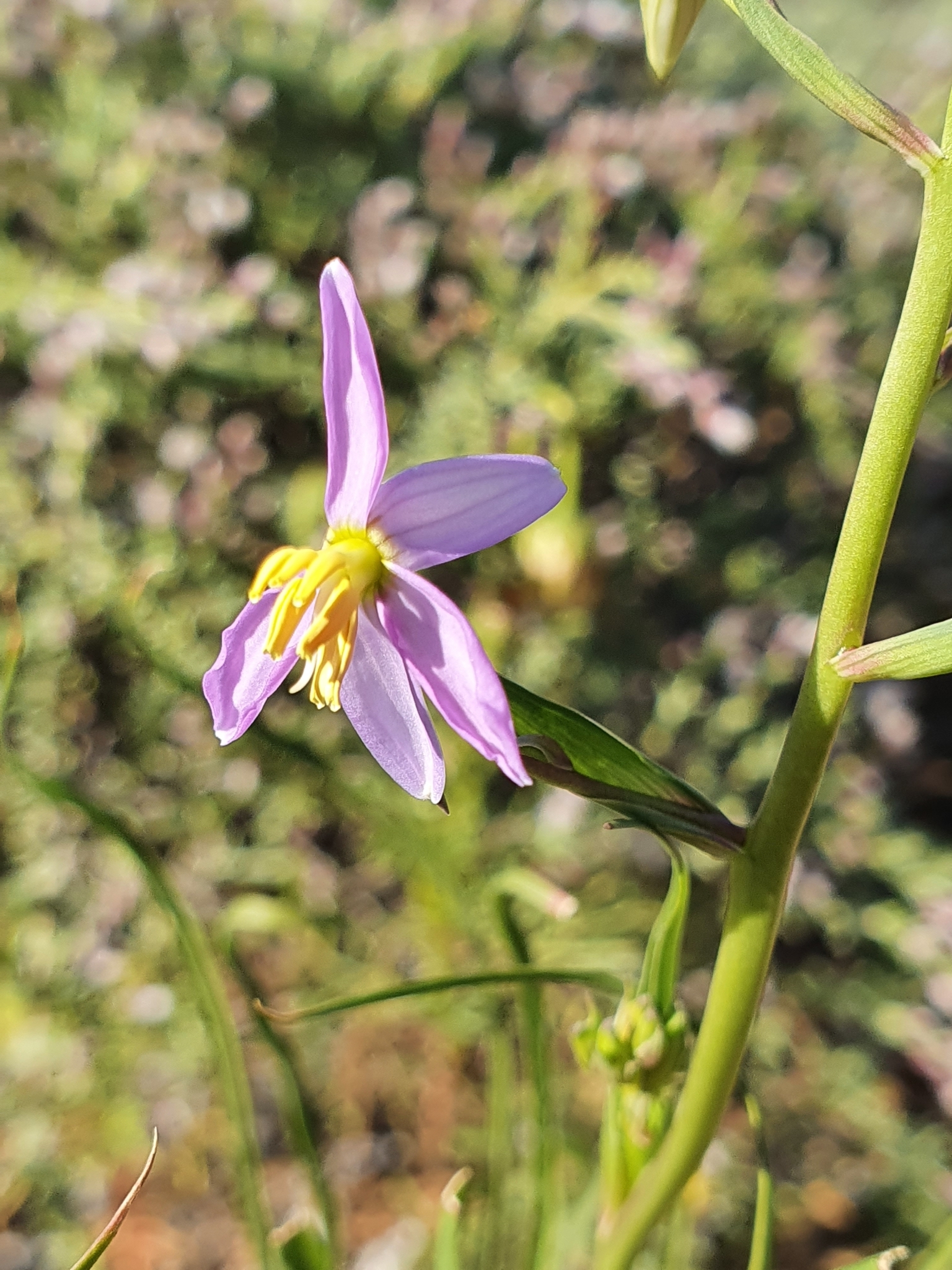
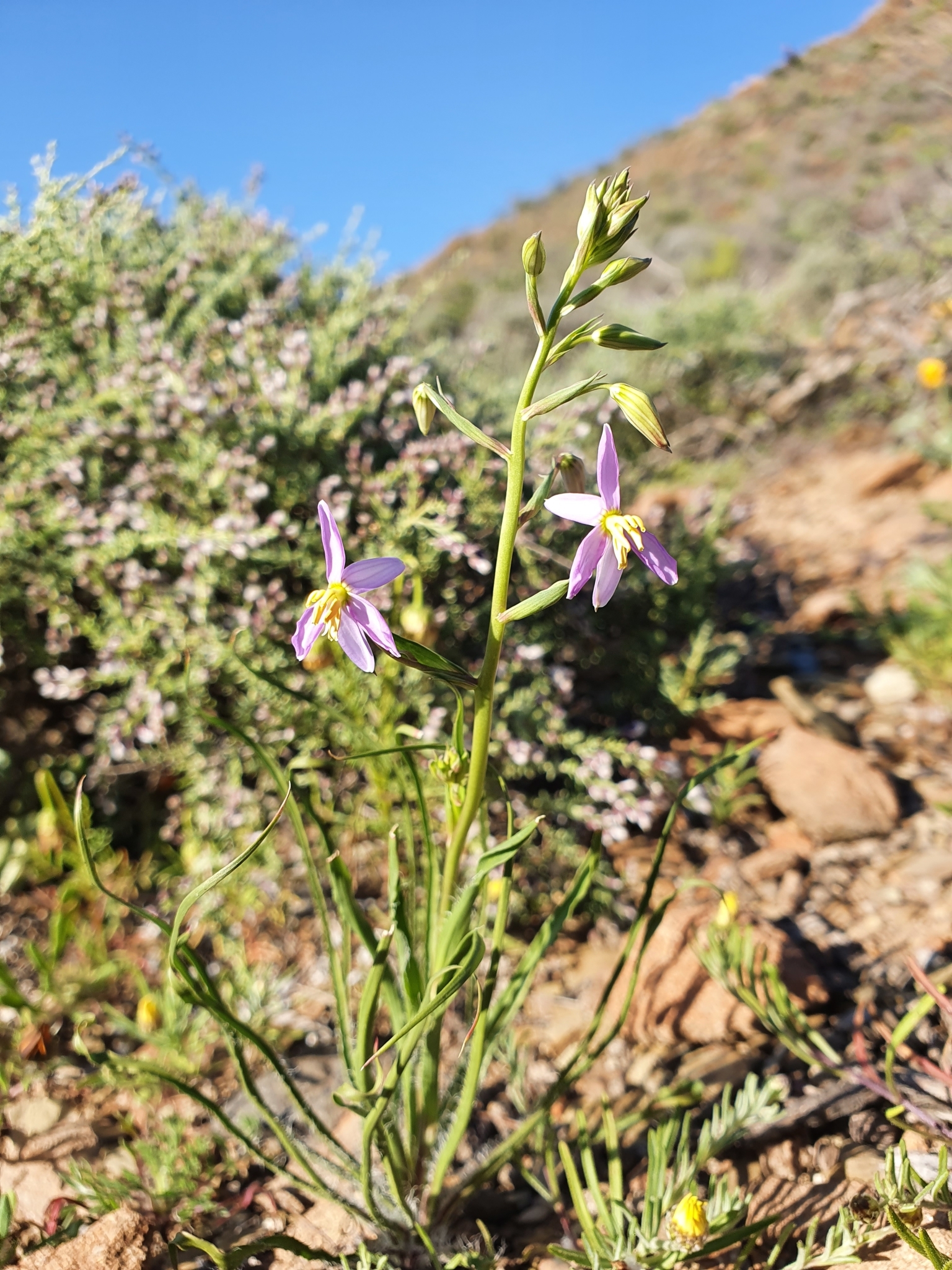
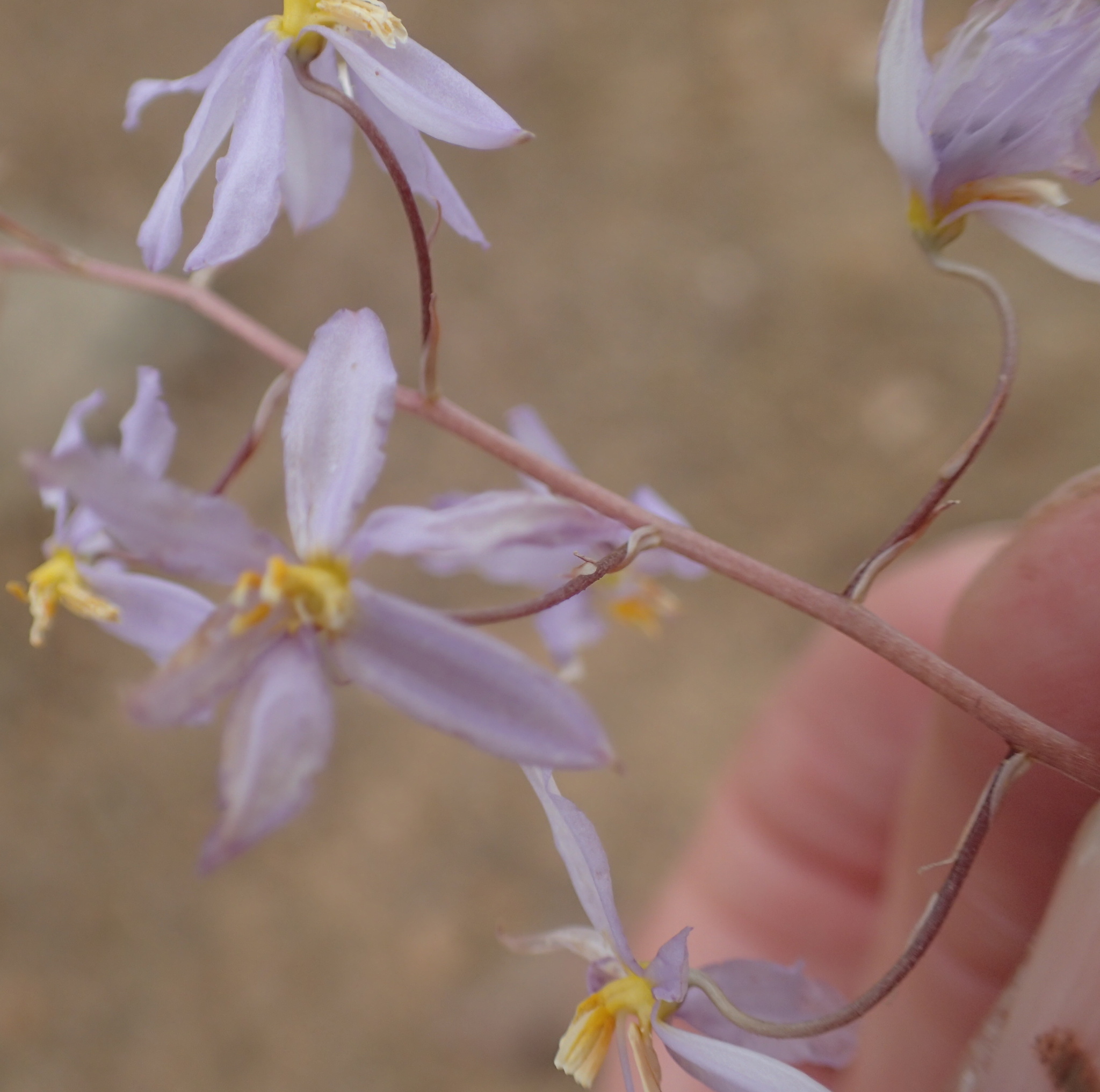
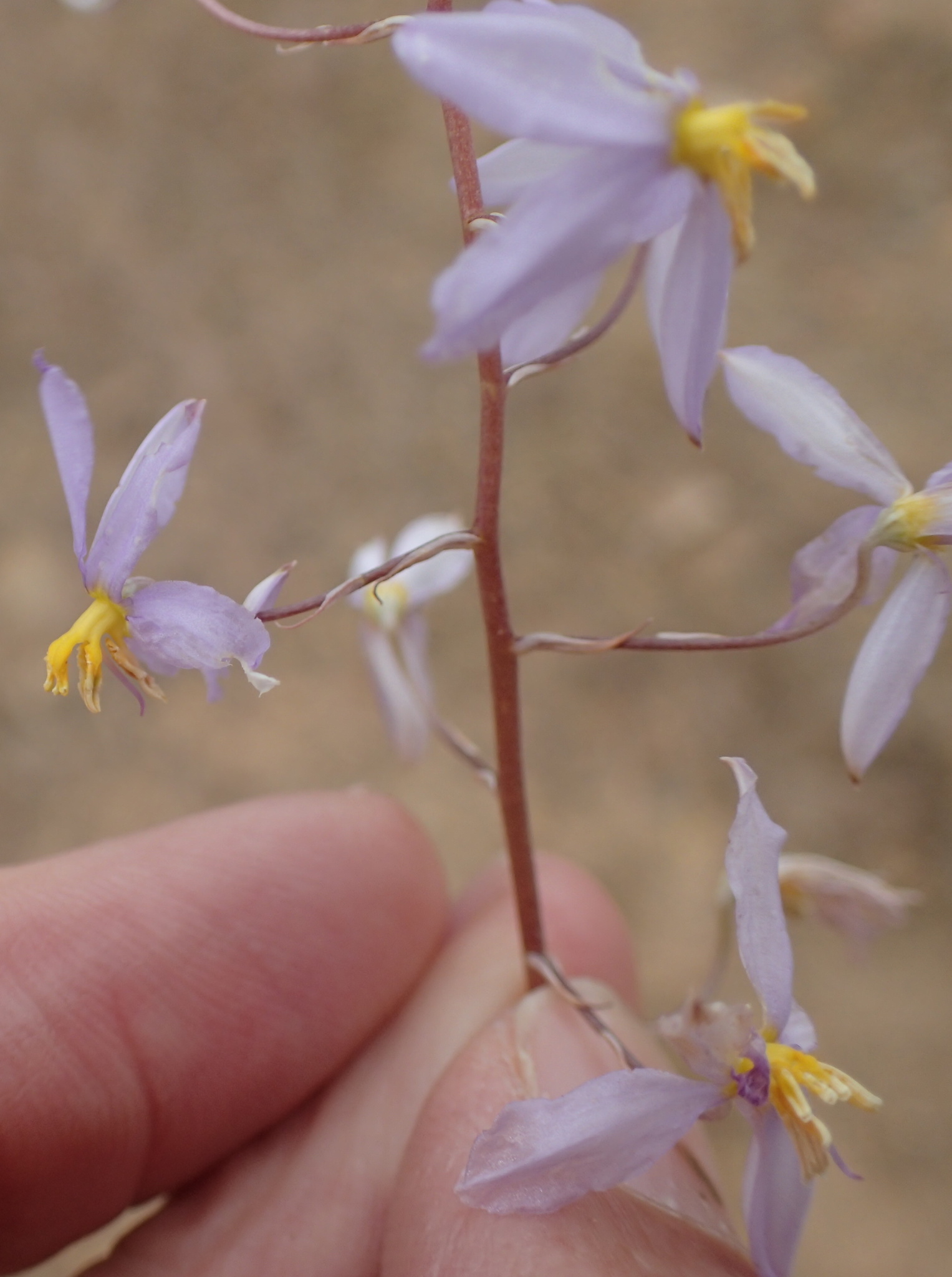
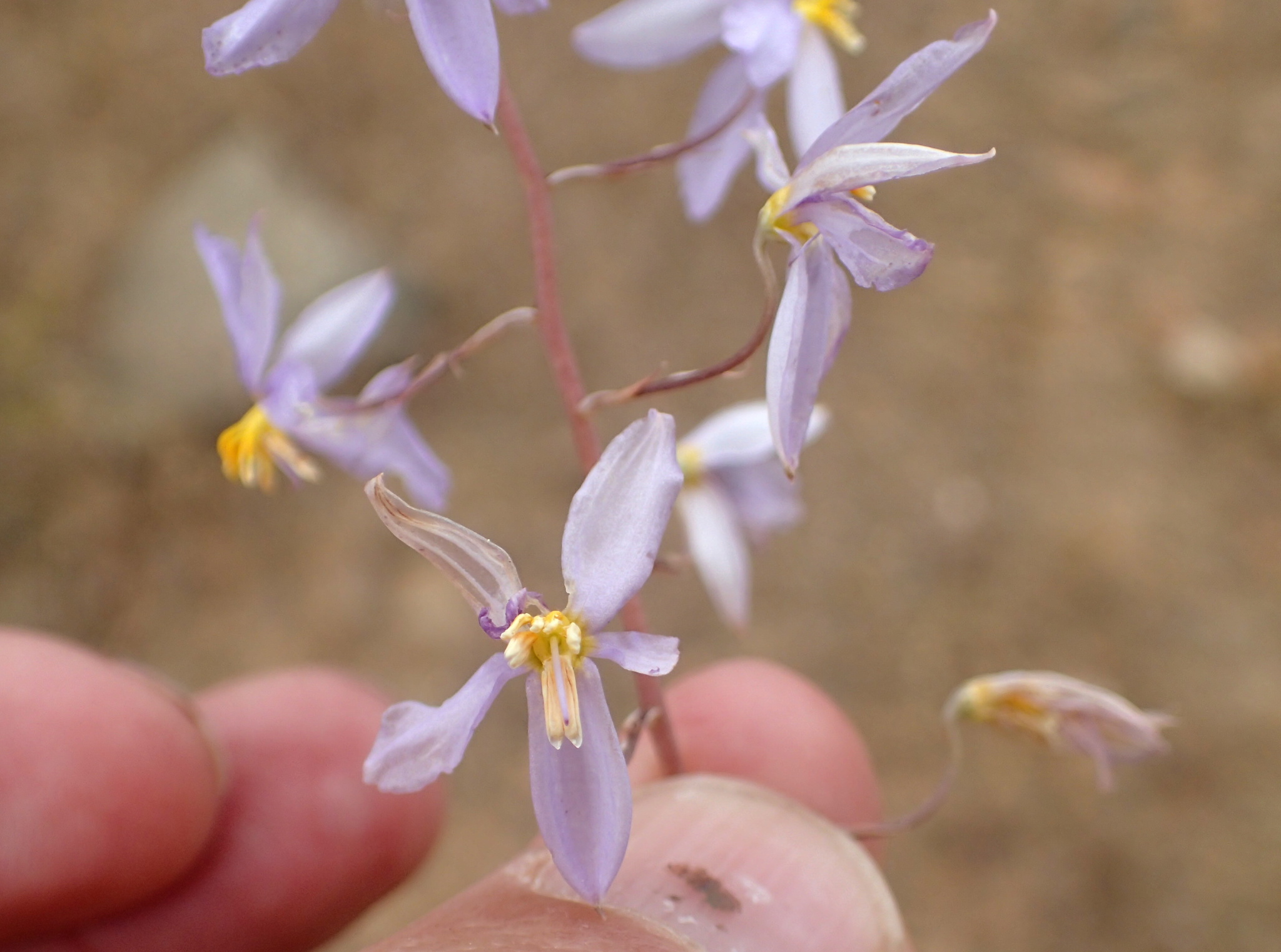
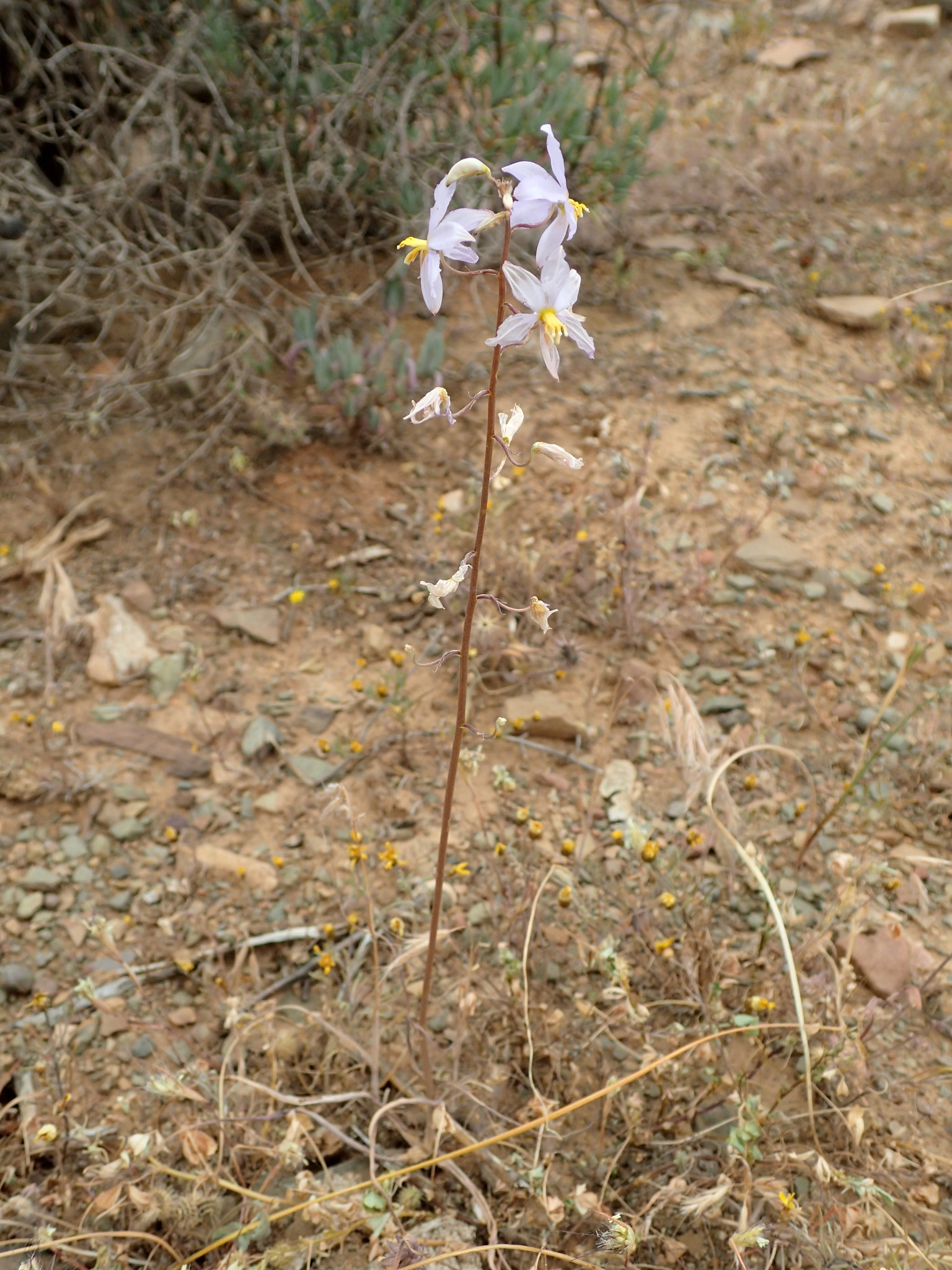
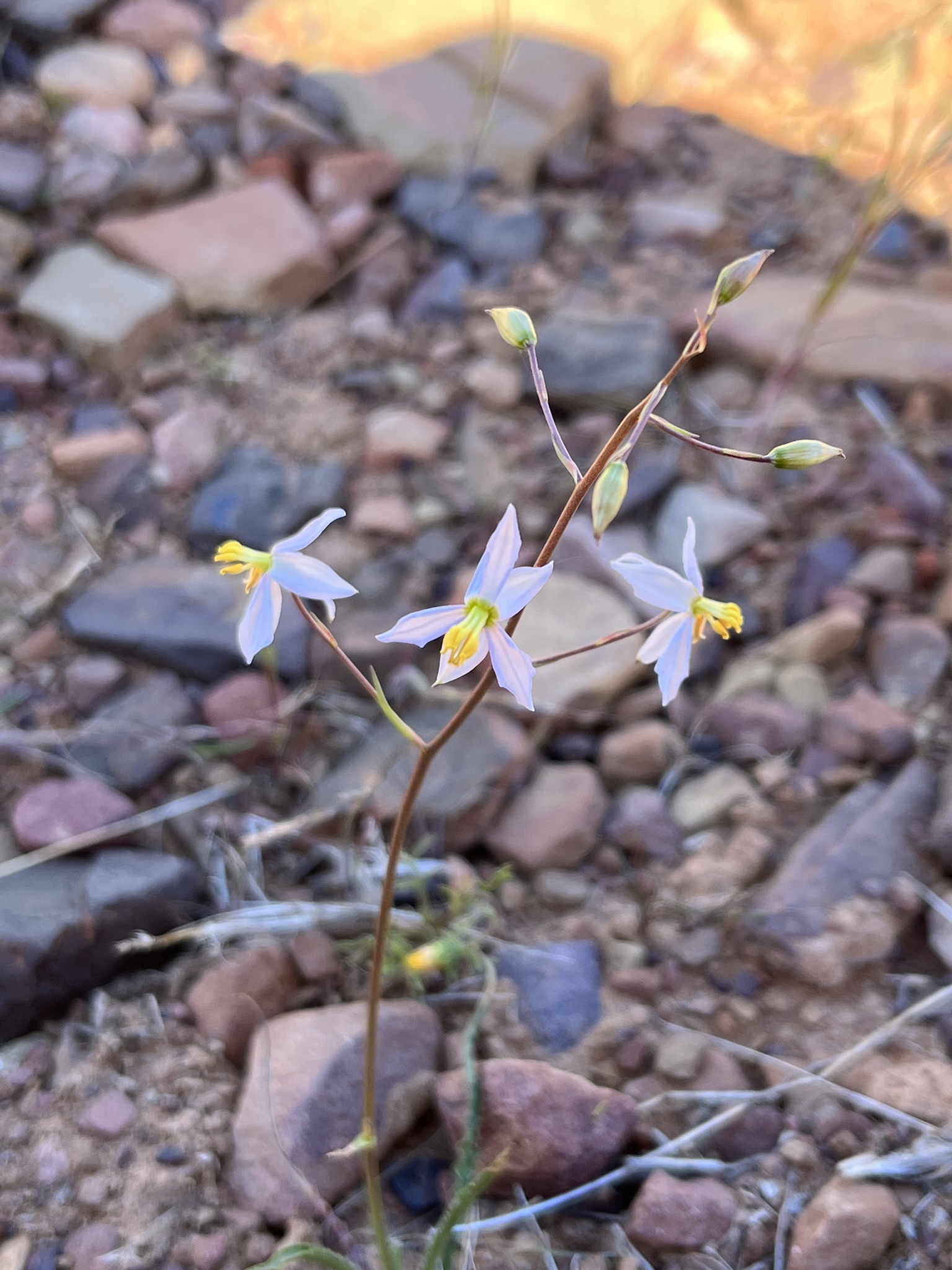
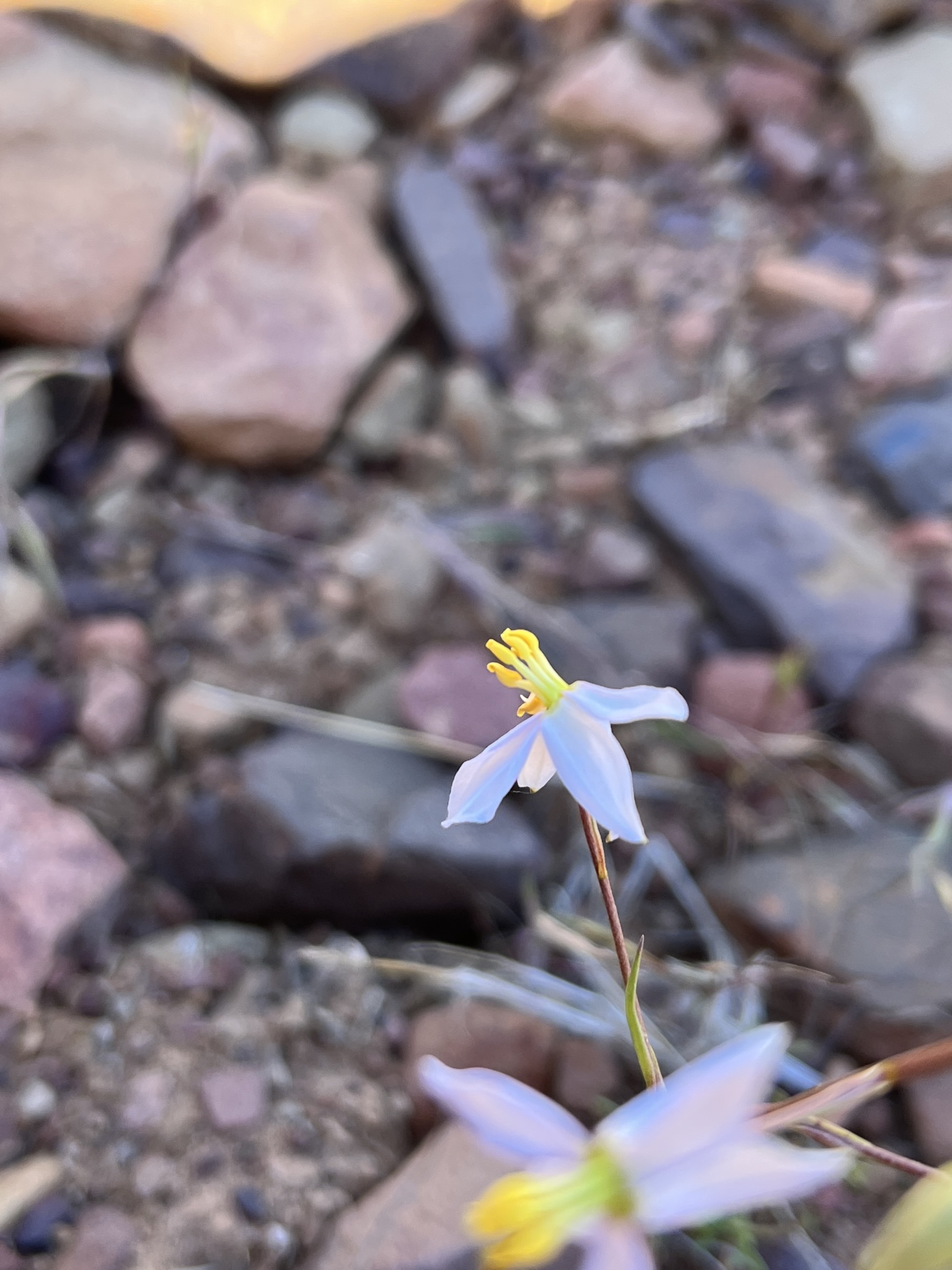
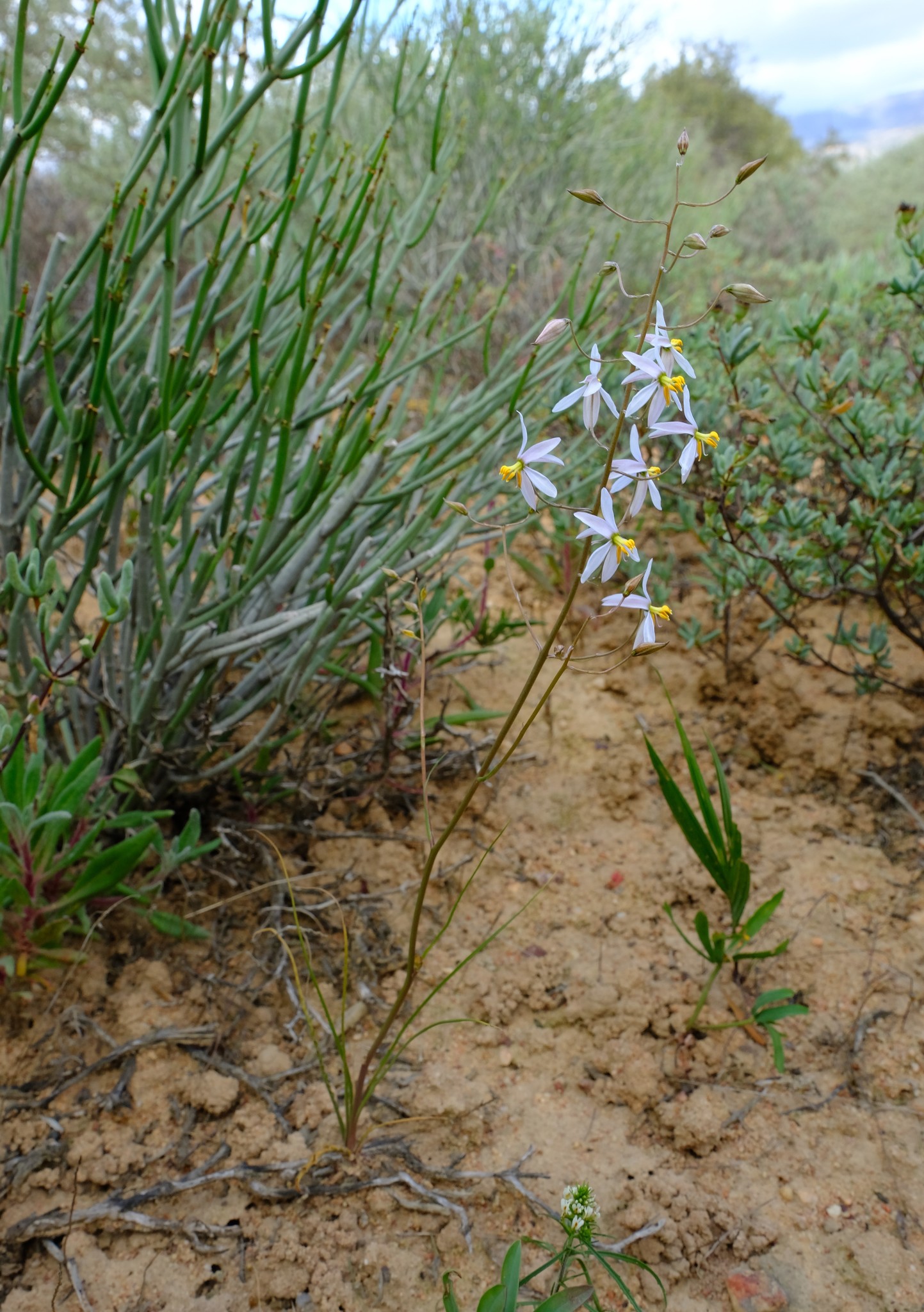
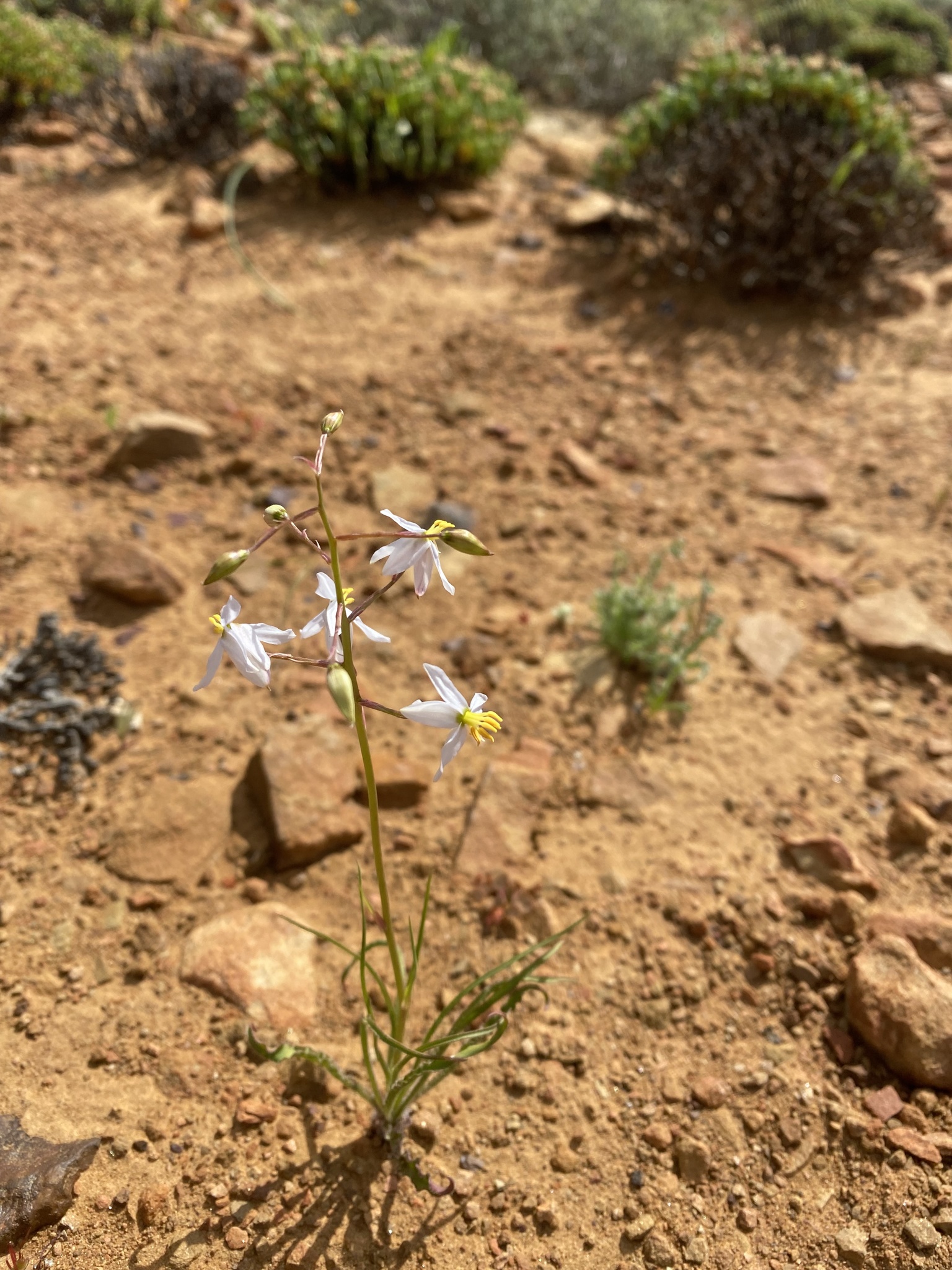
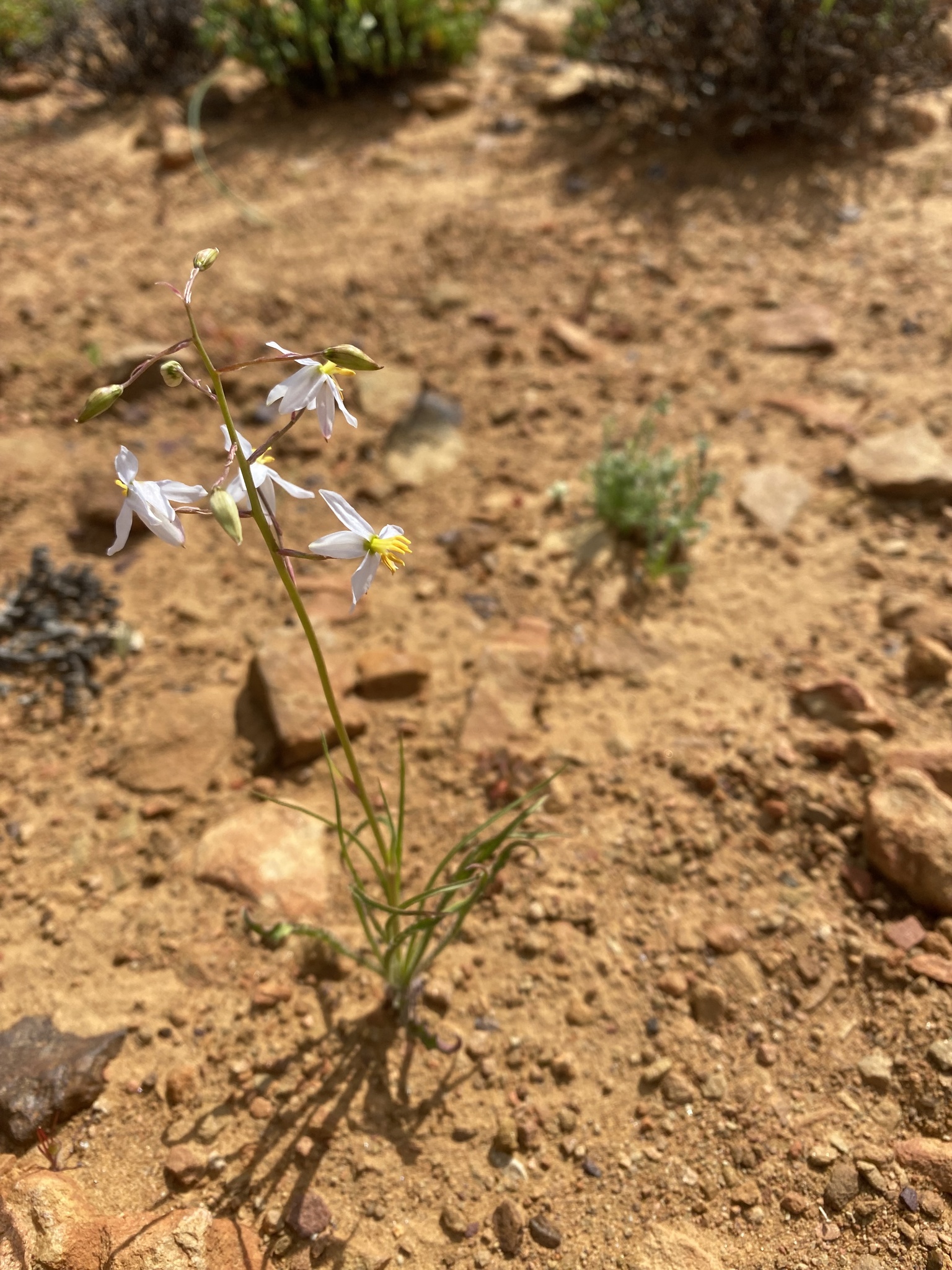
Plants 100-400 mm high. Corms deep-seated, 25-30 mm diam., tunics of coarsely netted, wiry or woody fibres, extending in a short or very long fibrous or papery neck to 100 mm long, pale brown. Basal leaves (5-) 9-17, suberect, often ± twisted or coiled apically, linear, 60-150 x 1-4 (-5) mm, attenuate, canaliculate- involute, with prominent midrib and ribbed veins abaxially, firm-textured, glabrous or veins puberulous abaxially, margins straight or ± undulate or crispulate, conspicuously ciliate in basal parts only with shaggy hairs 2.0-3.0 mm long but glabrous distally; upper cataphyll prominent, with crispulate margins villous as in leaves, strongly flushed purple towards edge and along veins, thus fenetrate, sometimes also villous on veins. Inflorescence a moderately dense raceme up to 25-flowered, simple or with up to 4 branches, lower flowers 0.3-0.6 times pedicel length apart; pedicels geniculate, horizontal in basal half or 2/3 then aburptly flexed upwards at ± right angles, mostly 20-30 mm long; bracteoles mostly inserted between lower and upper third, rarely subbasal. Flowers facing outwards, white to pale mauve or blue, fragrant; tepals spreading, ovate, 7-11 x 3-4 mm, apiculate. Stamens dimorphic, 5 + 1; filaments of posterior cluster 2.0-3.5 mm long, connate ± one 1/3 to 2/3 into tube 1.0-1.5 mm long, yellow, anthers 1.5-2.5 mm long, yellow; anterior stamen with filament ± 1 mm long, connate to upper cluster for ± half length, anther 2.5-3.5 mm long, yellow. Ovary half inferior, style medially deflexed, 3-4 mm long, not extending beyond anthers. Capsules erect on genicluate pedicels, subglobose, 5-6 mm diam., 3-lobed and retuse. Seeds unknown. From: Goldblatt, P; Manning, JC. 2012. A revision of Tecophilaeaceae subfam. Tecophilaeoideae in Africa. Bothalia 42(1): 21-41. [CC BY]
Like C. hyacinthoides but leaves linear-involute with long, shaggy hairs along margins towards base only, and cataphyll purple-fenestrate. From: Manning, JC; Goldblatt, P. 2012. Tecophilaeaceae. In: J Manning & P Goldblatt (eds), Plants of the Greater Cape Floristic Region 1: The Core Cape flora. Strelitzia 29: 255-255. South African National Biodiversity Institute, Pretoria. [CC BY]
Cyanella pentheri has mostly been treated as conspecific with C. hyacinthoides, essentially because of the confusion between true C. pentheri and what we regard as pubescent forms of C. hyacinthoides. Florally, the two species are certainly alike in their moderately dense, branched racemes of spreading, white or mauve to blue flowers with 5 + 1 arrangement of stamens with the filaments connate for ± half their length or more, but they differ significantly in their foliage. The leaves of C. pentheri are consistently linear and canaliculate-involute, mostly 1-4 mm wide, with margins that are conspicuously ciliate only towards the base with long, shaggy hairs 2.0-3.0 mm long. Similar, long cilia also fringe the upper catapyll, which is funnel-shaped, and strikingly pigmented with deep purple along the edges and veins, giving it a characteristic fenestrate appearance. The leaves of C. hyacinthoides, in contrast, are mostly lanceolate and 4-15 mm wide, rarely narrower, with margins either smooth or ciliolate-pubescent along their entire length, with much shorter hairs 0.2-1.0 mm long, and the upper cataphyll is usually unmarked. Pubescent forms of C. hyacinthoides from central Namaqualand have leaves that are variously puberulous to villous but never with the long cilia characteristic of C. pentheri. From: Goldblatt, P; Manning, JC. 2012. A revision of Tecophilaeaceae subfam. Tecophilaeoideae in Africa. Bothalia 42(1): 21-41. [CC BY]
Rocky and stony flats. From: Manning, JC. 2013. Tecophilaeaceae. In: DA Snijman (ed.), Plants of the Greater Cape Floristic Region 2: The Extra Cape flora. Strelitzia 30: 161-162. South African National Biodiversity Institute, Pretoria. [CC BY]
Rocky outcrops. From: Manning, JC; Goldblatt, P. 2012. Tecophilaeaceae. In: J Manning & P Goldblatt (eds), Plants of the Greater Cape Floristic Region 1: The Core Cape flora. Strelitzia 29: 255-255. South African National Biodiversity Institute, Pretoria. [CC BY]
Rocky places, often sandstone, mainly in arid fynbos. From: Goldblatt, P; Manning, JC. 2012. A revision of Tecophilaeaceae subfam. Tecophilaeoideae in Africa. Bothalia 42(1): 21-41. [CC BY]
Bokkeveld and Gifberg flats to Olifants River Valley. From: Manning, JC. 2013. Tecophilaeaceae. In: DA Snijman (ed.), Plants of the Greater Cape Floristic Region 2: The Extra Cape flora. Strelitzia 30: 161-162. South African National Biodiversity Institute, Pretoria. [CC BY]
Clanwilliam to Bokkeveld Mtns.* From: Manning, JC; Goldblatt, P. 2012. Tecophilaeaceae. In: J Manning & P Goldblatt (eds), Plants of the Greater Cape Floristic Region 1: The Core Cape flora. Strelitzia 29: 255-255. South African National Biodiversity Institute, Pretoria. [CC BY]
A restricted distribution through the middle reaches of the Olifants River Valley from north of Citrusdal to Klawer, extending along the foot of the Gifberg onto the Bokkeveld Escarpment, and inland to the Bidouw and Doring River valleys. From: Goldblatt, P; Manning, JC. 2012. A revision of Tecophilaeaceae subfam. Tecophilaeoideae in Africa. Bothalia 42(1): 21-41. [CC BY]
August
This map contains point-based occurrences at different locations
Occurrence in the Flora of Southern Africa (FSA) countries and South African provinces. Residence status indicates if a taxon is indigenous, endemic, naturalised or invasive in a specific region. This data is based on specimen records and literature
FSA
SA
BOT
NAM
ESW
LES
WC
EC
NC
FS
GA
KZN
LP
MP
NW
Absent
Indigenous
Endemic
Naturalised
Invasive



Names and Sources
Published in: Ann. K. K. Naturhist. Hofmus. 15: 26 (1900)
| Common name | Language | Reference/barcode | Published as |
|---|---|---|---|
| klipraap | Afrikaans | Goldblatt, P; Manning, JC. 2012. A revision of Tecophilaeaceae subfam. Tecophilaeoideae in Africa, Bothalia 42(1): 21-41. |
Classification
KINGDOM Plantae
SUBKINGDOM Phanerogamae
PHYLUM Anthophyta
ORDER Asparagales
FAMILY Tecophilaeaceae
SUBFAMILY Tecophilaeoideae
GENUS Cyanella
SPECIES pentheri
12 results for Cyanella pentheri Zahlbr.
Barcode: NBG1548089-0 Collector(s) & number: Helme, NA, 9635 | 2019-8-27
South Africa, Western Cape, 3 km S of Clanwilliam, just east of road to Algeria, near small dump.
Data Resource: BODATSA View record
Barcode: NBG1548107-0 Collector(s) & number: Helme, NA, 9663 | 2019-9-6
South Africa, Western Cape, Welbedacht, pass from Biedou valley to Tra Tra plateau.
Data Resource: BODATSA View record
Barcode: NBG0278261-0 Collector(s) & number: C.R.E.W., CR15371 | 2011-8-20
South Africa, Western Cape, Biedouw Valley (Joubert van der Merwe's farm) site above and around farmhouse. 32°09'05.4" E; 19°12'41.7" S.
General notes: Succulent Karoo biome. Hill slope. Well-drained, sandy soil. Sandstone. Flowers present.
Data Resource: BODATSA View record
Barcode: NBG1478527-0 Collector(s) & number: Helme, NA, 8964 | 2016-9-15
South Africa, Western Cape, ± 6 km SW of Clanwilliam; Kransvlei 205; 3 km NW of Driehoek.
Data Resource: BODATSA View record
This map contains point-based occurrences at different locations
2013
SERIES CHAPTER
Tecophilaeaceae Manning, JCIn: DA Snijman (ed.), Plants of the Greater Cape Floristic Region 2: The Extra Cape flora. Strelitzia 30: 161-162
South African National Biodiversity Institute, Pretoria
2012
PERIODICAL/JOURNAL
A revision of Tecophilaeaceae subfam. Tecophilaeoideae in Africa Goldblatt, P; Manning, JCBothalia 42(1)21-41
2012
SERIES CHAPTER
Tecophilaeaceae Manning, JC; Goldblatt, PIn: J Manning & P Goldblatt (eds), Plants of the Greater Cape Floristic Region 1: The Core Cape flora. Strelitzia 29: 255-255
South African National Biodiversity Institute, Pretoria
1991
PERIODICAL/JOURNAL
A revision of Cyanella (Tecophilaceae) excluding C. amboensis Scott, GSouth African Journal of Botany 57: 34-54
No results found for Cyanella pentheri Zahlbr.
Status and criteria
LC
Assessor(s)
Plantae Coordinator
| Part(s) of plant used | Use(s) | Reference |
|---|
Coming soon...


