PLANTAE / PHANEROGAMAE / ANTHOPHYTA / MALPIGHIALES / RHIZOPHORACEAE / RHIZOPHOREAE / CERIOPS / TAGAL

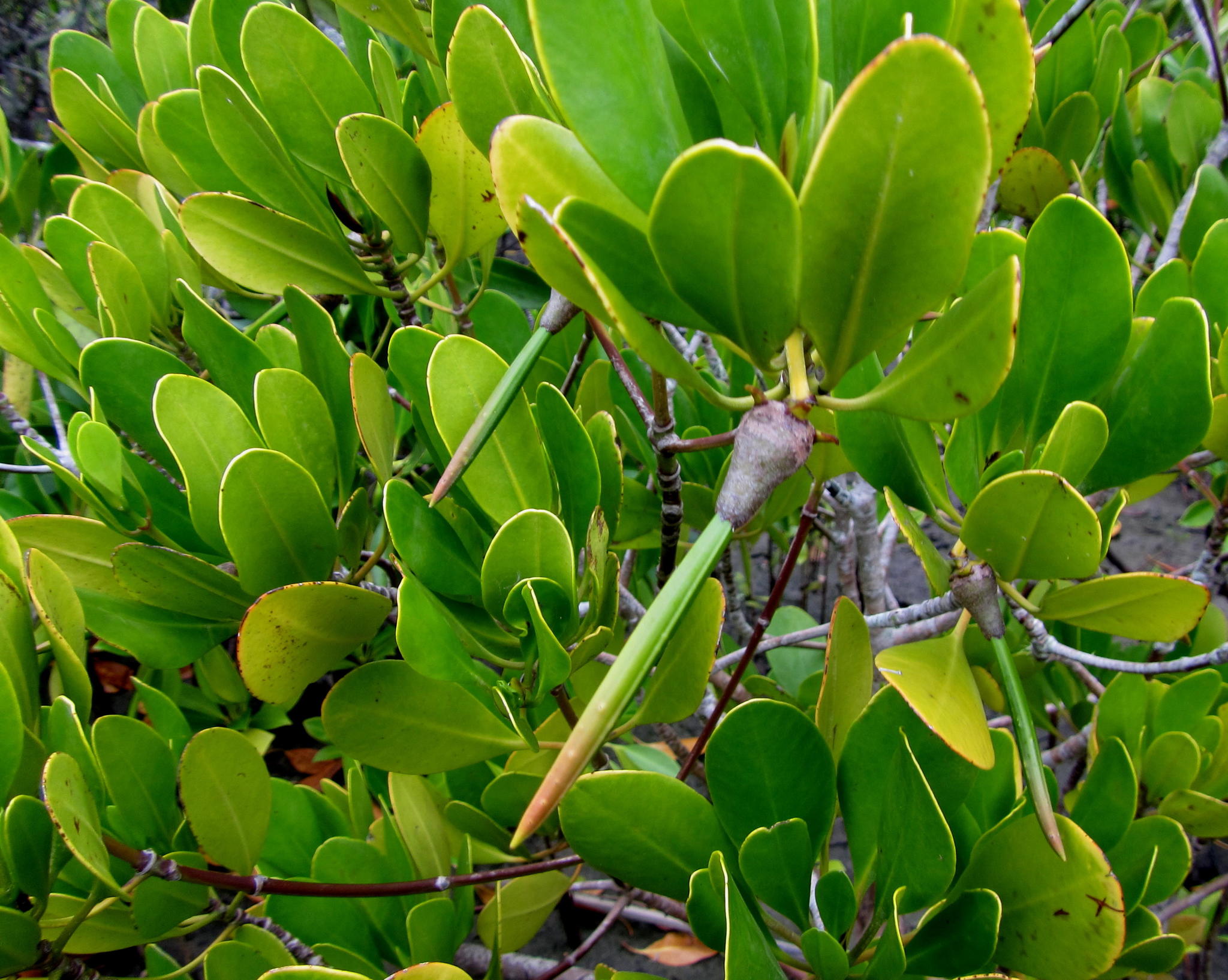
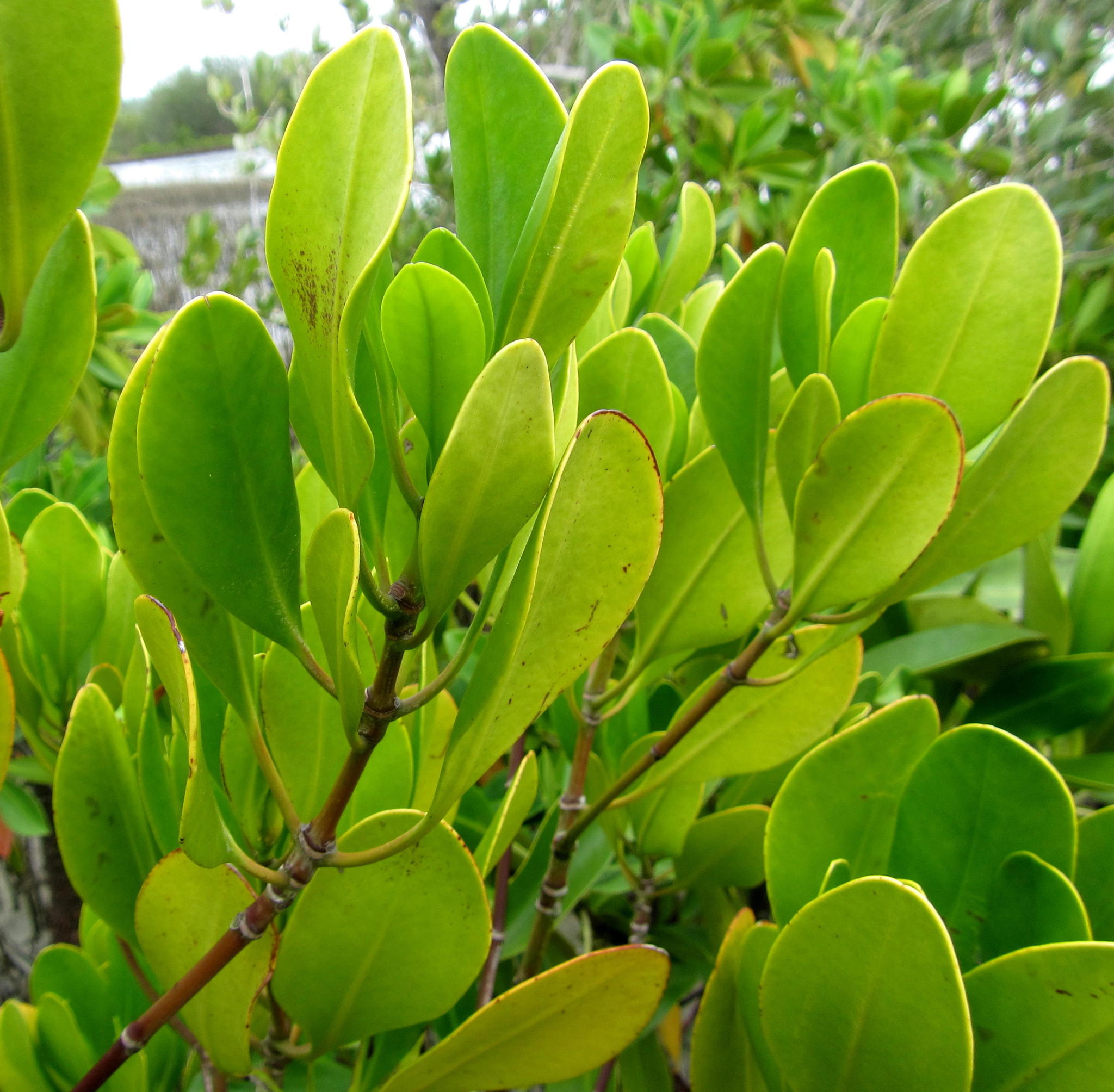
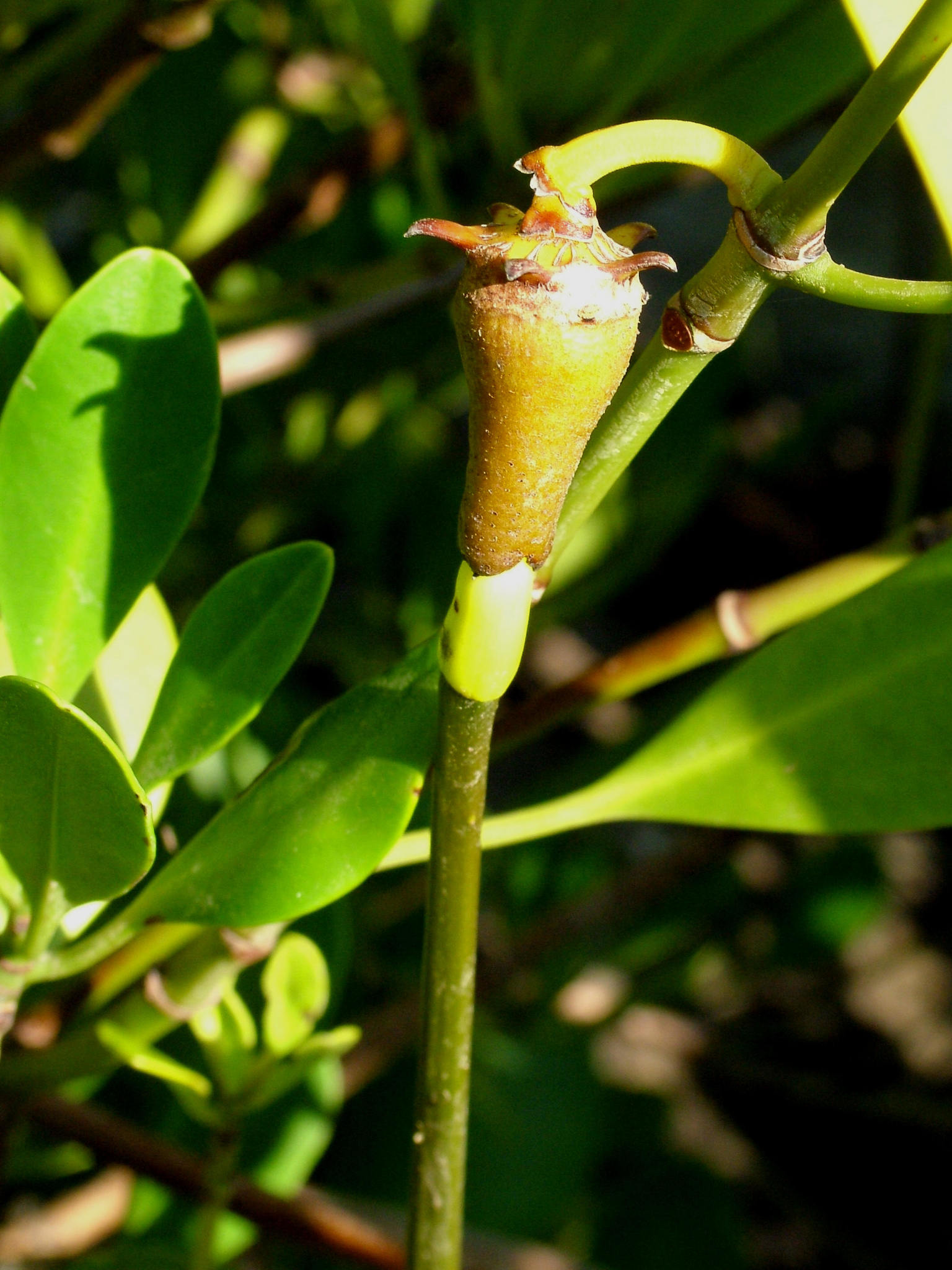
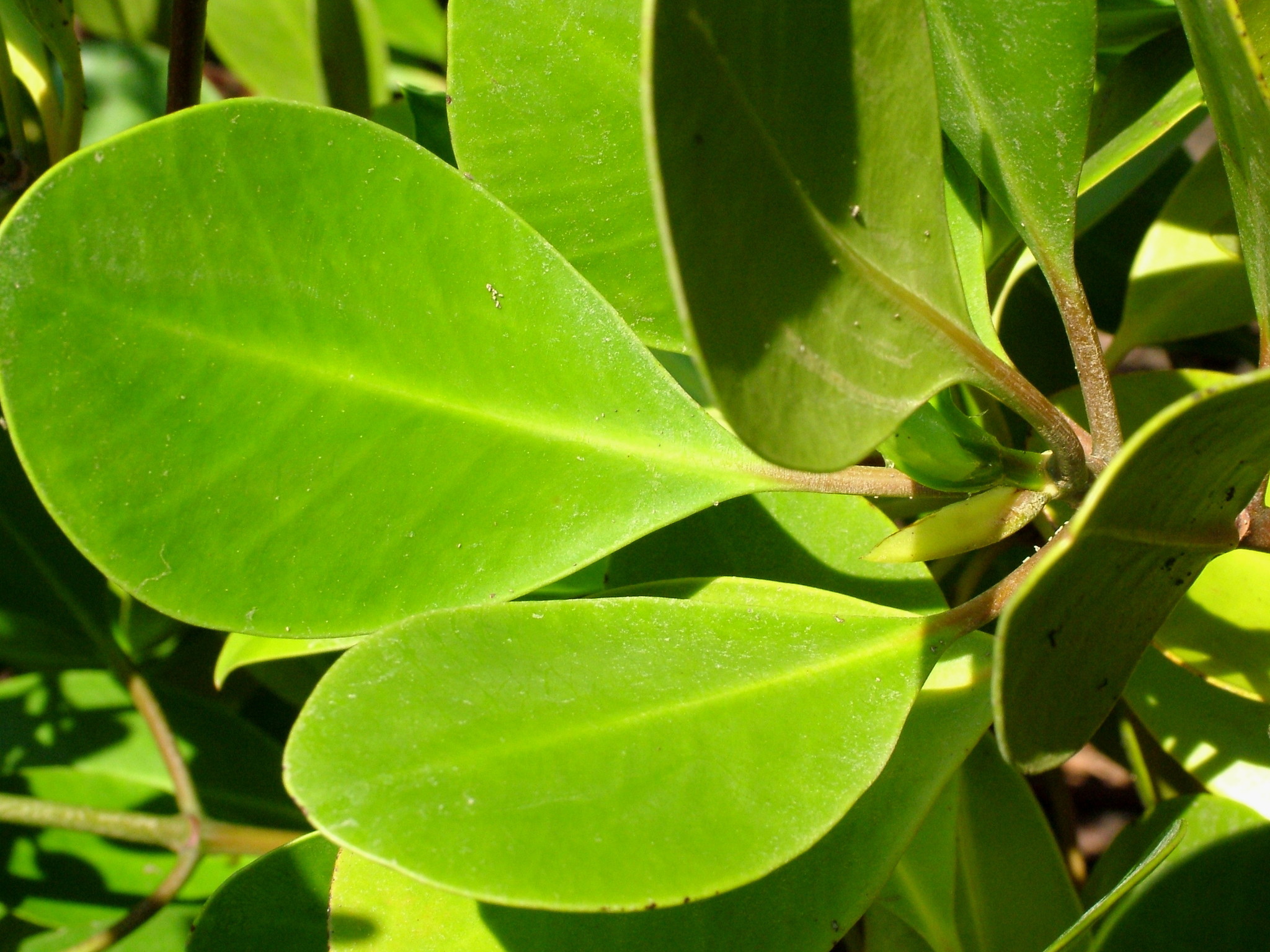
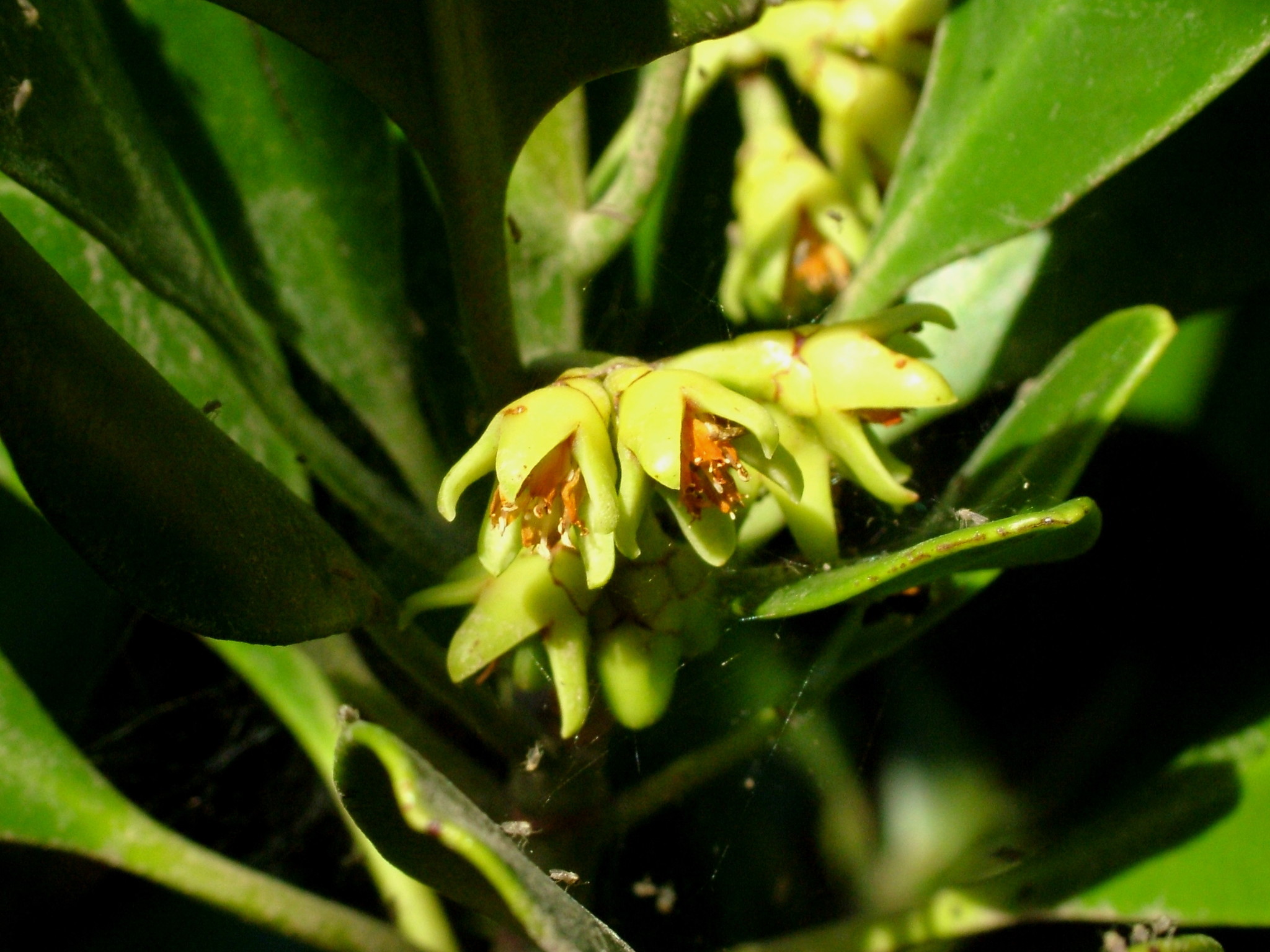
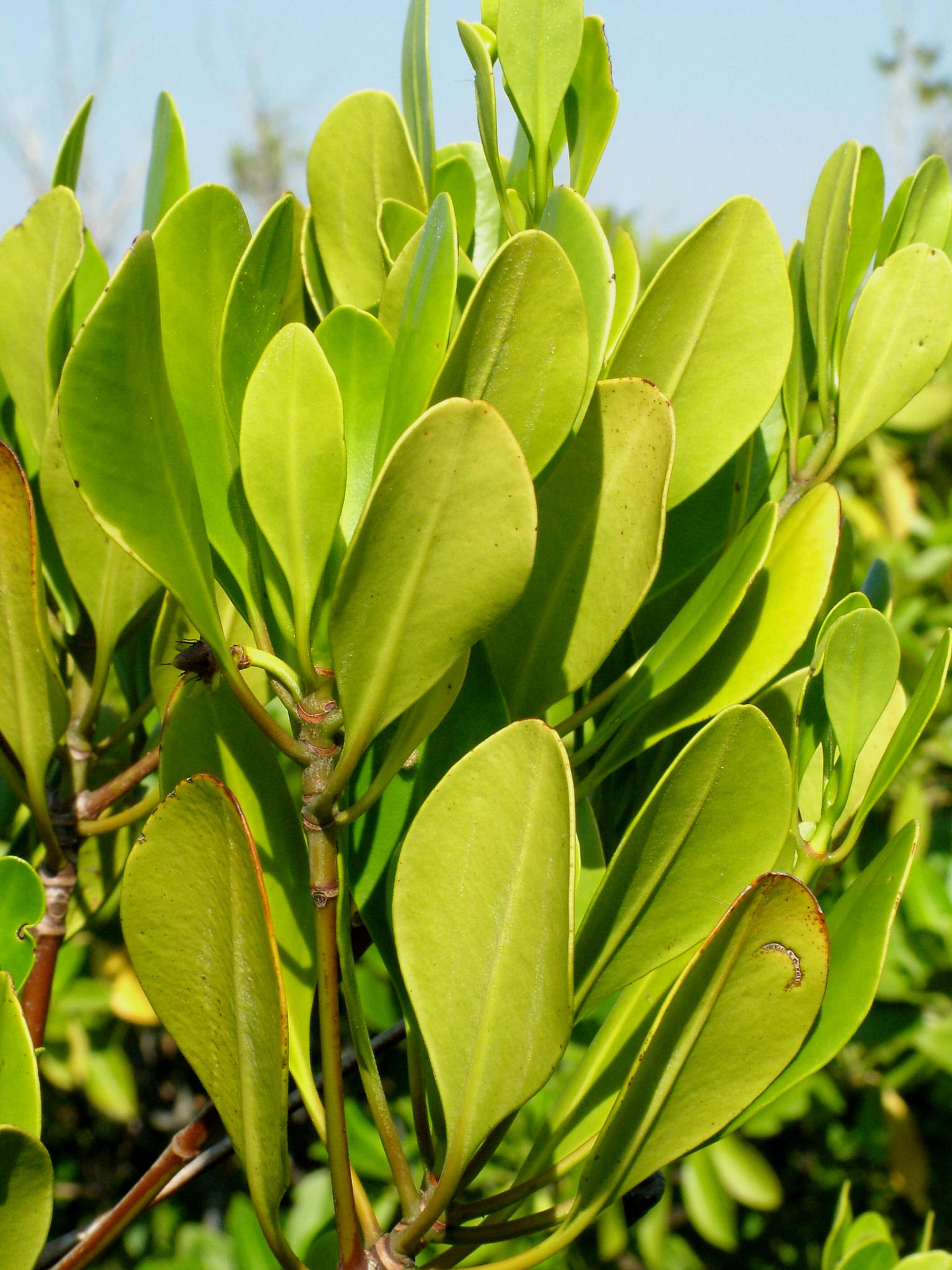
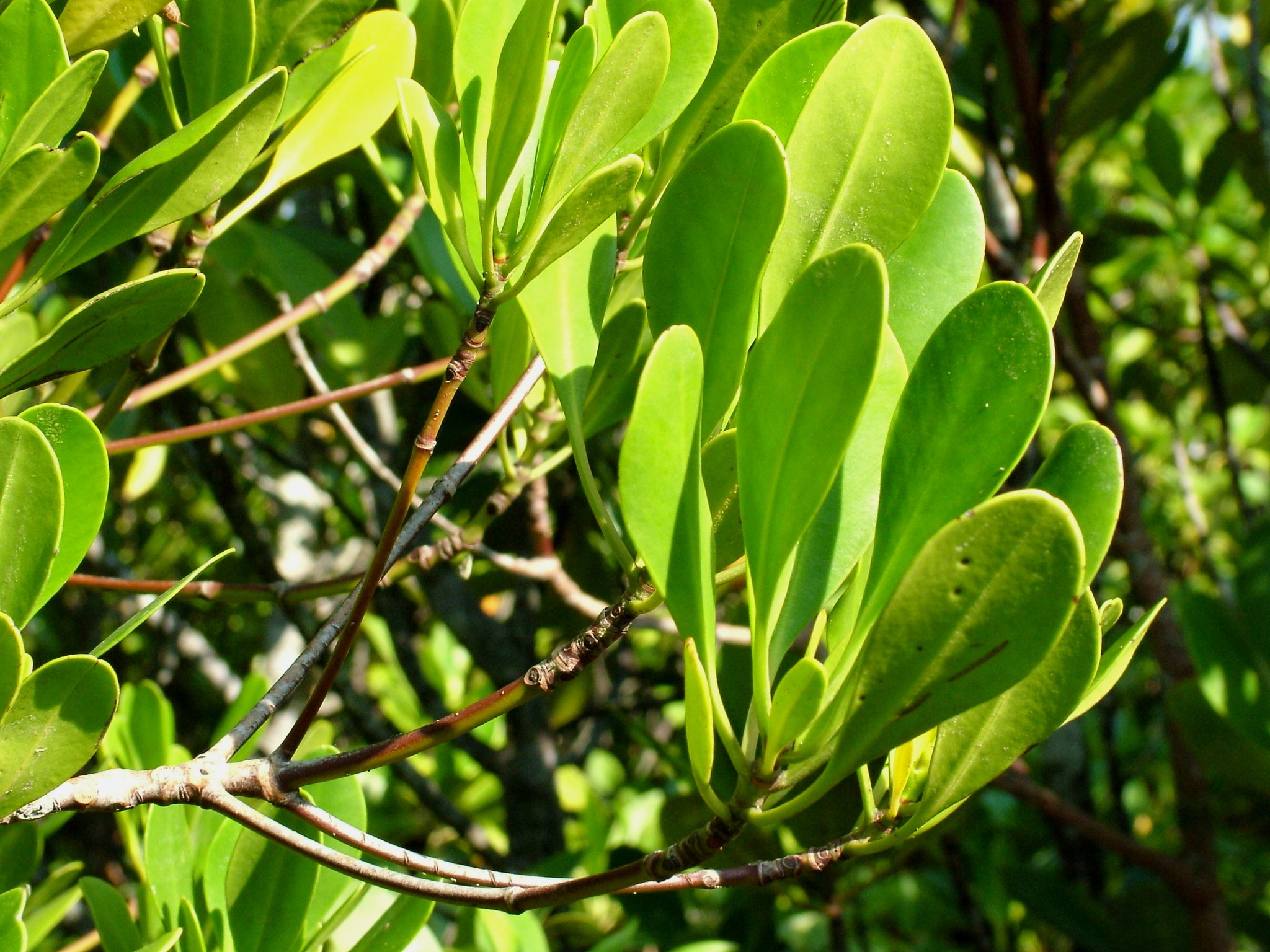
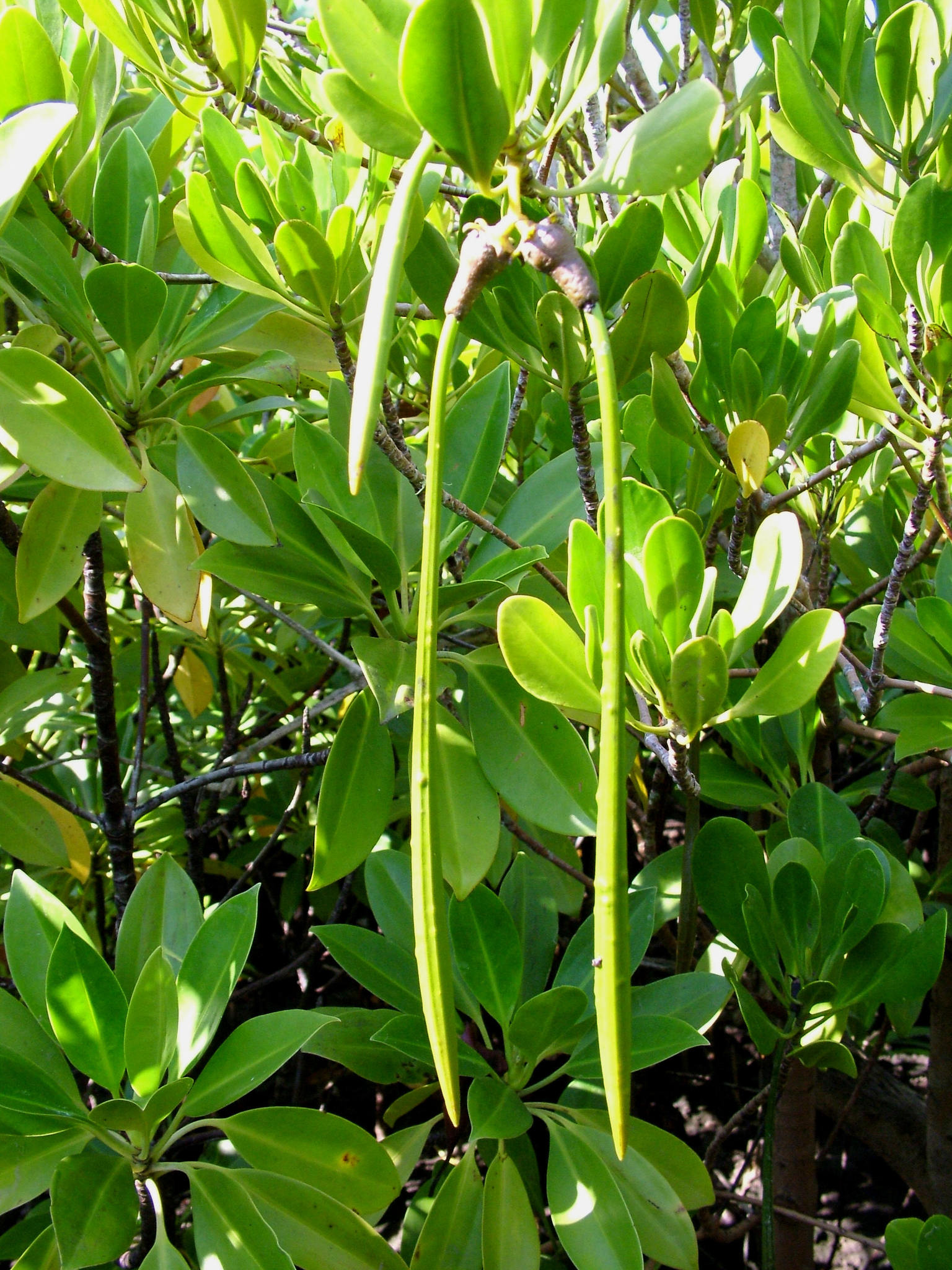
Shrub or small tree up to 6(15) m high; branches terete or slightly compressed towards the extremities, smooth, with elliptic to ± deltate or subcircular scars of the petioles of the fallen leaves and annular scars of the fallen stipules; bark brown to grey. Leaf-lamina usually 4-9 x 2-5 cm, elliptic to obovate; apex rounded to retuse; base narrowed into the petiole; midrib rather prominent below; petiole usually 1-3 cm long; stipules 1-2 cm long, lanceolate, plicate-involute initially, very acute at the apex and truncate at the base. Inflorescences (3)4-8-flowered; principal peduncle up to 1.5 cm long, very shortly or obsoletely 2-3-forked at the apex. Flowers 5-merous, subsessile; bracts and bracteoles c. 2 mm long, ± deltate or ovate-circular, obtuse or subrounded at the apex; flower-buds c. 5 x 4 mm, ellipsoid-ovoid, subpentagonal, glabrous. Calyx reddish-brown; calyx-tube c. 2.5 mm long; calyx-lobes c. 5 mm long, triangular or ovate-triangular, acute at apex, fleshy, abaxial surface glossy, adaxial surface paler and mat, with a longitudinal thickened ridge. Petals 3.5 x 2 mm, oblong or obovate-oblong, truncate and bearing 3 distinct very short glandular appendages at the apex, shortly cohering a little below the middle by the uncinate-hairy margins, the base slightly narrower than the apex, white or cream. Disk composed of 5, ± separate, 2-lobed elements. Stamens 10; filaments 3-4 mm long, ± filiform, narrowed and bent at the apex and slightly swollen at the base; anthers 0.5-0.7 mm long, ovoid-sagittate, acute at the apex, ochraceous. Ovary c. 3 mm long, ovoid, pale green; style c. 1.5 mm long, thickened at the base and minutely 3-lobed at the apex. Hypocotyl extended up to 26 cm from the fruit while on the tree, sharply longitudinally ridged, ± swollen subdistally. From: Da Torre, AR; Gonçalves, AE. 1978. 72. Rhizophoraceae. In: E Launert (ed.). Fl. Zambes. 4: 81-99. Flora Zambesiaca Managing Committee, Glasgow. [CC BY]
Evergreen woodlands and thickets along the intertidal mud-flats of sheltered shores, estuaries and inlets. The most inland of the Rhizophoraceous mangroves. From: Da Torre, AR; Gonçalves, AE. 1978. 72. Rhizophoraceae. In: E Launert (ed.). Fl. Zambes. 4: 81-99. Flora Zambesiaca Managing Committee, Glasgow. [CC BY]
Mozambique, Widely distributed along the western shores of the Pacific Ocean, in Formosa, Micronesia, Melanesia, northern and western coasts of Australia, and round the Indian Ocean; along the E. African shores from Somali Republic to S. Africa (Durban). From: Da Torre, AR; Gonçalves, AE. 1978. 72. Rhizophoraceae. In: E Launert (ed.). Fl. Zambes. 4: 81-99. Flora Zambesiaca Managing Committee, Glasgow. [CC BY]
0 to 1 m
This map contains point-based occurrences at different locations
Occurrence in the Flora of Southern Africa (FSA) countries and South African provinces. Residence status indicates if a taxon is indigenous, endemic, naturalised or invasive in a specific region. This data is based on specimen records and literature
FSA
SA
BOT
NAM
ESW
LES
WC
EC
NC
FS
GA
KZN
LP
MP
NW
Absent
Indigenous
Endemic
Naturalised
Invasive

Names and Sources
Ceriops boiviniana Tul.
Ceriops candolleana Arn.
Ceriops mossambicensis Klotzsch
Ceriops somalensis Chiov.
Rhizophora tagal Perr.
| Common name | Language | Reference/barcode | Published as |
|---|---|---|---|
| Indian mangrove | English | Van Wyk, AE; Van den Berg, E; Coates Palgrave, M; Jordaan, M. 2011. Dictionary of names for southern African trees. Briza, Arcadia. | |
| Indiese wortelboom | Afrikaans | Van Wyk, AE; Van den Berg, E; Coates Palgrave, M; Jordaan, M. 2011. Dictionary of names for southern African trees. Briza, Arcadia. | |
| isinkaha | Zulu | Van Wyk, AE; Van den Berg, E; Coates Palgrave, M; Jordaan, M. 2011. Dictionary of names for southern African trees. Briza, Arcadia. |
Classification
KINGDOM Plantae
SUBKINGDOM Phanerogamae
PHYLUM Anthophyta
ORDER Malpighiales
FAMILY Rhizophoraceae
TRIBE Rhizophoreae
GENUS Ceriops
SPECIES tagal
9 results for Ceriops tagal (Perr.) C.B.Rob.
Barcode: PRE0322387-0 Collector(s) & number: Tinley, KL, 455 | 1959-7-27
South Africa, KwaZulu-Natal, INGWAVUMA DIST.; KOSI
Data Resource: BODATSA View record
Barcode: NH0085557-0 Collector(s) & number: Ward, MC, 1322 | 1986-1-31
South Africa, KwaZulu-Natal, Kosi Estuary. 26°54'S 32°52'E
Data Resource: BODATSA View record
Barcode: NH0071101-0 Collector(s) & number: Moll, 5600 | 1971-10-26
South Africa, KwaZulu-Natal, Kosi Estuary.
General notes: Uncommon.
Data Resource: BODATSA View record
Barcode: PRE0353927-0 Collector(s) & number: Vahrmeijer, J(H), 923 | 1965-5-10
South Africa, KwaZulu-Natal, INGWAVUMA DIST.; KOSI ESTUARY; NR. FISHING KRAALS
Data Resource: BODATSA View record
Barcode: NH0063899-0 Collector(s) & number: Ward, CJ, 7972 | 1972-7-16
Mozambique, Mocambique: Beira District: Beira Section: Nhangau
General notes: Altitude: est. c. 6m.
Data Resource: BODATSA View record
Barcode: PRE0466194-0 Collector(s) & number: Ward, CJ, 8072 | 1972-10-9
South Africa, KwaZulu-Natal, KOSI ESTUARY EAST
Data Resource: BODATSA View record
Barcode: PRE0572638-0 Collector(s) & number: Glen, HF, 4049 | 2002-11-8
Mozambique, Maputo, Maputo dist.: Ilha Xefina Pequena: west side of island.
General notes: Mangrove swamp on humus-rich, sandy mud overlying quaternary sandstone. Slight general disturbance due to logging of Bruguiera gymnorrhiza. Tree c. 3 m tall; flowers white with c. 8 sepals, these spreading in fruit; propagules flattened. Prop roots and pneumatophores present. Relatively infrequent in drier parts of swamp.
Data Resource: BODATSA View record
This map contains point-based occurrences at different locations
2006
BOOK
Checklist of the Flowering Plants of Sub-Saharan Africa Klopper, RR; Chatelain, C; Banninger, V; Spichiger, RSANBI, Pretoria
1978
FLORA CHAPTER
72. Rhizophoraceae Da Torre, AR; Gonçalves, AEIn: E Launert (ed.). Flora Zambesiaca 4: 81-99
Flora Zambesiaca Managing Committee, Glasgow
No results found for Ceriops tagal (Perr.) C.B.Rob.
Status and criteria
NE
Assessor(s)
Plantae Coordinator
BOOK
Rowe-Rowe, D. T. 1994. The ungulates of Natal. Natal Parks Board
JOURNAL ARTICLE
Pacifici, M., Santini, L., Di Marco, M., Baisero, D., Francucci, L., Grottolo Marasini, G., Visconti, P. and Rondinini, C. 2013. Generation length for mammals. Nature Conservation. 5:87–94
REPORT
GeoTerraImage 2015. Quantifying settlement and built-up land use change in South Africa
JOURNAL ARTICLE
Wittemyer, G., Elsen, P., Bean, W.T., Burton, A.C.O. and Brashares, J.S. 2008. Accelerated human population growth at protected area edges. Science. 321:123-126
JOURNAL ARTICLE
Grey-Ross, R,Downs, C.T., and Kirkman, K. 2010. An assessment of illegal hunting on farmland in KwaZulu-Natal, South Africa: implications for oribi (Ourebia ourebi) conservation. South African Journal of Wildlife Research. 40:43-52
JOURNAL ARTICLE
Jewitt, D., Goodman, P.S., Erasmus, B.F.N., O’Connor, T.G. and Witkowski, E.T.F. 2015. Systematic land-cover change in KwaZulu-Natal, South Africa: Implications for biodiversity. South African Journal of Science. 111:1-9
JOURNAL ARTICLE
Belton LE, Dalerum F, van Rensburg BJ 2008. Factors associated with suni distribution in Tembe Elephant Park, South Africa: implications for management and conservation of a small antelope. African Journal of Ecology. 46:631-636
JOURNAL ARTICLE
Coates GD, Downs CT 2005. Survey of the status and management of sympatric bushbuck and nyala in KwaZulu-Natal, South Africa. South African Journal of Wildlife Research. 35:179
JOURNAL ARTICLE
Heinichen IG 1972. Preliminary notes on the suni (<i>Neotragus moschatus</i>) and the red duiker (<i>Cephalophus natalensis</i>). Zoologica Africana. 7:157-165
ELECTRONIC SOURCE
IUCN SSC Antelope Specialist Group 2016. <i>Nesotragus moschatus</i>. The IUCN Red List of Threatened Species 2016
JOURNAL ARTICLE
Kingswood SC, Kumamoto AT, Charter SJ, Jones ML. 1998. Cryptic chromosomal variation in suni <i>Neotragus moschatus</i> (Artiodactyla, Bovidae). Animal Conservation. 1:95-100
JOURNAL ARTICLE
Lagendijk G, Page BR, Slotow R 2012. Short-term effects of single species browsing release by different-sized herbivores on Sand Forest vegetation community, South Africa. Biotropica. 44:63-72
THESIS
Lawson D 1986. The ecology and conservation of Suni in Natal. University of KwaZulu-Natal
JOURNAL ARTICLE
Pretorius Q, Pretorius BP, Dannhauser CS 1996. The reproductive behaviour of the suni <i>Neotragus moschatus zuluensis</i> in captivity. Koedoe. 39:123-126
| Part(s) of plant used | Use(s) | Reference |
|---|
Coming soon...