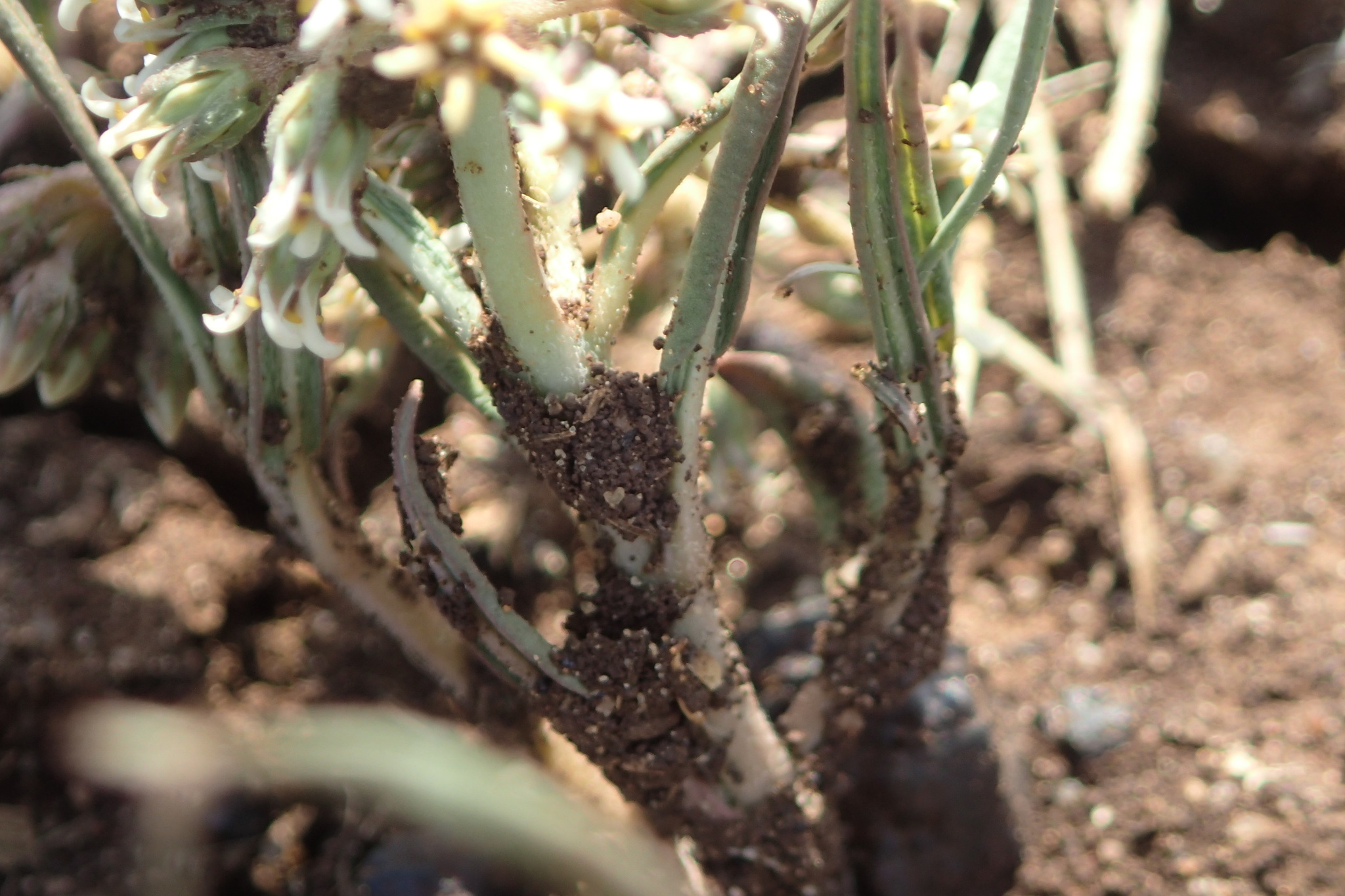
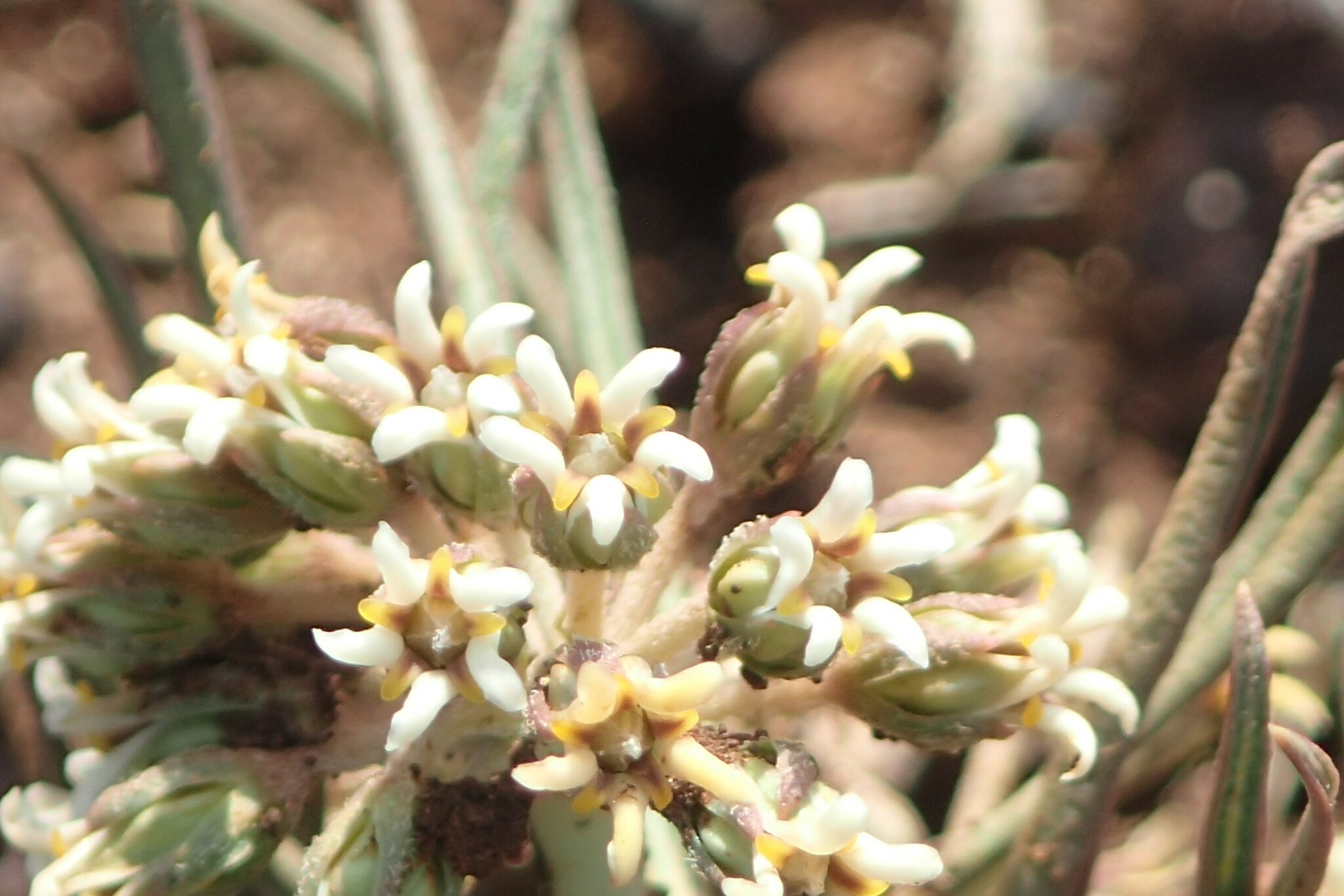
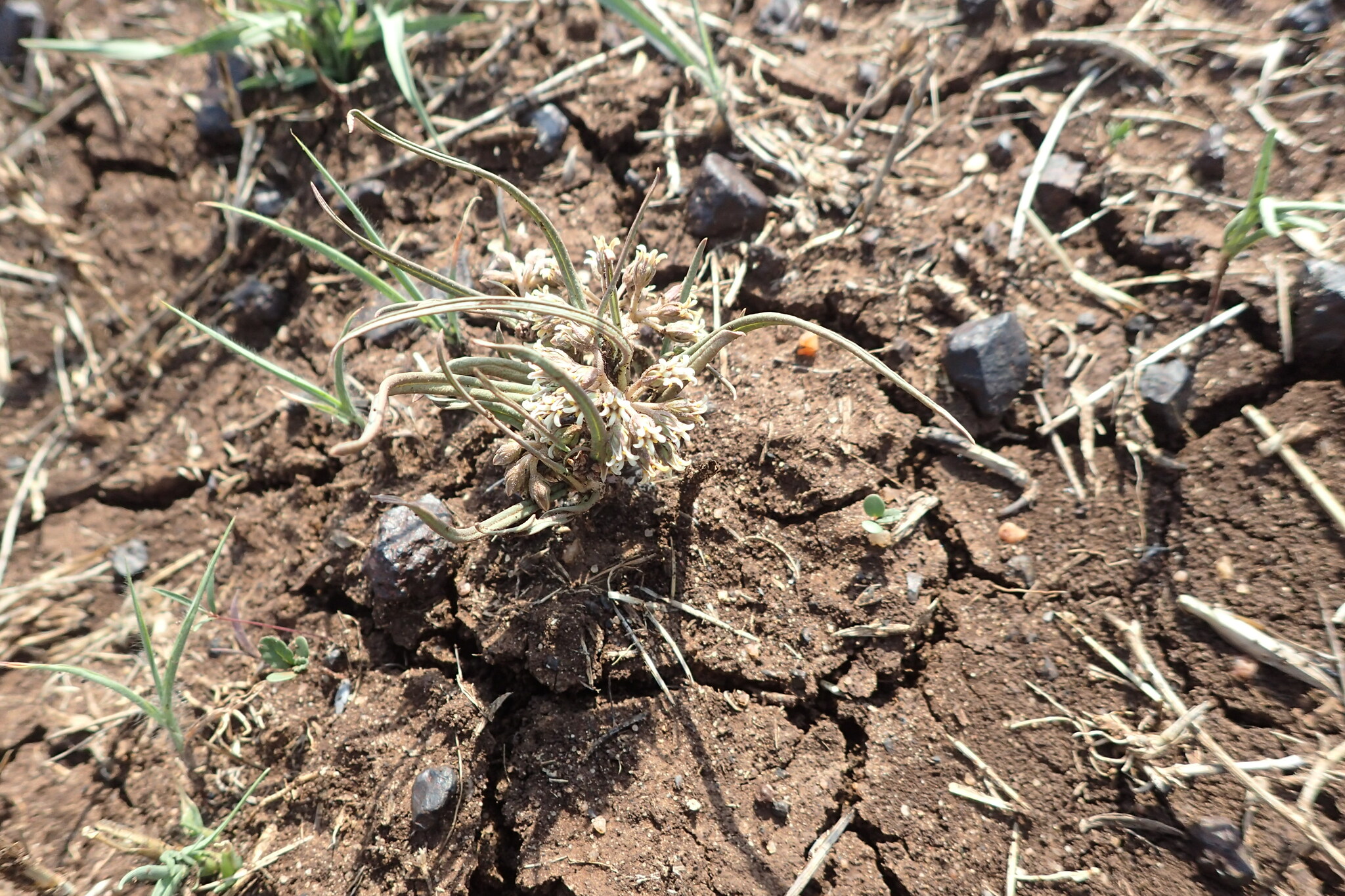
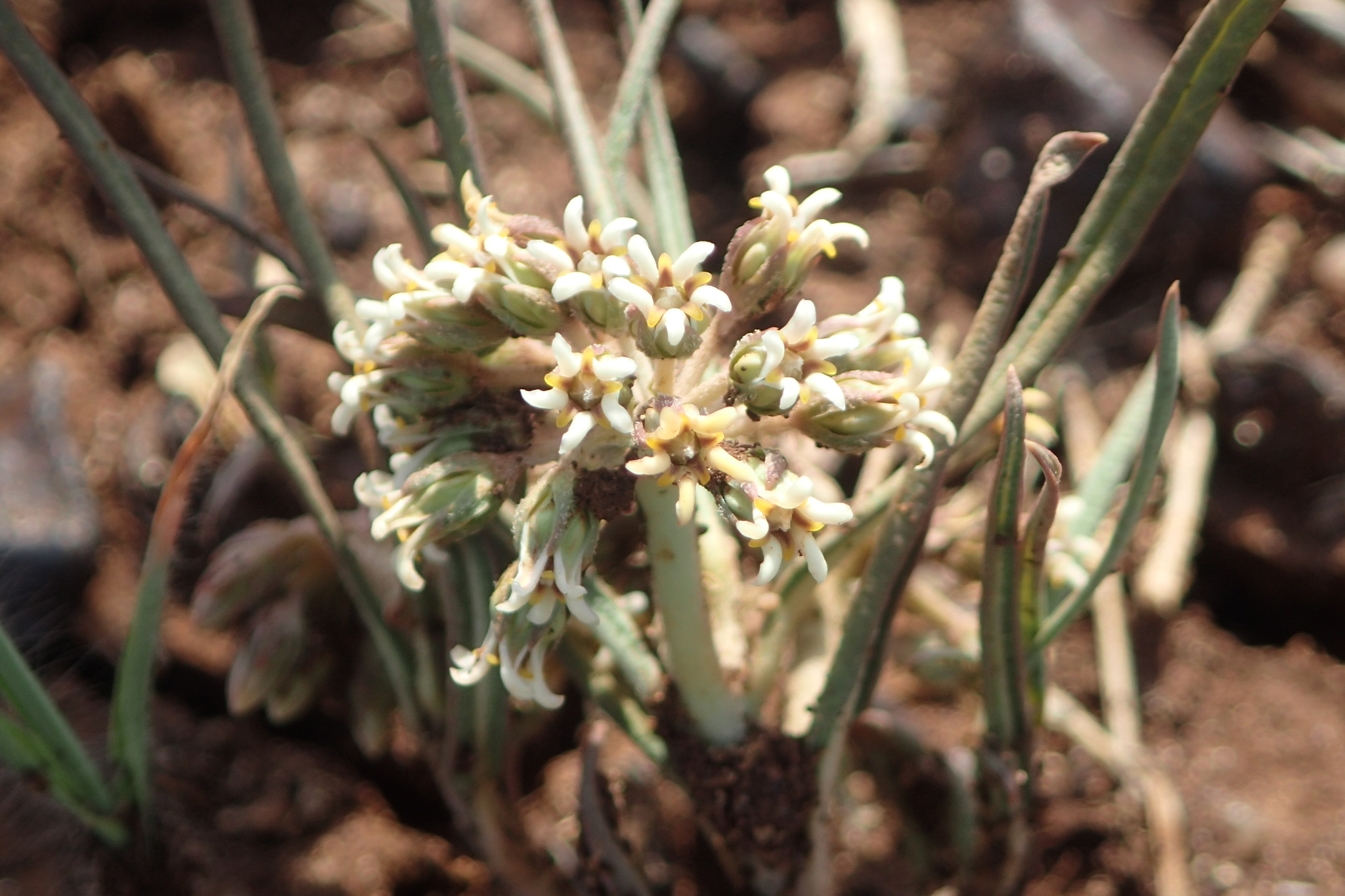
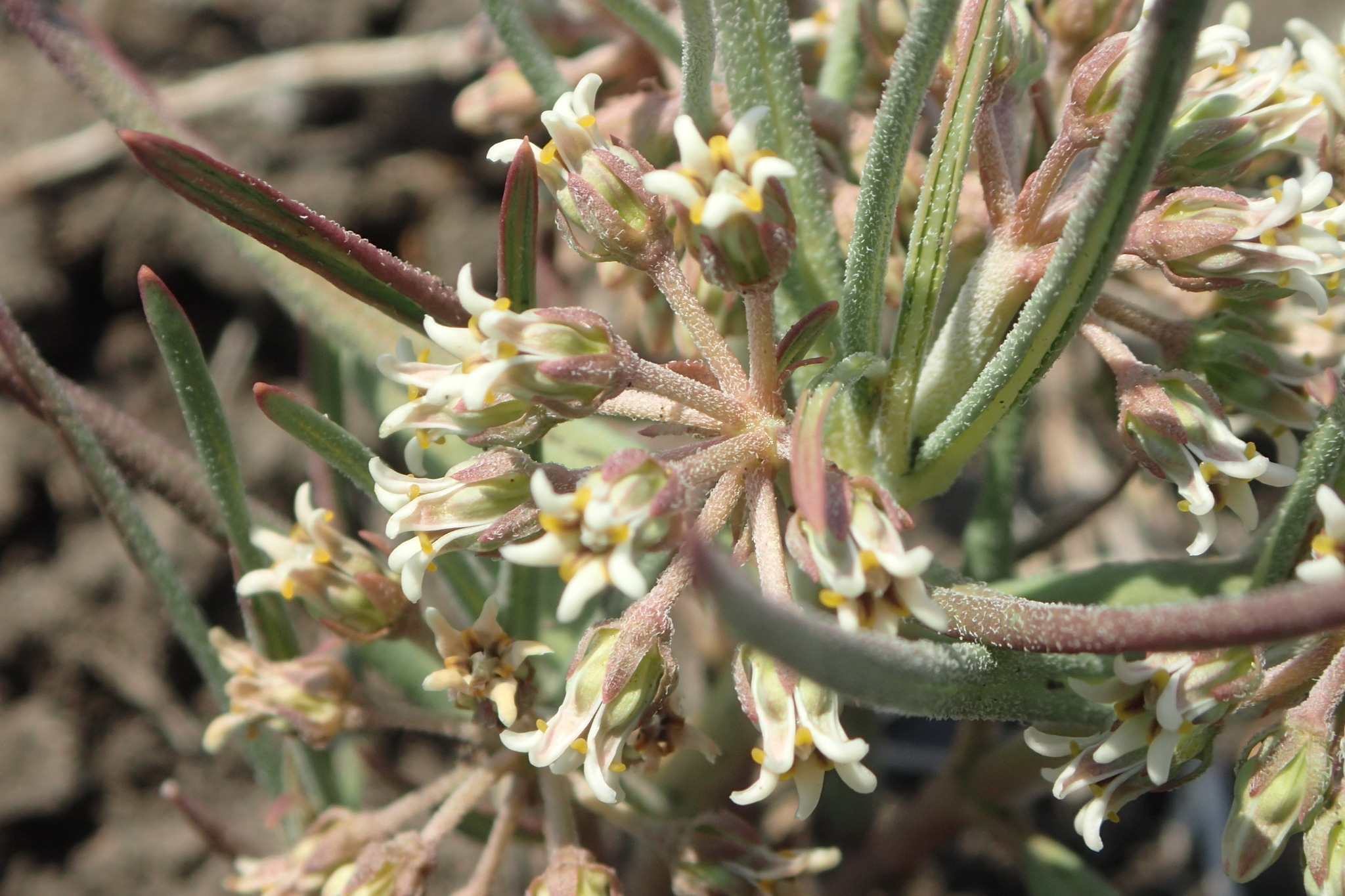
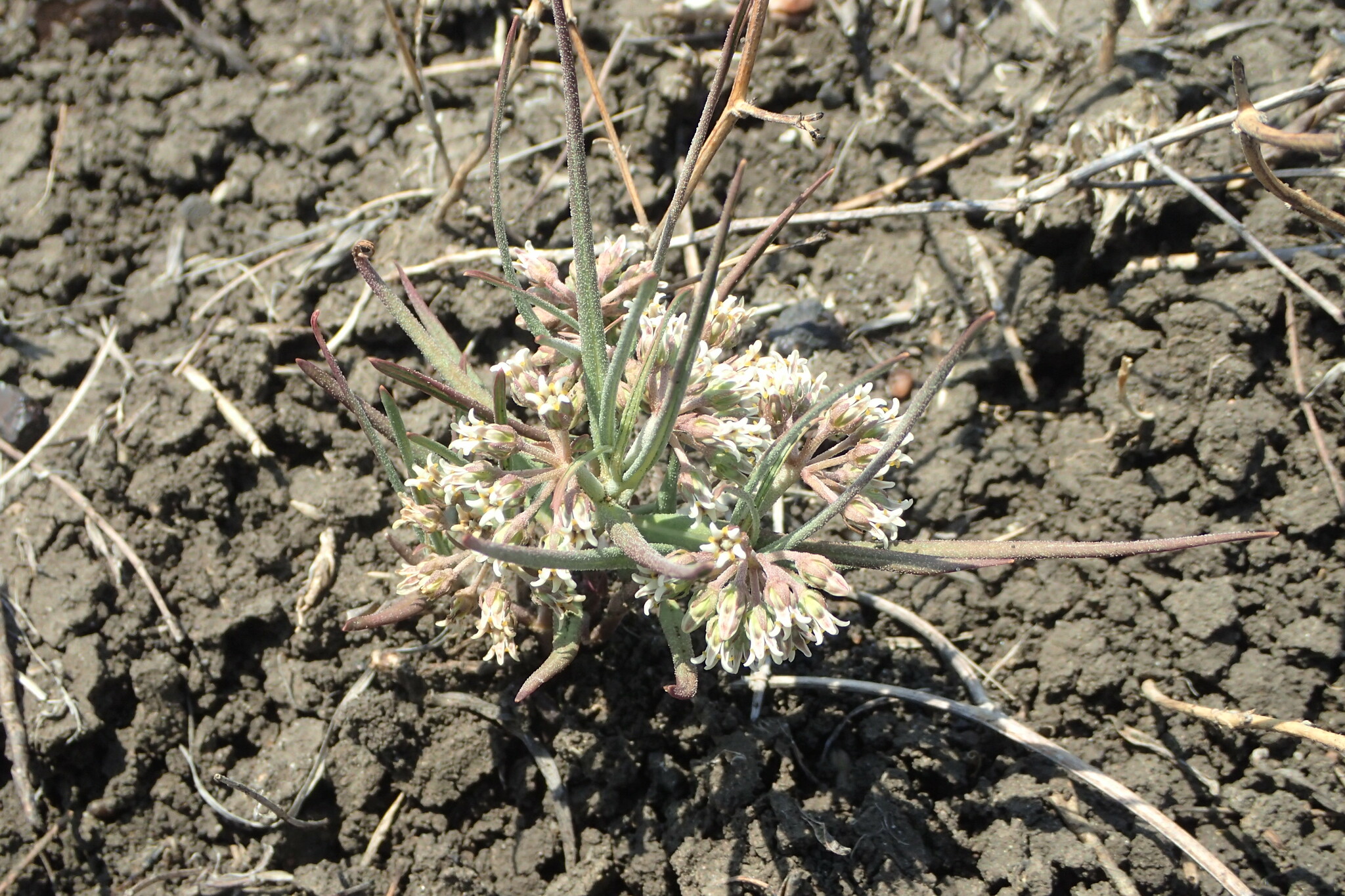
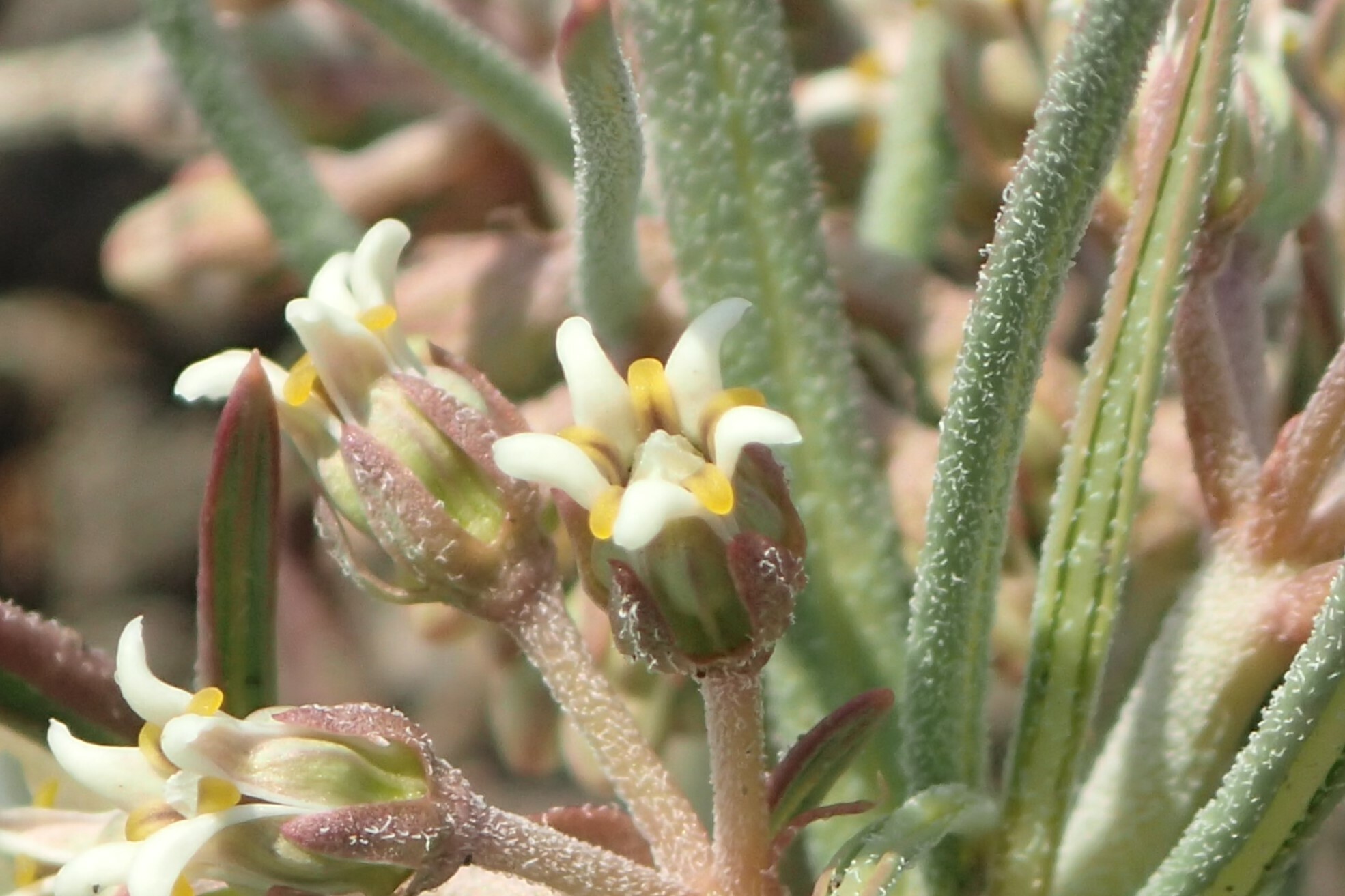
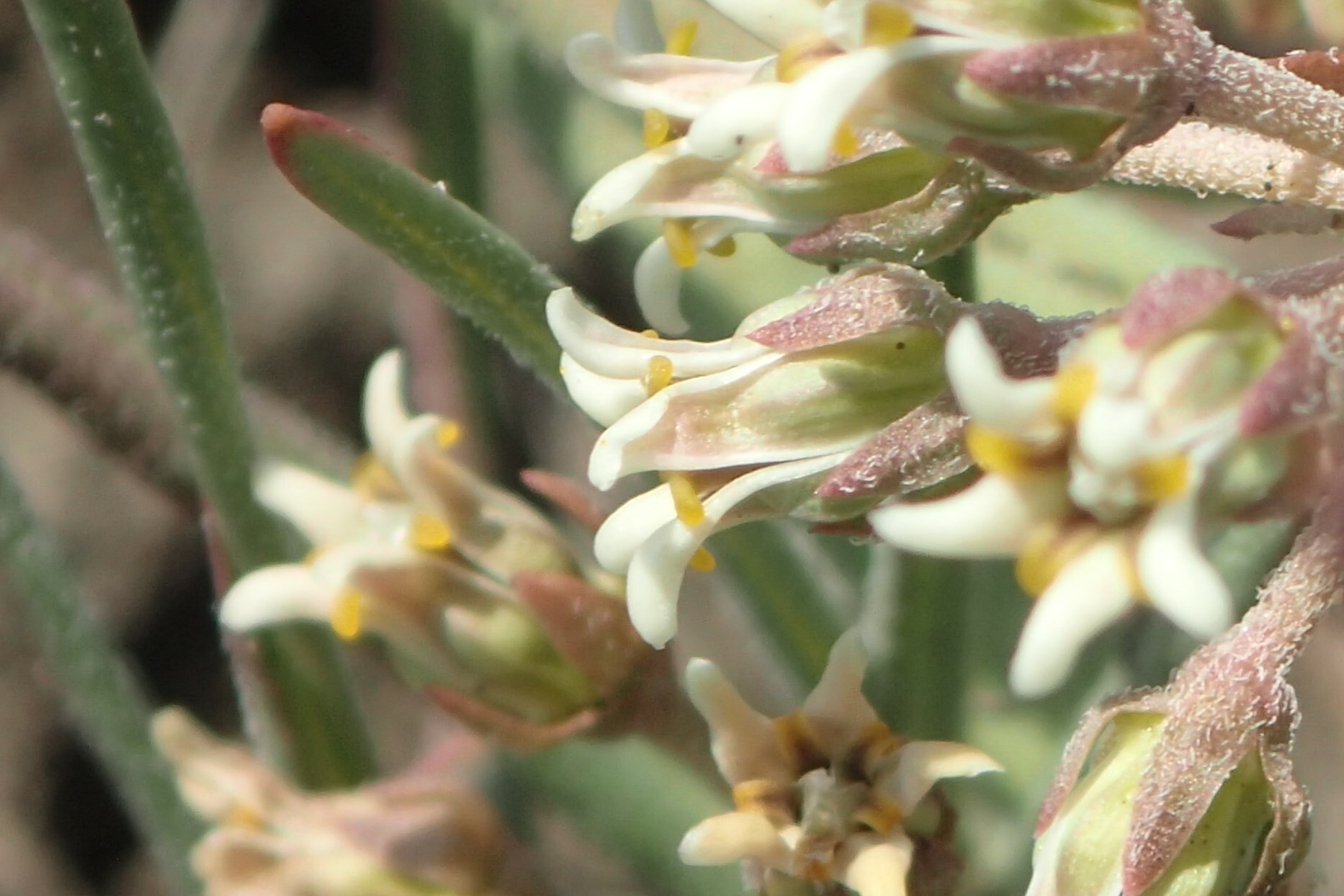
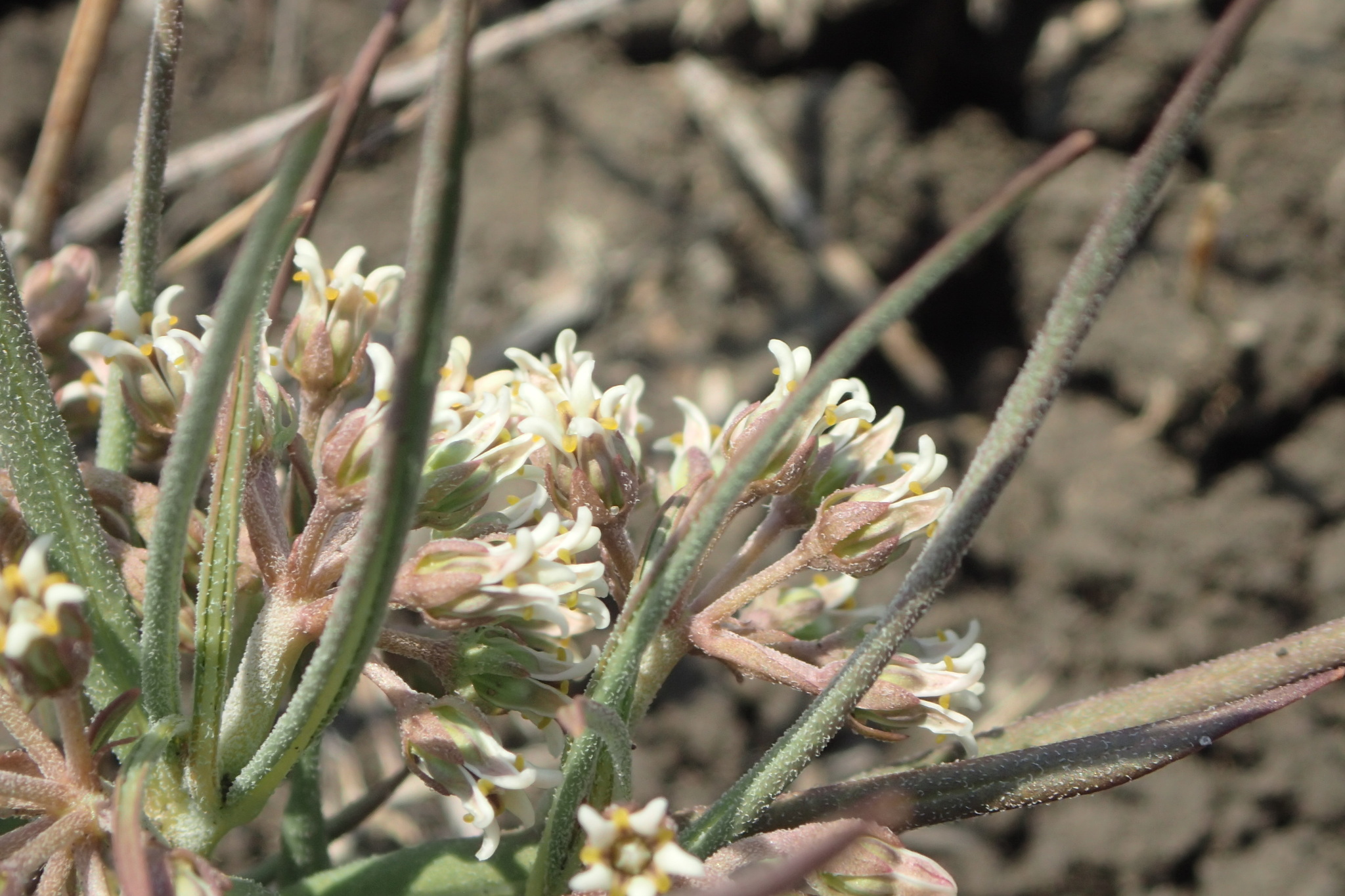
Geophytic perennial herb, all parts with milky latex. Tuber carrot-shaped 50-160 x 9-25 mm, dry fibrous, white in colour; neck 36-81 mm long, usually with long, fine fibrous roots; ending abruptly in ±1 mm diam. basal tip to 300 mm long. Stems (100-)230-280 mm tall, re-sprouting annually, sparingly branched from the base, sometimes stems hilariously hairy with pilose to tomentose hairs from the base towards the tips, but less persistent on old stems; older stems more pronouncedly grooved, furrowed, pleated or ribbed and pilose all round. Leaves sessile, opposite throughout, 14-134 x 1-6 mm, narrowly lanceolate or linear, base attenuate, apex acute or attenuate, margins revolute; main vein prominent below, paler than blade, sometimes tinged purple-maroon above (usually only the basal leaves), leaves usually much longer than internodes; sparsely pilose above, usually glabrous below, but if very dense above (in few specimens) then sparingly pilose below along veins and margin, seemingly wan ting in mature leaves. Inflorescences axillary, umbellate, 3-7 per stem or branch, pendant in bud, erect at anthesis, 5-16-flowered; peduncle 14-43 mm long in flower (13-34 mm long in fruit, contorted), hilariously pilose; pedicels 3-6.5 mm long, hilariously pilose; bracts linear to narrowly triangular, (0.5)2.5-3.6 x 0.4-0.5 mm. Calyx narrowly triangular, 2.3-3.5 x 0.5-1.3 mm; glabrous above, below evenly pilose or with a patch towards the apex. Flowers 2.5-4.9 x 2.2-4.4 mm; corolla 3.4-4.9 x 0.8-1.2 mm, strap-shaped with an abruptly dilating and rounded apex; inside green, maroon, cream, pink or greenish-cream, usually paler inside; glabrous, but papillose on the recurved apex; very rarely sparsely pilose towards apex on outside, green, or cream-brownish, usually darker outside. Corona 22-2.5 x 0.8-0.9 mm, strap-shaped or slightly broader above base, furrowed, tongue-like, extending beyond the 'tube' (formed by the tight-packed basal sections of the corolla) bending out- and downwards between the diverging corolla lobes, yellowish, yellowish-green, dark yellow to orange; extending beyond the corolla tube at which point they curve downwards extending between the corolla lobes. Gynostegial column 2.4 x 1.7-1.8 x 1.5 mm in diam. Gynostegial head conical and involute at the apex, 0.61-0.62 x 0.91-0.92 mm, with prominent stype. Anthers: anther-wing 0.5-0.6 mm long, extending 0.1-0.2 mm from column, notch at base of wing. Pollinaria: pollinia 0.72-0.77 x 0.24-0.26 mm; caudicle 0.30-0.33 x 0.05-0.08 mm; corpuscle ovate, 0.31-0.40 x 0.1-0.2 mm. Fruit mostly solitary per inflorescence due to abortion of others, (20-)90-132 x 6-8 mm with an elongated beak ending in an abrupt snout; green, two shades of green in longitudinal direction alternating; densely tomentose when immature to finely pubescent when mature. Seed ovate, 4.5-7 x 2-4 mm, brown; coma 11-24 mm long, attached at blunt end of seed. From: Bester, SP; Nicholas, A. 2018. New combinations in Stenostelma (Apocynaceae-Asclepiadoideae) and two novel species from South Africa. Phytotaxa 361(1): 41-55. [https://doi.org/10.11646/phytotaxa.361.1.3] [All rights reserved]
Closely related to Stenostelma umbelluliferum in all vegetative features, florally very distinct from the former species in that the corolla lobes arc erect, tightly adpressed to form a pseudo-tube in S. ligulatum compared to sub-erect loose lobes in S. umbelluliferum. Further the corona lobes arc flat and elongated with only the apical tips recurved where they arc exerted between the corolla lobes, compared to small rounded corona lobes in S. umbelluliferum. From: Bester, SP; Nicholas, A. 2018. New combinations in Stenostelma (Apocynaceae-Asclepiadoideae) and two novel species from South Africa. Phytotaxa 361(1): 41-55. [https://doi.org/10.11646/phytotaxa.361.1.3] [All rights reserved]
Growing on level plains of Acacia-savanna in full sun, in well-drained black turf soils. The known habitat is restricted to the Springbokvlakte Thornveld vegetation unit in the Central Bushveld bioregion. From: Bester, SP; Nicholas, A. 2018. New combinations in Stenostelma (Apocynaceae-Asclepiadoideae) and two novel species from South Africa. Phytotaxa 361(1): 41-55. [https://doi.org/10.11646/phytotaxa.361.1.3] [All rights reserved]
Stenostelma ligulatum is known only from Limpopo Province in the Springbok Flats of the Warmbad, Waterberg and Wonderboom districts. From: Bester, SP; Nicholas, A. 2018. New combinations in Stenostelma (Apocynaceae-Asclepiadoideae) and two novel species from South Africa. Phytotaxa 361(1): 41-55. [https://doi.org/10.11646/phytotaxa.361.1.3] [All rights reserved]
November
1064 to 1105 m
This map contains point-based occurrences at different locations
Occurrence in the Flora of Southern Africa (FSA) countries and South African provinces. Residence status indicates if a taxon is indigenous, endemic, naturalised or invasive in a specific region. This data is based on specimen records and literature
FSA
SA
BOT
NAM
ESW
LES
WC
EC
NC
FS
GA
KZN
LP
MP
NW
Absent
Indigenous
Endemic
Naturalised
Invasive

Names and Sources
Published in: Phytotaxa 361(1): 44 (2018)
Type: South Africa, Limpopo Province, Wonderboom District, just off Bela-Bela/Codrington road to Hammanskraal, Farm: Bath, section Avon, 7 Nov. 2007, S.P. Bester 8159 (PRE, holo.; E, K, MO, NH, NU, iso.)
Classification
KINGDOM Plantae
SUBKINGDOM Phanerogamae
PHYLUM Anthophyta
ORDER Gentianales
FAMILY Apocynaceae
SUBFAMILY Asclepiadoideae
TRIBE Asclepiadeae
GENUS Stenostelma
SPECIES ligulatum
13 results for Stenostelma ligulatum Bester & Nicholas
Barcode: PRE0768098-0 Collector(s) & number: Bester, SP, 8159 | 2007-11-7
South Africa, Limpopo, Wonderboom District. Just off Bela-Bela/Codrington road to Hammanskraal. Farm: Bath section of Avon. 24°58'08.3" S 28°29'29.3" E
Data Resource: BODATSA View record
Barcode: PRE0870185-0 Collector(s) & number: Bester, SP, 8156b | 2007-11-8
South Africa, Limpopo, Wonderboom District. Just off Bela-Bela/Codrington road to Hammanskraal. 24°58'17.9"S 28°29'29.3"E.
Data Resource: BODATSA View record
Barcode: PRE0768096-0 Collector(s) & number: Bester, SP, 8156 | 2007-11-8
South Africa, Limpopo, Wonderboom District. Just off Bela-Bela/Codrington road to Hammanskraal. 24°58'08.3" S 28°29'29.3" E
Data Resource: BODATSA View record
Barcode: PRE0882152-0 Collector(s) & number: Steyn, C., 20239 | 2023-11-24
South Africa, Limpopo, Mogalakwena. ca. 25 km NW from Mokopane in "fork"between N11 and R518 roads. Farm: Commandodrift 288 KR; central E section of farm.
General notes: No detailed search for the species, recorded them as I saw them along transects. Did not find more than one at a location (so a bit sporadically distributed).
Data Resource: BODATSA View record
Barcode: PRE0842943-0 Collector(s) & number: Bester, SP, 8601 | 2008-11-23
South Africa, Limpopo, Warmbad District. ca. 16 km SW of Settlers on R 576; 25°00'52.4" S 28°23'15.6" E
Data Resource: BODATSA View record
Barcode: PRE0802863-0 Collector(s) & number: Bester, SP, 6049 | 2005-11-9
South Africa, Limpopo, ca. 15 km West of Settlers when turning from the R516 between Settlers and Warmbad towards Codrington.
General notes: Biome: Savanna. Vegetation type: Clay Thorn Bushveld. Flower petals dark greenish outside, paler inside. Corona yellowish-green bent outwards between two adjacent petals. Only 11 plants found on this site. Follicles light and dark green alternating longitudinal striped pattern. Milky latex. Length of stem above ground 0.14 m; and below soil level neck 0.07 m; tuber 0.05 m and root tip 0.3 m. Leaves collected in silica gel for DNA. Flowers collected in spirit. Digital images taken.
Data Resource: BODATSA View record
Barcode: PRE0882151-0 Collector(s) & number: Steyn, C., 20238 | 2023-11-24
South Africa, Limpopo, Mogalakwena. ca. 25 km NW from Mokopane in "fork"between N11 and R518 roads. Farm: Commandodrift 288 KR; central E section of farm.
General notes: No detailed search for the species, recorded them as I saw them along transects. Did not find more than one at a location (so a bit sporadically distributed).
Data Resource: BODATSA View record
Barcode: PRE0860876-0 Collector(s) & number: Bester, SP, 11424 | 2012-11-28
South Africa, Limpopo, Waterberg District; 12 km ENE of Settlers on road R516 to Marble Hall, 35.1 km SE of Modimolle. Farm: Hopefield 675KR. 24°55'44.1"S 28°39'11.5"E.
General notes: Bioregion: Central Bushveld. Vegetation type: Springbokvlakte Thornveld. Flowers green outside, pinkish on inside. Corona dark yellow-orange. Milky latex. Disturbed side of road. Only a single plant encountered.
Data Resource: BODATSA View record
Barcode: PRE0768097-0 Collector(s) & number: Bester, SP, 8158 | 2007-11-8
South Africa, Limpopo, Wonderboom District. Just off Bela-Bela/Codrington road to Hammanskraal. 24°58'08.3" S 28°29'29.3" E
Data Resource: BODATSA View record
Barcode: PRE0861943-0 Collector(s) & number: Bester, SP, 10821 | 2011-11-11
South Africa, Limpopo, Warmbad District. Farm: Het Bad 465 KR, 4 km SSE of Warmbad. 24°55'14.9"S 28°18'15.6"E.
General notes: Bioregion: Central Bushveld. Vegetation type: Springbokvlakte Thornveld. Milky latex.
Data Resource: BODATSA View record
Barcode: PRE0768095-0 Collector(s) & number: Bester, SP, 8152 | 2007-11-8
South Africa, Limpopo, Wonderboom District. On road from Hammanskraal to Codrington. 25°02'04.4" S 28°20'40.5" E
General notes: Biome: Savanna. Central Bushveld Bioregion: Springbokvlakte Thornveld. Milky latex.
Data Resource: BODATSA View record
This map contains point-based occurrences at different locations
2018
PERIODICAL/JOURNAL
New combinations in Stenostelma (Apocynaceae-Asclepiadoideae) and two novel species from South Africa Bester, SP; Nicholas, APhytotaxa 361(1)41-55
No results found for Stenostelma ligulatum Bester & Nicholas
| Part(s) of plant used | Use(s) | Reference |
|---|
Coming soon...