
PLANTAE / PHANEROGAMAE / ANTHOPHYTA / LAMIALES / SCROPHULARIACEAE / LIMOSELLEAE / MANULEA / MINOR

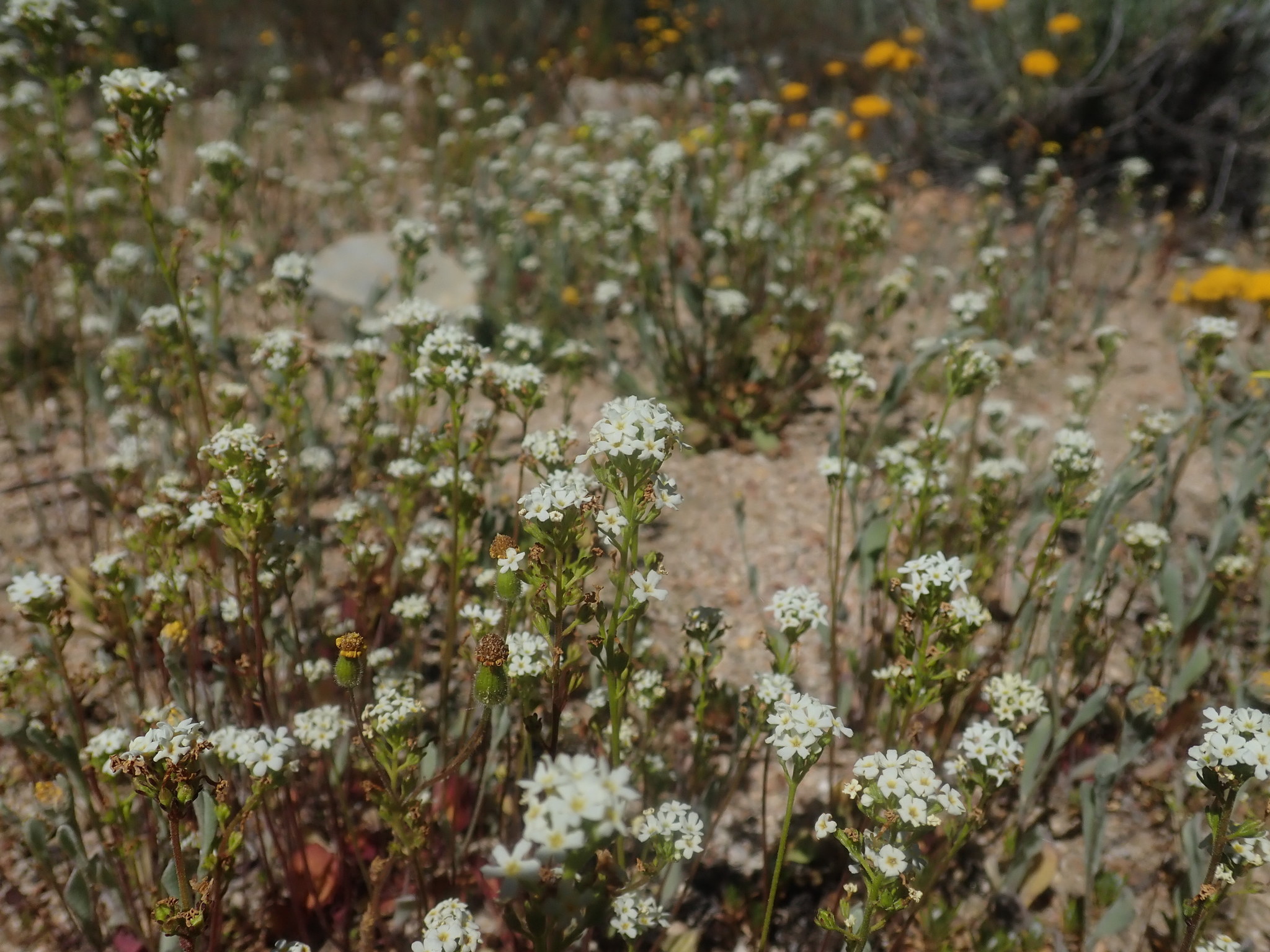
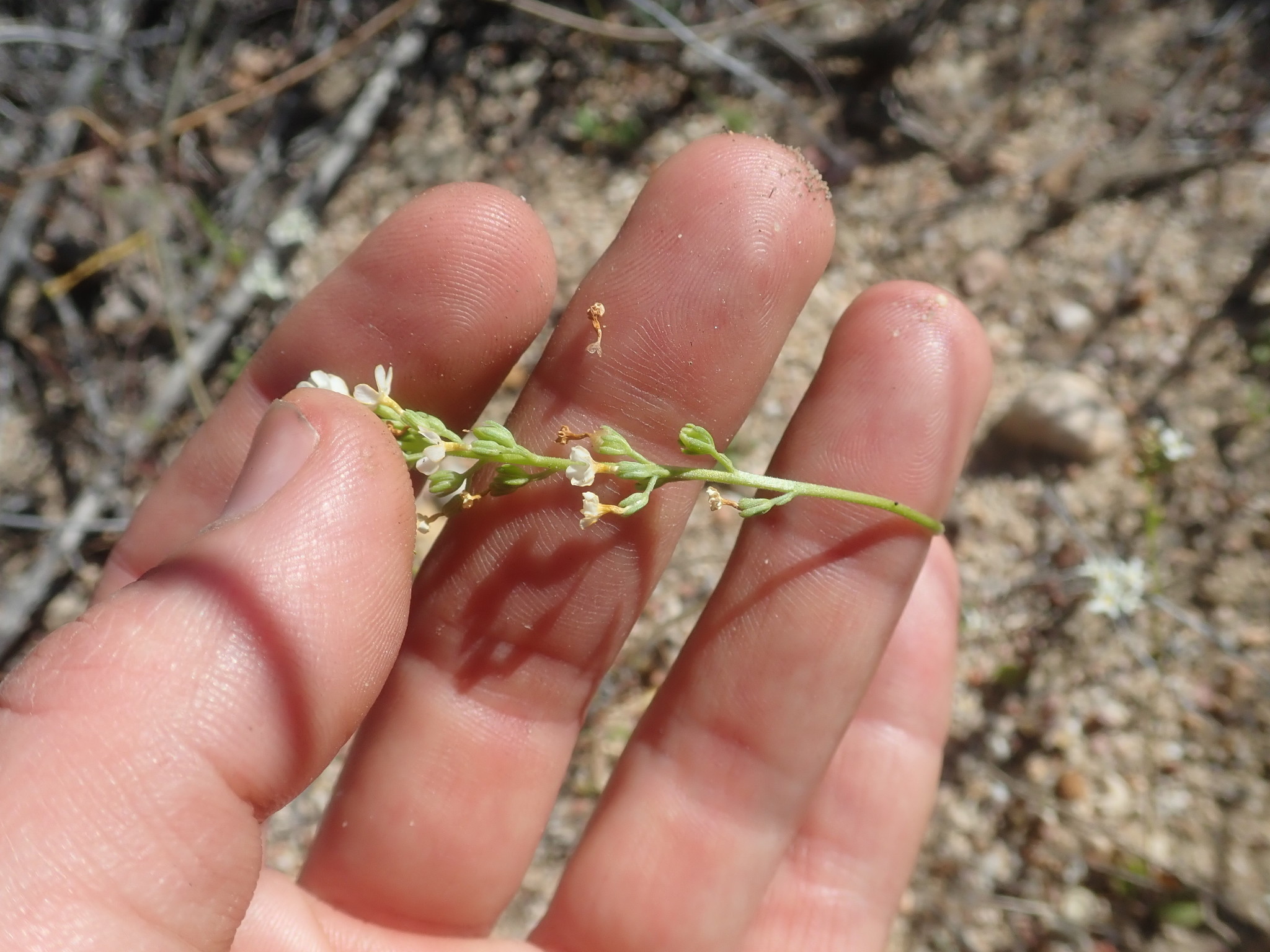
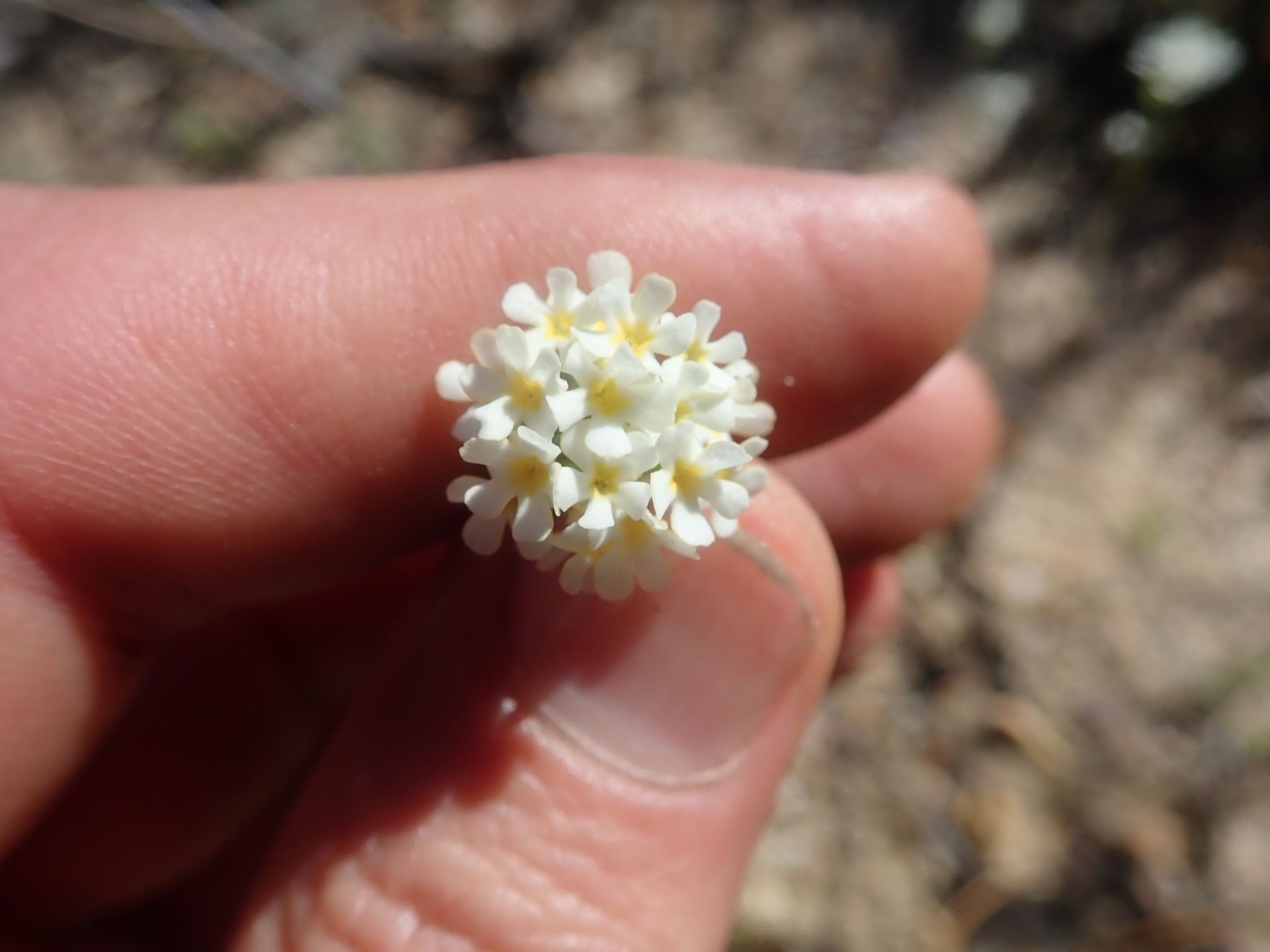
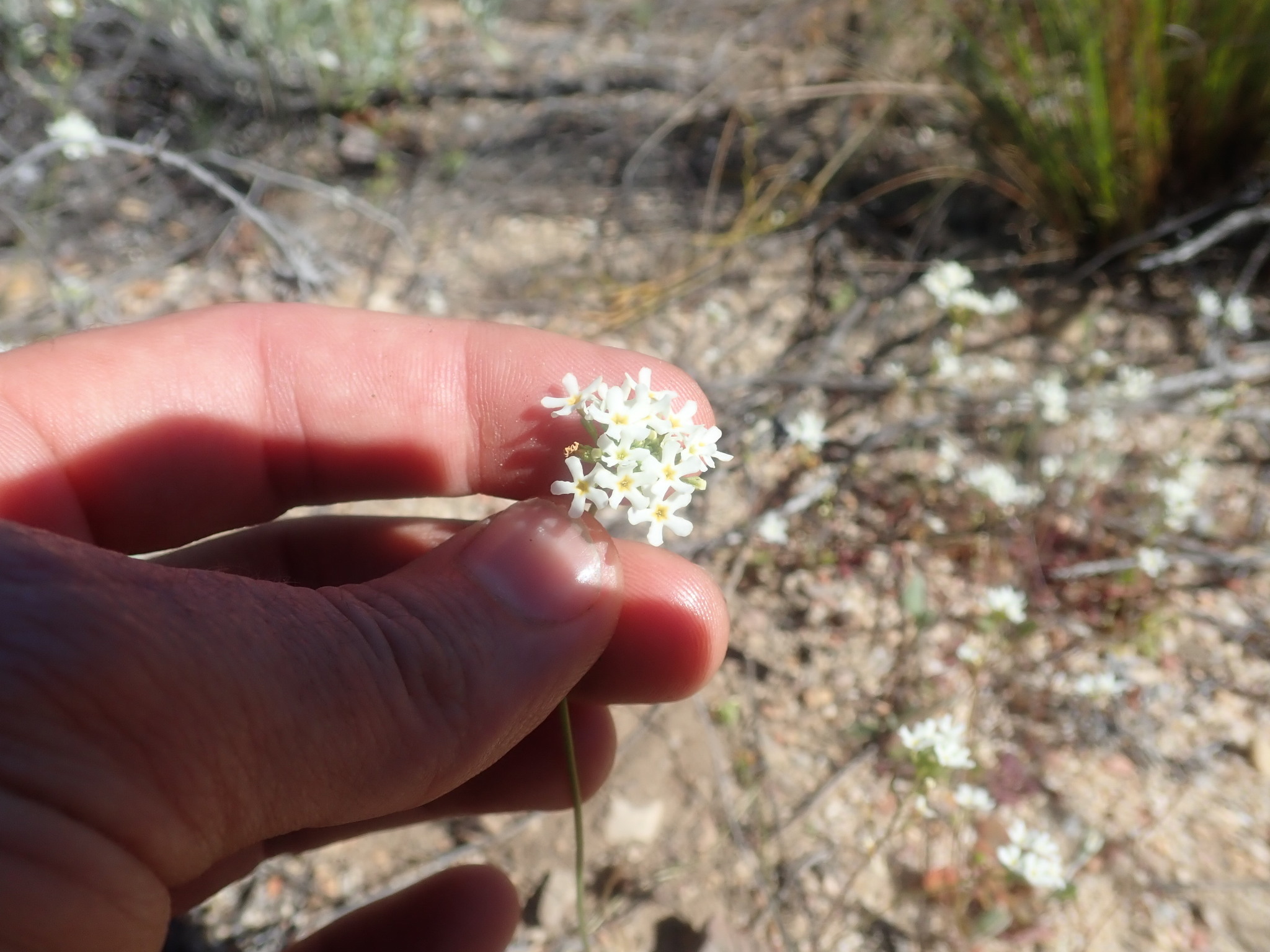
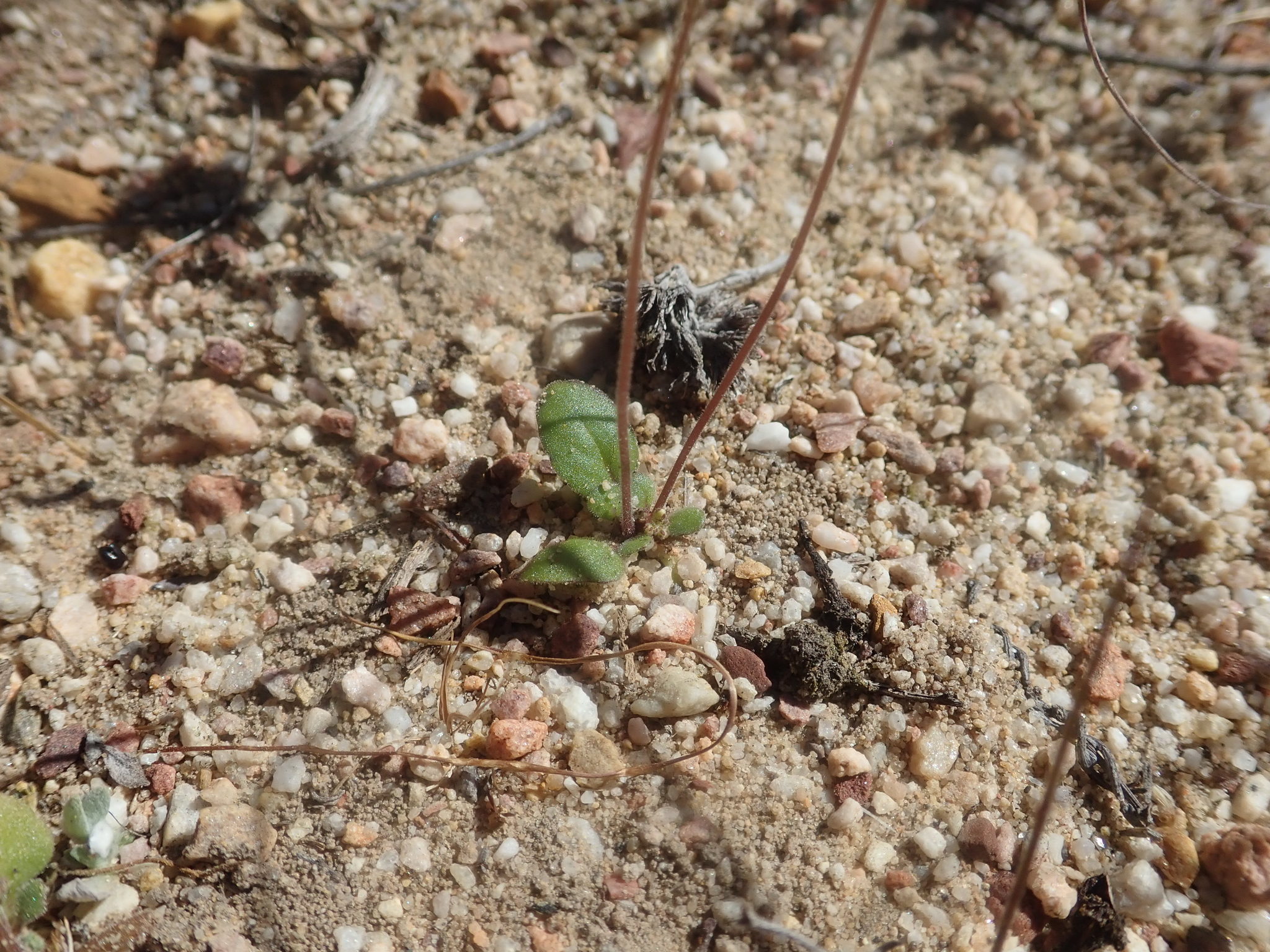
Annual herb, stems 1-c. 20 tufted from the base, c. 60-300 mm tall, erect, simple, minutely glandular-puberulous on upper part including inflorescence axis, hairs on lower part up to 0.2-0.3 mm long, mainly glandular, a few balloon-tipped, leafless. Leaves opposite, bases connate, crowded at base, blade c. 6-28 x 2.5-16 mm, oblanceolate, elliptic or ovate tapering to a flat petiolar part roughly length of blade, apex obtuse, margins subentire to serrate, both surfaces glandular-puberulous, hairs up to c. 0.3-0.4 mm long, occasional balloon-tipped hairs also present. Flowers many in long terminal racemes or narrow thyrses, either solitary or in 24-flowered cymules, solitary flowers and cymules often occurring together in one inflorescence. Bracts (lowermost) 1-3 x 0.5-0.8 mm, linear-lanceolate. Pedicels or peduncles (lowermost) c. 2.5-9 mm long, shorter upwards but all flowers with noticeable pedicels. Calyx obscurely bilabiate, tube 0.4-0.5 mm long, anticous lobes 2-2.6 x 0.6 mm, posticous lobes 1.75-2.5 x 0.5-0.6 mm, all lobes oblong-lanceolate, tips sometimes subspathulate, margins glandular-puberulous, hairs up to 0.1-0.2 mm long, sessile glistening glands as well. Corolla tube 3.5-4.5 x 0.75-1.1 mm in throat, cylindric, inflated near apex, limb ± bilabiate, 4.5-7 mm across lateral lobes, posticous lobes 1.5-2.2 x 1.75-2.2 mm, anticous lobe 1.75-2.8 x 1.3-2.1 mm, all lobes subrotund to elliptic-oblong, with rounded tips, white, yellow star-shaped patch around mouth and extending down tube, glabrous to minutely puberulous outside, glistening glands on backs of lobes, 4 longitudinal bands of clavate hairs in throat. Stamens 4, anticous anthers 0.25-0.4 mm long, just included, posticous anthers 0.6-0.8 mm long, included, posticous filaments bearded. Stigma 0.7-1.1 mm long, deeply included. Style 0.25-0.5 mm long. Ovary 1-1.2 x 0.6-0.7 mm. Capsules 3-3.5 x 1.5-2 mm. Seeds c. 0.5-0.6 x 0.3-0.4 mm, pallid. From: Hilliard, OM. 1994. The Manuleae: a tribe of Scrophulariaceae. Edinburgh University Press, Edinburgh. [All rights reserved]
Minutely glandular-hairy annual to 30 cm. Leaves crowded basally, usually toothed. Flowers in racemes or cymules, somewhat bilabiate, tube short and inflated above, lobes rounded, white with a yellow centre. From: Manning, JC; Goldblatt, P. 2012. Scrophulariaceae: Manulea L. In: J Manning & P Goldblatt (eds), Plants of the Greater Cape Floristic Region 1: The Core Cape flora. Strelitzia 29: 745-747. South African National Biodiversity Institute, Pretoria. [CC BY]
Manulea minor has been much confused with M. exigua, from which it is easily distinguished by its scapose stems, much less markedly toothed leaves and glandular pubescence. Its relationship seems to lie with M. praeterita, from which it is distinguished by the longer hairs on the stems (up to 0.2-0.3 mm versus 0.1 mm) and leaves (up to c. 0.3-0.4 mm versus 0.25 mm), and the entire corolla lobes (not distinctly lobed). From: Hilliard, OM. 1994. The Manuleae: a tribe of Scrophulariaceae. Edinburgh University Press, Edinburgh. [All rights reserved]
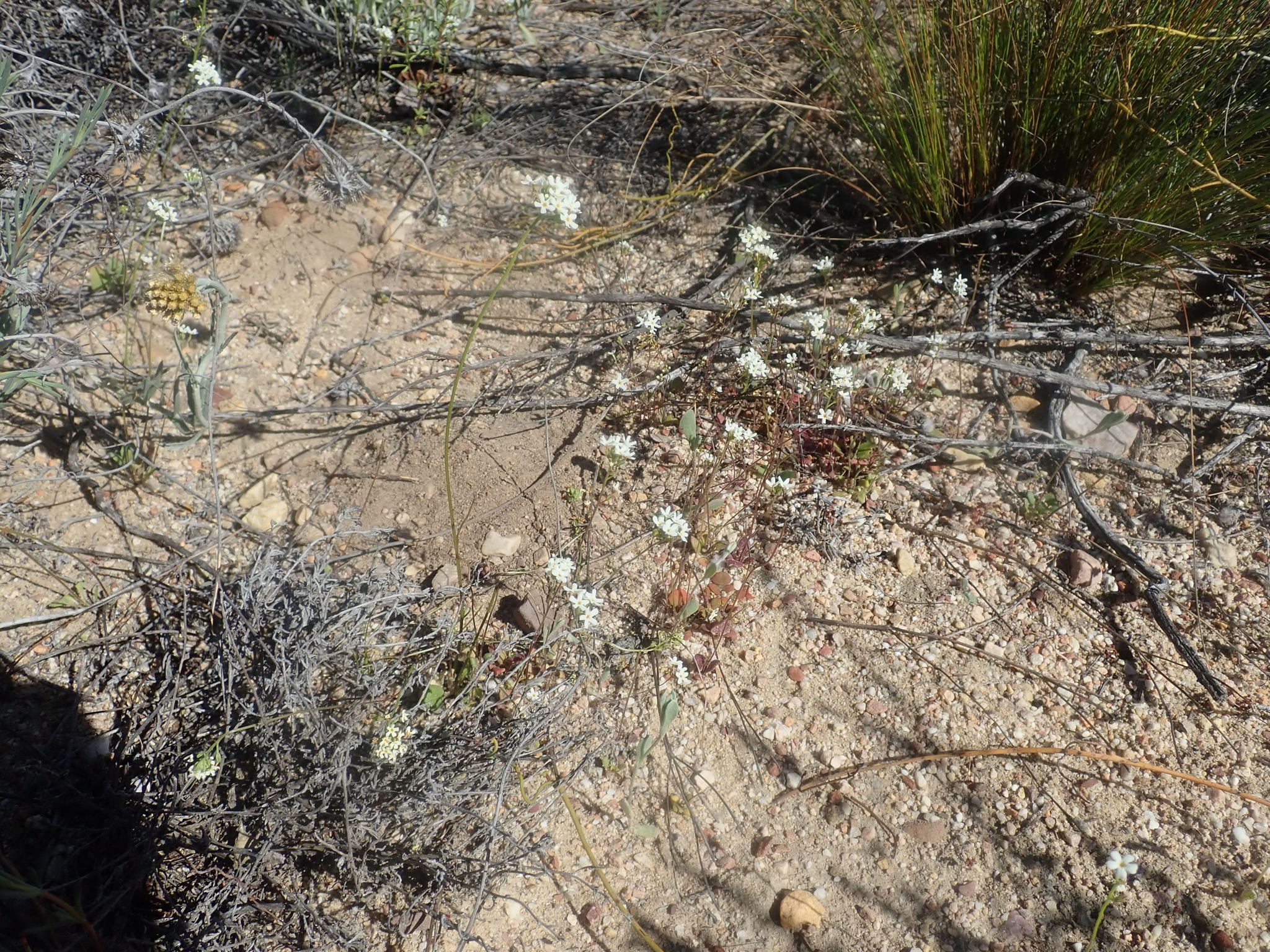
In sand. From: Hilliard, OM. 1994. The Manuleae: a tribe of Scrophulariaceae. Edinburgh University Press, Edinburgh. [All rights reserved]
Stony slopes. From: Manning, JC; Goldblatt, P. 2012. Scrophulariaceae: Manulea L. In: J Manning & P Goldblatt (eds), Plants of the Greater Cape Floristic Region 1: The Core Cape flora. Strelitzia 29: 745-747. South African National Biodiversity Institute, Pretoria. [CC BY]
Manulea minor is known with certainty only from the Hex River valley; its occurrence at Bellville needs confirmation. From: Hilliard, OM. 1994. The Manuleae: a tribe of Scrophulariaceae. Edinburgh University Press, Edinburgh. [All rights reserved]
Hex River Valley. From: Manning, JC; Goldblatt, P. 2012. Scrophulariaceae: Manulea L. In: J Manning & P Goldblatt (eds), Plants of the Greater Cape Floristic Region 1: The Core Cape flora. Strelitzia 29: 745-747. South African National Biodiversity Institute, Pretoria. [CC BY]
July to October
430 to 518 m
This map contains point-based occurrences at different locations
Occurrence in the Flora of Southern Africa (FSA) countries and South African provinces. Residence status indicates if a taxon is indigenous, endemic, naturalised or invasive in a specific region. This data is based on specimen records and literature
FSA
SA
BOT
NAM
ESW
LES
WC
EC
NC
FS
GA
KZN
LP
MP
NW
Absent
Indigenous
Endemic
Naturalised
Invasive

Names and Sources
Classification
KINGDOM Plantae
SUBKINGDOM Phanerogamae
PHYLUM Anthophyta
ORDER Lamiales
FAMILY Scrophulariaceae
TRIBE Limoselleae
GENUS Manulea
SPECIES minor
4 results for Manulea minor Diels
Barcode: NBG0046599-0 Collector(s) & number: Bolus, H, Guthrie 3071 | 1893-10-1
South Africa, Western Cape, Hex River Pass.
General notes: Alt. 1700'.
Data Resource: BODATSA View record
Barcode: NBG1558610-0 Collector(s) & number: Nicolson, G, TBC | 2021-10-9
South Africa, Western Cape, De Doorns. Naudesia farm, adjacent to N1.
Data Resource: BODATSA View record
This map contains point-based occurrences at different locations
2012
SERIES CHAPTER
Scrophulariaceae: Manulea L. Manning, JC; Goldblatt, PIn: J Manning & P Goldblatt (eds), Plants of the Greater Cape Floristic Region 1: The Core Cape flora. Strelitzia 29: 745-747
South African National Biodiversity Institute, Pretoria
1994
1904
FLORA CHAPTER
XCV. Scrophulariaceae Hiern, WPIn: WT Thiselton-Dyer (ed.). Flora Capensis 4(1-3)121-420
Lovell Reeve & Co., London
1896
PERIODICAL/JOURNAL
Diels, FLEBotanische Jahrbücher für Systematik, Pflanzengeschichte und Pflanzengeographie 23:
No results found for Manulea minor Diels
Status and criteria
CR
Assessor(s)
Plantae Coordinator
JOURNAL ARTICLE
Lavis, M. 1967. Notes on the genus Delosperma (Mesembrieae). Journal of South African Botany. 33:311-314
JOURNAL ARTICLE
Lavis, M. 1967. Notes on the genus Delosperma (Mesembrieae). Journal of South African Botany. 33:71-74
JOURNAL ARTICLE
Lavis, M. and Hammer, S. 1989. A new Conophytum from Namaqualand. Cactus and Succulent Journal (USA). 61:3-4
JOURNAL ARTICLE
Lavranos, J.J. 1966. A new Stapeliad from S.W. Africa. Journal of South African Botany. 32:195-199
JOURNAL ARTICLE
Lavranos, J.J. 1971. Aloe buhrii: a new species from the Calvinia district, Cape Province. Journal of South African Botany. 37:37-40
JOURNAL ARTICLE
Lavranos, J.J. 1973. Aloe chlorantha: a new species from the south western Karoo (South Africa). Journal of South African Botany. 39:85-90
JOURNAL ARTICLE
Lavranos, J.J. 2000. A new species of Othonna (Compositae) from southern Namaqualand (South Africa). Piante Grasse. 20:34-37
JOURNAL ARTICLE
Lavranos, J.J. 2002. Othonna pavelkae (Compositae) a new and unusual species from Namaqualand, South Africa. Cactus and Succulent Journal. 74:142-145
| Part(s) of plant used | Use(s) | Reference |
|---|
Coming soon...


