PLANTAE / PHANEROGAMAE / ANTHOPHYTA / ASPARAGALES / IRIDACEAE / CROCOIDEAE / IXIEAE / IXIA / SCILLARIS / TOXIMONTANA

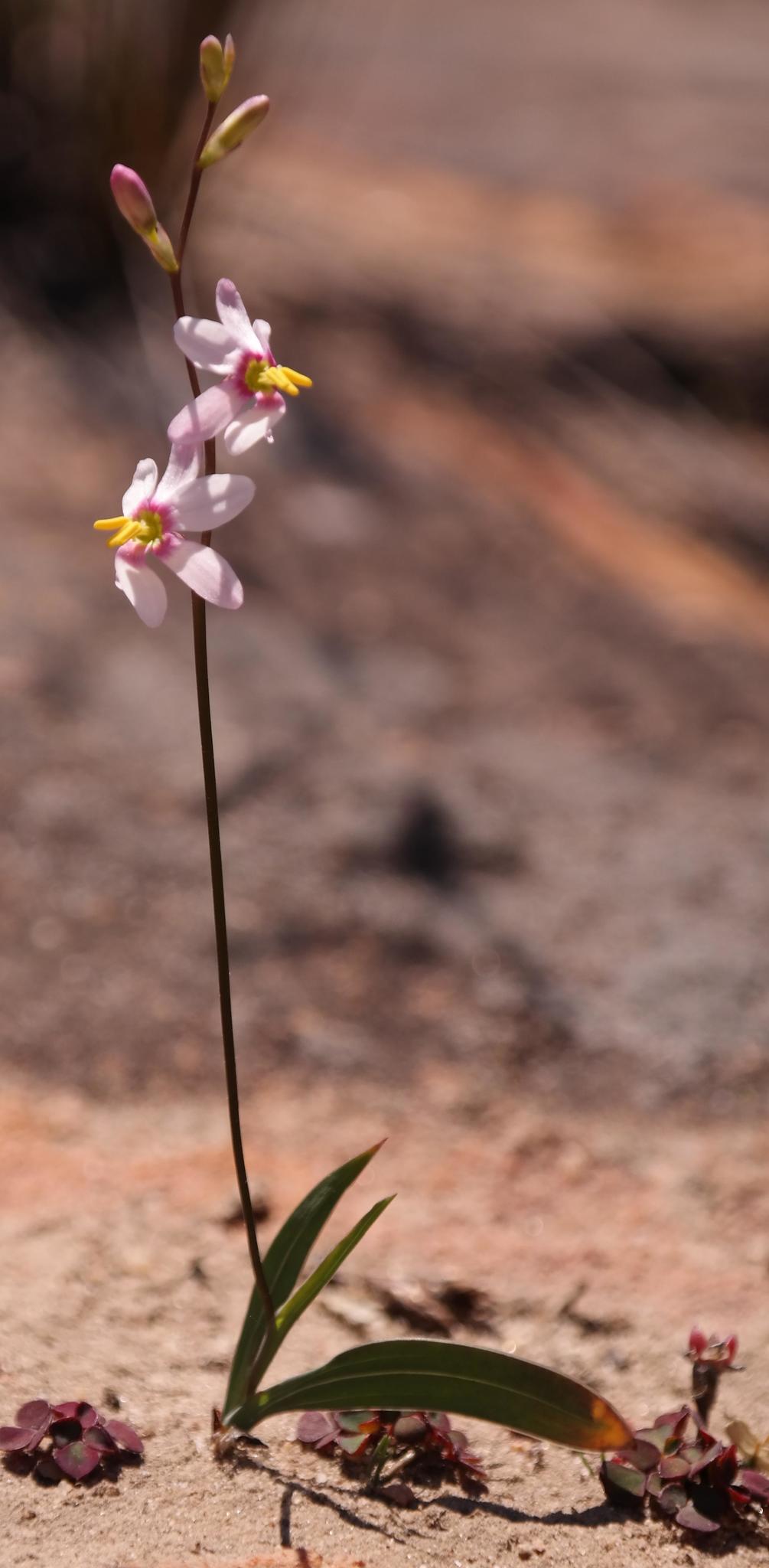
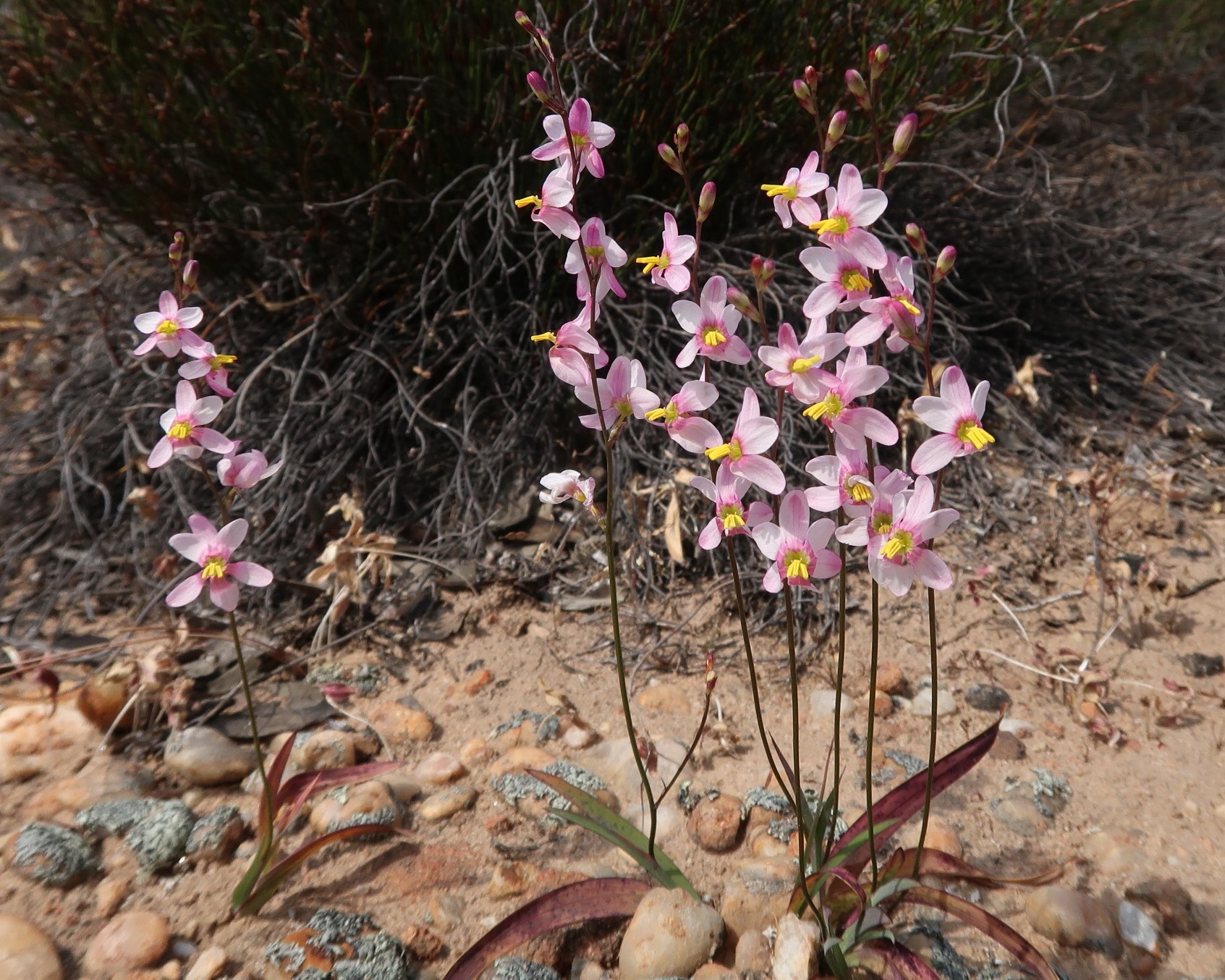
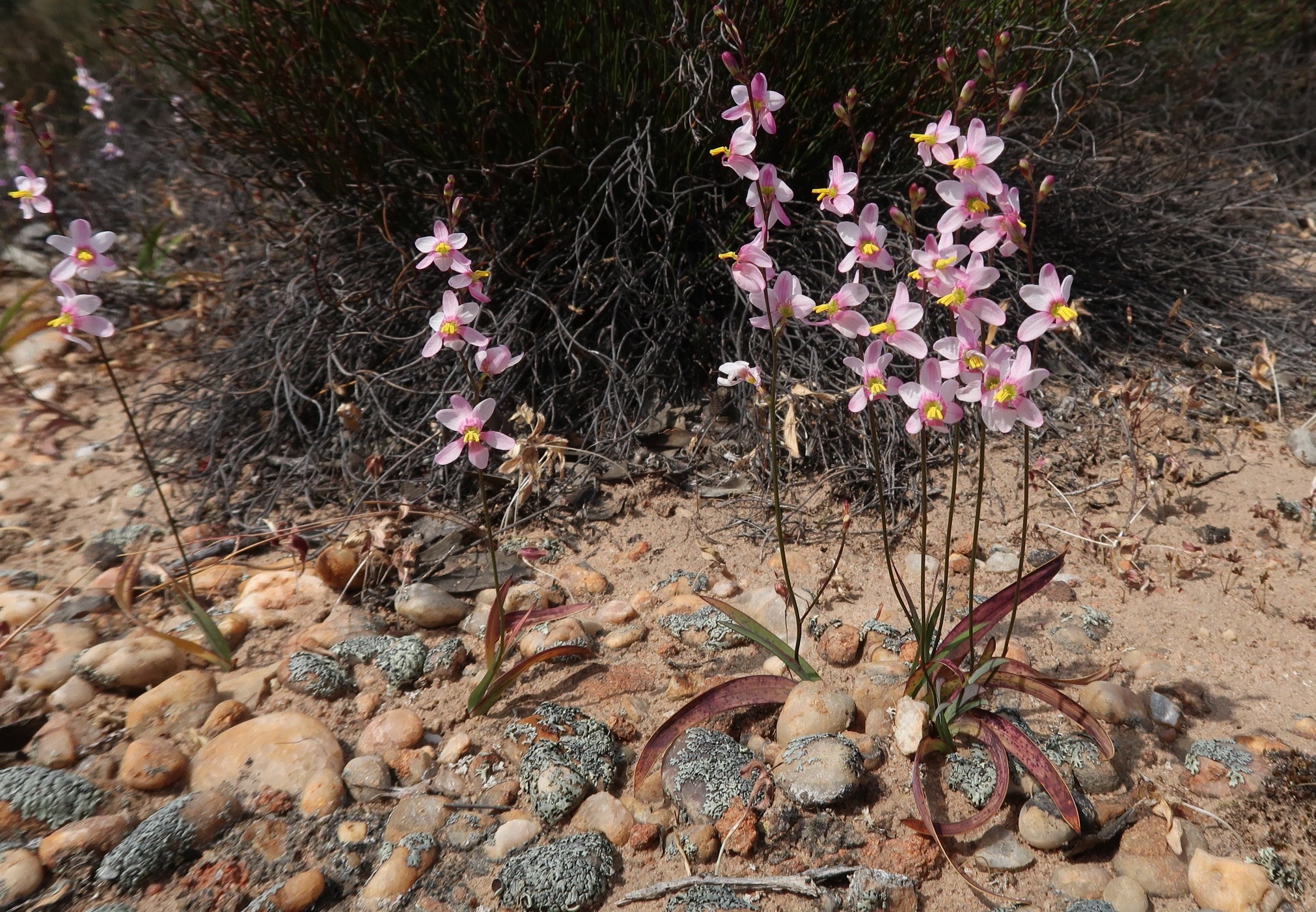
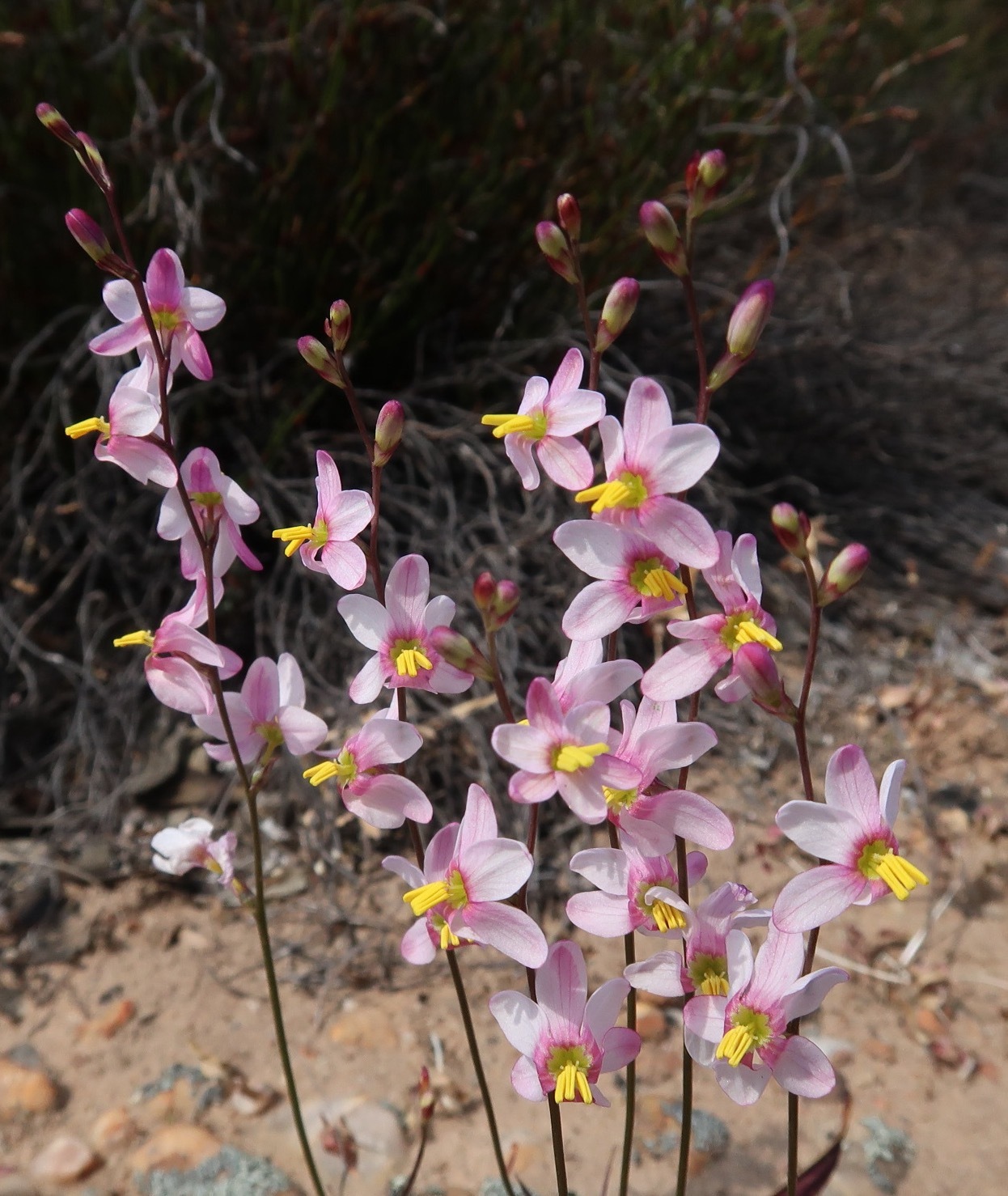
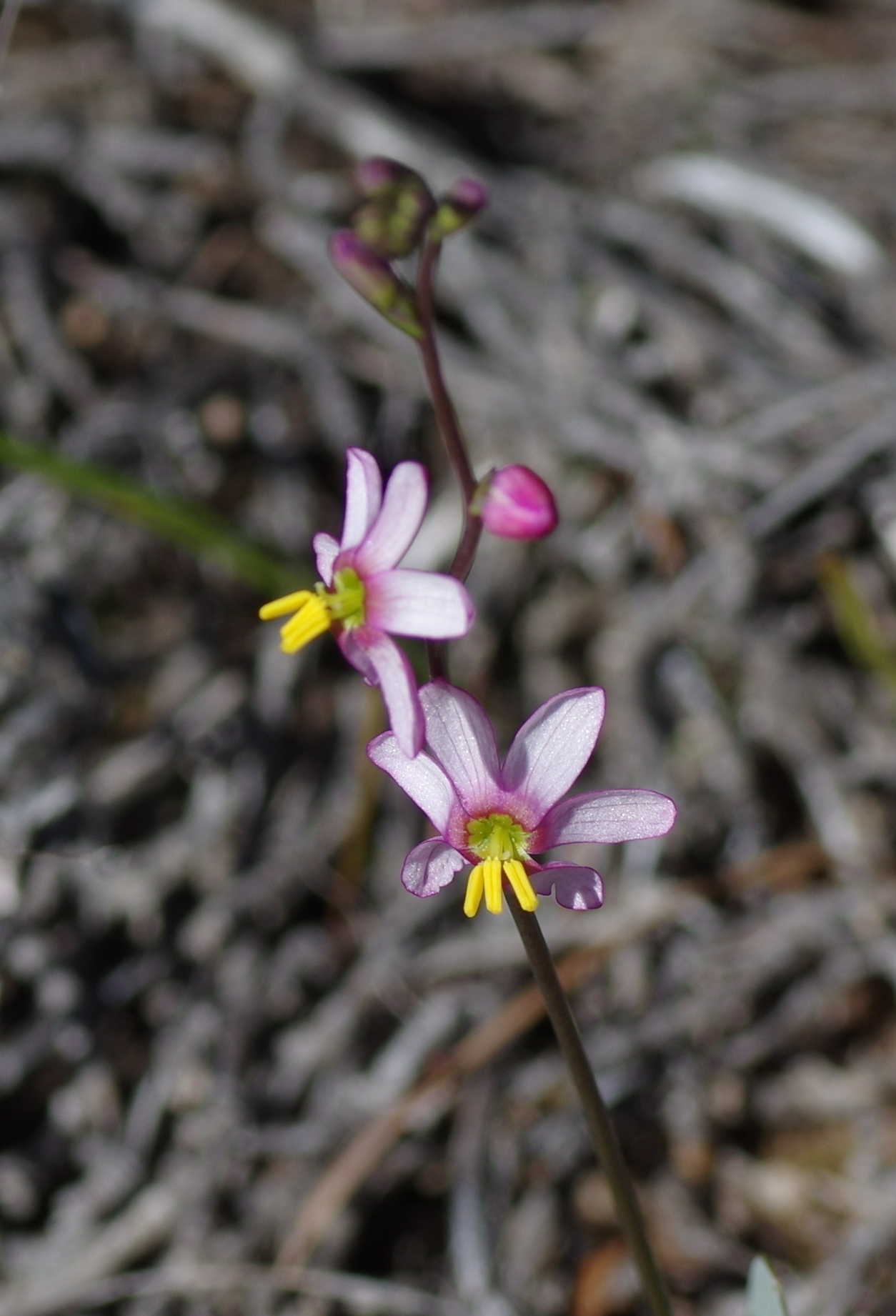
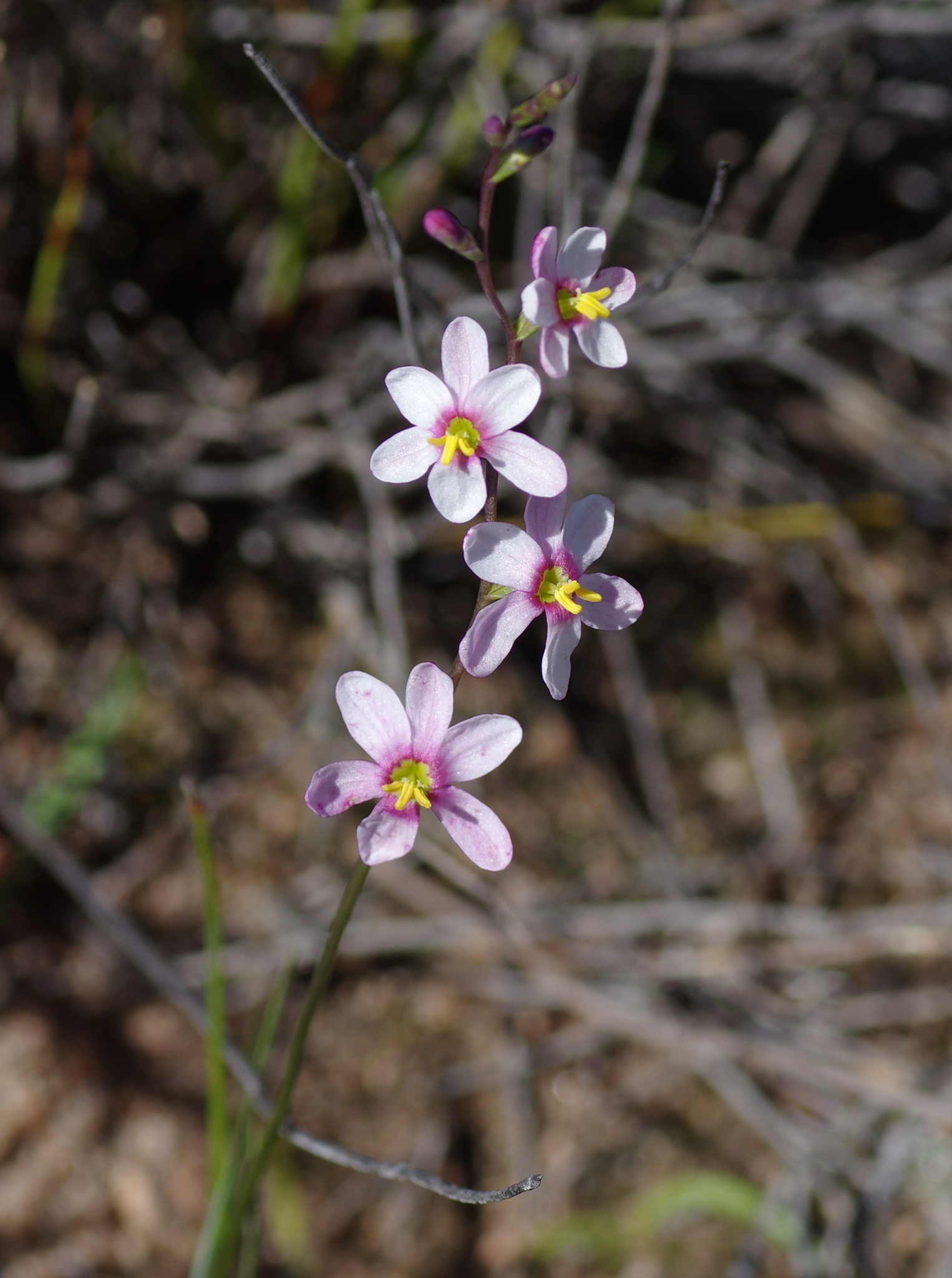
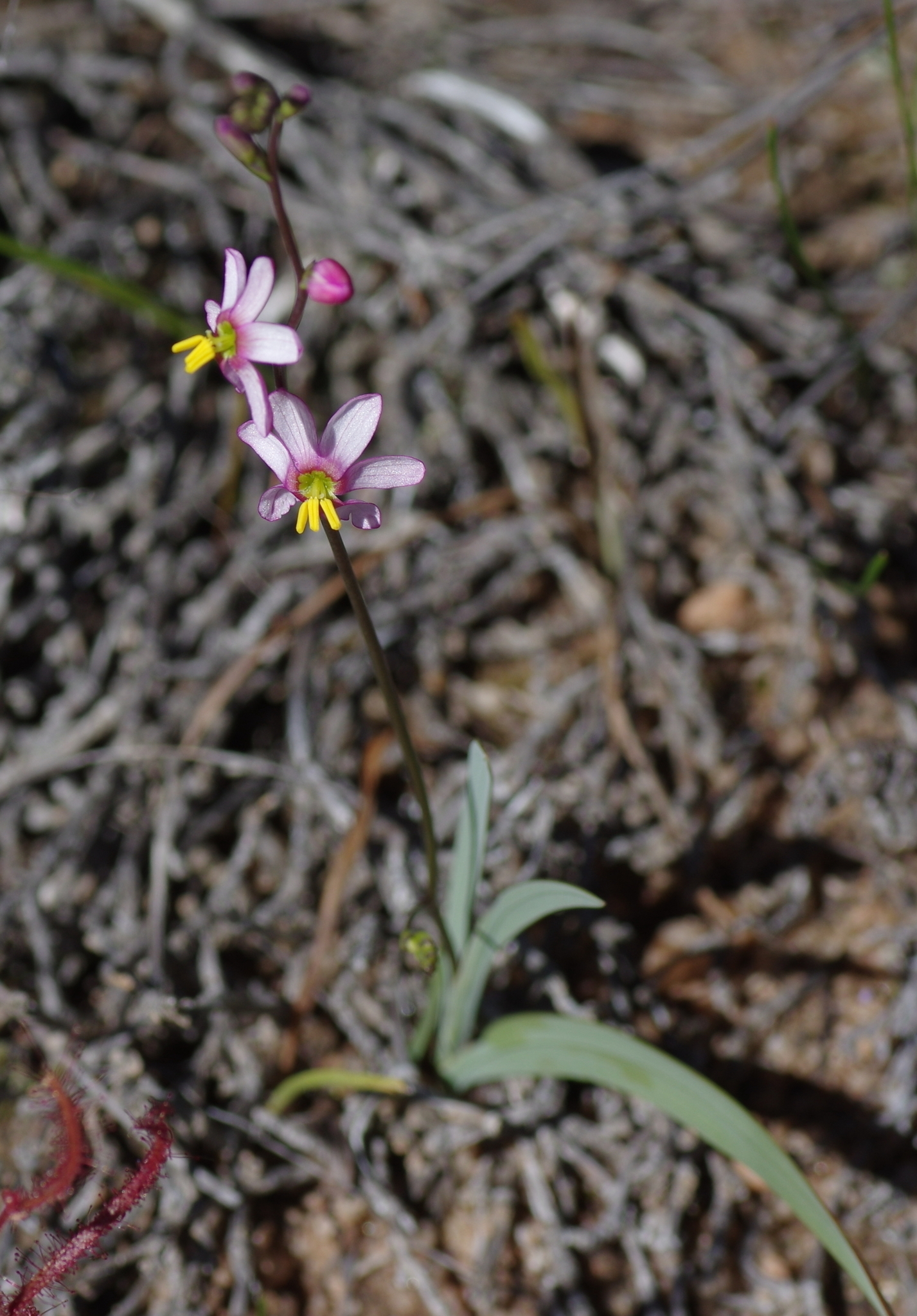
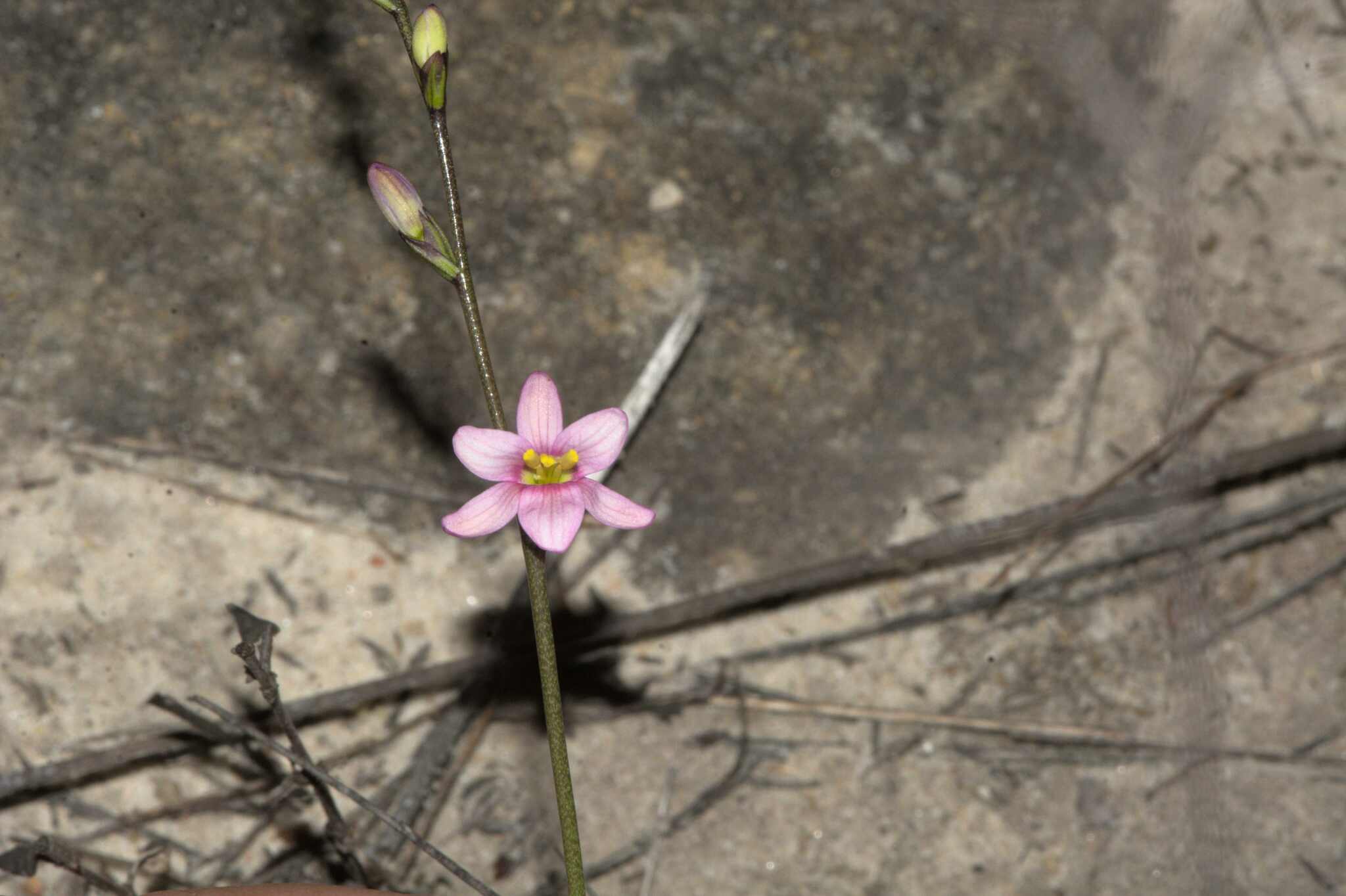
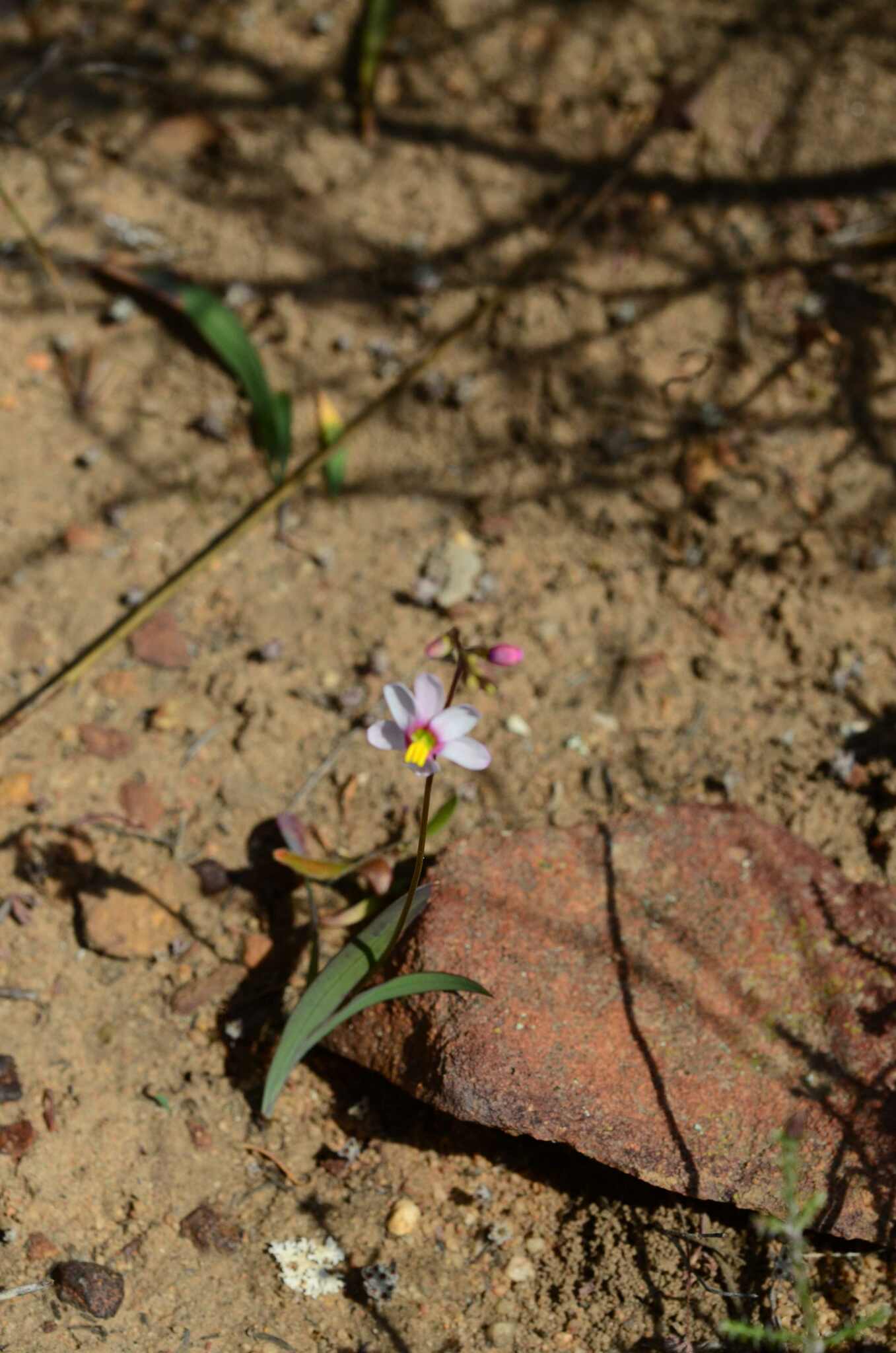
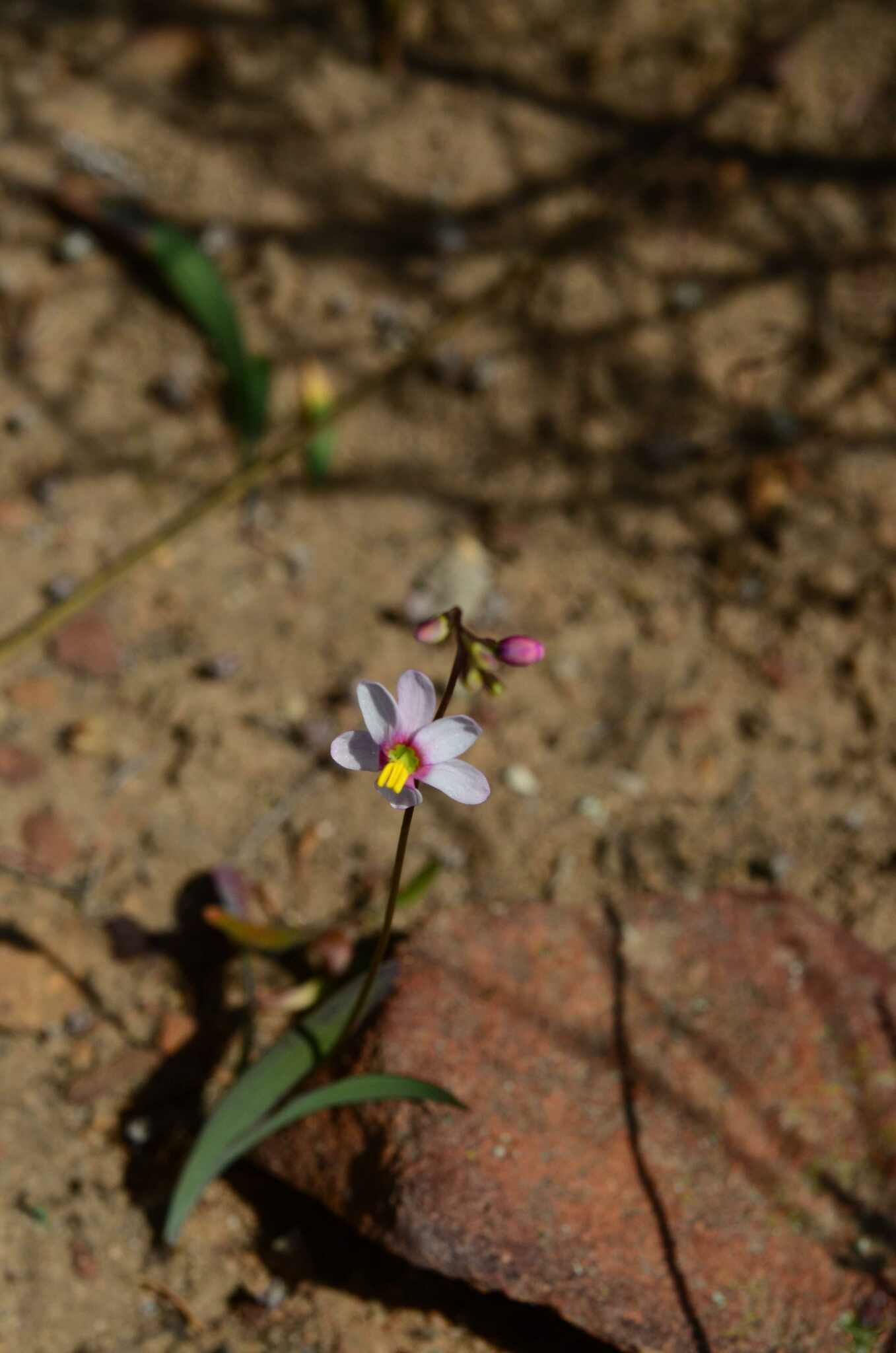
Plants 120-250 mm high. Corms globose-conic, mostly 15-18 mm at widest diam., bearing conspicuous cormlets at base; tunics of hard, coarse fibres. Stem simple or with 1 or 2, rarely 3 branches. Leaves (2)3(4), all ± basal, mostly 3-8 mm wide, with main vein and secondary pair of veins hyaline when alive, raised when dry, margins appearing thickened when dry. Spike mostly 10- to 15-flowered, flowers mostly 8-12 mm apart; bracts 3-4 mm long. Flowers opening pale pink turning deep pink next day, tepal bases yellow edged dark pink, throat pale yellow; perianth tube ± 3 mm long; tepals subequal, ± 8 x 4 mm lowermost held slightly apart and arched backward. Filaments 1.0-1.6 mm long; anthers 1.6-2.5 mm long. Style branches ± 1.5 mm long, almost reaching anther bases. From: Goldblatt, P; Manning, JC. 2020. Iridaceae of southern Africa. Strelitzia 42: 1-1159. South African National Biodiversity Institute, Pretoria. [CC BY]
Plants 120-250 mm high, simple or with 1 or 2, rarely 3 branches. Corms globose-conic, mostly 15-18 mm at widest diam., tunics of hard, coarse fibres; bearing conspicuous cormlets at base. Leaves (2)3(4), all ± basal, mostly 3-8 mm wide, main vein prominent, secondary pair of veins hyaline when alive, raised when dry, margins appearing thickened when dry. Spike mostly 10-15-flowered, flowers mostly 8-12 mm apart; bracts 3-4 mm long. Flowers opening pale pink turning deep pink next day, tepal bases yellow edged dark pink, throat pale yellow, perianth tube ± 3 mm long, tepals subequal, ± 8 x 4 mm lowermost held slightly apart and arched backward. Filaments 1.0-1.6 mm long, anthers 1.6-2.5 mm long. Style branches ± 1.5 mm long, almost reaching anther bases. Flowering time: late Sept.-mid- Nov. From: Goldblatt, P; Manning, JC. 2012. Systematics of the southern African genus Ixia (Iridaceae): 4. Revision of sect. Dichone. Bothalia 42(2): 87-110. [CC BY]
Subsp. toximontana is distinguished in Ixia scillaris by its low stature, seldom exceeding 150 mm, combined with relatively small flowers and only 2 or 3 leaves, these short and relatively narrow, 3-8 mm wide. The flowers have tepals ± 8 x 4 mm and anthers ± 2.3 mm long, smaller than in subsp. lata or subsp. scillaris. In their small size they recall subsp. scillaris rather than subsp. lata, in whose range it is nested. From: Goldblatt, P; Manning, JC. 2020. Iridaceae of southern Africa. Strelitzia 42: 1-1159. South African National Biodiversity Institute, Pretoria. [CC BY]
Subsp. toximontana is distinguished in Ixia scillaris by its low stature, seldom exceeding 150 mm, combined with relatively small flowers and only 2 or 3 leaves, these short and relatively narrow, 3-8 mm wide. The flowers have tepals ± 8 x 4 mm and anthers ± 2.3 mm long, smaller than in subsp. latifolia or subsp. scillaris. In their small size they recall subsp. scillaris rather than subsp. latifolia, in whose range it is nested. The particularly small size of all parts may be an adaptation to the habitat, nutrient-poor, shallow, sandy ground. From: Goldblatt, P; Manning, JC. 2012. Systematics of the southern African genus Ixia (Iridaceae): 4. Revision of sect. Dichone. Bothalia 42(2): 87-110. [CC BY]
Shallow, sandy ground overlying sandstone pavement. From: Goldblatt, P; Manning, JC. 2020. Iridaceae of southern Africa. Strelitzia 42: 1-1159. South African National Biodiversity Institute, Pretoria. [CC BY]
Subsp. toximontana grows in shallow, sandy ground overlying sandstone pavement. The habitat is permanently wet in the rainy winter and early spring months but becomes dry by the end of September and remains so through the summer and autumn. Most of its range is virtually intact and pristine at present. From: Goldblatt, P; Manning, JC. 2012. Systematics of the southern African genus Ixia (Iridaceae): 4. Revision of sect. Dichone. Bothalia 42(2): 87-110. [CC BY]
Restricted to the Gifberg and Matsikamma Mtn complex of northern Western Cape. From: Goldblatt, P; Manning, JC. 2020. Iridaceae of southern Africa. Strelitzia 42: 1-1159. South African National Biodiversity Institute, Pretoria. [CC BY]
Restricted to the Gifberg and Matsikamma Mtn complex of northern Western Cape. From: Goldblatt, P; Manning, JC. 2012. Systematics of the southern African genus Ixia (Iridaceae): 4. Revision of sect. Dichone. Bothalia 42(2): 87-110. [CC BY]
September to November
This map contains point-based occurrences at different locations
Occurrence in the Flora of Southern Africa (FSA) countries and South African provinces. Residence status indicates if a taxon is indigenous, endemic, naturalised or invasive in a specific region. This data is based on specimen records and literature
FSA
SA
BOT
NAM
ESW
LES
WC
EC
NC
FS
GA
KZN
LP
MP
NW
Absent
Indigenous
Endemic
Naturalised
Invasive

Names and Sources
Published in: Bothalia 42(2): 106 (2012)
Type: South Africa, Western Cape, Gifberg, 1/11/2011, Goldblatt & Porter 13703 (NBG, holo.; K, MO, PRE, iso.)
Classification
KINGDOM Plantae
SUBKINGDOM Phanerogamae
PHYLUM Anthophyta
ORDER Asparagales
FAMILY Iridaceae
SUBFAMILY Crocoideae
TRIBE Ixieae
GENUS Ixia
SPECIES scillaris
SUBSPECIES toximontana
10 results for Ixia scillaris L. subsp. toximontana Goldblatt & J.C.Manning
Barcode: PRE0059137-0 Collector(s) & number: Werdermann, E, 502 | 1958-10-9
South Africa, Western Cape, Van Rhynsdorp Dist.; Bokkeveld Mts.; Giftberg.
Data Resource: BODATSA View record
Barcode: PRE0060989-0 Collector(s) & number: Barker, WF, 9578 | 1961-9-17
South Africa, Western Cape, VAN RHYNSDORP DIST.; GIFBERG. ON UPPER PLATEAU.
Data Resource: BODATSA View record
Barcode: NBG0140308-0 Collector(s) & number: Snijman, DA, 963 | 1985-11-11
South Africa, Western Cape, Vanrhynsdorp. Matsikammaberg, N of Farm Die Vlei.
General notes: Growing in recently burnt TMS. Flowers pale pink with deep pink centre.
Data Resource: BODATSA View record
Barcode: NBG0102258-0 Collector(s) & number: Phillips, EP, 7542 | 1911-9-19
South Africa, Western Cape, Gifberg.
General notes: Flowers pink. Rare.
Data Resource: BODATSA View record
Barcode: PRE0692801-0 Collector(s) & number: Zietsman, PC, 1135 | 1985-9-21
South Africa, Western Cape, VANRHYNSDORP DIST.; GIFBERG; BO - OP DIE BERG.
Data Resource: BODATSA View record
This map contains point-based occurrences at different locations
2020
SERIES
Iridaceae of southern Africa Goldblatt, P; Manning, JCStrelitzia 42: 1-1159
South African National Biodiversity Institute, Pretoria
2012
PERIODICAL/JOURNAL
Systematics of the southern African genus Ixia (Iridaceae): 4. Revision of sect. Dichone Goldblatt, P; Manning, JCBothalia 42(2)87-110
No results found for Ixia scillaris L. subsp. toximontana Goldblatt & J.C.Manning
Status and criteria
LC
Assessor(s)
Plantae Coordinator
JOURNAL ARTICLE
Bannister, J. and Mitchell, E. 1980. North Pacific sperm whale stock identity: distributional evidence from Maury and Townsend charts. Reports of the International Whaling Commission. Special Issue 2:219-230
JOURNAL ARTICLE
Haase, B. and Felix, F. 1994. A note on the incidental mortality of sperm whales (<i>Physeter macrocephalus</i>) in Ecuador. Reports of the International Whaling Commission. Special Issue 15:481-484
| Part(s) of plant used | Use(s) | Reference |
|---|
Coming soon...