PLANTAE / PHANEROGAMAE / ANTHOPHYTA / ASPARAGALES / ASPHODELACEAE / ALOOIDEAE / HAWORTHIA / NORTIERI / PEHLEMANNIAE

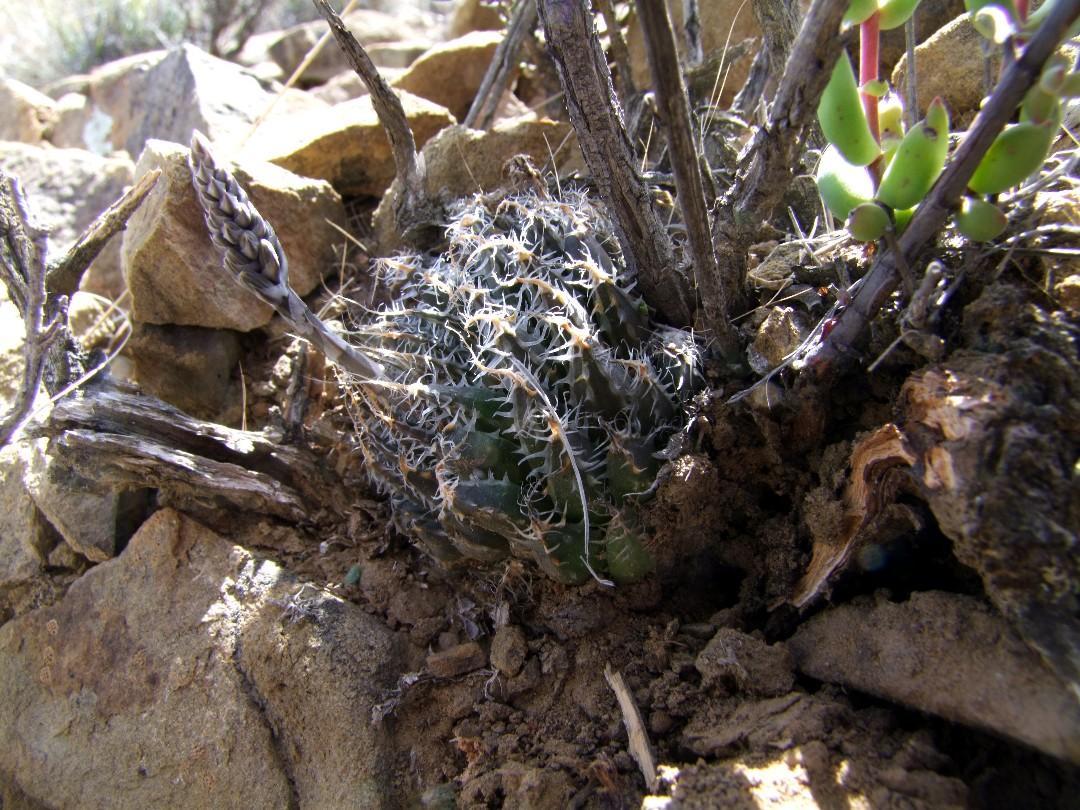
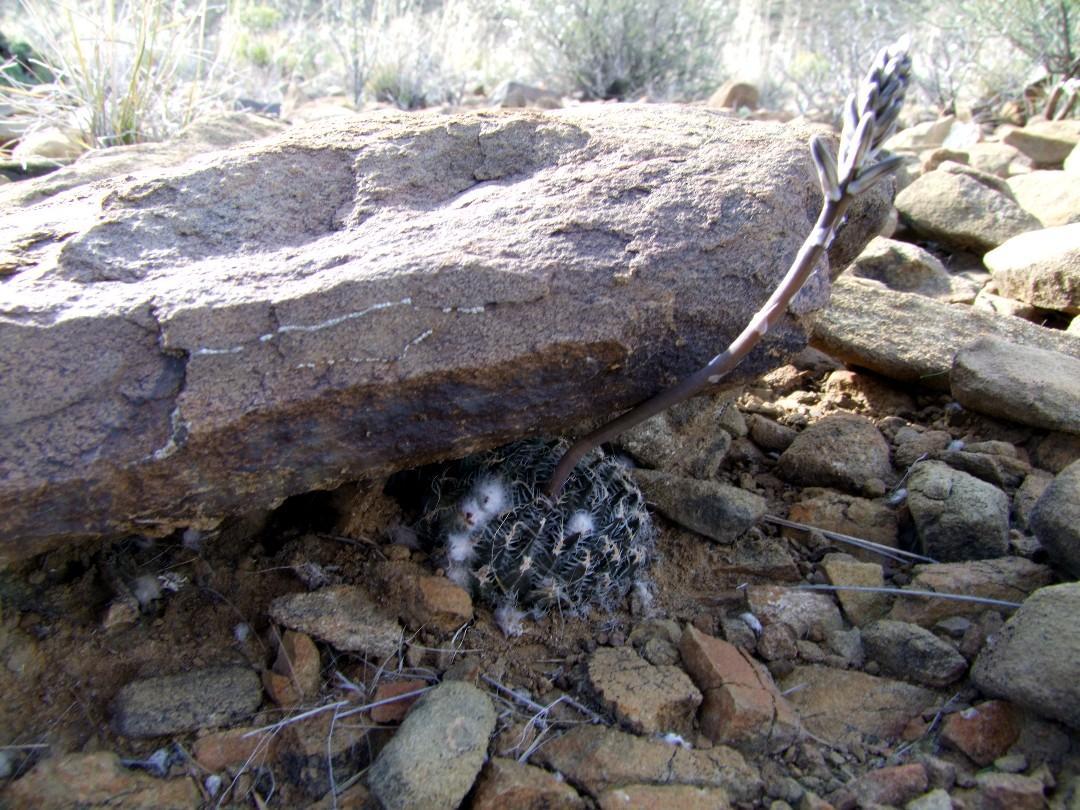
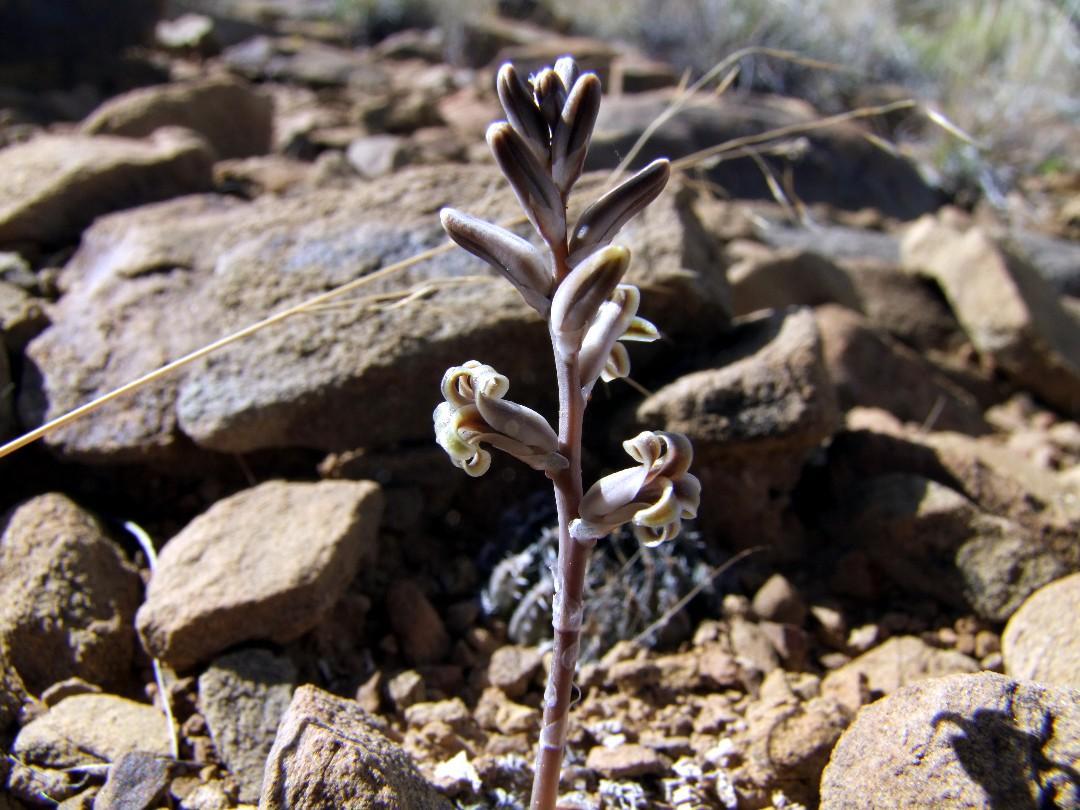
Plants acaulescent, in a basal rosette which is about 5.5 cm diam., (not) or slowly proliferous from the base. Leaves numerous, the young erect, incurved, the old ascending, somewhat spreading, incurved, about 30 mm long, 8 mm broad, up to 4 mm thick, oblong-lanceolate, black-green; upper surface flat to slightly rounded, semi-pellucid, with about 6 brownish longitudinal lines, smooth, yellow-white from the middle of the leaf to the base, green near the apex; lower surface rounded, black-green, yellow-white at the base of the leaves, smooth with 6 to 7 indistinct longitudinal lines; keel 1 or 2 in the upper third, with 2 mm long pellucid cuspidate teeth; margins acute, with 3 mm long cuspidate pellucid teeth; end-awn 9 mm long, brown, denticulated. Inflorescence about 21 cm tall; peduncle simple, terete, about 2 mm diam., 10 cm long, bracteate; sterile bracts membranous, ovate, acuminate, the two lower 10 mm long, upper 5-7 mm long, erect, keeled with a reddish-brown nerve; raceme about 11 cm long, lax, with about 20 spirally arranged flowers and buds, these quadrangularly arranged, 6 flowers open simultaneously; floral bracts 6 mm long, membranous, deltoid, acute, keeled with fine reddish veins, clasping the pedicels, (longer than the pedicels); pedicels 3 mm long, 1 mm diam., brown, erect; perianth greyish-black, 7 mm long, stipitate, compressed at base, the cylindrical-triangular base 5 mm across, constricted to 3 mm above, curved; posterior segments obtuse, recurved about 90 degrees with greyish-black veins; lower segments greyish-black, recurved, spreading; stamens 6 of two lengths inserted within the perianth tube 3 and 4 mm long; ovary 3 mm long, 1.25 mm diam., green; style 0.25 mm long, white, capitate. From: Scott, CL. 1985. The genus Haworthia (Liliaceae): a taxonomic revision. Aloe Books, Johannesburg. [All rights reserved] As: Haworthia pehlemanniae C.L.Scott
H. pehlemanniae shows affinities with two species, H. translucens and H. globosiflora which belongs to a different section. Vegetatively it is the nearest to H. translucens with its oblong-lanceolate leaves, with the margins and keel beset with pellucid teeth, but it differs and is characterised by the greyish-black quadrantly positioned globose flowers; these are fewer, not white, nor spirally arranged as observed in the inflorescence of H. translucens. From the second, H. globosiflora, it differs vegetatively by the longer leaves and longer teeth on the leaf margins, and the two species may be readily separated. Also the two species are geographically well separated, H. globosiflora occurs in the Calvinia District, while H. pehlemanniae occurs in the Laingsburg District. Superficially the inflorescences of the two species may be similar, but there are differences; the inflorescence of H. globosiflora is longer with more spirally arranged flowers, the perianth is longer and white, as compared with the shorter, quadrantly positioned, greyish flowers of H. pehlemanniae. From: Scott, CL. 1985. The genus Haworthia (Liliaceae): a taxonomic revision. Aloe Books, Johannesburg. [All rights reserved] As: Haworthia pehlemanniae C.L.Scott
It is a constituent of the Succulent Karoo, an area in which the dominant plants are succulents, with little grass. It occurs on flat, or slightly rising ground under low growing Karoo scrub. This area receives an annual rainfall of 125 to 200 mm mainly during the winter months; the summers are very hot and the winters cold with frost, and snow on the higher ground of the surrounding mountains. H. pehlemanniae grows in a rather powdery, argillaceous soil with pH 6.8. From: Scott, CL. 1985. The genus Haworthia (Liliaceae): a taxonomic revision. Aloe Books, Johannesburg. [All rights reserved] As: Haworthia pehlemanniae C.L.Scott
H. pehlemanniae is an interesting species which occurs in the drier and more arid region of the Great Karoo. From: Scott, CL. 1985. The genus Haworthia (Liliaceae): a taxonomic revision. Aloe Books, Johannesburg. [All rights reserved] As: Haworthia pehlemanniae C.L.Scott
500 to 1500 m
This map contains point-based occurrences at different locations
 This is a sensitive species therefore data has been redacted, click here to login.
Occurrence in the Flora of Southern Africa (FSA) countries and South African provinces. Residence status indicates if a taxon is indigenous, endemic, naturalised or invasive in a specific region. This data is based on specimen records and literature
FSA
SA
BOT
NAM
ESW
LES
WC
EC
NC
FS
GA
KZN
LP
MP
NW
Absent
Indigenous
Endemic
Naturalised
Invasive

Names and Sources
Published in: Haworthia Revisited: 130 (1999)
Type: South Africa, W Laingsburg, Scott 7450 (PRE)
Haworthia pehlemanniae C.L.Scott
Published in: Cact. Succ. J. (Los Angeles) 54(2): 70 (1982)
Classification
KINGDOM Plantae
SUBKINGDOM Phanerogamae
PHYLUM Anthophyta
ORDER Asparagales
FAMILY Asphodelaceae
SUBFAMILY Alooideae
GENUS Haworthia
SPECIES nortieri
VARIETY pehlemanniae
4 results for Haworthia nortieri G.G.Sm. var. pehlemanniae (C.L.Scott) M.B.Bayer
Barcode: NBG0144692-0 Collector(s) & number: Bayer, MB, 3906 | 1984-3-31
Data Resource: BODATSA View record
Barcode: NBG0157493-0 Collector(s) & number: Aslander, E, 801 | --
Data Resource: BODATSA View record
Barcode: PRE0633586-0 Collector(s) & number: Scott, CL, 7450 | --
Data Resource: BODATSA View record
This map contains point-based occurrences at different locations
This is a sensitive species therefore data has been redacted, click here to login.
2012
PERIODICAL/JOURNAL
The Haworthia Nomenclator: A list of accepted species with some guidelines for infrapecific names Bayer, MB; Manning, JCHaworthiad: 1-23
1999
1985
No results found for Haworthia nortieri G.G.Sm. var. pehlemanniae (C.L.Scott) M.B.Bayer
| Part(s) of plant used | Use(s) | Reference |
|---|
Coming soon...